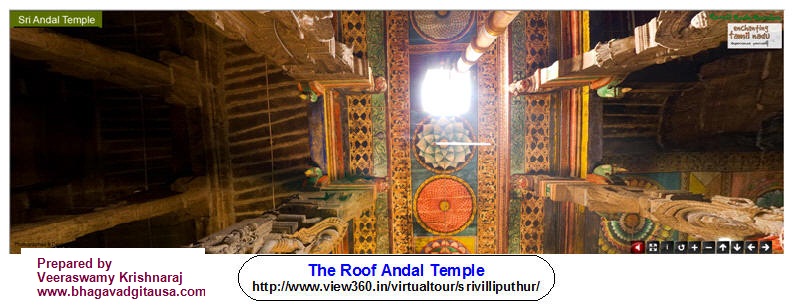
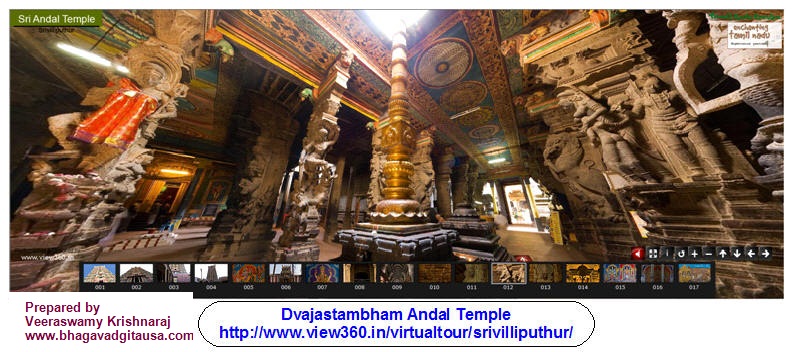
|
Bhagavad-Gita: 18 Chapters in Sanskrit |
| Download Bhagavadgita-all 18 chapters in Sanskrit, English, |
| transliteration and word for word translation. |
Bhagavadgita Pages in English, Chapters 1 to 18
| bg07-Sanskrit | bg10-Sanskrit | bg11-Sanskrit | bg12-Sanskrit | ||
| bg13-Sanskrit | bg14-Sanskrit | bg15-Sanskrit | bg16-Sanskrit | bg17-Sanskrit | |



| foxyform.com |
http://www.scribd.com/doc/24726666/Tiruppavai
http://www.scribd.com/doc/35478761 (In Tamil only)
You have your Google search engine tailored for this site.
Please enter the word(s) in the search box; it will take you to the file with that word in this web site. Enjoy your visit here.

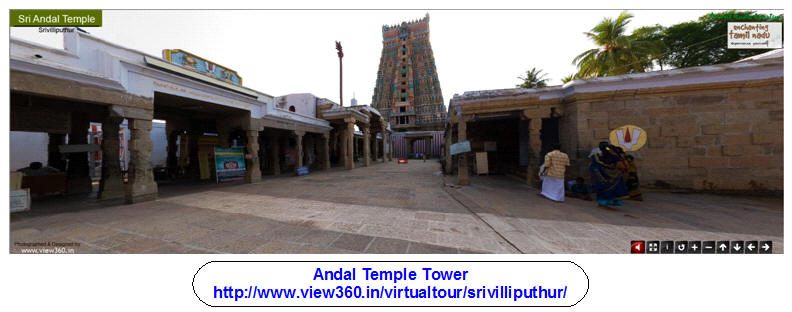


Hindu Newspaper: Monday, Jan 12, 2009. VIRUDHUNAGAR: Collector K. Raghupathi presented prizes to the winners of Tiruppavai recitation competition held as part of “Marghazhi Thiruvizha (= மார்கழி திருவிழா)” at Nachiar (Andal) Temple in Srivilliputtur in the district on Sunday.
According to a press release, the recitation of Tiruppavai was conducted for the last two days for school students under the auspices of the Department of Art and Culture, Tirunelveli region, Thanjavur Art and Culture Centre and District Cultural Centre. end
The Tamil poets have had the added advantage of using a language medium that is perhaps not as heavily encumbered as the rest; where the quality of sound and the impact of meaning seem to share a common ground as far as function is concerned.
The
whole of the Tamil language is the poet's ally. It was born vibrant and
malleable, ever ready to be shaped into rhyme or reason.
It simply waits for the expelled breath. A breath that is filled with a great
passion for life: be it the sighing of heart or the winds of thought.
Even the most dry and linear idea, when voiced with the Tamil tongue, is
enlivened by this expelled breath. The sound produced has shape: fine curves &
subtle contours, texture & color.
The beauty of Tamil does not rely on any trivial meaning which the mind might
attach to it. The richness of the sound imbues the words with a life of their
own, independent of any meaning that our concepts strive to convey. There is
an inherent sweetness to the Tamil tongue; and to the Tamil people themselves,
"Life" (birth, growth, love, work, death; the struggle of it all) has a
sweetness all it's own. --by
Layne Little
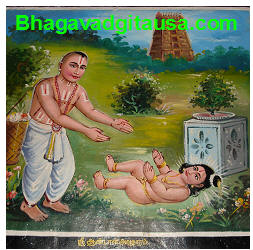
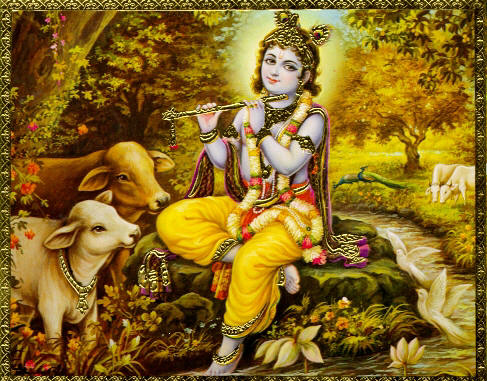
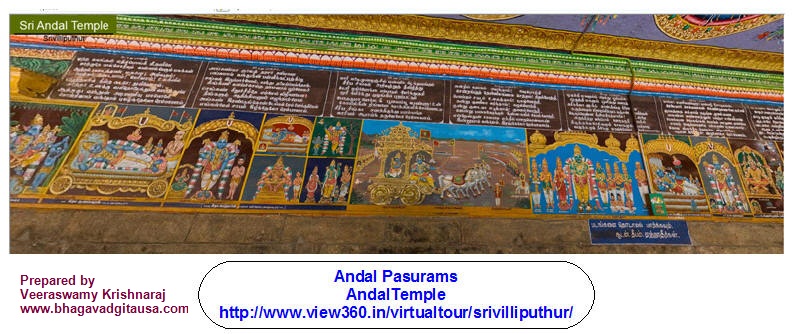
Temple painting of Andal's Avataram
Vatapatrasayee Temple, Srivilliputhur, Tamil Nadu
Vishnu Chitta finds Andal in his Tulasi (Sacred Basil) garden.
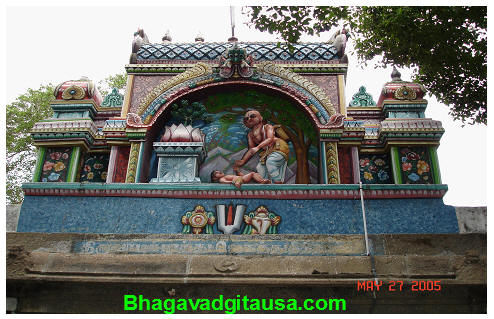
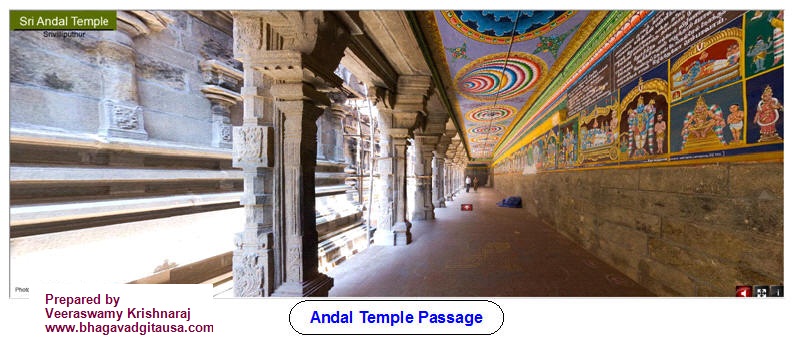
The Andal Temple, next to Vatapatrasayee Temple
(Andal'sTiruppavai composed in the year 731 CE.)
Please report any errors
This piece was composed by Andal Herself at the tender age of 5 years, who is BhuDEvi or Mother Earth and the consort of Vishnu.
Andal (She who rules [the heart of Vishnu]) as an infant appeared in the trough Vishnu Chitta dug in the garden near a Tulasi plant (Sacred Basil) and fragrant flowers which he cultivated for Vattapatrasayee temple use. This appearance in a trough is the same as Sita appeared when King Janaka was plowing the field. Both appeared from under the earth's surface crust and therefore are teleologically connected to the earth and Bhudevi (goddess of earth), who is one of the consorts of Vishnu. She is also regarded as AmsAvatara of Sri Devi. Consort here does not literally mean such a connotation but indicates his power, though devotional literature speaks in terms of consort and power. Her appearance on earth is to show the path to God through bridal mysticism, which, among other paths, promotes the idea of all devotees of either gender being Striyah (women/bride) in relation to God. God is Purusa (Man) and all devotees are Striyah. He named her Kothai (கோதை-Kodai, Godai, Goda) meaning 'maiden' or 'giver of cows.' Go = cow. It also means a facile wordsmith who possesses and gives felicitous words (to her devotees).
Here is another story that tells how the name Goda came about. Ten headed Ravana, the demon king of Sri Lanka, abducted Rama's wife by devious impersonation. Ravana was crossing the River Godavari; Sita pleaded with River Godavari to rescue her from the clutches of Ravana by entreating Godavari that she (Godavri) being a woman herself should come to the aid of Sita and save her from Ravana. Godavari did not respond, kept on going her own way and thus earned bad merit (பாபம் = sin). River Godavari was so afraid of Ravana that she did not tell Rama of the abduction of Sita across the river when Rama came looking for her and asking the trees, barks, stones and rivers for Sita. They all witnessed Sita's abduction but none revealed the incident to Rama. Godavari's demerit and sin in Treta Yuga were absolved when Perialvar named baby girl Goda (Godai) found near a flowerbed in Sri Villiputtur, Tamil Nadu. She also became one of the Vaishnavite saints. She is regarded as the incarnation of Lakshmi.
On the other hand, River Yamuna helped Vasudeva carrying Baby Krishna to cross Yamuna by draining itself to the waist level and thus earned merit.
One source tells, "The day of Sri Andal's birth is recorded in the holy book of Divyasuri Charita as Kali 97, Nala year, and 4th day in the month of Adi, Suklapaksha Purva Phalguni (born on a Tuesday, the fourth day of the bright fortnight of the moon, under the birth star of Pooram, in the month of Adi, Jul/Aug). With the lapse of years, Andal, otherwise known as Goda showed great devotion to Vishnu, and with age her devotion for Vishnu also grew. "
Another variation of the story:
It is customary for Vishnu Chittar to visit his Nandavanam to collect flowers for Vatapatrasayi Perumal. One day in the afternoon he heard a rumble in his garden. He turned in the direction of the sound and saw a five year old girl with divine features near a Tulasi plant. The moment was recorded as Nal Varudam, Aadi MAsam, EttAm ThEthi, Sukla Paksam, Panchami thithi, SevvAi-k-kizhamai, Poornam star, Thula lagnam.
Vishnu Chittar, surprised by the appearance of a divine-looking child asked who she was. She replied, “I am your daughter and my mother Thiruthuzhaai Devi is beside me.” He took the child to Vatapatrasayi Perumal Sannidhi and narrated the story to the deity. Perumal’s voice came loud and clear: O Azhvar, this girl Kothai is your daughter. Take her home and raise her with tender loving care. You will be blessed with auspiciousness in your life."
She grew up with her father periazvar and mother Tulasi Devi in the midst of temples; discourses on Vedas, Ramayana and Mahabharata; Bhajans; Kirtanas; and erudite scholars of Sri Vaishnavism. Right from the beginning, she had a fascination for Krishna and his pranks; that love matured into a Sankalpam (intent) to marry Sri Ranganathar. At the end of the article there is a description of Tulasi plant and its greatness.
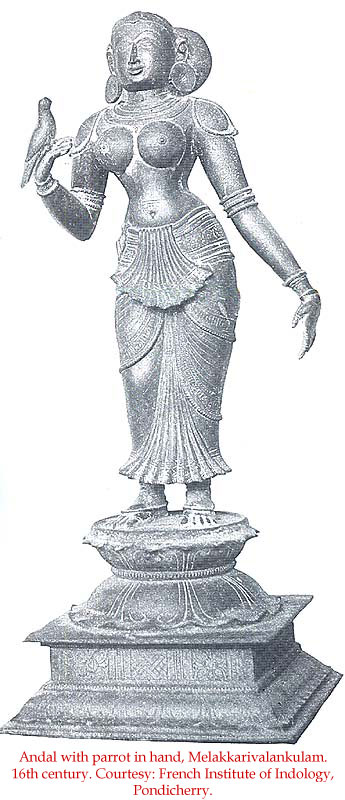
Her father, Vishnu Chittar known popularly as Perialvar, used to gather, weave, and offer flowers to the temple. Kodai innocently wore the flowers on her tresses and saw herself appreciatingly in the water mirror unknown to her father; those were the very flowers her father offered to God unknowingly; offering worn flowers to God is against the ritual sanctity. One day her father saw her wearing the flowers meant for the Lord. He was angry because of the loss of sanctity of the flowers, whose first enjoyer is the Lord and then come all others. On that momentous day, Vishnu Chittar did not offer any flowers to the Lord and related to the Lord the events. God told him that he loved to wear flower garlands worn by Kodai. Then the father realized that Goda was none other than Mahalakshmi. That was the day she received the name Andal--the one who rules the heart of Vishnu. She was also given the epithet 'Sūdikkodutta Sudarkodi = சூடிக்கொடுத்த சுடர்கொடி' meaning that she is the effulgent maiden who offered garlands to Bhagavan after wearing them. Thus the custom of offering worn flowers came into vogue until her absorption into Sri Ranganathar happened at the tender age of fourteen years. In the mean time her love for Ranganatha grew. She came of age and her father was looking for a suitable husband for her. She would not have it, because she was in love with Ranganathar and would not marry a mortal. She was so much in love with Bhagavan Krishna that she felt like one of the Gopis and composed Tiruppavai consisting of 30 poems, one poem for one day of the month of Margazhi (Dec/Jan). Its simplicity, depth and devotion are unparalleled in Tamil country. Vishnu Chittar was frustrated at the insistence of his daughter that she would only marry Bhagavan. One night, Sri Ranganathar appeared in his dream and asked for the hand of Kodai. Sri Ranganathar appeared in the dream of the high priest of the temple and bid him to bring Kodai from Srivilliputtur to Srirangam for the marriage. Vishnu Chittar went to the local deity, Vattapatrasayee asked him for his advice and consent which were promptly given, directing him to take her to Srirangam. Kodai was taken in a palanquin with pomp and pageantry under the very supervision of the Pandava King, Sri Vallabhadeva. Andal entered the Sanctum Sanctorum at the very tender age of fourteen and merged with the body of Sri Ranganatha. Chittar's joy knew no bounds; a voice came in a trumpet-like boom, 'you have been elevated to the position of my father-in-law.'
|
Sri U. Ve Velukkudi Krishnan Swamy Andal is revered for Tiruppavai more than Nachiar Tirumozhi. Margazhi is gloriously related to Andal than Thai. That is why Tirukkalyanam takes place at the end of margazhi month. For that matter, Andal never got married to Sri Ranganatha. She touched His lotus feet and vanished immediately. So all these utsavams are for the anubhavams of bhaktas. One should surrender to Rama Avatara through Sri Mahalakshmi (Sita), surrender to Varaha Avatara through Bhumi Devi and surrender to Krishna Avatara through Nila Devi (Nappinnai). Since the gopikas are surrendering to Krishna they chose Nappinnai. On the other hand, Andal has sung about Rukmini in her other work Nachiar Tirumozhi. |
Andal and Tiruppavai formed a juggernaut of Bhakti movement of one girl with rituals, awakening of spirit, giving up of Raga (passion) and Ahamkara (ego) and adoption of Vairagya (giving up of desires) for the sole purpose of merging with Krishna (Sri Ranganathar).
The first ten Pasurams extol the fruits of Anuttanam (Anushtanam = அனுட்டானம் = religious devotional observance); the second ten eulogizes, inspires, and promotes devotional service among the prospective participants; the third ten eulogizes and wakes up Krishna, His family and others and beseeches to immerse in His Grace.
Sanskrit Vedas are the earthen pot; Tiruppavai and Divyaprabhandam are pure golden pot, so any one irrespective of Varna can recite the verses.
The first three numbers indicate the sequence (of Tiruppavai) in Divya Prabhandam. The second numbers indicate 01-30 verses.
|
மார்கழித் திங்கள் மதி நிறைந்த நன்னாளால் நீராடப் போதுவீர் போதுமினோ நேரிழையீர் சீர் மல்கும் ஆய்பாடி செல்வச் சிறுமீர்காள் கூர் வேல் கொடுந்தொழிலன் நந்தகோபன் குமரன் ஏர் ஆர்ந்த கண்ணி யசோதை இளம் சிங்கம் கார்மேனிச் செங்கண் கதிர் மதியம் போல் முகத்தான் நாராயணனே நமக்கே பறை தருவான் பாரோர் புகழப் படிந்து ஏலோர் எம்பாவாய் (1--474) |
474 (01)
|
|
This is the month of Margazhi (Dec/Jan) and a full-moon auspicious day.
Shall we go to bathe; who is willing to go, O jeweled maidens
Rich lasses (girls) of prosperous Aypadi
Sharp-speared cruel torturer (of enemies), Nandagopan. His son and
The son of gracious beautiful-eyed Yasodha, the tender lion cub
with dark-colored body, beautiful eyes and a face like the sun and the moon
Narayana will grant us our desires (பறை = Parai = drum, Desired Object = What is good for us, conch, light)
The people of the world praise in humility. Listen, remember, O our damsel (O my dear lass)
(Let us perform the Pavai Nombu)
Pavai Nombu = young lady + penance)
Nombu = ceremonial
fasting, penance, religious
austerity.
Notes: Marghazhi is the clement month, neither hot nor cold.
மதிநிறைந்த Mathi niraintha = moon full = all sixteen digits of the moon.
கொடுந்தொழிலன்: Kodumthozilan = cruel worker = destroyer of enemies = destroyer of sins.
கார் மேனி = Kaarmēni = black body = dark blue complexion is natural to Krishna.
பறை = In this context 'What is good for us' example: Moksa.
ஏலோர் எம்பாவாய் = ElOr empaavaay = O my dear lass.
|
Here is an alternate translation of the Verse 01. The month of Ma:rgasi:rsha has come, just when we thought of going to our beautiful Lord Krishna. This is the nice time, the best days with cool and bright glow of shining moon in the sky. Whoever wish to rejoice in the shower to break the pangs and replenish the anguish of long separation from our beloved Lord Krishna, can come now ! O' the damsels of Gokula decorated in Jewellery and Ornaments, enjoying the plenty of cattle wealth and also the ever growing riches of the wonderful virtues of Govinda ! By doing so, Lord Krishna, who is highly obedient to Nandagopa his father, who always holds a sharp sword in his hands to protect his son and never hesitates even to injure those who may cause any harm to his son, and that Lord Krishna who is the "LION PRINCE" in the Yasoda's eyes that were wide open with the exquisite beauty, He who is in the colour of dark dense cloud, He who has red Lotus flower like eyes, He who has glowing face that appears like bright full Moon to His Lovers and like fuming red Sun to his opponents, He who is Lord Na:ra:yana himself, will bless us with an instrument called "Parai" (a small drum) as we desire Him alone and nothing else. So let us do this Vratham, such that the whole world enjoys the Great Happiness. Come On ! Join Us ! http://www.bhakthinivedana.org/tiruppavai/tiru_index1.htm |
Comment
Samsaram is afflicted with the oppressive heat of Endogenous, Exogenous, and Theogenous miseries-- Adhiatmika, Adhibautika, and Adhidaivika. The Grace of the Lord extinguishes these three fires and offers alleviation and liberation. The clement Margazhi month, neither hot nor cold, with the full moon day complements this abatement of heat. Full moon is also euphemism for full knowledge. That is the descent of Spiritual Knowledge to the soul. Yosada's child, not the distant Narayana in Vaikuntam, is the approachable Narayana in the form of youthful Krishna. He gives us heat and cold (Life and Grace) as and when necessary. Water sports are euphemism for immersion in His Grace. -Notes taken from talk by Krishnan Swami
Month of
Marghazhi (Dec/Jan) is the most celebrated month
of the year. In Bhagavad Gita verse 10.35, Krishna says, "Of the hymns in Sama
Veda (I am) Brhatsama; of meters, I am Gayatri; of months (I am) Margasirasa
(Dec-Jan); of all seasons, I am flower-bearer (spring).
Maragazhi is for the young girls to observe Nōnbu (Penance, religious austerity) which dictates an early morning bath before the sunrise. Narayana gives them the fulfillment of their desires. This verse touches on the goal and the means to attain fulfillment of their desires which eventually lead to Bliss and merger with the Lord. This is surrender and Bliss; this is finality (Saramam).
நீராடப் போதுவீர் போதுமினோ நேரிழையீர் : Shall we go to bathe; who is willing to go, O jeweled maidens. Commentators say that water-play or ritual bathing means in this context that the cowherd girls should immerse themselves in BhagavAn's lake of auspicious qualities: JnAna, Bala, aisvarya, Vīrya, sakti, Tejas (Spiritual wisdom, strength, Supreme Powers, valor, Sakti, Splendor). This immersion in Bhagavan is a guaranteed panacea for all mental, physical and spiritual ills. This immersion is Saranagati and means becoming a Prapannan, unconditional surrenderer to Bhagavan, the SarvAtmA, BhūthAtmA, SuddhAtmA, EkAthmA, AnEkAtmA (Soul of all, Atma of all Bhutas--matter, Pure Soul, One Atma, many souls). This immersion helps the Prapannan to get a little bit of the auspicious qualities of the Lord.
In Bhagavad Gita (18.66), Bhagavan says, "Abandoning all duties, surrender unto Me only. I shall deliver you from all sins. Do not lament."
sarva dharmAn parityajya mAm ekam saranam vraja |
aham tvAm sarva pApebhyo moksayisyAmi mA sucah ||
all kinds of duties giving up; to me only surrender,; |
I you all sins liberate not lament ||
Give up all duties; Surrender unto Me only.
I will liberate you from all sins. do not grieve.
18.66:
Abandoning all duties, surrender unto Me
only. I shall deliver you from all sins.
सर्वधर्मान्परित्यज्य मामेकं शरणं व्रज ।
अहं त्वां सर्वपापेभ्यो मोक्षयिष्यामि मा शुचः ॥१८- ६६॥
sarvadharmān parityajya mām ekaṁ
śaraṇaṁ vraja
ahaṁ tvā sarvapāpebhyo mokṣyayiṣyāmi
mā śucaḥ 18.66
sarva-dharmān1
parityajya2
mām3
ekam4
śaraṇam vraja5
aham6
tvām7
sarva-pāpebhyaḥ8
mokṣyayiṣyāmi9
ma10
śucaḥ11
18.66
parityajya2 = abandoning; sarva-dharmān1 = all duties; śaraṇam vraja5 = take refuge; mām3 = in Me; ekam4 = only/alone . • aham6 = I; mokṣyayiṣyāmi9 = shall deliver; tvā7 = you; sarva-pāpebhyaḥ8 = from all sins. • ma10 = do not; śucaḥ11 = worry.18.66
18.66:
Abandoning all duties, surrender unto Me
only. I shall deliver you from all sins.
The critical statement of Bhagavan is, "Surrender to me Only." Once this is done there is no more trembling fear of sins. Liberation is at hand; there is no need to worry.
This is one of the most celebrated statements of Krishna and the final Sarama Slokam meaning that it is the verse that teaches the meaning of attaining final bliss. Saramam = finality, the end. It is the Maha Mantra of Krishna. What it means is that a devotee can give up daily injunctions of the nature of Yagnas, difficult to pursue in Kali Yuga. What a devotee can attain in terms of benefits by Yagnas can be obtained just by uttering His sacred names by way of Sahasranamam.
Abandoning all daily duties means NOT giving up Sandyavandanam (and Mātyānikam-- Rites performed by the twice-born daily at noon-- but (giving up performance of) Yagnas (Sacrificial worship). Uttering the names of Bhagavan gives three kinds of benefits: Dhrista Balam, Adhrista Balam, and Dhrishtādhrishta Balam. Dhrishta Balam is the benefit open for all to see. Adhrishta Balam is the benefit derived by the devotee from Bhagavan with His invisible hand. The third one is a combination of the previous two.
Surrender to the Lord has its own advantages. Saranagata Raksa is surrender-protection and God is Saranagata Raksakan (Surrender-protector = protector of the surrenderer). When a king surrenders to an emperor, the latter accepts the surrender, forgives and forgets all enmity and animosities of the surrendering king and offers him protection from other enemies. If you go to Bhagavan with all sincerity, devotion and love and surrender to him, he forgives all your sins and gives you Moksa. Going to Moksa is attaining Paramapadam (salvation as highest bliss; also means his feet; his retinue in milk ocean). Paramapadam means living close to Vishnu lying on Adhi Sesa in the milk ocean with his conch, discus, club, bow and lotus, and attended by his Bhagavatas including Sri, Bhu, Neela, Garuda, Gandharva, Kimpurusa.
Bhagavan points the easy way to reach Him. What Bhakti, Jnana, Raja, Karma Yogas can obtain for a devotee is attainable (with one-pointed devotion) for a Prapannan who surrenders himself to Bhagavan, who confers Paramapadam to Prapannan.
The reference to the auspicious day is not made in vain. According to Nammalvar, the auspicious day is the day when we realize that there is only one God and we are His votaries and that God is Narayana.
Learned pundits consider bathing is just not for physical and ritual external purity alone. The bathing Pond is Bhagavan's Satchitananda (Being, Consciousness and Bliss); To bathe in the pond is to immerse in the Bliss of Bhagavan. That tells us the Ayarpadi girls have obtained Saranagata Raksa from Krishna. Wealth here refers to the spiritual wealth. The Ayarpadi girls were in the past the Gopis who are born again to serve Krishna. Pundits again say that the jewels refer to Jnanam and Vairagyam (spiritual knowledge and detachment from worldly goods and desires).
The beautiful eyes of Krishna refers to his paternal love (Vatsalya) for and shepherding of the votaries.
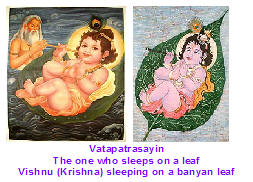
Andal performs the bath rituals, invites the girls as if they were the Gopis of Ayarpadi with Sri Villiputtur as the Gokulam, Vatapatrasayee Temple as Nadagopan's palace, and Vatapatra Sayin (வடபத்திரசாயின்) as Krishna. During Pralaya, Bhagavan is portrayed to be floating on a banyan leaf. How is it possible for a Being who has swallowed the whole universe to float on a leaf? That quality is what is called Akaditakatanaa Saamarthiyam (அகடிதகடனா சாமர்த்தியம்)--versatile doer of the impossible). It appears that the leaf supports Bhagavan. Is it the leaf that supports Bhagavan? Is it Bhagavan who supports the leaf? It is the latter supporting the former. He is the one who supports all the weight of the universe and the leaf itself. Akaditam = அகடிதம் = The impossible. Saamarthiyam = சாமர்த்தியம் = adeptness.
Andal equates Srivilliputtur of South India as the Ayarpadi pf North, her girl friends as the Gopis, Temple Vatapatrasayee as the palace and Lord Vatapatrasayee as Bhagavan Krishna.
வையத்து வாழ்வீர்காள்! நாமும் நம் பாவைக்குச் செய்யும் கிரிசைகள் கேளீரோ, பாற்கடலுள் பையத் துயின்ற பரமனடி பாடி நெய்யுண்ணோம் பாலுண்ணோம் நாட்காலே நீராடி மையிட்டு எழுதோம் மலரிட்டு நாம் முடியோம் செய்யாதன செய்யோம் தீக்குறளை சென்று ஓதோம் ஐயமும் பிச்சையும் ஆந்தனையும் கைகாட்டி உய்யுமாறு எண்ணி உகந்து ஏலோர் எம்பாவாய் 475 (2) |
|
vaiyattu vāḻvīrkāḷ! nāmum nam pāvaikkuc ceyyum kiricaikaḷ kēḷīrō, pāṟkaṭaluḷ paiyat tuyiṉṟa paramaṉaṭi pāṭi neyyuṇṇōm pāluṇṇōm nāṭkālē nīrāṭi maiyiṭṭu eḻutōm malariṭṭu nām muṭiyōm ceyyātaṉa ceyyōm tīkkuṟaḷai ceṉṟu ōtōm aiyamum piccaiyum āntaṉaiyum kaikāṭṭi uyyumāṟu eṇṇi ukantu ēlōr empāvāy 475 (2)
|
aiyaththu vaazhveerkaaL! naamum nam paavaikkuch cheyyum kirisaikaL kELiirO, paaRkataluL paiyath thuyindra paramanati paati neyyuNNOm paaluNNOm naatkaalE neeraati maiyittu ezhudhOm malarittu naam mutiyOm seyyaadhana seyyOm theekkuRaLai sendru OdhOm aiyamum pichchaiyum aandhanaiyum kaikaatti uyyumaaRu eNNi ukandhu ElOr empaavaay. |
vaiyaththu vaazhveerkaaL! naamum nam paavaikkuch
cheyyum kirisaikaL kELiirO, paaRkataluL
paiyath thuyindra paramanati paati
neyyuNNOm paaluNNOm naatkaalE neeraati
maiyittu ezhudhOm malarittu naam mutiyOm
seyyaadhana seyyOm theekkuRaLai sendru OdhOm
aiyamum pichchaiyum aandhanaiyum kaikaatti
uyyumaaRu eNNi ukandhu ElOr empaavaay.
Let us all live and prosper in the world! Hear (and watch) us do the ritual deeds for the Damsel (Deity). We are fortunate to live a good life on this earth. Let us not forget the feet of the Supreme Being in Yoga Nidra who lives in the Milk Ocean and at whose feet we shower songs of praise. We won't savor ghee; we won't drink milk; we will take a bath early in the morning; we won't use the eyeliners; we won't tie and wear flowers on our hair; we won't do the forbidden acts; we won't go around and utter (gossip) evil words; we will hand out (charity) to the needy, the poor, and the ascetics. We will think and be glad of our redemption. Let us perform the Pavai Nombu
Comment
Andal makes a list of Dos and Don'ts in this pAsuram. The Dos are not forgetting the feet of the Lord, showering songs of praise at His feet, taking a bath, giving charity to the needy and performing PAvai Nombhu....
The Don'ts are not savoring ghee, not drinking milk, not using eyeliners, not wearing flowers on their hair, not doing the forbidden acts, not making gossip....
Andal hands out a prescriptive code of conduct of Vaishnavas to the Gopis of Ayarpadi. Not forgetting the feet of the Lord is preliminary step before merging with his feet. Bathing is a measure of external purification accompanied by internal purification of mind and soul by not uttering evil words against anyone. Not eating ghee or drinking milk is resisting satisfaction of the senses (Indriyas). Eating the leftovers of Prasadam is the proper conduct. A Vaishnava does not decorate herself or himself until he merges with Krishna. All are Striyah (woman) in the presence of Krishna.
Prasadam: The food presented to an idol or the remnants of food left by a spiritual teacher which anyone may freely appropriate to his own use. A propitiatory offering or gift of food.
When it comes to serving and performing Prapatti and Saranagati and asking for Saranagata Raksam from the Supreme Being, there are some DOs and DON’Ts, which constitute the angas (parts) of Prapatti or Saranagati. The DOs and DON’Ts fit like the pieces of a puzzle and thus have a reciprocal fit with one another; all put together make one recognizable picture. One example of reciprocal fit is that you do pleasing acts and avoid displeasing acts to Bhagavan.
Parikara Vibhava Adhikara.
Parikara = encircling, helper or follower; Vibhāga = portion, partition, separation. Adhikāra = authority.
Though Prapatti is essentially a Vaishnava doctrine, I do not hesitate to embrace other sectarian or religious congruous thoughts
Prapatti: From Talks by Ramana Maharishi page 30-31: Take the case of bhakti--I approach Iswara and pray to be absorbed in Him. I then surrender myself in faith and by concentration. What remains afterwards? In place of the original 'I' , perfect self-surrender leaves a residuum of God in which the 'I' is lost. This is the highest form of devotion (Parabhakti), Prapatti, surrender or the height of Vairagya. Page 40-41: Complete self-surrender means that you have no further thought of 'I'. Then all your predispositions (samskaras) are washed off and you are free. You should not continue as a separate entity at the end of the course.
These angas or parts (limbs) of Prapatti or Saranagati constitute the authority.
The sixth is the most important Primary (angi) component of Saranagati and the first five constitutes the secondary components (angas). Angi = body; Anga = limb.
- AnukUlya Sankalpam = favorable, agreeable and friendly + determination, resolution, intention, declaration. The votary resolves to do only what is pleasing to Narayana. Here it pertains to worshipping at the lotus feet of the Supreme Being; bathing and the rest; helping the needy, the poor and the ascetics with a pleasant disposition.
-
PrAtikUlya Varjanam = unfavorable + prohibition: It is avoidance of unfavorable acts towards BhAgavatAs and BhagavAn. This is actually a double NO. According to Pavai Nombu, the aspirant observer should not eat anything, wear flowers or use makeup before offering them to Bhagavan. The general prohibitions are one should desist from acts not endorsed by the Vedas. One should not eat meat, egg, fish, onion, garlic and on certain occasions certain foods. Today's beverages like tea, coffee and alcohol should be avoided. Idle talk other than praising or chanting the name of Bhagavan should be avoided.
3. KArpanyam = Pitiful circumstances. KArpanyam is a condition from external prohibition which prevents devotees other than the twice-born to perform Jnana, Raja, Kriya and Bhakti Yogas to attain oneness with the One. In such cases Krishna advises the devotee to surrender at his feet because of utter helplessness. He assures that they will attain same benefits as the twice-born. This prohibition precluded the Sudras and other lower classes to perform Yogas. Saranagati and Prapatti are open to all without regard to natal caste and are the ticket to the feet of Bhagavan.
4. MahAvisvAsam = Great Faith. Great faith in Lord Narayana as the sole Saranagata Raksakan (Surrender-Protector). Holding on to the feet of the Lord in total faith is like the baby monkey that holds the mother in full faith for its welfare and transportation. Positive efforts on the part of the devotee to obtain salvation is the Markata Nyaya School of Vadakalais (The Monkey Analogy of Northern School of Vaishnavism). The Tenkalai Marjara Nyaya School (The Cat Analogy of Southern School of Vaishnavism) believes that the devotee can dispense with any effort at seeking salvation and God by himself out of compassion will carry the devotee to his abode as a cat carries the kitten by the nape of its neck. The Tenkalais seem to imply that God picks whom he likes. Vadakalais feel that the idea is unacceptable and goes against the principle of equal pay to equal work or equal reward for equal devotion. Some get paid for working (dog work, the working monkey) and some get paid for lounging around (catnapping); this is where the Vadakalais see the inequity. Both schools believe that Great Faith is a necessary component. working monkey. You have seen simians do the daily chores for people in wheelchair: turning lights on and off, closing the door... The great oft-mentioned episode of Prahalada who had a great faith in Vishnu to save him when his father raised his weapon to cut his son's head off because Hiranyan did not believe in Vishnu and challenged his son whether Vishnu was abiding in the palace pillar. At the nick of time, Lakshmi Narasimha emerged from the pillar and ripped apart Hiranyan thus saving his peerless devotee Prahalada. That is why Narasimha (Vishnu) is Sarva-antar-yAmi of SarAsaram. He abides in all and all abide in Him. Sarva-antar-yAmi = all -inner-abider; SarAsaram = Saram + Asaram = mobile things + immobile things.
5. Goptrtva Varanam = protection + begging, seeking, choosing; praying for protection. He is the only Saranagata Raksakan (protector and refuge giver to the surrenderer).
6. atma niksepa: entrusting the burden of protection exclusively to God.
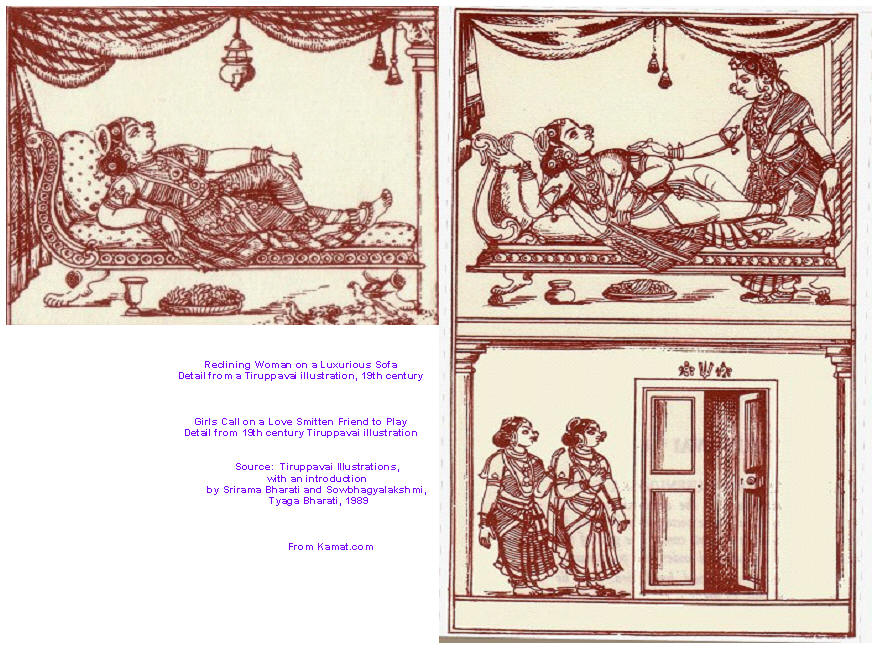
|
ஓங்கி உலகளந்த உத்தமன் பேர் பாடி நாங்கள் நம்பாவைக்குச் சாற்றி நீராடினால் தீங்கின்றி நாடெல்லாம் திங்கள் மும்மாரி பெய்து ஓங்கு பெருஞ் செந்நெலூடு கயல் உகள பூங்குவளைப் போதில் பொறிவண்டு கண்படுப்ப தேங்காதே புக்கிருந்து சீர்த்த முலை பற்றி வாங்கக் குடம் நிறைக்கும் வள்ளல் பெரும் பசுக்கள் நீங்காத செல்வம் நிறைந்து ஏலோர் எம்பாவாய் 476 (3) |
|
Ongi ulakaLandha uththaman pEr paatinaangaL nampaavaikkuch chaatri neeraatinaaltheengindri naatellaam thingaL mummaari peydhuOngkku perunj chennelootu kayal ukaLapoonguvaLaip pOdhil poRivaNtu kaNpatuppathEngaadhE pukkirundhu seerththa mulai patrivaangak kutam niRaikkum vaLLal perum pasukkaLneengaadha selvam niRaindhu ElOr empaavaay. |
1We sing the glory of the Supreme Being (Vamana) who measured the world. 2 After bathing, we do our Paavai Nombu. 3without fail and harm, there will be three rainfalls every month in the country. 4 little carps play in the tall luscious rice fields. 5 bright bees are sleeping in the Kuvalai flowers. 6 cowherds milk the still cows at their heavy udders. 7 milk pots (Kudam) overflow with milk from the bounteous big cows. 8 (the land) will flourish in everlasting prosperity. Let us perform the Pavai Nombu.
உத்தமன் = uththaman : Supreme Being, superior person, person of integrity. This refers to Vamana, the dwarf Avatar of Vishnu. The pundits feel that the Epithet Uththaman has special meaning in that in Vamana Avatar there is no killing, but all-around salvation and relief from distress and in other Avatars of Vishnu, there is much killing and Himsa (violence).
Jambhavan, the old Bear-Man pays a supreme tribute to Vishnu in the incarnation of Vamana, the Uththaman (ஓங்கி உலகளந்த உத்தமý), as worthy God fit for circumambulation. Jambhavan was so old that he lived through and knew Rama Avatar and Krishna Avatar. He fought with Krishna over Syamanthaka jewel, not knowing that he was fighting with Krishna, of whom he was a devotee.
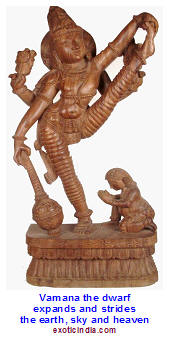
In the days of yore, King Bali, an Asura (Daitya), antithetical to Sura (Aditya) or gods conquered the three worlds. The gods complained to Lord Vishnu, who incarnated as the dwarf Brahmana Vamana, went to king Bali and begged him for a piece of land equal to the length and breadth of his three strides. King Bali, very much against the advice of the priest in chief, Sukracharya, agreed to part with a paltry piece of land to the dwarfish Brahmana. Bali never thought that three steps would more than cover the heavens and earth. The Lord at once stood up and expanded Himself to an immense size. He covered the heaven and earth in two strides and asked the king where he could place His third step. The king offered his head as the place for the third step, upon which the Lord pushed him down to the netherworld. For the king’s generosity, the Lord made him the ruler of the netherworld.
Bhagavan comes in all colors and sizes. He can transform from one to another with ease. He is the Yogi of Yogis. He can be small or large. Some say that bee sleeping in the heart of the flower is a reference to dark-colored Bhagavan remaining as Paramatma in the heart of all beings. The heart is the Anahata Chakra of the Kundalini Yoga. Prosperity is abundant milk, and rain without any devastation. The cows are a metaphor for Acharyas and the milk they yield is metaphor for Jnana (spiritual wisdom). Here you see a devotional axis: Bhagaavath-Acharya-Bhaagavath (Bhagavan-Guru-devotee); Acharya serves as the link between God and his votary.
ஆழி மழைக்கண்ணா! ஒன்று நீ கை கரவேல்; ஆழியுள் புக்கு முகந்துகொடு ஆர்த்து ஏறி ஊழி முதல்வன் உருவம்போல் மெய் கறுத்துப் பாழியந் தோள் உடைப் பத்மநாபன் கையில் ஆழிபோல் மின்னி, வலம்புரிபோல் நின்று அதிர்ந்து, தாழாதே சார்ங்கம் உதைத்த சரமழைபோல் வாழ உலகினில் பெய்திடாய்; நாங்களும் மார்கழி நீர் ஆட மகிழ்ந்து ஏலோர் எம்பாவாய் (477) 04 |
|
1.aazhi mazhaikkaNNaa! ondru nee kai karavEl;2.aazhiyuL pukku, mukandhukotu, aarththu ERi,3.oozhi mudhalvan uruvampOl mey kaRuththu,4.paazhiyan thOL utaip padhmanaapan kaiyil5.aazhipOl minni, valampuripOl nindru adhirndhu,6.thaazhaadhE saarngam udhaiththa saramazhaipOl7.vaazha ulakinil peydhitaai; naangaLum8.maarkazhi neer aata makizhndhu ElOr empaavaay. |
1. O Azhi mazhaikkanna, You do not for once hide your munificence.
2. You enter the ocean, drink, emerge turgid (with water) and ascend the sky.
3. You assume the dark form of the First in the world (primeval Lord of the
world).
4. You of powerful shoulders and sprouting Lotus in your navel hold in your
hands
5. the effulgent discus and the thunderous dextrorotatory conch
6. Without delay, You pour down like the shower of arrows from your Saranga bow.
7. You rain so we can live. We
8. delight in the Margazhi water play (ritual bath originally in River
Yamuna).
(Let us perform the Pavai Nombu.
ஆழி மழைக்கண்ணா = aazhi mazhaik-kaNNa = ocean-rain-precious as the eye; generally this epithet refers to Krishna. Kanna is the endearing name of Krishna. கண் (kaN) means eye. The name also refers to the rain god Parjanya also known as Indra.
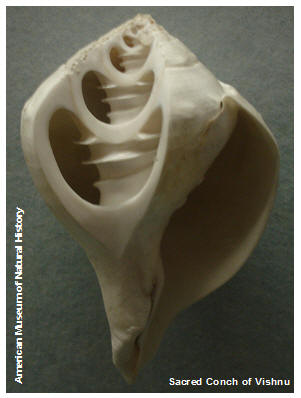
வலம்புரி = valampuri = dextrorotary = that which spirals to the right = conch.
சார்ங்கம் = saarngam = bow; this bow usually refers to the bow owned by Bhagavan Rama.
This is invocation of rain god (Varuna, Indra, Parjanya) as Krishna. The Ayarpadi girls were sages in the previous life. They wished to be born as cowherd girls to engage in dalliance with Krishna. This dalliance is actually a preliminary step before attaining oneness with the Lord of the universe, Krishna.
The dextrorotary Conch emits the sound of AUM and sends shock waves in the heart of evil men. The thunderous roar of the Conch caused concern to the Kauravas who cheated their cousins, Pandavas out of their kingdom in a game of dice; at the same time the sound was music to the ears of the Pandavas.
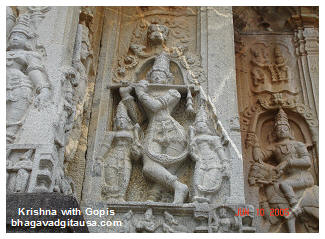
The clouds are like Avadhutas. He drinks like a cloud and pours like rain; he never hoards anything. He is like an ocean which does not swell when the rivers flow into it and does not dry when they stop. Acharyas are like rain clouds. They drink the water (Jnanam, knowledge) from the ocean of Vedas and Upanishads and pour like rain (give the essence of knowledge to others). They take water (the essence of Vedas) leaving the salt in the ocean and give pure nectar-like water to others. The clouds are the most generous, never keep anything for themselves and do not ask for any thing in return.
Rain is significant in another way. It rains for the good and the bad. Water is essential in ritual bathing, Acamana, Vratam, prayer, worship...
Vratam (Nonbu; religious vow, act of austerity; holy practice as fasting, continence; solemn vow, oath; penance; a ceremony). Acamana = ritual cleansing of mouth during purificatory ceremony.
The discus shines effulgently meaning that it removes ignorance from the devotees of Krishna. It also reminds us of the lightning which precedes the life-giving rain.
மாயனை மன்னு வடமதுரை மைந்தனைத் தூயப் பெருநீர் யமுனைத் துறைவனை ஆயர் குலத்தினில் தோன்றும் அணி விளக்கைத் தாயை குடல் விளக்கம் செய்த தாமோதரனைத் தூயோமாய் வந்து நாம் தூமலர் தூவித் தொழுது வாயினால் பாடி மனத்தினால் சிந்திக்க போய பிழையும் புகுதருவான் நின்றனவும் தீயினில் தூசாகும் செப்பு ஏலோர் எம்பாவாய். (478) 05 |
|
1. maayanai mannu vadamadhurai maindhanaith2. thooyap peruneer yamunaith thuRaivanai3. aayar kulaththinil thOndrum aNi viLakkaith4. thaayai kutal viLakkam seydha Daamodaranaith5. thooyOmaai vandhu naam thoomalar thoovith thozhudhu6. vaayinaal paati manaththinaal sindhikka7. pOya pizhaiyum pukudharuvaan nindranavum8. theeyinil thoosaakum seppu ElOr empaavaay.
|
1. You are the persevering Maayan, the son of North Mathura.
2. You are the chief of the pure Great River Yamuna.
3. You took birth as the Light of the Ayar Kulam (cowherd community).
4. You are Damodhara who brought glory to your mother's womb.
5. We come with purity and worship by offering flowers.
6.  We sing by the mouth and meditate with
our mind.
7. The past sins and future sins done without intent
8. will be put to fire and reduced to dust. So we will utter his Tirunamam.
Let us perform the Pavai Nombu.
1.vadamadhurai = North Madhura. This is where Krishna appeared on earth as the son of Devaki and Vasudeva. North Madhura is where Vamana (the dwarf) did penance, after taking the heaven and earth from king Bali and giving them to Indra. This is one of the tricks performed by Krishna on Bali who defeated the gods and usurped their kingdom. Since Bali was a devotee of Vishnu (Krishna), He could not take the kingdom by war but by trickery. Because of his birth there, Madhura is Vaikuntha on earth. River Yamuna runs here. By dipping his toes in the River, Krishna made it a pure river. Because His maternal uncle wanted to kill him, His voice as the newborn infant made his father move him across Yamuna (whose waters did not rise above the chest as Vasudeva ferried him in a basket on his head) to the house of Yasoda and Nanda.
When Krishna took his Avatar in the human form and birth as the son of Devaki and Vasudeva, He, as the newborn infant, had four hands holding the conch, discus, club, and a lotus flower, wore ear ornaments, necklace of Kaustabha stone, a diadem with Vidurya stone, and bracelets and showed the mark of Srivatsa on his chest. He was dark-blue with profusion of hair on his head. At once, the parents knew they were in the presence of Vishnu.
1. மாயன் = maayan = deceitful person; the performer of illusions; one who is given to diversion; elusive person; magic worker. This is an endearing name given to Krishna who can arrange, derange, and manipulate, and is a Machiavellian tactician. Krishna is also branded a thief, who steals the heart, and butter as a child.
2. துறைவன்: chief of maritime tract; the chief transporter of people in a vessel across the river. Krishna is Bhagavan who takes his devotees across the river of Samsara to the other shore of liberation.
4. Damodara (Daama + udara = rope [around] + belly) is one of many names of Vishnu/Krishna. The Yadava mothers complained to Yasoda that child Krishna was getting into mischief all the time and was disruptive of their work. To prevent him from leaving her house, Yasoda ties a rope around his waist and anchors it to a grinding stone mortar. The sweet gracious redemptory paradox is that Krishna cuts the ropes of karma and gives his devotees Moksa. How can one tie him down unless He willingly submits Himself to his earth mother, Yasoda?
5. We come with purity and worship by offering flowers. External and internal purity is essential before one worships Krishna. External purity is easy to achieve. Internal purity is possible only if the aspirant recites the name of Bhagavan and keeps his body, mind, speech and soul in virtuous order, which means total surrender to Bhagavan. Surrender to the Lord does not go well with ego, which must be destroyed when you face Him. The coconut we break in the temple is breaking of ego before God. The flowers we offer to God are a bouquet of Bhavas (being, becoming).
Nothing is too small or too unimportant when the devotee makes the offer in the spirit of devotion, piety, and purity. Every one of us, even the poorest of the poor, can afford to make offerings of a few drops of water to Bhagavan, who likes the metaphorical eight flowers from his devotees. The flowers blossom out of the heart of the true devotees of Bhagavan. These eight flowers have universal appeal to all.
1. The First and Foremost is the flower of non-violence (Ahimsa prathanam pushpam.
2. The flower of control of the senses (pushpam Indriya Nigraha)
3. The flower of compassion to all living beings (Sarva Bhutha Daya Pushpam)
4. The flower of tolerance, patience and equality (Kshama Pushpam Visedhadha)
5. The flower of Spiritual knowledge (Jnanam Pushpam)
6. The flower of Inner spiritual flame--meditation (Tapa Pushpam)
7. The flower of contemplation (Dhyana Pushpam)
8. The flower of Truth, the most delightful one (Satyam-ashta-vidam Pushpam Vishno Preethi-karam bhaveth) to the One who is all-pervasive.
The worshippers of Mother Goddess offer these flowers:
1) AmAya = Guilelessness
2) AnahamkAra = Absence of egotism. An+Aham+KAra = the opposite of Ahamkara.
3) ArAga = Absence of passion; detachment; absence of anger. A + RAga = No passion.
4) Amada = absence of pride.
5) Amoha = absence of delusion.
6) Adambha = absence of duplicity; straightforwardness; absence of hypocrisy.
7) Advesa = lack of enmity
8) Aksobha = absence of mental perturbation.
9) AmAtsarya = absence of envy.
10) Alobha = absence of greed.
11) Ahimsa = non-injury.
12) Indriya nigraha = Control of senses.
13) DayA = Mercy.
14) Kshama = Forgiveness; patience, tolerance.
15) Jnana = Knowledge of what is important and what is not important; Spiritual knowledge.
6. We sing by the mouth and meditate with our mind.
Singing is for glorifying Krishna.
Chanting is for uttering his many names.
Thought is for remembering Krishna.
Speaking is for eulogizing Krishna.
Hearing is for listening to his exploits and spiritual wisdom.
Seeing is for having his dharsan.
Using hands is to do service in His name.
Whatever one does, he should do it in the name of Krishna and all will be auspicious.
7. The past sins and future sins done without intent.
8. will be put to fire and reduced to dust. So we will utter his Tirunamam (sacred name).
Andal says that all sins will be destroyed by thinking, remembering, talking, meditating on him and offering the eight Bhava Pushpas. The common example given is that the sins are like ropes, which when burnt retain its shape and contour but fall apart on touch. That is the way Krishna burns the sins of his votaries.
புள்ளும் சிலம்பின காண், புள்அரையன் கோயிலில் வெள்ளை விளி சங்கின் பேர் அரவம் கேட்டிலையோ பிள்ளாய்! எழுந்திராய், பேய்முலை நஞ்சு உண்டு கள்ளச் சகடம் கலக்கு அழியக் கால் ஓச்சி வெள்ளத்து அரவில் துயில் அமர்ந்த வித்தினை உள்ளத்துக் கொண்டு முனிவர்களும் யோகிகளும் மெள்ள எழுந்து அரி என்று பேர் அரவம் உள்ளம் புகுந்து குளிர்ந்து ஏலோர் எம்பாவாய். (479) 06 |
|
1. puLLum silambhin kaaN, puL araiyan kOyilil2. veLLai viLi sangin paer aravam kaettilaiyO?3. piLLaai? ezunhthiraai , paeimulai nhanju uNdu4. kaLLach sakadam kalakku aziyakkaal Ochchi5. veLLaththu araviR thuyil amarnhtha viththinai6. uLLaththuk koNdu munivarkaLum yOgikaLum7. meLLa ezunhthu ari enRa paer aravam8. uLLam pukunhthu kuLirnhthu ElOr empaavaay
|
புள் = puLL = bird; some say that a bird is endowed with five senses. If they can wake up why should
not the damsel with six senses wake up? பிள்ளாய் = piLLaai = child = the one who does not understand the grace of God. வித்தினை = வித்து = Seed = Vishnu is the Seed of the universe. He is the seed from which all beings and matter originate.
1. See, the birds are chirping; the king of birds (Garuda in the) temple (of Vishnu). (The temple for Vishnu who rides on the king of birds, Garuda.)
2. Don't you hear the loud sound of the white conch.
3. O children (damsels), arise (from your beds); (He) ate the poison from Ogre's breast.
4. (He the demon posed as) a sham cart; (He, Krishna) destroyed the facade by kicking (the cart-demon).
He kicked the cart to loosen it (in to its component parts).
5. He is the seed (beginning) abiding in (Yogic) sleep on the snake in (the milk) ocean.
6. The Munis and Yogis invoke (his name in their) minds.
7. (They) quietly woke up and uttered the great sound 'HARI'
8. (The sound of HARI) entered our heart (and) made us tranquil. Let us perform the Pavai Nombu.
Verses (6-15) evoke Bhagavath Anubhava (Bhagavan experience).
1. See, the birds are chirping; the king of birds (Garuda in the) temple.
The chirping of the birds is wake-up call for the damsels of Ayarpadi. Andal (Kodai) goes to the front door
of each house and persuades them to get out of bed for the bath ritual. The birds represent Acharyas (line 6).
2. Don't you hear the loud sound of the white conch.
She further reminds the girls of Ayarpadi to listen to the loud sound of the white conch
from the Temple. It is further evidence of the coming of dawn. The sound of the conch
is Aum. Garuda, the vehicle for Vishnu, is regarded sacred.
The songs sung to wake up the deity is called (tiRuppaLLiyezuchchi (திருப்பள்ளியெழுச்சி)
3. O children (damsels), arise (from your beds); (He) ate the poison from Ogre's breast.
The damsel is addressed as PiLLaai (பிள்ளாய்--child), because of tender age she does not understand the Grace of God.
The maternal uncle of Krishna, Kamsa conscripted the services of an ogre, Putana, the killer of
newborns. When she was not killing, she wandered in the sky (Khecarii) and took a form
as the occasion demanded. She materialized as a beautiful nursing woman in the house of Nanda and
Yasoda, picked up the divine infant Krishna (age 6 days) and fed him her milk with poison smeared on her breast papilla (nipple).
The all-knowing divine child suckled her breast and sucked her Prana (breath) from out of her breast and
let her die with a loud cry. Poison stands for Avidya and Ahamkara (ignorance and ego). Krishna is the Light that lifts spiritual darkness. He destroys the ego and takes the soul into his bosom.
4. (He the demon posed as) a sham cart; (He, Krishna) destroyed the facade by kicking (the cart-demon).
He kicked the cart to loosen them in to its component parts.
It was Krishna's first birthday. His mother Yasoda gave him a bath (abhisekam). Cows and grains
were outside the house to be given as gifts to Brahmanas. In the hullabaloo, Yasoda forgot to feed him
and left after putting the sleeping Krishna under a cart containing pots of milk and yogurt. Krishna woke
up in hunger and cried. No one seemed to hear his cry. At this moment demon Sakatasuran was passing
by in the sky, saw the infant, and sat on the cart. His humongous weight was bearing down on the wheels
and breaking the cart. Before the cart could fall on him, Krishna kicked the wheel (the wheel, the cart,
the dairy pots, and the demon went flying up in the air and fell in a heap nearby without harming Krishna or the demon). The children, the cowgirls and others seeing this were struck with wonder.
Sakataasuran = Sakatam + asuran = cart + demon.
5. He is the seed (beginning) abiding in (Yogic) sleep on the snake (Ananta) in (the milk) ocean.
He is the beginning, the middle and the end of all beings and matter; but by Himself, He is
beginningless; He has no middle or end; Time is in Him and He is beyond Time. When Pralaya
envelopes Beings and matter, He goes into Yoganidra (yogic sleep) on the snake (Sesa) in the milk
ocean until next round of creation takes place upon his awakening. He is AUM.
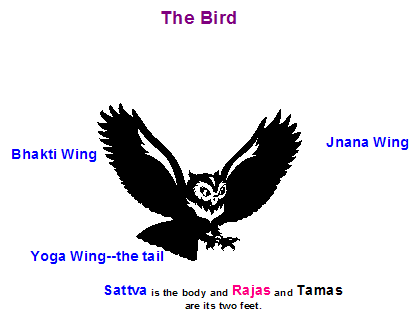
6. The Munis and Yogis abide Him in their heart and invoke (his name in their) minds.
They are compared to the birds. They have two wings and a tail, by which they fly. We, the ignorant ones, are the flightless penguins, which have rudimentary wings, unable to lift the bird in flight. As the penguins, we swim in the sea of Samsara.
7. (They) quietly woke up and uttered the great sound 'HARI'
8. (The sound of HARI) entered our heart (and) made us tranquil. Let us perform the Pavai Nombu.
The accomplished souls (Munis and Yogis) chant his name and the chorus of Hari and Rama Nama
should wake up all who sleep in spiritual darkness. Hearing the names of Vishnu gives spiritual awakening and tranquility of the heart.
|
கீசு கீசு என்று எங்கும் ஆனைச்சாத்தன் கலந்து பேசின பேச்சு அரவம் கேட்டிலையோ? பேய்ப் பெண்ணே காசும் பிறப்பும் கலகலப்பக் கைபேர்த்து வாச நறுங்குழல் ஆய்ச்சியர் மத்தினால் ஓசை படுத்த தயிர் அரவம் கேட்டிலையோ? நயகப் பெண்பிள்ளாய் நாராயணன் மூர்த்தி கேசவனைப் பாடவும் நீ கேட்டே கிடத்தியோ தேசம் உடையாய் திற ஏலோர் எம்பாவாய். (480) 07 |
|
kīcu kīcu eṉṟu eṅkum āṉaiccāttaṉ kalantu pēciṉa pēccu aravam kēṭṭilaiyō? pēyp peṇṇē kācum piṟappum kalakalappak kaipērttu vāca naṟuṅkuḻal āycciyar mattiṉāl ōcai paṭutta tayir aravam kēṭṭilaiyō? nayakap peṇpiḷḷāy nārāyaṇaṉ mūrtti kēcavaṉaip pāṭavum nī kēṭṭē kiṭattiyō tēcam uṭaiyāy tiṟa ēlōr empāvāy. (480) 07
|
1. kIcu kIcu enRu eNGkum aanaiccaaththan kalanhthu 2. pEcina pEcchu aravam kEttilaiyO pEyp peNNE
3. kaacum piRappum kalakalappak kaipErththu
4. vaaca naRuNGkuzhal aaycciyar maththinaal
5. Ocai patuththa thayir aravam kEttilaiyO
6. naayakap peNpiLLaay naaraayaNan mUrththi
7. kEcavanaip paatavum nhI kEttE kitaththiyaO
8. thEcam utaiyaay thiRa ElOr empaavaay
|
1. The birds everywhere are joining together in the chatter, kIcu, kIcu.
2. have you not heard the sound of the spoken speech, O crazy girl.
3.  as the garland of seed-like gold pieces jingle, the hand is getting
tired
4. The fragrance of the hair is spreading as the cowherd girls are by their
churning staff
5. make noise with the yogurt; Don't you hear the sound.
6. O leader of the girls! Narayana's Murthy (face, incarnation)
7. (we are) singing (the praise of) Kesavan; You hear.  Aren't you
sleeping?
8. You have Tejas (splendor). Open (the door). Let us perform the Pavai Nombu.
கீசு கீசு = kIcu kIcu = These are the onomatopoetic sounds of chirping of the birds, which
are the king crows (Bharadvaj, Skylark, strong and fast, a mythical, lucky bird). The cowherd girls are the reborn Acharyas and Bhagavatas (devotees of Bhagavat).
Butter is essential for all religious ceremonies. Butter is the essence of milk and curds and metaphorically the essence of Vedas and Upanishads. The Cowherd girls being the reborn Acharyas are taking the essence and giving it to the Bhagavatas. In the temple the devotees sing the praise of Narayana and Kesava, the killer of Kesi, which is symbolic of conquering the sense organs.
ஆனைச்சாத்தன் =
King crow; King-crow, glossy black bird with long forked tail, Dicrurus
macrocercus; Black Drongo. In this context, these birds represent Bhagavathas
(Bhaktas, devotees).
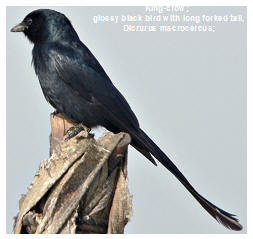
The birds assemble and chirp and in like manner, the devotees assemble and talk about their God, Narayana.
"Black Drongo (Dicrurus macrocercus) is a very common breeding resident of Haryana found in open areas, wetlands and near cultivation. This is a glossy black bird with a long deeply forked tail. These birds are quite agile in flight."
"Order: PASSERIFORMES Family: Corvidae Dicrurini Size: 31 cm Local Names: Kotwal, Bhujang"
Black Drongo
Dicrurus macrocercus
29 cm
"A common endemic sub-species in Taiwan. Wholly black with a dark blue gloss, the Black Drongo normally appears on the plains or at the top of forested or bamboo-covered hills. Frequently seen perching on power cables and the backs of water buffalo, this bird has excellent flying skills and a strong territorial sense. Its ability to immediately repel even such invaders as the eagle has gained the Black Drongo the local nickname of 'air police'. Known as 'oh-chew' (black) in Taiwanese, the bird is considered a friend of the water-buffalo."
The bird and Bhardvaja
(Maharishi Bharadvaja was a Vedic Scholar and yet at age 96 he was not satisfied with his knowledge of the Vedas; he thought his knowledge was incomplete. He prayed to Indra, sought and received an additional life time of 100 years for the learning of Vedas and thus he received three 100-year terms for intense study of Vedas. Before the last term was up for renewal, Indra appeared before Bharadvaja and asked him, "What are you going to do with the fourth 100-year life time?" Bharadvaja answered, "O Indra, What are you saying? I have nothing else to do except to remain a Brahmacharin and learn Vedas." Indra at once created three mountain-worlds: Bhuh, Bhuvah and Svahah (world, atmosphere, and heaven). He addressed the Sage and said, "Look at these three worlds; these are the Vedas." Bharadvaja's joy knew no bounds and asked Indra, "Did I learn all these three Vedas in my three 100-year terms?" Indra responded by scooping one fistful of mud from each mountain and retorted, "O Bharadvaja, What you say is very far from the fact. The Vedas that you have learnt in three hundred years are three fistfuls. How many 100 years do you need to scour the three mountains clean?" Bharadvaja was pretty shaken up at the immensity of the proposal and task. This reminds us of the Valluvar's pithy saying, "What you have learnt is of the size of fistful of mud and what you haven't learnt is of the size of the world." Thus Vedas are endless apart from its eternal existence, absent claim of authorship, and its learning by word of mouth from generation to generation.)
கேசவ: Kesava, the slayer of Demon Kesi. Demon Kesi was dispatched by the maternal uncle of Krishna to kill him. He assumed the form of a horse to kill Krishna. The demon horse charged towards Krishna as a roaring lion! In his rush, he wanted to trample Krishna who caught hold of the legs, made him loose his balance, danced around in circles and threw him in the air. The horse demon (Kesi) lost his consciousness for a moment but soon woke up and charged towards Krishna in anger. Krishna was ready for the horse and stuck his hand into the horse's mouth which felt like a red hot searing iron rod in the mouth and throat. The teeth fell out and the hand expanded many fold choking the horse. His breathing was cut off; his legs flailed here and there; his eyes bulged out; he lost his continence; he died. As the horse died, the hand shrank back to its normal size and came out easily from the horse's throat and mouth.

O Crazy girls! don't you hear the chirping of the birds, the jingling gold necklaces of the cowherd
girls with fragrant tresses and tired hands from churning the curds and the sounds of burbling pots?
O leader of the girls, Don't you hear the singing of the praise of Narayana and Kesava? Are you still
sleeping? You have radiance (tejas). Please open the door and let us perform the Pavai Nombu.
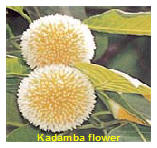
The girls go for the ritual bath in a group. Katyayani Vrata*: It is a custom and vow among the unmarried cowherd girls to worship goddess Katyayani (Durga) on the banks of Yamuna after bathing in the river. Each one beseeches Durga that she gets Krishna as her husband. While they are bathing in the River, Krishna steals their garments and stays perched on the Kadamba tree (anthocephalus kadamba) on the bank. When they find out that their clothes were stolen, they ask him to give them back their clothes. Krishna points to them that they committed an infraction against the Devatas by bathing in the river naked. To atone their sins, they have to come out and get their clothes from him, which they do. He promises them that he would be the husband for each one of them. Thus He is One and many are his forms.
The pots burble when the cowherd girls churn the curds in the pot with the churning staff to make butter, which is the favorite food of Krishna. He as a child sometimes stole and ate butter from other houses. (Don't worry about His cholesterol levels. His HDL level is high around 100.)
|
கீழ்வானம் வெள்ளென்று எருமை சிறு வீடு மேய்வான் பரந்தன காண்; மிக்கு உள்ள பிள்ளைகளும் போவான் போகின்றாரைப் போகாமல் காத்து உன்னைக் கூவுவான் வந்து நின்றோம்; கோதுகலம் உடைய பாவாய் எழுந்திராய், பாடிப் பறை கொண்டு மா வாய் பிளந்தானை மல்லரை மாட்டிய தேவாதி தேவனைச் சென்று நாம் சேவித்தால், ஆவா என்று ஆராய்ந்து அருள் ஏலோர் எம்பாவாய். (481) 08 |
|
|
1. Eastern sky is whitening; the water buffaloes are let out early in the morning
2. for grazing before the milking time. See, they are spread out. The rest of the girls
3. we stopped from going; (We) are waiting for you.
4. (We) have come calling and stand (in front of your house). the most desirable (for Krishna)
5. O girl, wake up. (We) sing and obtained the desired objects (for Pavai Nombu)
6. The One who split open the mouth of the animal (the demon horse) and killed the wrestlers
7. The Deva of all Devas Kannan / Krishna, if we worship
8. (He) will look into our wants, take pity and confer grace. Let us perform the Pavai Nombu.
1. Eastern sky is whitening; the water buffaloes are let out early in the morning.
The time is dawn; the eastern sky is lighting up in the morning sun. The sky changes colors at dawn and dusk. Just like the sky at dawn undergoes many moods and colors, the spiritual aspirant goes through many moods, experiences and maturation of the soul until he comes to the bright Light of Jnana. The dawn is symbolic of dawning of spiritual wisdom in the devotees of Krishna. The Tamasic water buffaloes are the epitomic ignoramuses who go to graze in pursuit of their sensory needs. They take a leisurely walk, lounge around in puddles, pools and ponds and appear to enjoy sitting in mire and mud holes. All this represents a wayward soul not in a hurry to go to the destination (liberation). Here சிறு வீடு (early morning grazing) is the small pleasures of sensual life. (சிற்றின்பம் = small pleasures = earthly pleasures). It is like saying that you let the senses wander where they want to; it is compared to the buffalo that goes where the grass is. பேரின்பம் (big happiness = heavenly bliss, salvation) is a focused march towards the goal of attaining Moksam or liberation. கீழ்வானம் also means the lower sky of the earth, implying that there is a மேல்வானம் or upper sky, also known as தஹரபுண்டரீகம்(Thahara pundarIkam), wherein Bhagavan abides. That place is Param, the Antaratma (Inner abider) is Bhagavan, who is attainable by Tyagam (renunciation). It is Atma Tyagam or Atma Samarpanam or the dedication of one's individual soul. The external rite indicating it is the offering of grains, milk, butter... Bhagavan does not expect the victuals but the dedication of the individual soul. That soul belongs to Him and He wants merger of the soul with Him.
The water buffaloes have gone grazing before they come back to the shed for milking.
2. for grazing before the milking time. See, they are spread out. The rest of the girls
3. we stopped from going; (We) are waiting for you. the most desirable (for Krishna)
5. O girl, wake up. (We) sing and obtained the desired objects (for Pavai Nombu)
The rest of the girls are held in wait for the third important girl to join the group. The third girl has seen the white Light of spiritual wisdom. The cowherd girls and Andal want to follow her because they consider the enlightened girl as their Acharya or Guru. They stand in front of her house and ask her to get out of bed to join and lead them.
கோதுகலம் உடைய பாவாய் = the desirable girl (Jnani or the wise one) for Krishna
Bhagavad Gita 7.17
Of these, the Jnani (the wise one), who is always in union with Me and whose
devotion is single-minded is the best. I am very dear to that Jnani, and he is
very dear to Me.
This is Krishna talking to Arjuna. That desirable Jnani is that girl still in bed in this 8th verse.
"O Girl, you are the most desirable for Krishna and vice versa." She is the personification of desire for Krishna. Since she has the Light of wisdom, she does not need to go anywhere. The cowherd girls urge her to wake up and join them. They are all happy in anticipation of seeing Krishna. Their happiness is equal to the happiness shown by Bharata on his way to see Rama. They have all that is necessary for Pavai Nombu. Going in a group to meet Krishna and group activities enhance devotion of the entire group.
For Pavai Nombu, the girls need certain
objects generally called Vrta Upakaranam (Instrument, implement, means,
apparatus; paraphernalia, as vessels at a sacrifice).
6. The One who split open the mouth of the animal (the horse demon) and killed the wrestlers
See the explanation for Kesava, the killer of Kesi the horse demon in the previous verse.
Kesi represents our ego and our desire to satisfy our senses. Krishna, if one follows him, will destroy the self-destructive ego and help us gain control over the senses. Gaining control over the senses means using the senses only in the glorification of Krishna. One thinks Krishna, speaks and sings Krishna, breathes Krishna, eats Krishna, hears Krishna, experiences Krishna... The senses have no value if they do not serve Krishna in their respective rolls.
The wrestlers. There was a talk making rounds in the town that Krishna killed a raging elephant by name Kuvalayapida. Kamsa, maternal uncle of Krishna heard about it and asked the wrestlers Canura and Mustika to take on Krishna and his half-brother Balarama (mere boys). Canura approached and talked to Krishna about a wresting match among the four. Krishna would not have it and told him that they are not well-matched pairs for wrestling. Canura would not give up and the game was on. Krishna took on Canura, Balarama Mustika. Hand to hand, leg to leg, palm to palm, calf to calf, head to head, chest to chest, shoulder to shoulder combat started to play out on the arena to the consternation of onlookers, parents and well wishers and to the delight of Kamsa. People did not like grown men of muscle wrestling with boys. They pushed, shoved, twisted each other. The wrestlers wanted to win by pinfall, submission or death. Krishna and Canura exhibited their fighting skills. Leg-locks, arm-locks, head-locks were of no use to submit Krishna. The same was true of Balarama matched against Mustika. Krishna and Balarama looked like runts against the mountain-like men and yet they held their own. People were not happy to see a mountain fighting the molehill. People started leaving the arena. The faces of parents of Krishna and Balarama were etched in worry and fright. Krishna would not have this nonsense go on any more. He threw his fist three times and jolted the giant; the spectators whooped. The giant Canura came flying like a hawk towards Krishna and landed heavy blows on Krishna's chest with his fists. The fist blows were no more than the feeling of garlands hitting an elephant. Before the hands could leave the chest, Krishna grabbed both hands of Canura and spun him in a circle many times so fast that Canura lost consciousness and shortly thereafter his life. Think of astronauts spinning in the centrifuge as part of their training. Krishna threw the mountainous body on the ground in a heap. He fell like the flag of Indra; his ornaments shattered and scattered.
Balarama struck Mustika so hard he vomited blood, his breath took leave him and he fell like a giant tree catapulted by a hurricane. Other wrestlers came forward and engaged Krishna and Balarama who made a short work of them and sent them on their way to the land of no return. The remaining wrestlers ran away from the royal arena in a trice.
7. The Deva of all Devas Kannan / Krishna, if we worship
8. (He) will look into our wants, take pity and confer grace. Let us perform the Pavai Nombu.
The cowherd girls are of the view that Krishna will give them grace and liberation by forgiving their demerits (Paapam), and accepting their prapatti.
தூமணி மாடத்துச் சுற்றும் விளக்கு எரியத் தூபம் கமழத் துயில் அணை மேல் கண் வளரும் மாமன் மகளே! மணிக்கதவம் தாள் திரவாய்! மாமீர்! அவளை எழுப்பீரோ? உம் மகள் தான் ஊமையோ அன்றிச் செவிடோ அனந்தலோ ஏமப் பெருந்துயில் மந்திரப் பட்டளோ? மாமாயன் மாதவன் வைகுந்தன் என்றென்று நாமம் பலவும் நவின்று ஏலோர் எம்பாவாய். (482) 09 |
|
|
1. Palace studded with pure gems with lamps burning all around
2. fragrant smoke, soft bed, the eyes dozing off
3. O Uncle's daughter! The door studded with gems, open the lock
4. Maamiis! would you wake her up? That daughter of yours
5. Is (she) dumb or deaf or in sleep
6. Is a sentry watching her in deep sleep? Is she in the grip of a Mantra?
7. Maamayan, Maadhavan, Vaikunthan so on and on
8. names many uttered. Let us perform the Pavai Nombu.
O daughter of my uncle, you are sleeping on a bed in a palace studded with pure gems, with bright lights shining all around and pervasive aroma of incense. Open the lock (and latch) on the door studded with gems. O aunt, would you wake her up? is that daughter of yours deaf or dumb? Is there a sentry watching her in the bed asleep (under a restriction)? Is she in the grip (spell) of a Mantra? We chant the (thousand) names (of Vishnu) of Mamayan, Madhavan, Vaikunthan and so on. Let us perform Pavai Nombu.
1. தூமணி மாடத்துச் சுற்றும் விளக்கு எரியத் =1. Palace studded with pure gems with lamps burning all around.
2. தூபம் கமழத் துயில் அணை மேல் கண் வளரும் = 2. fragrant smoke (INCENSE), soft bed, the eyes dozing off.
The two lines indicate that there is a palace studded with pure shining gems, lights everywhere illuminating the palace, fragrant smoke and a dozing person inside. The whole setting speaks of the presence of divinity in the house. The sleeping person is asleep to the world of matter and awake to the world of spirit. When the body dies, the spirit rises. The sleeping girl has attained Nityasiddhi.
3. மாமன் மகளே = uncle's daughter. It is customary to call any unrelated older person an uncle or aunt. Such an address is a mark of respect even today.4. மாமீர் = Aunt. Explanation as above. It also refers to the lineage of Acharyas. The sleeping girl has attained nityasiddhi. Her mother is the Acharya. By claiming a cognate descent (relationship) with the girl, Andal subtly brings the issue of anukūlars and Prathikūlars (aficionado and marplot; those who are favorable and those who are unfavorable). The girl in this verse who is in bed is Anukula Bhandhu (favorable kinsman). Here kinsman is a soul mate and not necessarily a blood relative.
5. ஊமையோ அன்றிச் செவிடோ அனந்தலோ
5. Is (she) dumb or deaf or in sleep
6. ஏமப் பெருந்துயில் மந்திரப் பட்டளோ?
6. Is a sentry watching her in deep sleep? Is she in the grip (spell) of a Mantra?
The inside girl is assumed to be sleeping, but she is not. She is meditating so deep that she is not aware of what is going on outside; thus she is deaf and dumb and also dead to the outside world. She is in a state of Turiya. She is having the dharsan of Krishna in her mental vista. The outside girls keep wondering whether she is under any Mantra charm.
மாமாயன் மாதவன் வைகுந்தன் என்றென்று
7. Maamayan, Maadhavan, Vaikunthan so on and on. three of the thousand names (Sahasranamam) of Vishnu.
8. நாமம் பலவும் நவின்று ஏலோர் எம்பாவாய்.
8. names many uttered. Let us perform the Pavai Nombu.
The cowherd girls start chanting the thousand names of Vishnu to wake up the sleeping girl.
.
O Lady, you intend to enter heaven by penance. Would you give an answer (reason) for not opening the door. Narayana who confers on us his blessings upon our eulogy, wears Tulasi on his head. Did Kumbakarna the sleeping giant who fell into Death's mouth give you the sleeping habit? O our precious Jewel, come and open the door in an alert state.
நோற்றுச் சுவர்க்கம் புகுகின்ற அம்மனாய்! மாற்றமும் தாராரோ வாசல் திறவாதார் நாற்றத் துழாய் முடி நாராயணன் நம்மால் போற்றப் பறை தரும் புண்ணியனால் பண்டு ஒரு நாள் கூற்றத்தின் வாய் வீழ்ந்த கும்பகருணனும் தோற்றும் உனக்கே பெருந்துயில்தான் தந்தானோ ஆற்ற அனந்தலுடையாய்! அருங்கலமே தேற்றமாய் வந்து திற ஏல் ஓர் எம்பாவாய் (483) 10 |
|
|
1. நோற்றுச் சுவர்க்கம் புகுகின்ற அம்மனாய்!
nORRuch suvarkkam pukukinRa ammanaay!
(By) penance heaven enter
O lady
2. மாற்றமும் தாராரோ வாசல் திறவாதார்
maaRRamum thaaraarO vaasal thiRavaathaar
an answer won't you give? the door One who does not open
3. நாற்றத் துழாய் முடி நாராயணன் நம்மால்
naaRRath thuzhaay muti naaraayaNan nammaal
fragrant garland of tulasi head Lord Narayana (who) by us
4. போற்றப் பறை தரும் புண்ணியனால் பண்டு ஒரு நாள்
pORRap paRai tharum puNNiyanaal paNtu oru naaL
(is) eulogized. Benevolence giving god Long ago one day
5. கூற்றத்தின் வாய் வீழ்ந்த கும்பகருணனும்
kURRaththin vaay vIzhntha kumpakarNanum
in Death's mouth fallen Kumbakarna (Kumbakarna fell into Death's mouth)
6. தோற்றும் உனக்கே பெருந்துயில்தான் தந்தானோ
thORRum unakkae perunhthuyilthaan thanhthaanO
having been defeated (he) gave you the great sleep.
7. ஆற்ற அனந்தலுடையாய்! அருங்கலமே
aaRRa ananthaludaiyaay! aruNGkalamE
excessive sleep you have! O (you are for us the) rare jewel
8.தேற்றமாய் வந்து திற ஏல் ஓர் எம்பாவாய்
thERRamaay vanthu thiRa El Or empAvAy
determination come open (the door). Let us perform the Pavai Nombu.
3.துழாய் = Tulasi is the most favorite of all plants for Vishnu. Vishnu Chittar, Andal's father supplied the Tulasi flowers to the deity. That Tulasi and the flowers were worn by Andal before they were put on Vishnu: that earned her the name Sudikkoduththa Sudaroli.
5. Kumbakarna, the sleeping giant and his ravenous appetite
Kumbakarna: It was play time for this Raksasa (demon) to harass and taunt men and gods. The gods and men supplicated to Brahma to bring him under control. Brahma laid a curse on Kumbhakarna for him to sleep like a hibernating bear for six months at a time and wake up one day only to guttle and go back to sleep for another six months. His cast-iron stomach was a bottomless pit and a black hole. Guess where he slept. You guessed it right. He slept in an underground cavern like a hibernating bear. Kumbakarna, the brother of Ravana and Vibhishana, was known for his fressing forays on food.
The Glutton Extraordinaire known for his indiscriminate crapulousness was woken up for war.
Ravana, his brother, had a humiliating defeat at the hands of Rama, the day before. Ravana abducted and was holding Rama's wife, Sita - the paragon of virtue. Ravana sent raksasas to wake Kumbakarna up and get him ready for the battle. The raksasas had a hard time opening the huge and heavy gates at the entrance of the cavern. They could hear him snore from afar and as they neared him, they were blown off their feet by his thunderous breathing. This pot-bellied and pot-eared raksasa was humongous. The cavern walls were studded with gems of all kinds. The raksasas had to figure out a way to wake him up without annoying him too much, because any annoyance would prove fatal to the messengers. Since he was a Glutton Extraordinaire, they hit upon the idea of waking him up with aroma of his favorite foods. They piled up carcasses of antelopes, boars, and buffaloes around him. They brought in a gargantuan pail of blood which he used to guzzle down in one gulp. Splashes of perfumes were slapped on him; aromatic Sandalwood paste was smeared on him. The raksasas made all kinds of noises and literally ran over his body. But he won't stir. They brought in a thousand elephants and made them run over him. He yawned, he stretched, he stirred, and he opened his eyes. His yawning mouth was like a deep cavern. As he stretched and stirred, the elephants fell off his body. His eyes were blazing as he opened them.
The Gargantuan Raksasa / devil goes to war
Ravana dispatched him to kill Rama and his simian army. Vibhishana, Ravana's and Kumbakarna's brother joined Rama's camp for moral reasons. Vibhishana gave Rama minute details of Kumbakarna's mighty prowess. Kumbakarna had this innate ability to grow or shrink to any size. He grew to a gargantuan size. Kumbakarna, fitted with protective gear, left for battle with a pike. He moved like a mountain. The monkeys were in a panic. They screeched, screamed and scattered in all directions. Rama, on Vibhishana's suggestion, assuaged their fears by saying that the gargantuan Raksasa was a thingamajig and not a living being; that put the monkeys at ease. The monkeys threw trees, rocks, and whatever that they laid their hands on. Nothing deterred Kumbakarna, who scooped thousands of monkeys in one swoop (of his hand) and smashed them on earth. As the gargantuan Kumbakarna moved, the earth and the mountains shook. He stuffed the monkeys into his mouth and gormandized them. Scared, beaten, mauled, and bleeding, the monkeys (not yet eaten) scattered in all directions. Even Hanuman, the monkey god, was beaten down by his pike. Sugriva, the monkey king, hurled a huge rough rock on Kumbakarna's chest. That crag broke into pieces. The demon got very angry and threw the pike on Sugriva, which was caught by Hanuman and broken into pieces between his legs. The demon became angrier, tore and threw a huge piece of mountain peak on Sugriva, who fell unconscious. He was picked up - like a ragged doll -and carried under his arm by Kumbakarna.
Sugriva, the monkey king mutilates the giant
Kumbakarna went back to his city, where people showered him with flowers and scented water. The water woke up Sugriva, who immediately in one swift body motion, sank his teeth, bit off his nose and tore both his ears off with his hands and nails. Kumbakarna dropped Sugriva in a fit of pain and gave a bloodcurdling roar. Sugriva jumped on his feet and scooted back to his friends.
Rama uses celestial weapons and kills Kumbakarna
Kumbakarna returned to the battlefield with a mace and bandages on his avulsed nose and ears. Lakshmana, brother of Rama, challenged him and sent scores of flaming arrows in a continuous stream at Kumbakarna, who laughed and said that he would fight only with Rama to destroy him. Rama having heard this, came down raining arrows on Kumbakarna's mace and body. His body, pierced by the arrows, looked like a humongous porcupine and rivers of blood ran down his gargantuan body. He ran hither and thither in excruciating pain; he smashed friend and foe alike under his feet. Thousands of monkeys, seeing a chance to bring him down, clambered on him, but were shook off like insects by the lumbering but nimble giant. Rama, having seen this, decided that it was time to bring the giant down, once for all. He shot arrows at lightening speed only to be brought down by Kumbakarna's club. Then Rama started using his celestial weapons. The celestial arrow, infused with the force of wind god, tore Kumbakarna's one arm holding the club. The demon's severed arm and the club came crashing down killing a thousand monkeys and his fellow demons. His thunderous roar shook the sky, shattered the mountains and dissipated the clouds. He yanked a living tree and came rushing towards Rama. Each step was quaking the earth and the trees were falling at distant forests. Rama sent three arrows, one infused with the force of wind and the other two with crescent-shaped heads powered by Indra's thunderbolt, which tore his other arm and his two legs. With blood shooting out of the stumps of his limbs like the red magma, and splashing all over, he uttered a thunderous cry out of his cavernous mouth. Rama silenced him in a trice by sending a shower of arrows into his mouth. Rama took another arrow, empowered it with the force of Brahmastra - Bramah's weapon - and shot. This arrow streaked and glowed like a comet, lighting up its path and severed Kumbakarna's head. His mountainous head looking like a luminous moon in the night sky with dazzling earrings, sped through space at lightning speed, knocking down the city's northern gate, and rolling down the highway. The head, impacted by the tremendous force of the celestial missile, plunked into the ocean, causing tidal waves. His head surfaced and bobbed upon the waves turning the brine crimson. Schools of fish came like waves; a million of them nibbled his head down to the bone; they were the most efficient eating machines; later they had fun chasing one another through the natural holes and clefts in the skull bone. If he were alive, he would have eaten them all in one gulp.
A pantheon of gods and rishis, hovering in the sky, showered adulations and celestial flowers on Rama; the monkeys huddled close to him. The remaining Raksasas took to their heels in wonder, shock, and awe.
(484) 11.
You are the golden creeper among the faultless cowherds who milk the herds of milch cows, fight the wars in the enemies' territory and destroy their power. O forest peacock, you have a waist like the one below the snake's hood. Get out of bed and come out. Your relatives and companions have come to your front courtyard and are singing the glory of Krishna who is of the color of dark blue nimbus cloud. O prosperous lass, you neither move nor speak. What are the possible reason and purpose of your sleep? Let us perform the Pavai Nombu.
கற்றுக் கறவைக் கணங்கள் பல கறந்து செற்றார் திறல் அழியச் சென்று செருச் செய்யும் குற்றம் ஒன்று இல்லாத கோவலர்தம் பொற்கொடியே! புற்றரவு அல்குல் புனமயிலே! போதராய், சுற்றத்துத் தோழிமார் எல்லாரும் வந்து நின் முற்றம் புகுந்து முகில்வண்ணன் பேர் பாடச் சிற்றாதே பேசாதே, செல்வப் பெண்டாட்டி! நீ எற்றுக்கு உறங்கும் பொருள்? ஏலோர் எம்பாவாய். (11) |
1.கற்றுக் கறவைக் கணங்கள் பல கறந்து
kaRRuk kaRavaik kaNaNGkaL pala kaRanthu
young cows herds many milked (Having milked many herds of milch cows)
2. செற்றார் திறல் அழியச் சென்று செருச் செய்யும்
ceRRaar thiRal azhiyach cenRu ceruch ceyyum
foes' strength destroyed by going to war in their territory
(go to the enemies in their territory to destroy their strength. )
3. குற்றம் ஒன்று இல்லாத கோவலர்தம் பொற்கொடியே!
kuRRam onRu illaatha kOvalartham poRkotiyE
faults any without cowherd golden creeper (You are the golden creeper among the faultless cowherds.)
(O golden Creeper, you are pure beyond compare among the cowherds.)
4. புற்றரவு அல்குல் புனமயிலே! போதராய்,
puRRuaravu alkul punamayilE pOtharaay
anthill snake waist forest peacock get up and come
(O forest peacock, your waist looks like the waist of the anthill snake.)
5. சுற்றத்துத் தோழிமார் எல்லாரும் வந்து நின்
cuRRaththuth thOzhimaar ellaarum vanthu nin
relatives companions all come your
(All relatives and companions have come now.)
6. முற்றம் புகுந்து முகில்வண்ணன் பேர் பாடச்
muRRam pukunthu mukilvaNNan pEr paata
courtyard enter cloud-colored name singing
(They) have entered your courtyard and are singing (the praise) of the name of (Kannan/Krishna).
7. சிற்றாதே பேசாதே, செல்வப் பெண்டாட்டி! நீ
ciRRaathE pEcaathE selvap peNdaatti nI
motionless speechless prosperous lass you
(you remain motionless and speechless, O you prosperous
lass
8. எற்றுக்கு உறங்கும் பொருள்? ஏலோர் எம்பாவாய்.
ERRukku uRaNGkum poruL? ElOr empaavaay
what possible reason sleeping meaning?
(What are the possible reason and meaning of your sleep.)
கற்று = kaRRu = cows with calves
line 1 & 2: These cowherds belong to the Yadava kulam (clan) of which Krishna is the Supreme Being. When their cows are grazing unmolested and no one is rustling them, they are in peace with their neighbors. When they are rustled or harm comes to them, the Yadavas take their fight to the enemies' land, vanquish them and drain their power and strength. They milk many herds of cows. The cows are the Vedas; the calves, the Upanishads; the milker, Krishna; the Bhagavad Gita, milk; Arjuna, Yogis, Rishis, Munis, aspirants, the milk drinkers. The cowherds being the milkers are the Acharyas. The milk is the divine wisdom or Brahma vidya, the essence of Vedas. To produce milk from cows they have to protect the cows; thus, they are also the protector of Vedas. The sleeping girl belongs to such strong community with divine wisdom. Who are the enemies? They are the apostates. They are the evil Kauravas who fought against the Pandavas. They are fair fighters. When Ravana ran out weapons, Rama asked him to leave the battlefield and come back next day with his weapons.
line 4. புற்றரவு அல்குல் = Anthill-residing cobra's (hood and) waist; the neck between the hood and the body of the cobra resembles her waist. Her waist (அல்குல் ) is narrow; her callipygian hemispheres (Nitamba or buttocks) are the hood. Her waist is so slender and narrow that it looks like the neck below the cobra's hood.
புனமயிலே: O Forest Peacock. Some regard that the sleeping beauty has hair spread out wildly while she is sleeping. And yet she has the charm and beauty of a peacock in its resplendent colors. பொற்கொடியே = O Golden Creeper. This epithet is given to the sleeping beauty. Vine or creeper is the staunch accomplished devotee; Krishna is the support (hypostasis); the tendrils and claspers are divine knowledge with which he or she twines around Krishna, the Paramatma. This runs parallel with Markata Nyaya School of Vadakalais, which says that an aspirant clings on to God or Krishna as a baby monkey would cling to its mother. This is merger of the individual soul with Paramatman, though each retains his or her individuality. Lakshmi, the consort of Vishnu is the vine which spirals around Vishnu in the most intimate embrace. Vishnu is that tree, Kalpaviruksha; Lakshmi is Kalpavalli. The Tree came from the milk ocean and all Acharyas are Kalpavirukshas satisfying the needs of the devotees.
The external beauty of the sleeping girl is indicative of her internal beauty, purity and depth in devotion. Since the external beauty is as attractive as the internal spiritual beauty, Krishna will be attracted to her, so surmises the girl who is camped out in the front of the house. Having her lead the parade will certainly draw Krishna so that every one can have a Dharsan (seeing) of him.
Since the inside girl is in deep meditation, she does not hear the loud invocation of the many names of Krishna. Here prosperity of the inside girl is indicative of both material and spiritual wealth. The outside girl along with the relatives and companions want to share her spiritual wealth. Nothing stirs, not even her breath; so deep is her meditation. They cannot understand her silence.
(485) 12.
The bellowing young suckling buffalo shows maternal affection for the calves resulting in spontaneous letdown of milk from the udders and thereby causing a mire in the shed. O sister of the wealthy, we are braving the fall of dew on our head and holding on to the door frame of your house. Because of righteous anger of Rama, the king of South Lanka Ravana met his death at the hands of Rama, who is sweet to the mind and to whom we sing eulogies. Now at least wake up from your big sleep. All townspeople know that we have assembled in front of your house. Let us perform Pavai Nombu.
கனைத்து இளங் கற்று எருமை கன்றுக்கு இரங்கி நினைத்து முலை வழியே நின்று பால் சோர நனைத்து இல்லம் சேறு ஆக்கும் நற் செல்வன் தங்காய்! பனித் தலை வீழ நின் வாசற் கடை பற்றி சினத்தினால் தென் இலங்கைக் கோமானைச் செற்ற மனத்துக்கு இனியானைப் பாடவும் நீ வாய் திறவாய் இனித் தான் எழுந்திராய், ஈது என்ன பேர் உறக்கம் அனைத்து இல்லாதாரும் அறிந்து ஏலோர் எம்பாவாய். (12) |
1. கனைத்து இளங் கற்று எருமை கன்றுக்கு இரங்கி
kanaiththu iLang kRRu erumai kanRukku irangki
bellowing  young suckling buffalo, to the buffalo
calf showing maternal love
(The bellowing young suckling buffalo shows maternal
love for the calves.)
2.நினைத்து முலை வழியே நின்று பால் சோர
nhnaiththu mulai vaziyae nhnRu paal saora
thinking (of the calves) udder by way of standing milk letdown
(thinking of the calves, spontaneous milk letdown
happens from the udders [of the buffalo]).
3. நனைத்து இல்லம் சேறு ஆக்கும் நற் செல்வன் தங்காய்!
nhnaiththu illam saeru aakkum nhR selvan thangkaay!
because of wetness (from the letdown) the house (the
shed) mire it becomes,  O sister of the wealthy
4. பனித் தலை வீழ நின் வாசற் கடை பற்றி
panith thalai veeza nin vaasaR kadai paRRi
slight drizzle,  heads,  falling, standing,
door frame, holding on to
There is a slight drizzle falling on our heads; we are
standing outside holding on the door frame.
5. சினத்தினால் தென் இலங்கைக் கோமானைச் செற்ற
sinaththinaal then ilangkaik kOmaanaich seRRa
because of (righteous) anger, south Lanka's ruler was
killed (by Rama)
6. மனத்துக்கு இனியானைப் பாடவும் நீ வாய் திறவாய்
manaththukku iniyaanaip padavum nii vaay thiRavaay
to the mind, the one with sweetness (is) eulogized;
you mouth won't open
Who is sweetness to the mind and to whom we sing
eulogies; you won't open your mouth
7. இனித் தான் எழுந்திராய், ஈது என்ன பேர் உறக்கம்
inith thaan ezunthiraay eethu enna pEr uRakkam
now at least wake up, this: what a big sleep.
Please at least wake up now.  This: what a big
sleep.
8. அனைத்து இல்லாதாரும் அறிந்து ஏலோர் எம்பாவாய்.
anaiththu illaathaarum aRinhthu ElOr empaavaay.
all householders know (all townspeople  are
awake.) Let us perform the Pavai Nombu.
Comment:
Here the buffalo is the Acharya who without holdback imparts the essence of Vedas to his pupils. That is compared to the spontaneous letdown of milk from the udders. It is the divine knowledge that he imparts to the pupils.
Commentators point to the four teats of the udder; one teat offers the Jnanap paal (milk of divine wisdom); the others are: Sruti, Smirti, Pancharaatra, and Divyapprabhandam. The letdown of milk constitutes Sri BhAsyam, Gita BhAsyam, Bhagavath Vishayam and Rahasyams.
The owner of buffaloes (Gopan - cowherd) is rich in cattle wealth and the sleeping girl (Gopi-cowherdess) is his sister. In the previous verse the outside girl (Gopi) invokes the name of the father; here it is the brother. The brother is not there in the house, which is the reason why the buffaloes are not milked and therefore they experience the letdown. Where is he then? He is performing services to Krishna; between his daily household work (Nitya Kainkaryam) and divine services (BhagAvath Kainkaryam), he chooses the latter. Later he will perform his house chores. The brother is rich not only in cattle wealth but also in spiritual wealth.
The front yard of the house is also the shed for the animals. The ground is flush with slush from the letdown and hoof traffic. The outside girls annoyed with the slush and the falling dew take refuge near the solid footing of the door frame.
The door-frame-leaning girls sing eulogies of Rama hoping that the sleeping gopi hears them. Commentators say that the door frame in this instance carries significance. The door frame has four sides, each side incorporates a part of the Mantra, "Om Namo Narayana." namo = homage. Namo also means the following: Namo = Na + Mahah = No + Yes (power, perfection). The votary says to Narayana," No, nothing is mine; Yes, all (all power, perfection, the universe, the souls) belong to You. ThAkura calls them, Ahamta (mineness) and Mamata --possessiveness (example of Ahamta: I am a doctor; example of Mamata: This is my house.)
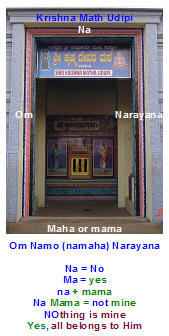
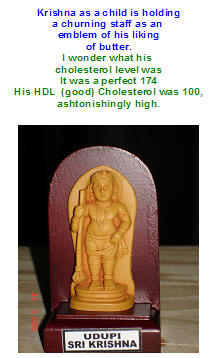
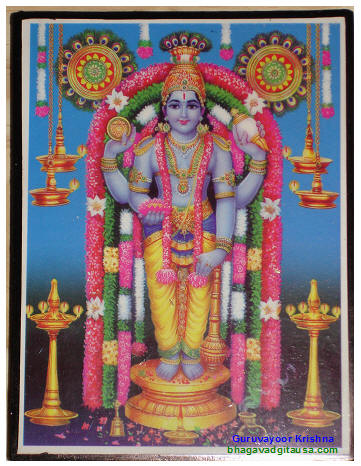
Andal narrates the story of Ravana in less than one sentence. Ravana the demon king of Lanka (modern Sri Lanka) abducts Rama's wife Sita and pays with his dear life. Andal says that Rama was angry. He gets angry very rarely, and when he gets angry (only for righteous reasons), even Devas would not come near him. His anger transmuted to righteous duty to kill Ravana and rescue his wife Sita. Ravana was the ten-headed demon. Was he the only demon? That demon is us with ten Indriyas out of control. They are five Janendriyas and five Karmendriyas. Ravana was Rajasic, drunk with power, passion and self-destructive behavior; his brother Kumbakarna was Tamasic with sloth and slumber; the other brother Vibhishana was Sattvic, left his brother Ravana, joined Rama's camp and surrendered to Him. This is one of the most celebrated Surrenders (Saranagati, Prapatti) to Narayana in the form of Rama.
Click to enlarge the thumbnail photo of Rama with Sita.

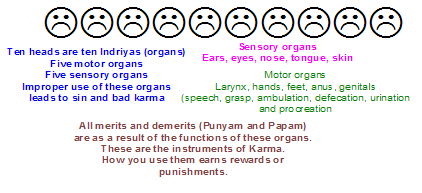
Rama's anger is illustrated with quotes from latter-day wise men.
1. We boil at different degrees. -- Ralph Waldo Emerson. Rama's anger has a very high boiling point.
2. The world needs
anger. The world often continues to allow evil because it isn't angry enough.
-- Bede Jarrett.
Where and when evil exists, righteous men get angry. Rama's anger transmuted to righteous duty to destroy the evil demon.
3. Anybody can become angry, that is easy; but to be angry with the right person, and to the right degree, and at the right time, and for the right purpose, and in the right way, that is not within everybody's power, that is not easy. Aristotle
Rama meets all these criteria with regards to his anger towards Ravana's despicable act.
The outside girl tries to persuade the inside girl to go with them for dharsan. She tries to embarrass her by saying that her relatives and companions know that she has not yet joined them.
(486) 13.
Krishna split open the mouth (beak) of the bird-demon Bakasura and nipped off and discarded the ten heads of Ravana. We sing his praise. All the girls have arrived at the meeting place to see Krishna. As Friday wakes up, Thursday goes to sleep. O Doe-eyed Lass, O Lotus-eyed Lass, don't you hear the chirping of the birds. On this auspicious day, you are still lying in bed instead of immersing yourself in the cool waters. Stop this pretend sleep and come and join us. Let us perform the Pavai Nombu.
புள்ளின் வாய் கீண்டானைப் பொல்லா அரக்கனை கிள்ளிக் களைந்தானைக் கீர்த்திமை பாடிப் போய் பிள்ளைகள் எல்லாரும் பாவைக் களம் புக்கார்; வெள்ளி எழுந்து வியாழம் உறங்கிற்று; புள்ளும் சிலம்பின காண்; போது அரிக் கண்ணினாய்! குள்ளக் குளிரக் குடைந்து நீராடாதே பள்ளிக் கிடத்தியோ? பாவாய் நீ நன்னாளால் கள்ளம் தவிர்ந்து கலந்து ஏலோர் எம்பாவாய் (13) |
1. புள்ளின் வாய் கீண்டானைப் பொல்லா அரக்கனை
puLLin vaay kiiNdaanaip pollaa arakkanai
bird's mouth (beak) split open vicious demon
(Krishna) split open the beak of vicious demon (Bakasura)
2. கிள்ளிக் களைந்தானைக் கீர்த்திமை பாடிப் போய்
kiLLik kaLainhthaanaik kiirththimai paadip pOy
he who nipped off and discarded the(ten heads) his praise (we) sing
(We sing the praise of Rama who cut of the ten heads of the demon king Ravana.)
3. பிள்ளைகள் எல்லாரும் பாவைக் களம் புக்கார்;
piLLaikaL ellaarum paavaik kaLam pukkaar
girls all the gathering place arrived
(all girls have arrived at the gathering place to meet Krishna. )
4. வெள்ளி எழுந்து வியாழம் உறங்கிற்று;
veLLi ezunhthu viyaazam uRangiRRu
Friday awakens; Thursday went to sleep.
Thursday has gone asleep and Friday woke up.
5. புள்ளும் சிலம்பின காண்; போது அரிக் கண்ணினாய்!
puLLum silambhina kaaN; pOthu arik kaNNinaay!
birds chirping see (hear, perceive); flower- and doe-eyed lass
(Don't you hear the birds chirping and flying in search of food?
O lass, with flower-like and doe eyes
6. குள்ளக் குளிரக் குடைந்து நீராடாதே
kaLLak kuLirak kudainhthu niiraadaathea (thea rhymes with they)
instead of immersing your body in the cool waters
7. பள்ளிக் கிடத்தியோ? பாவாய் நீ நன்னாளால்
paLLik kidaththiyO? paavaay nii nhnnaaLaal
you are lying in bed. Lass, on this auspicious day
8. கள்ளம் தவிர்ந்து கலந்து ஏலோர் எம்பாவாய்
kaLLam thavirnhthu kalanhthu ElOr empaavaay.
pretend sleep avoid, join. Let us perform the Pavai Nombu.
Give up the pretend sleep and join us. Let us perform the Pavai Nombu.
Comments:
This verse touches on the exploits of Krishna and Rama. Ravana's death in the hands of Rama was described in the earlier text.
The bird demon and Krishna
The crane's crowning moment: death in the hands of Krishna.
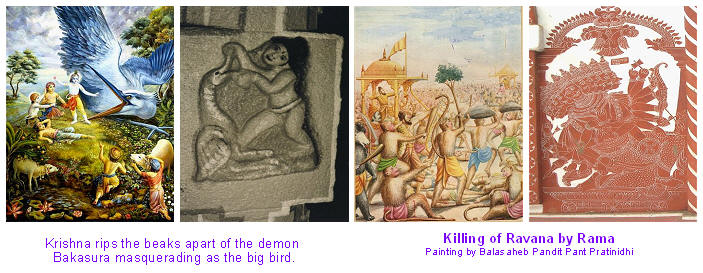
Krishna and the cowherd boys were tending their cows and calves on the banks of Yamuna River. The boys drank water from the river as the calves did. They sat on the bank and saw a huge shadow in the bank; on looking up there was a huge bird with long wings and beak. They were very afraid. It descended on the bank of the river and went straight to Krishna, who was a teenager then. That was the bird-demon, Bakasura, a friend of the evil uncle Kamsa. The bird pecked and poked Krishna with its beak a few times. Before they could do anything about it, the bad bird simply swallowed Krishna. Balarama and the boys could not believe their eyes and became motionless out of fright. As the bird demon was swallowing Krishna, the bird-demon felt a sensation of irritation and burning in his throat (as if he was drinking lye). This burning sensation was caused by the power and will of Krishna. Soon the bird demon vomited and started poking him with his bill. Bakasura had no idea that though Krishna was a teenager, he was still the father of Brahma, the creator of the universe. Krishna caught hold of the two parts of the bill and kept on splitting them far apart until the bird died of broken beak. The empyreal denizens showered flowers and praise on Krishna to the accompaniment of celestial instrumental music.
The girls are praising the exploits of both Rama and Krishna.
Thursday has gone to sleep and Friday woke up.
4. வெள்ளி எழுந்து வியாழம் உறங்கிற்று;
veLLi ezunhthu viyaazam uRangiRRu
Friday awakens; Thursday went to sleep.
Thursday has gone asleep and Friday woke up.
The awakening of Friday (Venus) is compared to the awakening of Jnanam (spiritual knowledge) and the passing of Thursday (Jupiter) is compared to the death of Ajnanam (Avidya, spiritual darkness).
Thursday = Euphemism for Charvaka religion or doctrine of Brihaspati (600 BCE to 1400 CE). Friday is euphemism for Vedic religion and belief in God.
Brihaspati, the priest of gods is the primary proponent of Hedonistic Lokayata school of contradictory thought and yet it appeals to the common man. (Think of Epicurus, The Greek Philosopher, 342-270 BCE.)
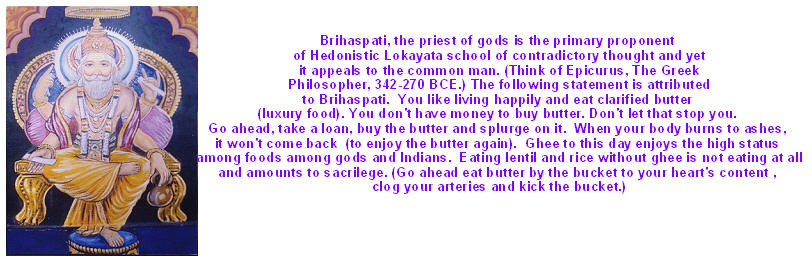
The following statement is attributed to Brihaspati. You like living happily and eat clarified butter (luxury food). You don't have money to buy butter. Don't let that stop you. Go ahead, take a loan, buy the butter and splurge on it. When your body burns to ashes, it won't come back (to enjoy the butter again). Ghee to this day enjoys the high status among foods among Indians. Eating lentil and rice without ghee is not eating at all.
Adi Sankara condemned the religion and doctrine of Brihaspati, belonging to atheistic school and antithetical to Vedas, Upanishads, Sastras, religious injunctions, Brahmanas of yore and the Hindu ritual practices. The Brihaspatis followed the religion of Lokayata also known later as Charvaka (º¡÷Å¡¸ Á¾õ). Charvaka religion, according to the opponents, believe in here and now. They don't believe in God, Sastras, Vedas, Upanishads. ChAru = SAru = sweet, attractive, beautiful; VAk = words, speaking = sweet-talking atheists. LOkayata = prevalent among people. They were the epicureans of the day adhering to Artha and KAma (wealth and passion) and not caring for Dharma and Moksa (duty and liberation).
The philosophy of WYSIWYG (What You See is What You Get). In this philosophy, perception is authority. (Prattiyatcham (perception-- பிரத்தியபட்சம்) is PramAnam (authority--பிரமானம்).
Charavaka rondo is as follows:
Life is here and now; enjoy it while you can;
No one can avert the searching eyes of Death.
When they burn your body, you leave for good,
never to return.
What you see is for real.
What you don't see is not real.
Heaven is on earth, where you can eat all you want,
when you splurge on good clothes, good living.
Hell is want, poverty, indigence.
Moksa (liberation) is death and nothing mo
Good life is to chew Pan and imbibe wine.
When the body dies, there is nothing else remaining
Not soul, not any Inner Witness.
More tirade by the Charvakas of Yore and today:
Rituals involving the fire offerings, the three Vedas, the ascetic's three staffs and the ashes for use on the body are a means of livelihood for the priests, who are not man enough to make any other living. Intelligence comes from elements such as earth, water, fire and air. (Ether is the element the Charvakas did not accept because void is an alien concept for them. If you cannot see it, it is not there.
Fat as part of body could as well be the soul, (which is not visible to the eyes). Since the sacrificed animal goes to heaven, why can't the sacrificer offer his own father as a sacrifice and hasten his arrival in heaven. Your rituals demand offering of food (Pindam) to and gratification of your dead forefathers. Why don't you feed the poor and the hungry down here on earth? Ritual eating of meat, the feeding of the dead, the forced sleeping of the queen with the dead horses in Asvamedha, and gifts to the priests are practices of trickery which bring a good living to the Brahmanas.
There are a few noble thoughts worthy of emulation and praise among the Charavakas: equality of men and women, abhorrence of caste, feeding the poor and the hungry... Eating of meat is an attack on the tantric practices. Condemnation of Asvamedha is an attack on Vedic religion as described in Yajur Veda. King conducts stallion sacrifice to enhance his power and glory, sovereignty over neighboring kingdoms and general weal and wealth of the empire. The practice of Asvamedha is too graphic for description here. Thanks, there is no more Asvamedha in practice in India. (Think of horse lovers and animal rights activists who condemn slaughtering of mustangs of the American plains for dog food and export to overseas to please the palate.)
(487) 14.
O Girl, look at your pond in your backyard garden. Red lilies are in bloom; water lilies (night lilies) closed their blossom. The ascetics with white teeth and ocher robes go to the sacred temple and blow the conches. You promised to wake us up early in the morning; you are just a tall talker. O lass, you are a shameless girl having a sweet running tongue (just talk, no action). The long-armed One carries the conch and the discus. Get out of bed and join us to sing the praises of the lotus-eyed Lord, Kannan.
உங்கள்
புழைக்கடைத் தோட்டத்து
வாவியுள்
செங்கழுநீர் வாய் நெகிழ்ந்து ஆம்பல் வாய் கூம்பின காண் செங்கல் பொடிக் கூறை வெண்பல் தவத்தவர் தங்கள் திருக்கோயில் சங்கிடுவான் போகின்றார் எங்களை முன்னம் எழுப்புவான் வாய் பேசும் நங்காய் எழுந்திராய் நாணாதாய் நாவுடையாய் சங்கொடு சக்கரம் ஏந்தும் தடக்கையன் பங்கயக் கண்ணானைப் பாடு ஏலோர் எம்பாவாய். (14) |
1. உங்கள் புழைக்கடைத் தோட்டத்து வாவியுள்
ungkaL puzaikkadaith thOttathu vaaviyuL
Your backyard garden in the pond
2. செங்கழுநீர் வாய் நெகிழ்ந்து ஆம்பல் வாய் கூம்பின காண்
sengkazunhiir vaay nhekiznhthu aambhal vaay koombhina kaaN
red lilies mouth (the petals forming the mouth) opened; water-lilies mouth closed
(red Indian water lilies blossomed and water-lilies closed their blossom)
3. செங்கல் பொடிக் கூறை வெண்பல் தவத்தவர்
sengal podik kuuRai veNpal thavaththavar
red brick color powder (saffron) raiment white teeth the ones who perform Tapas (ascetics)
the ascetics wearing saffron robes and flashing white teeth
4. தங்கள் திருக்கோயில் சங்கிடுவான் போகின்றார்
thangaL thirukkoyil sangiduvaan pOkinRaar
their sacred temple blow the conch go thus
(go to the sacred temple and blow the conch)
5. எங்களை முன்னம் எழுப்புவான் வாய் பேசும்
engaLai munnam ezuppuvaan vaay paesum
us in the first will wake up; mouth talks
You promised to wake us up first in the morning; you are a tall talker
6. நங்காய் எழுந்திராய் நாணாதாய் நாவுடையாய்
nhangkaay ezunhthiraai nhaaNaathaay nhaavudaiyaay
    O lass (a woman of distinction),  wake up
shameless girl  you with the tongue (just talk, no action)
O lass, you are a shameless girl having a sweet running tongue.
7. சங்கொடு சக்கரம் ஏந்தும் தடக்கையன்
sangkodu sakkaram aenhthum thadakkaiyan
conch wheel bearing long-armed one
8. பங்கயக் கண்ணானைப் பாடு ஏலோர் எம்பாவாய்.
pangkayak kaNNaanaip paadu ElOr empaavaay
(with) lotus eyes sing. Let us perform Pavai Nombu
செங்கழுநீர் = Nymphaea odorata = fragrant water lily.
Hybrids (fragrant water lily) come in many colors: rose, saffron, yellow, purple and vermillion.
ஆம்பல் = Tamil Aambal = Nymphaea lotus = white water lily
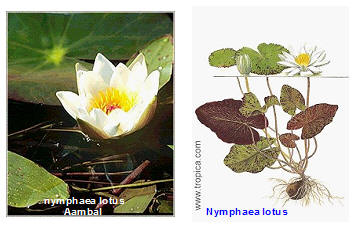
In this verse we have in the house a cowherd girl who is long on promises and short on keeping them. The mention of flowers are significant; the blooming of the water lily is the blossoming of enlightenment. The day lilies are the fragrant Nymphaea odorata (செங்கழுநீர்) ; they bloom in the day time. The night lilies are Nymphaea lotus (Aambal-ஆம்பல்) which bloom in the night time. Andal is saying that the nature is telling what the diurnal segment of the day it is. Some commentators say that the closing of the petals of Aambal into a bud is a metaphor for Ajnaanam (spiritual ignorance).
நங்கய் = nangai = woman of distinction. Man of distinction is நம்பி (nambhi). Nangai is spiritually advanced and so is free from ego and vanity (ahamkara and mamathai). She is in meditation; she does not know day or night; she is enjoying vision of Krishna. She made a promise that she would wake up others; yet, she forgot because she was in meditation. The saffron saints won't wait for her any more. They have gone to the temple to do service to the Lord. They wear the ocher clothes which indicate renunciation, devotion, piety and nonattachment. The white teeth is further indication that they do not engage in worldly pleasures such as chewing pan and eat only sattvic foods.
Krishna talking to Arjuna says in Bhagavad Gita the following with regard to food.
17.7: The food dear to all is also of three kinds. (So are the) Sacrifice, austerity, and charity. Hear the differences between them.
17.8: The foods that augment a long life, intellect, strength, health, pleasure, and satisfaction are juicy, smooth, firm, and heartwarming. (Those) foods are dear to Sattvic (people).
17.9: Rajasic people like foods that are bitter, sour, salty, very hot, pungent, dry and burning and cause misery, grief and sickness.
17.10: The foods, that are dear to Tamasic person, are spoiled, flavorless or tasteless, stinking, refuse, leftover (ritually impure), and impure (unfit for sacrifice).
Tongue stands for speech; actually it is the larynx and the Visuddha Chakra for the articulate speech. It is one of the motor organs out of the five Karmendriyas. Man gets karma by thought, speech and deed. The Acharyas, the intermediaries between BhagAvatha and BhAgavathAs, have controlled their mind, speech and action and therefore are pure beings. They are the Gurus and preceptors. Their tongue, their vac (words and speech) is the true speech and they are the true unblemished owners of their tongue--Naavudaiyaars.
Let us perform the Pavai Nombu.
(488) 15.
The outside girls address the inside girl as the young parrot and asked her whether she is still sleeping. The inside girl gets annoyed with all the shouting going on and says that she would be out in a trice. The outside girls retort that they know her felicitous and duplicitous speech from before and ask her to join them soon. The inside girl wonders aloud whether all are really out there. The outside girls retort and tell her to come out and count them herself. The inside girl says what they are going to do once she joins them. The outside girls say that they will go visiting the strong One Kannan who killed a mighty elephant and destroyed the strength of the enemies and sing his praise.
எல்லே! இளங்கிளியே இன்னம் உறங்குதியோ சில்லென்று அழையேன் மின் நங்கைமீர் போதருகின்றேன் வல்லை உன் கட்டுரைகள் பண்டே உன் வாய் அறிதும் வல்லீர்கள் நீங்கள் நான் தான் ஆயிடுக! ஒல்லை நீ போதாய் உனக்கு என்ன வேறு உடையை? எல்லாரும் போந்தாரோ? போந்தார் போந்து எண்ணிக்கொள் வல் ஆனை கொன்றானை மாற்றாரை மாற்று அழிக்க வல்லானை மாயனைப் பாடு ஏலோர் எம்பாவாய் (15) |
எல்லே! இளங்கிளியே இன்னம் உறங்குதியோ
ellE iLang kiLiyE innam uRangkuthiyO
Here you, young parrot, are you still sleeping?
சில்லென்று அழையேன் மின் நங்கைமீர் போதருகின்றேன்
sillenRu azaiyEn min nangaimIr pOtharukinREn
(the inside girl says) stop shouting, my elder companions,
I will be there in a trice.
வல்லை உன் கட்டுரைகள் பண்டே உன் வாய் அறிதும்
vallai un katturaikaL paNtE un vaay aRithum
(The outside girl says:)
your felicitous speech, beforehand your words we know
(we know your felicitous speech and words from before)
வல்லீர்கள் நீங்கள் நான் தான் ஆயிடுக!
vallIrkaL nINGkaL naan thaan aayituka
(The inside girl speaks) felicitous speakers you are; let us assume I am (felicitous)
ஒல்லை நீ போதாய் உனக்கு என்ன வேறு உடையை?
ollai nI pOthaay unakku enna vERu utaiyai
(The outside girls) Come and join us quick. What else are you thinking of?
எல்லாரும் போந்தாரோ? போந்தார் போந்து எண்ணிக்கொள்
ellaarum pOnthaarO? pOnthaar pOnthu eNNikkoL
(The inside girl) Are all assembled there?
(The outside girls) They are all assembled here. Come and count them yourself.
வல் ஆனை கொன்றானை மாற்றாரை மாற்று அழிக்க
val aanai konRaanai maaRRaarai maaRRu azhikka
(The inside girl says what are we going to do after I join you)
(The outside girls say in a chorus) The one who killed the strong elephant. the enemies' strength
destroy
(The one who killed the elephant and destroyed the strength of the enemies)
வல்லானை மாயனைப் பாடு ஏலோர் எம்பாவாய்
vallaanai maayanaip paatu ElOr empaavaay
the strong One, Kannan sing eulogy. Let us perform Pavai Nombu.
we sing praise of the strong Kannan (Krishna). Let us perform Pavai Nombu.
Conversation
(The outside girls say) Here you, young parrot, are you still sleeping?
(the inside girl says) stop shouting, my elder companions, I will be there in a trice.
(The outside girls say:) we know your felicitous speech and (duplicitous) words from before
(The inside girl speaks) Felicitous speakers you are; let us assume I am (felicitous)
(The outside girls) Come and join us quick. What else are you thinking of?
(The inside girl) Are all assembled there?
(The outside girls) They are all assembled here. Come and count them yourself.
(The inside girl) What are we going to do after I join you
(The outside girls say in a chorus) we sing praise of strong and valiant Kannan (Krishna), the one who killed the elephant and destroyed the strength of the enemies,
Let us perform Pavai Nombu.
This conversation is celebrated as the trilateral relationship between BhagAvat (Narayana), BhAgavatA (devotee) and BhAgavatA DAsyan (the slave of the devotee). For less confusion the following English words are used in the place of Sanskrit words. BhAgavatA = devotee; BhagAvat = the Lord. «Ê§ÂÛìÌõ «Ê§Âý = Slave of the slave. We are all the slaves of the Lord and being the slave of the slave is the most salvational act. Wearing the dust from under his feet is liberating. The afore-mentioned conversation is interpreted as follows. This Vaishnava code underlies the relationship.
1. எல்லே! இளங்கிளியே ellE iLang kiLiyE: O Young parrot.
This is a felicitous and solicitous addressing of the sleeping beauty as young parrot.
The parrot talk is repeating the names of Bhagavan with utmost devotion and sincerity. The
parrot represents the devotees or BhAgavatA, who think, speak, and do alike with reference
to BhagAvat (Lord) and other devotees.
2. இன்னம் உறங்குதியோ innam uRangkuthiyO Are you still sleeping?
Keeping the devotees waiting is not a good act. Sleeping here refers to negligence of the devotees waiting outside the mansion and doing things which are not in the service of the Lord or devotees. That lapse is not acceptable among devotees and the Lord.
3. சில்லென்று அழையேன் மின் sillenRu azaiyEn min the inside girl says stop shouting
This is an admonition of the inside girl instructing the outside devotees not to use any harsh words to another devotee.
4. நங்கைமீர் போதருகின்றேன் nangaimIr pOtharukinREn my elder lady companions, I will be
there in a trice.
The inside girl devotee respectfully addressing the outside girl devotees as elder companion girls. This means the devotees should address other devotees with great respect. Respect to a devotee is respect to the Lord.
5. வல்லை உன் கட்டுரைகள் vallai un katturaikaL (The outside girl says:) your felicitous speech; you are a skilled meister (German for Master) to spin a yarn or present a fabric of (fabricated) words. The assembled girls tease the sleeping beauty as spinner of words.
வல்லை = skilled;
-meister; in this context, it means lingua-meister; facile tongue.
கட்டுரைகள் = கட்டு + உரைகள் (Plural of உரை) =
fabricated, put together by tying +
text, narrative;
To spin a yarn (idiom) and such fabricated fabric of words. Spin doctor.
Constructive admonishment of the inside girl by the outside girl devotees should be taken in good spirit.
6. வல்லீர்கள் நீங்கள் நான் தான் ஆயிடுக! vallIrkaL nINGkaL naan thaan aayituka
(The inside girl says) felicitous speakers you are; let us assume I am (felicitous) a skilled and adroit spinner of pleasing-for-the-moment words.
Accepting the criticism as the prescribed corrective course coming from the Lord through the devotees.
7. ஒல்லை நீ போதாய் ollai nI pOthaay (The outside girls): Come and join us quick.
(The outside girls) Come and join us quick. The devotees cannot wait to meet other devotees because their cause is the same, serving the Lord and the fellow devotees.
8. உனக்கு என்ன வேறு உடையை? : unakku enna vERu utaiyai What else are you thinking of?
As a devotee what else is on your mind except following the well-established codes of conduct among devotees in the service of the Lord and the fellow devotees.
9. : எல்லாரும் போந்தாரோ? போந்தார் போந்து எண்ணிக்கொள் ellaarum pOnthaarO? pOnthaar pOnthu eNNikkoL
(The inside girl) Are all assembled there?
(The outside girls) They are all assembled here. Come and count them yourself.
Being in the company of other devotees, enjoying the sight of them and wearing the dust of their feet are bliss for a devotee.
10. வல் ஆனை கொன்றானை மாற்றாரை மாற்று அழிக்க
வலலானை மாயனைப் பாடு
val aanai konRaanai maaRRaarai maaRRu azhikka
vallaanai maayanaip paatu
(The outside girls say in a chorus) The one who killed the strong elephant. the enemies' strength
destroy
(The one who killed the elephant and destroyed the strength of the enemies)
the strong One, Kannan sing eulogy. we sing praise of the strong Kannan (Krishna).
Here the devotees sing the glory of the Lord (BhagavAn) in terms of His Kalyana Gunas (auspicious qualities).
Comments.
Krishna and the elephant (Kuvalyapida):
Kings, ministers, men, women and children assembled in the arena for a wrestling exhibition in Kamsa's country. Krishna and Balarama also wanted to see the competition and so arrived at the gate of the arena. They saw a huge elephant standing across the gateway blocking their entry into the arena. Krishna, by divine vision knowing the intent of the mahout ( and Kamsa) ordered him to move the elephant and let him go into the arena. To exert his authority Krishna told the mahout that he would dispatch him and his elephant to the House of No Return (death). That understandably angered the caretaker, who ordered the elephant to attack Krishna. The elephant charged towards Krishna headlong to catch him by the trunk and fling him into the House of Death. Krishna, the most agile Sportsman quickly moved behind the elephant so that its own massive body blocked its vision and sighting of Krishna. Krishna caught hold of the elephant's tail and dragged the elephant for at least 25 yards. Then he started pushing the elephant sideways from right to left and vice versa. The elephant was completely disoriented and its strength did not come handy in attacking Krishna, who suddenly appeared in front of the elephant, slapped it and made a quick exit to the back of the elephant. Krishna dashed to the front of the elephant, put himself down on the ground in front of its two legs and made the elephant trip and fall along with the riding mahout in a big heap. Thinking that Krishna was still on the ground, the elephant in an attempt to gore him plunged the tusk into the ground; Krishna was far away facing the elephant, which rushed towards Krishna on command from the mahout. Krishna caught hold of the trunk, yanked it so hard the elephant and the mahout fell down. Krishna immediately got on the back of the elephant and broke its back thus paralyzing the elephant and killing it. It was just a tap on the spine that broke its back. Krishna immediately made a quick work of the mahout and sent him to the Land of No Return.
This is the tenth girl being woken up by the moving band of lasses on their way to Pavai Nombu. End Verse 15 (488).
16 (489).
O Guardian of the mansion of Nandagopan. You guard the entrance decorated with festoons. Please open the jewel-studded door and let us in. Yesterday, Mayan, Manivannan made a promise to the Ayarpadi children that he would offer them the drums. We came in front of your house in ritual purity and sang hymns of praise to wake up the Lord. Please don't deny us entrance O lady! please open the door that welcomes us with affection.
நாயகனாய் நின்ற நந்த கோபனுடைய கோயில் காப்பானே! கொடித் தோன்றும் தோரண வாயில் காப்பானே! மணிக் கதவம் தாள் திறவாய் ஆயர் சிறுமியரோமுக்க, அறை பறை மாயன் மணிவண்ணன் நென்னலே வாய் நேர்ந்தான் தூயோமாய் வந்தோம் துயில் எழப் பாடுவான் வாயால் முன்னம் முன்னம் மாற்றாதே அம்மா! நீ நேய நிலைக் கதவம் நீக்கு ஏலோர் எம்பாவாய். (16) |
1. நாயகனாய் நின்ற நந்த கோபனுடைய
naayakanaay ninRa nanthakOpanudaiya
As the head stand Nandhagopan's
(Nandagopan as the chief)
2. கோயில் காப்பானே! கொடித் தோன்றும் தோரண
kOyil kaappaanE! kotith thOnRum thOraNa
Temple protector flag appearing (at the entrance of
Nandagopan with) festoons
(O guardian of the palace of Nandagopan with festoons
at the entrance.)
3. வாயில் காப்பானே! மணிக் கதவம் தாள் திறவாய்
vaayil kaappaanE! maNik kathavam thaaL thiRavaay
entrance guard! jewel-inlaid door latch open
(O guardian of the jewel-studded door, unlatch the
door.)
4. ஆயர் சிறுமியரோமுக்க, அறை பறை
aayar ciRumiyarOmukku aRai paRai
Ayarpadi children drums announced
(Kannan announced that he will offer drums to the children of Ayarpadi.)
5. மாயன் மணிவண்ணன் நென்னலே வாய் நேர்ந்தான்
maayan maNivaNNan nennalE vaay nErnthaan
Maayan the Lord of the color of blue sapphire yesterday by word of mouth gave assurance.
(Maayan, the Lord of the color of blue sapphire promised yesterday.)
6. தூயோமாய் வந்தோம் துயில் எழப் பாடுவான்
thUyOmaay vanthOm thuyil ezhap paaduvaan
in purity we have come sleep awake we sing songs.
(We have come in purity and sing hymns of praise to wake up the Lord.)
7. வாயால் முன்னம் முன்னம் மாற்றாதே அம்மா! நீ
vaayaal munnam munnam maaRRaathE ammaa nI
by word of mouth first-first don't deny O lady you
(Please don't deny us by word of mouth.)
8. நேய நிலைக் கதவம் நீக்கு ஏலோர் எம்பாவாய்.
nEya nilaik kathavam nIkku ElOr empaavaay
love (affection) conditioned door remove/unlatch (open). Let us do Pavai Nombu.
please open the Kannan-affectionate
door. Let us do the Pavai Nombu.
Go = cow, ox, cattle, kine. Nandagopan = Nanda + gopan = joy, delight, happiness + cowherd. Nandagopan = He is the Lord full of happiness and protector of cows.
Maayaan and Manivannan are some of the many names of Krishna.
Maayaan = the One adept in performing Maayaa = one of the 9 saktis of Vishnu; wisdom, supernatural power, illusion, deception, magic, fraud. Maayan also means a dark-complexioned person; Vishnu; deceitful person.
Gopaala = a cowherd, Krishna; Govardhana = a hill in Virindaavana near Mathraa; Goshtha = cow-pen; an assembly, meeting; Gosthii = chief person or president of an assembly; Gopatu = vain boaster; gosevaa = service to a cow; gosthaana = cow-pen; gokula = tract of land on Yamula River , home of Nanda and Krishna during his youth, inhabitants of that place; Bhaagavatha Goshti = an assembly of devotees.
1. நாயகனாய் நின்ற நந்த கோபனுடைய
Nandagopan is the chief. The mansion is his place. The ten outside girls want to enter the mansion. Mansion refers also to the temple. Nanda is the adoptive father of Krishna. The girls are requesting to see Krishna. The girls are contemporaries of Krishna, whose natural (biological) parents are Vasudeva and Devaki and the adoptive parents, Nanda and Yasoda.
2. கோயில் காப்பானே! கொடித் தோன்றும் தோரண
3. வாயில் காப்பானே! மணிக்கதவம் தாள் திறவாய்
O guardians of the palace of Nandagopan with festoons at the entrance. The mansion and the temple have guards at the entrance, known as Dvaarapaalakas (door keepers) whose permission the entrant has to obtain before entering the temple gates. The inner temple has Garuda as the guardian facing the Lord. The tenth girl in this verse is asking the guards to open the door to the mansion and also the doors to the temple. She sees the DvAdhastambham (flagstaff) with Garuda at the top.

Adhisesha, Garuda, Viswaksena guard the main deity near the inner sanctum. Vishwaksena is the commander-in-chief of Vishnu's army. In Vaishnava temples, food (Prasadam) is offered to the guardians before others can partake it. The inner sanctum guards are deities.
In Srirangam temple towers, the following Dwarapalakas guard the entrance: Bhadran and Subhadran at the south gate, Dhathan and Vidhathan at the north gate, Chandan and Prachandan at the east gate, and Jayan and Vijayan at the west gate . The same eight guards are on duty in Vaikuntham (Vishnu's heaven) also.
The worshippers have to get permission from the guards before they enter the temple. Permission to enter is given to Anukulars (friendly ones--friends) and denied to Pratikulars (the unfriendly ones--foes). In Tiruppati the following custom is established. First the owner of the temple Varaha Swamy , second the guards at the gate, third Thayar (consort of Vishnu), and fourth the Mūlavar (the main deity of the inner sanctum) should be worshipped in that order. In like manner we take a journey inwards through the gates of eyes, ears, and the rest and enter the temple of our body. The sensory organs have their own deities to whom we offer our worship. At last we come to Paramatman, abiding in the inner sanctum, the spiritual heart. He is the silent witness to our thought, word and deed. We offer our worship to him.
The gem-studded heavy doors blocking entry into the mansion and the temple are the ego, the glitter and the glamour of the phenomenal world, which block the vision of God. As the doors open and ignorance is lifted we enter, adore the Light, meditate on the divine splendor and beg the Lord to inspire our intellect.
6. தூயோமாய் வந்தோம் துயில் எழப் பாடுவான்
thUyOmaay vanthOm thuyil ezhap paaduvaan
in purity we have come, sleep, awake (and rise), we sing songs.
(We have come in purity and sing hymns of praise to wake up the Lord.)
When we approach God we should be pure externally and internally: Purity of mind, speech and body.
17 (490).
O Nandagopala, You donate clothes, cool water and food very generously. Please wake up, our Great God. O Yasoda, You are the head of creeper-slender woman. please wake up, O sprig, O Light of your clan. Our Great Lady, it behooves you to understand that the Lord tore the sky, grew and measured the worlds with two steps. O king of Devas desist from sleeping; do wake up. O Baladeva, you wear pure gold anklets on your feet. You and your brother Krishna, please wake up. Let us perform Pavai Nombu.
அம்பரமே தண்ணீரே சோறே அறஞ்செய்யும் எம்பெருமான் நந்தகோபாலா எழுந்திராய் கொம்பனார்க்கு எல்லாம் கொழுந்தே குல விளக்கே எம்பெருமாட்டி யசோதாய் அறிவுறாய் அம்பரம் ஊடு அறுத்து ஓங்கி உலகு அளந்த உம்பர் கோமானே! உறங்காது எழுந்திராய் செம்போற் கழலடிச் செல்வா பலதேவா உம்பியும் நீயும் உறங்கு ஏலோர் எம்பாவாய் (17) |
அம்பரமே தண்ணீரே சோறே அறஞ்செய்யும்
ambaramE thaNNIrE sORE aRaNgceyyum
The clothes, cool water, cooked rice
(other victuals), donate generously
He (Nandagopaalan) donates clothes, water, and victuals generously
எம்பெருமான் நந்தகோபாலா எழுந்திராய்
emperumaan nandagOpaalaa ezhunthiraay
our leader (Great Being, God) Nandagopaalaa get up (wake up)
கொம்பனார்க்கு எல்லாம் கொழுந்தே குல விளக்கே
kombanaarkku ellaam kozhunthE kula viLakkE
The head of the creeper-slender women, all, O Sprig, O Kula Light
You are the head of all slender women, O sprig, O Light of your clan
எம்பெருமாட்டி யசோதாய் அறிவுறாய்
emperumaatti yacsOthaay aRivuRaay
Our Great Lady Yasodaay come to understand
அம்பரம் ஊடு அறுத்து ஓங்கி உலகு அளந்த
ambaram Udu aRuththu ONGki uLaku aLantha
sky tearing grew up big the world measured
You tore the sky, grew up like a giant and measured the world
உம்பர் கோமானே! உறங்காது எழுந்திராய்
umbar kOmaanE uRaNGkaathu ezunthiraay
Devas king of, desist from sleeping, wake up
செம்போற் கழலடிச் செல்வா பலதேவா
cem poR kazhaladich selvaa BaladEvaa
Pure gold anklets feet wealthy Baladeva
O Baladeva You wear pure gold anklets on your feet
உம்பியும் நீயும் உறங்கு ஏலோர் எம்பாவாய்
umbiyum nIyum uRaNGu ElOr empaavaay
your brother Krishna and you, please, don't go to sleep. Let us do the Pavai Nombu.
Comment:
The girls entered the palace and found Nandagopala, Yasoda, Krishna and Balarama sleeping in their own separate beds. Nandagopala is Acharya (Guru); Yasoda is Mantra; Krishna is the meaning of Mantra; Balarama is the essence of Mantra. The Mantra is Ashtaksharam: Om namo Narayana. Krishna is flanked by his parents on one side and Balarama on the other side to prevent his abduction by Ayarpadi girls. That is why the Gopis had to wake up and announce their presence to Nanda first so that he became aware that Gopi's intentions were honorable.
Nandagopala is very generous and gives clothes, food and water, the essentials to live on this earth. Ambaram or clothes stand for AUM (Pranavam); sOru or foods stand for Narayanaya; TaNNIr or water stands for namah. All essentials put together amount to Om Namo Narayanaya (Ashtakshara -- 8-syllable mantra). This 8-syllable mantra and Tiruvikrama are one. Vikrama measured the earth, sky and heaven; that is AUM. Vikrama pushed Bali into Patala (netherworld) meaning his ego is destroyed; that is Namah. Vikrama is all-pervasive and that is Narayana. Andal extols Balarama on his jewels which are the wealth of grace. Balarama is the constant companion of Krishna and thus he is the Adisesha, the serpent bed of Narayana.
Entering the bed chambers of the foursome through the heavy gem-studded doors is the breaking of the ego before the girls approached them. Then they approach the Acharya Nanda and others through whom they learn Mantra, its meaning and essence. Doing service to the devotees of Narayana is known as Bhaagavata Kainkaryam; doing service to God is Bhagaavath Kainkaryam.
The vanquished Devas, Vamana the dwarf Brahman, shrewd Sukracharya and gullible King Bali
Vamana was one of the Avatars of Lord Vishnu. In the days of yore, King Bali, an Asura (Daitya), antithetical to Sura (Aditya) or god conquered the three worlds. The gods complained to Lord Vishnu. Vamana, the dwarfish Brahmana (incarnation of Vishnu) went to king Bali and begged him for a piece of land equal to the length and breadth of his three strides. King Bali, very much against the advice of the priest in chief, Sukracharya, agreed to part with a paltry piece of land to the dwarfish Brahmana. Bali never thought that His steps would cover the heavens and earth. The Lord at once stood up and expanded Himself to an immense size. He covered the heaven, sky, and earth in two strides and asked the king where he could place His third step. The king offered his head as the place for the third step, upon which the Lord pushed him down to the nether land. For the king’s generosity, the Lord made him the ruler of the nether worlds.
18 (491).
O daughter in law of Nandagopalan who has the strength of an elephant, not known for retreat.
O Nappinnai, your tresses exude fragrant smell. Please open the door. Look! the fowl are crowing. The cuckoo birds and their kind sitting on the Kurraththi (Jasmine) flower bower are cooing. We sing the praise of your husband. Your ball-holding fingers have known victory at ball games. Why don't you come and open the door in a happy mood with your red lotus hands adorned with jingling beautiful bangles. Let us do the Pavai Nombu.
உந்து மத களிற்றன் ஓடாத தோள் வலியன் நந்தகோபாலன் மருமகளே! நப்பின்னாய்! கந்தமும் கமழும் குழலீ! கடை திரவாய் வந்தெங்கும கோழி அழைத்தன காண்! மாதவிப் பந்தல் மேல் பல்கால் குயில் இனங்கள் கூவின காண் பந்தார் விரலி! உன் மைத்துனன் பேர் பாடச் செந்தாமரைக் கையால் சீரார் வளை ஒலிப்ப வந்து திறவாய் மகிழ்ந்து ஏலோர் எம்பாவாய் (18) |
உந்து மத களிற்றன் ஓடாத தோள் வலியன்
unthu matha kaLiRRan Otaatha thOL valiyan
the charging mad elephant, not retreating, one with strong shoulders
நந்தகோபாலன் மருமகளே! நப்பின்னாய்!
nanthagOpaalan marumakaLE nappinnaay
NandagOpan's daughter-in-law O Nappinai
கந்தமும் கமழும் குழலீ! கடை திரவாய்
kantham kamazhum kuzhali kadaithiRavaay
fragrance smelling tresses! gate (doors) open
வந்தெங்கும கோழி அழைத்தன காண்! மாதவிப்
vanthueNGkum kOzhi azhaiththana kaaN maathavip
coming from everywhere the fowl calling look! Kurrukkathi flowers
பந்தல் மேல் பல்கால் குயில் இனங்கள் கூவின காண்
panthal mEl palkaal kuyili naNGkaL kUvina kaaN
arbor upon many times cuckoo birds and their kind crying, look
The cuckoo birds and their kind are sitting on the Kurrukkathi flower bower and emitting cries.
பந்தார் விரலி! உன் மைத்துனன் பேர் பாடச்
panthaar virali un maiththunan pEr paadach
ball-holding fingers your husband name sing (sing his praises)
O ball-bearing fingers, We sing the praise of your husband.
செந்தாமரைக் கையால் சீரார் வளை ஒலிப்ப
centhaamaraik kaiyaal cIraar vaLai olippa
red lotus hands beautiful bangles jingling
with your red lotus hands and beautiful jingling bangles
வந்து திறவாய் மகிழ்ந்து ஏலோர் எம்பாவாய்
vanthu thiRavaay makizhnthu ElOr empaavaay
come open (the door) with happiness. Let us perform Pavai Nombu
Comment:
Nappinnai is the consort of Nandagopan and the incarnation of Nila Devi whom the Gopis seek to intercede on their behalf so that they can come near Bhagavan Krishna and get Seva (see him). Nila Devi is the daughter of Krishna's maternal uncle. This verse says that Nandagopan is wealthy in cattle and elephants and has the strength to subdue an elephant in musth. The inner meaning is that the Gopis belong to a virtuous group of devotees who associate only with other devotees of like nature and are the pupils of an Acharya. Devotion, Acharya association and intercession on their behalf are the three elements necessary before they can approach God. Chit (Chetanas, here the Gopis) is Atman with devotion; the cowherd king Nandagopan is the Acharya; Nila Devi is the mediator. All condition are ripe so the Gopis can meet Krishna. The strength of Nandagopan is not only physical but also spiritual.
கோழி அழைத்தன காண்:
In Srirangam a Vaishnava sought from Parasara Bhattar the answer to the qualities of a true Vaishnava. He sent him to Tirumalai AnantAzhvAn for an answer. During tatiiyaaraatanai (ததீயாராதனை--feast given to devotees of Vishnu) the student received permission to sit in the first few rows reserved for the ritualists. On the following days he was pushed back one row each day until he occupied the last row. On the day he was on the last row AnantAzhvAn called and explained to him the meaning of a Vaishnava, who is of the nature of a crane, a crow, a pinch of salt and lastly a true Vaishnava himself. The student waited patiently in the back rows like a crane waits for a big fish, absorbed the essence of Vedas like a cock pecks and picks grains leaving the chaff, rendered service to his fellow devotees, Acharya and Bhagavan like the salt augments the taste of food, and proved himself as a true devotee.
கொக்கை போல் இருப்பான்; கோழியை போல் இருப்பான்; உப்பை போல் இருப்பான்; உம்மை போல்
இருப்பான் = Kokkai pol iruppaan, Kozhiyai pol iruppan, Uppai pol iruppaan, Ummai pol iruppaan. = Like a crane he will remain; like a cock he will remain; like salt he will remain; like you he remains.
The absurdity of NOT being a crane, cock, salt, and true being.
The crane: It stands on one foot patiently, watches the small fry go by, catches the big one and never lets it get away from its beak. Similarly A true Vaishnava never professes his devotion to minor deities, takes refuge, gets hold of the lotus feet of Vishnu and never let go of them. Krishna says in Bhagavad Gita the following to Arjuna: 9.22: To those persons, who think of me to the exclusion of all else, worshipping me always and devoted to me, I bring yogam and ksemam (success and security).
Cock, hen: A cock or hen keeps his nose (beak) and eyes focused on the ground, stirs up the dirt, pecks and picks the grain to the exclusion of chaff. Likewise a Vaishnava ignores all faults and foibles of the Samsaric world and chooses to imbibe the wisdom and essence of the Vedas.
The salt: Salt is essential for taste and electrolyte balance in the body. Salt and food have an intimate connection. Without salt, food is not palatable but deficient. This connection (சம்பந்தம்) between fellow devotee (Bhaagavata), an Achaarya and Bhagaavat (Bhagavan Krishna) is established by service (Kainkaryam) to all. (This trilateral connection between a devotee, an Acharya and Krishna is kept intact by service to all three.) The salt is the service and connection and vice versa.
Salt (lavana in Sanskrit and உப்பு in Tamil) and salary are cognate words. In olden days, workers were paid salt as salary. Salt was one of the few food preservatives in olden days; good, hard-working people were called salt of the earth by Jesus Christ. The dull insipid ones are not the salt of the earth.
True to Form: The devotee remained faithful to qualities of (இலக்ஷணம்/இலக்கணம்) of a true Vaishnavite by exercising patience and not questioning the actions of his Acharya. A Vaishnava is true to form when he thinks and acts lower than a grass, is patient like a tree, does not feel elated or depressed on eulogy or calumny, treats all with respect and love and chants the holy name of Narayana. He wears his words literally and figuratively around their neck like a Maalai (garland, chain).
மாதவிப் பந்தல் மேல் பல்கால் குயில் இனங்கள் கூவின காண்:
The cuckoo birds and their kind are sitting on the Kurrukkathi flower bower and emitting cries.
Cuckoo and other song birds are perched on the fragrant flower bower and sing; they are the sages singing the glory of Bhagavan. End Verse 18.
19 (492).
As the standing lamps burn, you climbed on top of the soft mattress of the cot and rested your head on the bosom of Nappinnai who wears a bouquet of flowers on her tresses, O wide-chested Lord. Please open your mouth. O wide-eyed One with eyeliner, You never want to awaken your husband from his sleep. Look, You don't want to separate from Him even for a few moments. This is not commensurate with your good nature. Let us do Pavai Nombu.
குத்து விளக்கு எரியக் கோட்டுக்கால் கட்டில் மேல் மெத்தென்ற பஞ்ச சயனத்தின் மேல் ஏறிக் கொத்து அலர் பூங்குழல் நப்பின்னை கொங்கை மேல் வைத்துக் கிடந்த மலர் மார்பா! வாய் திறவாய் மைத் தடங்கண்ணினாய்! நீ உன் மணாலனை எத்தனை போதும் துயில் எழ ஒட்டாய் காண் எத்தனை யேலும் பிரிவு ஆற்றக் இல்லாயால் தத்துவம் அன்று தகவு ஏலோர் எம்பாவாய் (19) |
குத்து விளக்கு எரியக் கோட்டுக்கால் கட்டில் மேல்
kuththu viLakku eriyak kOttukkaal kattil mEl
standing oil lamps burning, legs cot on top of
As the standing oil lamps are burning, on the legged cot
மெத்தென்ற பஞ்ச சயனத்தின் மேல் ஏறிக்
meththenRa paNYca cayanaththin mEl ERi
soft cotton mattress atop ascend
கொத்து அலர் பூங்குழல் நப்பின்னை கொங்கை மேல்
koththu alar pUNGkuzhal nappinai koNGkai mEl
bouquet of flowers her tresses, Nappinnai's bosom on
வைத்துக் கிடந்த மலர் மார்பா! வாய் திறவாய்
vaiththuk kitantha malar maarpaa vaay thiRavaay
resting O broad chested One! mouth you won't open
மைத் தடஙகண்ணினாய்! நீ உன் மணாலனை
mai ththataNGkaNNinaay nI un maNaaLanai
eyeliner the One with wide eyes! you your husband
எத்தனை போதும் துயில் எழ ஒட்டாய் காண்
eththanai pOthum thuyilezha ottaay kaaN
at all moments from sleep awaken never let, Look
எத்தனை யேலும் பிரிவு ஆற்றக் இல்லாயால்
eththanai yElum pirivu aaRRak illaayaal
at all times separation to effect not done
தத்துவம் அன்று தகவு ஏலோர் எம்பாவாய்
thaththuvam anRu thakavu ElOr empaavaay
your nature not right. Let us perform Pavai Nombu.
Comment:
Krishna, the husband of Nappinnai climbs on the bed and rests his head on her bosom thus preventing her from responding to the outside girls and opening the door for them to come in. The cowherd girls beg Krishna to let Nappinnai to open the door. Nappinnai (in collusion with Krishna) implores Him by her eyes not to oblige the Gopis. The outside girls are getting angry with Nappinnai for not waking Him up from the bed. They want to share the company of Krishna and thus are appealing and chastising Nappinnai for her recalcitrant behavior.
The legs of the cot are made of tusks from Kuvalayapida that he killed ( from the earlier verse). Here the elephant is the ego of man. Krishna kills the ego and as the signature of vanquishing it, He has the cot made of its tusks. These four legs refer to four kinds of ego and four Purusharthas (Dharma, Artha, Kama, and Moksa)
கொட்டுக்கால் கட்டில் = kOttuk Kaal Kattil = Four PurushArthams ( Dharma , Artha , Kaama , Moksham = duty, wealth, desire, emancipation) representing the four legs of the Kattil (cot).
The cot and mattress represent
The cot legs also refer to four kinds of ego: Karuthruthva (I am the doer), bhogthruthva (I am the enjoyer), Jnathruthva (I am the Knower) and Seshtva (I am the only devotee). This is not the healthy attitude for a human being to arrogate himself as the exclusive doer, enjoyer, knower, and devotee. These four-part ego serves to create trouble with the next person, being and God. It is a series of "I AM. " Krishna is a I-series killer. God is the One who has the four-part distinction; man cannot. One has to sacrifice this four-part ego if one wants to attain God or live in peace with the next man and God.
Here is what Krishna Bhagavan says to Arjuna in Bhagavad Gita. Only Krishna can use the word "I" in the truest sense.
5.29: Knowing me thus as the enjoyer of all sacrifices and austerities (Yajana-tapasam) and the supreme Lord of this whole world or universe, the Friend of all living beings, one attains peace.
Any sacrifice, made to any gods goes to Lord Krishna Himself, since He is the Supreme Lord of all souls, including those of gods. He is the universe and the enjoyer of all Sacrifices. He is the friend of all the devotees, easy of access, loving as a parent, kind, and compassionate with infinite grace, though inscrutable. He is the knowledge, the Knower and Doer, but the Unknowable too.
13.22:
The Mahesvara, the Great Ruler in the body is (said to be) the
witness, the approver, the supporter, the enjoyer, the
Supreme Self (Paramatma) in the body, and the
Supreme Purusa.
The egomaniac's ranting is as follows according to Bhagavan Krishna. Krishna is the "I-Killer."
16.13: “I gained this today.” “I will fulfill this desire (tomorrow).” “I have this wealth.” “Moreover, I am going to gain this later.” This is what they think.
16.14: “I killed this enemy.” “I shall kill others too.” “I am the Lord.” “ I am the enjoyer.” “I am perfect, strong, and happy.”
16.15: “I am rich and of noble descent.” “There is nobody equal to me.” “I shall (perform) sacrifice.” “I shall give to charity.” “I shall rejoice.” They think thus deluded by ignorance.
தத்துவம் அன்று தகவு: Your action is not commensurate with your nature. Krishna is the Supreme Being (Paramatma) who resides in the spiritual heart of every being; He is the Antaratman, the Inner Being. Nila is his consort and generally called Thaayaar, Mother. She is the mediator between the jivas (embodied souls, human beings) and Vishnu. she is holding back Krishna, who belongs to (pervades) all beings. How could she do that ? That is against her very nature because she is the mediator between man and Krishna.
It is the strong recommendation that every devotee of Krishna or Vishnu should pay homage to Thaayaar before they worship Vishnu. This is because Vishnu checks with Thaayaar as to whether a devotee stopped to see her before the devotee came to worship him. Her mediation on his behalf makes it possible for the devotee to go to Vaikuntham.
20 (493).
O strong One, You went to thirty-three deities before they could suffer fear and trepidation. Please wake up from sleep. O upright One, O strong One, O immaculate One, You give sorrow to the enemies. Please wake up from sleep. O Nappinnai Lady, You have vessel-like soft breasts, red lips, and slender waist. O Tirumakale, wake up from sleep. Give us the fan and mirror; along with your husband, Krishna, take us right now to River Yamuna for ritual bathing. Let us do Pavai Nombu.
முப்பத்து மூவர் அமரர்க்கு முன் சென்று கப்பம் தவிர்க்கும் கலியே! துயில் எழாய்; செப்பம் உடையாய்! திறல் உடையாய்! செற்றார்க்கு வெப்பம் கொடுக்கும் விமலா! துயில் எழாய்; செப்பு அன்ன மென் முலைச் செவ்வாய்ச் சிறு மருங்கும் நப்பின்னை நங்காய்! திருவே! துயில் எழாய்; உக்கமும் தட்டொளியும் தந்து உன் மணாளனை இப்போதே எம்மை நீர் ஆட்டு ஏலோர் எம் பாவாய் (20) |
முப்பத்து மூவர் அமரர்க்கு முன் சென்று
muppaththu mUvar amararkku mun cenRu
thirty three deities before the onset of (misery) went
கப்பம் தவிர்க்கும் கலியே! துயில் எழாய்;
kappam thavirkkum kaliyE! thuyil ezhaay;
trepidation prevents strong man! sleep wake up
O Kali (the strong) you prevent trepidation. Wake up from sleep.
செப்பம் உடையாய்! திறல் உடையாய்! செற்றார்க்கு
ceppam udaiyaay! thiRal udaiyaay ceRRaarkku
O upright One! the strong One, to the enemies
வெப்பம் கொடுக்கும் விமலா! துயில் எழாய்;
veppam kodukkum vimalaa! thuyil ezhaay;
Heat giving the immaculate One! sleep wake up;
வெப்பம் = heat, sorrow, hell.
O immaculate One, You give sorrow (to the enemies); wake up from sleep.
செப்பு அன்ன மென் முலைச் செவ்வாய்ச் சிறு மருங்கும்
ceppu anna men mulaich cevvaaych ciRu maruNGkum
vessel like soft breasts red lips slender waist
Your breasts are soft and look like golden vessels; you have red lips and slender waist.
நப்பின்னை நங்காய்! திருவே! துயில் எழாய்;
nappinnai naNGkaay! thiruvE! thuyil ezhaay;
Nappinnai Lady! O Tirumakale! wake up from sleep;
உக்கமும் தட்டொளியும் தந்து உன் மணாளனை
ukkamum thattoLiyum thanthu un maNaaLanai
Fan and mirror give (to us) your husband (give us)
Give us the fan, the mirror and your husband
இப்போதே எம்மை நீர் ஆட்டு ஏலோர் எம் பாவாய்
ippOthE emmai nIr aattu El Or empaavaay
Right now us take us for water-play (bathing in the river). Let us do the Pavai Nombu.
Right now take us for the ritual bathing in River Yamuna. Let us do the Pavai Nombu.
முப்பத்து மூவர் = thirty three. some interpret it to mean 33 crores (1 crore = 10 million).
The thirty-three deities: Here is what Krishna says to Arjuna in Bhagavad Gita.
There are 12 Adityas, 11 Rudras, 8 Vasus, and 2 Aswins
10.21: Of the
Adityas, I am Vishnu. Of
the lights, I am the radiant sun. Of the Maruts, I am the Marici. Of
the stars, I am the moon.
"Of the lights, I am the radiant sun:" This is in concordance with Gayatri Mantra, " Tat Savitur Varenyam--That Light Adore."
There are twelve Adityas, one for each solar month; Vishnu is the last, the twelfth and the most important.
10.23: Of the (eleven)
Rudras, I am Sankara (Lord Siva). (I am) Vitteso
(Kubera) of the yaksas and Raksasas. Of the (eight)
Vasus, I am Fire. I am Meru of all mountaintops or peaks.
11.22: Rudras, Adityas, Vasus, Sādhyās, Visvedevas, Ashvins, Maruts, Ushmapas, Ghandarvas, yakshas, Asuras, and Siddhas gaze at you in amazement. (Arjuna talks about seeing Ashvins in the Grand Vision of Krishna.)
War is very common between Adityas and Daityas (gods and demons) though they are half-brothers. Their father is Kasyapa whose wives are Aditi and Diti, who are sisters. Aditi's sons are the Adityas (gods or Suras); Diti's sons are Daityas or Asuras (demons). There is always rivalry between them. Asuras are teetotalers while Suras imbibe Soma and other intoxicating drinks. Vishnu saves Adityas (gods), sometimes even before trouble escalates into war. Each individual is part god and part demon; how much of him is god and how much of him is demon define man.
Tirumakal (Sacred daughter) refers to Mahalakshmi, who is generally worshipped in three forms: Lakshmi, Goddess of wealth and personification of Daya (compassion), Bhudevi, Goddess of earth and personification of Ksama (forgiveness), and Niladevi, Goddess of beauty and grace and the object of anubhava sukham (enjoyment). Andal, the author of Tiruppavai is the incarnation of Bhudevi. In temples, Vishnu is seen together with both of them; Niladevi is usually not seen. They are also housed in three separate shrines with Vishnu in the front and his consorts, Lakshmi and Bhudevi in smaller shrines behind him. Lakshmi is on his right side and Bhudevi on his left side. Nappinnai or Nila is Krishna's favorite one. Niladevi is always described to possess the most and the best of feminine qualities. (My opinion: Remember here consorts mean the Saktis of the deity, not literally his wives. He is ever immersed in Bliss which is a zillion times more pleasurable than a marital bliss. Why would he need a wife under those circumstances? His saktis are personified as his consorts, who do appear in anthropomorphic form in temples, because man wants to see wealth, compassion, fertility, forgiveness and beauty in human form.) Ramanuja gives Lakshmi a high ontological status because she resides on His chest, and is an integral part of Reality and a mediator between man and Vishnu. Bhudevi and Niladevi are accorded a lower status. During the great deluge, demons abducted and hid Bhudevi (Earth) in the bottom of the ocean. Vishnu took the form of Boar (Varaaha) and rescued her. Because of her infinite forgiveness, she intercedes on behalf of devotees who committed sin. Niladevi is the incarnation of Bhudevi and the main enchantress of Krishna in Tiruppavai. She is so beautiful that Krishna cannot take his eyes off her and see the sinners; that is when she pleads with Krishna to forgive the sins of his devotees.
Lakshmi is Tirumakal (sacred daughter); Bhudevi, Manmakal (earth-daughter); Niladevi Aayarmadamakal (cowherd-daughter). Lakshmi is the primary consort of Vishnu and never wants to leave his chest.
Krishna is the strong, the immaculate and the upright one, ever in service of his Bhaagavataas, devotees. He would rather leave his consort to help his devotee if He has to make a choice. Krishna is the source of help for men and gods. When gods exhaust their tenure in heaven they are reborn on earth as men and women. Krishna can erase that fear of rebirth. The realized men and women of Vaikuntham are eternal residents (Nithyasuris) because they possess Parabhakti, Parajnanam, and Paramabhakti, qualities essential to be residents in Vaikuntham.
1. Parabhakti is the first stage of devotion in which a devotee perceives the Supreme Being by his spiritual vision.
2. Parajnanam is knowledge of God and the second and intermediate stage of devotion in which a devotee gains intimate knowledge of the Supreme Being by means of spiritual union.
3.Paramabhakti is the third and highest stage of devotion in which a devotee does not brook the slightest separation from the Supreme Being. (Obligate union)
These three entities are spiritual vision, spiritual union and obligate spiritual union, one higher than the preceding one. Obligate union here does not mean that the devotees and Krishna become one entity. Even in merger, Krishna and the Nithyasuris exist as separate entities. The Nithyasuris live in close proximity and do not have the right of creation, maintenance and destruction which are the exclusive right of Krishna. The Nithyasuris are like light water particles in a lake, while Krishna is like heavy water. Obligate Union brooks no tolerance for separation.
As Niladevi is the consort of Krishna, Acharya having பரதந்திரியம் (parathantiriyam--dependence) has the privilege of being treated as the consort of Krishna because of their love of Krishna. In relation to Krishna, an Acharya (man or woman) can only be a woman (striya). Nila plays the role of an Acharya to the outside girls knocking on the door for permission to enter and have a Seva or Dharsan (seeing) of Krishna. Parathantiriyam declares that an Acharya or Prapannan (surrenderer) has no one else to turn to in his needs.
Love (காதல்) is defined the best in Tamil: Thannai maRandha nilaiyil uruvaagum unarvu = தன்னை மறந்த நிலையில் உருவாகும் உணர்வு = A spontaneous feeling of (overpowering earnest longing) attachment to God (a being, an object or an idea) that shapes up while you are in a state of forgetting yourself and contemplating the beauty and perfection of God (the object or being or an idea). True love is a surge in feeling of becoming one with a being, an object or an idea; the end result is oneness, a fusion of subject and object. This is the kind of love the Alvars and Acharyas have for Krishna.
செப்பம் உடையாய்! திறல் உடையாய்! செற்றார்க்கு
ceppam udaiyaay! thiRal udaiyaay ceRRaarkku
O upright One! the strong One, to the enemies
வெப்பம் கொடுக்கும் விமலா! துயில் எழாய்;
veppam kodukkum vimalaa! thuyil ezhaay;
Heat giving the immaculate One! sleep wake up;
வெப்பம் = heat, sorrow, hell.
O immaculate One, You give sorrow (to the enemies); wake up from sleep.
Bhagavan possess auspicious qualities, Kalyana Gunas, which are of two kinds: Deha Gunas and Atma Gunas. Deha Gunas pertain to his body and Atma Gunas to his Soul. (Similarly Nappinnai [Nila Devi] has these qualities. As a matter of fact, we all do. Andal describes her physical attributes.) Krishna is a perpetual 16-year-old. All his physical attributes come under சௌந்தரியம் - சௌகுமர்யம் (beauty and youthfulness). The Acharya is so fixated on the physical and atma attributes he develops a fear that something may happen to Krishna and to remedy it he gives Mangalashasanam (Blessings to Krishna) which the Lord accepts willingly. On the surface it appears paradoxical: who needs well wishes, protection and blessing, the devotee or Krishna? This is the psychology of protecting the protector by wishing Him well. More commonly, in Jnana Dasha, the devotee pleads for protection from God. When the love matures and overwhelms the psyche of the devotee, he cannot but feel compelled to offer his love, blessings and good wishes (Prema Dasha) to the Lord, lest something might happen to Him. This is called Asthaana Bhaya (ill-founded fear) This Mangalashasanam fulfills the psychological needs of the devotee. Here is an analogy to explain the unfounded fear. A mother hears a premature infant of the next-door neighbor die of Sudden Infant Death Syndrome (SIDS). The mother loves her infant so much she is afraid that he also may die of SIDS. She pops in to the infant's room throughout the night to check her infant's breathing and color.
Jnana Dasha = knowledge condition, condition of knowledge; Prema Dasha = love condition, condition of love.
உக்கமும் தட்டொளியும் தந்து உன் மணாளனை
ukkamum thattoLiyum thanthu un maNaaLanai
Fan and mirror give (to us) your husband (give us)
Give us the fan, the mirror and your husband
இப்போதே எம்மை நீர் ஆட்டு ஏலோர் எம் பாவாய்
ippOthE emmai nIr aattu El Or empaavaay
Right now take us for water-play (bathing in the river). Let us do the Pavai Nombu.
Right now take us for the ritual bathing in River Yamuna. Let us do the Pavai Nombu.
Fan and mirror:
They are the necessary items for performing the Nombu. The fan represents the eight-syllable mantra, Om Namo Narayanaya and the mirror, Dwayam/Dvayam. Thirumantram (eight syllable-mantra), Dwayam and Charama (Sarama) Slokam constitute Rahasya Tryam. Rahasya = secret, esoteric, mystic truth; Tryam = three. The very first instructor of the three mantras is Sriman Narayana, who is the first Acharya of Guru Parampara (lineage). Sri Mahalakshmi was His first student.
There are three jewels or gems (Ratnatrayam):
1. Purana Ratnam (Vishnu Purana); 2. Stotra Ratnam (Alavandar's stotram); 3. Mantra Ratnam (Dwaya Mantra or Thiru Mantram).
Here are the three Mantras of Vaishnavas. 1. AshtAksharam (eight syllable Mantra); 2. Dwayam/Dvayam(two-line mantra, Thiru Mantram); 3. Carama Slokam (Final-Bliss Verse).
1. Om Namo Naaraayanaaya (ஒம் நமோ நாராயணாய)
2. ஸ்ரீமந்நாராயண சரணௌ சரணம் ப்ரபத்யே
ஸ்ரீமதே நாராயணாய நம:
Sriman Naaraayana1 Charanau2, Saranam3 Prapadye 4
Srimathe Naaraayanaaya5 namah6.
3. Sarva-dharmaan parityajya maamekam saranam vraja
aham tvaam sarva-paapebhyo moksayisyaami maasucah
சர்வ தர்மாந் பரித்யஜ்ய மாம் ஏகம் ஸரணம் வ்ரஜ
அஹம் த்வா ஸர்வபாபேப்யோ மோக்ஷயிஷ்யாமி மாஸூச:
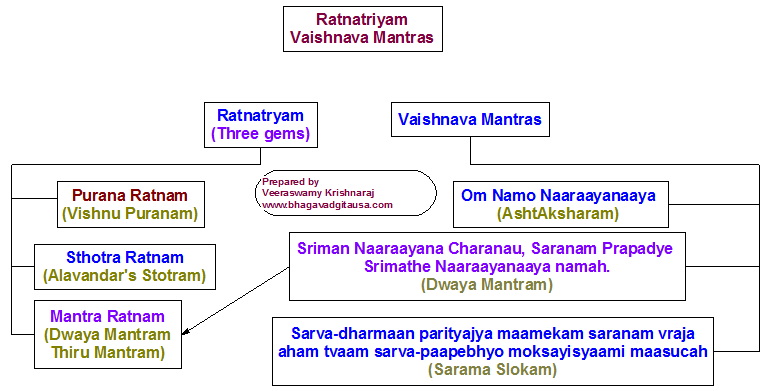
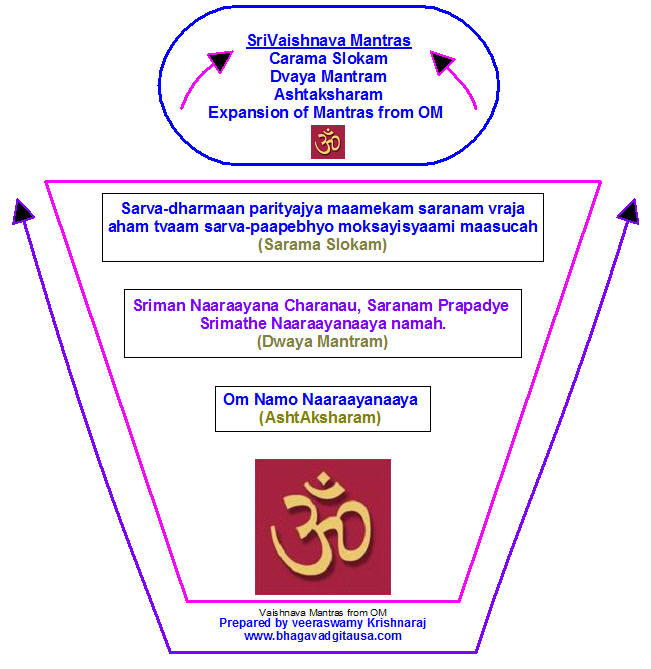
Om Namo Naaraayanaaya (ஒம் நமோ நாராயணாய)
Homage or obeisance to Lord Narayana
Comment:
This Thirumanthram consists of Pranavam and Manthrasesham: Om and Namo Naaraayanaaya. Sarama Slokam expands on Dwayam which expands on Manthrasesham which expands on Pranavam. Thus we have to learn Thirumanthram first. Pranavam and Namonarayana form the seed, root and trunk from which other Mantras branch out. Protection from a Mantra comes from its sound and meaning. MANTRA
SamsArikal or Chetanas (individual souls) forget Isvara Kainkaryam, the obligate state of servility of Seshas (Sishyas), and the Supreme State of Seshi (Krishna). To help the human race, Narayana took the form of the first Acharya Narayana and the first disciple Nara and taught Thirumanthram, the essence of Artha Panchakam. Since there were no Sishyas (disciples), he himself took the form of the disciple. The knowledge gained by Thirumanthram is easy like an inheritance and unlike the hard-earned wealth.
Narayana's Kalyana gunas, avataras, Mantras are endless. There are two kind of Mantras: Vyapaka Mantras speak of his limitless and pervasive form and the other Avyapaka Mantras speak of some gunas, some lilas. Vyapaka Mantras are superior to avyapaka Mantras. Ashtakshari, dvAdasAkshari and Shadakshari Mantras referring to Narayana, Vasudeva and Vishnu namas are the three higher Mantras.
Here are the three important Vyapaka mantras:
1. Om Namo
Narayanaya
2. Om Namo Bagavade Vasudevaya
3. Om Namo Vishnave
Of these three, the first one Poorna (complete) Mantra because Narayana pervades all, supports all, is the means (UpAyam) and the end (upEyam). This Maha Mantra is endorsed by Rishis, Vedas, Alvars, and Acharyas. Between the seed and the fruit, seed is greater. Likewise between Vaacya and Vaacaka (meaning and the word) meaning is more important; thus, the mantra is greater than Him. Others regard that the Lord is greater than his mantra, because he is the means and the goal.
All life forms take birth in this world of Samsara and misery; the ultimate goal is Moksa, centripetal movement of the soul to the Fountainhead. Artha Panchakam consisting of five elements is contained in the three rahasyas (secrets).
1. The Nature of God, 2. The nature of Jiva, 3. the means to gain salvation, 4. the nature of the goal, 5. the impediments. (collectively known as Arththa Panchakam.)
Understanding these elements is important for the Mumukshus (those who are eager for salvation).
Mumukshu = muktham + icchu = liberation + desire = one who desires liberation.
The soul is a slave and its only refuge is Him. Pranavam establishes the nature of the soul. The nama establishes the knowledge that soul does not have independence. Narayanaya is the goal.
Pranavam defines Seshatvam, nama PArathanthryam, NArAyaNAya Kaimkaryam. Acharyas call Om as Pranavam because of ubiquitous availability of Om from texts... Pranavam as part of mantra is available only in Acharya-Sesha transmission. Pranavam is AUM. A, akAram stands for the cause and the protector.
Impediments:
Baddha Samsaris ((பத்தம்--bond, tie) ; சமுசாரி--on who pursues worldly life). They have to grapple with everyday problems and needs for food, clothes and shelter. They have to contend with enemies and competitors. They are tied down to their family, friends and relatives. They seek relief from such needs as mentioned above.
Mumukshus: They are averse to the Samsaric misery and want to attain the abode of God. They don't seek rebirth; living in this world with the body is an impediment. They want to break the cycle and seek the feet of Narayana in Vaikuntham.
Muktas: They have broken the ties of Samsara, dissolved their karma, and reached the feet of Narayana. They don't want to break the service they do at His feet in Vaikuntham. Their impediment is anything that breaks their service to Narayana.
Nithyasuris: They are the permanent residents in Parmapadam always rendering service to the Lord. They don't brook any impediment in their service.
Dwayam (Saranagati Mantra / Mantra Ratnam) consists of two lines. It is compared to six-legged bees.
(1. SrIman nArAyaNa charaNau , 2. SaraNam. 3. PrapadyE.4.SrImathE. 5.nArAyaNAya 6.namah)
ஸ்ரீமந்நாராயண சரணௌ சரணம் ப்ரபத்யே
ஸ்ரீமதே நாராயணாய நம:
Sriman1 Naaraayana2 Charanau3, Saranam4 Prapadye 5
Srimathe6 Naaraayanaaya7 namah8.
Sriman1 Narayana2 feet3 surrender4 fall down5
Srimathe6 Narayanaya7 obeisance8
Sriman Narayana, I fall down and surrender at your feet
Sriman Narayana, my obeisance to you.
Comment:
I hold Lakshmi-associated Narayana's feet as the object of my surrender.
It is on account of Lakshmi-associated Narayana.
Dwaya Mantra has two lines and a total of six words. It condenses a ten-point reference as follows:
- Goddess Lakshmi is the mediator between the Jiva and the Lord
- They are the divine couple, always together.
- The Lord is of auspicious nature.
- His form is divine.
- His feet are the means of liberation from the world of Samsara.
- We accept His feet as the means of liberation.
- Lakshmi and Narayana are our goal.
- His control and power are inimitable.
- We worship Him.
- We destroy the inimical stance of “I and Mine,” the enemies of our soul.
SrIman nArAyaNa charaNau
= Sri Lakshmi, the auspicious Narayana- His
divine feet
SaraNam = take refuge (His feet are the refuge of
Chetanas (souls) and the means for liberation.
prapadyE = fall at His feet (We accept His feet as
the refuge.)
SrImatE = Lakshmi (and) Lakshmi of the form
mercy, and mediator between Narayana and the Chetanas
nArAyaNAya = Narayana, the supporter and maintainer.
aya = wishing an impeccable service.
nama: = not mine. This destroys the attitude of "I
am the doer, enjoyer, knower and the only devotee."
Nammazvaar says in Thiruvaaymozi (6.10.10) 3559.
1. அகலகில்லேன் இறையும் என்று அலர் மேல் மங்கை உறை மார்பா 2. நிகர் இல் புகாய் உலகம் மூன்று உடையாய் என்னை ஆள்வானே 3. நிகர் இல் அமரர் முனிக் கணங்கள் விரும்பும் திருவெங்கடத்தானே 4. புகல் ஒன்று இல்லா அடியேன் உன் அடிக்கீழ் அமர்ந்து புகுந்தேனே
O Lord! You have the inseparable Lotus-Lady on your chest. She has no intention of leaving her abode. He (the BhAgavatA) says that he has no other refuge but You. You are of inimitable fame. You create and protect the three worlds. You are my ruler. You abide in Tiruvenkatam, very much liked by Munis and Devas. I the Adiyen, not having any other refuge, seek refuge at your feet. You offer me refuge and grant me Arul (grace). AdiyEn = one who serves at the feet of Narayana, his BhAgavatA or the latter's feet and so on.
Sarama Slokam
Sarva-dharmaan parityajya maamekam saranam vraja
aham tvaam sarva-paapebhyo moksayisyaami maasucah
சர்வ தர்மாந் பரித்யஜ்ய மாம் ஏகம் ஸரணம் வ்ரஜ
அஹம் த்வா ஸர்வபாபேப்யோ மோக்ஷயிஷ்யாமி மாஸூச:
All dharmas abandoning unto Me Only surrender go
I you from all sinful acts (and their fruits) relieve. Don't worry.
Sarva-dharmaan1 parityajya2 maam Ekam3 saranam 4 vraja5
aham6 tvaam 7 sarva8-paapebhyo9 moksayisyaami 10 maa sucah11
All dharmas and actions1 abandon2; only unto me3 surrender4 go5
I6 you7 all8 from sin9 deliver10 not worry11
18.66: Abandoning all duties, surrender unto Me only. I shall deliver you from all sins. Do not lament. Thus says Bhagavan Krishna to Arjuna.
Comment.
This is one of the most celebrated statements of Krishna and the final Sarama Slokam meaning that it is the verse that teaches the meaning of attaining final bliss. It is the Maha Mantra of Krishna. What it means is that a devotee can give up daily injunctions of the nature of Yagnas, difficult to pursue in Kali Yuga. What a devotee can attain in terms of benefits by Yagnas can be obtained just by uttering His sacred names by way of Sahasranamam.
Abandoning all daily duties means NOT giving up Sandyavandanam (and Mātyānikam-- Rites performed by the twice-born daily at noon-- but performance of Yagnas (Sacrificial worship). Uttering the names of Bhagavan gives three kinds of benefits: Dhrista Balam, Adhrista Balam, and Dhrishtādhrishta Balam. Dhrishta Balam is the benefit open for all to see. Adhrishta Balam is the benefit derived by the devotee from Bhagavan with His invisible hand. The third one is a combination of the previous two.
Surrender to the Lord has its own advantages. Saranagata Raksa is surrender-protection and God is Saranagata Raksakan (Surrender-protector). When a king surrenders to an emperor, the latter accepts the surrender, forgives and forgets all enmity and animosities of the surrendering king and offers him protection from other enemies. If you go to Bhagavan with all sincerity, devotion and love and surrender exclusively to him, the Only One, he forgives all your sins and gives you Moksa. There are several examples of Saranagata Raksa.
Indra’s son Jeyandan behaves very ignominiously towards Sita. (He in the form of a crow pecks at the breasts of Sita.) Rama uses Brahmastaram (Brahma's missile weapon system) on Jeyandan who morphs into a crow. Unsupported by Indra and the Holy triumvirate, he flies from town to town, from house to house. The missile follows him wherever he goes. (That is one Smart Weapon!) Jeyandran having been given up by the powerful now seeks refuge in ordinary households. All turn their backs to the Crow-demon. Later he comes back to Rama and seeks Saranagati Raksa. His feet are pointing to Rama and head is on the other end, not a proper position of the body in Saranagati. Sita, the victim of abuse, in her Motherly mercy turns his head towards Rama. Thus Sita, insulted and abused by Jeyandan, helps him attain Saranagati Raksa. Rama took his sight from one eye and that is the reason why the crow tilts its head to see. Since then the crow started talking in Sanskrit (believe it or not). When you dry your clothes on the backyard clothesline, the crow sits on the wall and cries Ka and KA. Ka means who is he (evan-எவன்) and Kā means who is she (எவள்). He and She are Rama and Sita. When the crow caws, it is asking the question who is the Saranagata Raksakan. It is saying எவன்-எவள் because Sita is the one who puts its head at the feet of Rama for the Kākāsuran (the Crow-demon) to ask for Saranagata Raksa from Rama. Sita helps the culprit to gain Raksa. The one who gives Raksa or protection to the crow demon is Rama. Naturally the question is Ka and Kā .
In the same way Trisadai asked for Saranagata Raksa at the feet of Sita; that made Sita prevent Hanuman from destroying all the Raksasis. Rama offered Saranagata Raksa to Vibhisana. Saranagata Raksam destroys all sins. Saranagati Vidyai (சரணாகதி வித்யை) is the superior form as illustrated by Vibhishana Saranagati (விபீஷண சரணாகதி). Bhakti yoga may not confer Moksa in this birth; it may take one or more future births to attain Moksa. But Saranagati to the Lord immediately destroys all demerits (பாபம்) and confers Moksa.
There are four kinds of Saranagati: Ukti Nishta, Suva Nishta, Acharya Nishta, and BhAgavata Nishta. Nishta = abiding in firm meditation; Ukti = action done as told; Suva = Self without outside help; Acharya = Vaishnava spiritual preceptor, Guru; BhAgavata = Great devotee of Vishnu. Many use the terms Saranagati and prapatti interchangeably.
Ukti Nishta: The qualified aspirant receives a mantra from the Guru and surrenders to Bhagavan.
Suva Nishta: This is Self surrender by pure souls without outside help from Guru or Acharya. One example is Ramanujacharya. These are highly evolved souls.
Acharya Nishta: Here Surrender is obtained through Acharya who worships Bhagavan by chanting Mantra on behalf of the aspirant.
BhAgavata Nishta: Tried and true devotees of Bhagavan can introduce the aspirant to Bhagavan and implore Saranagata Raksa (surrender protection) on behalf of the aspirant.
The beauty about Saranagatti/Prapatti Raksa is there is no bar on any one based on external inequities.
He who accepts God (Krishna / Narayana) as his sole (only) refuge= prapannan = பிரபன்னன்.
21 (494).
Please wake up, O son of prosperous owner of big generous cows, which without interruption yield milk brimming over the top of the milk pots. O the Strong One, O the Great One, in this world you incarnated like an effulgent Light. Please wake up from your sleep. You sapped the strength of your enemies who fall at your feet with humility; in like manner we worship and praise you. Let us do the Pavai Nombu.
ஏற்ற கலங்கள் எதிர் பொங்கி மீது அளிப்ப மாற்றாதே பால் சொரியும் வள்ளல் பெரும் பசுக்கள் ஆற்றப் படைத்தான் மகனே! அறிவுறாய் உற்றம் உடையாய்! பெரியாய்! உலகினில் தோற்றமாய் நின்ற சுடரே! துயில் எழாய்; மாற்றார் உனக்கு வலி தொலைந்து உன் வாசல் கண் ஆற்றாது வந்து உன் அடி பணியுமா பொலே போற்றி யாம் வந்தோம் புகழ்ந்து ஏலோர் எம்பாவாய் (21) |
ஏற்ற கலங்கள் எதிர் பொங்கி மீது அளிப்ப
ERRa kalaNGkaL ethir poNGki mIthu aLippa
Milk cans brimming over the top
மாற்றாதே பால் சொரியும் வள்ளல் பெரும் பசுக்கள்
maaRRaathE paal coriyum vaLLal perum pacukkaL
without interruption milk yielding generous big cows
(big generous cows yield milk without interruption)
ஆற்றப் படைத்தான் மகனே! அறிவுறாய்
aaRRap pataiththaan makanE! aRivuRaay
abundant (cows) son (of Nandagopan)! come to know (get up from your bed)
(many cows, O son of Nandagopan! Please wake up from your bed.)
உற்றம் உடையாய்! பெரியாய்! உலகினில்
URRam utaiyaay periyaay ulakinil
O Strong One, O Great One, in this world
தோற்றமாய் நின்ற சுடரே! துயில் எழாய்;
thORRamaay ninRa cutarE thuyilezhaay;
incarnated standing O Brilliance! (from) sleep wake up.
You incarnated O Effulgence (Beacon Light), please wake up from sleep.
மாற்றார் உனக்கு வலி தொலைந்து உன் வாசல் கண்
maaRRaar unakku vali tholainthu un vaacal kaN
your enemies lost their strength to you. door entrance
ஆற்றாது வந்து உன் அடி பணியுமா பொலே
aaRRaathu vanthu un ati paNiyumaa pOlE
unable to bear (the loss of strength) your feet surrendering as if (like that)
your enemies unable to bear the loss of strength to you surrender at your feet; in like manner
போற்றி யாம் வந்தோம் புகழ்ந்து ஏலோர் எம்பாவாய்
pORRi yaam vanthOm pukazhnthu ElOr empaavaay
worship we have come praise Let us do Pavai Nombu
(Like the defeated enemies) we worship and praise you. Let us do Pavai Nombu.
in this verse, Andal depicts Nila joining the Gopis, who praise Krishna as the son of Nandagopala who is rich in cattle wealth and milch cows which yield abundant milk. They eulogize the Bhagavad gunas of Krishna as in Sahasranamam. In fact thousand eulogies merely show the limitation of human mind; His gunas are much more, waiting to be discovered.
Acharyas are the cows. All the Alvars belong to this group. The milk is wisdom; the brimming milk pots are the realized devotees full of spiritual wisdom.
Milk is also the divine Grace of Krishna. Very many lesser gods and demons opposed and fought against him. Their defeat and or death always confer grace on them.
The Gopis along with Nappinnai join to wake up Krishna. Krishna the son of Nanda is the manifest form of Vedas and a living proof of their divine authenticity. He is the Light which illuminates the sun, the moon, the stars, all lustrous objects. He as Paramatman is the shining Light of the soul. Gopis talk about his ten incarnations with a joust saying that He is there with them in a human form and they need Him. He is in Yogic sleep, very aware of what is happening outside with the Gopis.
The generous milch cows are the munificent Acharyas who overflow with Jnanam and offer it to their disciples.
வள்ளல் பெரும் பசுக்கள்: generous big cows: refers to the Acharyas.
உலகினில் தோற்றமாய் நின்ற: Vishnu's physical manifestation (10 Avatars) in the world.
சுடர்: Brilliance, effulgence: refers to Antayamin, (inner witness), Antaratman (Inner Self), Paramatman (Supreme Atman).
மற்றார்: enemies or those who oppose Krishna in war and or sattvic principles; Prathikulars.
மாற்றார் உனக்கு வலி தொலைந்து உன் வாசல் கண்
maaRRaar unakku vali tholainthu un vaacal kaN
your enemies lost their strength to you. door entrance
ஆற்றாது வந்து உன் அடி பணியுமா பொலே
aaRRaathu vanthu un ati paNiyumaa pOlE
unable to bear (the loss of strength) your feet surrendering as if (like that)
your enemies unable to bear the loss of strength to you surrender at your feet; in like manner
பொற்றி யாம் வந்தோம் புகழ்ந்து ஏலோர் எம்பாவாய்
pORRi yaam vanthOm pukazhnthu ElOr empaavaay
worship we have come praise Let us do Pavai Nombu
(Like the defeated enemies) we worship and praise you. Let us do Pavai Nombu.
When Krishna drains and saps the strength of the enemies, in humility and remorse they fall at the feet of Krishna. Likewise Gopis lose their ego and fall at his feet. This is total surrender. Saranagati = (Saranam = refuge) + (aagathi = coming) == coming of refuge. Bhagavan is the only protector; that is the upAyam or means of the Prapannan (he who accepts Bhagavan as his sole refuge). Charanagati = condition of falling at the feet.
Saranagathi
A Prapannan accepts Bhagavan as the sole refuge, takes an Acharya, becomes conversant to the five angas of Prapatti and gives the total responsibility for his protection to Bhagavan. Prapatti has three elements in it:
1. one’s Atma is dependent and subservient to Bhagavan (svarupa samarpanam),
2. one surrenders himself to the protection of Bhagavan (bhara samarpanam),
3. one surrenders all the fruits of existence (phala samarpanam).
svarupa = natural state of quality, nature.
Bhara Samarpanam = bhara = load; samarpanam = dedication, offering. This consists of five angas:
1. AnukUlya Samkalpam (friendly disposition, will, purpose). Performing god-pleasing acts.
2. PratikUlya Varjanam ( praticUlya = unfavorable; varjanam = avoiding) = avoiding displeasing acts.
3. KArpaNyam = pitiful circumstances. Conditions are so pitiable that he cannot protect himself.
4. MahavisvAsam = Great faith that Bhagavan will protect him. VisvAsam = faith.
5. GoptRtva VaraNam = preserve and protect + wishing, wooing, praying. Praying to Bhagavan to protect him.
SAttvika TyAgam: virtuous sacrifice of self-interest. BhagavAn is the owner, enjoyer, doer and so all efforts and fruits belong to (are sacrificed to) BhagavAn. That is the road to liberation or Moksa. This has three components.
- kartRtva tyAgam: privilege of doing an act + sacrifice. God is the doer and uses us as his instrument. It is His act.
- mamatA tyAgam: self-conceit, vanity + sacrifice. One should not have self-conceit and think that doership and fruits are his.
- phala tyAgam: fruit + sacrifice. All fruits go to Him and one des not consider the fruits belong to him.
A Prapanna worships BhagavAn hoping that He will grant Moksam when his body falls and life leaves him. All acts should be in conformity with Sastras. One performs BhAgavad Kainkaryam until his last breath leaves him. The Prapannan prays to BhagavAn for the following:
- tvat seshatva sthira dhiyam = mental firmness in the service of BhagavAn.
- tvat prAptyeka prayojanam = Attaining BhagavAn as the goal
- nishida kAmya rahitam = giving up unbecoming acts
- Nitya kinkaram= continual service (to BhagavAn, Acharya, and fellow devotee)
Obligations and rewards to Prapannan.
1. Service to Sri Devi, Bhu Devi, and Nila Devi
2. All his possessions, self, Chit, Achit, Atma, near and dear in the service of BhagavAn.
3. seeking BhagavAn’s protection from doing acts of sin and past sins.
4. Seeking forgiveness for all Prarabdha karmas, commissions and omissions in Sastric injunctions.
5. Doing Kainkaryam in this world till the last day when BhagavAn allows merger of Prapannan with Him in Vaikuntham.
22. (495).
The beautiful kings of the big countries with a sense of self-conceit, having been defeated, were coming in an assembly towards your sleeping bed. Likewise, we are headed towards you. Won't you cast your beautiful eyes little by little like the bell-mouthed lotus flowers gradually open their petals? Won't you look at us with your two beautiful eyes which look like the simultaneous rising of the moon and the sun? That will remove our sins. Let us do the Pavai Nombu.
அங் கண் மா ஞாலத்து அரசர் அபிமான பங்கமாய் வந்து நின் பள்ளிக் கட்டிற் கீழே
சங்கம் இருப்பார் போல் வந்து தலைப் பெய்தோம் கிண்கிணி வாய்ச் செய்த தாமரைப் பூப் போலே செங் கண் சிறுச் சிறிதே எம்மேல் விழியாவோ திங்களும் ஆதித்தியனும் எழுந்தாற் போல் அங் கண் இரண்டும் கொண்டு எங்கள் மேல் நோக்குதியேல் எங்கள் மேல் சாபம் இழிந்து ஏலோர் எம் பாவாய் (22) |
அங் கண் மா ஞாலத்து அரசர் அபிமான
ang kaN maa gnaalaththu aracar apimaana
beautiful this big
world kings with a sense of honor (and self-respect)
(The beautiful kings
of the big world with a sense of self-conceit)
பங்கமாய் வந்து நின் பள்ளிக் கட்டிற் கீழே
pangkamaay vanthu nin paLLik kattiR kIzhE
defeat (and disgrace) came to your sleeping bed under
having been defeated, came to your sleeping bed
சங்கம் இருப்பார் போல் வந்து தலைப் பெய்தோம்
cangkam iruppaar pOl vanthu thalaip peythOm
assembly remain in like that have come headed towards you
and assembled and headed towards you.
கிண்கிணி வாய்ச் செய்த தாமரைப் பூப் போலே
kingkiNi vaayc ceytha thaamaraip pUp pOlE
bells' mouth like lotus flower like
like small blossoming bell-like corolla of lotus flowers
செங் கண் சிறுச் சிறிதே எம்மேல் விழியாவோ
ceng kaN ciRuc ciRithE emmEl vizhiyaavO
beautiful eyes little by little on us won't you caste your glance
Like the beautiful bell-like flowers open their buds, little by little won't you cast
your beautiful eyes (glance) on us.
திங்களும் ஆதித்தியனும் எழுந்தாற் போல்
thingkaLum aathiththiyanum ezhunthaaR pOl
the moon the sun rising like that
as if the moon and the sun rose together (in the sky) simultaneously
அங் கண் இரண்டும் கொண்டு எங்கள் மேல் நோக்குதியேல்
aNG kaN iraNtum koNtu engkaL mEl nOkkuthiyEl
those eyes two together us on if you look
(if you look at us with both eyes)
எங்கள் மேல் சாபம் இழிந்து ஏலோர் எம் பாவாய்
engkaL mEl saapam izhinthu El Or empaavaay
us on curse (Papam) loose. Let us do Pavai Nombu.
(all sins will vanish)
Comment:
அபிமானம்: self-conceit, self-respect, sense of honor. பங்கம் = defeat, defect, disgrace.
When a king suffers அபிமான பங்கம், he becomes subservient to the victorious king; likewise, the Gopis approach Krishna in a servile manner. What they lost was their EGO. Andal advances the premise of servility of man to God.
Becoming servile to God is loosing the delusions that afflict man.
1. Delusion that body is soul.
2. Delusion that one is independent and self-directing
3. Delusion that we serve someone other than Narayana.
4. Delusion that relatives other than Narayana help us.
5. Delusion that Moksam is attainable by means other than devotion and surrender.
6. Delusion that worldly pleasures are permanent.
7. Delusion that we are the doer by our own motivation and power.
8. Delusion that irreverence to BhAgavatAs goes unnoticed by Narayana.
Once man gets rid of this eight-fold delusion, he attains தத்துவஞானம் (TatthuvaJnanam), knowledge of ultimate Truth.
நின் பள்ளிக் கட்டிற் கீழ = pangkamaay vanthu nin paLLik kattiR kIzhE = having been defeated, came to your sleeping cot
சங்கம் இருப்பார் போல் வந்து தலைப் பெய்தோம்= cangkam iruppaar pOl vanthu thalaip peythOm =
and assembled and headed towards (the foot of the bed).
Standing at the foot of the cot is an allusion to servility. One has to loose his or her ego before one approaches God. Arjuna and his opponent Duryodhana sought the help of Krishna in the war against each other. They took positions at the bed of sleeping Krishna, Arjuna at the foot of the bed and Duryodhana at the head of the bed. When Krishna opened his eyes, his glance fell on Arjuna and not on Duryodhana. Arjuna received Grace and opted to have Krishna on his side, while Duryodhana opted for the army of Krishna. Arjuna the recipient of Grace won the battle, while Duryodhana lost. Gopis refer to this incident when they say that they stand at the foot of the bed.
Seshatva/Seshatvam: exclusive servitude of devotee to Krishna. Ramanuja defines Seshatva as the ontological relationship between God and universe consisting of Chit and Achit (sentient souls and insentient matter). It means servitude (Daasa, slave) of man to God, his dependence, subservience and servility. A devotee identifies himself as adiyen (your slave, your humble servant, your foot-man, one at Your beck and call).
BhAgavata Seshatva means Chetanam (சேதனம்--sentient soul) is subordinate to Vishnu's devotees. Tiruvaimozhi (Decads 3.7 and 8.10) advances this premise. Whoever they may be, whatever their birth caste is, and as long as they are the true devotees of lotus-eyed Paraman (Supreme Being, Vishnu), they are worthy of ruling me (slave) in all my lives. (They are worthy of being my master). They who worship Vishnu with his hands and feet (Sashtanga Namaskaram) are my masters or swamis. Tirumangai Azvaar considers the Bhaagavataas superior to even Nityasuris.
Sashtanga Namaskaram = Prostration by touching ground with the eight limbs: two hands, two knees, two shoulders, chest and forehead.
Sesin (SEshi) is God and uses Sesa (SEsha) for His purpose. Sesa exists for the purpose of God.
More on SEshi and SEsha
SEshatvam is svarUpam (ஸ்வரூபம்--natural state) for us; SEshitvam is svarUpam for BhagavAn. We are SEsha and He is SEshi. SEsha is DAsa (Slave); SEshi is Master. The relationship between SEshi and SEsha is PArathanthiriyam (பாரதந்திரியம்): absolute dependence. It means that you assume the role of an object or a piece of furniture willing to be moved at the behest and hands of the Master. SEsha (DAsa or slave) cannot say he cannot be moved around, the way SEshi wants.
கிண்கிணி வாய்ச் செய்த தாமரைப் பூப் போலே
kingkiNi vaayc ceytha thaamaraip pUp pOlE
like small blossoming bell-like corolla of lotus flowers
செங் கண் சிறுச் சிறிதே எம்மேல் விழியாவோ
ceng kaN ciRuc ciRithE emmEl vizhiyaavO
little by little won't you cast your beautiful eyes on us.
செங் கண் = beautiful eyes; alternately red eyes.
Here, the Gopis are asking Krishna to open his beautiful eyes ever so slightly and more so gradually like the slowly opening of lotus flowers to cast his eyes on them and confer them the most precious gift of all, His Grace.
திங்களும் ஆதித்தியனும் எழுந்தாற் போல் = thingkaLum aathiththiyanum ezhunthaaR pOl
as if the moon and the sun rose
அங் கண் இரண்டும் கொண்டு எங்கள் மேல் நோக்குதியேல்
aNG kaN iraNtum koNtu engkaL mEl nOkkuthiyEl
those eyes two together us on if you look
those two eyes looking at us
எங்கள் மேல் சாபம் இழிந்து ஏலோர் எம் பாவாய்
engkaL mEl saapam izhinthu El Or empaavaay = our curse will vanish. Let us do Pavai Nombu.
The moon's cool rays bring joy, grace and illumination, which is euphemism for onset of illumination or attaining of superconsciousness in a Yogi. The sun's rays dispels darkness of Avidya (spiritual ignorance). Moon and Sun both together compared to the eyes of God bring grace, joy, illumination and dispelling of ignorance. Once they receive the wide-eye look from both eyes of Krishna, all karmas will vanish with the result they attain Moksa. Side glances are also celebrated as dispelling of darkness and conferment of Grace. The Gopis want fully open-eye straight look instead of a side glances which can be mistaken for amorous advances. Reciting this PAsuram (பாசுரம்--sacred poem) daily eliminates all PApams (பாபம்--sins)
23.(496).
O Lord of kAyAm flower complexion, You appear like the cohabiting great lion during the rainy season getting up from sleep in the mountain cave; emitting sparks while opening the eyes; moving, shaking and puffing up the mane; stretching the body in all directions; roaring majestically and starting out. Please come down from the temple, sit on the great throne, make an appearance in the Mandapam, enquire and examine the purpose of our visit and confer your Grace on us. Let us perform Pavai Nombu.
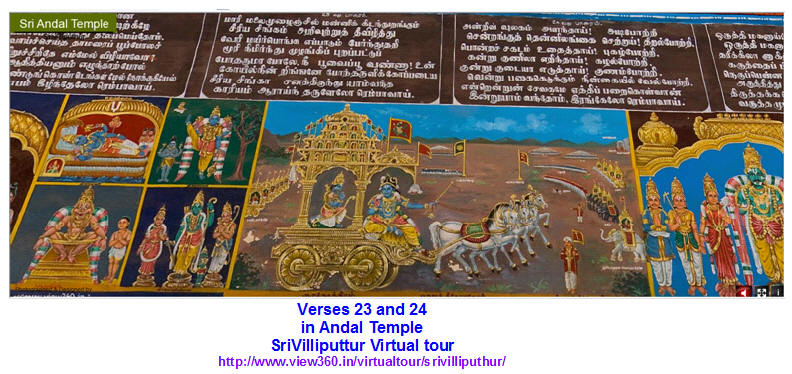
மாரி மலை முழைஞ்சில் மன்னிக் கிடந்து உறங்கும் சீரிய சிங்கம் அறிவுற்றுத் தீ விழித்து வேரி மயிர் பொங்க எப்பாடும் பேர்ந்து உதறி மூரி நமிர்ந்து முழங்கிப் புறப்பட்டுப் போதருமா போலே நீ பூவைப் பூவண்ணா உன் கோயில் நின்று இங்ஙனே போந்தருளி, கோப்பு உடைய சீரிய சிங்காசனத்து இருந்து, யாம் வந்த காரியம் ஆராய்ந்து அருள் ஏலோர் எம்பாவாய் (23) |
மாரி மலை முழைஞ்சில் மன்னிக் கிடந்து உறங்கும்
maari malai muzhaigncil mannik kitanhthu uRangkum
during rainy season, mountain
cave cohabiting sleeping
சீரிய சிங்கம் அறிவுற்றுத் தீ விழித்து
cIriya cingkam aRivuRRuth thI vizhiththu
beautiful lion waking up emitting sparks opening eyes
beautiful lion waking up with sparks emitting from the eyes
வேரி மயிர் பொங்க எப்பாடும் பேர்ந்து உதறி
vEri mayir pongka eppaadum pErnhthu uthaRi
mane hair puffed up all sides moving and shaking
மூரி நமிர்ந்து முழங்கிப் புறப்பட்டுப்
mUri nimirnhthu muzhaNngkip puRappattup
greatness straightening roar  starting Started (to leave
the cave) after straightening  and roaring majestically
போதருமா போலே நீ பூவைப் பூவண்ணா உன்
pOtharumaa pOlE nI pUvaip pU vaNNaa un
going like that you KAyAm flower-colored you ( going like that, O
Lord, you are of the color of of KAyAm flower. You)
கோயில் நின்று இங்ஙனே போந்தருளி, கோப்பு உடைய
kOyil ninRu iNGNGanE pOnhth aruLi kOppu udaiya
temple standing in this place come grace having (stand in the temple and confer Grace)
சீரிய சிங்காசனத்து இருந்து, யாம் வந்த
cIriya cingkaacanaththu irunhthu yaam vanhtha
Great throne sitting you coming
sitting on the throne. your coming
காரியம் ஆராய்ந்து அருள் ஏலோர் எம்பாவாய்
kaariyam aaraaynhthu aruL ElOr empaavaay
purpose examine grace. let us do the Pavai Nombu.

Comment:
Andal describes in this PAsuram (sacred poem) the majestic leonine Krishna who has already woken up from sleep and gave them a glance of grace. Sleeping lion refers to Lakshmi Narasimha-Vishnu in yogic sleep. The Gopis call him பூவண்ணா (கயாம் பூ கண்ணா), the One who is of the blue color of KAyAm flower. This epithet describes Krishna as the fully blossomed Jnani of Jnanais-- AtmaJnanai.
Earlier he was யசோதை இளம் சிங்கம் (Yasodai's young lion cub, the child Krishna). Andal exquisitely describes the leonine Krishna getting up and striding out; you can see the whole scene in your mind very vividly.
Krishna has four kinds of gait according to Jnana Acharya Swamy: the gait of a bull, an elephant in rut, a tiger and a lion.
Death by intelligent design
The lion motif in this PAsuram is a reference to Lakshmi Narasimhan, the man-lion Avataram of Vishnu. Hiranyan forbade all his subjects including his son Prahalada to cease and desist from worshipping Vishnu and promulgated that he was their God, entitled for their worship. Hiranyan tried to kill his son, a staunch devotee of Vishnu by pushing off the cliff, making an elephant trample him, goring him with spears, poisoning him, and throwing him in a pit of venomous snakes. Hiranyan received a boon from Brahma by austere penance that he could not be killed by man, animal, or god, by day or night, on earth or space, in fire or water, inside or outside, or inanimate or animate object.
This Man-Lion, a chimera, is a special adaptation of Vishnu, specifically self-created by Him to address, frustrate and neutralize the inviolable Varam (boon). Hiranyan challenged his son whether his God was in the pillar of the palace. Prahalada said, "Yes, He is in the pillar, here, there and everywhere." His God emerged from the pillar. Hiranyan's death came in the form of a chimerical man-lion at the fateful infinitesimal nanosecond at twilight (no man's land in time), on the thighs of Lord Narasimha, at the threshold between palace and courtyard and by the weapon, the nail of Man-Lion. Narasimhan destroys the enemy and gives his devotee grace. The Prahalada's story epitomizes the abiding faith (விஸ்வாசம்) of Prahalada in Vishnu being the all-pervasive Being. Narasimha is great great PerumAl (பெரிய, பெரிய பெருமாள்).
Man-Lion is not an animal, man or God.
The time of death is neither day nor night.
His death was neither on earth nor in space, but on the thighs of Narasimha.
Death came neither by water nor by fire.
Death came at the threshold, neither inside nor outside the palace
Death is by nail, neither animate or inanimate.
Periyaazvaar (பெரியாழ்வார்) sings the glory of Narasimha in the following PAsuram:
அளந்திட்ட தூணை அவண் தட்ட ஆங்கே| வளர்ந்திட்டு வாளுகிர் சிங்க உருவாய்| உளந்தொட்டு இரணியன்
ஒண்மார்வகலம்| பிளந்திட்ட கைகளால் சப்பாணி...
Apostate Hiranyan ordered his subjects to worship him as their God. Hiranyan asked his son Prahalada, whether his God is in the column supporting the palace. Prahalada said, "Yes." To prove that He is everywhere, Narasimha came out of the column, split Hiranyakasipu and killed him. The reason why the Lord killed him was due the fact that Prahalada underwent many unspeakable atrocities in the hands of his father because of his belief in Vishnu-Lakshmi-Narasimha. When the lions roar, they utter, "Om Narasimhaya nama." (Om obeisance to Lord Narasimha).
24 (497).
That day you strode the world; we worship your feet. Going to south Lanka, you vanquished Ravana; we praise your strength. You destroyed the cart-wheel demon; we praise your fame. You threw the calf-demon like a javelin; we worship your feet. You held the mountain as an umbrella; we praise your good nature. We praise the spear held in your hand and used to win and destroy enemies. We extol your services to obtain refuge from you. Today we have come; please show mercy; Let us do Pavai Nombu.
அன்று இவ் உலகம் அளந்தாய் அடி போற்றி சென்றங்குத் தென் இலங்கை செற்றாய் திறல் போற்றி பொன்றச் சகடம் உதைத்தாய் புகழ் போற்றி கன்று குணிலாய் எறித்தாய் கழல் போற்றி குன்று குடையாய் எடுத்தாய் குணம் போற்றி வென்று பகை கெடுக்கும் நின் கையில் வேல் போற்றி என்றென்று உன் சேவகமே ஏத்திப் பறை கொள்வான் இன்று யாம் வந்தோம் இரங்கு ஏலோர் எம் பாவாய் (24) |
அன்று இவ் உலகம் அளந்தாய் அடி போற்றி
anRu ivv ulakam aLanhthaay ati pORRi
That day this world measured (strode) feet worship
We worship those feet that strode this world.
சென்றங்குத் தென் இலங்கை செற்றாய் திறல் போற்றி
cenRangkuth thenn ilaNGkai ceRRaay thiRal pORRi
going there south Lanka vanquished strength praise/worship
Going to south Lanka you vanquished Ravana; We praise your strength.
பொன்றச் சகடம் உதைத்தாய் புகழ் போற்றி
ponRac cakatam uthaiththaay pukazh pORRi
destroy cart-wheel kicking fame praise
You destroyed the Cart-demon by kicking the wheel; We praise your fame.
கன்று குணிலாய் எறித்தாய் கழல் போற்றி
kanRu kuNilaa eRinhthaay kazhal pORRi
calf javelin threw feet worship/praise
You threw the calf-demon as if it is a javelin; We worship your feet.
குன்று குடையாய் எடுத்தாய் குணம் போற்றி
kunRu kudaiyaay eduththaay kuNam pORRi
mountain umbrella raised and held nature worship
You held the mountain as an umbrella; we worship your good nature.
வென்று பகை கெடுக்கும் நின் கையில் வேல் போற்றி
venRu pakai ketukkum nin kaiyil vEl pORRi
win enmity destroy your hands spear worship
We praise the spear held in your hands and used to destroy the enemies.
என்றென்று உன் சேவகமே ஏத்திப் பறை கொள்வான்
enRenRu un cEvakamE Eththip paRai koLvaan
in all ways your service extol desires obtain
We extol your services to obtain refuge from you.
இன்று யாம் வந்தோம் இரங்கு ஏலோர் எம் பாவாய்
inRu yaam vanhthOm iraNGku ElOr empaavaay
today we have come mercy. Let us do Pavai Nombu.
Today we have come; please show mercy; Let us do Pavai Nombu.
Comment:
We worship those feet that strode this world. Going to south Lanka you vanquished Ravana; We praise your strength. You destroyed the Cart-demon by kicking the wheel; We praise your fame. You held the mountain as an umbrella; we worship your good nature. All these exploits of the Lord are described elsewhere in this article. Krishna carried a spear to kill the enemies.
The calf-demon and shot-putter Krishna: Krishna's uncle Kamsa sent Kapithasuran to kill Krishna. The Asuran morphed into a tree and tried to kill him by falling on Krishna, who pretended as if he did not know the evil intentions of the demon. In the meantime Vatsasuran took the form of a calf and tried to kill Him. Krishna picked up the hind legs of the calf-demon, tied them together, spun the calf several times and threw the calf on to the wood apple tree. The impact brought the demons back to their original form and they died instantly.
25 (498).
As one Lady's biological son, and on the same night another lady's adoptive son, you grew up in hiding. Kamsa, your maternal uncle having become intolerant of you was thinking of doing harm to you. His intent suffering from fault has induced fire in Kamsa's stomach. O Nedumal, we beg you for liberation. If you confer on us what we desire, we will sing your wealth worthy of Sri and valorous services. Thus, our sorrows come to an end, making us happy. Let us do Pavai Nombu.
ஒருத்தி மகனாய் பிறந்து ஓர் இரவில் ஒருத்தி மகனாய் ஒளிந்து வளரத் தரிக்கிலான் ஆகித்தான் தீங்கு நினைந்த கருத்தைப் பிழைப்பித்துக் கஞ்சன் வயிற்றில் நெருப்பென்ன நின்ற நெடுமாலே உன்னை அருத்தித்து வந்தோம் பறை தருதியாகில் திருத்தக்க செல்வமும் சேவகமும் யாம் பாடி வருத்தமும் தீர்ந்து மகிழ்ந்து ஏலோர் எம் பாவாய் (25) |
ஒருத்தி மகனாய் பிறந்து ஓர் இரவில்
oruththi makanaayp piRanhthu Or iravil
some lady as her son having been born one night
You took birth as the son of a Lady (Devaki) one night
ஒருத்தி மகனாய் ஒளிந்து வளரத்
oruththi makanaay oLiththu vaLarath
one lady as a son hiding having grown up
You became the adopted son of Yasoda in hiding and grew up.
தரிக்கிலான் ஆகித்தான் தீங்கு நினைந்த
tharikkilaan aakiththaan thIngku ninainhtha
the one without tolerance having become harm think of
Kamsa having become intolerant (of Krishna) was thinking of doing harm
கருத்தைப் பிழைப்பித்துக் கஞ்சன் வயிற்றில்
karuththaip pizhaippiththuk kagncan vayiRRil
his intent having been made faulty Kamsa's stomach
நெருப்பென்ன நின்ற நெடுமாலே உன்னை
neruppenna ninRa netumaalE! unnai
like fire standing O Nedumaal to you
அருத்தித்து வந்தோம் பறை தருதியாகில்
aruththiththu vanhthOm paRai tharuthiyaakil
to beg have come liberation if you confer
திருத்தக்க செல்வமும் சேவகமும் யாம் பாடி
thiruththakka celvamum caevakamum yaam paati
Lakshmi wealth and service we sing
வருத்தமும் தீர்ந்து மகிழ்ந்து ஏலோர் எம் பாவாய்
varuththamum thIrnhthu makizhnhthu ElOr empaavaay
sorrows coming to end becoming happy. Let us do Pavai Nombu.
Comment:
ஒருத்தி மகனாய் பிறந்து ஓர் இரவில்
oruththi makanaayp piRanhthu Or iravil
some lady as her son having been born one night
You took birth as the son of a Lady (Devaki) one night
ஒருத்தி மகனாய் ஒளிந்து வளரத்
oruththi makanaay oLinthu vaLarath
one lady as a son hiding having grown up
You became the adopted son of Yasoda in hiding and grew up.
Krishna's birth takes place in Mathura ruled by Yadava clan. King Vasudeva and Devaki are his parents. Vasudeva, the son of Surasena marries Devaki, daughter of Devaka. Following the wedding, Kamsa, the brother of Devaki, as the custom dictates, serves as the charioteer and takes Vasudeva and Devaki to their palace by a chariot. The chariot leads a dowry procession of hundreds of elephants, thousands of horses, many chariots, many attendants and girl friends of Devaki, a melee of well wishers, a throng of musicians, and a medley of musical sounds. Out of the clear blue sky comes a thundering voice addressing Kamsa, "O fool of fools, you don't even know that the eighth child of your sister will kill you." Upon hearing the prophetic voice from the sky, demonic Kamsa turns his head around and grabs Devaki's hair. Vasudeva comes to Devaki's rescue immediately and tells Kamsa, "O Brother in law, there is no need to kill her now; no one knows that she will bear sons. You are safe from your sister and I will give you all the sons, if any are born in the future." Kamsa, knowing the honesty and integrity of Vasudeva, drives them to their palace. In course of time Devaki gives birth to eight male infants and one girl. Vasudeva, keeping his promise, brings the first born son to Kamsa. Knowing that the first born is not going to be his killer, he asks Vasudeva to take the child back. But Narada Muni informs Kamsa that there is an imminent birth of gods in the family of Vasudeva and Nanda and that he should not trust any one. Kamsa assuming that the gods must have already been born in the Yadava families, puts his sister and Vasudeva in jail. Devaki gives birth to sons, one every year; Kamsa kills them all including the first son whom he let go earlier. He is afraid that any one of them could be an incarnation of Vishnu. Narada gives Kamsa a history of his past life. Kamsa comes to know that in his previous birth he was demon Kalanemi, killed by Vishnu. He, thus becomes the enemy of Yadu family and worries about Krishna killing him in this life. Kamsa usurps the kingdoms of Yadu, Bhjoja and Andhaka dynasties and makes pact of friendship with other demonic kings.
When Devaki is pregnant with her seventh child, it is Vyuha, emanation or expansion of Krishna, Ananta or Sesa in her womb. Got to BG Chapter 12 Devotion to learn more about Vyuhas. Devaki and Vasudeva worry about the fate of the 7th child in the deathly hands of Kamsa. Krishna commands his Yogamaya to transfer the embryo from Devaki's womb to that of Rohini (another wife of Vasudeva), who is visiting Nanda and Yasoda. This transfer is performed by Yogamaya while Devaki and Rohini are in Yoganidra (Yogic sleep). Krishna says that he is personally going to appear in the womb of Devaki.
Yogamaya (Yoga maaya) the power of God in the creation of the world personified as deity.
Yoganidra. Vishnu's sleep personified as goddess and said to be a form of Durga.
Krishna also commands Yogamaya to enter the womb of Nanda and Yasoda in Vrindavana as their daughter, who will be worshipped as Durga, Bhadrakali, Vaishnavi, Narayani... Thus Krishna and Yogamaya appear as brother and sister in different wombs. The power of the Lord is always female and the wielder of power is male.
The transfer of the embryo is by extraction (Sankarshana) from Devaki and implantation in Rohini. Because of extraction, the male child (7th) was called Sankarshana, who is so strong both spiritually and physically that he is called Balarama. Sankarshana = Balarama. This is the first and most likely the last case of embryo transfer from one womb to another.
Krishna enters
the womb of Devaki with his full power without the necessity of vital fluid
for impregnation. (Consider the immaculate conception of Mary.) Kamsa
sees the radiant beauty of his pregnant sister staying in jail cell. He
worries about his fate and ponders on the question of killing his sister
before she gives birth to his killer. He does not kill his pregnant sister
because it would bring shame on him. His mind is fully occupied by the image
of the killer baby, the incarnation of Vishnu. Devaki goes into labor and
delivers a dark blue baby with auspicious features. Vasudeva and Devaki
see the newborn baby having four hands with conch shell, discus, club and a
lotus flower; wearing the necklace of Kaustubha stone, a diadem with Vaidurya
stone, earrings and bracelets; and bearing the mark of Srivatsa on his chest.
He looks like a dark cloud with a profusion of hair on his head. The parents
wonder how a child could be born with weapons, other accouterments, and four
hands. When they realize they are in presence of Vishnu himself, they offer
their obeisance and prayers. 
(The Guruvayur Temple in Kerala depicts Krishna [Krishnavathara] as he appeared to Vasudeva and Devaki at the time of His birth on this earth with four arms carrying the conch, the discus, the mace, and the lotus, Tulsi garland and pearl necklace. This is the effulgent and majestic form of MahaVishnu.) Krishna the infant speaks to the parents and tells them they were previously his parents twice.
1. The age of Swayambhuva Manu. Parents Sutapa and Prisni; son Prisnigarbha.
2. The next millennium. Parents Kasyapa and Aditi; son Upendra, a dwarf also known as Vamana.
3. The present birth. Parents Vasudeva and Devaki; son Krishna.
Baby Krishna (verbal unlike other infants) continues to talk:
I am born with unusual presentation so that you will believe me as the God who chose you as my parents. You are afraid of Kamsa. I ask you to take me out of here, leave me with Yasoda and bring her newborn female infant back to the prison cell, so that Kamsa will think that you gave birth to a girl. After he gives directions, the Lord turns into an ordinary two handed infant without the weapons and with some accouterments. Yasoda's baby girl is a manifestation of Yogamaya of the Lord. The power of yogamaya puts all the prison guards to sleep, opens all the chained doors, and lights up a path in the darkness. The night is dark, the clouds are black, the thunder and lightening are frightening, the rain is coming down in buckets; Ananta Sesa spreads his hood and covers Vasudeva and the newborn Krishna.
Krishna's Escape (credit: exoticindia.com)
Vasudeva comes to the banks of Yamuna in roaring floods; Vasdeva bearing Krishna crosses it with ease. According to legend, River Yamuna drains itself to the waist level of Vasudeva for his easy passage across the river. For this act,River Yamuna earns merit. (Consider this: When Moses and Hebrew slaves in flight, pursued by Egyptian soldiers, came across the impassable Sea of Reeds, God made the waters part and laid out in front of them a dry seabed passable; Moses and Hebrews escaped followed by the Egyptian soldiers treading the path in the seabed. When the last Hebrew was out on dry land, the sea closed on the soldiers and drowned them. The difference between God of Moses and Krishna is that Krishna's Yogamaya put all the soldiers to sleep. They didn't even know what was going on.)
He enters into the kingdom of Nanda; all are asleep; under the power of Yogamaya, he switches the infants and comes back to the prison. All things are back to their usual mode, upon his return and he puts the girl on the laps of Devaki. He puts the clamps back on his wrist and feet and no one would ever know what happened. Yasodha in the dark of night could not see the infant, when she gave birth; she could not tell whether it was a boy or girl; she only knows that she gave birth to a baby.
Kamsa receives information on the birth of the baby to Devaki. Bristling with fear, anger and horripilation, he proceeds to the prison cell. His sister Devaki prayerfully begs him to spare the life of the girl who means no harm to him. He grabs the girl and swings her with an intent to smash her on a stone. The girl slips from his hands, ascends to the sky sporting eight arms as the younger sister of Vishnu. She looks beautiful and splendidly dressed, though she carries fierce weapons in her hands: a sheaf of arrows, bow, bell, club, conch, lance and shield. The girl is actually Durga; the deities pay their homage. The girl addresses Kamsa, "You, Great Fool, tried to kill me. How could you even think of it? Your killer is already born somewhere else. Don't harm your sister." Kamsa relents, shows remorse and releases his sister and brother in law and goes to his palace. The erstwhile inmates return to their palace. Kamsa goes to his counselors and tells them all that happened. They advise him to taunt , torture and harass the sages and Brahmanas to get even with Vishnu, who is the designated killer of Kamsa. Taunting and torturing of Vishnu's devotees are equivalent to like treatment of Vishnu. Krishna grows up in the household of Nanda and Yasoda.
கஞ்சன் வயிற்றில்
நெருப்பென்ன நின்ற நெடுமாலே
கஞ்சன்: kancan = Kamsan. The other meaning of Kancan is miser; a dwarf who walks with an awkward slouch. Kancam means deception, villainy. Kamsan is the eponym for deception, villainy, inhumanity and ruthlessness. Kamsan is the prototypical personification of evil. Because of evil disposition towards Krishna, it is burning him like fire from inside the stomach. It is interesting to note that Kamsan is a virtual dwarf because of Tamasic Guna and his inveterate enemy Nedumal is tall and handsome and Sattvic (virtuous) to the core.
Kamsa . Previously we found out how Krishna and Balarama engaged, defeated and killed the wrestlers of Kamsa. Until then, Krishna had to contend with and kill Kamsa's alter ego, minions, subordinates, surrogates and scoundrels. When the wrestling was over, Krishna and Balarama received felicitations from the cowherd friends. The Brahmanas and other well wishers were jubilant with joy except Kamsa who drew a long face and resented the raucous reception given to Krishna and Balarama, and whose hands froze and refrained from clapping for the victors. He was ashamed to see his antaean wrestlers die in shame against mere "boys." even worse than death the team in the dugout fled in fear. (Antaeus of Greek mythology was a great wrestler. He inherited the winning streak from his mother Earth and invariably defeated everyone, as long as he was in physical touch with his mother. Hercules found out this secret, lifted him up off his mother Earth and crushed him to death before he could touch his mother. You might have noticed that the losing wrestler pinned down on the canvas slaps the canvas to end the fight. Bite-the-dust wrestler is asking his mother to come to his rescue.)
Kamsa could no longer take the hoopla and ordered an abrupt end to the playing of drums and music and decreed to expel Krishna and Balarama out of Mathura, confiscate the personal jewels of the cowherd friends of Krishna, and kill Krishna's adoptive and biological fathers Nanda and Vasudeva and his own father Ugrasena for siding with Krishna. Krishna wound not have things happen that way. He took a leap from the arena to the dais where Kamsa was sitting with his golden crown. Kamsa knowing that this was to happen drew and wielded his sword, and fielded the shield. Krishna, swordless and defiant, jumped on Kamsa, knocked off his crown, grabbed his long hair and dragged him to the wrestling ring. Krishna pinned him down on the canvas and pummeled him on the chest until his breath took leave of him. To convince his parents that Kamsa was really dead, Krishna dragged Kamsa as a victorious lion drags its prey. Kamsa, by losing to Krishna, gained liberation and Vaikuntham. He attained Saaruupya Mukti, meaning that he was of the form of Narayana Himself. In Vaikuntha, all have the same appearance as Narayana. Yes, if you walk into Vaikuntham, all look alike; you won't be able to pick the REAL ONE; but the rest of the bunch know Him; eventua lly youwill become one of them and know Him too. This is an instance where a person who fears God intensely gains heaven simply by thinking of him in fear. Kamsa had eight brothers who were seething with anger, wanted to avenge the death their brother and came to fight Krishna. Balarama intervened and killed them all one by one. Killing of maternal uncle Kamsa by Krishna was against Vedic injunction. Inevitability violates inviolate injunctions.
Krishna the benevolent God
The Gopis attained liberation (moksa) by love, Kamsa by fear, Sisupala by hatred, Pandavas by friendship, Yadhavas by attachment, Narada by devotion. The key is thinking and remembering the Lord in love, fear, hate, friendship, attachment, devotion or any one of myriad feelings. The Lord seems to say, "Ignore me at your own peril."
26 (499).
O Maale, O Manivanna, we want to take the ceremonial Margazhi bath. If you ask us what we need according to the observance of our elders, we need conches like your milk-white Panchajanyam which causes the world tremble by its sound, large drums, PallAndu singers, auspicious lamps, flags, and canopies.
மாலே! மணிவண்ணா மார்கழி நீர் ஆடுவான் மேலையார் செய்வனகள் வேண்டுவன கேட்டியேல் ஞாலத்தை எல்லாம் நடுங்க முரல்வன பாலன்ன வண்ணத்து உன் பாஞ்சன்னியமே போல்வன சங்கங்கள் போய்ப்பாடு உடையனவே சாலப் பெரும் பறையே பல்லாண்டு இசைப்பாரே கோல விளக்கே கொடியே விதானமே ஆலின் இலையாய் அருல் ஏலோர் எம் பாவாய் (26) |
மாலே! மணிவண்ணா மார்கழி நீர் ஆடுவான்
maalE! maNivaNNaa! maarkazhi nIraatuvaan
O Maalee! O Manivanna! markazhi water-play ceremony (penance)
O Maale, O Manivanna, Ceremonial Margazhi bath
மேலையார் செய்வனகள் வேண்டுவன கேட்டியேல்
mElaiyaar ceyvanakaL vENtuvana kEttiyEl
elders, what are to be done by them, what is wanted, you ask
what is needed according to observance of our elders, if you ask
ஞாலத்தை எல்லாம் நடுங்க முரல்வன
gnaalaththai ellaam natungka muralvana
the universe all tremble sounding
the sound that makes the world tremble
பாலன்ன வண்ணத்து உன் பாஞ்சன்னியமே
paal anna vaNNaththu un paaNYcacanniyamE
milk-white color your panchasanniyam
milk-white Conch like yours
போல்வன சங்கங்கள் போய்ப்பாடு உடையனவே
pOlvana cangkangkaL pOyppaadu udaiyanavE
like that conches large having
we need conches (like yours)
சாலப் பெரும் பறையே பல்லாண்டு இசைப்பாரே
caalap perum paRaiyE pallaaNtu icaippaarE
very big drums, pallandu sing they will
very big drums, Pallandu singers
கோல விளக்கே கொடியே விதானமே
kOla viLakkE kotiyE vithaanamE
auspicious lamp, flags, and canopy
ஆலின் இலையாய் அருல் ஏலோர் எம் பாவாய்
aalin ilaiyaay aruL ElOr empaavaay
banyan leaf one who sleeps on, grace Let us do Pavai Nombu.
You sleep on Banyan leaf during deluge. we need your grace. let us do Pavai Nombu.
Comments:
மாலே! மணிவண்ணா! ஆலின் இலையாய்! Epithets addressing Krishna. inserts: credit: exoticindia.com
மால்: MAl (sounds same as Mall) He who is desirable. மணி வண்ணா: ManivannnA. gem color = He who has the color of a blue sapphire gem. ஆலின் இலையாய் = Alin ilaiyAy= Banyan + leaf = He of banyan leaf = the one who sleeps on a banyan Leaf during the Great Deluge. There is a temple in honor of Banyan-leaf sleeper in Sri Villiputtur near Madurai: VatapatrasAyi Temple.
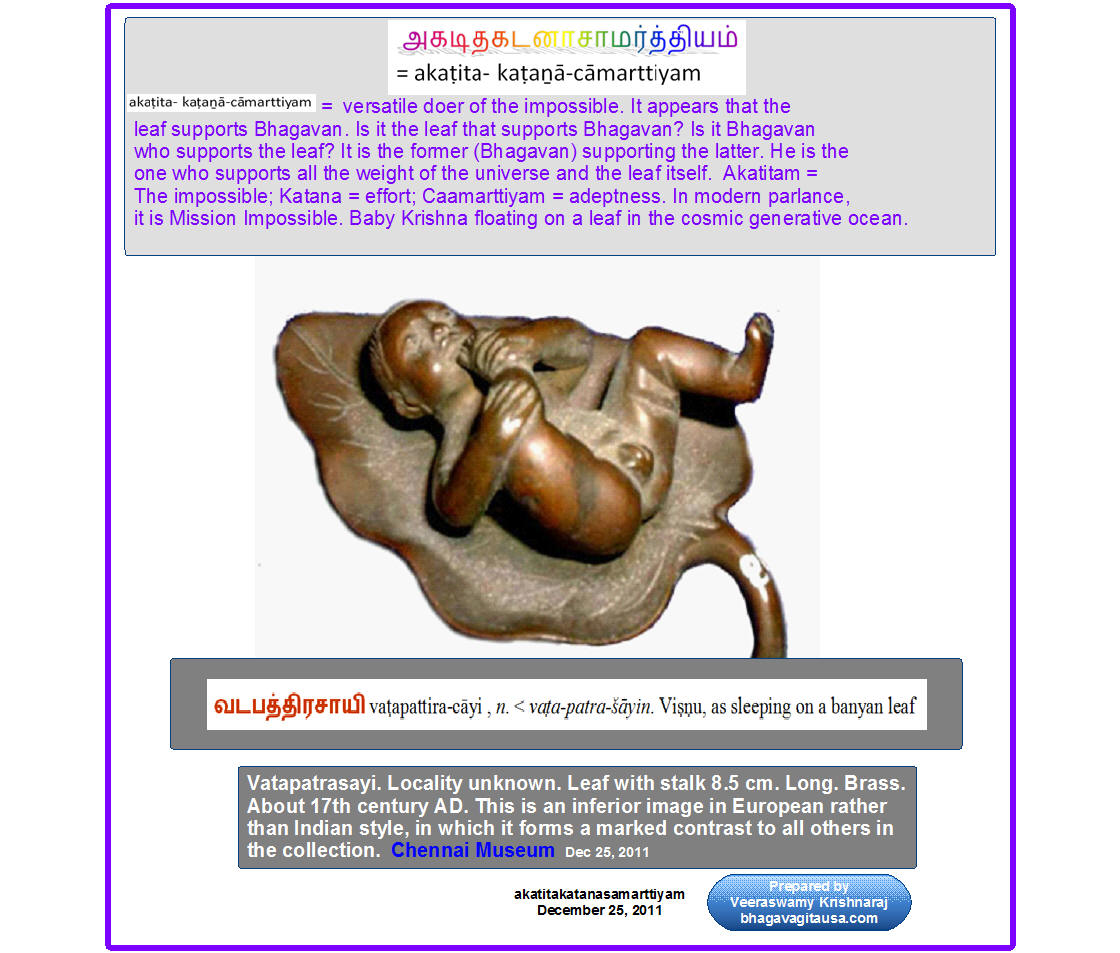


மேலையார் செய்வனகள் according to what the elders do. There is no Vedic injunction to carry out this Pavai Nombu and yet the cowherd girls perform what their elders did. Andal points to the importance of following the traditions and customs of Acharyas (elders).
Bhagavan Krishna says in Bhagavad Gita:
3.21: Whatever a great man does, the other people do. Whatever example he sets, humankind follows.
For the performance of Vratam, the Gopis ask for upakaranam (உபகரணம்), six things from Krishna: Conches as good as the Panchajanyam, big drums, PallAndu chorus singers, decorative lamps, banners and flags, and a big canopy. Thus, the Gopis plead with the Sleeper Baby on Banyan leaf (VatapatrasAyin
upa-kara–am: Instrument, implement, means, apparatus;
paraphernalia, as vessels at a sacrifice.
Coming back to the elders' religious observances, they perform mental worship and propitiation followed by external worship and propitiation which consist of six steps. The six upakaranams are used in the observance of the six steps, where the conch is blown, drums are beaten, chorus singing of PallAndu is done, the lamps are lit, the Lord is requested and reminded to take a ride on Garuda, and a canopy is spread over the Lord's bed.
27 (500)
O great Govinda, You vanquish and win over your enemies. We get rewards from you for singing about you with the accompaniment of drums. We wear jewels worthy of praise from the whole country, bracelets, shoulder ornaments, earrings, flowers, anklets, and many other ornaments. Thereafter we eat milk rice laden with ghee dripping and running down our elbows . Let us all together enjoy the occasion. Let us do Pavai Nombu.
கூடாரை வெல்லும் சீர்க் கோவிந்தா உன் தன்னைப் பாடி பறை கொண்டு யாம் பெறு சம்மானம் நாடு புகழும் பரிசினால் நன்றாகச் சூடகமே தோள் வளையே தோடே செவிப் பூவே பாடகமே என்றனைய பல்கலனும் யாம் அணிவோம் ஆடை உடுப்போம் அதன் பின்னே பாற்சோறு மூட நெய் பெய்து முழங்கை வழிவார கூடியிருந்து குளிர்ந்து ஏலோர் எம் பாவாய் (27) |
கூடாரை வெல்லும் சீர்க் கோவிந்தா உன் தன்னைப்
kUtaarai vellum cIrk kOvinhthaa un thannaip
enemies winning great Govinda you about
You are the great Govinda winning over the enemies. About you
பாடி பறை கொண்டு யாம் பெறு சம்மானம்
paatip paRai koNdu yaam peRu cammaanam
sing drum get we get rewards
For singing about you with accompaniment of drums we get rewards.
நாடு புகழும் பரிசினால் நன்றாகச்
naadu pukazhum paricinaal nanRaaka
country praising by jewels satisfactorily
jewels worthy of praise in the whole country
சூடகமே தோள் வளையே தோடே செவிப் பூவே
cUtakamE thOL vaLaiyE thOdE cevip pUvE
bracelet, shoulder ornaments earrings flowers for ear
பாடகமே என்றனைய பல்கலனும் யாம் அணிவோம்
paatakamE enRanaiya palkalanum yaam aNivOm
anklets, all those many ornaments we will wear
ஆடை உடுப்போம் அதன் பின்னே பாற்சோறு
aadai uduppOm athan pinnE paaRcORu
clothes (will) wear thereafter milk rice
We will wear beautiful clothes. Later we eat milk rice.
மூட நெய் பெய்து முழங்கை வழிவார
mUta nhey peythu muzhangkai vazhi vaara
covered ghee dripping elbows running down
ghee is dripping and running down our elbows
கூடியிருந்து குளிர்ந்து ஏலோர் எம் பாவாய்
kUdiirunthu kuLirnhthu ElOr em paavaay
together enjoy. Let us do Pavai Nombu
We all enjoy together. Let us do Pavai Nombu.
Comment:
கூடார் = unjoiner = opposite of joiner = apostate = enemy. கோவிந்தா = Govinda = Go + Vinda = cow + getting = cow protector. The cowherd girls along with Andal wear precious jewels and beautiful clothes. This marks the end of Pavai Nombu and they can enjoy the end of Pavai Nombu (fasting and the rest). It appears that wearing such adornments is the universal longing of woman folk all over the world from time immemorial. Here the adornments also mean Krishna-pleasing thoughts, words and deeds and also the eight-syllable mantra. Ear ornaments and flower refer to Dwayam Mantra; the anklets Sarama Slokam.
The enemies are the apostates whom the Acharyas subdue and win by their arguments. Others are the ones who consider the ephemeral body as Atma or soul.
Once the devotee is beatified with the jewels of three secret Mantras, he knows his means (UpAyam), and goal (UpEyam).
Ashtaksharam: Narayana is the Means and the Goal; He is the Fruit.
Dwayam: Devotee in body, mind and soul surrenders to Sriman Narayana and Sri (Periya PirAtti). The soul, the body, the doership, and the fruit belong to Narayana. His Grace will destroy all impediments, bad thoughts, desires, speech and acts so that the devotee continues to perform his Kaimkaryam to Perumal and PrAtti.
Sarama Slokam: Leaving aside all Yogas, Surrender to ME (Krishna) only. All samskaras, Vasanas, and Karmas will be destroyed. I (Krishna) give you refuge, and grant you Moksam, Vaikuntham (Paramapadam).
A travelogue of the soul's journey. A devotee's soul leaves the body through Brahma Randhra on the top of the skull, assumes a subtle form and ascends to Parmapadam through a mystic highway (ArchirAdi Marga- Pathway of Light). Arci = flame, luminosity, one of the Adityas. raadhi = perfection. The soul, celestial traveler meets on the Empyreal Highway a galaxy of lesser gods who familiarizes the traveling soul of the future encounters on the way and at the destination.
Bhagavan Krishna says in BG the following:
8.24: The paths of the departing souls, who attain the Brahman because of Brahman knowledge, are the fire, the day, the bright half of the month and the six months of sun’s northern passage.
The guides (the relay: Adhi Vahikas-- Superior Transporters) are Fire, Ahas (deity of the day), Suklapaksha (presiding deity of bright fortnight of the moon), Uttarayana (deity of Northern passage of the sun), Varusha (deity of the Year), Vayu (wind god), Surya (sun god), Chandra (moon god), Varuna (rain or water god), Indra (the chief of gods), Prajapati (the Primary progenitor), AmAnavan (presiding incorporeal deity of MAnasa lake).
Vidyut Purusha**: AmAnavan = Name of a god said to be on the banks of the river Viraj, who by his touch purifies souls on their way to heaven (Vaikuntham).
The mystic poets have described this journey of the soul. Nammaazhvaar (Nammalvar) describes the journey in the following verses in Tiruvaimozhi of Divyaprabhandam
10.9.1 (3979). Seeing the liberated souls, the clouds played the drums, the ocean waves slapped and clapped with raised hands, and danced; the seven worlds extended their help to the devotees for their onward journey.
10.9.3 (3981). The Munis of different worlds appeared before the devotees of Narayana, smiled lusciously, poured a rain of flowers, worshipped, praised and welcomed them, and pointed the way to Vaikuntham standing on either side of the AdiyArs-- those who serve at the feet of Narayana.
10.9.5 (3983). Devas standing on their assigned locations, greeted the devotees and asked them to take their seats and rule them. Kinnars and Garudars sang songs of praise, while Vedic Munis lit their Holy fires.
10.9.8 (3986) Enthused deities with crowns scaled the high walls and the tower decorated with festoon and flag to see the devotees. They said that there went Govinda's own AdiyArs, who, having the same form as Madhava, were entering the gates of Vaikuntha.
10.9.9 (3987). As the devotees entered the gates of Vaikuntham, the gods and Munis welcomed them, offered them their places and expressed their admiration, saying Mannavar (human beings) entering Vaikuntham earned their privilege.
10.8.10 (3988). The Vedic celestials, saying that it was their fortune that the devotees entered Vaikuntham, washed their feet. Moon-faced young girls welcomed them with sacred lamp, Purna Kumbha (ceremonial water-pot)....
This is SAlokya, being in the world of Bhagavan.
The purification of the soul, auspicious Mutation of Subtle body, advent of Suddha Sattva, infusion of Tejas into Jiva
Once the soul has come to the end of the Path of Light, it has to ascend a staircase of nine steps, Paramapada SOpAnam ( steps, stairs, gradations, tier). The journey starts with the passage of the subtle body through a river called Viraja (cleansing River), that runs between LIla VibhUti and Nitya VibhUti. When the soul wades to the opposite bank, it sheds the subtle body and becomes the aprAkrita divya mangala svarupa-- matterless, ageless, divine, auspicious, natural state of quality. The soul now is free from any trace of matter; it is divine, auspicious and pristine. This state is also known as Suddha Sattva -Pure goodness or Pure Spirit. It goes through another immersion in another body of water (airammadeeyam--Great Lake) and goes to an Asvatha tree in Somasavana--forest. Under the tree, 500 apsaras adorn the Pure Soul with garlands, perfumes, eyeliner, ornaments and clothes. At this moment Brahma Tejas (Brahma splendor) enters the soul along with Brahma Gandha (divine fragrance) and Brahma Rasa (divine flavor). The Pure Spirit is all Sattva devoid of Tamas and Rajas. There is complete severance with the mundane world; the Pure Spirit arrives at Paramapada Loka -- SAlokya (present in the world of Paramapadam). The soul as it makes the centripetal movement towards God, it enters the world of God (SAlokya). It enters the hall below a tower and sits in a seat which indicates Vichakshana (discriminating Intellect). This is the stage of Samipya--nearness to God. Superior to this stage, the soul acquires Brahma Yasas and Prajna (splendor, fame and discernment). The soul approaches the Divine Sesa bed of Vishnu, calls out, begs Him to wake up, open His eyes, grant spiritual wisdom, and make him the purest of the pure. At this juncture Hari allows him to come near His Divine Bed or couch (Amitoujas) and reveals his Blissful form to the soul. This union of the soul with Bhagavan is the final stage: SAyujya. Finally the arduous centripetal journey of the soul has ended in union with Mass of Bliss.
Let me give you a coordinate variant but interesting description of how the devotee meets Bhagavan.
He goes beyond the Aditya Mandalam. He is heading towards the Viraja River, the greatest river. The Suksma Sariram enters the River which removes all the fears. At the other side of the river the soul transforms into appearance of Parmatma with Conch, Discus, Pitambharam.... Five hundred Apsaras come running towards him; 100 of them carry flower garlands; 100 of them Sandal paste; 100 of them Dhupam; 100 of them silk garments. They decorate the Mukta Purusha with all these accouterments. Upanishad says that this is the best and the highest Alankaram (decoration). After dipping in Vraja River, one obtains eternal sacred body. All decorations are eternal and therefore called Brahma Alankaram. He continues on his journey to Vidyud Purusha, the lightning Purusha. His name is AmAnavan, meaning that he is not man but a Deva Purusha who takes him by hand past the Dvarapalakas to where Paramatma, Adisesa, Sridevi, Bhudevi, Niladevi are seated in splendor. Paramatman sits with one leg bent at the knee and the other hanging down. Nityasuris are worshipping Him. Satyam, Asatyam, Dharmam, Adharmam-ItyAdhi Devadais serve Him with Chamara fan. He is seated on Adisesa. This is what the Moksa Purusha sees. He sits far off and falls prostrate before Him many times. He is afraid to go near Him. Bhagavan smiles and bids him to come near Him. This is what Alvar says as கூவிக்கொள்ளும் காலம்--the Time of His Call in Vaikuntham. Bhagavan is seated on Sesa Paryankam and does Karavalambam (touching the Moksa Purusha with His lotus hands). He picks him up, stands him on Sesa, sits him on Sesa, later on His own lap, smells his head, and endearingly asks him, "where had you been all these days?" The Mukta Purusha tells him all that happened in his life. (Don't worry; it won't be too long; it is like flash memory.) Bhagavan puts His foot on his head as a sign of acceptance and grace and experiences the Moksha Purusha, who experiences Bhagavan (in modern parlance, meeting of the minds and feelings and mutual divine congress).
Though we are alike to Bhagavan in mutual experientialism in Vaikuntham, we cannot create, maintain and destroy the universe. They are His exclusive domain. However Great He is, He condescends to the level of His devotee so as to let the devotee experience Him. By His condescension only we come to know of His Greatness by our limited intelligence. சௌலப்பியம் = Easy access -- easy association -- quality. He showed these qualities during His Avataras. The experience of the Prapannan in Paramapadam consists of the following: 1) Vishnu and Mahalakshmi are eternally inseparable; 2) Bhagavan has divine qualities, unknown in others; 3) Bhagavan has a divine form.
The following verses tell us about the Empyreal Highway, (and the bliss in immersion in and wading through River Vraja). As evidence of pervasion of the Spirit, the soul gets an infusion of the splendor, fragrance, flavor, Sattva, and form of the Lord.
Nammalvar: 10.6.1--3946; 10.6.2--3947; 10.6.3--3948; 10.6.5--3950; 10.6.7--3952; 10.6.8--3953; 10.6.10--3955
3946. The One holding the discus serves and confers grace to His devotees. I will not take birth in a world of ignorance. O Mind, Go the way of the Lord and worship Him.
3947. By worshipping the One in Vaattaarru, one cuts off the thread of birth, (death and rebirth). Did you hear that, O stupid Mind? By praising Kesava and cutting asunder the connection to the karmic deeds and the world, we attained Narayana.
3948. O my Heart and Mind, we attained Narayana by reciting his many names. The One at Vattaarru of immense wealth came in a great hurry to give us heaven. These (auspicious) incidents happened against our thoughts and (dire) expectations.
3950. Bhagavan showed me the Empyreal Highway. O Heart and Mind , Laugh at perdition. Emperuman's feet adorned with Tulasi and flowers with honey-seeking bees. He, whose feet rest on my head, is the Rider of Garuda.
3952. We reached the feet of Bhagavan adorned with anklets. Our Govinda abiding in our heart lives in Vaattaarru which is the resplendent Thilakam of ocean-girt Tamil Nadu with its jeweled mansions. My body is fragrant from Tulasi adorning His lotus feet.
3953. Tulasi giving fragrance to His body adorns His head also. His discus comes to rest on his hand after His will is fulfilled. He is of the hue of dark mountain and blue ocean. I offer my thanks to Him. He remains in my heart and mind.
3955. He cut the thread of birth and rebirth, and bade me to remain His eternal slave. He in the form of Narasimhan split the body of Hiranyan. For absolution, He reclines under the hood of a serpent. He showed that becoming a slave to the elders (and great men) begets unobtainable benefits.
He cut the thread of birth and rebirth, and bade me to remain His eternal slave.
Krishna says: My devotees come to Me.
In modern parlance, the Empyreal Highway has many stops. The soul carries a toll-free E-Z pass at entry and exit to reach Narayana. At every stop from one to twenty-four, the soul is greeted and felicitated by a god or gods or psychopomps (= Guide or conductor of the souls). At some stops the soul has to wade through a river or lake to wash off all the accretions and residuals gathered during life on earth so that the soul emerges in a purer form. At stop 19, the soul receives the message that it has entered the world of Narayana (SAlOkya). In the Highway, all souls are Striyah (female) meaning that they are females in relation to Narayana; it does not matter what gender they belonged to on earth. Narayana is the only Purusa. As a matter of fact they do not carry any anatomical identity. At stop 20, the soul enters The Tower, takes a seat (at stop 21-Vichaksana Peetam) and enjoys a great fanfare from the assembled gods who tell the soul that it has attained the state of Samipyam --nearness to Narayana. A few more stops only remain before reaching Narayana. At exit 24, the soul is in the purest form, ready to merge with Narayana. Amitoujas is His divine couch which the pure soul approaches with humility; this is known as Sayujya, a state of intimacy and union. It is not a physical union. It is spiritual and yet it is not a fusion. It is like a family gathering; you are all in one place and yet you are separate; the patriarch is at the top of the heap. It is like the difference between heavy water and light water. All the pure souls are light water particles and Narayana is heavy water. In a typical lake there is plenty of light water and very little heavy water and yet they are mixed together and the chemistry of both is the same. Though they are one with Narayana, they cannot create, maintain and destroy the universe; only Narayana has that exclusive power. This merger is the end point in the centripetal movement of the soul to Paramatman. We are the chips off the Old Block and now the atomic Atma is back to its source. It is like the salmon coming back to its origin after a long arduous trip upstream, dying to its flesh and rising in spirit. The atman assumes its original nature (Atma SvarUpa) with the restoration of its eight special qualities (guna VisEsha), freedom from sin, old age, death, sorrow, hunger, thirst, want, weakness of will. Yet this free soul cannot create, maintain and destroy the world. It enjoys company of God, Nithyasuris, muktas and others of Parmapadam, which is the abode of True Bliss.
Here is what Krishna tells Arjuna in Bhagavad Gita about Bliss.
14.27: I am the abode of Brahman, immortal and imperishable, and eternal dharma and absolute bliss.
According to Brhad-aranyaka Upanishad 4.3.33, Bliss has been unitized. He, who is healthy, wealthy, lordly, and opulent, enjoys one unit of the highest bliss of man. From a previous to the succeeding stage, the bliss is greater by 100 times.
The multiplier effect is listed below:
Table:
|
Highest human bliss is (one). |
1 Unit of Bliss |
|
Man* who won over his world |
100 Units of Bliss |
|
Ghandharava’s Bliss,1 Unit = BlissX1X100X100 |
10,000 = ten K |
|
God’s bliss by action = BlissX1X100X100X100 =1,000,000 |
1 million |
|
God’s bliss by birth = BlissX1X100X100X100X100 =100,000,000 |
100million |
|
Prajapati’s bliss = BlissX1X100X100X100X100X100 =10,000,000,000 |
10 billion |
|
Hiranyagarbha’s bliss = BlissX1X100X100X100X100X100X100(Also Brahma’s bliss Br UP 4.3.33) |
1,000,000,000,000 = 1 Trillion |
| Brahman's Bliss | incalculable |
Taittiriya Upanishad (2.8.1) talks about bliss in the following manner. Youth with erudite knowledge of the Vedas, perfect in action, firm in mind, and sturdy in body enjoys one unit of human bliss. Human fairy enjoys one hundred times the human bliss. Divine fairy enjoys one hundred times the bliss of human fairy. Father enjoys one hundred times the bliss of divine fairy. One hundred times the father’s bliss is god’s bliss (by birth). One hundred times the bliss of god by birth is the bliss of god earned by meritorious work Indra’s bliss is one hundred times the bliss of gods. Brhaspati’s bliss is one hundred times Indra’s bliss. Prajapati enjoys one hundred times Indra’s bliss. Bliss of Brahma is one hundred times Prajapati’s bliss. Brahman’s bliss is beyond calculation.
Man* who won over his world is the one who practiced sacrifices, charity and austerity. Br. Upanishad 6.2.16
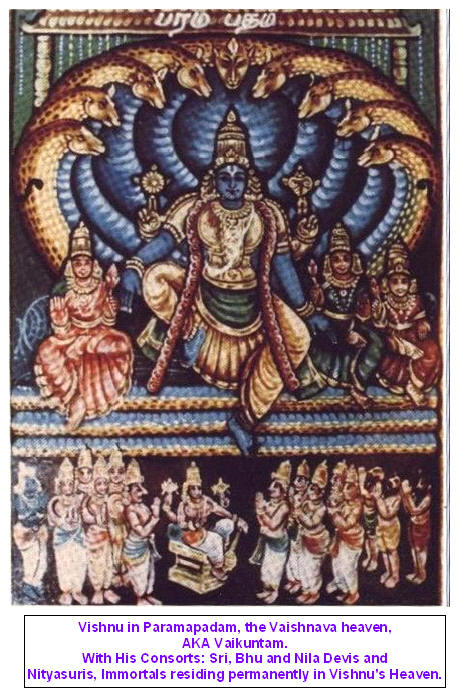
The following description of Vaikuntha, the heaven of Vishnu, is from the Mahabharata. [**] It is made entirely of gold, and is 80,000 miles in circumference. All its buildings are made of jewels. The pillars and ornaments of the buildings are of precious stones. The crystal waters of the Ganges fall from the higher heavens on the head of Druva; from thence into the hair of the seven Rishis; and from thence they fall and form a river. Here are also five pools containing blue, red, and white lotuses. On a seat glorious as the meridian sun, sitting on white lotuses, is Vishnu; and on his right hand Lakshmi, who shines like a continued blaze of lightning, and from whose body the fragrance of the lotus extends 800 miles.-- Hindu Mythology, Vedic and Puranic, by W.J. Wilkins, [1900], at sacred-texts.com
|
Srirangam Temple is the Srivaishnava Heaven on earth. Sri Velkudi Krishna Swamy elaborates on this.
Srirangam is called as bhooloka vaikuntham as mentioned in satadhyayi and dasadhyayi. Kaveri viraja seyam vaikuntham ranga mandiram sa vasudevo rangesa: pratyaksham paramam padam. A parallel is drawn between srivaikuntham and srirangam, viraja nadi and kaveri due to the aradhana kramam, practices, customs etc being followed in srirangam that are similar to Srivaikuntham. It also houses the 1000 pillared mandapam,tirumamani mandapam and vimanam as in srivaikuntham. On Srivaikuntha ekadasi day Namperumal enacts a jiva leaving this material body and journeying through archiradi marga and attaining parama padam. These are a few reasons which earned the status of Bhooloka vaikuntham to Srirangam. I do not know much about Guruvayoor. |
Cartographer's layout of Vaishnava heaven: Empyreal Highway mapped and simplified.
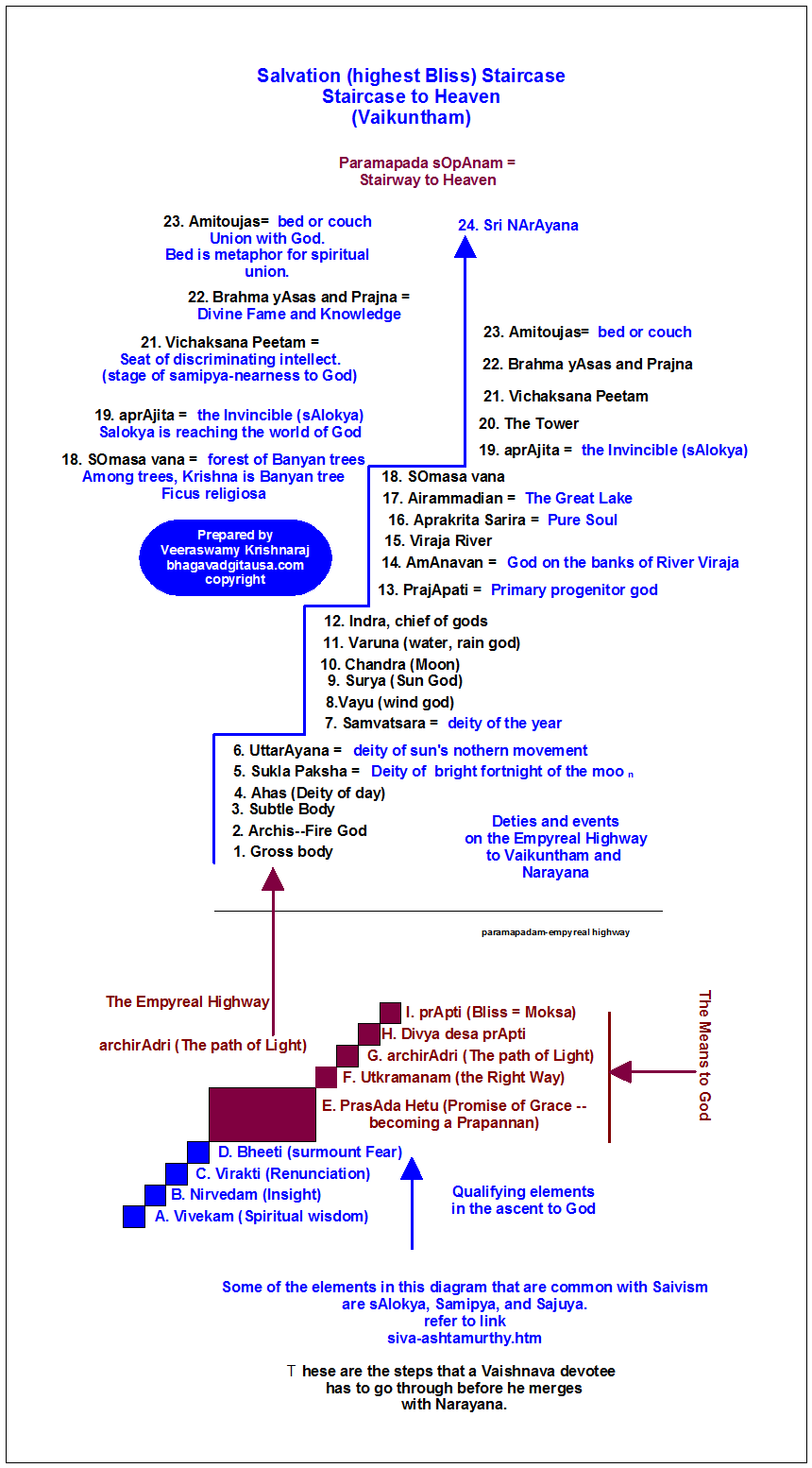
Archis: Arccis: See the diagram, #2 god in the Empyreal Highway. He is god who presides over Light.
jewels worthy of praise in the whole country.
We will wear beautiful clothes. Later we eat milk rice.
Andal as an youngster, unknown to her father, used to wear the flower garlands meant for Vattapatrasayee, looked at herself in the mirror and put them back in the basket. It is a sacrilege to offer worn flowers to God. She was discovered by her father doing this; she was severely reprimanded by Vishnu Chittar. God next day told him that He liked to wear garlands used by Andal. This custom still continues till today. The garlands worn by Andal in near-by temple the night before are offered to and worn by Vattapatrasayee the next morning. There is also a niche with mirror in the temple to depict this event.
Once the Pavai Nombu and fasting is over, the girls indulge in gorging themselves with cooked milk-rice laden with clarified butter, which runs down the elbows. Butter is a favorite food of Krishna. (Author's random thought: His cholesterol was less than 170; His HDL was sky-high meaning that he had no plaques in His arteries; His LDL was low. And yet as Karma would have it he "died" in the hands of a hunter who mistook his moving toes for deer's ears and shot his deadly arrow on Krishna. He did not really die, he made it look like it; that is his Maya. He lived a man and subjected Himself to the lots of men. Still today in USA, hunters die at the hands of deer hunters; rifles replaced bows and arrows. It is a tragic karmic compulsion and a paradox that deer hunters die at the hands of other deer hunters. Karma has a long sharp memory. In ancient Hindu religion and epics, there is a mention of widespread hunting of deer and other animals for food. Asva Medha (horse sacrifice) is one of our legacies. Animal lovers consider killing of wild horses in USA objectionable. It is heartening to know Bhagavan Krishna was a strict vegetarian.)
Verse 28 (501)
We will go behind the milch cows to the forest and eat there. We of the cowherd community lack knowledge. We received merits because of your birth in our community. O Govinda You do not have any deficiencies. Your relationship with us cannot be broken. We innocent children show affection to you by addressing you small names (Narayana). Please don't get angry with us. O Lord, give us liberation. Let us do Pavai Nombu.
கறவைகள் பின் சென்று கானம் சேர்ந்து உண்போம் அறிவு ஒன்றும் இல்லாத ஆய்குலத்து உன்தன்னைப் பிறவி பெறுந்தனைப் புண்ணியம் யாம் உடையோம் குறைவு ஒன்றும் இல்லாத கொவிந்தா, உன்தன்னோடு உறவேல் நமக்கு இங்கு ஒழிக்க ஒழியாது அறியாத பிள்ளைகளோம் அன்பினால் உன் தன்னைச் சிறு பேர் அழைத்தனவும் சீறி அருளாதே இறைவா! நீ தராய் பறை ஏலோர் எம் பாவாய் (28) |
கறவைகள் பின் சென்று கானம் சேர்ந்து உண்போம்
kaRavaikaL pin cenRu kaanam cErnhthu uNbhOm
milch cows behind going forest reaching eat
We will go behind the milch cows to the forest and eat.
அறிவு ஒன்றும் இல்லாத ஆய்குலத்து உன்தன்னைப்
aRivu onRum illaatha aaykkulaththu unthannaip
knowledge any lacking cowherd community you
We of the cowherd community lack knowledge. You....
பிறவி பெறுந்தனைப் புண்ணியம் யாம் உடையோம்
piRavi peRunhthanaip puNNiyam yaam udaiyOm
having been born amongst us merits we obtain
You by taking birth amongst us give us merit
குறைவு ஒன்றும் இல்லாத கொவிந்தா, உன்தன்னோடு
kuRaivu onRum illaatha gOvindhaa unthannOdu
deficiency any lacking Govinda to you
O Govinda, you do not have any deficiencies. your...
உறவேல் நமக்கு இங்கு ஒழிக்க ஒழியாது
uRavEl namakku ingku ozhikka ozhiyaathu
relation to us here remove not removable
Your relation to us cannot be broken.
அறியாத பிள்ளைகளோம் அன்பினால் உன் தன்னைச்
aRiyaatha piLLaikaLOm anpinaal un thannaich
innocent children love you with
We innocent children show affection to you by...
சிறு பேர் அழைத்தனவும் சீறி அருளாதே
ciRu pEr azhaiththanavum cIRi aruLaathE
small name addressing. angry don't do.
Please don't get angry with us for addressing you Narayana
இறைவா! நீ தராய் பறை ஏலோர் எம் பாவாய்
iRaivaa! nI thaaraay paRai ElOr empaavaay
O Lord, You give us liberation. Let us do Pavai Nombu
Comments:
We will go behind the milch cows to the forest and eat.
We of the cowherd community lack knowledge. You..
You by taking birth amongst us give us merit
O Govinda, you do not have any deficiencies. your...
Your relation to us cannot be broken.
We innocent children show affection to you by...
Please don't get angry with us for addressing you Narayana
The cowherd girls say to Krishna that they are ignoramuses following the herd into the forest for daily living. Following animals into the forest and eating in their midst stand for worldly pursuits without spiritual knowledge. The ideal would be that they are tailing Acharyas in search of wisdom and drink the milk of knowledge from them. They acknowledge their spiritual ignorance and their inability to perform Bhakti and Jnana Yoga and yet are good people because of their innocence, which with affection to Krishna makes them address Him as if he were a commoner. They seek forgiveness for earlier infractions. The only merit and virtue they have is that Krishna was born in their kulam. They are wanting in everything, while Krishna is wanting in nothing. They are assured in their feeling that their relationship with Him will never be broken. That is the one thing going for them.
|
Swami Velkudi Krishna's commentary
குறைவு ஒன்றும் இல்லாத கொவிந்தா = Govinda with no blemishes. Let us go into details on this question. Swami Ramanuja says the Lord is the repository of all good qualities. There is not an iota of blemish. He has countless good qualities. Sri Andal says kuraionrumillda Govinda (குறைவு ஒன்றும் இல்லாத கொவிந்தா ) So the questions are 1) If He were without any blemish (Kutram onru illada govinda! = குற்றம் ஒன்று இல்லாத கோவிந்தா!) why should He also be born like us who have all defects? Avataarasya Satya-tvam-- Sri Krishna tells His avatar is true. 2) He is Sarveshwaran, which means He is leader and commander of everyone. Then why should He be born like us who are commanded? 3) He is sarvagya, which means He knows all at all times, including past and future. Why then He is born like us with extremely limited knowledge? 4) He is considered as satya sankalpa, that is He knows what is right and wrong or full rational knowledge. Is He born by mistake in this world? 5) We are born to fulfill our karma. Is He also born to fulfill anything? But He is avapta samasta kaman, which means that He has no desire to be fulfilled as He has the happiness of all desires and more. In response, Lord responds with Six answers which Swamin Deskian quotes as: 1) Avataarasya Satya-tvam, 2) Ajaha svasva-bhaavatah: , 3) Suddha-Sattva Mayatvam ca , 4) Svecha maatra vidhaanatah: , 5) Dharma Glaanau Samudhayah: , 6) Sadhu Samrakshana-aartakah ] a) Is His avatar or birth true or false? He is in this world just as we are or Arjuna was there. Is His birth real like ours or is it a magic or illusion? Sri Krishna tells His avatar is true -Avataarasya Satya-tvam b) Is He born with His greatness and Power or without? Swami Desika says He is born with ajahatswaswabhavatha. Jahat means relinquish or without. So ajahat is with or fully equipped. In every avatar he is with full powers and with none of His greatness wanting. c) Is He born like us with blood and bone, that is with the five elements which have the three qualities of satva, rajo and tamo gunas? Sri Krishna tells that unlike our bodies, His body is full of satva quality alone and is called suddha satva mayam. That is it is not contaminated by rajo/tamo qualities. In fact, it is not even referred to as "udal--உடல் = body", but "Thirumeni --திருமேனி = sacred body". We also call His form Divya Mangala Vigraham--திவ்ய மங்கள விக்ரஹம் (divine auspicious form). d) Is He born because of karma as in our case? No says Sri Krishna and continues that His birth is at His will and determination [sankalpa]- Sva icha maatra vidhaanatah No one else including karma can decide his avatar. e) Who determines His time of birth? In our case as our papa/punya ripen our births are timed. Sri Krishna tells that His birth happens whenever there is danger to Dharma[righteousness] and Adharma flourishes. -Dharma Glaanau Samudhayah f) What is the purpose of His birth? In our case, we are born to expend the papa and punya acquired in various births. By suffering we spend away our papa and by enjoying we spend our acquired punya. The Lord also in many avatars appears to have suffered and enjoyed. Sri Krishna replies that He is born to protect sadhus or good people , to destroy evil and wicked persons and to establish and maintain Dharma - Sadhu Samrakshana-aartakah These six replies form the secret or rahasya of His avatar. Though He also appeared on this earth like us and played and cried, He is much above and we can never think He and we are same. -- Swami Velkudi Krishna. |
இறைவா! நீ தராய் பறை . Addressing Him as God and seeking his protection are an indication of their appreciation of Him and readiness to perform Saranagati, which is the best course of action for one incapable or unable to perform Yoga. NammazhvAr is in the forefront in the advocacy of Saranagati. He does not perform Bhakti, Jnana, or Karma yoga because his low caste disqualifies him from such performance. He is a Sudra by birth which does not preclude him from Saranagati and Moksa. The principle of Saranagati is based on two precepts: 1. Sarvesvara (Lord of all) has compassion, omniscience, omnipotence and is ready to offer Raksa or Saranya (refuge) to the devotees who want to cut asunder their bondage and attain God. 2. He is the only means of escape from the bondage.
nammazhvar says in 5.7.10 (3416)
ஆறு எனக்கு நின் பாதமே சரன் ஆகத் தந்து ஒழிந்தாய் = You made it possible that your feet are my only refuge.
6.3.10 (3482) lines three and four:
மழலை வாய் வண்டு வாழ் திருவிண்ணகர் மன்னு பிரான்
கழல் அன்றி மற்றோர் களை கண் இலம்; காண்மிங்களே.
Other than PirAn there is no support relieving distress.
There are special extenuating circumstances that make it possible for a devotee to perform Saranagati.
1. Akimcanya = utter destitution. It means externally enforced restrictions on Sudras to perform Yogas.
2. ananya gatitva = no other recourse or refuge than God.
Saranagatti consists of six requirements.
1. anukulya sankalpam: A positive intent or determined will to perform God-pleasing acts.
2. praticulya Varjana: Avoidance of god-displeasing acts.
3. karpanya: Pitiful circumstances which preclude other means of salvation.
4. maha Visvasam: Absolute faith in God as the sole proprietor.
5. goptrtva varana: appeal to God for protection.
6. atma niksepa: entrusting the burden of protection exclusively to God.
The sixth is the primary component and the first five are secondary components. Details on one angi and five angas are described elsewhere in detail.
29 (502)
We came and worshipped in the wee hours of the morning. Please listen to the reason we praise and worship your golden feet. We make a living by cattle-grazing and you took your birth in that community. Please do not go away without accepting our humble offerings. O Govinda, we are not here today just to obtain grace from you. Forever (many sevens of generations-- for many births) we together will abide with you and become slaves only to you. Please remove all other desires so that we can abide in you. Let us do Pavai Nombu.
சிற்றஞ் சிறு காலே வந்து உன்னைச் சேவித்து உன் பொற்றாமரை அடியே போற்றும் பொருள் கேளாய்! பெற்றம் மேய்த்து உண்ணும் குலத்தில் பிறந்து நீ குற்றேவல் எங்களைக் கொள்ளாமல் போகாது இற்றைப் பறை கொள்வான் அன்று காண் கோவிந்தா! எற்றைக்கும் ஏழ் ஏழ் பிறவிக்கும் உன் தன்னோடு உற்றோமே ஆவோம் உனக்கே நாம் ஆட்செய்வோம் மற்றை நம் காமங்கள் மாற்று ஏலோர் எம்பாவாய் (29) |
சிற்றஞ் சிறு காலே வந்து உன்னைச் சேவித்து உன்
ciRRagn ciRu kaalE vanthu unnaich cEviththu un
early wee hours of morning coming to you worshipped your...
We came and worshipped you in the wee hours of the morning. Your...
பொற்றாமரை அடியே போற்றும் பொருள் கேளாய்!
poRRaamarai atiyE pORRum poruL kELaay
golden lotus feet praise reason hear...
Please listen to the reason we praise and worship your golden lotus feet.
பெற்றம் மேய்த்து உண்ணும் குலத்தில் பிறந்து நீ
peRRam mEyththu uNNum kulaththil piRanhthu nhI
cattle grazing eat community born you
You were born in a cattle grazing community and we make a living.
(by) cattle rearing (those who) eat (that) community born (in which) You (were)
குற்றேவல் எங்களைக் கொள்ளாமல் போகாது
kuRREval engkaLaik koLLaamal pOkaathu
small offerings of ours taking don't go.
Please don't go away without accepting our humble offerings.
இற்றைப் பறை கொள்வான் அன்று காண் கோவிந்தா!
iRRaip paRai koLvaan anRu kaaN kOvinhdhaa
today grace obtain then see O Govinda.
We are not here today just to accept your grace, O Govinda
எற்றைக்கும் ஏழ் ஏழ் பிறவிக்கும் உன் தன்னோடு
eRRaikkum Ezh Ezh piRavikkum un thannOdu
forever seven seven births you together
Forever, for many births You with us together...
உற்றோமே ஆவோம் உனக்கே நாம் ஆட்செய்வோம்
uRROmE aavOm unakkE naam aatceyvOm
in relation to you will we be. Only to you we will become slaves
In association with you we will ever be. We will become slaves only to you.
மற்றை நம் காமங்கள் மாற்று ஏலோர் எம்பாவாய்
maRRai nam kaamangkaL maaRRu ElOr empaavaay
other our desires change. Let us do Pavai Nombu.
Please remove all other desires. Let us do Pavai Nombu.
comment.
In the previous PAsuram, there is an allusion to angas and angi of Saranagati; in this, the fruit (phalan, பலன்) obtained is offered at the feet of Narayana. The doer, the deed and the fruit (Phala samarpanam) belong to God. Phala Samarpanam = fruit dedication = dedication of fruit. Some commentators point to near anagram in that the word "Godai" is in "Govindha."
The cowherds are worshipping the golden feet of Krishna. They plead with Him to accept the little Kaimkaryam they do and give them Moksa. They have no pretensions to Yoga of any kind. They make only humble offerings and perform small Kaimkaryam. They are not trading favors with Krishna. They are mere and yet very staunch devotees of God who know only Seshatvam, servitude to Sarva Seshi (God of the Universe). Seshi = God; Seshan = devotee, slave. They also plead with Him to remove all desires so that they will not deviate from their path of Seshatvam.
30 (503)
O Madhava, O Kesava, You churned the ocean full of ships. The maidens with moon faces and beautiful jewels worshipped and received the drum. Kodai, the daughter of Sri Villiputtur's Bhattar Piran wearing a cool garland of fresh lotus flowers, sang Sanga Tamizh garland of thirty verses. They who recite these verses without flaw will receive grace from wealthy Tirumal with four arms, beautiful red eyes and auspicious face. Because of Him, all will receive grace everywhere and enjoy bliss. Let us do Pavai Nombu.
வங்கக் கடல் கடைந்த மாதவனைக் கேசவனை திங்கள் திருமுகத்துச் சேயிழையார் சென்று இறைஞ்சி அங்கு அப்பறை கொண்ட ஆற்றை அணிபுதுவைப் பைங்கமலத் தண்தெரியல் பட்டர் பிரான் கோதை சொன்ன சங்கத் தமிழ் மாலை முப்பதும் தப்பாமே இங்கு இப்பரிசு உரைப்பார் ஈரிரண்டு மால் வரைத் தோள் செங்கண் திருமுகத்துத் செல்வத் திருமாலால் எங்கும் திருவருள் பெற்று இன்புறுவர் ஏலோர் எம் பாவாய் (30) |
வங்கக் கடல் கடைந்த மாதவனைக் கேசவனை
vangkak katal katainhtha maathavanai kEcavanait
ship ocean churn Madhava, Kesava
O Madhava, O Kesava, You churned the ocean full of ships
திங்கள் திருமுகத்துச் சேயிழையார் சென்று இறைஞ்சி
thingkaL thirumukaththuch cEyizaiyaar cenRu iRaignci
moon, sacred faces, beautiful jewels, maidens went worshipped
The full-moon faced jeweled maidens worshipped the Lord.
அங்கு அப்பறை கொண்ட ஆற்றை அணிபுதுவைப்
angk appaRai koNda aaRRai aNiputhuvaip
there received the drum beautiful Puthuvai
They received the drum. Sri Villiputtur's...
பைங்கமலத் தண்தெரியல் பட்டர் பிரான் கோதை சொன்ன
paingkamalath thaN theriyal pattar piraan kOthai sonna
fresh lotus cool Pattar Piran's daughter Kodai said
fresh lotus garland cool (wearing) Bhattar Piran's (daughter) Kodai sang.
Bhattar Piran wears a cool garland of fresh lotus flowers. His daughter Kodai sang
சங்கத் தமிழ் மாலை முப்பதும் தப்பாமே
cangkath thamizh maalai muppathum thappaamE
Sangam Tamil garland of thirty verses. without flaw
இங்கு இப்பரிசு உரைப்பார் ஈரிரண்டு மால் வரைத் தோள்
ingku ipparisu uraippaar IriraNdu maal varaith thOL
here like this chant two pairs mountains stretch arms (shoulders)
They who chant these verses (without flaw) will receive grace (from the Lord) with four arms
செங்கண் திருமுகத்துத் செல்வத் திருமாலால்
cengkaN thirumukaththuch celvath thirumaalaal
beautiful (red) eyes, sacred face, wealthy TirumAl because of
எங்கும் திருவருள் பெற்று இன்புறுவர் ஏலோர் எம் பாவாய்
engkum thiruvaruL peRRu inpuRuvar ElOr empaavaay
everywhere grace get enjoy. let us do pavai nombu.
Comment:
வங்கக் கடல் The reference to ship means shiploads of Nithyasuris coming to pay homage to Bagavan reclining on Adisesha in Milk Ocean.
வங்கக் கடல் கடைந்த மாதவனைக் கேசவனை
Churning of ocean: Purpose: to get Ambrosia.
The churning of the ocean was done on the back of the tortoise because the churning pole started sinking. Tortoise (Kurma) was Vishnu himself as an Avatara. A snake (Vasuki) served as a churning rope to churn the ocean of milk (ksirasagara); Mount Mandara, the churning pin. The demons (Asuras) chose the upper end, because they considered the lower end dirty. The Devas or the Suras held the lower end. Lord Vishnu enjoyed the churning and the grinding of the stick on his back while he took a nap. The Lord controls Sattva, Rajas and Tamas gunas; he delegated Sattva to serve the Devas, Rajas the Asuras and Tamas Vasuki. The Lord held the stick to balance it. Churning began and soon Vasuki was belching fire and smoke from its mouth, nostrils and eyes. The Asuras were choking, huffing and puffing and turned black from soot and heat. The Devas suffered the same fate, but the Lord was splashing them with water, and fanning them with gales generated in the ocean by the churning. The sea-dwelling animals were rattled by this experience. Nothing came out of the ocean for a while; the Lord lent them a hand. Soon Halahala (Haalaahala) poison appeared on the surface of the ocean and spread like fire; it scorched and scalded all of them including the Lord who became black from his contact with it. Soon they prayed to Sadasiva (Siva) and pleaded with him to scoop up and swallow it. Siva consulted with his consort Sati (Parvati); with her consent, to protect all living beings in this universe, He swallowed the Halahala poison and held it in his throat, which made his throat look blue, giving him the name "Nilakantappa" which means blue-throated Lord. A few drops of poison went down in the cracks between the fingers and fell on earth, which were soon gobbled up by snakes, scorpions and the like. All of them including Lord Vishnu praised Siva for his generous act. (The Saivites and Saiva poets point this out poignantly saying, if it were not for Siva all asuras, gods, goddesses, Brahma and Vishnu would have perished. Another recurring theme in Saivite poetry is that Brahma and Vishnu could not find the ends of Siva in the form of fiery Lingam.) The Suras and Asuras redoubled their effort churning the ocean. Out came the wish-giving cow, Surabhi, also known as Kamadenu. The sages accepted the cow as gift for they needed the cow to provide milk and butter for performing sacrifice. There then came Uccaihsravas, the white horse, which King Bali took with the consent of Lord Vishnu, though Indra, the chief of Devas also wanted it. Out came the Airavata elephant; so white were the four tusks that they exceeded the whiteness of the snow-clad mountain of Kailas, the abode of Siva. Kaustubha gem, a ruby, of incomparable luster came out of the milk ocean, which the Lord claimed for himself to adorn his beautiful chest. A wish-tree by name Paarijaata (Parijata) appeared from the ocean. Then came to the delight of the inhabitants of heaven the Apsaraas (Apsaras = celestial nymphs) who wore the most beautiful gold jewels and grand robes and walked charmingly casting sidelong glances in a playful mood. (Comment: The Apsaras can anytime beat today's models strutting up and down runways. Apsaras were creations for the express purpose of entertainment, specially equipped for the job right from the beginning. They belong to a professional group of entertainers for the celestials. Hey, runway walkers, strut-walkers, and hip-twirlers, take a bow before the Apsaras. Who am I to say that? We the clodhoppers and pit-dwellers say it. )
Goddess Ramaa (Ramah) appeared next, who was the deification of wealth. Her appearance was a splendor of thousand lightning, which illumined all quarters of the universe and burst upon the crystalline mountain ranges of Sudama. Men, gods, and demons at once paid her their worshipful tributes for they knew that a pleased goddess brought mountains of gold and fortune to the devotees. They sought her Grace and glance, for she sparkled with heavenly comeliness, youth, noble conduct, and beautiful complexion. Though she was young, she was mother goddess. Every one of them showered gifts on her, for her grace assured humongous returns. The chief of gods and Lord of Paradise (Indra) brought her the most beautiful throne. Sacred River Ganges was not far behind; she brought what is most sacred to all, that is herself in gold jar for her ablutions. Mother Earth was competing with others and brought herbs for her ablutions. (Yes, in ancient India, the women used aromatic herbs, roots, and flowers in the bathtubs.) The cows were thumping and chomping mother earth (grass) to get her out of the way quickly, because they were impatient to get an audience with mother goddess. They brought the most precious products necessary for sacrifice: milk, curds (yogurt), ghee (clarified butter), cow dung and urine. Spring moved in front of the line with grace, beauty and vernal colors and gave her leaves, buds, flowers and fruits and basket of cheer and smiles. The seers (Rishis) brought what they knew best: procedures, protocols, rules, injunctions, regulations, and rites that she should follow in her ablutions. The Gandharvas (celestial musicians) next in line saw their chance to goad the Rishis out of their way with their musical instruments, started singing and dancing before their time and drummed the Rishis out of the audience hall; the mother goddess received them with enchanting smiles. The Apsaras, being the wives of Ghandharvas, came along dancing and singing and enjoyed a second-time audience with Rama. Suddenly there were flashes, the earth shook, the musicians were thrown off balance, thunderclaps came from sky, and yes, clouds were paying respects for the gracious goddess. Drums and double drums, tabors and tomtoms, conches, flutes and lutes made a tumultuous entry. Earth was spinning with tremors and wondered when they will stop the racket. Then came the lumbering elephants; they were the guardians of the four quarters. The elephants knew that poets for some unknown reason liked their gait and compared the gait of a lass to that of an elephant!! The Brahmanas knew it was time to chant the hymns. The elephants drew up the sacred Ganges water into their trunks and bathed Sri (Rama, mother goddess) who held a lotus in one of her hands. The ocean from which she emerged gave her two yellow silk shawls, the color and material that Vishnu liked most. Varuna, the god of water, gave her Vaijayanti, a garland of flowers, swarming with drunk bees, some of which were literally drowning in the nectar. Visvakarma, a Lord of created beings gave her many beautiful rare ornaments. Sarasvati, the goddess of learning and speech gave her a necklace of pearls. Brahma, the creator, gave her a lotus flower; the Nagas, the serpent-demons, chose a pair of earrings for gifting her.
(Rivers are always considered holy in India and elsewhere. Ganga is the River Goddess as goddess Sarasvati is. In Egyptian mythology, the gods originated on the fertile soil mounds left behind by the receding Nile after it flooded the banks. The Ennead [group of nine gods of Heliopolis] had their progenitor in Atum who rose from the mound. He is the Lord of Heliopolis whose progeny are Osiris, Isis, Set and others.)
A swarm of black bees came out of nowhere and buzzed around a wreath of lotus flowers in the hand of Sri. Her face showed no weariness; it lit up with a smile playing on her lips, and earrings caressing her tender cheeks. She moved about like a vine in the gentle wind. There was a gentle and sweet aroma in the air, there was no mistaking it was sandal paste, soon the aroma was becoming more intense and there it was painted on the breasts of Sri, which were round and symmetrical embracing each other gently. There was saffron too keeping company with the sandal paste. Her torso soon tapered into a slender waist which moved like a vine in the wind. As she passed in a motionless grace, her anklets jingled and she moved like a shining golden creeper among the Ghandharvas, Yakshas, Asuras, Siddhas, Caranas, and gods with the splendor of lightning, eyeing them all the time all around without giving a clue that their every being was scrutinized and put to test. She was looking for a consort who was free from any blemish, who was eternal, and whose virtues are beyond reproach. Did she find any in that throng of luminaries? Certainly not. Thoughts and emotions were jostling in her mind; externally she was cool as the fresh spring water. This ascetic, what a laugh, has no control over his anger. Look at this sage; he is wise, though it (his wisdom) is not free from attachment. Here is one, he looks great; shucks! he has no complete control over his lust. How could he be a Lord, when he depends on another for support? Look, here is righteous one; but he has no love for others. Here is one who appears liberal, but is that real? Could there be a motive? Is that true liberation? O, this one has true prowess. How long would that last? Yes, this one has no trace of attachment in any part of his body. What is the use, if he spends his time in meditation and does not have time for me? Yes, some live a long life; that is good for a spouse. Long life matters little if he is not amicable and propitious. Yes, some are amicable and propitious; but where is the guarantee they will live long? Some are amicable and live long, but they are not propitious. Yes, I know there is one who is amicable, propitious and of long life. Does he long for me? Her choice was Lord Vishnu. He grants Mukti or Liberation; his virtues are eternal; he is beyond the gunas: Sattva, Rajas and Tamas; everyone desires him, but he is disinterested. Lakshmi (Sri, Ramaa) placed a wreath of newly blossomed lotuses, swarming with inebriated black bees, on the shoulders of the Lord and stood by his side with utmost charm, beauty, poise, bashfulness, and divinity, casting glance on the Lord and waiting for his Grace (approval). Her eyes bloomed with smiles and the smile of the lotus blossoms, which were one of his favorites, were no match for divine and bashful smiles of Lakshmi. She was the Mother of the three worlds and the treasurehouse of riches, seeking the bosom of the Lord of the three worlds. Was this match made in heaven? Just by casting benign glances the Mother of creation protected the three worlds and their kings.
Suddenly melodious sounds from musical instruments poured forth from Gandharvas announcing the arrival of Brahma, Rudra, Sage Angira and others who showered lotus flowers on Vishnu. Glanced by Sri, they all became rich in all wholesome qualities. The mother of riches did not look at the Daityas and Danavas (Asuras--Demons). The lack of benign glance from Lakshmi is foreboding of bad things coming to them.
The ocean was still productive, objects and beings were emanating from its boundless munificence. The goddess of wine, Varuni, came out from the ocean with lotus-like eyes. The Asuras took her, of course with the approval of Lord Hari (Vishnu). The sons of Kasyapa (gods and demons) continued churning the ocean with the hope of getting the nectar. A young man emerged from the ocean. He was part god himself for he had a fragment (amsa) of the Lord in him. He looked amiable; he had long muscular arms; his neck was conch-shaped, his eyes were red, his skin was dark-brown, and he was wearing flowers and ornaments. He was Dhanvantari, the physician of the gods. He was carrying the jar of nectar and suddenly became the cynosure of all eyes. The Asuras in a trice grabbed the pot of nectar and ran as fast as they could. The Devas were dejected and crestfallen, for all their efforts and hopes were dashed. They fell prostrate like falling sticks at the feet of the Lord and begged for his help.
for more info go to Vishnu Weds Lakshmi
பட்டர் பிரான் கோதை சொன்ன
Andal acknowledges her adoptive father Bhattar Piran as her mentor and practicing Acharya, who is a prototypical Vaishnava in that he is learned in rituals, philosophy, Saranagati and all things Vaishnava. He wears Tulasi beads representing the supremacy of the Lord and the lotus beads representing supremacy of PirAtti. Thus all Vaishnavas are the devotees and slaves of the divine pair. The doer, the doership, the deed and the fruit belong to Narayana and thus are dedicated to Him.
சங்கத் தமிழ் மாலை
She composed her Pasurams and weaved them into Sangam-fame Tamil garland instead of Sanskrit for the sake of the Tamil-knowing people and eventually for all people.
Andal, Vishnu Chittar, Vattapatrasayee Temple, Tiruppavai, Andal Temple in Sri Villiputtur.
These hymns, Andal sang in love and surrender to Narayana/Krishna, are dedicated to Vattapatrasayee in His Temple in Sri Villiputtur. Knowing that Sri Andal was the incarnate Bhudevi (Goddess Earth), the consort of Vishnu, a Temple for Andal was built where she was found by Vishnu Chittar. Though her Temple is in Sri Villiputtur, she merged with Sri Ranganatha in Sri Rangam. She performed Katyayani Vratam as a cowherd maiden to merge with Krishna.
எங்கும் திருவருள் பெற்று இன்புரறுவர்
Those who recite and listen to Tiruppavai will receive Grace and Bliss from Bhagavan.
"Dross from your feet is the cure for my fever," so says Krishna. The gross sight of dross knocks the sages off their feet.
Once Krishna is afflicted with hyperpyrexia (high fever). Of course this is one of Krishna Lilas. He is having chills. He is the Disease, the Cure, and the Healer. He tells His compatriots that dross of the foot from the best of His devotee will cure His fever and orders them to get it. Dross = scrapings (from the foot) The first and the foremost devotee, they are looking for. Out comes the answer: VyAsar. They make a bee-line dash to VyAsar and demand dross from his foot. He is so upset by the demand he shuts his ears and says சாந்தம் பாபம் (peace sin). He further says, "What an injustice, what an atrocity, what a preposterous suggestion, What a sacrilege! Krishna eating my dross. Who made this suggestion?" The messengers retort," It is He who suggests this remedy." Having heard such an unbelievable story, he leaves for Dwaraka to see Krishna Himself. Knowing that it serves no purpose to further entreat him, they leave to see Uttavar, who upon hearing the request falls in a faint; it takes them a long time to resuscitate and get him back on his feet. He starts trembling like a wind-blown leaf and says, How could any one make such a demand from me? I will go to Krishna myself."
VyAsar and Uttavar are standing in front of Krishna trembling in silence with anxiety etched on their faces. Krishna is sitting on the golden lion-throne with a raging fever. The messengers now go to Gopis in Gokulam and make a similar plea. Immediately all 16 lakh Gopis (16 X 100,000) go into a frenzied activity of scraping their feet for a ball of dross and come up with umpteen pots. Krishna needs one drop of a dross from one devotee; what He gets is 1.6 million pots of dross. The Gopis load their precious cargo on eight carts and send them to Dwaraka. Krishna is sitting on the throne with trembling fever. VyAsar and Uttavar are standing by His side on wobbly legs with unscraped dross. All see the odorous pots of dross unloaded in front of Krishna. VyAsar and Uttavar are flabbergasted at the gross of sight dross. They addressed in sheepish tone, "O Krishna, What kind of Viparita Achaaram (விபரீத ஆசாரம்--perverse conduct) is this? Is this some kind Lila of yours? It is hard to understand your demand. Please illuminate us."
Krishna apparently in a delirium (but in truth in total health unknown to us) from fever tells in a tremulous voice, "O sages, I know you both and the Gopis. I will tell you the true state of your being. "You both think that it is a perversion of established religious practice to offer dross from your feet to Paramatma who is superior to all living beings. You consider such a loathsome act will earn a place in Patala (perdition). For that reason, you refused to part with your dross.
The Gopis also have the same attitude as yours. "We should not demean Krishna by offering our dross; that earns Paapam (sin) and a place in hell." Then why did they decide to offer their dross (despite the fact it will earn a place in hell)? Their thinking is, "Though we may fall into a hellhole and may suffer many miseries, our dross will cure his fever. Let Krishna eat our dross and enjoy cure of his fever. Though His survival depends on our destruction, that is our wish and our way."
The twosome Greats having heard the explanation wondered whether such an unselfish devotion exists at all in this world. They said, "They neither witnessed, nor heard about it before."
This is the story indicating the depth of devotion of Gopis to Krishna.
Notes:
Swami Desikan advances the following Vedanta Marga as a nine-step program. Compare this with the Empyreal Highway, mentioned before.
Paramapada SOpAnam (Stairway to Supreme Abode = salvation as the highest bliss)
AchirapAdri is the twenty-four step stairway, mentioned in the Empyreal Highway.
The 9-step staircase: 1) Vivekam, 2) Nirvedam, 3) Virakti, 4) Bheeti, 5) Prasada-hetu, 6) Utkramanam, 7) Archiradi,
8) Divyadesaprapti, 9) Prapti or Paramthma Prapti.
ANDAL3.gif
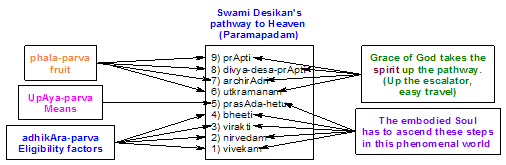
Each of the nine steps, depicted above is called Pariankam (பரியங்கம் = cot, sleeping place). The flight of steps become instead a flight of platforms.
1. Vivekam (விவேகம்- discrimination) is knowing the soul is eternal and the body is non-eternal. Soul is immutable and therefore what is mutable is not soul but a body. Narayana is the origin of all souls and therefore all souls belong to Him. He is Sat (Being); individual souls are Chetanams, Sat-Asat, Being-nonbeing, a combination or an impure compound. When Asat is removed, Jiva is pure and fit for merger. The individual souls should aspire for the Real, that is Bliss; all other worldly enjoyments do not lead to the Real and therefore are unreal.
Vivekam (discrimination) is spiritual wisdom consisting of 7 elements.
- Knowing the difference between soul and body. (Soul is eternal and body is mutable and subject to decay and death.)
- Knowing the difference between Sat and Asat (Paramatman is Sat; matter is Asat; Jiva is Sat-Asat.)
- Knowing the Agonists and the Antagonists of spiritual progress (Sattva is Agonist; Rajas and Tamas are antagonists.) Agonist = facilitator.
- Knowing the difference between the Real and the unreal. (Self is Real and non-self is unreal.)
- Knowing the soul belongs to Him.
- Knowing the soul's yearning to merge with its source (Atma Nivedanam /samarpanam = dedication of soul.)
- Knowing the Supreme objective of human pursuit (Parama purushArtham) is union with Paramatman (Bliss).
2. Nirvedam (நிர்வேதம்--loathing, disgust). When a man morphs into a Viveki (man of spiritual wisdom), he reflects on his past thoughts, words and deeds and engages in self-censure, regretting all omissions, and the missed opportunities to pursue the new-found path and all the commissions unworthy of pursuit. This is Nirvedam.
Tirumangai AlvAr's PAsuram reflects this self-revulsion.
Divyapraphandam Verse 948.
வாடினேன்; வாடி வருந்தினேன் மனத்தால்;
பெரும் துயர் இடும்பையில் பிறந்து
கூடினேன்; கூடி இளையவர் -தம்மோடு
அவர் தரும் கலவியே கருதி
ஓடினேன்; ஓடி உய்வது ஓர் பொருளால்
உணர்வு எனும் பெரும் பதம் தெரிந்து
நாடினேன்; நாடி நான் கண்டுகொண்டேன்-
நாராயணா என்னும் நாமம்.
I wilted; Wilting, I suffered pain in my mind and soul;1
born in a world of great pain2
(with which) uniting; I united with young girls.3
regarding (high of) their offering of sex4
I ran (after them); I ran seeking redemption from the Supreme Substance5
coming to my senses and setting my foot on the path.6
I sought Him; By seeking I found for myself7
Narayana is such a name.8
ibid, Verse 949
ஆவியே அமுதே! என நினைந்து உருகி
அவர் அவர் பணை முலை துணையாய்
பாவியேன் உணராது எத்தனை பகலும்
பழுதுபோய் ஒழிந்தன நாள்கள்;
தூவி சேர் அன்னம் துணையோடு புணரும்
சூழ் புனல் குடந்தையே தொழுது என்
நாவினால் உய்ய கண்டு கொண்டேன் -
நாராயணா என்னும் நாமம்.
O My Life, O My Nectar, thus thinking, my heart melted
One after one, I sought company with grand breasts
I the sinner not knowing many a day
wasted days lost for ever
the swans in loving embrace with their mates
the water-girt Kundanthai, I worship; my
tongue found my redemption
chanting the name of Narayana
Virakti. விரக்தி or விரத்தி: Freedom from worldly attachments; renunciation of worldly pleasures. VairAgyam (வைராக்கியம்-- Freedom from wordly desires) and Virakti are twins seeking freedom and renunciation. The Buddha is the prototype of these twins. Tirumnagai AlvAr sings the following PAsuram to impress his adoption of these principles. If one has to live half the life as a growing child, in marital life, old age and misery and pain, Tirumangai AlvAr rejects that life not worth its name and therefore does not want rebirth. The rest of his present life he wants to spend in a spiritual environment excluding all worldly pursuits. Desikan himself rejected the job offer of the court poet for the king.
To paraphrase Gandhi on Virakti and Vairagya with regards to Brahmacharya (celibate life), it is the scrupulous adherence to its tenets in its purity while completely virile physically. He himself had problems controlling "lust." He gave up drinking milk, because he thought milk promotes libido. He tried fruits and nuts and consulted doctors in vain. His futile attempts gave him the incremental strength to control and overcome his lust. A100 year old man declaring Brahmacharya is meaningless.
வேத நூற் பிராயம் நூறு மனிசர் தாம் புகுவரேலும்
பாதியும் உறங்கிப் போகும்; நின்றதில் பதினையாண்டு
பேதை பாலகன் அது ஆகும்; பிணி பசி மூப்பத் துன்பம்;
ஆதலால், பிறவிவேண்டேன்; அரங்க மா நகருளானே! (Divyaprabhandam 872 by Tirumazisai Alvar)
Accorded by Vedas, if man were to live a life time of one hundred years
half of that goes to sleep. The remaining fifty years
are spent as girl, boy, in disease and hunger, and old age miseries
On account of that, I don't want any more births, O ArangamAnagar Lord.
Once the twin rejection undergoes augmentation and later mutation into love for everything spiritual, the love for worldly things falls by the wayside. If there are any residual pleasures left, they transmute to love of God.
Beethi: பீதி: fear. Once the dissociation of the aspirant and the world takes place, a fear creeps into him and grows. Even heaven has no attraction for such a relinquisher. Am I good enough for Paramapadam? is it a given that I go to Paramapadam though I carry a bag of sins?
Tirumangai Alvar once again gives expression to his feelings in his PAsurams (TirumAlai)
Divyaprabhandam 903-904
...........................................................................................
.............................................................உன்னைக் காணும்
மார்க்கம் ஒன்றும் அறியமாட்டா மனிசரில் துரிசனாய
மூர்க்கனேன் வந்து நின்றேன்; மூர்க்கனேன், மூர்க்கனேனே. (DP903, TirumAlai 32)
.....................................................................To realize you
path any I don't know. Among men I am a sinner.
ignoramus I stand before You. O ignoramus, O ignoramus me.
The path to see You, I don't know. ( I don't know the way to realize you.) I am a sinner among men.
I stand before you an ignorant foolish person, O ignoramus, O ignoramus me.
மெய் எல்லாம் போக விட்டு விரி குழலாரிற் பட்டுப்
பொய் எல்லாம் பொதிந்து கொண்ட போழ்க்கனேன் வந்து நின்றேன்;
ஐயனே! அரங்கனே! உன் அருள் என்னும் ஆசை தன்னால்
பொய்யனேன் வந்து நின்றேன்; பொய்யனேன், பொய்யனேனே.--(DP 904 TirumAlai 33)
ஐயனே = AiyanE = O Aiyan = O Father, O Master.
அரங்கனே = AranganE = O Arangan = O Vishnu at Sri Rangam. Arangam = Rangam, the town where Vishnu is the presiding deity.
I let loose and lost the Truth by being caught in the cascading coiffure of belles.
buried in falsity, utterly destroyed, I stand before you
AiyanE! AranganE! Your Grace is my desire
Liar that I am, stand before you. Liar that I am, Liar that I became.
PrasAda Hetu: பிரசாத ஏது. grace, kindness, favor + foreboding; foreboding of Grace.
After arduous climbing of mere but significant four steps, the fear is replaced by an inkling of hope. His basic character emerges victorious over the fleeting hailstorm of fear and despair. This loss of fear is accompanied by self-deprecation and humility. ( நைச்சியானு-சந்தானம்¢ = naicciyAnu-cantAnam = profession of humility--தன்னைத் தாழ்த்திக்கூறுகை --self-deprecation.) This last attitude generates the feeling of AdhikAri, the One who takes charge (of himself and his destiny in this context); the qualified person; the superintendent. He is ready now to lay out a path for himself and use a means to attain his objective of reaching Paramapadam. He has two UpAyams, means: Bhakti Marga and Prapatti Marga.
Bhakti has three stages of development: Sadhana (practice), Bhava (being, becoming, dawning of divine love), and Prema (wholesome divine love). Sadhana are of nine kinds, all related to Krishna: hearing, chanting, remembering, serving at His lotus feet, worshipping Him, prayers, serving as a servant, friend, dedication of one’s own self (sravanam kirtanam visnoh smaranam pada-sevanam arcanam vandanam dasyam sakhyam atma-nivedanam). Srimad Bhagavatam: 7.5.23-24. Practice of Nama Bhajana covers all nine limbs of devotion.
Hare Krsna, Hare Krsna, Krsna Krsna, Hare Hare
Hare Rama, Hare Rama, Rama Rama, Hare Hare.
Bhakti Marga:
Sravanam: hearing, chanting, listening and enjoying the exploits of many incarnations of God.
Kirtanam: singing the eulogies of God.
Smaranam: Thinking constantly of God, Japam.
PAda Sevanam: Serving (at) the feet of the Lord. Doing Kaimkaryam for the Lord in the temple or doing service to the BhAgavatAs (devotees).
Archanam: Offering of water, flower, fruit, leaf to the God.
Vandanam: showing reverence or homage to God by prostration.
DAsyam: Doing service to God in the capacity of a slave or servant.
Sakyam: சக்கியம்: To act as a friend to God, who is the constant companion in life, death and hereafter.
Atma nivEdanam: ஆத்மநிவேதனம் = offering oneself to God; self-dedication.
Kulasekara AlvAr gives his feelings in this PAsuram which reflects giving up the world and the heaven to be near his God.
4.2 or 678, and 685 Divyaprabhandam
ஆனாத செல்வத்து அரம்பையர்கள் தற் சூழ
வான் ஆளும் செல்வமும் மண் அரசும் யான் வேண்டேன்;
தேன் ஆர் பூஞ்சோலைத் திருவேங்கடச் சுனையில்
மீனாய்ப் பிறக்கும் விதி உடையேன் ஆவனே. --678
eternal wealth celestial dancers surrounded by
heaven ruling wealth and earth kingdom I don't want;
nectar-spilling flower garden Tiruvenkata in the pond
as a fish, fate (privilege) becoming one.
I don't want to rule a kingdom on earth or heaven surrounded by celestial dancers and bestowed with eternal wealth. I want to have the privilege of being born a fish in the Tiruvenakata mountain pond where riverine nectar flows from the flower garden.
செடியாய வல்வினைகள் தீர்க்கும் திருமாலே!
நெடியானே! வேங்கடவா! நின் கொயிலின் வாசல்
அடியாரும் வானவரும் அரம்பையரும் கிடந்து இயங்கும்
படியாய்க் கிடந்து உன் பவள வாய் காண்பேனே. --685
thicket of weed-like wicked deeds destroying O TirumAl!
O NediyAnE!, O VEnkadavA! Your temple gateway (doorway--entrance)
AdiyArs, VAnavars, and Arambaiyars, wait, stand and walk on
the steps that I remain and see your red coral lips.
O Tirumal, you destroy the thicket of karma. O NediyAnE, O VenkadavA, I will remain the step (in the west, it is the doormat) in the walkway at the entrance of your temple, tread by devotees, celestials and the heavenly dancers, and a constant witness to your red coral lips.
திருமாலே = O TirumAl = The Great God, Vishnu. நெடியானே = NediyAnE = Tall God, Vishnu. வேங்கடவா = VEkatavA= dweller on the Tiruppati hills.
At this stage of spiritual development with Vivekam deeply entrenched and Nirvedam, Virakti and Bheeti behind him, Bhakti (devotion to personal God) is strong in his heart, mind and soul and he has gone beyond the threshold and entered the world of God (Salokya). Here is a verse by PeriazvAr.
பறவை ஏறு பரமபுருடா!, நீ என்னைக் கைக்கொண்டபின்
பிறவி என்னும் கடலும் வற்றிப் பெரும்பதம் ஆகின்றதால்;
இறவு செய்யும் பாவக் காடு தீக்கொளீஇ வேகின்றதால்
அறிவை என்னும் அமுத-ஆறு தலைப்பற்றி வாய்க் கொண்டதே. --DP 464 by PeriazvAr.
Garuda-riding Paramapurusha! You, after taking me in your hands (took charge of me)
the ocean named 'birth' has gone dry and having become supreme abode
death-causing forest of Papam burns and cooks in a raging fire
Wisdom, named Ambrosial river, tides over my head.
O ParamapurudA, the moment you took ward of me, the sea
of birth and death, having gone dry, became my supreme abode. The birth- and
death-causing Karma burns and boils in a raging fire. I am immersed over my
head with the wisdom named Ambrosial River. (I am immersed in Bliss.)
பறவை = bird = the Mythical Bird, Garuda, the vehicle of Vishnu.
பரமபுருடா = Supreme Purusha = The Supreme Being.
PeriazvAr feels grateful that the Lord has accepted him and abides in his heart.
அனந்தன் பாலும் கருடன் பாலும் ஐது நொய்தாக வைத்து, என்
மனந்தனுள்ளே வந்து வைகி வாழச் செய்தாய்; எம்பிரான்!
நினைந்து என்னுள்ளே நின்று நெக்குக் கண்கள் அசும்பு ஒழுக
நினைத்திருந்தே சிரமம் தீர்ந்தேன் நேமி நெடியவனே --470, 5.4.8
Entertaining less love for Ananta and Garuda, You entered my heart and gave me a new lease on life. O EmpirAn, You abide in my heart; my eyes shed tears. Thinking of you, I expunged all my miseries, O Lord of Discus.
Prapatti Marga
Now we go to Prapatti Marga for the one who does not have the discipline or birth privilege of a Brahmana to practice Jnana, Karma, or Bhakti Marga.
The results are the same but the means are different. Here success is enhanced by finding an Acharya in this BhagAvan-Acharya-BhAgavata axis. Acharya is the intermediary between God and Prapannan. Madurakavi AlvAr sings the following PAsuram (DP 940-- #4).
The importance of an Acharya in Prapatti Marga.
நன்மையால் மிக்க நான்மறையாளர்கள்
புன்மை ஆகக் கருதுவர்; ஆதலில்,
அன்னையாய் அத்தனாய் என்னை ஆண்டிடும்
தன்மையான் சடகோபன் என் நம்பியே.
virtuous scholars of four Vedas
mean and vile so they will regard me; On that account
mother and father me rule me
of such nature Sadagopan my the elite among men.
Normally the virtuous scholars of four Vedas will regard me as a vile person. Sadagopan, the elite among men, of the nature of mother and father to me rules me.
6. Utkramanam: Passing out. This is the sixth stage when a BhaktA/Prapannan leave the body and continue his voyage to Paramapadam. It is an outward and upward journey of a lighter soul devoid of its excess baggage.
Utkramanam means atma leaving the physical body. The departure is in the hands of Bhagavan; Atma undergoes distress at separation from the body. Bhagavan helps a Prapannan’s soul or Atma exit via the Suksma Nadi and Brahma Randhra. Those who are not Prapannan: Bhagavan helps their Atma to exit via other Randharas.
Dying can be painful, pleasant, unpleasant, horrid, ugly, peaceful.... But Krishna's devotees die a death of quiet dignity. Krishna says in BG 8.5 the following.
8.5: At the time of
death, he, who remembers Me when leaving the body, goes to My being. Of this,
there is no doubt.
7. ArchirArdi: is described elsewhere in detail. See the diagram of Empyreal Highway to Paramapadam. The soul travels this pathway as a subtle body. When it goes through the River Viraja, the Suksma Sarira (subtle body) drops.
Different texts have different presentations.
Next is Archiradhi Margam.
Archi is Agni. It is the path of Light-
Suklagathi ArchirAdhi Margam. The opposite
Margam
is Krishna (dark) Margam. ArchirAdhi Margam is one way path to Vaikuntham. It
is the empyreal Highway. Suklapaksha
Abhimani Devatas greet the Prapannan on his way to Vaikuntham.
He goes beyond the Aditya Mandalam. He
is heading towards the
8. Divya Desa PrApti: Divine country enjoyment. The soul wades through the celestial River Viraja and when it reaches the other shore, it acquires a new status: Sanctification. This consecration guarantees the certainty that the soul does not carry any sins, vasanas, samskaras, and karma, meaning that the subtle body drops. This is where you gain when you lose. It is as pure as God himself. The emerging new pristine lighter body is called AprAkrita Divya Mangala Svarupa (matter-free, divine, auspicious self-same form).
9. PrApti: Final Bliss. A state of union with God is described elsewhere.
Wake up with Hari Nama on your lips, walk chanting Kesava, say Govinda before you eat, and mutter Madhava when you go to sleep. At any time, let Dwayam dance on your lips: Sriman Naaraayana Charanau, Saranam Prapadye. Srimathe Naaraayanaaya namah.
|
Sri Krishnan Swamy, the leading exponent of Srivaishnavism. Dec 2011 All the nitya suris (eternally liberated ones) have the same ayudhas (weapons) and abharanas (Ornaments) as Sriman Narayana. Jaya and Vijaya are the dvara palakas (gate keepers) in Vishnu loka (world) and they too possess the same ayudhas. In fact all of us would also get the right to possess them when we become muktas (the one freed from sin). The deities of azhvars whom we worship in the temples are archa forms of their vibhava tirumeni (Manifested sacred body) and so they do not hold sankha and chakra (Conch and Discus). Amongst many merits of moksha one is saroopyam (form and appearance of the deity) in which we are blessed with the same form as Sriman Narayana. A bhakta (devotee) has the right to get annoyed with his Perumal (God). But he is consoled quickly by his Lord. Individual experiences have to be accepted as they are and are never to be questioned. Archa form = the form for worship = Manifestation of Viṣṇu as idols and other sacred symbols which are worshipped in temples and houses |
The Greatness of Tulasi plant, Ocimum tenuiflorum or Ocimum sanctum.
Vishnu loves Tulasi leaves. துளசி. Siva explains to his son Skanda about the greatness of Tulsi. Upon the advice of Vishnu, the gods and demons churned the Milk Ocean. KAmadhenu, Karpaka tree (கற்பகமரம்) Airavatham, Uchchaisravam, Moon, Mahalakshmi emerged from the ocean. At last Dhanvantri with Ambrosial Nectar in a vessel emerged. That time only, Vishnu shed teats of joy. From the tears, an appropriate plant grew. That is Tulasi. Since Vishnu bore the Mantara mountain (the churning staff) on His back in the form of tortoise, he (Achuta) developed fatigue which was relieved as soon he wore the Tulasi garland. Vishnu spoke to Tulasi, 'O Tulasi, by your presence and touch, I attained Supreme Bliss. Ask me for a boon.' Tulasi entreated Vishnu as follows: 'if any one worships you with my leaves in great devotion to you, eat the leaves, circumambulate me in worship, and smell my fragrance, their sins should come to an end. And you should like me for ever.' Tulasi is a Goddess. Vishnu conferred the boon to Tulasi and said, ' O Tulasi Devi, I would not be satisfied if any one worships me with all the worldly wealth unless at least they do it with a leaf or petal of Tulasi. Even one Tulasi leaf or petal offered to me by any devotee, I will be bound by their love. I will give them what they ask for and a guaranteed place in Vaikuntam.'
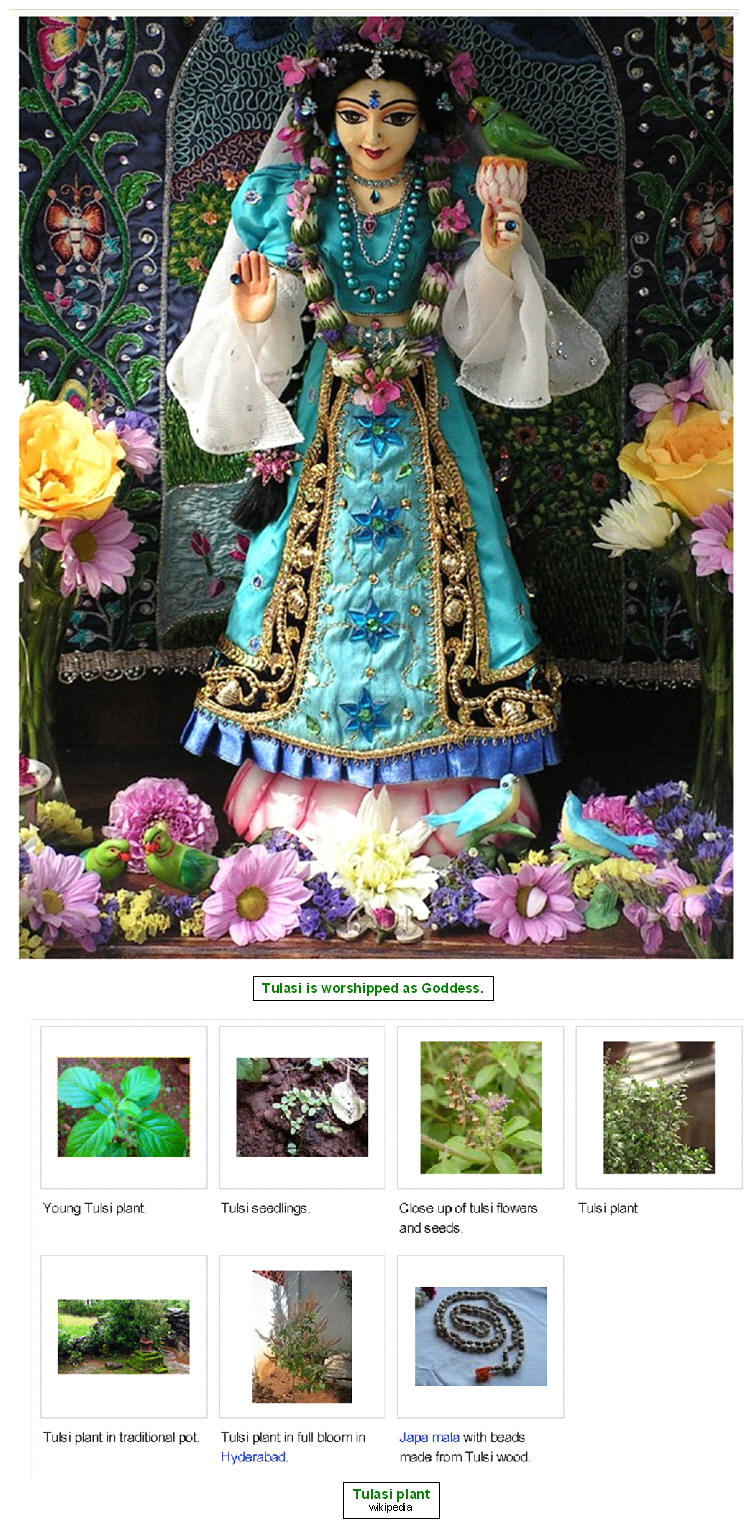
Muruga (Skanda) is the War God and the son of Siva and Parvati. Once when He was fighting Tarakasura, he was very much fatigued, Siva advised Him to pray to Tulasi Devi , meditate on her Coat of Mail (துளசி கவசம்) and seek Her help. Murugan followed Siva's advice and eventually conquered the demons Tarakasuran and Surapadman.
The Greatness of Tulasi is described in Padma Purana (Part 7, Chapter 23- Motilal Banarsidass publishers). This is a condensed version of the chapter with added material.
Siva narrates the greatness of Tulasi to Narada Muni. Knowing the importance of Tulasi expunges all sins. All parts of Tulasi plant (roots, main stem, branches, its skin or tender bark, leaves, flowers, fruits) and the clay at the roots are purifying. Tulasi used as the crematorium firewood frees a person from all sins and rebirth. Vishnu's messengers upon seeing the dead man in the Tulasi funeral pyre, take him directly to the world of Vishnu (Vaikuntam) bypassing the world of Yama the god of death and his servants. All gods seated from their airplanes shower flowers on the Tulasi-wood funeral pyre and the cremated body. The celestial singers sing songs of praise. Vishnu and Siva express pleasure at seeing him. Vishnu takes him to His abode, after cleansing him of all his sins in the presence of gods and holds a celebratory festival in his honor. The seeds of sin along with the sins are burnt in the burning Tulasi-wood.
Tulasi-wood used by the crematorium attendqnts have their sins expunged. Any act done with Tulasi-wood does bring cleansing of sins as in cooking with it for the gods, lighting it for light, making a paste and smearing it on one's body.... If a man offers Tulasi leaf to the manes along with Pinda (cooked rice), the manes remain contented for a hundred years. Smearing the body with clay at the roots of Tulasi plant is equal to visiting and bathing in the holy place. Even a Brahmana murder is forgiven if one sees or touches the Tulasi plant in Tulasi garden in his house. Whichever house has the Tulasi plant does not have visitation from poverty, hostile actions, disease, fear or grief. Wherever there is Tulasi, Vishnu is there close by. Worshipping Tulasi prevents diseases, and cancels out portents. All beings in the path of its fragrant wind are purified.
Siva and Vishnu take residence in the house with the clay of Tulasi plant. Its root is Brahma, the middle is Vishnu, and the sprouts are Rudra-Siva. Carrying the water dripping from the Tulasi plant on one's head obtains the fruits of bathing in Ganges. Planting Tulasi in the temple of Siva guarantees one's stay in heaven for many Yugas equal to the number of seeds in the plant. A poor man worshipping Tulasi daily becomes a rich man.
Here is a short account of Tulasi Stotra (Hymns of praise of Tulasi), as told by Siva Mahadeva. The presiding goddess is Sri Tulasi Devi (Mother Goddess). She fulfills all desires of the mind. O the bearer of lotus, protect my head; O praise-worthy and great Tulasi, protect my forehead; O Lotus-eyed, protect my eyes; O the companion of Mahalakshmi, protect my ears; O Sukanda (சுகந்தா), protect my nose; O Ezilvadani (எழில்வதனீ) protect my face; O Subhadai (சுபதை), protect my tongue; O Vidyamayi (வித்யாமயி), protect my neck; O Kalyani, protect my shoulders; O Vishnu Vallabhai, protect my heart; O PunyathA, protect my middle; O SaubhAgya Devi, protect my navel; O Kundalini, protect my waist; O Devi, protect my thighs; O Janani, protect my knees; O Narayani, protect my legs; O Sarvarakshaki, protect all my body parts; O Tulasi Devi, protect me during bad times, fear, war, night, day, dawn, noon, evening twilight.
The Tulasi Kavasam is Amrita or nectar of Supreme Secret; Purity; Remover of fear; Guarantor of liberation to Mumuksus (ones desirous of salvation); Guarantor of meditation to Dhyana Yogis; Guarantor of love to the seekers; Guarantor of knowledge to the seekers; Guarantor of wealth to the indigent; Guarantor of expiation of sins; Guarantor of food and health to the needy; Guarantor of heaven to the aspirant; Guarantor of wealth to the seeker; Guarantor of progeny to the seeker; Guarantor of restoration of kingdom to the vanquished king; Guarantor of Grace [and being the Universal Inner Dweller (சர்வாந்தர்யாமி = SarvAntharyAmi)] to the householders desirous of obtaining Dharma, Artha and Kama. The ones desirous of obtaining all these perfections should worship Tulasi Kavacam with opposed palms before the sun. The ones who chant these Mantras daily, would fulfill all their desires and wants and reach my abode easily.
Chanting this Mantra and stroking one's body with Darbha grass guarantee progeny with a long life to a childless woman, and complete cure of leprosy in the sufferers. The ones, desirous of support from the rulers should perform Japa (muttering prayers) under a tree, Ficus religiosa (அரச மரம்); the ones desirous of great beauty, should perform Japa on the banks of rivers and lakes; the ones desirous of learning should perform Japa under the Indian Coral tree (Erythrina indica = பலாச மரம்). The ones desirous of marrying a good maiden should perform Japa in Chandi Temple. Prayers should be offered in Siva's temple for vanquishing the foes; in Vishnu Temple for obtaining all of one's needs; and in Uddhiana Vanam (?) for marrying a girl of his heart's desire.
There is no need for repetition in the advocacy and efficacy of Tulasi Kavasa Mantra, because the chanter get the benefits they seek. Thus Siva Peruman states that one should abide his heart in Tulasi Devi who killed the demon Tarakasuran and chant the Tulasi Kavasa Mantra. This is the Mantra instructed by Siva to Muruga (Skanda = கந்தன் or முருகன்) to vanquish the demon.