PLEASE CLICK HERE: GANESA.pdf
Ganesa

Bhagavadgita Pages, Chapters 1 to 18
BG01
BG02
BG03
BG04
BG05
BG06
BG07
BG08 BG09
BG10
BG11
BG12
BG13
BG14
BG15
BG16
BG17
BG18
V.Krishnaraj

Ganesa family.jpg
May 12, 2023
(Verse 1)
Oh Pillaiyar, embodiment of grace
Feasting on rice flakes
and Kozhukkattai's embrace
With an appetite so hearty, worries you
erase
Difficulties dissolve, leaving no trace
(Chorus)
Pillaiyar Pillaiyar, your greatness shines bright
The sibling of the
six-faced Kandan's might
Ever ready to alleviate sorrows with your
light
Oh Pillaiyar, you're our guiding light
(Verse 2)
Pillaiyar Pillaiyar, the fire sacrifice's guide
Boons bestowed upon us,
far and wide
You are the first and foremost, none can deny
In your
presence, all obstacles subside
(Chorus)
Pillaiyar Pillaiyar,
your greatness shines bright
The sibling of the six-faced Kandan's
might
Ever ready to alleviate sorrows with your light
Oh Pillaiyar,
you're our guiding light
(Verse 3)
Seated beneath the mesquite
tree, blessings you impart
Expunging our sins, healing every wounded
heart
Under the bael tree, you play your divine part
Pillaiyar
Pillaiyar, we offer our love and regard
(Chorus)
Pillaiyar
Pillaiyar, your greatness shines bright
The sibling of the six-faced
Kandan's might
Ever ready to alleviate sorrows with your light
Oh
Pillaiyar, you're our guiding light
(Bridge)
With turmeric or
even mud, we worship with devotion
Your five-syllable Mantra, a sacred
potion
Pillaiyar Pillaiyar, your divine connection
Brings us solace
and eternal protection
(Chorus)
Pillaiyar Pillaiyar, your
greatness shines bright
The sibling of the six-faced Kandan's might
Ever ready to alleviate sorrows with your light
Oh Pillaiyar, you're
our guiding light
(Outro)
Oh Pillaiyar, we sing this song with
reverence
In your presence, we find solace and deliverance
Forever
grateful for your divine benevolence
Pillaiyar Pillaiyar, you're our
eternal essence
05/12/2023
Ganesa = Gana + Isa = Troops + leader, superintendent, chief, master....
Gana is commonly translated as attendants. It also stands for class of animate and inanimate entities, flock, multitude, number, series, tribe, troop.... Ganesa is the superintendent of Siva's troops. A troop comprises 27 chariots, 27 elephants, 81 horses, and 135 footmen. He is the leader of Ganas (Ganapati = Gana +Pati).
Ganesa is the first son of Siva and Parvati. Since Ganesa is the creator and remover of obstacles, he is worshipped at the beginning of any undertaking or any composition. His invocatory Mantra is OM Sri Ganesaya Namah among others.
Vighneswara is the Lord of obstacles. (Vighna +Iswara = obstacles + Lord) and so obstructs our chosen path if our timing is wrong. In his capacity as Vinayaka, He removes the same obstacles and impediments, when He feels success is a certainty. As Siddhidhata, He is Bestower of Success.
Vinayaka is the remover of obstacles. Ekadanta = the one-tusked; Danta is tooth or tusk. It is cognate with dental. Gajamukha and Gajanana = the elephant face; Pilliayar = (honorific) son, Ganesa. Lambodara = the pot-bellied.
Ganesa and the West
West is intrigued by Ganesa. They don't know
what to make of the Hindu God, Ganesa.
Ganesa, according to the students from West, was
not present in the Hindu scene prior to the fifth century. He did not figure
in Mahabharata, though Hindus are of the belief that
Ganesa was the scribe of Mahabharata when Vyasa
narrated and dictated the Great Story. Because of his
theri-anthropomorphic appearance, the western students are of the
opinion that Ganesa was the god of elephant
cult. Ganesa might have been the successor to
the evil spirits, Vinayakas. One thinks that
Ganesa is the Sun-God of the Dravidians and his
Vahana (vehicle) the rat stands for darkness,
which the sun dissipates. They quote Koomaraswamy
saying that Ganesa is the
godling related to Yaksas and
Nagas. Monier
williams says
Ganesa and his brother
Skanda are the head of tutelary village divinities, offering
protection against evil. They attribute the rise of
Ganesa to the forefront to the aggressive promotion by his followers
and worshippers. Others point to the mention of Ganesa
in Vedas, as the one with elephant face and one tusk. Speculations abound as
follows. Siva defeated Ganesa the non-Brahmanical,
Non-Vedic godling and later conferred
Ganesa the honor of the leader of Siva's
attendants. Parallels are drawn to show the simultaneous acceptance of
Ganesa in the Brahmanical
fold and the assimilation of the tribals in
South India into the Varnasrama dharma of
Brahmanical Vedic practitioners after the
Buddhist and Jain decline.
Ganesa made of scruff
Ganesa, a case of Xenograft
Transplantation
One legend says that scruff (dross) from the nape of Parvati's neck was the origin of Ganesa. Parvati was alone in her abode, when Siva went to Kailāsa (abode of snow--Himalayas) which is a mountain in the Himalayan range; Kubera and Siva live in the loftiest peaks north of Manasa Lake. When Siva came back, he tried to force his way past anthropomorphic Ganesa, who would not allow that because his mother was in the bath and he did not know who Siva was. Siva ordered one of his Ganas to cut his head off. Parvati was angry and grief-stricken. Vishnu went searching for a head and found a young elephant, whose head was transplanted on Ganesa's body. Another legend says that Sani looked at Ganesa and his evil eyes beheaded his head and Vishnu replaced it with the elephant's head. Go to Supplement and look at ChitraRadha's Curse for more details.
A question may be raised: If xenograft was possible then, why did Vishnu not put Ganesa's own severed head back in its place? I guarantee that my statement constitutes no disrespect; Hindu gods invite queries like this from devotees. But that Ganesa carries an elephant head needs an explanation more so than why his own severed head was not put back in its place. We do not know the motive behind the xenograft, while Vishnu had the technical ability to transplant and we have to find an explanation on why he has the elephant head. Life and story of Ganesa according to Hindus have metaphorical significance. Indian Gurus concentrate on the symbolism of the anatomical peculiarities.
Linga Purana and
Vinayaka's birth, Chapter105
The origin of Vighnesvara
and Vinayaka (the dispenser and remover of
obstacles)
The Devas came to Siva who greeted them with his blessings. The Lord of word and speech addressed Siva saying that the Asuras were causing harm to the Suras (gods) and begged that Siva should throw impediments on the evil ways of Asuras (demons). The trident-bearing Lord of Devas, Siva entered the womb of Uma, the Universal Mother, and emerged as Ganesvara. (The concept of God entering the womb of his spouse without insemination and emerging as a divine being and making his wife his own mother is special in Hindu religion.) Ganesvara is the Master of Ganas, that is Siva. All Devas and Ganas euologized Siva-Maheśvara, the source of the universe and the glorious remover of miseries of human and worldly existence. Ambika-Uma received with gladness her elephant-faced Lord Gajānana (Gajanana), the creator of the world and the wielder of the trident and noose. Devas and others eulogized and bowed to Mahesa and Ganesa.
Ganesa the elephant-faced God dances and offers homage to his father and mother. Mahadeva-Siva picks up his son, kisses him on his forehead and says that he took his birth to destroy the Daityas (demons) and bring joy to Adityas (gods) and Brahmins, the Vedic scholars. Ganesa is endowed with special powers: throwing obstacles to sacrifice by the Daityas; removal of vital breaths from those who are negligent in performing rites, and teaching and study of Vedas; removal of vital breaths from those who do not perform the duties of their castes; treating the worshippers as equal to him; protecting the old, the infirm, the young, and the devotees. Siva says that worship of Siva, Vishnu, or Brahma would commence with the worship of Ganesa. All auspicious rites and rituals would be ineffective unless Ganesa is worshipped first. Siva continues to eulogize Ganesa. "Ganesa is worthy of worship by Brahmins, Ksatriyas, Vaisyas, and Sudras with the offering of victuals for realizing their siddhis. Devas (Suras, Adityas, gods) and others would accomplish nothing if they do not offer flowers, fragrance and incense to Ganesa. Brahma, Vishnu, Siva (includes himself) are no exception and if they do not worship you first, you will throw impediments in their path. Ganesa creates impediments in the rites and rituals of Daityas (Demons, Asuras)."
|
exoticindia.com with added text from Veeraswamy
Krishnaraj |
|
Ganesa dispenses and
removes obstacles. Man is essentially a polar animal, two poles being
virtue and evil, and in-betweens. He is man and angel on the virtuous
side, animal on the other end, and many times somewhere in-between.
Virtue and vice are Adityas (gods) and
Daityas (demons). Man is a hybrid, part
god and part demon and combination and
permutation thereof. Asuric
(demonic) nature and pursuit someday will face obstacle while the
reverse is true for the Suric.
The large elephantine
head of Ganesa is symbolic of
immense intellect needed to understand Vedanta. Large
ears represent constant
listening and hearing of
Vedanta from the teachers. The
trunk represents versatility; it can
lift heavy objects,
pluck one blade of grass or
pick a penny. The tusks stand for the discriminative power of
Ganesa, while choosing from the dualities
of opposites, right and wrong, love and hate....
Parasurama's
axe thrown in anger was adroitly stopped by one of the
tusks; the broken tusk is symbolic of transcending dualities. Another source
tells that the intact tusk represents the maleness of Siva and the
broken tusk the femaleness of Sakti. His
humongous mouth, stomach and appetite stand for whopping love of life.
A humorous story goes with his large
appetite, by which Ganesa
humiliated Kubera's vanity.
Exoticindia.com
Krishnaraj. Go to Children Eat Free under
Supplement. His large abdomen is symbolic of
his ability to stomach the vicissitudes of life and vacillations of
others. The victuals at his feet stand for nature's abundance and
elements ready to serve and satisfy him. The mouse at the feet looking
up to him gnaws at and depletes the merits of a human being and
represents desire and its fateful consequences.
Ganesa keeps the desire under his control.
The moon once laughed at him for his rotund corpulent
abdomen, ungainly walking, riding on a minute mouse of desire and
wrapping his abdomen with the snake. Moon the deified form of
intellect received a curse that he would be invisible one day on a
periodic basis.
He has four arms with accouterments and weapons. Axe
cuts the attachments, desires, sorrows
and dualities of this world, while the rope pulls the devotee near
him. The rice ball represents the reward he gives to his devotees. The
fourth hand offers blessing, protection and removal of obstacles.
|
Padma Purana and
Gangeya-Ganesa
Another legend says that the dross from the nape of the neck of Parvati was thrown into the River Ganges and was swallowed by the elephant-headed goddess Malini, giving birth to five-headed elephant with four arms. Goddess Ganga claimed him as her son; Siva intervened and declared that he was Parvati's son. Siva excised the four heads leaving one head and anointed him as the Remover of obstacles. Other legends will be mentioned in the article elsewhere. (Two Ganesas, credit: exoticindia.com)
Obstacle and misery come in three flavors: Exogenous, endogenous, and Theogenous (Adibautika, Adiatmika, and Adidaivika). The word Theo-genous is coined by me. Ganesa can ward off these miseries.
Exogenous miseries and obstacles come from the outer world of beings and matter. Lifestyle change can help ameliorate this misery.
Endogenous miseries and obstacles come from the body, mind and soul; they need mending from proper specialists.
Theogenous miseries and obstacles are god-sent and include natural disasters like floods, hurricanes, earthquakes, tsunamis.... They could be part of karmic baggage of an individual.
He is the Lord of beginnings, the beginning of any task, undertaking or composition; the devotee needs his power of removal of obstacles which may crop up .
The Hindu stories are regarded by the west as Myth and Mysticism, while Hindus regard them as Truth and Mysticism. Scientist use intelligence, reason, prior knowledge, experience, intuition to arrive at physical truths. Transcendental Truths are beyond the scope and reach of the above faculties, which are of material origin. How can matter understand spirit? It is like the pot trying to figure out the composition of the clay. The Rishis looked inside rather than outside to find the answers to the questions of the spirit. This is where the eight principles come into play. As the scientist needs training, discipline, and diplomas to perform his work and unravel exoteric truths, a Rishi needs the following to delve into the inner world and explain esoteric Truths.
(1) Yama (Don’ts): sexual abstinence, ahimsa (noninjury),
no lies, no theft, no greed.
(2) Niyama (Dos): meditation on Brahman or
Isvara; mauna
(silence); study of Vedas, Upanishads, and moksa-promoting
literature; repeating of mantra OM; ascetic practice; clean body and mind;
contentment; God-Pleasing actions.
(3) Asana: body positions and postures.
(4) Prānayama:
breath control.
(5) Pratyahara (withdrawal): no contact
between senses and objects of senses. This
should come natural to him.
(6) Dharana: concentration and
focus of mind on an object or idea.
(7)
Dyana: meditation.
(8)
Samadhi: Convergence, one-pointedness, Subject and object (Yogi) unity.
Go to TMTM03 for
details.
Once the Rishi becomes an expert, he receives enlightenment and revelations. Esoteric Truths are rendered understandable to the ordinary people by way of stories, metaphors, analogies.... The contradictions, apparent moral turpitudes and dilemmas, fair and unfair means and the rest in the lives of gods, goddesses, men, plants, animals are embedded in the stories to elucidate the Truth.
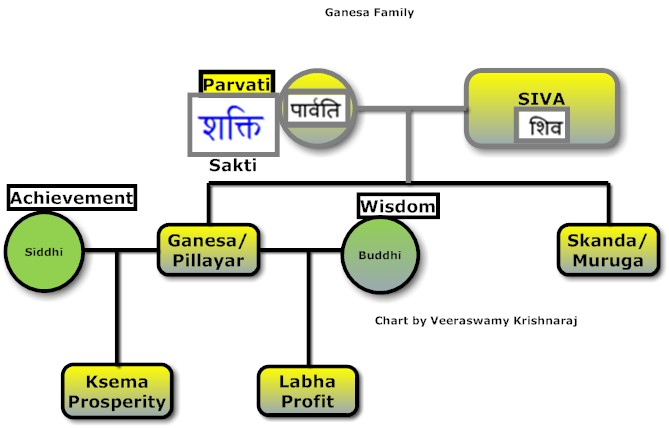
He is married, according to Siva Purana, to Siddhi and Buddhi, the two daughters of Visvarupa; Siddhi (Achievement) gave birth to Ksema (Prosperity) and Buddhi to Labha (Profit).
Ganesa's
liberality is glorified here. Excerpt from The Great Liberation page
139 by Woodroffe.
Page
139, The great liberation. About Ganesa. On this verse Tarkalamkara says
Tantras observe that shortly after the churning of the ocean the
inexhaustible jar of Amrta or nectar was
placed in the hands of Ganesa. Whenever any of the Devatas wanted to
drink the nectar, Ganesa would pour it out for him. In this way he got no
leisure. Once, Ganesa became very tired and some impurity (Mala) came out of
his trunk, out of that a man came.
Because he came out of the trunk (Sunda) he
was called a Saundika or brewer. Ganesa placed the jar of nectar in
the hands of this man and granted him the following boon, viz., that as the
Devatas churned the ocean after throwing into it drugs and other substances
and produced nectar so the brewer and his descendants would put into water
different things and churning it would produce nectar which they were to
give to other people but never drink it themselves.
In the drinking of this no one should make
any distinction of caste. If the brewer of the present day make wine
from the prescribed articles according to the method laid down in the
Tantras then man becomes long lived and free of ailments. Old men imbibing
wine become young again.
These are some of the many names of Ganesa.
ஆகுரதன்
āku-rataṉ = ākhu-ratha
= Bandicoot-rider = Gaṇēša, as riding a
bandicoot.
தும்பிமுகன் tumpi-mukaṉ
=
தும்பி + முகன்.
Proboscis + Faced = God Gaṇēša;
அங்குசதாரி
aṅkucatāri = ankuša-dhārin
= wearer of goad.
அங்குசபாணி aṅkuca-pāṇi =
Holder of goad.
அங்குசபாசதரன் = Holder of goad.
அத்திமுகத்தோன்
atti-mukattōṉ = hasti-mukha
= elephant-faced = Ganēša, as
elephant-faced.
அம்பிகைதனயன்
ampikai-taṉayaṉ
= Ambika + son =
Gaṇēša, as son of Pārvatī
(Ambika);
ஆனைமுகன்
āṉai-mukaṉ = elephant-faced =
Gaṇēša, as the elephant-faced god.
ஈசன்மைந்தன்
īcaṉ-maintaṉ
= Lord’s + Son = An appellation used in
respect of any one of the sons of Šiva.
ஏகதந்தன் ēka-tantaṉ
= one- danta
= one-tusked. Gaṇēsa, the one-tusked.
Sanskrit Danta and English Dental
are cognate.
ஏரம்பன் ērampaṉ
= Hēramba =
well-versed in maths.
Gaṇēša.
ஒருதந்தன் oru-tantaṉ
= one-tusked = Gaṇēša, who has only
one tusk.
ஒற்றைக்கொம்பன் oṟṟai-k-kompaṉ
= one-horned = Elephant with one tusk.
2. Gaṇēša who has only one tusk, the other one
having been broken by him, according to Hindu mythology, to write the epic
of the Mahābhārata on Mount
Mēru, to the dictation of Vyāsa.
கங்கைபெற்றோன் kaṅkai-peṟṟōṉ =
Ganges-Holder =
Vignēšvara who, like his father
Šiva, has the Ganges in his matted locks.
கசானனன் kacāṉaṉaṉ
= Treasurer.
கசானனன்
kacāṉaṉaṉ = gaja-
ānan = Ganēša, who
has the face of an elephant;
கணநாதன் kaṇa-nātaṉ
= gaṇa-nātha
= Hosts + Lord = Chief of Šiva's hosts.
கணபதி kaṇa-pati
= gaṇa-pati
= Hosts+Chief = Gaṇēša,
who is the chief of Šiva's hosts.
கணபதி-
விநாயகன்
kaṇapati- vināyakaṉ = The
Chief of Ganas and Remover of Obstacles.
கணேசன் kaṇēcaṉ
= gaṇēša.
Gaṇēša, son of Šiva,
as the overlord of Šiva's hosts
கயமுகன் kaya-mukaṉ
= gaja-mukha
= elephant-faced = Gaṇēša, the
elephant-headed
சிந்தாமணி:
cintā-maṇi = A mythical gem believed to yield to
its possessor everything that is desired = Ganesa,
who removes the darkness of ignorance
தொந்திக்கணபதி tonti-k-kaṇapati
= Big belly- Lord of hosts =
Big-bellied Gaṇēša.
பாசபாணி pāca-pāṇi
= Noose-holder = one holding the noose in hand
பிள்ளையார் piḷḷaiyār
=
பிள்ளை +
ஆர் =
piḷḷai + ār = son +
honorific plural suffix = Son, used honorifically.
போசனப்பிரியன் pōcaṉa-p-piriyaṉ
= food-lover = Gourmand, Epicure, Glutton = God
Gaṇēša.
மாமுகவன் mā-mukavaṉ
= big-faced = Gaṇēša.
மூத்தநயினார்
mūtta-nayiṉār
= eldest + son = Gaṇēša,
as the eldest son of Šiva.
மூத்தோன்
mūttōṉ = The Eldest = Gaṇēša,
as the eldest of Šiva's sons
மூஷிகவாகனன்
mūṣika-vākaṉaṉ
= Bandicoot + rider = Gaṇēša, as riding the
bandicoot.
மோதகப்பிரியன் mōtaka-p-piriyaṉ
=
A kind of rounded
braid
of hair on the top of head + Liker.
மோதகப்பிரியன்
mōtaka-p-piriyaṉ.
mōdaka-priya =
Steamed rice + Liker
= Gaṇēša;
mōtakam =
mōdaka = Cake of rice-flour made into a
ball and boiled or steamed.
யானைமுகவன்
yāṉai-mukavaṉ
:
யானை + முகவன்
= Elephant + faced
Gaṇēša;
வல்லவைமன்
vallavai-maṉ = Vallaivai-husband
= Gaṇēša, as the husband of
Vallavai;
விக்கினநாயகன்
vikkiṉa-nāyakaṉ
= Obstacle-Lord = Lord of Obstacles =
Gaṇēša.
விக்கின-
விநாயகர் vikkiṉa-
vināyakar = Obstacle-remover.
விக்கினம்
vikkiṉam = vighna
(Sanskrit) = Obstacle, impediment, hindrance, difficulty.
விக்கினராசன்
vikkiṉa-rācaṉ
= vighna-rāja
= Obstacle-Ruler = Ruler or Lord of obstacles.
Ganesa was victorious over an
Asura king Vighna (Obstacle).
விக்கின-விநாசனர்
vikkiṉa-vināśanar = Obstacle-destroyer.
விக்கினேசுவரன்
vikkiṉēcuvaraṉ
= Gaṇēša, as
controlling obstacles.
விநாயகன் vināyakaṉ
= Vināyaka
(Sans) remover = Gaṇēša, as the remover of
obstacles.
ஸ்தூலகாயர்
=
Sthūlakāyar = of big body.
Vignesvarar = The Lord of Obstacles. Vighna is obstacle. Vighnesvara is the Lord of Obstacles; the Controller of obstacles. Vinayaka is the remover of obstacles.
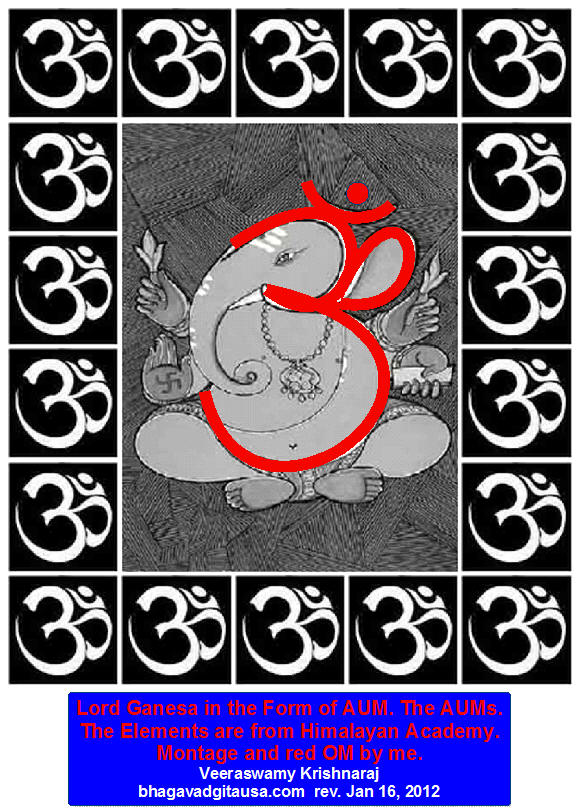
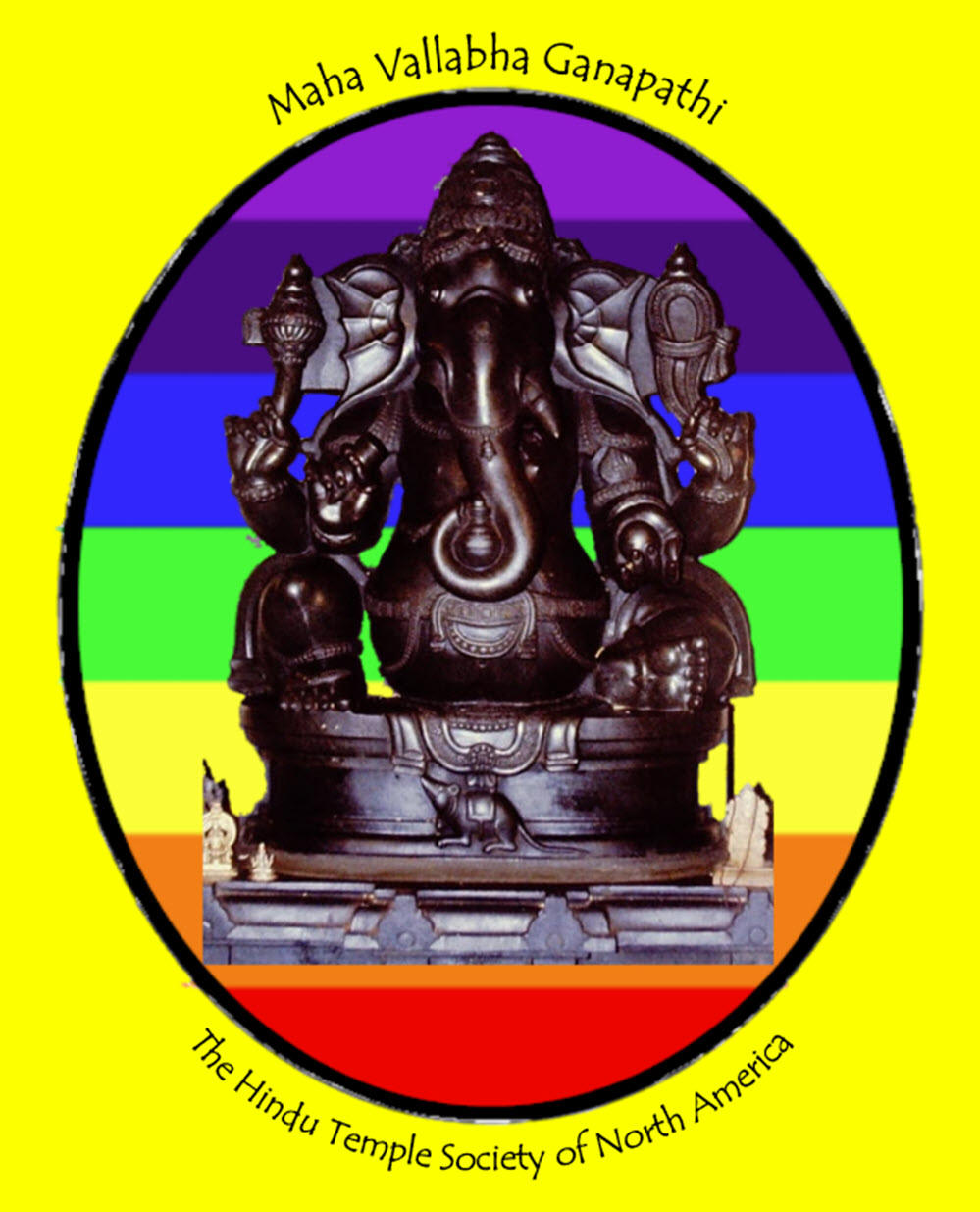
The first son of Siva and Parvati is Ganesa. He is primordial Being without beginning and end. Pranavam (AUM/OM is the First from which all universes and beings came. Pillaiyar or Ganesa is of the form of Pranavam. You will see the form of Pranavam when you put together the elephantine face, the ear, (the curved proboscis) and the potbelly. sivagn5.jpg below
Here is a story about worshipping God with the three-eyed Coconut.
Vighnesvara confronted his father Siva and demanded that he sacrifice his head. Whatever that is important to a person, he should sacrifice. Ganesa likes this sacrifice. Here the three-eyed coconut represents the head with three eyes, two physical and the third eye of wisdom and spirituality. The coconut also represents an intact EGO, which upon breaking yields the panacea of coconut water, meaning a person with a shattered ego obtains the nectar of immorality.
Ganesa has the looks of the elephant; the mouse looks the opposite of his body in its size. The mouse is his ride around town. Though He is big in His body, He abides lightly in the hearts of His devotees.
I heard recently a story about Divinity and gods.
Once upon a time, gods abused their Divinity. Brahma hid the Divinity out of reach of the gods so they would not abuse it again. Brahma brought together an advisory commission, which suggested the possible places to hide Divinity: the bosom of the Earth, the top of the mountain, the depths of the ocean. Brahma was sure that gods would somehow unearth it, dive into the ocean or climb the mountain to reclaim Divinity. Brahma the Exponent of Vedas and the Creator God hid it where no god would look for it--that is hiding it within themselves. Hinduism says that God is within you. When you recognize God and obtain God realization, you become god (examples: RamakrishnaParamahamsa, RamanaMaharishi...). We came from god and we go back to Him as the salmon goes back to its redd (Spawning area up stream).
For the gods Divinity is the main asset. For a peacock, its asset is the iridescent tail. What is important for Ganesa is his tusk. He broke it for use as a writing instrument to pen Mahabharata, as Vyasa dictated it.
The legend says that (Ganesa's mother) Parvati's soldiers faced obstruction from a demon Pandasuran. At that moment, Siva looked at Parvati with rapturous joy. She begot a child with equal joy. The newborn broke all the obstructive devices of the demon and helped his mother vanquish the demon.
He is the manifest god from the beginning. He is the esteemed first child of Parvati and Siva and earned the name Pillaiyar (பிள்ளையார் = Esteemed son, honorific way of addressing a child). Siva, upon his birth, blessed the child saying that henceforth all endeavors would need Ganesa’s blessing.
All undertakings are preceded by worship to Ganesa who removes all the impediments (Vighna). Ganapathi, appointed the chief of all Siva's attendants is the primary god of worship for the followers of Gānapathiyam.
தோப்பிக்கரணம் tōppi-k-karaṇam = Punishment or reverence to god requiring a person to take hold of his ears with his hands and sit and stand alternately.
This activity is done before the idol of Ganesa in temples and at home.
தோப்பி tōppi = by hands. கரணம் karaṇam = ears = holding the ears with the hands or fingers.
Man faces three kinds of miseries: Adhidaivica, Adhibautica and Adhiatmica (Theogenous, Exogenous, and Endogenous). These miseries come from God (The Unknowable), from external sources and from inside the body. These obstacles impede success in one’s endeavors. A devotee offers his worship to Pillaiyār who wards off all these impediments.
Once as a child Ganesa had Vishnu's discus in his mouth. To retrieve it, Vishnu danced holding his ears by the hands. As he danced, Ganesa laughed and let go of the sharp discus.
A note of caution. Intellection and exegesis of sacred texts to a certain extent strips away the body of the sacred texts of its essential elements and renders it a dry, humorless and bleached skeleton. It is like delving into the ocean of god and spirit with the intellect as the ship and a salt doll as the diver. RamakrishnaParmahamsa uses this analogy to impress us on the futility of scientific tools to investigate God and spirituality. There is a place in the material domain for science, which has no value in elucidating God. As a worm cannot fathom man, so is the case of man to take a measure of God.
When Ganesa was born, Siva, as said earlier, ordained that all endeavors are preceded by supplication to Ganesa, without which no act would bear its fruit. Child Ganesa created The Obstructionists (Vighna Ganas = Obstructive Attendants or Obstructionists), who fell at his feet and over whom Ganapathy (Chief of Ganas) wielded power and control.
Man is part god and part demon. Man’s qualities are godly and demonic. In Hindu mythology the gods and demons are cousins. The six demonic enemies or sins of the human race are lust or desire (Kama), anger (Krodha), greed (Lobha), delusion (Moha), pride (Mada), and envy (Matsarya), which are the six divisions of the army, that is Samsara (life on earth).
The West gives a list of seven deadly sins: pride, covetousness, lust, anger, gluttony, envy, and sloth; the seven sins cause spiritual death.
Every day, the good and the bad qualities pull man to their side.
Ganesa carries a three-pronged trident on his hand, with the power and strength to overcome three fundamental qualities of man and matter. They are Sattva, Rajas and Tamas (Virtue, Passion and Darkness). The Yogi (Jesus Christ, Gandhi, Ramakrishna Paramahamsa, Ramana Maharishi…) are Sattvic; Alexander the great was Rajasic; Hitler was both Rajasic and Tamasic. Even among Yogis, the better man transcends all these three gunas (traits, modes, qualities). Water at room temperature is Sattvic; hissing steam is Rajasic; ice cube is Tamasic. Just as the sun is transcendent and shines for the good, the bad, the ugly and the indifferent, the best of men transcends these three qualities and serves humanity.
How is man going to vanquish the six demonic qualities? Vighnesvara carries a noose which binds (ropes in) the demonic qualities.
Padma Purana says that Parvati created Ganesa from the dross she collected from the nape of her neck. She fashioned an elephant. Parvati comes from Parv and Parvat: the former means parts and the latter means mountain. She has three parts to her: Iccha, Jñāna and Kriya (Will, Knowledge and Action). She is the daughter of the king of mountain and she is Pārvati.
Siva is Prakasa (Light of Consciousness, radiance, self) and Parvati is Vimarsa. They are like cotyledons of a pea in a pod. One without the other does not exist. It is like the rich man and his riches. Vimarśa: This word comes from the root mrish = to touch, to affect, to cogitate. It is that which is "pounded or handled" (elucidated) by thought, object of reflective thought. Pradhana and Prakrti also convey the meaning "placing in front "; that which is so placed is object. All three terms denote the principle of objectivity. Prakasa and Vimarsa are Siva’s Consciousness and Sakti’s objects. They are the Heart and Pulsation. We are made of Siva’s Consciousness and Sakti’s objects, though human consciousness and body are limited. Ultimately we are extensions of Siva through Sakti. We are miniSivas with limitations. Siva, Sakti, beings and matter are one.
AdhiSankara says Brahman and Jivas are one. Brahmam is the ocean; each one of us is water in a teaspoon. The latter came from the ocean and cannot claim the individual egoism. It has to fall back and become the ocean itself. Brahmam is all and we are necessarily Him.
He being the ocean has self-limited his power and became the water in the river, lake, well, vessel, cup, spoon and the many individual embodied souls. He gave the mind to man and made it possible for him to experience the merit and sin and at the end to become Himself. Oscillations of the mind keep us bound to Karma and we are not pure to realize we are after all Him. Though we are He, we pray for His grace which helps us to identify with Him. The mind makes us different from Him. The mind from the beginning is recalcitrant and does not identify our souls with the Universal Soul.
Mind is a monkey holding on to the body. He destined the body to die. Man must give up the rotting fruit of a body. Paramatman is the wholesome fruit. Once this is obtained, the monkey gives up the rotten fruit of a body. Bhakti, prayer, and pilgrimage help in this effort. If the mind gives up identifying with the body and the ego, he is Paramatman. We become He or God: That is monism. Once we realize this monism or Advaitam, difficulties, fear, lust, enmity... do not restrain us. What we think is apart from us and causes fear... Mukti or liberation is becoming loose from the bonds. Kailasam or Vaikuntam are not for future attainment. The liberation is here and now. Ether is one and all-pervasive. We are (the little pots with) the ether limited by the pots. When the pots break, we become part of the general Ether. We become Brahmam once the delusive circumscribed Mayic pots break. Maya keeps us from realization we are Brahmam.
Siva Purana gives a different strain of a narrative about the origin of Ganesa. There were two celestial maidens, Jaya and Vijaya, who once told Parvati she should have her own Ganas or attendants apart from Siva’s Ganas, to maintain her independence.
Once Mother Parvati was bathing in an indoor pond, with Nandi the sacred bull and the Mount of Siva guarding the entrance. Siva came along and challenged by Nandi, brushed aside Nandi’s pleading objection, entered the pool area and surprised Parvati. From then on, Parvati decided against using Siva’s Ganas or attendants to serve her needs.
Parvati collected dross from the nape of her neck, shaped it like a person and breathed life into it. That is her son Ganesa made of dross. Think of the Christian narrative that God made Adam from dust. Once, Ganesa was guarding the entrance to the pool. Siva walked to the entrance and Ganesa prevented him from entering the gate leading to the pond. Words were exchanged and eventually Siva cut off his head with his trident. Parvati was grief- stricken. Siva attached an elephant’s head in its place and breathed life into Ganesa. That is the elephant-headed Lord of the Ganas.
|
http://www.astropeep.com/mantra/108-names-of-shri-ganeshji-ganpathi-vinayakar/ |
|
|
1 Akhurath –
One who has Mouse as His Charioteer
2 Alampata –
Ever Eternal Lord
11 Bhuvanpati – God of the Gods
12 Buddhinath –
God of Wisdom
33 Gajavaktra –
One who has Mouth like An Elephant
55 Mrityuanjaya –
Conqueror of Death
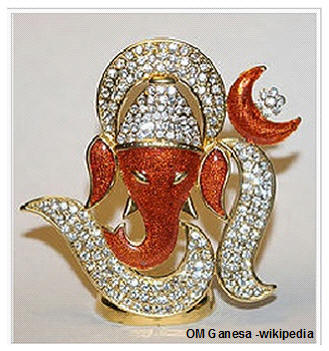
Wikipedia. Om is the body of Ganesa.
|
58 Musikvahana –
One who has mouse As charioteer
75 Shoorpakarna
–
Large-Eared
Lord
98 Vighnarajendra
–
Lord of All
Obstacles
|
The Hindus are exposed to their gods even when they are in the wombs, as the parents visit the temples. As (infants and) children, they go to the temples with the parents and relatives and develop devotion to the deities and a habit to visit important temples as they go visiting towns and villages on business, pleasure or pilgrimage.
Ganesa is the Lord of New Beginnings. He is the First One to offer prayer to, before you worship any god. Siva said that about Ganesa, when he made him the chief of Ganas or attendants of Siva. The Gods and Goddesses come next for your worship. Ganesa never allows kukarma (कुकर्मं = wicked deed) to haunt his devotees and prompts them to do sukarma (सुकर्मं = good deed).
When devotees of Ganesa go through difficulties because of the resolving Karma from the past, Vinayaka (Remover of obstacles) confers grace and helps the devotees tolerate them and shows them new paths. This passive part of Prapatti is to surrender to the will of Ganesa (Prapatti = Taking refuge, as in God). Devotion and Prapatti burn down Karma. Prapatti is both passive and active.
|
The
active part of Prapatti is as
follows. Prapatti is like a tree. The main
trunk is Atma
Samarpanam, soul dedication. The others are the branches of the
trunk. Without the Main Trunk of Atma
Samarpanam, the five branches do not
exist. The Vaishnavites and
Saivites believe in Active
Prapatti, where in the devotee puts in an
active effort to earn grace from Siva.
1)
Ānukūlya-Saṅkalpa = Firmness to do God-pleasing acts. =
இறைவனுக்கு என்றும் அனுகூலமாய் இருக்கும் உறுதி. 2)
Prātikūlya-Varjana = avoidance of God-displeasing acts.=
இறைவனுக்கு உகவாத
செயல்களில் ஈடுபடாதிருத்தல். 3)
Kārpaṇya
= Humility from helplessness to resort
to other means of salvation.
உபாயம் இல்லாத எளிமை. 5)
Mahā-viśvāsa = Great Faith in God.
பெருமானிடம் முழுமையான
நம்பிக்கை. 5)
Goptṛatva-Varaṇa
= Request God for protection.
இறைவனிடம் காத்திடும்படி கோரும் நிலை. 6) Main Trunk:
Ātmanikṣepa
= Soul dedication, surrender to God for protection.
தன்னை இறைவன்
திருவடிகளில் ஒப்படைத்துக் கொள்ளல். The last one is the
Angi or principal resolution; the other
(first) five are
Anga, secondary resolutions of Prapatti.
Saranagati is
Prapatti in an intense form. |
Grace is a reward from
Ganesa to a devotee when he worships Him with
devotion and prapatti (unconditional surrender
to God). With Grace there is a noticeable change for the better in one's
life. Grace is reward for your good works; boon is what you asked for and
received. Grace is what you earned; boon is what is given to you.
Grace keeps you closer to God. Grace is work and reward; boon is receiving
for no work at all. You earn Grace; you take or receive boon.
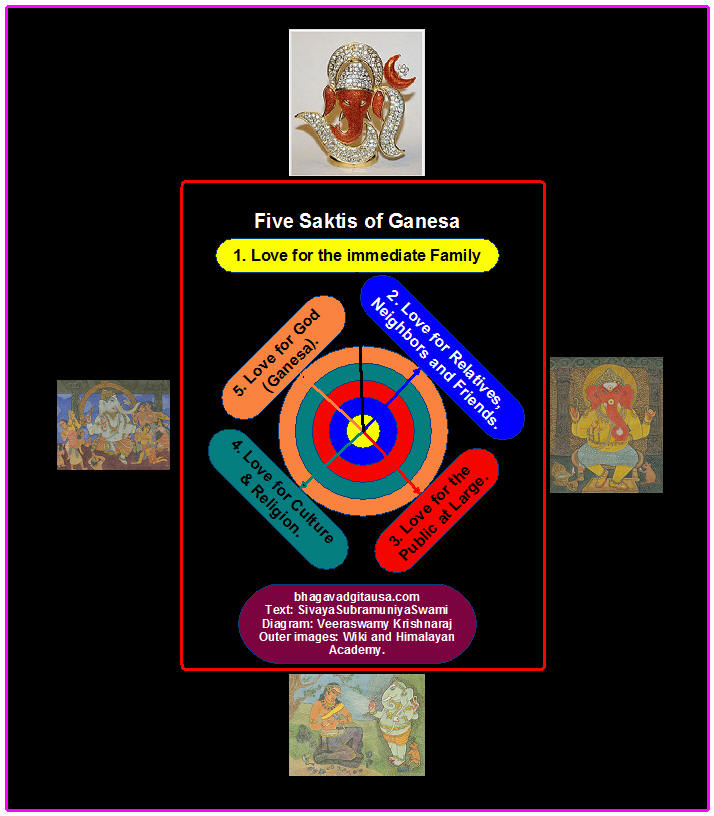
Ganesa: His rotund Abdomen is matter, mind and the world. It is by the Will of Siva, Sakti, Ganesa and Muruga everything moves. Gravity keeps us grounded and the celestial objects in orbit. Likewise, Love keeps us grounded at home, neighborhood, work, community, nation and the world. See the diagram below.
Ganesa is gravity, while
Muruga is electromagnetic force--
SivayaSubramuniyaSwami). Gravity proves itself when objects fall to
earth. Electromagnetic energy is the invisible force.
Ganesa
presides over Asuddha
Tattvas down from the 13th Tattva to the
36th. Muruga
rules over tattvas in the range from 6th to the
12th (Suddha-Asuddha
Tattvas). Siva's own special
domain is from the first to the 5th tattvas (Suddha
Tattva).
|
Siva-
Muruga-Ganesa Domains |
|
Siva1, Sakti2, Sadasiva
3, Isvara4, Sadvidya5, MayA6, Kala7,
Niyati8, Kala9, Vidya10, Raga11,
Purusa12
Prakrti
Tattva13, Buddhi14, Ahamkara15, Manas16,
hearing--Ears17, touch--Skin18, vision and
color--Eyes19 , tasting--Tongue or mouth20,
smell--Nose21, speech-Larynx22, grasp-Hands23,
ambulation--Feet24, evacuation--Anus25,
procreation-Genitals26, sound27, palpation28,
form29, taste30 , odor31, ether32,
air33, fire34, water35, earth36.
|
|
Maya sakti as it evolves produces in a cascade fashion all the building blocks of the universe including the soul, attributes, Time, order, knowledge, desire and passion, prakrti, buddhi, ahamkara, manas, hearing, tactile sense, vision and color, tasting, smell, speech, grasp, ambulation, evacuation, procreation, sound, palpation, form, taste, odor, ether, air, fire, water, and earth. Without the above a human cannot be a complete man. This is Pravṛtti, evolution (centrifugal movement). All these products are subject to change or mutation as opposed to immutability of Siva-Sakti. This is the centrifugal force of Siva-Sakti where in all products travel away from the center that is Siva-Sakti. When all these products seek their source (centripetal force), they involute into Sakti; that is Nivṛtti--reabsorption. This is the vision Ramakrishna had of Maya who produced and then swallowed what she produced. In terms of Kundali, all the Tattvas express themselves as she descends from Sahasrara Chakra to Muladhara Chakra (Pravrrti), while she absorbs and internalizes all these expressed Tattvas when the Prana rises from Muladhara to Sahasrara Chakra. Maya Tattva is the creator of these five limitations and originates from Sakti. When Purusa is free from impurities and realizes Sivaness, the cloud of Maya and its cohorts lift and vanish, and the individual soul receives Grace. The material cause of enjoyment or experience (Bhoga) is Karma; instrumental cause Maya, the efficient cause Mala. (Sivaraman)
Prakrti
Tattva13, Buddhi14, Ahamkara15, Manas16,
hearing--Ears17,
touch--Skin18,
vision and color--Eyes19
, tasting--Tongue or mouth20,
smell--Nose21,
speech-Larynx22,
grasp-Hands23,
ambulation--Feet24,
evacuation--Anus25,
procreation-Genitals26,
sound27, palpation28, form29, taste30
, odor31, ether32, air33, fire34,
water35, earth36.
These entities are the Impure Tattvas with
no spiritual connections. They are mere matter. As
theTattvas descend down the line they
acquire solidity, the Earth being the most solid.
Siva's Consciousness descends to the second tier to become the human
consciousness; the third tier are the
Tattvas that help him live in this world
with his body and bounty of the earth.
|
Matter is that which we see and don't see. We know the unseen and invisible Air exists because we know we cannot live without it. We do not see Dark Matter because it does not emit light. The planets and the star are kept together in orbit by gravitational force. The mass determines this centripetal gravitational force. There is not enough visible mass to keep the planets together in orbit and therefore, there must be something more than what we see to exert gravitational force. This is Dark Matter which amounts to 23% of the universe. Besides this, Dark Energy has the centrifugal force and accounts for expansion of the universe. About 72% accounts for the Dark Energy. The Dark Matter is said to be composed of Weakly Interacting Massive Particles (WIMPs). When two particles collide they destroy each other and release an electron and its antimatter equivalent, a positron. The scientists hypothesize the existence of Dark Matter and Dark Energy by their effects.
Air and Dark Matter are invisible. In like manner, God is invisible. The scientists believe that Dark Matter exists because of its effects on gravity. It is a hypothetical situation. Ramakrishna Paramahaṁsa (RKPH) has seen God, though he cannot bring Him in and stand Him before us. RKPH goes beyond hypothesis because he has seen God.
Mudgala Purāṇa speaks of eight forms of Ganesa. --Wikipedia
- Vakratunda (Vakratuṇḍa) ("twisting trunk"), first in the series, represents the absolute as the aggregate of all bodies, an embodiment of the form of Brahman. The purpose of this incarnation is to overcome the demon Matsaryāsura (envy, jealousy). His mount (vāhana) is a lion.
- Ekadanta ("single tusk") represents the aggregate of all individual souls, an embodiment of the essential nature of Brahman. This incarnation overcomes the demon Madāsura (arrogance, conceit). His mount is a mouse.
- Mahodara ("big belly") is a synthesis of both Vakratuṇḍa and Ekadanta. It is the absolute as it enters the creative process. It is an embodiment of the wisdom of Brahman. This incarnation overcomes the demon Mohāsura (delusion, confusion). His mount is a mouse.
- Gajavaktra (or Gajānana) ("elephant face") is a counterpart to Mahodara. This incarnation overcomes the demon Lobhāsura (greed). His mount is a mouse.
- Lambodara ("pendulous belly") is the first of four incarnations that correspond to the stage where the Purāṇic gods are created. Lambodara corresponds to Śakti, the pure power of Brahman. This incarnation overcomes the demon Krodhāsura (anger). His mount is a mouse.
- Vikata (Vikaṭa) ("unusual form", "misshapen") corresponds to Sūrya. He is an embodiment of the illuminating nature of Brahman. This incarnation overcomes the demon Kāmāsura (lust). His mount is a peacock.
- Vighnaraja (Vighnarāja) ("king of obstacles"), corresponds to Viṣṇu. He is an embodiment of the preserving nature of Brahman. This incarnation overcomes the demon Mamāsura (possessiveness). His mount is the celestial serpent Śeṣa.
- Dhumravarna (Dhūmravarṇa) ("grey color") corresponds to Śiva. He is an embodiment of the destructive nature of Brahman. This incarnation overcomes the demon Abhimanāsura (pride, attachment). His mount is a horse.
Envy and jealousy, Arrogance and conceit, delusion and confusion, greed, anger, possessiveness and pride, and attachment are the bane of humanity. Ganesa in his many forms, Vahanas (mounts) and qualities conquers these enemies of mankind. These qualities are called Vikaras (विकारः) = of the mind.
Ganesa in the North Indian view is married to Buddhi and Siddhi (Discriminating Knowledge and success) and in the South Indian view he is a confirmed celibate. All gods have consorts in a figurative sense, who project the power of the gods. The power of the gods is always of feminine character. When gods want to destroy a demon, they invoke their powers, concentrate them as a feminine energy and grant that energy to Durga to destroy the demons. Again these demons are personified evils in man. Hinduism is full of symbolism. The gods and goddesses carry weapons. They are all powerful, can kill by thought and word and do not really need weapons. To their devotees hardwired in WYSIWYG (What you see is what you get), seeing gods with weapons is reassuring. These weapons carried by gods are used to kill the evil qualities in men. The divine consorts of gods are their qualities, which take on feminine forms. Gods and Goddesses Are Supreme Consciousness without gender anatomy; they do not sport bodies normally. They appear in human form to their devotees. Buddhi and Siddhi are the Ida and Pingala (left and right) Nadis or channels in Kundalini Chakras. The same Nadis are anthropomorphized in the names of the consorts of Muruga: Valli and Dvayāni.
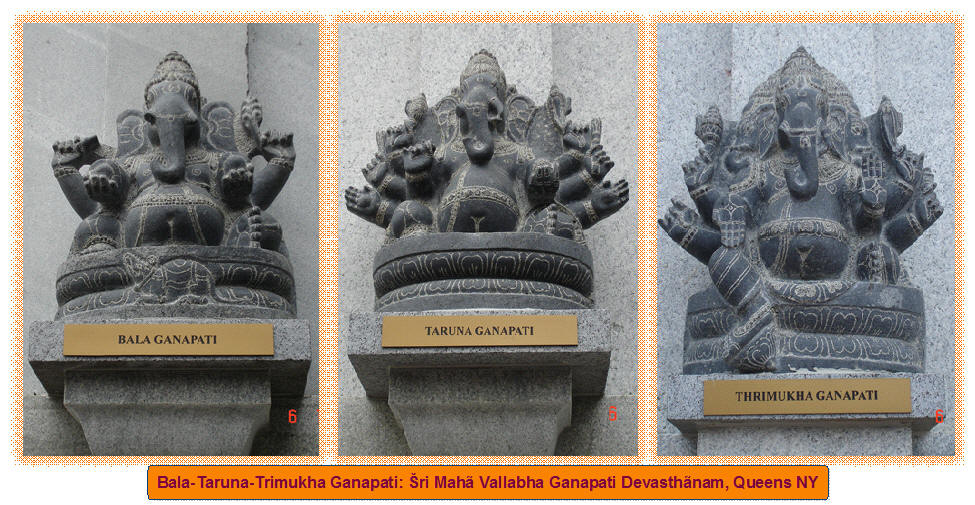
Ganapathi also comes in 32 forms: 1. Sri Bala Ganapathy of crimson color, 2. Sri Taruna Ganapathi of crimson color, 3. Sri Bhakta Ganapathy of white color, 4. Sri Veera Ganapathy of crimson color, 5. Sri Sakti Ganapathy of Vermillion color, 6. Sri Dwija Ganapathy of white color, 7. Sri Siddhi Ganapathy of golden color, 8. Sri Ucchishta Ganapathy of blue color, 9. Sri Vighna Ganapathy of golden color, 10. Sri Kshipa Ganapathy of crimson color, 11
This file below can be seen at Ganesa32Aspects.pdf
From Wikipedia
Some of the details of the descriptions, such as the colors to be used in meditation upon the form, are taken from the meditation verses and may not correspond exactly to the pictures. |
|||||||||||||||||||||||||||||||||||||||||||||||||||||||||||||||||||||||||||||||||||||||||||||||||||
|---|---|---|---|---|---|---|---|---|---|---|---|---|---|---|---|---|---|---|---|---|---|---|---|---|---|---|---|---|---|---|---|---|---|---|---|---|---|---|---|---|---|---|---|---|---|---|---|---|---|---|---|---|---|---|---|---|---|---|---|---|---|---|---|---|---|---|---|---|---|---|---|---|---|---|---|---|---|---|---|---|---|---|---|---|---|---|---|---|---|---|---|---|---|---|---|---|---|---|---|
|


Just as Jesus Christ is son of God, Satguru Sivayasubramuniyaswami regards Ganesa the son of God Siva. The Son is the testimony of the immanence of God being generated eternally. Ganesa reflects the wisdom of His Father and is the repository of the word of God Siva.
Om Śrī Gaṇesāya Namaḥ is the Mantra of Gaṇeśa.
Aum Gaṁ Gaṇapataye Namaḥ is the Mūla (or root) Mantra and also Bija or Seed Mantra, because it has the Bija “gam” in it.
Gayatri Mantra of Gaṇeśa as follows.
These Mantras are from the Book Loving Ganesa by Satguru Sivaya Subramuniyaswami of Iraivan Temple Hawaii.
|
ॐ एकदन्ताय विद्महे वक्रतुण्डाय धीमहि तन्नॊ दन्तिः प्रसॊदयात् ōm̐ ēkadantāya vidmahē vakratuṇḍāya dhīmahi tanno dant iḥ prasodayātWe devote our thoughts to one-tusked Lord. We meditate upon Him who has a curved trunk. May the tusked One guide us on the right path. Gaṇapati Upanishad |
|
ॐ तत्पुरुषाय विद्महे वक्रतुण्डाय धीमहि तन्नॊ दन्तिः प्रसॊदयात् ōm̐ tatpuruṣāya vidmahē vakratuṇḍāya dhīmahi tanno dantiḥ prasodayāt We devote our thoughts to the supreme Person.We meditate upon Him who has a curved trunk. May the tusked One guide us on the right path. Nārāyaṇa Upanishad |
| ॐ
तत् कराताय विद्महे हस्तिमुखाय धीमहि तन्नॊ दन्तिः प्रसॊदयात् ōm̐ tat karātāya vidmahē hastimukhāya dhīmahi tanno dantiḥ prasodayāt We devote our thoughts to that Supreme Person. We meditate upon Him who has a curved trunk. May the tusked One guide us on the right path. Maitrāyaṇi Saṁhitā |
|
Invocation of Ganesa as found in the Book "Deivaththin Kural"
Translation from Tamil to English: Veeraswamy Krishnaraj
Pillaiyar (பிள்ளையார் = Ganesa) Temples are ubiquitous all over Tamil Nadu. There are Pillaiyar temples with walls, roofs, and domes (Turrets). There are Pillaiyar idols even at the feet of trees, open to the sky and the elements. Kumaran (குமரன்) is son (பிள்ளை). All over India, Kumaran refers only to the second son of the divine couple Siva and Parvati. He is Kumara-k-Kadavul (குமரக்கடவுள்). We do not address him Kumaranar (குமரனார்), an honorific title. We gave the honorific title only to the elder son of Siva and Parvati. Pillaiyar is of the form of AUM, from which the universe and beings take origin. His elephantine face and the trunk resemble Pranava (பிரணவம்), OM.
Though he appears to be a child, he is in the forefront in making us raise our hands high in adoration of him. Avvaiyar (ஔவையார்) is the great worshiper of Ganapati. She meditated on Vinayaka in Bhru-Madya (புருவமத்தியம்) and composed Vinayagar Akaval (விநாயகர் அகவல்), Avvaiyar's all-embracing Yoga Sastra. If you committed it to memory, you will obtain supreme spiritual knowledge (paramajñāna = பரமஞானம்). There is a story about Avvaiyar. Sundaramurthy Swamy and Seraman Perumal Nayanar left for Kailasam. They wanted to take Avvaiyar with them. At that moment, she was worshipping Viksesuvarar (விக்சேசுவரர்) and the duo, pressing her to join them, asked her to finish the worship expeditiously. Avvaiyar: You go the way you chose to go. For your sake, I will not hasten the worship. Vinayaka worship is my Kailasam. The duo left for Kailasam. Avvaiyar completed the worship observing all the details. At the end, Pillaiyar made his gracious presence visible (பிரசன்னம்) to Avvaiyar, picked her up by the trunk and in one sweep took her to Kailas. Swamy Vignesvar shows that kind of favor to his devotees. What is the reason for breaking a coconut before Vinayaka Murthi? Vignesvarar asked his father to sacrifice his head to him. Love of Ganesa comes to the forefront, only when a devotee sacrifices what he regards above all else as precious. Siva created a hard-shelled three-eyed coconut seed in the form of his head, so the devotee can sacrifice it to Ganesa; such a sacrifice is pure Thyakam (giving). Tamil Nadu is the only place where the coconut is broken this way. The broken coconut is an entitlement for the children. This truth, I learnt from a child. In 1941, I was in Nagapattinam, observing a vow. In the temple, it was customary to break coconuts by hundreds. The children milled around the coconut breaking area and left no space for breaking the coconuts. The elders admonished the children to stay away from the place, so they could break the coconuts. One child came forward and said, “You break the coconuts for Pillaiyar. What right you have to tell us not to come to where you break the coconuts.
There is no deity more corpulent than Pillaiyar; the head is that of an elephant; the stomach is humongous; the body is huge; he is known as Sthūla Kāyar (ஸ்தூல காயர் = Gross body is huge); he is like a mountain. He is a little child; at this stage, he has to eat a lot relative to his age and size, so he can grow. The body should not be allowed to waste. A sannyasi should not be of a big body; there is no beauty and grace, if a Sannyasi ate a lot, and look big. As a person becomes older and aged, he or she fasts in the night. A child does not do it. The beauty in a child is to be corpulent (chubby) with a paunch. This child-deity shows that a child should be a ‘‘butterball.’ Pillaiyar holds a rice ball in his hand. He looks like an elephant. His mount is a small mouse. Other deities have a bull, a horse, a bird…as the mounts. Though Pillaiyar’s size is inversely proportional to the size of his mount, the greatness and honor of a deity do not proceed from the size of the mount. Because of the greatness of the deity, there is greatness to the mount. Pillaiyar, though huge, remains light in the hearts of his devotees. Every living thing has a great honor in one of its own organs. Kavari-māṉ (கவரிமான் = Bos grunniens) has its honor in its tail, the peacock in its long, erectile, greenish, iridescent tail. The peacock grooms and protects its tail. The organ of honor for Pillaiyar is his tusk. He sacrificed it in the name of writing Mahabharata with it as a writing instrument for justice, Dharma, learning… Swamy needs no instrument as a special need. He can use anything as an instrument, at the command of his thought. His tusk was the weapon, when he killed an Asura; the same tusk served as a pen for writing Mahabharata. The objects, which never stops fascinating us, are the moon, the ocean, the elephant… We never get a feeling of surfeit looking at them and enjoy their presence. As we look at his elephantine form, we are immersed in joy; that is bliss; that is Bliss Principle (ஆனந்த தத்துவம்); it is the principle of Insatiable Delight. He was born in bliss. Pantāsuran was a demon. Parvati attempted to destroy him. Pantasuran deployed obstructive forces, so Parvati could not approach him. Siva looked at Parvati with ecstatic amorousness. Parvati instantly gave birth to the joyful child, Pillaiyar, who smashed all the obstructive weapons and helped her in destroying the demon. He is the son of Parvati and Paramesvara. He manifested (ஆவிர்ப்பவித்தல்) himself from the original source (மூலம்); that is why we call him Pillaiyar. When you worship any deity, you have to obtain favor from Vinayaka, so the endeavor would face no obstruction or impediment. Ganapathiyam is the sect that regards Ganesa as the primary god of worship. Mahavishnu was the teacher, advising us to do the tōppi-k-karaṇam (தோப்பிக்கரணம் = Punishment or exercise requiring a person to take hold of his ears with his hands and sit and stand alternately). There is a story behind this. Pillaiyar, the son-in-law of Vishnu, in an act of play, took away the discus of Vishnu and put it in his mouth. It is impossible to wrest anything from his hands. His strength is immense. Threat of punishment does not work with him. Vishnu thought he could get it back, if it fell from his mouth. Vishnu devised a stratagem. He held his ears with his four hands and danced. Vinayaka rolled over the floor laughing. The discus fell, and Vishnu took possession. Any endeavor would come to a fruitful conclusion, only when Vignesvara manifests a favorable disposition. Let us worship him, offer Puja and live happily with no impediments. |
Feb 2, 2020
Ganesa leads all Gods; He is the First One (முதல்வோன் = Muthalvōṉ). Whatever task is in the offing, he is the first God for (mandatory) worship. He is Muthalvōṉ because he is the older of the two sons of Śiva and Pārvati. Praṇavam (AUM) is the first that exists. Since Vināyakaṉ is the deified form of Praṇavam, He is Muthalvōṉ. Since He is the first receiver of the Fruit of Wisdom from Śiva, He is Muthalvōṉ. Since Gaṇapathy worship is traditional before worship of other Gods, He is Muthalvōṉ. Since He is the chief of the Śiva Gaṇas, He is Muthalvōṉ. He is the Lord of all planets and therefore Muthalvōṉ. Translation by Krishnaraj. Source: Thiruppugazh.org