Only Hindu relion is Gynocentric. Sep 8,
2022
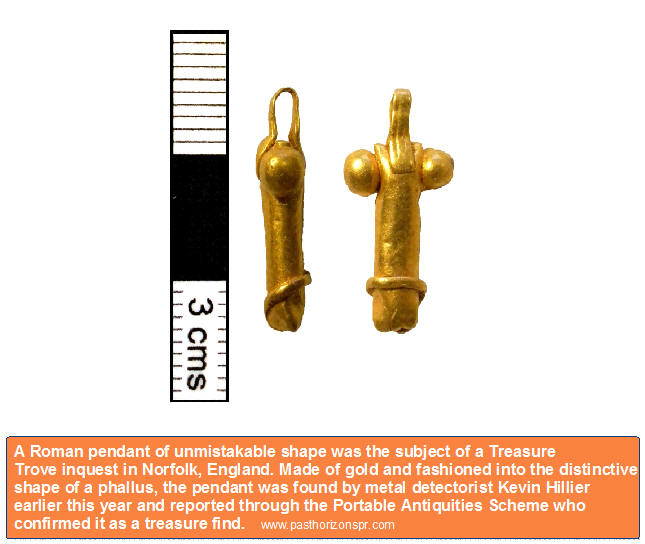
It was the custom in olden days to adorn children with
phallus-pendants around the
neck in certain parts of Europe. Sanskrit
'Phal' (Phallus is
derivative word) is to cleave open or asunder; if it is not for Sanskrit, we
won't know what that lolling pendant thing is!), German
Pfahl, English Pole,
Greek Palo... are words which essentially mean
penetration, a staff, brandishing, to burst
forth, to cleave... 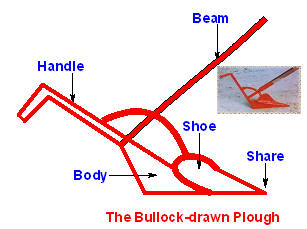 Remember
the Pole Dancers in the nightclubs. Now you know what a pole is or
for that matter a Maypole is. The tradition lives on.
The Legend lives on. Those Poles are symbolic of
god Priapus or Mutinus.
From Sanskrit Phal (फल्
= break through) comes the Sanskrit word Phala
(फल) for fruit (Tamil 'Palam' = பழம் for
fruit), which naturally means progeny. Sanskrit Phāla
(फाल) means ploughshare,
a common euphemism for phallus. Earth is regarded a female (Mother Earth) in
many cultures. She waits patiently to be ploughed and seeded. Once she is
seeded, she looks up from below at the heavens patiently waiting for the
rain. Such were and are the attitudes of many cultures. The man-god comes
down as rain from heavens. The Indo-Aryan rain god and the chief of gods,
Indra, sends downpour of rain to germinate the seed. The seed was previously
placed in the trough made by the plough. The Indo-Aryans and Indra had a
cozy relationship with each other. The Indo-Aryan supplied Soma (inebriant
and hallucinogen) to Indra, while Indra sent rain in return. Does it not
sound like the cozy relationship between the drug dealers and drug users:
dough for dope or dope for guns? (Jan 2009) The
Hindu religious heads are up in arms when they hear the allegedly incorrect
of portrayal that Soma was an inebriant and hallucinogen, which they believe
the west portrays to denigrate the Hindu gods and the Vedic Brahmanas. The
Seers and Saints of today have not tasted the blessed thing. How would they
know its effects? Soma is locked away in Indra's heaven. Sita the divine
consort of Rama and the incarnation of Mahalakshmi was found as the earth
was ploughed. In like manner, historical Andal was found in the flower
garden by Vishnu Chittar.
Remember
the Pole Dancers in the nightclubs. Now you know what a pole is or
for that matter a Maypole is. The tradition lives on.
The Legend lives on. Those Poles are symbolic of
god Priapus or Mutinus.
From Sanskrit Phal (फल्
= break through) comes the Sanskrit word Phala
(फल) for fruit (Tamil 'Palam' = பழம் for
fruit), which naturally means progeny. Sanskrit Phāla
(फाल) means ploughshare,
a common euphemism for phallus. Earth is regarded a female (Mother Earth) in
many cultures. She waits patiently to be ploughed and seeded. Once she is
seeded, she looks up from below at the heavens patiently waiting for the
rain. Such were and are the attitudes of many cultures. The man-god comes
down as rain from heavens. The Indo-Aryan rain god and the chief of gods,
Indra, sends downpour of rain to germinate the seed. The seed was previously
placed in the trough made by the plough. The Indo-Aryans and Indra had a
cozy relationship with each other. The Indo-Aryan supplied Soma (inebriant
and hallucinogen) to Indra, while Indra sent rain in return. Does it not
sound like the cozy relationship between the drug dealers and drug users:
dough for dope or dope for guns? (Jan 2009) The
Hindu religious heads are up in arms when they hear the allegedly incorrect
of portrayal that Soma was an inebriant and hallucinogen, which they believe
the west portrays to denigrate the Hindu gods and the Vedic Brahmanas. The
Seers and Saints of today have not tasted the blessed thing. How would they
know its effects? Soma is locked away in Indra's heaven. Sita the divine
consort of Rama and the incarnation of Mahalakshmi was found as the earth
was ploughed. In like manner, historical Andal was found in the flower
garden by Vishnu Chittar.
In ancient Greece, Membrum Virile (Phallus
;
Mèdhra in Sanskrit)
was taken in a procession to the Temple of Bacchus and elite corpulent
matrons of the city dutifully and reverentially
hung floral decorations on Priapus.
Sacrosanct phallus was consecrated in the Temple of Liber (Temple of Bacchus)
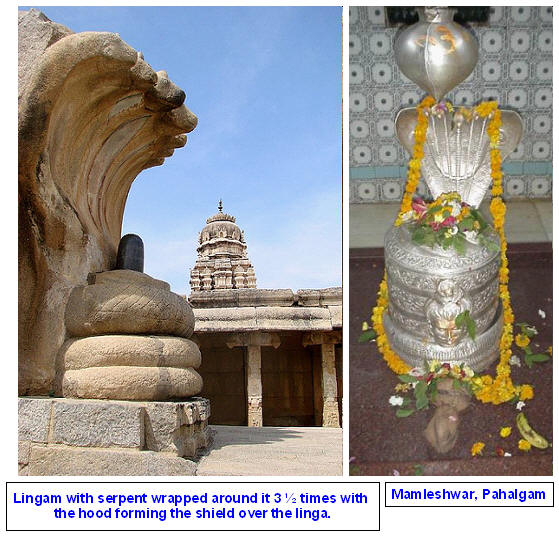
Liber is
an ancient Italian god of wine and vineyards, in later
times identified with Bacchus. What Liber is for
phallus is Liberia for the female genitals, which were consecrated in the
Temple of Liberia. These two deities (pale god and goddess as compared
to the real Ones--Siva-Sakti) were the Father and the
Mother (Siva-Sakti = Father
God and Mother Goddess = Lingam in its labial
vestibular pedestal in Hindu temples). From time
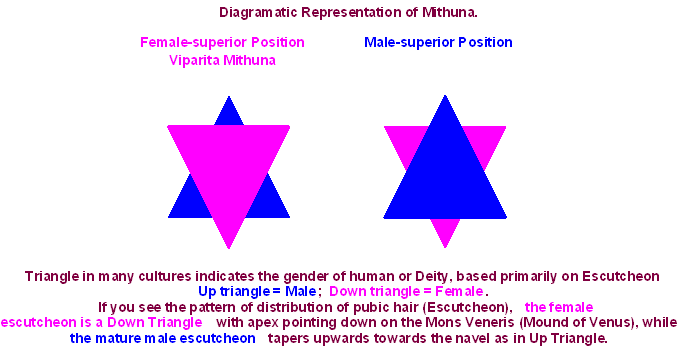
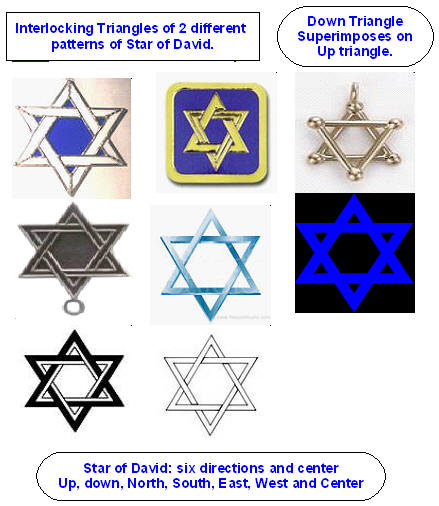
immemorial in India, the Goddess was represented by the down triangle and the
God by the up triangle. The superimposition is Maithuna (consortium).
God Priapus was the much celebrated god of fertility among
the ancient Greek poets. An Athenian Oracle was the first to recommend the
installation, consecration and worship of god Pri
apus.
As the Hindus offer flowers, milk, fruits and other victuals to gods,
the ancient Greeks did the
same to god Priapus. 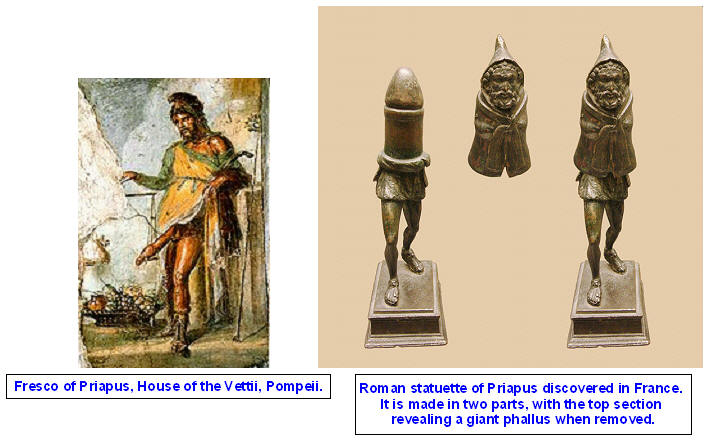
Priapus was anointed as the Triphallus to portray the
immense size, splendor and effulgence of his fecund principle. Roman Ladies
from the elite upper cr
ust of
bygone days sat on the gigantic member of Priapus in veneration and adulation
pleading with Priapus to accept the first offering of modesty and
virginity, so that they would be fecund as long as
possible with their husbands.
God Priapus was so popular among the women,
the jealous husbands banished him from the city of Lampascus. Lo and behold,
the curse of god Priapus descended on the male members. The curse in the form
of 'a fell disease' hit
them hard on the most precious landmark of the body:
genitalia, groin and inner thighs. Ugh.
What was that? Pediculosis Pubis, commonly known as Pubic
Louse. Ugh. Ugh. That is a bad place to have a louse (lice) meandering
through a hirsute forest and having sanguine supper, breakfast, and
lunch.Worse still, these lice defecate right on
their meandering jaunts. Or was it Jock
itch (tinea cruris)? It is the infection
of the superficial layers of the skin with mold-like fungus (dermatophytes).
Fungus: is it the blue in the blue cheese?
Turophiles (cheese lovers) like mold in the cheese and not in the groins.
Or was it Eczema? This form affects the genitals,
inner upper thighs and buttocks. No one knows. The
result is the same: an annoying cumulative urge to alleviate pruritic spasms
and compulsions. Pruritis = itch.
The wives rejected their
husbands outright with disgust and alarm at the sight of their husbands
scratching the crotch before elite invited guests and senators of Rome. Every
time a louse took a leap from one pilose strand to the next for a bite or
sport, the wives saw their husbands do cha-cha-cha as if they were warming up
for a dance. The guests couldn't figure out the spasmodic seizures coming in
waves on their host. As the louse took a leap for a bite, they danced to the
beat of the bite. The men's ego deflation was fast and furious.
The women's love for Priapus
grew by rhythmic leaps and bounds. The
Oracle in chief was consulted
by deprived husbands and frustrated
wives and gave them a prescient advice to invite god
Priapus back in their midst. Every garden in the landscape had the god Priapus
installed, consecrated, decorated, and worshipped.
They painted him red and called him
Ruber or Rubicundus. If you are reminded of Rudra,
the red god of Hindus, you are right. Rudra is
red and no other than
Siva Himself and the spouse of Kali, who
(Siva) sports the form of Lingam. Sacrifices were made
throughout the land with vegetables, fruits, dairy products and animals. So do
the Hindus make offering
to Rudra-Siva
Lingam. The words
Rudra (Sanskrit), red, ruddy, ruber, ruby, rouge, rubicund, rubiola, rubious
denote or are associated with red
color, another instance of Sanskrit being the mother of Indo-European
languages. Rudra also means, "crying." When Rudra was born, he cried and
looked red, which most newborns do.
The
future of Priapus was doomed, as the god was blamed for the ills
and orgies
of the society.
His statue stands
in the orchards as a scarecrow to scare off
the thieving birds,
the
man-thieves,
and
children.
What degradation to Priapus who stood
tall and turgid among mortals! The deflowering god, who took delight in
strewing the plucked fragrant hymenal petals all around the pudendum, became
the lowly village deity relegated to flower-beds, gardens and fields.
The god-son of Dionysus
and Aphrodite,
Priapus,
because of his connection to fertility,
was
represented by
the carvings of
fig-tree, oak, cypress, marble or wheat-dough. These are some of the common
materials (wood, mushy cooked rice, sand,
clay,
metal, marble, crystal,
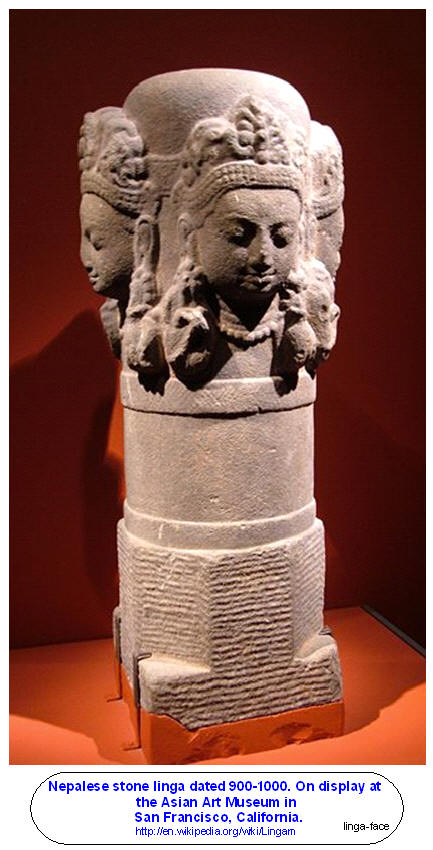
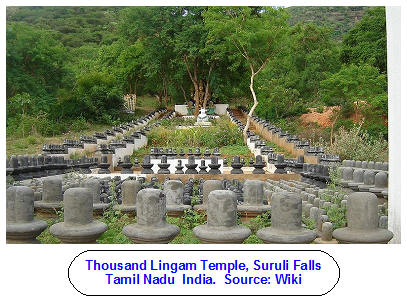
stone...) used to create Lingam
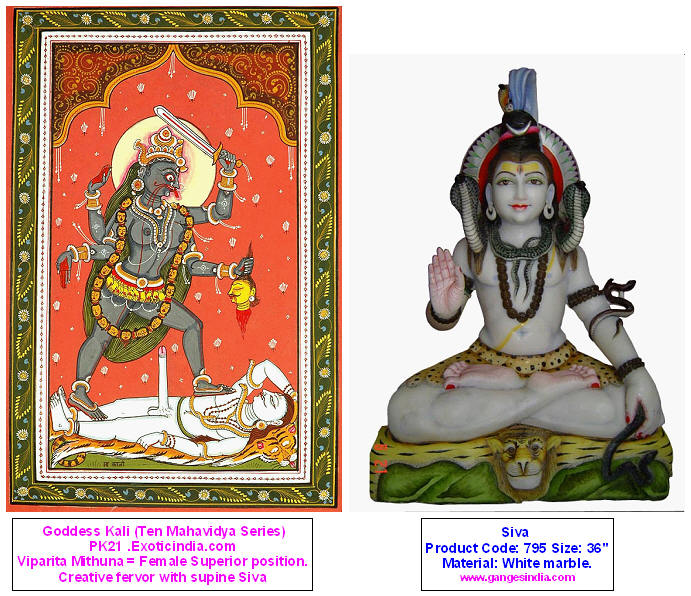
of Hindu God, Siva, the Consort of Kali.
Lord Siva stands tall in the universe from time immemorial, while demiurge
Priapus suffered detumescent flaccid lolling degradation in the modern times;
even mega-doses of the likes of Cialis or Viagra or their combined cocktail
mixture fail to restore the once glorious resplendent towering ego of
erstwhile tumescent Priapus, who prided himself as the first and the foremost
fore-taster of the pudenda of the world.
|
Sayings of Ramakrishna page 252
921. Humanity (Human Nature) must
die before divinity manifests itself. But this divinity must in turn die
before the higher manifestation of the Blissful Mother (Brahmamayi) takes
place. It is on the bosom of the dead divinity (Siva) that the Blissful
Mother dances Her celestial dance. |
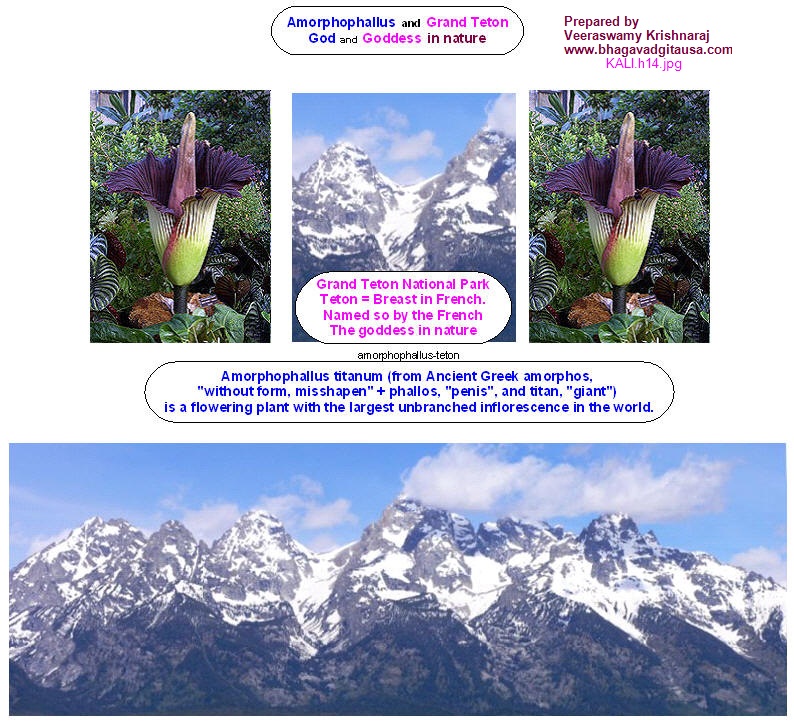
Just walk around the world in a leisurely
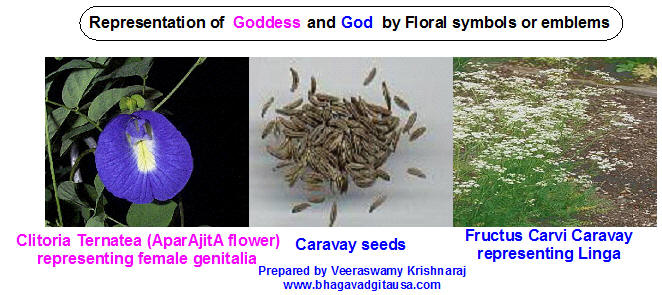
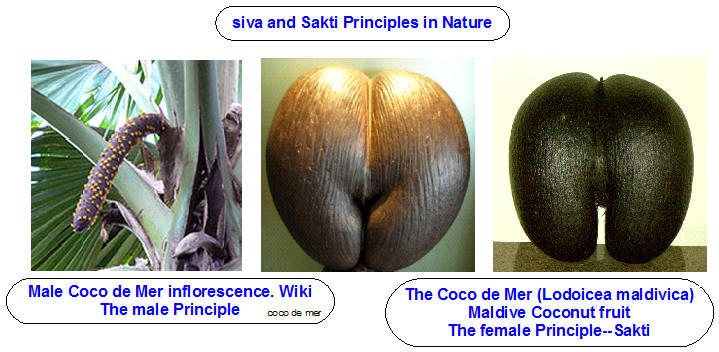
manner; you will see goddess and god in many objects. Look at the flower and
the twin peaks as examples.
|
Siva, Why the
Phallic Form. (based on Sivapuranam -- சிவபுராணம், Chapter 12)
Some say,
Upanishads are beyond the comprehension of ordinary people and that is why
Puranas were written to explain the philosophy, abstruse subjects,
concepts, theories, doctrines... in the Upanishads in the form of stories
to illustrate such esoteric concepts, ideas, philosophies, theology....
Its effects are
felt from the most learned to the illiterate in India in that they all
understand Hinduism's concepts at all levels of education, or lack
thereof.
Vedic texts prescribe the kindling of
sacred fires under the Pleiades, because the Pleiades now have the
Fire-God Agni as their mate. We are told that the Pleiades were the wives
of the Seven Sages, but are now precluded from intercourse with their
husbands, who divorced them. Therefore the Pleiades now rise in the east,
while the Seven Sages (that is, the stars of Ursa Major) are in the north.
The Fire God Agni mentioned as the mate of the Pleiades apparently
represents the young vernal sun, whose conjunction with the Pleiades
started the New Year.
Later Sanskrit texts tell the myth in more
detail and in several variant forms. According to them, the Fire God Agni
(or the
great ascetic god Siva)
seduced the Pleiades in the absence of their husbands, the Seven Sages.
They were divorced. Only Arundhatii, the faithful wife of Sage
VasiSTha, could not be seduced. She could remain as the star Alcor with
her husband, the star Mizar of Ursa Major (see fig. 13).
This is really one of the central myths of
the Hindu religion.
In a Puranic version, God Siva seduced six
of the
wives of the absent Seven Sages in their
Himalayan hermitage. The Sages cursed Siva’s phallus to fall down. The
fallen phallus started to burn the world and stopped only when the Sages
placed it on a vulva-shaped platform and worshipped it with cooling
water-libations. This is how the cult of Siva’s linga or phallus
originated. Siva, one of the greatest gods of
Hinduism, has mostly the phallus as his cult icon since the earliest
historical times. Siva’s Vedic predecessor Rudra is thought to be of
non-Aryan origin. In Vedic texts, Rudra is euphemistically called Siva
‘benign’, and equated with the Fire god Agni as is Siva in the
Pleiades myth.
https://www.thehindu.com/multimedia/archive/00133/_A_Dravidian_Soluti_133901a.pdf
------------------------------------------------------------------------------------------------------------
The
sages were curious why Siva assumed the phallic form. Siva Purana in the
words of Suta tells the following episode. Daruvana forest, near Badrinath,
is where the devotees of Siva meditate on him. Once the chief Brahmana
sage goes deep into the woods to collect twigs for sacrificial fire. Siva
is wont to test his devotees and the arrogant Rishis by any means he could
devise. A stark naked man smeared with ash all over his body is walking
around holding his phallus and doing all unimaginable activities and
tricks with it. His intent is noble (O yea, tell me about it!); doing good
to the sylvan sages pleases Him most. Some Rishipatnis (the wives of sages
or Rishis) are frightened to look at a man with wayward phallus. Other
wives of the sages, fascinated, excited, elevated and impressed by the
newness of the pudendal show, gather around him. Some actually embrace him
and some hold his hands. There is a gleeful melee among the wives to get
close to him. The jingle and the jangle of the bangles and the wayward
whipping and whooshing phallus attract the attention of the blissfully
married sages, who come close to their wives and the man whose only wear
is ash. They see the Ash-Man perform unimaginable and perverse antics with
his phallus, fume and froth and challenge him, "Who are you?" The Ash-Man
does not answer; it is for them to find out who He is on their own --Rishis
are prescient and yet could not figure out who the Ash-man was. (This is
important in Hinduism: Find the God with your own efforts.) The Rishis
were kicking against the pricks. They could not stop the man do what he
does best. They had one powerful device in their command. They cast a
curse on him, "You, patent pervert. You violated the Vedic injunctions and
moral path. Let your phallus fall to the ground."
kick against the pricks: to
resist incontestable facts or authority; protest uselessly.
Suta continued his story of Avadhuta.
(Avadhuta:
One who has shaken off from himself worldly goods, feeling and obligation,
a philosopher. The highest form of renunciation. Lord Siva in this
instance.) The sages have power in their words, word power-- no, it is not
a software; the phallus at once falls to the ground from the divine
perineum. It burns the ground where it falls; Lo and behold, the phallus
propels by itself; the self-propelling phallus starts moving leaving a
burning trail, which looks like a fallen lightning; almost everything is
burnt in its path. The Rishis still do not have a clue about the Owner of
meandering phallus. The trailblazing iridescent phallus goes to the
netherworld, later to heaven, and back to earth; the agile ambulating
fallen member cannot stay in one place. It appears it has lost its way and
is trying to find its natural habitat. The inhabitants of earth,
netherworlds, and heavens are panic-stricken; the usually tranquil sages
go into dire and dithering grief --what have they gotten into or what have
they gotten out of (their senses, of course); the gods enjoy no peace or
joy. The sages regret for having cast the curse of fallen phallus. They
have neither the means nor the Mantras to recall the fulgurant phallus.
The sages and gods rush to Brahma, the Creator and relate to him the story
of wayward itinerant phallus with a trail of raging fire. Brahma, the
Vedic Scholar, at once sees the hand (and phallus) of Siva and his Maya
(delusion-causing prank) at work. (You could ask, 'How could Siva do
such a thing?' Remember, Hinduism is full of symbolism to teach the common
man philosophical concepts. In this instance, Siva wants the arrogant
Rishis to come to their senses in their relationship with Siva. Siva wants
to teach them a lesson so they shed their super-size towering tumescent
ego. Siva shows that His Ego towers over theirs. There is only one Ego in
this universe, that of Siva (Aham = I am.). Our little egos must die
before the towering Ego of Siva so that we receive His Grace and merge
with Him. The meandering phallus is also symbolism in that wandering
Purusa (man) is seeking Sakti (woman) for union, so that creation can take
place.)
Brahma pulls the sages by the scruff and tells them that they violated the
first etiquette of serving a guest (Avadhuta Siva) in midday. That
violation bestows on them the onerous sin, which will dog them as karma.
Brahma comes to a shrewd conclusion that the meandering phallus should be
immobilized first. The anxious sages ponder on the question of pinning
down or finding a home for the ambulating phallus. They came up empty.
They have no idea and beg Brahma to offer some suggestions. The Vedic
Scholar puts his four heads-- four parallel processors-- together (the
fifth head was sliced off by Siva for lying a long time ago.) and comes up
with another brilliant suggestion: The sages must find a suitable trap,
cage, or receptacle for the meandering phallus. What could be that
receptacle for the phallus? The sages rake their brains for a solution;
none popped up in their collective sagacious mind. They look forlorn at
Brahma, the Grandfather of the worlds, in a supplicant manner. Brahma
tells the sages that they must propitiate goddess Parvati (Kali's other
name), offer prayers and beg Her to transform Herself into a vaginal
passage to receive, fixate, douse, quench and contain the wayward fiery
phallus. Now the sages are not sure about the multi-tasking
procedural elements in intromission, immobilization and containment of the
phallus in its natural habitat. Again brilliant Brahma comes up with a
bright solution. He makes the following suggestions:
1.
Act with love and devotion to goddess Parvati, the consort of Siva. Aim at
pleasing Her.
2.
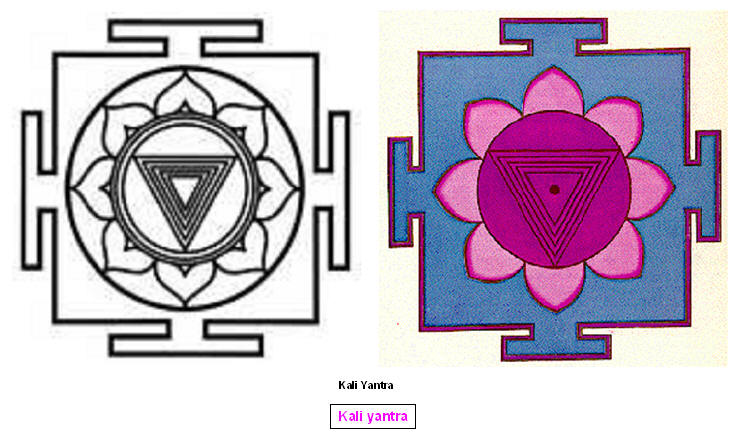
Draw an eight-petalled mystic diagram (Yantra) of lotus and place a pot in
the center of it. Pour waters from Tirthas (holy places on the banks of
holy rivers) along with sprouts and sprigs of barley and Durva grass (Panicum
Dactylon).
3.
Vedic Mantras should be chanted and the pot, thus infused and invoked,
becomes sanctified. Remember Siva and offer prayers to the sacred pot.
4.
The blazing phallus must be extinguished, cooled and appeased by dousing
it with cools waters of the sacred rivers. Chanting of Satarudriya Mantras
along with sprinkling of water will immobilize and stabilize the restless
phallus.
Satarudriyam:
A Vedic hymn addressed to Rudra or Siva in his hundred aspects. Satam =
sacred vessel, that which is perpetual, eternal. Sata-Viryam = Bermuda
grass.
5.
Parvati in the form of genital passage and an auspicious arrow will
constitute the pedestal in which the phallus will be installed with the
chanting of Vedic Mantras. (The pedestal correlates anatomically to the
female pudendum, and lingam to the phallus. The allegorical elements are
the pedestal and Lingam; the anatomical pudendum and phallus stand for the
creative force of Sakti and Siva. There is no prurient or deviant
suggestion in this representation, according to devotees of Siva. From
this united entity only the universe of beings and matter originate
through 36 Tattvas. ♂ ♀: If you wondered where circle and
arrow came from, now you know their origin. The circle is the pedestal or
pudendum (Vagina); the lingam is the phallus (and the arrow, power, vigor,
and manliness.)
6.
Please propitiate and worship Lord Siva with fragrant scents, sandal
paste, flowers, incense and food. Fall prostrate at His holy feet, sing
sacred hymns, play musical instruments, utter Svastyayana mantras and
glorify the victory of the Lord.
Svastyayana:
mantras recited for good luck.
7.
Say the prayers to the Lord as follows: "You are the Lord of gods; you are
the delighter of the universe; you are the creator, protector, and
destroyer of the universe; You are Akshara, the imperishable." This will
bring stability, prosperity, restoration of balance, and happiness to the
universe.
The
sages (whose curse backfired) follow these rituals and Lord Siva, pleased
with the seers, expresses his delight--the ever-loving auspicious Siva is
benign to His devotees. Siva suggests that only Parvati can be the
receptacle for His phallus, as no other woman (deity =
தேவி)
can fit the role and this will make his phallus quiescent. Upon directions
from Siva Himself, the sages and gods take Brahma to Parvati and offer her
their salutations and worship. Parvati (Kali is an aspect of Parvati)
obliges and accepts to conform to the request. This is how the phallus
comes to be known as Hatesa (hata + Isa = Accursed Lord) and Siva-Siva.
The worlds become one happy place. Lingam will offer liberation to the
devotees. Lingam is Li
and
Gam
meaning to dissolve and go out, meaning that Lingam is the ultimate
Reality in which everything dissolves and from which everything takes its
origin. Siva is Yogin of Yogins, who has supreme control over his
senses. How do we explain his dalliance and dawdling? He is the Soul of
the universe and all beings are the individual souls who take origin from
him. Therefore, it is the compulsion of the homing device of the soul to
seek out Siva and merge with him. This merging takes a story form in
Puranas, where two opposite polarities come together and present as Linga
embedded in a pedestal, from which the whole universe of matter and beings
emanate and in which they subside. In Tantra, the bliss from sexual
intercourse is the carnal equivalent of the Bliss, Beatitude or Ecstasy
from the spiritual merger of the individual soul with the Universal soul,
mundane orgasm being the weaker cohort of Spiritual Beatitude.
Ancient Greece is known for the
festival of Demeter
and Persephone
and female devotees carrying phalli made of dough and live snakes in
procession as icons of generation and regeneration. Tantrics practice
codified Mantra-driven rituals of sexual intercourse within the confines
of marriage.
David Smith quotes Kanta Puranam (12th Century) that Siva did have a
physical relationship with the Rishi's wives and they instantaneously gave
birth to 84,000 boys who on the advice of Siva became ascetics.
Siva
is the Universal soul. All of us are the individual souls. Intercourse
portrays the merger of the two. The fixation of the phallus in the female
genital tract means the prelude to creation of the universe and beings.
------------------------------------------------------------------------------------------------------------------------------------
Hindu Sacred texts
compare the male and female as two friction sticks.
The friction sticks are euphemism for
man and woman, their conjugal union, progeny.... Arani = A+rana = No+Joy.
When the two sticks are separated, there is no joy. Thus, each one
individually is a joyless stick; two sticks together are full of joy;
thus, they are two joy sticks; the stationary lower horizontal stick is
woman and the churning vertical stick is man. Out of this joy (-ous
union) comes sparks of fire and Ayus (life).... Man stabilizes woman in
his churning encounter denoting the idea that the lower stick should be
held steady when the upper stick is churning. The sound that emanates
during this churning session is the talk man and woman have with each
other. The talk is all about woman giving him a progeny.
Chandogya Upanishad V.8.1-2
(Translation by Dr. Radhakrishnan--The principal Upanishads page 430)
Woman, verily, O Gautama, is the Fire; of this the sexual organ is the
fuel, what invites is the smoke, the vulva is the flame, what is done
inside is the coals, the pleasure is the sparks. In this fire the gods
offer (the libation of) semen; from this arises the foetus. (There it is,
the reproductive physiology in a nutshell.)
Pruravas (man) is the Moon (also the
Belt of Orion) and Urvasi (woman) is Rohini Star (Orange Star Aldebran).
The Moon is married to 27 wives (27 Nakshatras of the Zodiac; sidereal
cycles of Moon). Moon stays in one of 27 mansions (the Royal
Chamber) each night. Rohini (Urvasi), the 4th mansion is his favorite.
Lunar mansion is one of the 27 divisions of the sky. Nakshatra =
Lunar Mansion, Constellation. Moon goes through 27 mansions, while the sun
goes through 12 signs of Zodiac. Pruravas goes to one mansion every night
and thus to 27 mansions in a month. This polygamous prince Pruravas takes
his oft-practiced jaunt whistling, glancing, and smiling piquantly to the
27 chambers, one chamber every night to keep the joy sticks in working
order.
"Each Nakshatra represents a division
of the ecliptic similar to the zodiac (13°20’ each instead of the 30° for
each zodiac sign). The orbit of the moon is 27.3 days, so the Moon takes
approximately one day to pass through each Nakshatra."
Ecliptic = the apparent annual path of the sun in the heavens.
13°20’ = 13 Degrees and 20 minutes. 13.3333 X 27.3
= 364
-------------------------------------------------------------------------------------------------------------------------------------
Swami Vivekananda explains the origin of
Siva-Linga in a lecture at the Paris Congress in 1900. A German
Orientalist, Gustav Oppert, reduced whole concept of Linga worship in its
association with Salagrama-Silai (sanctified natural stone image of Siva)
as mere phallism. Swami, in his erudite rendition of the history of Linga
origin, says that Atharva Veda Samhita identifies Skambha (Sacrificial
Post, Axis Mundi) with Eternal Brahman. The bull that carries the
sacrificial twigs for such an event becomes the mount of Siva also. The
Skambha (the post) over time becomes Linga which later is associated with
Siva-Linga. Swami raises another possibility: Vaishnavas pick up the idea
of Stupas from Buddhists and associate stones with Salagrama-sila. The
association of Salagrama-sila with phallus comes after the fall of
Buddhism in India. Siva Lingam and Salagrama-silai have nothing to do with
sex as much as Holy Communion in Christianity has nothing to do with
cannibalism.
Some
Scholars regard Rudra as a Dravidian god of thunder and lightning,
and Indra as the Aryan counterpart. Rudra means “Red and flashing One.”
Rudras or Maruts are the sons of Rudra. When Maruts enter, they raise a
ruckus, flash their lightning, roar like a lion, unleash their thunder,
and wear robes of rain. Rudra wields 100 weapons and is Pasupati, the Lord
of the cattle. Rudra is later known as Siva,
who was born of Brahma and is in charge of dissolution of the universe.
Lord Siva is part of the Hindu Holy Trinity of Brahma, Vishnu, and Siva.
Siva’s image appears usually (in the temples) in the form of
Linga, which has at least two meanings:
1.
Li, to dissolve and
gam, to go out
2.
Sign
The meaning has significance in that what leaves the body
after death or dissolution and is involved in transmigration of the soul
is Lingasarira or subtle body. Linga also means “Sign.”
The sign stands for transcendental power and
generative principle. MERU is a mountain, considered as the
epicenter of the universe (Axis Mundi) and the abode and playground of the
gods. Ganga River gracefully falls from its high point and runs down in
four directions. Brahma's city of gold graces the summit, surrounding
which there are eight satellite cities. Krishna and Vishnu have abodes on
Mount Meru. Deep below the base of the mountain are the seven
netherworlds, and the mountain is supported by and balanced on the seven
manifold heads of snake Vāsuki, whose movement causes tremor of the
mountain. At Pralaya or dissolution, his fiery breath consumes the whole
creation and universe. (Mount Meru is the Himalayas and the tremor felt is
from the manifold head of the snake [of a South Asian subcontinent
thrusting] under the Himalayas.) As Olympus is
the
mythical abode
of the greater Grecian gods, Meru is the abode of Hindu gods.
|
Kali is Infinite, Formless and Whole (Aparicchinna,
Arupa, Purna), out of which come the finites, the forms and the not-wholes (Paricchinna,
Rupa, Apurna). It is Her Maya Sakti that renders Her original into limited and
finite beings and objects. Her Consciousness (along with Sentience) sleeps in
stone, feels in flora, senses in fauna and thinks in man, but is always
truncated, veiled or obliterated in objects and beings--differential endowment
of Her Consciousness. Man in his ignorance (Avidya) entertains and sees
dissociation between man and man, man and animal, man and objects and animals
and objects. This is called Bheda Buddhi, dissociative thinking or dichotomic
perception. Man does not understand the oneness of all and oneness with Her;
all proceed from Her. You, I, he, she, it and that are one Self. This whole
universe is one organism. This is Monism and there is no diremption.
Suppose a person has a disease of the eye. The
objects look double. Once the eye defect is corrected he sees correctly. In
like manner, man sees double: Aham and Idam ( = I and That or I and the
world); that is duality. If the perception of duality is removed, he is the
world and the world is him. Extend the idea to Self ( = Universal
Consciousness or Brahman) on one side and the world of beings and matter on
the other side. If man removes that perception of duality between Self and the
world, the Self and the world become one. The Vaishnavites carry this idea one
step further. There is no world and beings without Brahman. The world and
beings are Brahman-dependent.
A single Supreme Consciousness percolates down
the Suddha, Suddha-Asuddha and Asuddha Tattvas, endows some of them with
varying degrees of consciousness and yet does not diminish in its original
splendor. TATTVAS-36
Lucius Apuleius writes in The Golden Ass (AD160) about
Goddess, "I am nature, the universal Mother, mistress of all elements,
primordial child of time, sovereign of all things spiritual, queen of the
dead....Though I am worshipped in many aspects, known by countless names,
propitiated with all manner of different rites, yet the whole round earth
venerates me." Translation by Robert Graves.
The
above statement could have been made by Kali; the only difference is that Kali
swallows Time meaning that Time is in her and that She is not the Child of
Time, rather She is the Mother of Time and transcends Time. She is the
queen of the living and the dead.
Siva, when he is in the
company of Mahavidyas, always plays a lesser role: Tara and Kali stand on
supine Siva, while Tripura Sundari sits on him. This is subordinationism
where Kali is the First; Siva, Brahma and Vishnu come in second; all else (We
the People) come third.
1.On
your left is Kali standing on a demon with her left foot on his chest. (Demons
are Passion, Anger, Greed...)
2.
Goddess Kali standing on her consort Siva.
Goddess
Kali shows her defiance to her consort, and her independence. Here defiance
means that She offers liberation to the souls (Her Children).
3.Goddess
Virtus standing on Mr. Tyranny (The
great seal of the Commonwealth of Virginia).
vamil.gif) CODE
OF VIRGINIA official description:
CODE
OF VIRGINIA official description:
Section 7.1-26. The great seal. The great seal of
the Commonwealth of Virginia shall consist of two metallic discs, two
and one-fourth inches in diameter, with an ornamental border one fourth of an
inch wide, with such words and figures engraved thereon as will, when used,
produce impressions to be described as follows:
On the obverse,
Virtus, the genius of the
Commonwealth, dressed as an Amazon, resting on a spear in her right hand,
point downward, touching the earth; and holding in her left hand, a sheathed
sword, or parazonium, pointing
upward; her head erect and face upturned;
her left foot on the form of
Tyranny represented by the
prostrate body of a man, with
his head to her left, his fallen crown nearby, a broken chain in his left
hand, and a scourge in his right. Above the group and within the border
conforming therewith, shall be the word "Virginia," and, in the space below,
on a curved line, shall be the motto, "Sic
Semper Tyrannis--Thus
Always to Tyrants."
On the
reverse, shall be placed a group consisting of Libertas, holding a wand and
pileus in her right hand; on her right, Aeternitas, with a globe and phoenix
in her right hand; on the left of Libertas, Ceres, with a cornucopia in her
left hand, and an ear of wheat in her right; over this device, in a curved
line, the word "Perseverando."
| If you
are bored, down and out, and desperate for a non-pharmacologic pick-me-up,
a slap on the face (I needed that),
a knock on the forehead1,
a kick on the butt, a nudge with the elbow, a tug on your T-shirt..., go
and get insulted by none other than Shakespeare himself; this is where you
go for a fix:
https://www.pangloss.com/seidel/Shaker/
a knock on the forehead1
:
Remember
the funny commercial wherein the kid pops mom on the head because mom was
eating a fried food instead of drinking vegetable juice V8.
I took these insults in stride.
Thou loathed issue of thy father's
loins! (That is enough, Time
out --Krishnaraj)
Taken from: Richard III, Shakespeare.
You, minion, are too saucy.
(Are you talking to me?-- Krishnaraj)
Taken from: The Two Gentlemen of Verona
Thou mammering rampallian lewdster!
(What do you mean? --Krishnaraj)
Thou weedy base-court scut!
(You don't really mean that, do you Shakes?
--Krishnaraj)

|
David Kingsley in the book
Mahavidyas
(page 83) says the following:
Kali's gaping mouth and lolling
tongue, her appearance and habits generally, are unquestionably repulsive to
our ordinary sensibilities. In Tantra, this is probably precisely the point.
What we experience as disgusting, polluted, forbidden, and gruesome is
grounded in limited human (or cultural) consciousness, which has ordered,
regimented, and divided reality into categories that serve limited,
ego-centered, selfish conceptions of how the world should be. Kali, in her
rude way, deconstructs these categories, inviting those who would learn from
her to be open to the whole world in all of its aspects. She invites her
devotees, like Ramakrishna, to dare to taste the world in its most disgusting
and sacrality, which is the Great Goddess herself. End of David Kingsley
quote.
In the Dakshinesvar
temple, black Kali stands on supine white Siva with wide-open eyes with her
right foot planted over his chest, where the heart is and the left foot on his
right thigh. Siva's eyes are transfixed on his consort. Her right side is all
goodness and motherly love and her left side is all destruction. Kali comes in
many forms of which two are mentioned here. One is the benign kind and the
other is the fierce kind. Benign Kali (Dakshina) keeps the right foot forward
planted on the chest of Siva with her left hand holding the sword; fierce
Smasāna (cremation ground) Kali holds the left foot forward with the
sword on the right hand. Kali is the Creatrix-Victrix-Genetrix.
The View from the West.
(Old Western cultures depict some Venus figures (Venus-Aphrodite-Victrix-Genetrix)
as the corpulent matriarch who is a goddess of fertility and pregnancy, houses
the fetus (creative, sheltering, nourishing and protective), begets, and
nurtures the infants. That is the good side of the Goddess.
Victrix
= Bringer of Victory;
Genetrix = Begetting
Mother. The Greek Aphrodite, the goddess of love, beauty and fertility, was
the cynosure and love of all gods. Greek Aphrodite became the Roman Venus.
She emerged from the foam
of the sea as the Hindu Goddess Lakshmi emerged from the churning sea and
later married Vishnu.
Upper Paleolithic culture spanning from Siberia to France depicts an ivory
figure with exaggerated breasts (that
rival and excel today's silicon implants), protuberant belly and
callipygian hemispheres: this is the fertility goddess. Aphrodite-Venus
is said to have caused the Trojan War. Venus is associated with the
Mesopotamian Ishtar. The Mother Goddess is often in many cultures depicted as
Virgin, Mother and Crone. Kali in the form of Sodasi is the virgin. Kali is
the Mother from whom the whole creation proceeds; Dhumavati is the crone. She
is all in One. Another reason why back in the mist of time a woman was an
object of wonder, worship and veneration was that she survived her monthly
bleeding as witnessed by clueless men. Bleeding was a feared event because the
men died after a significant bleed when gored by the irate hunted animals.
Here is a woman who bleeds like clockwork (like the Old Faithful that upchucks
steaming jets of water on cue from the bowels of the earth) and survives the
periodic hemorrhage unlike the peevish, petulant pale men who die bleeding.
The western authors say that the mystic and myth of woman being goddess waned
when the hunter-gatherer transitioned to agrarian and cognized his mite in the
reproductive physiology while observing the breeding of his livestock.
Father God took precedence to Mother Goddess who eventually waned into
oblivion in the west.
Before the rendition and oblivion of goddess
into extinction in the west, the
west says that the western goddess was the Feral Hunter (think of tigress) and
so was much feared. She doled out love to those who worshipped her.
Celtic goddess of Martial Arts and War Brigid was the patroness of Druids, a
metallurgist (taught mankind to forge metal), a repository of inspiration, and
a protector of maidens, young brides and parturient women. She is the
antithesis of Priapus who consensually deflowered the luscious lasses
and maidens. He was a serial deflowerer. Christian patriarchy has destroyed
the goddess for good. The female Trinity of Maiden, Mother and Crone
underwent a spiritual masculinizing genitoplasty into Father, Son and the Holy
Spirit. This gender reassignment by spiritual (genital) reconstruction has had
its repercussions in the dichotomized civilizational role of male (dominance)
and female (subservience) until recently when the women were liberated,
enfranchised and admitted into the work force. And yet there are no goddesses
in the West but plenty of Divas, who are not really goddesses. Diva: a
distinguished female singer; prima donna. Diva is derived from Deva, a
divine being in Sanskrit. Diva is no match to Devi (goddess in Sanskrit). In
the world, you have anion
and cation;
you have yin
and yang;
you have lunar woman
and solar man,
you have Anima
and Animus;
in the West, you have a
god; where is the goddess?
There is no complement, symmetry or perfection without goddess.
Joseph
Campbell in
The Power of Myth
(page 171-173)
says the following, " Of course, in biblical times, when the Hebrews came in,
they really wiped out the Goddess. The term for the Canaanite goddess that is
used in the Old Testament is " the Abomination." ...Many of the Hebrew kings
are condemned in the Old Testament for having worshipped on the mountaintops.
Those mountains were symbols of the Goddess. (Think of Wyoming's The Grand
Tetons. Teton = Breast) And there was a very strong accent against the
Goddess in the Hebrew, which you do not find in the Indo-European mythologies.
....our own western subjugation of the female is a function of biblical
thinking.... In the Old Testament you have a God who creates a world without a
goddess." --Joseph Campbell ((March 26, 1904 – October 30, 1987)
Misunderstood prayer according to Jews.
Excerpts from Internet
And these two prayers the Jews were obliged to recite in the
morning, at their going in, and coming out of the synagogue.
"It is a tradition of the second-century sage Rabbi Judah
bar Ilai, saying, three things a man ought to say every day; blessed be thou,
"that thou hast not made me a Gentile"; blessed art thou, that thou hast not
made me an unlearned man (or one that is vain and foolish, uncivil and
uncultivated);
blessed art thou, that
hast not made me a woman (d).''
In their prayer books (e), these thanksgivings stand thus:
"blessed art thou, O Lord our God, the King of the world,
that thou hast
made me an Israelite; (in some books it is, as before, that thou
hast not made me a Gentile;) blessed art thou, O Lord our God, the King of the
world, that thou
hast not made me a servant; blessed art thou, O Lord our God,
the King of the world, that
thou hast not made me a woman:''
when
the women, instead of this last, say:
"blessed art thou, O Lord our God, the King of the world, who has made me as
he pleases.''
And very agreeable to one of these benedictions does the
Ethiopic version render the prayer of the Pharisee here; "I
thank thee, O Lord that thou hast not made me as other men".
The philosopher Arthur Schopenhauer has remarked on the
uncanny parallel between the wording of the Jewish blessings and an ancient
Greek tradition ascribed variously to Thales, Socrates, or Plato. The sage in
question was allegedly in the habit of thanking God for three things: "that I
was born a human and not a beast; a man and not a woman; a Greek and not a
Barbarian."
"BLESSED ART THOU, O LORD OUR G-D, KING OF THE
UNIVERSE, WHO HAST NOT MADE ME A WOMAN."
Jewish tradition states that woman is more
spiritually advanced than a man and thus does not need more commandments to
attain perfection. Siddur (= order = prayer book). Since men are not as
perfect as women, they have to strive harder to attain perfection.
|
Blessed art thou, O Lord our God, King of the universe, who hast not made
me a heathen (Gentile).
Blessed art thou, O Lord our God, King of the universe, who hast not made
me a bondman (Slave).
Men say:
Blessed art thou, O Lord our God, King of the
universe,
who hast not made me a woman.
Women say:
Blessed art thou, O Lord our God, King of the uni-
verse, who
hast made me according to thy will. |
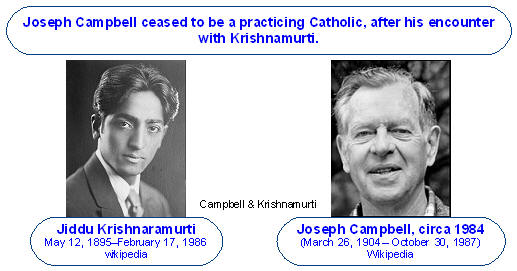
Joseph Campbell's life-altering encounter with
Jiddu Krishnamurti.
In 1924 (Professor) Campbell traveled to Europe
with his family. On the ship back, he encountered
Jiddu Krishnamurti; they discussed Asian philosophy, sparking in Campbell
a life-long interest in Hindu and Indian thought.
Following this trip, Campbell ceased to be a practicing
Catholic. --Wikipedia
In the
Old Testament, there is no direct mention of goddess. The mountains, the
mounds, the knolls and the hills were where the goddess was worshipped.
Impurity, abomination, fertility cult, nature worship, paganism, irreligion
were some the terms used for goddess worship.
Clare
Gibson says: The veneration of the Goddess was virtually universal by around
3000 BC; between 1800 and 1500 BC Judaism had begun to demonize her.
The
Virgin Birth Vs. the virgin stalkers in heaven or hell
In
Christian tradition, the concept of virgin birth is beautifully explained by
Joseph Campbell. When a man awakens at the level of the heart (Anahata Chakra
of Kundalini), a point of compassion, he takes a virgin birth: it is the
god/goddess who emerges in him or her. The previous physical birth is
not virgin birth. The lower centers of the Pelvic Basin and abdomen (Muladhara,
Svadhisthana, and Manipura Chakras of aggression) are not refuted but
transcended; they become subject to and servant to the heart. That is in
essence Virgin Birth. Today's malcontents, sociopaths and terrorists in the
hope of consorting with myriad virgins in the afterlife fail to attain Virgin
Birth in this life. The virgins in heaven upon whiffing the downwind of the
terrorists will become incorporeal and thus escape any contact with the
fleet-footed egregious killers. Or the celestial virgins in the fashion of
Daphne in Greek mythology may become laurel trees (Laurus nobilis) to
save themselves from the amorous pursuit of the erstwhile killers. The ghosts
of his victims will be hounding them for eternity.
|
New York Times dated
April 23, 2009 Op-Ed Columnist article titled,
Islam,
Virgins
and
Grapes.
The following
is the excerpt. 'One
scholar at the Notre Dame conference, who uses the pseudonym Christoph
Luxenberg for safety, has raised eyebrows and hackles by suggesting that
the “houri” promised to martyrs when
they reach Heaven doesn’t actually mean “virgin” after all. He argues that
instead it means “grapes,” and since conceptions of paradise involved
bounteous fruit, that might make sense. But suicide bombers presumably
would be in for a disappointment if they reached the pearly gates and were
presented 72 grapes.' End of NYT article.
Houri: Houri in Islam means several
things: chaste females restraining their glances; modest gaze; wide eyes;
beautiful eyes; eyes like pearls;
VIRGINS with
bodies not affected by pregnancy or breast-feeding; companions of equal
age; non-menstruating, non-urinating,
non-defecating and childfree females; transparent to the marrow
of their bones; eternally young; hairless except the eyebrows and the
head; pure; beautiful; splendid; and much more besides.--- Wikipedia.
httpss://en.wikipedia.org/wiki/Houri |
Soldier on soldier Violence
"It may be hard to comprehend the twisted logic that led to this tragedy.
But this much we do know - no faith justifies these murderous and craven
acts; no just and loving God looks upon them with favor. And for what he has
done, we know that the killer will be met with justice - in this world, and
the next." President Obama at Fort Hood memorial Service on Nov 10, 2009 for
those killed on Nov 05, 2009. The shooter and killer: Major Nidal
Malik Hasan. |
|
Here is a verse from Koran 5.32.
Text and Translation by
Maulana Muhammad Ali
https://www.muslim.org/english-quran/quran.htm

005.032 On that account:
We ordained for the Children of Israel that if any one slew a person -
unless it be for murder or for spreading mischief in the land - it would
be as if he slew the whole people: and if any one saved a life, it would
be as if he saved the life of the whole people. Then although there came
to them Our apostles with clear signs, yet, even after that, many of them
continued to commit excesses in the land. Dec 10, 2008
https://www.jannah.org/qurantrans/quran5.html |
Mumbai's most influential Muslim cemetery
rejected the corpses of nine of the gunmen (terrorists) and said "Islam does
not permit this sort of barbaric crime." People who committed this
heinous crime cannot be called Muslim," said Hanif Nalkhande, a trustee of the
influential
Jama Masjid Trust, which runs the 7.5-acre (three-hectare)
Badakabrastan graveyard in downtown Mumbai. While some Muslim scholars
disagreed with the decision — saying Islam requires a proper burial for every
Muslim — the city's other Muslim graveyards are likely to do the same. Among
the 19 foreigners killed were six Americans. The dead also included Germans,
Canadians, Israelis and nationals from
Britain, Italy, Mexico, Japan, China,
Thailand,
Australia, Singapore and
Mexico. Mumbai Massacre-- Dec 1, 2008. M.F. Husain expatriate painter
born in India and living abroad does not like the handiwork of the terrorists
and is exhibiting his handiwork in painting at a leading London art gallery --
Dec 10, 2008.
https://news.yahoo.com/s/ap/20081201/ap_on_re_as/as_india_shooting_261
| Here is the view of Hinduism.
You, I, he, she, and that are whole; there are no divisions. You hurt him,
you hurt yourself. You destroy that; you destroy yourself. We are whole
and not parts.
Vivekananda says: “I am in
everything, in everybody. I am in all lives and I am the universe.”
The
Complete Works of Swami Vivekananda Volume 1
[ Page : 357 ] THE VEDANTA PHILOSOPHY
The theory of the Vedanta, therefore, comes
to this, that you and I and everything in the universe are that Absolute,
not parts, but the whole. You are the whole of that Absolute, and so are
all others, because the idea of part cannot come into it. These divisions,
these limitations, are only apparent, not in the thing itself. I am
complete and perfect, and I was never bound, boldly preaches the Vedanta.
If you think you are bound, bound you will remain; if you know that you
are free, free you are. |
That you
take a virgin birth when you awaken at the level of the heart and that the god
emerges in you are an echo of what Ramakrishna Parmahamsa said as follows. Man
asks himself the question: who am I? The answer is, "I am Brahman. I am not
the body." The meaning is I am the spirit (soul) and not the body that houses
the spirit. The imprinting of this theme in one's mind and awakening at
Anahata (Heart) Chakra is virgin birth. The Spirit is One which pervades all
beings. If one is hurt, all are hurt.
Brahman
or God is in the spiritual heart of all beings; if you hurt one being, you
hurt the god in the victim and the god in your own heart. You hurt one; you
hurt all and the God.
Jesus
Christ and Mary Magdalene; Ramakrishna Paramahamsa and Kali
Mother Goddess worship is still strong in India. So transition to agriculture
and animal husbandry alone could not account for the waning of Goddess
worship, as advanced by the western students. People in India keep the
Goddesses on par with Gods. The pre-Islamic Arabs had goddesses who went into
oblivion with the advent of Islam; so also was the fate of the goddesses after
the advent of Christ. Virgin Mary, not part of the Holy Trinity, is still
regarded to have some vestiges of the Mother Goddess.
|
The Worship of Mother Goddess, Aphonomenin, if Dravidians still survive in
the sub-consciousness of the Mediterranean Christianity through the
veneration paid to the ‘Black Virgin's' in Italy, Spain and France. The
emblem of the Mother Goddess was fist and reminds us of Minakshi of
Madurai. As mother of plants she is symbolised by the fig tree in Asia
minor and in Mediterranean Europe. This symbolism finds an echo in the
binding of peepul branches in the marriage court yards in Tamil country.
The mother goddess is also connected with the serpent worship, in the
Pre-Hellenic Mediterranean world and the worship of the serpent is still
in existence in South India.
In 1963, a scholarly work
Dravidian origins and the west
by Dr. N. Lahovary, translated from his original French work, was
published in English |
Consider
Mary Magdalene, the allegedly reformed prostitute, who became the disciple of
Jesus Christ. Lately her standing (she was never supine.) is revitalized and
given a make-over. Her depiction with cascading knee-length blond or red hair,
lily-white soft skin with a splash of peachy pink, perfectly delightful
corpulence, a sliding, slipping and revealing diaphanous veil over her
well-endowed virginal torso between the Adam's Apple and the pit of the
stomach with tensile teats, and expectant eyes turned towards heaven indicates
a Northern-European nulliparous
callipygian sinuous
siren of impeccable virtue, rather than a woman of ease from Magdala, a
fishing village in Northern Galilee. Her painted depiction of nobility,
nubility, and modesty, free of striae over her breasts, abdomen, and hips is
in contrast to nullity attributed to her by the pronouncement of Pope Gregory
1 in 591 C.E. and characterization of Mary Magdalene as
peccatrix,
a sinful woman and NOT as meretrix,
a prostitute. PeccAtum = sin. Bible mentions that Jesus cured her of evil
spirits (Luke 8:2).

meretrix = merre
+ trix = Earning female. meretr
cius
of, pertaining to prostitutes, der. of meretrx
prostitute = mere-, s. of merre
to earn + -trx
-TRIX; see -OUS]. trix is used in
English to form feminine nouns (aviatrix; executrix). trix is old
English for female. Meretrix is an ugly word in my opinion; it means an
earning woman or a working woman, euphemism for a prostitute.
nulliparous =
being a female that/who has not borne
offspring.
callipygian =
having shapely buttocks.
striae =
Stretch marks.
The Eastern Orthodox Church asserts and
maintains that Mary Magdalene was a woman of virtue all her life. There are
many books which say that Magdalene was the wife of Jesus. Catholic Church and
other Christians denounce such a claim. There are others who say that
Magdalene was pregnant with the baby of Jesus at the time of his crucifixion.
Some claim today's Merovingian lineage wears the genes of Jesus Christ and
Mary Magdalene. Some claim Holy Grail is a misnomer and the Real Holy Grail is
Mary Magdalene, the receptacle of Jesus' bloodline.
Karen L. King, a church historian at Harvard Divinity School
identified a small fragment of fourth-century papyrus that includes the words,
“Jesus said to them, ‘My wife...’ ” Another clause appears to say, “she will
be able to be my disciple.” Some experts have concluded that the manuscript,
written in Coptic, is authentic.
Dr. King’s papyrus dates from the fourth century — roughly 350
years after Jesus’s life and death.
The Gospel of Mark, for example, was written around A.D. 70, only about 40
years after the crucifixion. ...a
greater claim to accuracy. Jesus Christ ...receiving
a surprise visit from his family, who had come from his hometown, Nazareth. “A
crowd was sitting around him; and they said to him, ‘Your mother and your
brothers and sisters are outside, asking for you.’ ” Why no mention of a wife?
--NYTimes September 20, 2012 Mr. and Mrs.
Jesus Christ? By JAMES MARTIN.
The Sacred Texts of East and West and North and South are
full of modifications, interpolations, additions and deletions. These
interpolations found their way into Sacred Hindu Texts. I assume the same
happened to other religious texts. In Hinduism very few have the courage to do
research the sacred texts, as they do in the West. In that sense the West is
more honest.
|
A case of interpolation in Brahma
Sutra as opined by none other than Swami Sivananda, a Tamil Nadu-born
Doctor who became a Samnyasi with utmost credentials and who took fencing
lessons from an untouchable, known undeservedly, disparagingly and
disrespectfully in the past and sometimes in the present a Pariah (பறையன்),
at whose feet Swami Sivananda (a genuine Brahmana) fell to the surprise of
many for the simple reason the Untouchable was his Guru.
The Sudras by virtue of caste at
birth do not have the privilege to study Vedas. |
|
Sugasya
tadanadarasravanat
tadadravanat suchyate
hi
I.3.34 (97)
Brahma Sutra |
|
Suk:
grief; Asya:
his;
Tat: that, namely
that
grief; Anadarasravanat:
from hearing his
(the Rishi’s)
disrespectful speech;
Tada: then; Adravanat:
because of
going to
him i.e.
to Raikva; Suchyate: is referred to;
Hi:
because. |
|
|
|
Swami Sivananda's Comment. |
|
|
|
The discussion on the
privilege of
divine meditation
begun in Sutra 25 is
continued. |
|
The whole of this Adhikarana
about Sudras together with the
preceding one about the Devas
appears to
be an interpolation of some later author.
page106 Brahma Sutra translation by Swami Sivananda. |
| --Veeraswamy Krishnaraj |
Once
Kali appeared before Ramakrishna Paramahamsa as a local prostitute in
the sanctum of her own temple. The founder of the Kali Temple Ms. Kumari
regarded Kali as a Virgin. Some people recognize only two colors, two sides on
everything; there are no shades and colors between the white and the black,
the red and the blue, the good and the bad. In like manner, the woman is
dichotomized: Virgin or prostitute; it is like two sides of the coin or
anything: head and tail; red and blue; black and white. The Hindu idea of a
woman, a person, a god, a goddess or a thing is that he, she or it comes
from time to time with many shades, colors, sides and qualities, which do not
have to be in a perfect fit as in a jigsaw puzzle.
In
Mohenjodaro, archeological digs showed female clay figurines with exaggerated
female organs. They are the ritual icons of Mother Goddess. Siva appears as
ithyphallic (erect member) Yogi surrounded by deer, buffalo, elephant,
rhinoceros and tiger. The reason why He is surrounded by animals is that He is
Pasupati. Pasu + Pati = Animal + Lord = Lord of animals. In Sanskrit
Pasu also refers to Individual soul. Thus He is the Universal Soul of all
individual souls or Lord of souls. In Christian Tradition, the souls about to
be redeemed are collectively called the flock; that is Pasu. We are all
Pasus of the flock. John 10:16 of Bible says: So there will be one flock,
one Shepherd. If you delve further, you notice that the animals live in peace
around Him. (We should all
live in peace.) The tiger
does not devour the deer. If all individual souls flock around Him, there is
peace. Peace radiates from Him because Siva is Yogi whose nature transcends
Sattva, Rajas and Tamas (Goodness, motion and passion, and darkness). Tantrics
say there are three kinds of people: Pasu, Vira and Divya (Animal, Hero-man
and Divine man). TANTRA. Remember the English word
Diva came from Sanskrit Deva. Sanskrit Vira is cognate with Latin
Vir
or Wer
for man or husband. I postulate the very concept of flock came from India; the
proof is earlier depiction of Siva as the Lord of Pasus (individual souls or
animals). I advance the theory that the very concept of Pati and Pasu (Lord
and the flock in Christian tradition) came from India to abide in Biblical
thinking. It is so because Siva is prius Jesus Christ and the oral or written
Bible.
Eventually the bull became his Vahana (transport) and the theriomorphic form
of Siva, according to western authors. His Sakti or power is the Mother
Goddess (Kali). Together they portray Siva-Sakti, the equivalence of 1 and 0,
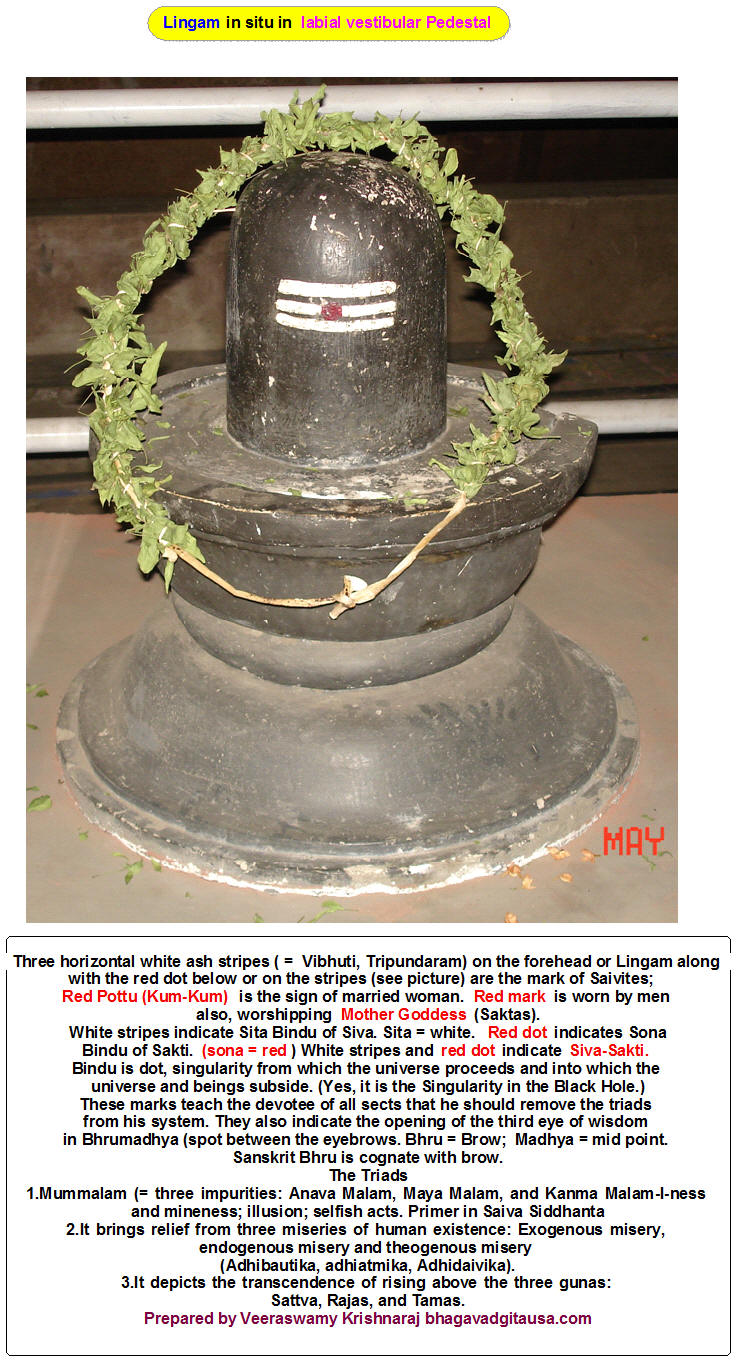
from which the whole universe proceeds. Here is a picture of Lingam in
situ in the labial vestibular pedestal.

That 1
and 0 are represented in Lingam on its base. Siva is the first ONE who said,
I (Aham).
That is Divine Ego, from which all individual egos came later via Sakti. Upon
telling Sakti that He is the First One (Numero Uno), she accepted Her
position, Zero (0) initially. Here zero does not mean She is a non-entity.
That is when the unitary Siva-Sakti (two cotyledons in a seed-Ardhanarisvara
or Androgynous Siva) became polarized, gendered and created the Universe and
beings. NAda-Sakti looked at Him (Pum Rupa = male form, the One) with longing
eyes (Sivon Mukhi = turning towards Bindu-Siva). This is called Mithah
Samavaya of Bindu and NAda, mutual agreement or obligation to begin creation.
Siva is Consciousness and Bindu; and Sakti is Nada and matter (Prakrti). Being
ONE (1) is being lonely. One is no more than ONE without the zero (0). From
this union of One and Zero comes all numbers, alphabets, combinations,
permutations, fractions, beings, matter, souls, and endless possibilities. You
won't have computers without 1 and 0. Now you know why Sakti (Kali) wears a
garland of 51 heads representing the 51 Sanskrit alphabets. Why heads:
that is where vocal speech (Vikhari speech, the spoken word, articulated
speech) originates. If you were repulsed by the garland of heads, now you know
the symbolism.
| Wendy
Doniger and Woodroffe: Note the difference in their take of 'Who am I?'
and 'I am' with regards to self-reference by God.
Judge for yourself whose interpretation is
authentic without the sweet burden of self-promotion. Wendy's polarizing
post reeks of a lateral stand.
Wendy Doniger: The
“Who?” question pops up in another cosmogonic hymn of the Rig Veda
(10.121), in which each stanza ends with the questioning refrain, “Who is
the god whom we should worship with the oblation?” The hymn begins: “He by
whom the awesome sky and the Earth were made firm, by whom the dome of the
sky was propped up, and the sun, who measured out the middle realm of
space—“who is the god whom we should worship with the oblation?”13
And so forth. Later Hindu tradition was troubled by
this open-ended refrain and invented a god whose name was the
interrogative pronoun, ka (cognate with the Latin quis,
French qui), Who. One text explained it: the creator asked the
sky god, Indra, “Who am I?” to which Indra replied, “Just who you just
said” (i.e., “I am Who”), and that is how the
creator got the name of Who.14
So, too, one Vedic ceremony: when the ritual subject goes to heaven and
comes back again, he must say, on his return, “I
am just who I am”15
(it is interesting to compare this
with the more confident Jewish and Christian concepts of the Great I Am).
Read back into the Vedic hymn, as it was in the Vedic commentaries,16
this resulted in an affirmative statement (“Indeed, Who is the
god whom we should honor with the oblation”) that closed down some of
those openings through which fresh theological air had flowed.17
Wendy Doniger
Aham and Idam (I and this)
|
December 16,
2012
Exodus 3:14 |
| 14
God said to Moses, “I AM WHO I AM”; and He said, “Thus you shall say
to the sons of Israel, ‘I
AM has sent me to you.’ ”
I AM =
Aham (अहम्
= I being such) as said by Siva.
John 8:58.
Jesus said to them, “Truly,
truly, I say to you, before Abraham was born,
I am.” |
TANTRA
The following
information is obtained from the Garland of Letters and the Serpent Power
by Woodroffe.
Aham and Idam (I and this) Siva
says, 'I.' The world is 'This.'
This is the celebration
of Kamakala in the form of sound and letters, of which She (Sakti) is made
of. There is no universe, no life, no beings, no sound, no speech
without Kamakala. She is beyond the three Saktis, the Sun, the Moon and
the Fire. She is the causal seed of all, with whom Siva unseparately is,
according to Woodroffe. Sakti and Siva need each other for creation.
First there was One without a second or Brahman,
which had the inclination to create (Sristi-Mukha).
The power of Brahman to produce and exist as the
world is called Vimarasa Sakti, which is a producer and the product.
This Vimarsa Sakti is none other than Sakti Herself. Brahman sees Itself
in the mirror, which is the Vimarsa Sakti.
The created world is called IDAM (This),
which is the reflection and the object of our experience. The
Svarupa (own form) of Siva is Aham (I). Now we have two entities, Aham and
Idam. Idam is the reflection of Aham. Woodroffe.
My
Commentary:
You would have noticed that Wendy Doniger was never challenged by Pukka (பக்கா
= Ripe, mature, complete, superior,
substantial, consummate) Sanskrit scholars
in India, whose daily bread and butter is recitation of what Wendy
vehemently criticizes or holding Upanyasams (Lecture;
உபந்நியாசம்)
on sacred texts. They are steeped in Sanskrit from their childhood.
They live and breathe Sanskrit. They probably do not know her, do not care
to know her, let alone read her books and posts.
A common attitude among
the super-pundits in religion in India is to hide from the foreigners,
hide their treasured sacred texts and knowledge, act dumb, deaf, doped and
insane and not to rattle the dumb, the dope and
the dupe; they quote
Bhagavad-Gita 3:29. Those who
are deluded by the gunas (here passion etc) of Nature are attached to the
works of Nature.
He who knows the whole truth
should not unsettle the ignorant who do not know the whole truth.
The "Yogis" who go after foreigners and fame are eager for money and build
a coterie of the like-minded.
Quotes:
Bhagavadgita
4:40: A know-nothing fool with no faith and many
doubts is lost. For such a doubting soul, neither in this world nor in the
world beyond is there happiness. |
To know about the story of
1 (the origin and dissemination of 0 and numbers) click on the link below (PBS)
https://www.pbs.org/previews/storyof1/
Excerpt:
The Indian
numbers were a smash hit across the Islamic world before they were finally
brought to Europe, where they met fierce resistance. It took 500 years for the
battle between Roman and Indian numbers to play out, but by the 16th century,
the Indian figures, now commonly called Arabic numerals (Read Indian numerals-
my input), finally triumphed - perhaps because Florentine mathematician
Fibonacci showed Christian merchants how useful Indian numerals could be, for
instance, for calculating profits.
But the
story doesn't end there. Within a hundred years, German mathematician
Gottfried Leibniz invented a binary system, using the Adam and Eve of
mathematics, One and Zero. Since then, as the language of computers, this
two-digit binary system has come to dominate every part of modern life.
The story of
the number one is the story of Western civilization. Terry Jones ("Monty
Python's Flying Circus") goes on a humor-filled journey to recount the amazing
tale behind the world's simplest number. Using computer graphics, "One" is
brought to life, in all his various guises, in STORY OF 1, airing on PBS
Wednesday, March 29, 2006, 8:00-9:00 p.m. ET. One's story reveals how
celebrated civilizations in history were achieved, where our modern numbers
came from and how the invention of zero changed the world forever - and saved
us from having to use Roman numerals today.
Siva's and Sakti's
mutual desire gave rise to three things in the universe: He, She, and It;
everything in the universe is covered by these three.
The Indus seals were
found in Sumerian Ur attesting to the fact that people of Sumeria and
Mohenjodaro and Harappa in India were trading partners between 2300 to 2000
B.C.
KAli
and Her 12 Functions and aspects according to Subject, Knowledge and Object of
Krama system. One has to have a plan, knowledge and executive power to
create, maintain and resorb this universe and beings. All these are present in
Kali.
Krama is order or proper course of action and
does not support either Pratyabhijna or Kula System.
Kashmir Saivism. In Krama, God Realization
comes one step at a time. The rise of Kundalini Sakti
Kundalini Power from lower Chakra to higher
Chakra belongs to Krama system, which was introduced into Kashmir Saivism by
Sivanadanatha at the end of 7th Century A.D. To begin with he had three female
disciples, who later had both male and female disciples.
Krama gives precedence only to Sakti. The
centerpiece of Krama System is SaktopAya Kashmir
Saivism and 12 Kalis.
The 12 Kalis are the 12 aspects of one cognition.
(Twelve aspects of one person: example: You are the father, the son, the
brother, the grandson, the great grandson, the husband, the father-in-law, the
grandfather, the great grandfather, the uncle, the brother-in-law, and the
son-in-law.) When you see a pot, sensation emerges from your thought and
travels to the locus of the pot and then returns back to the thought with
particulars of the pot. Perception, cognition, realization of the pot take
place in the mind. This is the perception going to object and returning to the
subject. These movements are deified and called twelve Kalis in the Krama
System.
1) Creation Kali, 2) Preservation Kali, 3)
Reabsorption Kali, 4) Indefinable Power of Kali, 5) Mergence Kali, 6)
Engulfing Kali, 7) Dissolution (of all) Kali. 8) resorption of senses in Ego--
Homogenization of senses--Kali, 9) resorption of Ego in her Creative power--
Kali, 10) Union of subject in Consciousness --Kali, 11) Union of individual
consciousness with Universal I-Consciousness--Kali, 12) Union with Siva
Consciousness ---Kali.
Let me explain a few points here. When we come
down to earth, we are endowed with soul, consciousness, body, senses, ego,
intellect etc. First comes the soul and consciousness, later the body, the
organs, senses, ego, mind, Buddhi, Chittam etc. When we make a return journey,
the last entity we obtained dissolves first into the preceding entity and this
retrograde involution or Reabsorption traces the steps backwards until our
soul/consciousness alone stands, which is resorbed into Siva. Kali facilitates
this creative downstream cascade and resorptive upstream uptake. All twelve
processes are effectuated by Kali.
The first four aspects of Kali are the four powers: 1) Srsti (= Creation),
Sthiti (= maintenance), SamhAra (=Dissolution), AnAkhya (Realm beyond words)
in relation to object (= prameya). Objects are what Kali creates.
KAli performs 12 functions.
This piece is a highly technical subject in Kashmir Saivism. Let me give you
an idea as to how Kali goes about creating this universe. There are
three entities: Subject, knowledge and object. Subject is either Kali or
the human individual soul and the object is the world or universe.
She has to have an idea of what she wants to create; she has to have a
knowledge to create, maintain, take back all and create again. When she takes
back, she takes back the senses, the ego and she dissolves all matter. When
she takes back the human soul, she integrates the individual soul with the
Consciousness of Siva. You become one with the maker.
1)
Srsti Kali: She has the Will to create and
has an idea as to what they are going to be. She is known as Srsti Kali. This
is the nascent idea of creation by Kali of the object. In this stage Kali is
gathering knowledge, the stage of PramAna ( = Knowledge and means of
Knowledge).
2) Rakta Kali: She is concerned with Sthiti or
maintenance of the visible world by the five senses. Here Kali wants to
preserve and protect the object she created through the five senses. .
3) SthitinAsa
Kali: She withdraws the objective world into Her. Her external form
comes to an end and comes to rest in Her. In this aspect of Kali, she tells
Herself, 'I have known the object.' 'Been there, done that.' (The
object is the world of beings and matter.)
4) Yama Kali: She manifests herself beyond extrovert
or introvert aspect and represents the AnAkhyA, indefinable power in relation
to objective experience. She goes beyond subject (KAli) and object
paradigm to a realm, where the consuming energies of 12 Kalis abide.
5) SamhAra
Kali:
When Parasamvid, Her Highest Divine Consciousness withdraws into Her
all external objects and makes them identical with herself, the aspect of
SamhAra Kali emerges. In this aspect of SamhAra Kali, she tells Herself, 'the
objects are non-different from me.' The subject and object
are one and non-different. Read the lyrics, 'I
Am The World' below.
6) Mrtyukali: In this aspect, Mrtyukali engulfs and
swallows SamhAra Kali, and internalizes the residual objects and traces of the
objective world. This is Sthiti (= maintenance) in the stage of PramAna (=
means of knowledge and Knowledge).
7) Bhadrakali: The objects dissolve in
Bhadrakali's essential nature. This is SamhAra in the stage of PramAna. Her
other name is Rudrakali.
8) MArtanda Kali: MArtanda is sun or god of
sun. The cluster of 12 Indriyas or organs is called sun because they
illuminate the objects like the sun. The 12 Senses are five sense organs, five
motor organs and Manas and Buddhi. She dissolves the 12 senses in Ego or
Ahamkara. She is AnAkhyA, indefinable power in relation to PramAna, the means
of Knowledge. She goes beyond the PramAna paradigm, where the consuming 12
Saktis abide. The 12 senses have lost their name and individuality upon
dissolution in Ego. What she created, she is absorbing : the body, the
senses etc. Senses and body are gone.
The four stages 5 to
8 are the four powers of Kali in relation to PramAna (= means of
knowledge). All that Kali (Subject) does is knowledge in relation with the
world, the beings....
The four stages of
Kali from 9 to 12 represent Kal's four powers in relation to ParamAta (= the
limited subject with only Anava Mala).
9) ParamArkakAli: She is the
creative power in relation to the limited subject. She merges Ahamkara in her
Creative Power. The limitations of object and senses are annihilated. This
limited subject is not the one with three Malas but with only Anava Mala. He
is the Pasu with Anava Mala, 2 notches above the Pasu with 3 Malas.
Primer in Saiva
Siddhanta
10)
KAlAgnirudrasakti:
When Parasamvid, the Highest Divine Consciousness, merges the individual soul
with the Universal Self, she is called KAlAgnirudrasakti.
Kali represents the power of Sthiti (= Maintenance) in relation to PramAta ( =
the limited subject) to rest in Her Universal Self. The Subject dissolves in
the Consciousness. The experience of KAlAgnirudrasakti
at this level is, 'I am all this.' Her other name is MahakAli, because She has
in Her everything inside Her including Time.
11)
MahAkAlakAli:
She dissolves the individual 'I' in the universal Perfect 'I' which is free
from all objects. This is the ultimate absorption or SamhAra in relation to
limited subject.
12)
MahABharaiva-Ghora-CandakAli: This state of Kali is AnAkhyA in relation to the
limited subject. This is beyond all characterization in words. This is Akula
stage (= Siva). Here PramAtA, PramAna and Prameya (subject, means of knowledge
and object) are all dissolved in I-Consciousness. This is ParA (= Supreme or
highest) because all previous states are her manifestation ante Akula state is
Siva state. The other name for MahABharaiva-Ghora-CandakAli is
MahABhairavaGhora CandaKali, where in Canda is the realm of Prameya
(=Subject), Ghora is Prameya ( = Knowledge and means of knowledge), and
MahaBhairav is PramAtA ( = Subject).
|
5) SamhAra
Kali:
When Parasamvid, Her Highest Divine Consciousness withdraws into
Her all external objects and makes them identical with herself, the aspect
of SamhAra Kali emerges. In this aspect of SamhAra Kali, she tells
Herself, 'the
objects are non-different from me.' The subject and
object are one and non-different. Read the lyrics, 'I
Am The World' below. |
|
Lyrics to I Am The World
:
I am the world. I'm the boys
and the girls.
I'm the dads on the grind, paying rent, punching time.
I'm the guy on TV, saying, Jesus is near
I'm the man in the cell. I'm his courage and fear.
I'm the trust that
you give and the honor you lose.
I'm the future you change every moment you choose.
I'm the now and the never when you got no more time.
I'm the dream that is rising in the back of your mind.
I'm the sickness and cure. I'm polluted and pure.
Baby, I am the world, and I'm yours!
I'm the joy in the
air at the birth of your child,
And the pressure to win so your father will smile.
I am the king. I'm the czar. I'm the pope.
I'm your finest good deeds and your worst dirty jokes.
I'm the air that
you breathe when you got no more steam.
I'm the people you trust. I'm the people who leave.
I'm the now and the never when you got no more time.
I'm the dream that is rising in the back of your mind.
I'm the sickness and cure. I'm polluted and pure.
Baby, I am the world, and I'm yours!
I am the sun and the darkest of nights.
I am choice to the left, I am death to the right.
I'm the dull of the bruise and the sting of the bruise.
I am with you for good.
I'm the world. I'm the rules!
I'm the now and
the never when you got no more time.
I'm the dream that is rising in the back of your mind.
I'm the sickness and cure. I'm polluted and pure.
Baby, I am the world, and I'm yours!
I AM THE WORLD!
https://www.lyricsmania.com |
The
following piece is written by me. It is waiting for approval from Maureen
Dowd!
This
piece along with the main article was written by Veeraswamy Krishnaraj, M.D.
There were enquiries as to who wrote this piece. I am a retired pediatrician,
familiar with human genetics.
Saktas believe that male descended from the First Female and this is the
learned scientific view of the geneticists too. This information may fluster
Adam because he believes that Eve came from him. Adam's presumed and unproven
donation to male of the species is the Y chromosome which is not as robust as
it once was, and shrinking and wasting away. Consider the gene-poor Y
chromosome equal to a cash-poor wallet.
"The
homogametic sex is female (XX) and the heterogametic sex is male (XY), thus
the sex linked genes are carried on the X chromosome."--- sciencedaily.com
The Meiotic Chaos
Compare the robust size of X chromosome with its counterpart, a runt (the Y)
lined up by its side. There is an element of nurture in X so an embryo with YO
(absent X) does not go to term; an XO can go to term, though not normal. The Y
is a loner; the Y rejects the advances of X to exchange genes except at the
ends (PAR- PseudoAutosomal Region,
5% of Y and yet containing 72% of genes for recombination), when they do the
dance of "give and take." The rest of DNA on the Y belongs to
"boys-only-club," also known as
NRY (non-recombining region
of Y constituting 95% of the Y chromosome), which does not participate
in recombination of exchange. There are 20 genes here, some of which doing the
housekeeping functions and being copies of genes on the X and the other genes
enhancing male fertility and having many copies in Y. The housekeeping
genes are found elsewhere in other organs. The Y has been an immigrant haven
for new genes. Copies of DAZ
fertility genes from chromosome 3 found their way to live in the Y chromosome.
DAZ genes find expression only in testis. (DAZ
= Deleted in
AZoospermia. Azoospermia =
no sperms in the fluid) Some males with infertility lack the
DAZ
male fertility gene. Chromosome 3 has DAZ-like
(DAZL) gene. Now you know why males show off their Razzle-DAZL. This DAZL
rascal copied itself on to the Y chromosome about thirty million years ago.
The
immigrant genes kept it alive (like the immigrants to America kept it
progressive); otherwise the Y would have attained extinction. Over ages, the
immigrant genes die off. There is no new "real blood" coming into Y.
Will Y waste away and come to a naught?
The
laconic Y is short, dense and wasting way; it will take 10 million years for
the Y to become a shell of its former self. Just like before, an event will
take place in the chromosomes and the
SRY (Sex-Determining
Region
Y) gene
will come into being.
SRY gene codes for Testis Determining Factor (TDF)
or SRY protein. Mutations in SRY leads to XY females (Gonadal Dysgenesis or
Swyer Syndrome). Translocation of part of the Y chromosome containing SRY gene
to the X chromosome casuses XX male Syndrome. SRY gene, if damaged in male
fetus, results in Genotype males, and phenotype females.
Its
(Y)
size does not match Its hyperbole, haughtiness, hubris, and bombast. The house
of Y is mostly junk (respectfully called non-coding DNA). They (sperm) march
by millions to assault one ovum with hardy accouterment, loaded with
nourishment, so a lonely sperm can enter the premises for companionship and
progeny. All the other prospective suitors die in battle, as one princely
critter enters the once impregnable fortress and makes a mark with an X or a
Y. The little runt has a big ego; it has the ability to morph the primary
default state of femaleness of the embryo into a male, if the critter carries
the Y (SRY).
The critter says in effect, "I am the greatest; I punched a hole and broke
through the formidable fortress; it is me who decides whether the progeny is
male or not." SRY gene has some very Extraordinarily Primitive
Qualities: SRY is Intronless gene. Most of the human genes have introns--non-coding
regions. SRY is all Exons. Bacterial and Fungal genes have no introns. Now you
see how primitive SRY is. SRY Exon gene is the cause of Hastiness
in males. SRY gene is all business, neither a prologue nor an epilogue nor a
nicety; it does not waste time but cuts to the chase. It is impatient and
efficient to its cause :*)
By
the way scientists discovered the female chromosome first and called it X; yes
it looks like an X and it is big in metaphase (153 million base pairs--2000
genes). They could not find the Male Critter Chromosome because it was tiny.
When they discovered it, it was named Y (60 million base pairs--78 genes).

Genetically speaking,
Y came into being from X about 300
million years ago. Adam
can draw little comfort from that notion. Even worse, the X and Y were
not sex chromosomes to begin with; they were autosomes before they became
sexy. The future Y chromosome was a copy of X chromosome. Where is the male
pride here? And a mere copy at that. Some call the Y, X-degenerate. What would
Adam say to this? The males don't draw any comfort from that scientific fact.
The scientists traced the X and the Y chromosome backwards and found them not
sexy but very unsexy autosomes. The X is a repository of thousands of
genes, while the Y is the poor - but proud- owner of a few dozen. A
dozen or so of the genes (27) shared by the X and Y look like fossils from
which scientists reconstructed the evolutionary story of the X and the Y.
The fossil genes are neatly arranged at the tips of the X chromosome, which
speaks of good housekeeping. The Y chromosome fossil genes in a typical
fashion are strewn up and down the length of the Y chromosome; this may
explain why bachelor's dormitory rooms are in disarray.
Anagram: Dormitory = Dirty Room. It is an evolutionary
curse. Normal chromosomes exchange genes, when they line up during sperm or
egg formation, just like children exchange baseball cards. By doing this
mutual reciprocal exchange, the pairs know that they belong to each other;
if they do not recombine, the two may go their own separate ways and take
other forms. This exchange or recombination was suppressed in the distant past
during evolution. The blame goes to Y because Y moved the genes by taking
chunks of DNA and flipping them upside down: inversion. Inversion event
is the way Y frustrates X. This is the temper tantrum of Y which flings the
genes into places where the X cannot find and make reciprocal exchange.
It is no wonder that Israelite men were wandering in the desert for forty
years without a clue of their destination. They could have taken a hint from
their spouses. They could have asked
the desert-dwelling Arabs
for direction. Why did they not do it?
It goes back to the recalcitrant behavior of the Y.
The Y does not have an idea what a map
is or how to use it.
The X chromosome DNA chunks are in
good order. Now you can see why the house of Y is in disarray; moreover, Y
likes it that way. The scientists examined the X chromosome's suitcase
of genes which are neatly arranged in four groups, one on top of another. The
suitcase of the Y chromosome is a hodgepodge of disparate things thrown in
carelessly. That is why X (mother) gets nightmarish chills when she enters her
son's bedroom.
Three hundred
million years ago--give or take a few million years-- one of the unsexy
autosomal pair (the future sex chromosome) underwent mutation and became the
sex chromosome which looked identical at first and later one started sporting
SRY gene--Sex-determining Region Y. The original partner without the SRY gene
stayed the X chromosome. Then the chromosomes did not determine the sex of the
progeny. Environmental stimulus like temperature determined the sex of the
progeny. Turtles and crocodile still follow the old-fashioned ways.
This drama of human ancestors of sex
chromosomes was played out in reptiles. As David Page puts it, this mutant Y
became "a tyrannical male-determining gene that said, 'I (Y) will no longer
respond to these environmental cues. If I am present, the male pathway will be
followed.' " (Now you know
why Siva said to Sakti, 'I' (Aham).
'I' of Siva is the Super-Supreme Divine Ego.
No one in the universe can match it.
In Hindu religion, the Mother Goddess gave birth
to the Brahma, Vishnu, and Rudra (The Holy Triad). Later she created three
spouses for them.
First the mammal
chromosomes parted company with the birds 240-320 million years ago; autosomes
became the sex chromosomes and Y acquired the SRY gene and X was deficient in
SRY; we parted company with duck bill platypus 130-170 million years ago; for
the third time we parted company with kangaroos 80-130 million years ago; for
the fourth and the last time X and Y differentiated and parted company with
lemurs 30-50 million years ago.
Once it incorporated
the SRY gene, it started losing genes. It is said that the Y is losing 5 genes
every million years. The SRY gene is the switch that is turned on in male
fetus bearing Y chromosome. To begin with the X and the Y had approximately
1000 (1098) genes and now the Y has only 80 (78) genes. They exist
as palindromes. The scientists say when the Y chromosome undergoes
mutation, damage, slippage and loss, it makes up and recoups the loss by
copying from its palindromes. In females there are two X (XX) chromosomes; if
one X chromosome gene is diseased the other X chromosome makes up, and the
disease is not manifest. In case of males, a similar situation is catastrophic
because there is no balancing counterpart for the male and so Y suffers from
X-linked diseases like hemophilia, autism, muscular dystrophy, fragile-X and
so on. Now you know why the males are unbalanced.
Since 95% of Y (NRY= Non-recombining Region of Y) does not recombine
with the X (the genes are all turned upside down in Y), it is isolated from X
and starts accumulating mutations. 98% of Y chromosome is junk and the
male passes on the accumulated junk to his sons and along the male
line. (Genes undergoing mutation need recombination to repair the damage; if
not they accumulate as junk. Kangaroo has the most junk in its Y chromosome. (That
is why it jumps on its springy hind legs carrying all that junk instead of
walking!; the weighty junk needs a spring to get it off the ground; O
yes, I am stretching the truth! ) Scientists
scavenge the garbage dump (study the junk) and identify paternity; junk has
value; Y junkyard is research and commercial paradise: Y carries $ signs.
David Page says Y is not really a landfill but a National Park, much like
Yosemite or Yellowstone, (O Yea, tell me about it) though he admits that hairy
earlobes (I keep trimming it; I still don't know
why I need hair on my earlobes.)
and porcupine skin are its(Y's) manifestations.
Y Chromosome is known to invite and harbor immigrant genes from other
chromosomes that favor maleness like fertility genes.
When Kali says that
she is the origin of gods, men, women and matter, who is going to refute that
claim? Remember that the original Y is a copy of X. The male genes hijacked
(took residence in) the autosome which would become Y. That is why most
of the hijackers are male. If you (squatter) stay long enough in a
place, you eventually own it. That is how the newly discovered India of
Columbus became America! That is how the autosome became the Y chromosome,
when the sex genes claimed ownership; there was a transfer of deed of
ownership of the house to Y chromosome. The colonizer becomes the owner. To
begin with the new X and Y looked alike; they did their dance like all other
autosomes and exchanged genes from each other. Then the Y became a loner and a
lone ranger and stopped nuclear exchange with X except at the ends; simply
put, Y was not talking much with X; there was no exchange of ideas (genes);
this may be the primordial beginning of marital discord between X and Y.
Y also has a lot of palindromes of enormous lengths which forwards and
backwards read the same like
MADAM (Madam, I'm Adam). There
are palindromes
within palindromes which are compared to hall of mirrors.
Y is proud of his mirrors esp., the
ones on the ceiling.
The Y chromosome chants these
palindromes like Mantras, repeating them umpteen times. The palindromes
are like money in the bank. When its sperm-producing gene is damaged, it can
repair it from the palindromes. It is like copying a passage from the back-up
copy of a file in the computer. In other somatic chromosomes, repairs take
place during mitosis. One such palindrome is the infertility gene. Deletions
in the gene during sperm formation leads to infertility.
That is misspelling
and thus mispronunciation of Mantra, which equally has
deleterious effect in the world of Tantrics. Remember all this drama takes
place in meiosis in the testis. XY uses XX as the copying machine for its X
and Y chromosomes; that is the sad Truth and speaks ill of Y.
(That is why the ancient seers of India called woman, Dhatri.
A woman makes a facsimile of her husband in her
son and so is called Dhātrī. As you see, ancient seers and sages of
India thought about the physiology of pregnancy and Fax Machines too.
BG10. )
The
copying of a single man's Y and fathering many children are called Male
Intrasexual Selection. Genghis Khan's and his male relatives' Y spread widely
and wildly because of conscripting large number of concubines on their
victory march over a swath of land. Manchu and Mongol chromosomes left genetic
imprints of large size in the populations of East Asia. This Male Intrasexual
Selection is not uncommon in the Middle East noted for harems in the past.
Y says
to X, "I am not going to take this nonsense coming from you anymore.
Your womb, your womb is the cause of your
hysteria (hyster = uterus,
womb), raving and ranting." X without missing a beat says, "Aren't we
testy today like everyday.
Listen, you goofball; I had enough with you; put up or shut up. Be a
YY and never see the light of day."
Females
are XX, put together in a balanced way, while
males are XY and
unbalanced.
The
hubris of Y
took new dimensions. Only Y
(males) could testify
in the court in olden days because Y
has the testis. The
X
for lack of testis, though a reliable map reader, observer, and witness could
not testify. Thanks, things have changed.
Palindrome:
Palindrome is not an aerodrome
named after the Vice presidential candidate Ms. Palin in 2008 presidential
election. I just want to make it clear to the readers.
|
Ramakrishna Paramahamsa (February
18, 1836 - August 16, 1886) the most revered Sage (Maharishi = Great Seer)
in his book,
Sayings of Sri Ramakrishna
Page
124-126
Attitude Towards Women
435. All women are parts of the
Divine Mother, and therefore they should be looked upon as mothers by all.
436. Women, whether naturally good
or not, whether chaste or unchaste, should always be looked upon as images
of the blissful Divine Mother. (Mary Magdalene, do you hear that?)
437. Q.. How should we look upon
the fair sex?
A. He who has known the Real, who
is blessed with the vision of God, does not regard them with any fear. He
sees them as they really are--parts of the Divine Mother of the universe.
So he not only pays all honour and respect to women, but actually worships
them as a son does his mother.
438. Q, How can we conquer lust?
A. Look upon all women as your own
mother. Never look a woman in the face, but always look at her feet. All
evil thoughts will then fly away.
439. The woman who observes
continence even while living with her husband, is veritably the Divine
Mother Herself.
440. Q.. Sir, what do you think of
the mode of devotional practices in the company of women, as enjoined by
the Tantras?
A. Those are not safe 'paths'; they
are very difficult, and are often attended' with slips. There are three
ways of practising devotion (according to the Tantras)-one may cultivate
the attitude of the 'hero', or the 'hand-maid', or the 'son' towards the
Divine Mother. Mine is the attitude of the 'son'. To think of oneself as
the hand-maid of the Divine Mother is also good. But the path of the
'hero'
is fraught with danger. Very pure is the path of 'sonship' (i.e.
thinking of oneself as the son of the Divine Mother.)
441. Do you aspire after Divine
grace? Then propitiate the Mother, the Primal Divine Energy (Sakti). Yes,
She is Mahamaya Herself. She it is Who has deluded the whole world, and is
conjuring up the triple device of creation, maintenance and dissolution.
She has spread a veil of ignorance over all, and unless She unbars the
gate, none can enter the 'Inner Court'. Left outside, we see only the
external things, and the Eternal One, Sachchidananda, remains ever -beyond
our ken.
The Divine Sakti has two aspects-Vidya
and Avidya. Avidya deludes and is the mother of Kamini-Kanchana 'woman and
gold'; and it binds. But Vidya is the source of devotion, kindness,
knowledge and love, and it takes us towards God.
This Avidya has to be propitiated,
and hence the institution of Sakti worship. Various are the ways of
worship for gratifying Her-as Her 'handmaid', or 'hero', or child'.
Sakti-sadhana is no joke. There are very strenuous and dangerous practices
in it. I passed two years as Mother's 'hand-maid' and 'friend'. Mine,
however, is the mood of the 'child', and to me the breasts of any woman
are like unto my mother's.
'hero'
= It is called Virachara in the Tantras. In this path the devotee
has to worship the Goddess as the Divine Consort, taking a woman as the
vice deus.
Women are so many images of Sakti.
In the western parts of this country the bridegroom holds a knife in his
hand during marriage, and in Bengal, a nut-cracker. The idea is that he
will cut the bonds of Maya with the help of the bride who is Sakti
Herself. This is Virabhava, 'the way of the hero'. But I never practised
it. Mine is the attitude of the 'child'. |
|
Air
India operates all-women crew flights
Special Correspondent March 9, 2010
CHENNAI: As part of the International Women's Day
celebrations, Air India operated an all-women crew flight on select
sectors in international and domestic sectors from three southern cities
on Monday.
Flight IC 573/574 Chennai-Colombo-Chennai was piloted by
Capt. M. Deepa and First Officer Soniya Jain with five women cabin crew
members and two women security personnel. Load and Trim sheet was prepared
by Shobana and Tarmac loading operation was done by M.S. Yasodha.
In all, Air India operated 12 flights, including
Mumbai-New York, Hyderabad-Dammam-Chennai, Mumbai-Bangalore-Mumbai,
Muscat-Mumbai-Ahmedabad and Mumbai-Nagpur-Mumbai.
Talking to reporters, Sunil Kishen, Executive Director
(Southern Region), Air India, said that it was an eventful day. “This is
the not the first time that we are operating flights with all-women crew
on the Chennai-Colombo-Chennai sector. We have been doing it for the last
two years. In the last one year, we would have flown at least 52 all-women
crew flights.” |
Medical
information: Normal genotype for male is
XY
and for female XX.
One has to understand two terms:
Genotype and
Phenotype. Genotype
is the genetic makeup of an organism, while phenotype is observable
constitution of an organism (WYSIWYG = what you see is what you get). No one
can change the Genotype but Phenotype can be changed. In modern times when a
male undergoes sex-change operation, the person's genotype is still XY but the
phenotype
of
surgically altered and hormonally induced and augmented
person
(with secondary sexual characteristics) is female.
Karyotype:
the chromosomes of a cell, usually displayed as a systematized arrangement of
chromosome pairs in descending order of size.
When there is no Male-Determining Gene (Normal Y), the fetus
takes the default route and develops along the female line.
Here you can read about sex chromosomal mishaps
or accidents during fertilization and embryo formation.
Cytogenetic analysis of tall Alabama prisoners showed two of
100 Caucasian and none of 108 Negroes to have the
XYY
karyotype. Convictions were numerous for each XYY
prisoner, with robbery, burglary, and automobile theft being the most common
offenses. Psychological evaluation indicated IQs of 105 and 108. (XYY
are mistakenly called Super-males.)
Supported in part by U.S. Public Health Service
grants MH16828-01, HD0102, FR 5349, and FR 0530.
Metafemales
or triple-X females, inherit three
X chromosomes--their genotype is XXX
or more rarely XXXX or
XXXXX. As adults, these
"super-females" are usually an inch or so taller than average with unusually
long legs and slender torsos, but otherwise appear normal. They have
normal development of sexual characteristics and are fertile. They may
have slight learning difficulties and are usually in the low range of normal
intelligence (especially the XXXX and
XXXXX individuals). They tend to be
emotionally immature for their size during childhood. This sometimes
results in teachers and other adults labeling them as troublemakers.
None of these traits prevent them from being socially accepted as ordinary
adult women. This type of chromosomal abnormality is
less rare than Turner syndrome,
but little is known about it. The
frequency is approximately 1 in 1,000 female infants and it occurs more
commonly when the mother is older.
Klinefelter
syndrome males inherit one or more extra
X chromosomes--their genotype is
XXY or more
rarely
XXXY,
XXXXY,
or
XY/XXY
mosaic. They characteristically have
relatively high-pitched voices, asexual to feminine body contours as well
as breast enlargement, and comparatively little facial and body hair.
They are sterile or nearly so, and their testes and prostate gland are
small. Extra genetic material from the X chromosome interferes with
male sexual development, preventing the testicles from functioning
normally and reducing the levels of testosterone.
XX-male
Syndrome.
Female
Genotype--Male
Phenotype.--de la Chapelle
syndrome--Male with female genes, into which the male genes crossed over
during meiosis.
XX male syndrome (also
called de la Chapelle syndrome) is a rare sex chromosomal disorder
in men. Usually it is caused by unequal crossing over between X and Y
chromosomes during meiosis. Symptoms include small testes,
gynecomastia (breast development) and sterility. Many males with this
condition also have effeminate characteristics.
Men typically have one X chromosome and one Y chromosome
in each diploid cell of their bodies. Women typically have two X
chromosomes. XX males have two X chromosomes, but otherwise appear to be
male. Diploid = two chromosomal pair in the cell)
Swyer syndrome, or XY
gonadal dysgenesis, is a type of female hypogonadism in which no
functional gonads are present to induce puberty in an
otherwise normal
girl whose karyotype is then found to be
XY.
Her gonads are found to be nonfunctional streaks. Estrogen and
progesterone therapy is usually then commenced. The gonads are normally
removed surgically because they do not function and may develop cancer.
The person can have either 46,XX or 46,XY.
There are androgynous babies and grown-up
adults with XX/XY
genotype (Chimera).
Turner Syndrome with genotype 45,X.
or XO.
There is only one X in the female
phenotype. There are other variations in the sex chromosome analysis.
Testicular Feminization.
Phenotype: Appearance, girl or Adult female. Genotype and Karyotype: Male,
XY.
Androgen insensitivity
syndrome (AIS) is when a person who is genetically male (has one X and one
Y chromosome) is resistant to male hormones called androgens. As a result,
the person has some or all of the physical characteristics of a woman,
despite having the genetic makeup of a man.
The syndrome is divided into two main categories:
complete and incomplete. Complete AIS results in someone who looks female.
In the incomplete AIS syndrome, the degree of sexual ambiguity varies
widely from individual to individual.
Causes
The syndrome is caused by various genetic mutations on
the X chromosome. The mutations make a developing male baby unable to
respond to androgens. (Androgens are responsible for male physical
characteristics.)
Androgen = any substance, as testosterone or
androsterone, that promotes male characteristics.
If the androgen
insensitivity is complete, this prevents the
development of the penis and other male body parts. The child is born
appearing to be a girl. The complete
form of the syndrome occurs in as many as 1 in 20,000 live births.
Different degrees of androgen resistance can result in a
wide variety of outward symptoms. Incomplete AIS can include other
disorders, such as Reifenstein's syndrome (also known as Gilbert-Dreyfus
syndrome or Lubs syndrome), which is associated with hypospadias (where
the opening of the urethra is on the underside, rather than at the tip, of
the penis), gynecomastia (breast development in men), and cryptorchidism
(when one or both testes fail to descend into the scrotum after birth).
Also included in the broad category of incomplete AIS is
infertile male syndrome, which is sometimes due to an androgen receptor
disorder.
In its classic form (complete androgen resistance), the
person appears to be female but has no uterus, and has sparse armpit and
pubic hair. At puberty, female secondary sex characteristics (e.g.,
breasts) develop, but menstruation and fertility do not.
--------------------------------------------------------------------------------------------------------------------
Kali's divine
aliases:
Bhowani Devi, Sati, Rudrani, Parvati,
Chinnamastika, Kamakshi, Uma, Menakshi, Himavati, Kumari. She has names that
start with the letter K: KAli, KarAli, Kalyani, KalAvati, KamalA,
Kalidarpaghni, KaparddIsakripanvitA...
100 names of Kali
starting with K (modified from
Woodroffe--Hymns
to Kali and Mahanirvana Tantra):
|
KripAgamA
Attainable Only by Thy mercy
|
|
KrishAnu Thou Art Fire
|
|
KapilA One of tawny
color |
|
KrishnA Black of hue.
Krishna = black
|
|
KrishnAnanda-vivardhinI
She who Increases joy (and bliss) of Krishna
|
|
KAlaratri Night of
Darkness
|
|
KAmarUpa She in the Form
of Desire
|
|
KAmapAsa-vimocinI
Liberator from the Bonds of Desire
|
|
KAdambinI Dark as a bank
of nimbus clouds
|
|
KalAdhAra Wearer of the
Crescent Moon |
|
Kalikalmasa-nAsini
Destructress of sin (in Kali age) |
|
KumAri-pUjanapritA
Pleased by the Worship of Virgins |
|
KumAri-pUjakAlayA Refuge
of all worshippers of
Virgin |
|
KumAri-bhojanAnanda Who
is Pleased by the Feasting of Virgins
|
|
KumAri-rUpadhArini Who
is in the Form of a Virgin
|
|
Kadamba-vanasamcara Who
wanders in the Kadamba Forest
|
|
Kadamba-pushpasantosA
She shows pleasure with Kadamba flowers |
|
Kadamba-vanavasini She
lives in the Kadamba Forest
|
|
Kadamba-pushpamAlinI
Wearing a Garland of Kadamba-Flowers
|
|
Kishori Thou Who Art
Ever Youthful
|
|
KAlakanthA She has a
soft low Voice
|
|
Kalanada-ninadini She
has sweet voice as the Chakravaka-Bird
|
|
Kadambari-panarata She
who drinks the Kadambari Wine
|
|
Kadambari-priya The
pleased imbiber of Kadambari wine |
|
Kapalapatra-nirata Whose
eating bowl is a hollow skull |
|
Kamkalamalya-dharini Who
wears a Garland of Bones
|
|
Kamalasana-santushta Who
expresses happiness with the Lotus Flower
|
|
Kamalasana-vasini
Who sits on the Lotus
|
|
Kamalalaya-madhyastha
Who Abides in the Center of the Lotus
|
|
Kamalamoda-modini Whjo
likes the fragrance of lotus flower |
|
Kalahamsa-gati Who moves
like a swan |
|
Klaibyanasini Destroyer
of fear |
|
Kamarupini She who
assumes forms at will |
|
Kamarupa-kritavasa Whose
abode is Kamarupa |
|
Kamapitha-vilasini whose
abode is Kamapitha |
|
Kamaniya Beautiful One
|
|
Kalpalata Creeper who
Provides every Desire
|
|
Kamaniya-vibhushana
Beauty is Your Ornament
|
|
Kamaniya-gunaradhya
Adorable Image of all Tenderness
|
|
Komalamgi Who has a
tender Body |
|
Krishodari Slender of
Waist or small abdomen |
|
Karanamrita-santosha Who
is pleased with the Nectar of purified wine
|
|
Karanananda-siddhida
Giver of Success to those who enjoy that wine
|
|
Karanananda-japeshta
Wine-bliss worship |
|
Karanarchchana-harshita
KArana-Archchana-Harshita = wine-homage delight.
|
|
Karanarnava-sanmagna
KArana-arnava-sanmagnA = Wine-ocean-immersion
|
|
Karanavrata-palini
Protector of those Who observe ritual with wine
|
|
Kasturi-saurabhamoda
Gladdened by the Scent of Musk
|
|
Kasturi-tilakojjvala
Luminous with musk Tilakam on forehead |
|
Kasturi-pujanarata
Attached to those who worship with Musk
|
|
Kasturi-pujakapriya
Loving those Who Worship Her with Musk
|
|
Kasturi-dahajanani
Mother of those who Burn Musk as Incense
|
|
Kasturim-rigatoshini Who
is fond of the Musk-Deer
|
|
Kasturi-bhojanaprita Who
is pleased to Eat Musk |
|
Karpuramoda-modita Whom
the Scent of Camphor Gladdens
|
|
Karpura-malabharana Who
is adorned with Garlands of Camphor
|
|
Karpura-candanakshita
Body smeared with Camphor and Sandal Paste
|
|
Karpura-karanahlada Who
is Pleased with Purified Wine flavored with Camphor
|
|
Karpuramrita-payini who
Drinks of wine-nectar Flavored with Camphor
|
|
Karpura-sagarasnata Who
bathes in the Ocean of Camphor
|
|
Karpura-sagaralaya
Camphor-ocean-abode |
|
Kurchabija-japaprita
Bija Mantra-Hum- (KUrcchchabija)-worship-Liker
|
|
Kurchajapa-parayayana
HUM-worship-departure-path (who threatens with Bija-HUM) |
|
Kulina Embodiment of the
KulAcAra |
|
Kaulika-radhya Adored by
Kaulikas |
|
Kaulika-priyakarini
Benefactress of the
Kaulikas |
|
Kulacara Observant of
the KulAcAra
|
|
Kantukini Joyous One
|
|
Kulamarga-pradarshini
Revealer of the Kaulikas |
|
Kasishvari Queen of KAsi
(Benares, VarnAsi) |
|
Kashtahartri Allayer of
Suffering
|
|
Kasishvara-dayini Giver
of Blessings to the Lord of KAsi (Siva) |
|
Kasishvara-kritamoda
Giver of Pleasures to the Lord of KAsi |
|
Kasishvara-manorama KAsi-Lord-beloved |
|
Kalamanjira-carana Whose
Toe-bells Sound Sweet Melodies as You move |
|
Kvanatkanci-vibhusana
Whose Girdle bells Tinkle Sweetly
|
|
Kancanadri-kritagara
abiding in the mountain of gold |
|
Kancanacala-kaumudi
Moonbeam on the Mountain of Gold
|
|
Kamabija-japananda
KAmabija Mantra (Klim) recitation gladness |
|
Kamabija-svarupini
Embodiment of the mantra 'klim'
|
|
Kumatighni Destructress
of all Evil Inclinations
|
|
Kulinarti-nasini
Destructress of the Kula's Afflictions
|
|
Kulakamini Lady of the
Kula
|
|
Kalakantaka-ghatini
Destructress of the Fear of Death |
Notes: 28. Kumari-pUjanapritA
Pleased by the Worship of Virgins. Worship of KumAri by men and of
married woman by other women is common in Bengal. Here Kumari is Devi --Woodroffe,
page 46 Hymns to the Goddess.
Notes: 38.
KalanAda-ninAdinI She has sweet voice as the
CakravAka-Bird. The birds sing to each other from the opposite banks of
the river. They are the epitomical love-birds with passion in the poet's mind.
Notes: 40.
KAdambari-priyA The pleased imbiber of Kadambari wine. KAdambarI
is mead (alcoholic liquor from honey and water). Devotees of Lalita serve
Mead, fish, flesh, and cooked cereals before partaking them. These are the
Madya, wine;
Mamsa, meat;
Matsya, fish;
Mudra, grain; and
Maithuna, sexual
union of the Vamacara Tantrics belonging to Veera and Divya classes.
Notes: 47:
Kalahamsa-gati Who moves like a swan. Swans live
in the celestial lake, MAnasa. Likewise, She lives in the mind-lake (MAnasa)
of He devotees.
Notes 51:
Kamapitha-vilasini whose abode is
KAmapitha (love
place = love nest). Mahapitha (Great
place) is one among the many with that name. Devi (Sati) died from spontaneous
combustion from the internal heat of Tapas, when she was offended by her
father, who did not invite her consort, Siva for the Yagna. Some say that she
immolated herself in the fire of Yagna. Siva picked up the dead body and
wandered around. Vishnu cut her body in to many pieces; her genitals fell in
Assam; that place became a Mahapitha or Kamapitha.
Notes 53:
Kalpalata Creeper who gives every Desire. This is
a reference to the Wish-Tree (Kalpa tree) in heaven which fulfils all desires.
Woman is referred to as a creeper since she wraps around her husband for
support. Kalpa = the plant; latA = creeper.
Notes 58:
Karanamrita-santosha Who is pleased with the
Nectar of purified wine. KArana-amrita = Causal Ambrosia. KArana in this
context refers to the wine imbibed by the Tantrics as part of the Panchatattva
ritual.
Notes 79:
Kurchajapa-parayAyana HUM-worship-departure-path
(who threatens with Bija-HUM). Devi threatens and vanquishes the demons by
muttering HUM Bija Mantra and send them on the path of departure to the world
of no return.
Notes 80:
Kulina Embodiment of the KulAcAra. Kula is
Sakti or Devi. Akula (not Sakti) is Siva. The union Kula-Akula, the union of
Sakti and Supreme Consciousness, is Kaula, the essence common to Siva and
Sakti. Devi is Kaulini. The way of Kaulikas (followers of KulAcAra) is
KulAcAra. Adapted from
Woodroffe.
Notes 93: Kancanadri-kritagara
abiding in the mountain of gold. KAncana is Sumeru mountain. The three peaks
are Brahma, Vishnu and Siva, extending to the four quarters of the world. In
their midst there is another peak 400 Yojanas in height (Yojana = 8-9 miles)
with the effulgence of its flowers. Adapted from
Woodroffe,
Hymns to KAli.
Notes 95:
Kamabija-japa-ananda
KAmabija Mantra (Klim) recitation
gladness.
The other names are:
Chaturvargaprada (giver of the four aims) Sadhvi (holy)
Sarvamangalamangala (universal auspiciousness) Bhadrakali, Vilakshi, Kamadatri
(giving desires) Kalatmika (self of kalas), Nilavani (blue Sarasvati)
Mahagaurasarvanga (greatly golden in all limbs), Sundaripara (Supreme beauty),
Sarvasampatprada (giver of all prosperity),
MahAkali, Jagadhatri (creator of the world) JaganmAta, ( mother of the
world), Jaganmayi (consisting of the world), JagadAmba (world mother),
Jagatsara (essence of the world), Jagadanandakarini (cause of bliss in the
world), JagadvighnAsini (destroyer of world obstacles), Gauri (golden one),
DukhadaridyanAshini (destroyer of unhappiness and poverty), Bhairavabhavini,
Bhavananta, Sarasvataprada (bestower of eloquence), Bhimanadini (sounding
terrifying), Varavarnini, Vararoha, Shivaruha (riding Shiva),
Mahishasuradhatini, Shivapujya (worshipped by Shiva), Shivaprita (loved by
Shiva), Danavendraprapujita (worshipped by Danavas), Sarvavidyamayi
(consisting of all vidya), Sarvasarvabhisthaphalaprada (giver of the fruit of
every possible desire), Komalangi (soft of limbs), Vidhatri (creatrix)
Vidhatrivaradayini (giver of boons in creation), Purnenduvadana (with a face
like the full moon), Nilameghavarna (the colour of a blue rain-cloud) Kapalini,
Kurukulla, Viprachitta, Kantachitta, Attahasayuta (laughing loudly), Padma
(lotus), Padmaragopashobhita, Karabhayaprada (hand removing fear), Kali, Kalaratrisvarupini
(true form of the night of time), Svadha, Svaha , Vashatkara, Saradindusamaprabha
(as bright as the autumn moon), Sharatjyotsna (light of the autumn moon),
Samhlada,
Viparitaratatura (addicted to taking the superior sexual role),
Muktakeshi (dishevelled of hair), Cchinnajata, Jatajutavilasini,
Sarvarajayutabhima, Sarvarajoparisthata, Shmashanstha (dwelling in the
cremation ground), Mahanandistuta (praised by Mahanandi), Samdiptalochana, Shavasanarata
(addicted to the corpse asana), Nanda, Siddhacharanasevita (served by
Siddhacharas), Balidanapriya (fond of animal sacrifice), Garbha (the womb), Bhurbhuvasvahsvarupini
(true form of Bhurbhuvahsvar), Gayatri, Savitri, Mahanilasarasvati,
Lakshmirlakshanasamyukta (showing all the signs of Lakshmi), Sarvalakshanalakshita
(having every single characteristic), Vyaghracharmavrita (wearing tiger skin),
Madhya, Trivalivalayanchita, Gandharvaihsamstutasa (praised by the
Gandharvas), hi Inda Mahapara (greatly supreme one), Pavitra, Parama
(supreme), Maya, Mahamaya, Mahodaya, Maheshvari,
Madonmada (drunk with desire), Matangi (elephant lady)
Madanaprita, Madaghurnitalochana (eyes full of desire), Madottirna
Kharparasinaramundavilasini, Naramundasraja (with a necklace of men's heads),
Devi Khadgahasta (holding a cleaver), Bhayanaka (giving fear). Source
Woodroffe and others unknown.
A Guru who knows his origin.
The view from the
West: Opposed to the view of Saktas or worshippers of Mother Goddess.
With the advent of Puranic times, goddess worship underwent
revival and reformation. Anti-Buddhist movement was strengthened by Mother
worshippers. Vedic age kept the goddesses within the confines of
divine household of gods; they were mere shadows; the divine wives reflected
the subordinate, dependent status of women in the Indo-Aryan's social customs.
The goddesses of Dawn (Usha) and Night (Ratri) were sisters, more as a concept
in the recess of the mind of poetic Indo-Aryans. Vedic age regarded Mother
Earth Prithvi as a cow; Water goddess (VAruni) had more prominence. Could it
be because VAruni was also a goddess of wine and intoxication?
Vedic belief was that man was the original and the woman was a later
discovery. Take Adam for example; he was purportedly the origin of Eve.
The gods appeared first; their mothers came later. Adityas came first and
Aditi, their mother was a later invention or introduction. Indra came first
and his mother came later. This male dominance was prevalent in other cultures
too. Take for instance the Lord of the Christians and Jews. He created man
without the help of a woman. There were many water goddesses and spirits like
Sarasvati (Athena or
Minerva of the Romans),
who was the water goddess of River
Sarasvati. Bharathi, a form of Sarasvati was the goddess of the Vedic Bharata
tribe. Sarasvati was elevated to her present status in Puranic times as the
wife of Brahma. Brahma, the west claims, took Gayatri (described as a
milkmaid) as his second wife;
Sarasvati cursed him so he would be worshipped only once a year. The
fashioning and generative skills of woman were recognized so much so the
Indo-Aryan regarded Saranyu, the bride of the Sun and the mother of the twin
Asvins as the architect of the trident of Siva and the discus of Vishnu,
beside other weapons systems. Lakshmi who came out of the ocean (the daughter
of the Ocean, Samudra) married Vishnu and became the goddess of earth, wealth,
and benevolence and the World-Mother (Pirati, ThAAyar in Tamil =
À¢Ã¡ðÊ ¾¡Â¡÷). Vishnu was first;
Lakshmi came later from Milk Ocean. They remained as husband and wife through
many incarnations. Siva came first ; then came Parvati and her aliases
Uma, Sati, Gauri, Kali, Durga at various times. There was only one
triad, Brahma, Vishnu,
and Rudra--all males. There were no female
counterparts, according to the West. I could think of the Holy Triad of
Sarasvati,
Lakshmi and
Durga,
the respective spouses of male gods.
When the male gods were faced with demon Andhaka, they created out of their
Tejas (power) a feminine form which illuminated the heavens; the light was of
three colors, Red for
Lakshmi, white for
Sarasvati
and black for Parvati; they became the feminine consorts of the
respective husbands. Just as the hurricanes are named after people, the
diseases are named after goddesses. One such example is the goddess Chitala as
the goddess of smallpox.
Saktas (Mother-Goddess worshippers) do
not believe in the idea of First Male. They are of the belief that the
first Being was Mother goddess and the gods and goddesses were Her sons and
daughters. They believe that Kali is the Mother of Vishnu, Siva and Brahma.
This idea finds resonance with the scientific fact that woman came first and
man came later. XX first and XY later. Srimad Devi
Bhagavatam (Chapter 11) blames Kali Yuga, the attenuation of Sattva Guna and
the clever pundits for the worship of Hari and Hara and other Devatas instead
of Mother Goddess. It further states that 100% Sattvic Pundits of
Kaliyuga worship only Mother Goddess and not anybody else and therefore "do
not have to suffer any pains in their mother's womb." No male power worth its
name can work, enjoy and move in this world without the help of Mother
Goddess. This universe and twenty-four Tattvas are Her creation. She is the
ONLY repository of Cit Sakti without which no creation is possible.
|
Mother and
Mother Goddess
Mother and
Mother Goddess are held in such high esteem that the Indian mothers sit on
the boards of Industrial Giants. Recently (April 4, 2009), NYTimes reports
the following.
Matriarchs with little formal
business experience sit on the boards of industrial giants. Recently, the
country’s highest court even told two tycoon siblings to go to their
mother to settle a corporate dispute.
There is a “huge, continuing
umbilical cord between mothers and sons,” said Tarun Das, a commerce
specialist who sits on several corporate boards and is the chief mentor
for the Confederation of Indian Industry, a trade group.
The veneration of the mother in
India has a long history, rooted in part in Hinduism’s powerful female
gods. The country is often referred to as Mother India. Nearly every
Bollywood movie features a strong mother character in a leading role. And
one of India’s largest suppliers of milk and cheese is Mother Dairy.
“Mother gets the pride of place
whatever we do, whatever we say,” said K. Raghavendra, head of human
resources at Infosys BPO, the outsourcing unit of
Infosys Technologies.
He said the opinions of mothers
even influenced hiring in the information technology industry, because
young people going to their first job interview often take their parents.
Mr. Rahman, the composer of the
score and award-winning theme song of “Slumdog Millionaire,” refers to his
mother as his “business partner.” She pushed him to pursue music although
he was interested in science and electronics.
Mukesh and
Anil Ambani, long-feuding brothers and two of the world’s richest men,
control vast industrial, telecom and retail empires worth tens of billions
of dollars.
When they
took a squabble over
natural gas rights to the Bombay High Court,
Justice J. N. Patel suggested the middle-aged billionaires take it up with
an even higher power.
“Why don’t you go
back to your mother?” he said, apparently in earnest. “It’s a matter of
national importance, and a resolution will be in the public interest since
natural gas is a national asset,” the justice added.
Like many of India’s tycoons, the
Ambani brothers inherited a family business after their father died, and
their mother, Kokilaben, is one of a handful of corporate matriarchs who
wield power beyond their education or professional experience.
Arun Kashyap, a policy adviser
for the United Nations Development Program, based in the United States,
said his 83-year-old mother had a “distinct role in the career path I
chose,” teaching him that “both wealth and wisdom
are goddesses,” and that he could not
have both. NYTimes 04/04/2009 |
Mahakali is the one who swallows Time, and the Mother of all beings and gods.
Daksina
means "south, gift, right." Yama is the Lord of death and lives in the south.
He is afraid of taking Kali's devotees to Yama Loka, the abode of death, so
she is called by the name Daksina Kali. The other explanation says that she
offers the gift that guarantees liberation. The third explanation says that
she is Daksina Kali because she plants her benign right foot on Siva over his
chest where the heart is. She places her dangerous left foot on the demons and
the wicked who succumb to her wrath. Kali in the cremation grounds (Smasana
Kali) has her left foot forward in the company of ghosts, ghouls, jackals, and
fearsome companion Mothers. (Mothers: Think of Charlie's Angels.) Another
plausible explanation suggests that south-facing Daksina-Siva or -Bhairava
adulates and worships Kali. The town where there is a Kali temple is called
Daksinesvar. When you ask devotees which Kali they prefer, the informed ones
prefer Kali with left foot forward (Vama Kali), because a devotee rises above
the good and the bad, renounces the world and achieves liberation quickly. Her
third eye strikes terror to the demons and the wicked. The three eyes
represent triads: the sun, moon and fire; the past, present, and future. Third
eye stands also for eternal wisdom.
Siva, Vishnu and Brahma come up like
bubbles from ocean and disappear, while she lives for ever. It appears that
ancient seers of India saw the escape of gases from the undersea volcanoes at
bottom of the ocean. She is the ocean, while Brahma, Vishnu and Siva amount to
quantity of water contained in the hoof-print of a cow. She is formless
but takes many forms by her Maya. She is the real creator, preserver and
destroyer, while Brahma, Vishnu, and Siva are her
children, and perform those functions at her behest. (She is
Tryambaki meaning she is the Mother of the
three.) She ebbs and flows with the phase of moon. She is bright during the
waxing bright fortnight of the moon and dark in the waning dark fortnight,
becoming dark and fierce at moonless night. (In the west, crescent moon was an
icon of fertility.) In the dark of moonless night (Pralaya
/ dissolution) she is hideous and
emaciated, flails her four arms, bares her fangs and devours all beings. What
she gives in life, she takes back in death; she spins the wheel of death and
renewal in an endless fashion. There is no birth or life without her; there is
no death without her. She is Sakti (Power) of Siva; Siva is Sava (dead)
without Sakti. She roams under polyonymous names: Sati, Parvati, Durga, Uma,
Bhairavi, Bhavani, Tripura-Sunadari. She is Time: life and death, which are
part of Time, are resident in her; she wields her Sakti on life and death.
She has the noose, the staff and the sword and to prove that no one can
escape the tyranny of Time, she carries a severed head. The blood-dripping
sword (of knowledge) and the severed head represent fall of Avidya (ignorance)
and rise of Vidya (knowledge). Head is the seat of human consciousness, which
is not transcendent or superconscious, and always mired in mundane
affairs and in apara vidya (not supreme knowledge).
Severing of the head is also symbolic
of severing of false human consciousness and opening of
superconsciousness necessary for Para Vidya (Supreme knowledge). The sword
symbolizes the cutting the knots of Pasa (impurities, bonds) of the soul,
which prevent the soul from attaining moksa. Blood dripping from the head is
removal of Raja Guna (motion and passion) and ascent of Sattva (virtue and
goodness).
Death and darkness are preludes to life
and light: That is Kali in those aspects. There is no way one can explain all
these qualities of Kali without painting a picture as seen elsewhere.
She wears or
sports a kilt of severed arms dangling from her waist as a skirt, a necklace
of 51 severed heads representing 51 letters of Sanskrit
alphabet, earrings dangling in the form dead children, serpents as
bracelets, spear, club, discus, conch, bow and arrows, sling and mace, a sword
dripping blood, a lolling tongue, a pair of scissors, fierce fangs with
blood-dripping lips, a flower on one hand, and a cascade of flowing hair
streaming from her head. Is there a sight with more gore than blood? Are there
pain and anguish more than a child's death? Death is a predictable reality
which no one can escape. All these realities of life one has to face before
one takes leave of life. That is the role Kali plays by bringing reality to
one's life. Her lolling tongue, the insatiable thirst for blood, a skirt made
of amputated hands, dangling dead children, wriggling snakes and bodiless head
dripping blood depict the ever-present violence and terror in the world in
many of its forms. Aren't you reminded of the war? She wears the
devastation of war on her body. If you see her you see the nakedness of
war in its full spectrum. That is Reality. Since she is the Supreme Goddess
and has the power of all gods concentrated in her, she on her body, wears, as
it were, creation, maintenance, destruction, veiling and grace. Some sources
say that she was embarrassed by stepping on Siva in the battleground and as a
sign of shame and modesty, she lolled her tongue out. Others say that red
tongue is Raja Guna overcome by white teeth, Sattva Guna.
Another explanation: The
heads, Kali wears as a garland of heads are those of Demons, whom Kali
vanquished and established righteousness. The Demons are
Kama, Krodha, Lobha, Moha, Mada,
Matsarya (desire, anger, greed, delusion, pride, and envy. This is
the Garland of Letters (VarnaMALA
= letter + garland).
In Hinduism and Christianity, the word is the origin of the universe.
"Let there be light, there was light."
Kali is a polynomial Goddess; Here is she with
eight names presiding on eight group of Sanskrit letters.
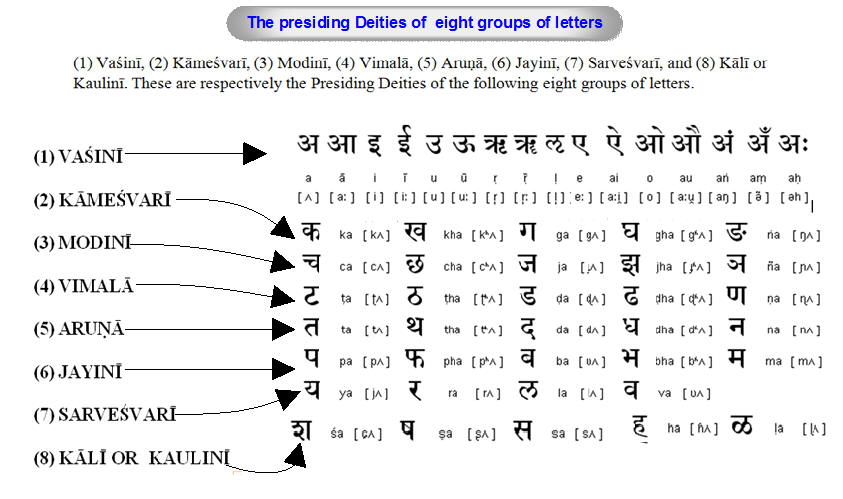
"In
the beginning was the Word, and the Word was with
God, and the Word was God. He was in the beginning with God. All things
were made through Him, and without Him nothing was made that was made. In Him
was life, and the life was the light of men. And the light shines in the
darkness, and the darkness has not overcome it."
John 1:1-5 Think
of Logos, the Divine Word.
The letters represent the universe of
names and forms; without letters there is no name or no form. At pralaya or
cosmic dissolution, she withdraws all letters, meaning the universe. With
reference to Kundalini Yoga, the Body Centers contain all letters of the
Sanskrit alphabet on the petals of the Lotuses. We (our body, mind,
soul) are the Universe, the microcosm of the macrocosm that is the larger
Universe.
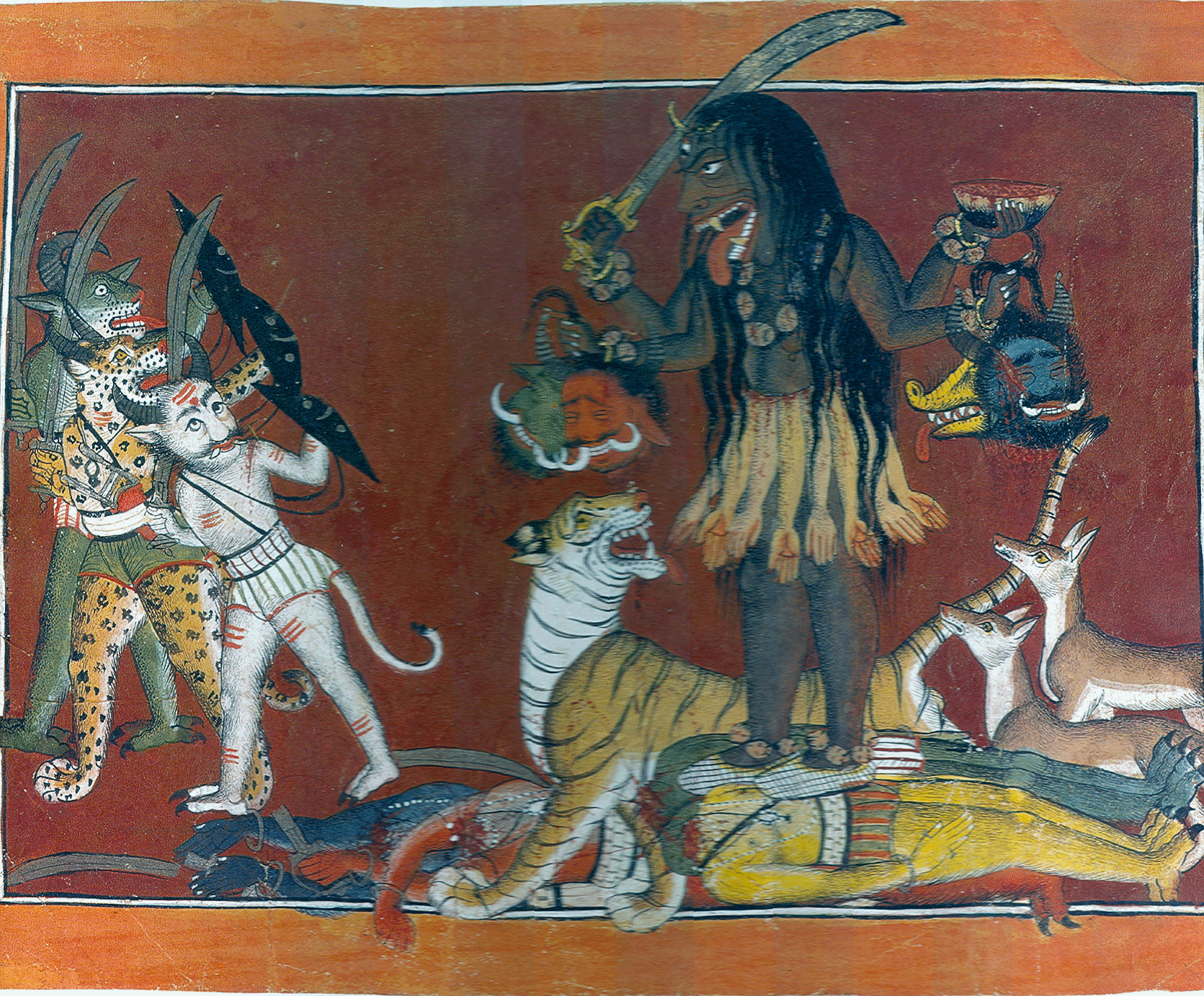
Letters of alphabet: Revelation 1.8: "I am the Alpha and the Omega," says
the Lord, who is and who was and who is to come, the Almighty.
Her lolling red tongue
is also symptomatic of Raja Guna, which indicates the creative power in her;
her Raja guna (motion, passion, creation) is constructive in Kali, while it
is destructive in humans; it is a reminder that men should control their
Raja Guna (motion, passion and destruction).
Karma is thought, word
and deed; hand is the end organ for the performance of a deed or action. A
skirt of severed arms is symbolic of expunction of Karma; thus, Kali cuts
the devotees free from the hand of karma.
Kali's votaries unload all their Karma by their devotion.
She appears in front
of Ramakrishna Paramahamsa (RKPH) as a real-life gracious goddess accepting
food and submitting herself to his test to see whether she is really a
breathing and living goddess, RKPH feeling of her breath under her nose; she
also appears as Ramani a known seductress and prostitute in front of RKPH
within the sanctum in an act of play with her disciple. RKPH addressed the
Mother Kali, saying She chose to appear as Ramani for his worship of Her in
that form. Kali is divine, though she represents (but transcends) goodness,
virtue, vile, wickedness, and all human weaknesses. We are of course
reminded of Jesus Christ and Mary Magdalene.
She sits on supine
Siva in Viparita Maithuna (reverse coition) stance in the cremation ground.
In the Dakshinesvar temple, black Kali stands on supine white Siva with
wide-open eyes with her right foot planted over his chest, where the heart
is and the left foot on his right thigh. Siva's eyes are transfixed on his
consort; that is living Siva looking at her, while Sava Siva looks away from
her purporting that He has absorbed both Siva and Sakti into Him. Her right
side is all goodness and motherly love and Her left side is all destruction.
What right hand gives, left hand takes away; here the meaning is that She
gives Dharma (righteousness), Artha (wealth), and Kama (love) during life
and moksa (liberation) at death. That is a fact of life, good and bad,
birth and death, benign and malignant. Joseph Campbell says, "In
the West, we tend to make our beneficent divinities beneficent, and our
malignant ones malignant.
The main point in these Eastern images is that both
terms are present in the same image, as they are in life. In his wonderful
Tristan, Gottfried von Strassburg says, 'They tell me there are those
who seek only happiness and peace. Let God give them peace. I seek the life
that has both bitterness and sweetness simultaneously'."
Kali comes in many
forms of which two are mentioned here. One is the benign kind and the other
is fierce kind. Benign Kali (Dakshina) keeps
the right foot forward planted on the chest of Siva with her left hand
holding the sword; fierce Smasāna (cremation
ground) Kali holds the left foot forward with the sword on the right
hand. Mahakali is the one who swallows Time,
and the Mother of all beings and gods. Kali
says to every one in and out of sight that She
is life and death, the dance of life and death, the broad-step Dancer of the
wide universe and a nimble Dancer on the point of a diamond.
Shyama Kali is black Kali who as Sati was
dancing in a frenzy and the world was terrified. Siva, her dear consort,
laid himself flat on the ground, hoping that she would step on him, take
pity and remorse and stop the wild dance. She stepped on her husband by
mistake, realized her mistake, lolled her tongue out in remorse, and
stopped the wild dance. Gunas (modes) carry color codes; Sattva, virtue, is
white; Rajas, motion and passion, is red; Tamas, lethargy and indolence, is
black. Black is the all-consuming color where all colors drown and
disappear. Black color like the black hole draws everything in its consuming
spiral and all substances and qualities disappear. That is Nirguna Brahman
(Kali) without qualities. Lolling tongue is passion and activity, while the
white teeth holding the tongue in check is virtue. Lolling red tongue
is a reminder to the devotee that one should control his Rajas guna with his
Sattva guna. What the right hands confer in the form of protection from fear
and boons are countered by the left hand holding the severed head and the
blood-stained sword; she is a protector of the devotee on one hand and
a destroyer of the enemy and evil on the other hand. The destruction may
sometimes be unmitigative, superabundant, unchecked and indiscriminate.
Tejas of gods coalesced to form goddess Kali, who received all their
collective strength and weapons; the gods did not impose any restriction on
donated strength and weapons. When the gods realized their mistake, they
sent Siva to lie down in a supplicant fashion on the battlefield and her
many paths, so that she feels embarrassed (Faux Pas) upon stepping on him,
and thereby mitigate her inordinate power. She creates Maya but is free of
its effects. Maya is the progenitor of the universe and beings. Clothing is
covering the body; likewise covering is hiding the Truth; nudity is
uncovering the Truth. Smasana Kali loves to
stay in cremation grounds, where the Kosas (sheaths) of the body dissolve
and return to their respective sources, earth, water, air, fire, and ether.
Likewise, the Tattvas involute starting from earth backwards and upwards to
Superconsciousness of Devi. Once the Mahabhutas and impurities disappear for
ever by the fire of knowledge, what is left is pure soul with knowledge, (saktinipatam).
Saktinipatam is descent of Supreme Spiritual knowledge into the soul, when
all the impurities are burnt off.
Sakti (wife)
always stood by Siva on his left side in this process of Pravrtti
(evolution, creation and multiplication). Evolution (Pravrtti) is a
centrifugal movement of the soul away from Goddess. She chooses to bump
(demote) the fecund father, rejects amorous advances from Divine Father,
takes his place and stands him on her left side (role reversal); this
process is the beginning of Nivrtti
(cessation, retrograde involution). Nivrtti is centripetal movement of the
soul towards Goddess. She is in possession of three qualities:
Iccha, Jnana and Kriya (Will, Knowledge, and
Action). She exercises her Will because she has the necessary Knowledge,
which gave her the name Mahavidya (Great Knower). She destroys all the
devilish qualities of her sons, holds them by her right hand, and takes them
back on Nivrtti Marga (path). The fecundating Father who feels responsible
for Pravrtti falls prostrate at her feet to save the world, which Sakti
produced with marginal and meager help from fecundating Father; the Goddess
tramples him under her feet and takes her sons back on the journey of
Nivrtti. Nivrtti is taking the soul back to its
fountainhead. We are fallen beings. When we resolve and erase
all impurities, Maya, Kanma, and Anava Malas,
we go back to Godhead.
In
Dakshinesvar temple, Kali does not wear a skirt of severed demons' hands;
instead, golden chains grace her waist. The founding patroness of the
temple, did not like demons' hands touching Kali who was regarded as Kumari
(virgin) by the founder. The hands represent action; action along with
thought and word result in Karma; severing the hands and using them as a
girdle are symbolic of absorbing the karma of her devotees and demons at the
end of cosmic cycle. The fetuses that adorn the ears are symbolic of renewed
life. She is life and death at the same time; she is maintenance too. She
has the third eye of wisdom and omniscience. She wears a Varnamala of 50
skulls around her neck, representing letters of Sanskrit alphabet. Varna =
letter; Māla = garland. Sabda or Sound is the origin of the universe.
Utterable, audible and intelligent Sanskrit sound and its visual symbol, the
letter, are Akshara or imperishable and distinguish man from animals; Sabda
and Varna proceed from Kali, the Mother goddess, and blossom into
Pada (syllables), Vak
(words), and Vakya (sentences). Sound is
supreme, imperishable, and immutable, while its derivatives, names and
forms, morph and mutate. Let me give a modern-day example. We have the
letters of the DNA code: A,C,G,T --Adenine, Cytosine, Guanine and Thymine.
Adenine and Thymine, Guanine and Cytosine pair off. These fixed pairs as
rungs of ladder in a helical shape and form make tens of thousands of genes,
which morph and mutate to make many life forms.
Sabda is the progenitor
of names and forms. Go to >>>>>Sabda
or Sound<<<<<<. Each letter has a complement of male and female deities,
conjugation of which assures creation and produces a wide world of language
and speech. This is the concept of Logos common to all cultures and borrowed
from Tantrics.
Kali's Bija Mantra is
KREEM, which is the sound body of the Mother.
Your name in sound is your sound body. Ka is Kali, Ra is Brahman, EE is
Mahamaya, M is the terminator (M = Chandra Bindu = Nada and Bindu) Nada is the
Mother, and the Bindu is the vanquisher of sorrow. Om
Kreem Kali is her Mantra, chanting of which confers wisdom,
auspiciousness, bliss, liberation and pure Consciousness, the last of which is
closer to Siva-Sakti's Pure Consciousness than to human consciousness; the
difference is like that between diamond and pebble. See below, Kali
Yantra.

Maha Kali is the most commonly seen Great
Goddess of dark complexion with ten faces, three eyes on each face, and ten
hands. She is an emanation from Durga with the express purpose of killing
Demons, Madhu and Kaitabha. Shyama (black)
Kali, and Raksha
(protection) Kali are among the other Kali forms.
Raksha is considered as Maha Kali. Votaries worship
Shyama Kali at home
for boons. Raksha Kali offers protection against disease, death from
epidemics, famine, and natural disasters (flood, drought and earthquake). She
is Smasana Kali (Masānam = burial ground,
cremation ground--Tamil), when she dribbles blood from her lolling tongue and
mouth, wears a skirt made of severed hands and a garland of freshly cut heads,
and moves in the midst of corpses and howling jackals in the burial or
cremation ground. Smasana Kali carries
Kapala with wine, appears and behaves
intoxicated. It is conjectured that the altered consciousness from wine is
portrayal of Superconsciousness of the Goddess (and Yogis and Sadhakas).
KapAla = skull as a eating or drinking bowl.
Bhadra Kali (Auspicious Kali) killed Demon Mahisa and yet before his
death, gave him a boon that he would not leave, but serve at her feet wherever
there is a worship of her. She has three eyes and four hands bearing a
trident, and an axe, a drum and a skull. She is also depicted to have sixteen,
eighteen or one hundred arms; she wears a crown with the crescent moon, a
snake around her neck, and a red drape, and gores a buffalo with her lance.
In a hill temple around Warangal and Hanamkonda, Bhadra Kali in stone is in a
sitting stance with eight arms, each with a weapon. She is
Phalaharini Kali, destroying the fruits of karma.
Phalaharini = phala + hārini = (evil) fruit
destroyer or remover = destroyer of fruits of Karma. She brings Karma to a
zero sum, so the devotee can attain salvation. Nitya
Kali is eternal beyond Time and gives her
devotees relief from disease and deprivation and takes them into her bosom of
wisdom and liberation. Thugs invoke Dakait
Kali to protect and serve them. Dākā = robbery.
Guhya Kali, Secret, mysterious Kali, is a form of
Durga with deep sunken eyes, terrible teeth, lashing tongue, tangled matted
hair, and a huge abdomen with wriggling snakes galore under her, around her
and everywhere. She imbibes wine. Ananta, a thousand-headed cosmic
serpent, forms a hooded canopy over her head. It is symbolic of wealth,
wisdom, and fertility. Serpent Kundali pierces through six Chakras to reach
Sakti and Siva in the higher plane; likewise, Ananta is capable of going to
Nether world, earth and higher worlds. Siddha Kali
awards perfection to Tantric worshippers. Her favorite drink is blood
in Kapala (skull bone). (If this is abhorrent, consider blood sausages
of the modern day.) Elsewhere in this article, there is a description of
Daksina Kali.
All the violence
and terror of the world have come together in its stark nakedness on the body
of Kali. That is reality. Other goddesses bring auspicious aspect of life into
focus; Kali alone by herself brings an opposing view of life. Birth, life,
death and many other kaleidoscopic events in one's lifetime ranging from the
pleasant to the most gruesome are morphing episodes and all of them find
expression in Kali. She is the Mother Goddess of men, gods, and goddesses and
other living beings. Even those benign and evil goddesses are her children.
Kali presents herself to her devotees as young girl,
grown woman, queen, virgin, whore and goddess. She is the living
goddess in each one of them; she transcends the gunas of all her human
presentment. Is Kali frightening her children who are men, women, gods,
goddesses, and other beings? No, she injects a sense of reality in the life of
each individual. She stands on Sava Siva (dead Siva, her husband) in the
battlefield and on the crematorium and burial ground with female jackals as
company. Is that a sign of bliss in widowhood? Is that something else? Siva
presents himself as a baby, whom she picks up and nurses on her breast. It is
a statement that Siva without Sakti is dead. She is defiant, independent and
dominating and yet very susceptible to Siva's servile persuasion. Siva many
times acts as doormat in relation to Kali who unknowingly steps on her husband
only to suffer remorse and shyness, and abandon her fierce nature.
Beings bound by Time come like blips of light and disappear in the dark night
of Nitya (perpetual) dissolution of daily occurrence. Her weapons stand for
the power of Time over the individual's life: death. Death is tellingly stark
naked at the crematoria and burial grounds which are the common venue of
Kali and where she keeps company with goblins and jackals. She is clad
in space, luminous in appearance; she is also clad in pitch darkness, when she
is Death; all differences submerge in consuming darkness. She is the Naked
Truth and Absolute Power. She strips away all illusions of human existence.
She is a one-woman show; the whole universe is Her show and Dance Hall. When
her Power is unmanifest and latent, she is sava Siva; she stands on (the
corpse of) Siva to prove it. Remember that corpse is euphemism for lack of
Sakti or power in Siva without Her. When she is bright as the full Moon, she
holds her hand in high-five stance, guaranteeing Fear-Not reassurance and
confers boons of moksa (liberation) to her devotees. Association of cremation
ground and Kali brings home the reality of death to a person and the futility
of love and hate, and other opposing qualities. In life, opposite emotions
assault the person; at death, all opposites come to an end; in the cremation
ground, sitting with the dead and the living help the Tantric Sadaka to see
beyond life and death and warring opposite emotions and develop Vairagya
(detachment, desirelessness). In the cremation ground, the Tantric hopes to
lose body awareness and identifies himself with the Soul. It is celebration of
the spirit over the ephemeral body.
The
holiest of holy temple of Kali is Kalighat in Calcutta. When Sati (her other
name) died by her own fiery internal heat, Siva carried her body on his
shoulders all over the world, vouching to destroy it. Sati could not bear the
insult of her father Daksa, who going against convention, did not offer Siva's
portion of sacrifice. No sacrifice is complete without Siva partaking the
offerings at sacrifice. Daksa's arrogance was later suitably rewarded with
removal of his head and transplanting of a goat's head in its place. Vishnu,
the preserver, worrying about the welfare of the world, intervened, cut the
corpse into fifty-one pieces which fell at various parts of the earth.
Fifty-one parts stand for the fifty-one letters of the Sanskrit alphabet. Kali
is Sabda Brahman (Sound Brahman or Sound Goddess), the origin of letters,
which she wears as skulls around her neck. Each place where the body part fell
is sacred. Sabda or sound is the origin of the universe of beings and matter.
Kali wears one hundred
and eight skulls around her neck in some representations, which means that we
carry the memories of our previous births.
The West regards Durga as the high-caste version of non-Brahmanical
Prevedic Kali. White Durga Vs Black Kali
Students in the West of Black Kali and White Durga are of the opinion that
Kali is a non-Brahmanical deity, while Durga (her other name) is the
high-caste version (incarnation) and counterpart. Durga is regarded by the
western students as belonging to Post-Vedic period. Her warrior status is
assumed to represent the wars between the indigenous population of India and
the Indo-Aryans (This is disputed). Durga is portrayed as white seated
on a tiger. Her eight hands stand for eight elements. A garland of 52 human
heads represents the letters of the Sanskrit alphabet. She is the Sabdabrahman
or Brahman of sounds and the origin of letters, words, phrases, prose and
poetry in all languages. The very first written text in the world was Rg Veda
in Sanskrit. Mark Twain says:
India
is, the cradle of the human race,
the birthplace of human speech, the mother of history, the
grandmother of legend, and the great grand mother of tradition. Our most
valuable and most constructive materials in the history of man are treasured
up in
India
only.
Kali expunges karma in her devotee and confers bliss. Kundalini Sakti is the
ferocious fire; if you cannot control it, it is destructive conflagration and
Kali; when you can control it and use it properly, it is an useful fireplace
and Durga. Kali is Kundali in Muladhara Chakra, Hamsa in Anahata (Heart)
Station, Bindu in Ajna Chakra (Mind Chakra), and Formless superconsciousness
in Sahasrara Chakra. Kundali is Muladhara Chakra is the Spirit in sleep. Hamsa
is the high flying bird, an euphemism for the Spirit. Bindu is dot and the
origin of the building blocks (Tattvas) of the universe. Our body is a temple
which houses many devatas, Kali with different names at different Chakras,
Siva in many forms, Vishnu , Brahma, and other resident devatas of the
Chakras. If there is anything sacred around you, you do not have to look
further than your body. Going to temple, according Bengali Bauls (traveling
minstrels), is like bumping into or jumping over high hurdles on the way to
the destination. They would rather take the journey inside their own body of a
temple to find the God and the Truth.
One of the episodes
illustrates the blood thirstiness of Kali and that is for a good reason. Kali
faced Titan
Raktavija
on the battleground and fierce battle took place between the Titan and Kali.
(It is symbolism of the good fighting the evil and the victory of good over
evil.) A thousand fighting clones of Titan appeared from each drop of
blood every time she wounded him and spilt his blood on the battleground. The
battlefield was chock full of these fighting clones. Kali brought in
Matrakas
to fight her battle with the clones. Things got worse; more clones appeared as
more blood was shed. Kali created Chandi, who started killing the clones. Kali
had a brilliant idea: she sucked up all the blood from his body and bones as
the Matrakas and Chandi were killing the clones; she herself was stuffing the
clones into her mouth. She grew to an enormous size and filled the sky and
heaven. As Kali sucked the Titan bone-dry, there was no more blood falling on
the battlefield. That was the end of Titan Raktavija. Compare Kali's problem
with that of Hercules. Hercules had a problem with the Hydra (water serpent)
with nine heads; every time he cut one head of Hydra, two heads grew in its
place. Hercules hit upon the idea of cauterizing the neck to destroy the
germinating heads as he cut the heads off one by one. This idea of clones
germinating from drops of blood in ancient Hindu religious thinking is
fascinating. IT neatly fits in with the modern idea of cloning.
Kali orDurga is a demon killer (Kriya Sakti).
Demons are the Tamasic (Dark)
demons in our mind:
Kama, Krodha, Lobha, Moha, Mada, Matsarya (desire, anger, greed, delusion,
pride, and envy). Once Kali or Durga kills these demons, Lakshmi (Ichcha
Sakti) takes over the mind and helps us get rid of Rajasic
Vikshepa
(False perception; distraction; to and fro oscillations of the mind; gales of
desire blowing in the mind) which are hard to remove from the mind. Lakshmi
helps man acquire the Will Power (Ichcha Sakti) and get rid of remnants of
desire and false perception by Upasana (worship). What is left is ignorance
meaning spiritual ignorance. Spiritual enlightenment is infused by Sarasvati (Jnana
Sakti). The eradication of impurities, desires and ignorance with the help of
these three deities is celebrated for nine days and nine nights, 3 days and 3
nights for each deity (Navaratri = nine nights). It takes nine days and nine
nights to defeat these demons. Nine manifestation of Mother Goddess (Durga,
Bhadrakali, Amba, Annapurna, Sarvamangala, Bhairavi, Chandika, Lalita, and
Bhavani) are celebrated over nine nights. The tenth day is Vijayadasami,
meaning victory (over the demons of the mind; realization and emancipation) on
the 10th day. It is celebrated in the beginning of summer and winter. In
Puranas, the demons are described as living beings. Mantras:
Om Sri MahaLakshmyai Namah. Om Sri Durgayai
Namah. Om Aim Sarasvatyai Namah.
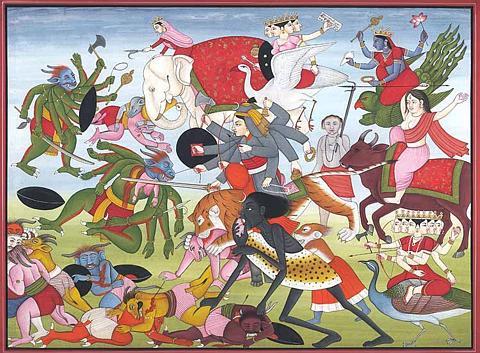
Matrakas
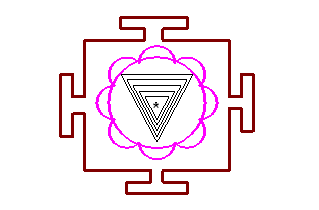
Kali Yantra: The 360°
circle is enveloping Avidya (Ignorance); the
eight-petalled lotus represent the
derivatives of Prakriti: Mahaabhutas plus (Earth1, Water2,
Fire3, Air4, and Ether5), Manas6
(mind), Buddhi7 (intellect), and Ahamkara8 (ego). They
also represent eight Bhairavas and eight Bhairavis. The center is occupied by
Bindu. The triangle is turned down in
female deities and up in male ones. (The genital area is escutcheon in the
form of a triangle.) The circle of Avidya (spiritual ignorance) is life and
death cycle, which one has to transcend or cross to attain Absolute Reality.
The fifteen corners of the five triangles
represent three groups of fives: five sensory organs, vision, hearing, taste,
smell, and touch; five motor organs, hands for grasp, feet for ambulation,
larynx for speech, evacuative organ, and reproductive organ; five vital airs (pranas),
Prana for intake and utilization,
Apana for expulsion, Samana
for assimilation, Vyana for digestion,
distribution and sustenance, Udana for utterance
and death. Prana is inhaled air;
Apana is downward air exiting the anus;
Samana is neither up nor down, but equal;
Vyana is the air or oxygen that carried in the
blood to various organs for their vital function; Udana
is upward-moving expelled air in the throat; it is useful for speech; when it
goes upwards for good, it means death. Remember that in Hinduism, all
biological functions are called Prana (breath, air).
Click>>>>>Bindu
triangle = es-cutch-eon =
a decorative or
protective plate around a door handle, keyhole, light switch, or the like = in
this instance, female or male pudendum = the external genital organs of a man
or woman. Upright triangle is a sign of the male; down triangle, the sign of
the female.
The points on the
five triangles amounting to fifteen stand for the fifteen days of waning
moon.
| Five Triangles |
5 Sensory organs |
5 Motor organs |
5 Vital airs |
Tribindu-progenitors |
| Fifteen days of waning
moon. |
Jnanendriyas are the
five senses: eyes, ears, nose, tongue, and skin for vision, hearing,
smelling, tasting, and touching. |
Karmendriyas are motor
organs: voice box, hands, feet, rectum and genitals for speech, grasp,
locomotion, evacuation, and generation. |
Prana,
Samana,
Apana,
Udana,
Vyana. |
Tribindu
Maya
Bija Mantras |
The
Mother Goddess
Mahisasura defeated the
Suras (gods) and made himself the Lord of the Heavens. Siva and Vishnu by
their yogic vision and word of mouth came to know of the triumphant return of
the Titans (Asuras, demons). Heaven had been the usual habitat of the gods,
but now and then the Demons vanquished the gods and took possession of the
universe until Siva and Vishnu came to their rescue. It is again the good
versus evil.
The Demon King Mahisa
had the protection of a boon that guaranteed no death at the hands of man or
god. Vishnu, Siva, and other gods, upon supplication from lesser gods,
diffused their Tejas (splendor, male energy) from their bodies, which
eventually coalesced and congealed into a warrior goddess, Kali, who was one
mass of splendor, a powerhouse of a million suns. Having become the
repository of Tejas from gods, she was ready to face any adversary on the
battlefield. She had help from seven Maatrakaas (Mothers) to fight the army of
Mahisa. The real battle is between overwhelming Virtue on one side and
degraded evil forces on the other side representing usurpation, selfishness,
jealousy, anger, hatred, and ego. Who else other than a Mother could
restrain, admonish, and punish her errant children? Adam gave his Tejas
(rib in this case) to create Eve (the rib was taken while he was obtund); the
Hindu gods gave Tejas to create a warrior goddess;
Koran says that
God created one soul, a mate from the latter and countless men and women
thereafter. That is one view. Ask the Tantrics, they have a different version.
Mother Goddess is the origin of men and material. Go to
"Durga
kills demons"
for a different version of the story of Mahisa.
The gods witnessed in the mouths of Vishnu, Siva and the bodies of other gods
an unrivaled splendor (Tejas) emanating in all ten
directions, coalescing and congealing into a woman Mahisasmardini
(Killer of Mahisa). Her face rivaled the splendor of Siva's face; her hair
shone like lightning and rivaled that of Yama; her hands were as beautiful and
splendorous as those of Vishnu. In all, she had the appearance of a valiant
seductress and killer (007 seductress is no match). Her beauty was a direct
bequeathal from Siva, her strength from Vishnu. Siva
gave her his Trident, Vishnu his discus. Indra ,
the Lord of the heavens, gave her thunderbolt; Surya, the Sun, gave her his
rays to emanate from her pores in great effulgence. Varuna the god of ocean
gave her a garland of fade-free lotus flowers, crest jewel, earrings, and
bracelets. The moon's beaming rays composed her
breasts; Indra's her waists;
Varuna's her calves and thighs; earth's her hips;
Brahma's her feet; the sun's her toes; Indra's
her fingers; Kubera's her nose;
Patriarch's her teeth;
Fire's her three eyes; Dusk's her
eyebrows; Wind's her ears;
celestials' her limbs. She was sitting on Padma, the lotus seat. (She
was the Light and Splendor of all gods.) Vishnu and Siva knew that Mahisâsura
obtained a boon that he would not be killed by any one except a woman. Mahisa
was of the opinion that woman could never overpower and kill him. That is the
reason why the gods created Mahisasmardini to kill Mahisa. Recent examples:
Adolf Hitler and Saddam Hussein (Mahisa) were the demons. The US and the
Coalition forces (Mahisasmardini) took the challenge and eliminated the
threat.
(Ten directions
are N; NE; E; SE; S; SW; W; NW; Above and Below.)
Other celestials gave the following
articles to Kali.
| Kaala |
Milk ocean |
Visvakarman |
Ocean |
Himavat |
Kubera |
Sesa |
| Sword and shield |
Jewels and cloth |
Axe |
Impenetrable armor,
garland, and Lotus
|
Lion and gems |
vessel with
inexhaustible supply of wine |
Nagahara (Serpent
necklace) |
Having been
endowed with Light, Splendor, weapons and jewels, the goddess roared, which
reverberated through heaven and earth; the oceans roiled with tsunamis; the
earth shook; the gods let out a cry of victory and relief. The gods looked at
Ambika, the newly created warrior goddess, and spouted words of praise. The
gods raised their arms and marched their army to the battlefield. The Daityas
(Demons) felt the tumult of the seas and the earth and the din of celebration.
They hoisted their arms and were at the ready to march. Mahisa turned his face
towards the Light and Sound and rushed headlong towards Ambika, who was
radiating beauty and luster in all directions illuminating the three worlds.
Million of his armed minions were not far behind Mahisa. They were
battle-hardened heroes, and masters of their weapons. They fought hard, they
fought long; Ambika easily parried missiles and weapons launched by them. She
sent showers of arrows on her enemies, used her trident, club, axe and Sakti.
As She roared like a lion and her bells jangled, the fierce sounds stupefied
the Asuras who lay there on the battleground motionless for Kali to smash them
with her club. Kali created out of her body many Matrakas (Maatrakaas), the
fighting mothers; remember, no men were allowed to do
their fighting. They are the
seven mothers: Brahmani, Mahesvari, Kaumari, Vaishnavi, Varahi, Indrani,
Camunda. These seven mothers are the personified energies (Tejas) of
seven deities resident in Kali. Mahisasura was in the form a buffalo.
Demons have the ability to morph as they please. There were piles of bodies,
body parts, and weapons strewn all over the battlefield, which is the
handiwork of one goddess and her Ganas (assistants) fighting millions of
soldiers. Headless bodies danced in the battlefield and the heads were talking
as they rolled on the ground asking the goddess and her army to stop fighting
them. Rivers of blood from Asuras, elephants and horses flowed on the field.
Kali killed many Daitya Generals with her sword, pike and club.
Mahisasura, enraged at the carnage, killed many of the Ganas and rushed
towards the lion of the goddess with the intent to kill it. As he rushed, he
cleared his way by kicking debris with his hooves, sweeping some with his
tail, and using his horns and snout to fling them. He was angry and rushed
towards the lion who noticed the thrashing buffalo, who broke the mountain top
with his horns and hurled a crag at the lion. Many mountains tops were gored
by the horns and there was a rain of crags from the sky. The clouds, rent by
the horns, dissipated in no time out of fear. The ocean, whipped by his tail,
came in waves and ran beyond its shores. Ambika witnessed all this devastation
and was ready to put an end to the Buffalo Demon. (Ambika = Mother, the other
name for Kali)
She took a lasso,
swirled it skillfully with ever widening circle (the cowboys are no match in
this art) and swung it on the Buffalo Demon to catch him by the horns. As soon
as the noose fell on the demon, he metamorphosed into a lion. He was the
simon-pure "Morph." No sooner than she tried to cut his head off, he became a
human being with a sword in his hand. She sent a downpour of arrows on him,
which he parried with his shield. He became an elephant, swung his trunk and
landed a blow on the lion. Then he became a human; the goddess cut off his
hand with her sword; he took his original form of Buffalo. (In Hindu tradition
hands are the doers of karma, good and bad deeds. Thus cutting the hands is
symbolic of expunging karma.) He sent turbulence through all three worlds and
Chandica the protector of the worlds, was very angry with him. She began
drinking wine and laughed out loud. The Demon also bellowed loud. He dug
the mountains with his horns and flung them at the Goddess; she pulverized
them all with her arrows. Now the effects of inebriation was showing on her;
her eyes were red and her face became ruddy; she was excited; she spoke like
the rumbling clouds. "O monumental idiot, O demon of decadence and low
intellect, why are you so foolhardy? No Asura in this universe can stand
before me." Thus saying, she jumped on him, kicked his neck and thrust him
with her spear. He was dying and yet he continued to fight. With his strength
ebbing and blood gushing from his body, he managed to be half-human and
half-buffalo (Chimera). His buffalo head fell off his body with one clean
sweep of the sword by Kali; he fell to the ground; he was dead. His followers
ran away shouting and asking for mercy. Indra praised the goddess; the
Gandharvas sang songs of glory; the Apasaras danced. Millions of Devas
were hovering in the sky singing praises and came reverentially to Devi with
down-cast heads and shoulders. The purport is Kali
kills the demons in us (desire,
anger, greed, delusion, pride, and envy, takes us to Godhead, and gives us
liberation) and
retires to Himalayas. Desires are the
demons. The desires morph from one to another. There is no end to desires.
Goddess kills the desires. How are you going to explain these ideas to
everyday people like me? By telling stories like this.
This is the time of
origin of Mahalakshmi from Kali, conferring
wealth and fertility. Mother Goddess is the origin of all gods and goddesses;
Mahalakshmi, Sarasvati, and others came from the
physical sheath (Kosas) of Parvati (Kali).
Kali (Durga in this instance) fought
with the demon for nine days and nine nights. That is killing of demons and
eradication of Avidya (spiritual ignorance) in us.
These nine days and nights and the tenth day and night (Sakti Puja) are
celebrated as Navaratri (nine nights) of the bright fortnight in the month of
Aswin (Sep/Oct). The demons in us have to die before we can approach Siva or
Mother Goddess. The demons are the Pasas (impurities, bonds). The morphing of
Kali/Durga (Transfiguration) to Mahalakshmi and
Sarasvati are morphing of the soul from one of
impurities to that of prosperity and that of
Light, Wisdom and Knowledge.
This is transmutation of Tamas (darkness, delusion and indolence), to Rajas
(motion and passion) and to Sattva (virtue and goodness) in that order.
It is common sight to see the constellation of Durga, Mahalakshmi and
Sarasvati in one shrine under one dome in the temple as in Balaji Temple in
Bridgewater, New Jersey. This descent of spiritual wisdom into the soul is
Sattinipatam. When the soul is infused with this wisdom, it is pure enough to
merge with Sakti and Siva. Sakti is the intermediary between Siva and man;
between Siva and man there is a chasm which cannot be crossed unless Sakti
helps the soul. Siva is Absolute Purity and cannot tolerate any contaminating
impurity; Sakti helps the pure soul cross this perilous chasm and merge with
Siva. Kali (Durga), Mahalakshmi and Sarasvati are celebrated for 3 days each
and the tenth day is the day of victory when the soul merges with Siva. The
tenth day of victory is Vijayadasami and the
tenth night is Dasra. This is the day of celebration when men, women and
children lay down their important tools (soldiers, weapons; men, their tools
of trade; children, their books) at the feet of Goddess and do Seva.
As Kali continued
her rampage, gods were struck with fear. What if she destroys the whole
universe? Who was going to stop her? The collective Tejas of all gods and the
holy triumvirate --Brahma, Vishnu and Siva-- was still active in the form of
Kali in the battlefield. Who was there to diffuse this unspent energy? Kali
was wandering in the battlefield in a drunken state (drunken of the blood of
her enemies) and was about step on and trip over a beautiful naked white
body smeared with ash. She cast her eyes on the body and her eyes met his
eyes; She knew it was her Divine Consort Siva Himself laying down at her feet.
Her tongue lolled out in embarrassment; her eyes bulged; her coalesced energy
came to a standstill, diffused and dissipated; Kali was there no more.
Daruka slain by Kali and Siva's Cosmic Dance (Linga Purana, Chapter 106)
Once upon a time,
there was an Asura (demon) by name Daruka who obtained a boon that no one in
the universe could kill him except a woman. He was so confident in his mind
that if men and gods could not kill him, it is unlikely a woman would kill
him. He performed penance and attained immense strength. He went on a killing
rampage of Devas and Brahmins like the infernal fire at the end of Yuga (eon).
The surviving Devas and Brahmins sought refuge with Brahma, Vishnu, Siva and
others. The chief of gods, Indra, cleverly disguised himself as a woman and
confronted Daruka to no avail; he was roundly routed. Indra, Brahmins and
others ran to Brahma in utter desperation and sought his help. Brahma took
them all to Siva, related their woeful story and pleaded with him to have
Daruka killed by a woman. Siva looked at his consort, showered praise, and
requested her to kill Daruka for the welfare of the world, gods and men.
Parvati, the consort of Siva, entered into the body of Siva with the power of
her Maya (illusion), all the time unknowing to the assembled gods, shed her
physical body, gathered the poison from the neck of Lord Siva and fashioned
herself a body out of the said poison. Siva, coming to know the machination of
Parvati inside his body for the public weal, created Kali with the blue neck
and created her from his third eye. Kali knew her mission; Bhavani and
Parmesvara (Kali and Siva) were ready to launch an attack on Daruka with
intent to kill the demon. Gods and Siddhas including Indra, Brahma and Vishnu
took one look at the flaming fire of a goddess Kali with black neck decorated
with poison and froze with fear and fright. Suddenly an eye seemed to sprout
on her forehead; she wore a crescent moon on her head, she bore a trident in
her arm; she jangled her fine jewelry as she moved. Along with her were the
Lords of Siddhas and Pisacas, the flesh-eating demons of yellow complexion.
Kali in battle with Daruka killed him. Men and gods could not accomplish what
Kali executed in a neat fashion. The roiling anger, the power and the
redundant energy in Kali did not die or dissipate with the end of the mission.
The universe of gods and men were in agitation, looking at the frightful Kali
and her unspent Tejas (power, brilliance). Siva promised to the gods that he
would make sure that her anger melted into love. By the power of Maya, Bhava
(Siva) morphed into a baby boy, placed himself on the battlefield and squealed
in hunger pains.
 According
to Rg Veda, the newly married woman is blessed with long life with her husband
and 10 children plus the 11th child being her own husband. The reason is that
a woman loves her last offspring the most; that love she reserves for her
husband, whom she should think of as the most loved and the last child. In
Hindu thinking, a son is the facsimile of her husband. In relation to
Babylonian goddess Ishtar of the 8th century BC, Tammuz, the Babylonian
shepherd god played the mythical role of husband, son, and brother.
Inanna-Ishtar always played the dominant role.
According
to Rg Veda, the newly married woman is blessed with long life with her husband
and 10 children plus the 11th child being her own husband. The reason is that
a woman loves her last offspring the most; that love she reserves for her
husband, whom she should think of as the most loved and the last child. In
Hindu thinking, a son is the facsimile of her husband. In relation to
Babylonian goddess Ishtar of the 8th century BC, Tammuz, the Babylonian
shepherd god played the mythical role of husband, son, and brother.
Inanna-Ishtar always played the dominant role.
It appears that Siva knew exactly
when to express and project Kali's anger, when to extinguish it and when to
execute the strategies that go with them. Kali just finished killing the
demons. The demons are euphemism for bad qualities of the human race. Demons
are the Tamasic (Dark) demons in our mind: Kama, Krodha, Lobha, Moha, Mada,
Matsarya (desire, anger, greed, delusion, pride, and envy). Siva had to
extinguish the superabundant energy of Kali. Siva's Maya overpowered and
deluded Kali and instilled in her a strong nurturing instinct.
As Kali was wandering among the mutilated bodies and
corpses, she was about to step on a crying baby;
she stopped, picked him up and tenderly nursed him at her breast, exhibiting
her maternal instinct. Here is an instance of the Lord playing the role
of suckling baby to extinguish the unspent and redundant Tejas of Kali;
suckling not only quenched his hunger pains, but also drew out her unspent
wrath and Tejas (the collective power derived from male gods), which he
stomached along with her milk. Here you may notice the blur between wife and
mother in one woman. Another view states that Kali nursed him back to
health after Siva suffered pain in his throat from ingesting the poison from
the generative ocean.
By draining and drenching the fire of wrath, the
Lord (Siva) became the protector of men, god and Tirthas (holy places). He
took eight forms as his manifestation as the Supreme intelligent Protector of
Tirthas: Sarva for earth, Bhava for water, Rudra for fire, Ugra for air, Bhima
for ether, Pasupati for Ksetrajna, Isana for sun, and Mahadeva for moon
(according to Swami Sivananda). These eight forms are collectively called
Murtayo'stau or Ashtamurti. See insert: Nursing
Mother Goddess: exoticindia.com
|
https://www.aolnews.com/world/article/saudi-clerics-advocate-adult-breast-feeding/19504280
Breast milk son is permitted to be in the vicinity of
breast milk siblings who the sisters nursed before they were 2 years
of age.
June 9, 2010
Lactating
women in Saudi Arabia are given permission to offer breast milk to cognate
and non-cognate males and acquaintances in order to induce mother-son
feelings (Vatsalaya =
वत्सलय
in Sanskrit)
in the milk-imbibing recipient towards the milk donor and vice versa. Once
this breast-milk-induced platonic relationship is established between the
unrelated woman and man, they can be around each other, when that
proximity occurs in social situations--driving the woman. Breast milk can
be pumped out and offered in a glass; the man can directly suckle at the
breast of woman under mutual consent five times in order to establish the
platonic relationship in good measure. It is not uncommon for the sisters
to breast feed the nephews, so the daughters do not have to cover their
faces in the vicinity of cousins later during adulthood. They are known as
breast milk siblings. Islam forbids sexual encounter between a woman
and a man, who suckled at the breast of the woman. Concerned people wonder
whether a hairy face suckling on the breast of a woman is an appealing
proposition in the context of Fatwa. |
In order to
express gratitude and propitiate Kali for her services, Siva performed Tandava
Dance with goblins and ghosts. Paramesvari (Kali) seeing and enjoying the
delightful cosmic dance of Siva, danced in the company of ghosts, goblins, and
Yoginis. The galaxy of gods along with Indra, Brahma, and Vishnu paid their
respects, praised Kali and prayed to goddess Parvati. Yoginis = female
Yogis. End of Daruka.
Black Kali becomes Sodasi and Golden Gauri
Parvati (Kali) was once
addressed as
KALI
(black) by snow-white Siva; Kali was upset, retired to Mount Sumeru, and
became an ascetic vowing to change her black complexion
to white. (Siva and Parvati were in a conversation. Siva lovingly
addressed Parvati, "O daughter of Himavat, I am white like the moon and you
are black. I am the sandalwood tree and you are the snake wrapped around it.")
Narada, the tale-bearing Muni, went to Kali and told her that Siva was
considering marriage to another woman and that she should immediately go back
to Siva. Is this not misportrayal and a benign mischief on the part of Narada
Muni to have Siva and Kali come back together? Kali by that time was
losing the pigment in her skin and became light-skinned, but did not know
about it. (Think of Michael Jackson, who allegedly bleached his skin white.)
When she went to Siva, she saw a wheat-complexioned woman in the mirror of the
heart of Siva. She was upset, angry and jealous; Siva noticing her disposition
asked her to look more closely. Kali found her own light-skinned image and
realized her misperception. Siva calling her Tripurasundari said that she
would remain sixteen for ever; that is how she became known by that epithet,
Sodasi (and Gauri--one with golden color). Sodasi likes to sit sometimes on
the lotus sprouting out of the navel of reclining Siva. Sodasi = sixteen year
old. In the Indian mind, golden color (not white complexion) is the most
desired esp. among females.
Kali (Parvati)
shed the black skin (black sheath or Kosa); the emerging Ambika is called
Kausiki. Another source tells that the dark sheath or Kosa became Kausiki.
(Hey plastic surgeons, can you perform this surgical feat, peeling of the
black skin in one sweep and making a person snow white? It is not as simple as
peeling a yellow banana or a russet potato and make them look white. )
Kali is the Mother
of the universe, the protectress of her children and the destroyer of evil.
The elements in this legend of Kali portray certain qualities in a person and
the accompanying passions. Man is divine and demonic at the same time, two
sides of one person. There are gods and men who are divine; there are demons
and men who are demonic. Kali is the destroyer of not only the demonic
qualities in a person but also the karmic fruits that haunt the devotees in
the form of rebirth and suffering.
| Kali was called Black by Siva, Her
Consort. She was offended. Here is the conversation.
Page 232 Skanda Purāṇa
Part II. publisher: Motilal Banarsidass
55.
Thereupon, that son of Parvati played amidst the Ganas eulogizing the
devotion to Saṅkara repeatedly in his mind.
56.
'I bow down unto all living beings and request them to do something very
difficult to do. Worship Isana (Siva) with devotion. This is the benefit
of that devotion.
57.
When Viraka (Adopted son of Parvati, an attendant to Siva) went out to
play, goddess Parvati sported with (the Lord) wearing matted locks of
hair, recounting various kinds of stories.
58.
Then Mahesvara (Siva) placed his arms round the neck of the daughter of
the Mountain (Parvati), In order to make her perform a special penance,
he made the following witty remarks to the
goddess:
59.
Indeed Sarva (Siva) had a
white-complexioned body. He shone particularly like the moon. The goddess
had the complexion of blue lotus, coloured (as it were) by the night.
Sarva
(Siva) said:
60.
On my white body, O slender-bodied lady, 'you
with your black colour shine like a black serpent maiden coiling round a
fair sandalwood tree.
61.
You are like the dark night mixed with the
moonlight. You give me the defect of vision like the night in the
dark half (of the lunar month).
62.
On being addressed thus, the daughter of the Mountain got her neck
released from (the grip of) Sarva. With the eyes
reddened due to anger and with the face deformed by the knitting of the
eyebrows she said:
63.
"O Crescent-bearing one, that all the people are assailed by other people
is because of their own deeds. A suppliant of necessity meets with
frustration?
64.
I sought you with various kinds of severe austerities and brilliant
activities. (Unfortunately) at every step that holy
observance of mine is being insulted.
65.
O Sarva, I am not crooked nor am I adverse and odd and deformed, O Dhūrjaṭī
(= Having the burden of top knot on the head esp. of Siva). You have
attained forbearance, because of your own faults as well as of the faults
of the splendour of Doṣākara
(i.e. the Moon, also one who is a mine of defects).
66.
I do not deprive (others) of eyes. You alone are a destroyer of eyes
(eye-sight). Bhaga knows this (aspect) of yours. So also the entire three
worlds.
67.
You create a headache in me reviling me with your
own defects. For you called me Kṛṣṇa
(black) but you are called Mahākāla
('extremely black as a great annihilator').
68.
I am going to, the mountain in order to abandon myself by means of
penance. I have nothing to do with my being continuously alive because
I have been insulted by a rogue."
69.
On hearing her words which had been very sharp on account of anger, Bhava,
Hara whose conduct was inscrutable' said in great excitement:
70.
"O daughter of the Mountain, you are not conversant
with the reality. I am not censuring or reviling you. With the intention
of uttering some coaxing words I engaged myself in this diversion of
amusing words.
71.
It was a mistake on my part (to have thought) that the daughter of the
Mountain had a clean mind about her being my beloved. Generally the way of
thinking of persons in great prosperity is peculiar (i.e. other than the
ordinary).
72.
O lady of dark limbs, the words of people like us
act (i.e. imply) otherwise. If you are angry, O timid lady; 1 will not say
like this again to you.
73.
I shall be a sycophant-a flatterer saying amusing
words. O lady of pure smiles, give up your anger; I bow down my head
before you. I pray to you with the palms joined in reverence.
74.
I do not undergo any perturbation even though 1 am censured with mean
insult. It is better that I am extremely humble. Still, O goddess, you do
not thereby become endowed with good qualities."
75.
Although she was advised and urged by means of
many words of flattery and good words by the Lord, the chaste lady did not
give up her intense anger, because she had been wounded in a vulnerable
spot.
76.
She shook off her feet held by the hands of Sankara- With her forelocks
thrown back, the daughter of the Mountain wished to go away in a hurry.
77.
As she went off in fury, the Slayer of the Puras (Siva) said, "It is true
that the daughter is on a par with her father in her limbs.
page
234 Skanda Puraṇa
78.
Your mind is like the peak of Himacala (mountain) encircled and obscured
by the clusters of clouds. Your mind is very difficult to be fathomed.
79.
You have acquired hardness from the forests of Himacala, crookedness from
the rivers and impossibility of being resorted to from the snow.
80.
All these things, O goddess have come over to you from Himacala, "
On
being told thus, the daughter of the Mountain said to Girisa once again:
81.
With her face fuming and shaking with anger and thelips throbbing she
said: "O Sarva, do not censure people with good qualities. You are viewing
everyone in comparison with you.
82.
Because of your contact with the wicked ones,
everything has come over to you: The state of being many-tongued from the
serpents, the lack of Sneha (affection, glossiness) from the ash (which
you apply to your person).
83.
(You have got) turbidness of the heart from the moon; Durbodhatva
(inability to understand) from the bull. Or enough. of speaking too much.
Why should I talk and strain myself? (Parvati calls Siva
'bull-headed;' Siva rides a bull.)
84.
You were a resident of cremation ground. You have no sense of shame
because of your nudity. You are devoid of mercy because you are a
skull-bearer. Who can (enumerate your faults)"
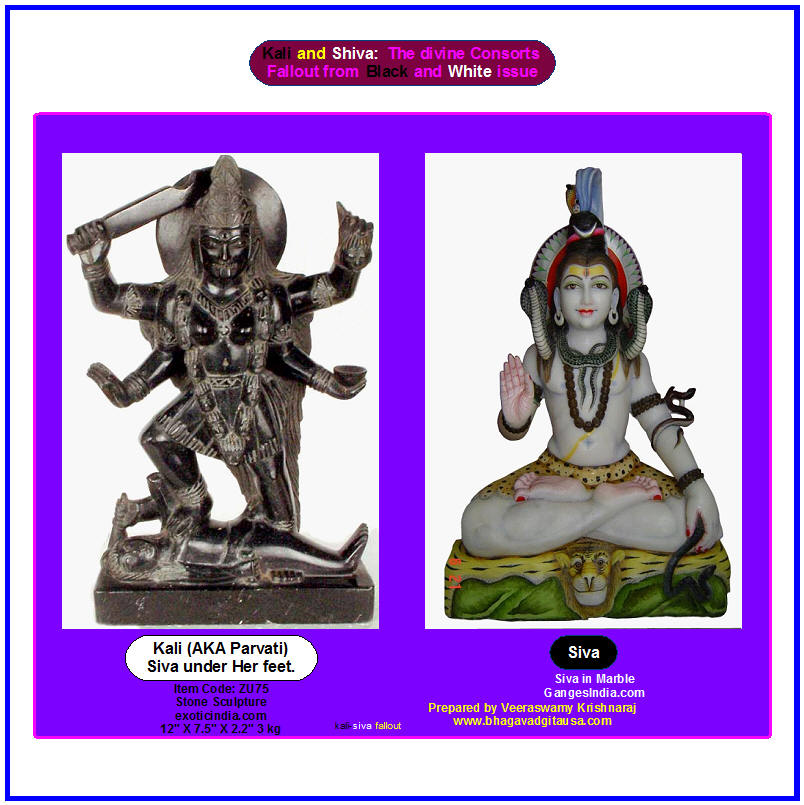
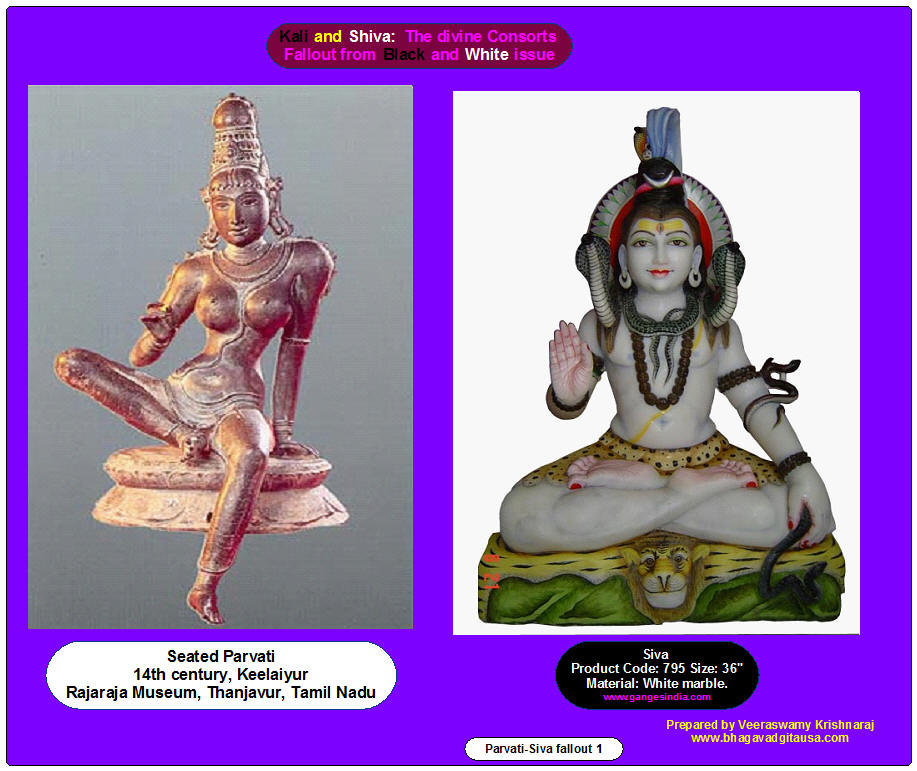
CHAPTER TWENTY-EIGHT
Pārvatī
goes to the Mountain for Penance
Narada said:
1.
After saying thus, the daughter of Himadri went out of the mansion. As she
proceeded ahead, the Ganas made a hue and cry.
2.
"Where are you going, mother?", saying this and crying loudly, they ran
forward. Viraka grasped the feet of the goddess. and said in a faltering
voice choked with tears:
I
3-4. "O Mother, what is this? Where are you going in great fury? Why are
you hurrying away? I will follow you, my mother, very affectionate towards
me. If I am forsaken by you, I will not be able to bear the harshness of
Girisa. A son will always be the victim of the harshness of his father if
he has no mother."
5-10. With her right hand, the mother lifted up his face and said to
Viraka: "O son, do not feel sorry. (If bereaved of the mother) It is not
proper to fall down from the top of the mountain. It is not justifiable
for you to go with me. I shall tell you, my son, a befitting job; listen,
I have been called Kṛṣṇa
('Black') by Hara and censured. I was treated with contempt. I shall
therefore perform a penance and acquire white complexion.
This (Lord) is enamoured of women of white
complexion. After I have gone, you must guard the entrance continuously
looking for even the smallest aperture. See that no women enters and
approaches Hara, If you happen to see any other woman here, tell me, dear'
son. Thereupon I shall do what is suitable." Viraka, the son devoid of
ailments and delighted in every limb said. "Let it be so" (i.e. your order
is proper, I shall abide by it).
II.
He had his person dipped in the pond of nectar in the form of the mother's
order. His fever (i.c. heated feelings) got subsided. After paying
obeisance to his mother, he went to see the Three-eyed god (Siva) .'
12-14: When the Elephant-faced One bowed down and stood there with the
throat choked with tears requesting, "O , Parvati, take me too," she said,
"O boy, since you are elephant-faced, he will laugh at you as at me. Hence
come along with me. Let my state or fate be that of yours too. Death is
better than discomfiture at the hands of knaves, dear son". Saying thus
and tiking (the Elephant-faced One, Ganesa) with her, she went to the
mountain Himādri.
|
The West has a field day with Kali's many faces and moods, longing for blood
and gore, garland made of freshly cut heads, dead children dangling from
her earlobes, skirt stitched together with severed hands, holding of
blood-dripping head, disheveled hair, lolling tongue, liking for human flesh
and animal sacrifices, reverse coition, walking, standing and sitting on her
husband Siva, pendulous breasts, sometimes round and firm breasts, wrinkled
skin. The west portrays her as nymphomaniac, though devoted to Siva. The west
quotes Sahasranama Stotra in a perverse prurient glee that she is all Yoni,
she likes dwelling in the Yoni, she wears a garland of Yonis, she loves and
dwells in the Lingam, she swims and dwells in a ocean of semen. Yoni = Vagina,
womb; Lingam = Phallus. Surface embellishments or apparent imperfections
impress the surface gleaners who are content with what they see and gather and
offer their pedestrian opinion, sometimes with Ph.D appended to their names
and a title of chairperson and or professor of religion; the Pure and the
devotee delve deep under the surface and gather nuggets of gold and diamond.
Kali is such a study object for the surface gleaners and deep diggers. The
gleaner loathes, fears, and or avoids pollution, violence,
unconventional behavior, gruesome killing, fierce weapons, habits and
habitats, associations, and practices of Kali. The gleaner takes everything
about Kali literally, while the Tantric takes them as allegory. Pollution and
purity are Mother Goddess; beauty and ugliness are Mother Goddess;
killing and refuge are Mother Goddess; all polarities and dualities converge
in Mother Goddess; there is nothing that she is not, because She is the
Universe. A Tantric after initiation from a Guru dies to his flesh
(allegorically) and the spirit rises to merge with Kali; that is Monistic
Advaitism; Sadhaka and Brahman-Kali become one. Think of Catholic nuns being
the true spouse of Jesus Christ; if one reads true love in it, there is
redemption; if one reads sexuality in it, he has the Anahata Chakra in his
pelvic basin. Sadhaka's (aspirant) Bhutasuddhi, Nyasa, Pranayama, Dhyana,
Mantra and Japa are acts that help involution of the soul (stripping of the
soul of all its sheaths-DROSS) and taking the soul to merge with the Ultimate;
this process destroys the material categories (Tattvas) like ego and mind;
thus, the soul is ready to merge with the Ultimate.
The punk and the professor
The ivory tower impudent impresarios
with appended Ph.Ds and professorial titles perform in the classrooms of
universities. These egomaniacal morons carry a ponderous bag of
odoriferous ordure and outlandish ideas, which they feed to budding Ph.Ds, who
roil and mire in the intellectual hogwash of the prurient professors and
pretenders who profess to know everything but know nothing about Kali. These
low-minded ill-informed nincompoops with impressive titles and a mile long
C.Vs. are born to dwell, feed and die in the cloaca. The plumber who unplugs
the loaded toilet traps makes a beeline for the toilet and never visits the
library or prayer room in the house. He obviously sees no need for it. To him
a clogged toilet is more important than a prayer room or library. (It is an
unfair and undeserved insult to the plumber to compare the professors to the
plumber; try living with a clogged toilet.) Such is the nature of these
professors and gutter minds, when they visit the House of Hinduism. These are
the fellows who perform colonoscopy without preparing the patient for the
procedure. They get a mother lode of excrement on their faces.
Here is Woodroffe who distinguishes
himself on his observations. This is what Woodroffe says about the sexual
references in Hindu religious texts.
Page 182-183 The Garland of letters. One
should worship the Devata in SAmarasya (literal meaning is bliss of sexual
union). That is the gross meaning ; here it is Suksma (subtle) aspect. An
erotic symbol is employed to denote the merger of the Jiva (individual soul)
and the Supreme Consciousness in Ecstasy (Samadhi). The Tantrics largely
employ such imagery which is to be found in the Upanishads and in the
non-Indian scriptures. Read Song of songs. Christ's love for
His bride, the church. (If the professor of religion in the West does not get
this idea in his head how the heck this person is going to teach the future
Ph.Ds.)
Spiritual union is symbolized and described by terms
borrowed from the world of sensual man, because man knows sexual bliss and has
no idea of the spiritual bliss. How can a Yogi describe Ecstasy? By
referencing it to sexual bliss.
Love is not always sexual as everyone knows. Let us say, the
bliss in sexual union as measured in units is one. According to the Tantrics,
Sadhakas, and Kundalini practitioners, they experience spiritual bliss in
units that exceeds sexual bliss exponentially. You have to be in it to know
it. (In Lottery terms, you have to be in it to win it.) Without experiencing
Spiritual Ecstasy, we cannot offer an opinion on its depth and dimension.
Love (காதல்)
is defined the best in Tamil: Thannai maRandha nilaiyil uruvaagum unarvu
= தன்னை மறந்த
நிலையில் உருவாகும் உணர்வு
=
A spontaneous feeling of (overpowering earnest longing) attachment to God (a
being, an object or an idea) that shapes up while you are in a state of
forgetting yourself and contemplating the beauty and perfection of
God (the object, being or an idea). True love is a surge in feeling of
becoming one with a being, an object or an idea. This is the kind of
love the Alvars had for Krishna, Nayanars for Siva, nuns for Jesus Christ,
Saktas for Mother Goddess....
Coming back to
Kali.
Could it be possible that a single
supreme Goddess portrays the good, the bad, and the ugly of all humanity? The
above illustrates the following. Man's life consists of seven stages: three of
them animal, three of them human and one Yogi. The first six levels have
corporeal support (adhara ) and the seventh is niradhara (incorporeal). They
are
Muladhara1, Svadhistana2, Manipura3, Anahata4, Visuddha5, Ajna6 and Saharara7
planes at the level of anus, genitals,
navel, heart, throat, forehead and Niradhara, twelve inches above Brahma
Randhara (anterior fontanel area) respectively. The first three centers are
pelvic and abdominal. Pelvis and abdomen are 'the primary habitat' of animals
and men, who engage in deglutition and defecation, procreation and recreation,
excretion, and emoting. It is living a life of animal passions, Kama, Krodha,
lobha, Raga and Dvesha (lust, anger, greed, passion and hate). One should
transcend the lower Chakras and ascend to higher chakras. When animal man
rises to Anahata4
plane, the animal dies; man emerges; he becomes human; all animal passions
drop off; he rises above dualities of pain and pleasure, love and hate; he
becomes aware of the inner man; the spirit is born; he has the marks and
makings of Yogi. The animal consciousness morphs into human consciousness on
its way to superconsciousness. The next plane is
Visuddha
Chakra at the level of the throat. This is the seat of Vaikhari speech and
spirit.
Vaikhari: (Articulation,
Speech)
It is the speech that originates in the
larynx.
Vaikhari is the mother (origin) of
letters--Alphabet (Varna),
syllables (Pada),
words (Vak),
and sentences (Vakya).
Go to Sabda or Sound for more details. Here the
spiritual man emerges; all human faults and foibles lose their moorings; he
becomes more and more conscious of the inner man and eternal Truth; he drops
out of the material world; androgynous Siva appears; the path of liberation
starts here; the world images recede; spiritual world emerges and dawns on
him. From here he rises to
Ajna
Center. Avidya (ignorance) leaves him and
Vidya (spirtual knowledge) fills the vacuum. The
divine Guru touches his life and consciousness; his mind and AUM fuse into one
to merge with the Divine. The spirit rises and the body stays; he enters the
state of Turiya.
Let me expand on Avidya and Vidya.
Ramakrishna Paramahamsa sees Maya as Brahman in its twofold aspect:
Avidyamaya and Vidyamaya. (Avidya = ignorance;
Vidya = wisdom) Avidyamaya in terms of Kundalini Chakras is living in the
pelvis and abdomen--Muladhara, Svadhisthana and Manipura Chakras of lower
order; it is living a life of animal passions, Kama, Krodha, lobha, Raga and
Dvesha (lust, anger, greed, passion and hate). One should transcend the lower
Chakras and ascend to higher chakras. Avidyamaya keeps man in Samsara, a cycle
of birth and rebirth. Vidyamaya represents the higher centers and
consciousness of Anahata, Visuddha, Ajna and Sahasrara Chakras or stations of
life. Once Vidyamaya conquers avidyamaya, the round of birth and rebirth is
abolished and one enters a state of Mayatita, end
of Maya or freedom from Maya. Maya is the power of Kali
who transcends both types of Maya. She shines far above the clouds of
Maya, under whose spell man lives.)
Dvadasanta.
There are Âdhāra
centers in the body;
NirÂdhāra centers are
Sahasrara Chakra and above.
Adhara
= support. Niradhara
= without support; centers above the sixth Chakra. There are six Adhara
Centers in the body: Muladhara, Svadisthana, Manipura, Anahata, Visuddhi, and
Ajna each one presided by a deity, Brahma, Vishnu, Rudra, Mahesvara,
Sadasiva, and Apara Bindu.
Adhara yogam
is accomplished by Kundalini yogi who ascends all the six centers to reach the
seventh Sahasrara center in the crown presided by Paranada where he
unites with Siva. Kundlini yoga is Adhara yogam. Beyond Ajna center, Sahasrara
Chakra and other centers are the Niradhara centers without any apparent
support; reaching it as a group is
Niradhara yogam.
Jnana and Prana ascend beyond the seven centers and course through
eighth, ninth, tenth, and
eleventh sthanas (posts),
presided respectively by
Parabindu, Paranada, Parasakti and Parasiva.
Beyond these eleven centers is the 12th and furthest ultimate point of yogic
journey (the Ultima Thule),
Dvadasanta.
This journey from Sahasrara chakra to the 12th point in space is
Niradhara Yogam which is the
state of the soul, when it loses its self-consciousness, attains Sivahood and
remains without any attachment.
Reaching Dvadasanta Siva (Paraipara) in Jnana form is Bliss. (Please note
that there are several variants of the theme in different texts.) Many other
texts say that this center is 12 inches above the crown as opposed to the
above description. Realization from the 8th to 12th is progressively deeper
and the 12th is ultimate experience.
Now we are coming back to the
questions that start with "Could it be possible." Could it be possible that
she chose to exhibit the submerged violence in all of us, span the spectrum of
our deep unspeakable thoughts, acts and tendencies and dig deep into our
fancies, fantasies, and fears? Could it be possible that she acted out the
full spectrum of activities ranging from the virtuous to evil to teach us a
lesson that all are her acts and that we are her instruments or puppets? Could
it be possible that the lesson is that humanity has to rise above the beauty
and beastliness and seek moksa or liberation? Could it be possible that the
oppressed woman should rise and find her own identity and destiny without
being tied to her father, husband or son? Could it be possible that a woman
wants to be sexually liberated within the confines of marriage? Could it be
possible that man should rise above prejudices and serve all equally, whether
they are clean or dirty, rich or poor, conforming or non-conforming, ugly or
beautiful, black or white, sick or healthy? No woman or goddess other
than Kali has taken the challenge of man or god and faced him with eternal
wisdom, boldness, power and bohemian disdain and wisdom, trampling all
conventional mores dictated by man and god. Kali rises above man and god and
treats them as her dear children. If she is that bad, why do male gods run to
her every time they have trouble with Asuras, or demons?
Who are the demons? They are the demons in us -passion, anger, greed,
delusion.... They want her to do the dirty job? All gods donate their
Tejas (power) and weapons; thus, she is the sum of all their destructive
power, might, virtue and vice. She declares that she is the Mother Goddess of
men, women, gods and other beings. She is Satchitananda, Being, Consciousness
and Bliss. She is the only Mantra you need to know for Moksa.
Coming to
reverse coition (Viparita Maithuna, female over male), the explanation goes as
follows. There is Siva-Sakti; from Sakti proceeds Tattvas or building blocks
of the universe, 36 in all. Go to
TATTVAS-36 for more information. There are three broad categories of
Tattvas: Suddha Tattvas, Pure principles,
divine principles; Suddha-Asuddha Tattvas,
pure-impure principles, human principles;
and Asuddha Tattvas, impure principles, material
principles.
Evolution (Pravrrti) is the creation
of beings and universe from Siva-Sakti; that is the descent and centrifugal
movement of Pure Consciousness of Siva into a universe of beings and matter
with less or no consciousness, represented by normal coition. The
consciousness and souls proceed from Siva and matter proceeds from Sakti.
Involution (Nivrrti) is the return of
the souls and matter back into Siva and Sakti; that is the centripetal
(ascendant) march of the souls back to Siva-Sakti, represented by reverse
coition. In this process, the matter abides in Sakti and the souls subside in
Siva.
As you may notice these is a
descent of Pure Consciousness of Siva-Sakti in
the first category to
human consciousness in the second category to
the materials such as ego, mind, intellect needed to
embody the soul in the third category.
Material needed to embody the soul.
(13. Prakrti Tattva, 14. Buddhi,
15. Ahamkara 16.
Manas, 17. hearing 18.
tactile sense, 19. vision and color,
20.tasting, 21.
smell, 22. speech, 23.
grasp, 24. ambulation, 25.
evacuation, 26. procreation,
27. sound, 28.
tactile sense, 29. form, 30.
taste, 31. odor, 32.
ether, 33. air, 34.
fire, 35. water, 36.
earth.)
This descent from pure consciousness
to an embodied human soul is called Pravrrti, evolution, centrifugal
movement, or creation. The reverse process is Nivrrti, centripetal force or
involution, where the human soul drops all matter (from 13 to 36) and other
intermediate categories and merges with Sakti; reverse union of Sakti and Siva
comes into play; that marks the end of creation. Reverse coition symbolizes
this reverse process and decreation (involution), where all events are
retrograde and in reverse process. Usual configuration of Siva and Sakti is
Pravrtti, while reverse configuration is Nivrrti.
|
Yoni Display and
Designer Vagina
The Pursuit of
Perfect Vagina
Cosmetic Vaginal
Surgery
Mother Kali would be
outraged.
Note: The words used
here are the prevalent lingo in current use as applied to the subject on
hand. No insult is intended or implied.
Yoni: Sanskrit word for the womb,
uterus, vulva, vagina, female organs of generation-- Rg Veda; a typical
symbol of the divine procreative energy.
The West and the media condemn
genital mutilation of girls whereby the sensitive erectile tissue
(the clitoris) is excised to prevent the female from experiencing orgasm,
which in certain cultures is the exclusive domain of men. Designer Vagina
(vulgarly characterized as Pursuit of Perfect Pussy) in the west is
the latest in mutilation of body (genitals) of ostensibly gentler
kind--painful nevertheless- wherein parts are physically altered by a
licensed doctor (partial excision = Labial reduction) to please the ogling
suitor and the contemplative psychic self. In genital mutilation of the
cruel kind, the unwilling victim is subjected to physical extirpation of
precious private parts by a village medic with a sharp razor. In the
genital mutilation as practiced in the west, the genital parts are cut to
please the man, either the beau, the spouse, the peers or the personal
psyche. It is a statement of prevailing fashion and conformity with the
peers. Newspapers are in the forefront in condemning the genital
mutilation practiced in the African continent, but are mysteriously silent
on the genital mutilation in the west. It appears that man is the dominant
determining factor in dictating the African and the Western genital
mutilations. If man does not insist on it, it would not happen. Woman
submits willingly or unwillingly to cutting of her genitals to please the
man. What an atrocity? Aim in the West: a perfectly sculpted, esthetically
pleasing, visually appealing, peachy pink external genitalia and vagina.
April 26, 2016
Teenagers from 13 to 18 are ogling each other’s
external genitalia after waxing or shaving and compare them to the
air-brushed goddess-like images in the internet. They simply don’t like
the labia minora (the inner lips) looking like flapping butterfly wings.
Labia minora come in all colors, sizes and shapes, some profusely
redundant and some well tucked-in under the labia majora. Most of the
white girls have varying degrees of pigmentation of labia minora.
Pigmentation ranges from almost absent to visibly present. It is normal.
It is so of male genitalia of white males also. Blame the pigmentation on
the hormones.

The labia minora are there for a purpose. The latter
(the tucked-in look) is the rage. Don’t blame it on yourself. It is the
ancestral and the parental DNA that dictates the color, the size and the
shape. It is in the genes. Blame it on Eve. Yes, Blame God. Labia minora
is part of the sensate orgasmic unit. You remove that, you may be an orgasmic
cripple. There is a profusion of nerve endings in the labia minora. You
cut it, you tuck it, and you lost it; the result is a host of miseries:
scars, keloids, possible crippled orgasm… Besides, nubs take the place of the
trimmed wings. Boy, they look ...
In the good old UK, there is an increase in
labiaplasties. USA is not behind in this genital mutilation. Circumcision
does not cripple orgasm, but partial excision of labia minora may cause
it.
Some girls have painful swelling of labia minora
during monthly periods. Excessive, redundant and profuse labia
minora cause irritation in some sports activities of girls. They deserve
labiaplasty with parental consent.
https://www.soc.ucsb.edu/sexinfo/article/labiaplasty
Ref:
https://well.blogs.nytimes.com/2016/04/25/increase-in-teenage-genital-surgery-prompts-guidelines-for-doctors/?_r=0
June 30, 2016
Depilation of Mons -- the new rage in the name of
hygiene.
The new rage among teenagers and women is to have the
Barbie Doll Look of the female genitalia. The pubic hair serves a host of
valuable functions: Cushion, Trapping of bacteria... They all wish they
had Atrichia, congenital absence of hair on Mons. This is the age of
underboob, sideboob, butt cleave and sidebutt graduating to discrete
exposure of Mons (bereft of pubic hair). Many paparazzi have taken
pictures of the silken smooth mons as the celebrities descend on the red
carpet from the limo.
There is a price to pay: Folliculitis, abscesses,
lacerations, Vulvar and Vaginal infections...
https://well.blogs.nytimes.com/2016/06/29/most-women-prefer-to-go-bare-citing-hygiene-and-baffling-doctors/?_r=0
------------------------------------------------------------------------------------------------------------------------------
May 7, 2010.
https://www.nytimes.com/2010/05/07/health/policy/07cuts.html?scp=1&sq=clitoris&st=cse
In a controversial change to
a longstanding policy concerning the practice of
female circumcision
in some African and Asian cultures, the
American Academy of
Pediatrics is suggesting that American doctors be given
permission to perform a ceremonial pinprick or “nick” on girls from these
cultures if it would keep their families from sending them overseas for
the full
circumcision.
The academy’s committee on
bioethics, in a policy statement last week, said some pediatricians had
suggested that current federal law, which “makes criminal any nonmedical
procedure performed on the genitals” of a girl in the United States, has
had the unintended consequence of
driving some families to take their daughters to other countries to
undergo mutilation.
According to the WHO, there are four major types of
female genital mutilation:
1.
Clitoridectomy:
partial or total removal of the clitoris (a small, sensitive and erectile
part of the female genitals) and, in very rare cases, only the prepuce
(the fold of skin surrounding the clitoris).
2.
Excision: partial or
total removal of the clitoris and the labia minora, with or without
excision of the labia majora (the labia are "the lips" that surround the
vagina).
3.
Infibulation:
narrowing of the vaginal opening through the creation of a covering seal.
The seal is formed by cutting and repositioning the inner, or outer,
labia, with or without removal of the clitoris.
4.
Other/[Unclassified]:
all other harmful procedures to the female genitalia for non-medical
purposes, e.g. pricking, piercing, incising, scraping and cauterizing the
genital area. Because the damage to females is so extensive during the
cutting process, the term “female circumcision” does not accurately
describe what women endure. In male circumcision, the foreskin is removed
without damaging the penis itself. However, circumcision of females is
equivalent to cutting off the head of the penis. The male
equivalent
of a clitoridectomy would be the amputation of most of the penis. The male
equivalent
of infibulation would be the removal of the entire penis, its roots of
soft tissue, and part of the scrotal skin. But while a man would not
normally experience further complications once the wound heals, the scars
created by the female operation lead to terrible problems at childbirth as
normal dilation is prevented and complications when it comes to sexual
intercourse. Half of all women subjected to FGM in
Ethiopia have their
clitoral hood cut. In the remaining cases, the clitoris and/or the labia
minora are cut. Infibulation only occurs in a limited number of ethnic
groups and appears to be losing ground.
Wikipedia
------------------------------------------------------------------------------------------------------------------------------
Yonis Galore:
Yoni Display is
the British, American, Japanese, and European adaptation of and a radical
variation from Tupperware Party, wherein the trusted females ranging from
teens to women (who have borne children) come together, display, score,
and compare their private assets with mirrors, giggles and smiles,
effusive and appreciative ahhhhs and woooos, yet well-camouflaged and
suppressed and 'sensitive' ughs, mutual psychological support and
recommendation of a surgeon who specializes in Designer Vagina. Some girls
and women do not like the natural, profuse, redundant and luxuriant wormy,
wing-like dark Labia Minora (Redundant Loose hanging Inner Lips looking
like a hanging bat or a butterfly) that wander away from their anchor
loosely, project and hang far beyond their strict anatomical confines,
look like flaps standing guard at the introitus and defeat the esthetic
appeal to the self with the mirror, the peer and the prospective lover.
Some teenage girls and women refuse to display their assets to their boy
friends for private viewing privilege because in the group (display)
session they found out that their hidden private parts in the pelvic basin
do not meet esthetic display standards with the aid of unflattering
mirrors and a forest of peering eyes of the peers. Simply put, they are
ashamed of uncouth appearance of their genitalia. Their main complaint is
the wormy-looking undulant wayward dark inner lips which, though
supposedly smaller than the bigger cousins (Outer Lips) on the outside,
overwhelm them and thus make the external genitalia look grotesque
according to the owners. Another important unspoken factor for
partial surgical excision is the labia minora or the inner lips are of
darker color, even black in a white background in white people on account
of normal natural hormonal preferential accumulation of melanin pigment in
the Inner Lips (esp. more in the visible margins). Nipples are also darker
than the surrounding skin. Genitals are usually of darker color compared
to the rest of the body in all races; it is less so in Northern Europeans.
The true color of a person is seen in sun-deprived arm pits and upper
inner arm. The genitals and the nipples in both genders grow darker and
darker going down from Northern Europe to Mediterranean, from Europe to
Middle East, from Russia to south. There is a close and invariable
correlation between natural blonde or red hair and the color of the
genitals (Inner Lips) and nipples and yet the genitals and nipples are
darker. Lesser the pigment in skin, hair, nipples, inner upper arm,
armpits and Inner Lips, greater is the purity of the white race according
to certain purists and puritans (and gleaned information), which, some
say, is the origin of sayings: Gentleman prefer blonds; blonds have more
fun. But others say such epithets, words, phrases and sayings point to
'perceived promiscuity' and paucity of cortical mantle in red heads
and blondes. With all the obsession with the color and degree of
pigmentation of the Inner Lips, it is worthwhile to know that if it is not
for Black African Eve and Adam, we won't be a living species. Blondes with
light skin do exist in all races, probably as a result of mutant gene(s).
African Adam and Eve in real life had black genitals, nipples, and African
features according to anthroposcopy, while European old masters painted
and created Adam and Eve in their own image. Since God created Adam
(and Eve) in His own image, God must be black. The limited man does not
think so.
Ugly Fanny Syndrome: (British
nomenclature) Teenage boys and men walked out on peers and women with
'Ugly Fanny' with Loose pigmented Inner Lips for their allegedly sloppy
appearance. Fanny =
(British) Female genitals; (US) Buttocks.
Upon presentation of the privates, they laughed truculently at the
allegedly pukey pussy and left the lithotomic languid lass in limbo
without a word. That is ego deflation of mortal kind. The message was loud
and clear: "Trim and Tuck the Inner Lips; otherwise don't show me your
ugly assets; love you, babe." Men and boys conveniently ignore their
own darker genitals and nipples. Listen to this trite: He is dark and
handsome. When it comes to females, gentlemen prefer blondes. 'Trim
N Tuck': No wonder the girls want to trim down and tuck them in
(surgically). Trim N Tuck eliminates the dark edges of the Inner Lips too.
That is a bonus. It is like wearing contact lenses which give resemblance
to blue eyes in otherwise black or brown eyes. The 'Ughs' of beaus drive
the girls with genital woes to painful surgery under local anesthesia.
What a pity! The benign-looking pussyfooting surgeon with steady hands,
steely eyes and a loaded macabre syringe gingerly injects the local
anesthetic in one of the most sensitive tissues of the female anatomy,
utters practiced jargon and mantras of kind and paternal words to
the supine lithotomic wincing patient, gently jabs the needle in all
cardinal directions, squirts the anesthetic as he withdraws the needle and
gets ready with the scalpel to make the unkindest cut. The blood squirts
from small arterioles like wayward hoses. The genitals are richly
vascularized and innervated and hence the radiant heat and exquisite
sensitivity. The surgeon applies pressure and dissolving sutures. Laser
and curved scissors are other tools in his armamentarium or the surgical
tool box.
Labiaplasty = Labial reduction surgery: My
understanding is that women do not want to have large labia Majora (Outer
lips). They appear as protuberances (like buns) through swimsuits, tight
jeans, and diaphanous see-throughs. The bucks, the beaus, (runway
bottom-feeding) the buttheads and the beach bums may not like them. The
women may not want to attract unkind attention from the ogling beached
whale-look-alikes, who take a survey of the female anatomy paying
particular attention to hills and valleys, clefts, drooping boobs, plunge
push-up bras showing the jiggling, rippling and scintillating upper and
inner quadrants of the breasts, see-sawing buns or the tight gluts. The
models trotting on the runways have the surgery done for aesthetic reason.
Heredity, irritation from tight clothes, hormones, and childbirth are some
of the causes of profundity of pudendal mounds and Outer Lips. Surgeons
catering to Beau Monde have as clients aerobic instructors, marathon
runners, equestrian instructors whose undies and outer garments get sucked
in to the cleft front and back and cause irritation of the wayward
wings of Inner Lips, gravitate to the lithotomy table for remodeling and
renovation of their assets.
Who wants to own a
wrinkled prune-like floppy drooping Labia Majora (Outer Lips) with a sad
sack look? No one, not even an octogenarian, who hasn't felt NAda
(Sanskrit for thrill) for sometime, so they say. Plump up the Outer Lip;
puff up the mounds; round out the Mound of Venus (Mons Veneris); sport the
'Perfect Vagina'; walk in jaunty steps; feel like a million bucks;
saunter on the sidewalk on 5th
avenue with confidence with esthetically pleasing and appealing
mounds (no, not for public display). It is an inner feeling. Fat
liposuctioned from the inner thigh or abdomen is used to fill the deflated
Outer Lips. Vertical Lips vie with Horizontal Lips for augmentation for
lovemaking, oscular pastime and tickling of male fantasy. The lovers
bounce off the puffed up pads in their conjugal undulations. If some one
has an elevated Mound of Venus, the surgeon suctions out the fat from the
undersurface. If the prospective client does not want to wear the natural
hood or hold a parasol over the clitoris, the surgeon simply trims it
down, which the client believes enhances her orgasmic ripples. G-Spot gets
a shot in the arm every four months to keep it in tune. No one has yet put
the finger on the geographical longitude and latitude of the G-spot so
much so that not even Lemuel Gulliver can discover and identify this
landmark with confidence and certainty. Some sexologists claim they know
the G-spot like the back of their hand. Not that G-Spot is not there but
it is difficult to locate even by adroit dexterous digital probes. There
is also a great demand for deforestation of the Pilose Escutcheon by laser
hair reduction within the bikini line. Apart from the esthetics of
non-hirsute silky-soft pudendum (The Mound of Venus), it is an important
step in eliminating infestation with pubic louse but is no guarantee
against head louse. People with AIS (Androgen Insensitivity Syndrome) with
missing Androgen Receptor gene (AR) have no pubic hair.
There is a mounting
demand for such esthetic Yoni surgery. Some gynecologists do not approve
of these life-style procedures and the GYNs taking advantage of vulnerable
and impressionable women and teenagers. (Distracters call them,' The
Purveyors of Pelvic Basin.') Some worry about bleeding, infection,
urinary and fecal contamination of the wound and stinging after surgery,
damage to the nerves, residual pain, and the prospect of being grounded
without intimacy for months. Some regard the life-style
plastic surgeons as Tinkerers of Pelvic Basin for Profit or Profiteers of
Pelvic Basin. The maligned surgeons say that the demand is there and they
are simply servicing a growing demand. It is a demand and supply
situation. Ask the satisfied women, whose sour love life was jump-started
and rejuvenated after Vaginoplasty, reconstructive hymenoplasty and
purse-string tightening of vaginal opening. Some point to the fact that
hymenoplasty is an essential hymeneal procedure for girls from certain
part of the world, because the girls may have to pay the ultimate price,
death, for premarital sex and loss of integrity of membranous hymen and
vaginal ring. The surgery is done by scores every day to protect and serve
the erstwhile deflowered and now restored prospective brides from
bridegrooms, brothers and others in that part of the world, who insist on
vestal virgins who proudly shed their virginity with a show of blood on a
white sheet on the marital bed.
The Temple of Hermes:
This
industry of venereal delights is
shaped around the vaginal vault with sex therapists, surgeons, physician
assistants, psychologists, vaginal mold makers, nurses, support staff,
stretch limos. Going to these outfits is like going to a place of worship,
particularly the Temple of Hermes, who is the god of riches and the
Phallic God with caduceus entwined by serpents. Hermaphroditus was
the son of Hermes and Aphrodite. The medical term Hermaphrodite is derived
from Hermes and Aphrodite. He became androgynous (at age 15) when nymph
Salmacis saw the 15-year old son of Hermes in the pool, bitten by
lascivious lunging love, jumped into the pool and merged with him. It is a
scientific fact that there are androgynous people with XX/XY genes in real
life. This reminds me of Androgynous God of the Hindus, Ardhanarisvara,
who is none other than Siva Himself. Siva is the Divine Consort of Kali.
Priapus and Eros are also the sons of Hermes and Aphrodite. Goddess of
Fortune or Fortuna is the daughter of Hermes and Aphrodite. Autolycus, the
Prince of Thieves is the son of Hermes. With such a distinguished ancestry
and heredity, no wonder the Temple of Hermes thrives in modern times. Here
you have a Pantheon of gods, goddesses and the present day
scalpel-wielding godlings catering to the weal and welfare of woman. I
could see one day a temple in its true form with statues of Hermes,
Aphrodite and their progeny line the corridors leading to the Inner
Sanctum also called OR (Operating Room = Operating Theatre in UK),
where the Inner Lips are sacrificed on the operating table in a ritual
grandeur, pomp and splendor with the life-style surgeons acting as the
High Priests. The excised and sacrificed Inner Lips, removed from the
sanctum and silenced forever find their way into the womb of Mother Earth
as Medical Waste. God must be feeling wretched for having created this
intrusive double-door at the entrance of the vaginal interoitus leading to
the womb that for Yugas nurtured the human fetus. The Inner Lips must go!
These Inner Lips go the way of foreskins, Appendices, and
Gall-bladders. What was God thinking when He created these redundant
useless organs? I don't see any sanity in God for making the nipples and
the inner lips dark or black in white people. At last man comes to the aid
of God to rectify God's egregious errors and make the woman whole. God's
mistakes perpetrated on woman are unpardonable: the slant-eyes, the ugly
nose, thin lips, thick lips, sagging boobs, ... The list goes on and on.
For all these crimes against humanity, He should be prosecuted and put on
trial with a jury of women who went on Lithotomy table to rectify His
(god's) egregious mistakes . At last, man rescues God for His sloppy job
on woman. Thank You Man for your Grace.
Why did God create
white fat that accumulates in the paunch, thighs, buttocks...? The plastic
surgeon again comes to the rescue of the woman suctioning all that ugly
fat.
Take European Master
painters; they knew better to draw Adam and Eve in their own image. What
does God know? Zilch, Nada. God creates Adam and Eve in Africa in utter
black color. What ignorance? Thank Man for fixing the errors of God.
The painters made Adam and Eve white.
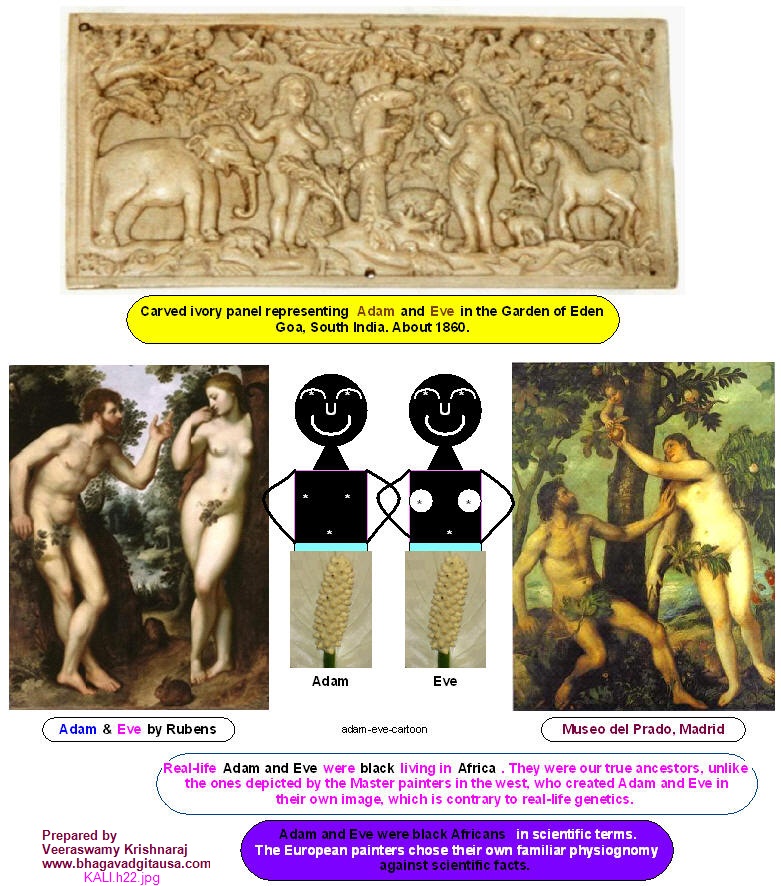
There is money to be
made here by OB-GYNs with gold fingers. To the providers it is a question
of demand and supply. It is legal. Otherwise, why would they do it?
Neovaginoplasty is a recognized essential reconstructive surgery in the
treatment of vaginal atresia and other malformations of the genital tract.
Stone age savants
are saying that we are seeing a transformation of woman who only wanted in
the past a luxuriant thick cascading hair on the head, arch-like thin
eyebrows and non-hirsute smooth skin in the rest of the body. Then came
along nose job, fashioning of round eyes, breast augmentation,
reduction, abdominoplasty tummy tuck, liposuction.... Now we have Designer
Vagina. The question, they ask, whether all these are done to please the
man, please themselves or please a perceived idealized woman hiding inside
them?
Virginal Encounter,
2nd time around with renovation and remodeling of assets. The remaking of
a Vestal Virgin. "Play it again, Sam" Vaginal Rejuvenation Surgery.

Now hear this. There are women with
children and men in their middle ages who want to experience Virginal
Encounter with each other once again. The thrill of it is inexpressible
according to them. What do you do to replay the first encounter for the
man and the women? Man can't do much. Of course, there is Viagra and
the rest. A woman can do a lot. She undergoes Vaginoplasty,
Tightening of Vaginal ring, reconstruction of hymen, Trim and Tuck of the
inner Lips and any other procedure deemed necessary by the surgeon. Lo and
behold, we have a born-again neo-virgin with all renovated and remodeled
vestal virginal parts in place for connubial sports. The surgeon appends a
price tag that hangs from the clitoris. That is money in the bank. The
price tag is in thousands of dollars. Imagine a woman going to a
life-style surgeon who can attach price tags on the female anatomy in
places like ears, eyes, eyebrows, nose, lips, forehead, face, breasts,
nipples, navel, abdomen, thighs, genitals.... That can add up to $500,000
or more depending upon the skill and reputation of the cosmetic surgeon,
office location and the weight of the buyer's wallet. The weight of
the price tags alone can make the patient and her body parts droop further
down, which gives a good reason for the surgeon to fix and pull the parts
up.
Conclusion by Stone age Savant:
Learn to love your body as it is. You will live in peace with yourself.
Less pain, wear and tear on the pudenda. Don't you know the insurance
companies swear that a woman is a preexisting condition?
The
all-comprehensive term should be Designer Yoni (and not Designer Vagina),
the term that includes the womb, uterus, vulva, vagina, and all female
sexual organs. You have to keep coming back to Greek and Sanskrit for your
new terminology.
Jeweled Nipples, Clitoris and Inner Lips:
Female nipple piercing and genital piercing involving the clitoris, labia
Minora (Inner lips) and other parts are not uncommon. I have seen
them in my practice--that too in teenagers. I had been requested by the
teenage girls not to reveal the body piercing to their parents. I did
comply with their requests. It is sad indeed. Jewelry in moist areas tend
to give infections. Allergy to the metal is not uncommon.
You may see pre-op and post-op images of
labiaplasty by using popular search engines with entry of word 'Labiaplasty.'
There are OB-Gyns or plastic surgeons who would not perform labiaplasty,
though there is no law against surgery of this type. It is completely
legit.
Photos before and
after surgery: This is for your education. This is not a referral.
The images are graphic and disturbing and the contents are for mature
adults only. Do not enter this site, if you do not want or intend to
visualize these disturbing graphic medical images, which are posted for
education of the prospective clients.
Warning: This
medical site is not authorized for teenagers and children; entering the
medical site is attestation that you are an adult 21 and over.

Momma Comics. Feb
6, 2010
Jay Müller
Clinic Feb 6, 2010
We specialize in putting
living genital spare parts in your body. Our slogan is, "If he went to buy
you diamonds in ..., you want to go to Jay Müller." We take a smear from
your cervix (remember pap smears) and coax the cervical cells into
Müllerian stem cells which go to work on a matrix and produce a new uterus
and vagina and we join the upper vagina to lower vagina grown from stem
cells generated from cells of external genitalia. Our highly trained and
board certified GYNs will replace your worn out parts and fit you with new
parts. There is no question of transplant rejection, since it came from
your own cells.
Disclaimer: Occasionally, God and nature put a wrench and create a cloaca.
Our GYNs can fix it.
Our Motto: a Complete Woman.
Established: 4004 B.C. the year, God created Eve from Adam's rib.
We like the year
4004 because it is a Palindrome.
Carbon Management: Diamond merchants reduce Carbon footprint by converting
carbon into diamonds.
We at Jay Müller convert cervical cells into neo-vagina.
You can show off you diamonds and be happy with your neo-vagina.
--- Jay Müller,
M.D
April 11, 2014.
The prediction of artificial vagina as said above came true as this report
is published. A new report in The
Lancet shows
that vaginas can successfully be grown in a lab from women’s own cells and
implanted in their bodies. Four young women in the U.S. born with missing
or abnormal vaginas have undergone the transplant process, which involves
taking a biopsy from the not fully formed vulva and growing the vagina in
a bioreactor. Follow-up tests indicate that the lab-grown organs are
functioning normally. The women report normal levels of "desire, arousal,
lubrication, orgasm, satisfaction" and painless intercourse. Although none
have conceived yet, they are menstruating, which suggests pregnancy will
be possible.--Cheat Sheet |
The virginity industry. April 24
2010
http://news.bbc.co.uk/2/hi/middle_east/8641099.stm
|
|
By Najlaa Abou Mehri and
Linda Sills
BBC Radio 4, Crossing Continents
|

Young Arab women wait in an upmarket medical
clinic for an operation that will not only change their lives, but
quite possibly save it. Yet the operation is a matter of choice and
not necessity. It costs about 2,000 euros (£1,700) and carries very
little risk.
The clinic is not in Dubai or Cairo, but in Paris.
And the surgery they are waiting for is
to restore
their virginity.
Whether in Asia or the Arab world, an unknown number
of women face an agonising problem having broken a deep taboo. They've
had sex outside marriage and if found out, risk being ostracised by
their communities, or even murdered.
Now more and more of them are undergoing surgery to
re-connect their hymens and hide any sign of past sexual activity.
They want to ensure that blood is spilled on their wedding night
sheets.
Some of the women come to the doctor because they
need virginity certificates in order to marry.
With Chinese manufacturers leading the way, there
are now non-surgical options on the market as well. One website sells
artificial hymens for just £20 (23 euros). The Chinese hymen is made
of elastic and filled with fake blood. Once inserted in the vagina,
the woman can simulate virginity, the company claims. |
|
Y-chromosomal (African) Adam
probably lived between 60,000 and 90,000 years ago, judging from
molecular clock and
genetic marker studies. While their descendants certainly became close
intimates, Y-chromosomal Adam and
mitochondrial Eve (African) are separated by tens of thousands of years.
'Y-chromosomal Adam'--wikipedia. Note: All human beings trace their lineage to
one African Adam and one African Eve, who lived thousands of years
apart. The contemporary females of African Adam died leaving no DNA
fingerprints. Humanity traces its origin to a single African Adam and a single
African Eve, ages apart: the latter-day African Eve whose DNA consorted with
the earlier African Adam's transmitted DNA along the male line.
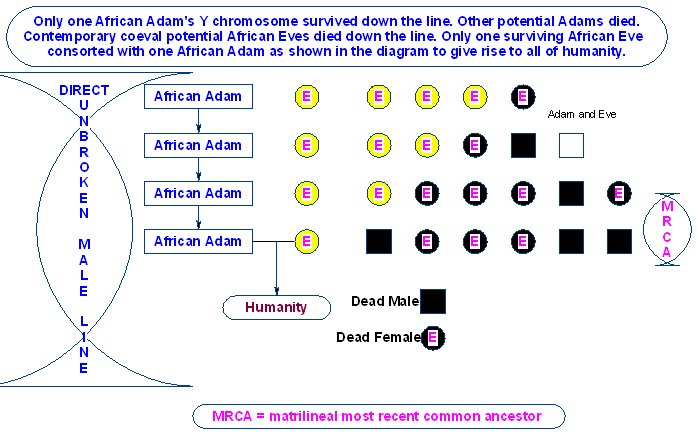
|
Sri U.Ve.Krishnan Swami is a repository
of Srivaishnava sacred lore.
In a reply to a question touching on the
subject of menstruation, his answer is as follows.
Ladies, during periods, cannot enter the kitchen or Perumal
room or what (for) that matter any place in the house.
You can allot one room in your house for those days. Of course she can
take care of her child but you will have to provide her and the child with
everything. Fourth day she can enter the house but again cannot cook.
Fifth day she has to take bath in a pond and then can enter all the
places. Life is merrier only when we obey to the dharma sastra. It is His
merry that makes us merrier. ---Sri U.Ve.Krishnan Swamy.
I respectfully ask him this question.
The House of Misery and dystopia
There is a custom in Brahmana and other households in
India that the menstruating woman is ostracized, segregated, shunted,
secluded and secretes herself out of sight in a room. This is a very
discriminatory practice in my opinion and this burden is placed on the
woman and the family by inconsiderate men, who wrote the injunctions many
eons ago. Did they touch base with Sri, Uma, Valli, Devayanai and other
women, before they wrote the injunctions? No, they did not. This is called
ThIttu (தீட்டு in Tamil = Pollution). The woman is polluted for 5 days
every month and after childbirth. The Sastraic code writers branded
themselves the Pollution Control Board to stem the tide of pollution
emanating from a menstruating woman in the household. Look around the
house: the mosquito infested puddles, dog-dos, all kinds of garbage. That
is pollution they are willing to live with. Many post menopausal old
wives, who went through the rigorous punishment themselves before,
figuratively flog the younger women and drive them into the impure
isolation room or to the platform on the verandah (திண்ணை). The passersby
know the lady of the house is polluted for 5 days. If she happens to be a
widowed menstruating woman, she is further punished to shave her head,
wear white sari, cover her head out of shame, shed jewels and sit on the
verandah. The dead men, not wanting the women married again, established
these injunctions against the women. The idea is that the widow looks as
unattractive as possible so the eligible men would avert their eyes.
Discriminating and liberal men of this age can see misery and the beauty
through the veil. Most people walking on the street particularly avoid
seeing the widow for fear that a widow is a sphinx spreading bad luck.
Heartless people call them by the pejorative word Mundai (முண்டை = a widow
with a shaven head). Even the crows lose respect for such a widow
and constantly cry and assemble a mob of cawing and mocking crows before
the poor widow. The crows look at her with their heads cocked to one side
and the beaks turned up in an act of supreme condescension. She is
showered not with homilies but with contumelies for her silent suffering.
The widow is compelled to mourn until her death, submit herself to
humiliating head shave once a month, forgo chewing Pan, makeup, fun
things, and flowers excepting sectarian marks on the forehead, shed all
her jewels, wear only white saris, and desist from attending festivities,
marriage and Upanayana ceremonies. The widow is barely tolerated, and
regarded as a bad omen. Soon after attaining widowhood (thank god, Sati is
no more, thank the British), the now newly-minted widow is surrounded by
well-meaning womenfolk exhorting her to tolerate her widowhood with
fortitude. They embrace, grab, push her, and shed rivers of tears on her.
They make her sit on a stool; a near, dear and close female relative
utters words of wisdom and Mantra of solace and rips (cuts) the marriage
badge and chain (மாங்கலியம், தாலி) off the widow's neck. The next
sacerdotal ceremony of humiliation is a visitation from a barber, who
dutifully shaves the beautiful locks of the angelic woman with the eyes of
doe; this inhumane transformation makes her two year old cry all day long,
who hesitates and withdraws from his or her shaved mother out of primal
fear. The men and the colluding old wives are smug in their belief they
followed the Sastras without one hair out of place. Mercifully, a saivite
widow is allowed to wear the sacred ashes and the Vaishnavite woman red
Srichurnam.
Coming back to the menstruating woman with a live
husband, she is allowed to attend to the baby. The poor husband is
left high and dry on the now-deserted marital bed with a pining woman, her
color drained from head to toes, in a desolate room. This five day hiatus
takes a toll on the forlorn wife, and deprived husband esp. after a hard
day's work in the office. The Sastras inflict on them injunctions as to
when they can and when they cannot consort, which is marked on a mental
calendar with an YES or NO on each box; with all the restrictions, it is a
miracle, the couple lead a normal married life. Tensions build and spill
on other household members and the office co-workers. The other men and
in-laws keep a tab on the married couple's strict adherence to Sastraic
injunctions. They scrub and clean the room (rarely with cow dung) once the
monthly periods are over. Cow dung is purifying and menstruating woman is
polluting. Go figure that. It is a common occurrence that infants
sometimes with attached umbilical cords come into the emergency room of
the hospital with florid case of tetanus because infants were sleeping on
bare floor smeared with cow dung. It is not uncommon that the sticklers
and imbibers of Panchagavya with a heavy dose of cow dung come down with
diarrhea, and kidney ailments. All these things go unnoticed or
conveniently ignored in the name of religion in a country, where health is
compromised in the name of injunctions. The believers take dips in the
unchlorinated temple tanks with stagnant water in the name of injunctions
and vociferously defend the sacredness and purity of water in the tank,
and Ganges river polluted with sewage, dead bodies and other flotsam.
(Panchagvya [பஞ்சகவ்யம்]: cow dung, Cow
urine, Cow milk, Cow curds, Cow ghee. I am positive that the religious
people and strict followers of Sastras stopped eating the cow dung
panchagavya. Nowadays, the informed gave up on cow dung and substituted it
with other hygienic edible product.)
If there are teenage girls in the household or if it is
a
joint family, this room becomes the 24/7 refuge almost everyday of the
year for the fair sex. The room may hold a few women in the joint family
as tradition-bound outcasts. Many educated woman in high positions in
modern families both in India and abroad conveniently ignore this age old
custom and keep pace and peace at work and home. The indigent women go to
work no matter what their menstrual situation is. They have no
choice but to work through the menstrual periods to make a living.
The Sastras did not have forethought that things would change over eons,
women would be going to work, they could not afford to take off 5 days
every month, esp. when they are the main bread winners.... The college
girls cannot afford to take off 4 or 5 days a month from attending classes
during the menstrual days. Their studies would suffer.
Where am I going to find a pond for my wife and
daughters in the city of Chennai so they can take the ritual purifying
ablutions after the monthly periods come to an end? There are umpteen
dirty puddles and no clean ponds for ritual ablution of my wife and
daughters. Tell me who would want to bath in and drink water from the pond
if all the town's menstruating women regularly dip themselves and
inconsiderate men wash their bottom after defecation. Why don't we try a
nice shower or in the worst case scenario use the roadside tap water? What
about the menstruating Brahmana-student woman living abroad with four
roommates in a one room shared apartment or in a hut in India? The woman
taking a ritual ablution abroad in a clean pond will invite the ogling
men, and police ready to issue a summons. There may not be a pond for
miles. Now that the woman has all the modern conveniences and feminine
hygiene products in the market, why don't we dispense with these
restrictive Sastraic injunctions which demand ostracization, isolation,
confinement and compliant comportment? I never heard of a Brahmana women
or any other women belonging to other castes infect anyone in or outside
the family with any diseases. There is an exception: A woman with Aids or
venereal diseases can infect men during periods or even otherwise.
If we allow her to take care of children, we are letting
a polluted women [தீட்டு] take care of them. How is it that our children
do not deserve a clean woman but adults do? The two year old child does
not have a clue why his or her mother is shunted and secretes herself in a
room for five days every month. You cannot hold a two year old in the
polluted room for more than five minutes; he would be running around the
house spreading the pollution, when he or she seeks the comfort of
father, grandmother or grandfather. I want to ask the rule makers whether
this lady in the isolation room has her own toilet facilities. Middle
income people cannot afford to have attached bathrooms in India. She may
have to sneak into master bathroom when no one is looking. Forget about
the ubiquitous Indian-style squat toilets with no support handles on the
walls. They are a misery; one with creaky joints cannot squat, defecate,
wash the posterior with water from the 16-ounce mug and get up to a
standing position. Recently built houses and good hotels have western
style toilets. Indians have a code in washing the butt: left hand for
washing and right hand juggling the 16-ounce mug. Sometimes the water tap
is placed on the left hand side, which makes it that much more difficult.
Thus the tradition is to eat with your fingers on the right hand and wash
the posterior with the left hand. The left hand (பீச்சைக்கை
pīccai-k-kai) is polluted and the right hand is the pure
hand. One should not use the left hand to handle things esp. prayer
accouterments. Since most people in India do not use soap and water after
posterior ablution, the cleanliness of the hands are suspect.
Medically speaking, she is clean as long as she washes
her hands with a detergent of any kind. I know of a Brahmin family
where the husband under treatment for tuberculosis moved around the house
with children and adults and yet the menstruating wife had to sit out for
four days in an isolation room. The wife and children of this person with
TB took prophylactic anti-tuberculous medication because of their intimacy
with the said person. With due high regard, respect and empathy, I am
asking who the polluter is in this family. Who wrote the rules? It is the
men who did.
The high priests should not hide behind
Sastras and injunctions. I have a question. Vishnu is Srinivasa; His body
is the abode of Sri, who lives very close to Him on His chest. Where is
She going to go and secrete Herself for 5 days every month? Yes, Her body
is made of Suddha Sattvam (Pure Empyreal A-prakritic Parakritic substance)
and yet She is a woman, whose sine quo non is menstruation. Lakshmi
asserts She would never leave Bhagavan even for one nanosecond. Did
Sastras think of it? Take Lakshmi Narasimha; I never saw Lakshmi
leave Her perch on His left thigh and secrete Herself in a nook. I am
seeing Valli and Devayanai standing by Skanda and never saw them leaving
Him for 5 days at a time.
In bad old days, a long long time ago, there was child
marriage among Brahmanas and others. We by conscience, compassion for the
girls and law fight child marriages. It is still taking place. We stopped
Sati, thank the British. We are trying to eliminate caste among us, going
against the Laws of Manu. We are up against unsavory, unfriendly,
deleterious, and defunct Sastric injunctions, which are against
egalitarian principles. Why don't we eliminate this notion that a woman is
polluted and unclean during her normal physiological menstruation? Some of
these Sastraic injunctions are the product of the polluted minds of the
bygone era. It also shows and perpetuates the notion that women were and
are second class citizens, who have no say in what men mete out to them.
To adhere to irrelevant and harmful practices in the name of a religion is
foolish indeed. This isolation of the mother definitely plays a havoc on
the psyche of the two year old youngsters.
It is common knowledge that the original Sastras
underwent modifications and interpolations by zealots. The Sastraic
content is not wholly genuine but an adulterated product. We have to pick
and choose what is good in the interest of humanity at large. Sri Krishnan
Swamy says that the division in Srivaishnavism into Vadakalai and Tenkalai
has no currency anymore. In like manner, the ostracization and isolation
of women during their monthly periods do not apply anymore.
I am thankful that the menstruating women had not to
take a dip in the ocean; that would have been catastrophic in view of the
fact that a shark can apprehend one drop of blood in the ocean a mile
away. Pond is no different, because the fish come after blood, crusted
impetigo and other skin sores and nibble on them.
Besides these, why does not our Sastra think of people
beyond the Indian subcontinent? Obviously, the code writers of Sastras
were not aware of the Eskimos, the Europeans, the Chinese....Obviously,
Manu did not know they existed. The most orthodox Indian men during the
British Raj took orders from and had to serve under British men; they
never had the audacity to tell the women of the British officers to go and
jump in a lake to purify themselves before showing up with their husbands
in the office or public functions. It appears that sastraic injunctions
are fungible. Fungibility (flexibility) is woof and warp of Hinduism,
which is its strength. Rama's backbone is ethical, moral and legal;
Krishna's backbone is fungible. Krishna stole the Parijata tree from
Indra's garden. If you think Krishna needs a tree desperately for Himself
or Sathyabama, you are wrong. It just goes to prove that what you own is
not yours but Bhagavan's; you have a temporary custody of it. What He
giveth, He taketh away.
Sastras were written neither on stone nor on water. They
came down by word of mouth, which demanded prodigious memory. Memory
sometimes fails and a wrong word substitutes for the right word. This
process continues over generations and Sastras change with unintended
consequences. There were and are charlatans in Hinduism; they rewrote some
texts in Sastras, interpolated many verses and interpreted some wrongly.
Example.
The Brahma Sutra devotes a whole section (9) 1.3.34 to
38 on the topic of disqualification of Sudras for Brahma-knowledge.
Janasruti, a previously documented Ksatriya (warrior caste) but now
mistaken for a Sudra (menial worker) was grief-stricken to hear words of
disrespect. Of all birds, a flamingo derided Janasruti for lack of
Brahma-knowledge and he ran to Raikva in grief. When Raikva saw
grief written all over the face of Janasruti, Raikva called him a Sudra
for the word Sudra also means "grief." The Sudras are prohibited
from offering sacrifices, but not acquiring Brahma-knowledge.
A well-known Sudra of Mahabharata is Vidura, born of Vyasadeva and a
palace maid and is known to have mastered Brahma-knowledge.
It is common in Hindu mythology that elements, birds,
beasts, trees... can talk. A talking flamingo is one of those articulate
birds.
A case of interpolation in Brahma Sutra
as opined by none other than Swami Sivananda, a Tamil Nadu-born Doctor who
became a Samnyasi with utmost credentials and who took fencing lessons
from an untouchable, known undeservedly, disparagingly and
disrespectfully in the past a Pariah (பறையன்), at whose feet Swami
Sivananda fell to the surprise of many for the simple reason the
Untouchable was his Guru. .
Sugasya
tadanadarasravanat
tadadravanat suchyate
hi
I.3.34 (97)
Suk:
grief; Asya:
his;
Tat: that, namely
that
grief; Anadarasravanat:
from hearing his
(the Rishi’s)
disrespectful speech;
Tada: then; Adravanat:
because of
going to
him i.e.
to Raikva; Suchyate: is referred to;
Hi:
because.
Swami Sivananda's Comment.
The discussion on the
privilege of
divine meditation
begun in
Sutra 25 is continued.
The whole of this Adhikarana
about Sudras together with the
preceding one about the Devas
appears to
be an interpolation of some later author.
page106 Brahma Sutra translation by Swami Sivananda.
Swami Vivekananda who introduced Hinduism to America (12
January 1863 – 4 July 1902), says the following:
(Supreme tenets of Hinduism
originated from the ruling kings of different eras. The ritual Hinduism is
the product of Brahmins. The kings
freely gave away and popularized their teachings. The Brahmins (priests)
kept their rituals and their purported meaning under wraps and practiced
them for a livelihood. The Hindu is burdened with these mindless rituals.
Take Bhagavadgita: It came from
the mouth of Krishna, a king and an incarnation of Vishnu, the God. Take
Buddha: He was a prince. He gave away all his teachings free of charge.)
The Complete Works of Swami Vivekananda Volume 1 [ Page : 452- 453 ] THE
GITA I
Yours humbly,
Submitted by
Veeraswamy Krishnaraj |
|
Sri U.Ve.Krishnan Swami is a repository
of Srivaishnava sacred lore.
In a reply to a question touching on the
subject of menstruation, his answer is as follows.
Ladies, during periods, cannot enter the kitchen or Perumal
room or what (for) that matter any place in the house.
You can allot one room in your house for those days. Of course she can
take care of her child but you will have to provide her and the child with
everything. Fourth day she can enter the house but again cannot cook.
Fifth day she has to take bath in a pond and then can enter all the
places. Life is merrier only when we obey to the dharma sastra. It is His
merry that makes us merrier. ---Sri U.Ve.Krishnan Swamy.
I respectfully ask him this question.
The House of Misery and dystopia
There is a custom in Brahmana and other households in
India that the menstruating woman is ostracized, segregated, shunted,
secluded and secretes herself out of sight in a room. This is a very
discriminatory practice in my opinion and this burden is placed on the
woman and the family by inconsiderate men, who wrote the injunctions many
eons ago. Did they touch base with Sri, Uma, Valli, Devayanai and other
women, before they wrote the injunctions? No, they did not. This is called
ThIttu (தீட்டு in Tamil = Pollution). The woman is polluted for 5 days
every month and after childbirth. The Sastraic code writers branded
themselves the Pollution Control Board to stem the tide of pollution
emanating from a menstruating woman in the household. Look around the
house: the mosquito infested puddles, dog-dos, all kinds of garbage. That
is pollution they are willing to live with. Many post menopausal old
wives, who went through the rigorous punishment themselves before,
figuratively flog the younger women and drive them into the impure room or
to the platform on the verandah (திண்ணை). The passersby know the lady of
the house is polluted for 5 days. If she happens to be a widowed
menstruating woman, she is further punished to shave her head, wear white
sari, cover her head out of shame, shed jewels and sit on the verandah.
The dead men, not wanting the women married again, established these
injunctions against the women. The idea is that the widow looks as
unattractive as possible so the eligible men would avert their eyes.
Discriminating and liberal men of this age can see misery and the beauty
through the veil. Most people walking on the street particularly avoid
seeing the widow for fear that a widow is a sphinx spreading bad luck.
Heartless people call them by the pejorative word Mundai (முண்டை = a widow
with a shaven head). Even the crows lose respect for such a widow
and constantly cry and assemble a mob of cawing and mocking crows before
the poor widow. The crows look at her with their heads cocked to one side
and the beaks turned up in an act of supreme condescension. She is
showered not with homilies but with contumelies for her silent suffering.
The widow is compelled to mourn until her death, submit herself to
humiliating head shave once a month, forgo chewing Pan, makeup, fun
things, and flowers excepting sectarian marks on the forehead, shed all
her jewels, wear only white saris, and desist from attending festivities,
marriage and Upanayana ceremonies. The widow is barely tolerated, and
regarded as a bad omen. Soon after attaining widowhood (thank god, Sati is
no more), the now newly-minted widow is surrounded by well-meaning
womenfolk exhorting her to tolerate her widowhood with fortitude. They
embrace, grab, push her, and shed rivers of tears on her. They make her
sit on a stool; a near, dear and close female relative utters words of
wisdom and Mantra of solace and rips (cuts) the marriage badge (மாங்கலியம்,
தாலி) off the widow's neck. The next sacerdotal ceremony of humiliation is
a visitation from a barber, who dutifully shaves the beautiful locks of
the angelic woman with the eyes of doe; this inhumane transformation makes
her two year old cry all day long, who hesitates and withdraws from his or
her shaved mother out of primal fear. The men and the colluding old wives
are smug in their belief they followed the Sastras without one hair out of
place. Mercifully, a saivite widow is allowed to wear the sacred ashes and
the Vaishnavite woman red Srichurnam.
Coming back to the menstruating woman with a live
husband, she is allowed to attend to the baby. The poor husband is
left high and dry on the now-deserted marital bed with a pining woman, her
color drained from head to toes, in a desolate room. This five day hiatus
takes a toll on the forlorn wife, and deprived husband esp. after a hard
day's work in the office. The Sastras inflict on them injunctions as to
when they can and when they cannot consort, which is marked on a mental
calendar with an YES or NO on each box; with all the restrictions, it is a
miracle, the couple lead a normal married life. Tensions build and spill
on other household members and the office co-workers.The other men and
in-laws keep a tab on the married couple's strict adherence to Sastraic
injunctions. They scrub and clean the room (rarely with cow dung) once the
monthly periods are over. Cow dung is purifying and menstruating woman is
polluting. Go figure that. It is a common occurrence that infants with
attached umbilical cords come into the emergency room of the hospital with
florid case of tetanus because infants were sleeping on bare floor smeared
with cow dung. It is not uncommon that the sticklers and imbibers of
Panchagavya with a heavy dose of cow dung come down with diarrhea, and
kidney ailments. All these things go unnoticed or conveniently ignored in
the name of religion in a country, where health is compromised in the name
of injunctions. The believers take dips in the unchlorinated temple tanks
with stagnant water in the name of injunctions and vociferously defend the
sacredness and purity of water in the tank, and Ganges river polluted with
sewage, dead bodies and other flotsam.
(Panchagvya [பஞ்சகவ்யம்]: cow dung, Cow
urine, Cow milk, Cow curds, Cow ghee. I am positive that the religious
people and strict followers of Sastras stopped eating the cow dung
panchagavya. Nowadays, the informed gave up on cow dung and substituted it
with other hygienic edible product.)
If there are teenage girls in the household or if it is
joint family, this room becomes the 24/7 refuge almost everyday of the
year for the fair sex. The room may hold a few women in the joint family
as tradition-bound outcasts. Many educated woman in high positions in
modern families both in India and abroad conveniently ignore this age old
custom and keep pace and peace at work and home. The indigent women go to
work no matter what their menstrual situation is. They have to work
through the menstrual periods to make a living. The Sastras did not
have forethought that things would change over eons, women would be going
to work, they could not afford to take off 5 days every month, esp. when
they are the main bread winners.... The college girls cannot afford to
take off 4 or 5 days a month from attending classes during the menstrual
days. Their studies would suffer.
Where am I going to find a pond for my wife and
daughters in the city of Chennai so they can take the ritual purifying
ablutions after the monthly periods come to an end? There are umpteen
dirty puddles and no clean ponds for ritual ablution of my wife and
daughters. Tell me who would want to bath in and drink water from the pond
if all the town's menstuating women regularly dip themselves and
inconsiderate men wash their bottom after defecation. Why don't we try a
nice shower or in the worst case scenario use the roadside tap water? What
about the menstruating Brahmana-student woman living abroad with four
roommates in a one room shared apartment or in a hut in India? The woman
taking a ritual ablution abroad in a clean pond will invite the ogling
men, and police ready to issue a summons. There may not be a pond for
miles. Now that the woman has all the modern conveniences and feminine
hygiene products in the market, why don't we dispense with these
restrictive Sastraic injunctions which demand ostracization, isolation,
confinement and compliant comportment? I never heard of a Brahmana women
or any other women belonging to other castes infect anyone in or outside
the family with any diseases. There is an exception: A woman with Aids or
venereal diseases can infect men during periods or even otherwise.
If we let her to take care of children, we are letting a
polluted women [தீட்டு] take care of them. How is it that our children do
not deserve a clean woman but adults do? The two year old child does not
have a clue why his or her mother is shunted and secretes herself in a
room for five days every month. You cannot hold a two year old in the
polluted room for more than five minutes; he would be running around the
house spreading the pollution, when he or she seeks the comfort of
father, grandmother or grandfather. I want to ask the rule makers whether
this lady in the isolation room has her own toilet facilities. Middle
income people cannot afford to have attached bathrooms in India. She may
have to sneak into master bathroom when no one is looking. Forget about
the ubiqitous Indian-style squat toilets with no support handles on the
walls. They are a misery; the one with creaky joints cannot squat,
defecate, wash the posterior with water from the 16-ounce mug and get up
to a standing position. Luxury houses and good hotels have western style
toilets. Indians have a code in washing the butt: left hand for washing
and right hand juggling the 16-ounce mug. Sometimes the water tap is
placed on the left hand side, which makes it that much more difficult.
Thus the tradition is to eat with your right hand and wash the posterior
with the left hand. The left hand (பீச்சைக்கை
pīccai-k-kai) is polluted and the right hand is the pure
hand. One should not use the left hand to handle things esp. prayer
accouterments. Since most people do not use soap and water after posterior
ablution, the cleanliness of the hands are suspect.
Medically speaking, she is clean as long as she washes
her hands with a detergent of any kind. I know of a Brahmin family
where the husband under treatment for tuberculosis moved around the house
with children and adults and yet the menstruating wife had to sit out for
four days in an isolation room. The wife and children of this person with
TB took prophylactic anti-tuberculous medication because of their intimacy
with the said person. With due respect and empathy, I am asking who the
polluter is in this family. Who wrote the rules? It is the men who did.
The high priests should not hide behind Sastras and
injunctions. I have a question. Vishnu is Srinivasa; His body is the abode
of Sri, who lives very close to Him on His chest. Where is She going to go
and secrete Herself for 5 days every month? Yes, Her body is made of
Suddha Sattvam (Pure Empyreal A-prakritic Parakritic substance) and yet
She is a woman, whose sine quo non is menstruation. Lakshmi asserts that
She would never leave Bhagavan even for one nanosecond. Did Sastras think
of it? Take Lakshmi Narasimha; I never saw Lakshmi leave Her perch
on His left thigh and secrete Herself in a nook. I am seeing Valli and
Devayanai standing by Skanda and never saw them leaving Him for 5 days at
a time.
In bad old days, a long long time ago, there was child
marriage among Brahmanas and others. We by conscience, compassion for the
girls and law fight child marriages. It is still taking place. We stopped
Sati, thank the British. We are trying to eliminate caste among us, going
against the Laws of Manu. We are going against unsavory, unfriendly,
deleterious, and defunct Sastric injunctions, which are against
egalitarian principles. Why don't we eliminate this notion that a woman is
polluted and unclean during her normal physiological menstruation? Some of
these Sastraic injunctions are the product of the polluted minds of the
bygone era. It also shows and perpetuates the notion that women were and
are second class citizens, who have no say in what men mete out to them.
To adhere to irrelevant and harmful practices in the name of a religion is
foolish indeed. This isolation of the mother definitely plays a havoc on
the psyche of the two year old youngsters.
It is common knowledge that the original Sastras
underwent modifications and interpolations by zealots. The Sastraic
content is not wholly genuine but an adulterated product. We have to pick
and choose what is good in the interest of humanity at large. Sri Krishnan
Swamy says that the division in Srivaishnavism into Vadakalai and Tenkalai
has no currency anymore. In like manner, the ostracization and isolation
of women during their monthly periods do not apply anymore.
I am thankful that the menstruating women had not to
take a dip in the ocean; that would have been catastrophic in view of the
fact that a shark can apprehend one drop of blood in the ocean a mile
away. Pond is no different, because the fish come after blood, crusted
impetigo and other skin sores and nibble on them.
Besides these, why does not our Sastra think of people
beyond the Indian subcontinent? Obviously, the code writers of Sastras
were not aware of the Eskimos, the Europeans, the Chinese....Obviously,
Manu did not know they existed. The most orthodox Indian men during the
British Raj took orders from and had to serve under British men; they
never had the audacity to tell the women of the British officers to go and
jump in a lake to purify themselves before showing up with their husbands
in the office or public functions. It appears that sastraic injunctions
are fungible. Fungibility (flexibility) is woof and warp of Hinduism,
which is its strength. Rama's backbone is ethical, moral and legal;
Krishna's backbone is fungible. Krishna stole the Parijata tree from
Indra's garden. If you think Krishna needs a tree desperately for Himself
or Sathyabama, you are wrong. It just goes to prove that what you own is
not yours but Bhagavan's; you have a temporary custody of it. What He
giveth, He taketh away.
Sastras were written neither on stone nor on water. They
came down by word of mouth, which demanded prodigious memory. Memory
sometimes fails and a wrong word substitutes for the right word. This
process continues over generations and Sastras change. There were and are
charlatans in Hinduism; they rewrote some texts in Sastras, interpolated
many verses and interpreted some wrongly.
Example.
The Brahma Sutra devotes a whole section (9) 1.3.34 to
38 on the topic of disqualification of Sudras for Brahma-knowledge.
Janasruti, a previously documented Ksatriya (warrior caste) but now
mistaken for a Sudra (menial worker) was grief-stricken to hear words of
disrespect. Of all birds, a flamingo derided Janasruti for lack of
Brahma-knowledge and he ran to Raikva in grief. When Raikva saw
grief written all over the face of Janasruti, Raikva called him a Sudra
for the word Sudra also means "grief." The Sudras are prohibited
from offering sacrifices, but not acquiring Brahma-knowledge.
A well-known Sudra of Mahabharata is Vidura, born of Vyasadeva and a
palace maid and is known to have mastered Brahma-knowledge.
It is common in Hindu mythology that elements, birds,
beasts, trees... can talk. A talking flamingo is one of those articulate
birds.
A case of interpolation in Brahma Sutra
as opined by none other than Swami Sivananda.
Sugasya
tadanadarasravanat
tadadravanat suchyate
hi
I.3.34 (97)
Suk:
grief; Asya:
his;
Tat: that, namely
that
grief; Anadarasravanat:
from hearing his
(the Rishi’s)
disrespectful speech;
Tada: then; Adravanat:
because of
going to
him i.e.
to Raikva; Suchyate: is referred to;
Hi:
because.
Swami Sivananda's Comment.
The discussion on the
privilege of
divine meditation
begun in
Sutra 25 is continued.
The whole of this Adhikarana
about Sudras together with the
preceding one about the Devas
appears to
be an interpolation of some later author.
page106 Brahma Sutra translation by Swami Sivananda.
Swami Vivekananda's opinion:
(Supreme tenets of Hinduism
originated from the ruling kings of different eras. The ritual Hinduism is
the product of Brahmins. The kings
freely gave away and popularized their teachings. The Brahmins (priests)
kept their rituals and their purported meaning under wraps and practiced
them for a livelihood. The Hindu is burdened with these mindless rituals.
Take Bhagavadgita: It came from
the mouth of Krishna, a king and an incarnation of Vishnu, the God. Take
Buddha: He was a prince. He gave away all his teachings free of charge.)
The Complete Works of Swami Vivekananda Volume 1 [ Page : 452- 453 ] THE
GITA I
Yours humbly,
Veeraswamy Krishnaraj |
|
ॐ श्रीदुर्गायै नमः
OM Śrī Durgāyai
Namah
ॐ
श्री महा कालिकायै नमः
= OM
Śrī
Mahā
Kālikāyai
Namah |
From Kalikarpuradi Stotra Translation by Arthur Avalon
PRAYER by
SRI
VIMALANANDA-SVAMI
AT THE
FEET OF
SRI
SRI
KALIKA
May
the Maha-Devi
who is
called Kalika,
Because She is without beginning or end,
Whose
Body is imagined to be blue of colour,
Because like the blue sky She pervades the World,
And
because She is Cidghana
1
Sattvagunamayi
Who is
imagined to be black
Because She is colourless and above the coloured Gunas,
Whose
hair is dishevelled (Muktakesi)
Because though Herself changeless She binds infinite numbers
of
Jivas by bonds of
Maya,
symbolized by Her dishevelled hair and because She makes
liberated (Mukta)
Brahma,
Visnu
and Mahesvara
who are Kesa,
2
p. 40
Who is
imagined as having the Sun, Moon and Fire as Her three eyes,
Because as the Virad, the Witness of the world past, present and future She
sees
everything,
Who is
pictured as wearing the dead bodies of two boys as Her ear-ornaments,
Because as said in
Agama
and Nigama the childlike and unperturbed (Nirvikara)
Sadhaka
is
very dear to Her, who being the sole Creatrix, Preserver and Destructress of
infinite
millions of Worlds, has on Her Body the mark of the Yoni signifying creation,
full and
high
breasts denoting preservation, and a terrible visage signifying the withdrawal
of all
things,
Who is
said to have large teeth, and a lolling tongue and to hold in Her hand a cup
made
of human skull,
Because the Cinmayi
Mahadevi
drinks
the wine of delusion arising from the Tamas Guna
of Her
Sadhaka
by means of Sattva-pradhana
rajoguna,
40.1
Who is
pictured as wearing a garland of severed heads,
Because She is
Sabdabrahman
(Sabdabrahmarupini)
and the heads are the fifty letters,
Whose
upper and lower right hands are seen to be making the Abhaya and Vara Mudras,
Because She both destroys the dangers, and grants the desires of Sakama-Sadhakas,
Whose
upper left hand is depicted as wielding a sword,
p. 41
Because She severs the bonds of illusion for the Niskama-Sadhaka,
Whose
lower left hand is seen to hold a human head,
Because She grants him Tattvajñana,
Who is
called Digambari
(space-clad)
Because being Brahman (Brahmarupini)
She is free from the covering of Maya
41.1
and
unconcerned (Nirvikara),
41.2
Who is
pictured as having a waist-chain of human hands,
Because hands are the principal instrument of work (Karma) and at the close of
a Kalpa
all Jivas
with their Karmas are merged in the Avidya
Sakti
of Mahamaya,
Who is
seen standing on the breast of corpse-like
Siva,
Because the Supreme State (Paramapada) and Svarupavastha
or Mahadevi
(one
with
Siva)
is Nirguna
and changeless (Nirvikara),
Who is
seen in Viparita-maithuna
41.3
with
Mahakala,
Because at the beginning of a Kalpa She who is ever blissful (Nityanandamayi),
and
being
united with
Siva,
feels pleasure in the work of creation which She effects by
bringing the changeless Parasiva
under Her dominion (Vasibhuta),
Who is
again said to live in the cremation ground,
Because when at the end of a Kalpa all things in the universe from Brahma
to a
blade of
grass
are dissolved in Mahakala,
She is in and one with that Mahakala,
who may be thus
compared to a cremation ground, and because at
p. 42
the
death of Jivas
She exists as the individual (Vyasti)
Jivatma
in the
burning ground,
Whose
Yantra for worship is composed of a circle symbolizing Maya,
an eight-petalled
lotus
denoting the eightfold Prakrti,
three Pentagons representing the fifteen Avayavas
and a
Bindu denoting
Siva-Sakti,
Because She is, as Paramatma,
in the gross and subtle
bodies
consisting of the three Gunas
and twenty-four Tattvas, Whose Bija
'Krim',
42.1
the
Queen
of Mantras is pure Sattva Guna,
and consciousness (Caitanyamayi)
and grants both
Enjoyment and Liberation, Who is worshipped as Daksina
because She alone grants the full
fruits
of all forms of Upasana
and
Yajña.
May
She, this Mahadevi,
who is Saccidanandarupini
and
forgiveness itself, pardon all
offences committed by me in the explanation of this Her Hymn.
Sambhu
with His five mouths is unable to relate Thy qualities.
Pardon
all my childishness. Be propitious.
Guard
my life, guard my repute and guard my wife, sons and wealth.
And at
death grant me Liberation.
O
Mother of the World, obeisance.
SRI
VIMALANANDA-SVAMI
Footnotes
30:1
See Mundakopanisad,
1-2-4.
39:1
This
is a play on the word Ghana which means mass and black or dark blue cloud.
Cidghana is massive, compact, unmixed, pure Consciousness (Cit). Again She is
Nirguna
and stainless but is also Meghangi
(cloud-bodied) because through Adhyasa
of the three Gunas
She appears varicoloured just as a cloud in itself colourless appears white,
blue, and so forth by contact with the sun's rays. So Devi-Purana
says, 'Just as the uniform cloud appears as of many colours, so does She too
through the instrumentality of the Gunas.'
39:2
Kesa
= K + A +
Isa.
And K = Brahma,
A = Visnu,
and
Isa
= Rudra. The Niruttara-
Tantra
says, 'Kali
who is
Aniruddha-sarasvati,
is the great desire-granting tree, the sole
Cause
of Enjoyment and Liberation for Brahma,
Visnu
and Mahesa.'
Aniruddha = self-willed.
40:1
White
Teeth stand for the white Sattva Guna,
the red
Tongue
stands
for the red
Rajo-Guna
and Delusion is the Tamo-Guna.
The meaning is, the Mahavidya
is
represented with a lolling tongue because She first destroys the Sadhaka's
Tamo-Guna
by increasing his Rajo-Guna,
and large teeth because by increasing his Sattva Guna
and suppressing his Rajo-Guna
She grants him the state of Nirguna-Brahman.
In the Dhyana
of Tara
it is
said, 'Ugratara
Herself destroys the
Jadya
(unconscious nature) of the three worlds by putting it in her skull-cup.'
41:1
In the
eighteenth century work of Kamalakanta
called Sadhakaranjana
it is said: 'Of
the
Nirakara-Brahman,
understand, Maya
to be
the
Akara'
(Nirakara-brahmer
akara
dekha Maya).
The
Sunya
has no form until encircled by Maya.
41:2
Vikara
is also 'change'. She is then in Her changeless aspect.
41:3
Coition in which the woman assumes the dominant
role.
Sakti
is active and
Siva
is
the
passive principle.
42:1
The
Svami
also points out that the 'Kr' sound in this Mantra is also to be found in the
word Christ and in the Mussulman's Karim.
See Maya
Tantra Ch. vii for the Yavana-Bija.
Kali.
Black Kali, you stand on white supine
Siva,
Tongue lolling out, blood dripping,
Right foot planted on his left chest,
Left foot balanced on his right thigh,
Your
eyes far away, his orbs seeking mercy.
You are rock in your heart;
Your defiance is sublime.
White teeth, red tongue, black skin, owl
eyes,
Floating feet, four hands, diadem rare,
Kilt of severed hands, limp tots on
earlobes,
Wine breath, belly full of blood and
carrion:
Your persona is forbidding.
Your anima is grace and mercy.
Left hand holds a severed head dripping
blood,
Sword in right hand held aloft.
Burning eyes reduce demons to ash.
Turgid breasts suckle the gods.
Right side is nurture;
Left side is torture and killing.
You bore three sons Brahma, Vishnu, and
Siva.
Brahma is dawn, Vishnu is sunshine, Siva
is night;
Brahma is earth, Vishnu is sap, Siva is
bark beetle.
Dawn follows night, Siva is god Right.
Three is One; One is three; Morph is the
game.
Baddies are the bane of gods and all
life.
Murder and mayhem is your game bringing
order.
Mace to the face, sword to the neck,
They die by millions, rise by zillions
--
Clones from drops of blood.
You sear the neck, and suck the marrow
dry.
No spill, no clones.
Baddies sprout like mushrooms.
She plucks; she puts noose to the neck;
Like mollusks they slip away, and morph:
Butterflies here, wasps there, lions
over there.
In one sweep she nets and stuffs them
into her mouth;
Blood of Baddies are her beverage.
Elephants and mahouts are her meal;
Elephant’s tail disappears from between
her lips
Like the snake going into the hole.
She is so hungry she could eat a horse!
Warriors are her favorite snack.
Mahisa is the head honcho of the bad
lot;
He swells into a gargantuan, hiding the
sun,
And matching her appetite for violence.
She drives a spear setting his soul
free;
His body rolls downhill eastward,
showing the orange orb.
The baddies and minions perish;
Jackals, hyenas and wolves come yelping,
Following the long scent of death.
Sniffing and salivating,
Pads drenched in shoals of blood,
Quadrupeds feast on choice carrion.
The feral feast ends amidst deathly
peace and plenty.
The living furs tread on leaden stomach
and feet
To their dens of waiting hungry pups.
She is a black beauty, wearing a garland
of skulls.
She is Sound and all its emanations;
Skulls are letters; garlands are words
and phrases.
She wears robes of sky; elements know
her.
Sun is her son who cannot tan her any
deeper;
Wind’s swish and coo do not bother her.
Earth is her daughter whose patience is
eternal;
Water, the juice of life, is her
daughter.
Moon is her daughter; she wears her like
a jewel on her tresses.
Ether is her daughter who pervades all
spaces.
Silent Sound vibrates; visual sound
dances the body.
Anahata sound is unbeaten mental sound,
heard in the spiritual heart.
Vaani is a still sound at the base of
Axis Mundi;
Einstein’s ideas come piped-in from
Vaani.
Articulate sound is intelligent whoosh
of human larynx.
V. Krishnaraj
Kubjika Tantra
states that the portfolios of creation, maintenance, and destruction are held
by Brahmi, Vaishnavi and Rudrani and their husbands are dead bodies. Who wears
the pants in the house? Who is the bread winner?
Devi is a palette
of contrasts. She is Avidya (nescience) because she obscures and binds (the
spiritually ignorant) until he is ready for vidya; she is Vidya (spiritual
knowledge) because she confers Vidya, ends Samsara and gives liberation and
moksa. She is
VAsaka
Sakti and VAkya
Sakti;
VAkya
Sakti is Brahman without attributes (Parabrahman);
she is the goal of Upasana (worship); ordinary mortals except perfected Yogis
cannot realize her. Tantrics worship
VAsaka
Sakti, the clinical Brahman, Sabdabrahman, Saguna Isvara, Saguna Brahman, or
god with form and name; She is the fruit and the nut. She is the essence and
the fruit. She is the manifestation of Cit and Cit itself. She plunges
into the darkness and yet illuminates the whole universe. She opens and closes
her fish-like eyes causing creation and destruction of myriad worlds.
Cit = Sentient soul. Acit = insentient matter.
Vakya = meaning; essence. Vasaka =
words, phrases etc
Vakya
is meaning; VAsaka is words, phrases and
mutterings of Mantra.
Every Mantra has two Saktis (powers):
VAkya Sakti and
VAsaka Sakti; the former is the seed and latter is the flesh of the
fruit; the former is life of Mantra and the latter is the sustainer of life;
the Vakya Sakti is subject and
transcendent, and VAsaka Sakti is object
and immanent; one cannot get to the seed without going through the fruit; one
cannot understand the meaning and true nature of
Vakya sakti without worshipping VAsaka
Sakti (they are like Brahman and Isvara);
Vakya sakti is without attributes (Brahman),
VAsaka Sakti is with attributes (Isvara);
Vakya sakti is seed and
VAsaka Sakti is the tree; seed and
Vakya Sakti are latent and dormant; tree and
VAsakaSakti are awake and florid;
Vakya Sakti is white light and
VAsaka Sakti is spectral or rainbow colors,
yellow, blue, red and more of Kundalini Devi. Paramatma
(Krishna) is Vakya Sakti, while the son of
Devaki is VAsaka Sakti. The god who is the
subject of Mantra is Vakya Sakti and
Pratipaadya (to be explained, meaning) Devata and god who is Mantra itself
(god's sound body = Mantra) is VAsaka
Sakti. Vakya Sakti is like clouds and
VAsaka Sakti is like rain water.
Vakya Sakti is unlimited;
VAsaka Sakti is delimited.
Vakya sakti is all-pervasive and unmanifest,
while VAsaka Sakti is manifest. The
VAsaka Sakti of Mantra with attributes is
awakened by Siddhi of Sadhakas who then with the help Devi step into the
monistic world of Brahman knowledge. (Ref. to white light and spectral
or rainbow colors, and seed and tree are author's input.)
VAsaka Sakti is the road to
Vakya Sakti; the former is the means and the
latter is the goal.
Kali caters to all
kinds of devotees in her three forms: 1) Parabrahman, 2) Suksma (subtle)
form--Mantra form, and 3) Gross (Sthula ) form or anthropomorphic form and its
extensions and variations with many hands and the rest. Devi or Kali as
Prakriti manifests as male and female and also Brahma, Vishnu and Mahesvara.
As Lalita, she is
described as having slender bent waist from heavy erect protruding breasts
which cause three folds of skin under her breasts (trivalīvalayopetām),
swelling jeweled and belled hips, jeweled crown and hair decked with flowers,
effulgent eyebrows outshining the eight-day moon, ruby cheeks, coral lips,
bud-like teeth and eyebrows arched like the gates of the palace of Kamaraja,
perfect nose, chin, arms, limbs, and knees tapering down to graceful bright
feet, which shatter the darkness of her devotees and put the lotus to shame.
She sheds moonlight from her face which soothes the triple maladies of misery
(exogenous, endogenous, and theogenous miseries).
She is Tripura because
her body is made of three Saktis: Brahmani, Vaisnavi, and Raudri. The three
cities are a metaphor for man with three qualities: Sattva, Raja and Tamas
(virtue, motion and passion, lethargy). She is the transcendent beauty of
three cities or three gunas or the three cities of the demons. These
triads are called Kūtas (
Kuta, peaks, summit, prominence)
or peaks of Sri Vidya Mantra. Vidya of TPS consists of three syllables.
Pancha-dash-akshari
(5 + 10 + syllables) Mantra is of three peaks (Kuta):
Vagbhava-kuta, Kamaraja-kuta, Shakta-kuta.
She is the Pervader of the three worlds: Heaven, earth and netherworld. She is
the ruler of three bodies: Karana, Suksma and Sthula--causal, subtle and
gross. TPS is the Self in the three states of consciousness of man:
wakefulness, dream sleep, and deep sleep. She is also the Self in Turiya and
Turiyatita in Yogis--my interpolation.
The many
colors of Kali (palette
of many colors)
The color of Devi
changes; she is white when she confers liberation; she is red when she
controls men, women and kings; She is saffron when she controls wealth. As the
disseminator (facilitator) of enmity and dissension, she is tawny. While she
is in the thrill of love, she is rose-colored. She becomes black while she
kills.
Her subtle form is
Kundalini in the body. As Mahadevi she is Sarasvati, Lakshmi, Gayatri, Durga,
TPS, and Annapurna. Devi is the consort of Siva in the form of Sati, Uma,
Parvati, and Gowri. She was Sati before Daksa's Yajna; when Siva refused
permission to Sati to go to the Yagjna, she became the ten Mahavidyas: Kali,
Bagala, Chinnamasta, Bhuvanesvari, Matangi, Sodasi, Dhumavati, TPS, Tara, and
Bhairavi. MAHAVIDYAS. She disowned her father and
gave up her name Daksayani (Sati) when her father Daksa did not invite her
husband Siva for Yajna.
Sati became very
angry with her father Daksa for not inviting her and her consort Siva for the
Yajna and died while she was in Tapas, whose great internal heat consumed her
body. The practice of Sati in the olden days among the widows takes its name
after her. Grief-stricken Siva picked up the dead body of Sati and wandered
around; the world was burdened with overpopulation and evil. Vishnu removed
the burden of the corpse from the shoulders of Siva by cutting it into 51
pieces by his discus. Wherever the body parts fell, they became the
Mahapithsthanas where Devi is worshipped along with her Bhairava.
| Brain |
three eyes |
tongue |
nose |
upper lip |
lower lip |
stomach |
chin |
|
kotari with
Bhimlochan |
Mahisamardini with Krodhish |
Ambika with
Unmatta |
Sunanda with
Traimbak |
Avanti with
Lambakarna |
Fullara with
Bhairabhvishesya |
Chandrabhaga with
Bakratunda |
Brahmari with
Vikrakatakkha |
| Hingulaya near
karachi |
Karavipur near
Karachi |
Jullundur, Punjab |
Bengal |
Ujjain |
Birbhum, Bengal |
Near Mumbai |
Yanasthana |
|
left cheek |
right cheek |
Upper teeth |
lower teeth |
left buttock |
right buttock |
two
ears |
hair |
|
Visvamatuka with Dandapani |
Gandakichandi with Chakrapani |
Narayani with Sanghar |
Barahi with Maharudra |
Aparna with Bhairabha |
Sri
Sunadari withSundaranand |
Jai
Durga with Aviruka |
Uma
with Bhutesh |
|
Godavari |
Gandaki River |
Suchidesa |
panchasagar |
Bhavanipur |
Sriparvata |
Karnat |
Vrindavana |
|
crown |
nape of neck |
Larynx |
neck |
rt
shoulder |
lt
shoulder |
rt
arm |
right palm |
|
|
Vimala with Sangbarta on Ganges |
Mahalakshmi with Sarvananda |
Kalika with Yogesh |
Mahamaya with Trisandhyasur |
Kumari with Bhairabha |
Mahadevi with Mahodara |
Bhavani with Chandrasekhar |
Daksayini with Amar |
|
|
Kirit |
Srihatta |
Nalhati |
Amarnath,Kashmir |
Ratnabali |
Mithila |
Chattagram Bangaladesh |
Kogram Manav Ksetra |
|
|
elbows |
middle of palm |
ten
fingers |
left
arm |
rt
breast |
lt
breast |
Navel |
|
Mangalachandi withkapilambar |
Gayatri with Sarvananda |
lalita withBhava |
Bahula with Bhiruk |
Tripuramalini with Bhisan |
Shibani with Chanda |
Jaidurga with Vaidyanathan |
|
Ujjaini |
Manibhanda |
Prayag, Alahabad |
Bahula |
Jullendhar |
Ramgiri |
Bihar
near Joshidi |
| navel |
skeleton |
rt
hip |
lt
hip |
Yoni |
knees |
lt
thigh |
rt
thigh |
|
Vimala with jagannatha |
Devagarbha with Ruru |
KAli
with Asitananda |
Narmada with Vadrasen |
Khamakhya with Umananda |
Mahashira with Kapali |
Jayanti with Kramadisvar |
Sarvanandarai with Bomkesa |
| Utkal
Puri orissa |
Kanchidesh |
Kalmadhava |
Sone
River |
Nilachal Hill Assam |
Nepal |
Jayanti Bengal |
Magadha W.Bengal |
| rt
foot |
rt
big toe |
rt 4
toes |
rt
ankle |
Center of the brow |
hands |
necklace |
earrings |
| TPS
with Tripurusha |
Yogadaya with Khirakanta |
Kali
with Nakulesvar |
Savitri with Asvanath |
Mahisamardini with Bakranath |
Nandini with Chanda |
Nandini with nadikishore |
Visvalakshmi with Kāla |
|
Tripura |
Khirgam |
Calcutta |
Kurukshetra |
Bakresvar |
Jessore |
Nandipur |
Benares |
| back |
ankle
bells |
lt 4
toes |
left
ankle |
lt
foot |
|
Sharvani with Nimisha |
Indrakshi with Rakchesvara |
Ambika with Amrita |
Bhimarupa with Sarvananda |
Vramari with Isvara |
|
Kalikashram |
Sri
Lanka |
Virat |
Bivasa |
Shalbari W.Bengal |
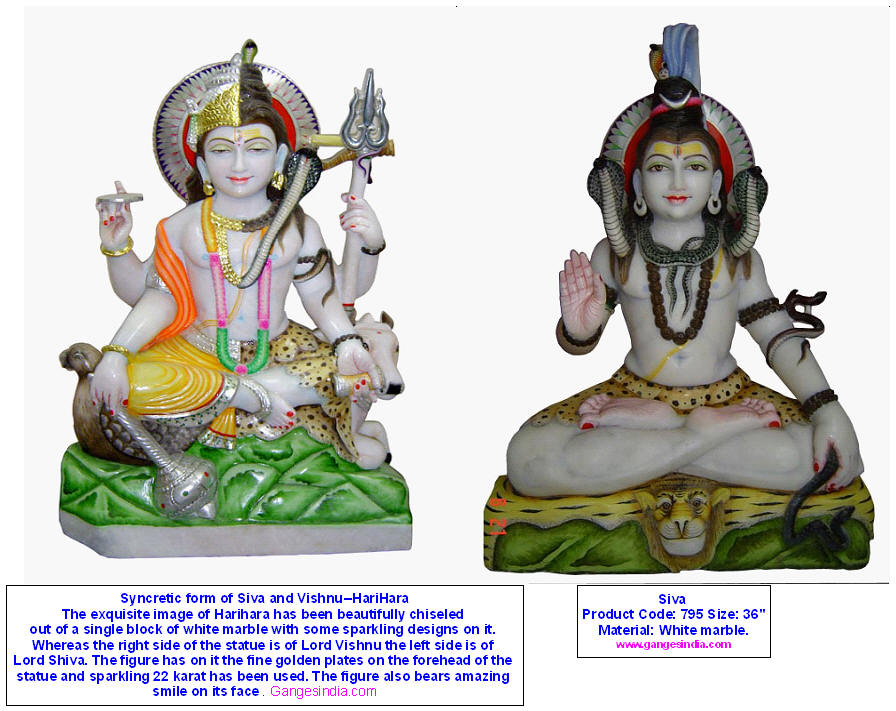
Siva's Consort goes by many names depending on her association. As the Consort
of Siva, She is Bhavāni; as the Mother of the world, She is Ambikā or
Jaganmātā; as the daughter of Daksa and Virini, She is Uma; as the daughter of
Himavat, She is Pārvati; as the repository of powers of gods, She is Durga in
Her warrior status; She is Sakti with Siva; She is Kali with Siva; As Sati,
She was the daughter of Daksa; She is the ten Mahavidyas.
As the personified energy of the gods Vishnu, Brahma, and Rudra, representing
the three qualities Sattva, Rajas, and Tamas, the Goddess is called 'Triguna'
, the One possessed of three qualities. As the personified energy of Siva, who
is the Supreme Being, devoid of attributes she is called Nirguna.
She is the Mother Goddess of Vishnu, Brahma and Rudra, the synthetic form of
three qualities responsible for creation, maintenance and dissolution of the
universe.
When Parvati aka Kali wanted to perform a penance as a
child, Her mother said, 'O, no (U mā
= उ मा
). Thus the sweet lady came to be known Uma.
Motilal Banarsidass publishers, Siva Purana Translation by Prof.
Shastri.
Here is flowchart depicting Siva and Sakti.

Kamakhya temple
The Kamakhya Temple is a
shakti temple situated on the Nilachal Hill in western part of
Guwahati
city in Assam,
India. It is
the main temple in a complex of individual temples dedicated to different
forms of the
mother goddess as the Dasa
Mahavidya,
including
Bhuvaneshvari,
Bagalamukhi,
Chinnamasta,
Tripura Sundari and
Tara.
It is an important pilgrimage destination for general Hindu and
Tantric
worshipers. The Yogini Tantra, a latter work, ignores the origin of
Kamakhya given in Kalika Purana and associates Kamakhya with the
goddess Kali and
emphasizes the creative symbolism of the yoni. Wikipedia.
Sadhu dressed as Kali July 2010
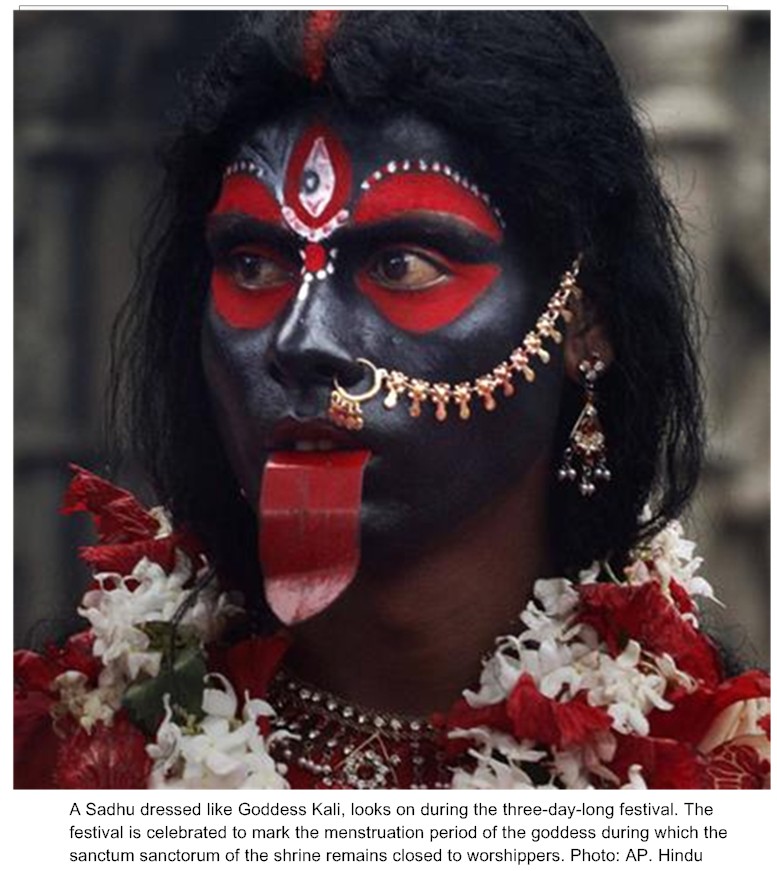
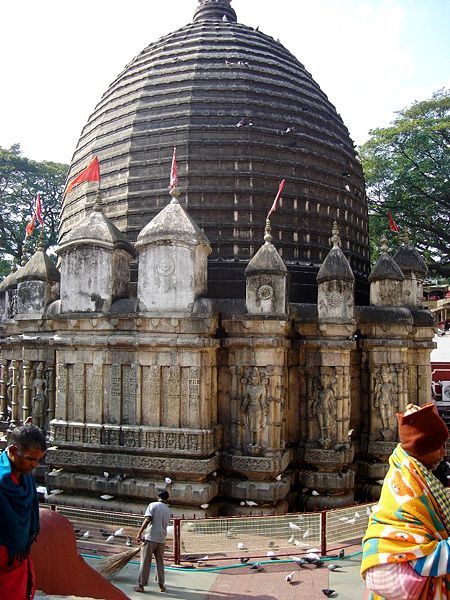
Kamakhya Temple Guwahati, Assam Wikipedia
|
CHAPTER XI
ŚAKTI—POTENCY TO CREATE by Woodroffe, part of the book The
Garland of letters.
IN the
previous chapter I have referred to Śakti, Nāda, Bindu. In this and the
two next I will deal in great detail with each of these three concepts of
Śakti. One of the clearest accounts known to me of the evolution of Śakti
is that given in the authoritative Tāntrika-Prakaraṇa called Śāradā (also
spelt Sāradā) Tilaka by Lakṣmaṇācārya. This work was formerly of great
authority in Bengal. Its value is much increased by the commentary of
Rāghva-Bhatta. As this work with its commentary is of prime importance,
and is cited throughout the following chapters, I may here note the
following account which Lakṣmaṇācārya gives of himself at its close.
Mahābala a great sage was succeeded by his son Ācāryapaṇdita, a Deśika (Tāintrik-Guru).
His son Śrīkṛṣṇa-Deśika had a son Lakṣmaṇa-Deśika who wrote the
Śāradā-Tilaka. Rāghava, in his commentary called Padārthādarśa, says that
Lakṣmaṇa was the disciple of Utpalācārya, who was the disciple of
Somānanda, who was the disciple of Vasugupta, who was the disciple of
Śrīkaṇṭha. This is the Gurupaṇgkti of Lakṣmaṇa. His disciple was the
great Kāśmīrian Abhinava-Gupta, the author of Paramārthasāra. The
latter’s disciple was Kṣemarāja, the author of the Śivasūtra-Vimarśini.
The date generally assigned to Abhinava-Gupta is the eleventh century.
Therefore Sj. Akśaya Kumāra Maitra, Director of the Varendra Anusam ̣
dhāna-Samiti, who has supplied me with these details of the Gurus and
Śiṣyas of the author, concludes that the Śārada was written at the end of
the tenth or beginning of the eleventh century. Rāghava mentions 1510 as
the age of his commentary. Taking this to be the Vikrama Samvat we get
1454 A.D. as its date. These details serve another purpose. There are
persons who insist on a total disconnection between the Śaiva and
Śākta-Tantras. Lakṣmaṇācārya was a member of the Kāśmīrian Śaiva School,
and his work was, as I have stated, of great authority among the Bengal
Śāktas.
●The
Śāradā (Chapter, I, verse 7) says: “From
Sakala-Parameśvara, vested with the wealth of Sat, Cit, Ānanda issued
Śakti; from Śakti came Nāda; and from Nāda issued Bindu.”
|
Saccidānandavibhavāt sakalāt parameśvarāt
Asīc
chaktis tato nādo nādād bindu samudbhavah. |
Parameśvara
is here Śiva-Tattva. He is Sakala, because He is with the creative Kalā or
Śakti. As already explained Śakti, when Vyaṣtirūpā, that is
individualised, is called Kalā. Śiva is always with Śakti. But in the
supreme state, Śakti is unmanifest and exists in Her own (Svarūpa) form as
Being-Consciousness-Bliss (Sacchidānandamayī, Cidrūpiṇī),
undistinguishable from Śiva. Sakala-Śiva is thus Saguṇa-Brahman. He is
said to be vested with the wealth of Sat, Cit, Ananda or Being,
Consciousness and Bliss to show that His association with Avidyā does not
deprive Him of, or affect, His own true nature (Svarūpa). Śiva has two
aspects. In one of these He is the Supreme Changeless One who ie
Saccidānanda and Saccidānandamaya. This is Parā-samvit. In the other He
changes as the Universe; change being the experience of the Jīva so
created. The cause of such change is Śiva-Tattva inseparably associated
with Śakti-Tattva.
●“There
issued Śakti.” This is Śakti-Tattva of the Thirty-six Tattvas. Śakti
evolves Nāda, and Nāda, Bindu. These are aspects of Śakti preparing to
create the Universe and are dealt with in future chapters. Here I am
concerned with Śakti-Tattva only: that is, with that form of Śakti which
is specifically so calIed; since Nāda, Bindu and the rest are all but
names for different aspects of Śakti.
●It
may be asked how Śakti can be said to issue from that which was already
with Śakti. Rāghava-Bhatta explains that the author here follows the Sāṁkhya
principle of the appearance of realities from realities (Sadutpattivāda)
and speaks of the condition of readiness (Ucchūnāvasthā) of Her who being
without beginning or end existed in a subtle state identified with
Caitanya in Dissolution (Yā anādirūpā caitanyā-dhyāsena Mahāpralaye
sūkṣmā sthitā). Adhyāsa is the attribution of the nature of one thing to
another according to which something is considered to be what it is not.
In other words during Dissolution there is some potential principle in the
Brahman which, as manifest, appears not to be Consciousness (Cit), but
which owing to the absence of operation during the dissolved (Laya) state
is identified with Cit. The distinction is very subtly marked by the
Sanskrit word Cit for Śiva and Cidrūpiṇī for Śakti. Cit is there in
either case, for ultimately there is nothing but Consciousness. But that
principle which in creation manifests as seeming Achit is in itself
Cidrūpiṇī. One is Consciousness and the other is a principle in the form
of Consciousness. I prefer to look at Śakti from the Consciousness aspect
which is Her own form (Svarūpa) and to say that Śakti in Dissolution is
what She really is, namely, Cit. In creation Consciousness, as Śakti, has
power to veil Its own true nature, and when we are ourselves subject to
this power we attribute unconsciousness to It. The substance in either
case is this: In Dissolution, Consciousness and Bliss alone is. Then
without derogation to the changelessness of Consciousness there is an
apparent dichotomy into subject and object, that is, Consciousness and
Unconsciousness. Śakti is conceived as ready to create the Universe
composed of Guṇas as its effect (Kārya). In other words, pure
Consciousness becomes the world-experience. The Prayogasāra says: “She,
who is eternal and all-pervading, the Genetrix of the Universe, issues
from Him.” Vāyavīya- Samhitā says: “By the will of Śiva, Parā-Śakti is
united with Śiva-tattva and at the beginning of Creation appears from It
just as oil from sesamum seed when pressed.” The Pancarātra is also cited
by Rāghava-Bhatta as saying, “The Parama Puruṣa at the beginning of
Creation, seeing that She who is Saccidānandarūpini is the source (Adhiṣthāna)
of the manifestation of all Tattvas makes manifest eternal Prakṛti.”
These statements, like all our accounts in such matters, are pictorial
thinking, being necessarily imperfect attempts to explain the
manifestation of activity of Consciousness.
●Cause
and effect are really one, but appear different. The first aspect of Śakti
is its causal (Kāraṇa) aspect. But this again may be analyzed into the
various stages of its capacity and preparedness to create. These stages
are marked by certain names which again are mere labels denoting states of
Śakti. Thus Nāda and Bindu are names for
those aspects of Śakti which are more and more prone to Creation (Ucchūnāvasthā
= Ucchūna + avastha = bloated condition). Nāda and Bindu are but two
states of Her Creation (Sṛṣtyupayogyāvasthārūpau). Śakti-Tattva is the
first kinetic aspect of Brahman. Śakti then becomes more and more kinetic
until, as Bindu, Śakti is Īśvara-Tattva. This Bindu differentiates into
the Triangle of Divine Desire called the Kāmakalā upon which there is that
Brahman Sound (Śabda-brahman), which bifurcating into Śabda and Artha, is
Śakti in its aspect as effect (Kārya) or the manifested Universe of Mind
and Matter. This “Tāntrik” account gives firstly an apparent
“development” in the causal body of Śakti being in the nature of a
resolution of like to like; and then a real development (Pariṇāma) of the
effects (Kārya) produced from the causal body. The whole is necessarily
described after the manner of a gradual process stated in terms of our own
psychological experience. But such a process exists only in time which
first appears with the Sun and Moon. Bhāskararāya in his commentary on the
Lalitā Sahasranāma (Verse 117) cites Gorakṣanātha as saying in his
Mahārthamañjarī, “In a moment the world is created and in a moment it is
destroyed."
●Śakti-Tattva
and Śiva-Tattva are inseparable (Santata- Samavāyinī), the former being
only the negative aspect of the latter. Both exist even in
Dissolution, the first emanation proper being
Sadākhya which corresponds with Nāda
in the above mentioned verse. Śiva-Tattva is defined in the Tattva-Sandoha
1, as follows: “That, beyond which there is none other, moved of His own
will in order to create the whole world.
The first movement (Spanda prathama) is called the Śiva-Tattva by those
who know.”
|
Yad
ayam anuttaramūtir |
|
nijecchyākhilam idam jagat sraṣtum |
|
Paspande sah spandah |
|
prathamah Śiva-tattvam ucyate tajjñaih. |
●As
the Vimarśinī on the Pratyabhijnā says—It is the “I-experience not looking
towards another” (Ananyonmukhah ahampratyayah). It is the self-side of
experience, Prakāśa or Jñānamātra, which is such, because of the negation
of all objectivity or not-self by Śakti-Tattva. For this Jñānamātra, She,
as Vimarśa-Śakti, provides through gradual stages the objects of its
experience. Her function is negation (Niśedha-vyāpāra-rūpā Śaktih) of all
objectivity so as to produce the mere subjective knowing (Prakāśamātra)
which is the Śūnyātiśūnya. She then evolves from Herself the objective
world in order that it may be the content of the Śiva consciousness. She
is pure Will ever associated with Śiva. She is the seed of the whole
Universe of moving and unmoving things then absorbed in Herself.
|
Icchā
saiva svacchā |
|
santatasamavāyinī satī śaktih. |
|
Sacarācarasya jagato |
|
bījam
̣ nikhilasya nijanilīnasya. (Tattva-Sandoha, 2.) |
●She
is thus called the Womb (Yoni), or Seed-state (Bījāvasthā), and by the
Parāpraveśikā, “Heart of the
Supreme
Lord” (Hṛdayaṃ , Paramestituh). The Yoginīhṛdaya- Tantra says that men
speak of the heart of Yoginī; She is Yoginī because She is connected with
all things both as Cause and Effect. This
Yoginī is knower of Herself (Yoginī svavid). She is called the Heart: for
from the Heart all issues. She is the Heart of the Universe: the pulsing
movements of which are Herself as Śakti. What more can be said than the
words of the Yoginīhṛdaya, “What man knows the heart of a woman, only
Śiva knows the heart of Yoginī.”
●In
the Pratyabhijñā-Hṛdaya (Sū 4) it is said, “The auspicious supreme Śiva
desiring to make manifest the Universe which is one with Himself first of
all shines forth as the one Cit as the Very Void detaohed from Māyā (that
is, there is no objectivity) and as undifferentiated Illumination (that
is, Prakāśa or Jñāna). He then next appears in the form of diverse
experiencers consisting of an infinite endless number of Tattvas, words
and beings which are in the nature of a blooming forth of Consciousness
and Bliss."
|
Śri-paramaśivah svātmaikyena sthitaṁ viśvaṁ avabibhāsayiṣuh
pūrvam cidaikyākhyāti
māyānāṣṛitaśiva-paryāyaśūnyāti śūnyātmatayā prakāśābhedena
prakāśamānatayā sphurati;
tatah
cid-rasāśyānatārūpāśeṣa-tattva-bhuvana-bhāva-tattat-pramātrādyātmatayā’
pi prathate. |
●The
substance of the matter may be stated thus: whilst from the static
transcendental aspect (Paraśiva, Parāśakti) Consciousness changelessly
endures, there is from the kinetic creative aspect (Śiva-Śakti) a
polarisation in consciousness, the poles of which are Śiva, and Śakti
representing the Ahaṃ and Idaṃ aspects of experience. Owing to
this polarisation there is in lieu of the unitary experience a division
into the knower, knowing and known, Mātṛ,
Māna, Meya, as it is called. Consciousness then identifies itself
with the products of its own kinetic Śakti, that is, with mind as the
subject of experience and with matter as its object.
This polarisation is explained in the
Śākta-Tantras by the illustration of the grain of gram (Caṇaka). Under
the sheath of the grain of gram two seeds are found in such close union
that they appear when held together as one. With, however, the tearing of
the outer sheath the two halves of the seeds fall apart. These two seeds
are said to be Śiva and Śakti and the encircling sheath is Māyā. Like all
attempts to explain the unexplainable, the illustration is to some extent
defective, for in the gram there are two separate seeds —but Śiva-Śakti
are an undistinguishable unity. The commentator on the
Ṣat-cakranirūpaṇa (Serpent Power) cites the following: (v. 49): “In
the Satyaloka is the formless and lustrous One. She is like a grain of
gram devoid of hands, feet or the like. She has surrounded Herself by Māyā.
She is Sun, Moon and Fire. When casting off (Utsṛjya) the covering She
divides in two (Dvidhā bhittvā) and becomes intent on (Unmukhi) creation,
then by differentiation of Śiva and Śakti arises creative ideation (Sṛṣti-kalpanā).”
By “differentiation” is meant the polarisation of Consciousness into
subjective (Prakāśa) and objective (Vimarśa) aspects. The Self sees
another. The same commentator cites the Prapancasāra Tantra as saying that
the Parabindu divides into two parts, of
which the right is Bindu, the male, Puruṣa or Haṃ , and the left is
Visargah, the female Prakṛti or Sah. Hamsah is the Union of Prakṛti and
Puruṣa and the Universe is Hamsah. In, however, the MSS. on which
my edition of this Tantra is based it is said that Parabindu divided by
Kalā becomes threefold—Bindu, Nāda, Bīja.
The difference is of no moment for this Bindu (Kārya) is Śiva and Bīja is
Śakti, and Nāda is merely the relation (Mithah-samavāyah) of the two.
The combined Hamsah indicates the same relation as is expressed by Nāda.
In the Kulacūdāmaṇi Nigama (Chap. I, vv. 16-24), the Devī says of the
first stage: “I, though in the form of Prakṛti, lie hidden
in Being-consciousness- bliss (Aham
̣ prakṛtirūpā cet saccidānandaparāyaṇā).
Then in the initial creative stage when
Karma ripens the Devi in the words of the Nigama “becomes desirous of
creation and covers Herself with Her own Māyā.” This is the
appearance of the kinetic Śakti. The same doctrine is stated with greater
or less detail in various ways. Unitary experience, without ceasing to be
such, is yet, as Jīva polarised into the dual experience of the Māyika
world. Consciousness as Cit-Śakti and Māyā-Śakti projects from itself, in
a manner conformable with our own psychological experience, the object of
its experience. The Māyika experiencer (Māyā-pramātrī) takes what is one
to be dual or many. This is the division of Śiva and Sakti which are yet
eternally one. All action implies duality, Duality is manifestation.
Manifestation is nothing but an appearance to consciousness. As there is
ultimately but one Self, the Self appears to itself; that is,
consciousness is polarised.
These two poles are the continuity of the “I” (Ahaṃ ) and
its ever changing content which is “This” (Idaṃ ).
●Just as there is absolute rest and a world movement, so Śakti or Creative Consciousness is itself of twofold aspect, static and
dynamic. Cosmic energy in its physical aspect is potential or kinetic, the
first being that state in which the equilibrated elements of Power hold
each other in check. It is not possible to have one without the other. In
any sphere of activity, according to these views, there must be a static
background. If one Spiritual Reality be assumed it cannot be actually
divided into two. It is possible, however, that there should be a
polarisation in your experience whereby what is indivisibly one and the
self, appears as many and the not-self. How? The answer is Māyā, that
Power of Her whereby what is impossible to us becomes possible. Māyā is
Śakti, but Śakti is not to be identified only with this form of It. In the
thirty-six Tattvas, Māyā is a particular and comparatively gross form of
Śakti which appears after the evolution of the Sadvidyā-Tattva. It is
defined as that Śakti which is the sense of difference (Bhedabuddhi); that
is, the power whereby the individual consciousness, distinguishing itself
from others, considers itself separate from them. Śakti is understood
differently in the Śākta Tantra and in Śamkara's Mayevada; a matter of
primary importance from the point of view of Sādhana and with which I will
deal on some future occasion. Whatever be the description given, all
accounts must end in the inconceivable Śakti (Acintyā). She the One, the
Primordial Śakti (ĀdyāŚakti) appears as many; and so the Śākta Sādhaka
saying, “Aham ̣ Devī na cānyosmi” (I am the Devī and, none other),
thinks to himself “Sa’haṃ ” (She am I). |
BGALLCOLOR.pdf contains all 18
chapters in Sanskrit and English for free download.
Sample Verse
श्रीभगवानुवाच
अभयं सत्त्वसंशुद्धिर्ज्ञानयोगव्यवस्थितिः ।
दानं दमश्च यज्ञश्च स्वाध्यायस्तप आर्जवम् ॥१६- १॥
śrībhagavān uvāca: abhayaṁ sattvasaṁśuddhir jñānayogavyavasthitiḥ
dānaṁ damaś ca yajñaś ca svādhyāyas tapa ārjavam 16.1
śrībhagavān uvāca:
abhayam1 sattva-saṁśuddhiḥ2
jñāna-yoga-vyavasthitiḥ3
dānam4 damaḥ5 ca6 yajñaḥ7
ca8 svādhyāyaḥ9 tapaḥ10 ārjavam10
16.1
śrībhagavān uvāca
= Sri Bhagavan said: abhayam1
= fearlessness; sattva-saṁśuddhiḥ2
= purity of the mind;
jñāna-yoga-vyavasthitiḥ3 = steadiness in Yoga of
knowledge; dānam4 =
charity; damaḥ5 =
self-control [of organs]; ca6
= and; yajñaḥ7
= sacrifices; ca8
= and; svādhyāyaḥ9
= study of the scriptures;
tapaḥ10 = austerity;
ārjavam10 =
rectitude... 16.1 continued.
16.1: Sri Bhagavan said: Fearlessness,
purity of mind, steadiness in yoga of knowledge, charity,
self-control, sacrifice, study of scriptures, austerity, rectitude,
(continued)...
|
Feedback Form


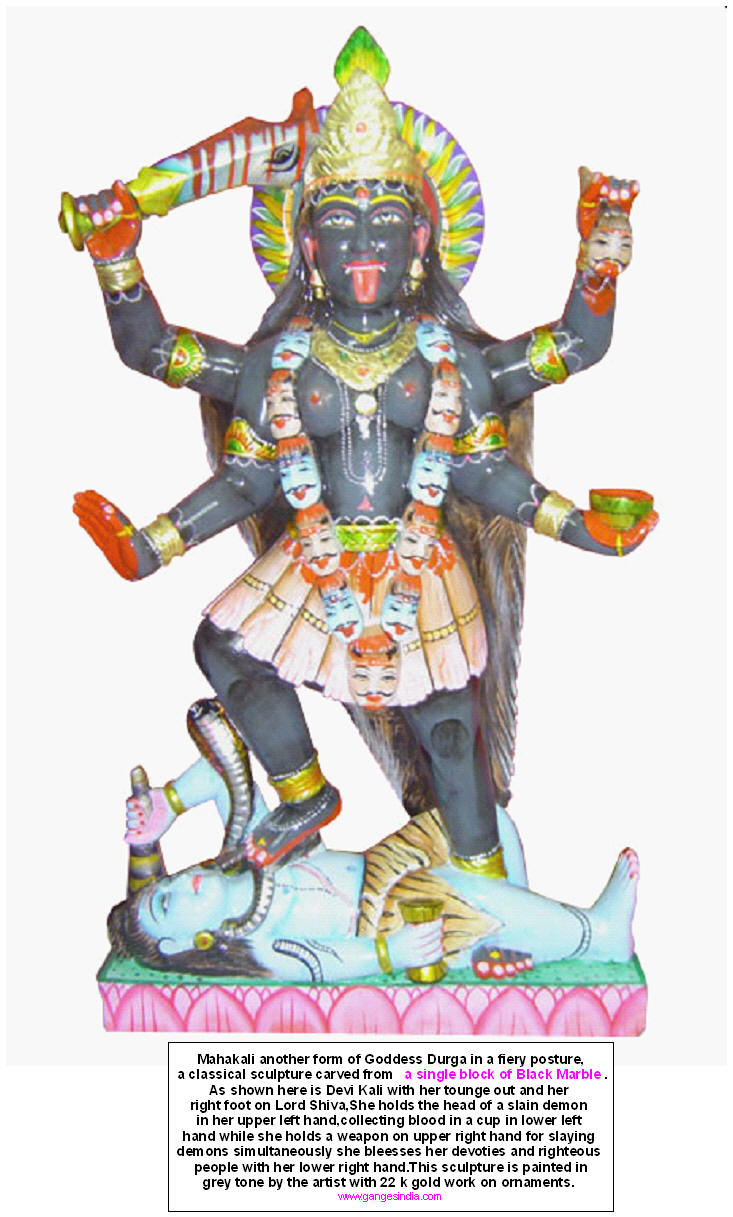

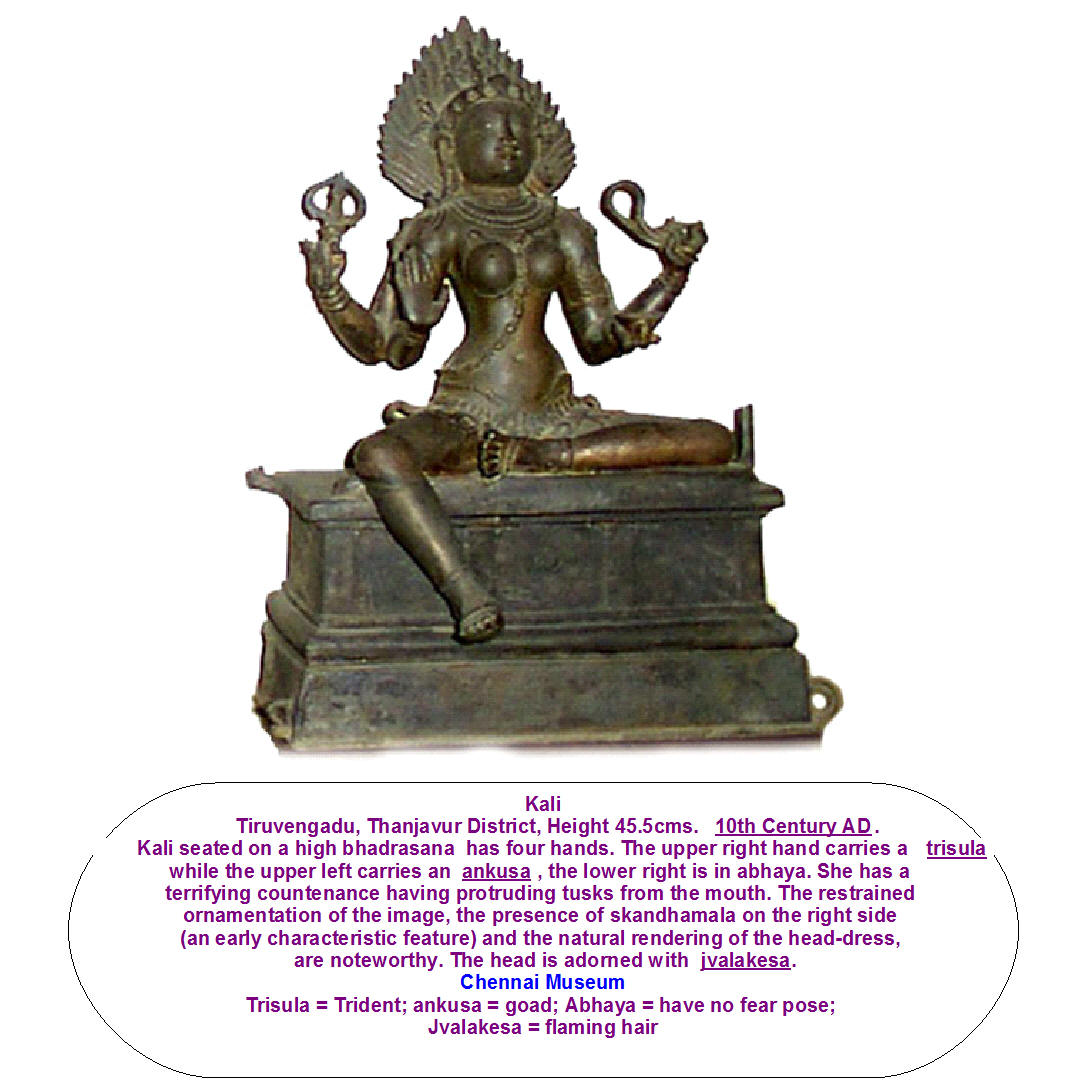
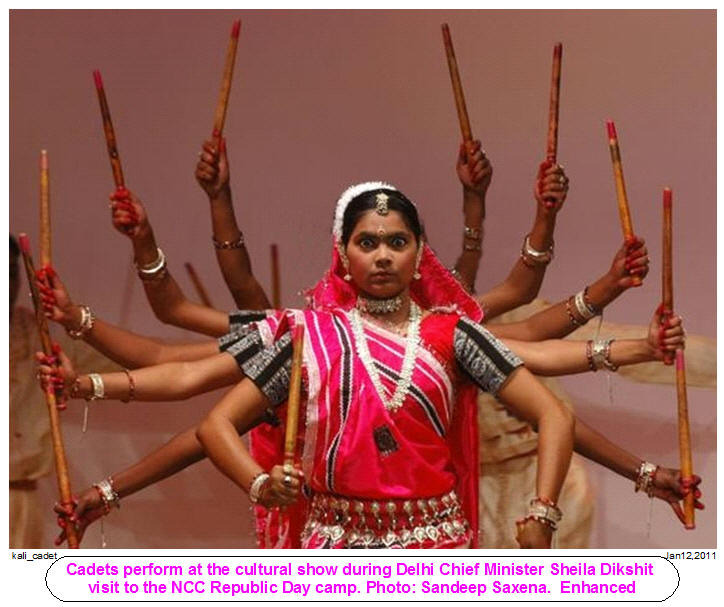

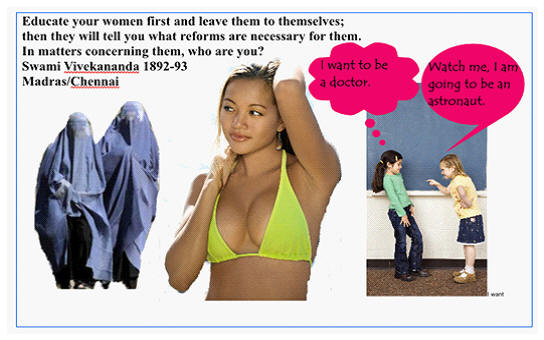
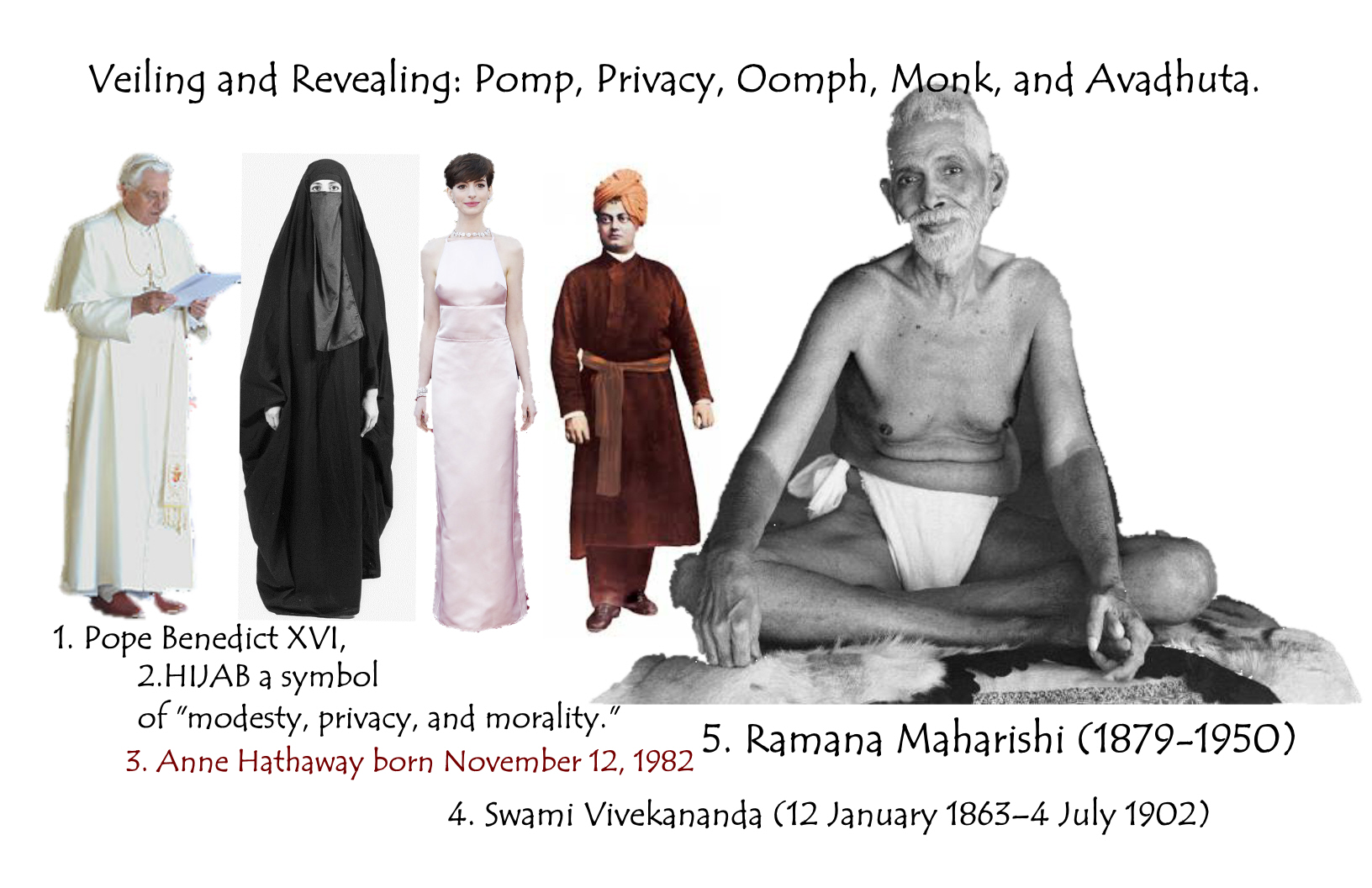
 What does a
woman want?
What does a
woman want? 
 "This
was the fulfillment of the quest for a vision of what the future
might hold, which led me and my followers to the lovely Garden
Island of Kauai, held the most sacred of all by the Hawaiian
peoples long, long ago. It is alongside the sacred Wailua River,
leading to the top of Mt. Waialeale, that this place of pilgrimage
is being built, a temple of kaivalya, granting freedom from the
past and a vision for the future. The temple's 700-pound
50-million-years-in-the-making crystal icon is a kalpaka
(spiritual wish-fulfilling) ever-giving Sivalingam. So many
blessings await each pilgrim. None are ever neglected.
"This
was the fulfillment of the quest for a vision of what the future
might hold, which led me and my followers to the lovely Garden
Island of Kauai, held the most sacred of all by the Hawaiian
peoples long, long ago. It is alongside the sacred Wailua River,
leading to the top of Mt. Waialeale, that this place of pilgrimage
is being built, a temple of kaivalya, granting freedom from the
past and a vision for the future. The temple's 700-pound
50-million-years-in-the-making crystal icon is a kalpaka
(spiritual wish-fulfilling) ever-giving Sivalingam. So many
blessings await each pilgrim. None are ever neglected.

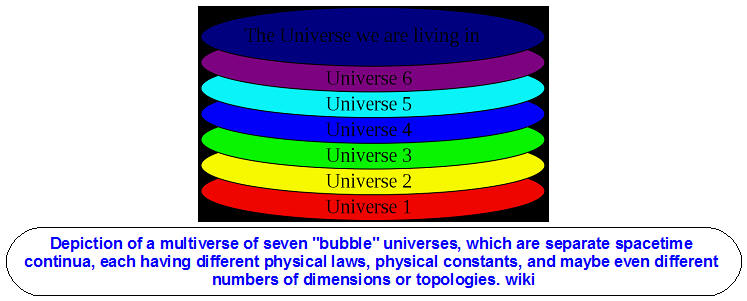
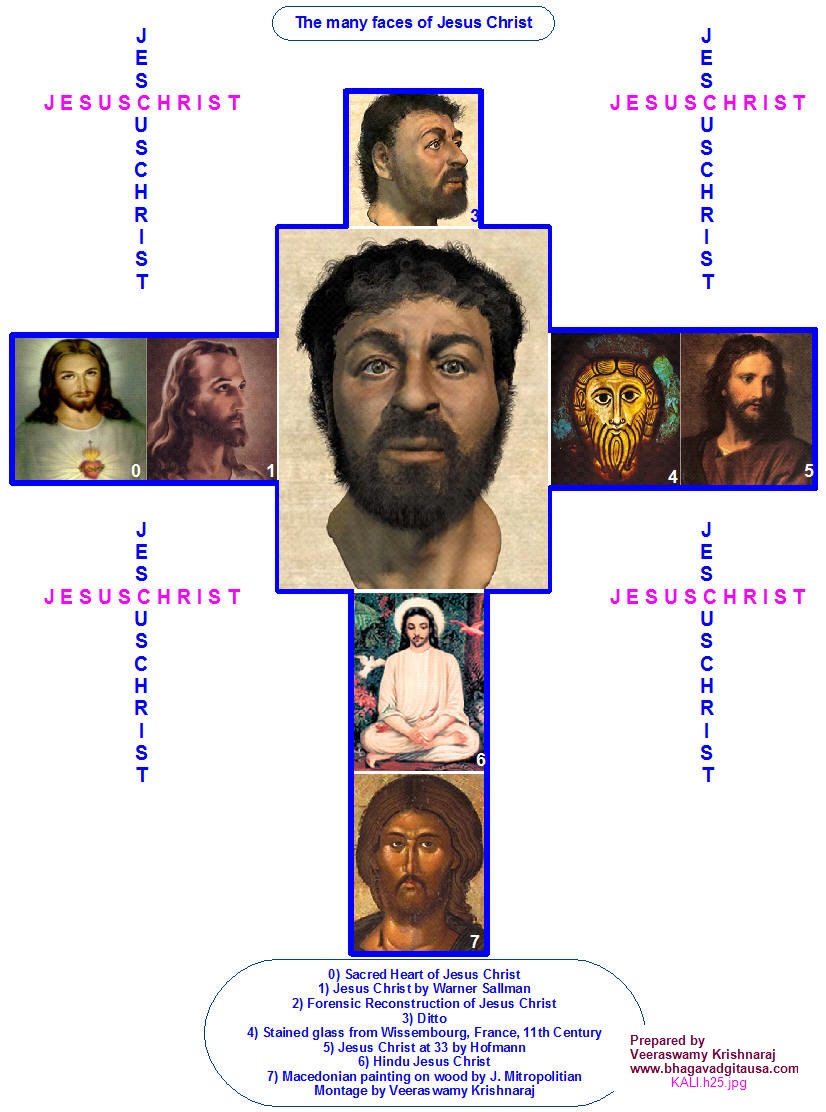

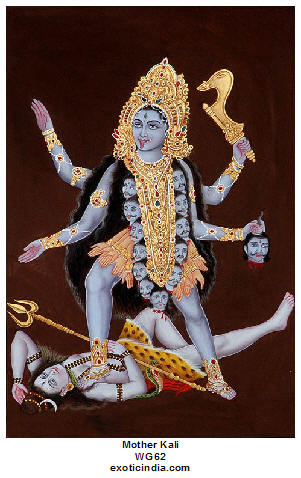
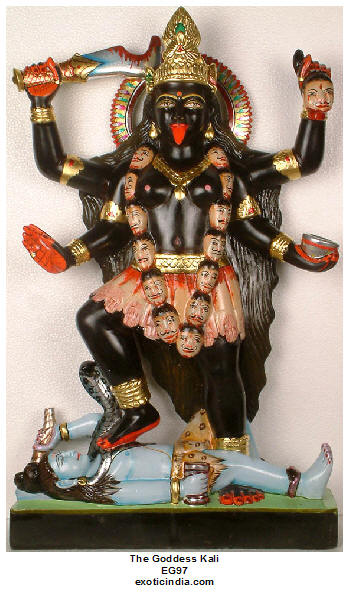
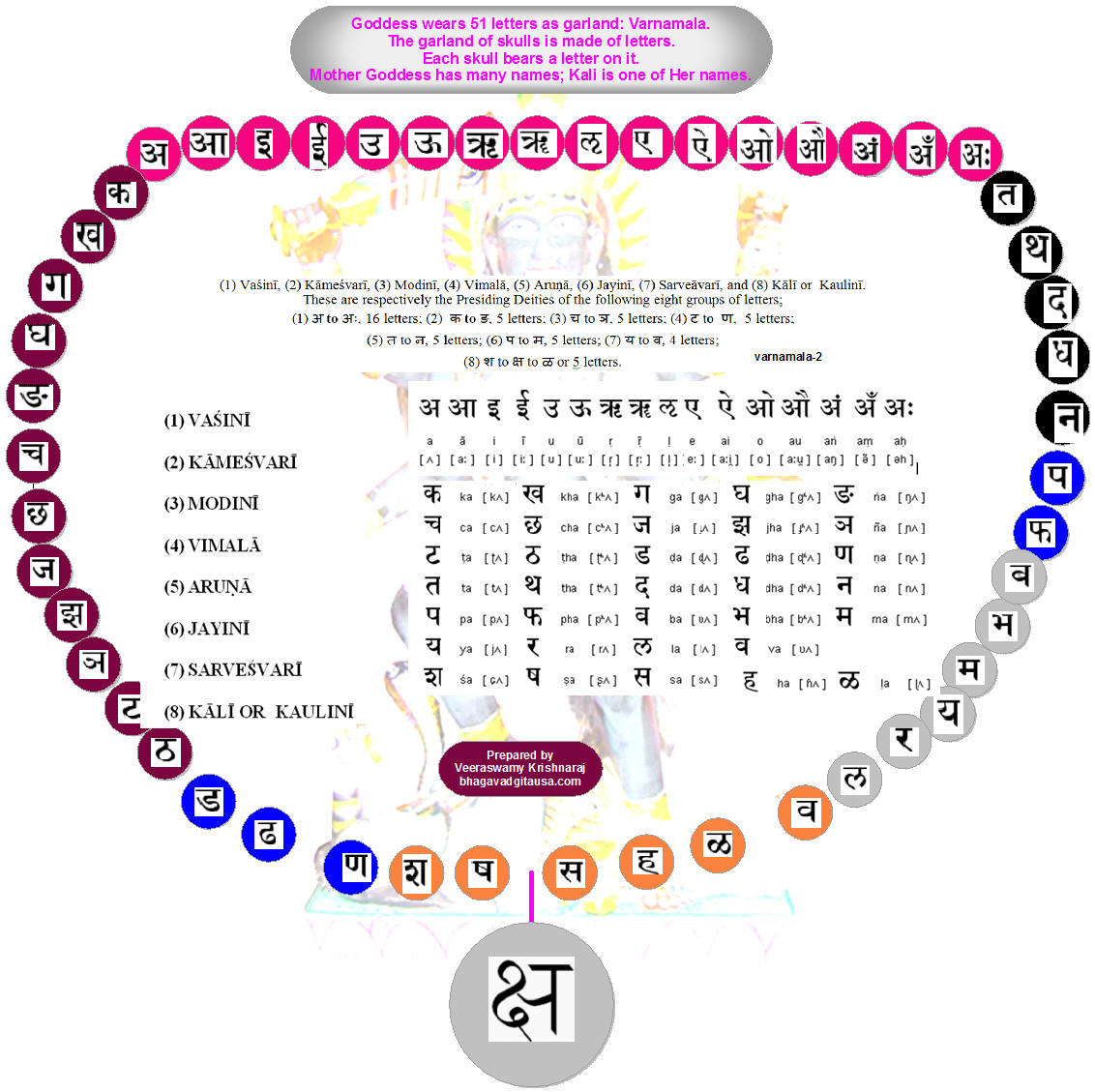
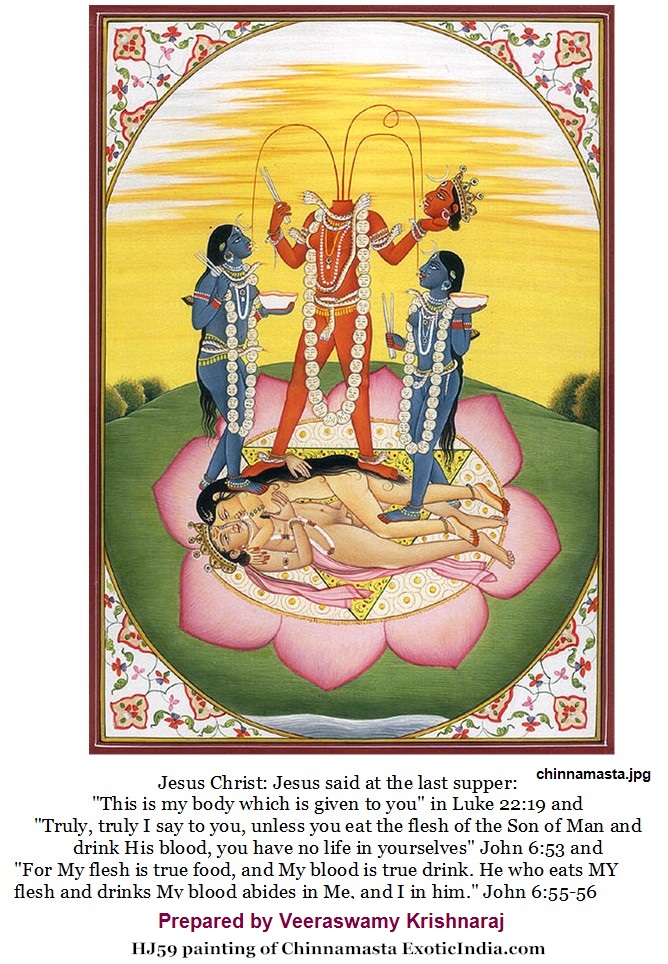
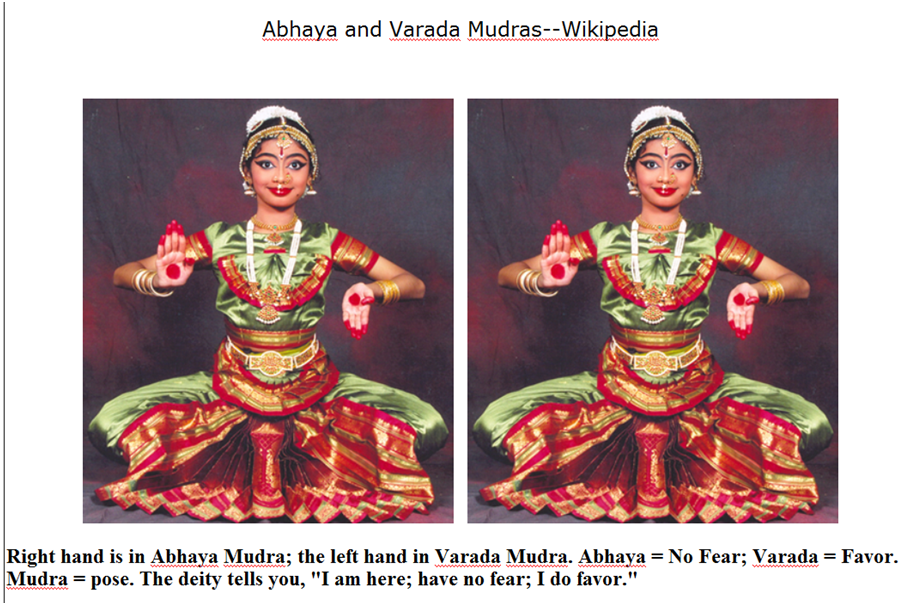
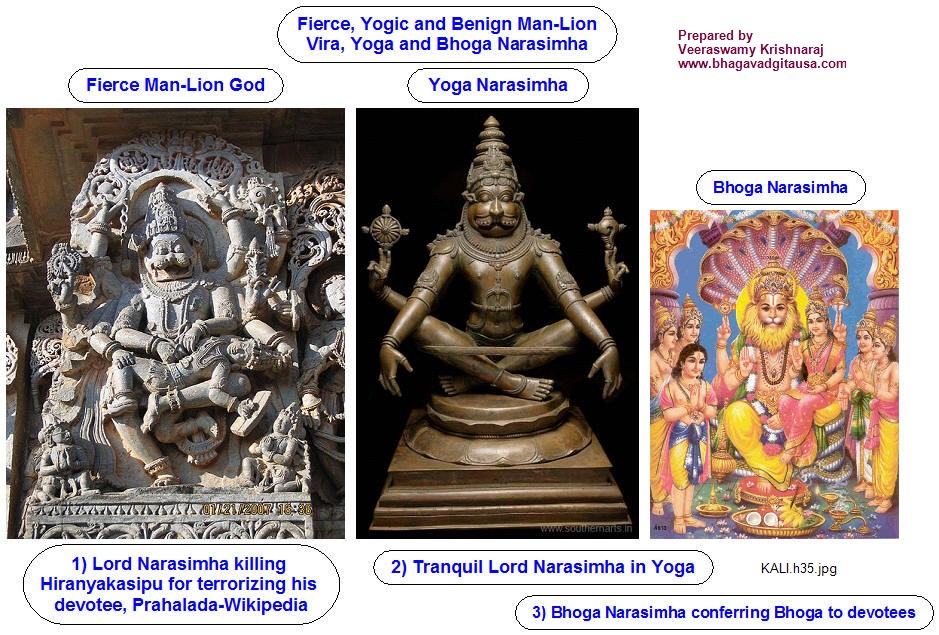
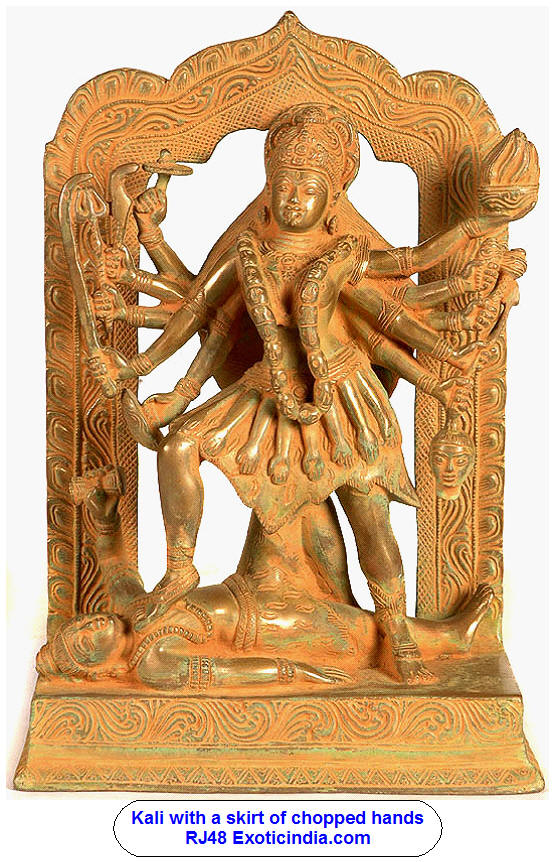
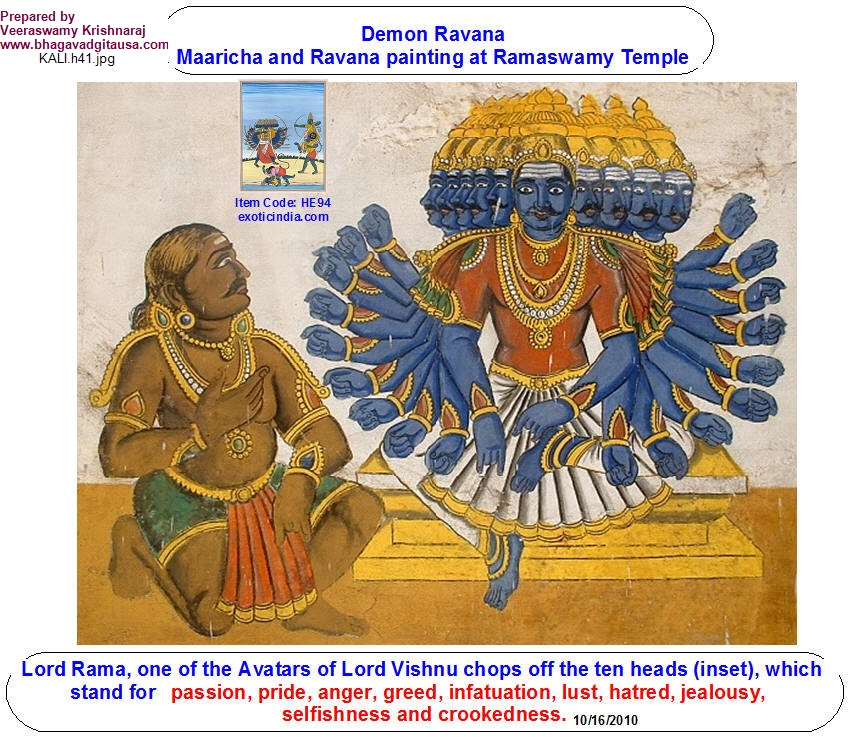
 You
should also look at the deity as to her seat. In this depiction, the
Goddess is in a post-war tranquility, ready to confer benediction to her
devotees. The weapons are held but not used in this image. If the deity is
sitting on a lion or tiger with body parts strewn all around, she is not
there to entertain us in a circus. She means business --decapitation and
is ready to take down the demons in us. If the deity has many arms
and holds conch, discus, bow, shield, sword, bell, noose and trident in
assault mode, you should know she is on a war path to destroy the demons
(in us). See the weapons on her hands and accouterments. When she
launches the smart weapon the discus from her uppermost right arm, no
demon can keep his greedy or evil head safe on his shoulders. In Hindu
mythology, discus is a smart weapon. Once it is launched, the discus spins
like a meat slicer, makes midcourse corrections, and pursues the victim
everywhere until the head rolls. Look at the trident, the club....
Before She launches the weapons and after She emerges victorious, She
blows her conch, (and sings at a 'Hootenanny.'-- I just made it up.).
You
should also look at the deity as to her seat. In this depiction, the
Goddess is in a post-war tranquility, ready to confer benediction to her
devotees. The weapons are held but not used in this image. If the deity is
sitting on a lion or tiger with body parts strewn all around, she is not
there to entertain us in a circus. She means business --decapitation and
is ready to take down the demons in us. If the deity has many arms
and holds conch, discus, bow, shield, sword, bell, noose and trident in
assault mode, you should know she is on a war path to destroy the demons
(in us). See the weapons on her hands and accouterments. When she
launches the smart weapon the discus from her uppermost right arm, no
demon can keep his greedy or evil head safe on his shoulders. In Hindu
mythology, discus is a smart weapon. Once it is launched, the discus spins
like a meat slicer, makes midcourse corrections, and pursues the victim
everywhere until the head rolls. Look at the trident, the club....
Before She launches the weapons and after She emerges victorious, She
blows her conch, (and sings at a 'Hootenanny.'-- I just made it up.).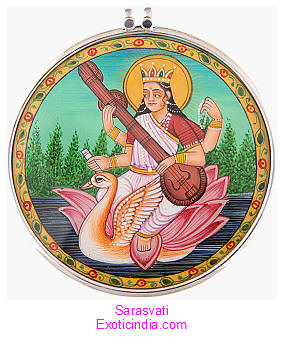 If she
is sitting or standing on a lotus flower without weapons, you know that
she is well disposed and ready to reward the virtuous or her votaries. If
she is holding the book, she is the most learned goddess in the universe.
Don't even think or try to outwit Her. She can bring you down in a trice.
Just praise and pray to her so she may give you the boon of knowledge.
Sarasvati sitting on the swan is the
Goddess of arts and learning. It is a common sight in India that students
pray to Sarasvati (and also Lord Ganesa-the Lord of new beginnings) for
success in their studies. With the left upper arm, she rolls the prayer
beads. With the left lower arm and the right upper arm she plays stringed
instrument. She has a paper roll getting ready to read between rolling the
beads and plucking the strings. At the same time she can ride her swan
too. I can't chew gum and walk at the same time. With that kind of
multitasking, Sarasvati is inimitable and at the same time looks out for
the devotee ready to confer boons. Deity sporting many hands is not a
physical anomaly as some alien religions say but a depiction of Her or His
many attributes. Have you seen two tongues in a double-tongued? Have you
seen the tail in a person who drags his tail?
If she
is sitting or standing on a lotus flower without weapons, you know that
she is well disposed and ready to reward the virtuous or her votaries. If
she is holding the book, she is the most learned goddess in the universe.
Don't even think or try to outwit Her. She can bring you down in a trice.
Just praise and pray to her so she may give you the boon of knowledge.
Sarasvati sitting on the swan is the
Goddess of arts and learning. It is a common sight in India that students
pray to Sarasvati (and also Lord Ganesa-the Lord of new beginnings) for
success in their studies. With the left upper arm, she rolls the prayer
beads. With the left lower arm and the right upper arm she plays stringed
instrument. She has a paper roll getting ready to read between rolling the
beads and plucking the strings. At the same time she can ride her swan
too. I can't chew gum and walk at the same time. With that kind of
multitasking, Sarasvati is inimitable and at the same time looks out for
the devotee ready to confer boons. Deity sporting many hands is not a
physical anomaly as some alien religions say but a depiction of Her or His
many attributes. Have you seen two tongues in a double-tongued? Have you
seen the tail in a person who drags his tail?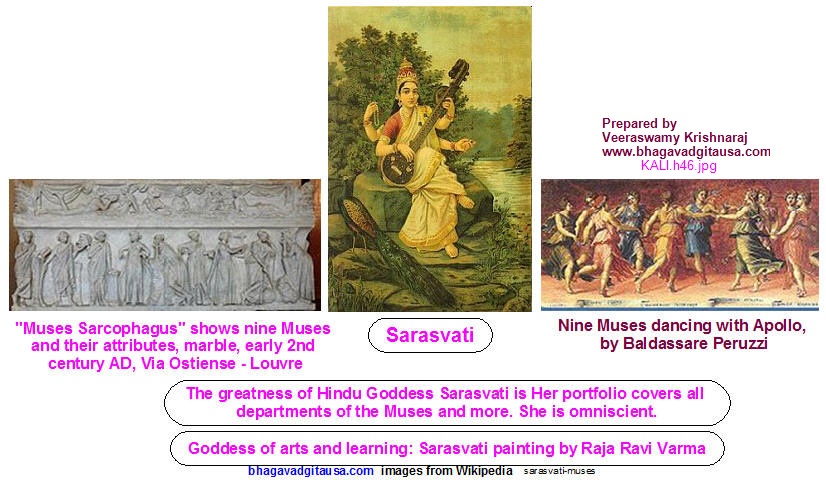
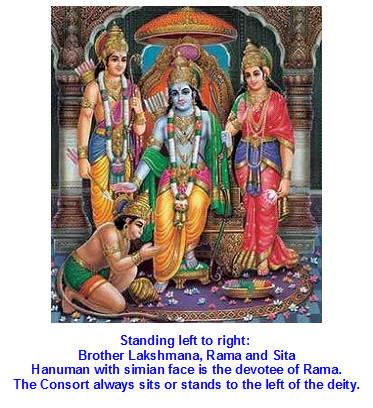 offering her blessings
and protection. If the hand is pointing to her foot, it means, you should
offer obeisance, and worship her feet to receive favors. If the God is
holding weapons in a family depiction (Ram Parivar = Family of Rama), look
at the weapons. If the bow is not drawn and remains untaut with the arrows
in the quiver, it is a post-war tranquility, benign nature and offering of
protection. The situation is like a nation parading its potent weapons for
the people and the visiting foreign dignitary to see, enjoy and feel the
might of the nation. It is also a public announcement to the existing,
prospective and recalcitrant enemies, "Don't mess with us."
offering her blessings
and protection. If the hand is pointing to her foot, it means, you should
offer obeisance, and worship her feet to receive favors. If the God is
holding weapons in a family depiction (Ram Parivar = Family of Rama), look
at the weapons. If the bow is not drawn and remains untaut with the arrows
in the quiver, it is a post-war tranquility, benign nature and offering of
protection. The situation is like a nation parading its potent weapons for
the people and the visiting foreign dignitary to see, enjoy and feel the
might of the nation. It is also a public announcement to the existing,
prospective and recalcitrant enemies, "Don't mess with us." 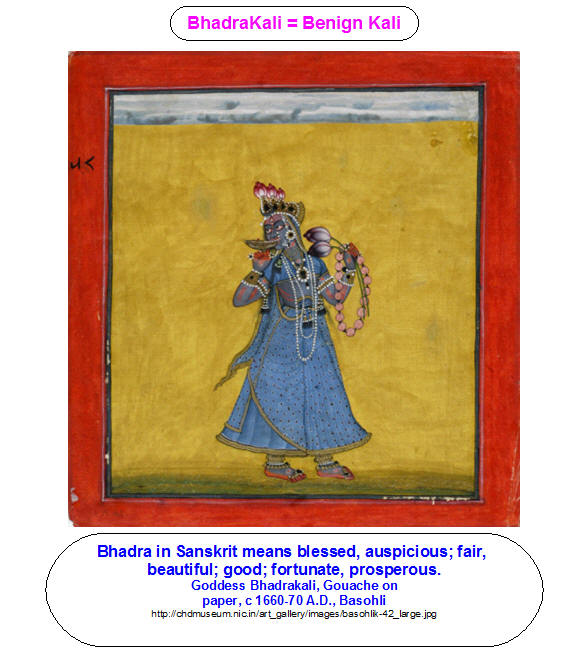 Kali, the
wife of Siva has many names: Gauri, Parvati, Uma.... When
polynomial Parvati is with Siva, she has only two hands. By Herself, she
has four hands. In her two-handed form, she is all dolled up sitting or
standing on a lotus flower pedestal to the left of Siva or Siva-linga
and holding a blue lily in the right hand with the left hand hanging
down loose gracefully. There are variations of this theme. In the
four-handed pose, She holds a flower in each of the upper hands with the
lower hands in Abhaya and Varada poses (Fear-not and boon postures). See
here Bhadrakali, a benign goddess.
Kali, the
wife of Siva has many names: Gauri, Parvati, Uma.... When
polynomial Parvati is with Siva, she has only two hands. By Herself, she
has four hands. In her two-handed form, she is all dolled up sitting or
standing on a lotus flower pedestal to the left of Siva or Siva-linga
and holding a blue lily in the right hand with the left hand hanging
down loose gracefully. There are variations of this theme. In the
four-handed pose, She holds a flower in each of the upper hands with the
lower hands in Abhaya and Varada poses (Fear-not and boon postures). See
here Bhadrakali, a benign goddess.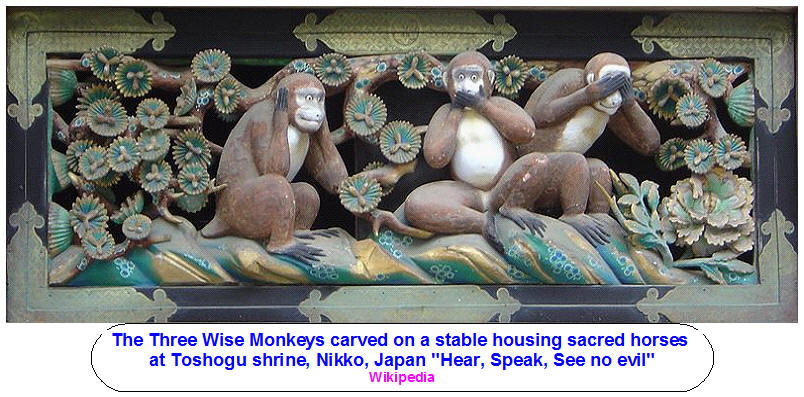
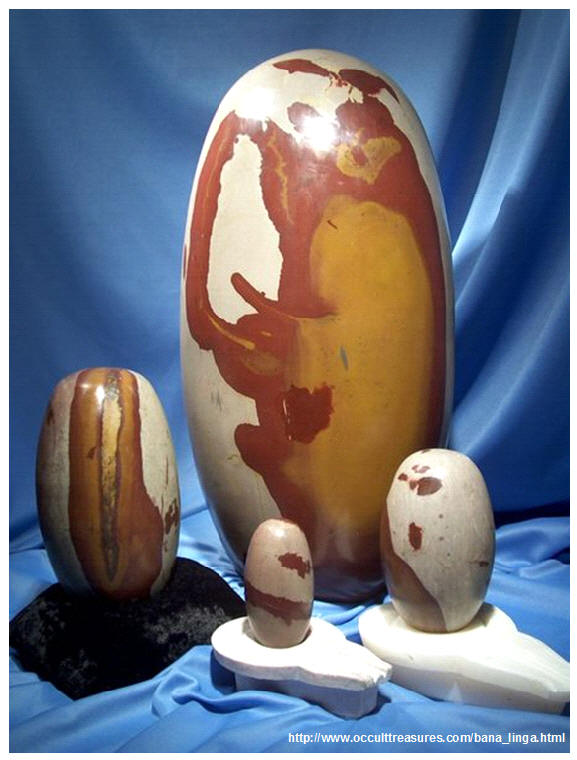
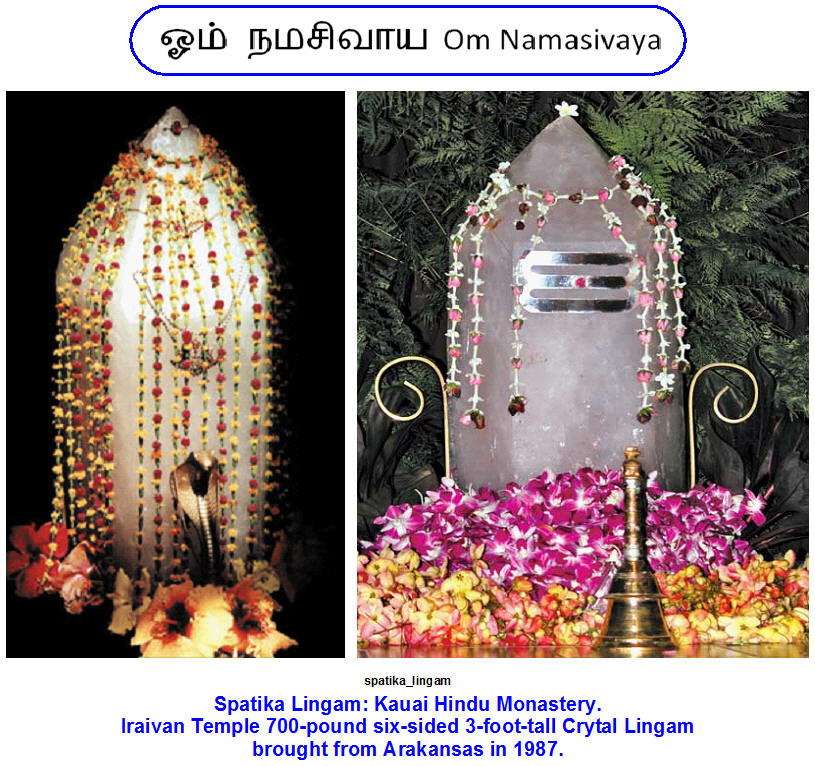
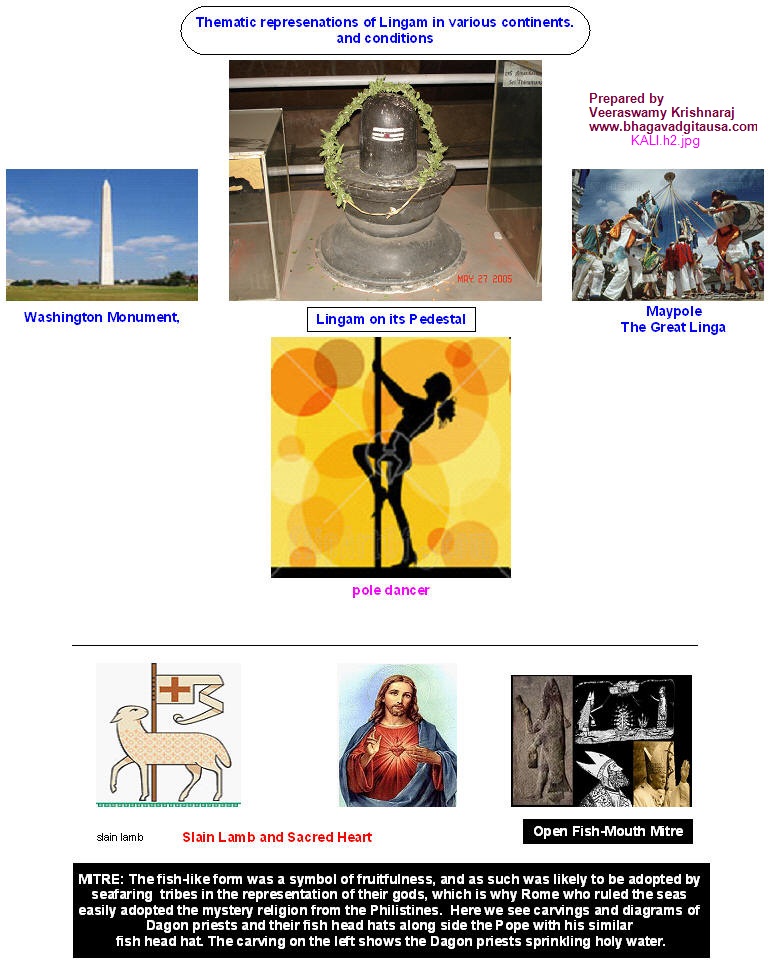

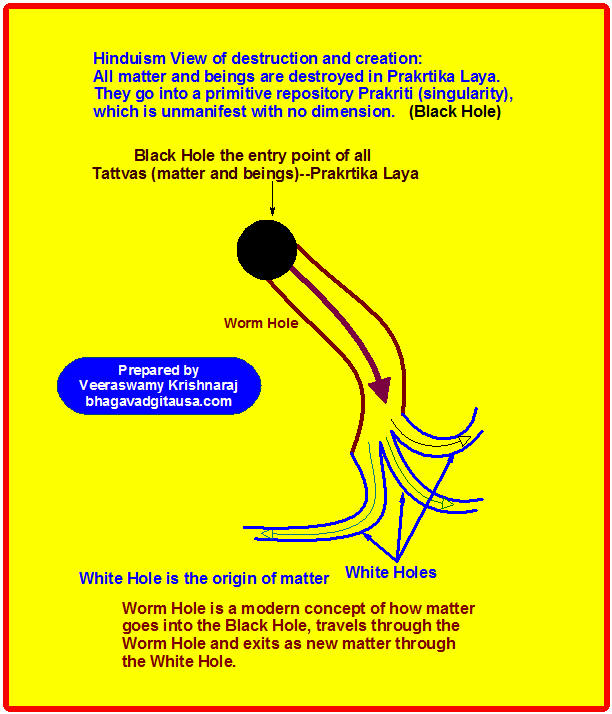
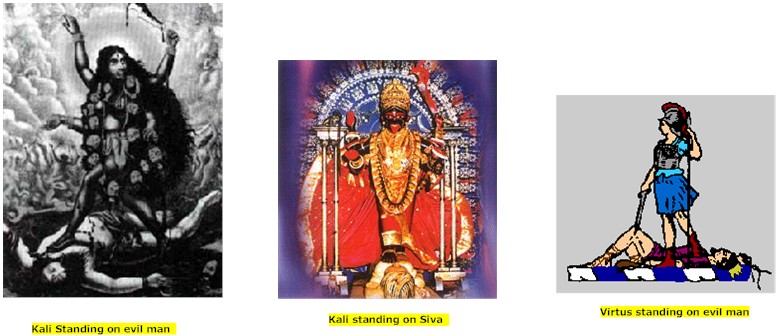
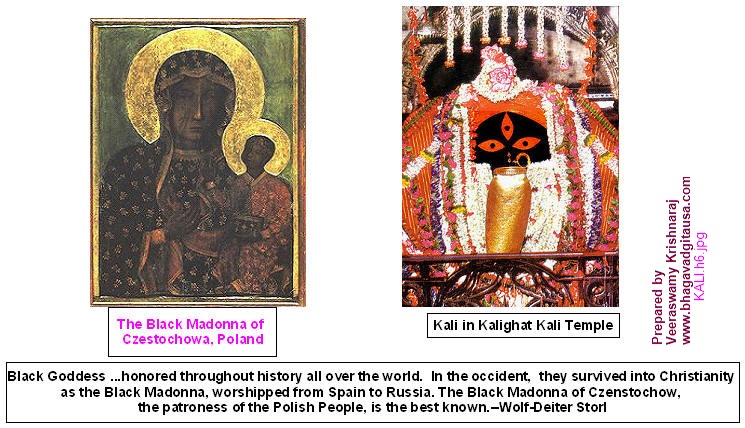

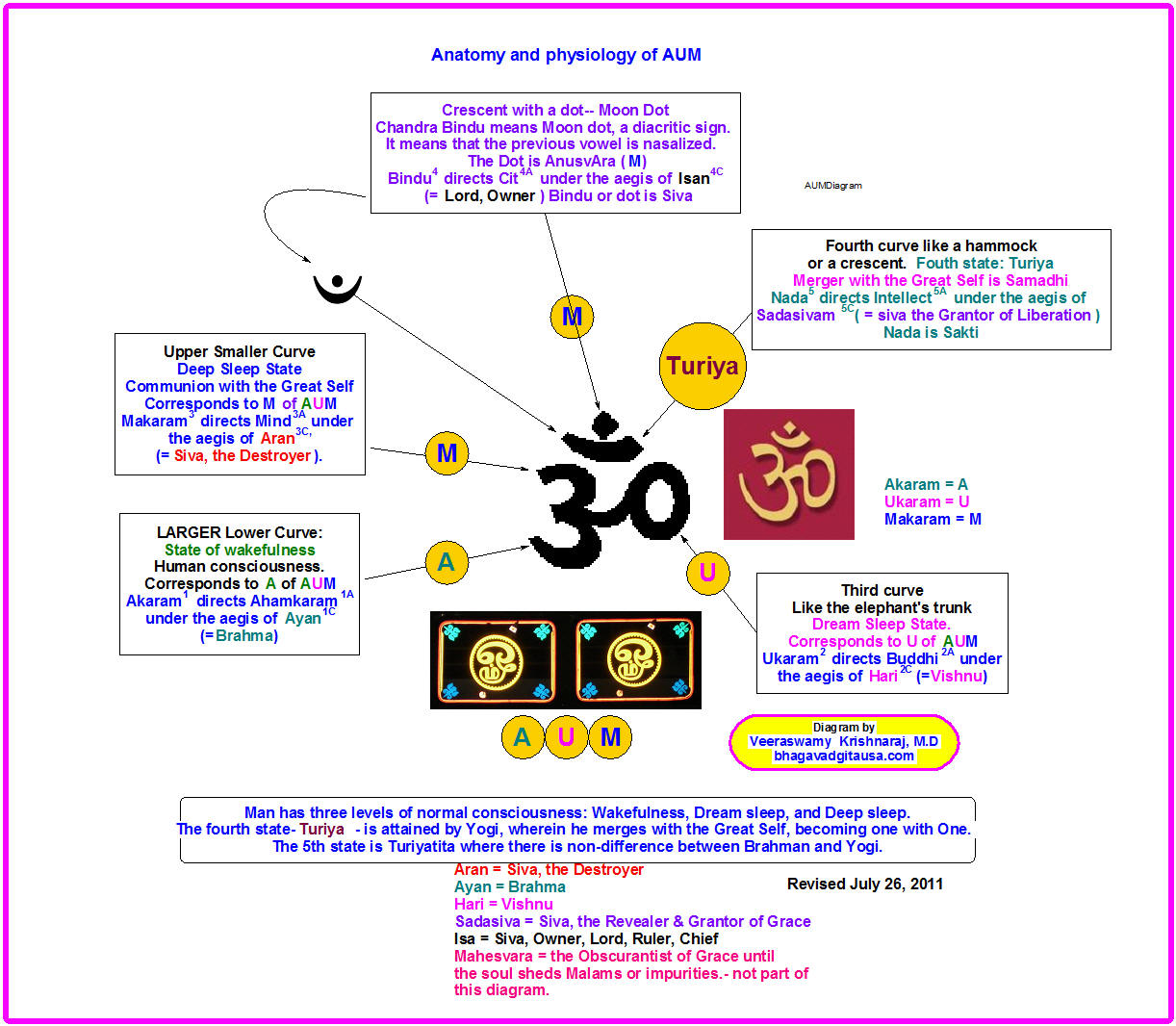

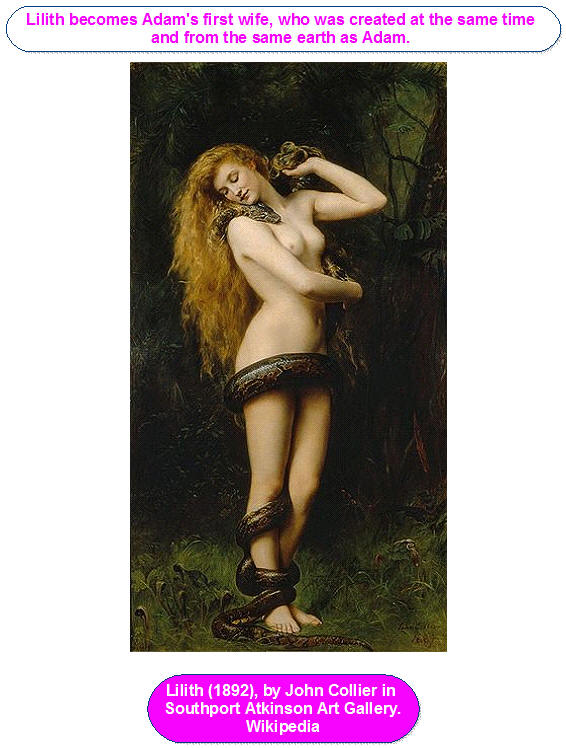
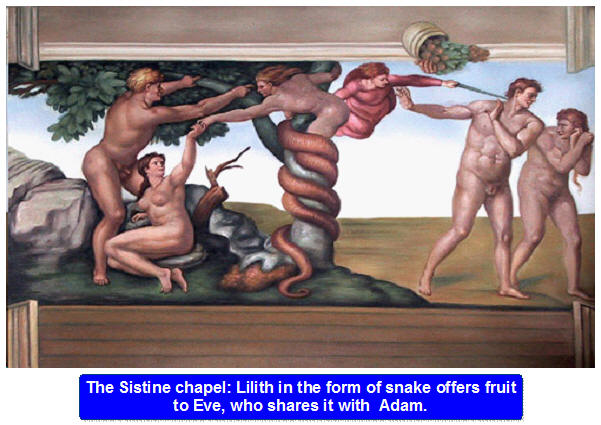
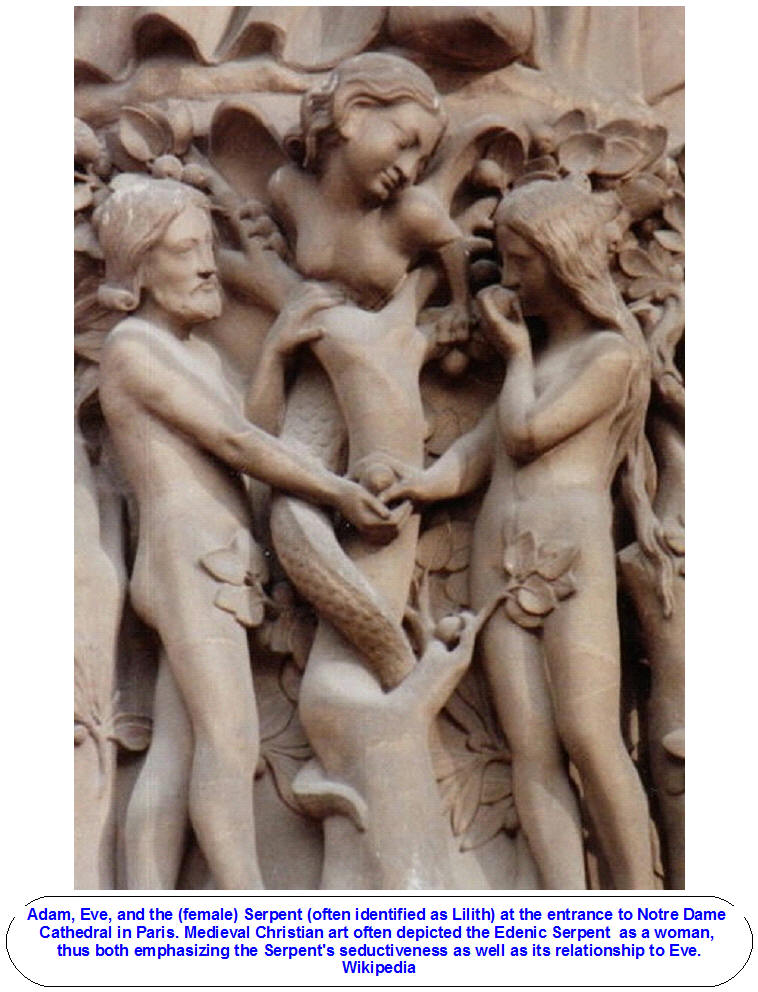
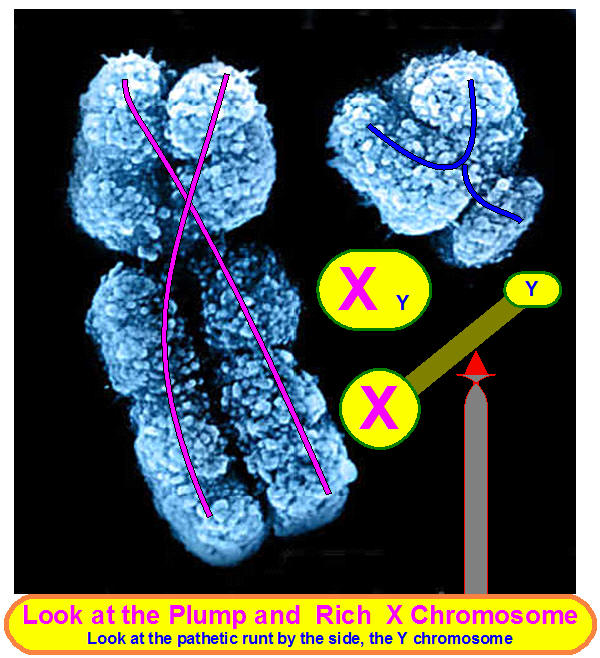
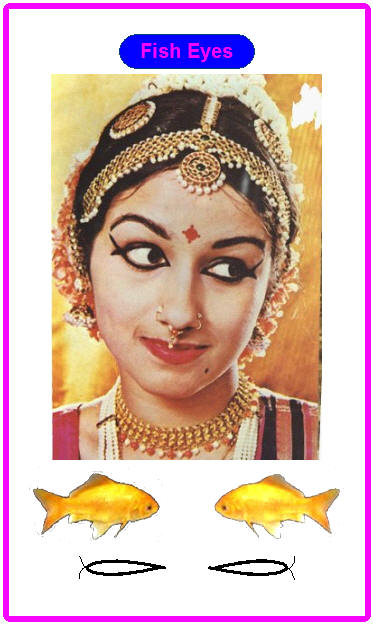 e
was no RollingStone to record and report the event. June 2010.) The people
have no idea of the number of cows the girl's father has added to his
cowshed. No gumshoeing [He chewed gum too!] village sleuth was allowed
near the stable for a head count. The man is happy that he drove a hard
bargain and won an eight cow woman8
(for four cows) with whom he is in passionate love. Bargain is beautiful.
Shorting is sweet. He would not have a nine cow woman as wife, because he
does not like the idea of other men taking a bite at a luscious woman with
their lascivious eyes. His mother wished she had a one cow daughter-in-law
so that she had somebody help her in daily chores around the kitchen and
the house instead of spending time in front of a mirror. The women in the
village could not stand the bride's company, because their husbands were
ogling the eight cow woman, instead of working in the fields. The husbands
were jealous because the women were glancing the
e
was no RollingStone to record and report the event. June 2010.) The people
have no idea of the number of cows the girl's father has added to his
cowshed. No gumshoeing [He chewed gum too!] village sleuth was allowed
near the stable for a head count. The man is happy that he drove a hard
bargain and won an eight cow woman8
(for four cows) with whom he is in passionate love. Bargain is beautiful.
Shorting is sweet. He would not have a nine cow woman as wife, because he
does not like the idea of other men taking a bite at a luscious woman with
their lascivious eyes. His mother wished she had a one cow daughter-in-law
so that she had somebody help her in daily chores around the kitchen and
the house instead of spending time in front of a mirror. The women in the
village could not stand the bride's company, because their husbands were
ogling the eight cow woman, instead of working in the fields. The husbands
were jealous because the women were glancing the