

|
Bhagavad-Gita: 18 Chapters in Sanskrit |
| Download Bhagavadgita-all 18 chapters in Sanskrit, English, |
| transliteration and word for word translation. |
Bhagavadgita Pages in English, Chapters 1 to 18
| bg07-Sanskrit | bg10-Sanskrit | bg11-Sanskrit | bg12-Sanskrit | ||
| bg13-Sanskrit | bg14-Sanskrit | bg15-Sanskrit | bg16-Sanskrit | bg17-Sanskrit | |

V.Krishnaraj
You have your Google search engine tailored for this site.
Please enter the word(s) in the search box; it will take you to the file with that word in this web site. Enjoy your visit here.
Contact Feedback Form

Veeraswamy Krishnaraj.
BGALLCOLOR.pdf 3181.08KB (3257428 bytes)
The above file has all 18 chapters of Bhagavadgita in Sanskrit, Transliteration, colorized words for easy identification, word 4 word translation, superscription of words, rearrangement of words in a readable form in English. This is the best you can get on the internet in one file. It is free.
|
Sample Verse श्रीभगवानुवाच अभयं सत्त्वसंशुद्धिर्ज्ञानयोगव्यवस्थितिः । दानं दमश्च यज्ञश्च स्वाध्यायस्तप आर्जवम् ॥१६- १॥
śrībhagavān uvāca: abhayaṁ sattvasaṁśuddhir jñānayogavyavasthitiḥ
śrībhagavān uvāca:
abhayam1 sattva-saṁśuddhiḥ2 jñāna-yoga-vyavasthitiḥ3 śrībhagavān uvāca = Sri Bhagavan said: abhayam1 = fearlessness; sattva-saṁśuddhiḥ2 = purity of the mind; jñāna-yoga-vyavasthitiḥ3 = steadiness in Yoga of knowledge; dānam4 = charity; damaḥ5 = self-control [of organs]; ca6 = and; yajñaḥ7 = sacrifices; ca8 = and; svādhyāyaḥ9 = study of the scriptures; tapaḥ10 = austerity; ārjavam10 = rectitude... 16.1 continued. 16.1: Sri Bhagavan said: Fearlessness, purity of mind, steadiness in yoga of knowledge, charity, self-control, sacrifice, study of scriptures, austerity, rectitude, (continued)... |
Narayaneeyam

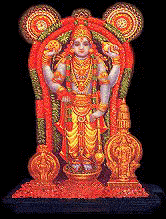
Four Handed Lord Vishnu
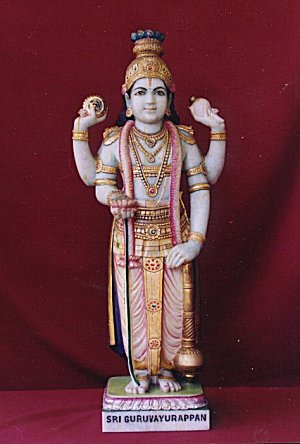
Depiction of Vishnu as the Lord of Guruvayur
Narayana Bhattatiri (1560 C.E.), the author of Narayaneeyam, came from a distinguished South Malabar family of Brahmana poets, scholars and Bhaktas. Bhatta is the honorific title of a learned Brahmana. Bhattacharya and Bhattatiri have similar import. He married early in life to the daughter of Acyuta Pisaroti, who recognized the lad's talent and taught him Vyaakarana (Grammar). He had teachers, Madhavacharya for Vedas and Damodara for Taraka. Pisaroti (Pisharady) and Narayana Bhattatiri suffered from a similar joint and or paralytic disease; it is presumed that the student took his teacher's disease by Āvāhana (Invitation, invocation). Many physicians treated him to no avail and the story goes like this. (Could it possible that they had paralytic polio with joint contractures? It appears that many were afflicted with paralysis and joint disease at that time. This combination suggests paralytic polio. Many recover from paralytic polio and some end up with paralysis and joint contractures.) NB sent a messenger to a scholar and poet about his illness and the latter wrote a cryptic note, "eat with fish." NB took it to mean that he should write eulogies on Narayana starting from his Fish incarnation. Thus, the journey to Guruvayur and composition of Nārāyanīyam began. The work is an epitome of Bhagavata Purana and consists of 1036 verses. The date of completion of Narayaneeyam was Nov 27, 1586.
A variation of the story says that NB composed NArAyaneeyam after he contracted the disease; he thanked his disease for inducing him to write the composition. Later only, he paid his second homage to Bhagavan.
Guruvayur Sri Krishna Temple's history goes into the mist of antiquity and it stands 25 km north-west of Trichur in Kerala state. Guru-Vayu-Pura-Mahatmyam in Sanskrit, part of Narada Purana, contains mention of its antiquity. Legend has it that the temple is more than 5100 years old; the idol hewn out of black stone is much older. The legend dates it back to Dwapara Yuga. The chief architect was Visvakarma at Guruvayur. The town took the name of Guruvayur after Guru (Brhaspati) and Vayu who brought the idol to shores of the Lotus Lake, now known as Arattu-kulam (Bathing pond). Being the first worshipper, Brahma at the beginning of Padma Kalpa began worshipping Krishna. (Visvakarma is the celestial architect for the gods.)
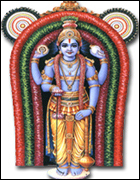
The Guruvayur Temple in Kerala depicts Krishna [Krishnavathara]
as he appeared to Vasudeva and Devaki at the time of His birth on this earth
with four arms carrying the conch, the discus, the mace, and the lotus, Tulsi
garland and pearl necklace. This is the effulgent and majestic form of
MahaVishnu. Guruvayur is so sacred that it is considered the Vaikunta on earth (Bhuloka
Vaikunta) with MahaVishnu appearing with four hands.
When Krishna departed to Vaikunta after his sojourn on earth, Dwaraka was swallowed by the sea. (Now that we know that tsunami waves --Dec 2004 dealt a heavy blow to mostly the coast of Tamil Nadu and Andhra, it is possible that Dwaraka was swallowed up by some cataclysmic event. To this list of victims we have to add Mahabalipuram in Tamil Nadu. Or it could be that the oceans rose from global warming.) Uddhava, an old man, devotee, friend and counselor of Krishna during Krishna's Dwaraka days was left behind when Krishna ascended to Vaikunta. Uddhava saved the image of Narayana (Krishna with four hands), according to Brhaspati, the preceptor of gods. Mahavishnu Himself worshipped the idol in Vaikuntham. Varuna, the sea-god swallowed the image and tossed it everywhere by its waves; the sea receded; the image, worshipped for 100 years in Dwaraka, was recovered and the wind-god took it on his head and Brhaspati and Vayu began their journey to find a home for the image. During their wandering all over India, they met Parasurama who chose a place for the idol near a Lotus Lake, where Siva and Parvati welcomed the Guru and Vayu. The idol was named Guru-Vayu-r-Appan (Guru-Vayu-the Father or Lord--the Lord of Guruvayur). According to the legend, Siva named the place Guruvayur to honor Guru Brhaspati and his disciple Vayu. Siva and Parvati having ceded their site for the installation of the idol, moved to the opposite bank of the lake and had a temple of their own, Mamiyur temple. Before Dwaraka had the idol of Mahavishnu-Krishna, many hands were in possession of the idol from the time Mahavishnu gave it to Brahma in the first Brahma Kalpa: Sutapas, Kasyapa, Vasudeva, Krishna, Uddhava, Brhaspati and Vayu and lastly Guruvayur. Sutapas and Prsni , Kasyapa and Aditi, and Vasudeva and Devaki over generations served as parents of Vishnu in many forms: Sutapas and Prsni gave birth to Vishnu in the form of Prsnigarbha, Kasyappa and Aditi to Vamana, and Vasudeva and Devaki to Krishna, who installed the idol in Dwaraka, consecrated and worshipped it after the demise of Vasudeva and Devaki.
(Kalpa = a thousand cycles of Mahayugas; go to BG08 for more details on Yugas and Kalpas.)
The idol in Guruvayur according to the legend is neither Svayambhuva nor an artifact made by human hand. It is a Vigraha (life-like image) of Narayana carved out of stone, PAthAla Anjanam (subterranean dark-colored stone). Anjanam = அஞ்சனம் == அஞ்சக்கல் == Sulphuret of anitmony, black bismuth. His form in the temple is called Divyakaisoravesham (Divine boy form---10-15 years of age). Devotees feel the Chaitanya (Divine Cosmic Consciousness or Intellect) in the temple. This Chaitanya is pure innocence of child Krishna. The High Priests (Melsanthi) of the temple in sacred deference to worship of Child Krishna remain in temple premises in voluntary celibacy for a period up to 6 months.
The Lord of Guruvayoor is easy to please; His appearance is one of puerile levity of divine kind, quick forgiveness, and liberal munificence. Sankaracharya composed Govindashtakam and Bhajagovindam when he was on a visit to Guruvayur.
The present is Sveta Varaha Kalpa (White Boar Kalpa), meaning that Vishnu in his incarnation as White Boar lifted the earth from the netherworld Rasatala after Hiranyaksa hid it there. In the present Kali Yuga of 432,000 years, 5000 years have gone by. The immediately preceding Kalpa was Padma Kalpa (Padma = Lotus).
Narayaneeyam Canto 8 V1
At the end of Mahapralaya, the first
Brahma Kalpa saw the arrival of new Brahman, who received the knowledge of the
Vedas
Table: The Yugas
|
Yugas |
Duration |
Standards |
Color |
Disposition |
|
Krita |
1,728,000 Years |
Age of Perfection |
White |
Over |
|
Treta |
1,296,000 Years |
Age of Triad |
Red |
Over |
|
Dvāpara |
864,000 Years |
Age of Doubt |
Yellow |
Over |
|
Kali |
432,000 years |
Age of Vice |
Black |
Present |
|
Maha (total) |
4,320,000 years |
AUM |
AUM |
AUM |
12 months make a day and night of the celestials; 360 such divine days make a divine year.
One Maha Yuga (4.32million years) is equal to
12,000 divine years
Brahmanda Purana (3.4.2.92-103a) states the great sages counted up to 18-digit numbers.
Dasa = 10; Satam, Parivrdha = 100; Sahasram, Paripadmaka = 1,000; Ayutam = 10,000; Niyutam = 100,000; Prayutam = 1,000,000; Arvutam, Arbudam = 10,000,000; Nyarbudam = 100,000,000; Vridam, Kharbudam = 1,000,000,000; Param = 10,000,000,000; Kharvam = 100,000,000,000; Nikharvam = 1,000,000,000,000; Sankham = 10,000,000,000,000; Padmam = 100,000,000,000,000; Samudra = 1,000,000,000,000; Antyam = 1,000,000,000,000,000; Madhyamam = 10,000,000,000,000,000; Parardham = 100,000,000,000,000,000; Para = 2XParardha = 0ne lifetime of Brahma = 311.04 Trillion mortal years of man.
Classification of Pralaya or dissolution. Dissolution comes in three ways: incidental, elemental, and absolute. See the variation in classification below.
|
Naimittika |
Prākrtika |
Atyantika
(Moksa) |
Nitya |
|
incidental
Occasional,
accidental, special, Kalpal dissolution.
|
Involution or resolution of the elements into their primitive repository, Prakriti. Marks the end of Brahma's life, 72,000 Kalpas, 100 Brahma years or 311.04 Trillion mortal (Man)years.
Involving
primordial matter |
Everlasting,
Absolute, unbroken, final
A |
Eternal or constant, everyday occurrence
|
|
Partial
dissolution |
Total Final
sublation |
Liberation of
Jiva |
Daily occurrence
|
|
Periodic with
clock-work precision |
Involution |
Liberation |
Common |
|
Accompanies
sleep cycle of Brahma. Brahma’s dissolution. Occurs by onset of Brahma’s
sleep. |
Final retrograde
involution of all elements |
An acquired
phenomenon. The Rishi and the Supreme Spirit
become one. |
Perpetual
destruction or Constant dissolution of living beings. |
|
Occasional,
special, accidental. Periodic occurrence as in sleep–wake cycle. Brahma’s
sleep is death of the universe. Being awake is life for the universe. |
Elemental. Relating to Prakrti, or the
original element, material
|
Absolute
Liberation is
final and absolute. Jiva merges with Para Brahman |
Perpetual or
Eternal |
|
This takes place
after every Brahma's day and when Brahma sleeps |
Universe traces
back to its original nature, elements. |
Attainment of
Supreme knowledge |
Extinction of
individual lives. |
|
Brahma’s sleep
phenomenon |
Primordial
Elemental state of the world |
Death as a
constant |
Transient came
life as a constant |
|
Lord
Nārāyana swallows the universe, and sleeps on a
bed of serpent in the causal ocean |
Linear
involution of all elements into primordial matter |
The absolute
non-existence of the world in the experience of the Rishi who merges with
the Supreme Spirit. |
(Bimodal
appearance and) disappearance of life and death, day and night. |
|
Bhu, Bhuvah and
Swah (this world, the space and beyond (heaven).
worlds are consumed by fire emitted by the serpent god,
Sankarsana. Since it gets too hot, Bhrgu muni
moves from Maharloka to Janaloka. |
The egg retraces
its steps back into its constituent elements, from which it formed. |
The liberation
of a human being after the dissolution of the gross and subtle bodies and
the karma reaches a zero-sum status. |
|
|
Gunas repose in equilibrium.
|
Brahma
dies |
|
|
Laya:
is the dissolution of the universe at the end of MahāYuga,
an aggregate of four Yugas. Physical world is destroyed by flood and fire. This
is followed by creation (Sristi), preservation (Sthiti)
and dissolution (Laya).
Pralaya is the dissolution at the end of a Kalpa (one day of Brahma).
Mahāpralaya is the dissolution at the end of a Mahākalpa
(a thousand MahaYugas, Brahma Laya, Naimittika Laya). Physical, subtle,
and causal worlds are destroyed or absorbed. All existence, time, space and
individual consciousness, all the lokas (worlds),
and their inhabitants return to God as waters of rivers return to the ocean.
Time Scale: Laya<Pralaya<Mahāpralaya.
There are 1000 Mahayugas in one day or Kalpa of Brahma. Fourteen Manus come and go during one Kalpa. At the end of a Kalpa, one Brahma's day (4.32 billion years), the earth is depleted of its resources. A total scarcity ensues and lasts for a hundred years. For lack of food, all beings lose their vitality, become listless and indifferent, wither and die. The eternal Vishnu transforms into Rudra and absorbs all living beings into himself. Vishnu enters the seven rays of the sun, imbibes all the waters of the earth and prompts evaporation of water from and desiccation of all animal and inanimate matter. All waters of oceans, rivers, lakes, springs and of the Patala evaporate and disappear. The seven rays of the sun thus turgid with the waters of the globe augment into seven suns whose radiant glow engulfs all and sets them on fire. The earth on account of extreme dryness looks like the back of a tortoise. Hari in the form of Rudra becomes the scorching tongue and breath (of fire) of Serpent Sesha. Patala and earth are reduced to ashes. The fires leap and spread to the upper atmosphere, domain of gods and heavens; the three worlds are reduced to cinder. The residents of these spheres move to Maharloka; later they and the residents of Maharloka unable to bear the heat move to Janaloka.
Janardhana, in the form of Rudra, consumes the world and exhales dark heavy clouds, Samvarta, which collide, roar and emit lightning. The clouds are of many colors, black like blue lotus, white as water-lily, dusk-like smoke, yellow, grayish brown like an ass, deep blue as lapis lazuli, azure like the sapphire, white as the conch or jasmine buds, black like collyrium, and bright-red like ladybird. The massive clouds assume shapes of towns, houses, mountains and columns. They pour rains for a hundred years submerging the three worlds in water and darkness; all oceans join to become one ocean. Vishnu's strong breath blowing for a hundred years disperse the clouds. The wind returns back to Vishnu who is the creator, supporter and destroyer of the universe. He goes to sleep (Yoganidra-Meditation Sleep) on the coiled bed of Sesa in the form of Brahma. (By now the saints have taken safe refuge in Janaloka.) This is called Incidental dissolution. When Brahma closes his eyes, all things fall and disappear; when he opens his eyes, all things come back to life. This incidental dissolution is also called Naimittika Pralaya, Kalpal dissolution, or intermediate dissolution.
More on Yoganidra of Vishnu and Yogis
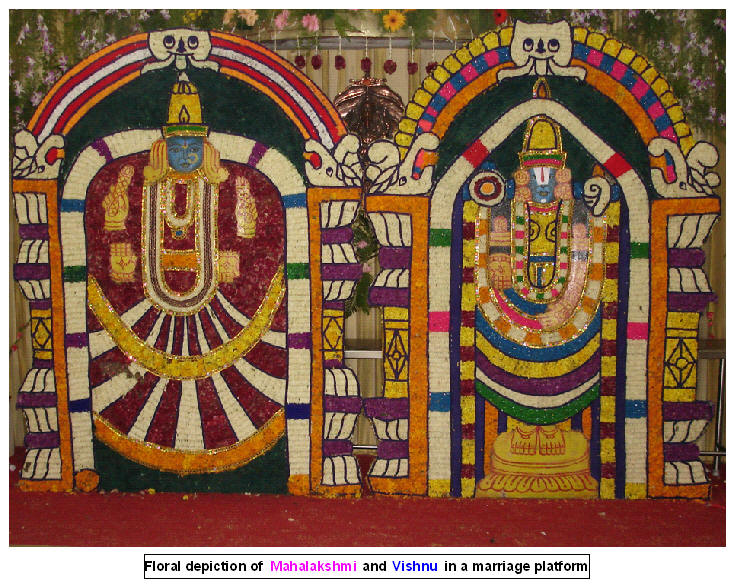
Sleep is deified and the deity associated with Yoganidra goes under several names: Parvati/Durga/Mahamaya/Devi/MahaKali or Mahalakshmi. Parvati is regarded as the sister of Vishnu and Mahalakshmi is the Consort of Vishnu. At the end of Cosmic Cycle, Mahalakshmi assumes the form of Nidra-goddess or Sleep-goddess (Nidrā, Yoganidrā, Mahāmāyā, Mahāmārī, Kşudhā, Tṛşā, Kalarātri, Durgā, Pārvati --one with several names). Vishnu goes into cosmic yogic sleep after the deluge on serpent Adisesha. Sesa means Remainder and means what remains after the world is destroyed. Vishnu sleeps in the potentially generative Cosmic ocean on what remains after destruction.
When Yoganidra remains and resides in Vishnu's eyes, it is Nimesham-closed eyes); When the sleep-goddess leaves the eyes and Vishnu, it is Unmesham or opening of eyes. Closing and opening of eyes correspond to the end of the world and the beginning of the world.
When Vishnu is in Yoganidra, a lotus sprouts from His navel and Brahma the creator was sitting inside the lotus. He looks around and finds two demons threatening to kill him. They originated from the earwax of Vishnu and emerged from His ear canal. Brahma was in a state of acute panic and begs Yoganidra to leave Vishnu, so that Vishnu would wake up, kill the demons (Madhu and Kaitabha), and let him start his work of creation. Vishnu wakes up as the sleep-goddess leaves, kills the demons and bids Brahma to create the world.
At microcosmic human level of Yoganidra, the Yogi retains the full power of mental faculties while simultaneously withdraws from the stimuli of the outer world.
Elemental dissolution entails the breakdown of Mahat and its distal products by the Will of Krishna; scarcity and fire consuming the worlds including the netherworld marks its beginning. According to the theory of Tanmatras, earth has the property of smell; water absorbs the smell of the earth meaning that the earth loses its integrity and becomes one with water like dissolved minerals (slurry-liquefaction--water-saturated soil as in earthquakes). The waters of the worlds swell from the load of "smell," overruns and submerges everything in its path. Water has the function of taste; water loses its essential rudiment of flavor and becomes one with fire. (Simply put, water evaporates, is no more and disappears into fire, when there is fire.) There is raging fire everywhere all over the world on all its sides. The rudiments of fire being the light and form are robbed by air; simply put in modern thought, fire dies when the air runs out of oxygen and air itself extinguishes the fire. Air accompanied by sound pervades the ten regions of space. Air subsides in Ether whose rudimentary property is sound. Ether fills all spaces, nooks and crannies. The radical element Ego absorbs the sound. The sequence of events are retrograde involution of elements; earth into water; water into fire, fire into air, air into ether, ether into ego on account of loss of their intrinsic properties. Ego is swallowed up by Mahat whose property is intelligence. In evolution, which is called Pravrrti, Mahat cascades down from Ego to earth. This is a descent from Consciousness to the last substance earth. In this descent the substrate becomes substance, which again serves as the substrate for the next distal substance; thus there are seven forms of nature (Prakrti) cascading from and including Mahat: Mahat, Ego, Ether, Air, Fire, Water, and Earth. From Mahat, the outer boundary of the universe proceeds through intermediaries to earth, the inner boundary. Brahmānda (Brahma's egg or the physical world) involutes in a manner described above. All above elements reach equilibrium when it comes to Sattva, Rajas and Tamas and thus a state of inertia is induced. Both Prakrti and spirit subside in the Supreme Spirit. This Supreme Spirit is Vishnu, the maintainer of all things, the master controller of all things and eulogized in Vedas and Vedanta. This is the end of elemental dissolution.
Table:
AUM is a space-filler.
|
The
World |
Body
Part |
Living Entity |
Comments |
|
GOLOKA |
AUM |
|
EXCLUSIVE |
|
Vaikuntha |
AUM |
Vishnu Bhaktas (devotees) |
AUM |
|
Brahmaloka |
Head |
Brahman |
Eternal, indestructible |
|
Satyaloka |
Head |
Brahma |
AUM |
|
Taparloka |
Breasts
|
Vairagins. Free from impurities |
AUM |
|
Janarloka |
Neck |
Sanat-kumara,
abode of the gods, Siddhas. Free from impurities |
Also
Sri, Bhu, Siva (Rudra) |
|
Maharloka |
Chest |
Bhrgu, saints, and gods, Siddhas. Free from impurities |
AUM |
|
Svarloka |
Heart |
Indra’s heaven, abode of the gods
|
AUM |
|
Bhuvarloka |
Navel |
space
between the earth and sun |
AUM |
|
Bhurloka |
Navel |
The
earth |
AUM |
|
Atāla |
Waist |
AUM |
AUM |
|
Vitāla |
Thighs |
AUM |
AUM |
|
Sutāla |
Knees |
AUM |
AUM |
|
Talatāla |
Shanks |
AUM |
AUM |
|
Rasatāla |
forefeet |
AUM |
AUM |
|
Mahatāla |
Ankles |
AUM |
AUM |
|
Patāla |
Soles
of the Feet |
Netherworld |
AUM |
Brahma was the first worshipper at the beginning of Padma Kalpa. In Varaha Kalpa, childless Sutapas and Prsni worshipped on the recommendation of Brahma and became parents of Vishnu Himself in the form of Prsnigarbha.
Pracinabarhi, son of Svaymbhuva Manu and Satarupa, had ten sons, collectively called Pracetas, who upon attaining majority declined married life and entered the ocean to perform penance for ten thousand years after receiving instructions from Siva. Before such an act, Pracetas came upon a tranquil lake with aquatic animals, lotus flowers of many colors and a shore with luxuriant vegetation. They heard musical sounds and saw lord Siva emerging from the water along with his attendants and musicians. His body was molten gold in motion, his throat blue, and his eyes three. They fell at the feet of Siva like ten sticks and paid their obeisance. Siva, impressed with their piety and sattvic behavior, wished them well and told the princes that anyone who was devoted and surrendered to Krishna was very dear to him. He continued to speak. "Any person who performs his duty well for one hundred births becomes equal to Brahma. With longer performance, he can come close to me. Any one who surrenders to Krishna or Vishnu earns his privilege of going to high spiritual domains. (Lord Siva and lesser gods go to these domains after Pralaya [Great Deluge]). All my devotees are dear to me. Now I reveal to you a Mantra chanting which will take you to the ultimate realization.
Having said that, Siva eulogized Lord Krishna, "You are the Supreme Lord, all glories to you. You are the most realized Soul in this universe. Please let me partake of your auspiciousness. You are the most worship-worthy Supersoul and I offer my obeisance." He went on further singing his panegyric hymns. Siva having said the hymns disappeared. The Prectas stood in the water of the lake of Tranquility and repeated the hymns of praise to Vishnu. Legend has it that the Lotus lake of Narayaneeyam was the ancient Rudrathirtham (presently called Arattukulam) extending to Mamiyur and Thamarayur, 3 km away. The site of Guruvayur temple is known as Rudrathirtham
This passage of the idol from antiquity to the present is for the express purpose of conferring salvation (moksa) to the devotees and worshippers of Lord Krishna in His four-handed form. Though the idol is Mahavishnu, it is commonly worshipped as Krishna in Guruvayur.
The outer enclosure of the temple houses a 33.5 meter-tall gold-plated Dwajastambham (flagpost) and a 7 meter-high Deepastambham (lamppost). Srikoil constitutes the sanctum sanctorum with other deities, Ganesa, Ayyappa, and Bhagavathi.
There is another legend associated with the temple at Guruvayur. King Parikshit was killed by the serpent Chief, Takshaka. Parikshit's son Janamejaya avenged his father's death by raising a sacrificial fire which killed many innocent snakes. The king of the serpents cursed Janamejaya to suffer from leprosy. The leprous king was in great distress and decided to commit suicide; sage Dattatreya appeared before him and recommended worshipping and propitiating Lord Krishna in Guruvayur. The king was cured of leprosy after many years of worship of Lord Krishna. Another version says that Janamejaya was afflicted with painful rheumatism and sores, visited Guruvayur with his Guru Atreya, prayed to Guruvayurappan and after four months of worship and devotion, was free of his rheumatism and sores.
The temple was renovated by Pandya King. Court astrologers predicted that the king would die of snake bite within 12 months. The king undertook a pilgrimage to holy places and visited the Guruvayur temple. At the end of the 12-month period of uncertainty and fear of death, the king chided the astrologer for causing distress to him and false prediction. The astrologer told the king to look for the healed mark of snake bite on his left leg. There was one and the astrologer explained that Ananta-Adisesa (the serpent bed of Vishnu) protected him from snake-bite because at the time of bite he was inside the temple and promised to renovate the temple. The king accepted the explanation and forgave the astrologer. The king rebuilt the temple at a date unknown to us.
It is beyond any doubt that Guruvayurappan is the God of health, healing and welfare. As NB was narrating the story of Krishna, Guruvayurappan (idol) nodded His head in approval and agreement and instructions. His rheumatism ameliorated with the passage of time and later he was completely cured. NB addresses Guruvayurappan in the first person Plural, presents in verses the exploits of the Lord, and seeks his assent by asking Him, "Is'nt that so?" He also begs to cure him of his disease. For all, the Lord nodded his head in approbation. His 1036 verses are the epitome and essence of 18,000 verses in 12 Cantos of Bhagavata Purana. In addition, Ramayana and Sankhya philosophy are presented in their essence. His ardent heart-felt devotion shines in each verse. It is a face-face conversation with the Lord, where NB utters the verses and the Bhagavan nods the head in reply.
In Canto 100 in Narayaneeyam, NB experiences the Vision of the Lord. Translation is rendered in prose for clarity. This is what NB says:
1. I see the grand radiance (Tejas) of the Lord excelling the thicket of Kalaya flowers (Ruby Saltbush--Enchylaena tomentosa-- Emu Bush). I am drenched and immersed in the nectar of Bliss as the Tejas suffuses me from all around. I see in the midst of the glow a divine youngster blossoming into a beautiful youth, surrounded by sages like Narada delightfully horripilated by the glow and immersed in Brahmananda and a bevy of beauties, who are the deified Upanishads.
2. I see your thick luxuriant black curly hair coiffured into a thick and heavy coil (Kondai or braid) on the top of the head, adorned with jewels with precious gems, a wreath of Mandara flowers (Erythrina Indica, one of the five celestial trees), and many-colored plume of peacock. Your broad and rising forehead reminiscent of waxing moon looks beautiful with the upstroke of sandalwood Tilakam (mark on forehead).
3. O Guruvayurappa, Your beautiful eyes, bound by eyebrows oscillating like gentle waves of Ocean of Mercy, attract my heart and mind, are lined by lustrous eyelashes along their lids, shine with splendorous pupils, appear as long, tender, and red Lotus Petals and by their playful dancing glance of Mercy cool the worlds. Please cast such glance of yours on destitute me.
4. Permit me to visualize your face endowed with a majestic nose, mirror-like emerald cheeks which reflect the two fish-shaped earrings that adorn your ears, and two red ruby lips showing the soothing benign smile that proceeds from thy inner Bliss.
5. Jewels adorn your coral-red hands; your lustrous finger nails cast many colors on the flute held to your lotus-like lips and face; your flute emanates cool sweet melodious sounds that soothe all worlds. Drench my ears with your ambrosial music, which is Sabdabrahman.
6. I meditate on your neck sporting Kaustaba jewel casting its radiant luster, adorning and rendering your handsome neck crimson and your chest splendorous with Srivatsa mark sporting brilliant sinuous undulating pearl necklace and a Vanamala made of wild flowers and sprigs with buzzing bees seeking nectar.
Srivatsa : a mark or curl of hair on the chest of Vishnu or Krishna, white in color and represented in pictures by a symbol resembling a cruciform flower (Sanskrit Dictionary).
Vanamala: Garland made of wild flowers and sprigs.
7. O Guruvayurappa, I meditate on You who attracts the whole world with fivefold wondrously fragrant unguents; though you contain the Brahmānda in your stomach, your waist is slim and slender like a vine; you wear an yellow Pitambaram brilliant like molten gold set on a sapphire rock of bluish tint; Your waist band is adorned with shining gems and tinkling small bells.
Pitambaram = yellow robe
Brahmānda = Brahma + Anda = Brahma's + Egg; the universe.
8. I meditate on your radiant, firm, sturdy thighs, the cynosure and stealer of Ramah's heart and mind, which are covered by Pitambaram for fear they may induce raucous excitement in the world; on your box-like knees containing the precious gifts of life to the humble devotees prostrating at your feet; and on your tapering forelegs with strong, sturdy, and beautiful calves.
Eulogizing the Lord and his body parts are very common among devotee-saint-poets of India. Alwars, the worshippers of Vishnu, stand in the forefront in such poetic panegyric. They also assume the role of a spouse in relation to the Lord. The worship of the body parts first and later the whole body and still later the void, is the progression of worship from Sagunabrahman to Nirgunabrahman. Ordinary people need an object to concentrate on during meditation; body part is such an object. Once the votary becomes proficient, he can visualize the whole body; later he can focus on the nameless, formless, and attributeless Nirgunabrahman, which is in the realms of the Yogi. Extraneous thoughts do not jostle Yogi's mind; His mind and body forget their substance and merge with Nirgunabrahman, which is the highest form of worship
9. I meditate on your anklet whose sweet soft sounds profess the importance of worshipping your feet; on your feet which rescue your votaries drowning in the sea of ignorance as you rescued and stabilized the sinking churning pin of a Mandara Mountain in the Milk Ocean for Ambrosia by letting it rest and churn on your back in the form of a Tortoise; and on the aggregate of your crimson toes with moon-like radiant nails which dispel the suffering from the mind of worshippers.
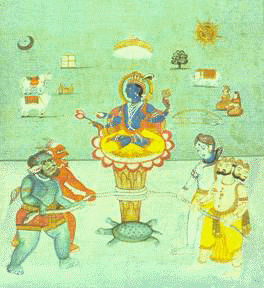
Churning of the ocean. The tortoise (Transmuted Vishnu) serves as the stable base for churning; his form is sitting on the top of the mountain, the churning pole, to stabilize it, as Asuras (demons) on your left and Suras (gods) on your right churn the ocean for nectar of immortality. The Suras (the gods are here represented by Siva and Brahma. They may not have actually participated in the churning. Lesser gods and demons did all the churning.
10. Your feet, of all parts, are the most beloved by the Yogis; serves as the refuge for the Muktas; and are like the Kalpatru yielding all wants of the votaries. O Krishna, let those feet of yours abide in my heart, expunge all my suffering and grant me Brahmananda.
Muktas: The liberated souls.
Kalpatru: wish-yielding celestial tree.
Brahmananda: Brahma's Bliss; Supreme Bliss.
11. Forgive me for saying things here in my ignorance not knowing your greatness in its entirety. May this hymn consisting of more than 1000 verses be the source of Prasadam. This piece obtained the name of Narayaneeyam on account of the fact that it is an eulogy of Sri Narayana and the author also bears the name, Narayana. This hymn adheres to the Vedic Pramanam describing your Lilas. May it bring long life, health and happiness to all its listeners and readers.
Prasadam = Grace
Pramanam = Vedic authority
Lilas = sports (activities) of the Lord
End of Narayaneeyam, the Last Canto (100) and the last verse.
The history of the Temple: continued.
The rulership of the area in and around Guruvayur came under Perumals, who being Siva devotees neglected the Guruvayur temple and supported the nearby Mamiyur temple of Siva and Parvati. The Krishna temple came into disuse and temple lights went dead for lack of support. One day a Sannyasi went to the Mamiyur temple and asked for food and shelter for the night; the temple priests told him derisively that they ran out of food and he could find plenty of food and shelter in the rich Krishna Temple. What he found on arrival was a decrepit and destitute temple; a Brahmana boy received him and provided him with sumptuous food and shelter.
The Sannyasi conferred his blessing on the poor temple and said that the Mamiyur priests' prediction would come true in that Krishna temple would be rich. Thus, Maiyur temple declined and Krishna temple ascended in fame and riches. Swami Tapasyananda in his commentary on Narayaneeyam, says that the temple kept no records before 17th century. He further states that Alvars (era ending in 8th century) did not make any mention of the temple in Divyaprabhandam. Kuruvayur was the name mentioned by a 15th century poet for the temple town and the name took Sanskrit flavor, Guruvayur, later. The Dutch in 1716 and Tippu in 1789 attacked the temple and stole what they could. The main idol was stashed away by the temple priests elsewhere and brought back after fall of Tippu. The temple came into its intrinsic worth when the devotee-saints received mystic experiences including recovery from paralysis by Bhattatiri.
The philosophy of Narayaneeyam
Brahman is THAT, knowing which everything is known. Timeless Brahman is eternal, immeasurable and expansive. Bhagavata Puranam and its epitomic successor, Narayaneeyam expound Vedic and Upanishadic Truths couched in stories of Krishna.
Upacana or worship
Brahman is Parabrahman (Supreme Brahman).
Isvara is Mayabrahman (Brahman with Maya).
The individual soul is Avidyabrahman (Brahman with ignorance).
Mayabrahman and Avidyabrahman are terms coined by me to show the three levels of Brahman.
We are all Brahmans with a difference. We came from him and we go back to him. He took two forms Mayabrahman (also known as Isvara) and Avidyabrahman or Brahman with ignorance. When Isvara sheds his Maya and Avidyabrahman sheds his Avidya or ignorance, both go back and merge with Parabrahman. Isvara is God, while Avidyabrahman is man.
The above concept advanced by Panchadasi is not accepted as such by the advocates of Acintya Bhedabheda. Go to BG04 for Acintya Bhedabheda.
Isvara is a powerful intermediary between Avidyabrahman and Parabrahman. The Isvara and avidya states are a clinical condition, while Parabrahman transcends these states. Mayabrahman, commonly known as Isvara, the Controller or simply God, uses Maya to create, maintain, and destroy this world and helps the soul expunge its sins and impurities, infuses the soul with Brahman Knowledge (Brahma Vidya) and eventually facilitates re-absorption (involution or merging with Brahman).
Coming to Isvara and Brahman, Upacana is worshipping ParaBrahman through Isvara (worshipping Vakya Sakti through Vacaka Sakti). Ishtamantra is the Deity-specific Mantra, which brings the aspirant to Ishtadevata (god or goddess of his liking). Vakya Sakti is Parabrahman without attributes; he is the goal of Upasana; ordinary mortals except perfected Yogis cannot realize him. Tantrics worship Vacaka Sakti, the clinical Brahman, Sabdabrahman, Saguna Isvara, Saguna Brahman, Mayabrahman or god with form and name--all preceding names are synonyms.
Vacya = Vakya = meaning of Mantra
Vacaka = Vasaka = words, phrases and sentences of Mantra.
Every Mantra has two Saktis (powers): Vakya Sakti and Vacaka Sakti; the former is the seed and latter is the flesh of the fruit. The former is life of Mantra and the latter is the sustainer of life; the Vakya Sakti is subject and transcendent, and Vacaka Sakti is object and immanent. One cannot get to the seed without going through the fruit; one cannot understand the meaning and true nature of Vakya sakti without worshipping Vacaka Sakti (they are like Brahman and Isvara). Vakya sakti is without attributes (Brahman), Vacaka Sakti is with attributes (Isvara); Vakya sakti is seed and Vacaka Sakti is the tree; seed and Vakya Sakti are latent and dormant, and tree and Vacaka Sakti are awake and florid. Vakya Sakti is white light and Vacaka Sakti is spectral or rainbow colors, yellow, blue, red and more of Kundalini Devi. Paramatma is Vakya Sakti, while the son of Devaki (Krishna) is Vacaka Sakti. Vakya is meaning; Vacaka sakti is words, phrases and mutterings of Mantra. God, who is the subject of Mantra, is Vakya Sakti and Pratipaadya (to be explained, meaning); Devata and god, who is Mantra itself (god's sound body = Mantra), is Vacaka Sakti in his manifest form. Vakya Sakti is like clouds and Vacaka Sakti is like rainwater. (one cannot quench his thirst with the cloud; rainwater serves the purpose well; Nirguna Brahman is the cloud and Saguna Brahman is water.) Vakya Sakti is unlimited; Vacaka Sakti is delimited. Vakya sakti is all-pervasive and unmanifest, while Vacaka Sakti is all-pervasive and manifest. Siddhi of Sadhakas awakens the Vacaka Sakti of Mantra; with the help of Devi, they step into the monistic world of Brahman knowledge. (White light, spectral or rainbow colors, seed and tree, cloud and rainwater are input from author.) Vacaka Sakti is the road to Vakya Sakti; the former is the means and the latter is the goal. Yogis are capable of meditating on Brahman without going through the preliminary step of worshipping and meditating on Isvara (Vacaka Sakti). In this instance, the yogi is the seeker of Cashew Nut, which is outside the fruit; somehow the Yogi coaxes and brings out the nut from inside the fruit; it takes a Yogi to meditate on attributeless Brahman--author's opinion.
Manifest God or Goddess, Sabda Brahman or Sound Brahman is the object of worship. Sabda Brahman is immanent and pervades the universe and beings; Virat Purusa is the one with manifest body (Virat sarira) and comes down to earth as Avatara (incarnation). Five gross elements, ten senses (five of motor organs and five sensory organs), five vital airs, Manas (mind as an organ), Buddhi (intellect), Ahankara (ego), and Citta (thinking) make the body of Sabda Brahman. Worship of Sabda Brahman is at the level of human consciousness and worship beyond that is Turiya, where the Sadhaka and formless Brahman become one. That is Vakya Sakti.
When you see jewelry, you see gold; when you see pots, you see clay; when you see the world and the universe, you see Brahman. When you see people you see Brahman (That Thou Art); He is the Knower in each one of us. For more details on Brahman and Atman, go to PANCHADASI (ATMAN AND BRAHMAN).
Bhattatiri equates Parabrahman with Mahavishnu / Narayana, and Krishna with the manifest Brahman (Mayabrahman, Sagunabrahman or Isvara), Guruvayurappan. Parabrahman without attributes or conditions is not an entity receptive to worship or approach. His manifest surrogate with complete potency (Purna avatar), Krishna-Guruvayurappan is the manifest god or Saguna brahman for worship. What is unapproachable and unreachable in Parabrahman becomes approachable and reachable in Krishna. Parabrahman is Niskala (without parts), while Krishna is Sakala with parts. Although Parabrahman is omnipresent in the universe, Bhattairi worships Him in the likeness of Krishna-Guruvayurappan, because he cannot see Him in the universal form. There are very few people who saw Him in His universal form; one among them was Arjuna.
His medium of worship is Bhakti, devotion or love of Ishta-devata. His Bhakti colors all he sees, feels, says and writes about Guruvayurappan.
In the first canto, Narayana Bhattatiri (NB) describes the Glory of the Lord, " Your form is Suddha Sattva, which is like the waves on the surface of a deep ocean, that is Pure Supreme Brahman, a treasure-house of pearls of liberated souls."
Since Krishna is a manifestation of attributeless Parabrahman, Vyasa states that His constitution is Pure Sattva without the contaminating Rajas and Tamas. Pure Sattva does not exist in nature; it is always admixed with Rajas and Tamas. Suddha Sattva is His internal constitution (Swarupa Sakti) in contradistinction to his external sakti, Prakrti, which in its equilibrium consists of equal amounts of Sattva, Rajas, and Tamas. He is Purna avatar as opposed to other partial avatars.
Krishna has a special place among Vaishnavites. He is Bhagavan.
Bhagavan: One who is endowed with Bhaga (Grace) is Bhaga-van. Bhaga consists of six attributes: (Transliteration from Tamil) Aisvaryam, Viryam, Pukaz, Tiru, Jnanam, and Viaragyam (Supremacy, Power, Glory, Sacredness, Wisdom, and desirelessness or detachment. others list the following attributes: knowledge of creation, maintenance, destruction, origin and sublation of all life forms, Supreme Truth, and Avidya or ignorance. Yes, He is Ignorance and Knowledge at the same time; He is everything; there is nothing He is not. Some say that the attributes correspond to nine angles of Yantra, which is a mystical diagram made of lines, curves, alphabets and syllables etched on metals and stones, whose purpose is to invoke god for progeny, health, and wealth.
Others list the following: Sri (Auspiciousness), Virya (Power), Jnana (Wisdom), Vairagya (Dispassion), Kirti (Glory), and Mahatmya (Greatness).
Bhaga is Grace and any desirable quality such as dignity, majesty, distinction, excellence, beauty, loveliness, love, affection.
NB seems to make such fine distinction between Parabrahman and Bhagavan (Clinical or Sabdabrahman) that they are one and the same except in philosophical analysis. Krishna being the waves and Parabrahman being the ocean, he sees no difference. To the stickler to semantics, there is a world and ocean of difference.
Achintya Bheda-abheda:
(Incomprehensible difference -
nondifference) According to this, the individual
souls are like sparks in the fire and depend on Krishna. These atomic souls are
like the rays of the sun, but the rays are not the sun. The individual soul is
the wave and the Parabrahman is the ocean. The wave is different and yet there
is non difference between the wave and the ocean. Each soul is partly divine in
its likeness to God and partly animal because of its animal nature; the latter
is ignorance, and māyā affects it. Once the jiva earns release, it goes to God
but never merges with God.
The same simile is applied to Parabrahman and Krishna. There is a difference between the Krishna-waves and Parabrahman-ocean and yet there is no difference between the waves and the ocean. To reduce Krishna as a surrogate and Parabrahman as Higher Being runs counter to the notion that Krishna is real and resides in the idol. Why would anybody parley one's devotion into liberation by worshipping a lesser or a surrogate god? NB sees the non-difference between Krishna with form and the Supreme Brahman without form.
|
Hindu Newspaper reports that Madhavan Nair of Indian Space Research Organization visited Guruvayur Temple to express thanks to Guruvayurappan for the successful mission to moon. November 22, 2008
|
 Mr. Nair said the ISRO was
planning to launch Chandrayaan-2 in 2012, a mission in which a robot would
be sent to collect samples from the lunar surface and conduct tests. In
2015, it would conduct a spacewalk and the man mission to the Moon would be
launched only after it. After completing the Chandrayaan series, the ISRO
would be going in for a mission to Mars and the steps for it had started. A
blueprint of this project was expected to be out only after four or five
years, he added. He landed here at 11.40 a.m. on Saturday and was on his way
to the Guruvayur temple.
Mr. Nair said the ISRO was
planning to launch Chandrayaan-2 in 2012, a mission in which a robot would
be sent to collect samples from the lunar surface and conduct tests. In
2015, it would conduct a spacewalk and the man mission to the Moon would be
launched only after it. After completing the Chandrayaan series, the ISRO
would be going in for a mission to Mars and the steps for it had started. A
blueprint of this project was expected to be out only after four or five
years, he added. He landed here at 11.40 a.m. on Saturday and was on his way
to the Guruvayur temple.Ramanuja and Sankara agree that Reality is One; for R the Real has internal complexities (Vishishta, qualified), while S says that Reality is simple. Brahman has three Reals in his Complex: Isvara, Cit and Acit. 1. Isvara: The Soul of the Universe, The Transcendant Lord, Sagunabrahman, Mayabrahman, SatChitAnanda (the liberated souls are the Bliss body of the Lord). 2. Cit: a Community of Jivas or individual souls, dependent on Isvara; the subtle body of the Lord 3. Acit: Prakrti, matter, the Gross body of the Lord. R becomes the strong proponent of Bhakti movement (coming into full fruition) that began with Bhagavad Gita as laid out to Arjuna by Lord Krishna.
Ramanuja
advances his qualified nondualistic philosophy (Vishishtadvaida)
that the Soul of the universe and the community of individual souls are one with
the qualification that the individual souls are identical with God but not
equal. Let my explain this apparent contradiction with an example.
Vishnu and liberated souls move as
one unit, but there is Vishnu as one identity and the myriad souls as the second
entity. Vishnu is heavy water and the souls are light water.
Heavy Water and light water
are chemically identical but not equal. Chemically Heavy Water (D2O
or 2H2O and light water (H2O) are the same and
yet they are different. The two Hydrogen atoms in light water are replaced by
heavier Deuterium atoms in D2O. The atomic nucleus of Deuterium has
one proton and one neutron and one orbiting electron. It is the extra
neutron that makes D2O heavier than H2O by 10%. D2Oand
H2O exist in lake water in a proportion of 1 to 20 million water
molecules. When you drink water it is a mixture of both. Likewise your body is
soaked in Heavy Soul and light soul. An infinitesimal tad of Heavy Water Vishnu
is necessary for you to sustain life. Vishnu is the Inner Soul (AntarAtman) in
you. You are the ubiquitous abundant light-weight individual soul compared to
the all-pervasive Heavier Soul of Vishnu. Just remember that Vishnu is zillion
times heavier than the individual soul, though Vishnu and the pure soul are
(chemically) identical. Though they are identical, the light-weight individual
souls cannot create, maintain or destroy the universe and beings; that is the
exclusive domain of Vishnu. 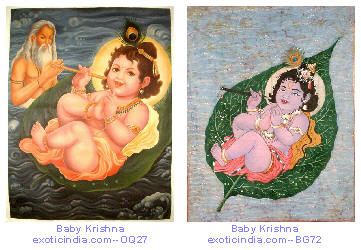 There
are myriad qualities of Vishnu that we do not have. As the Heavy Water is not
radioactive, Vishnu is not dangerous to your health; He exists in minute
quantity in your Spiritual Heart.. Pralaya (destruction of the body) by Vishnu
through Rudra is recycling of soul, until they merge with him. This merger is
the merger of light water of individual souls with Heavy Water of Vishnu. During
Pralaya, Bhagavan is portrayed to be floating on a banyan leaf. How is it
possible for a Being who has swallowed the whole universe to float on a leaf?
That quality is what is called
Akadithakatanaa Saamarthiyam
--Tamil Lexicon--«¸Ê¾¸¼É¡º¡Á÷ò¾¢Âõ--
(versatile doer of the impossible). It appears that the leaf supports Bhagavan.
Is it the leaf that supports Bhagavan? Is it Bhagavan who supports the leaf? It
is the former supporting the latter. He is the one who supports all the weight
of the universe and the leaf itself.
Akaditam
= The impossible.
Saamarthiyam = adeptness.
There
are myriad qualities of Vishnu that we do not have. As the Heavy Water is not
radioactive, Vishnu is not dangerous to your health; He exists in minute
quantity in your Spiritual Heart.. Pralaya (destruction of the body) by Vishnu
through Rudra is recycling of soul, until they merge with him. This merger is
the merger of light water of individual souls with Heavy Water of Vishnu. During
Pralaya, Bhagavan is portrayed to be floating on a banyan leaf. How is it
possible for a Being who has swallowed the whole universe to float on a leaf?
That quality is what is called
Akadithakatanaa Saamarthiyam
--Tamil Lexicon--«¸Ê¾¸¼É¡º¡Á÷ò¾¢Âõ--
(versatile doer of the impossible). It appears that the leaf supports Bhagavan.
Is it the leaf that supports Bhagavan? Is it Bhagavan who supports the leaf? It
is the former supporting the latter. He is the one who supports all the weight
of the universe and the leaf itself.
Akaditam
= The impossible.
Saamarthiyam = adeptness.
Canto 2
Sri is known not to stay in one place thus reversing the fortunes of many a being. The Lord was grateful to Bhrgu Muni for guaranteeing Sri to stay on His chest permanently for He had a large debt to repay to Lord Kubera, Croesus of heavens. Sri is known as Cancala which literally means " moving to and fro, unsteady". NB injects a humorous strain in Sri being a vacillator. He states in Verse 14, that Mahalaksmi (Sri) is enamored by the divine beauty of her consort, Vishnu; and yet (in the next verse to highlight her fickleness, he says that) she becomes attached to the Bhaktas who eulogize the auspicious qualities of her Consort. Sri and Vishnu have an understanding between them. They do not like to be eulogized right on their face. They know a sycophant, a million miles away. Yes, Sahasranamam is an exception. Vishnu likes to hear Sri eulogized before Him and Vice Versa. Vishnu is the DECIDER (word borrowed from President Bush, April 2006) and Sri is the MEDIATOR between the devotee and Vishnu. Vishnu always checks with Sri on the veracity and genuineness of a devotee and plays the role of a DECIDER to confer boons.
(A scenario to consider: George W, the DECIDER checks with Laura before he decides. This information is not confirmed by the author.)
Nammalvar says that Sri, Lord's consort, removes the karma and facilitates attainment of moksa at the feet of Vishnu / Narayana. The Tenkalais believe that Sri is very high up in the ontological status, but separate and unequal to Vishnu, simply because she is a finite soul. But Vadakalais believe that Sri is an integral part of Vishnu and infinite and therefore enjoys equal status. All the Alvars and the followers agree that Vishnu has become tender, understanding, loving, auspicious, creative, life-sustaining and is in a constant state of bliss because of Sri. Sri is regarded as a facilitator and mediator between man and God, Vishnu.
Vishnu Purana (chapter eight) discusses Sri enjoying equal status with Lord Vishnu. He is meaning and She is speech; He is understanding and She is intellect; He is the creator and She is the creation; He is the sun and She is the radiance; He is the moon and She is the light; He is the ocean and She is the shore; He is the lamp and She is the light; He is the tree and She is the vine; and He is the Male and She is the Female.
Canto 4 V10
The devotee who desires for Sadyo Mukti, sheds his desire and attachment; he abandons his Linga Sarira (because it does not anymore carry a frontload of Karma, Samskaras and Vasanas;) thus he merges (Laya = lysis) with Paramatma. (His Linga Sarira actually "lyses" in Paramatma.) Before his physical body goes back to the elements; his five breaths, mind, buddhi, and ten Indriyas depart through Brahma Randhara on his head. This instantaneous liberation or lysis is called Sadyo Mukti. Sadyo = instantaneous; Mukti = liberation.
Bhagavad Gita States the following, coming from the very mouth of Bhagavan Krishna Himself.
8.24:
The paths of the departing souls, who attain Brahman because of Brahman
knowledge, are the fire, the day, the bright half of the month and the six
months of sun’s northern passage.
Chāndyogya Upanishad 4.15.5 and 5.10.1-2
The knower of Brahman, at the time of
departure, reaches the Brahman by following the paths of the deities presiding
over the fire, the day, the bright fortnight of the waxing moon and the six
months of sun’s northern passage. These deities take the soul in the fashion of
a relay race handing over the soul to the deity in the next relay station. The
light and time are the common factors; the deities of fire, day, bright
fortnight, and six months of sun’s northern passage travel progressively longer
distances, carrying the soul. Thus, the soul lands in the abode of Brahma for
eventual attainment of the Supreme or returns to the earth in the embodied form.
This is the “Path of Light” (aka, Northern
path or Path of Gods) for the passage of souls which are endowed with Brahma
knowledge (Brahma-Vido Jnāna), but not realized knowledge (Vijnāna), possessing
which would have liberated them right here on earth. He, who practices
austerities and goes on the path of deva-yāna (Path of Gods), never takes a
birth again in this world. He, who practices actions and ceremonies with
expectation of a reward, goes on the path of pitr-yāna to the land of the
ancestors and returns to the earth.
Chandogya Upanishad says the following about Path of the Gods. C5.S10. it is the Path of the Gods. Those who in the know meditate with faith and austerity go to light, day, the bright half of the month of the waxing moon, and the northern passage of the sun during six months. The Northern passage takes the route to the sun, moon, and lightning; a celestial picks up the soul and takes it to Brahma. The Path of Gods derives its cartographic details from Rg Veda, which mentions that Fire (Agni) is the go-between between gods and men. Agni takes the oblations of men to the gods by the path specified above; the accomplished sacrificer also takes the same path to the gods. Dr. Radhakrishnan states that we should not take this path as a literal edict; the stopovers on the Path to the Gods indicate progressive knowledge and light, while Pitr Yana (path of forefathers) is a path of darkness and corruption.
Narayaneeyam Canto 15 Verse 8:
The Grahasta (householder) who worships and offers sacrifices to Pitras and Devas, goes on the Southern Path of Smoke; as Punyam runs out on him he falls (to Samsaric life on earth or returns to earth as a human being). He who surrenders himself to Me and performs action without desire, goes on the Northern Path of Light and attains liberation. You in the form of Kapila taught Devahuti. Isn't it correct?
Bhagavadgita 8.25:
Smoke, night, also the dark (half of the month), the six months of sun's
southern passage are the paths the departing yogi takes, attains the lunar
light, and returns (to earth after a sojourn).
Similar sentiments are expressed in Bhagavad Gita (8.25) and Narayaneeyam 15.8
The path of the souls who perform rituals and sacrifices: the path of smoke, also known as Dhumadi Marga.
The paths of the departing souls, attached
to desires are the smoke, the night, the dark fortnight, and the six months of
sun’s southern passage, reach the light of the moon and return to earth after a
sojourn.
Chāndyogya Upanishad 5.10.3
Again, the deities presiding over the smoke, the night, the dark fortnight, and the six months of sun’s southern passage take the departed soul who wallows in desires to the world of fathers, space, and moon, who is the king of Soma. They become the servant of the gods and develop mutual liking for each other. Once the meritorious Karma is spent, they return to earth to resolve the residual karmic overhang.
Those who do not perform any sacrifice go to the Kingdom of Yama, never to leave.
The return path is just retracing the path back to where they began the journey.
The returnee resides for a while, but comes back to the earth on account
of residual karma. Once the positive karma from meritorious deeds is spent, he
comes back to the earth in a form that transforms from one substance to the next
substance: space, air, smoke, moisture, cloud, rain, rice, barley, trees, and
plants. They take birth as rice, barley, herbs and trees. The fate of soul
trapped in the plant kingdom depends on the merit of the animal or person who
eats or sows the vegetable matter. From this stage onwards, the soul takes
residence in an animal or a person depending on the deeds.
Chādyogya Upanishad 5.10.8 says: He, who
is wise (Vijnānam) takes the path of the gods and goes to the gods; he, who
works with expectation of a reward, takes the path of the manes and returns to
the earth as a person; he who does neither continues to ride the wheel of life
as animals.
The stealer of gold, the wine drinker, the paramour of teacher's wife, a Brahmana killer and they who consort with the former four take a fall into abysmal hell.
These paths attest to the spiritual development of a person. They will tread the lesser path until they become spiritually enlightened and take the path of gods, never to return to this world of Samsara.
Bhagavadgita 8.26:
Light and darkness are the two eternal paths of this world. By (the
former) one, he goes, not to return; by (the latter) the other, he returns
(again).
Jiva takes on the qualities of Sattva, Rajas and Tamas. Jiva's body is Avidya while Isvara's body is Maya. Subtle and gross bodies of Jiva come out of Avidya causal body. Lord's will (Ichha) is Maya Sarira (body) and the creator of the world. Here the term "body" does not mean a palpable body with head, trunk and limbs, in the same sense that a "body of knowledge" does not walk on feet. Isvara's Maya Body is creative (of the universe) while Jiva (man's individual soul) is the causal body, creative in its own limited sense because it gives rise to subtle and gross body--Suksma and Sthula Sarira). Jiva's causal body (Karana Sarira) is pervaded by Avidya (ignorance) of its true nature that it is part of Brahman; it is temporary amnesia (loss of memory or forgetfulness, that ). In its amnesic state, Jiva is not contaminated with Vikshepa (projection, dispersion) until it takes on the gross body with head, trunk and limbs. Jiva without Vikshepa is closer to Isvara (Supreme Consciousness and Supreme Knowlege) than the Sthula Sarira (gross body). Though it forgets its true nature, the causal body is closer to Isvara than the gross body; therefore, it has supreme knowledge within ignorance (Prajna within Praajna--knowledge within ignorance). This ignorance is both veiling and projecting (Avarana and Vikshepa). This ignorance veils Sat and Cit (Being and Consciousness) of Brahman and projects the phenomenal world by Vikshepa. Vikshepa: power of ignorance that causes the world seem real. This projection is mediated by Tanmatras: Principles of Sound, touch, vision and color, taste and smell, which are pervaded by qualities Sattva, Rajas and Tamas. The Sattva of Sound becomes the sense of hearing; that of touch, the sense of touch and so on. These in combination form an entity called Antakarana or inner organ which has three components: Manas, Buddhi, and Ahamkara. These were discussed elsewhere. The Rajas-dominated sound, touch, vision (color and form), taste, and smell become the respective organs.
C5:V1 Narayaneeyam
This verse describes the effects of Brahma Pralaya and subsequent events. After Brahma Pralaya, there was no existence to speak of, neither this world nor heaven, neither in the gross nor subtle form (Vyakta-avyaktam). Maya,(the potent and fecund precursor of the building blocks of the universe), subsided (Laya-lysed or dissolved) in You, having entered a latent phase due to rendering of the three Gunas into equilibrium. Neither existence, nor non-existence, nor Time, nor day nor night existed. Only You existed as Parānanda Parakāsāthman (Supreme Bliss-Radiant Super Soul = Sat-Chit-Ananda = Being-Consciousness-Bliss)
Explanation with example: Vyakta-avyaktam = manifest-unmanifest or partially manifest. In another context God's form (Murti) is spoken of Vyakta-avyaktam. Murti (form) is unmanifest, manifest or partially manifest. Sivalinga is aniconic (an-iconic or A-Vyaktam), while Nataraja is Vyaktam or manifest. An intermediate form, Vyakta-avyaktam, is the Muka Linga which depicts a face on the Linga.
Note: The sequence of creation differs from account to account.
Garuda Purana (Book one, chapter four) tells us in
the words of Lord Hari the details of creation as narrated to Rudra.
Nara-Narayana is the Supreme soul.
The visible universe with the manifest and the unmanifest abide in Spirit
(Purusa) and Time. The Lord has no beginning and no end (death). He came Avyakta,
the Unmanifest from which the Soul was born.
In a cascade fashion, entities started evolving from the Soul: Mahat or
Intellect, mind, firmament, air, fire, water, and earth. He creates a cosmic
golden egg (Hiranyagarbha), which is infertile
until he penetrates it. The
four-faced Brahma in Rajas mode becomes busy with creation of the movable and
the immovable. The whole universe
and beings emerge from the golden egg. At the end
of the Kalpa, the Lord in the form of Rudra dissolves the universe.
The first creation (Sarga or Sristi)
is Mahat, cosmic Intellect from Brahman himself.
The second creation (Vi-sarga
or Vi-Sristi) is Bhuta sarga, the subtle elements (Tanmatras).
The third creation is
Vaikarika sarga (transformational creation). It is
also known as Aindriyaka sarga (creation of sense organs). These three preceding
creations are called Prakrta sarga (elemental, natural, or original creation –
building blocks). The
fourth creation is Mukhya
sarga (chief or principal creation). Insentients and immobile objects
belong to this category. The fifth creation
is Tiryak-yonasyah or Triyaksrotas.
(Tiryak=oblique, horizontal + yonasyah=womb) = animals. (Tiryak=oblique,
horizontal + srotas=canal) = animals, whose propulsion of nutrients go
horizontally or have horizontal canals (intestines). Srotas means canal and
therefore, it is natural to think that they (birds and beasts) have intestines
that run parallel to the ground in their standing position.
Some other explanations are offered. They are called Tiryaksrotas, not
because their bodies move obliquely, but because their nature is full of
ignorance (Ajnabahula) and ego and their ways are
wrong. The sixth creation is
Urdhvasrotas, the gods who have canals going up or
whose nutrients go upwards. The seventh
creation is Arvaksrotas, the human beings whose
flow of nutrients goes downwards. Though the literal meaning says that their
canal and nutrients go downward, another explanation is given: They live below
the heaven; they are full of brilliance, but are contaminated with darkness
(Tamas) and stimulated by Rajas. They are enlightened both inside and outside.
The eighth creation is
Anugraha sarga, meaning creation of mental conditions like Sattva and
Tamasa gunas. It is of four types:
Viparyaya, Sakti, Siddha, and Mukhya. The immobile
creation such as mountain is viparyaya, meaning it
is unconscious. The last five creations from the
fourth to the eighth are called Vaikrta sarga, transformational creation.
Vaikrta sarga is a product of meditation by Brahma. The ninth creation is
Kaumara, belonging to both Prakrta and Vaikrta creations.
In all living beings, the Lord exists in four
forms: Viparyaya, Sakti, Buddhi, and Siddhi.
Viparyaya in this context means that the lower principal
creation such as trees and plants is deprived of consciousness. In
animals, the dominant mode of his presence is sakti
or physical power. In human
beings, he exists as buddhi or intelligence. In
realized souls like yogis, he exists as
Siddhi or spiritual
attainment.
Coming to the Kaumara or Kumaras (Sanatkumara, Sanandana, Sanaka, Sanatana and Rbhu), that is the ninth creation. These are the mind-born sons of Brahma, who refused to raise a family, remained bachelors and enjoyed youth (kumara).
Dissolution
sequence: Time reigns supreme in involution of the manifest universe and the
gunas into undifferentiated matter (Mula Prakrti, or undifferentiated primordial
matter) Avyakta. Mula Prakrti means original germ or root substance.
First let us look into partial dissolution before
we go to total dissolution. After a thousand MahaYugas, Brahma laya (Naimitika
laya, occasional, partial, periodic, kalpal dissolution) takes place. (Varaha is
the present kalpa preceded by padma kalpa.) It
will be one hundred years of no rains. Seven blazing suns will light up the sky,
turn everything in the path of their rays dry and burn the three worlds, the
earth, Bhuvah and Svah, and Mahar loka. The nether
worlds will undergo incineration at the sight of Rudra, Vishnu’s form.
Mysterious clouds emanate from the mouth of Lord Visnu, which, for 100
years, will pour down rains that flood the whole world. Fire and floods will
destroy all mobile and immobile things. This dissolution coincides with the
onset of Brahma’s sleep. The primary creation remains intact and only secondary
creation has undergone dissolution.
It would be raining,
not cats and dogs, but “elephants' trunks” meaning that each drop would be the
size of an elephant's trunk. There is water everywhere, fire subsides, wind dies
down, there is no light, and there is total darkness. Brahma with his thousand
eyes, thousand feet, thousand heads, thousand mouths and thousand arms presides
over this watery grave of cosmic size.
He is learned in three Vedas. He has the radiance and the color of the
sun. He is Virat, he is Hiranyagarbha, and he is
beyond thought and imagination. All came beings, now dead, are wrapped in
darkness. In Maharloka the sages see Time sleeping. The survivors of this great
deluge are the Time, Saptarishis and
Satya in Maharloka;
Sri, Bhu, Siva, and Sanatkumara in Janaloka; Brahma
and Sankarsana in Satyaloka; Narayana and his
devotees in Vaikuntha;
The other
dissolution is Prakrtika
Pralaya (total, natural dissolution; retrograde involution; elemental
involution, Brahma’s dissolution). When Brahma dies after one hundred Brahma
years (311.04 Trillion man years), Lord Hari destroys the universe and absorbs
into his body the creator, Brahma. The significance of this is that Brahma who
was responsible for secondary creation of the universe from the elements
supplied by Lord Vishnu is no more, and the universe has reverted back to its
primordial state in Vishnu.
According to
Saiva belief, Mahadeva (Supreme Siva) destroys the
universe, beings, gods including Brahma, Vishnu and Siva (adjunct status of the
same Gods). Saiva Siddhantists consider Supreme Siva,
Paraparam (Beyond the Beyond, Supreme Supreme) as their God of gods; Siva, one
of the Holy Triumvirate, is a mere god of the triad. The students from the west
believe that Saiva Siddhantists selectively elevated the status of Siva of the
earlier Triad to the Super-supreme status. Supreme Siva stays while Brahma and
Vishnu come and go in this and many other
Henotheists of Hindu religion are of the belief that Siva and Vishnu are of
equal status, though Siva and Vishnu may stride up and down the parallel
hierarchal ladders of their respective sects; Siva and Vishnu do not knock each
other's ladder for supremacy; they switch their relative
MahaVishnu is superior to Vishnu and is equal to Sadasiva, the revealer of Grace and the third Consciousness in Suddha Tattvas. Lord Siva performs his Tandava (wild dance) wearing a garland of skulls. The universe undergoes retrograde involution; each substance (like earth) or element falls back into its previous state until the state of Mahat is reached, when Mahat and Devi (Siva's spouse) merge into the body of Siva. Pradhana (Primary essential progenitor substance, matter) and Purusa (Spirit) exist separately in him and the gunas are inert.
At the onset of Prakrtika
Pralaya, there will be a drought followed by
scorching sun, which will be followed by heavy downpour for one hundred years.
Now the egg of the universe will rupture and dissolve in water, which marks the
death of Brahma.
Sankarsana,
Vishnu’s manifestation, sends forth the poison-fire from below. The egg of the
universe catches fire on all its sides. The wind blows violently for one hundred
years. The universe is reduced to dust and smoke. The universe and beings
vaporize to a subtle state of smell.
Smell from
conflagration dissolves in water. Involution takes place from the gross to
subtle elements until it reaches the element sound. In a linear retrograde
fashion the earth dissolves (or involutes into) in the water, the water in the
fire, the fire in the air, the air in the ether, the ether in the senses, the
senses in the subtle elements, the subtle elements in their subtle sources, the
latter in Mahat, and Mahat in three gunas. The sensory and motor organs (Indreyas)
merge into their respective deities. The deities merge with their inner
controller. The mind merges with Sattvika ahankara, sound with Tamasa ahankara.
Ahankara itself merges into Mahat, which dissolves in three gunas, which
dissolve in the unmanifest Prakrti, the latter in the imperishable and the
latter in the darkness. Darkness becomes one with the
transcendent, which is neither existing nor
nonexisting. Joseph Campbell explains what transcendent is.
In
Occidental
theology,
the word transcendent
is used to mean
outside of the world.
In the East, it means outside of thought.
Brahma, the creator
merges or involutes into avyakta or Mula Prakrti. The earth, the fire, and all
other elements lose their intrinsic properties and merge or fall into Mula
Prakrti. As you see, the universe is came from the undifferentiated (Unmanifest)
Mula Prakrti; and on dissolution, it retraces its steps backwards. Mula Prakrti
merges with Time-Spirit, which stops all its functions. Time-spirit merges with
the final repository and the wielder of Maya, the Atman also known as Purusa.
The Lord refers to Eternal Atman as Me.
Bhagavata Purana
states in Book twelve, Chapter four that the Unmanifest Primordial matter is
Pradhāna (Mula Prakrti), which is the progenitor
unmanifest substance, not subject to Time, modification, death, and decay; it
has no beginning, no end and is the cause of everything. It has no form and all
elements are present in a potential state.
Sankara's view: Between the Brahman and the
Universe, there is Brahman's māyā (time, space, and
causation) as the divine mysterious driving or projecting force.
Here is a table of
the Indriyas and the respective presiding deities
|
Eye |
Ear |
Nose |
Tongue |
Skin |
Voice |
Hands |
foot |
Anus |
Genitals |
Manas |
Buddhi |
Ego |
Citta |
|
Sun |
QTR* |
Asvins |
Pracetas |
Wind |
Fire |
Indra |
Vishnu |
Mitra |
Prajapati |
Moon |
Brahman |
Siva |
Acyuta |
QTR*: The quarters
of the world.
When
Perialvar sings the praise of Baby Krishna in verse
40 of Divyaprabhandam, he describes the
pralaya or dissolution:
“You swallow the earth, the mountains, the oceans, and the seven worlds
and keep them in your protective custody.”
According to Samkhya theory, the evolution and involution are linear starting from the Transcendent and ending in the world and vice versa. In involution, the world burns up. Dissolution (retrograde involution, Centripetal march of souls and matter to their source) takes place until the stage of the Transcendent. The next cycle of evolution starts.
Creation according to Bhagavatam, Vishnu Puranas and other sacred texts
Bhagavatam contains the views on creation in question-answer sessions.
There are ten features: Sarga,
Visarga, Vrrti, Raksā,
Manvantra, Vamsas,
Vamsānucharita, Samsthā,
Hetu, and Apāsraya.
Sarga is primary
elemental creation. Another descriptive name for it is subtle creation. The
principal product is Maha-tattva,
the Great Principle also known as Cosmic Intelligence, came by the disturbance
in the equilibrium of Sattva, Rajas, and Tamas, the three modes of matter or
Prakrti. This is the first part of the primary creation; the will (Iccha)
of the Lord provides the fillip. In all, Mahat, Ahankara, five
tanmatras, five gross elements, five
janendriyas, Sattva, Rajas, Tamas, ten presiding
deities of five motor and five sensory functions, mind and its presiding deity,
moon, and Time make Sarga. These 33 elements form
the building blocks for launching the secondary creation (Visarga).
|
Five gross
elements (pancha Bhutas). |
Five Tanmatras. |
Five
Janendriyas. |
|
Earth, Fire,
Water, Air, and Ether. |
Sound, Vision,
Taste, Smell and Touch. |
Ears, Eyes,
Tongue, Nose, and Skin. |
From the Cosmic
Intelligence proceeds Aham or
ego, the second element, in a downstream
fashion. The third is the evolution of
Bhūta sarga
(matter). The fourth is the evolution of knowledge and work (Sarga
– jnāna and kriya).
The fifth is the appearance of divinities in the
mode of Sattva (goodness), and the mind. The
sixth is the assertion of Tamas (darkness) of
ego, resulting in abuddhi (lack of judgment).
Visarga:
This secondary creation is an act of Brahma under the direction of the Lord of
lords, Nārāyana or Vishnu, who came all the elements
and the mind in primary creation. Brahma’s other name is
Virat (manifestation) Purusa. In reality,
Virat Purusa is the Lord himself in the form
of Brahma. Brahma’s assignment is to assemble the elements with the help of
Sattva, Rajas and Tamas, which help the elements undergo combination,
recombination, mutation, and permutation in so many ways that the whole universe
appears as many disparate objects and beings. Another name for it is gross
creation. “Internatal” (from birth to birth) Karma
clinging to the subtle body is the invisible entity that gives form, character,
and destiny to living beings. Neither Brahma nor the Lord of the lords normally
interferes with Karma or Time, though the Lord of the lords can expunge karma by
His grace.
The seventh creation is that of plants and trees,
which have feeling of touch but are wanting in mental function. The eighth is
the creation of animals and birds. The ninth is the creation of humankind (Nri
or Nuri). Here all the living beings come to life
out of elements made by the Supreme Purusa in the primary creation.
According to
Sākta-Sānkhya theory, the Parā
Sakti (the Supreme Power) of the Lord MahāVisnu is
the force behind creation. The power has three components: Prakrti, Purusa, and
Kāla (Time). When the equilibrium of Prakrti becomes
unstable from glance of Time-Spirit, a cascade of events and products takes
place in a linear fashion, where the preceding product is the substrate for the
next substance or entity: Prakrti, Mahat, Ahamkāra,
Tanmātras, Mahā
Bhūtas, Ākāsa (Ether),
Vāyu (Air), Agni (Fire), Jala
(Water), and Bhūmi (Earth). Once the basic elements
are in place, Brahma goes to work using guna, which is of three types: Sattva,
Rajas, and Tamas. Tamoguna (darkness, delusion, and
ignorance) becomes the basic quality of the winged creatures like insects and
birds, quadrupeds, and worms. Sattvaguna (Virtue and
Truthfulness) is the basic quality of the gods. Rajoguna
(motion and passion) is the basic quality of the bipeds (humans). Progenitors,
came by Brahma, populated the world and contributed in increasing the
population.
According to Kurma Purana Book two, chapter three,
Kāla manifests from the union of Purusa with
Pradhāna, matter or Prakrti. Brahman is the
repository of Purusa, Pradhāna and Time, which have
no beginning or end. Time is the
begetter and the destroyer of living beings. Siva admits that he owns Tamasi
(also known as Time), the annihilator of the world, having taken the form of
Rudra. No one controls Time except
Brahman,
who owns it, and is beyond its effects.
Time controls all animate and inanimate, mobile and immobile entities,
and all products of Mahat including mind, matter, moods, and modes. Brahman is
an entity, claimed by both Vaisnavites and Saivites.
Brahman accordingly manifests as a personal God in the form of Narayana
and Siva for their respective sects.
That is his Maya (illusion)
Vrtti
or Sthana: Mode of life, and means of sustaining
life. The ontological hierarchy is described. This describes the various planets
and its inhabitants.
Raksā:
Protection and preservation. This depicts all the descents and incarnations of
the Lord for the benefit of humanity, including sinners. It talks about the
eternal and endless grace of the Lord.
Manvantara:
The reign of the Manus, and the life and times of gods,
rishis, and sages are discussed with reference to
the benefit they offered to all living creatures.
Vamsa:
Genealogy or lineage. Brahma and the saptarishis
(seven sages) and their disciples, the royalty and the genealogy tree starting
from Brahma are described along with their achievements and service to humanity.
Vamsānucharita
(Vamsa + Charita means
genealogy or dynastic history of the pious kings and rulers who served God and
their subjects.
Canto 5, Verse 4-10
5.4 O Guruvayurappa, You are characterized as the Witness in the Vedas,
remaining by Maya and not entering into it. You appear as Pratibimba (reflected
image) in the products of Maya; one such reflection is Jiva, which has no
independent existence without You. Directed by You, Maya through its medium of
Kālam, (Karmam, and svabh

Jiva: individual, individual soul.
5.6. This Aham (Ahankara) at its onset differentiates into Sattvika Ahankara, Rajasic Ahankara and Tamasic Ahankara. Sattvika Ahankara also known as Vaikarika Ahankara generates the indwelling deities of Indriyas (organs): Dikpalas, Vayu, Surya, Varuna, Asvini, Agni, Indra, Mitra, Prajapathi, Chandra, Brahma, Rudra, ksetrakjan.
5.7. O All-pervasive Guruvayurappa, Upon your direction, Sattvika Ahankara generated Citta consisting of Manas, Buddhi, and Ahankara. Likewise, Rajasic (Taijasa) Ahankara generated ten Indriyas (organs). Tamasa Ahankara came the Tanmatra, Sound.
5.8. O Guruvayurappa, under your guidance and direction, from Sound came Ether; from Ether came Touch; from Touch came Air, from Air came Form; from Form came Fire; from Fire came Taste; from Taste came Water; from Water came Smell; from Smell came Earth. Thus, O Bhagavan, you created the Five Maha Bhutas (Great elements).
5.9. The Maha Bhutas, Indriyas, and their respective deities did not have the power to create this living world. The deities prayed and pleaded with You and thus, you pervaded into the Maha Tattvas. You infused them with the action power and created Hiranyagarba-Brahmāndam.
Hiranyagarba-Brahmāndam: Golden Egg / Brahma's Egg = this universe.
5.10. O Guruvayurappa, You created water in which remained the Brahmāndam for a thousand years. You broke through the Egg and assumed the form of 14 worlds of Virat Purusa. With thousands of hands, feet and heads, you appeared in the form of many Jivatmas. I plead with you to cure and protect me from all kinds of illnesses. Hearing the supplication of NB, Bhagavan nodded his head in assent.
In the following write-up you may notice some minor internal variations which speak of the different sources and interpretations.
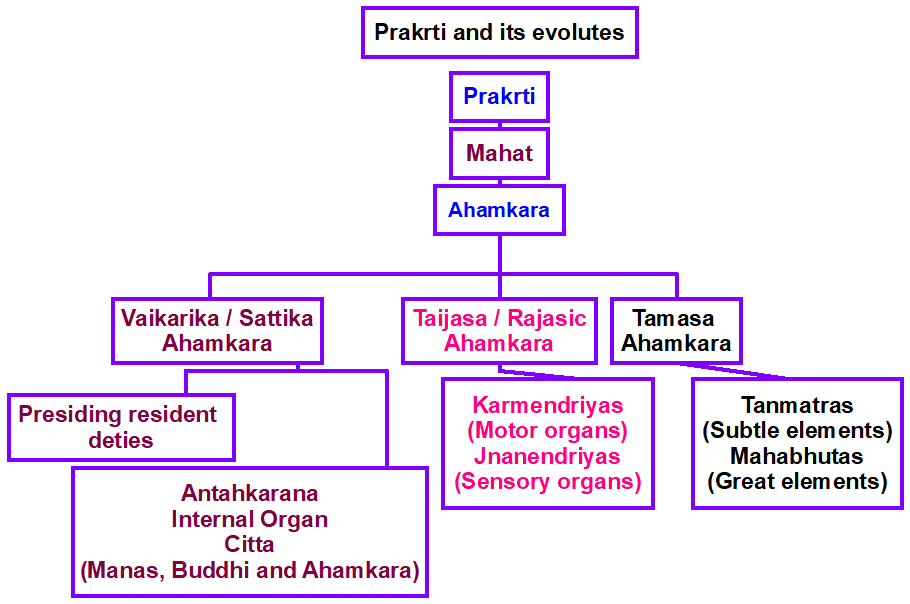
We are spirit and matter, which are recycled according to the merit or demerit of karmic load. It is Samsara, birth and rebirth. Samkhya philosophy of dualism: Kapila was the founder and propounder of Samkhya philosophy. Its basis is not Vedic; it treats two juxtaposed contrary polar principles: Prakrti and Purusa. In Samkhya, Prakrti does not contaminate Purusa but the latter lights up Prakrti.
Purusa is Consciousness and Supreme Unparalleled Intelligence, and Prakrti [Pra (before) krti (creation)] is matter, unconscious, indiscriminate, and insentient. If PRAKRTI sounds similar to PROCREATE, it is so in meaning too. Prakrti indicates an urgency to produce, as Prasavam (parturition) has the imminence to deliver a baby. It is the same as PROCREATIX in Latin.
Matter in Saiva Siddhanta has the following qualities:
1. unconscious element.
2. anything that obstructs consciousness and its working.
3. anything that obstructs obtaining right knowledge.
4. anything that imparts false, incomplete and partial knowledge.
5. senses which do not have intrinsic consciousness or omniscience.
6. a mind that does not present knowledge of things as they truly are.
7. all physiological and psychological processes.
8. all organs.
9. Space, Time.
10. Apara vidya, not supreme knowledge as opposed to Para Vidya.
Aparavidya covers arts and sciences.
Andakosa, the cosmic egg,
represents matter. The cosmic egg has seven layers: water, fire, Hara, ether,
ahankara (ego), Mahat, and gunas. Vishnu pervades the egg as Vairaja and makes
it viable and productive. The individual souls emanate from the Lord’s Para
Prakrti (Supreme Nature), while the universe emanates from his Apara Prakriti
(Inferior [not supreme] Nature). The cosmic egg is Apara, while Vairaja is
Nothing new can come out in this world that does
not exist in Aparaprakrti in its potential form. Also from Prakrti evolves,
Citta which consists of Mahat,
buddhi, ahankāra, and manas. Mahat has the unique ability to undergo
transformation into this universe when it comes under the field of vision of the
Lord, (influence of) Time, and three gunas, according to Bhagavatam 3.5.28.
Mahat
Mahat is the Great principle and results in buddhi,
from which develops ahankāra, I-ness or individuation. Mahat and buddhi are the
cosmic and individual counterparts of intellect. Sixteen entities such as five
faculties of action, manas (instinctive mind) five faculties of sense, and five
tanmatras namely sound, touch, color, taste, and smell arise from ahankāra
(ego). This pluripotential Prakrti (nature) results in gunas – Sattva, Rajas,
and Tamas. These three constituents of gunas are inseparable and form a complex
– Sattva-Rajas-Tamas complex, which is inert, if it is in equilibrium. Only one
of the three constituents is dominant in a person or entity. Sattva is
knowledge, intellect, light, and balanced emotion; Rajas is the motor behind
Sattva and Tamas; Tamas is darkness, passivity, or negativity. Without Rajas,
Sattva, and Tamas are inert; dominance of Rajas naturally means revved-up
emotions. These three gunas, complex or strands condition the manifest world,
both animate and inanimate; the force behind this complex or strands is
excitatory Purusa, which agitates these strands or gunas and causes
disequilibrium and subsequently diversity and polymorphism. Bhagavatam (3.10.14)
states that God created the first product Mahat by causing disturbance in the
equilibrium of the gunas.
Ahankāra (ego), the second product, is subject to Sattva, Rajas, and Tamas: The Sattvika ahankāra gives rise to the mind and the presiding deities of the senses; the Rajasic ahankāra gives rise to the sensory and motor organs; the Tamasika ahankāra gives rise to the subtle elements like sound, touch, color and vision, taste, and odor.
Ego by nature does not express satisfaction and is in a state of restless motion. Ego has ignorance, likes and dislikes: 1. ignorance of the difference between the eternal and the noneternal, 2. mistaken belief that body and mind are the same as self, 3. love and attachment to gratifying objects, 4. hatred and avoidance of unpleasant things, and 5. love of life and fear of death.
The sensory and motor organs are called Jnanedriyani and Karmendriyani. (Jnana +Indriyani = perception organs. Karma + Indriyani = action (motor) organs.) Organs of perception are eyes, ears, nose, tongue, and skin. Motor organs are larynx, hands, feet, anus and genitals and their functions are speech, grasp, locomotion, evacuation and reproduction. Citta, the command and control center or inner organ (antahkarana), presides over the vital functions of the universe of the body. These vital functions go by the generic name Prana which consists of five parts: Prana, Samana, Apana, Udana, and Vyana. Please refer to the commentary on verse, BG10.9 for more details on Vital breaths. Here breath does not exclusively mean physiological respiration. Implicit in the terms is the fact that all the organs to work optimally need breathing of air (prana) by the lungs.
Saiva siddhantist says, soul is the ever-awake knowing entity in wakefulness, deep sleep and dream sleep. The sense organs receive their respective stimuli (eyes perceive color and form, ears receive sound.) and pass them on to Antakarana, the inner organ which consists of Manas, Buddhi, Ahamkara, and Citta (Citta covers manas, ahamkara, and buddhi: mind, ego and power of discernment or judgment). Perception received by the inner organ reaches the soul, as the wave rolls to the shore.
The subtle elements proceed in their formation in a cascade fashion starting with sound, which gives rise to ether. The elements combine under the enzymatic action of Time, Maya, Jiva, and the glance of the Lord. Ether, treated with these enzymes, becomes touch, which transforms to air; the air and ether combine in the presence of enzymes to become color; from color evolves fire; fire and air combine to produce water, whose special quality is taste; water and fire combine to form earth, whose special quality is odor. Source: Bhagavatam 3.5.27-37.
The elements starting with Ether going forward in
their combinations and permutations sequentially and progressively pick up
qualities of the previous elements and display their own special qualities.
Bhagavatam 3.5.36
Table:
| Element(s) | Resulting Product | Cumulative & Special quality |
| Sound | Ether (all-pervasive, one quality) | Sound |
| Ether | Air (two qualities) | Sound and Touch |
| Air and Ether | Fire (three qualities) | Sound, Touch, and color/form |
| Air and Fire | Water (four qualities) | Sound, Touch, Color, and Taste |
| Water and Fire | Earth (five qualities) | Sound, Touch, Color, taste and odor. |
As I said earlier, the elements need four factors for transformation and they are Time, Maya, Jīva, and the glance of the Lord; time connotes change; Maya is illusion plus distraction; Jīva is the life force; the most critical deciding factor in the combinations, permutations, and transformations is the glance of the Lord. Maya is the cause of the universe, which, in its female form, derives its energy and support from the Lord. Avyakta (the Unmanifest) is the father of Maya.
According Saiva Siddhanta and its main proponent Tirumular, Sakti is the mother of Maya. Space, air, fire, water, and earth were born of Maya in succession. From Maya came the subtle elements Tanmatras, from which the gross elements were born; thus, Maya is the Mother of the Universe and beings.
Maya according to Ramakrishna Parmahamsa
On attainment of Nirvikalpa Samadhi, Ramakrishna Paramahamsa sees Maya as Brahman in its twofold aspect: Avidyamaya and Vidyamaya. (Avidya = ignorance; Vidya = wisdom) Avidyamaya in terms of Kundalini Chakras is living in the pelvis and abdomen--Muladhara, Svadhisthana and Manipura Chakras of lower order; it is living a life of animal passions, Kama, Krodha, lobha, Raga and Dvesha (lust, anger, greed, passion and hate). One should transcend the lower Chakras and ascend to higher chakras. Avidyamaya keeps man in samsara, a cycle of birth and rebirth. Vidyamaya represents the higher centers and consciousness of Anahata, Visuddha, Ajna and Sahasrara Chakras or stations of life. Once Avidyamaya is conquered with Vidyamaya, the round of birth and rebirth is abolished and one enters a state of Mayatita, end of Maya or freedom from Maya. Maya is the power of Kali who transcends both types of Maya. She shines far above the clouds of Maya, under whose spell and shadow man lives.
Let us take cloning as an example: The biologists
have mastered the physical art of cloning. The product is not as perfect as
nature because the main factor – glance of the Lord – is lacking.
In the following diagram, the concept of Sūtra, not
found in Sankhya system, is a contribution of Bhagavata purana.
Sūtra means thread or
aphoristic rule. Sutra is the functional counterpart of Mahat, the Cosmic
Intelligence. Both work together --Intelligence and function—to evolve Ahankara.
Sutra is subtler than Mahat.
Here is another version of the evolutes of Prakrti (Bhagavata Purana).
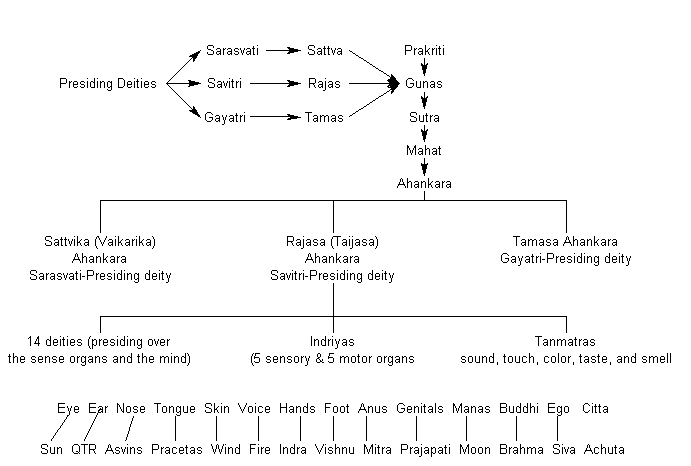
Here is the Saivite view of Prakrti and its evolutes.
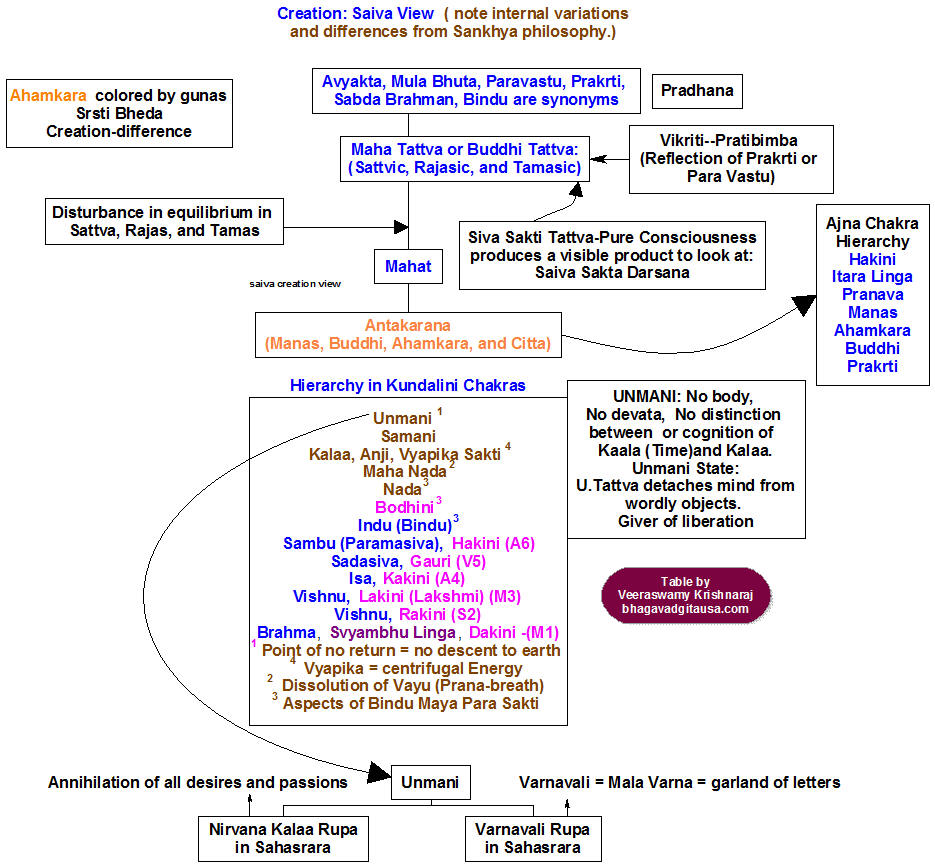
Karmendriyani are five motor organs, voice box, hands, feet, rectum and genitals, causing speech, grasp, locomotion, evacuation, and generation. Janendriyani are five sensory organs, ear, skin, eye, tongue and nose involved in hearing, touch, vision, taste, and smell.
Sarasvati, Savitri and Gayatri preside over the gunas, Sattva, Rajas and Tamas respectively.
NA16.8
Sakra (Indra) took one look at Urvasi and heard the narration of Your greatness. Krishna Avatar is Purna Avatar and greater than Your descent as Nara-Narayana.
Narayaneeyam Feedback Form