|
Bhagavad-Gita: 18 Chapters in Sanskrit |
| Download Bhagavadgita-all 18 chapters in Sanskrit, English, |
| transliteration and word for word translation. |
Bhagavadgita Pages in English, Chapters 1 to 18
| bg07-Sanskrit | bg10-Sanskrit | bg11-Sanskrit | bg12-Sanskrit | ||
| bg13-Sanskrit | bg14-Sanskrit | bg15-Sanskrit | bg16-Sanskrit | bg17-Sanskrit | |
Veeraswmy Krishnaraj

You have your Google search engine tailored for this site.
Please enter the word(s) in the search box; it will take you to the file with that word in this web site. Enjoy your visit here.
Tilakam
திலகம்
|
The Complete Works of Swami Vivekananda Volume 6 [ Page : 115 ] NOTES TAKEN DOWN IN MADRAS, 1892-93 Educate your women first and leave them to themselves; then they will tell you what reforms are necessary for them. In matters concerning them, who are you? Swami Vivekananda 1892-93 Madras/Chennai |
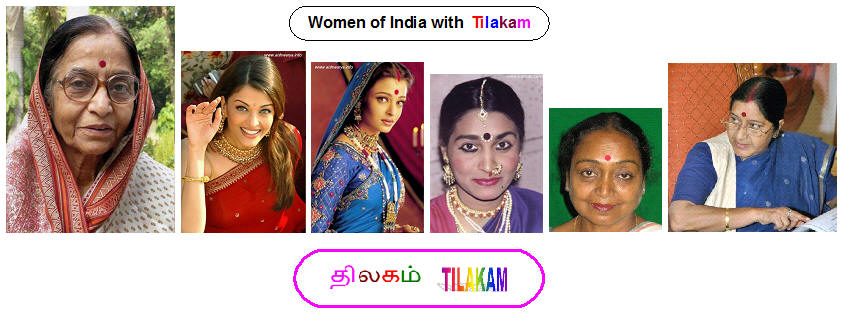
Tilakam (திலகம்) A mark on the forehead made with colored earths, sandalwood or unguents whether as an ornament or a sectarian distinction;
Clerodendrum phlomoides (Vaathamatakki--வாதமடக்கி a plant- in Tamil; dagdharuha); a freckle compared to a sesamum seed; a kind of skin eruption.Monier Williams Dictionary. It is applied over Ajna Chakra (Bhrumadya = the spot between the eyebrows. Bhru = brow, which is cognate with and derived from Sanskrit Bhru. Ajna Chakra is the sixth Kundalini Chakra on the forehead area, attaining which evokes spiritual knowledge.Ash from the dead bodies was worn in primitive times to remind us about the impermanence of life on earth and the reality and certainty of death. Ash as a symbol of nothingness brings home the point that all objects that give a feeling of I and Mine in the world eventually come to an end and greed and possessiveness have no place in the world. Ash is the remains of the body and what remains after the body is the immortal soul. To be attached to the impermanent body and not the eternal soul is the paradox of daily mundane living. Soul is burdened with impurities (Malam = மலம்), though the liberated soul is pure. Ash is pure and has undergone test by fire; thus, all impurities should be rendered into ash. All matter (Panchabhutas = Five Great Elements) are perishable revealing the underlying eternal Parmatman (Supreme Soul). Siva smearing Himself with Ash is the reminder of impermanence of the five elements and the underlying eternality of Brahman, (who is the hypostasis of all that exists).
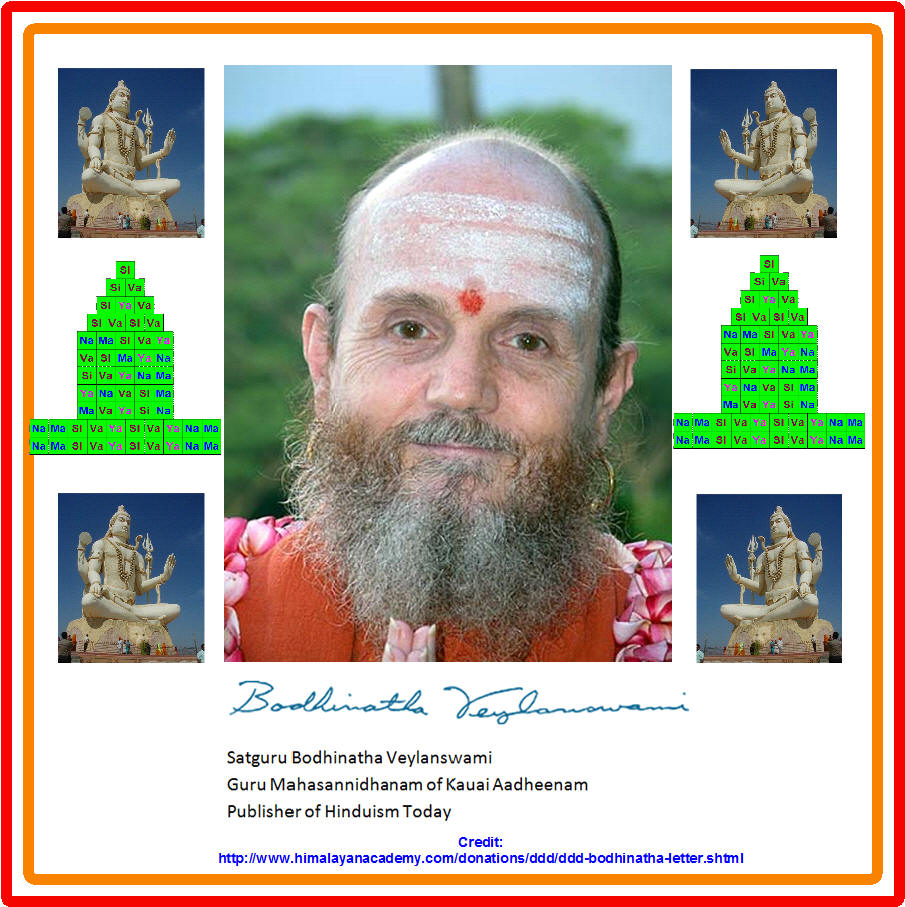
It is interesting to note how a westerner describes the forehead marks of Siva and Vishnu worshippers. Here is the observation of Monier Monier-Williams (12 November 1819 – 11 April 1899) on the forehead marks. His observation and the humor. Posted October 10, 2014
400 Daily Religious Ceremonies. 400 (436 OF 644)
After bathing comes the ceremony of Bhasma-dhāraṇa, or application of ashes. This is done by rubbing ashes taken from the sacred domestic hearth on the head and other parts of the body, with the repetition of a prayer to Śiva (from the Taittirīya Āraṇyaka X. 43):— 'I offer homage to Śiva (Sadyo-Jāta). May he preserve me in every birth. Homage to the source of all birth.'
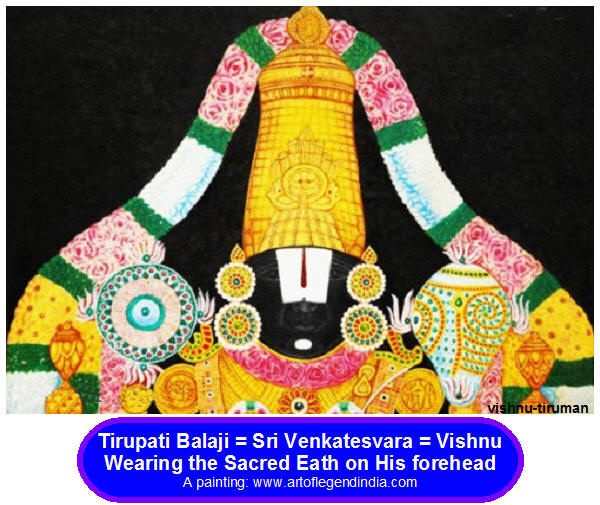
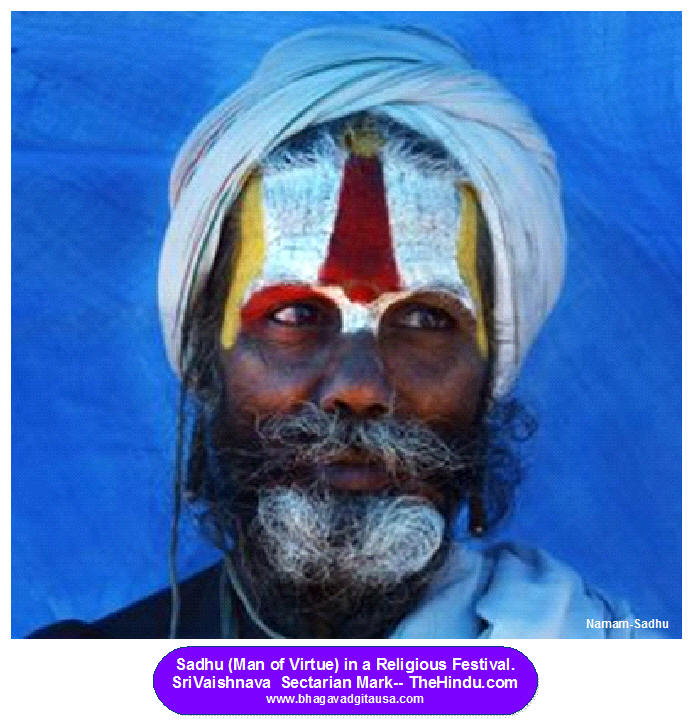
The Srivaishnava Urdhva Pundra = நாமம், the three vertical marks
Three horizontal white ash stripes (விபூதி, திரிபுண்டரம் = Vibhuti, Tripundaram) -Krishnaraj)
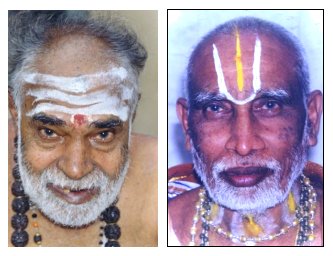
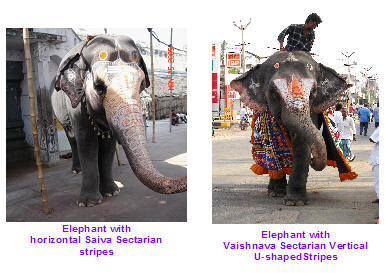
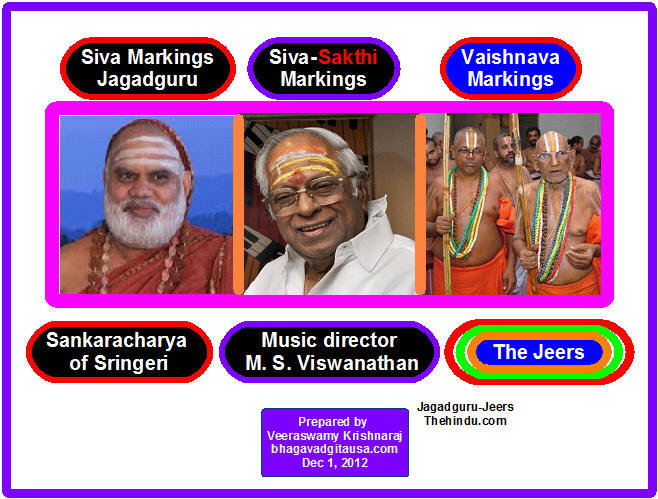
At this time, also, every pious Hindu marks his forehead with the sacred mark (called puṇḍra or tilaka) of his own peculiar faith or religious views. When a man is a Śiva-worshipper, he does this with ashes, in which case it is merely a part of the Bhasma-dhāraṇa rite just described1. Sometimes a curved perpendicular mark, sometimes a circular one, sometimes three horizontal lines (tri-puṇḍra) are made with white earth or pigment2. Of these markings the upright (Ūrdhva, p. 67) denotes the impress of the god Vishnu's feet3, and the three horizontal the three functions of Śiva (p. 80).
I once said to a Brahman who seemed proud of his curved perpendicular mark:' What's the difference between you and your friend there with his three horizontal marks ? ' ' Oh,' he replied, ' we are as different in opinions as the horizon from the zenith. He does his religion horizontally, I do mine perpendicularly. But we are very good friends notwithstanding.'
The next act is Śikhā-bandhana, or the tying up of the locks on the crown of the head (p. 374), lest any hair, thought to convey impurity, should fall on the ground or in the water.
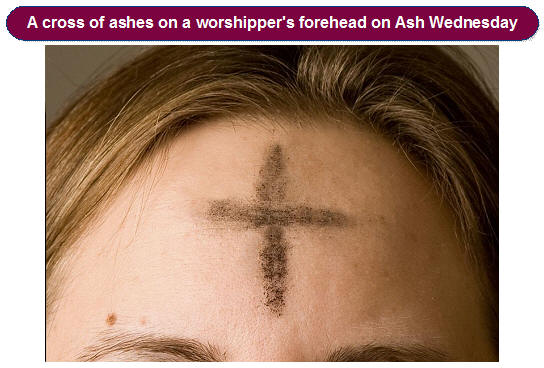
1I am told that on Ash-Wednesday in the Roman Catholic Church members of the congregation go up to the altar and are marked with the sign of the cross. This, I believe, is sometimes done with the ashes of palms such as are used on Palm-Sunday. I am told, too, that the priest as he marks each person says : 'Dust thou art, and unto dust thou shalt return.'
2The worshippers of Vishnu generally use Gopīćandana, a kind of white earth brought from Dvārikā.
"3It usually consists of two upright lines joined by a curve at the bottom. The Rāmānuja Vaishṇavas, as we have seen, dispute over the form of this mark (see p. 126).
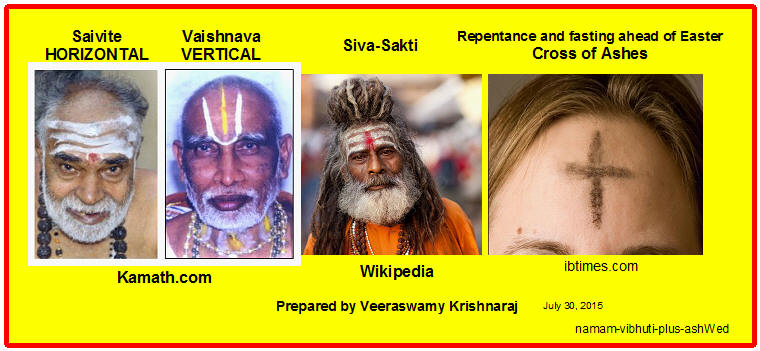
The Stars (dots) and Stripes, and colors
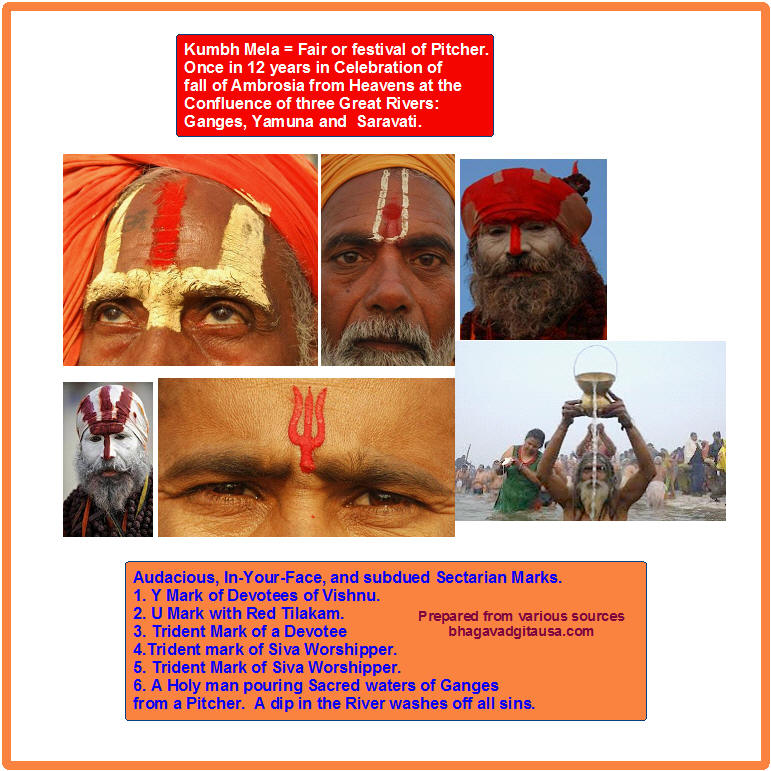
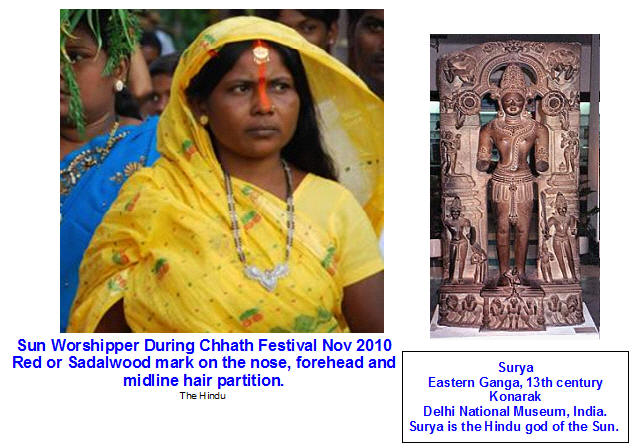
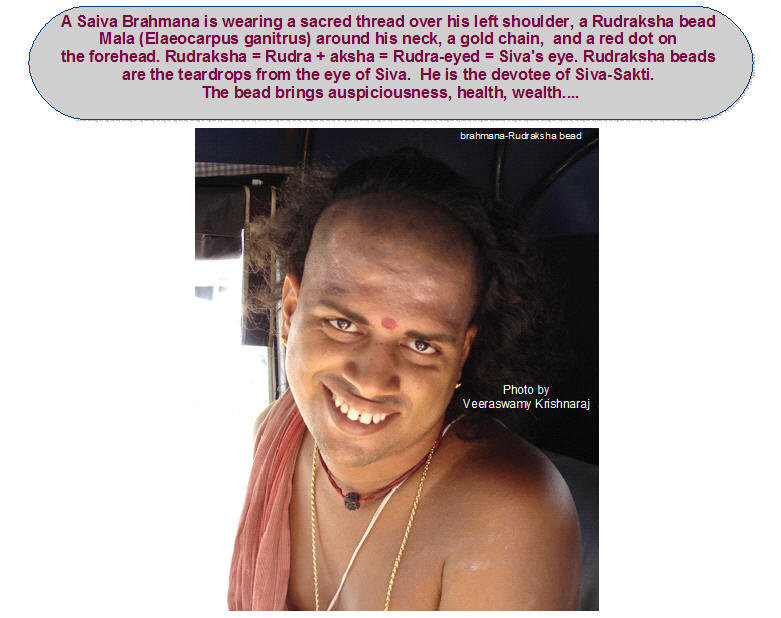
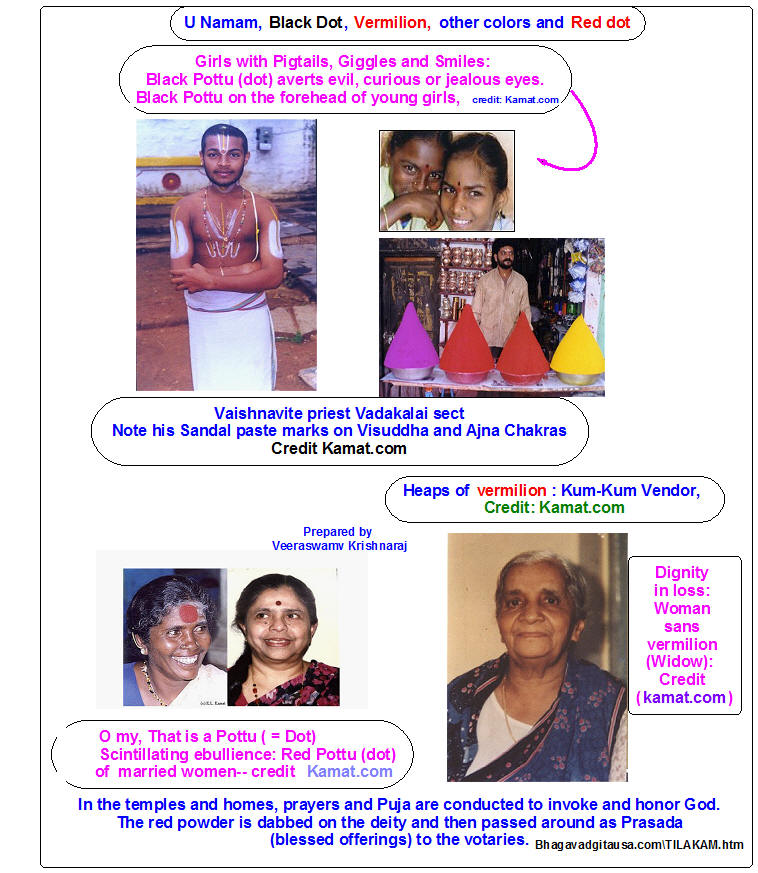
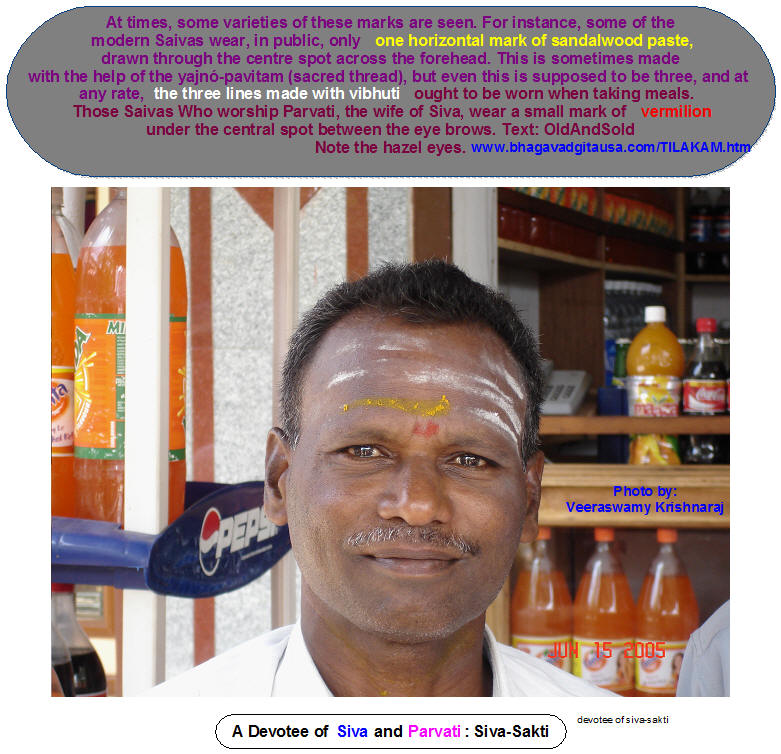
The forehead mark is white, red, yellow or black most of the time. Three horizontal white ash stripes (விபூதி, திரிபுண்டரம் = Vibhuti, Tripundaram) on the forehead along with the red dot below the stripes (see picture) are the mark of Saivites; three vertical stripes (Namam) the sign of Vaishnavites; black Pottu/Bindi (● dot) the sign of the black moon and the premarital virgins with sexual purity. Red Pottu (Kum-Kum) is the sign of married woman. Red mark is worn by men also, worshipping Mother Goddess (Sakti; Saktas). The red Pottu or mark also indicates the third eye of wisdom, worn just below the center of the forehead.
|
Tamil Proverb as recorded and told by Rev. REV. HERMAN JENSEN 252. இது என் குலாசாரம், இது என் வயிற்றாசாரம். This is the law of my caste, and this is the law of my belly. 851. Potters are never Vaishnavas ; but the potters at Srirangam were compelled by the Vaishnava Brahmins to put the Vaishnava mark on their foreheads; otherwise the Brahmins would not buy their pots for the temple. One clever potter, having considered this difficulty, after making the Saivite symbol (Vibhoothi) on his forehead put a big Vaishnava mark on his stomach. When rebuked for so doing by a Brahmin, he replied as above. |
|
Oct 16, 2012. Red Dot: Significance. The Āsana (seat) of the Devi is also red, which is the Rājasika colour. Red is an active (Rājasika) colour. The flower of these Tāntrikas is the red Japa-puṣpa (hibiscus), and in the ritual of Latā-sādhana the Madanāgāra is sprinkled with red sandal. Red indicates Will and Desire (Iccha) and Vimarśa Śakti and so it is said Sarvasya etasya lauhityam Vimorśaḥ --Woodroffe The Great Liberation, page 117. Explanation by Krishnaraj Devi = Female Deity. Japa-puṣpa = Worship-flower. Tāntrikas = practitioners of Tantric rituals. Latā-sādhana = Latā = Mādhavi Creeper = Gaertnera racemosa, slender woman; sādhana = attaining one's goal, gaining power over. Latā-sādhana = the rite of sexual union. Madanāgāra = place of love-god Kāma or Hindu Cupid; red sandal = sandalwood powder made red. Vimarśa Śakti = Action power of Sakti, the consort of Siva. Vimarsa is the Kartitva (doership) Sakti of Siva. Siva's Prakasa (splendor) is the heart and Vimarsa (Sakti = power) is the pulsation. Siva is covert; Sakti is overt. Siva is the Boss; Sakti is the Executive; they are One. |
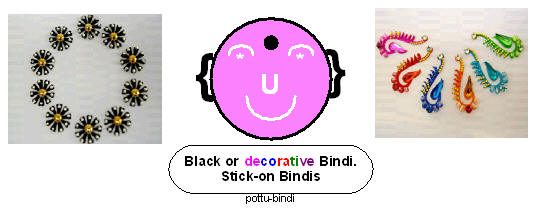
I suggest that American high school girls and others who have taken a vow of chastity until marriage wear a black dot (= ● = Bindi = பொட்டு) on their foreheads to stave off testosterone-charged, acne-faced, gangly, ungainly, loose-tongued, teenage ducks with bluff and bluster. That black Bindi (dot) gives the wearer a perimeter of sacrosanct ambiance around her. It is a public declaration that the boys dare not approach chaste though nubile girls with dots on their foreheads. It also serves as a beauty mark. There are also many decorative stick-on Bindis as depicted above.
|
NEW DELHI, INDIA, February 2, 2013 (India Times): Young Muslim women in India, and even Pakistan, can be increasingly seen sporting the chooda (red bangles), mangalsutra (thaali = தாலி = Marriage pendant around the neck on a chain.) and often the sindoor (= सिन्दूर = kumkum powder). And they see no taboo in it, taking it as a fashion statement, something that adds to their "just married" look. "Wearing a chooda doesn't make me a Hindu or a lesser Muslim," says 21-year-old Sumaira. "See, among Muslims there is nothing that differentiates married women from those who are still single. I have been fascinated with choodas ever since I was a kid. So that was one of the first things I bought after my engagement.
It's not only the chooda. The demand for
mangalsutras is picking up, and not just in India but also in Pakistan
where many of those who ask for it attribute it to the influence of
India's enormously popular saas-bahu soaps. Jewellers in Delhi confirm
this trend. "In the past two-three years, we have seen a growing number of
Muslim women, some in burqas, ask for the mangalsutra," says Ankit Kohli,
owner of Raj Jewellers. "They prefer the ones that have diamond pendants."
Bangles (Chooda) have been worn by Indian women from at least 2600 B.C. --Krishnaraj |
White stripes indicate Sita Bindu of Siva. Sita = white. Bindu = dot...Red dot indicates Sona Bindu of Sakti. (sona = red). White stripes and red dot indicate Siva-Sakti. Bindu is a dot, singularity from which the universe proceeds and into which the universe and beings subside. (Yes, it is the Singularity in the Black Hole.) It appears that ancient Hindus had an idea of the recently-conceived idea, Singularity. Bindi, the forehead mark is derived from Bindu. Descending Viloma and ascending Anuloma meet at the middle of forehead, the site of the Mark and Ajna Chakra, where the Sadhaka obtains spiritual Knowledge and visions of Siva. When human consciousness ascends in Anuloma fashion to Ajna Chakra (forehead), Higher Saktis pick up the soul and take it to the higher Consciousness. For definitions of anuloma and viloma go to BINDU.
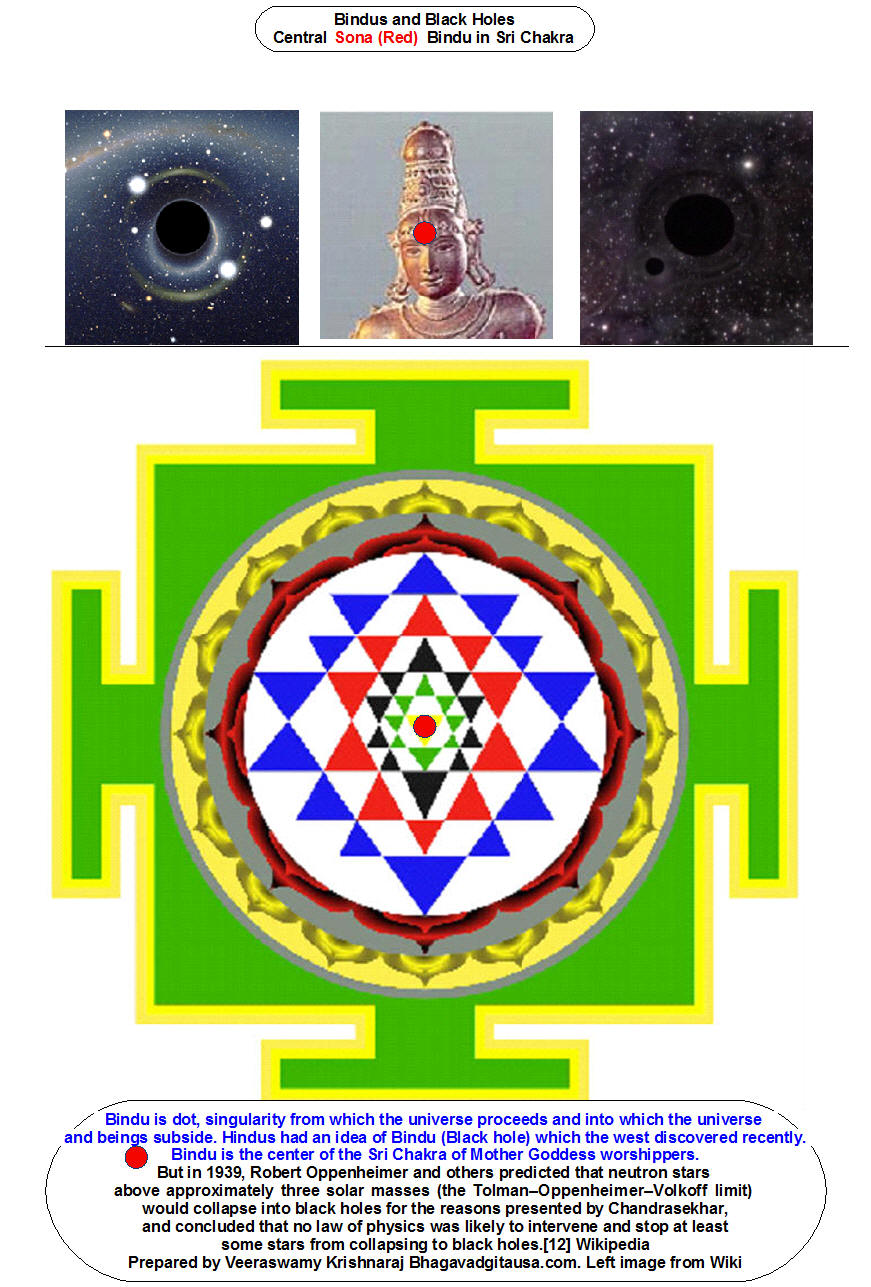
Significance of Rituals and marks: Karpura Arati (கற்பூர தீபாராதனை = Waving of lighted camphor before a deity) is symbolic of the burning of the mind by the light of illumination. Vibhuti (விபூதி = sacred ashes) is Siva (absolute Being) and Kum-kum (குங்குமம் vermilion powder) is Sakti (Power, consciousness). In another point of view, Siva is Consciousness and Sakti is Prakriti (Matter).
|
Hrīṁ, Śrīṁ, Krīṁ, to Thee the Supreme Devi (Sakti), Thou Who dwelleth in and art in the form of all things, Who art surrounded by Thy attendant Devatas, and Who hearest all Thy insignia, Who art above even the most high, to Thee, Who art the Ādyā Kālikā, I offer this oblation: Svāhā (66-67). Woodroffe Great Liberation Page 97. Siva and His Sakti are so called when the worshippers are in a joyful mood. The Tantrāntara gives the following meditations on ĀnandaBhairava and Ānanda-Bhairavī. The former is lustrous like ten million suns and cool like ten million moons. The Deva has five faces with three eyes in each and eighteen arms. He is on a Brahmapadma in the middle of the ocean of nectar. His throat is blue. He is decked with ornaments and seated on a bull. He holds a skull and Khaṭvāṅga (The club surmounted by the skull; a piece of wood half burnt from a funeral pyre is also so called) and makes a music with bell and drum (Damaru). He holds the noose (Pāśa), goad (Aṅkuśa}, mace (Gadā), spear (Muśala), sword (Khaḍga), shield (Kheṭaka), axe (Paṭṭiśa}, hammer (Mudgara), trident (Śūla) and staff (Daṇḍa). He holds a vajra (thunderbolt) and a severed head and makes the Mudrā (gesture) of granting boons and dispelling fear. Ānandabhairavī, the Devī Sudhā, should be meditated upon as lustrous as a hundred thousand millon moons white as snow and the Kunda flower. She has five faces with three eyes in each and eighteen arms. She is eager to give joy to all, She is large-eyed, smiling and seated in front of the Devadeveśa. Woodroffe, Mantras and Purification. The Great Liberation. page 133. |
Vibhuti is of two kinds: Para Vibhuti and Apara Vibhuti. The sacred ashes are of the latter class. The Para is what remains after all the dross has been burnt away by the Fire of Realization. It is Absolute Being. --Talks by Ramana Maharishi, page 89.
Votary belonging to Mādvachārya sect wears sandal paste midline vertical line on forehead instead of red line. Guruvayurappan (Lord Krishna in Guruvayur in Kerala) is seen with the U mark on his forehead, made of sandalwood paste and saffron. Preparatory rites involve using of sandalwood paste and its distribution to the votaries as Prasadam at the end of ceremony. Sandalwood paste is used on various parts of the body for Sandhyavandanam and post-Upanayanam worship. Vadakalais wear U Namam; Tenkalais wear Y Namam. Link --> vadakalai_tenkalai. Namam = The Vaiṣṇava sectarian mark, worn on the person in 12 places, reciting the 12 names of Viṣṇu.
|
‘Tripundra’
refers to the three horizontal stripes of holy ash that are applied on the
forehead.
The three lines, from top represent balance and illumination, dynamism and
basic inertia and darkness. |
|
Correction. Photo 3: The man looks like Caucasian, wearing a crown rather than a trident. These are Vaishnava markings.
|
|
Horizontal and Vertical Markings விபூதி and நாமம் The distinctive head markings (namas) identify the sects of Hinduism. Shaivites apply bands across their foreheads (left). Vaishnavites, adherents of Vishnu, wear three vertical lines (right).
|
|
Happiness in tranquility (credit: kamat.com)
A Muth and its Swamiji are the nucleus of cultural,
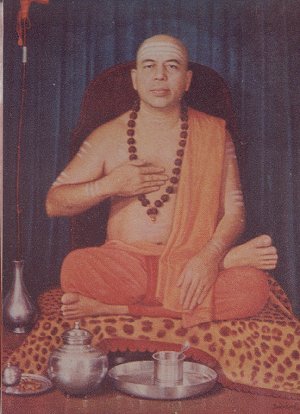
spiritual and philanthopic activities Tranquil physiognomy Eight triune Vibhuti stripes: one triune on each of the 8 parts of the body 1st Triune: Forehead, 2: neck, 3-4-5-6-7-8 on the arms; three triunes on each arm. |
|
| Paul Brunton in 1930s
travels up and down India looking for Yogis, goes to Tiruvannamalai
ArunachalaTemple, and sees what he calls a 'gaudy caste mark' and a
'grotesque' trident mark on the eyebrow. page 167,
A Search in Secret India. A
description of him is available in Wikipedia.
"When we reach the gateway once more, I have to step aside because an elderly Brahmin sits on the ground in the middle of the path with a little brass water-jug beside him. He paints a gaudy caste mark on his forehead, holding a broken bit of mirror in his left hand. The red-and-white trident which presently appears upon his brow - sign of an orthodox Hindu of the South - gives him, in Western eyes, the grotesque appearance of a clown. A shrivelled old man, who sits in a booth by the temple gates and sells little images of holy Shiva, raises his eyes to meet mine and I pause to buy something at his unuttered request." (Krishnaraj: Obviously Paul Brunton did not understand and did not care to learn about the Namam (நாமம்). He calls the sacred mark of Sri Vaishnavites "The red-and-white trident as a sign of orthodox Hindu of the South." Paul was a learned man and yet did not have rudimentary knowledge of the sacred sign of the Sri Vaishnavites. Calling it 'grotesque' indicates the depth of his ignorance. He makes an uneducated offhand remark. What a folly? He identified the person an elderly Brahmin in the middle of the path. It is more than likely he is not a Brahmin with a broken mirror but a merchant. Paul did not mention whether the man had the sacred thread across his shoulder and chest, a sign of the twice-born or Brahmin. What he means by holy Shiva, no one knows. Is it the Lingam or what? At that point in time, he was English and thus what he said to English people about India was for all intents and purposes authentic firsthand information. If you don't know a culture, keep your mouth shut. |
Sacred Ash is of three types: Karpam, Anukarpam, and Upakarpam. Karpam is the ash made from cow-dung caught by hand as it drops [Really, you don't say.] and prepared according to Agamic rites. Anukarpam is the ash made from the cow-dung picked up from the pasture lands [You mean picking it up with your bare hands without gloves, Ugh, Ugh.]. Upakarpam is the ash prepared from the ashes left behind after forest fires and the ashes in the brick kiln.
These marks teach the devotee of all sects that he should remove the triads from his system. They also indicate the opening of the third eye of wisdom in Bhrumadhya (spot between the eyebrows. भ्रू = Bhrū = Brow; Madhya = mid point. Sanskrit Bhrū is cognate with brow.
The Triads
Mummalam =மும்மலம் (three impurities: Anava Malam, Maya Malam, and Kanma Malam—I-ness and mineness; illusion; selfish acts. Primer in Saiva Siddhanta
It brings relief from three miseries of human existence: Exogenous misery, endogenous misery and theogenous misery (Adhibautika, adhiatmika, Adhidaivika).
It depicts the transcendence of rising above the three gunas: Sattva, Rajas, and Tamas.
Generally Prarabdha Karmic fruit comes in three flavors: Adhidaivika, Adiyatmika and Adhibautika (Theogenous, endogenous and exogenous).
Adhidaivika (Theogenous Misery) Karmic fruit originates from God and determines the heredity, ancestry, and environment of the eater of the fruit. The birth may be of high, average or low status with its fruits; the souls after departure may enter heaven or hell for pleasure or pain. Vedas pronounce the word of God. The violator goes to hell and suffers; the complier goes to heaven and enjoys bliss. The Lord dispenses fruits according to the merit or demerit of one's karma; that is the will of God. Suffering in hell abolishes sins. Another source tells that Theogenous misery happens at conception and embryonic stage, at birth, and at death.
Adhiatmika Karma (Endogenous Misery) brings fruits from one's own body by way of disease, suffering, misery, old age and others. Another source tells that the miseries come from self, other people, animals....
Theogenous and Endogenous Miseries are both mental and physical.
Mental Miseries are அழுக்காறு, அவா, வெகுளி, கவலை (Envy, Desire, Anger, and Anxiety).
Physical Miseries are
பிணி, காயம் (Disease, Injury).Adhibhautica Karma (Exogenous Misery) means that the miseries proceed from the five Great Elements: Rain, Wind, Earthquake, Tsunami and Volcano....
The souls after death go to the world of Vishnu, Brahma, or Indra, live among gods and enjoy bliss, eating fruits of good deeds in Svarga. Svarga is an inferior heaven of Indra, which does not offer permanent liberation. Once this pleasant sojourn in heaven comes to an end, it is time to eat the bitter fruits of evil deeds; the Vaishnava heaven (Vaikuntam, Paramapadam), once reached, is the permanent place for the liberated soul living with Krishna, Sri, Bhu, Nila and Nityasuris. The unliberated soul after death is taken to Yama, the god of death, who dispenses appropriate fruits for the sins. The suffering involves incineration, dipping in hot oils and other unspeakable hellish experiences. Once the fruits are eaten in heaven and hell, the soul returns to earth to expiate the remaining karma. BG02: verse 2.44 commentary. The Saivites attain permanent liberation and place in Kailash, once the impurities are removed, the soul undergoes malaparipakam and Odukkam (மலபரிபாகம், ஓடுக்கம்) and attain liberation. Such souls are known to have attained Jivan Mukti (சீவன்முத்தி liberation from the trammels of worldly existence even during life.), meaning that they are liberated while alive in a body on earth. It is like Early Admission into IVY league colleges, even while the student in question has not yet finished his school. The Srivaishnavites believe in Videha Mukti (incorporeal liberation = Emancipation of the soul after death, விதேகமுத்தி). They reach Vaishnava heaven only after death.
The forehead is an important locus in the body by which a person distinguishes himself by his Jnanam (spiritual wisdom). That glabellar locus (Bhrumadhya) is the 6th locus in Adhara Yogam of Kundalini, Ajna Chakra, by which a man transcends and rises from the secular to the spiritual sphere. As the person acquires external and internal purity there is no more any need for demonstrative signs on his body like ash stripes. The person who demonstrates flagrantly the sectarian marks on his face and body is obviously an aspiring man of the world and has not ascended to and transcended Ajna Chakra.
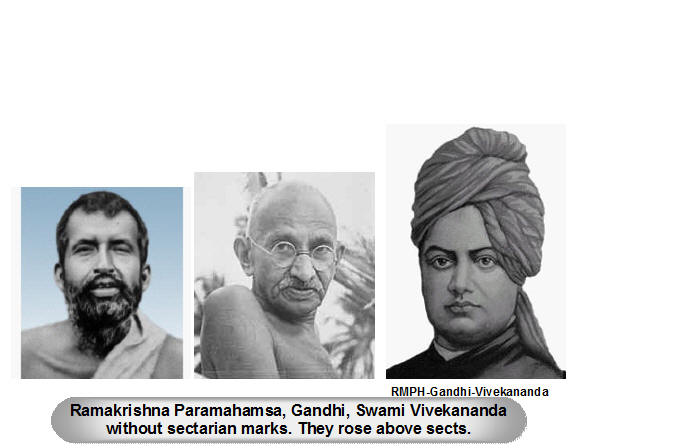
External purity and the advent of internal purity are in place. Siva has taken an abode in his heart, a sign of internal purity. Such a devotee becomes the temple of God and becomes the man of the universe, treating all equally. According to Vaishnavites Vishnu is all-pervasive and thus pervades all beings and matter.
Fire is the purifier. Both Vaisnavites and Saivites claim that their Isvara (Narayana or Siva) is the Vaisvanara, the fire-god. Krishna (Narayana) claims to be Vaisvanara. Agni (cognate with Latin ignis and its derivative ignition) means the One who leads us forward. Of all Devatas, Agni (Fire god) is the visible one who appears before you at the strike of a match or churning of the sticks in olden days. He is a Leader, thus takes us forward and upward and showers us with benefits (rewards). He is Prohitan (Pro = forward or upward; Hitam = benefit) and a good advisor. Contrary or ill advice earns demerits to the advisor and that is why Agni always gives good advice. He has a soft heart for those who adore him in words and hymns of praise and always extends privileges and help. When you worship Agni, Vaishnavites say you worship only Vishnu, because Vishnu is the Antaryami (Inner Controller and Suksma Vasudeva = Vishnu in subtle form) of Agni. When you call Agni, you are calling Vishnu. Oblation to Agni is oblation to Vishnu. The boons from Agni are boons from Vishnu.
The view from the West: Adapted from Harper's Dictionary of Hinduism
The West is of the opinion that Agni was an
Indo-Aryan Elemental god along with other elemental gods of the Wind, Earth,
Air, and Ether. Agni (Fire-god) always rises and so has the unique ability
to carry oblations to the gods. One can see the flames rise, and smell of the
burnt offerings rise in the form of smoke. Before the days of matchsticks, the
Indo-Aryan used fire-sticks ( friction
sticks = அரணி = अरणि =
araṇi)
to produce the spark. Indo-Aryan described Agni as butter-faced and
butter-backed with flaming hair [he thrives on butter], thousand eyes, and
golden teeth. Agni had many roles in the Indo-Aryan culture. He is immanent in
every god because gods cannot live without the oblations he brings to them.
Since Agni is the carrier of oblations from earth, he had the opportunity to
come into contact with Ri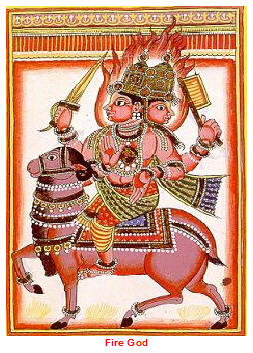 shis and
gods. When they were meditating, not looking and not on the alert
or not paying attention , I am sorry to say Agni ravished their wives.
Talk about flame, sparks, heat and mojo in the bedroom. There is no home without
heat; there is no living person without heat. The living you just simply cannot
avoid the Fire-god. Since Agni is a serial Ravisher, he accumulated a mother
lode of carnal sin. In Tiruvannamalai Tamil Nadu, Siva is the presiding deity of
the Arunachalesvarar Temple. On the southeastern face of the mountain there, a
spring Brahmatirtha appeared; by bathing in it, the fire-god expunged his sins
of adultery with married woman. Agni got away easy.
shis and
gods. When they were meditating, not looking and not on the alert
or not paying attention , I am sorry to say Agni ravished their wives.
Talk about flame, sparks, heat and mojo in the bedroom. There is no home without
heat; there is no living person without heat. The living you just simply cannot
avoid the Fire-god. Since Agni is a serial Ravisher, he accumulated a mother
lode of carnal sin. In Tiruvannamalai Tamil Nadu, Siva is the presiding deity of
the Arunachalesvarar Temple. On the southeastern face of the mountain there, a
spring Brahmatirtha appeared; by bathing in it, the fire-god expunged his sins
of adultery with married woman. Agni got away easy.
(Here is an explanation. A living body is warm. A woman is said to radiate more heat from genitals than from the rest of the body. According to Hindu Sacred Lore, Woman is fire; her vagina is the fuel; the vulva is the flame; the orgasm is the sparks. - Chandogya Upanishad V.8.1-2) That is why people say, "He or she has burning passion, a burning desire...")
In this depiction, Ram-riding Agni has two faces, black eyes, black hair, many hands, three legs, seven tongues: one benign and and the other destructive. He is known to ride, rams, goats, parrots and horses.
He is the priest of the gods and god of the priests. He is the visible god in every home, where no cooking can happen without him. Yes, Agni includes microwave ovens that generate heat and cook food without flame. Without him there is no light; he drives away the demon of darkness. Every time one strikes (churns) the Fire-sticks (or strikes a match), he is born; thus he is born in every home, always staying young. He is full of fire, zeal, strength and youth. That is why women consider him the giver of life and children. Where there is heat, there is life; thus he is immortal and bestows immortality to his votaries. Red horses draw his chariot leaving a black trail. He obligingly clears thick forests creating open space for people to live and prepares the ground for new growth of flora. Sometimes he takes refuge and hides in water, meaning that the dark moisture-laden nimbus clouds generate lightning (and thunder) and rain. Puranas give him an anthropomorphic form. He is born of Brahma. He emerged from the mouth of Virat-Purusa. On face of the earth, he has earthly parents. He takes birth as a ritual fire from Vasubharya (the daughter of light) and Dharma. He marries Svāhā and fathers three sons: Pāvaka, Pāvamāna, and Suci, who give rise to a progeny of forty-nine children associated with 49 fires. Harivamsa euologizes Agni: his chariot has 7 winds for the wheels and smoke as its banner; he has a companion goat; he has four hands and carries a fiery javelin; his head gear is a swirl of smoke; he is dressed in black and is one of the 8 regents of space. Agni also lives deep in the earth as subterranean fire (VadabhAgni) and emerges from there as VadabAmukha (Asvodaraja = Mare's Mouth) and incinerate the world. In his individual form, he is the funeral pyre. He has 9 forms: Rudra, Sarva, Pasupati, Ugra, Asani, Bhava, Mahandevah, Isana and Kumara. As a wise god his names are Kavi, Jatavedas, Pracetas; as the Lord he is Dhatr, Katr, Bhutadi, Suresa; as the child of water Apāmgarbha; as a maker of gold Hiranyakrt; Hiranyaretas, Vasuretas; as universal, Vaisvanara and pancajanya; as springing from the fire-stick, samigarbha, Aranisuta. In water he exists in complete balance. Ritually, Fire and water burn and wash away the sins.
|
Virat-Purusa page 239, Harper's Dictionary of Hinduism Purusa is depicted as a cosmogonic figure,' a creative source, the primeval male who envelops the whole earth and who represents totality." This hymn is the earliest account of secondary creation and is of particular interest as the earliest account of the structure of Vedic society, which its alleged composer Narayana divides into four occupational or functional categories, each corresponding to a particular part of the sacrificed body of the Purusa. This sacrifice became the prototype of all future sacrifices.' From the Purusa's severed body the brahmana emerged from his mouth, from his arms the rajanya; from his thighs the vaisya, and from his feet the sudra. From his mind was produced the moon; from his eye the sun; the wind from his breath; from his navel the atmosphere; from his head the sky, and so forth. Upon this purely symbolic description of the social, political and economic structure of late Vedic society, subsequent Indian 'sociologists' built a caste system, which was ultimately presented in the Manu-smrti as the inviolable expression of divine law. The Purusa-sukta was also prescribed for those desiring a son, for purification, 'and in the ceremonies performed in founding a temple which is constructed in the likeness of the Purusa'." In the SBr. (XI. 1.6, 1-2) Purusa appears as the secondary creator Prajapati, who emerged from the golden egg produced by the primeval waters. In the Ait Up. (1,1-4) he is also portrayed as a cosmogonic figure, the instrument of secondary creation, from whose bodily parts emerged speech (vac), breath (prana), sight (caksus), hearing (Srota), mind (manas), etc. But in the Samkhya system the term purusa denotes the passive complement of the active creative principle (prakrti). There is nothing higher or beyond the Purusa (Katha Up., 3, II); it represents the material from which the world was made, (i.e., the causa materialis) as well as its creator (causa efficiens). 'Man is limited by his body and sense-impressions, only his inner 'universe' is within his reach; hence the universe, the macrocosm, is depicted as a Cosmic Man. The Unborn was one of the early designations of the World-ground. It was later called Purusa, Prajapati, Brahman or Narayana; later Visnu inherited the formula (Coomaraswamy, Yaksas, pt. ii, p. 25). The hymn contains sixteen verses, this number representing totality. Purusa becomes the oblation = the animal victim of the cosmic sacrifice = creation performed by the gods. 'The self-immolation of the demiurge is conceived in many mythologies to be an essential prerequisite of creation. In Christian mythology the corrupt creation is restored to its pristine glory through Christ's self-sacrifice, which is like a second creation' (IT., p. 335; v. also Eliade, Patterns, p. 183). The myth of the sacrifice of the Primordial Giant is European, but it has also been found among other ethnic groups, including some of the most archaic' (Eliade, Yoga, p. 138, n.112). |
|
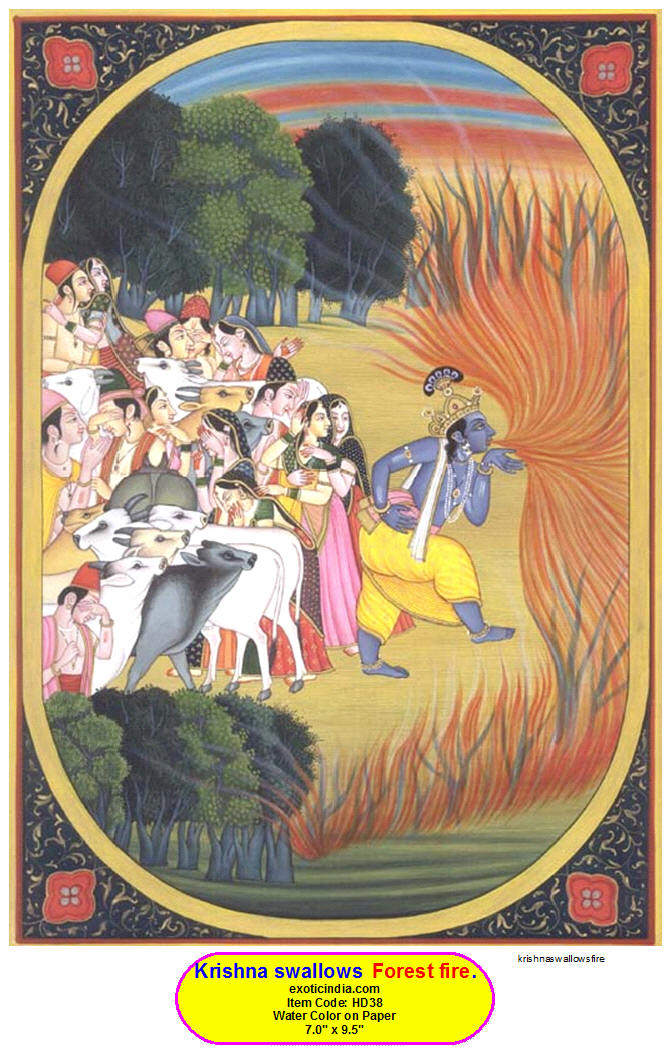
Setting: Krishna, cows and boys on a
grassland in the forest. The cows were missing. The boys panicked. The
boys went searching for the cows following the hoof prints, fresh cow dung
droppings, grazed grass.... They found the cows in the Munja forest and
brought the cows back home. Out of nowhere, a forest fire raged around
them. The leaping flames with fiery tongues reached out and licked the
boys and the cows, singeing the hair. Pandemonium and confusion reigned
but the boys and cows were immobilized because there was no way out to
escape the fire. They pleaded with Krishna, who assured them of safety and
asked them to close the eyes. They had all their faith reposed on Krishna,
who simply opened His mouth, drew the fire, swallowed it and saved the
cows and the boys. [Krishna simply sucked the oxygen out of the fire.] The
boys opened the eyes and the fire was gone from around them. They and the
cows went home happy. [People in the vicinity of great fire sometimes die
not because of fire but because of consumption of oxygen by the fire thus
depriving the people of oxygen to breath.] Srivaishnavism is of the belief that fire-god is the elemental god, who is under the control of Krishna, who is the God of gods in the Hindu pantheon. Krishna is also God of Indra, the god of thunder and Lightning. Indra tried to drown the cowherds and the cows once by sending torrential rain; Krishna lifted the Govardanda Hill under which all living beings took shelter. Once Krishna was visiting Indra's heaven with Satyabhama, who liked the Parijata tree. Krishna obliged His Spouse by uprooting and mounting the tree on Garuda for transport to Dwaraka. Krishna has been a thief all His life. Did He not steal butter from the homes of the trusting cowherd women? Once a thief always a thief. For ages, he has been the thief of the souls, heart and mind. Coming back to the story, the gardeners informed Indra and Saci (Indrani) about the brazen act. Saci was heart-broken, since she loved the tree which had all-season buds, flowers, fruits and fragrance. Indra went to war with Krishna over a tree, who won over Indra fair and square. Indra was standing alone on the battlefield with bare hands; Krishna let him live. Such is the compassion and generosity of Lord Krishna. Krishna just wants the tree and not the life of Indra. Saci and Indra agreed to let Satyabhama and Krishna take the tree and be returned after their demise. Here is an important lesson in Srivaishnavism. Everything belongs to Vishnu; you only have a temporary custody of it; all power and glory belong to Him. Yes, everything belongs to Him; No, you don't own it: that is the meaning of Namah. What He giveth, He taketh away; don't fall in love with the material possessions. Parijata: This tree is the Coral Tree (Erythrina indica). It is one of the five trees obtained from the churning of the milk ocean. Indra claimed the tree and planted it in Indra's heaven. Saci loved the fragrance and the flowers of the tree. She wore it daily.
The west is of the opinion that Vishnu and Siva came into their own and surpassed the elemental gods of the Indo-Aryans. When the liberated souls go to Vaikuntam [Sri Vaishnava heaven], they are greeted on the way; one such first greeter is the Fire-god. Arcis = Flame; Name of the deity, Fire-god अर्चिस् =அர்ச்சிஸ் = arcis , n. < arcis. Name of the deity [fire-god] met with first on the way to the supreme heaven, who leads on to the next, and who presides over light; மோக்ஷத்திற்குச் செல் வோரை முதலிற்கண்டு உபசரித்து வழிநடத்துந் தெய் வம். (அஷ்டாதச. அர்ச்சி.)
|
| Hindu and Greek Mythology: Life without mythology is a barren desert. Mythology is the verdant oasis in the desert of barren life. --Veeraswamy Krishnaraj
|
Story of three fires of Indo-Aryans:
Urvasi (उर्वशी = Fervent desire; Apsaras, dancer in Indra's heaven came down to earth; mistress of Gandharva; a perennial youth; the one who conquers the heart; a drop-dead beauty in the heavens came down to earth and married prurient Pururavas on the condition that she would eat only one drop of butter once a day (low-maintenance spouse or low self maintenance), she would keep her pet rams always by her bedside, and that Pururavas would not appear naked to her except in bed. Pruravas was a machismo muscle man with a ton of Mojo (actually a celestial on earth). He, the frequent flyer to Indra's heaven, took his chariot to heavens and drove it at a breakneck speed that scattered the clouds and fluttered the heart of Urvasi who thus bowled over called out Pruravas to save her from a demon. Their eyes met and sparks began to fly. Her body grazed his and his body warmth was titillating; their breaths came together bathing each other's face. She never felt in heaven such warmth as in a human body.
They had to part hoping they would meet again. Each one dwelled in the mind and soul of the other. One day Urvasi was dancing in the court of Indra playing the role of Lakshmi before Vishnu, a galaxy of gods and a crush of Celestials. During her song and dance performance in a reverie, instead of eulogizing the name of 'Vishnu' she uttered the name of Pruravas, a fallen and degraded Celestial and mere earthling at that time. Sage Bharata sagged in his seat hearing this sacrilege and later managed to get up and stood on his seat with his mouth agape. Mitra and Varuna, the frequent ejaculators, were always on-the-brink hyperexcitable celestials; the sight of Urvasi was so overwhelming they simply could not contain themselves, lost control of their retentive faculty and emitted their celestial seeds. They were so embarrassed by this spontaneous paroxysmal effluence, whose blame was assigned to Urvasi, they excommunicated her, for no fault of hers, from heavens. They reasoned, "We can't be emitting like this in heaven in unison at the sight of Urvasi in the presence of gods and goddesses. We have to safeguard our retentive faculty and reputation. We have no other recourse than to excommunicate her to earth."
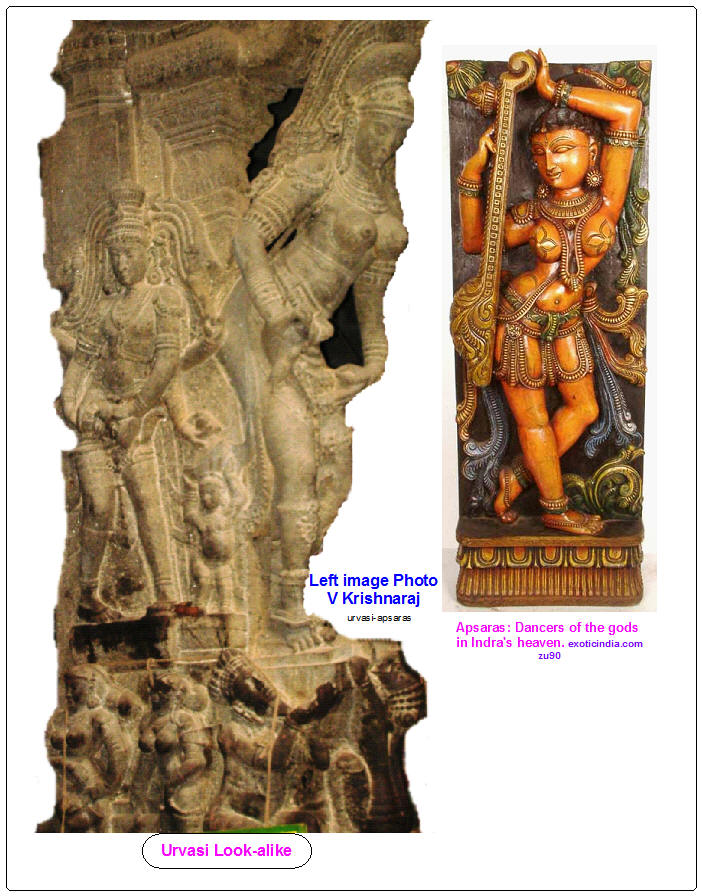
| Apsaras =
अप्सरस्
= அப்ஸரஸ். Essence of the waters, Moving in and between the waters, moving
in the clouds. A class of female divinities. They inhabit the sky and
often visit the earth. They are wives of Gandharvas. They can change their
shape at will. Their Lord is Indra. They love playing in water. --Monier
Williams Dictionary. They dwell also in Svarga or Indra's heaven. They dance as the Gandharvas sing for the gods. They morph into any form; their favorite morphing is to a bird. Since they are beautiful and seductive, many claim their parentage: Prajapati; the churning ocean of milk, Bhasi; the mother of birds. Seductive beauties have many fathers; no one claims the Uglies. The gods dispatch (as in James Bond 007 series) Apsaras (the celestial nymphs) to seduce Rishis and ascetics and then drive them insane. They are very well suited for this job description because they embrace promiscuity with glee, glow and abandon and or nymphomania (as if indulging in many kinds of deserts) avidly and willingly; they have no maternal bond with their offspring so much so they abandon the babes on earth and once their pudendal and pelvic passados, sports, pastimes and missions are executed without any flaw, they fly back to heaven abandoning the babes to report back to the mission headquarters in heaven. Their name indicates they have a smell about them. They like to hang around trees, bushes and plants. If you find a herb, a plant, a leaf, a bark, a stem... having a fragrance, it is because Apsarases are dwelling in them. Take the cinnamon bark and all the culinary herbs for instance. Since the floras grow from the earth, the Apsarases have a basic earthy odor. In fact, Mother earth is their mother and Father heaven the father. Our luck is that our fathers and mothers are earthbound; that is why we can't fly to heaven as they do. But Pruravas (a fallen celestial) had that ability. In the universe, they are the frequent fliers and accumulate many miles. With the way the gas (petrol) prices are nowadays (Somebody questioned the high gas prices in the presidential debate on Oct 16, 2012.), you may think they worry about the cost of flying. No cause for worry. They fly by thought. No gas, no waiting on line, no taking off the shoes or underwears!, no security clearance, no intrusive body searches, no embarrassing images, no OPEC, no passport, no visa. You think Los Angeles; you zap up and zip to LA; you had lunch in NY and are there in LA for breakfast on the same day. If you have special powers to recognize an Apsaras, you can tell them off, "Get lost and go back to your tree or woods. Go and hide in your fragrant bush." I don't understand why an earthling upon seeing a luscious, lascivious and licentious Apsaras would tell her off. Go figure. They are endowed, sinuous, naturally fragrant, seductive and willing to carry out their mission, the kind of mission dreams are made of. (Think of all these herbal lotions, potions, liquid soaps, fragrances... that men and women wear or use nowadays. If only you have an Apsaras by your side, her natural (nothing artificial there) fragrance will rub off on you.) That Mantra of rejection does take away their powers of flight, morphing &c. In reality, who wants to dismiss such a damsel with undying youth, heavenly body, divine smell, fragrant mouth and sharp mind? She is not your proverbial dumb blond--all appearance and no stuff in the nano-thin cerebral mantle with no convolutions. Judge for yourself. The problem is they are not sighted easily. Their favorite trees are Nyagrodha, Asvatta, and Udumbara trees (न्यग्रोध, अश्वत्त, उडुम्बर = Ficus indica , Ficus religiosa, and Ficus racemosa). If you hear the divine sound of cymbals and lutes coming from these trees, you know they are up there in the trees. Don't mistake the rustle of the leaves, whooshing of the wind, the pirouetting and chattering of the leaves on their petioles and the wild movement of the branches as music and dance of the Gandharvas and Apsarases. They are sought after by humans to bestow favors during wedding processions. What is a wedding procession without music? If you are habituated to gambling, you need to look no further and seek their favor. This is my tip to trippers to Atlantic City and Los Vegas. The sacred texts have differing numbers in their census, which ranges from 42,000 to 35,000,000. My explanation of the undercount is that upon arrival of the census takers, they go into hiding in the trees, bushes and other thick foliage. They are aliens anyway on earth. They don't want to be discovered and deported until their pelvic mission is accomplished. They scoot on seeing census takers and Border Patrol Agents. UAVs have no value in locating them. When the UAVs fly, they morph into ants. They can disappear in thin air. Since they can assume any shape and form and when the BPAs arrive, they look like squirrels, porcupines, groundhogs... It is better not to round up and corral all the said animals thinking they are illegal aliens. On the way to the Tall Wall, they simply disappear and you are left with the bag. Thermal imaging has no value, because their body temperature blends well with the surroundings. Factoids: They don't ask for any entitlement benefits like earth people do: Social Security, Medicare, Medicaid, Disability payments. They easily chummy up with republicans. And yet they hide in their favorite trees, not asking for entitlements. June-July 2011. While Apsarases attend Soma (Moon god),
their husbands the Gandharvas attend Varuna, the god of the sky. I don't
like to say anything bad about the wife of Varuna, the god of the sky,
rain, law and order.
If you happen to
notice a person with dropsy, ask him to seek forgiveness from Varuna,
because the patient may have offended Varuna, the proof being his dropsy.
He is quick to anger and yet melts with compassion and cures his
petitioner. He does not have the wherewithal for all sicknesses and
maladies of the world. He himself once suffered from erectile dysfunction
and received herbal remedy from a Gandharva. He is associated with horses
and ocean. The remedy made him the enviable stallion of all times. It was
a one-dose remedy. Take a back seat, Viagra, Cialis and the like. One dose
of the herbal remedy cured him of his ED; that would put all ED companies
out of business. He is the Lord of waters and rides an aquatic animal,
Makara. But the fact remains his wife
Varunani, the goddess of wine, goes tipsy, topsy and turvy sometimes.
Reports of her drunken driving of her superfast aerial cars, her arrest by
her husband's law and order celestial cops in unmarked flying chariots,
revocation of license or any pending arrest warrants have not thus far
been You drink Soma (an inebriant and a hallucinogen) once, you want it again and again. In Vedic Times, only Brahmanas and gods were allowed to imbibe Soma. Or you may need a prescription as Californians do from their doctors for ganja (weed) for ailments like whiplash, back pain, and other myriad inexorable ailments. Now (11/2015), Ganja Mania is spreading and legal marijuana is available in many states. There is an inexorable, hoarse and raucous cry for legalization of the weed. Between Soma and Ambrosia available to the gods, there is no preference one over another. The gods drink Ambrosia for eternal life. Soma, they drink for general well-being and during rites, rituals, wrangling and wars. Unfortunately, you can't buy soma; it is locked away in the celestial cellars of Indra. When Indra went to war against Bhagavan Krishna over a tree (Parijata or Wish-giving tree), he drank the finest Soma in his cellar. Teetotaling Krishna defeated him easily. |
That set in motion her descent to earth as consequence of the curse of Sage Bharata, and effluent embarrassment of Mitra and Varuna. They stipulated that she would have a son by Pruravas and abandon them both and return to heaven.
They (Urvasi and Pruravas) lived happily on earth for 61,000 years with the rams in the bedroom. I bet some would want just one night with Urvasi. They played in the groves, rested by the lake full of lotus flowers.... (Excerpt from song: O strutting peacock, beautiful damsel, O heavenly nymph, you have large soft eyes, you have gentle air about you. O my fair bride, your charming gaze, your lovely face, your cascading and sometimes flying tresses in the breeze. My Urvasi, your hot breath on a cold night... so said Pruravas.) Urvasi's condition for marrying Pruravas was to have two pet rams in her bedroom, and that he should not appear naked outside of the bed (Talk about prenup). If the conditions were broken, she would leave him.
| Aries is symbolized by the ram. The ram has come to represent male fertility, aggression, and courage. A ram's horn is part of a cornucopia, the "horn of plenty", symbolizing abundance. In history, rams were often symbols of leadership. Aries natives are said to be leaders and pioneers. Rams butt their heads into their enemies; and Aries natives are thought to approach life "head-on". --http://www.cafeastrology.com/zodiacaries.html |
Vishnu Purana says, "Beholding her (Urvasi) infinitely superior to all other females in grace, elegance, symmetry, delicacy, and beauty, Pururavas was equally fascinated by Urvasi." (Someone said: You dogs and monkeys, stop salivating.) Confiding in his merits, Pururavas addressed the nymph, and said, "Fair creature, I love you; have compassion on me, and return my affection." Urvasi, half averting her face through modesty, replied, "I will do so, if you will observe the conditions I have to propose." "What are they?" inquired the prince; "declare them." "I have two rams," said the nymph, "which I love as children; they must be kept near my bedside, and never suffered to be carried away: you must also take care never to be seen by me undressed; and clarified butter alone must be my food." To these terms the king readily gave assent. --Vishnu Purana, Translation from Sanskrit by H.H.Wilson.
Life in heaven was dull and boring without Urvasi
around. The gods and Gandharvas (Celestial musicians) in the heaven were
hellbent bent on getting her back to heaven by hook or crook. Urvasi
was awakened one dark night by the cries of her bleating ram. Pruravas also
heard the same but would not move out of the bed because he was afraid that he
would be discovered stark naked by Urvasi. The thieving and conniving Gandharva
came back again and stole the second ram. There was a ruckus in the royal
bedchamber (with a celestial nymph by the side) aggravated by the crying rams.
The king hoping he would not be found naked in the moonless night, woke up naked
to run after the thief with his sword. The Gandharva on account of his service
to Indra, the god of thunder and lightning, invoked a brilliant flash of
lightning on the king and the chamber so much so Urvasi saw Pruravas naked out
of the bed by the lightning with a sword aloft in his hand. Since the Gandharva
accomplished his objective, he abandoned the bleating rams, disappeared in the
thick of night and went to heaven to report completion of his mission. The naked
king came back to his chamber; since the compact was broken, Urvasi took off
from the balcony, abandoning Pruravas, whose pathetic hold on the end of her
sari slipped; Urvasi ascended to heavens.
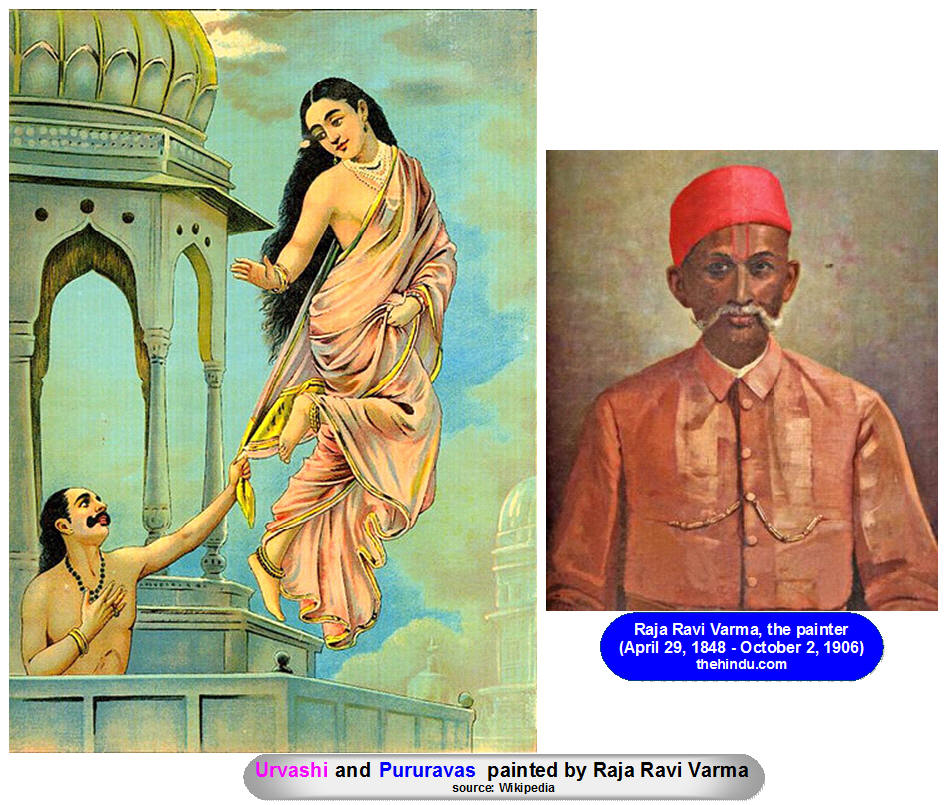
He was wandering naked about the world [Yes, he left the sword behind.] and by happenstance saw Urvasi bathing in a river along with four Apsarasas. By now, the conditions of his physical appearance were officially lifted; he could appear anyway he wanted. Remember he never put on his clothes ever since Urvasi left him. (During my childhood, I have seen many wandering stark-naked Sadhus with flailing pelvic assets in the bazaars.) Urvasi had not changed one bit from the day he laid his eyes on her. But she looked she might be pregnant; she was carrying his child. He begged her to come back. She obliged him by sharing her bed with him that night but would not go with him. Instead, she allowed him conjugal visits once a year. [How inconsiderate of her. Ordinary man might die waiting.] She gave him six sons: Áyus, Dhímat, Amávasu, Viśwavasu, Śatáyus, and Śrutáyus. For six years, she was continuously pregnant. Her beauty and body never changed or sagged one bit through all these pregnancies: her assets defied gravity; her posteriors were firm as ever; her body was sinuous; there were no striae (stretch marks on her abdominal wall, breasts or buttocks); she was sixteen then, sixteen now and sixteen for ever. The first-born son was Ayus (Life). He continued to beg her to return to him. The erstwhile thieving and conniving Gandharvas in heaven came down, gave a pot of fire and asked him to divide it into three fires according to Vedic precepts. You may ask, "what is this all about?" Fire is important in the life of Indo-Aryans. Fire you cook with. There is no sacrifice without fire. Sacrificial fire (Fire god Agni) is the messenger between man and god. Fire carries oblations to god and brings back boons to man from god. Every god has a name, an address and a zip code in heaven. Fire-god knows them all and delivers the human sacrifices to the respective gods without any miss. Like the Fedex or UPS, he picks up the packages from all earthly houses and delivers them to the gods. Since Fire is the messenger between god and man, he is regarded as the visible god in the universe. Fire is necessary for cremation. Fire upon cremation of forefathers takes them to heaven. Fire is latent in a nubile woman and wife waiting to be expressed by and engulf man, upon which a woman gives birth to Life, Light, Knowledge, son.... Fire is latent in wood used in fire sacrifice. It takes two to tango; likewise it takes two sticks to create fire, heat, light and life; the sticks (Arani = अरणि = tinder-stick [friction sticks] for producing fire by attrition) are the man and wife. Body heat indicates life; thus, fire and heat are life. You all know Survivorman Les Stroud with no water, no shelter, no food and a harmonica to lift him from loneliness used friction sticks to create fire.
Candle (fire, light) lit every Friday night and
Saturday evening augurs the beginning of weekly Sabbath and marks its end.
Candles in Chanukah lit for eight nights marks the retake of their temple from
the Greeks and Persians. The light of the candle indicates the living divine
being (Fire god in case of Hindus). Commemoration of the dead (forefathers etc.)
in the family and holocaust are marked by candles in Judaism.
In Christianity candles, votive and or decorative, serve as the Light of God,
and Jesus during Easter, mark festive occasion, shine as decorative
accouterment....
Here is a tip from me: It is common in the knowledgeable circles of beaus and babes to invoke Urvasi to grant success in their love affairs. But don't keep bleating rams in the chamber of love or love nest. Take a two ounce bottle of clarified butter. When she asks to go to a fancy expensive restaurant, just rub and roll the bottle, take the dropper and administer one drop of the butter in her mouth. That one drop will quench her fire in the belly and thus you can save a ton of money and with that money you can buy a car, a house, a boat, or even a yacht.
He (Pruravas, consort of Urvasi) divided the fire into Garhapatya, Daksina, and Square Ahavaniya representing Earth, Atmosphere and Sky and the powers inherent in them. Once he did it, he was reunited with Urvasi. To honor them, the two fire-sticks (aranis) from Asvattha tree (Ficus religiosa) were called Pruravas and Urvasi. When the sticks come together in friction they create heat, fire, light and life. It is mojo all over again, man. The friction sticks are euphemism for Urvasi and Pruruvas, their conjugal union, progeny.... Arani = A+rana = No+Joy. When the two sticks are separated, there is no joy. Thus each one individually is a joyless stick; two sticks together are full of joy; thus, they are two joy sticks; the stationary lower horizontal stick is Urvasi and the churning vertical stick is Pruravas. Out of this joy (-ous union) comes sparks of fire and Ayus (life, which is the name of their son.).... Pruravas stabilizes Urvasi in his churning encounter denoting the idea that the lower stick should be held steady when the upper stick is churning. The sound that emanates during this churning session is the talk Pruravas and Urvasi have with each other. The talk is all about Urvasi giving him a progeny, particularly a son.
Chandogya Upanishad V.8.1-2 (Translation by Dr. Radhakrishnan--The principal Upanishads page 430) Woman, verily, O Gautama, is the Fire; of this the sexual organ is the fuel, what invites is the smoke, the vulva is the flame, what is done inside is the coals, the pleasure is the sparks. In this fire the gods offer (the libation of) semen; from this arises the foetus. (There it is, the reproductive physiology in a nutshell.)
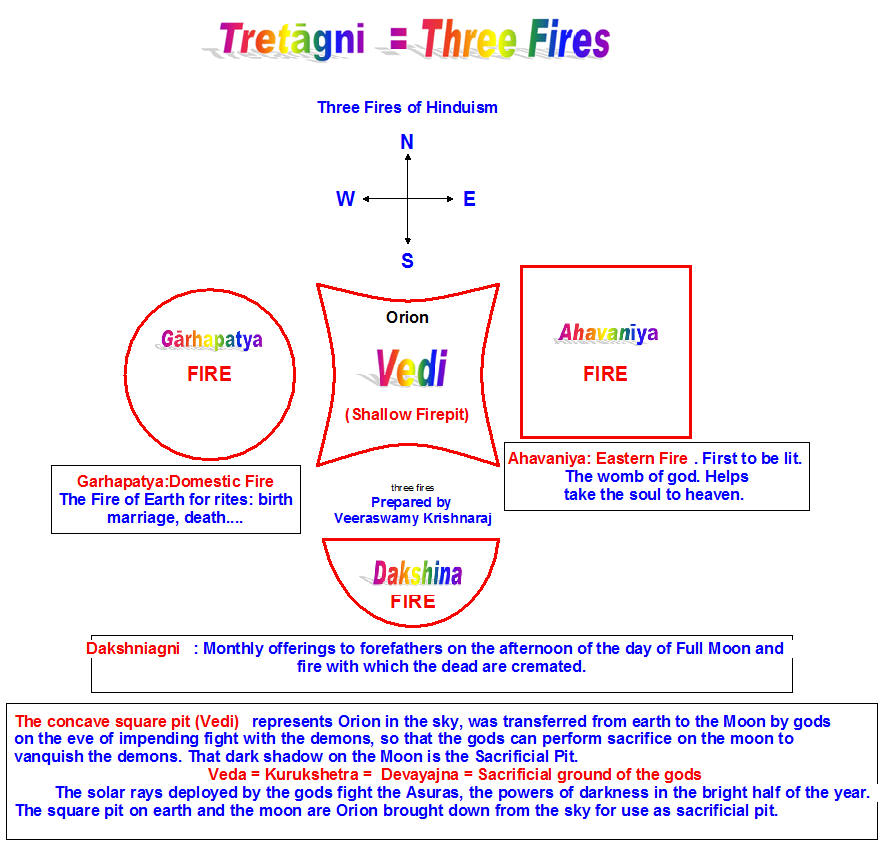
Round pit and West, the Garhapatya Fire: rites connected with birth, wedding, death, exorcism, prevention of diseases.
Semicircular pit and South, Daksinagni: Fire for the cremation of the dead (flesh-eating fire), monthly offering to ancestors.
Square pit and East, Ahavaniya Fire: Srauta (based on Srutis or revealed Texts) rituals, Nitya and Kamya Karmas.
Prometheus
and Fire.is Titan, the father of Deucalion and brother of Atlas and Epimetheus, who taught humankind various arts and was sometimes said to have shaped humans out of clay and endowed them with the spark of life. For having stolen fire from Olympus and given it to humankind in defiance of Zeus, he was chained to a rock where an eagle daily tore at his liver, until he was finally released by Hercules. --Dictionary.
I
|
The Vestal Fire and Garhapatya Fire are the same.
In the Ancient Roman Religion, there were Vestal Virgins. Vesta is the virgin goddess of the hearth, home, and family in Roman religion. Vesta's presence is symbolized by the sacred fire that burned at her hearth and temples. Her closest Greek equivalent is Hestia.[1] The importance of Vesta to Roman religion is indicated by the prominence of the priesthood devoted to her, the Vestal Virgins, Rome's only college of full-time priests. Their tasks included the maintenance of the fire sacred to Vesta, the goddess of the hearth and home, collecting water from a sacred spring, preparation of food used in rituals and caring for sacred objects in the temple's sanctuary.[21] By maintaining Vesta's sacred fire, from which anyone could receive fire for household use, they functioned as "surrogate housekeepers", in a religious sense, for all of Rome. Their sacred fire was treated, in Imperial times, as the emperor's household fire. Allowing the sacred fire of Vesta to die out, suggesting that the goddess had withdrawn her protection from the city, was a serious offence and was punishable by scourging.[24] The chastity of the Vestals was considered to have a direct bearing on the health of the Roman state. Because a Vestal's virginity was thought to be directly correlated to the sacred burning of the fire, if the fire were extinguished it might be assumed that either the Vestal had acted wrongly or that the vestal had simply neglected her duties. http://en.wikipedia.org/wiki/Vestal_Virgin
Comments by Veeraswamy Krishnaraj I propose that the concept of Garhapatya Fire of Hindus and Household and Temple Vestal Fire of the Ancient Roman Religions are one and the same. Both are domestic fires. Extinguishment in both religions is serious. They have to be lighted back immediately. Garhapatya fire is the witness and sanctifier, and under use for rites connected with birth, wedding, death, exorcism, prevention of diseases... Garhapatya = The Lord of the Household. Yes, this Fire is the Lord of the house. AhavanIya = to be an offering as oblation. consecrated fire. (the Eastern Fire). Called as the womb of the God. Dakṣiṇāgni is the southern fire that receives oblations for the past ancestors (Dead ancestors always dwell in the South); the presently dead people in the family are cremated in the Southern Fire, which is also used for Abhicara Yagna in driving away evil spirits and killing enemies. The Vestal Virgins are the keepers of virginity. Their Virginal Fire of the Vestal kept away all unchaste thoughts, words and deeds. The Hindus had more elaborate concept about fire by dividing it into three kinds. Vestal Fire was Virginity. Sita walked on fire to prove her chastity to Rama. Fire respected her chastity and did not burn her. Fire created by the sticks (Arani) bring joy and life--Children. Fire-producing Aranis do not represent virginity but sexual intercourse, chastity (fidelity) and enjoyment of life and progeny. Household Fire was important in ancient Roman Religion. It was the fire of Vestal Virgin. Vesta is chastity. The burning fire is a sign of Vesta or chastity. As in Hindu religion, anyone can receive fire from the Vestal Fire for his or her household fire (garhapatya fire of the Hindu household). In Roman Religion, Vestal Fire was chastity. In Hinduism, Woman is Fire, vulva is the flame, the pleasure is the sparks. Gods offer libation of semen in the Fire. In Roman Religion, death of Fire is loss of chastity. Chastity means refraining from sexual intercourse, virginity, celibacy...Celibacy is abstention, while chastity is fidelity, refraining but not abstention. Vesta = Brit. a short friction match with a wood or wax shank. Chaste is pure; Chastity is Purity. Purity comes from abstention from unlawful sexual intercourse and generally means not engaging in extramarital sex. Sex within marriage is chaste. In Abrahamic religion, unchaste practices within marriage is prohibited: Sex during menstruation, Vidual sex as opposed to Vidual chastity (chastity during early widowhood), and use of contraception within marriage as in Catholic belief... Celibacy is abstention from sex. Among priests, sex before ordination is not a matter of immediacy. Celibacy is abstention from sex after ordination. Celibacy in Christian Praxis helps unite the body and spirit and is a flagpole of self-mastery (Control of Indriyas or sense organs in Hinduism). Even today, the Hindu priests practice celibacy a certain number of days or weeks before they do their priestly duties in some temples. They sleep in the temple premises for the duration of their priestly duties and forgo visiting their homes. The Law of Chastity demands abstinence from sex before marriage and complete fidelity to one's partner during marriage. Chastity is purity in thought, word and deed before and after marriage, and marital fidelity between husband and wife. All religions agree that marriage between man and woman is a legal instrument and a theistic ordinance by which they help multiply and replenish the earth. Chastity is all-pervasive. Fidelity applies to marriage; Celibacy applies to a person under certain conditions: priesthood, being an anchorite... adultery is voluntary sexual intercourse between a married person and someone other than his or her lawful spouse. fornication is voluntary sexual intercourse between two unmarried persons or two persons not married to each other. Fornication and adultery are very common in all cultures. In Hinduism celibacy and chastity are Brahmacharya, a milestone in the life of the twice-born after proper initiation. It was spiritual instruction under the tutelage of a guru. Chandogya Upanishad V.8.1-2 (Translation by Dr. Radhakrishnan--The principal Upanishads page 430) Woman, verily, O Gautama, is the Fire; of this the sexual organ is the fuel, what invites is the smoke, the vulva is the flame, what is done inside is the coals, the pleasure is the sparks. In this fire the gods offer (the libation of) semen; from this arises the foetus. (There it is, the reproductive physiology in a nutshell.)
|
Pruravas is the Moon (also the Belt of Orion) and Urvasi is Rohini Star (Orange Star Aldebran). The Moon married 27 moon-struck wives (27 Nakshatras of the Zodiac; sidereal cycles of Moon). Moon stays in one of 27 mansions (the moony or lunar Royal Chamber) each night. Rohini (Urvasi), the 4th mansion is his favorite. Lunar mansion is one of the 27 divisions of the sky. Nakshatra = Lunar Mansion, Constellation. Moon mission is for the Moon to go through 27 mansions in a month, while the sun goes through 12 signs of Zodiac. Pruravas (Moon) goes to one mansion (love nest) every night and thus to 27 mansions in a month. This polygamous prince Pruravas takes his oft-practiced jaunt whistling, glancing, and smiling piquantly to the 27 chambers, one chamber every night to keep the joy sticks in working order.
"Each Nakshatra represents a division of the ecliptic similar to the zodiac (13°20’ each instead of the 30° for each zodiac sign). The orbit of the moon is 27.3 days, so the Moon takes approximately one day to pass through each Nakshatra." Ecliptic = the apparent annual path of the sun in the heavens. 13°20’ = 13 Degrees and 20 minutes. 13.3333 X 27.3 = 364 days in a year.
Lunar Asterisms: In Hindu mythology, the lunar mansions are 27 in number. The moon in its orbit stays one day in each star mansion. Each star is a consort of the moon. The 4th mansion (Rohini) is the favorite consort of the moon. The 27 Nakshatras with four Padas each, amount to 108, which is the number of beads in a Japa Mala or rosary.
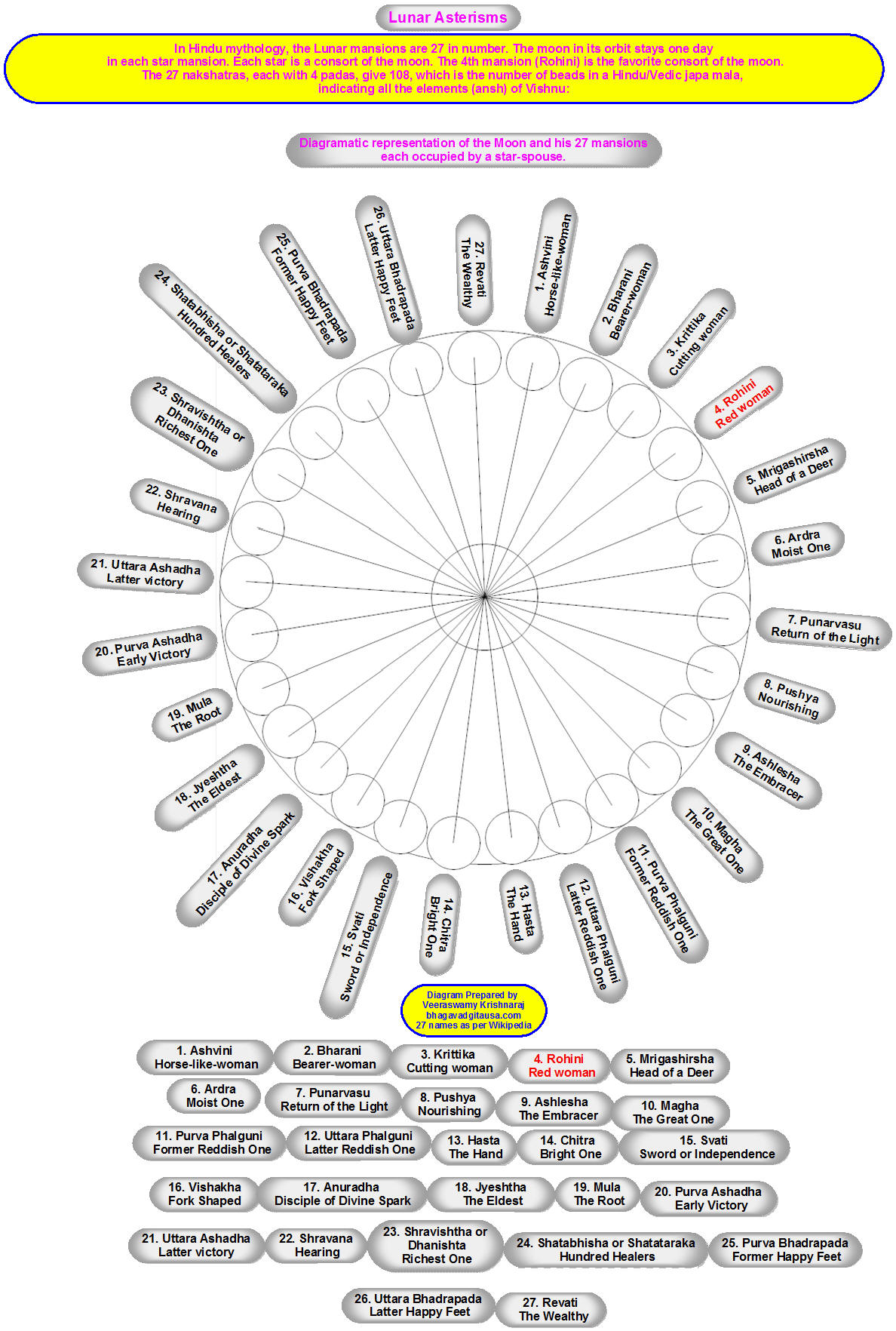
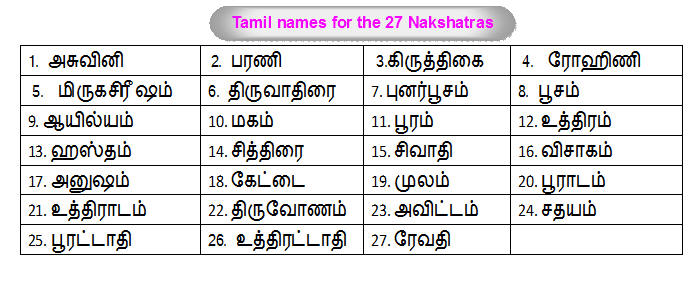
The fourth wife Rohini refers to the fourth day of the moon when it makes its appearance as a visible crescent (New Moon). The Fourth day of the waxing moon in Greek mythology is when goddess Maia gave birth to Hermes. Click KALI for Hermes
| The moon grants sixteen desires known as Kalas: 1) AmrtA, 2) PrAnadA, 3) PUsA, 4) Tusti, 5) Pushti, 6) Rati, 7) Dhrti, 8) SasinI, 9) CandrikA, 10) kAnti, 11) JyotsnA, 12) Sri, 13) PrIti, 14) AngadA, 15) PUrnA, and 16) PUrnAmrtA (Ambrosia1, Life giver2, Growth promotor3, Giver of contentment4, Nourishment5, Attachment6, Constancy7, Container of hare (man in the moon = little Orion)8, Beam spreader9, Effulgence10, Moonlight11, Prosperity12, Delight13, Body or limb developer14, Fullness15, and Fullness of nectar16. |
("Moon is considered Virgin Mary of the Roman Catholics and nourishing mother of the heavens. She is the queen of the night also called Luna (Diana). Diana is the twin sister of Apollo. She governs chastity as well as fertility."--Hindu Dharma website )
The gods were performing sacrifice in Orion and then Little Orions on Earth and the moon appeared later. It is like the Little Indias in New York City around 28th and Lex (Lexington avenue) and Jackson Heights in Queens, NY.
Nakedness of Pruravas is the moon in the dark of night on New Moon (the first day of moonless dark night). The two lambs or rams tied to the bed of Urvasi during the night are the two Asvins or deities ushering the summer sun. The thieving Gandharvas are the rays of the sun, untie and release the two rams indicating the advancing rays of the sun. The heliacal setting of Rohini (Urvasi) follows.
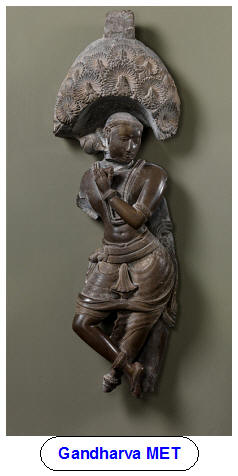 Gandharvas live in the atmosphere, though you cannot see them. They are
the musicians of heavens; their knowledge is called Gandharvaveda (-vidya).
He is the guardian of Soma and rain cloud, a rain maker.... His parents
are Heaven and Earth. Gandharvas are the rays of the sun which shine our
universe. Atharva Veda claims that the Gandharvas are phenomic Chimeras or
Hybrids having upper human body with shoulder wings and lower bird-like
bodies. They are capable of metamorphosis and appear like handsome
effeminate men. They are the purveyors and guardians of Soma which causes
hallucination and inebriation according to the west, which is vigorously
repudiated by Hindu saints, Sadhus. (Hello Recreational pharmacologic
aficionados (RPAs), Soma is available in Indra's heaven locked in a vault
whose doors are reinforced with a spinning wheel with razor sharp spokes.)
Gandharvas live in the atmosphere, though you cannot see them. They are
the musicians of heavens; their knowledge is called Gandharvaveda (-vidya).
He is the guardian of Soma and rain cloud, a rain maker.... His parents
are Heaven and Earth. Gandharvas are the rays of the sun which shine our
universe. Atharva Veda claims that the Gandharvas are phenomic Chimeras or
Hybrids having upper human body with shoulder wings and lower bird-like
bodies. They are capable of metamorphosis and appear like handsome
effeminate men. They are the purveyors and guardians of Soma which causes
hallucination and inebriation according to the west, which is vigorously
repudiated by Hindu saints, Sadhus. (Hello Recreational pharmacologic
aficionados (RPAs), Soma is available in Indra's heaven locked in a vault
whose doors are reinforced with a spinning wheel with razor sharp spokes.)
These Gandharvas are great musicians and yet have perspiration with a strong earthy odor. This is because his mother is Earth. Gandha (गन्ध = கந்தம்) means fragrance. When soma is transported to the sacrificial hut, they are always afraid of Soma being stolen from their trucks, which is not different from the hijacking of liquor truck. They invoke and utter Mantras to protect the fully loaded trucks of Soma. "Move forward. O Lord of the world, to all thy stations (the modern equivalent is the liquor stores). Let no opponent find thee; let no robbers find thee; nor the Gandharva, Visvavasu, injure thee (Taitreya Samhita 1.2.9). As you may notice, it appears hijacking of Soma is an inside job because a Ghandarva himself is involved in hijacking or damaging Soma. One way they get rid of the bad Gandharva is by incantation. The transporter wears an amulet to ward off thieves. The inimical Gandharavas, their girl friends or spouses (the Apsarasas) may cause insanity to other good Gandharvas. They (the insanity inducers) are paid off by propitiatory sacrifices; it is like paying off the Somali hijackers of ocean-going ships (Think of the movie Captain Phillips based on true story--October 2013). The Gandharvas like to hang in and around trees as teenagers hang around street corners swilling beer and smoking pot when cops are not looking. This does not mean Gandharvas are bad; that would be stereotyping; there are a few bad apples here and there. Most of them are good and engage actively manipulating the mind of others to generate pure thoughts. In an act of edification, Taitreya Samhita eulogizes them and elevates them by calling them Candramas (moon), Prajapati (the Lord of men) and Vayu (Air-without which we cannot live). To inculcate some fear and respect, a Gandharava is also called Death. A good dose of fear is an ingredient of respect. Remember, he can cause premature death. The west lumps the Gandharvas along with Raksasas, Asuras, Nagas, Yaksas... as the enemies of Indo-Aryan, and sometimes friends. There is internal strife among these adversaries. Gandharvas oppress the Nagas, who are the sons of Kasyapa (who is also the father of gods). King Purukutsa helps them cross the Narmada River to vanquish them by exposing the hideout of the Gandharvas. King Purukutsa is none other than an incarnation of Lord Vishnu. You cross Vishnu, you are in whole lot of trouble. Vishnu is a benign god; you can never get Him angry, but watch out... Why do motorists go wild and crazy during twilight driving? Gandharvas and Apsarasas radiate cheer and charm during day, sing and dance in the groves, mountains.... Come twilight, they are up to mischief. They strike a person with instant insanity. Come twilight and see the commuting motorists on Turnpikes, Expressways, Parkways, Highways, Byways, roads and dead-end streets. They drive like mad. They want to get home fast (to pick up canoodling where they left off with Viagra or Cialis on board). They curse. They show fingers, fists... Why? They became insane in the twilight. Blame it on the Gandharvas and Apsarasas. They can put you over the barrel, then go ahead, revive and get you back to normal. It is misery for us and sports for them. The twilight mad drivers turned lovers with Viagra or Cialis on board make Ayus with their joy sticks. Vyagra is Sanskrit means " engrossed by, entirely occupied with." Occupied with what? Joy sticks. October, 20, 2013. Once Varuna the god of sky, water, celestial ocean, Law and Order, the Nether world and according to Rg Veda the Lord of heavens and earth had suffered from erectile dysfunction (ED). Since the Gandharvas are the purveyors of herbal medicine, they restored his virility by prescribing and supplying him with ED herbs. (I bet there is a leaf somewhere out there in the world yonder one can chew and then plunge into pelvic-centric sports and pastimes.) If you see a horse, remember that the horse was the son of a Gandharva chieftain in previous life. They look up to Varuna, the presiding deity of horses. The horses draw the sun's chariot whose path is under the aegis of the Gandharvas. The Gandharvas are well known to protect virgins. They love women and protect them wherever they are. Their parents do not get involved in arranging their marriage. They simply fall in love on their own accord and can marry without parental consent; thus Gandharva marriage (Gandarva-vivaha) stands for love marriage. Gandharvi is the female equivalent of Gandharva. The Gandharvis are the ancestors of horses. Manthara, the sister of Bali, was a Gandharvi in previous life. See, what comes out of a Gandharvi: a horse. Ref.: Sacred texts, Harper's dictionary of Hinduism, Dictionary of Hindu Lore and Legend. |
This first son Ayus is Life, the Fire (Agni) who is identified in Rg Veda as Hotar, who is the intermediary between Devas (gods) and men, who brings men and gods together, who carries oblations to gods and boons to men, and who takes forefathers to heaven. Pruravas brings out Agni (Libido) hiding or latent in Urvasi. Since Agni is Fire and son, one cannot go to heaven without a son. The only way to heaven for a man is to have Fire (Ayus, Agni, Hotar) as a son by kindling two sticks together, symbolism for union. Because of Agni's manifold beneficial functions, three fires are maintained in the house.
Pruravas embraces Urvasi three times a day (of course fully clothed; in the night he is naked in bed, not a stitch in sight on his body.) and thus naturally there should be three fires. The western equivalent mores for a couple would be to kiss, hug and say three times a day, "I love you, Honey." The Gandharvas gave a pot of fire and asked Pruravas to divide it into three fires so he could get Urvasi back.
More on Pruravas and Urvasi from Sacred Texts, Wikipedia and Indo-Aryan Mythology by Narayan Aiyangar
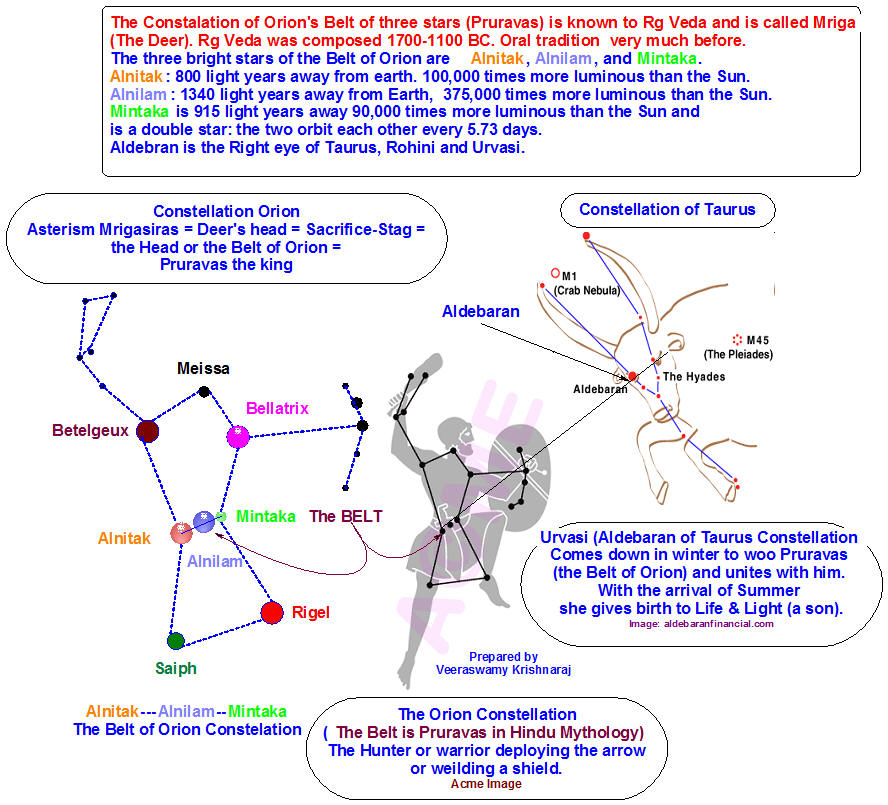
Pruravas is the Belt of Orion; Urvasi is Rohini.
The Constellation of Orion's Belt of three stars is known to Rg Veda as the Antelope in the moon (Mriga = मृग).
The three bright stars of the Belt of Orion are ζ Ori (Alnitak), ε Ori (Alnilam), and δ Ori (Mintaka).
Alnitak: 800 light years away from earth. 100,000 times more luminous than the Sun.
Alnilam: 1340 light years away from earth. 375,000 times more luminous than the Sun.
Mintaka is 915 light years away from earth. 90,000 times more luminous than the Sun and is a double star: the two orbit each other every 5.73 days
Pruravas and Urvasi are not the sun and the dawn.
Pruravas or the Moon is the son of the sun.
Pruravas and Urvasi are the Moon and his favorite consort Rohini ; the two sticks (Aranis) are their vernal (woody) representations coming from Asvattha tree.
The two Aranis (wooden sticks) are necessary to generate fire for the sacrifice.
Urvasi is Rohini (Vak, speech, word or knowledge).
|
|
Urvasi (Aldebran = Orange Giant Star in Zodiac Constellation 65 light years away) comes down in the winter nights to woo the moon, who is the man of the sky, and who dies on every New Moon day only to rise again. Pruravas is the regent or Devata of Orion's Belt known as Mrigasiras (Deer head, the Hunter) where Urvasi (Rohini-Aldebran) and Pruravas-Belt of Orion are proximate to each other. Two Asterisms Rohini and the Orion's Belt consort. Rohini-Aldebran-Urvasi meets and mates with Pruravas-Orion Belt in the nights of winter and gives birth to summer light, the fire or the Ayus (Life).
Amāvasya (= Amā = together. Vas = to dwell) is the night of the new moon when the sun and the moon dwell together, and the first day of the first quarter when the moon is invisible. On the first day of the New Moon, the moon dies or is invisible, because the moon has descended on the flora (trees) to exist in them. The New Moon is without rays and therefore naked. The two lambs (rams) are the Asvins, who preside over dawn. The lambs are tied down to Urvasi's bed during night. They are let loose by the Gandharvas, the rays of the sun during day. The most important tree is the Asvattha tree (Sacred Fig Tree) representative of all trees. Moon is the Lord of flora: Vanaspati. Thus the Aranis made of Asvattha wood are a form of Moon.
|
The moon is born from the sun. (If you are of scientific bent and mind, you would miss the mythology.) That moon being Pruravas was created to defeat the Dasyus (the natives). The solar light nourishes the moon to make him shine and kill the darkness. The moon in turn nourishes trees and plants. Urvasi goes to the house of Pruravas where they engage in consortium. It means Rohini comes to her husband's house. She went from Day to Night. Coming to her husband is coming to the Kurushetra, the sacrificial ground, which is the little Orion. In the diagram, Orion (Pruravas) is the sacrificial pit. There are are three sacrificial altars; Garhapatya, Daksinagni, and Ahavaniya. This concave square pit is Orion on earth and the dark shadow of Orion in the moon telling that Little Orion as a sacrificial pit is on earth and the moon.
Urvasi loves Pruravas = The dawn rises.
Urvasi sees Pruravas naked = the Dawn is gone. The day is light. (The Dawn merged into daylight.)
Urvasi finds Pruravas again = the sun is setting; night is coming, time for consortium.
|
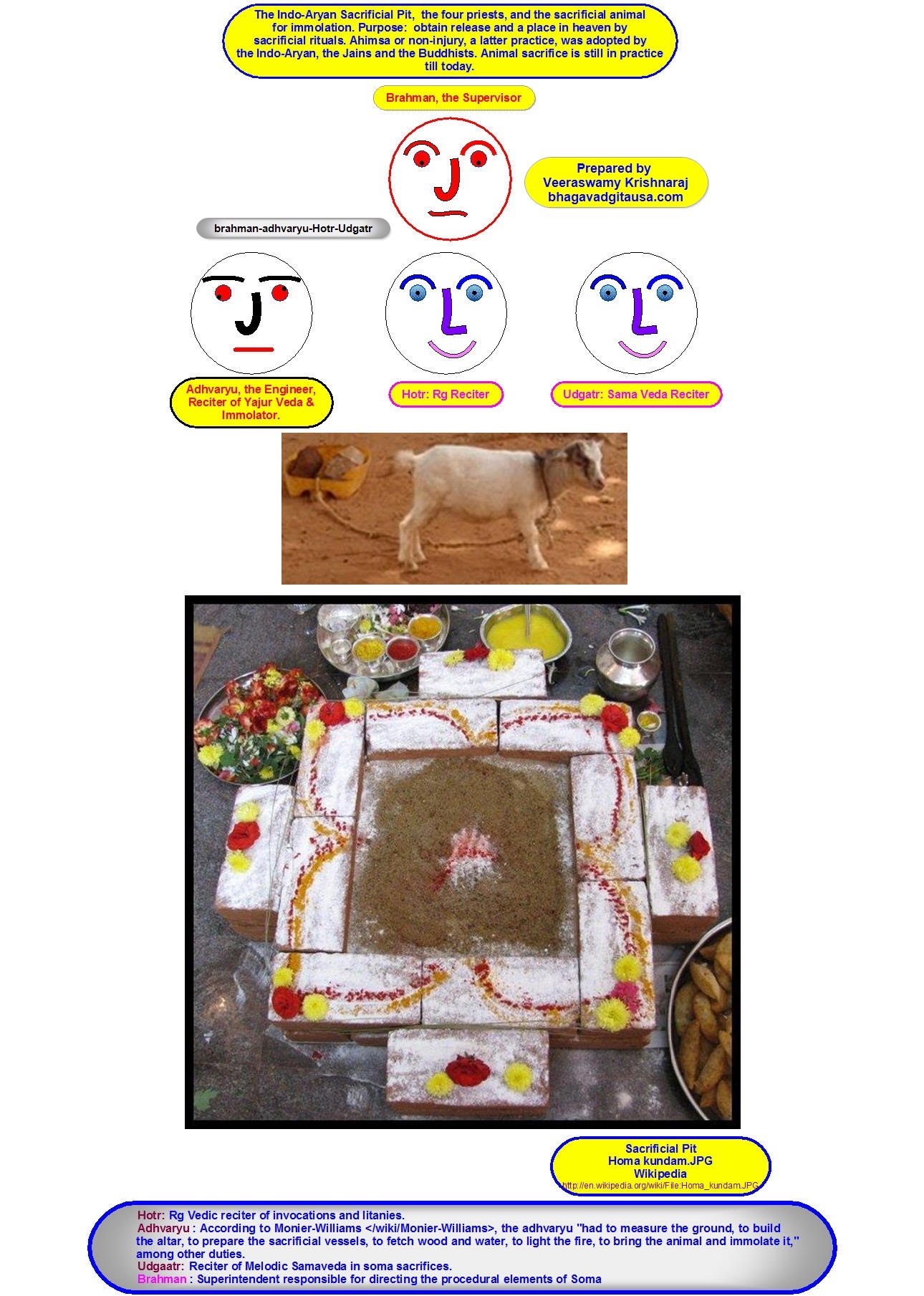
Vaishnavites are vehemently opposed to animal sacrifice, but recite the Vedas, and feed animals, guests and manes. In a multi-denominational temple, when the time comes for animal sacrifice, the practice kept the immolation of the animal out of sight of Bhagavan Krishna by a screen. In Vaishnava tradition and according to Sahasranamam, Bhagavan is PutAtma1, Paramatma2, Muktanam parama gatih3. Mukkur Lakshmi Narasimhachariyar questions who that Paramatma2 is. What is the reason for invoking Him as such? He is present in five Maha Yagnas (ஐவகைவேள்வி): Devata Yagnam1, Bhuta Yagnam2 , Bruhma Yagnam3 , Manushya Yagnam4, and Pitru Yagnam5. Thus Vishnu is known as Yagna-Purusha (யக்கியபுருடன்--yakkiya-purutan) meaning that Vishnu assumes the form of Sacrifice. What we eat is a great Yagnam. We eat not to sustain our body but for the Lord inside us. To perform Yagnam, we need a place. This body is the place for such Yagnam (sacrifice). Bhagavan says that this body is Ksetram (field). In our body the Homa Kundam is the mouth. Homa Kundam = Fire Pit = Pit dug out in the ground for keeping sacrificial fire. Five kinds of Sacrifice which a
householder is enjoined to perform daily. கடவுள்வேள்வி1 (
தேவயஞ்ஞம்1), பூதவேள்வி2
(பூதயஞ்ஞம்2), பிரமவேள்வி3( பிரமயஞ்ஞம்3),
மானிடவேள்வி4(மனுஷ்யயஞ்ஞம்4) தென்புலத்தார்வேள்வி5
(பித்ருயஞ்ஞம்5 ) = Devata Yagnam1, Bhuta Yagnam2 ,
Bruhma Yagnam3 , Manushya Yagnam4, and Pitru Yagnam5. |
Tretāgni = Three fires
GArhapatya is a family sacrificial fire handed down to the male progeny (Y Chromosome) right down the line and thus links generations of the family. GArhapatya should be kept alive all the time over many generations. If it goes out, it is relit from Ahavaniya with accompanying atonement. GArhapatya is thus the Fire of Lord of the household, is the guest of the house, sanctifies and witnesses every rite. It is the Fire of the Earth. Without this domestic fire, no rites like birth, marriage, death... can be performed.
DaksinAgni is the Southern Fire because offering to Pitrs (South-living dear departed ancestors) are made in this fire. It is the fire that is used to cremate the dead and thus is called Flesh-eating Fire. The West says that this fire drives away evil spirits, who constantly threaten the sacrifice. It is maleficent fire as opposed to beneficent fire of Garhapatya. It is the Fire of the Atmosphere.
Ahavaniya is the Eastern Fire that is lit first, that should be kept alive perpetually, that is regarded as the womb or seat of God and that by which one ascends to the celestial world. If it extinguishes, it is relit from Garhapatya fire and atonement made immediately. Otherwise the eldest son of the initiator of the sacrifice would die. It is the Womb of the goddess. He who reveres it goes to heaven. It is the Fire of heaven.
|
|
Fire has many other names or associations: Anala; Angiras; Agnicyana; Agnidh; Apah; Apam-Napat; Adhararani; Atharvan; Bhrgu I and Bhrgu II; Garuda; Matarisvan; Yupa; Sami; havyavahana; Simha; Daksignagni; Trita Aptya(s).
Anala: Anala is the presiding deity of gold. Anala carries oblations to Indra.
Angiras is a famous Rishi and a fire-priest, who is the first to perform the fire sacrificial ritual.
Agnicyana is preparation of sacrificial fire place. The bricks represent all directions denoting the expansion of the universe in all directions and man's integration with cosmic order. The bricks also represent the year and endless birth, death and rebirth of the soul in a body. The heart of the altar is the Agni's tongue of flame and its leaping tongue denotes the aspiration of man to identify himself with the Cosmic Man, whose dismembered body is the origin and parts of the universe. Agnicyana is affirmation of identification of man with creation and destruction of the universe from the Cosmic Purusa.
Agnidh is the kindler or the priest who lights the sacrificial fire, after sprinkling it three times with water to pacify Agni. When the fire is red hot, Agni is invited to drink the Soma from the Agnidh's bowl.
Apah is goddess of waters, who gives boons and attends sacrifices. There are many like her. They are benign beings involved in the cure; purification; removal of sin and bad dreams; and immortality. The West compares Apah to Sumerian Apsu (primeval waters) personified as Nammu who created heaven and earth. Babylonian myth personifies water as Apsu who put salt in the waters of the ocean, personified as Tiamat, his consort. As you see, Sanskrit Apah and Sumerian Apsu are cognate words.
ApAm-napAt means offspring of waters. Clouds are considered as Aerial Ocean. Lightning in the clouds is the son of Aerial Ocean.
Panchasuddhi forms part of the worship as prescribed in Agamas. Chariya and Kriya are the soft deeds of the votaries of Siva. They should be free of Pancha-ma-Pātakam (five heinous sins of killing, lying, stealing, drinking and abusing one's Guru). The votary should engage in Pancha Suddhi (five-part purification) in worship: Bhuta suddhi, Anma suddhi, Dravya suddhi, Mantra suddhi, and Linga suddhi in Saivism. Tantrics also have five-part purification: Atma suddhi, Stana Suddhi, Mantra suddhi, Dravya Suddhi, and Deva Suddhi.
When a Brahmana performs the daily sacrifice, he bathes and applies the sectarian marks on his body.
Bhuta Suddhi: Daily ceremonial by which the soul is purified from daily sins, part of Anma-Suddhi.
Anma Suddhi: Soul's realization of Divine grace as its mainstay.
Dravya Suddhi: Purification of defiled objects.
Mantra Suddhi: Ceremonial purification by sprinkling water consecrated by mantra.
Linga Suddhi: Realizing the immanence of God in the non-sentient universe, as well as in the sentient.
The following are special to Tantric worship.
Stana Suddhi: Purification of the place of worship (Tantra).
Deva Suddhi: Purification of a 'deity' which consists in placing its image on a seat, bathing it, adorning it with garments, ornaments, and offering incense, light.
Some of the other variations of Suddhi
Sat Suddhi
(six types of purity): Sat = six + Suddhi = purification.
1.
Stana suddhi (purity of place):
Purity of place of worship.
2.
Dravya suddhi (purity of articles):
Purity of Sacraments.
3.
Atma suddhi (purity of body): Purity
of the physical body
4.
Citta Suddhi (purity of mind):
Purity of mind and thought
5.
Mantra suddhi (purity of mantra):
Ceremonial purification by sprinkling water consecrated by Mantra.
6.
Murti Suddhi (purity of the murti):
is the same as Deva Suddhi.
Three Strikes, You're Out; earn three stripes and you are in.
If you are convicted of Ego, Ignorance and Bad Karma, You are out and cast into the world of misery of birth and rebirth. With three strikes against you, you are taken for a ride of life and death in the ever-revolving metempsychosis. You could get out of this Ferris Wheel of life and death by reducing Ego, Ignorance and Bad Karma into ash, earning the three stripes, and showing off your rank by applying the ash on the forehead as three stripes, which are a badge of honor. You may even flaunt your good conduct by wearing the badge of three stripes on nine parts of your body: one on forehead, two on upper arms, two on elbows, two on wrists, one on the neck and one on the chest. The neck (throat) is the seat of Visuddha Chakra and the forehead the seat of Ajna Chakra. The stripes indicate the removal of Ego, Spiritual Ignorance and Bad Karma. Ego comes between you and the next person and also between you and God. An aspirant cannot approach God with the feeling of ego, "I" and "mine." There is only one "I" in this Universe and that is the "I" of God. You, He, She, it and That (matter) are parts of God. Removal of spiritual ignorance is the beginning of the descent of Jnanam (spiritual knowledge and wisdom) into your soul--Saktinipatam = சத்திநிபாதம்). The eradication of karma is known as Irruvinaioppu = இருவினையொப்பு, meaning that both good and bad Karmas are brought to naught (equilibrium) individually. If one has ten good karmas and five bad karmas, it does not mean a positive balance of good karmas would preclude his birth into this world. Having a load of Karma means life on earth, whether it is good or bad. Good karmas lead to good fruits and good life and bad Karma gives bad fruits and suffering in this world. Null Karma is the object and that is Iruvinaioppu, which guarantees no birth.
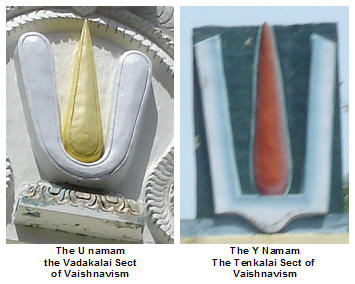
The Vaishnavites wear a V or U mark on the forehead: Tiruman is Sacred Earth. See the photo for the visual. The mark consists of two white outer vertical stripes on the forehead and the midline yellow or red stripe. The white line ingredient is clay; the yellow or red line ingredient is yellow or red-dyed turmeric or sandalwood paste mixed with saffron. The white lines represent Brahma (purity) and Vishnu and the red line brilliance, wealth and Lakshmi. Thus the lines represent the inseparable togetherness of Vishnu and Lakshmi (Sriman Narayana). Many say that vertical white lines are Vishnu and the red midline is Lakshmi. Vadakalais regard the verticality of Lakshmi and Vishnu as horizontal, meaning they are equal. The Tenkalais regard them as unequal; Vishnu is the sole savior of the soul, while Lakshmi is the mediator on behalf of the soul yearning for release and merger. Click this link: vadakalai_tenkalai
Tiruman = Tiru + Man = திரு + மண் = Sacred + earth, dust, sand. Sri Churnam = Sri's powder (red) = ஸ்ரீ சூர்ணம். Sri = Lakshmi. White of Namam is Vishnu and red of Namam is Lakshmi.
There are commentators who think of white and red of the Vaishnava sectarian mark on the forehead as universal in their meaning. White is Sattva (= சத்துவம் = सत्त्व, the quality of Vishnu; Red is Rajas, the quality of Lakshmi. In Saiva tradition Siva is white and Sakti is red. Siva is white and Kamesvari is red. Sattva is virtue, goodness.... Rajas is motion, passion and activity.
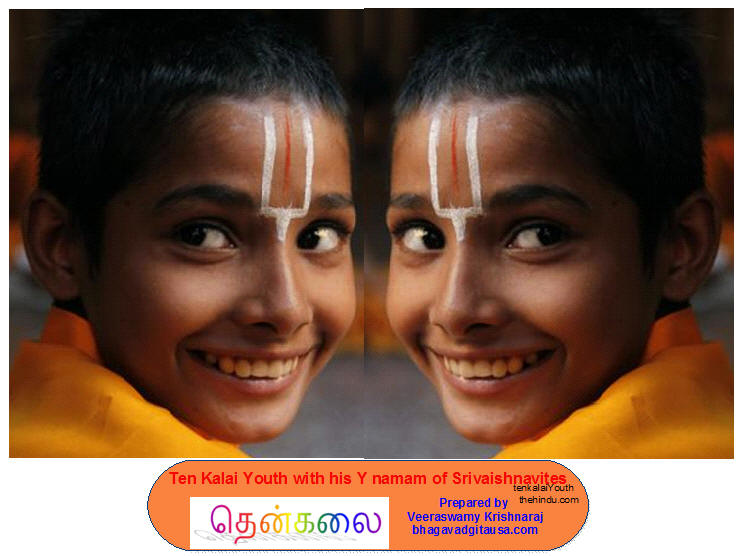
Some devotees wear the Namam on the crown, forehead, the upper arms, forearms, front of the neck and chest. Wearing Namam (Tiruman) on various parts of the body by the devotees is to obtain protection from Vishnu and His weapon systems and also to demonstrate that their body is the temple wherein reside Vishnu and Sri. Vishnu wears Tiruman on His forehead to demonstrate to his devotees His omni-pervasiveness and the omnipotence of His weapons to protect them from all directions. The yellow streak in the midline between the two white streaks indicates a priestly or pious tradition. Vaishnavite women do not wear the white stripes except the red or yellow midline stripe, which is called Sri-churnam-- ஸ்ரீ சூர்ணம், the power of the Goddess. The white goes with the white garb of man and the red goes with the red sari of a woman (kusumba-- குசும்பம் = red / saffron). (You may wonder why man is painted white and woman red. There is a reason. In ancient reproductive physiology of India, the red menstrual blood was equated with the ovum of the woman and the white is obviously connected with the seminal fluid. When they come together, there is conception.) White horizontal stripes of Saivites and white vertical stroke of the Vaishnavites are marks of male gods, while red is the mark of (female) goddesses.
|
Why does Vishnu wear Namam? Sri U. Ve Velukkudi Krishnan Swamy explains There are a few reasons for Bhagavan wearing tiruman kappu (திருமண் காப்பு) 1. Kurathazhvan says ' uddharat upari bhakta janan iti - urdhva pundra tilakam bahumanaat ' - The lord is adorned with tiruman pointing upwards to physically show His bhaktas that it would lift you above this samsara. 2. Bhaktas enjoy wearing tiruman (திருமண் = Sacred earth = நாமம் = Sectarian mark of Srivaishnavites). Bhagavan wanting to know the secret of this joy is trying out for Himself. (appayya dikshitar says ' vaishnava bhogya lipsaya va') 3. It is an alankara (அலங்காரம் = adornment, decoration) to Him.
It is Srivaishnava tradition and belief that Garuda, the mythical bird serving as the mount of Vishnu, took the white mud from the Sveta Dvipa (White Island) in Milk Ocean and spread it around in India. That is the sacred earth that we wear on our forehead. |

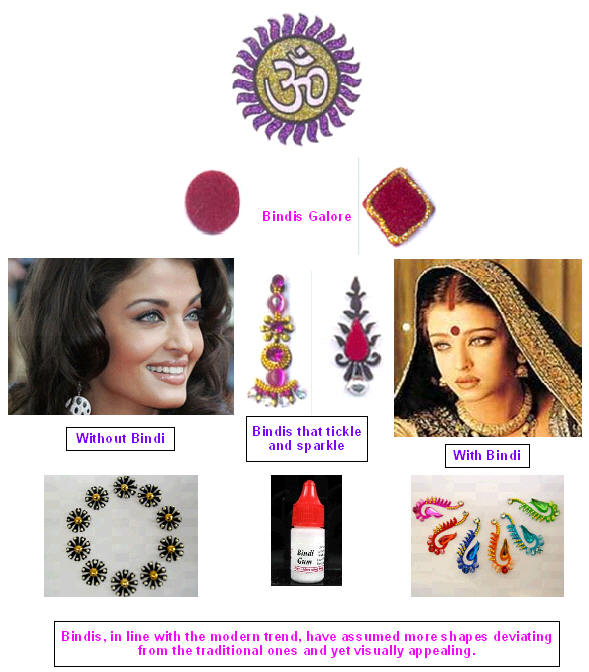
The Vallabha followers wear one midline vertical line which represents Yamuna Devi.
The white powder mixed with water for the vertical stripes comes from chalk; red Kumkum comes from mixing turmeric with limestone. Kumkum means a lot of things: Hindu by birth and or practice; the third eye of wisdom and power in Siva; simple beauty mark or fashion statement; married status; mark of devotion to female deities, Lakshmi, Sarasvati, Mother Goddess. Sakti is Mother Goddess and redness associated with fire goes with Sakti. Kumkum application on the forehead of a guest is a sign of invitation into a household. Kumkum can also be streaked along the midline partition of the hair in women. Nowadays stickers of many colors and shapes are applied to the forehead as a woman would wear lipstick.
Lord Krishna wears the yellow U mark on his forehead made of sandalwood and saffron paste (Kasturi Tilakam). Sandalwood paste used during Puja is distributed to the devotees at the end of the ceremony in Guruvayur Temple of Krishna. Madhavacharya sect uses sandalwood paste for Namam. Sandalwood marks of Discus (Chakra) and Conch (Sanku) are worn on the deltoids, while some have permanent scared impressions of Discus and Conch on their deltoids as a mark of initiation into Vaishnava Dasan community (the Servant of Vishnu).
When a person is ready to offer worship to the Lord, the steps taken are Pancha-anga Seva (Five-limbed Service or Worship)
Panca-anga Seva: (Upasana - page 215 Monier
Williams Dictionary)
1.
Abhigamana
=
Approaching
2.
Upadana = Preparation of
offerings
3. Ijyā = Oblation
4. Svādhyāya = Recitation
5. Yoga = devotion
Samāsrayana is resorting or attaching oneself to a sect. This initiatory process of person irrespective of caste, gender, creed, color is in the domain of Acharya as he applies it to a Sishya who makes a pledge that he or she will follow the tenets of the Guru.
Five Samskarams are done at initiation of the Sishya by Acharya into Vaishnava sect: Tāpam (branding on the arm and limbs), Pundaram (the lines), Nama (names of Vasudeva), Mantra (a hymn), and Yajna--Ijyaa (Yaaga--worship the images of Vasudeva). All castes are eligible for this initiation. The males undergo Samskarams after thread ceremony and women after marriage.
Samskara = sacrament performed at significant events in one's life in this context; imprints of past life in another context.
Tāpam is branding of the right deltoid area with the image of Chakra (Discus) and the left shoulder with the image of Sankhu (Conch) with red hot silver. The icons or seals on the shoulders (Deltoid area) facilitate happy life on earth, destroy the sins, stop the minions of the Lord of Death (Yama) from taking him to Netherworld, and help attain Vaikuntha; The seals are the ticket to Vaikuntha (Vaishnava Heaven aka Paramapadam).
| Five part
purification (SamskAra = சம்ஸ்காரம் =
संस्कार ) in the initiation of a
Srivaishnava.
1) Thapa Samskara. தாப சம்ஸ்காரம்: தாப = fire. Fire branding the shoulders with marks of conch and discus of Vishnu, one of pañca-camskāram. The scars from branding appears on the shoulders. Conch is synonymous with space and waters of the Causal Ocean from which life emerges. Space is all-pervasive as Sriman Narayana is. He is also the origin of anything you feel, touch, see, hear, taste, measure.... The discus or Chakra is the spinning disc, capable of reducing the object it strikes into its elemental particles which subside in Narayana, the origin of matter, souls.... The hot imprinting of Discus and Conch indicate that the embodied soul, Srivaishnava initiate is the properly inducted property of Sriman Narayana. All the rest are also the property of Sriman Narayana, not yet properly inducted into the order, according to Sri Vaishnava tradition. These scarified emblems declare that the wearer is immune from the three maladies of life on earth: Endogenous, Exogenous and Theogenous miseries. They also affirm Sesi-Sesa relationship (= the relationship between the Lord and the man- Paramatma and Jivatma). When animals are branded and graze together with others brands, each animal is identified by the owner. Likewise, at the time of death, the god of death comes calling. When the minions of the God of death see the Conch and the disc, they do not bundle him up for transportation to hell. The messengers of Vishnu come along and take him to Vaikuntam, Srivaishnava heaven. The Initiates are authorized to perform priestly functions in the temples and offer oblations to forefathers.2) Pundara Samskara: புண்டரம் puṇṭaram. Marks on the forehead and other parts of the body, made with sandal, sacred ashes or earth. Pundaram is applied to 12 important parts of the body, wherein Narayana with his consort has taken residence. See the picture. please refer to the table below depicting the Lord in 12 Upavyuha forms: Kesava, Narayana, Madhava, Govinda, Vishnu, Madhusudhana, Trivikrama, Vamana, Sridhara, Hrishikesa, Padmanabha, Damodhara. The outer white vertical lines (திருமண் = Sacred Earth) represent (Narayana and) His lotus feet; the midline upstroke (Sri Churnam = ஸ்ரீ சூர்ணம் = Sri's powder) His Consort, which is either red or sandalwood color. Red is worn by married woman and sandalwood by widows. I have seen widows wearing red. 3) Nama Samskara: Naming Ceremony. நாம ஸம்ஸ்காரம். As you have noticed, this ceremony is meant to transform a person from secular to authentic Srivaishnavite. Thus modification of the name is in order. The Acharya declares that the aspirant will hereafter be called by prefixal name of Adiyen (= அடியேன் = Servitor) and suffixal name of Dasan (= தாசன் = servitor or slave [of Narayana and His lineage of Acharyas]). This Suffix is added to his existing name if it is already one of the many names of Vishnu; if not, the aspirant is given a new Srivaishnavite name. A pre-suffixal name of Acharya, Ramanuja is added. Example: If one's name is Krishna, he would be called after Samashrayanam (= समाश्रयण) Adiyen Krishna Ramanuja Dasan. Adiyen-Your name-Ramanuja-Dasan is one's new name after Samāśrayaṇa (समाश्रयण = taking refuge). Prefix-Name-Ramanuja-suffix. In females, Dasan becomes Dasi. 4) Manthra Samskara: மந்திர ஸம்ஸ்காரம். There are three Secret Mantras: Mula Mantra (8-syllable Mantra), Dvayam (2 mantras in one), and Caramaslokam from Bhagavadgita. The Acharya instructs these Mantras to the aspirant. The Initiate should not be reveal Mula and Dvaya Mantras to anyone. They gain potency only upon instruction from an Acharya. Mula Mantra is chanted after morning ablutions and bathing. The two-line Mantra is chanted anytime, anywhere and any place. 5) Yaga Samskara: Yajña (Yāgā) Samskāram யாகா ஸம்ஸ்காரம். This consists of performance of worship to Sriman Narayana. This is twofold: External and internal (mental). After ritual sipping of water, wearing the sectarian marks (Urdhavapundram), & prostration to Sriman Narayana, the person sits on designated seat. Breath control, chanting of 8-syllable Mantra, worshipping of the Lord in one's heart (Mānasīka Arādhana) are done. The ritual is elaborate. |
Mantras are three: Astākcari /Ashtakshari, eight-syllable Mantra (moola Mantra / Root Mantra) and two more mantras.
|
SriVaishnava Mantras Eight-Syllable (Ashtakshari) Moola Mantra ॐ नमो नारायनाय Om namo Nārāyaṇāya (1) ---------------------------------------------------------------------------------------------------------- Dvyam (the two mantras of Vishnu and Lakshmi; For Mental Chanting only.) श्रीमन्नारायणचरनौ शरणं प्रपद्ये श्रीमते नारायणाय नमः Śrīman-nārāyaṇa-caraṇau-Śaraṇaṃ prapadye Śrīmate Nārāyanāya namaḥ (2) ----------------------------------------------------------------------------------------------------------- सर्वधर्मान्परित्यज्य मामेकं शरणं व्रज । अहं त्वां सर्वपापेभ्यो मोक्षयिष्यामि मा शुचः ॥18.66॥ Sarva-dharmān parityajya mām ekam śaraṇaṁ vraja Aham tvāṁ sarva-pāpebhyo mokşayişyāmi mā śucaḥ (3)
|
1.Moola Mantra (Astākcari)
Om namo Nārāyanāya (om-na-mo-Nā-rā-ya-nā-ya = (eight-syllable Mantra; For Mental Chanting only.)
Only people who have undergone Pancha Samskara can use the Pranava before Namo Narayana; others, irrespective of all differences can recite Namo Narayana.
2. Dvyam (the two mantras of Vishnu and Lakshmi; For Mental Chanting only.)
Sriman Nārāyanā-Sarano Saranam Prapadhyē
Srimatē Nārāyanāya namah.
This two-line Mantra is known as Mantra Ratna (Mantra Gem; Gem among Mantras). This Mantra can be recited without regard to place or time by the initiate.
Sriman Narayana, I fall down and surrender at your feet
Sriman Narayana, my obeisance to you.
Comment:
I hold Lakshmi-associated Narayana's feet as the object of my surrender.
Lakshmi-associated Narayana, my obeisance to You.
Dvaya Mantra has two lines and a total of six words. It condenses a ten-point reference as follows:
Goddess Lakshmi is the mediator between the Jiva and the Lord
They are the divine couple, always together.
The Lord is of auspicious nature.
His form is divine.
His feet are the means of liberation from the world of Samsara.
We accept His feet as the means of liberation.
Lakshmi and Narayana are our goal.
His control and power are inimitable.
We worship Him.
We destroy the inimical stance of “I and Mine,” the enemies of our soul.
SrIman nArAyaNa charaNau =
Sri Lakshmi, the auspicious Narayana- His divine feet
SaraNam = take refuge (His feet are the refuge of
Chetanas (souls) and the means for liberation.
prapadyE = fall at His feet (We accept His feet as the
refuge.)
SrImatE = Lakshmi (and) Lakshmi of the form
mercy, and mediator between Narayana and the Chetanas
nArAyaNAya = Narayana, the supporter and maintainer.
aya = wishing an impeccable service.
nama: = not mine. This destroys the attitude of "I am
the doer, enjoyer, knower and the only devotee."
Purport: Devotee in body, mind and soul surrenders to Sriman Narayana and Sri (Periya PirAtti). The soul, the body, the doership, and the fruit belong to Narayana. His Grace will destroy all impediments, bad thoughts, desires, speech and acts so that the devotee continues to perform his Kaimkaryam to Perumal and PrAtti.
3. Caramaslokam: The Verse of last method of attaining Moksa (liberation) in Bhagavad Gita 18.66, as told by Bhagavan Krishna to Arjuna is as follows.
sarva-dharmān parityajya mām ekam saranam vraja
aham tvām sarva-pāpebhyo moksayisyāmi mā sucah ---Bhagavadgita 18.66
18.66:
Abandoning all duties, surrender unto Me only. I shall deliver you from
all sins.
Do not lament.
The three mantras constitute Rahasyatraya (rhSyÇy) and the teaching is Mantropadesa.
Following this, the Acharya (Guru) gives a Daasya Naamam to the initiated Sisya (pupil).
Daasya = servant, slave, devotee. Naamam = name. The name is usually after God, Alvaar or Achaarya ending in Dasan. As you notice, Namam and name are cognate.
Ijyaa / Yajna / Yaaga / tiruvārātanam
Ijyaa = worship or reverence of God.
|
3. Caramaslokam सर्वधर्मान्परित्यज्य मामेकं शरणं व्रज । अहं त्वां सर्वपापेभ्यो मोक्षयिष्यामि मा शुचः ॥१८- ६६॥
sarvadharmān parityajya mām
ekaṁ śaraṇaṁ vraja
sarva-dharmān1
parityajya2
mām3
ekam4
śaraṇam vraja5
parityajya2 = abandoning; sarva-dharmān1 = all duties; śaraṇam vraja5 = take refuge; mām3 = in Me; ekam4 = only/alone . aham6 = I; mokṣyayiṣyāmi9 = shall deliver; tvā7 = you; sarva-pāpebhyaḥ8 = from all sins. ma10 = do not; śucaḥ11 = worry.18.66
18.66:
Abandoning all duties, surrender unto
Me only. I shall deliver you from all sins. |
Guru Acharya gives instructions as to Ijyaa (Aradhana or worship) of Narayana, which is of two forms: External (Bahya) and Internal (Manasika—mental). The ritual consists of Acamanam (sipping of water), Urdhvapundaram (wearing the namam), prostration at the feet of the Lord, sitting, Pranayama (breath control), Japam and mental recitation of Ashtaksharam and Dvayam, sprinkling of water from the vessel on all the sacraments, AvAhana (invitation of the Lord), Arghyam (offering of water to the Lord), PAdyam (water used to wash the feet), Snana (bathing of the idol), Vastra (offering clothing to the idol), Yajno Pavita (offering the Sacred Thread), Bhusa (ornamental decoration of the idol), Gandha (sandal paste to the idol), Pushpa (flowers), Dhupa (incense), Dipa (waving light), Aksata and Naivedya (offering of grains and victuals), Tambula (Pan-betel), Namaskaram (prostration), and Pradhaksina (Clockwise pirouetting or spinning on flat feet indicating that you pay obeisance to the Supreme Inner Lord [Paramatma, Antaratma]). Pradhaksina is clockwise circumambulation, rotation of the whole body in one place or 360° slow spin. Once the Aradhana is over, you may partake of the Prasada (leftover food after worship; sacrament) with others.
Bhagavan Krishna says in Bhagavd Gita,
3. 13: The virtuous, who eat the remnants of food offerings in sacrifice, will gain release from all sins, but the sinners who prepare food to sustain their own bodies, eat sin.
| திருவாராதனம் |
tiru-v-ārātanam, (Tamil
Lexicon) 1. Worship of a deity; கடவுட்பூசை. திருவாராதன்ஞ் செய்வன் வேதாவென்றால்
2. Paying homage, one of panca-camskāram,
q.v.; |
This is daily performance of worship before the Saligrama by the Vaishnava. The devotee follows the Pramānas (all Sacred Texts of Vaishnava sect) devoted to God (Paramathma), Soul (Jivatma), Means (Upaya), Fruit (Palam / Phala) and Impediments (Virodhi) to Moksa (liberation). These are the Artha-panchakam (five-fold understanding).
A person undergoes many Samskaras (purifications) from the time of his birth: Jatakarma (consecratory rites after birth), Namakarana (naming sacrament) and Upanayanam (holy triple-cord ceremony). The goal of all these sacraments or Pancha Samskaras is to purify the individual and his soul so that he attains God realization. Samskarams in Vaishnava tradition is done to induct an individual into Sri Vaishnava sect, because no one is Sri Vaishnava until he or she is inducted; Sri Vaishnava is not a birth right. When a person is inducted with Pancha Samskaras, he is born into the sect. The idea is that all previous lives were a waste until one becomes a Sri Vaishnava.
Samskaras (Purificatory rites or sacraments) are many:
|
From birth to naming ceremony--infancy and early Childhood |
||||
| Garbadhana | Punsavana | simantonnayana | Jatakarma | Namakarman |
| Residence in the womb at conception. | wish for a son at the end of 1st trimester. (Is it not too late for this wish?) | parting the hair of wife by the husband at 4th to 7th month of pregnancy. | Father welcomes the newborn and feeds ghee and honey* (Honey is dangerous until one year of age because of Infantile botulism.) | naming ceremony between 11 to 41 days. |
|
Early childhood to preteen |
||||
| Annaprashana | Karnavedha | Cudakarana | Vidyarambha | Upanayana |
| Feeding of solids at age 6 months. | ear-piercing at 1st, 3rd or 5th year of life. | Head shaving between 31 days and 4 yrs after birth. | Beginning of education at variable age. | Triple-cord ceremony; induction into study of sacred texts. |
|
Teen to marriage |
||||
| Ritukula | Keshanta | Nishchitartha | Vivaha | |
| coming of age for girls. Menarche. | 1st shave of the chin at age 16. | betrothal ceremony. | Marriage. | |
|
Transition to spiritual life ending in death |
||||
| Vanaprastha | Sannyasa | Antyeshti | ||
| Transition from family life. | Transition to life of seclusion and meditation. | Funeral rites. | ||
There are two sects among Vaishnavites: Vadakalais and Tenkalais; the former wear U Namam and the latter the Y Namam. The handle of the Y representing the footrest of Vishnu sits on the bridge of the nose and the rest goes up from the glabellar area (Bhrumadhya or from between the eyebrows). The vertical outer stripes represent the feet of Vishnu; the midline stripe is Lakshmi between the two feet of Vishnu. We are the property of Vishnu who resides in the temple of our spiritual heart. Lord Vishnu guides our thoughts, words and deeds and thus the devotee (dasan- slave or servant) wears his mark on the forehead, throat, and shoulders indicating his affiliation to the sect and protection of the body part from the Secondary Expansions (Upavyuhas) of the Lord.
The icon of his own feet on the forehead of Vishnu is a protective weapon with which he protects his devotees.
Padma Purana says the following about Urdhvapundara (Upright lines or Namam). Even a Chandala wearing the Namam is a pure soul, worthy of veneration.
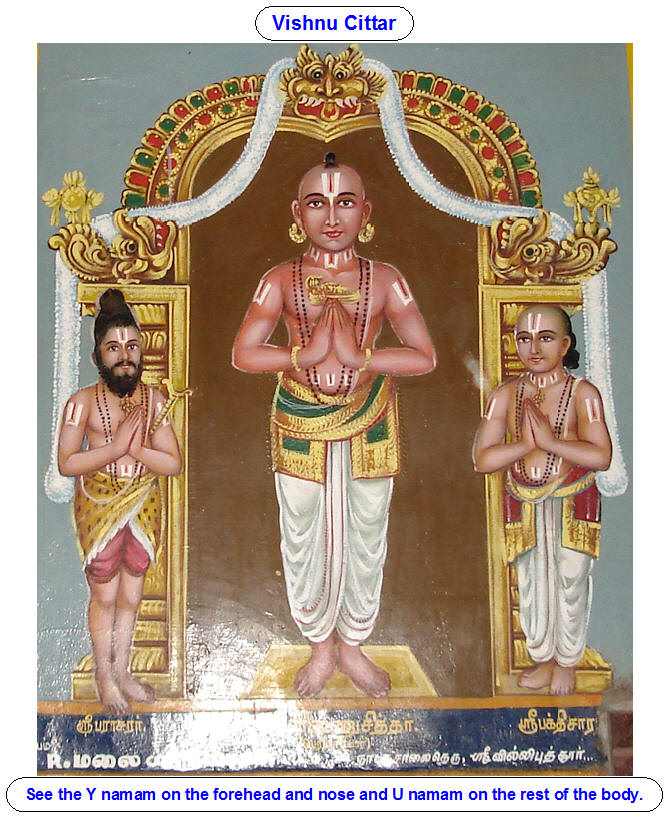
Sri Paraasarar--Sri Vishnu Chittar--Sri Bakhtisaarar
Vishnu Chittar AKA Periazhvar is one of the most famous Alvazrs who are the saint-poets of Vaishnava sect.
On the anterior body surface there are ten U Namams; one on the anterior chest is concealed behind the palms and there are two on the back; in all there are twelve Namams. This painting is in Andal Temple in Sri Villiputtur near Madurai Tamil Nadu. The U Namam here indicates that these devotees (Vadakalai Sect of Vaishnavism) of Vishnu regard Sri Vishnu's consort Sri equal to Vishnu.
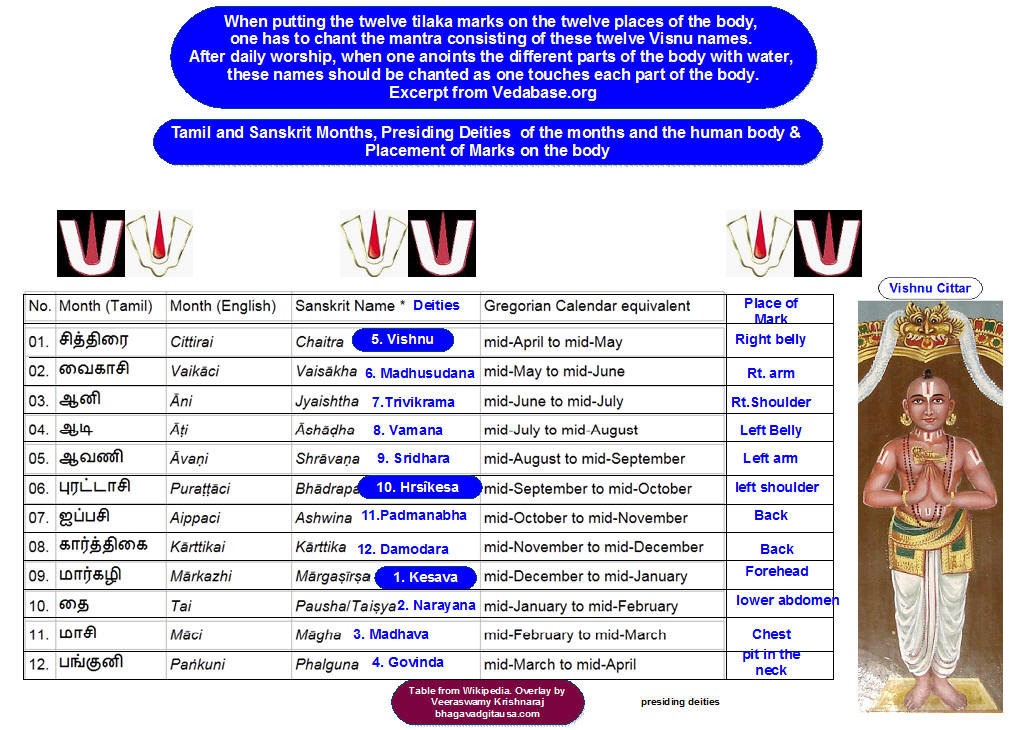
"When putting the twelve tilaka marks on the twelve places of the body, one has to chant the mantra consisting of these twelve Viṣṇu names. After daily worship, when one anoints the different parts of the body with water, these names should be chanted as one touches each part of the body.
"When one marks the forehead with tilaka, he must remember Keśava. When one marks the lower abdomen, he must remember Nārāyaṇa. For the chest, one should remember Mādhava, and when marking the hollow of the neck one should remember Govinda. Lord Viṣṇu should be remembered while marking the right side of the belly, and Madhusūdana should be remembered when marking the right arm. Trivikrama should be remembered when marking the right shoulder, and Vāmana should be remembered when marking the left side of the belly. Śrīdhara should be remembered while marking the left arm, and Hṛṣīkeśa should be remembered when marking the left shoulder. Padmanābha and Dāmodara should be remembered when marking the back." - Excerpt from Vedabse.org.
For Sandhyavanadam worship, the Namam (Tiruman or Urdhva pundra ) is applied in 12 places with the recitation of mantras: forehead, abdomen, chest, throat, right side of the abdomen, right hand, right side of the throat, left side of the abdomen, left hand, left side of the throat, back of the neck, and back. All Namams apart from the forehead do not have the footrest, meaning it is an U and not a Y of the forehead.
The Upavyuhas (Secondary Emanations), the loci of Thiruman application and the respective Mantras.
Mantra
Anatomical locations of Tiruman application
Protective deity to whom obeisance is paid. All are names of Vishnu.
Weapons held
name of Consort
Om Kesavaya Namaha
Forehead
Kesava
Discus in 4 hands
Sri
Om Narayanaya Namaha
Abdomen
Above the navel
Narayana
Conch in 4 hands
Amruthodbhava
Om Madhavaya Namaha
Chest
Madhava
Koumodhaka in all 4 hands
Kamala
Om Govindaya Namaha
Throat = Sternal Notch
Govinda
Saranga in all 4 hands
Chandrasodari
Om Vishnuvae Namaha
Upper Abdomen -Right side
Vishnu
Plow on all 4 hands
Vishnu Patni
Om Madhusudanaya Namaha
Right upper arm corresponding to upper chest Namam
Madhusudana
Rods on all 4 hands
Vaishnavi
Om Tiruvikramaya Namaha
Neck -Right side
Tirivikrama
Sword on all 4 hands
Vararoha
Om Vamanaya Namaha
Upper Abdomen -Left side
Vamana
Thunderbolt on all 4 hands
Hari Vallabha
Om Sridharaya Namaha
Left upper arm in line with chest Namam
Sridhara
Axe on all 4 hands
Sharngini
Om Hrishikesaya Namaha
Left side of neck
Hrishikesa
Crow bar on all 4 hands
Devadevika
Om Padmanabhaya Namaha
Back of the neck
Padmanabha
All weapons on all 8 hads
Mahalakshmi
Om Damodharaya Namaha
Back
Damodhara
Whip on all 4 hands
Surasundari
The Upaviyuhas, the presiding deities and the respective months and the twelve Adityas (page 137 Monier Williams Dictionary)
|
|
|
|
|
|
|
|
|
|
|
|
|
|
|
|
|
|
|
|
|
|
|
|
|
|
|
|
|
|
|
|
|
|
|
|
|
|
|
| தாபம் |
tāpam, n. Tamil Lexicon 1. Heat, burning; 2. Branding the shoulders with the marks of conch and discus of vishnu, one of panca-camskaram, q.v.; |
Coming back to Tāpam, the icons or seals on the shoulders (Deltoid area) destroy the sins, stop the minions of the Lord of Death (Yama) from taking him to Netherworld, and facilitate happy life and attaining Vaikuntha.
White outer stripes with red or yellow midline stripe keep the divine couple together and represent a temple keeping the Lord and Sri in it. During the application of Namam to the 12 places of the torso, neck and forehead, the Vaishnava devotee recites the appropriate Mantras for Vishnu and Sri. This application and recitation prepare him for performing rituals like Sandhyavandanam, Aradhanam, and all other Vaidic karmas. Application of the Namam in a sitting position with the invocation (Avahanam) of the many names of the Lord (Murthys) offers Kaappu (protection) to respective part of the body. The index or ring finger (middle finger not proper) is used in the application. The U consists of two vertical lines and the bend of the U. The bend is Paadam or foot, drawn first followed by right and left extensions in that order. The space between the two vertical lines sports the third vertical line of Sri.
Supreme Vasudeva is the Progenitor of all Vyuhas (Emanations). Here is the Family Tree.
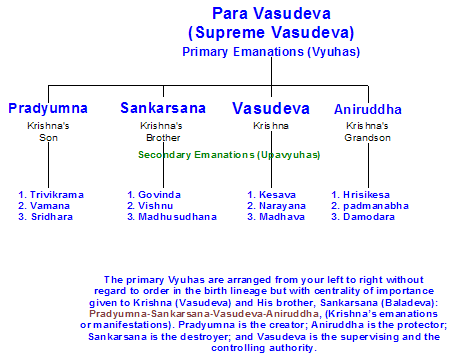

The 12 Upavyuhas as depicted above in the diagram represent the 12 suns corresponding to the 12 Zodiacs.
Below is the table that describes the protecting deities (Upavyuhas), the protected body parts, the colors, the directions, the consorts and Mantras.
| Num | Protected part | Protecting Murthy of body parts; color of the deity; direction | Weapons offering protection | Name of Consort | Mantra | Mantras invoking the consorts of the Upavyukas |
| 01 | Forehead | Kesava; Golden; East | 4 Disci in four hands |
Sri |
#1 |
Sriyayai nama |
| 02 | Center of abdomen | Narayana; Dark-blue; West | 4 Conches in all four hands |
Amruthodhbava |
#2 | Amrutothbhavaayayai Nama |
| 03 | Center of chest | Madhava; gem;up | 4 Maces in four hands |
Kamala |
#3 |
Kamalaayayai Nama |
| 04 |
Front neck (middle); Suprasternal notch in front |
Govinda; Moon; South | 4 bows in four hands |
Chandrasodhari |
#4 |
Chandra Sodharyayai nama |
| 05 |
Right side of Lower abdomen |
Vishnu; lotus filament; North | 4 ploughs in four hands |
Vishnu Patni |
#5 |
Vishnupatnyayai nama
|
| 06 |
Right upper arm |
Madhusudhana; Lotus; SE. |
4 Pestles in four hands |
Vaishnavi |
#6 | Vaishnavyayai nama |
| 07 |
Right side of the front of the neck |
Trivikrama; Fire; SW |
4 Swords in four hands |
Vararoha |
#7 |
Varaarohayayai nama |
| 08 |
Left Lower abdomen |
Vamana; Rising sun; NW |
4 Thunder Bolts in four hands |
Hari Vallabha |
#8 | Harivallabhyayai Nama |
| 09 |
Left Upper arm |
Sridhara; Lotus; NE |
4 Axes in four hands |
sārngini |
#9 |
Saarnginyayai nama |
| 10 |
Left side of the front of the neck |
Hrisikesa; lightning; Down direction |
4 Hammers in four hands |
Deva Devika |
#10 |
Devadevikaayayai nama |
| 11 |
Low Back |
Padmanabha; Effulgence of Sun; Manas |
All weapons in eight hands |
MahaLakshmi |
#11 |
Maha Lakshmyayai Nama |
| 12 |
Back of the neck in the midline |
Damodara; Silkworm; inside and outside the body. |
4 Ropes in four hands |
Surasundari |
#12 |
Saarnginyayai nama Sarva-abhishtapala-pradhaayayai nama |
The following are the Mantras recited at the application of Namams on various parts of the body.
1. Chathus-chakram namasyāmi Kesavam Kanakaprabham.
Sriyayai nama
2. NaarāyaNam ghana-shyāmam chathus-sankham namāmyaham
Amrutothbhavaayayai Nama
3. Maadhavam MaNibhangābham chinthayāmi Chathurgadham
Kamalaayayai Nama
4. Chandra-bhāsam chathus-sārngam Govindham aham aasrayE
Chandra Sodharyayai nama
5. VishNum Chathur-halam vandhE Padhma-kinjalka-sannibham
Vishnupatnyayai nama
6. Chatur-musalam-abjābham SamsrayE Madhusudhanam
Vaishnavyayai nama
7. Agni varNam chathu: khdkam Bhāvayāmi Trivikramam
Varaarohayayai nama
8. Vaamanam Baala-SuryAbham chathur-vajram vibhāvayE
Harivallabhyayai Nama
9.
Saarnginyayai nama
10. ChathurmudhgaramabhyEmi Hrisikesam Tadithprabham
Devadevikaayayai nama
11. Panchāyudham Padhmanābham PraNamāmyarkka-rochisham
Maha Lakshmyayai Nama
12.
Surasundaryayai nama
Sarva-abhishtapala-pradhaayayai nama
Nitya Kriya: Obligatory daily activities of religious nature in a religious enclave or temple, at home with modifications.
1. Upon waking up from the bed chant the name of Krishna, remember the names of Guru and Krishna, meditate on Krishna and his lilas and pay obeisance to Bhagavan.
2. Answering the calls of nature, cleansing oneself properly.
3. Acamana: Ritual sipping of water as an act of purification.
4. Hygiene of mouth and teeth.
5. Snana: Bathing in water with ambient temperature (cool water).
6. Wearing clean clothes.
7. Application of Tilaka on the forehead and body.
8. Chanting Gayatri (Vedic and Vaishnava).
9. Chanting of Japa.
10. Mangala Aratika of the Lord (4.30 AM of waving of light)
Mangala = auspiciousness. Arati = waving of light
|
ஆரத்தி |
ā-rati. |
11. Panegyric of the Lord by group singing (Kirtana), and dancing.
12. Worship of Guru and the Lord with Darsana (viewing), taking the foot nectar and flowers, Circumambulation and obeisance.
13. Worshipping Tulasi.
14. Serving the place of worship by cleaning
15. Studying and hearing of Sacred Texts.
16-17. Regard and respect to Vaishnavites, all beings and guests.
18. Communal eating.
19. Performance of one's duties.
20. Rest and relaxation.
These
are the three Vaishnava Mantras mentioned earlier.
Here are the three Mantras of Vaishnavas. 1. AshtAksharam (eight syllable Mantra); 2. Dwayam (two-line mantra, Thiru Mantram); 3. Sarama Slokam (Final-Bliss Verse).
1.
Om Namo Naaraayanaaya (ஓம் நமோ நாராயணாய)
2.
ஸ்ரீமந்நாராயண சரணௌ சரணம் ப்ரபத்யே
ஸ்ரீமதே நாராயணாய நம.
Sriman1 Naaraayana2 Charanau3, Saranam4 Prapadye 5
Srimathe6 Naaraayanaaya7 namah8.
3.
सर्वधर्मान्परित्यज्य मामेकं शरणं व्रज ।
अहं त्वां सर्वपापेभ्यो मोक्षयिष्यामि मा शुचः ॥१८- ६६॥
Sarva-dharmaan parityajya maamekam saranam vraja
aham tvaam sarva-paapebhyo moksayisyaami maasucah
சர்வ தர்மாந் பரித்யஜ்ய மாம் ஏகம் ஸரணம் வ்ரஜ
அஹம் த்வா ஸர்வபாபேப்யோ மோக்ஷயிஷ்யாமி மாஸூச:
Om Namo Naaraayanaaya (ஒம் நமோ நாராயணாய)
Comment:
This Thirumanthram consists of Pranavam and Manthrasesham: Om and Namo Naaraayanaaya. Sarama Slokam expands on Dwayam which expands on Manthrasesham which expands on Pranavam. Thus we have to learn Thirumanthram first. Pranavam and Namonarayana form the seed, root and trunk from which other Mantras branch out. Protection from a Mantra comes from its sound and meaning. MANTRA
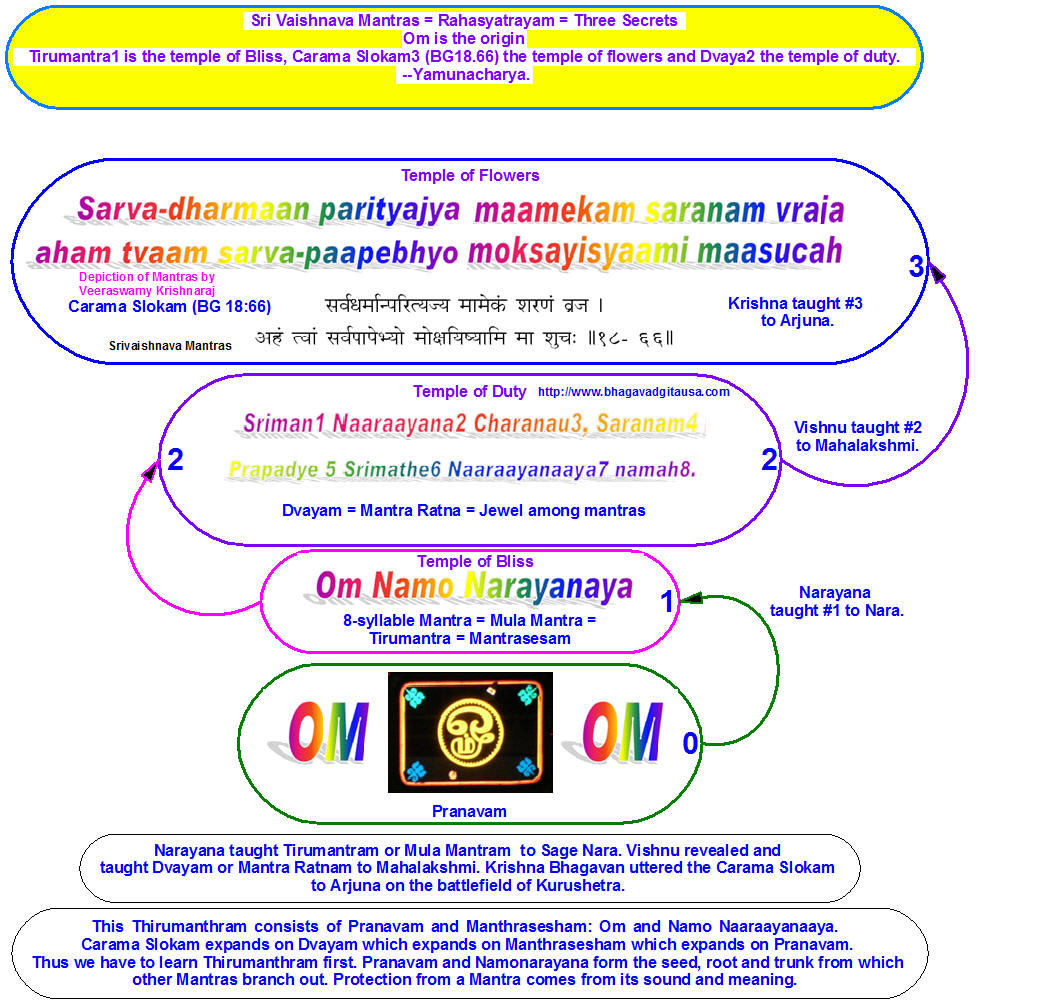
SamsArikal or Chetanas (individual souls) forget Isvara Kainkaryam, the obligate state of servility of Seshas (Sishyas), and the Supreme State of Seshi (Krishna). To help the human race, Narayana took the form of the first Acharya Narayana and the first disciple Nara and taught Thirumanthram, the essence of Artha Panchakam. Since there were no Sishyas (disciples), he himself took the form of the disciple. The knowledge gained by Thirumanthram is easy like an inheritance and unlike the hard-earned wealth.
Narayana's Kalyana gunas, avataras, Mantras are endless. There are two kind of Mantras: Vyapaka Mantras speak of his limitless and pervasive form and the other Avyapaka Mantras speak of some gunas, some lilas. Vyapaka Mantras are superior to avyapaka Mantras. Ashtakshari, dvAdasAkshari and Shadakshari Mantras referring to Narayana, Vasudeva and Vishnu namas are the three higher Mantras.
Here are the three important Vyapaka mantras:
1.
Om Namo Narayanaya
2. Om Namo Bagavade Vasudevaya
3. Om Namo Vishnave
Of these three, the first one is Poorna (complete) Mantra because Narayana pervades all, supports all, is the means (UpAyam) and the end (upEyam). This Maha Mantra is endorsed by Rishis, Vedas, Alvars, and Acharyas. Between the seed and the fruit, seed is greater. Likewise between Vaacya and Vaacaka (meaning and the word) meaning is more important; thus, the mantra is greater than Him. Others regard that the Lord is greater than his mantra, because he is the means and the goal.
All life forms take birth in this world of Samsara and misery; the ultimate goal is Moksa, centripetal movement of the soul to the Fountainhead. Artha Panchakam consisting of five elements is contained in the three rahasyas (secrets).
1. The Nature of God, 2. The nature of Jiva, 3. the means to gain salvation, 4. the nature of the goal, 5. the impediments. (collectively known as Arththa Panchakam.)
Understanding these elements is important for the Mumukshus (those who are eager for salvation).
Mumukshu = muktham + icchu = liberation + desire = one who desires liberation.
The soul is a slave and its only refuge is Him. Pranavam establishes the nature of the soul. The nama establishes the knowledge that soul does not have independence. Narayanaya is the goal.
Pranavam defines Seshatvam, nama PArathanthryam, NArAyaNAya Kaimkaryam. Acharyas call Om as Pranavam because of ubiquitous availability of Om from texts... Pranavam as part of mantra is available only in Acharya-Sesha transmission. Pranavam is AUM. A, akAram stands for the cause and the protector.
Impediments and levels of proximity to Narayana.
Baddha Samsaris ((பத்தம்--bond, tie) ; சமுசாரி--on who pursues worldly life). They have to grapple with everyday problems and needs for food, clothes and shelter. They have to contend with enemies and competitors. They are tied down to their family, friends and relatives. They seek relief from such needs as mentioned above.
Mumukshus: They are averse to the Samsaric misery and want to attain the abode of God. They don't seek rebirth and living in this world with the body as impediment. They want to break the cycle and seek the feet of Narayana in Vaikuntham.
Muktas: They have broken the ties of Samsara, dissolved their karma, and reached the feet of Narayana. They don't want to break the service they do at His feet in Vaikuntham. Their impediment is anything that breaks their service to Narayana.
Nithyasuris: They are the permanent residents in Parmapadam always rendering service to the Lord. They don't brook any impediment in their service.
Dwayam (Saranagati Mantra / Mantra Ratnam) consists of two lines. It is compared to six-legged bee.
(1. SrIman nArAyaNa charaNau , 2. SaraNam. 3. PrapadyE.4.SrImathE. 5.nArAyaNAya 6.namah)
ஸ்ரீமந்நாராயண சரணௌ சரணம் ப்ரபத்யே
ஸ்ரீமதே நாராயணாய நம:
Sriman Naaraayana1 Charanau2, Saranam3 Prapadye 4
Srimathe Naaraayanaaya5 namah6.
SrimanNarayana1 feet2 surrender3 fall down4
SrimatheNarayanaya5 obeisance6
Sriman Narayana, I fall down and surrender at your feet
Sriman Narayana, my obeisance to you.
Comment:
I hold Lakshmi-associated Narayana's feet as the object of my surrender.
Lakshmi-associated Narayana, my obeisance to You.
Dwaya Mantra has two lines and a total of six words. It condenses a ten-point reference as follows:
Goddess Lakshmi is the mediator between the Jiva and the Lord
They are the divine couple, always together.
The Lord is of auspicious nature.
His form is divine.
His feet are the means of liberation from the world of Samsara.
We accept His feet as the means of liberation.
Lakshmi and Narayana are our goal.
His control and power are inimitable.
We worship Him.
We destroy the inimical stance of “I and Mine,” the enemies of our soul.
SrIman nArAyaNa charaNau =
Sri Lakshmi, the auspicious Narayana- His divine feet
SaraNam = take refuge (His feet are the refuge of
Chetanas (souls) and the means for liberation.
prapadyE = fall at His feet (We accept His feet as the
refuge.)
SrImatE = Lakshmi (and) Lakshmi of the form
mercy, and mediator between Narayana and the Chetanas
nArAyaNAya = Narayana, the supporter and maintainer.
aya = wishing an impeccable service.
nama: = not mine. This destroys the attitude of "I am
the doer, enjoyer, knower and the only devotee."
Nammazvaar says in Thiruvaaymozi (6.10.10) 3559.
1. அகலகில்லேன் இறையும் என்று அலர் மேல் மங்கை உறை மார்பா 2. நிகர் இல் புகாய் உலகம் மூன்று உடையாய் என்னை ஆள்வானே 3. நிகர் இல் அமரர் முனிக் கணங்கள் விரும்பும் திருவெங்கடத்தானே 4. புகல் ஒன்று இல்லா அடியேன் உன் அடிக்கீழ் அமர்ந்து புகுந்தேனே
O Lord! You have the inseparable Lotus-Lady on your chest. She has no intention of leaving her abode. He (the BhAgavatA) says that he has no other refuge but You. You are of inimitable fame. You create and protect the three worlds. You are my ruler. You abide in Tiruvenkatam, very much liked by Munis and Devas. I the Adiyen, not having any other refuge, seek refuge at your feet. You offer me refuge and grant me Arul (grace). AdiyEn = Servitor; one who serves at the feet of Narayana, his BhAgavatA or the latter's feet and so on.
Sarama Slokam
Sarva-dharmaan parityajya maamekam saranam vraja
aham tvaam sarva-paapebhyo moksayisyaami maasucah
சர்வ தர்மாந் பரித்யஜ்ய மாம் ஏகம் ஸரணம் வ்ரஜ
அஹம் த்வா ஸர்வபாபேப்யோ மோக்ஷயிஷ்யாமி மாஸூச:
All dharmas abandoning unto Me Only surrender go
I you from all sinful acts (and their fruits) relieve. Don't worry.
Sarva-dharmaan1 parityajya2 maam Ekam3 saranam 4 vraja5
aham6 tvaam 7 sarva8-paapebhyo9 moksayisyaami 10 maa sucah11
All dharmas and actions1 abandon2; only unto me3 surrender4 go5
I6 you7 all8 from sin9 deliver10 not worry11
18.66: Abandoning all duties, surrender unto Me only. I shall deliver you from all sins. Do not lament. Thus says Bhagavan Krishna to Arjuna.
Comment.
Krishna says, AHAM, meaning I and referring to Himself. AHAM = A +Ha +M.
(Aham = A is the first letter of Sanskrit alphabet; Ha is the last one and Ma (M) is the terminator. Aham encompasses all the letters and thus, is Sabda Brahman. Krishna encompasses and pervades the whole universe. The one-syllable I belongs exclusively to Krishna and no one else. We arrogate ourselves by saying I. He is the I and we are that, it...
This is one of the most celebrated statements of Krishna and the final Sarama Slokam meaning that it is the verse that teaches the meaning of attaining final bliss. It is the Maha Mantra of Krishna. What it means is that a devotee can give up daily injunctions of the nature of Yagnas, difficult to pursue in Kali Yuga. What a devotee can attain in terms of benefits by Yagnas can be obtained just by uttering His sacred names by way of Sahasranamam.
Abandoning all daily duties means NOT giving up Sandyavandanam (and Mātyānikam-- Rites performed by the twice-born daily at noon-- but performance of Yagnas (Sacrificial worship). Uttering the names of Bhagavan gives three kinds of benefits: Dhrista Balam, Adhrista Balam, and Dhrishtādhrishta Balam. Dhrishta Balam is the benefit open for all to see. Adhrishta Balam is the benefit derived by the devotee from Bhagavan with His invisible hand. The third one is a combination of the previous two.
Surrender to the Lord has its own advantages. Saranagata Raksa is surrender-protection and God is Saranagata Raksakan (Surrender-protector). When a king surrenders to an emperor, the latter accepts the surrender, forgives and forgets all enmity and animosities of the surrendering king and offers him protection from other enemies. If you go to Bhagavan with all sincerity, devotion and love and surrender exclusively to him, the Only One, he forgives all your sins and gives you Moksa. There are several examples of Saranagata Raksa.
Indra and his son Jeyandan learn to surrender to Krishna and Rama
Indra, worship of Indra, Indra’s anger towards
Krishna, lifting of Govardhan hills.
Vridhavan was a place of bounty because Nanda and
the Gopas offered sacrifice to Indra, in return for Dharma, Artha, and Kāma
(right conduct, possessions, and worldly pleasures). Krishna asked His father
Nanda the meaning of offering
sacrifice to Indra, when Indra simply could not alter or expunge people’s karma.
Krishna advised the gopas to feed all animals and Brahmins and make offerings to
the Govardhana hill. Krishna assumed a gigantic form and said that He was the
consumer of their offerings; Indra, the Lord of clouds, lightning, thunder, and
rain, became mad and sent down torrential rains and thunders for seven days.
There was water everywhere; people and animals were in fear of the floods.
Krishna held up the Govardhana hill for seven days; and people, animals, and
cows took shelter under the hill; the gopas were wonder-struck seeing the
seven-year old Krishna holding up the hill. Indra, having realized his mistake
and self-conceit, came down from heaven and asked for forgiveness from Krishna,
who accepted his apologies and said to him that He did him a favor by taking
away his power and teaching him humility. Krishna protects all those who take
refuge in, and surrender to Him. As an aside, Indra was born from the crown of
Brahma. The message is that Krishna’s abode is higher than heaven, that his
devotees get protection from him, and that He is the only one who has the power
to offer release from karmic shackles.
Child Krishna holding up the hill
9.21:
Having enjoyed the wide world of heaven and exhausted the merit of their pious
deeds, they return to the world of mortals. Thus conforming to doctrine of the
three Vedas and desiring sense pleasures, they go and come (Gatāagatam, Go and
Come = death and rebirth).
In svarloka, you can witness the Apsaras dancing and the Ghandarvas singing. the beauty is that you enjoy the song and the dance. You can take a leisurely walk in the celestial gardens of Indra, Nandana Kanana and smell all the flowers and feast your eyes.There is a special tree, Parijata tree, which sprang up from milk-ocean, was claimed by Indra and planted in Nandana. You can see Sachi, Indra’s wife walking amidst the trees and flowery bushes, picking flowers and wearing them on her tresses. Sachi loves the flowers of Parijata tree, whose bark is gold, leaves are of copper color, and fruits are very fragrant. You can see the gardeners tending the delicate bushes, flowers and the flower beds. You may be lucky to see the SAdhyas, the gods of the old, much celebrated in Rg Veda and Tait. Samhita. They existed before man was created. They took the central position in yearly pusya-snAna (ablutions) and the consecration of kings, and Asvamedha sacrifice. You may have the extraordinary luck to witness VisvAvasu, the chief of Gandharvas and an accomplished dancer and musician. You may be able to catch a glimpse of the Maruts, who are known as hard drinkers of Soma when they are not fighting the enemies of Indra. Their enemies are afraid of them because they can create darkness instantly and prevent the enemies from seeing; they whack them dead. They have teeth of iron, roar like lions, enter with lightning and thunder, and exercise control over rain. There parents were Diti and Kasyapa. Indra cut Diti’s one Embryo into 49 pieces and thus created forty nine Maruts. The modern scientists have to take a backseat to Indra, because they haven’t yet produced 49 clones from one embryo. To assert His supremacy and fulfill Satyabhama’s wish, Krishna uprooted Parijata tree and mounted it on Garuda and was ready to take it to Dwaraka. Indra and his warriors suffered defeat at the hands of Krishna in their attempt to prevent hijacking of the tree. It was returned to Indra when Krishna died. You may ask why Krishna, the Lord of the Universe steal a tree. There is a lesson in this. The sacred Texts say that Krishna is the owner of everything in the universe. He can do anything He wants with what He owns. He giveth one time and taketh away next time. This was lesson to Indra, the chief of gods. Krishna is God of gods and has Supremacy over every one and everything.

You get many chances to talk to beautiful Vidyadharis who carry terrible MahAstram VaidyAdharam weapon and yet are very harmless. Don’t worry about Vidyadharas who aren’t the jealous type and who carry swords as a mark of wisdom, and wear flower garlands as a symbol of victory. The sad truth is that you don’t get to enjoy this for ever. You have to come down to earth once your sojourn comes to an end. Other worlds up to Brahmaloka offers same enjoyments. Above Brahmaloka, only eternally free souls can enter. The material worlds offer Bhukti and not Mukti and not Cit Sukha or spiritual happiness.
Indra’s son Jeyandan behaves very ignominiously towards Sita. (He in the form of a crow pecks at the breasts of Sita.) Rama uses Brahmastaram (Brahma's missile weapon system) on Jeyandan who morphs into a crow. Unsupported by Indra and the Holy triumvirate, he flies from town to town, from house to house. The missile follows him wherever he goes. (That is one Smart Weapon!) Jeyandran having been given up by the powerful now seeks refuge in ordinary households. All turn their backs to the Crow-demon. Later he comes back to Rama and seeks Saranagati Raksa. His feet are pointing to Rama and head is on the other end, not a proper position of the body in Saranagati. Sita, the victim of abuse, in her Motherly mercy turns his head towards Rama. Thus Sita, insulted and abused by Jeyandan, helps him attain Saranagati Raksa. Rama took his sight from one eye and that is the reason why the crow tilts its head to see. Since then the crow started talking in Sanskrit (believe it or not). When you dry your clothes on the backyard clothesline, the crow sits on the wall and cries Ka and KA. Ka means who is he (evan-எவன்) and Kā means who is she (எவள்). He and She are Rama and Sita. When the crow caws, it is asking the question who is the Saranagata Raksakan. It is saying எவன்-எவள் because Sita is the one who puts its head at the feet of Rama for the Kākāsuran (the Crow-demon) to ask for Saranagata Raksa from Rama. Sita helps the culprit to gain Raksa. The one who gives Raksa or protection to the crow demon is Rama. Naturally the question is Ka and Kā .
In the same way Trisadai asked for Saranagata Raksa at the feet of Sita; that made Sita prevent Hanuman from destroying all the Raksasis (ogres). Rama offered Saranagata Raksa to Vibhisana. Saranagata Raksam destroys all sins. Saranagati Vidyai (சரணாகதி வித்யை) is the superior form as illustrated by Vibhishana Saranagati (விபீஷண சரணாகதி). Bhakti yoga may not confer Moksa in this birth; it may take one or more future births to attain Moksa. But Saranagati to the Lord immediately destroys all demerits (பாபம்) and confers Moksa.
There are four kinds of Saranagati: Ukti Nishta, Suva Nishta, Acharya Nishta, and BhAgavata Nishta. Nishta = abiding in firm meditation; Ukti = action done as told; Suva = Self without outside help; Acharya = Vaishnava spiritual preceptor, Guru; BhAgavata = Great devotee of Vishnu. Many use the terms Saranagati and prapatti interchangeably.
Ukti Nishta: The qualified aspirant receives a mantra from the Guru and surrenders to Bhagavan.
Suva Nishta: சுவ நிஷ்டை. This is Self-surrender by pure souls without outside help from Guru or Acharya. One example is Ramanujacharya, Swamy Desikan... These are highly evolved souls, endowed with Bhagavad Prema (Abiding Love of Sriman Narayana). The accomplished have complete knowledge of the meanings of the three Rahasya Mantras and other Sacred texts, which help the practitioner and aspirant complete the requirements for fruitful Prapatti in a proper way. Sva Nishta is practiced by very few. It is 'do or die' proposition; if you do well, you get Moksa; if you don't do well, you get nothing.
Acharya Nishta: Here Surrender is obtained through Acharya who worships Bhagavan by chanting Mantra on behalf of the aspirant.
BhAgavata Nishta: Tried and true devotees of Bhagavan can introduce the aspirant to Bhagavan and implore Saranagata Raksa (surrender protection) on behalf of the aspirant.
The beauty about Saranagatti/Prapatti Raksa is there is no bar on any one based on external inequities.
He who accepts God (Krishna / Narayana) as his sole (only) refuge is prapannan = பிரபன்னன்.
|
Chhath is
another Hindu Festival dedicated to Surya (sun). It is believed to have
started by
Karna, the son of Surya, who became a great warrior and fought against
the Pandavas in the Kurukshetra War. Chhath is unique to
Bihar,
Jharkhand and the some Parts of
Uttar Pradesh,
Nepal &
Mauritius. Wiki
|
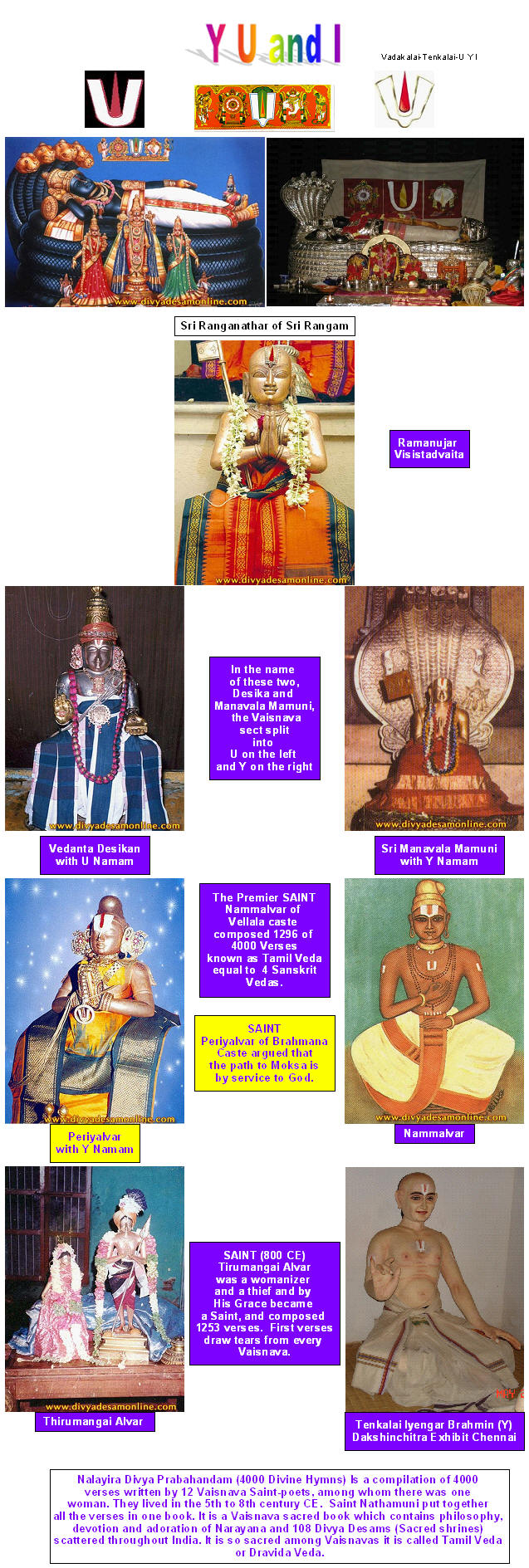
|
27 Nakshatras of the Zodiac, Indian and western. Source: Wiki |
|||
|
2
Bharani
|
3
Krittika
|
||
|
5
Mrigashīrsha
|
6
Ardra
|
7
Punarvasu
|
8
Pushya
|
|
9
Āshleshā
|
10
Maghā
|
11
Pūrva Phalgunī
|
12
Uttara Phalgunī
|
|
13
Hasta
|
14
Chitra
|
15
Svātī
|
16
Vishakha
|
|
17
Anuradha
|
18
Jyeshtha
|
19
Mula
|
20
Purva Ashadha
|
|
21
Uttara Ashadha
|
22
Shravana
|
23
Shravishthā or
|
24
Shatabhisha or Shatataraka
|
|
25
Purva Bhadrapada
|
26
Uttara Bhādrapadā
|
27
Revati
|
|