What is SriVaishnavism
Veeraswamy Krishnaraj

|
Bhagavad-Gita: 18 Chapters in Sanskrit |
| Download Bhagavadgita-all 18 chapters in Sanskrit, English, |
| transliteration and word for word translation. |
Bhagavadgita Pages in English, Chapters 1 to 18
| bg07-Sanskrit | bg10-Sanskrit | bg11-Sanskrit | bg12-Sanskrit | ||
| bg13-Sanskrit | bg14-Sanskrit | bg15-Sanskrit | bg16-Sanskrit | bg17-Sanskrit | |
Azvārs
are Avatāra Purusas,
immersed in Gunānubhava of Sriman Nārāyana. Some
of them are Ayonijars, the ones not born of the
womb. Nammalvar is the most prolific among the Alvars.
Sriman
Narayana is the First and the Foremost Acharya. Periyapirati (Sri) is the
second One. Vishvaksena is the 3rd One. The first
three belong in the Vaikuntam. The rest of the successors belong to the world
of Samsara. Nammalvar is the incarnation of Vishvaksena in the SriVaishnava
tradition. Nammalvar is the First and the Foremost among the earthbound
Acharyas and Alvars. Nathamuni is the
next Acharya coming in the footsteps of Nammalvar a few centuries later. There are many more down the line of
Acharyas. Ramanuja is one among the leading Acharyas. His prolific Bhakti literature include Sri Bhasyam, Dῑpam, Sāram,
Vedārtha Samkarakam, Sri Gitabhasyam, many Gadayams....
The three Gunas, Sattva, Rajas and Tamas (Tirguna) veil the
nature of Bhagavan in Samsaris under the yoke of Karma.
Sattva is white, virtue, goodness, light, pleasure... and
leads to salvation. Rajas is red, motion and passion
and their attendant qualities. Tamas is black, darkness, indolence, sleep....
The Gunas are in equilibrium in dormant stage at deluge or
Cosmic Sleep. When the gunas are agitated, there is a panoramic presentation of
substances, personalities, states and conditions. The three qualities are in
equilibrium in Mūla Prakriti, which has the potential for transformation
when agitation of the gunas takes place.
The Primordial Substance with quiescent Gunas is
beginningless and has neither origin nor dissolution.
Prakriti is eternal, transformational, and insentient and
exists expressly for the use of another entity such as the embodied soul
burdened with Karma.
Prakriti1 has two aspects: Avyakta and Vyakta
(the Unmanifest and the Manifest). In its Vyakta state
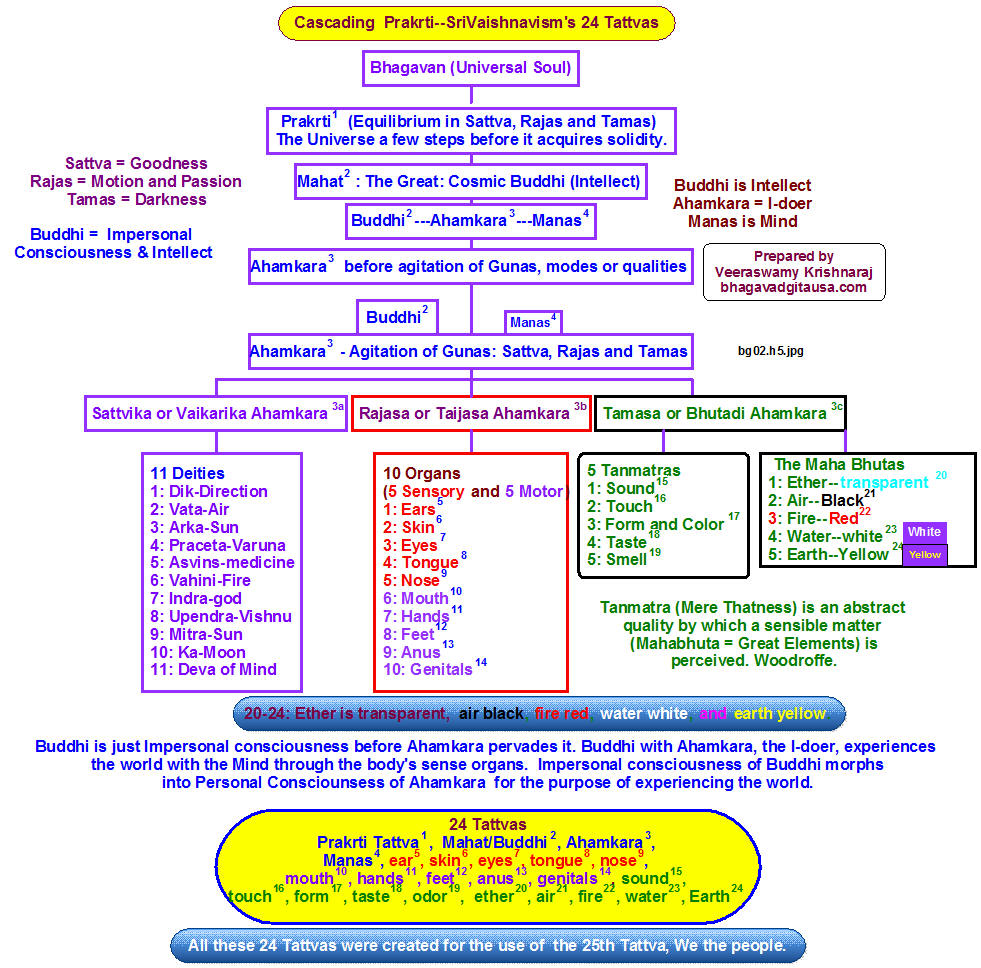
it is florid in its manifestation: 24 categories beginning with Prakriti1
or 23 Tattvas beginning with Mahaan2 and ending with Earth24.
Jivatma is the 25th entity. To begin with, this Mahat or Mahān2
is one stream but cascades down into many distributaries or streams according
to the Gunas that influence the downstream categories. Mahat2 is
Cosmic Intellect and becomes Buddhi2 at terrestrial level. For
didactic purposes, Buddhi2 produces Ahamkāra3 and
manas4. Buddhi or Mahat, depending on one's view, is
pervaded by the gunas.
Ahamkāra, the 'I-Doer' derived from Mahat/Buddhi2
in conjunction with the mind thinks that the body is the soul.
Ahamkara and the mind think mistakenly that Anatma
(non-soul) is Atma. Ahamkāra is pervaded by the Gunas resulting in
Sattvika (or Vaikarika), Rajasa (or Taijasa) and Tamasa (or Bhutadi) Ahamkaras,
according to Samkhya system. In Srivaishnavism, there is no Rajasa Ahamkaram;
Rajas provides the fillip to Sattvika and Tamasa Ahamkaram.
Though the dominant
guna in each of these entities is Sattvika, and Tamasa, it is
the Rajasa engine that drives these three entities. The Sattvika
Ahamkara (not accepted in Sri Vaishnavism) gives rise to Deities
; Rajasa to organs; and Tamasa to Tanmatras and later to Maha Bhutas.
See the diagram.
SriVaishnavas
must be familiar with Tattvam, Hitam and Prushartham.
Tattvam is threefold: Chetanam, Achetanam and Isvaran
(Cit, Acit and Isvara = the Sentient, the insentient, and the Brahman [Ruler,
Lord, Brahman]).
Narayana
is the means and the goal and thus one should have knowledge of the three
tattvas. Acit is insentient and incapable of being a knower, a thinker or
actor. It is neither an agent of self-willed action nor an enjoyer.
The
insentient matter is threefold: Triguna, Kaala and
Suddha-Sattva ( சுத்த-சத்துவம்). Matter, in its cascade,
begets 24 tattvas, Jivatma being the 25th entity.
Chetanam:
Cit = the Sentient. Jñāna is one of his qualities and refers to Tāma-Bhutaja-Jñānam. Jiva's Svarūpam (சொரூபம்) is Jñānamayam. So the
Jiva is known as Tāmi-pūthaja-jñāni.
It helps the Jῑva apprehend himself, other objects and his svarūpam.
JIva exists as Anu (atom), AnantasvarUpam (Bliss form), something other than a
physical body, the imperishable and the slave of the Lord.
Tattva is Tattvatrayam meaning that there are three Reals in the
world: Isvara, Cit and Acit including Mula Prakrti. Hitam is pointing the virtuous path of
approach to the Lord. Purushartham refers to the ultimate meaning of man, which is
liberation (Moksa) obtained by close affiliation with and dedication to
the Lord. (Purushartham = Artha, Dharma,
Kama, and Moksa or Mukti = Wealth, righteousness, Love, Liberation.)
Here is the take by Woodroffe on Moksa or Mukti as he describes the
Sakti point of view. Consciousness has thus a twin aspect; its liberation (Mukti or
Moksa) or formless aspect, in which it is as mere Consciousness-Bliss; and a
universe or form aspect, in which it becomes
the world of enjoyment (Bhukti). One of the cardinal principles of the Śakta
Tantra is to secure by its Sadhana both Liberation (Mukti) and Enjoyment
(Bhukti). Woodroffe,
Serpent Power page 38 in his discussion of Sakti.
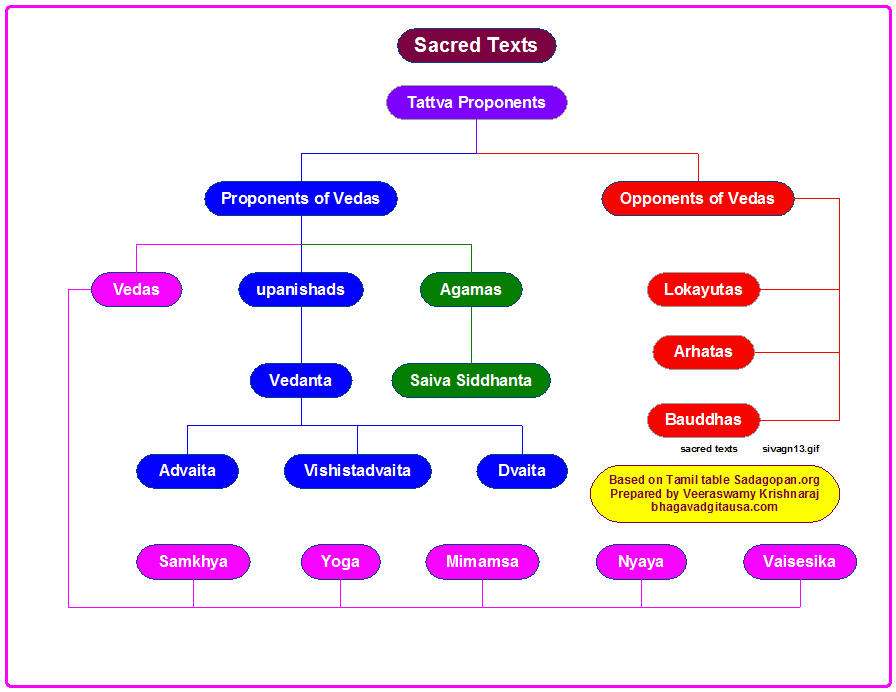
Tattavatraya tells the difference between Advaitic Monism of
Sankara and Qualified Monism of Ramanuja (QMR).
QMR says that there are three Reals in the world: Isvara, Cit and Acit.
This is the gist of QMR. The Lord abides in Cit and Acit. He is the Supersoul
inside the souls (Soul within the soul). It is called
Tattva because it tells us the relationship between and among these three
entities.
JivAtmas
of this nature are innumerable and fall into three categories: Baddha, Mukta and Nitya. Baddha is
helpless person bound by desire and Samsara (life on earth). Mukta is the one who obtained liberation by escaping
from the desires of Samsaric life and observing one of Bhakti-Parabhaktis. Muththar receiving the help of Guru practice Bhakti or
prapatti and attain Moksa.
Nitya is one
who is free from desires and who performs daily services to Emperuman. Nityas
do not carry the burdensome Karma anytime in their eternal life. Garuda and
Vishvaksena belong to Nitya category.
Achetanam
is unintelligent and insentient and has three Gunas: Sattva,
Rajas and Tamas. This is Mulaprakriti (Root
Substance), which is subject to constant transformation (Parinaamam). Mulaprakriti is stable when these three
Gunas are in equilibrium. Disequilibrium
prompts transformation of Mulaprakriti and results in many Tattvas or
categories, which are the building blocks of the universe and man. Mulaprakriti
1, Buddhi2, Ahamkara3 are the linear elements,
the last two are derived from Mulaprakriti.
The Gunas are necessary for transformation to take place at every step
of the way. The nature of the products reflects the Guna that acted on its
predecessor. Ahamkara3 is again modulated by the Gunas: Sattvika Ahamkara, Tamasa
Ahamkara. These two Ahamkaras do not have self-induction or -propulsion; Rajas
is the engine behind the Sattvika and Tamasa Ahamkaras and provides motion and
direction so that they generate the Prakriti-vikriti or terminal Vikriti
Tattvas.
Sattvaika Ahamkara
produces 11 Tattvas. Srivaishnava
explicators differ from others in that the former claim that mind, 5 sensory,
and 5 motor organs originate from Sattvika
Ahamkara. From Tamasa
Ahamkara come the five Tanmatras and 5 Great
elements. Rajasa
Ahamkara impels or inducts into action the Sattvika and Tamasa Ahamkara
to undergo transformation as explained before. Prakriti
is the substrate and the transformed resulting products are
known as Vikriti. Mulaprakriti is
Prakrti; the eleven organs and the earth are the Vikriti; mahAn
and the Tanmatras are Prakriti-Vikriti.
Our
body is Prakriti, Mahan, Ahamkaram and five Great
elements. Thus, the body became the abode of the Indriyas (organs).
Kaala:
It is the element that remains in the present, and
expands to the past and future. It is the Will of Bhagavan that transformation and mutation in the world
of desires come under the aegis and purview of Time. In Sri Vaikuntam, time loses its expansion
forwards and backwards according to the Will of Bhagavan. They remain in the
present all the time.
Suddhatattvam: Pure Category. Sattva Guna
pervades it without the contamination from Raja and Tama Gunas. In Vaikuntam,
all bodies of Beings, the Mandapams (Halls), Towers, Walkways, and all things
are Suddha-Sattva-Mayam (Supersaturated with Purity), which pervades upwards
without any limitation from Vaikuntam, earning the name Nityavibūti
(Eternal Splendor or Glory; Eternal Glory of Transcendental Splendor). The
bodies and incarnations of the Lord and the Nityasuris are eternal. They can
assume any form and can create human beings in the forms of fathers, mothers....
Suddhatattvam
is of the nature of empyreal Aprakritic Sattva (which transcends and exceeds
the earthbound Prakritic Sattva). It is the object of Highest
attainment, known as Paramapada. It is Ānandamaya,
that which is full of bliss, unalloyed happiness. It is Shādgunyamaya, manifestation of six auspicious qualities:
Knowledge, Power, Strength, Suzerainty, Vigor, and Heroism. These divine
qualities transcend similar prakritic earthly qualities.
Time
is one element that is not affected by the Gunas. Time
is a wheel. The Lord controls Time; mobile and immobile things; the cycle of
birth, death and rebirth; and liberation.
Tattvas, Tanmatras (Aviseshas =Unmanifest), Organs,
Mahabhutas (Viseshas = Manifest)....
There
are variations in the depiction of what comes from what. The basic knowledge
comes from Samkhya system of philosophy. Sri Vaishnavites say that Sattvika
Ahamkara gives rise to twofold sense organs: Antara and Bāhya (Internal
and external). The internal Mind generates the Will and retains memory. The
external organs report to the mind. The impressions from the external organs
move through the Mind, Ahamkara, Buddhi and Chitta. Chitta has the exclusive
ability to communicate with the individual soul, which has the exclusive
capability to merge with the universal Soul.
There
are five sense organs and five motor organs.
Tamasa Ahankara gives rise to Tanmatras and later to the Great Elements: Sabda Tanmatra (Sound)--Touch--form--taste--smell Ether-Air-fire-water-earth.
Tanmatras
namely sound, touch, color, taste, and smell are the subtle, supersensible,
rudimentary and nonspecific particles from which the gross elements namely
akasa, air, fire, water, and earth evolve respectively. There are two divisions
in the gross (great) elements (Mahabhutas): Amurtta and Murtta, the formless
and the formed. Akasa and air are formless elements, while fire, water and
earth formed.
Panchadasi (2.88) says that Akasa is the most extensive element compared to the
rest. Quantitatively starting from air each element is 12.5% of the former
element. It attributes this statement to Puranas.
The Tanmatras have specific names: Sabda Tanmatra (sound), Sparsa Tanmatra (touch), Rupa Tanmatra (color and form), Rasa Tanmatra (taste), and Gandha Tanmatra (smell). Sound abides in Sabda Tanmatra; same premise applies to all Tanmatras.
The tanmatras (merely that)
are nonspecific in the sense that they lack qualities (according to Samkhya philosophy)
such as Sattva, Rajas, and Tamas or calmness, turbulence and delusion.
When the transformation takes place from the subtle to the gross, the gross
elements acquire qualities. These gross elements again in turn are responsible
for products downstream such as hearing, tactile sense, vision, taste, and
smell collectively called sensory functions. The latter have corresponding
peripheral organs to receive the respective sensations, namely the ear, the
skin, the eyes, the tongue, and the nose, which again have their own respective
brain centers.
|
Sound |
Touch |
Color |
Taste |
Smell |
|
|
Gross Elements |
Ākāsa (Ether) |
Air |
Fire |
Water |
Earth |
|
Hearing
|
Tactile
sense |
Vision
|
Taste
|
Smell
|
|
|
Peripheral
sensory receivers |
Ears
|
Skin
|
Eyes
|
Tongue
|
Nose
|
|
Brain
centers |
Auditory
center |
Sensory
cortex |
Visual
cortex |
Gustatory
center |
Olfactory
center |
These
Tanmātras are the subtle physical counterparts of sense perceptions:
hearing, tactile sense, vision, taste, and smell. The subtle element that
travels from the flower to the nose is tanmātra. The five bhūtas (the
gross elements), ether, air, fire, water, earth evolve from Tamasic
tanmātras. The dominant element's space or compartment consists of half (50%) of the dominant element and one eighth (12.5%)
each of the other four elements. None of the reconstituted gross elements is
pure in each compartment. We know now the gross elements developed from
the subtle elements and so it is reasonable to deduce the gross elements exude
subtle elements. For the gross elements to acquire the gunas (qualities),
Sattva, Rajas, and Tamas (calmness, turbulence, and delusion) during the
transformation from the subtle elements, the gross elements had to become
compounds representing one dominant element and four other contaminants.
Compartment
one, Ether: 50% is Ether and 12.5% each of air, fire, water, and earth.
Compartment two, Air: 50% is Air and 12.5% each of ether, fire, water,
and earth.
Compartment
three, Fire: 50% is fire and 12.5% each of
ether, air, water, and earth.
Compartment four, Water: 50% is water and 12.5% each of ether, air,
fire, and earth.
Compartment five, Earth: 50% is earth and 12.5% each of ether, air,
fire, and water.
Let us take
water: 50% is water; Water is Hydrogen and oxygen; if you take the atoms, there
is space. It is mixed with air (think of fish
extracting oxygen from water). Water has Fire in it, meaning there is heat in
water. When you remove heat from water it becomes ice.
It has earth in it meaning it has minerals, which contributes to the taste of
the water.
Table: From the
subtle and the finer elements, to the gross, to the sensory, to the Command and
Control Center (Buddhi and Purusa), and to the motor organs: Chain of events go from the top to the bottom.
One example:
Sound becomes Ether, which upon its gross manifestation becomes hearing; the
latter needs an organ to receive the hearing. The peripheral organ needs
pathways, central processing organ and organ of response to the sound --
Vestibulocochlear pathway, going to auditory region (Temporal lobe), Mind,
Buddhi and Purusa, Mind, Motor cortex and actions.
Tanmātras
is special to the Sankhya system, one of its greatest contributions.
Mātra-Tan means "merely that". All objects and beings emanate
tanmātras, subtle, supersensible and fine elements all the time. Let me
give you an easily understood phenomenon. All warm-blooded beings emanate heat;
that heat is fire, which traces its origin to the Rupa Tanmātra
"Color and shape." All of us can detect that heat without any
problem. We also emanate Carbon Dioxide; you and I cannot detect carbon dioxide
in the air or its source with our senses; a mosquito does not have a problem
detecting carbon dioxide, hones in on, lands on and bites us. The mosquito has
a CO2 detector in its
mouth appendage, called Maxillary palp.
|
Subtle
and nonspecific |
Subtle
and nonspecific |
Subtle
and nonspecific |
Subtle
and nonspecific |
Subtle
and nonspecific |
|||||
|
SOUND
|
TOUCH
|
COLOR
|
TASTE
|
SMELL
|
|||||
|
Air
12.5%
Fire 12.5%
water
12.5%
Earth
12.5% |
Ether
50%
|
Ether
12.5%
Fire
12.5%
Water
12.5%
Earth
12.5% |
Air
50%
|
Ether
12.5%
Air
12.5%
Water
12.5%
Earth
12.5% |
Fire
50% |
Ether
12.5%
Air
12.5%
Fire
12.5%
Earth
12.5% |
Water
50% |
Ether
12.5%
Air
12.5%
Fire
12.5%
Water
12.5% |
Earth
50%
|
|
ETHER
|
AIR
|
FIRE
|
WATER
|
EARTH
|
|||||
|
Gross
and Specific |
Gross
and Specific |
Gross
and Specific |
Gross
and Specific |
Gross
and Specific |
|||||
|
Hearing
|
Touch |
Vision
|
Tasting
|
Smelling
|
|||||
|
Ears
|
Skin
|
Eyes
|
Tongue
|
Nose
|
|||||
|
Vestibulocochlear
|
Sensory
Pathways |
Visual
Pathways |
Taste
Pathways |
Olfactory Path.
|
|||||
|
Auditory
region of the cerebral cortex |
Somatic
sensory region of the cortex |
Visual
region of cerebral cortex |
Gustatory
region of cerebral cortex |
Olfactory
region of cerebral cortex |
|||||
|
Mind
|
Mind
|
Mind
|
Mind
|
Mind
|
|||||
|
Buddhi
& Purusa |
Buddhi
& Purusa |
Buddhi
& Purusa |
Buddhi
& Purusa |
Buddhi
& Purusa |
|||||
|
Mind
|
Mind
|
Mind
|
Mind
|
Mind
|
|||||
|
Motor
Cortex |
Motor
Cortex |
Motor
Cortex |
Motor
Cortex |
Motor
Cortex |
|||||
|
Motor
Organs-Karmendriya |
Motor
Organs-Karmendriya |
Motor
Organs-Karmendriya |
Motor
Organs-Karmendriya |
Motor
Organs-Karmendriya |
|||||
We also emanate many other tanmātras, which only
yogis can detect. You know that a shark can detect the tanmātra that
emanates from a minute amount of blood spilled in the ocean within the range of
its special sense. We do not have that ability. Likewise
a bitch (a female dog) exudes pheromones in the urine during estrus, which is
detected by the male dog many miles away. The proof is that the male dog goes
out looking for the female dog; things happen and you have a litter on hand.
That is Tanmatra. Scientists say we unconsciously detect pheromones emanating
from the opposite sex. Now you see how
yogis can detect tanmātras that we miss.
You can see the same phenomenon in the psychics. The dead bodies exude
tanmātras that a psychic can sense from miles away, and which we cannot
detect. Vivekananda says the temples and places of worship emanate good
tanmātras, which augment and strengthen the Sattvic quality in the
devotees. When Sattvic yogis go to these temples of worship, the place acquires
more beneficial tanmātras. You may call these tanmātras as
vibrations.
Ether comes from elemental
sound. Sound is primal. OM is primal. Akāsa is ether, the stem substance.
Ether
is perceived
as sound.
Air comes from
elemental sound and touch, and is primarily perceived
as touch.
Fire comes from
elemental sound, touch, and color, and is perceived
primarily as color and form or shape.
Water comes
from elemental sound, touch, color, and taste, and is
perceived primarily as taste.
Earth comes
from elemental sound, touch, taste and color, and is primarily
perceived as smell.
Each gross
element, as you see, becomes a compound when it is combined
with other elements.
The gross
elements, gross body, and their connection:
Table:
|
Earth
|
Water
|
Fire
|
Ether
|
|
The
Cranium
The
Skin
The
Intestines
The
Bones
The
Flesh
The
Nails
|
Body
Fluids
Blood
Urine
Saliva
Sweat
Other
Fluids
|
Hunger
Thirst
Body
Heat
Swoon-Syncope
Libido
|
Anger
Lust
|
As ether,
air, fire, water and earth gather mass (transformational change of Ether into
gross substances) and become progressively grosser, they acquire progressively
more qualities. Ether has five forms of motion. Ether moves everywhere
unobstructed and makes it possible for other forces to work in its realm. When
motion into space takes place, Vayu (air) is born and being heavier than ether,
it propagates sound. When motion and expansion take place upwards, it becomes
fire and is seen and felt. When motion takes place downward giving rise to
contraction (precipitation) it becomes water that is seen,
touched and tasted in space. When there
is obstruction in motion, Cohesion, Agglutination, Aggregation or Sedimentation
takes place giving rise to earth in space which is
seen, touched, tasted and smelled. These are the five forms of matter: etheric
(sarva vyapi, all- pervading; Nirupa, formless), aerial (Vayava), fiery
(Prakasa and Tapa), fluid (Tarala and Calanasila) and solid (Ghana, Drdha,
Samghata and Kaathinya--dense, fastened, joined and hard). When primordial clouds condense, they become
matter, stars, planets that we see, says the modern science.
According to Samkhya, the eye is only a peripheral organ and the visual cortex
in the brain is the organ of sight; the same rule applies for hearing,
smelling, tasting and touching. The sensory input from all the peripheral sites
are processed in their respective brain centers and presented
to the manas or the mind. Sattvic, Rajasic or Tamasic Ahankāra
processes information, and buddhi takes the product to Purusa. Purusa is the
king and gives orders to buddhi, which in turn orders the mind to activate the
motor response: The mind instructs the motor organs to carry out the orders.
Instinctive Manas, ahamkāra, and buddhi form a unit known as (Citta or)
antakarana or inner organ. Ahamkāra (ego) in its three colors is conceited
and Rajasic; deluded and Tamasic; or virtuous and Sattvic. Sattva, Rajas, and
Tamas colors buddhi too, and its response is according to the dominance of one
of these three gunas.
Sattva, Rajas,
and Tamas gunas rule the world, both sentient and the insentient. The
transcendental Lord, Vishnu is beyond these three gunas. Yogamāyā of
the Lord, the barrier between the Lord and the material world, is the external
energy, from which Mahatatva and Ego take their origin.
Ego gives rise
to the first five elements: the sky or ether (its subtle form is sound), the
air, the fire, the water and the earth. The sense perception started with
sound, later went on to hearing, touch, vision, taste, and smell. The objects
that produce these sense perceptions, namely sky, air, fire, water, and earth
also evolved alongside. The sensory organs that perceive these senses originate
from the five elements.
Nose exists for
smell (and for breathing–prāna); if there is no smell or prāna, there
is no need for a nose. Naturally, smell or prāna existed first, before
nose came. Sound existed first before the auditory apparatus came into being.
The elements that produce these sensations such as smell come into existence
alongside the senses. There are three parts to this equation. The subtle,
nonspecific and finer elements are the sound, touch, vision, taste, and smell,
all collectively called five tan-matras. Intermediate components are what
travel between the subtle and the gross elements in a downstream fashion. That
phenomenon is experience created by the infinitesimal particles. The
corresponding gross components are ether, air, fire, water, and earth. The
relationship between the five sense organs and the tanmatras is horizontal,
while the relationship between the finer and the gross components is vertical.
|
|
Prakriti
¯
|
|
|
|
|
|
|
||||||
|
|
Mahat /Buddhi |
|
|
|
|
|
|
||||||
|
Karmedriya
¯
|
Jnanedriya
¯
|
Manas
|
Tanmatra
¯
|
Tanmatra
¯
|
Tanmatra
¯
|
Tanmatra
¯
|
Tanmatra
¯
|
||||||
|
Motor
Functions |
Sense
of Perception |
|
Sound
Subtle
element
¯
|
Touch
Subtle
element
¯ |
Color
Subtle
element |
Taste
Subtle
element |
Smell
Subtle
element |
||||||
|
Speech
Prehension
Ambulation
Evacuation
Procreation
|
Auditory
Tactile
Visual
Gustatory
Olfactory
|
|
Infinitesimal
particles
¯
Ether
(Gross element) |
Infinitesimal
particles
¯
Air
(Gross element) |
Infinitesimal
particles
¯
Fire
(Gross element) |
Infinitesimal
particles
¯
Water
(Gross element) |
Infinitesimal
particles
¯
Earth
(Gross element) |
||||||
|
|
|
|
|
|
|
|
|
||||||
TANTRA14.jpg
SriVaishnavites
attribute Buddhi to have Adhy-ava-sāya (= mental effort, apprehension) and Abhi-māna (=
self-conceit) and Cintā (=
சிந்தை
= Meditation, contemplation). But
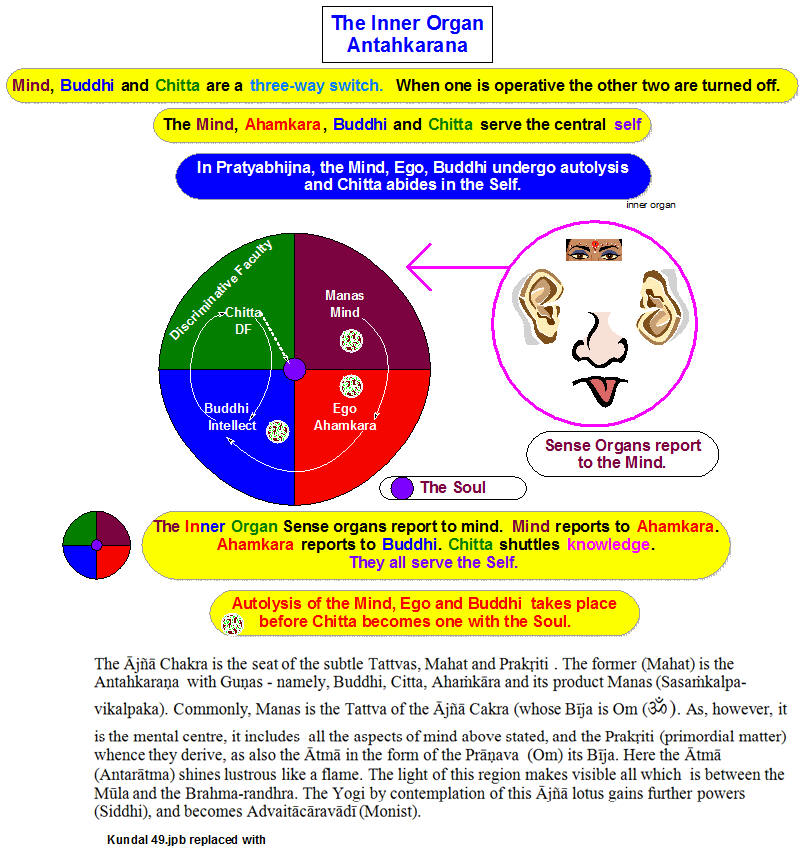
others advocate the following premise. Mind, Ego, Buddhi, and Cinta or Citta
are one organ known as Inner Organ (Anatah Karana) with functional
polymorphism. It means that these four are constituents of the Inner organ;
they work like gears in the car; when one gear is working, other gears are
disengaged. When Mind works (manas-Vrtti), Buddhi and Citta stop working.
Buddhi is Citta in Srivaishnavism but in Antahkarana premise, Citta is one
notch above Buddhi. In the diagram above, you will notice that the Soul
occupies the center; Mind, Ego, and Intellect serve Chitta or Determinative Faculty,
which serves the central Soul. Sense organs report to the Mind, which
submits the mental impressions to Ego, which analyses them from selfish point
of view of the experiencer and forwards ego-colored impressions to Buddhi
(Intellect).
Manas = Mind.
Buddhi = Intellect. Chitta = Citta = Determinative faculty.
According to
Sriviaishnavism, Buddhi or Citta communicates with the Universal Soul or
Paramatman; it is not so in Antahkarana paradigm, wherein Citta supersedes
Buddhi and communicates with Paramatman.
When Buddhi is
churning, you call the function Buddhi-Vritti. Same is
true of Manas-Vritti and Chitta-Virrti. Manas-Vritti, Buddhi-Vritti and
Chitta-Virrti are controlled by a three-way switch, a case of reciprocal
inhibition; only one switch is operative at a time. When Manas is churning,
Buddhi and Chitta stop churning. Manas is a gatherer
of information; Buddhi is a sifter, a sorter, an analyzer, a collator, and a
processor of knowledge. It is like gathering intell (intelligence) by Manas,
the field agents, and the analyzer of 'intell' is the Buddhi. Buddhi is
intelligence, reason, power of discernment or judgment. Its intrinsic memory is
evanescent (has only short-term memory like RAM.). Antahkarana is the inner
organ or the repository of Manas, Ego, Buddhi and Chitta. Chitta is a shuttle
that moves knowledge back and forth from the front burner of consciousness or
Buddhi to back burner and vice versa. When knowledge shuttles via the
shuttle-express (Chitta) to the front of consciousness, you call it Smrti or
remembrance; when knowledge is put in storage and not remembered, it is called
Apohana (loss or forgetting); but it is available upon
demand. Impressions; analytical interpretation; and storage and recall are the
respective functions of Manas, Buddhi and Chitta, which work like gears in the
car; when one gear is on, the other two gears are disabled. Ego or Ahamkaram is
the 'I-doer', which looks at its own important self from the self of others and
the world and is a mediator between the id and the world of objects and beings.
Vritti or vrtti
in this context is churning of the mind, Buddhi and Chitta, meaning they are
engaged in their respective activities. Yoga is to turn off this churning of
the restless entities, so that he can abide in his self (svarupa) with ablation
of mind, Ego and Buddhi and subside in Tranquil Chitta-Atma. Only Chitta
communes with the effulgent Soul. Svarupa = the nature of Brahman as it is in itself
(Svarupa); Svarupa is the nature of anything as it is in itself. -Woodroffe Serpent Power, page 29.
|
Brahma, Vishnu and Shiva are the names for functions of the one
Universal Consciousness operating in ourselves. And whatever be the means
employed it is the transformation of the "lower" into
"higher" states of consciousness which is the process and fruit of Yoga and the cause of all its
experiences. Woodroffe, Serpent Power page 19 Introduction. |
Mind, Buddhi,
and Chitta are one entity with three different functions and so named
individually based on its function at that moment in time; Chitta is
hierarchically the most superior element of the three and has the privilege of
communicating with the Self or the Soul which occupies
the center of a human being (and the diagram). When Chitta communes with the
Soul, Mind, Ego and Buddhi vanish (autolysis); peace and quiet prevail;
communion with the Soul is effective.
Soul, the King
presides over, directs, and benefits from Mind, Buddhi, Ego and Chitta. When
they all go to battle for the king, they all die with Chitta merging with the
Soul. What it means is mind the mechanical meditator, Buddhi the fickle
meditator and Ego the I-maker have to die for the Chittam to meditate and find
oneness with the soul. Manas-Nasa = destruction
of mind; Buddhi-Nasa = destruction of Buddhi; Ahamkara-Nasa = destruction of Ahankara. When there
is destruction of ego, mind, and intellect, there is tranquility, there is no
egotistical 'I' factor, there is no propagation of
thought waves from the mind, and there is no intellection giving rise to
extraneous concepts and notions. Under theses circumstances there is only one
EGO, that of God. An aspirant can appraoach God
only when his ego is destroyed. Your ego is no match to God's EGO. you say, 'You Go' to your ego before you face God. Under these
ideal conditions, Chittam can go to work and meditate on the
Indivisible Oneness and merge with it.
-----------------------------------------------------------------------------------------------------------------------------------------------------------
Back to SriVaishnavism
SamAsarayanam, KAlakshEpam and Parabhakti are essential to be a true Srivaishnava. The three
initiations can be obtained from one or different Acharyas. Acharyas do this as
selfless service to the Sisya and provide all devices for the Sisya to live a
right life and attain Moksa. Sisya in turn is obligated to pursue the path with
full faith, refrain from deriding the ACharya, and keep the Mantras secret.
Worshipping and meditating on the Acharya, spreading Acharyas' good name... are
the duties of the Sisya, who should also regard the Acharya's form that of
Sriman Narayana caming in his life for his salvation.
Sisya is expected to perform
KAlakshepam to expound the tenets of SriVaishnavism according to his ability.
The three secret Mantras are the Tirumantra,
Dvayam and Carama Slokam.
Dvayam was revealed by Emperuman Himself. Carama
Slokam came from the mouth of Krishna. These three mantras have 8, 25 and 32 Syllables and 3, 6,
12 words respectively. Upon initiation
with these mantras by the Acharya, the Sisya should chant them daily. Sri
Desikan have explained these Mantras in his treatises.
Isvara:
Isvara is immutable, Jnaana-sorUpi (of the form of knowledge), all-pervasive,
omnipresent, beyond time and space, unlimited in His pervasion in objects,
Ananda-sorupi (of the form of Bliss).... He has no defects. Acit and Cit in
their wholeness are His Body. He is the way and the goal. He is the creator,
preserver and destroyer. He is the
hypostasis of all and transcends all. He controls and rules over all. He is the
enjoyer of all fruits. He removes all desires of the ones who attained Him. He
is the object of eulogy of all Sacred Texts. He is the worshipped and the
benefactor. He is the creator of Brahma and other gods, who fear Him and obey
His commands. By His SvarUpam, sacred
Body, Gunas, and the objects He created, He is greater than all put
together. He is the repository of
Kalyaana Gunas--Auspicious qualities. There is nothing new that He desires.
There are no circumstances, in which He is away from Sri.
His
sacred Body is fivefold: Paramam, VyUham, Vibhavam,
AntaryAmi, and Archai. See the table below
PararUpam
is VAikunta ParaVasudeva RUpam. VyUham
is Vasudeva-SAmkarshana-Prayumna-Anirudha Rupams. Vibhavam consists of Matsya and
KUrma Avataras.
AntaryAmi
is the resident subtle form in the hearts of all. Archai form is the appearance
in DivyaDesa of sacred forms and the desired forms as requested by His
devotees.
PeriyaPirAtti
(Sri) is integral to IsvaraTattva. Apart from these two, all other beings
belong to JῑvaTattva. Piratti is all-pervasive
like Bhagavan, besides being the path and the goal. As parents look after the
welfare of the children, the Duo looks after the needs of the world (like the
parents).
These
two Tattvas (Bhagavan and Sri) are inseparable. Sri or PirAtti serves as the
Mediator or PurusakAra (Personal effort) on behalf of the devotees. Parabhakti
along with Surrender to both of them is the way to go.
Hitam:
Hitam is the observation of ways and means such as Bhakti, Parabhakti... with
Moksa as the goal.
Bhakti Yoga:
Bhakti Yoga is of many kinds. This should be observed
until the attainment of Moksa, which takes a long time. It is hard to observe
its tenets (Anga). It is difficult to find a practicing proponent of Bhakti
Yoga.
Parabhakti:
The ones, unable to observe Bhakti Yoga, resort to Parabhakti as the
Moksa-upAya. This goes by various names: Prapatti, Saranāgati, Upāya-anushtanam.... This is fourfold: Sva Nishta, Ukti Nishta, Achārya Nishta, Bhāgavata Nishta. Ukti Nishta and AchArya Nishta are the forte
of Acharyas in Mutts. The problem with these Nishtais is Moksa is elusive, if
they do not meet the letter of the prescription.
Ukti
Nishta is acquisition of impeccable knowledge and meanings of the three Secrets,
other sacred Texts...
நிஷ்டை niṣṭai
, n. < ni-ṣṭhā. 1.
Meditation; 2. Observance of
religious duties and vows; விரதானுஷ்டானம்
Nishta = abiding in firm meditation; Ukti = action done as told; Suva
= Self without outside help; Acharya =
Vaishnava spiritual preceptor, Guru; BhAgavata = Great devotee of Vishnu. Many use the
terms Saranagati and prapatti
interchangeably.
Ukti Nishta: The qualified aspirant receives a
mantra from the Guru and surrenders to Bhagavan.
Suva Nishta: சுவ நிஷ்டை.
This is Self-surrender by pure souls without outside help from Guru or Acharya.
One example is Ramanujacharya, Swamy Desikan. These are highly evolved
souls, endowed with Bhagavad Prema (Abiding Love of Sriman Narayana). The
accomplished have complete knowledge of the meanings of the three Rahasya
Mantras and other Sacred texts, which help the
practitioner and aspirant complete the requirements for fruitful Prapatti in a
proper way. Sva Nishta is practiced by very few. It is 'do or die' proposition;
if you do well, you get Moksa; if you don't do well,
you get nothing.
Acharya Nishta: Here Surrender is obtained
through Acharya who worships Bhagavan by chanting Mantra on behalf of the
aspirant.
BhAgavata Nishta: Tried and true devotees of
Bhagavan can introduce the aspirant to Bhagavan and implore Saranagata Raksa
(surrender protection) on behalf of the aspirant.
The beauty about Saranagatti/Prapatti Raksa is there is no
bar on any one based on external inequities.

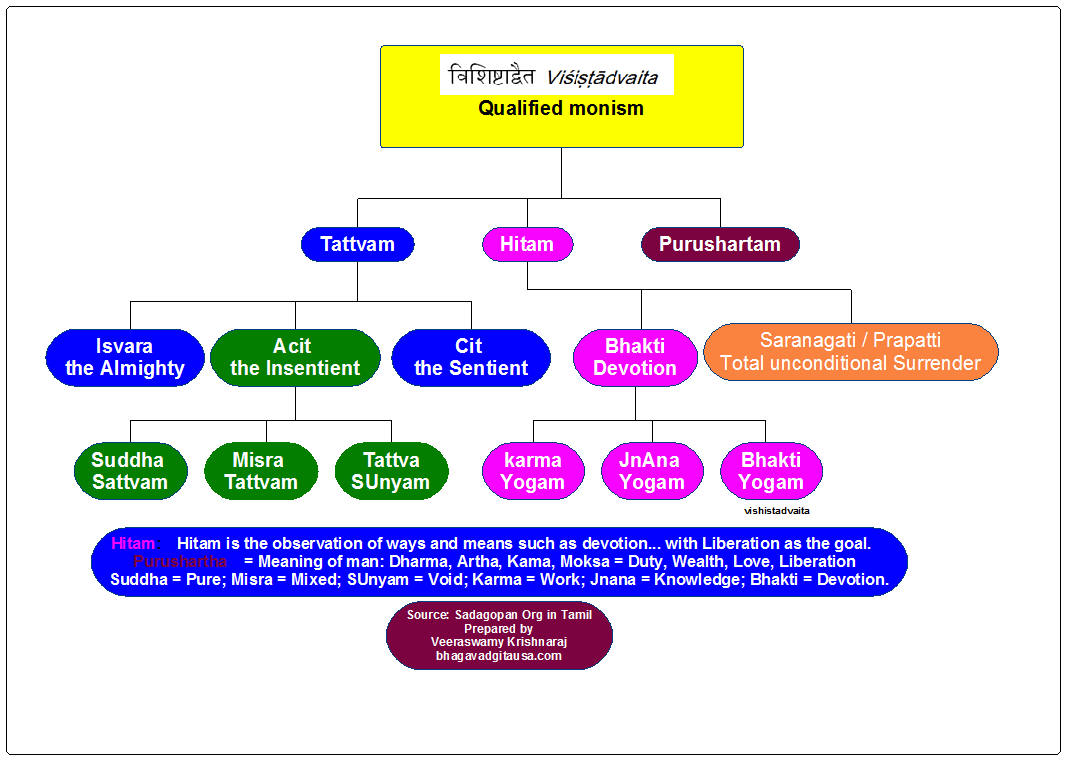
Acit or Acetanam is insentient. It is of the nature of
transformation from substrate to substance-from Prakriti to Vikriti. Acit does not have knowledge. It is of
threefold nature: Suddha Sattvam, Misra Tattvam, and
Tattva Sūnyam. The Indian Scriptures say, in the words of Herbert Spencer in
his "First Principles," that the universe is an unfoldment (Srishti)
from the homogeneous (Mulaprakriti) to the heterogeneous (Vikriti), and back to the homogeneous again (Pralaya or
Dissolution). Serpent Power by Woodroffe.
Suddha Sattvam is Pure Sattva not contaminated with Rajas and Tamas.
Appearance or disappearance is not its nature. It is eternal. It is
self-effulgent. Its other name is Māyā. It is transcendent Sattvic
aprakriti not contaminated with Rajas and Tamas. The opposite of Maya is Avidya
Prakriti (Malina Sattva = Impure Sattva) which is short on Sattva, and long on
Rajas and Tamas. Malina Tattva = Avidya = Misra Tattva (mixed principle). Suddha Sattva is the Highest Empyreal Form
and Malina or Misra Tattva is the lower form.
All souls caught in material energy are Misra Tattva. One who gives up the material Tattva and considers
himself an infinitesimal part of the Lord, the Supreme Personality of Godhead,
is suddha-anucit (pure atomic sentient fragment
of the Lord). Transcendental substance is suddha-sattva.
The Lord and all of His cohorts have transcendental bodies,
have qualities identical with those of the Lord; are beyond the ravages of
Time, of Suddha-Sattva nature, eternal and immutable, of auspicious qualities,
effulgent with Vedic knowledge; and engage in fivefold worship of the Lord.
--Gaudiya Cosmotheism. Bhagavan, His cohorts and devotees live in Vaikuntam and
have qualities of Suddha Sattva. Sankarsana (Brother of Bhagavan Krishna)
radiates Suddha Sattva energy. (It is all in the Family!) This energy sustains
Vaikuntam with auspicious qualities. Krishna's Tirumeni (திருமேனி = Sacred Body) is aprakritic
Suddha Sattva and unlike the five great elements that make the body of His
creations.
Misra Tattva is Mula Prakrti having all the three Gunas. It is antithetical to
Jñāna and thus called Māyā. The three gunas remain the basis of
the five Great elements. The opposite of
Maya is Avidya Prakriti (Malina Sattva = Impure Sattva) which is short on
Sattva, and long on Rajas and Tamas. Malina Tattva = Avidya = Misra Tattva. Suddha Sattva is the higher Form and Malina or
Misra Tattva is the lower form.
Misra Tattva's nature of transformation abides in Prakriti. The
changed product is Vikriti. Jiva's body is made of Prakriti, Ahamkaram, five Great elements and the home of Janendriyas and
Karmendriyas (Motor and sense organs).
Sattva-Sūnyam. It is a state wherein Time is bereft of all
Gunas. In this world, birth, maintenance, and death are under its control. In
paramapadam, there is no death, and its nature is eternal. Time serves as a
subsidiary for God's acts like creation....
Acit and Cit
have the intrinsic Time element and Darma-Buta Jnanam. The Cit or Chetanam's
Dharma-Buta jñānam has four divisions: Happiness, Unhappiness, Likes and
Dislikes (இன்பம், துன்பம், விருப்பு, வெறுப்பு. The Chetanams are subject to this vicissitudes.
Isvara: He is the
primal mover of Cit and Acit. Vātsalyam, Sausῑlyam, Svāmithvam,
Saulabyam ... are the auspicious qualities in Him. He is also repository of
auspiciousness, Strength, Valor, Knowledge, Splendor, Power.... The attributes
of His form are Satyathvam, Jnaathvam, Ananthatvam, Ānanthatvam, Amalathvam (the States of being Truth,
Knowledge, Infinity, Joy, Purity). He is Creator of the world and eternal.
The
Lord is not subject and does not yield to limitations by time and place. Though
He is the Basis and Mover of Acit, He is not subject to its mutability. He
controls and transcends all Tattvas. His Divine Auspicious form is effulgent
and beautiful beyond compare; shines as the Suddha Sattvam; grants grace to the
supplicants; and offers refuge to all. He is radiant in His Divine wear and
weapons.
His
Divine Body manifestations or emanations are five: Parathvam, Viyūham,
Vibhavam, Antaryāmi and Archa. See the Chart for description.
Five
Aspects of Viṣṇu Purushotama
1)
Para the Highest: The Supreme manifestation
2)
Vyuha = Emanation = Primary manifestation = supreme Vasudeva
3)
Vibhava = Omnipresent Form = Secondary manifestation = Avatars
4)
Antaryamin = Inner Dweller = Subtle manifestation = Suksma Vasudeva
5)
Archa: Archavatara = Gross manifestation for worship = Image form
Paratvam is the Infinite
Form of Bhagavan in Paramapadam surrounded by Sri, Bhu, Nila, Nityasuris and
other sacred Beings.
Vyūha forms of the Lord are the
appropriate ones for creation, maintenance, destruction and Grace. These are
fourfold and each one has two sub-forms, amounting to a total
of 12 forms. These forms
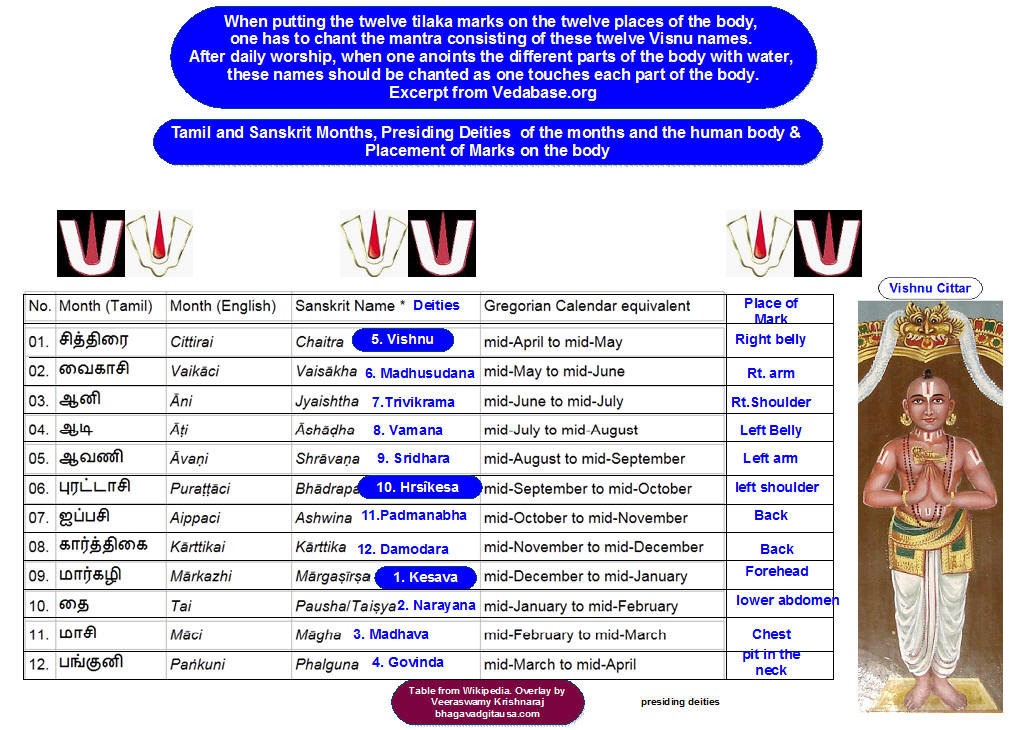
correspond to the months and reside in the body parts of the devotee-servitor.
That is why the devotee wears the SriVaishnava marks on twelve parts of the
body.
Vibhava is the state of
Avatara or incarnation of two types: AvEsa and Mukkiya avatara (the Empowered
and the Foremost incarnations). The Empowered are
Dattātreya and Parasurāma. The Mukkiya Avatārs are Rāma and
Krishna.
Anataryāmi is the life of
all and the Light of the individual soul, abiding in the spiritual heart of the
individual.
Archa form is
Bhagava's assumption of a form that is desired and worshipped
by his servitor-devotee. These forms are many, resident in the temples
for the Dharsan of the devotees.
Here is what Poygai Alvar says about Antaryāmi (அந்தர்யாமி
= the Inner Regulator or Controller). அந்தர்யாமித்துவம்
antar-yāmittu- vam, n. < antar-yāmitvam.
Manifestation of Viṣṇu as being immanent in the universe and governing
it, one of five tirumāl-nilai; திருமால்.
2125:
தமர் உகந்தது எவ்
உருவம் அவ் உருவம்
தானே;
தமர் உகந்தது எப் பேர் மற்று
அப்
பேர்; தமர்
உகந்து
எவ் வண்ணம்
சிந்தித்து
இமையாது இருப்பரே,
அவ் வண்ணம்
அழியான் ஆம். 44
The Lord assumes
the form desired by the servitor-devotee. He takes the name, desired and
addressed by them. He takes the Form in which they meditate Him, constantly. He
is our Chakrapāni (சக்கரபாணி
= cakkara-pāṇi
= Viṣṇu, as holding the discus in His hand).
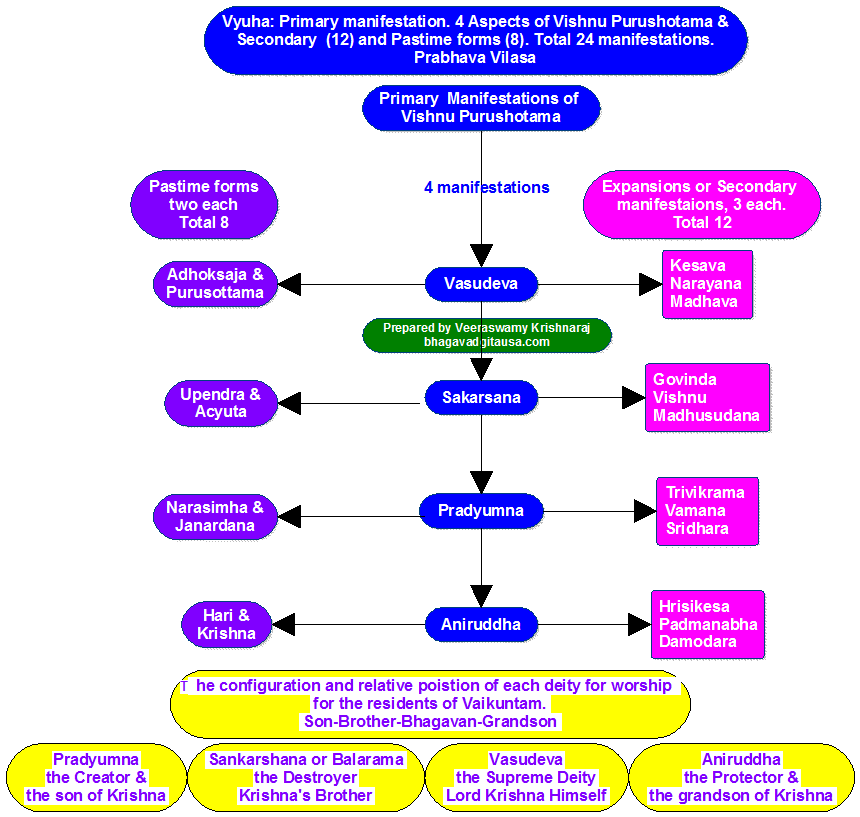
Vyuha: There are four primary divisions (= Creation,
Maintenance, Destruction and Grace = படைப்பு, காப்பு, அழிப்பு, அருள்) presided over by
Vāsudeva, Sańkarṣaṇa, Pradyumna and Aniruddha and two secondary divisions of each amounting to 12 divisions in
all. Vāsudeva is the first
one giving rise to the three linear emanations. Vāsudeva is
paramatma; Sańkarṣaṇa
is the repository of all Jīvas.
In the destruction of the world, He manifests as Rudra, Adharma, Sarpa,
Yama and the demons. Pradyumna is mind,
intellect (and the senses). Aniruddha is
Ahaṇkāra. Vāsudeva is the material cause of the
universe, though the distal three entities are not material.
EXCERPT FROM VEDABASE.ORG
Vāsudeva expansions are Keśava, Nārāyaṇa and Mādhava. The
expansions of Sańkarṣaṇa are Govinda, Viṣṇu and Madhusūdana. This Govinda is different
from the original Govinda, for He is not
the son of Mahārāja Nanda. The
expansions of Pradyumna are Trivikrama, Vāmana and Śrīdhara. The expansions of Aniruddha are Hṛṣīkeśa, Padmanābha and Dāmodara.
"These twelve are the predominating
Deities of the twelve months. Keśava is the
predominating Deity of Agrahāyana, and Nārāyaṇa is the predominating Deity of Pauṣa. "The
predominating Deity of the month of Māgha is Mādhava, and the
predominating Deity of the month of Phālguna is Govinda. Viṣṇu is the
predominating Deity of Caitra, and Madhusūdana is the predominating Deity of Vaiśākha. "In the month of Jyaiṣṭha, the predominating Deity is Trivikrama. In Āṣāḍha
the Deity is Vāmana, in Śrāvaṇa the Deity is Śrīdhara, and in Bhādra the Deity is Hṛṣīkeśa. "In the
month of Āśvina, the predominating Deity is Padmanābha, and in Kārttika it is Dāmodara. This Dāmodara is different from Rādhā-Dāmodara, the son of Nanda Mahārāja in Vṛndāvana.
"When putting the twelve tilaka marks on the
twelve places of the body, one has to chant the mantra consisting of
these twelve Viṣṇu names. After
daily worship, when one anoints the different parts of the body with water,
these names should be chanted as one touches each part
of the body.
"When one marks the forehead with tilaka, he must remember Keśava. When one marks the lower abdomen, he must remember Nārāyaṇa. For the chest, one should remember Mādhava, and when marking the hollow of the neck one should remember Govinda. Lord Viṣṇu should be remembered while marking the right side of the belly, and Madhusūdana should be remembered when marking the right arm. Trivikrama should be remembered when marking the right shoulder, and Vāmana should be remembered when marking the left side of the belly. Śrīdhara should be remembered while marking the left arm, and Hṛṣīkeśa
should
be remembered when marking the left shoulder. Padmanābha and Dāmodara should be remembered when marking the
back."
From Vāsudeva, Sańkarṣaṇa, Pradyumna and Aniruddha, there are eight additional pastime
expansions. O Sanātana, please hear Me as I mention Their names. The eight pastime expansions are
Puruṣottama, Acyuta, Nṛsiḿha, Janārdana, Hari, Kṛṣṇa, Adhokṣaja and Upendra. Of these eight
expansions, two are pastime forms of Vāsudeva. Their names are Adhokṣaja and Puruṣottama. The two pastime forms of Sańkarṣaṇa are Upendra and Acyuta. The pastime
forms of Pradyumna are Nṛsiḿha and Janārdana, and the pastime forms of Aniruddha are Hari and Kṛṣṇa.'
All these twenty-four forms constitute the chief prābhava-vilāsa pastime forms of the Lord. They are named differently according to the position of the weapons in Their hands. Of all these, the forms that differ in dress and features are distinguished as vaibhava-vilāsa. Of Them, Padmanābha, Trivikrama, Nṛsiḿha, Vāmana, Hari, Kṛṣṇa and so on all have different bodily features. Vāsudeva and the three others are direct prābhava pastime forms of Lord Kṛṣṇa. Of these quadruple forms, the pastime expansions are twenty in number. All these forms preside over different Vaikuṇṭha planets in the spiritual world, beginning from the east in consecutive order. In each of the eight directions, there are three different forms. Although They all have Their residences eternally in the spiritual sky, some of Them are situated within the material universes. There is an eternal residence of Nārāyaṇa in the spiritual sky. In the upper portion of the spiritual sky is a planet known as Kṛṣṇaloka, which is filled with all opulences. The planet of Kṛṣṇaloka is divided into three sections — Gokula, Mathurā and Dvārakā. Lord Keśava eternally resides at Mathurā, and Lord Puruṣottama, known by the name Jagannātha, eternally resides at Nīlācala. At Prayāga, the Lord is situated as Bindu Mādhava, and at Mandāra-parvata, the Lord is known as Madhusūdana. Vāsudeva, Padmanābha and Janārdana reside at Ānandāraṇya. At Viṣṇu-kāñcī
there is
Lord Viṣṇu, at Māyāpur Lord Hari, and throughout
the universe a variety of other forms.
All of these forms are mūrti forms, and They are worshiped in the temples. Their names are Keśava at Mathurā, Puruṣottama or Jagannātha at Nīlācala, Śrī Bindu Mādhava at Prayāga, Madhusūdana at Mandāra, and Vāsudeva, Padmanābha and Janārdana at Ānandāraṇya, which is
situated in Kerala, South India. At Viṣṇu-kāñcī is Lord
Varadarāja, and Hari is situated at
Māyāpur, Lord Caitanya's birth site. Thus in
different places throughout the universe there are various Deities in temples
bestowing Their causeless mercy upon the devotees. All
these Deity forms are nondifferent from the mūrtis in the spiritual world
of the Vaikuṇṭhas. Although the arcā-mūrti, the
worshipable Deity form of the Lord, appears to be made of material elements, it
is as good as the spiritual forms found in the spiritual
Vaikuṇṭhalokas. The Deity in the temple, however, is visible to the
material eyes of the devotee. It is not possible for one in material,
conditioned life to see the spiritual form of the Lord. To bestow causeless
mercy upon us, the Lord appears as the arcā-mūrti so that we can
see Him. It is forbidden to consider the arcā-mūrti to be made of
stone or wood.
it is
said: No one should consider the Deity in the temple to be made
of stone or wood, nor should one consider the spiritual master an ordinary
human being. No one should consider a Vaiṣṇava to belong to a particular caste or creed, and
no one should consider caraṇāmṛta or Ganges water to be like
ordinary water. Nor should anyone consider the Hare Kṛṣṇa mahā-mantra to be a
material vibration. All these expansions of Kṛṣṇa in the material
world are simply demonstrations of the Lord's mercy and willingness to give
facility to His devotees who are engaged in His devotional service within the
material world.
These 12 sub-Vyuha forms are on the limbs of a Vaishnava devotee, who thus have applied the ThirunAmam on 12 places of the body. See the chart.
presiding deities = TILAKA23.jpg
vadaka1.gif
Sri,
the Consort of Vishnu is integral part of Isvara Tattva. She is all-pervasive like Bhagavan. They are the Father and the Mother.
She is the Mediator between devotee and Bhagavan and also
the Giver of Grace. Observation of Parabhakti is the path to Tirumakal (திருமகள் = Lakshmi as
the Mother). Observation of Parabhakti entails seeking Piraatti (பிராட்டி) as the
Mediator and surrender (சரணம் = saranam) of
both of them. The Mother is next to Bhagavan in receiving the worship.
Itham: இதம். Itham is the
dual path to Bhagavan: The Path of Bhakti and Pirapatti (பிரபத்தி = சரணாகதி = Saranagati). Both
Devotion and taking Refuge are essential; one without the other is incomplete.
Bhakti:
is the pinnacle of love. It is the Great love towards Bhagavan. It is a firm
belief in Him. Bhakti is capable of leading one to Bhagavan.
Bhakti
has eight parts or Angas.
இயமம், நியமம், ஆதனம், பிராணா
யாமம், பிரத்தியாகாரம், தாரணை, தியானம், சமாதி are the eight
Angas.
இயமம்: Yama. Abstention
from lying, killing, theft, lust, covetousness; one of the elements of aṣṭāṅka-
yōkam.
நியமம்: Niyama: Self-control.
ஆதனம்: Asana. Posture.
பிராணாயாமம்: Pranayama. Regulation of breath.
பிரத்தியாகாரம். Pratiyakara.
Withdrawal of one's senses from external objects.
தாரணை. Dharana.
Forms of meditation
சமாதி. Samadhi.
Intense contemplation of God, identifying oneself with Him.
These
eight Angas help the aspirant become pure so he can approach and experience
Bhagavan. Some practitioners perform some impossible acts like levitation
with Mantras and Tantras. Thatis not Yoga. Siddha Suddhi with the removal of 'My, Mine'
is Yoga. For the mind to be pure, one should start with physical purity by
restraining one's senses.
Based on these eight Angas
of Bhakti path, Karma Yoga, Jñāna Yoga, and Bhakti Yoga
are the paths, which are progressive from the first to the third. At the end
are the Parabhakti, parajñānam, & Parmabhakti.
अभ्यासयोगयुक्तेन चेतसा नान्यगामिना ।
परमं पुरुषं दिव्यं याति पार्थानुचिन्तयन् ॥८- ८॥
8.8: He, who is steady in constant practice of
meditation on the Supreme Person with the mind not distracted otherwise and always
thinking of Me, reaches the Divine Me. - Bhagavadgita 8.8
Jñāna
Yogam = ஞானயோகம்.
Karma Yoga induces love to Bhagavan in the aspirant. In jnaana yoga, this love
leads the aspirant to meditation on Bhagavan. One has to attain freedom from desire
of fruits, before Jnaanam dawns on the aspirant and the aspirant feels and
experiences paripuranatvam (பரிபூரணத்துவம்
= fullness, pervasion, perfection). Jnaana Yoga is meditation with Bhagavan in
the mind and experiencing paripuranatvam.
Self-realization. As a result
of Jnaana yoga, Athmanubhavam (ஆத்மானுபவம் =
self-realization) is easier to obtain.
Since the aspirant feels oneness with all souls, he comes close to
Bhagavan. This Atmajnaani (ஆத்மஞானி) considers
service to God is paramount in his life. He knows that his soul is the body of
Bhagavan and his existence is for the purpose of Bhagavan (சேஷத்துவம்).
1)
Karma Yoga
2) Jñāna yoga
3)
Bhakti yoga
1)
Karma Yoga.
கர்மயோகம்: The acts correspond to
those of great souls. Of all aims in life, attaining Bhagavan is the highest
goal. All acts done with Bhagavan in mind are what take one to Him. The fruits
of these acts must be far from his mind.
Mere worship alone for its glory is not Yoga. It must be Nishkama Yogam,
completely dissociated with desire of fruits.
Sri Vivikananda says that acts that direct you to Bhagavan
are the duties; all others deviant acts dragging one to a lower plane are not
duties.
2) Jñāna
Yogam
ஞானயோகம். Karma Yoga
induces love to Bhagavan in the aspirant. In Jñāna yoga, this love leads
the aspirant to meditation on Bhagavan. One has to attain freedom from desire
of fruits, before Jñāna dawns on the aspirant and the aspirant feels and
experiences Paripūranatvam (பரிபூரணத்துவம் = fullness,
pervasion, perfection). Jñāna Yoga is meditation with Bhagavan in the mind
and experiencing Paripūranatvam. Because of Jñāna Yoga, Atmānubhavam (ஆத்மானுபவம் = self-realization) is
easier to obtain. Since the aspirant
feels oneness with all souls, he comes close to Bhagavan. This Atmajñāni (ஆத்மஞானி) considers service to God
is paramount in his life. He knows that his soul is the body of Bhagavan and
his existence is for the purpose of Bhagavan (śeṣatvam
= சேஷத்துவம்).
3) Bhakti Yogam. பக்தியோகம். Karma and Jñāna Yogas and the attainment
of Atma-Darśana (ஆத்மதரிசனம் = Soul's perception of itself,
self-realization) serve as the preliminary step
towards Bhakti Yoga. Atma-anubhavam (One's own self-realization) is the step
towards Universal Consciousness or realization of Bhagavan Himself. Parabhakti, Parajaanam and Paramabhakti are identifying with Bhagavan and serve as the instruments
in the pursuit of oneness with Bhagavan and Bhagavat Darśana (Vision, Perception or
Realization of Bhagavan). Enjoyment at union with Bhagavan and grief at separation
from Him constitute Parabhakti (பரமபத்தி). Emperuman's
Darisanam (எம்பெருமான் தரிசனம் = Vision of
Bhagavan) is Parajñānam (பரஞானம்).
Definitions according to Tamil Lexicon, Madras
University
பரபத்தி: Parabhakti. The first stage of devotion in which a devotee perceives the
Supreme Being by his spiritual vision.
பரஞானம்:
Parajñānam. The second and intermediate stage of
devotion in which a devotee gains intimate knowledge of the Supreme Being.
பரமபத்தி: Paramapakti.The third and
highest stage of devotion in which a devotee does not brook the slightest
separation from the Supreme Being.
Saraṇāgati: சரணாகதி. Taking shelter, seeking refuge. That
there is no way in life other than God Himself is firm faith of the devotee,
who seeks refuge at the feet of Bhagavan: That is Saranagati, which goes by
several terms: ParaSamarppaṇam, Paraniyāsam,Upaya-anuṣtānam,
pirapatti (பரசமர்ப்பணம், பரநியாசம், உபயானுஷ்டானம், பிரபத்தி).
Saranam (சரண்) indicates the feet of the Lord. There is no
recourse other than His feet.
Kulasekhara Alvar says in his verse 688
Divyaprapandham the following: தருதுயரம் தடாயேல் உன் சரண் அல்லால் சரணில்லை (There is no
refuge from sorrow other than your feet.).
Parasamarppaṇam (பரமசமர்ப்பணம்) is getting engaged in acts favored by Bhagavan, avoiding
earthly pleasures, delegating to Bhagavan all responsibilities and living a
life of dedication.
Paraniyāsam (பரநியாசம்) is shifting or placing one's
burden upon one's guru or god.
Upayānushtānam
(உபயானுஷ்டானம்) means second path. It is
complementary pathway along with the Bakti Yogas.
பிரபத்தி pirapatti. n. < pra-patti.
Taking refuge, as in God. Pirapatti also means
superior or special path. This special path is designed by
Bhagavan for the disadvantaged devotees, who are incapable or
disqualified from other paths and who for lack of no other recourse, take
refuge at His feet. Bhgavan in Bhagavadgita (4:11)
says, "O Partha, whoever
takes whatever path to reach me, I reciprocate in like manner. Men follow all
kinds of paths leading to Me."
Bhakti, a ladder made of love to Bhagavan, establishes a
connection between earth and Bhagavan's abode. It is an elusive path for most
of us. Bhakti Māṁrga is like a bridge made
of hair spanning over a river of conflagration. It is not an easy path for the
soul immersed in spirtual ignorance, who pines for
Moksa. Sastras advocate Saranagati for all souls to attain Moksa.
Bhagavan
Krishna says in Bhagavadgita 18:66:
|
18.66: Abandoning all duties, surrender unto Me only. I shall deliver you from all sins. Do not lament. चरम स्लोक = Carama Sloka = final Slokam सर्वधर्मान्परित्यज्य मामेकं
शरणं व्रज । अहं त्वां
सर्वपापेभ्यो
मोक्षयिष्यामि मा शुचः
॥१८- ६६॥ sarva-dharmān
parityajya mām ekam śaraṇam vraja |
முமுட்சு mumuṭcu , n. < mumukṣu.
1. One who is eager for salvation. Mumutsu is the Chetanam (embodied soul)
desirous of attaining God. Mumutsu takes the path of Prapatti to attain his
goal.
The
makeup of Saranāgatan (Prapannan) consists of incapability to perform the
likes of Karma Yoga; inability to delve into Saastras; feeling left out of
Bhakti path and regretting his inability; and intolerance of delay in attaining
Moksa. Prapannan has one or more of these disabilities.
The greatness of Saranagati: The likes of Karma Yoga demand a thorough knowledge
of Sastras and observation of all injunctions. Knowing the organic connection
between Jivas and Bhagavan is adequate for the surrendering Prapannan. Other
duties and demands are not in the forefront.
Saranagati
does not have any impediments to progress such as Varnasrama Dharma; only the
twice-borns can observe the Yogas.
Atma-Darsnam is available only after successful completion of Karma and
Jñāna Yogas. Saranagati, unlike these difficult
paths, is available to all aspirants irrespective of their Jāti or sect.
Parabhakti is capable of yielding Parajñānam and Paramabhakti.
Bhakti
path is difficult to observe for ordinary people. Prapatti is easy to observe
for all those with complete faith. The followers of Bhakti path have to eat all
the fruits of Punyam and Pāpam. Bhagavan removes all Karmas in the
Pirapannan (= பிரபன்னன் = He who accepts God as his sole refuge) and offers
the fruit of Salvation immediately. Prapatti
has no limitation from place, time, mode, qualification and other restrictive
conditions.
Bhakti path entails a continuous dedication to and observation of injunctions without any imperfections. Ashtanga Yogam is a must in all such efforts. Saranagatan has to make once in a lifetime total, unconditional, irrevocable surrender to Bhagavan and dispense with all rites and rituals.
The follower of Bhakti path has the karmic
compulsion to take births repeatedly. Saranagatan does not take another birth.
He enjoys the parānubhavam (பரமானுபவம் = Supreme Bliss) continuously.
Prapatti: The main Angi or principal resolution is Atma-niksepa (Atma Samarpanam = Soul dedication, surrender to God for protection). The other five are Angas, secondary resolutions of Prapatti based on Atma Samarpanam. Saranagati is Prapatti in intense form as practiced by Alvars.
Angi = Primary limb. Anga = secondary limb.
ஆத்மநிவேதனம் ātma-nivētaṇam = Atma Niksepa = Atma Samarpanam , n. < id. +. Self-dedication, offering oneself; தன்னை அர்ப்பணஞ்செய்கை.
Prapatti is like a tree. The main trunk is Atma Samarpanam, soul dedication. The others are the branches of the trunk. Without the Main Trunk of Atma Samarpanam, the five branches do not exist. see the presentation of diagram as a pentagon-star.
1) Ānukūlya-Saṅkalpa = God-pleasing acts. = இறைவனுக்கு என்றும் அனுகூலமாய் இருக்கும் உறுதி. 2) Prātikūlya-Varjana = avoidance of God-displeasing acts.= இறைவனுக்கு உகவாத செயல்களில் ஈடுபடாதிருத்தல். 3) Kārpaṇya = Humility from helplessness to resort to other means of salvation. உபாயம் இல்லாத எளிமை. 5) Mahā-viśvāsa = Great Faith in God. பெருமானிடம் முழுமையான நம்பிக்கை. 5) Goptṛatva-Varaṇa
= Request God for protection.
இறைவனிடம் காத்திடும்படி கோரும் நிலை.
6) Main Trunk: Ātmanikṣepa
= Soul dedication, surrender to God for protection. தன்னை இறைவன் திருவடிகளில் ஒப்படைத்துக் கொள்ளல். The last one is the Angi or principal resolution; the other (first) five are Anga, secondary resolutions of Prapatti. Saranagati is Prapatti in intense form as practiced by Alvars. Tamil text excerpts from sgtprabhandam.pdf Sadagopan.org.
Saranagati are of four kinds:
1) SuvaNishta சுவநிஷ்டை
2) Ukti Nishta உத்திநிஷ்டை
3) Acharya Nishta ஆசாரியநிஷ்டை
4) BhAgavada Nishta பாகவதநிஷ்டை
Nishta
= 1. Abiding in firm meditation; 2. Meditation. 3. Observance of religious
duties and vows.
Ukti = action
done as told; Suva = Self
direction without outside help; Acharya
= Guru; Bhāgavata = Great devotee of
Vishnu. Many use the terms Saranagati and prapatti interchangeably.
1) Suva Nishta: This is self-surrender by pure souls
without outside help from Guru or Acharya. One example is Ramanujacharya.
These are highly evolved souls.
2)
Ukti Nishta:
The qualified aspirant receives a mantra from the Guru and surrenders to
Bhagavan.
3)
Acharya Nishta: Here Surrender is obtained
through Acharya who worships Bhagavan by chanting Mantra on behalf of the
aspirant.
4) Bhagavata Nishta: Tried and true devotees of
Bhagavan can introduce the aspirant to Bhagavan and implore Saranagata Raksa
(surrender protection) on behalf of the aspirant.
In
Saranagati, Bhagavan does not discriminate based on one's fitness or lack thereof. Anyone with the conviction of surrender and
observation of its tenets is admissible. Of all forms, Bhagavan in His Archa
Avataram for worship is the worthy one for the Saranagatan. Azvars worshipped Archittan (= அர்ச்சிதன் = One who is worshipped = Bhagavan in His
Archaavatara form (image worship).
Observation of Prapatti obtains the
ultimate fruit of Purushartham, Moksa. Man's creation is for the express
purpose of attaining Moksa. Realization of the nature of the three principles
of Isvara, Cit and Acit will release one from the bonds of Samsara. The
surrenderer-deovotee obtains happiness in this world and attains Vaikuntam upon
death.
Arciraathi Marga to Vaikuntam.
At
the time of departure from the body, Jiva exits via the Brahma Nadi, receives
welcome from Agni and such Celestials and takes the path shown by them. In its
progress along the path, Jiva lets go of the Subtle Body, wades across Vraja
River, sheds all impurities and acquires a body made of Suddha-Sattvam as
granted by the Grace of Bhagavan. It enters the Divine Hall welcomed with
felicitations.
In
the Mandapam, the Suddha-Sattva Jiva worships the Acharya, later sees Bhagavan
with Divine SorUpam and enjoys Paramanubhavam.
The Jiva gets the vision of the Lord, exults, experiences and immerses in the ocean of Bliss. The Jiva joins Nityasuris, Muktas and others, sing songs of praise of Bhagavan and Azvar's verses and remains in ecstasy. Vaishnava Vedantam calls this ParipUrna Brahmaanubhavam and Parama Purushartam.
After Mukti, Prapannan acquires the attributes of the Lord, joins at the feet of Bhagavan, Nityasuris like Antanta, Garuda, Vishvaksena and the like, and enters the ocean of Bliss. He never returns from there. Vaikuntam is the ultima Thule. No Return means the Jiva, though born on this earth, always enjoys Paripurna Brahmanubhavam (Complete experience and enjoyment of Bhagavan).
There are three SriVaishnava Mantras.
|
குலம்
தரும்; செல்வம் தந்திடும்; அடியார் |
|
படுதுயர்
ஆயின
எல்லாம் |
|
நிலம் தரும்
செய்யும்; நீள்விசும்பு
அருளும்; |
|
அருளொடு
பெருநிலம்
அளிக்கும்; |
|
வலம்
தரும்;
மற்றும்
தந்திடும்; பெற்ற |
|
தாயினும்
ஆயின
செய்யும்; |
|
நலம்
தரும்
சொல்லை நான்
கண்டுகொண்டேன் |
|
நாராயணா
என்னும்
நாமம்.
956 Divyaprabhandam |
|
It gives greatness; It gives
wealth; it flattens all miseries; it gives the home of liberation; it gives
Bhagavan's Grace; It enables you to perform your Dharma; it gives you the
strength to realize Him; It does more things than a begetting mother does; It
gives many good things; I found that Narayana Mantra. Translation by
Veeraswamy Krisnaraj |
Dvayam: For the salvation of
the Jivatmas, responding to the request of Tirumagal (திருமகள்), Bhagavan composed two-line Mantra.
ஸ்ரீமந் நாராயண சரணௌ சரணம் ப்ரபத்யே
ஸ்ரீமதே நாராயணாய நம:
Sriman Nārāyana charaṇau saranam prapadyē
Srimathē Nārāyanāya nama:
The
first line: I surrender and take refuge
at the two feet of Bhagavan in whom abides Sri.
The
second line: Let me perform Kainkaryam (service) to Sri-associated Narayana.
Charama Sloka: Charama Slokam
सर्वधर्मान्परित्यज्य मामेकं
शरणं व्रज ।
अहं
त्वां सर्वपापेभ्यो
मोक्षयिष्यामि मा
शुचः ॥18.66॥
Sarva-dharmān
parityajya mām ekam śaraṇaṁ vraja
Aham tvāṁ
sarva-pāpebhyo mokşayişyāmi
mā śucaḥ
18.66:
Abandoning all duties, surrender unto Me only. I shall deliver you from all sins. Do not lament
(grieve).
Reference
1) Culakam - cupped hand = nutshell. Tattva traya in a Nutshell
2) Anātma Nirūpana Adhikāra = Chapter on the
investigation of non-soul
3) Sri Desika Prabhandam
4) Panchadasi
5) SGTVedantaDesican.pdf Sadagopan.org. Part of the Text
reflects translation from this PDF Document.