Bhagavadgita Pages, Chapters 1 to 18
BG01 BG02 BG03 BG04 BG05 BG06 BG07 BG08 BG09 BG10 BG11 BG12 BG13 BG14 BG15 BG16 BG17 BG18
www.bhagavadgitausa.com
V.Krishnaraj
You may post missives on this board:
http://www.bhagavadgitausa.com/cgi/discus/discus.pl
http://www.bhagavadgitausa.com
09/01/2014
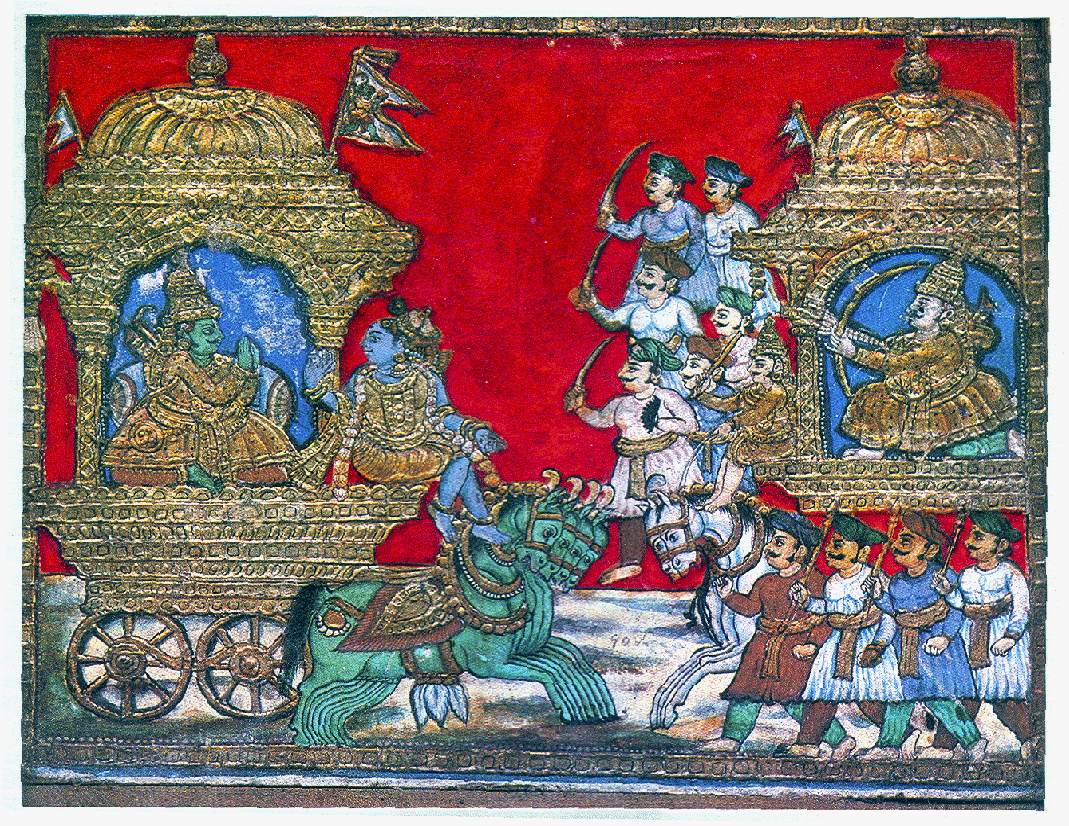
Tanjore painting of Mahabharata war
PREFACE
Bhagavad-Gita is based on the inspired wisdom found in the Upanishads. Upa = near, ni=down, sad=sit. The teacher taught Upanishads to the pupils sitting down near him. Another explanation. Upa + ni + shadah. Shadah = (the Jnanam or knowledge that renders) the doubts, miseries, and karmic merits and demerits into dust.
The Hebrew word Yeshiva also means sitting (Sad in Sanskrit). Yeshiva is a Jewish school of religious learning.
BG is part of Mahabharata, and Vyasa was its author. It is claimed by the West that Vyasa was a generic name for an author, compiler, (editor) and or "oral-aural-memory-scribe / writer / publisher". The West surmises there were many Vyasas. ...Biardeau has remarked, "even the most staunch supporters of Western textual criticism in India would never dream of 'critically editing the Vedas. .., since they are absolutely authoritative as they are."
Robert Louis Stevenson writes
To learn aright from any teacher, we must first of all , like a historical artist, think ourselves into sympathy with his position. If a saying is hard to understand, it is because we are thinking of something else. There is always a ruling spirit behind the code of rules, an attitude, a relation, a point of the compass, in virtue of which we conform or dissent.
Translations:
I read many translations of the Bhagavadgita; most of the translations by the western authors were consistently inaccurate. Purports and commentaries by Ramanujacharya and Sankaracharya (with English translations by Indian scholars) are the most precious and accurate. What I generally find in Indian authors is that their writings demonstrate cultural intimacy and scholarship and promote Bhakti (devotion) in the reader. What the West writes about Hinduism is generally a tiresome impersonal exegesis of uncertain scholarship and a hostile stance to a culture they don't understand; a watermark of cultural antipathy runs between the lines. Of course there are some significant exceptions. Take for instance Sir John Woodroffe (who with the help of Ghosh) authored many books on Hinduism, Saktas, The Serpent Power, Tantrics etc.
One example:
18.66: Sarama slokam
Sarva-dharmān parityajya mām ekam saranam vraja:
aham tvā sarva-pāpebhyo moksayisyāmi mā sucah.
Sankaracharya:translation into English from Sanskrit.
Abandoning all forms of rites and duties, take refuge in Me alone. I shall free you from all sins. (Therefore) do not grieve.
Sarva-Dharman: all forms of rites and duties: Here the word Dharma (righteousness) includes adharma (unrighteousness) as well; for what is intended is total renunciation of all actions, as enjoined in the Vedic and Smrit texts like, 'one who has not desisted from bad actions. Give up religion and irreligion.
religion = ritual observance of the faith.
Ramanujacharya: translation into English from Sanskrit.
Completely abandoning all Dharmas, seek Me alone for refuge. I will release you from all sins. Grieve not.
Relinquishing Dharma: the complete relinquishment of the sense of agency, possessiveness, fruits etc., in the practicing of Karma, Jnana, and Bhakti Yogas in the way instructed, and the realizing of Me as the agent, object of worship, the means and the end.
Radhakrishnan:
Abandoning all duties, come to Me alone for shelter. Be not grieved, for I shall release thee from all evils.
Dharma: ritual and ethical duties, sacred duties of reverence to teachers, duties to ancestors or Pitrs, preservation of caste or Varna, the law of right action.
Swami Prabhupada:
Abandon all varieties of religion and just surrender unto Me. I shall deliver you from all sinful reaction. Do not fear.
Sarva-dharmān parityajya: Give up all the processes that have been explained to Arjuna in the past chapters. Here Prabhupada explains what he thinks what Dharma or religion is.
Mahatma Gandhi:
Abandon all duties and come to Me, the only refuge. I will release thee from all sins, grieve not.
Krishnaraj
Abandoning all duties, surrender unto Me only. I shall deliver you from
all sins.
R.C.Zaehner:
Give up all things of law, turn to Me, your only refuge, (for) I will deliver you from all evils; have no care.
Giving up all things of law is a bad translation of Sarva-dharman parityajya, and a poor choice of words. Dharma is not law, but duties and rites. Law varies from land to land; duties and rites stay the same. Dharma is broken everyday without fear of prosecution, because it is beyond the purview of enacted law.
Law = the principles and regulations established in a community by some authority and applicable to its people; law is secular and has nothing to do with religion in most countries with some significant exceptions.
Classical Hindu Mythology by Cornelia Dimmit & J.A. van Buitenen says the following about Avatars on page 63-64. As with epithets of Vishnu, the many avataras in the Puranas may well have been originally separate deities, each with its own deeds, devotees and cult, who in the course of time became subsumed under a single god. The animal descents in the Puranas may represent remnants of animal worship, or they may simply be the fruits of religious imagination. The same might be said for the semi-human avataras of Vamana the Dwarf, and Narasimha, the Man-Lion...heroes Rama and Krishna stand out as potentially historical figures first transformed by legend into deities, then later subsumed under the personality of Vishnu. (A dwarf is not semi-human as Dimmit characterizes. Her characterization of Vamana is Dim Wit. Dwarf is a human being who has the intellect of humankind. What a colossal misperception!) It is likely that Krishna was first a hero, advanced to become a minor deity, and finally absorbed into godhead of the eternal and supreme Lord of the universe, Vishnu.
The view from the West
The theme of Gita declares that the ancient faith in sacrifice as the sole means of liberation is no longer valid. Only deeds springing from altruistic motives (NiskAma Karma), and devotion (bhakti) to Isvara and faith in his grace (prasAda) can lead to realization of Brahman.
The Gita confirms the definition of avatAra as an incarnation of the Supreme Being, which occurs from age to age in response to a particular need or crisis.
Opinions vary about the date of the original composition of the Gita, some placing it in or about the fourth century B.C., others in the third or second centuries. Whichever of these is correct, the work in its present form indicates considerable revision. Some are of the opinion that Bhagavad Gita predates the composition of Mahabharata, and Gita was an interpolation. Zaehner says that with each re-reading it appeared to him to be a far more unitary work than most modern scholars had been prepared to concede.
Of the thirty-four manuscripts used to compile the critical edition of the Mahabharata, two omit the Bhagavadgita entirely. On sound text-critical grounds all stanzas above 700 are, in all manuscripts unquestionably secondary insertions.
The Mahabharata was originally a secular work in which a number of sacred works were interpolated. Bhagavadgita is the earliest exposition of the Bhakti system of EkAntika Dharma. --Harper's Dictionary of Hinduism, page 40.
Aldous Huxley wrote: “The Bhagavad-Gita is the most systematic statement of spiritual evolution of endowing value to mankind. It is one of the most clear and comprehensive summaries of perennial philosophy ever revealed; hence its enduring value is subject not only to India but to all of humanity.”
I read the Ph.D thesis manuscript of Professor Patricia Yvonne Mumme, The College of Wooster, Wooster, Ohio 44691. It is treasure-trove of information, every Vaishnava should have. The book "The Srivaisnava Theological Dispute: Manavalamamuni and Vedanta Deskia" is being reprinted and is forthcoming in 2008 from Navabharat Enterprises in Bangalore, India. The book is authored by: Professor Patricia Yvonne Mumme, Ph.D, The College of Wooster, Wooster, Ohio 44691 USA.
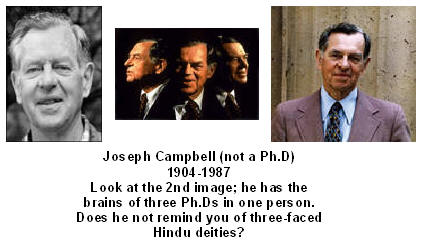 Joseph Campbell (03/26/1904 --
10/30/1987) was an American mythology professor, writer, and orator well-versed
in comparative mythology and comparative religion. He is the most authentic
erudite American professor in his field of study.
He wanted to study Sanskrit, modern art, and Medieval literature for his Ph.D;
his advisors did not support him. Then he followed his bliss. He did well
without the Ph.D appendage to his name. Here is a man who went after true
knowledge and not a Ph.D. His knowledge is so immense, ten of the Ivory
Tower Ph.Ds and professors cannot match him. He was a heavy weight in his
field and understood other religions and cultures very well. The light weights
of today with rare exceptions are a curse to their profession. He was a
professor at Sarah Lawrence college for 38 years from 1934 to 1972.
Joseph Campbell (03/26/1904 --
10/30/1987) was an American mythology professor, writer, and orator well-versed
in comparative mythology and comparative religion. He is the most authentic
erudite American professor in his field of study.
He wanted to study Sanskrit, modern art, and Medieval literature for his Ph.D;
his advisors did not support him. Then he followed his bliss. He did well
without the Ph.D appendage to his name. Here is a man who went after true
knowledge and not a Ph.D. His knowledge is so immense, ten of the Ivory
Tower Ph.Ds and professors cannot match him. He was a heavy weight in his
field and understood other religions and cultures very well. The light weights
of today with rare exceptions are a curse to their profession. He was a
professor at Sarah Lawrence college for 38 years from 1934 to 1972.
The following is an extract from Wikipedia.
Hinduism Today Magazine is a quarterly magazine published by the Himalayan Academy in Kapaa, Hawaii, USA. It is distributed throughout the United States and internationally, currently in 60 nations. Founded by Satguru Sivaya Subramuniyaswami in 1979, it is a public service of his monastic order to promote an understanding of the Hindu faith, culture, and traditions. Hinduism Today Magazine was launched in 1979 by Satguru Sivaya Subramuniyaswami (Gurudeva), published by his non-profit organization Himalayan Academy.
Specific goals of the magazine include:
- 1. To foster Hindu solidarity as a unity in diversity among all sects and lineages;
- 2. To inform and inspire Hindus worldwide and people interested in Hinduism;
- 3. To dispels myths, illusions and misinformation about Hinduism;
- 4. To protect, preserve and promote the sacred Vedas and the Hindu religion;
- 5. To nurture and monitor the ongoing spiritual Hindu renaissance;
- 6. To publish a resource for Hindu leaders and educators who promote Sanatana Dharma. [5]
As a highly objective magazine with such a diverse presentation of thought, its appeal extends far beyond the Hindu community, especially to those interested in its portrayal of Hindu culture, as well as the thought processes and sentiment used to convey this content.
India Abroad reports in its Feb 29, 2008 issue about the famous Jagannatha Temple in Puri which prevents entry of foreign-born Bhaktas (White Baktas), who have been Pujaris of the same deity in the West for many years. I have witnessed white Bhaktas or visitors sitting inside some temples were not allowed into the Sanctum Sanctorum. There are white Hindu priests in USA performing Hindu rituals in temples and homes. It is a welcome sign, affirming the universality of Sanatana Dharma, its native genius and willingness to embrace one and all.
In the West, there is no restriction of admission based on race, color, creed... into the Hindu temples.
While visiting Goa India, we were ejected unceremoniously from Basilica Bom Jesus by a caretaker. My wife's Bindi (Tilakam = ¾¢Ä¸õ, ¦À¡ðÎ ) on the forehead was the mark of abomination and the external marker of our Hindu faith in the eyes of the caretaker. We did not succeed when we confessed our love for Jesus Christ.
The following write-up is based on many published accounts.
American Universities and educational system are chock-full of errant information masquerading as teaching material on Hinduism. There is a campaign among concerned citizens to rectify this erroneous depiction of Hinduism in American schools, colleges and Ivory towers. My understanding from Sanskrit scholars of repute is that some Ivory Tower Religion Departments are mere dung heaps manned by bigots and pseudosanskritists whose vicarious scholarship (of Sanskrit) results in misinterpretation of Vedas, Upanishads and other Sacred Texts because of lack of intimate personal exposure to Sanskrit culture, cultural disaffection, unsecular credentials and interpretation from an alien cultural environment and mindset. One has to live, breath, and study Sanskrit among and from Indian Sanskrit Scholars in India to know the language and its subtleties. Sir John Woodroffe was one such Scholar. Others are mere shadows (with no substance).
The following is a depiction of sorry state of affairs in the so-called halls of higher learning in the US and the West.
The description of the following professor based in USA is collected from published material with my comments. The names have been withheld. She is a professor of Religion (Hinduism), a Big Kahuna in her field with double Ph.Ds, has written many books and lectured extensively on Hinduism. She is popular among her eager students and controversial in her pedestrian quips, quotes, lectures, writings, and acerbic comments on Bhagavad Gita. If it is not for her, there won't be many Ph.Ds with special interest in Hinduism. To that extent we should be grateful to her. She churns out many Ph.Ds like there is no tomorrow. Those Ph.Ds may have been fed pablum instead of pabulum (nutritious food) so much so they have been serving pablum to other Ph.D students in their capacity as department chairpersons. She made Hinduism popular among her students and the public, more as a perverse curiosity. Some Indians believe she is antithetical to or ignores and distorts the values, beliefs, achievements and glories of Sanatana Dharma. Some believe that her translations and interpretations lack Sanskrit Cultural suffusion and intimacy. There are Sanskritists who believe that her translations show lack of vitality, context, intimacy, native nuance, and scholarship (in Sanskrit). Some claim that her words contain more prurience than punditry. (Another professor, a purveyor of perversion of Pelvic Basin, sees a flaccid phallus in a proboscis and schnazzola, when he is face to face with Ganesa.) A newspaper attributes the following to her: “The Bhagavad Gita is not as nice a book as some Americans think,” the good professor informed her audience. “Throughout the Mahabharata ... Krishna goads human beings into all sorts of murderous and self-destructive behaviours such as war.... The Gita is a dishonest book ; it justifies war.” Prof. added for good measure : “I'm a pacifist. I don’t believe in ‘good’ wars.” (Philadelphia Inquirer, 19th November, 2000.) What depth, What insight, what incandescence! Such pedestrian profession comes from a professor with porcupine prickliness and interrupted intellect.
She misses the forest for the trees. Bhagavadgita is all about the human struggle against evil; it is a war in the field of mind, soul and body between evil and virtuous forces within oneself. She missed the message by a light year. The Harper's Dictionary of Hinduism says (page 157) "Kurksetra symbolizes the struggle to maintain right against the forces of evil." If a Religion dept Chairperson does not get the essence of this message, how could any student learn from this person? If she has any residual penchant for Bhagavad Gita, she should study the Sanskrit original Bhasya (Commentary) made by Ramanuja (1017-1137) and Sankaracharya (788-820 CE). Of course, they did not have Ph.D from the so-called prestigious university appended to their names. They were stalwart intellectuals with full command of Sanskrit. Likewise, William Shakespeare did not have a Ph.D appended to his name. The appended Ph.D does not mean anything; it is the mind and its content that matter. Her translations and comments, they claim, are not precise and contextual but display a vinegary word salad. She tends to forget to mention the contribution of Hindus in mathematics and numbers while talking about Yugas but is quick to comment on the futility of Indian cosmology, and the glory of Darwin's Theory of evolution. I wonder whose ancient cosmology is more precise than that of Hindus. Actually to the Hindu, the world was round when the rest of the world believed it was flat. It did not take a genius to say the world was round. The Hindu looked at the sun and the moon and made the connection and conclusion. The ancient Hindu Sacred Texts say that there are crores and crores (Crore = 10 million) of universes like ours. The rest of the world in ancient times had no concept of zero, a thousand, a crore, a billion or a trillion until Hindus taught them. Santana Dharma is too big, ancient, peaceful, secular, strong and overpowering in its concepts, practices and followers that one woman (Hello, she is NOT a Kali or Durga) however big her foreign (universities) credentials (Ph.Ds) are, cannot bring it down. She is not a Ph.D in religion and or Sanskrit from Benares Hindu University. What would you like to order in a restaurant: genuine Basmati rice and Indian Mangoes or imitation? Receiving Ph.D in Sanskrit and Hindu religion from a western university is not the same as from a reputable Indian University.
Don't forget you can buy degrees and Ph.Ds on line for a fee. People are in high places including academia with fake degrees or with degrees obtained in Ivory Towers just by having a famous last name, by making contributions, by paying fees, partying in the campus, submitting 'term papers from high-tech term-paper firms', having cozy relationship with department chairperson, creating nonexistent transcripts and doing everything under the sun without putting in an effort. Take elite college admissions. The NYTimes reports the following (01/15/08): The usual justification for legacy preferences is candidly cynical: they generate contributions from alumni. That crass bargain seems a poor substitute for the usual considerations in admissions decisions, like merit and diversity. But private universities are certainly entitled to trade money for principle. That preferences for the children of alumni were a relatively recent phenomenon, a result of anti-Semitism and xenophobia in the first part of the last century. Some conclusions: People with children gave more. Giving increased as the children of alumni who applied to the university neared 18. Giving dropped off after the admissions decision, and the decline was far greater when the child was rejected. Justice Clarence Thomas said the Constitution’s equal protection clause did not prohibit “unseemly legacy preferences” because they did not directly involve race.
Hello Hindus! Don't get upset with her. Don't forget she is making a living by talking about Hinduism; that pays her bills; I am glad and proud that Hinduism pays her bills and puts food on her table. Hinduism is her bread and butter. That much we are sure; to that extent she must in her mind be grateful. Sanatana Dharma does not believe in taking the food out of the mouth, which spills unfiltered toxic sewage of feigned scholarship in the form of words and phrases, however much one does not appreciate a person's distorted views.
A baker takes the dough, beats, slaps, kneads, rolls, dips, twists, ties it in a knot, dabs it in salt and bakes it to make a pretzel. That is what some academics do with the truth, submit a cockamamie thesis, and get a Ph.D for it from other incompetent department chairpersons. Perversion and prurience are the stock in trade in some instances. The real Truth is immutable. The sad truth is that articles on Hinduism in Encyclopedias are written by trusted but incompetent westerners. I recently pointed out to the most subscribed encyclopedia of our time with references about the erroneous information on Tenkalais and Vadakalais, most likely written by a westerner who has no knowledge of Tamil, its culture and tradition. The encyclopedia in a matter of a few weeks rewrote the article and presented the correct information in its online edition. Some of these professors write books out of unbound ego, perpetuate wrong information and teach rubbish to the yearning Ph.D students. Many of the Ph.Ds are the mental clones of these professors, who seek immortalization through their effete clones. They perpetuate and teach the same stereotypical hogwash to others.
Actually I thank her for her talks on Hinduism. Among the western audience there will be a worthy one or two who can see the Truth through the smoke and mirrors. All alleged acerbic comments will sink in in some of the listeners and thinkers in a benignly advantageous fashion so much so they will make a comparative assessment with their own faith. All the immediate reflexive snickers, giggles and belly laughs evaporate once the thinker makes an intelligent reflection. Some will be turned off; some will find the Truth. Hinduism is older than other's faith, has a rich culture, and outlived many invasions, turbulence, ostracism, conversions, and all other adverse events. It is actually alive and well, thriving, and kicking. If Sanatana Dharma (Hinduism) cannot withstand an attack from every quarter, it is not worth its salt and cannot be proud of its intrinsic value. Sanatana Dharma can take verbal, physical (Dot Busters), and unjust assaults from intellectual dwarfs with Ph.Ds and thrive as it has done for millenniums. These dwarfish Dot Busters armed with Ph.Ds, computers and privileged appointments inhabit the nooks and corners of the Ivory Towers, ambush the unsuspecting on their prowls in the classrooms and steal the impressionable minds.
Professor, I believe you are a Crypto Hindu; prove me wrong by not talking about Hinduism. Welcome in our midst. Say what you want without fear or favor; but don't forget to add some spice and flavor. Don't forget to do the following when you give the talk: Massage their ego, make them salivate on juicy tidbits, tickle their fancy and prurience, convince them that the true locus of their brain is in the pelvis or abdomen and not in the head, stir up their emotion, make them revile other religions, tell them they are the best and the brightest you ever spoke to. All this will get you an invitation before you leave the lecture hall. Laugh all the way to the bank. We count on your standup comedy and entertainment to attract and humor your audience. You are a better Hindu than some of us are. We belong to an all-inclusive Sanatana Dharma (Hinduism), which accommodates in its fold rats, bats, cats, dogs, atheists, theists, gnostics, agnostics, infidel, skeptic, Tantrics, Saktas and all imponderables. There is only one religion that treats all living creatures equally. Bhagavan says in Bhagavad-Gita the following: 5.18: A learned humble Brahmin, a cow, an elephant, a dog, and even a dog-eater are seen with an equal eye by a punditah (sage). In Hinduism you can hate God and still attain liberation. What other religion can say that with conviction and proof? Kamsa hated Krishna to the extreme and tried to kill Him many times; Krishna killed him and dispatched him to heaven because Kamsa died at the hands of God. Under the same circumstances, others would say, "go to Hell." 12/31/2007
Krishna is the central Supreme Persona in BG. Krishna descended on this earth in a human form, was not only divine but subjected himself to activities, limitations, trial and tribulations that humans are prone to, in the interest of humanity. Reciting the name of Krishna once brings benefits obtained by reciting the whole Sahasranama three times. Of all names, he likes to be called by the name of Govinda. All incarnations and names and forms of Vishnu are those of Krishna. One source (Brahma Samhita translation by Thakura Gosvami) tells that Krsi/Krs means Existence, Truth, Attractive and na means Bliss. Krishna = black.
View from the West continued
Krishna means black, while Arjuna means white; there is no racial significance in the names, just as English surname Black, and the German Schwartz have no racial connotation. It is by no means certain, as is usually assumed, that Krishna, the Pandavas, the Kauravas, and Jarasandha were Aryans, for evidence is gradually accumulating that a fairly developed culture and powerful non-Aryan kingdoms flourished in that part of India before the entry of the Aryans. Page 150 Harper's Dictionary of Hinduism.
Janmastami is the celebration of birth (Janma) of Krishna on the eighth day of the dark fortnight (Krishna Paksa) of the month of Bhadrapada (Aug-Sep). The number 8 has significance in that He is the 8th incarnation of Vishnu, and the 8th child of His mother Devaki. The devotees fast and keep a vigil until midnight, the hour of His birth in Mathura by the Yamuna River. He was ferried across Yamuna in a basket on the head by His father Vasudeva to escape the tyranny of His maternal uncle Kamsa.
Compare this to Moses, the son of Yochebed and Amram (Amram, Jacob's great-grandson married his aunt Yochebed) who, from fear of being discovered, was put in a bulrush basket and floated down the Nile under the watchful eyes of his sister Miriam. The baby was found in the Nile River by the bathing princess Bathya (or Merries) who took pity, adopted the baby and hired Yochebed to nurse the baby on the recommendation of Miriam. (God's miraculous ways of saving Moses). Miriam and Yochebed kept the secret.
BG is a treatise, which teaches man the means and the methods to attain spiritual knowledge, liberation and eventual union with Brahman as opposed to Faustian knowledge. It is a kind of home coming for the atman (self) after many travels through and sojourns in many bodies. It is as if the self caught in the physical body, burdened with unresolved karma, and yet pure and unblemished, is striving hard to attain liberation from the cycle of births and rebirths, until the time the self can go home to its origins, namely Brahman /Atman.
The View from the West
09/04/2006
Donald A Mackenzie in his book Myths and legends of India (Chapter 8 Page 138) offers an opinion. "the original narrative was greatly hampered by inserting long speeches and discussions regarding Brahmanic conceptions and beliefs. An excellent example of this process is afforded by the famous Bhagavad-gita, from which we have quoted in the previous chapter. The narrative of the first day's battle is interrupted to allow Krishna to expound the doctrines of the Vaishnava faith, with purpose to make converts to the cult of Vishnu."
If Mackenzie were alive to make an observation today he would say, "the Bhagavad Gita is the unwanted commercial interruption in the two-hour telecast of an interesting war movie." --Krishnaraj
What brilliance! Bravo Mackenzie! Mackenzie must have written his opinion during his happy hour of demented inebriation.--Krishnaraj
Siva says, "anyone who does not consider Vishnu as equal to Me is not My devotee." --Krishnaraj
Mackenzie contradicts himself by saying, "Vishnu and Shiva figure as great gods in the Mahabharata, and now and anon the other is given the first place."
If Siva is called a great god, Mack implies that Saivism receives equal treatment. That being so, where is the promotion of one cult over the other? (This is an example of Mackenzie's drooling words from a demented mind.)
Another westerner offers an interesting view. The invaders did not kill off all the Hindus because an average Hindu does not have a vicious bone in his body. On top of that, the Hindu thinks, believes, and says all foreigners (Mlecchas) are crypto-Hindus. There is nothing that Hinduism hasn't fathomed that we have in our religions (religion other than Hinduism). How threatening is it when a Hindu says Jesus Christ is an incarnation of Vishnu? Allah and Ram are one and the same with different names. How could you hate a fellow who says such endearing things?
Here is what Bhagavan says:
7.21: Whatsoever is the form of deity, a devotee desires to worship with faith, I make sure that his faith is steady (in that deity).
7.23: Finite and limited is the fruit gained by these men of small intelligence (small minds). The worshippers of gods go to those gods, but my devotees come to Me.
12.15: He by whom the world is not shuddered, who is not shuddered by the world, and who is free from delight, displeasure, fear, agitation, is also dear to Me.
Tanjore painting 19 depicts the conversation between Krishna and Arjuna. Go to http://www.geocities.com/Athens/Crete/3739/GODS/
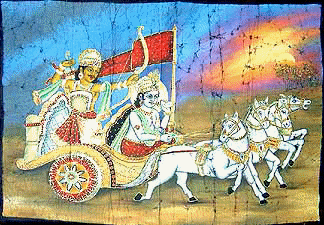
exoticindia.com
The Battlefield and Arjuna's depression
Kurukshetra War and Chennai connection
IT was a battle royal between Pandavas and Kauravas (Kurus). It was cousins against cousins. Pandu, the father of five Pandavas died leaving the kingdom to his half-brother Dhrtarastra, who had one hundred sons. When Dhrtarastra decided to give the kingdom - what is rightfully theirs -to Pandavas, Duryodhana, the eldest son of Dhrtarastra took the throne for himself by enticing Yudhisthira, the eldest of Pandavas, to a game of dice and stacking all odds against him. The Pandavas lost the kingdom in the game of dice, and were banished to the forest for twelve years. The last year - the thirteenth - was spent incognito according to the agreement. Upon their return, Duryodhana wouldn't even give a land the size of a postage stamp - five villages. Krishna tried to bring the cousins together in vain and offered the warring factions to choose either Him or his military machine Krishna, the head of the Yadhava clan joined the Pandavas upon their choice and request, while the Kauravas opted for Krishna's army. Krishna refused to bear arms against the Kurus and made a promise to that effect. Bhishma the grandfather of the Kurus who wanted Krishna to break his vow and enter the war with weapons, sent rains of arrows on Krishna which drew blood and scarred his face for ever. Krishna stood there, took the assault and kept his promise. There is a temple in Chennai that celebrates Krishna in the form of Parthasarathy, meaning Partha's Charioteer. Partha =Arjuna.; Sārathy = charioteer. The Parthasarathy Temple (8th Century) in Chennai shows Krishna with scars on his face. The legend says that Krishna, after the Kurushetra war, came to a pond replete with Alli flowers. That site became the holy place and temple, Tiruvallikeni, which was corrupted to Triplicane by the British. The Parthasarathy temple was built by a Pallava king.
Krishna became the charioteer of Arjuna, one of the Pandavas. The war was fought in Kuruksetra. In modern times the area would have been in the vicinity of Delhi.
AUM is portrayed well in Krishna-Arjuna chariot, which is of the form of Pranavam. A is Krishna, Ma is Arjuna, everything else is U. A is in front; M is behind A. Paramatma the 26th Tattva is in front of the 25th Tattva, Arjuna the Jivatma.
Krishna, upon request from Arjuna, drove the chariot and stationed it between the two armies. Arjuna took one look at the armies and immediately became disheartened. He saw his friends, relatives, and teachers on either side. He couldn't get himself to kill his near and dear just for the sake of gaining a kingdom or a piece of land. He would rather die in the hands of Kurus ( Kauravas) than to kill any of them. His body, mind, and heart sank in deep depression. He lost his will to kill his enemies.
Comments:
Throughout the battle between the Pandavas and Kauravas, Sanjaya, a charioteer, a friend and secretary was acting as a reporter to the blind king Dhrtarastra, the father of Kauravas, on the battlefield happenings. Sanjaya had this unique "Omnivision", by which he could see in his mind and narrate all events in real time on the battlefield, while staying close to the blind king in safety, away from the battlefield. He was in effect the seeing eyes of the blind king, with omnivision. One compensated for the other more than one can imagine. The blind king Dhrtarastra didn't have the foresight to see the destruction of his own sons, when he went along with his eldest son Duryodhana in the game of dice and entrapment of Yudhisthira, the eldest of the Pandavas.
Krishna, related to both Pandavas and Kauravas, was neutral. Krishna tried his best to avert a war between Pandavas and Kauravas. When imminence of war was in the horizon, He proposed that one party can get his military machine and the other can have Him. Duryodhana, in his egoistic ignorance, chose Krishna's military machine, while the Pandavas chose Krishna. That clinched the outcome of the battle.
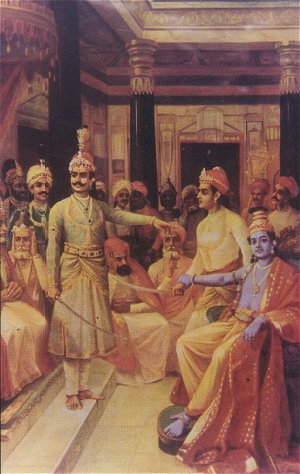
Krishna as Ambassador in the court of Kurus attempting to prevent war: Painting by Raja Ravi Varma. Credit www.kamat.com
The God in human form has dark blue skin like the nimbus clouds; there is no way one can miss Him.
Gita talks about Dharmaksetra and Kuruksetra in one breath. The former is a field of Dharma - duty and righteousness and the latter is a battleground in the land of the Kurus / Kauravas. It was a battle between the good and the evil. The battleground itself is representative of life's struggle and the desire of atman (self) to merge with Brahman or Atman (Self). Dharma is the underlying framework for that struggle. Life and struggle without Dharma are futile and even worse, the breeder of karma. The body is the chariot and the atman is riding the chariot. Buddhi - intuitive intelligence -is the chariot driver. The mind is the reins and the senses are the horses. Buddhi controls the mind and the senses. And Krishna is the Self or Brahman. This analogy is mentioned in the Upanishads. The senses are compared to vicious horses in Sv. Up 2.9
Arjuna's unwillingness to go to war and cause the death of his near and dear, was one of compassion, but in his confusion, did not address the duty he was sworn to as a Ksatriya. Arjuna worried about the death of his kith and kin and leaving so many widows, who without their husbands, brothers and fathers, were susceptible to deprivation and degradation of their status and moral values.
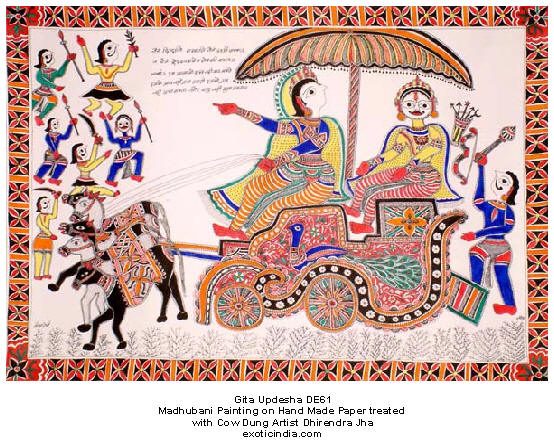
Krishna the Charioteer and Arjuna the Warrior Prince.
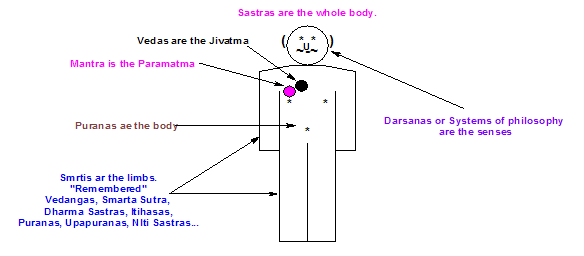
BHAGAVADA GITA
CHAPTER 1
1.1:
Dhritarāstra said:
Assembled
in Dharmaksetra and Kuruksetra eager for battle, what did my people and the
sons of Pandu do, O Sanjaya?
Dharmaksetra:
The field of righteousness. Kuruksetra: The field of Kurus. The implication is
that a battle is about to happen between the forces of right and wrong in the
land of the Kurus.
Seeing the Pandava army in battle formation,
Duryodhana approached his teacher and (the king) spoke these words.
Drona was his Guru.
1.3: Behold this great army of the sons of
Pandu deployed in battle formation by the son of Drupada, your intelligent
disciple, O teacher.
1.4: Here are the heroes and the great
archers equal to Bhima and Arjuna in battle: Yuyudhana, Virata, and Drupada,
the great fighters.
1.5: Dhristaketu, Cekitana, valiant Kasiraja,
Purujit, Kuntibhoja, and Saibya, the foremost among men.
1.6: Yudhamanyu the valiant, Uttamauja the
powerful, the son of Subhadra, and the sons of Draupadi are great chariot
fighters.
1.7: Know also, O Dvija Uttama, the leaders
of the army, who are distinguished. I will name them for your
information.
Dvija-Uttama: The “twice-born supreme,” the
best of the Brahmanas.
1.8: (Like) yourself, Bhishma, Karna,
victorious Kripa, Asvatthama. Vikarna, and the sons of Somadatta as well.
1.9: Many other heroes, for my sake, have
risked their lives. They are equipped with many different kinds of weapons, and
all of them are proficient in war.
1.10: Our strength is unlimited, protected by
Bhisma. Protected by Bhima, the strength of Pandavas is limited.
1.11: All of you, stationed everywhere on all
fronts in your respective positions, protect Bhisma.
1.12: The valiant Bhishma, the elder of the
Kurus and the grandfather, roared like a lion and blew his conch loudly to
cheer up Duryodhana.
1.13: Thereafter, conches, kettledrums,
trumpets, tabors, and horns were sounded all together. It was a tumultuous riot.
1.14: Thereafter, Madhava and Pandava (Lord
Krishna and Arjuna) sitting on the great chariot yoked with white horses
sounded the divine conches.
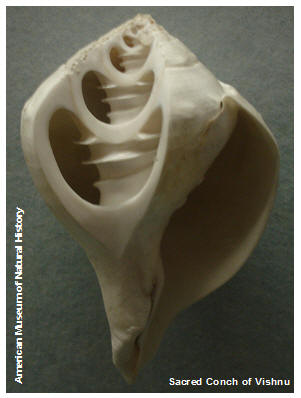
1.15: Hrisikesa blew His conch, Pāchajanya; Dhanajaya
blew his conch, Devadatta; and Bhima the big eater and formidable doer of deeds
blew his big conch, Paundra.
Hrisikesa is Lord Krishna. Dhananjaya is
Arjuna. Bhima is Arjuna's sibling.
1.16-18: Yuddhisthira, Nakula and Sahadeva,
Sikhandin, Dhristadyumna, Virata, Satyaki, Drupada, the sons of Draupadi, and
the son of Subhadra all blew their respective conches.
The verses were condensed to convey the
meaning only. Nakula and Sahadeva are twins.
1.19: The tumultuous roar (of the conches),
reverberating through the sky and the earth, tore the hearts of the sons of
Dhritarastra (the Kauravas).
1.20: O King, thereupon Arjuna, whose
flag
bore the crest of Hanuman, seeing the sons of Dhritarastra ready for battle,
took up his bow, and spoke these words to Lord Krishna.
Hanuman means that he is heavy-jawed; he is
the chief of Vānarās, ape-like beings, which helped Rama fight Ravana, the
demon-king of Sri Lanka. The latter abducted the wife, Sita, of Lord Rama; when
Rama sent Lord Hanuman to look for Sita, he reached Lanka in one long jump.
Ravana ordered his servants (Raksasas/devils or demons) to set Lord Hanuman’s
tail on fire, and paraded Hanuman on the streets of Lanka with his tail in
blaze; abducted Sita, knowing this, invoked Agni, the Lord of Fire, who let the
end of the tail glow in the flame, but not burn and stay fire-resistant.
Hanuman, in the spirit of teaching a lesson
to Ravana and Indrajit, set the city on fire. Lord Hanuman's services are
recognized and celebrated by man and God and He is always imaged along with
Rama, Sita, and Lakshmana, Rama's brother. Hanuman claims His lineage from Vayu
(Enlil
of Summeria), the wind God and Añjanā, an apsarasa. An apsarasa is a celestial nymph
and dancer and is usually a mistress of Gandharva living in Svarga, Indira's
paradise. Lord Hanuman's image adorns Arjuna’s flag.
Author's note: Smokes, flags, and drums have been in use for a long time. It is claimed that Egyptians used the flags as early as 4000 B.C., on their ships identifying its registry. Vexillum is the Latin word for flag. A flag historian is called Vexillologist. Sanskrit word for flag is Dhvaga. Flags were used in ancient India in front of liquor stores, announcing they were open for business.
In Summerian mythology, the god of wind (Air, Airspace) is Enlil, the second most powerful god of Sumerians. Enlil was born of ANU (heaven) and KI (earth) and became the chief of gods (the Indra of Hindu mythology). He also put together the Laws of the Universe, ME known in Hindu mythology as RTA.

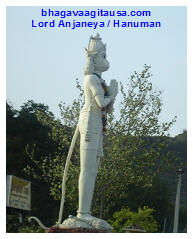
Hanuman
1.21- 22: O Acyuta (Krishna), stand my
chariot between the two armies in order for me to look upon those who are eager
for a battle and with whom I have to fight.
The verses were condensed to convey the
meaning only.
1.23: I wish to see those assembled here
willing to fight and serve the evil-minded son of Dhrtarāstra.
1.24: Sanjaya said:
O Bharata (Dhrtarāstra), having been
addressed by Gudakesana (Arjuna), Hrsikesa (Lord Krishna) placed the best of
chariots in the midst of both armies.
1.25: Facing Bhisma, Drona, and all great
chiefs (the Lord) said to Partha: Behold (all of) the Kurus gathered thus.
1.26-29: Partha could see standing there (on
the battlefield) fathers, also grandfathers, teachers, maternal uncles,
brothers, sons, grandsons, friends too, fathers-in-law, well-wishers and the
armies of both sides. Kaunteya, after seeing all of them, and all kinds of
relatives, overwhelmed by compassion and lamentation spoke. Arjuna said: O
Krishna, after seeing all the relatives present before me all ready and eager
to fight, I feel the limbs of (my) body shake, (my) mouth dry, my body quiver,
and my hair stand on end.
1.30-31: My bow, Gandiva, is slipping from my
hand. My skin is burning. I am not able to stand steadily. I am forgetting
myself. My mind is reeling. I see evil omens. I do not see any good in killing
my own kinsmen in the battle.
1.32: O Krishna, I long neither for victory,
nor for kingdom and happiness. O Govinda, of what use is the kingdom,
enjoyment, or life
1.33: They, for whose sake kingdom,
enjoyment, and happiness are desired, are standing here in the battlefield
ready to give up their lives and riches.
1.34: Teachers, fathers, sons, as well as
grandfathers, maternal uncles, fathers-in-law, grandsons, brothers-in-law, and
other relatives.
1.35: I do not want to kill them, though they
(want to) kill me, O Madhusudhana, even for the three worlds, not to speak of
an earthly kingdom.
1.36: By killing the sons of Dhrtrastra, what
pleasure can there be? O Janardhana, upon killing these armed aggressors sin
will come upon us.
1.37: Therefore, it is not becoming of us that
we kill the sons of Dhritrastra. How, by killing kinsmen, can we become happy O
Madhava?
1.38: Even if they, whose minds
are overwhelmed by greed, do not see sin in the ruin of the family, or crime in
treachery to friends…
Even if they, whose greed overwhelms their
mind, do not see sin in the ruin of the family, or crime in treachery to
friends…
1.39: Why should not we have the wisdom to
see the crime in the ruin of the family O Janardhana, and turn away from the
sins?
1.40: With the ruin of the family, the
eternal kula dharma is destroyed. When dharma is destroyed, the whole family
turns to adharma.
Kula dharma: Established order of the family,
family institution. Dharma: Established order. Adharma: Unrighteousness.
1.41: When Adharma prevails, O Krishna, the
women of the family become morally corrupt, and when women are tainted, O
Varsneya (Krishna), Varna Samkara comes into existence.
To this day in India, women bear the heavier burden than men in guarding morality and any scrofulousness on their part brings disproportionably erosive shame to the family.
Adharma: Unrighteousness. Varna Samkara:
mixture of castes by intermarriage.
1.42:
Commingling (of castes) brings hell to the family and those who
destroyed the race. The spirits of the ancestors fall, deprived of their
offerings of food and water.
Sankarah narakAya eva kula-ghnAnAm kulasya ca
patanti hi esAm lupta pinda udaka kriyAh.
Purport:
Because commingling of castes, the family and
the destroyers of the race go to hell. The spirit of the ancestor falls,
deprived of the offerings of food and water.
Sankara: Commingling of castes
(looked down
upon at that time as miscegenation) was looked down upon in the west in the
past. Kula-ghnānām: destruction of race
Many of the commentators have deliberately altered the meaning the Sanskrit word, Sankara. In keeping with the modern view of equality of races, many of the commentators on this verse conveniently do not address this issue of commingling of races out of embarrassment, common courtesy and decency. Commingling of races is deliberately altered to such word as confusion. If one wants to get a correct translation of this verse, one has to read Sankara and Ramanuja.
Sankara's commentary in Sanskrit as translated by Swami Ghambirananda:
And the intermingling in the family leads the ruiners of the family verily into hell. The forefathers of these fall down (into hell) because of being deprived of the offering of rice-balls and water.
Ramanuja's commentary in Sanskrit as translated by Svami Adidevananda:
This mixing of classes leads to hell the clan itself and its destroyers; for the spirits of their ancestors fall degraded, deprived of the ritual offering of food and water.
The confusion verily drags the family-slayer, as well as the family, to hell, and for want of obsequial offerings and rites their departed sires fall from blessedness.
Gandhi's comment: Hindu Dharma by M.K.Gandhi page 56-65.
Gandhi is a firm believer in Varnasrma Dharma. Gandhi admits he was born of Vaishya (Traders) parents, 3rd down the line. Gandhi says, "I as a Vaisya would be earning my bread by selling drugs (pharmacist) or groceries. Vaisya Varna includes all professions. A tailor may not become a blacksmith although both may be and should be called as Vaisyas. No one is superior to any other (among the four varnas). A scavenger has the same status as a Brahmin. He endorses the view of Max Muller by quoting him: In Hinduism more than any other religion that life was no more and no less than DUTY. Varna does not make life dull and rob it of all ambition. Under the cover of Varna, hideous inequalities and tyrannies are practiced at the present day in Hinduism. Varna is not a mere institution made by man but it is a law discovered by him. The evil lies in the doctrine of superiority and inferiority superadded to it. I do regard Varnashrma as a healthy division of work based on birth. The present idea of caste is a perversion of the original. He (a non-Brahmin) who performs the duty of a Brahmin will easily become one in the next incarnation.
It appears that according to Gandhi, any Varna can do any work suited to his temperament, training, intellect, aptitude, and education, as long as he or she does not call himself or herself by other than his Birth-Varna.
Apart from four main castes, Brahmin,
Ksatriya, Vaisya and Sudra, there is the fifth class, Antyaja. Antya (last in
order) + Ja (caste) = the lowest caste. The Antyajas are the washer men,
tanners, mimics (actor), Varudas (cane-weavers), Kaivartas (fishermen), Bhedas*,
and Bhillas (hill tribes).
Bhedas*: name of certain tribe.
Below these people, there are the Mlecchas
and Dumbas. Mlecchas generally are the foreigners, barbarians, non-Aryans and
those who do not speak Sanskrit. Dumbas are basket and rope makers,
cremation
workers, street musicians and
dancers.
The view from the west.
Commentary section following chapter and verse 5.18, describes mixed castes according to Garuda Purana 1.96-1-73, as narrated by Yajnavalkya.
The
spirits of the ancestors fall, deprived of their offerings of food and water.
There is a beautiful description about CirArtham (Sraddha), offering of food to the ancestors (manes) in Book 6 KuraiOnrumIllai by Mukkur Lakshmi Narasimhachariar. Achariar quotes Pitru-Gitam in Vishnupuranam. Cirartham (º¢Ã¡÷ò¾õ) is a two-way fare. The manes are pleased with the offering from their descendants, who offer blessings to their progeny who perform the ceremony. The ceremony is presided by a deity, Harshana. The offered food is called Pinda and the act is Sraddha. The following is an extract from Vishnu Puranam, translated from Sanskrit to English by H.H.Wilson. They who are desirous of worshipping their Pitrs or the gods can do Sraddha on a day of new moon when the stars Dhanishtha, PurvaBhadraPada or Sata-Bhisha. Another class of Sraddha is done on the third lunar day of the month of VaisAkha (April, May) and the ninth of Kartika (October-November) in Sukhla Paksha (Bright Fortnight). Other dates are 13th of Nabha (July-August) and the 15th of Magha (Jan-February) in Krishna Paksha (Dark Fortnight). They are the first days of a Yuga (age) and most sacred. On these above days; solar and lunar eclipses; and 8th lunations of the Dark Fortnight of Agrahanya, Magha, and Phalguna (Dec-Feb); the days commencing the solstices, when the nights and the days alternately begin to diminish; the anniversaries of manvantaras; the day, the sun is in the path of the goat; days of meteoric occurrences; Sesamum seeds and water are offered to the progenitors of the mankind. A Sraddha on these days and seasons gives happiness to the Manes for a thousand years. The songs of the forefathers give the descendants purity of heart, integrity of wealth, prosperous seasons, perfect rites, devout faith, and all that men desire. That blessed descendant will be born in a distinguished family. If the descendant cannot afford elaborate food items and gifts of wealth, jewels, clothes, land, conveyances, and any valuable gifts to the officiating Brahmana priest, there are alternatives in the descending order: 1) unboiled grain, affordable gifts, plantain, dal; 2) a fistful of sesame seeds; 3) about ten to fifteen sesame seeds stuck on a wet thumb; 4) one day's worth of grass for the cow; 5) going to the forest, throwing the hands up in the air to the sun and other celestials and declaring that he cannot afford anything to the forefathers and the officiating Brahmana. Actually these are the words and recommendations of the manes themselves to their descendants.
Narasimhachariar adds no one should think of Sraddha as wasteful. We have seen how Sastras made Sraddha simple.
Pitru Devatas are RudrAs, Vasus, and Adityas. Sraddha offers contentment to the Devatas and not to the departed parents. Their blessing and grace give prosperity to the progeny. Some of the Devatas are wandering without receiving the Sraddha. They desire that one of their progeny would perform Sraddha and make them happy and contented and thus facilitate liberation. That is why one should do Sraddha on a the day Bhishma attained liberation. The Devatas will be supremely happy upon receiving Pitru Karyam (Sraddha= À¢òÕ ¸¡¡¢Âõ) and send their Anugraha. The descendants will also attain liberation just like Bhishma.
Swami Sivananda says the following on offering of food to manes (Sraddha).
The Pitrus are forefathers who dwell in Pitru-loka. They possess clairvoyance
and clairaudience. Recitation of Mantras exercises tremendous influence through
their vibration. The Pitrus hear the sounds through the power of clairaudience
and they are pleased. They bless those who offer the oblation. In Sraddha, the
essence of food offerings is taken up by sun’s rays to Suryaloka and the
departed souls are pleased with the offerings. Even in the West many persons
perform Tarpana and Sraddha. They have scientifically investigated into the
beneficial effects of such oblations. It is the imperative duty of all
householders to perform Sraddha and Tarpana to please the Rishis and the Pitrus.
It is only the deluded souls with perverted intellects who misconstrue things
and neglect to perform the sacred ceremonies and consequently suffer.
1.43: By such evil deeds such as kula ghānām
and Varna Sankara, eternal Jāti dharmā and kula dharmā are destroyed.
Kula ghānām: destruction of race. Varna Sankara: mixture of castes by
intermarriage. Jāti dharmā: established order of caste or institution of
caste. Kula
dharmā: established order of the family, family
institution, practice or observance peculiar to a tribe or family,
peculiar duty of a caste or race.
1.44: We have heard it said (by the learned)
that those men, whose kula dharma is destroyed, O Janardana, would always dwell
in hell.
Purport: O Janardana, we heard it said (by
the learned): once kula dharma is annihilated, hell is the habitation for these
men.
1.45: Alas! We have decided to commit great
sins, by getting ready to kill our kinsmen because of greed for the pleasures
of kingdom.
Rājya-sukha-lobha: kingdom-pleasure-greed:
greed for the pleasures of kingdom.
1.46: Better would it be for me, if the sons
of Dhritrastra with weapons on hand were to kill me on the battlefield, while
I, unarmed, offer no resistance.
Purport: It is better for me that the sons of
Dhritrastra kill me on the battlefield with weapons on hand, while I am unarmed
and offer no resistance.
1.47:
Sanjaya said:
Thus
saying in the battlefield, Arjuna sat down on the seat of the chariot, laying
aside his bow and arrow with his mind taken over by sorrow.
End BG Chapter 1