HOME PAGE


Bhagavad-Gita:Chapters in
Sanskrit
|
BGALLCOLOR.pdf
(All 18
chapters in Sanskrit, Transliteration, and Translation.) |
Bhagavadgita in English
What is Mahabharata to histories, is butter in curd, Brahmana among
bipeds, the Aranyaka among the Vedas and nectar among medicines, the sea
among receptacles of water and the cow among Quadrupeds. Paraphrase. Vyasa's
saying in Mahabharata as translated by Ganguli.
As butter is in curd, Brahmana among bipeds, the Aranyaka among the
Vedas, and nectar among medicines; as the sea is eminent among receptacles
of water, and the cow among quadrupeds; as are these (among the things
mentioned) so is the Bharata said to be among histories.
as translated by Ganguli
www.bhagavadgitausa.com
Veeraswamy Krishnaraj: Tolerance with
love is to speak in tongues of all faiths, hold in the heart the Truth of
all faiths and see all faiths in the face of humanity.
About the author:
Veeraswamy Krishnaraj, M.D; F.R.C.P (Canada) is a board certified
pediatrician in active practice until the end of 1998. He immersed himself
in study of Hinduism in depth. He has sufficient knowledge and understanding
of Hindu religion that he is confident to publish this book. He kept the
words simple, supple, illuminating and to the point, while retaining the
original flavor, beauty and grace. Compound words in Sanskrit are a
nightmare for the beginner, as they are spliced together compactly in one
continuous stretch of characters. He parsed the compound words into
digestible syllables or words with superscripts and sequential numbers and
rearranged the words in the verse in a readable form in English. In this
book, he claims ownership of shortcomings and cedes the rest to Bhagavan.
This book is good for students, and devotees reading the Bhagavad-Gita in
Satsang (true company). Two verses nestle in two boxes in one page with no
break or carry-over to the next page. Diacritics help the reader enunciate
the words like a Sanskritist. The English words are reader-friendly.
Wherever there is a need for elaboration, an addendum supports it.
Simplicity, authority, universality, and profundity are the hallmark of the
Bhagavadgita, the Bible of the Hindus. The Bhagavadgita is the Song of the
Lord. It provides guidelines for daily living with no dogmas and ritual
overtones. It encourages and supports your individuality. It also explains
the consequence of errant ways. Total surrender to Bhagavan releases the
devotee from the ills of life on earth. Hinduism as a term is an external
appellation from non-Hindus. Its true name is Sanatana Dharma (Eternal Law
or Eternal Order) commensurate with Rta (Cosmic Order). The beauty about the
Bhagavadgita is its appeal is universal.
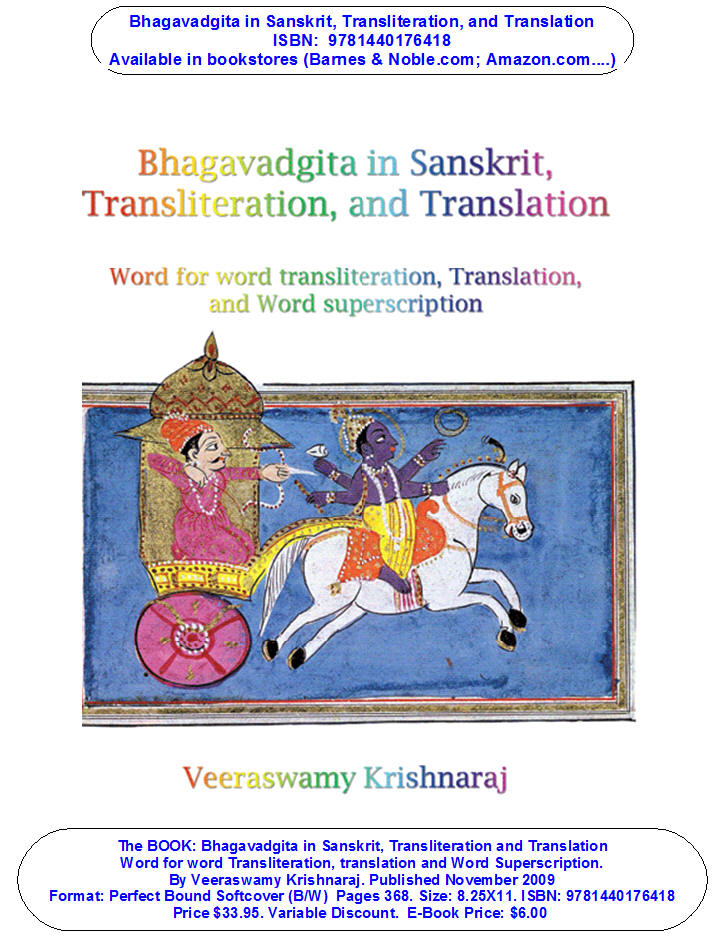
Bhagavadgita in Sanskrit,
Transliteration, and Translation
ISBN: 9781440176418. Published Nov 2009
Available in bookstores (Barnes&Noble.com; Amazon.com....)
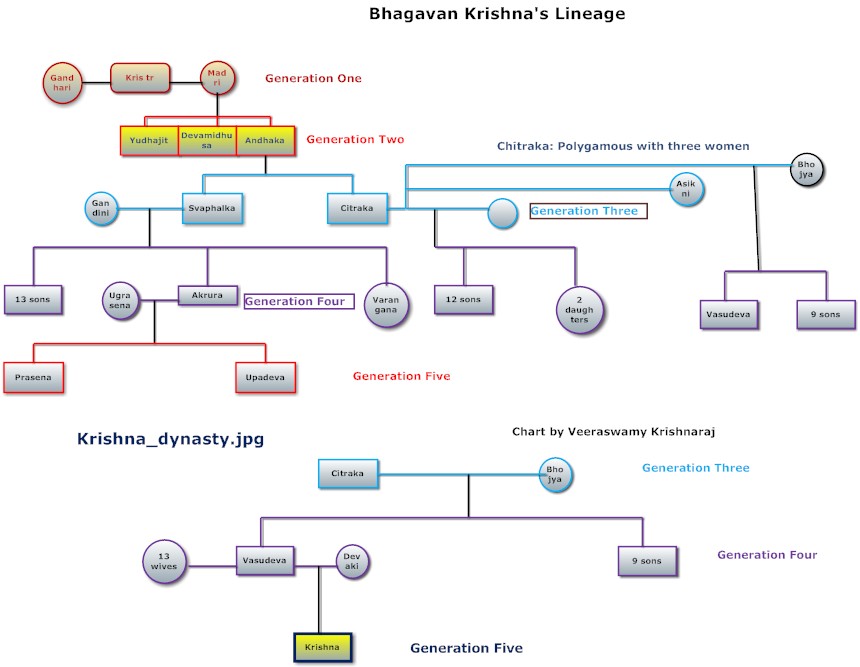
July 19, 2013: Krishna Bhagavan today
is 5241 years of age.
Based on scriptural details and astrological
calculations the
date of Krishna's birth, known as Janmashtami,[59] is
19 July 3228 BCE and departed on 3102 BCE. Krishna belonged to the Vrishni clan
of Yadavas from Mathura,[60] and
was the eighth son born to the princess
Devaki,
and her husband Vasudeva.--Wikipedia
Krishna was born in Mathura on the
banks of Yamuna India, three thousand years before Jesus Christ. His descent
was to punish evil and uphold Dharma. His incarnation is whole and complete
(Purnavatara of Vishnu). He was human in appearance but divine in his
deportment. Many miracles are attributed to his childhood. He was born a
prince in a prison cell, when, on the orders of his maternal uncle Kamsa,
his father and mother were put in the prison.
His maternal uncle Kamsa believed a prediction that Krishna the eight
child of Devaki would kill him. Devaki gave birth to Krishna in the prison
cell. Bagavan was secretly transported out of the prison and was raised by
the head of cow-herders across River Yamuna.
Later as a youth, Krishna killed Kamsa and reinstated Kamsa's father as
the king.
In Kuruksetra war, The Pandavas chose Krishna and the Kauravas chose
Krishna's army, since Krishna maintained neutrality. Bhagavad Gita (The Song
of Bhagavan or the Song of the Divine) is the Philosophical and Theological
treatise in the form of conversation between Krishna and prince Arjuna in
the battlefield.
http://www.bhagavadgitausa.com
03/14/2017
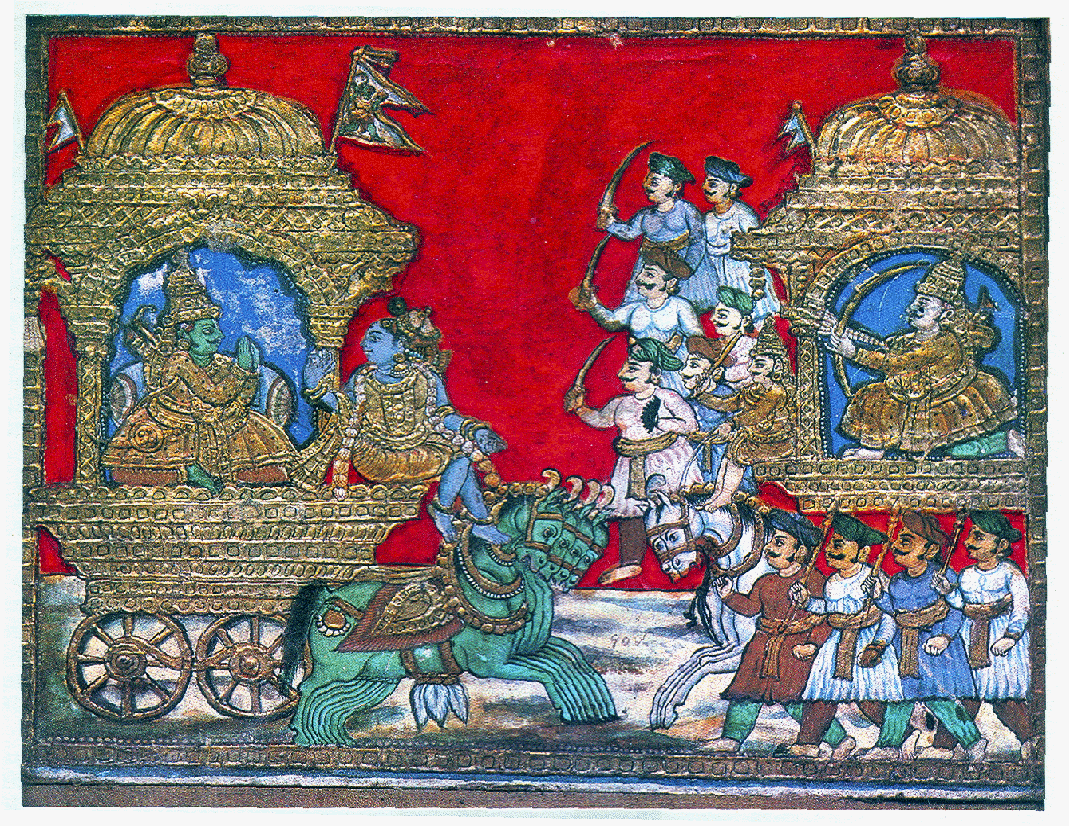
Tanjore painting of
Mahabharata war
PREFACE
|
Karma Yoga: Doctrine of communion of
individual consciousness with Universal Consciousness through deeds. |
Bhakti Yoga: Doctrine of Devotion in communion
of individual soul with the World Soul. |
Jnana Yoga: Doctrine of Knowledge in communion
of Jivatma with Paramatma. |
| BG1. Aruja's distress BG 2 Samkhya
Yoga
BG 3 Karma Yoga
BG 4 The Yoga of Knowledge
BG 5 Yoga of Renunciation of Action
BG 6 The Yoga of self-control |
BG 7 Knowledge and Realization BG 8
Brahman the Imperishable
BG 9 Yoga of Sovereign Knowledge and Sovereign Secret
BG 10 Manifestation
BG 11 The Grand Vision
BG 12 Bhakti
|
BG 13 The Knower, the Field, and the
Nature BG 14 The Three-Guna Psychology
BG 15 The Supreme Person
BG 16 The Divine and the Demon
BG 17 Gunas and Faith
BG 18 Renunciation and Liberation
|
Bhagavad-Gita is based on the inspired wisdom found in the
Upanishads.
Upa = near, ni=down,
sad=sit. The teacher taught
Upanishads to the pupils sitting down near him. Another explanation.
Upa + ni + shadah. Shadah = (the Jnanam or knowledge that renders) the
doubts, miseries, and karmic merits and demerits into dust. The
Bhagavad-Gita is considered as Gitopanishad.
Swami Vivekananda: The origin of ancient Sanskrit is 5000 B.C.; the
Upanishads [are at least] two thousand years before that. Nobody knows
[exactly] how old they are. The Gita takes the ideas of the Upanishads and
in [some] cases the very words. They are strung together with the idea of
bringing out, in a compact, condensed, and systematic form, the whole
subject the Upanishads deal with.--
The Complete Works
of Swami Vivekananda Volume 1 Page 446.
The Hebrew word Yeshiva also
means sitting (Sad in Sanskrit). Yeshiva is a Jewish school of religious
learning.
BG is part of Mahabharata, and Vyasa was its author. It is claimed
by the West that Vyasa was a generic name for an author, compiler, (editor)
and or "oral-aural-memory-scribe / writer / publisher". The West
surmises there were many Vyasas. ...Biardeau
has remarked, "even the most staunch supporters of Western textual criticism
in India would never dream of 'critically editing the Vedas. .., since they
are absolutely authoritative as they are."
Aldous Huxley wrote: “The Bhagavad-Gita is the most systematic statement of
spiritual evolution of endowing value to mankind. It is one of the most
clear and comprehensive summaries of perennial philosophy ever revealed;
hence its enduring value is subject not only to India but to all of
humanity.”
I read
the Ph.D thesis manuscript of Professor Patricia Yvonne Mumme,
The College of Wooster, Wooster, Ohio 44691.
It is treasure-trove of information, every Vaishnava should have.
The book "The
Srivaisnava Theological Dispute: Manavalamamuni and Vedanta Deskia"
is being reprinted and is forthcoming in 2008 from Navabharat Enterprises in
Bangalore, India.
The book is authored by: Professor Patricia Yvonne
Mumme, Ph.D, The College of Wooster, Wooster, Ohio
44691 USA.
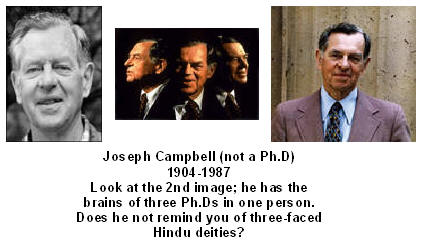 Joseph Campbell (03/26/1904
-- 10/30/1987) was an American mythology professor, writer, and orator
well-versed in comparative mythology and comparative religion. He is the
most authentic erudite American professor in his field of study. He wanted
to study Sanskrit, modern art, and Medieval literature for his Ph.D; his
advisors did not support him. Then he followed his bliss. He did well
without the Ph.D appendage to his name. Here is a man who went after true
knowledge and not a Ph.D. His knowledge is so immense, ten of the
Ivory Tower Ph.Ds and professors cannot match him. He was a heavy
weight in his field and understood other religions and cultures very well.
The light weights of today with rare exceptions are a curse to their
profession. He was a professor at Sarah Lawrence college for 38 years from
1934 to 1972.
Joseph Campbell (03/26/1904
-- 10/30/1987) was an American mythology professor, writer, and orator
well-versed in comparative mythology and comparative religion. He is the
most authentic erudite American professor in his field of study. He wanted
to study Sanskrit, modern art, and Medieval literature for his Ph.D; his
advisors did not support him. Then he followed his bliss. He did well
without the Ph.D appendage to his name. Here is a man who went after true
knowledge and not a Ph.D. His knowledge is so immense, ten of the
Ivory Tower Ph.Ds and professors cannot match him. He was a heavy
weight in his field and understood other religions and cultures very well.
The light weights of today with rare exceptions are a curse to their
profession. He was a professor at Sarah Lawrence college for 38 years from
1934 to 1972.
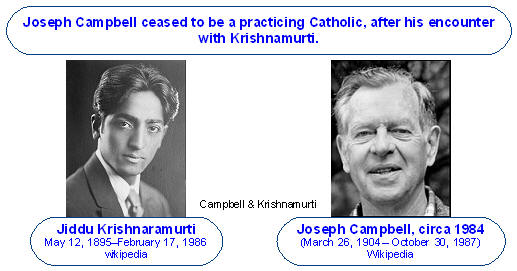
Joseph Campbell's life-altering encounter with Jiddu
Krishnamurti.
In 1924 (Professor) Campbell traveled to Europe with his
family. On the ship back, he encountered
Jiddu Krishnamurti; they discussed Asian philosophy, sparking in
Campbell a life-long interest in Hindu and Indian thought.
Following this trip, Campbell ceased to be a
practicing Catholic. --Wikipedia
John A. Grimes received his B.A. in Religion
from the University of California at Santa Barbara and his M.A. and Ph.D. in
Indian Philosophy from the University of Madras. He has taught at
Universities in India, Canada, Singapore, and the United States. His book
publications include: The  Vivekacudamani:
Sankara's Crown Jewel of Discrimination; Ramana Maharshi: Darshan in
Darshana; Ganapati: Song of the Self; Problems and Perspectives in Religious
Discourse: Advaita Vedanta Implications; Sapta Vidha Anupapatti: The Seven
Great Untenables; Sankara and Heidegger: Being, Truth, Freedom; and The
Naiskarmyasiddhi of Suresvara. He presently spends his time writing and
traveling between California and Chennai. Exoticindia.com
Vivekacudamani:
Sankara's Crown Jewel of Discrimination; Ramana Maharshi: Darshan in
Darshana; Ganapati: Song of the Self; Problems and Perspectives in Religious
Discourse: Advaita Vedanta Implications; Sapta Vidha Anupapatti: The Seven
Great Untenables; Sankara and Heidegger: Being, Truth, Freedom; and The
Naiskarmyasiddhi of Suresvara. He presently spends his time writing and
traveling between California and Chennai. Exoticindia.com
He claims he has the Samskaras to study and write on
Indian philosophy, Indian mythology, Advaita Vedanta and the Hindu deities.
ஜான் கிறைம்ஸ்
The following is an extract from Wikipedia.
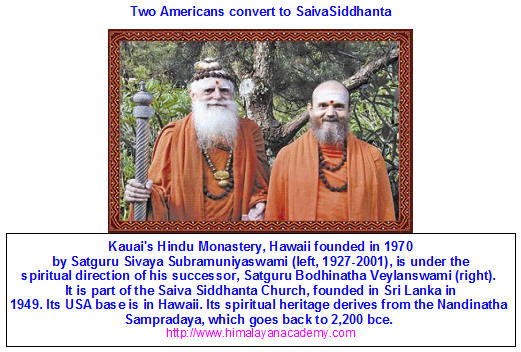
Hinduism Today Magazine is a quarterly
magazine
published by the Himalayan Academy in
Kapaa,
Hawaii, USA. It is distributed throughout the United States and
internationally, currently in 60 nations. Founded by
Satguru Sivaya Subramuniyaswami in 1979, it is a public service of his
monastic order to promote an understanding of the
Hindu faith,
culture, and traditions. Hinduism Today Magazine was launched in 1979
by
Satguru Sivaya Subramuniyaswami (Gurudeva), published by his
non-profit organization Himalayan Academy.
Specific goals of the magazine include:
- 1. To foster Hindu solidarity as a unity in diversity among all
sects and
lineages;
- 2. To inform and inspire Hindus worldwide and people interested in
Hinduism;
- 3. To dispel
myths, illusions and misinformation about Hinduism;
- 4. To protect, preserve and promote the sacred
Vedas and
the Hindu religion;
- 5. To nurture and monitor the ongoing spiritual Hindu
renaissance;
- 6. To publish a resource for Hindu leaders and educators who promote
Sanatana Dharma.
[5]
As a highly objective magazine with such a diverse presentation of
thought, its appeal extends far beyond the Hindu community, especially to
those interested in its portrayal of Hindu culture, as well as the thought
processes and sentiment used to convey this content. (Satguru Sivaya
Subramuniyaswami is a white American, who in the tradition of Great Sages of
India attained Realization of Siva.)
http://himalayanacademy.com/basics/nineb/
Nine Beliefs of Hinduism

Our beliefs determine our thoughts and attitudes about life, which in turn
direct our actions. By our actions, we create our destiny. Beliefs about
sacred matters--God, soul and cosmos--are essential to one's approach to
life. Hindus believe many diverse things, but there are a few bedrock
concepts on which most Hindus concur. The following nine beliefs, though
not exhaustive, offer a simple summary of Hindu spirituality.
- Hindus believe in a one, all-pervasive Supreme Being who is both
immanent and transcendent, both Creator and Unmanifest Reality.
- Hindus believe in the divinity of the four Vedas, the world's most
ancient scripture, and venerate the Agamas as equally revealed. These
primordial hymns are God's word and the bedrock of Sanatana Dharma, the
eternal religion.
- Hindus believe that the universe undergoes endless cycles of
creation, preservation and dissolution.
- Hindus believe in karma, the law of cause and effect by which each
individual creates his own destiny by his thoughts, words and deeds.
- Hindus believe that the soul reincarnates, evolving through many
births until all karmas have been resolved, and moksha, liberation from
the cycle of rebirth, is attained. Not a single soul will be deprived of
this destiny.
- Hindus believe that divine beings exist in unseen worlds and that
temple worship, rituals, sacraments and personal devotionals create a
communion with these devas and Gods.
- Hindus believe that an enlightened master, or satguru, is essential
to know the Transcendent Absolute, as are personal discipline, good
conduct, purification, pilgrimage, self-inquiry, meditation and
surrender in God.
- Hindus believe that all life is sacred, to be loved and revered, and
therefore practice ahimsa, noninjury, in thought, word and deed.
- Hindus believe that no religion teaches the only way to salvation
above all others, but that all genuine paths are facets of God's Light,
deserving tolerance and understanding.
Hinduism, the world is oldest religion, has no beginning--it precedes
recorded history. It has no human founder. It is a mystical religion,
leading the devotee to personally experience the Truth within, finally
reaching the pinnacle of consciousness where man and God are one. Hinduism
has four main denominations--Saivism, Shaktism, Vaishnavism and Smartism.
Dr. Mahadevan of Madras university (1972) quotes Bhāmati that Vyasa was
the incarnation of Vishnu's Cognitive Energy (Jñānaśakti-avatāra).
Robert Louis Stevenson writes
To learn aright from any teacher, we must first of all , like a historical
artist, think ourselves into sympathy with his position. If a saying is
hard to understand, it is because we are thinking of something else. There
is always a ruling spirit behind the code of rules, an attitude, a
relation, a point of the compass, in virtue of which we conform or
dissent.
exoticindia.com
The Battlefield and Arjuna's depression
Kurukshetra War and Chennai connection
IT was a battle royal between Pandavas and Kauravas (Kurus). It was
cousins against cousins. Pandu, the father of five Pandavas died
leaving the kingdom to his half-brother Dhrtarastra, who had one hundred
sons. When Dhrtarastra decided to give the kingdom - what is rightfully
theirs -to Pandavas, Duryodhana, the eldest son of Dhrtarastra
took the throne for himself by enticing Yudhisthira, the eldest of Pandavas,
to a game of dice and stacking all odds against him. The Pandavas lost
the kingdom in the game of dice, and were banished to the forest for twelve
years. The last year - the thirteenth - was spent incognito according
to the agreement. Upon their return, Duryodhana wouldn't even give a land
the size of a postage stamp - five villages. Krishna tried to bring
the cousins together in vain and offered the warring factions to choose
either Him or his military machine Krishna, the head of the Yadhava
clan joined the Pandavas upon their choice and request, while the Kauravas
opted for Krishna's army. Krishna refused to bear arms against the Kurus and
made a promise to that effect. Bhishma the grandfather of the Kurus who
wanted Krishna to break his vow and enter the war with weapons, sent rains
of arrows on Krishna which drew blood and scarred his face for ever. Krishna
stood there, took the assault and kept his promise. There is a temple in
Chennai that celebrates Krishna in the form of Parthasarathy, meaning
Partha's Charioteer. Partha =Arjuna.; Sārathy = charioteer.
The Parthasarathy Temple (8th Century) in
Chennai shows Krishna with scars on his face. The legend says that Krishna,
after the Kurushetra war, came to a pond replete with Alli flowers. That
site became the holy place and temple, Tiruvallikeni,
which was corrupted to Triplicane by the British. The Parthasarathy
temple was built by a Pallava king.
Vishnu incarnates when Dharma is on descent. Vayu Purana Chapter 35 lists
the Deva-Asura wars, Vishnu is involved in. The first war was Narasimha
(caused by Man-Lion). The second war was Vamana as the Dwarf when He
intervened in the war between Devas and Bali and restored the suzerainty of
the gods. The 3rd, the 4th, the 5th were VArAha, the churning of the ocean,
and the war of TArakAmaya on the abduction of TAtA by Candra. The 6th, 7th,
the 8th and the 9th were Adhibaka, Traipura, AndhakAra and Dhvaja wars. The
10th, 11th, and the 12th were VArta, HalAhala and KolAhala. in all these
wars Vishnu extracts victory over His opponents either alone by Himself,
with others or through surrogate gods.
Krishna became the charioteer of Arjuna, one of the Pandavas. The war was
fought in
Kuruksetra. In modern times the area would have been in
the vicinity of Delhi.
|
Kurukṣetra
Kurukṣetra
is land of Kuru, the territory around Thanesar between Sarasvatī and
Dṛṣadvatī rivers.
This is where King Kuru did the plowing, meaning it is a cultivated
land. The uncultivated land was called Kuru-Jāṇgla.
Prof. Shastri,
Śivapurāṇa
Motilal Banarsidass publishers. |
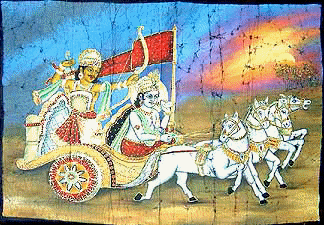
AUM is portrayed well in Krishna-Arjuna chariot, which is of the form of
Pranavam. A is Krishna, Ma is Arjuna, everything else is U. A is in front; M
is behind A. Paramatma the 26th Tattva is in front of the 25th Tattva,
Arjuna the Jivatma.
Krishna, upon request from Arjuna, drove the chariot and stationed it
between the two armies. Arjuna took one look at the armies and
immediately became disheartened. He saw his friends, relatives, and
teachers on either side. He couldn't get himself to kill his near and
dear just for the sake of gaining a kingdom or a piece of land. He would
rather die in the hands of Kurus ( Kauravas) than to kill any of them. His
body, mind, and heart sank in deep depression. He lost his will to kill his
enemies.
Comments:
Throughout the battle between the Pandavas and Kauravas, Sanjaya, a
charioteer, a friend and secretary was acting as a reporter to the blind
king Dhrtarastra, the father of Kauravas, on the battlefield happenings.
Sanjaya had this unique "Omnivision", by which he could see in his
mind and narrate all events in real time on the battlefield,
while staying close to the blind king in safety, away from the battlefield.
He was in effect the seeing eyes of the blind king, with omnivision.
One compensated for the other more than one can imagine. The blind king
Dhrtarastra didn't have the foresight to see the destruction of his
own sons, when he went along with his eldest son Duryodhana in the game of
dice and entrapment of Yudhisthira, the eldest of the Pandavas.
Krishna, related to both Pandavas and Kauravas, was neutral. Krishna
tried his best to avert a war between Pandavas and Kauravas. When
imminence of war was in the horizon, He proposed that one party can get his
military machine and the other can have Him. Duryodhana, in his egoistic
ignorance, chose Krishna's military machine, while the Pandavas chose
Krishna. That clinched the outcome of the battle.
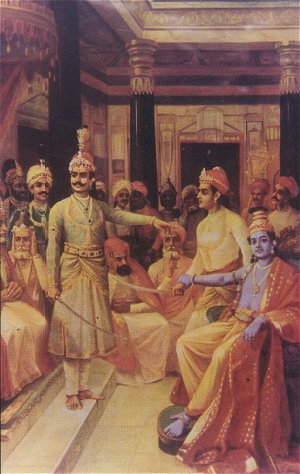
Krishna as Ambassador in the court of Kurus attempting to
prevent war: Painting by Raja Ravi Varma.
Credit www.kamat.com
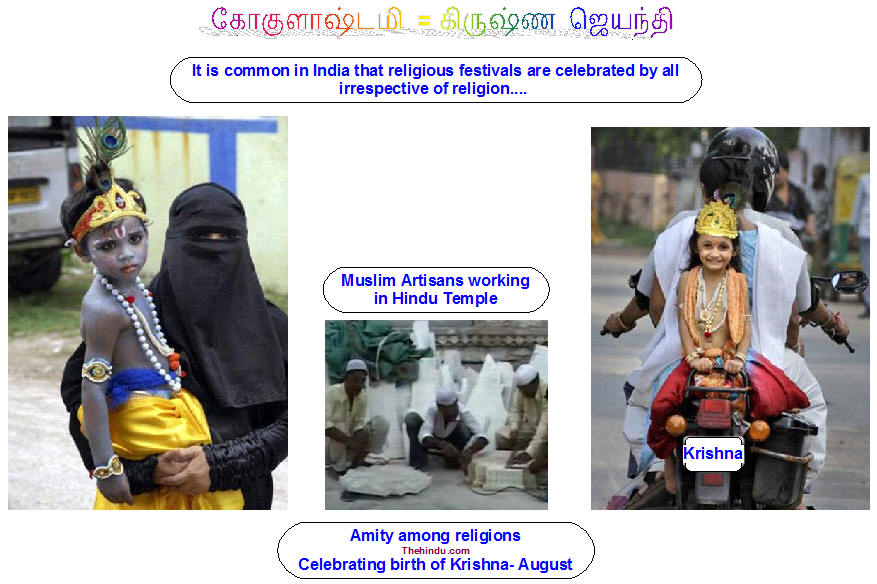
The God in human form has dark
blue skin like the nimbus clouds; there is no way one can miss Him.
Krishnajayanti is celebration of
Krishna's birth.
Gita talks about Dharmaksetra and Kuruksetra in one breath. The former is
a field of Dharma - duty and righteousness and the latter is a battleground
in the land of the Kurus / Kauravas. It was a battle between the good and
the evil. The battleground itself is representative of
life's struggle and the desire of atman (self) to merge with Brahman
or Atman (Self). Dharma is the underlying framework for that struggle.
Life and struggle without Dharma are futile and even worse, the breeder of
karma. The body is the chariot and the
atman is riding the chariot. Buddhi - intuitive intelligence -is the
chariot driver. The mind is the reins and the senses are the horses.
Buddhi controls the mind and the senses. And Krishna is the Self or Brahman.
This analogy is mentioned in the Upanishads. The senses are compared
to vicious horses in Sv. Up 2.9
Arjuna's unwillingness to go to war and cause the
death of his near and dear, was one of compassion, but in his confusion, did
not address the duty he was sworn to as a Ksatriya. Arjuna worried about the
death of his kith and kin and leaving so many widows, who without their
husbands, brothers and fathers, were susceptible to deprivation and
degradation of their status and moral values.
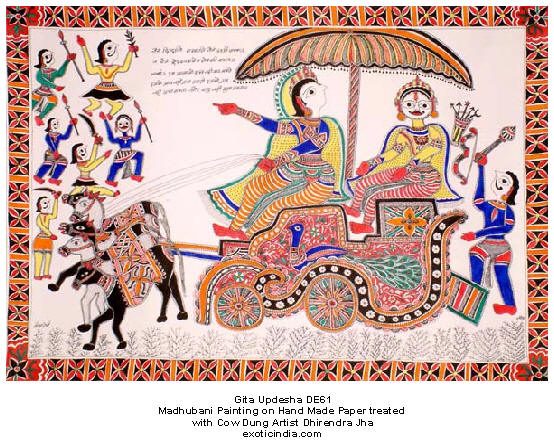
Krishna the Charioteer and Arjuna the Warrior Prince.
Chapter 1: Arjuna's
Distress
BHAGAVADA GITA
CHAPTER 1
धृतराष्ट्र उवाच
धर्मक्षेत्रे कुरुक्षेत्रे समवेता युयुत्सवः ।
मामकाः पाण्डवाश्चैव किमकुर्वत
सञ्जय
॥१-१॥
1.1
dhṛtarāṣṭra
uvāca
dharmakṣetre
kurukṣetre
samavetā yuyutsavaḥ
māmakāḥ pāṇḍavāś cai 'va kim akurvata
sañjaya 1.1
1.1:
Dhritarāstra said:
Assembled
in Dharmaksetra and Kuruksetra eager for battle, what did my people and the
sons of Pandu do, O Sanjaya?
Dharmaksetra: The field of righteousness. Kuruksetra: The field of Kurus.
The implication is that a battle is about to happen between the forces of
right and wrong in the land of the Kurus.
सञ्जय
सञ्जय
उवाच
दृष्ट्वा तु पाण्डवानीकं व्यूढं दुर्योधनस्तदा ।
आचार्यमुपसंगम्य राजा वचनमब्रवीत्
॥१-२॥
1.2
sañjaya uvāca
dṛṣṭvā tu pāṇḍavānīkaṁ
vyūḍhaṁ duryodhanas tadā
ācāryam upasaṅgamya
rājā vacanam abravīt 1.2
1.2: Sanjaya said:
Seeing the Pandava army in battle
formation, Duryodhana approached his teacher and spoke these words.
Drona was his
Guru.
पश्यैतां पाण्डुपुत्राणामाचार्य महतीं चमूम् ।
व्यूढां
द्रुपदपुत्रेण तव शिष्येण धीमता ॥१-३॥
1.3
paśyaitāṁ pāṇḍuputrāṇām
ācārya mahatīṁ camūm
vyūḍhāṁ drupadaputreṇa tava śiṣyeṇa
dhīmatā 1.3
1.3: Behold this
great army of the sons of Pandu deployed in battle formation by the son of
Drupada, your intelligent disciple, O teacher.
अत्र शूरा महेष्वासा भीमार्जुनसमा युधि ।
युयुधानो
विराटश्च द्रुपदश्च महारथः ॥१-४॥ 1.4
atra śūrā maheṣvāsā
bhīmārjunasamā yudhi
yuyudhāno virāṭaś
ca drupadaś ca mahārathaḥ
1.4
1.4: Here are the
heroes and the great archers equal to Bhima and Arjuna in battle: Yuyudhana,
Virata, and Drupada, the great charioteer.
धृष्टकेतुश्चेकितानः काशिराजश्च वीर्यवान् ।
पुरुजित्कुन्तिभोजश्च शैब्यश्च नरपुङ्गवः ॥१-५॥
1.5
dhṛṣṭaketuś
cekitānaḥ kāśirājaś ca
vīryavān
purujit kuntibhojaś ca śaibyaś ca narapungavaḥ 1.5
1.5: Dhristaketu,
Cekitana, valiant Kasiraja, Purujit, Kuntibhoja, and Saibya, the foremost
among men.
युधामन्युश्च विक्रान्त उत्तमौजाश्च वीर्यवान् ।
सौभद्रो
द्रौपदेयाश्च सर्व एव महारथाः
॥१-६॥ 1.6
yudhāmanyuś ca
vikrānta uttamaujāś ca vīryavān
saubhadro draupadeyāś ca sarva eva mahārathāḥ 1.6
1.6: Yudhamanyu
the valiant, Uttamauja the powerful, the son of Subhadra, and the sons of
Draupadi are great chariot fighters.
अस्माकं तु विशिष्टा ये तान्निबोध द्विजोत्तम ।
नायका मम
सैन्यस्य संज्ञार्थं तान्ब्रवीमि ते
॥१-७॥ 1.7
asmākaṁ tu
viśiṣṭā ye tān nibodha dvijottama
nāyakā mama sainyasya saṁjñārthaṁ tān bravīmi te 1.7
1.7: Know also, O Dvija Uttama, the
leaders of the army, who are distinguished. I will name them for your
information.
Dvija-Uttama: The
“twice-born supreme,” the best of the Brahmanas.
भवान्भीष्मश्च कर्णश्च कृपश्च समितिंजयः ।
अश्वत्थामा विकर्णश्च सौमदत्तिस्तथैव च
॥१-८॥ 1.8
bhavān bhīṣmaś
ca karṇaś
ca kṛpaś
ca samitiṁjayaḥ
aśvatthāmā vikarṇaś ca saumadattis
tathai 'va ca 1.8
1.8: (Like)
yourself, Bhishma, Karna, Kripa, Asvatthama. Vikarna, and the sons of
Somadatta as well, ever victorious in battle.
अन्ये च बहवः शूरा मदर्थे त्यक्तजीविताः ।
नानाशस्त्रप्रहरणाः सर्वे युद्धविशारदाः
॥१-९॥
1.9
anye ca
bahavaḥ śūrā madarthe tyaktajīvitāḥ
nānāśastrapraharaṇāḥ sarve yuddhaviśāradāḥ 1.9
1.9: Many other
heroes have risked their lives
for my sake.
They are equipped with many weapons, and all of them are skilled in
war.
अपर्याप्तं तदस्माकं बलं भीष्माभिरक्षितम् ।
पर्याप्तं त्विदमेतेषां बलं भीमाभिरक्षितम्
॥१-१०॥ 1.10
aparyāptaṁ tad asmākaṁ balaṁ
bhīṣmābhirakṣitam
paryāptaṃ tv idam eteṣāṁ
balaṁ bhīmābhirakṣitam 1.10
1.10: Our strength is unlimited,
protected by Bhisma. Protected by Bhima, the strength of Pandavas is
limited.
अयनेषु च सर्वेषु यथाभागमवस्थिताः ।
भीष्ममेवाभिरक्षन्तु भवन्तः सर्व एव हि
॥१-११॥ 1.11
ayaneṣu ca
sarveṣu yathābhāgam avasthitāḥ
bhīṣmam evā 'bhirakṣantu bhavantaḥ sarva eva hi 1.11
1.11: All of
you, stationed everywhere on all fronts in your respective positions,
protect Bhishma without remiss.
तस्य संजनयन्हर्षं कुरुवृद्धः पितामहः ।
सिंहनादं
विनद्योच्चैः शङ्खं दध्मौ प्रतापवान्
॥१-१२॥ 1.12
tasya
sañjanayan harṣaṃ kuruvṛddhaḥ pitāmahaḥ
siṃhanādaṃ vinadyocchaiḥ śaṅkhaṃ dadhmau pratāpavān 1.12
1.12: The valiant Bhishma, the elder
of the Kurus and the grandfather, roared like a lion and blew his conch
loudly to cheer up Duryodhana.
ततः शङ्खाश्च भेर्यश्च पणवानकगोमुखाः ।
सहसैवाभ्यहन्यन्त स शब्दस्तुमुलोऽभवत्
॥१-१३॥
1.13
tataḥ
śaṅkhāś ca bheryaś ca paṇavānakagomukhāḥ
sahasai 'vā 'bhyahanyanta sa śabdas tumulo 'bhavat 1.13
1.13: Thereafter, conches,
kettledrums, trumpets, tabors, and horns were sounded all together. It was a
tumultuous riot.
ततः श्वेतैर्हयैर्युक्ते महति स्यन्दने स्थितौ ।
माधवः
पाण्डवश्चैव दिव्यौ शङ्खौ प्रदध्मतुः
॥१-१४॥ 1.14
tataḥ
śvetair hayair yukte mahati syandane sthitau
mādhavaḥ pāṇḍavaś
cai 'va divyau śaṅkhau
pradaghmatuḥ
1.14
1.14: Thereafter, Madhava and
Pandava (Lord Krishna and Arjuna) sitting on the great chariot yoked with
white horses sounded the divine conches.
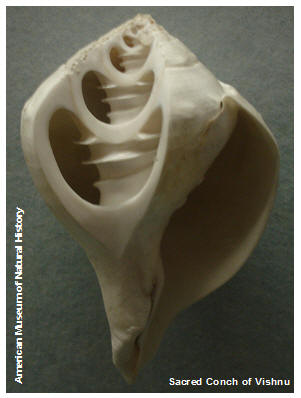
पाञ्चजन्यं हृषीकेशो देवदत्तं धनञ्जयः ।
पौण्ड्रं
दध्मौ महाशङ्खं भीमकर्मा वृकोदरः
॥१-१५॥ 1.15
pāñcajanyaṁ
hṛṣīkeśo devadattaṁ dhanañjayaḥ
pauṇḍraṁ dadhmau mahāśaṅkhaṁ bhīmakarmā vṛkodaraḥ 1.15
1.15: Hrisikesa blew His conch, Pāchajanya; Dhanajaya blew his conch,
Devadatta; and Bhima the big eater and formidable doer of deeds blew his big
conch, Paundra.
Hrisikesa is Lord Krishna, Dhananjaya is Arjuna and Virokdara [Bhima] is
Arjuna's sibling.
Panchajanya, Devadatta and Paundram are the names of conches of the
respective personas.
Bhima means 'The Terrible', and thus are the epithet Bhima and eponymous
acts, Bhima Karma (= terrible deeds).
अनन्तविजयं राजा कुन्तीपुत्रो युधिष्ठिरः ।
नकुलः
सहदेवश्च सुघोषमणिपुष्पकौ
॥१-१६॥ 1.16
anantavijayaṁ rājā kuntīputro
yudhiṣṭhiraḥ
nakulaḥ sahadevaś ca sughoṣamaṇipuṣpakau 1.16
काश्यश्च परमेष्वासः शिखण्डी च महारथः ।
धृष्टद्युम्नो विराटश्च सात्यकिश्चापराजितः
॥१-१७॥ 1.17
kāśyaś
ca parameṣvāsaḥ śikhaṇḍī ca mahārathaḥ
dhṛṣṭadyumno virāṭaś ca
sātyakiś cā 'parājitaḥ 1.17
द्रुपदो द्रौपदेयाश्च सर्वशः पृथिवीपते ।
सौभद्रश्च महाबाहुः शङ्खान्दध्मुः पृथक्पृथक्
॥१-१८॥ 1.18
drupado draupadeyāś ca sarvaśaḥ
pṛthivīpate
saubhadraś ca mahābāhuḥ
śaṅkhān
dadhmuḥ
pṛthak-pṛthak
1.18
1.16-18: Yuddhisthira, Nakula and
Sahadeva, Sikhandin, Dhristadyumna, Virata, Satyaki, Drupada, the sons of
Draupadi, and the son of Subhadra all blew their respective conches.
The verses were condensed to convey
the meaning only. Nakula and Sahadeva are twins.
स घोषो धार्तराष्ट्राणां हृदयानि व्यदारयत् ।
नभश्च
पृथिवीं चैव तुमुलो व्यनुनादयन्
॥१-१९॥ 1.19
sa ghoṣo dhārtarāṣṭrāṇāṁ
hṛdayāni vyadārayat
nabhaś ca pṛthivīṁ cai 'va tumulo vyanunādayan 1.19
1.19: The tumultuous roar (of the
conches), reverberating through the sky and the earth, tore the hearts of
the sons of Dhritarastra (the Kauravas).
अथ व्यवस्थितान्दृष्ट्वा धार्तराष्ट्रान्कपिध्वजः ।
प्रवृत्ते शस्त्रसंपाते धनुरुद्यम्य पाण्डवः
॥१-२०॥
1.20
atha vyavasthitān dṛṣṭvā
dhārtarāṣṭrān
kapidhvajaḥ
pravṛtte śastrasaṁpāte
dhanur udyamya pāṇḍavaḥ
1.20
1.20: O King, thereupon Arjuna,
whose flag bore the crest of Hanuman, seeing
the sons of Dhritarastra ready for battle, took up his bow, and spoke these
words to Lord Krishna.
The insignias (limbs) of a king are the following: NAdu = Country,
Mala = mountain, Nadi = River, Ijru = Village, Kottara = Palace, Kutira =
Horse, Ana = Elephant, Murasu = War Drum, Koji = Flag,
CenkOl (Scepter). The only thing Arjuna was left with was his chariot,
his horses, his bow and arrows, and his flag. More importantly, Arjuna had
Krishna on his side and front as his Charioteer. His final victory was made
possible by Krishna, his friend, relative (brother-in-law) and Bhagavan.
Arjuna married Krishna's sister and his cousin Subhadra.
Hanuman means that he is
heavy-jawed; he is the chief of Vānarās, ape-like beings, which helped Rama
fight Ravana, the demon-king of Sri Lanka. The latter abducted the wife,
Sita, of Lord Rama; when Rama sent Lord Hanuman to look for Sita, he reached
Lanka in one long jump. Ravana ordered his servants (Raksasas/devils or
demons) to set Lord Hanuman’s tail on fire, and paraded Hanuman on the
streets of Lanka with his tail in blaze; abducted Sita, knowing this,
invoked Agni, the Lord of Fire, who let the end of the tail glow in the
flame, but not burn and stay fire-resistant.
Hanuman,
in the spirit of teaching a lesson to Ravana
and Indrajit, set the city on fire. Lord Hanuman's services are recognized
and celebrated by man and God and He is always imaged along with Rama, Sita,
and Lakshmana, Rama's brother. Hanuman claims His
lineage from Vayu (Enlil
of Summeria), the wind God and Añjanā, an apsarasa. An apsarasa is a
celestial nymph and dancer and is usually a mistress of Gandharva living in
Svarga, Indira's paradise. Lord Hanuman's image adorns Arjuna’s flag.
Author's note: Smokes, flags, and
drums have been in use for a long time. It is claimed that Egyptians used
the flags as early as 4000 B.C., on their ships identifying its registry.
Vexillum is the Latin word for flag. A flag
historian is called Vexillologist. Sanskrit word for flag is
Dhvaga. Flags were used in ancient India in
front of liquor stores, announcing they were open for business.
In Summerian mythology, the god
of wind (Air, Airspace) is
Enlil, the second most powerful god
of Sumerians.
Enlil
was born of ANU (heaven) and
KI (earth) and became the chief of gods (the
Indra of Hindu mythology). He also put together the Laws of the Universe,
ME known in Hindu mythology as
RTA. Sanskrit
Rta, English Right, Persian arta, and Latin ritus
are cognate.

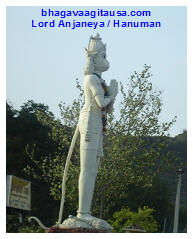
Hanuman
हृषीकेशं तदा वाक्यमिदमाह महीपते ।
अर्जुन उवाच
सेनयोरुभयोर्मध्ये रथं स्थापय मेऽच्युत
॥१-२१॥
1.21
hṛṣīkeśaṁ tadā
vākyam idam āha mahīpate
senayor ubhayor madhye rathaṁ sthāpaya me 'cyuta 1.21
यावदेतान्निरिक्षेऽहं योद्धुकामानवस्थितान् ।
कैर्मया
सह योद्धव्यमस्मिन् रणसमुद्यमे
॥१-२२॥ 1.22
yāvad etān
nirikṣehaṁ yoddhukāmān avasthitān
kair mayā saha yoddhavyam asmin raṇasamudyame 1.22
1.21- 22: O Acyuta (Krishna), stand
my chariot between the two armies in order for me to look upon those who are
eager for a battle and with whom I have to fight.
The meaning of the verses are
condensed to convey the meaning only.
योत्स्यमानानवेक्षेऽहं य एतेऽत्र समागताः ।
धार्तराष्ट्रस्य दुर्बुद्धेर्युद्धे प्रियचिकीर्षवः
॥१-२३॥ 1.23
yotsyamānān
avekṣe 'haṁ ya ete 'tra samāgatāḥ
dhārtarāṣṭrasya durbuddher yuddhe priyacikīrṣavaḥ 1.23
1.23: I wish to see those assembled
here willing to fight and serve the evil-minded son of Dhrtarāstra.
सञ्जय उवाच
एवमुक्तो हृषीकेशो गुडाकेशेन भारत ।
सेनयोरुभयोर्मध्ये स्थापयित्वा रथोत्तमम्
॥१-२४॥
1.24
Sañjaya
Uvāca:
evam ukto
hṛṣīkeśo guḍākeśena bhārata
senayor ubhayor madhye sthāpayitvā rathottamam 1.24
1.24: Sanjaya said:
O Bharata
(Dhrtarāstra), having been addressed by Gudakesana (Arjuna), Hrsikesa (Lord
Krishna) placed the best of chariots in the midst of both armies.
भीष्मद्रोणप्रमुखतः सर्वेषां च महीक्षिताम् ।
उवाच पार्थ पश्यैतान्समवेतान्कुरूनिति
॥१-२५॥
1.25
bhīṣmadroṇapramukhataḥ sarveṣāṁ ca mahīkṣitām
uvāca pārtha paśyai 'tān samavetān kurūn iti 1.25
1.25: Facing Bhisma, Drona, and all
great chiefs (the Lord) said to Partha: Behold (all of) the Kurus gathered
thus.
तत्रापश्यत्स्थितान्पार्थः पितॄनथ पितामहान् ।
आचार्यान्मातुलान्भ्रातॄन्पुत्रान्पौत्रान्सखींस्तथा
॥१-२६॥ 1.26
tatrā 'paśyat sthitān
pārthaḥ pitṛn atha pitāmahān
ācāryān mātulān bhrātṛn
putrān pautrān sakhīṁs
tathā 1.26
श्वशुरान्सुहृदश्चैव सेनयोरुभयोरपि ।
तान्समीक्ष्य स कौन्तेयः सर्वान्बन्धूनवस्थितान्
॥१-२७॥
1.27
śvaśurān
suhṛdaś cai 'va senayor ubhayor api
tān samīkṣya sa kaunteyaḥ sarvān bandhūn avasthitān 1.27
कृपया परयाविष्टो विषीदन्निदमब्रवीत् ।
अर्जुन उवाच
दृष्ट्वेमं स्वजनं कृष्ण युयुत्सुं समुपस्थितम्
॥१-२८॥
1.28
kṛpayā
parayā 'viṣṭo
viṣīdann
idamabravīt
dṛṣṭve
'maṁ svajanaṁ kṛṣṇa
yuyutsuṁ samupasthitam
1.28
सीदन्ति मम गात्राणि मुखं च परिशुष्यति ।
वेपथुश्च शरीरे मे रोमहर्षश्च जायते
॥१-२९॥
1.29
sīdanti mama gātrāṇi
mukhaṁ ca pariśuṣyati
vepathuś ca śarīre me romaharṣaś
ca jāyate 1.29
|
Beholding
these my relatives arrayed
Before my
eyes in serried line of battle,
Preparing
for the deadly fray, my limbs
Are all
relaxed, my blood dries up, a tremor
Palsies my
frame, the hairs upon my skin
Bristle with
horror, all my body burns
As if with
fever, and my mind whirls round,
So that I
cannot stand upright, nor hold
The bow
Gāṇḍīva slipping from my hand.
I cannot —
will not fight — mighty Krishna.
I seek not
victory, I seek no kingdom.
"What shall
we do with regal pomp and power,
What with
enjoyments or with life itself,
When we have
slaughtered all our kindred here?
Indian Wisdom by Monier Monier-Williams
Verse 1.28-33
page 139.
Note dated July 8, 2015 |
1.26-29: Partha could see standing
there (on the battlefield) fathers, also grandfathers, teachers, maternal
uncles, brothers, sons, grandsons, friends too, fathers-in-law, well-wishers
and the armies of both sides. Kaunteya, after seeing all of them, and all
kinds of relatives, overwhelmed by compassion and lamentation spoke. Arjuna
said: O Krishna, after seeing all the relatives present before me all ready
and eager to fight, I feel the limbs of (my) body shake, (my) mouth dry, my
body quiver, and my hair stand on end.
गाण्डीवं स्रंसते हस्तात्त्वक्चैव परिदह्यते ।
न च
शक्नोम्यवस्थातुं भ्रमतीव च मे मनः
॥१-३०॥ 1.30
gāṇḍīvaṁ sraṁsate hastāt tvak
cai 'va paridahyate
na ca śaknomy avasthātuṁ bhramatī 'va ca me manaḥ 1.30
निमित्तानि च पश्यामि विपरीतानि केशव ।
न च
श्रेयोऽनुपश्यामि हत्वा स्वजनमाहवे
॥१-३१॥ 1.31
nimittāni ca
paśyāmi viparītāni keśava
na ca śreyo 'nupaśyāmi hatvā svajanam āhave 1.31
1.30-31: My
bow, Gandiva, is slipping from my hand. My skin is burning. I am not able to
stand steadily. I am forgetting myself. My mind is reeling. O Kesava,
I see adverse omens; I foresee no good by killing my own people in battle.
न काङ्क्षे विजयं कृष्ण न च राज्यं सुखानि च ।
किं नो राज्येन गोविन्द किं भोगैर्जीवितेन वा
॥१-३२॥
1.32
na kāṅkṣe
vijayaṁ kṛṣṇa na ca rājyaṁ sukhāni ca
kiṃ no rājyena govinda kiṁ bhogair jīvitena vā 1.32
1.32: O Krishna, I long neither for victory, nor for kingdom and nor for
happiness. O Govinda, of what use is the kingdom, enjoyment, or living?
येषामर्थे काङ्क्षितं नो राज्यं भोगाः सुखानि च ।
त
इमेऽवस्थिता युद्धे प्राणांस्त्यक्त्वा धनानि च
॥१-३३॥ 1.33
yeṣām arthe
kāṅkṣitaṁ no rājyaṁ bhogāḥ sukhāni ca
ta ime 'vasthitā yuddhe prāṇāṁs tyaktvā dhanāni ca 1.33
1.33: They, for whose sake kingdom,
enjoyment, and happiness are desired, are standing here in the battlefield
ready to give up their lives and riches.
आचार्याः पितरः पुत्रास्तथैव च पितामहाः ।
मातुलाः श्वशुराः पौत्राः श्यालाः संबन्धिनस्तथा
॥१-३४॥
1.34
ācāryāḥ
pitaraḥ putrās tathai 'va ca pitāmahāḥ
mātulāḥ śvaśurāḥ pautrāḥ śyālāḥ sambandhinas tathā 1.34
1.34: Teachers, fathers, sons, as
well as grandfathers, maternal uncles, fathers-in-law, grandsons,
brothers-in-law, and other relatives.
एतान्न हन्तुमिच्छामि घ्नतोऽपि मधुसूदन ।
अपि त्रैलोक्यराज्यस्य हेतोः किं नु महीकृते
॥१-३५॥
1.35
etān na hantum icchhāmi
ghnato 'pi madhusūdana
api trailokyarājyasya hetoḥ kiṁ nu mahīkṛte
1.35
1.35: I do not want to kill them,
though they (want to) kill me, O Madhusudhana, even for the three worlds,
not to speak of an earthly kingdom.
निहत्य धार्तराष्ट्रान्नः का प्रीतिः स्याज्जनार्दन ।
पापमेवाश्रयेदस्मान्हत्वैतानाततायिनः
॥१-३६॥
nihatya dhārtarāṣṭrān
naḥ kā prītiḥ syāj
janārdana
pāpam evā 'śrayed asmān hatvai 'tān ātatāyinaḥ 1.36
1.36: By
killing the sons of Dhrtrastra, what pleasure can there be? O Janardhana,
upon killing these heinous sinners,
sin will
descend on us.
तस्मान्नार्हा वयं हन्तुं धार्तराष्ट्रान्स्वबान्धवान् ।
स्वजनं
हि कथं हत्वा सुखिनः स्याम माधव
॥१-३७॥ 1.37
tasmān nā
'rhā vayaṃ hantuṁ dhārtarāṣṭrān
svabāndhavān
svajanaṁ
hi kathaṁ hatvā sukhinaḥ syāma mādhava 1.37
1.37: Therefore, it is not becoming
of us that we kill the sons of Dhritrastra. How, by killing kinsmen, can we
become happy O Madhava?
यद्यप्येते न पश्यन्ति लोभोपहतचेतसः ।
कुलक्षयकृतं दोषं मित्रद्रोहे च पातकम्
॥१-३८॥
1.38
yady apy ete
na paśyanti lobhopahatacetasaḥ
kulakṣayakṛtaṁ doṣaṁ mitradrohe ca pātakam 1.38
1.38: Even if they, whose minds are
overwhelmed by greed, do not see sin in the ruin of the family, or crime in
treachery to friends…
Even if they, whose greed overwhelms
their mind, do not see sin in the ruin of the family, or crime in treachery
to friends…
कथं न ज्ञेयमस्माभिः पापादस्मान्निवर्तितुम् ।
कुलक्षयकृतं दोषं प्रपश्यद्भिर्जनार्दन
॥१-३९॥
1.39
kathaṁ na
jñeyam asmābhiḥ pāpād asmān nivartitum
kulakṣayakṛtaṁ doṣaṁ prapaśyadbhir janārdana 1.39
1.39: Why should not we have the
wisdom to see the crime in the ruin of the family O Janardhana, and turn
away from the sins?
कुलक्षये प्रणश्यन्ति कुलधर्माः सनातनाः ।
धर्मे
नष्टे कुलं कृत्स्नमधर्मोऽभिभवत्युत
॥१-४०॥ 1.40
kulakṣaye
praṇaśyanti kuladharmāḥ sanātanāḥ
dharme naṣṭe kulaṃ kṛtsnam adharmo 'bhibhavaty uta 1.40
1.40: With the ruin of the family,
the eternal kula dharma is destroyed. When dharma is destroyed, the whole
family turns to adharma.
Kula dharma: Established order of
the family, family institution. Dharma: Established order. Adharma:
Unrighteousness.
अधर्माभिभवात्कृष्ण प्रदुष्यन्ति कुलस्त्रियः ।
स्त्रीषु
दुष्टासु वार्ष्णेय जायते वर्णसंकरः
॥१-४१॥ 1.41
adharmābhibhavāt kṛṣṇa
praduṣyanti
kulastriyaḥ
strīṣu duṣṭāsu
vārṣṇeya
jāyate varṇasaṁkaraḥ 1.41
1.41: When
Adharma prevails, O Krishna, the women of the family become morally corrupt,
and when women are tainted, O Varsneya (Krishna), Varna Samkara comes into
existence.
To this day in India, women bear the heavier
burden than men in guarding morality and any scrofulousness on their
part brings disproportionably erosive shame to the family.
Adharma: Unrighteousness. Varna
Samkara: mixture of castes by intermarriage.
ससरो
नरकायैव कुलघ्नानां कुलस्य च ।
पतन्ति
पितरो ह्येषां लुप्तपिण्डोदकक्रियाः
॥१-४२॥ 1.42
saṅkaro
narakāyai 'va kulaghnānāṃ kulasya ca
patanti pitaro hy eṣāṁ luptapiṇḍodakakriyāḥ 1.42
1.42:
Commingling (of castes) brings hell to the family and those who
destroyed the race. The spirits of the ancestors fall, deprived of their
offerings of food and water.
Purport:
Because of commingling of castes,
the family and the destroyers of the race go to hell. The spirit of the
ancestor falls, deprived of the offerings of food and water.
|
Question ID: 522 -
NAMASKARA! According to shastras, is a Brahmin male allowed to marry a
Kshatriya female as a primary and only wife ? If so (or if not so),
are the resultant progeny considered Brahmins ?
Sri U. Ve Velukkudi Krishnan Swamy answers:
Varna sankaram is a papa as per first chapter
of Gita.
Meaning: Marriage
between castes (Intermarriage) is sin according to Bhagavadgita,
chapter 1, Verse 42. |
Sankara:
Commingling of castes looked down upon at that time as miscegenation was
looked down upon in the west in the past. Kula-ghnānām: destruction of race.
Many of the commentators have
deliberately altered the meaning of the Sanskrit word, Sankara. In keeping
with the modern view of equality of races, many of the commentators on this
verse conveniently do not address this issue of commingling of races out of
embarrassment, common courtesy and decency. Commingling of races is
deliberately altered to such word as confusion. If one wants to get a
correct translation of this verse, one has to read Sankara and Ramanuja.
Sankara's
commentary in Sanskrit as translated by Swami Ghambirananda:
And the
intermingling in the family leads the ruiners of the family verily into
hell. The forefathers of these fall down (into hell) because of being
deprived of the offering of rice-balls and water.
Ramanuja's
commentary in Sanskrit as translated by Svami Adidevananda:
This mixing
of classes (castes) leads to hell the clan itself and its destroyers; for
the spirits of their ancestors fall degraded, deprived of the ritual
offering of food and water.
The
confusion verily drags the family-slayer, as well as the family, to hell,
and for want of obsequial offerings and rites their departed sires fall from
blessedness.
Gandhi's
comment: Hindu Dharma
by M.K.Gandhi page 56-65.
Gandhi is a
firm believer in Varnasrma Dharma. Gandhi admits he was born of Vaishya
(Traders) parents, 3rd down the line. Gandhi says, "I as a Vaisya would be
earning my bread by selling drugs (pharmacist) or groceries. Vaisya Varna
includes all professions. A tailor may not become a blacksmith
although both may be and should be called as Vaisyas. No one is superior to
any other (among the four varnas). A scavenger has the same status as a
Brahmin. He endorses the view of Max Muller by quoting him:
In Hinduism more than any other religion that life was no more and no less
than DUTY. Varna does not make life dull and rob it of all ambition. Under
the cover of Varna, hideous inequalities and tyrannies are practiced at the
present day in Hinduism. Varna is not a mere institution made by man but it
is a law discovered by him. The evil lies in the doctrine of superiority and
inferiority superadded to it. I do regard Varnashrma as a healthy division
of work based on birth. The present idea of caste is a perversion of the
original. He (a non-Brahmin) who performs the duty of a Brahmin will easily
become one in the next incarnation.
It appears that according to
Gandhi, any Varna can do any work suited to his temperament, training,
intellect, aptitude, and education, as long as he or she does not call
himself or herself by other than his Birth-Varna.
Apart from four main castes,
Brahmin, Ksatriya, Vaisya and Sudra, there is the fifth class, Antyaja.
Antya (last in order) + Ja (caste) = the lowest caste. The Antyajas are the
washer men, tanners, mimics (actor), Varudas (cane-weavers), Kaivartas
(fishermen), Bhedas*, and Bhillas (hill tribes).
Bhedas*: name of certain tribe.
Below these people, there are the
Mlecchas and Dumbas. Mlecchas generally are the foreigners, barbarians,
non-Aryans and those who do not speak Sanskrit. Dumbas are basket and rope
makers, cremation workers,
street musicians and dancers.
The view
from the west.
A note on cremation: Cremation of the dead as a Hindu custom came down
from the Indo-Aryan Agni (Fire-god) worshippers in the Vedic age. Modes of
disposal of the dead have been passed from antiquity: Agni Dagdhah (burning
by fire), An-Agni Dagdhah (not burnt but buried), Paroptah (casting off),
Uddhitah (Exposure of the dead). The Persian fire-worshippers exposed
the dead to the vultures in the tower of silence, the custom practiced
by Zoroastrians (Parsees). The cremation custom spread to Europe
later. In olden days in Europe, the wealthy dead were reduced to
ashes; the poor were buried. The Aryans
invading
into Europe introduced this custom. Since the Aryans were nomads, they
cremated the dead. Burial place and the relatives, according to
belief, were haunted and threatened by spirits of Pitris or ancestors;
therefore, the nomads cremated their near and dear to avoid haunting by the
ghosts, which ran away because the fire took the souls to Hades, a welcome
house for the departed souls of the earth. The Indo-Aryans were of the
belief that the dead take the path of Agni to the world of forefathers and
Yama (god of death), live in splendor like the gods, leave behind all the
miseries and evils of the earth-life, live a better and more perfect life,
receive solace and recognition from Yama, enjoy fulfillment of all desires,
and move among gods.
Sanskrit Yama, Tamil Yaman,
Persian Yima, Nordic Ymir, and Canaanite god Yam are
one and the same god.
Agni, glorified by gods and men, is invoked by them to make the path of
the departed fathers straight and trouble-free, show kindness and carry the
oblations. The Dead make their journey to Yama on foot. Yama and His sister
Yami are no different from the twins, Persian Yima and Yimeh, whose parents
are Vivahvant as the Indian counterparts had Vivasvat as their parent. Yami
woos Yama (!), who rejects her proposal outright.
Yama wears blood-red garments and sports a glittering sable hue and
appearance. He
rides a buffalo and holds a club and noose.
Yami is identified with post-Vedic River Goddess, Yamuna. Yama has two grey
dogs, each with four eyes ( four eyes = two physical eyes and a yellow
pigmented fur by each eye), and two messengers, owl and pigeon. The Dead,
who faithfully fulfilled all religious observances, are welcomed and assured
of their original shining form without the sin, shame and taint of the
earth. Yama is Dharma Raja, King
Righteousness, and Pitrapathi, Lord of the
fathers, Samavurti, the Impartial Judge,
Kritana, the Finisher,
Antaka, He who Ends Life, and Samana,
the Leveler. (Death is a Leveler.) His Minister and chronicler keeps a
record of the deeds of men in a book called Agra
SamAdhanA (a Register of Human Actions) from which he reads out a
litany of bad (and also good) acts, which demand suitable rewards or
punishments. Post-Vedic Yama is the Chief Executive of a complicated system
of Hells and goes also by the name of Dandadhara, the Wielder of the rod or
mace. He binds the souls with the noose and carries out the decrees of
gods (an exclusive franchise) and takes charge of the soul of the size of a
thumb at the appointed time. (Vaishnavas are of the belief that Yama and his
minions show deference to Vishnu's devotees, irrespective of their caste or
any other terrestrial differences.)
Commentary section following chapter
and verse 5.18, describes mixed castes according to Garuda Purana 1.96-1-73,
as narrated by Yajnavalkya.
The spirits of the ancestors fall, deprived of their offerings of food and
water. (Read the Verse 1.42)
There is a beautiful description
about CirArtham (Sraddha), offering of food to the ancestors (manes) in Book
6 KuraiOnrumIllai -குறையொன்றுமில்லை- by
Mukkur Lakshmi Narasimhachariar. Achariar quotes Pitru-Gitam in
Vishnupuranam. Cirartham (சிரார்த்தம்)
is a two-way fare. The manes are pleased with the offering from their
descendants, who offer blessings to their progeny who perform the ceremony.
The ceremony is presided by a deity, Harshana. The offered food is called
Pinda and the act is Sraddha. The following is an extract from Vishnu
Puranam, translated from Sanskrit to English by H.H.Wilson. They who are
desirous of worshipping their Pitrs or the gods can do Sraddha on a day of
new moon when the stars Dhanishtha, PurvaBhadraPada or Sata-Bhisha. Another
class of Sraddha is done on the third lunar day of the month of VaisAkha
(April, May) and the ninth of Kartika (October-November) in Sukhla Paksha
(Bright Fortnight). Other dates are 13th of Nabha (July-August) and
the 15th of Magha (Jan-February) in Krishna Paksha (Dark Fortnight). They
are the first days of a Yuga (age) and most sacred. On these above
days; solar and lunar eclipses; and 8th lunations of the Dark Fortnight of
Agrahanya, Magha, and Phalguna (Dec-Feb); the days commencing the
solstices, when the nights and the days alternately begin to diminish; the
anniversaries of manvantaras; the day, the sun is in the path of the goat;
days of meteoric occurrences; Sesamum seeds and water are offered to
the progenitors of the mankind. A Sraddha on these days and seasons gives
happiness to the Manes for a thousand years. The songs of the forefathers
give the descendants purity of heart, integrity of wealth, prosperous
seasons, perfect rites, devout faith, and all that men desire. That
blessed descendant will be born in a distinguished family. If the descendant
cannot afford elaborate food items and gifts of wealth, jewels, clothes,
land, conveyances, and any valuable gifts to the officiating Brahmana
priest, there are alternatives in the descending order: 1) unboiled grain,
affordable gifts, plantain, dal; 2) a fistful of sesame seeds; 3) about ten
to fifteen sesame seeds stuck on a wet thumb; 4) one day's worth of
grass for the cow; 5) going to the forest, throwing the hands up in the air
to the sun and other celestials and declaring that he cannot afford anything
to the forefathers and the officiating Brahmana. Actually these are the
words and recommendations of the manes themselves to their descendants.
Narasimhachariar adds no one
should think of Sraddha as wasteful. We have seen how Sastras made Sraddha
simple.
Pitru Devatas
are RudrAs, Vasus, and Adityas. Sraddha offers contentment to the Devatas
and not to the departed parents. Their blessing and grace give prosperity to
the progeny. Some of the Devatas are wandering without receiving the Sraddha.
They desire that one of their progeny would perform Sraddha and make them
happy and contented and thus facilitate liberation. That is why one
should do Sraddha on a the day Bhishma attained liberation. The Devatas will
be supremely happy upon receiving Pitru Karyam (Sraddha=
பித்ரு காரியம்) and send their Anugraha. The descendants will also
attain liberation just like Bhishma.
Swami Sivananda says the
following on offering of food to manes (Sraddha).
The Pitrus are forefathers who dwell in Pitru-loka. They possess
clairvoyance and clairaudience. Recitation of Mantras exercises tremendous
influence through their vibration. The Pitrus hear the sounds through the
power of clairaudience and they are pleased. They bless those who offer the
oblation. In Sraddha, the essence of food offerings is taken up by sun’s
rays to Suryaloka and the departed souls are pleased with the offerings.
Even in the West many persons perform Tarpana and Sraddha. They have
scientifically investigated into the beneficial effects of such oblations.
It is the imperative duty of all householders to perform Sraddha and Tarpana
to please the Rishis and the Pitrus. It is only the deluded souls with
perverted intellects who misconstrue things and neglect to perform the
sacred ceremonies and consequently suffer.
दोषैरेतैः कुलघ्नानां वर्णसरकारकैः
।
उत्साद्यन्ते जातिधर्माः कुलधर्माश्च शाश्वताः
॥१-४३॥ 1.43
doṣair etaiḥ kulaghnānāṁ
varṇasaṁkarakārakaiḥ
utsādyante jātidharmāḥ kuladharmāś ca śāśvatāḥ 1.43
1.43: By such evil deeds such as
kula ghānām and Varna Sankara, eternal Jāti dharmā and kula dharmā are
destroyed.
Kula ghānām:
destruction of race.
Varna Sankara: mixture of castes by
intermarriage. Jāti dharmā: established order
of caste or institution of caste.
Kula dharmā: established order of the
family, family institution, practice or observance peculiar to a tribe or
family, peculiar duty of a caste or race.
Sivapurana (Rudrasamhita Section II,Chapter
13, V35) mentions the three debts that Brahmanas, Ksatriyas and
Vaisyas owe, to which two more are added later. The
first debt is Brahmacharya or study of Vedas owed to the Rsis;
second, sacrifice and worship owed to the gods;
third, begetting a son owed to the manes;
fourth, benevolence owed to humanity;
fifth, hospitality owed to guests.
उत्सन्नकुलधर्माणां मनुष्याणां जनार्दन ।
नरकेऽनियतं वासो भवतीत्यनुशुश्रुम
॥१-४४॥
1.44
utsannakuladharmāṇāṁ manuṣyāṇāṁ janārdana
narake niyataṁ vāso bhavatī 'ty anuśuśruma 1.44
1.44: We have heard it said (by the
learned) that those men, whose kula dharma is destroyed, O Janardana, would
always dwell in hell.
Purport: O Janardana, we heard it said (by the learned): once kula dharma is
annihilated, hell is the habitation for these men.
अहो बत महत्पापं कर्तुं व्यवसिता वयम् ।
यद्राज्यसुखलोभेन हन्तुं स्वजनमुद्यताः
॥१-४५॥
1.45
aho
bata mahat pāpaṁ kartuṁ
vyavasitā vayam
yad rājyasukhalobhena hantuṁ svajanam udyatāḥ 1.45
1.45: Alas! We have decided to
commit great sins, by getting ready to kill our kinsmen because of greed for
the pleasures of kingdom.
Rājya-sukha-lobha:
kingdom-pleasure-greed: greed for the pleasures of kingdom.
यदि मामप्रतीकारमशस्त्रं शस्त्रपाणयः ।
धार्तराष्ट्रा रणे हन्युस्तन्मे क्षेमतरं भवेत्
॥१-४६॥ 1.46
yadi mām apratīkāram aśastraṁ
śastrapāṇayaḥ
dhārtarāṣṭrā raṇe
hanyus tan me kṣemataraṁ
bhavet 1.46
1.46: Better would it be for me, if
the sons of Dhritrastra with weapons on hand were to kill me on the
battlefield, while I, unarmed, offer no resistance.
Purport: It is better for me that
the sons of Dhritrastra kill me on the battlefield with weapons on hand,
while I am unarmed and offer no resistance.
सञ्जय उवाच
एवमुक्त्वार्जुनः सख्ये रथोपस्थ उपाविशत् ।
विसृज्य सशरं चापं शोकसंविग्नमानसः
॥१-४७॥
1.47
Saṅjaya
uvāca
evam uktvā 'rjunaḥ saṅkhye
rathopastha upāviśat
visṛjya
saśaraṁ cāpaṁ
śokasaṁvignamānasaḥ 1.47
1.47:
Sanjaya said:
Thus
saying in the battlefield, Arjuna sat down on the seat of the chariot,
laying aside his bow and arrow with his mind taken over by sorrow.
End BG Chapter 1
