

|
Bhagavad-Gita: 18 Chapters in Sanskrit |
| Download Bhagavadgita-all 18 chapters in Sanskrit, English, |
| transliteration and word for word translation. |
Bhagavadgita in English
| bg07-Sanskrit | bg10-Sanskrit | bg11-Sanskrit | bg12-Sanskrit | ||
| bg13-Sanskrit | bg14-Sanskrit | bg15-Sanskrit | bg16-Sanskrit | bg17-Sanskrit | |
https://myindiastories.com
Veeraswamy Krishnaraj: Tolerance with love is to speak in tongues of all faiths, hold in the heart the Truth of all faiths and see
all faiths in the face of humanity.
You have your Google search engine tailored for this site.
Please enter the word(s) in the search box; it will take you to the file with that word in this web site. Enjoy your visit here.
About the author:
Veeraswamy Krishnaraj, M.D; F.R.C.P (Canada) is a board certified pediatrician in active practice until the end of 1998. He immersed himself in study of Hinduism in depth. He has sufficient knowledge and understanding of Hindu religion that he is confident to publish this book. He kept the words simple, supple, illuminating and to the point, while retaining the original flavor, beauty and grace. Compound words in Sanskrit are a nightmare for the beginner, as they are spliced together compactly in one continuous stretch of characters. He parsed the compound words into digestible syllables or words with superscripts and sequential numbers and rearranged the words in the verse in a readable form in English. In this book, he claims ownership of shortcomings and cedes the rest to Bhagavan.
This book is good for students, and devotees reading the Bhagavad-Gita in Satsang (true company). Two verses nestle in two boxes in one page with no break or carry-over to the next page. Diacritics help the reader enunciate the words like a Sanskritist. The English words are reader-friendly. Wherever there is a need for elaboration, an addendum supports it.
Simplicity, authority, universality, and profundity are the hallmark of the Bhagavadgita, the Bible of the Hindus. The Bhagavadgita is the Song of the Lord. It provides guidelines for daily living with no dogmas and ritual overtones. It encourages and supports your individuality. It also explains the consequence of errant ways. Total surrender to Bhagavan releases the devotee from the ills of life on earth. Hinduism as a term is an external appellation from non-Hindus. Its true name is Sanatana Dharma (Eternal Law or Eternal Order) commensurate with Rta (Cosmic Order). The beauty about the Bhagavadgita is its appeal is universal.
09/21/2017
The Knower, the
Field, and the Nature
The Supreme Knower, the Body, and the Prakriti
Ksetrajna, Ksetra, and Prakriti
13.0: Arjuna said:
Prakriti, Purusa, the field, and
the knower of the field, knowledge, and the object of knowledge, I wish to
know, O Kesava.
अर्जुन उवाच
प्रकृतिं पुरुषं चैव क्षेत्रं क्षेत्रज्ञमेव च।
एतद्वेदितुमिच्छामि ज्ञानं ज्ञेयं च केशव।।
Arjuna uvāca
prakṛtiṁ puruşaṁ caiva kşetraṁ kşetrajñam eva ca
etad veditum icchāmi jñānaṁ jñeyaṁ ca keśava.
This above verse is present only in Bhagavad-gita as it is by Prabhupada. Thus it is given the number 13.0.
Purusa = The Enjoyer. Ksetram = Body. Ksetrajnam = Knower of the body. Jnanam = Knowledge. Jneyam = object of knowledge. Sariram = body. Ksetram = field. Ksetrajna = Knower of the body.
The human body is
the ksetra or the field; the individual soul, trapped inside the body, is
Ksetrajna or the knower of the field; the person owning the body is the
apparent knower or ksetrajna. Knowledge is to know Brahman as Bliss. The idea
here is that if unthinking prakriti makes the body, who is the knower of this
body? The individual soul and the Higher soul are the Knowers of the field and
have an organic relationship to each other. The individual soul or self is
less of a knower than the Higher Self or Soul, because Prakrti burdens and
conditions the individual soul. The field of activity for the Higher soul is
not only this universe, but the individual souls too. The Lord is the Knower
and the witness in bodies of gods and men, and His ksetra is the universe and
the beings. He is the Soul also of gods and men. Once the knower understands
the distinction between the soul and the body, salvation is within his reach.
All exist for His enjoyment. He is BhOkthA,
BhOgyam and PrErithA. BhOktha is the individual. BhOgyam is that which is
experienced. PrErithA (Animator) is BhagavAn. BhOktha is the enjoyer. Only if
He wills, one can have the enjoyment. Ultimately He is all three. That is
the VishEshArtham. That is the knowledge we should acquire. Bhagavan
experiences us, because He remains inside us; thus He is the Ultimate BhOgyan
(enjoyer or experiencer).
VishEshArtham = Elaborate explanation, (pointing out the special features and
beauties of a stanza).
1:Putatma1 (பூதாத்மா) The Pure Self - One who
is untainted by the effects of karma - good or bad. Puta Atma yasya sa putatma
- One who has the pure Atma is pUtAtmA.
2:Paramatma2 (பரமாத்மா) The Supreme Soul - for
whom there is no other guiding or superior soul
3:Muktanam Parama gatih3 (முக்தானாம் பரமகதி) One
who is the ultimate goal for all muktas or Released or Liberated Souls.
Yagna = Yajna = Yagnam/Yajnam = யக்ஞம் =
யஞ்ஞம் = Sacrifice = ritual Sacrifice.
In Vaishnava tradition and according to Sahasranamam, Bhagavan is PutAtma1, Paramatma2, Muktanam parama gatih3. Mukkur Lakshmi Narasimhachariyar questions who that Paramatma2 is. What is the reason for invoking Him as such? He is present in five Maha Yagnas (ஐவகைவேள்வி): Devata Yagnam1, Bhuta Yagnam2 , Bruhma Yagnam3 , Manushya Yagnam4, and Pitru Yagnam5. Thus Vishnu is known as Yagna-Purusha (யக்கியபுருடன்--yakkiya-purutan) meaning that Vishnu assumes the form of Sacrifice. What we eat is a great Yagnam. We eat not to sustain our body but for the Lord inside us. To perform Yagnam, we need a place. This body is the place for such Yagnam. Bhagavan says that this body is Ksetram. In our body the Homa Kundam is the mouth. Homa Kundam = Pit dug out in the ground for keeping sacrificial fire.
Five kinds of Sacrifice which a householder is
enjoined to perform daily. கடவுள்வேள்வி1 ( தேவயஞ்ஞம்1),
பூதவேள்வி2 (பூதயஞ்ஞம்2), பிரமவேள்வ3(
பிரமயஞ்ஞம்3), மானிடவேள்வி4(மனுஷ்யயஞ்ஞம்4)
தென்புலத்தார்வேள்வி5 (பித்ருயஞ்ஞம்5 ) = Devata
Yagnam1, Bhuta Yagnam2 , Bruhma Yagnam3 , Manushya Yagnam4, and Pitru Yagnam5.
வேள்வி in Tamil = யஞ்ஞம்
in transliterated Sanskrit = Sacrifice.
Devata Yagnam1 = தேவயஞ்ஞம் = sacrifice
to deities performed in the consecrated fire.
Bhuta Yagnam2 = பூதயஞ்ஞம் = Giving
food to animals.
Bruhma Yagnam3 = பிரமயஞ்ஞம் =
Learning and Reciting the Vedas.
Manushya Yagnam4 = மனுஷ்யயஞ்ஞம் =
Feeding of guests.
Pitru Yagnam5 = பித்ருயஞ்ஞம் =
Offering of libations to ancestors.
(Saiva Siddhantists have a different view about the knowledge of the individual soul and God. Siva is Pure Consciousness separate from and higher than the physical world. He relates to the world through His Sakti, while Vishnu is all-pervasive. He is in you, me and that. Sakti is Siva's surrogate in all His dealings with the world of beings and matter. We are part Sat and part Asat and thus are not pure until we get rid of Asat.
The individual soul is not as pure as the Pure Intelligence, that is Siva, because Siva is pure knowledge and does not seek knowledge from an external source; He exercises Iccha, Jnana, and Kriya (desire, knowledge, and action) without any help from other outside entities. On the other hand individual soul seeks knowledge from the senses derived from the products of Maya (material cause of universe and beings). Apart from it, the individual soul is enveloped in a shroud of Mala or impurities. The individual soul is Sat-Asat (Asat = unconscious matter, insentient matter, Cit-Acit of Vaishnavites) because it uses Asat (sensory organs) to acquire knowledge. God is Pure knowledge; He does not need hands-on experience, direct perception, demonstration, or instruction to acquire knowledge. He sees without eyes; He hears without ears. The soul and its capacity to acquire knowledge are compared to an eye or crystal; God or Siva is the sun. All objects, including the crystal, disappear in the thick of darkness and the eye cannot perceive any object (in darkness); the eye and the crystal need sunlight to see and shine respectively. Siva provides sunlight of knowledge to the soul to cognize an object.
The soul is compared to an owl which is naturally equipped with the nictitating membrane in addition to the eyelids. The owl closes its eyes with its nictitating membrane and prevents light from entering its eyes. In like manner, the soul is covered by Anava Mala preventing the light of knowledge reaching the soul.)
Since
the individual soul (Jiva) is trapped inside the body, he is a ksetrajna,
bound by body, mind, and sense organs and therefore is called Nitya-baddha
(eternally bound soul). He can obtain liberation by controlling his mind and
senses. The other Ksetrajna is
known as Nitya mukta, who lives free in Vaikuntha. For
the soul to go into Vaikuntha is like buying a one-way ticket to eternal bliss
(it is like crossing the Rubicon); the soul never leaves Vaikuntha once it
arrives there. The individual soul is like a tenant in the body and the
Paramatman is like the Landlord. The Lord can evict the soul from the body
(physical death) and either takes the soul ito Vaikuntha or relocate it in
another body-house. The Jiva-ksetrajna knows something about his field. The
Lord knows and owns all jiva-ksetrajnas (all souls) and their bodies and
therefore He is the Supreme Ksetrajna, the Supreme Knower.
As
Prana (breath), sense organs, mind, and intelligence are unable to wake up the
body of a sleeping person, the indwelling jiva-ksetrajna wakes up a person.
There
are five sheaths in the body or the field: food, vital air, mind, Vijnāna, and
bliss. Bliss or Anandamāyā kosa or causal body is the innermost layer, and
knowing bliss as one's own form is knowledge. Even though the Self is not a
manifest object, its presence is palpable in all experiences of the body. The
difference between the individual self and the Higher Self is the latter is
free from the limits and conditions of beings (with individual self).
It is
not the endless study of the Vedas; it is not standing on one leg (until it
withers) for a thousand years; it is not the sacrifices, pilgrimages, and
prayers; these are not the path to Bliss. True knowledge is to understand that
liberation is to know Brahman, and giving up the I-consciouness, mine-ness,
passions, and dualities.
Self,
Soul, and Higher Self are equivalents; lower self, "self,” soul, and
individual self are equivalents.
13.1: Sri Bhagavan said:
This body, O son of Kunti, is called the field; he, who knows this, is called the knower of the field by the learned ones.
The
implication here is that not everybody knows who the knower of the field is.
13.2: Know Me as the Knower of the field in all fields, O
Bharata. The knowledge of the field and its Knower is knowledge in My opinion
or mind.
Ksetrajnnam: Knower of the field. Ksetra: Field. Ksetrajana is the Lord. He is
the Knower of all fields.
He is
the Knower and the Witness in the bodies of gods and men. His ksetra or the
field is the universe and the beings. He is the Soul also of gods and Men.
He
binds all beings from the highest to the lowest: All beings are strung
together like flowers on a thread; man is a bead or a bud on the thread of the
conscious Higher Self; thus, that Self or that thread is the Inner Controller.
He is the earth, and is in the earth, but the earth knows not. He is the inner
controller: He is all-pervasive in both the sentient and the insentient.
The
whole world proceeds from the Imperishable Brahman. Brahman delegates Himself
to become Isvara, the personal God, and in that transformation, He becomes the
Mayin and exercises His māyā power. The Prakriti that projects is māyā itself;
here māyā is both the power of the Mayin and the projected Prakriti. Māyā is
both the cause and the effect: you know the cause when you see the effect, and
Mayin (Isvara) owns both. Māyā is Sakti/power, which Siva uses to create this
universe: This is the Saivaite view. Ramanuja believes the creative power
remains in Lord Vishnu (in the form of Brahma). (According to Sankara, this
union between Self and "non-self” is the basis of adhyāsa or superimposition.)
The Lord is the Knower or the enjoyer of both the prakriti and the individual
souls. The individual self is also a knower or an enjoyer of this matter
(prakriti) in his own limited field: his body is his ksetra or field and he
falsely identifies himself as the body.
13.3: What the field is; what kind it is; what its transformations
are; what its source is; what he is; who he is; and what his dominion is, hear
from Me briefly.
Let
Me tell you briefly about the field, its nature, its modifications, its
source, its purpose, who the individual self is, the nature of the self, and
its dominion.
13.4: The rishis sang this in
many ways, in various Vedic hymns, and aphorisms of Brahma sutra with logic,
reason, and certainty.
(The sages sang this in many
ways, in various hymns and aphorisms of Brahma sutra, with logic, reason, and
certainty.)
13.5: The great elements, the egoism, the intellect, the
unmanifested, the senses, the mind, and the five sense objects.
13.6: Desire, hatred, pleasure and pain; the body as an agglomerate
(of 25 elements), consciousness, and firmness:
this is the field briefly described with their modifications.
Sanghatah:
agglomerate. Cētana: consciousness. Dhrutih: firmness. Savikāram:
modification.
Panchadasi (Chapter five) defines consciousness as follows: Consciousness is that by which a man hears, sees, speaks, tells different tastes apart. Brahman is the consciousness present in the gods, humans, horses, cows.
Each
one of us (body) is an agglomerate of 24 elements and consciousness: earth,
water, fire, air, ether (5); vision, hearing, smelling, tasting, and touching
(10); eyes, ears, nose, tongue, and skin (15); speech, grasp, locomotion,
excretion and generation (20); buddhi, ego, mind and Avyakta (24). These 24
elements collectively called field or ksetra are subject to modifications
(Savikāram): desire, hatred, pleasure and pain, experiences of life events and
the final release, moksa. The individual self moves intimately in the elements
and their modifications. The mode of behavior deeply rooted in the above
elements finds firmness or anchor in the following: Sattva, goodness; Rajas,
passion; or Tamas or darkness, which undergo modifications. The ultimate goal
of all these modifications is to attain liberation by becoming totally
Sattvic.
The five great elements are
earth, water, fire, air, and ether. Ahankāra is the ego, Buddhi is the
intellect, and Avyaktam is the unmanifest. The five senses are vision,
hearing, smelling, tasting and touching (touch sense) served by the eyes,
ears, nose, tongue and skin. These are sensory Jnānendriyas. The "eater” or
the enjoyer of the senses is bhoktar. The sense organs are different from
senses and the five objects of senses are motor functions: speech, grasp,
locomotion, excretion, and generation served by (Karmendriyāni) larynx, hands,
feet, rectum, and genitals. The doer of these is kartar. Now we have five
sensory functions and five motor functions with corresponding organs. Add to
this the manas, the ahankara, and the buddhi. Manas (mind) has a dual
function, both sensory and motor. If mind does not pay attention, sensory and
motor functions of the respective Indriyas (organs) do not occur. You look but
you do not see when your mind is not functional. On the sensory side, mind
observes, evaluates, and determines the sensory input such as vision, hearing,
smell, taste, and touch. On the motor side, actions are initiated, after the
sensory input undergoes evaluation by the mind and buddhi.
Tanmatras namely sound, touch, color, taste, and smell are the subtle, supersensible, rudimentary and nonspecific particles from which the gross elements namely akasa, air, fire, water, and earth evolve respectively. There are two divisions in the gross (great) elements (Mahabhutas): Amurtta and Murtta, the formless and the formed. Akasa and air are formless elements, while fire, water and earth formed.
Panchadasi (2.88) says that Akasa is the most extensive element compared to the rest. Quantitatively starting from air each element is 10% of the former element. It attributes this statement to Puranas.
The tanmatras (merely that) are nonspecific in the sense that they lack
qualities (according to Samkhya philosophy) such as Sattva, Rajas, and Tamas
or calmness, turbulence and delusion. When the transformation takes place from
the subtle to the gross, the gross elements acquire qualities. These gross
elements again in turn are responsible for products downstream such as
hearing, tactile sense, vision, taste, and smell collectively called sensory
functions. The latter have corresponding peripheral organs to receive the
respective sensations, namely the ear, the skin, the eyes, the tongue, and the
nose, which again have their own respective brain centers.
|
Tanmātras ― Subtle Elements |
Sound |
Touch |
Color |
Taste |
Smell |
|
Gross
Elements |
Ākāsa
(Ether) |
Air |
Fire |
Water |
Earth |
|
Sensations |
Hearing |
Tactile sense |
Vision |
Taste |
Smell |
|
Ears |
Skin |
Eyes |
Tongue |
Nose |
|
|
Brain centers |
Auditory center |
Sensory cortex |
Visual cortex |
Gustatory center |
Olfactory center |
The Tanmatras have specific names: Sabda Tanmatra (sound), Sparsa Tanmatra (touch), Rupa Tanmatra (color and form), Rasa Tanmatra (taste), and Gandha Tanmatra (smell). Sound abides in Sabda Tanmatra; same premise applies to all Tanmatras.
These
Tanmātras are the subtle physical counterparts of sense perceptions: hearing,
tactile sense, vision, taste, and smell. The subtle element that travels from
the flower to the nose is tanmātra. The five bhūtas (the gross elements),
ether, air, fire, water, earth evolve from Tamasic tanmātras. The dominant
element's space or compartment consists of half (50%) of the dominant
element and one eighth (12.5%) each of the other four elements. None of the
reconstituted gross elements is pure in each compartment. We know now the
gross elements developed from the subtle elements and so it is reasonable to
deduce the gross elements exude subtle elements. For the gross elements to
acquire the gunas (qualities), Sattva, Rajas, and Tamas (calmness, turbulence,
and delusion) during the transformation from the subtle elements, the gross
elements had to become compounds representing one dominant element and four
other contaminants.
Compartment one, Ether: 50% is
Ether and 12.5% each of air, fire, water, and earth.
Compartment two, Air: 50% is Air
and 12.5% each of ether, fire, water, and earth.
Compartment three, Fire: 50%
is fire and 12.5% each of ether, air, water, and earth.
Compartment four, Water: 50% is
water and 12.5% each of ether, air, fire, and earth.
Compartment five, Earth: 50% is
earth and 12.5% each of ether, air, fire, and water.
Compartment four,
Water: 50% is water and 12.5% each of ether, air, fire, and earth.
Let us take water: 50% is water; Water is Hydrogen and oxygen; if you take the atoms, there is space. It is mixed with air (think of fish extracting oxygen from water). Water has Fire in it, meaning there is heat in water. When you remove heat from water it becomes ice. It has earth in it meaning it has minerals, which contributes to the taste of the water.
Table13.06 table: From the subtle and the finer elements, to the gross, to the sensory, to the Command and Control Center (Buddhi and Purusa), and to the motor organs: Chain of events go from the top to the bottom.
One example: Sound becomes
Ether, which upon its gross manifestation becomes hearing; the latter needs an
organ to receive the hearing. The peripheral organ needs pathways, central
processing organ and organ of response to the sound -- Vestibulocochlear
pathway, going to auditory region (Temporal lobe), Mind, Buddhi and Purusa,
Mind, Motor cortex and actions.
|
Subtle and
nonspecific |
Subtle and
nonspecific |
Subtle and
nonspecific |
Subtle and
nonspecific |
Subtle and
nonspecific |
|||||
|
SOUND |
TOUCH |
COLOR |
TASTE |
SMELL |
|||||
|
Air 12.5%
Fire
12.5%
water 12.5%
Earth 12.5% |
Ether 50%
|
Ether 12.5%
Fire 12.5%
Water 12.5%
Earth 12.5% |
Air 50%
|
Ether 12.5%
Air 12.5%
Water 12.5%
Earth 12.5% |
Fire 50% |
Ether 12.5%
Air 12.5%
Fire 12.5%
Earth 12.5% |
Water 50% |
Ether 12.5%
Air 12.5%
Fire 12.5%
Water 12.5% |
Earth 50%
|
|
ETHER |
AIR |
FIRE |
WATER |
EARTH |
|||||
|
Gross and
Specific |
Gross and
Specific |
Gross and
Specific |
Gross and
Specific |
Gross and
Specific |
|||||
|
Hearing |
Touch |
Vision |
Tasting |
Smelling |
|||||
|
Ears |
Skin |
Eyes |
Tongue |
Nose |
|||||
|
Vestibulocochlear |
Sensory Pathways |
Visual Pathways |
Taste Pathways |
Olfactory Path. |
|||||
|
Auditory region
of the cerebral cortex |
Somatic sensory
region of the cortex |
Visual region of
cerebral cortex |
Gustatory region
of cerebral cortex |
Olfactory region
of cerebral cortex |
|||||
|
Mind |
Mind |
Mind |
Mind |
Mind |
|||||
|
Buddhi & Purusa |
Buddhi & Purusa |
Buddhi & Purusa |
Buddhi & Purusa |
Buddhi & Purusa |
|||||
|
Mind |
Mind |
Mind |
Mind |
Mind |
|||||
|
Motor Cortex |
Motor Cortex |
Motor Cortex |
Motor Cortex |
Motor Cortex |
|||||
|
Motor
Organs-Karmendriya |
Motor
Organs-Karmendriya |
Motor
Organs-Karmendriya |
Motor
Organs-Karmendriya |
Motor
Organs-Karmendriya |
|||||
Tanmātras is special to the Sankhya system, one of its greatest contributions. Mātra-Tan means "merely that". All objects and beings emanate tanmātras, subtle, supersensible and fine elements all the time. Let me give you an easily understood phenomenon. All warm-blooded beings emanate heat; that heat is fire, which traces its origin to the Rupa Tanmātra "Color and shape." All of us can detect that heat without any problem. We also emanate many other tanmātras, which only yogis can detect. You know that a shark can detect the tanmātra that emanates from a minute amount of blood spilled in the ocean within the range of its special sense. We do not have that ability. Likewise a bitch (a female dog) exudes pheromones in the urine during estrus, which is detected by the male dog many miles away. The proof is that the male dog goes out looking for the female dog. That is Tanmatra. We don't have that ability. Now you see how yogis can detect tanmātras that we miss. You can see the same phenomenon in the psychics. The dead bodies exude tanmātras that a psychic can sense, which we cannot detect. Vivekananda says the temples and places of worship emanate good tanmātras, which augment and strengthen the Sattvic quality in the devotees. When Sattvic yogis go to these temples of worship, the place acquires more beneficial tanmātras. You may call these tanmātras as vibrations.
Ether
comes from elemental sound. Sound is primal. OM is primal. Akāsa is ether, the
stem substance. Ether is perceived as sound.
Air
comes from elemental sound and touch, and is primarily perceived as touch.
Fire
comes from elemental sound, touch, and color, and is perceived primarily as
color and form or shape.
Water
comes from elemental sound, touch, color, and taste, and is perceived
primarily as taste.
Earth
comes from elemental sound, touch, taste and color, and is primarily perceived
as smell.
Each
gross element, as you see, becomes a compound when it is combined with other
elements.
The
gross elements, gross body, and their connection:
Table:
|
Earth |
Water |
Fire |
Ether |
|
The Cranium
The Skin
The Intestines
The Bones
The Flesh
The Nails |
Body Fluids
Blood
Urine
Saliva
Sweat
Other Fluids |
Hunger
Thirst
Body Heat
Swoon-Syncope
Libido |
Anger
Lust |
As ether, air, fire,
water and earth gather mass (transformational change of Ether into gross
substances) and become progressively grosser, they acquire progressively more
qualities. Ether has five forms of motion. Ether moves everywhere unobstructed
and makes it possible for other forces to work in its realm. When motion into
space takes place, Vayu (air) is born and being heavier than ether, it
propagates sound. When motion and expansion
take place upwards, it becomes fire and is
seen and felt. When motion takes place
downward giving rise to contraction (precipitation) it becomes
water that is
seen, touched and tasted in space. When
there is obstruction in motion, cohesion, agglutination, aggregation or
sedimentation takes place giving rise to earth
in space which is seen, touched, tasted and smelled. These
are the five forms of matter: etheric (sarva
vyapi, all- pervading; Nirupa, formless), aerial
(Vayava), fiery (Prakasa and Tapa),
fluid (Tarala and Calanasila) and
solid (Ghana, Drdha, Samghata and
Kaathinya--dense, fastened, joined and hard). When primordial
clouds condense, they become matter, stars, planets that we see, says the
modern science.
According to Samkhya, the eye is only a peripheral organ and the visual cortex
in the brain is the organ of sight; the same rule applies for hearing,
smelling, tasting and touching. The sensory input from all the peripheral
sites are processed in their respective brain centers and presented to the
manas or the mind. Sattvic, Rajasic or Tamasic Ahankāra processes information,
and buddhi takes the product to Purusa. Purusa is the king and gives orders to
buddhi, which in turn orders the mind to activate the motor response: The mind
instructs the motor organs to carry out the orders. Instinctive Manas,
ahankāra, and buddhi form a unit known as Citta or antakarana or inner organ.
Ahankāra (ego) in its three colors is conceited and
Rajasic, deluded and Tamasic, or virtuous and
Sattvic. Sattva, Rajas, and Tamas colors buddhi too, and its response
is according to the dominance of one of these three gunas.
Sattva, Rajas, and Tamas gunas
rule the world, both sentient and the insentient. The transcendental Lord,
Vishnu is beyond these three gunas. Yogamāyā of the Lord, the barrier between
the Lord and the material world, is the external energy, from which Mahatatva
and Ego take their origin.
Ego
gives rise to the first five elements: the sky or ether (its subtle form is
sound), the air, the fire, the water and the earth. The sense perception
started with sound, later went on to hearing, touch, vision, taste, and smell.
The objects that produce these sense perceptions, namely
sky, air, fire, water, and earth also evolved alongside. The sensory
organs that perceive these senses originate from the
five elements.
Nose exists for smell (and for
breathing–prāna); if there is no smell or prāna, there is no need for a nose.
Naturally, smell or prāna existed first, before nose came. Sound existed first
before the auditory apparatus came into being. The elements that produce these
sensations such as smell come into existence alongside the senses. There are
three parts to this equation. The subtle, nonspecific and finer elements are
the sound, touch, vision, taste, and smell, all collectively called five
tan-matras. Intermediate components are what travel between the subtle and the
gross elements in a downstream fashion. That phenomenon is experience created
by the infinitesimal particles. The corresponding gross components are ether,
air, fire, water, and earth. The relationship between the five sense organs
and the tanmatras is horizontal, while the relationship between the finer and
the gross components is vertical.
|
|
Prakriti
¯ |
|
|
|
|
|
|
|
|
Mahat /Buddhi |
|
|
|
|
|
|
|
Karmedriya
¯ |
Jnanedriya
¯ |
Manas
|
Tanmatra
¯ |
Tanmatra
¯ |
Tanmatra
¯ |
Tanmatra
¯ |
Tanmatra
¯ |
|
Motor Functions |
Sense of Perception |
|
Sound
Subtle element
¯ |
Touch
Subtle element
¯ |
Color
Subtle element |
Taste
Subtle element |
Smell
Subtle element |
|
Speech
Prehension
Ambulation
Evacuation
Procreation |
Auditory
Tactile
Visual
Gustatory
Olfactory |
|
Infinitesimal particles
¯
Ether (Gross element) |
Infinitesimal particles
¯
Air (Gross element) |
Infinitesimal particles
¯
Fire (Gross element) |
Infinitesimal particles
¯
Water (Gross element) |
Infinitesimal particles
¯
Earth (Gross element) |

13.7: Humility, nonostentation (Adambhitvam), nonviolence,
patience, straightforwardness, service to Ācārya, purity, steadfastness,
self-restraint, (continued)
13.8: aversion towards sense objects, absence of egoism, having insight into the suffering related to birth, death, old age, disease, sorrow (continued)
Ego, Id and Superego form the personality.
Ego in Latin means "I".
Id, based on “ancestry, heredity and
environment” and called Prārabda karma, which is not under our control, is
what the infant is born with. Sprouting seed karma is what it is:
Prārabda Karma is in resolution or sprouting. It is in motion and it cannot be
stopped: It is like the potter's wheel, it spins even after the external force
ends, and it stops once the momentum is spent. It is like the discharged arrow
from the bow: It is too late to stop the arrow in midflight. The archer has no
control over it once the arrow leaves the bow; it cannot be stopped until the
momentum is spent. You have to bite this bullet (of Prārabda karma). It is
congenital and knowledge of Brahman cannot destroy it. There is no prevention
or cure for this: It has to be resolved or lived.
Libido energizes Id according to Freud. This libido is Prāna in Veda. Id in a
vacuum is instinctive, its reactions are reflex jerks, and it has to be
controlled.
Id is the basis, on which EGO is
built: Ego is a dynamic process, by which the personality is built on the
framework of Id, while it is in contact with the external reality. Id’s
operating principle is pleasure principle, to ensure maximum pleasure and
minimal frustration to the individual. Reality Principle is fulfillment of
instinctual needs through dynamic process of awareness and adjustment to
environment. Ego always tries to satisfy the reflex jerks of the Id, but
Superego tries to modify the reflex jerks in behavior or response. Id tries to
make the best out of a good or bad situation, in the context of
I-consciousness, and Mine-ness. Ego has its own standards: ego ideal, which is
dictated by external reality.
Superego is the conscience of the individual, which has the modulating
influence on one’s satisfaction of needs according to one’s moral values. The
societal norms and the prevailing environment to a certain extent dictate this
superego. Under the influence of superego, the Id's instinctive reflex
reactions can be modified, postponed, deferred, and sublimated. All of the Id,
much of the ego and the superego are unconscious. Part of the ego and the
superego sitting on top of them are at a conscious level. These three
components are like an iceberg floating at an angle, where the Id is
completely submerged, but only part of the ego and the superego are seen above
the water level or consciousness.
There
are three states of consciousness or awareness: the Conscious, the
Preconscious, and the Unconscious one below the other. (More later on
Superconsciousness.) The conscious state is general awareness and thoughts and
remains on the surface. The Preconscious state is under the surface and is the
warehouse of information that we can recall at moment’s notice: such as name
of a person. Below that, the unconscious state is a repository of lost,
suppressed, repressed, preverbal, infantile thoughts, ideas and experiences,
and (do not get jolted) possibly memories from the previous lives. All of
Id, a good deal of ego and superego are unconscious or under the water
level or below conscious level and that is why some of our reactions to
situations are automatic and unexplainable, unless we make a conscious effort
to react to it in a conscious manner. Id plays a role in the dream sleep
experiences. Pleasure principle is modified according to reality principle,
superego, and ego ideal.
Id and ego are Ahankāra. The superego
and the ego ideal are the buddhi illumined by Purusa, assuming that Sattva is
the dominant mode in buddhi. Here manas (mind) takes order from buddhi. If
Tamas is the dominant mode of the Superego and ego ideal, you have an
antisocial being. Part of this id is accumulations of vāsanās (smell,
tendencies, or impressions) left from previous transmigrations of the soul.
That is the reason it is subject to karma (ancestry and heredity). If an
infant can inherit genes from parents, why should not that infant inherit the
vāsanās (tendencies or impressions) from previous births?
Self-image, self-worth, self-respect, I-ness, and mine-ness, egotism (vanity),
you-ness (altruism):
According to Vedas, Self-image, Self-worth, self-respect, and you-ness must
supersede I-ness and mine-ness for establishing dominance of self over the
body, welfare of the world, and liberation or moksa of the individual.
Eastern thoughts:
Vivekananda says there are many kinds of consciousness: subconsciousness,
consciousness, and superconsciousness. Subconsciousness is instinct seen in
animals; it is hardwired, automatic, and reflex, 100 percent reliable,
foolproof, and not reason-based; so, a bird knows instinctively the
wherewithal to build a nest without being taught. On the other hand, the
consciousness is ruled by reason and less instinctive. Errors are more often
seen here than in those with the instinctive knowledge. It is a higher state
of mind, seen only in human beings. Yogis possess a still higher state of
consciousness known as superconsciousness. It is cultivated, and beyond the
ordinary human range: One has to go beyond reason, and beyond consciousness,
because that knowledge is beyond hearing, beyond what is heard, and beyond
thought; it is revealed wisdom. By this superconsciousness, man becomes divine
and free; he gains immortality, and his bondage is torn asunder. Instinct
matures into reason and reason matures into Superconsciousness or Samādhi in
the yogi. Some yogis acquired imperfect superconsciousness, experienced
hallucinations without a full preparation for the state of a yogi, and
received faulty revealed wisdom with superstitions. Elsewhere, you will find
notes on yogi and samādhi.
Ahankāra has this automated unthinking reflex response to external stimuli and
the manas is instinctive and not intuitive or discerning (here manas, the mind
is not the same as west perceives), but it is matter, lacking thinking ability
unless it is yoked with buddhi and Purusa. (It is like a chip not connected to
a power source.) Before the manas acts on these external stimuli, they pass
through the ego factor of I-ness, buddhi applies its sattvic filter and then
come the actions from manas. As you see, the manas, ahankāra, and buddhi form
a unit: Citta, the command and control center of the body or antahkarana (the
inner organ). Buddhi is the modulator of response and therefore is the
moderator and inherits Sattva, Rajas, and Tamas from Prakriti. The yogi gets
rid of the Tamas and Rajas. Once Tamas disappears, darkness dissipates and
buddhi becomes clear and translucent as water; then with the fall of Rajas,
agitation is gone and stillness prevails. With the clarity and composure, and
the turbidity removed, buddhi shows by its reflective mirror purusa in its
self-luminous state, standing aloof from the hustle and bustle of prakriti
(matter). Of course, you have to be a yogi to get to that stage.
13.9: detachment; absence of attachment to son, wife, home;
constant equilibrium on attainment of the desirable and the undesirable;
(continued)
A monk goes beyond desire to seek the Self. Brahman is the unborn Self. Knowing Him is all that we need to know. The Brahmanas seek to know Brahman by the study of Vedas, rituals, fasting, sacrifice, gifts, penance, and pilgrimage. On knowing Him, one uplifts oneself to be an ascetic. Monks wander looking for Brahman, and want not anything else in this world. Since the monks know this, they desire not for sons. Desire for sons is desire for wife, home, and wealth. The sage says, “What am I going to do with sons?” (Extract from Brhad Upanishad 4.4.22.) According to some modern psychologists, man wants to immortalize himself in this universe by leaving a progeny. It is the opposite for a monk; there is no immortality through wealth (and sons). (Brhad Upanishad 4.5.3.) Perpetuation in this physical world in the form of progeny is time away from seeking Brahman for the monk or the sage; seeking Brahman is antithetical to seeking wealth for the Sage.
Take for instance Mother Teresa. She took a vow of Chastity, poverty, Obedience and Enclosure. She forsake a vow of mundane ubiquitous married life at 18 years of age and switched to that of bride of Christ. Her call came when she was only a 12 year old girl.
Husband, wife, sons (and daughters), wealth, cattle, Brahmana, Ksatriya, gods,
Vedas, and beings are dear, not for their own sake, but for the sake of
Self in them. When their respective nature
deserts or dies, each entity has only the all-pervasive
Self. Brhad Upanishad 4.5.7. When people say, “I like you as you are,”
they should mean that they like the Self in you,
not you as a body, mind, wealth... That Self is the same in everybody.
13.10 Dedicated concentration and unswerving devotion to Me having no other refuge, resorting to solitary places, discomfort in the midst of people.
3.11: Constancy in the attainment of the knowledge of the Supreme
Self, and insight into the knowledge of the Truth are (declared) the
knowledge, and that which is otherwise is non-knowledge.
|
Swami Rama Tirtha (1873-1906) was great Advaitin who was also equally at ease with Persian, Arabic as well as Sanskrit literature. He happened to be in Lucknow in 1905 when Muslim Maulanas came to him to get enlightened on Hinduism and their own religion. In a question and answer session with Muslims of India, Swami Rama Tirtha apologizes for being direct and to the point. He addresses himself in third person singular in the city of Lucknow. Rama regrets to say all this. Rama has great respect and regard for the Islam, due to its simplicity and direct faith in God and, he takes Muslims as his own self. Rama says with love what he thinks to be right from his own experience and observation, because it is sin to hide any thing from his own dear ones. If he is wrong, he may be corrected. Rama will have the least objection to this. He had a dialog with them about God. Here he defines Truth as said in Islam. Dear friends, the word meaning of Kufra is to hide. What? To hide Truth or Reality is Kufra and he who hides Truth is Kafir. According to the Indian Muslims in general, Kafir is one who is not a Muslim. But this interpretation is absolutely wrong. How does a Kafir hide Truth? He hides it behind the curtain of his Khudi or ego which has its roots in selfishness. In other words, the person, who asserts his ego or selfishness, as against Truth, is Kafir. And what is Truth? Truth is that which remains the same, yesterday, today and forever. But Truth or Reality is only one. It is only God who is immortal, eternal and imperishable. Therefore, the person who does not implement this Truth in his daily life and who, instead, lays stress on his ego or selfishness in his worldy dealings, is, as if, hiding God, the Truth, behind the curtain of his egoism. In other words, he remains unconcerned with God, as if there is no God for him. By such an attitude, he commits Kufra (sin) and deserves to be called a Kafir. Now, it is for you to judge what is Kufra and who can be called a Kafir. Mere utterance of Kalma without practising it in your daily life will not help you. It will not absolve you of your sins or selfishness. You have to change your selfishness into selflessness or Godliness. It is, therefore, most essential for all of us including, Hindus, Muslims, Christians, Buddhists, to live together with love and unity. The entire universe is one because of the direct connection with God, the creator of the universe. If your God has made them take birth in the non-Muslim families, who are you to shed their blood, annihilate them or hate them after branding them as Kafirs? How do you justify yourself in finding fault with God's doing? How dare you interfere in His planning? According to Koran, all are equal in the eyes of God who is the Rabbul-Almin, the Lord of all the worlds. Who are you, then, to create differences and disunity in the so-called Kafirs and the Momins, when God is common to all? Please reflect, if you yourself are a real Momin? Are you not a Kafir yourself, if you deny God and act with selfish motives? This is certainly not the teachings of the Islam, the 'Religion of Peace'. By Swami Rama Tirtha (1873-1906) ------------------------------------------------------------------------------------------------------------------------------------------------- (lā ilāha illallāh, Muḥammadur rasūlullāh There is no god but God, and Muhammad is the Messenger of God" Kalma = word, declaration of faith. wikipedia. All religions say the same thing; thus, brotherhood is advocated among all religions. |
13.12: I will explain to you that by knowing which one gains the
nectar of immortality. That beginningless
Supreme Brahman is neither Sat nor Asat.
Sat and
Asat were explained elsewhere. (See Chapter 9 Verse 19 Comments, Yoga of
Sovereign Knowledge and Sovereign Secret.) A note on Sat and Asat or Being and
Non-Being or Existence and Non-Existence. These words are confusing. How could
you get something out of nothing? Asat is subtle and unmanifested; Sat is
gross and manifested. What you do not see does not mean that such and such
does not exist. An example is in order here. Water exists in humidity and when
condensation takes place, you see water. Water is hydrogen and oxygen, two
unseen substances: When Prāna (energy) is applied to hydrogen and oxygen water
becomes "manifest". If you go back to the origin of hydrogen and oxygen, you
go back to Ether or Akāsa, the stem substance. Asat is a state where names and
forms are in hiding and are waiting for expression, where names and forms are
mere thoughts, and where the potentialities and possibilities exist: Asat is
undifferentiated, latent and unmanifest, while Sat is manifest. According to
Sankara, Brahman is neither Asat nor Sat. He is Avyakta – the unmanifested. He
is a homogeneous entity and through enzymatic inductive māyā power, this
heterogeneous universe and beings are projected or superimposed on Brahman.
|
Parama Brahman according Sakti Worshippers Parama-brahma is not creator and has no activity. Prakrti like iron moved by the magnet (Purusa) creates, upholds, and dissolves by the mere presence of Parama-Brahma. The proximity of the spring season is the mere efficient (Nimitta mātra) of the blossoming of the leaves and flowers on the trees. In the same way the Supreme Brahman is the mere efficient in creation and so forth, the three Gunas being the material cause (Upādanakāraṇa) .-Tarkalamkara. Page 69 The Worship of Sakti, The Great Liberation by Woodroffe. (Oct 6, 2012) |
13.13: Everywhere hands and feet; everywhere eyes, heads and faces;
everywhere ears: He exists
pervading everything.
सर्वतः पाणिपादं तत्सर्वतोऽक्षिशिरोमुखम् ।
सर्वतः श्रुतिमल्लोके सर्वमावृत्य तिष्ठति ॥१३- १३॥
sarvataḥ pāṇi-pādam tat sarvataḥ
akṣi-śiraḥ-mukham
sarvataḥ śruti-mat loke
sarvam āvṛtya
tiṣṭhati
13.13
(Āvritya:
covering, pervading.)
He is
the embodiment of all living entities and therefore in this form, he is all
eyes, ears, faces and all things. All entities are in this manifest form. In
His unmanifest form, He is Param Brahman; He is silence; He is Pure
Consciousness.
13.14: He is the light of all Indriyas and gunas; He is also the
abstainer from Indriyas. He is unattached to anything; He is the supporter of
all. He is devoid of any gunas and yet enjoys the senses.
Ābhāsam: light, splendor
Indriyas are the senses. Gunas are
Sattva, Rajas, and Tamas. He is the force or light behind the senses, enjoys
the senses, and yet is not of the senses. He is Nirguna Brahman, unalloyed by
the Gunas of Prakriti. He moves without foot, He grasps without hand, He sees
without eyes, He hears without ears. He knows all that is to be known; of Him,
no one knows. (Svetāsvatra Upanishad 3.19.)
Kena Upanishad (1.2-3) says that Brahman is the ear of the ear, the mind of
the mind, the speech of the speech, the breath of the breath, the eye of the
eye, the wisdom in the aspirant. If it were not for the Eternal Reality, the
Indriyas (senses) would not function.
Brahman, the Eternal Real, is where
the eye, the speech, and the mind do not go. It means that Brahman is beyond
comprehension and perception by senses such as the mind, the speech and the
eye. Brahman is without eyes, but sees; the eyes see not Brahman; He is beyond
the senses.
13.15: What is outside and inside
all beings, and in the moving and the unmoving is too subtle (fine, minute, or
small) for apprehension. That, which is near and yet is far away, is That.
Brhad
Upanishad 2.5.15:
This
Self is the Lord of all beings, the king of all beings. As the hub and the rim
of a wheel hold the spokes together, so the hub of Self holds together all
beings, all gods, all worlds, all breathing creatures, all these selves
(jivatmas)
Trying to understand Brahman is
impossible. Any assertions or attributes, one tries to add on Him, are met
with frustration. Consider the following apparent contradictions: He sits here
and moves far. He is lying here but goes everywhere. He rejoices and rejoices
not. Katha Upanishad 1.2.21. Sankara asserts that Brahman is silence and
stability in Nirguna Brahman. Ramanuja asserts that He is splendor in His form
as Isvara.
13.16: He is undivided and yet He
appears divided in all beings. He is the supporter of the world, also the
object of knowledge, swallowing and creating also (of beings).
gras-ana-ishnu: accustomed to
swallow, dissolution of the universe.
The
Greater Self is present in the spiritual heart of every living being.
Therefore, it appears divided, but not actually divided. It is like the
luminous sun and its many reflections in the water; it is like one space with
many jars of space. Similarly, One Brahman appears as many in all beings and
as One in each being. The Brahman is like the sun and each one of us is like a
little mirror reflecting the image of the sun: Brahman is One and undivided,
but appears divided. God, Brahman, or Self is like the oil in the sesamum
seeds, water in the dry riverbeds, latent fire in the friction sticks and
wood, fragrance in the flower, and gold in the reef of gold.
13.17: He (that) is the light of all lights. He is beyond Tamas
(darkness and delusion). He is the knowledge. He is the object of knowledge.
He is the knowledge worthy of knowing. He stands firm in the hearts of all, so
goes the saying
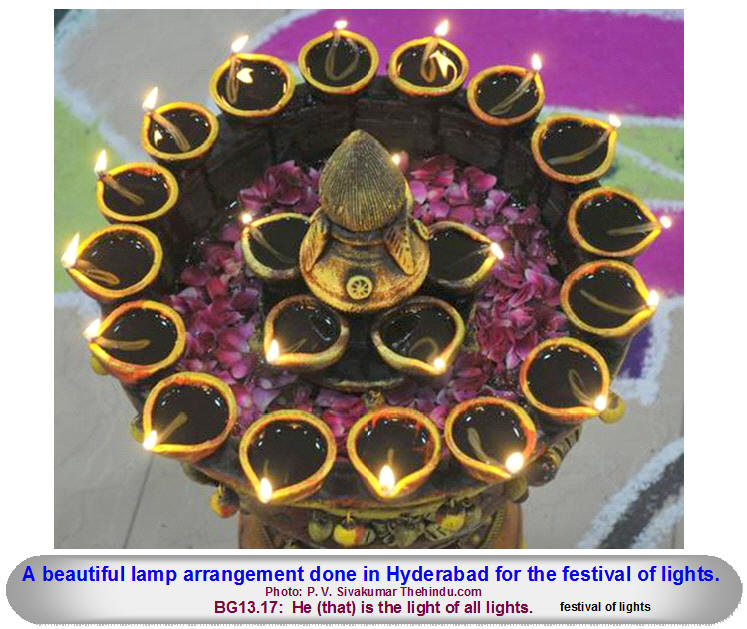
Purusam
Mahāntam Āditya-varnam Tamasah parastāt = The Supreme Person of Sun color is
beyond darkness (SvetāsvataraUpanishad 3.8)
13.18: Thus, the field, also
knowledge, and the object of knowledge were briefly recited. My devotee, by
understanding their wisdom, enters My own nature or state of Being.
13.19: Know that Prakriti and
Purusa are both without beginning; know also that
Vikārān and gunas (transformation and modes) are born of Prakriti.
Vikārān: transformation,
modification. Gunas: modes or attributes
Vishnu the supreme being, is one, whilst he is all: He is Avikāra (அவிகாரன்) , not
subject to change; Sadaikarழ்pa, one invariable nature: he is the liberator (tāra), or
he who bears mortals across the ocean of existence: He is both single and manifold (ekānekarūpa
= Eka-aneka-rupa = one-many-forms): and He is the indiscrete (avyakta அவ்வியத்தம் = that
which is not perceptible to the senses = unmanifest) cause of the world, as well as the
discrete (vyakta = வியத்தம் = That which is perceptible to the senses = manifest)
effect; or the invisible cause, and visible creation.
Achyuta = அச்சுதன் = Not Fallen. A in Achyuta is privative. Chyuta is Fallen. Thus
Achyuta (Vishnu) is Not Fallen. He is Imperishable Being. It also means that He is not
distinct from final emancipation. It signifies that He is free from decay. Skanda Purana
says that Vishnu never declines or varies from His own nature.
Vishnu is Supreme, the Best (Uttamam = உத்தமம் = That which is preeminent or excellent),
Spirit (Purusha = புருடன்), Male, Sacrifice, Moksha Dharma.
He is Vasudeva. Vas = To dwell. He abides in all things; all things abide in Him. Deva
is radiance, resplendent like the sun.
Samkhya philosophy says that Pradhana (பிரதானம்) is independent and coordinate (of equal
importance) with Primary Spirit.
Vishnu is SadasadAtmika (Sat-Asat-Atmika = சத்து-அசத்து-ஆத்மிகம் = What Is-What is
Not-Soul, comprehending soul = having the power of both cause and effect, giving origin
to material things. Because of it, He does not increase or diminish; He is changeless.
He is Anadi (அனாதி = without beginning = without birth = Not engendered from by any
created thing). He is the Womb of the world, self-influenced by the Creator that is
Himself.
The world is made from Purusha and Pradhana (Prakrti = Matter). The Indiscrete Cause (அவியத்த
காரணம் = Avyakta Karanam) is Brahma, Vishnu in the form of Brahma.
After Mahapralaya (Total Great
Dissolution), the crude Matter, Nature, or Chaos becomes the coexistent
element with the Supreme. Pradhana after dissolution merges with Vishnu.
Alvars say that Vishnu swallows the universe of matter and souls. The elements
of creation (that he contains after dissolution) are in essence one with
Vishnu, though they are detached and different in existence. This speaks of
the doctrine of difference-non-difference (Bheda-Abheda).
Pradhana in its unmodified state is Sattva, Rajas and Tamas in equilibrium, contained separately by the Spirit ( Purusha = Spirit). What brings this contained matter to become active and blossom out in to a visible universe of matter? Times after certain interval, unites Matter, Pradhana and Purusha and brings about creation. H.H.Wilson opines that Phanes or Eros is the Hindu Spirit or Purusha; Chaos is Matter or Pradhana; and Chronons is KAla or Time. Pradhana is Vyaya (வியயம் = that which may be expended) or Parinamin (which may be modified). Purusha is Avyaya (அவ்வியயம் = Inconsumable) or Aparinamin (Immutable). Vishnu or Achyuta, the Male Spirit (Purusha) enters into Prakriti (also known as Maya) and implants Amsa ( Seed, tad or fragment) of Himself and agitates Pradhana or Prakriti. Time serves as an agent in the creation. Sankocha (சங்கோசம் = contraction, equilibrium of three qualities) or Inert Pradhana undergoes Vikasa (விகாசம் = blooming, evolution) meaning blossoming out of the material universe (preceded by disequilibrium and agitation).
The first product after agitation and expansion (Vikasa) is Mahat (the Great or Intellect). Mahat is presided by the Soul. Ksetranjana = (Knower of the Field or embodied Spirit) is the cosmic equivalent of Buddhi (intellect).
Mahat is the divine mind in creative operation and incorporeal substance. Buddhi is derived from Mahat; from Buddhi comes Ahamkara (Aham + KAra = I + doer = Egotism = I think, I feel, I am). Ahamkara has three subdivisions: Vaikarika or Satvika Ahamkara, infused with virtue and goodness. Taijasa or Rajasa Ahamkara has Tejas, heat, motion and passion. Butadi or Tamasa Ahamkara is elementary and has darkness. Sattvika Ahamkara gives rise to senses; from the Tamasika Ahamkara come the unconscious elements. Rajasa Ahamkara gives motion to the inert Sattvaika and Tamasa Ahamkaras. There are variations in the products and interpretation of these entities.
Janardhana, the one only God, takes the name of Brahma, Vishnu, and Siva according to the needs and creates, maintains and destroys. Janardhana = Jana + Ardhana = men + worship = the adoration of mankind.
13.20: It is said that Prakriti is Kārya Kārana (cause of
effect), instrument, and agency. The Purusa is said to be the cause of
experience of pleasure and pain.
The
thoughts expressed here are within the purview of Upanishads. Kārya Kārana =
cause of effect. The cause is resident in the effect: Our bodies are the
effect and prakriti is the cause. The instruments are the senses. Prakriti is
also an instrument and agency and the Purusa is the cause of experience of
pleasure and pain.
The individual soul is an agent of
the Higher Soul or Atman. The individual soul is not only an agent but also
the doer. Since the lesser soul is the doer, it is also an enjoyer and
therefore experiences pleasure and pain. Since the lesser soul is an agent of
the Higher Soul or the Supreme, the agent is under the control of the Higher
Soul, which is responsible for the actions of the agent. So The Higher Soul is
also an Enjoyer and Experiencer but with a difference. The experience of the
doer, agent, and enjoyer does not affect HIM. Prakriti is the agency. Prakriti
provides all products to the agent (to run his business or) for doing and
experiencing. The products supplied by prakriti to the individual soul are
body, buddhi, ahankāra, manas and Indriyas. Prakriti is also an instrument of
the Owner of Prakriti, which is the Supreme Self. Prakriti is the agency
and is comparable to the commercial franchise. The franchise holder, that is
the individual soul, takes all the gains and losses in this instance. The
Supreme Self is Karta (Creator-Agent), because He is the Intelligence and the
Owner of Prakriti. That which sets Prakriti in motion is the Real Agent. The
products of Prakriti, as supplied by the Supreme to run the franchise or
agency, become the instruments (buddhi, manas, ahankāra, senses etc.) of the
individual soul. The individual soul is the doer, enjoyer and an agent,
because “he is asked to take his instruments with him, while roaming and
wandering in his own body.” Once the agent is deprived of his instruments
namely buddhi etc., he is no longer an agent. His agency is dissolved. His
body and instruments go back to Prakriti (matter). The Supreme has control
over the agent.
13.21: Purusa situated in Prakriti certainly enjoys the gunas of
Prakriti. Attachment to the gunas (modes) is the cause of birth of a being in
good and evil wombs.
Evil womb is a reference to animal womb. Evil is Tamas, darkness, impenetrable darkness of the soul; that is fall from grace of a human being, entirely caused by bad karmic deeds of previous life. There are many kinds of good wombs: the parents of Krishna, The Buddha, Jesus Christ, Mother Teresa....
13.22: The Mahā-Īsvara, the Great Ruler in the body is (said to be)
the witness, the approver, the supporter, the enjoyer, the Supreme Self
(Paramātmā) in the body, and the Supreme Purusa.
Anumantā: the one who approves,
assents, permits.
The Supreme Self
resides in the spiritual heart of the body and is like the Upper Bird acting
as a Witness, while the lower bird (individual self) is eating sweet and sour
fruits. He is the Great Ruler of the body and the enjoyer too. He supports the
lower self and the body, meaning the prakriti-based body. Here the Lord is
also the Supreme knower of the body.
In all experiences, The Lord is the Primary Experiencer and we the secondary enjoyers or experiencers. In The Uddhava Gita, Dialogue 11, Verse 36, Krishna says, "In the living, I am the movement, speech, rejection, acceptance, enjoyment, touch and sight, taste, hearing, and smell. I am that power by which the senses enjoy the objects of this world." Translation by Swami Saraswati.
13.23: He who understands Purusa and Prakriti with the gunas
(Sattva, Rajas, and Tamas), is never born again though existing in the present
in all modes (any mode).
13.24: By meditation, some see the Atman (The Greater Soul) in the
self through intellect, others by the yoga of knowledge (Sānkhya yoga or Jnāna
Yoga) and still others by Karma Yoga.
13.25: But others worship, ignorant of these yogas (Jnāna and
Karma), by hearing from others. They certainly go (across) beyond death by
(leap of faith) trust in what they heard.
Even
those who are ignorant of Jnāna and Karma yoga, worship Me according to what
they heard from others: the Truth. They cross the ocean of samsāra (birth and
death) and attain Me, having faith in Me from what they heard.
13.26: Whatever comes into being, unmoving or moving, you must know
that (it is by) the union of the ksetra and ksetrajna (field and the knower of
the field).
13.27: He who sees the imperishable Supreme Lord, residing equally
in all perishable living entities, really sees.
13.28: Seeing Isvara (Lord) equally abiding everywhere, he does not
injure the (Greater) Self by the (individual) self, and then attains the
Supreme goal.
Isvara
is the resident in all beings and the controller of the individual self in all
beings. The individual self that does not injure the Greater Self (the Lord)
and considers the Greater Self as One and the same (equal and identical) in
all beings, attains the Supreme goal: This is the basis for ahimsa or
non-violence.
13.29: He, who sees that Prakriti (nature) performs all activities, knows that the self is not the doer; he truly sees.
Prakriti is the cause, the agency and the instrument, and performs all
activities. The individual self appears as the apparent doer because of avidya
and karma (ignorance and prārabda karma), but it is not the real doer. The
individual self or the soul's true function in this instance is that of a
witness. (Elsewhere it is mentioned that the Greater Self is the Witness: He
is the Universal Witness, the Witness of the witnesses.) Imagine a riotous
situation, where the distinction between a spectator and the protester is
lost. Both of them are arrested and the spectator is mistakenly labeled a
protester. Because the individual soul or self is all wrapped up in kosas or
sheaths originating from Prakriti, and of avidya and karma, it is mistakenly
accused of doership.
Vyapruteshu Indriyeshu Atmā Vyāpārī۠va Avivekinām
Drusyate Abhreshu Dhavatsu Dhavanniva Yathā Sasī 19
As the clouds move in the sky, the moon appears to run for the ignoramus or the non-discriminating person. Likewise, Atman appears like the worker when the senses are working.
13.30: When one sees that the
individuality of all living beings abides in One, and that all living beings
are expansions of One, he attains Brahma (realization) then.
When
one knows that the individuality of diverse species of living beings centers
on God, and originates from Him, he attains Brahman. A learned humble Brahmin,
a cow, an elephant, a dog, and even a dog-eater are seen with an equal eye by
a punditah (sage). BG Chapter 5 Verse 18.
That is because all
beings are God's creatures. They all rise from Him and subside in Him. Brhad
Upanishad 2.4.5: all beings are dear not for the sake of being(s) but for the
sake of SELF (the Lord inside them).
Ramakrishna Paramahamsa kept his doors and heart open for all sincere seekers of God: doctors, lawyers, housewives, drunkards, prostitutes. (Think of Jesus Christ and his disciple Mary Magdalene.) To him all were children of Goddess Kali; in each one of them, he saw the Divine Mother playing hide-and-go-seek in their bodies and forms. Once Mother Goddess appeared as a well-known prostitute in the sanctum Sanctorum of the Kali temple, when no one was around. He said that Kali decided to sport the form of a prostitute that day, when he was the officiating priest in the temple.
13.31: The imperishable (or immutable) Supreme Self is without
beginning and attributes, though dwelling in the body, O Kaunteya; It neither
acts nor stains.
अनादित्वान्निर्गुणत्वात्परमात्मायमव्ययः ।
शरीरस्थोऽपि कौन्तेय न करोति न लिप्यते ॥१३- ३१॥
anāditvān nirguṇatvāt
paramātmāyam avyayaḥ
śarīrasthopi kaunteya na karoti na lipyate 13.31
anāditvāt1
nirguṇatvāt2
paramātmā3
ayam4
avyayaḥ5
śarīrasthaḥ6
api7
kaunteya8
na karoti9
na lipyate10
13.31
avyayaḥ5
= The
immutable;
paramātmā3
= Supreme Soul; [is]
anāditvāt1
= without beginning; [and]
nirguṇatvāt2
= without attributes;
api7
= though;
śarīrasthaḥ6
= dwelling in
the body;
kaunteya8
= O Kaunteya;
ayam4
= [This] It;
na karoti9
= neither
acts;
na lipyate10
= nor is
stained. 13.31
nirguṇatvāt2 = without Gunas. Ramanuja says Paramatma is 'free from Gunas', being devoid of Sattva and other Gunas of Prakrti, It neither acts nor gets tainted; it is not tainted by the qualities of the body.
In Ramanuja's Srivaishnava theology, Brahman is not afflicted by Prakrtic Sattva, Rajas and Tamas. But it does not mean Brahman is attributeless; Ramanuja says as opposed to Advaitins that Brahman is NOT impersonal and has kalyana Gunas (auspicious attributes).
|
Ramanuja's encounter and fallout with Yadava in Kanchi, excerpt from the book, 'Ramanuja's Teachings in His Own Words'. pages 4-5-6 'Talking points' Guru Yadhava: Brahman has eyes like the posterior (red genitals) of the monkey (in estrus). Ramanuja (1017–1137 CE): God has eyes like the lotus which blooms before the morning sun. Ramanuja drops a bomb on his Acharya (Guru). The ground buckles and fractures, a rift valley is formed and an unbridgeable chasm comes between the Guru and Ramanuja. He found (Acharya) one in Yadavaprakasa. Here he joined the group of other students learning under that teacher. In the course of his lesson, Yadava came across the passage "Satyam Jnanam Anantam Brahma" in the "Taittiriya Upanisad. He explained it in a way which did not appeal to Ramanuja. Challenged by the teacher to furnish a better explanation Ramanuja argued that the passage meant not that Brahman is "Satyam, Jnanam and Anantam" but that Brahman has them as its qualities and that they are attributes which could coexist in Brahman without mutual contradiction, just as redness, softness and perfume could harmoniously coexist in the flower. Therefore to try to postulate an attributeless Brahman or a Brahman in whom different attributes cannot coexist is neither logical nor consistent with the affirmatory character of the Vedic passage in question. After hearing this, Yadava simply said in disdain "Thou, to argue with me?" and kept silent. [In Vaishnava theology, Brahman has attributes. Attributeless Brahman is anachronism. In Advaita there two Brahmans: Nirguna or attributeless Brahman and Saguna Brahman or one with attributes.--Krishnaraj] Another day, Yadava began to comment on the verse Tasya Yathā kapyāsam pundarīkam evam akṣiṇī of the Chhandogya Upanisad (1.6.7 Page 348 in book by Radhakrishnan on Upanishads, kapi = monkey) and said that it meant that Brahman had his eyes like the posteriors of a monkey. (The color of the lotus is compared to the posterior (external genitalia) of the monkey in estrus.-Krishnaraj) When Ramanuja heard this, he felt a pang shooting across his heart to find that he should hear noble Vedic passages thus interpreted. His grief was so keen that a hot tear scalded his cheeks. Ramanuja said, "I am grieved that those beautiful Vedic lines are so awkwardly construed". "What is thy interpretation then?" angrily asked Yadava. "Sir", cried Ramanuja, "can you not see that Ka means water and pibati signifies drinking. Kapi means that which drinks water, the sun or the lotus stalk. āsa is to open. Pundarika is the lotus. And therefore the import of the passage is that God has eyes like the lotus which blooms before the morning sun". Yadava heard this and flared up saying "Haughty Youth: if thou canst accept my teaching, thou must leave". Ramanuja spoke not a syllable in reply but took his departure. The teacher and the disciple became thence forward estranged. Tasya Yathā kapyāsam pundarīkam evam akṣiṇī of the Chhandogya Upanisad (1.6.7) = "His eyes are even as a red lotus flower." By Dr. Radhakrishnan. The science behind kapyāsam: kapyāsam = buttocks of a monkey; the swollen red external genitals of the female monkey in estrus, announcing to the male monkeys that she is receptive to their advance.--Krishnaraj |
The
Supreme Self is the Atman residing in the spiritual heart side by side with
the individual self or jivātman. It is pristine, without beginning or end,
imperishable, immutable, without attributes and unaffected by the Gunas,
self-effulgent and remains as a Witness. We are like turbid waters; He devoid
of the gunas is like clear water. The gunas stick on us but in Him the gunas
or modes roll off like water from the surface of the Lotus leaf. He is like
the sun and we are like the candles. He is stainless. He cannot be wetted.
He is immutable but yet changes; that is his nature; that is the apparent paradox. Immutability is essence of the Supreme. The changes proceed from him, but in himself, he does not change.
13.32: As the all-pervasive ether is not stained due to its subtle
nature, the all-pervasive Self, taking abode in the body, is never stained.
The
all-pervading Ether is the primal causal imperishable stem substance, out of
which projects the prakriti and the manifested universe. This stem substance,
ether evolves, transmutes, transforms, modifies, and projects under the
influence of Prāna, and in this case, Rta is the prāna. During dissolution or
pralaya, the manifested universe subsides into ether. This variegated universe
goes from ether to ether. "From dust to dust,” and “from Dawn to Dawn" do not
adequately explain the Vedic concept of ether.
13.33: As the sun lights up
this the whole world, similarly, the ksetrin (the knower of the field)
illuminates all of the ksetram (the field), O Bharata.
As the sun lights up this whole world, the knower of the field (Self or self)
illuminates the whole field, the body, or the universe.
There are two
parallels here. One is that the Greater Self or the creator, the ksetrin, the
Knower of the field is illuminating the whole universe, which is His body. The
other one is that the jivatma, the knower of the field is illuminating the
physical body.
13.34: They who know the
difference between the field and the knower of the field and who have the eye
of wisdom focused on liberation of beings from Prakrti attain the Supreme.
The
field is the created universe and the knower of the field is the creator or
the Atman. Those Jnāna yogis, who know the difference between the field and
the knower, and have knowledge of the ways and means of liberation from
Prakriti, attain the Supreme.