Veeraswamy
Krishnaraj: Tolerance with love is to speak in tongues of all
faiths, hold in the heart the Truth of all faiths and see
all faiths in the face of humanity.
You have
your Google search engine tailored for this site.
Please enter the word(s) in the
search box; it will take you to the file with that word in this web site.
Enjoy your visit here.
About the author:
Veeraswamy Krishnaraj, M.D; F.R.C.P (Canada) is a board certified pediatrician
in active practice until the end of 1998. He immersed himself in study of
Hinduism in depth. He has sufficient knowledge and understanding of Hindu
religion that he is confident to publish this book. He kept the words simple,
supple, illuminating and to the point, while retaining the original flavor,
beauty and grace. Compound words in Sanskrit are a nightmare for the beginner,
as they are spliced together compactly in one continuous stretch of
characters. He parsed the compound words into digestible syllables or words
with superscripts and sequential numbers and rearranged the words in the verse
in a readable form in English. In this book, he claims ownership of
shortcomings and cedes the rest to Bhagavan.
This book is good for students, and devotees reading the Bhagavad-Gita in
Satsang (true company). Two verses nestle in two boxes in one page with no
break or carry-over to the next page. Diacritics help the reader enunciate the
words like a Sanskritist. The English words are reader-friendly. Wherever
there is a need for elaboration, an addendum supports it.
Simplicity, authority, universality, and profundity are the hallmark of the
Bhagavadgita, the Bible of the Hindus. The Bhagavadgita is the Song of the
Lord. It provides guidelines for daily living with no dogmas and ritual
overtones. It encourages and supports your individuality. It also explains the
consequence of errant ways. Total surrender to Bhagavan releases the devotee
from the ills of life on earth. Hinduism as a term is an external appellation
from non-Hindus. Its true name is Sanatana Dharma (Eternal Law or Eternal
Order) commensurate with Rta (Cosmic Order). The beauty about the Bhagavadgita
is its appeal is universal.
bg Chapter 18 Renunciation and Liberation
The Complete
Works of Swami Vivekananda
Volume 6 [ Page : 109 ]
NOTES TAKEN DOWN IN MADRAS,
1892-93
Christ was a Sannyasin (ascetic),
and his religion is essentially fit for Sannyasins only.
His teachings may be summed up as: "Give
up"; nothing more -- being fit for the favoured few.
"Turn
the other cheek also!"-- impossible, impracticable! The
Westerners know it. It is meant
for those who hunger and thirst after
righteousness, who aim at perfection.
"Stand on your
rights", is the rule for the ordinary men. One set of moral rules cannot
be preached to all -- sadhus (சாது = A gentle, harmless person --Tamil
Lexicon) and householders.
Swami Vivekananda
http://www.lotussculpture.com
Bhagavan is the Master of all the universes as depicted below. See one pixel
size of the sun, and earth is invisible. See the ego-deflating size of Antares
in the constellation Scorpius, by whose size sun is only one pixel. (File: The
universe-antares-sun-earth)
Since the Lord is the owner of
Para and Apara, He is Man (Purusa) and all created
beings are women (Striyah).
Para = The Supreme abode of Bhagavan Krishna, A
world of Bliss and liberation. Apara = the pleasures enjoyed in inferior
worlds.
In Vaishnava heaven (Vaikuntam or Paramapadam),
every one qualified and destined to reach there, has to go through
purificatory passage through lake and river. When they arrive at Vaikuntam,
they have the same form as Bhagavan.
According to Brahma Sūtra, the individual soul is a
repository of knowledge, a knower, an enjoyer, and a participating agent. The
soul takes its qualities from the limiting adjuncts inherited from Prakriti
and karma, while the natural state of the soul is that state, when it is not
burdened with limiting adjuncts. The natural state is pristine and pure as
that seen in a diamond, while the adjuncts are the dirt and grime covering the
diamond. The apparent negative qualities of the soul are extrinsic in their
origin and therefore are liable to change from birth to birth. The soul
becomes an agent (purusha with a small 'p') when it wraps itself with the kosas (sheaths such as
body, intellect, breath...) and Indriyas (sense organs). When the kosas fall,
the agency falls. That the soul is atomic1 is not only a
connotation of its size but also its adventitious nature in relation to
Brahman. It is non-different from Brahman, when it is not covered with kosas
or is in a state of liberation (compared to pure diamond without dirt and
grime). It is different from Brahman when it is burdened with adjuncts or
upādhis. The adjuncts are real and beginningless, because their cause is
beginningless māyā. Māyā is neither SAT nor ASAT (Being or Nonbeing) and has
the ability to transform one object or substance to another object or
substance, and a substrate into a substance: The substrate is Brahman (Maya-Prakrti)
and the substance is the manifest world. This transformation is called
Parināma. Māyā, apart from being the progenitor of matter, is enzymatic in its
quality and a substrate, and arises from Brahman;
avidya or ignorance induces this enzymatic māyā. When avidya is
removed or inhibited, the fog of māyā lifts and Brahman comes into view. This
avidya-induced māyā regulates this phenomenal world. Brahman is One (=
निश्चल
Nishkala = no parts), but has the
urge and capacity to become many (=
शकल
= Sakala = many parts). This phenomenal
world is a toy for His plays (lila), pastimes (Vilāsa) and māyā.
Vaishnava philosophy rejects the concept of
Avidya of Monism.
Sri Yamuna (916-1036 CE) was the first of the
kind to take on the Advaitins (Non-dualists = Monists) by the dialectical
sword. He devoted himself to do 360 degree study of the nature of the
individual self and the Absolute. Advaita Vedanta advances the triadic
doctrine of the Unity of Self, the illusion of the Universe and Avidya.
The Advaitin's view is abhorrent to Sri Vaishnavism. Yamuna and Ramanuja seek
to examine the fabric of Advaita philosophy by woof and warp, find loopholes
and rip it apart. Among the opponents of Advaitins, Maya and illusion of the
universe are some of their favorite subjects for disputation. They believe
that attacking the fortifications of the opponent's philosophy is essential in
building their own system of philosophy. Sankara's
(788-820 CE)
fort of Monistic
philosophy withstands many forays from the likes of Yamuna (916-1036 CE),
Ramanujacharya (1017-1137), Madhava (1238-1317). Monism does not fall with the
likes of Sri Harsa, Anandabodha, and Cisukha holding the Fort. Vedanta Desikan
(1268 CE – 1369 CE) tries to find chinks in the armor of Monism. Satadusani
was the weapon he designed to pierce the armor. The weapon system (Satadusani)
borrows heavily from Sri-Bhasya of Ramanuja and attempts to make a more
polished, advanced and elaborate Stinger. Some original ideas are obvious in
the system, designed to strike the opponent where they are most vulnerable.
(Here read: the hollowness in the arguments of the opponents.) Counter
arguments to invalidate all the Advaitic theories developed since
Ramanujacharaya are incorporated in Satadusani, which takes advantage of all
contradictions in the opponent's argument and attack their stand from all
around (multi-pronged attack). Desika says that one could deploy the arrows of
arguments contained in Satadusani in an endless repetition like robot (or like
a broken record, a kind of Echolalia) to bring the Monism down on its knees.
Satadusani by Desika takes up one hundred philosophical
issues for critical analysis. The target is the doctrines of Advaita Vedanta.
At the outset Sankara and his philosophical cohorts come under the cross hairs
of Desika. Desika takes up the position of the opponent (Purvapaksa) as the
opening statement. Desika trucks through the illogical loopholes, shoots the
opponents down and catches the contradictions by the nape of the neck which he
wrings adroitly. Thus he clears the underbrush of pesky erroneous theories of
opponents and thereby makes his position stand on terra firma. This process is
called VAda, whereby the protagonist causes destruction of weeds of erroneous
philosophy and establishes (construction) a fertile flower bed of his
philosophy. The stance of VAda is unlike Jalpa and Vitanda. Jalpa
(wrangling) entails dictatorial dialectics, emphasizing on winning the
opponent debater on pointless disputation, "quibbles, futilities and other
processes which deserve rebuke." Vitanda (irrational reasoning; Caviling =
trivial objections) is winning a disputation by advancing frivolous and
perverse arguments with emphasis on drowning the loud uproar of the opponent.
"It is mere attack on the opponent." In Jalpa and Vitanda, the truth is
sacrified on the alter of debate forum, simply to establish a front as a
debater. It is more psychological than sapient. There is more heat than light
in Jalpa and Vitanda and mostly light and very little heat in VAda. In Jalpa
and Vitanda, captious arguments may be used. Desika establishes the
validity of Satadusani by embracing VAda Grantha as the terra firma of
Visitadvaita VedAnta. VAda Grantha is a sword rather than a defensive
shield on the fencing platform of debate.
Vādam
= வாதம் = argument to establish the
Truth. The requirements are to study and comprehend the opponent's argument
fully and to have clear concept of one's own position. Vādam is
twofold: effective destruction of the opponent's view and establishment of
one's own view to the satisfaction of all.
Vitanda =
விதண்டா வாதம்Fallacious, captious
argument, sophistry; also known as
குதர்க்கம்
= kutarkkam
Desika goes to battle the Advaitins in the sacred
halls of temples.
Satadusani is said to contain 100 VAdas but only 66
VAdas survive. It is thought that 34 VAdas are lost for ever. Satadusani
investigates epistemological, metaphysical, cosmological, religious and
ethical issues. The first 8 Vadas deal with the 1st aphorism of
Vedanta-sutras--the meaning, significance and nature of Brahman. The
first 8 also deal with Karma and Jnana. Vada 9 questions and dismisses the
eligibility of Advaitin to engage in philosophical debate. Vadas 10 to 30
discuss the nature of Perception and Difference, Advaitin's view of the
Universe as Illusion, the nature of Consciousness, the validity of scripture
and other related subjects. Vada 32 is devoted to the doctrine of monistic
Jivanmukti (liberation while alive), which the Vaishnavas do not accept. They
believe in Videha Mukti, liberation after death or incorporeal liberation. The
Vadas do not follow Sri-Bhasya in a numerical sense. Nirguna and Saguna
Brahmans (Attributeless and qualified Brahman) are discussed. The
lack of sequential treatment of subject, it is surmised, is based on the
premise that the debates are recorded as they happen. One account says
the following. A debate went on for seven days in Srirangam between Vedanta
Desika and the Advaitins. Perarulala Jiyar, a disciple of Desikan
records the debate and submits the transcript (minutes) to Desikan on the 8th
day after the Pundits are roundly defeated. Another account says that Desikan
himself wrote the material soon after each debate. Though there is no coherent
arrangement, the debate material is extensive, complete and comprehensive.
Eight points of debate-battle.
The 66 Vadas are grouped under 8 categories: 1)
Pramanas [means to acquire knowledge], 2) Perception and Difference, 3) The
Nature of Consciousness, 4) The Individual Self and the Absolute, 5) The
Nirguna Brahman, 6) The Universe, 7) The Doctrine of Avidya, 8) Sadhana and
Mukti.
The Monistic Advaita Vedanta
theory: Brahman is the only Reality
and all else is illusory. Avidya-māyā is the driving force behind the
projection of this universe and is the creation of Mayin, the Lord, while
Yogamāyā and atmamāyā are divine processes by which He self-creates Himself to
be born in this world. In the latter two instances, Karma and Avidya are not
in force, because He is Brahman and Supreme; and He is above Avidya and Karma.
Kashmir Saivism is monistic; Cit or Consciousness is
the One Reality. Consciousness and matter are identical and not separate.
There is no division between God and the world.
The world is not an illusion as
depicted by Monistic Sankara (788-820 CE). Thus Sankara's Monistic
Advaita Vedanta is different from Kashmir Saivism, which was non-existent
while Sankara was alive. Kashmir Saivism borrowed heavily from other earlier
Saiva sects such as Saiva Siddhanta, Advaita Vedanta; its origin is later in
time around 9th century. It was fashioned as a distinct sect of Saivism, whose
nucleus is Saiva Siddhanta.
Though all Saiva Sects have Siva as their
centerpiece, each claim that Siva initiated each sect with a distinct
impress, with many commonalities.
Vasugupta (875-925 CE) is the first proponent of Kashmir Saivism from
revelation by Siva as depicted in Siva Sutras. The bothersome question is why
Siva gave different versions of Saivism to different sects. Could this be due
to the difference in their understanding?
Before the advent of Kashmir Saivism, Saiva Siddhanta
Primer in Saiva Siddhanta
was prevalent in Kashmir. Then came along Vasugupta who presented Siva
Sutra of 78 verses as an alternative to Saiva Siddhanta. They were based on
Monistic Agamas and advocated a three-way Marga (pathway) to Moksa
(liberation). His follower Ksemaraja made commentaries on Siva Sutra Siva-Sutras and gave details as to how Siva
Sutra came about. It was of divine origin, a dream revelation made to
Vasugupta (875- 925 CE) by none other than Siva Himself. Upon instruction from
Siva, Vasugupta found a tablet with inscription of Siva Sutra on the
Mahadevagiri hill. Authors believe the other version which says that
Siva came in Vasugupta's dream and gave him a rendering of the entire Siva
Sutra and instructed him to spread Monistic Saivism among his worthy
followers. The feather in his cap consists of three compositions:
1) Siva Sutra, 2) Spanda Karika, 3) Commentary on
Bhagavadgita.
This universe according to
Sankara is a projection from Monistic Brahman and is like the waves on the
ocean surface. The waves are a projection or superimpositions, come and go,
rise and fall, and are the stuff of Prakrti (matter). For the duration of the
wave, it has a name, a form, and a “life.” You, I, the universe, this
and that are the waves. Here today and gone tomorrow. This transience and
appearance (projection and superimposition) are because of a phenomenon called
avidya-māyā (ignorance-illusion). The wave is a dink and comes up and
goes down in a wink; that is māyā or illusion; it is real for the duration of
its existence; but the wave itself is not Real. The Real is the Monistic ocean
or Brahman and to say the wave is Real is avidya or ignorance. If you remove
the Prakrti or the wave, you remove māyā and avidya. In other words, subtract
all the waves on the ocean surface, you see only the Ocean (Brahman).
Now you receive the direct vision of Brahman and in this allegory, you see the
ocean under the waves; the ocean is monism; the ocean and waves are dualism.
The 'Rope and the Snake' explain Avidya-māyā, ignorance and illusion. In the
dark, you see the rope and mistake it for a snake; and this is
superimposition: the false snake is superimposed on a real rope. One should
remove the superimposition or false impression of the snake from the real
rope. Another example given is that the shell is mistaken for silver. What is
the basis of the avidya-māyā? That is Time, Space, and Causation that play
havoc on our perception and come between the Real and the relative real
(unreal). Avidya-maya and Vidya (Knowledge) are the resident Saktis
(powers) of the Lord and are like shade and Light of the sun; the former
causes bondage, illusion, and veiling while the latter brings about
liberation.
Desikan gives seven reasons why
Monistic
Avidya doctrine is
untenable. 1) Its nature is unintelligible. 2) Its characterization as
inexplicable as it is self-contradictory. 3) It is not established by any
Pramanas--means of knowledge. 4) Neither Brahman nor Jiva-soul can be its
locus. 5) Its obscuration of Reality-Brahman is unintelligible. 6) the removal
of Avidya or nescience by true knowledge is untenable. 7) Its conception of
cessation is a riddle.
Faulty premise: Brahman (God) itself appears as universe. It is compared to a
rope (Brahman) appearing as snake (universe). Seeing the snake in a rope is
Avidya, ignorance or Ajnana. The rope does not transform itself into a snake.
Ajnana
(lack of knowledge) is the cause of this false perception. Rope is the cause
of temporal snake and is the basis or substrate of the illusory snake.
Likewise Brahman, the basis of the universe, is the material cause of the
temporal illusory universe. Thus Brahman is the material cause of the universe
without at the same time contradicting that Brahman is immutable.
Vedanta Desikan examines
the rope-snake theory in light of Vishistadvaita philosophy. Brahman,
qualified by the individual selves and matter (Cit and Acit) in their subtle
form is the material cause of the universe. Matter (Acit) exists in a subtle
form in the body of Brahman; that matter, and not Brahman, undergoes
transformation, mutation, multiplication into a world of objects. Brahman
Himself stays immutable and is thus an indirect substrate of the world of
objects through matter. (In Vaishnavism, mutability belongs to matter; Mutable
Brahman is inconceivable. Impersonal Brahman does not exist.) But for
Advaitins, Brahman is the locus of MAyA which is the direct substrate of the
illusory manifestation of the universe. This entails that Advaitic Brahman
undergoes mutation, which is against the tenets of Vedanta. Visishtadvaita
Brahman (Visista Brahman = Qualified Brahman). Brahman is immutable and yet
like an infant becomes a boy, youth, man... indicating that the body is
changing while the self (the soul) the basis of the body does not change.
Desikan says that the Causality of Brahman should be taken in the same vein.
All the changes belong to Brahman and yet Brahman stays immutable in
complicity with Vedantic precepts. Avastha (State) is integral with the
substrate. Cit and Acit (Sentient souls and insentient matter) exist in a
subtle unmanifest state in the body of Brahman in dissolution. -- adapted
from Advaita & Vishistadvaita by S.M. Srinivasa Chari.
Avidya-maya and Vidya run parallel with Tirobhava and Anugraha (Veiling
and Grace) of Saiva Siddhanta and are the innate forces (Sakti) of
Mother-goddess of the Sakta sect.
Vedanta Desikan vigorously argues
that Monistic (Advaitic) Paradigm of Shell-Silver illusion (snake-rope)
tumbles down on its face with a rattle when one knows the nature of
difference. Desikan called it everything except calling it a shell game of the
Advaitins. The Advaitins are not cognizing the difference, the
shell-ness of the shell and the silver-ness of the silver to avoid the
illusion of mistaking the shell for the silver (the wave for the ocean, the
snake for the rope). They have to notice both the positive and negative
qualities of shell and silver in order to transcend or escape from or avoid
the illusion. Though the shell-ness is seen, the difference of the shell
from the silver is not cognized, leading to the illusion of silver in the
shell. Thus superimposition (of silver on shell) is an invalid argument and
lack of perception of difference. One should cognize two objects as different.
All this essentially comes to support Vishistadvaita (qualified Monism) theory
of three distinct Reals: Isvara, Cit and Acit (The Lord, The sentient
soul, the insentient matter). There is nothing unreal here. The world is not
an illusion but real. The Acit is real; the phenomenal world is real; Isvara
is Real; the individual souls (We the people) are real. Brahman cannot be
burdened with Avidya-maya. If He is full of ignorance, how could He create
this world? Brahman and individual souls are identical with a ton of
difference. Vaishnava Brahman can create, maintain and recycle matter and
beings (souls); the Cit or we the people cannot do them. Isvara and the
Cit become identical, once the impurities of the Cit are shed and the Isvara
grants Grace. Vishistadvitins are of the belief that there is no such thing as
impersonal Brahman, whom only transcendental Yogis can access. Brahman (Isvara)
is Personal Brahman whom all and sundry can access. Brahman or Para Brahman of
Vishtadvaitins is a living breathing God on earth, the universe and Vaikuntam,
the Vaishnava heaven.
According to Garuda
Purana (1.194.28), Kavaca of Visnu (coat of arms) is the origin of Māyā. This
Kavaca has the ability to destroy all sins through the agency of Māyā. Since
Kavaca is external to Vishnu, Kavaca-associated Maya is Bahiranga Maya
(External Maya or power). As you see, here Maya is said to be associated
with Vishnu, which (Maya) Vaishnavas do not support.
atomic1:
Tirumular (Tirumantiram: Tantra Seven, Verses
2011-2014) says that the soul (Jiva) is the size equal to 1 in 100,000 parts
of a cow’s downy hair. Cow’s downy hair is approximately 16 microns in width.
Go to Saiva Siddhanta view of the soul.
The term atomic is used both to indicate
its size and its adventitious nature.
As you have
noticed, I tried to bring into focus the points of view of many philosophies
and internal differences within.
18.1 Arjuna said:
I wish (or desire) to know the Truth about
Sannyāsa and Tyāga
and the difference (thereof), O Mahabaho, O Kesi-nisūdana.
Mahā bāho: Mighty-armed
one. Hrisi kesa: Master of the senses. Kesi nisudana: Killer of demon Kesi.
These are some of the names for Lord Krishna.
Sannyāsa and Tyāga are
renunciation of selfish acts and
performance of deeds without expectation of rewards
respectively. Sannyāsi renounces material objects and worldly comforts and has
ascended the eight arduous steps or angas to reach that status. Sannyāsa is
the fourth stage of life and the sannyāsi has no worldly possessions. A Tyagi
on the other hand can be anybody who does acts without expectation of rewards.
A householder can be a Tyagi, but not a Sannyāsi. The criteria for a Sannyāsi
are more stringent and on a different and higher plane. A yogi (Sannyāsi) is
capable of Kaivalya, Samādhi and Ānanda. See elsewhere for description.
As mentioned below, a
yogi or a Sannyāsi has to climb eight arduous steps in full faith and
accomplishment to reach the top. A true renouncer (Sannyāsin) is the one who
relinquishes action without expectation fruits of such an action.
Desirelessness (non-attachment--vairāgya) is one of the cardinal symptoms of a
yogi. The Eight-in-one-yogi climbs the rungs of the ladder: withdrawal,
observance, postures, breath-control, withdrawal of senses, fixed attention or
concentration, contemplation or meditation, and superconsciousness or samādhi.
He is an exemplar by practice:
Ahimsa, truth, non-theft, continence, patience, firmness, compassion, honesty,
purity and rejection of gifts and moderation in food intake (only animal
products allowed are dairy products). A yogi can attain samādhi only when he
adheres strictly to the tenets.
Inaction is dereliction of duty (which he is
sworn to, trained for, or ordained by birth) and performance of action with
rewards on the mind. (Go to bg Chapter Six- The Yoga of self-control for more
details.)
18.2:Sri Bhagavan said:
The seer knows that sannyāsa is renunciation of
work attached to desires. The wise declare Tyāga as renouncing the fruits of
all actions.
Between Tyāga and sannyāsa, sannyāsa is a higher
calling. Tyāga is for karma yogis and sannyāsa for the Jnāna yogis. For a
sannyāsi, even the life-sustaining biological functions are work, and it is a
burden that prevents him from total continuous immersion and absorption into
Brahman. Sannyasa = renouncer of action. Tyagi: renouncer of
fruits.
18.3:Some wise men say that
all work is evil and
should be renounced, while others say that acts of sacrifice, charity, and
penance should not be relinquished.
Let me give you an example of
what a day-to-day act becomes an act of violence and evil for which atonement
exists. Don't we sometimes feel bad to core and cut an apple? How
could anyone plunge a corer right into the heart of the apple and cut such a
beautiful creation of nature? That is why all work is evil. Take a practicing
Jain in the extreme. When he falls in the river, his religion dictates, he
should not flail his arms and legs to reach the riverbank but let the currents
take him there. The teaching is that flailing causes violence to water
particles. What is the remedy or atonement for cutting an apple and
eating it? This belongs to obligate or necessary evil to sustain life;
atonement is vaiccuvatEvam (வைச்சுவதேவம்),
which entails making an offering to
Visvadeva (விசுவதேவர்) before
taking the main meal of the day. Visuvadevar (Visvadeva = all-gods) is an
Aggregate of all gods, known and unknown.
All Work is
Evil bg 18.3. By
extension, eating is also evil because in preparation of food, animals
may have been destroyed. notes added on October 27, 2014.
The gods worshipped in the Vaiśvadeva are Vedic, and the ceremony is
therefore from its antiquity far more interesting than the
Pañćāyatana-pūjā, or any other modern form of the Deva-pūjā. It is
described in its most ancient form in Manu III. 84-93. The idea involved
in the entire service seems to be, that before a man begins eating he
ought to consecrate and purify his food by making offerings of small
portions of cooked rice and other food to all the deities through whose
favour he is himself fed, and more especially to Fire, who is the bearer
of the offering to heaven. In point of fact the whole ceremony resolves
itself into a form of homage offered to the gods who give the food, and
to the god of fire without whose aid this food could not be prepared for
eating. There is also a notion
that, in preparing the food by cooking, animals may have been
accidentally destroyed, for which expiation should be made. --Monier-Williams,
Brahmanism and Hinduism
18.4:Certainly, hear from Me, O
the Best of the Bharatas. In renunciation, Tyāga is declared to be of three
kinds, O Tiger among men.
தியாகம்
=
Tyāga
= giving, munificence. தியாகி
=
Tyagi = one who gives.
There are three parts to Tyāga: the doer, the
deed, and the reward. The Tyagi should surrender all three to the Lord because
he is a mere anonymity, a mere instrument, a mere slave: The agency or
doership is not his, but belongs to the Lord. When one claims actions or deeds
as his, he claims the fruits of those deeds. Therefore, the tyāgi should
surrender them too, to the Lord. Since you are a mere slave, you keep what is
given to you; you work for Him and therefore, all your being (and existence)
and anything that goes with that belong to the Lord. The Lord owns each one of
us lock, stock, and barrel. He is the instrumental, material, and spiritual
cause of our being. He enjoins the deed whether you know it or not, and
therefore, the reward belongs to Him.
The deed or action is of five kinds: 1)
Nityakarma examples are Sandhyavandanam and
recitation of Gayatri Mantra.
2) Naimittika Karma
refers to action performed on visiting holy places, during eclipses, full
moon, dark moon, Ekadasi (11th day of every fortnight), birthday, marriage
anniversary and much more. 3) KAmya Karma refers
to religious rites and rituals for personal benefits (sons, riches, job) and
for preventing and removing diseases, obstacles, catastrophes, and bad
outcomes. 4) PrAyascitta Karma refers to acts of
repentance to expunge sins of the past and the present. 5)
Necessary and obligate actions include
profession, work, business, farming, service, eating, sleeping, awakening,
biological functions....
18.5:Acts of sacrifice, charity, and penance should not be renounced and
must be done. Sacrifice, charity, and penance purify the wise.
Yajna, Dāna and Tapah: sacrifice, charity, and
penance. Tapah or tapas means heat. The generative heat is conserved,
sublimated, and channeled into asceticism.
Sacrifice, charity, and penance are the means of
purification of those engaged in contemplation (worship), which expunges all
prarabdha karma, according to Ramanuja.
18.6:All actions should be performed renouncing the attached fruits. It is
thus My decided (considered) and best opinion, O Partha.
One should perform an action without
attachment to the act or the fruit. Attachment to action and fruits lead to
attachment to the body, mind, sensory and motor organs, possessions, family
etc. We serve the family as a duty and not for praise, honor, gratitude,
appreciation.... The father does not relinquish his duty to his family, but
relinquishes his attachment to the acts and their fruits.
18.7:Renunciation of prescribed duty is improper. Renunciation because of
illusion is (said to be) due to Tamas or ignorance.
“Duty before all else:” The whole universe
revolves on duty, work, sacrifice, universal and personal Dharma, or laws.
Tamas is the root cause of ignorance, negligence
and delusion. Tamasic elements in ignorance and human reasoning consider wrong
as right. Ignorance is false knowledge as opposed to right knowledge. Ramanuja
says, "Renunciation of obligatory and occasional actions have their roots in
erroneous knowledge "
Examples of Tamasic renunciation are not
performing one's duty to one's family, employer, neighbor, place of worship,
community, a nation and the world.
18.8:He, who renounces his work because of difficulty or for fear of bodily
pain, does not gain the fruits of Tyāga by doing Rajasic Tyāga or
renunciation.
Rajas = Motion and passion. Rajasic people
consider service to the family, employer, neighbor, place of worship,
community, a nation or the world entail necessary pain and suffering and thus
abandon such obligations; that is Rajasic relinquishment. Giving up is not the
answer; doing it and not attached to the deed and fruit are the right
attitude. Rajasic relinquishment is neglect of obligation and duty and
pursuing luxury and its pleasures.
18.9:When he does the prescribed duty, that ought to be done, O Arjuna,
giving up the attachment and the fruits, in My opinion, is sattvic Tyāga or
renunciation.
Sattva = Virtue, goodness. Attachment to action
and its fruit is bondage; relinquishing of attachment to both is Sattvic
renunciation. Sattvic Tyagi is the ideal type because he does not abandon his
duty out of delusion like the Tamasic person making wrong choices or abandons
his duty out of fear of pain and suffering like the Rajasic person pursuing
comfort and luxury. Let me give you an example of disinterested action and
renunciation of reward. When you turn your ignition keys, run the engine
and drive the car, the car is performing a disinterested action without
serving you a homily; it is not asking for a reward; it is simply doing its
duty. You could apply this analogy to the sattvic person.
18.10:He, who neither hates disagreeable action nor is attached to agreeable
action, is a sattvika, a Tyagi, and a wise man, having cut off all doubts.
Purport: Action is of two kinds: agreeable and disagreeable.
What is an agreeable action? Agreeable action is that which pleases the
senses, the mind and the mood and disagreeable action is that which riles the
senses, the mind and the mood. Take a child for instance. To him playing and
watching TV are agreeable action; doing homework is disagreeable action.
Arjuna is sitting in the chariot getting ready for the
battle; to him it is disagreeable action to fight his cousins. Bhagavan
suggests that what makes a wise sattvic Tyagi is rising above the pain and
pleasure of actions and performing one's duty. In this instance, it is to
engage the enemy in battle, a disagreeable action.
A Sattvika, a Tyagi and a wise man all rolled into one
person has virtue and goodness, renounces selfish acts and performs
deeds without expecting any rewards and possesses wisdom and learning.
To such a person with special endowment, agreeable and disagreeable actions do
not generate either attachment or aversion respectively. A Sattvic Tyagi,
in a spirit of renunciation, rises above his reactive impulses in agreeable
and disagreeable situations and performs what is expected of him. When
he does that, he becomes a wise man, having removed all his doubts.
Mahatma Gandhi says the following: "Neither does he disdain
the unpleasant action, nor does he cling to pleasant action-- this wise man
full of Sattva, who practices abandonment, and who has shaken off all
doubts."
18.11:It is certainly never possible for the embodied one to renounce all
actions. However, anyone renouncing the fruit of work is (said to be) a Tyagi.
A person (embodied soul) cannot give up actions, because he has to work,
eat, drink, sleep, raise a family.... When a man is sleeping, apparently
not doing any action, his heart beats, his digestive juices flow, his
breathing goes on automatically.... He cannot renounce ALL actions and yet can
renounce SOME actions. What could that be?
It is not performing proscribed actions without the reactive element of
aversion or dislike for that act; it is performing a prescribed action without
the element of a liking for the act. What is the purpose of that attitude? The
fruits. By doing these acts with an attitude of disinterestedness, he
renounces all fruits of those actions. Now you see a Tyagi. Why is that
attitude of relinquishment important? Thought, word and deed generate Karma.
Relinquishment of aversion, liking and the fruits frees one from Karma and its
consequences. It is like working and NOT paying taxes. How is that? If
you work as a volunteer and don't take a salary (fruit), you don't pay taxes.
That volunteer work (action) is not rewarded with fruit and so there is no tax
(karmic consequence).
18.12:The desirable, the undesirable, and the mixed are the three kinds of
fruits of work that come after death for the Atyagi but not for the Tyagi.
Sankaracharya says that a non-renouncer (Atyagi) experience three kinds
of fruits or results after death: 1) the Desirable, becoming god; 2) the
Undesirable, going to hell; 3) Mixed, to be reborn as human being. On the
other hand a Tyagi (= Sannyasi or renouncer) is not subject to these results
or transmigration of the soul but attains eternal liberation.
Atyagi (he who is not a Tyagi; the one who has
not relinquished the fruit) savors three kinds of fruits: sweet and pleasant,
acrid and unpleasant, and mixed. These are karmic fruits one has to eat
without exception or escape. Tyagi's selfless actions do
not bear any fruits and therefore he does not eat any of these fruits now or
anytime. Man feels happy eating sweet fruits meaning living a
joyous life. The same man feels dejected eating the acrid and mixed fruits.
These actions and fruits are connected with the body and not with the soul.
The Tyagi relinquishes Prakriti (matter) associated with the body and its
derivates such as mine-ness and egotism. He is Karmayogi, who performs actions
for the welfare of others. Here is a depiction of the entrance to the
temple (Here it is a monastery for illustration). When you enter the temple,
you give up Egotism, mine-ness and all negative thoughts and then only enter
with humility and prayer on your lips. The door frame has four sides. The
Mantra in honor, adulation and worship of Vishnu is
Om Namo Narayanaya. In its parts it says, "O Narayana, nothing is
mine; yes, all belongs to You. " That attitude does not bear any fruits though
one acts. For more details on Karma go to bg02.
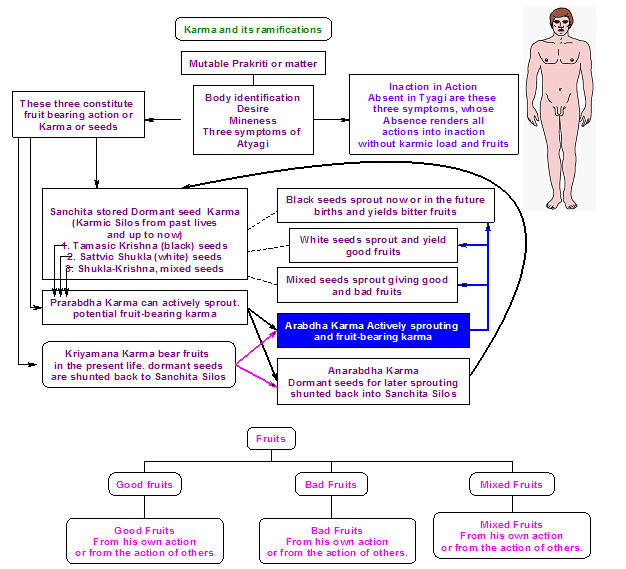
There are three
Karmas (Sanchita, Kriyamana (Agami) and Prarabdha); there are three fruits
(desirable good fruits, undesirable bad fruits and mixed fruits).
Sañcita are seeds;
Prārabdha are sprouting seeds.
சஞ்சிதம் = सञ्चित =
Sañcita =
Accumulated karma of former births that still
remains to be experienced.
பிராரத்தம் = प्रारब्ध =
Prārabdha = Past karma, whose effect has begun to operate.
ஆகாமியம் =
आगामिन् = Āgāmin
= Karma which is yet to come, good and
bad karma of the present life which are expected to bring their rewards in
future births. This karma yields results now, later or in the future births
and if so becomes part of
Sañcita karma.
Sañcita Karma,
a collection of past Karmas,
includes
Prārabdha karma (under resolution now in this
birth).
Sañcita has three kinds of
seeds: Sattvic Shukla white
seeds, Tamasic Krishnablack seeds and
Shukla-Krishna mixed seeds; these seeds give their respective
fruits. They are only seeds, which when they start sprouting in this birth as
Prarabdha Karma, results in rewards (White), punishments (Black) and mixed
(Black and White) experiences.
Prārabdha karma: set in motion;
Sprouting; germinates and yields fruits according to the seeds.
Prarabdha, Agami and Sachita Karmas are Sanskrit
terms.
Nukar (நுகர்)
+Vinai (வினை) = Eat, consume + Karma;
Eru = (எரு)
Impending; Tol = (தொல்)
distant in the past.
1.
Prarabdha Karma is
Nukarvinai in Tamil, meaning that the person eats the fruits of his
Karma now. 2. Agami Karma is
Eruvinai meaning impending Karma.
3. Sanchita Karma, that includes Prarabdha karma,
is Tolvinai or Pazavinai in Tamil meaning it
involves distant deeds of former births. Once all Malas and Karma are
destroyed, there is no rebirth. Tamil saints are of the opinion that Diksai
(தீட்சை) expunges Prarabdha and Sanchita Karmas and
Guru's eye of wisdom expunges Agami Karma.
Diksa
Titcai
or Diksai
is initiation of a disciple into the mysteries of
Saiva religion; it consists of three stages:
Samaya-diksai, Viceta-diksai, and Nirvana-diksai
(initiatory rites, second or middle step in initiation, which gives the
disciple special privilege of making Puja to Siva, and Third and last step,
which helps the disciple free himself from the bonds of existence and attain
emancipation--Tamil Lexicon). As fire destroys cotton and reduces it into
ashes, Diksai reduces all Malas into ashes and
obtains liberation. Mantras destroy prarabdha karma and guarantees no rebirth,
as fire roasts seeds and renders them unproductive. I introduce the term 'Acarpous
Karma' for the Karma that is rendered sterile and not productive of
fruit.
மேலைக்கு வருவினை
ஏது என்னில் அங்கண்
விருப்புவெறுப்பு எனஅறி அவ்விளைவும் எல்லாம்
மூலத்த வினைப்பயில்வாம் என்னில் நாம்மேல்
முற்றி அதன் பயன் உனக்கு முளைக்கும் என்பர்
ஞாலத்து வினைகள் இருதிறன் ஆகும் புந்தி
நண்ணாத வினைநணுகும் வினைஎன ஒன்று இரண்டாம்
ஏலத்தான் இதம் அகிதமாம் இதனால் வழுவாது
எய்தியிடும் புண்ணிய பாவங்கள் என்றே. 30
The cause of
future Karma is performance of deeds with like and dislike. The
deeds are on account of Ahamkaram giving rise to Agamia Karma which is
the cause of the next birth. The question is whether like and dislike
are the fruits of previous Karma. The answer. The feeling of I and Mine
gives the notion, 'I did the deed and the other did the deed to me' and
remains as the germinal cause of next birth. There are two kinds of
deeds: one of goodness and one of evil (இதம்
and அகிதம்). These deeds are also of two
types: புத்திபூர்வம் and
அபுத்திபூர்வம். They create Punniyam and
PAvam ( புண்ணியம் and
பாவம் = Merit and sin) The fruits of these
deeds occur without fail.
இதம் =
That which is salutary, comfortable, acceptable, agreeable.
அகிதம் = That which is unfit,
unsuitable; Evil, harm
புத்திபூர்வம்
= In full
consciousness; conscientiously (Acts done in full consciousness) .அபுத்திபூர்வம்
= That which is unintentional
(Acts done unintentionally).
Likes and dislikes during acts are
of conscious and
unintentional nature. That happiness and misery are the fruits of
Karma is the right notion, while the nature of the world is to attribute
acts to oneself or others. This attitude engenders Karma.
Intentional and unintentional acts
are either salutary or harmful; the resulting fruits are served by God
to the doer --the embodied soul-- to eat or experience.
18.13:Learn from Me O Mahā-Bāho, these five factors/causes for
fulfillment of all actions as stated in the Samkhya doctrinal conclusions (Sānkhye-krtānte).
What are these five factors governing either
prescribed or proscribed action according to Sankhya Doctrine? Find out from
the following verses.
18.14:The body, also the agent or the doer, the organs of various kinds,
various and separate efforts, and the divinity the fifth is also here.
The action has five causes (elements) for its
accomplishment: 1) physical body, 2) agent, 3) organs
of perception, 4) various individual functions, and 5) divinity.These five are the
factors needed for the prosecution of human acts as stated in Samkhya
doctrine.
He (5) is theAntaryamin, Antarvarti, Antaratman and Paramatman
1) Adhisthanam is the
body (the seat), the repository of love,
hate, desire, aversion, happiness, sadness, knowledge, ignorance and many
other dualities. Body is called a seat because it is the seat of the
individual soul and World-Soul
2) Kartā: Agent or doer. It should be
understood that the Acharyas offer different interpretations of the agent. Who
is this agent? Samkhya doctrine: Purusa is only a spectator or a witness; He
does not participate in action because of his
weak
limbs; on the other hand, Prakrti is muscular but blind. If Purusa is
weak-limbed, how could he be the agent or doer? It is said that Purusa is the
agitator, the activator of gunas and therefore a doer. Without Purusa, Prakrti
cannot act.
According to Sankara, Ahankāra (ego) is the
agent. It is the “I” factor powered by Rajas, and both are in collusion.
Ramanuja claims that jivātman (the soul) is the
agent, while Madhava says that Lord Vishnu Himself (the World-Soul) is the
Agent. For Sankara, the instrument and the agent are the same. Divinity is the
wild card here: When the agent and the instruments go one way, divinity may go
the other way. Is it karma? According to Sankara, the nature of deity
(divinity) is not for analysis or inference by logic; what little we know is
derived from scriptures: Divinity is beyond logic and reason.
3) Organs of perception
are thirteen in number: 5 motor organs, the hand, the foot, the mouth, anus
and genitals; 5 sensory organs, ear, eye, nose, tongue, skin; three internal
organs (Antakarana) mind, intellect and egoism. The motor and sensory organs
are the external organs. Modern anatomists say essentially the same thing and
may use different terms.
4) Various individual
functions: Ramanuja says that these refer to the five vital airs,
without which the senses and the body cannot live. Go to
bg04 for more information on Vital airs.
5) Divinity: He is Antaryamin, Antarvarti,
Antaratman and Paramatman. Go to bg18.73 for explanation. He is the
Resident of our spiritual heart. From Him comes to us memory, knowledge
and their removal (bg15.15). The individual soul draws energy from the
World-Soul, Bhagavan. How he spends His Energy is up to the individual
soul and it is left up to his free will to direct his senses, organs....
Bhagavan provides the Energy and Permission but not the direction, which is up
to the individual soul. The consequence of his acts is his and not
Bhagavan's and yet nothing happens without BhagavAn's knowledge. Let me give
you an example. Utility companies provide gas and electric power. You can use
gas to cook your meals, and heat your house. That is what it is meant for. You
can also use gas to burn down the house, which is not the intent and purpose
of gas. You cannot blame the gas company for setting the house on fire. You
bear the consequences for your acts. The same thing applies to God. He
provides Energy and Permission. How you use them is your business.
18.15:Whether karma is done in a proper or perverse manner (right or wrong),
a man does it by his body, speech and mind; these are its five primary causes.
Nyāyam: Right or fit, axiomatic, standard,
proper, conforming to scriptures. Viparīta: contrary, perverse.
Action in perverse manner is doing acts against
the canons of Sastras. What are the five primary causes?
1) Action by body: The body being a composite
entity of organs, elements, mind, ego, speech and the rest, functions under
the aegis of the individual soul. 2) Action by the soul: The soul acts as the
agent and the knower. 3) Action by organs: The motor organs like speech,
hands, feet etc participate in action. 4) Action by the vital airs. The vital
airs such as Prana, Apana etc sustain the actions of the organs. 5) Action by
Divinity: The World-Soul, the Inner Self, the inner Controller brings action
to its completion.
If Divinity is the ultimate doer of action, why
should the individual self, organs, vital airs, and body be held responsible
for such action? Divinity is the Engine, Mover, Activator, or Impeller
of action. The prosecution of action is left to the individual in the sense
whether it is done within the purview of the canons of Sastras or against
them. The freedom of choice and action is given to the individual.
All acts of man are done by speech, body and
mind. Mind is the origin of thought and speech and the formulator of intended
actions, which the body carries out for better or worse. The fruits of actions
are also experienced by these three.
18.16:He sees his own pure “Self” as the doer or agent due to lack of
intelligence. Thus, this ignoramus never sees or perceives.
Durmatih: ignoramus, one with false notion or
opinion.
Mind, body and speech are products of Prakrti and
do all the acts under the aegis of five causes as said above. The individual
self or soul is not by itself the agent or the doer; it is subject to the
consent of the Supreme Self, according to Ramanuja. Only an ignoramus
considers the individual self or soul as the doer.
The man with ego-deluded mind thinks he is the doer. When the delusion
lifts, he realizes he is not the doer. Sankara give the following commentary.
A person riding the palanquin thinks he is moving; in reality he is not moving
but the palanquin bearers are moving.
18.17:He who is free from doership or ego, whose intelligence is not tainted,
though he kills in this world, never kills and is never bound (by his
killing).
This verse has contextual meaning and advice,
directed to Arjuna, the prince and the warrior under battlefield conditions.
It does not mean that somebody can kill somebody else and claim immunity.
Every one acts according to his duty that he is born to fulfill, trained for,
or ordained. Arjuna is ordained to fight to kill his enemy, since he is the
warrior. One's duty is one's conscience. Performance of one's duty according
to one's conscience is Sattva. Killing an enemy under battlefield conditions
is a duty of a warrior, and therefore, his actions do not bind him. Brahmanda
Purana (1.2.36.188) states that killing an individual to save many is neither
a major nor a minor sin. The individual self is NOT the doer but a
silent witness.
Individual soul belongs to and identifies with
the Self (Bhagavan). By declivity, which is dissociation of the individual
self from the Self or world-Soul, man identifies himself with the body. This
is ignorance. If man develops egoism or body identification, dissociation
(declivity) from Bhagavan takes place. This sense of I and identification with
the body (Egoism) has two aspects: AhamsphUrti
and Ahamkrti.
AhamsphUrti (
"I"- vibration) is waking up and finding himself alive in his body (body
consciousness). Soul-consciousness is absent or obtund.
Ahamkrti is waking
up, looking at the body and saying I am white, black, brown, Brahmana, Vaisya,
Sudra, professor, teacher...; all these are identification with the body or
body consciousness. He forgets the universality of the soul. By this special
affinity with a class, race, caste, quality, profession, man identifies
himself with the unreal, impermanent and evanescent. With this affinity, he
considers actions done by the unreal body as done by the Real or the soul
The unreal are the external markers of body; the
Real is the self or the soul. When we greet a fellow human being with opposed
palms, we are not addressing the person in his body aspect but greeting the
soul in him. The fount of Ahamkrti is egoism, the arrogance of
I overriding and subducting the soul.
The twin aspects of body consciousness and
affinity refer to the body, the unreal element and not to the soul, the Real.
When man attains Self-realization, his body consciousness subsides.
When he does actions in the name of self or soul without
the impediment of body consciousness, those actions are without any Karmic
load and do not bind him. He is not the doer any more. Bhagavan is
telling Arjuna to lose body consciousness, attain soul consciousness and do
his duty.
18.18: Knowledge, object of knowledge, and the
knower are the three kinds of stimulus (impelling) to action. The sense
organs, the action, and the doer are the threefold confluence of action.
Knowledge, Knowable and the Knower are
three essential impellers of action. Knowledge is to know the object of
knowledge; it is like knowing the use of a pen. The object of knowledge is the
act that has to be done; writing with the pen is the object of knowledge. The
knower is he who knows the act; it is the man who knows to write with the pen.
The sense organs, the action and the doer are essential for an action to come
to completion. Illustration: the eye is the sense organ, the action is seeing
and the doer is the person. What do all these mean? What are all these things leading us to?
Find out as you go.
18.19:Jnāna, karma, and kartā are threefold, according to the difference in
Gunas as said in the science of Gunas of Sankhya doctrine. Hear it rightly.
Jnāna, karma, and kartā:
knowledge, action and doer (agent) yathāvat: duly, properly, rightly.
Knowledge, action and the doer are governed by the three Gunas or modes
of behavior: Sattva, Rajas
and Tamas (virtue and
goodness; motion and passion;
darkness, ignorance, sloth and slumber.
Knowledge, action and doer each is governed by
Sattva, Rajas and Tamas. Once knowledge is sattvic, it necessarily
follows that action and doer are sattvic. The same is true of Rajas and Tamas.
18.20:That is knowledge, by which “One” Being is seen in all beings as the
Imperishable and the Undivided in the divided. Know that knowledge is Sattva.
Knowing that Reality (Imperishable Being,
World-Soul, Supreme Being, God) runs like an unbroken thread through all
beings is Sattva or goodness. It like the thread running through and holding
all flowers together in a garland or beads in a chain. This Atman (Self,
World-Soul) is the Supreme Knowledge, which is
One and the Same remaining undivided (like the thread) and imperishable in all
beings, though existing apparently distinct and separate in each being,
whether the being is particularized as a high-born, low-born, poor,
rich, learned, ignorant, multicellular, unicellular, animal, plant.... He is
the Immutable and Imperishable Self or Soul abiding in the perishable forms or
bodies like us and remaining completely unaffected by the fruits of actions
generated by the individual and his karma. "Such
knowledge of the immutability (and imperishability) of the Self in all
changing beings is Sattvika." according to Ramanuja.
Sankaracharya defines "SaravabhUtesu
as all things beginning from the
Unmanifest to unmoving things, through which knowledge, one sees that Entity
to be Avibhaktam, undivided; in every body,
Vibhaktesu, in all the
diversified things, in the different bodies. That Reality, which
is the Self, remains like space undivided. That realization of the Self as
non-dual is Sattvikam. That Self is Knowledge through which one sees
a single undecaying Entity." Sankara seems to include beings and matter
in "Sarvabhuta".
18.21:The knowledge by which one sees manifold divisions among all beings
because of their separateness, distinct nature and diverse condition, know
that knowledge is Rajas.
Rajasic knowledge sees manifold divisions among
all creatures due to separate and distinct nature, and diverse condition.
Prthaktvena: due to separateness or distinct
nature. Nānā-bhāvan: diverse conditions. Prthakvidhān: manifold divisions or
types.
A Rajasic person is the one who sees diversity in
unity, due to natural distinction and individuality among living beings, which
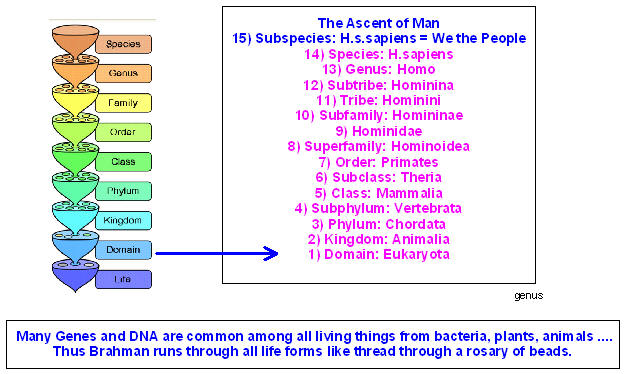
include people, animals, birds, insects, trees.... He categorizes and divides
living things (and objects) by Family, genus, species and individual
parameters. He does not see the pervasiveness of the Lord or Brahman running
through all living beings like a thread running through the beads in a chain.
He notices the differences but does not see the Oneness of Brahman in all
living beings. It is like a Rajasic white man seeing the blackness in the
black people and the brown in the Indians or Vice Versa; the Oneness of
Brahman in all these people eludes his rajasic perception and predisposition.
Ramanuja says that the bodily attributes do not affect the abiding Atman
or the World-Soul in each being. This knowledge, when lacking, is of
Rajasa guna. Rajas as guna is the cause of love and hate, aversion and
attachment.... It thus sees diversity in unity, and fails to notice unity in
diversity (World-Soul in diverse beings).
Bhagavan Krishna says,
'A Punditah (sage) regards (sees) with an equal eye a humble Brahmin, a
cow, an elephant, a dog, and even a dog-eater.'
(bg5.18)
18.22:Tamas holds to a single act as if it were the whole, without regard to
the cause, and knowledge of the Reality or Truth and therefore, is frivolous.
यत्तु कृत्स्नवदेकस्मिन्कार्ये सक्तमहैतुकम् ।
अतत्त्वार्थवदल्पं च तत्तामसमुदाहृतम् ॥१८- २२॥
yat tu kṛtsnavad
ekasmin kārye saktam ahetukam
atattvārthavad alpaṁ ca tat
tāmasam udāhṛtam
18.22
kṛtsnavat
= as though it were all.
ekasmin
= to one, in one.
saktam =
attached, cling, confined, ahaitukam= that which is
irrational, bereft of logic. a-tattva-artha-vat
= absence of Truth.
alpam
= trivial, frivolous.
tāmasam
= born of Tamas. udāhṛtam
= said to be.
Kārye:
effect, result,
single type of act--Ramanuja.
Kārye: form, to one body or to an external
image--Sankara.
Kārye: work -- Ramanuja, Prabhupada.
The physical body comes from Prakrti (matter). If
body, being an incomplete entity, were considered as a whole, it is an
irrational and foolish thought because body without Soul is incomplete and
contradicts the existence of life and Reality. Ramanuja’s interpretation is
different: He calls Kārye as a single type of act. He says, "while an act of
worship of Ghosts (anyone less than Bhagavan, the Lord) offers minor fruits
(as if they are the ultimate goal), the worship of Bhagavan offers many fruits
including the ultimate fruit of salvation."
After reading many commentaries, the following is
my take and understanding of this verse.
Tattvartha = Truth,
Reality, Noumenon
The Tamasic person thinks as follows. He regards one phenomenon as if it
were the whole Tattvartha, the Noumenon. Phenomenon is one (single) thing as
it appears; Noumenon is One Thing in Itself
as it really is. One Thing in Itself is
Purna, wholeness, or Plenitude and is an Entity with myriad things in its
parts. The purport is that Thing in Itself is more than one thing as it
appears. Phenomenon is one infinitesimal part and manifestation of the
Noumenon, which is the whole. Noumenon is more complex than phenomena. A
Tamasic person takes a limited and circumscribed view of a thing, takes it as
a whole and loses sight of the Truth and its complexity. It is like the five
blind men and the elephant. He sees the phenomenal world and ignores the
Tattvartha, the Noumenon (the Truth) that is Bhagavan. He takes the world for
his selfish enjoyment as it relates to him and misses and ignores the
Tattvartha. He cannot see beyond the limitation of his ego, body and
mind.
Sattvic person sees unity
in diversity and the thread of Bhagavan running through all beings and
objects of the universe. (This is the Vaishnava view.)
Rajasic person sees
diversity in unity. To use Nehruvian idiom, Rajasic person has
fissiparous trait.
Tamasic person is a man of trivial pursuits and misses
the unity in diversity.
18.23:That action, which is performed as duty or obligation, without love,
hatred, or desire, by one without attachment to its fruits, is called Sattva.
saṅga-rahitam
= worldly
attachment, desire -
forsaken, deserted = without worldly
attachment.
a-rāga
+ dveṣataḥ
=
without love
or hatred.
aphala-prepsu
= no fruit + longing for
= not longing for fruit.
The clouds rain, the sun shines, and the wind blows
without attachment, love, hatred, and desire for fruits; that is Sattva.
There are so many common loan words like these between
Sanskrit and Tamil. Phala is fruit in
Sanskrit; Pazham (ÀÆõ)
in Tamil is fruit. Sangam = sangam--
ºí¸õ = attachment.
RAga = irAgam,
þá¸õ. dvesa =
dvesam, Чńõ.
18.24:Action, which is performed with a desire to enjoy the fruits, and
is prompted by ego and an extraordinary effort , is considered Rajasic.
bahula-āyāsam: abundance of exertion,
extraordinary effort, or great effort.
Here is a prototypical Rajasic person with
TAB--Type A Behavior.
He talks fast; his voice is screeching, annoyingly loud, and unpleasant. His
carriage is tense, robotic, and jerky. He has palpebral (eye lids),
facial, possibly body and limb ticks.His jaws are tight and TMJs click.
He smacks his lips. His masseters (chewing muscles of the face) are bulging
from constant tonicity, indicating clenched teeth. He sucks in air to
accommodate his rapid-fire staccato speech. He sighs more often than
not. His eyelids blink and pulsate like a wound-up haywire metronome. His
teeth are worn out from excessive grinding while sleeping and awake. He has
black circles under the eyes like a raccoon from loss of sleep, fatigue,
smoking…. He drives fast, cursing pedestrians, and other drivers, honks
unnecessarily, talks to himself while driving, and yells obscenities at
passing cars, pedestrians and "ugly chicks." He weaves through traffic like a
crazed snake shooting towards the hole in the snake-hill. He keeps looking at
the light, starts moving at amber light; green is too late in coming for him.
He screeches to a halt at the nick of time to avoid a pedestrian who is
minding the green light and walking in the pedestrian crosswalk.He smokes, eats, talks on the cell
phone, fiddles with the buttons on the dashboard, yells at the other drivers
and shows the middle finger to the passing cars, all while driving.He bares his teeth like a surly dog.
His forehead has wrinkles and his mouth is puckered like a string purse from
contraction of muscles around the mouth. Sometimes his sourpuss sports a
hesitant smile which dissolves into anger when faced with casual contacts
at toll booths. He curses the toll booth employees for no fault of
theirs for the rising toll charges. He does not actually eat but wolfs the
food down as fast as his gullet can safely pass it down. Before his spouse
could say, ‘second helping,’ he is all done with eating, taps his fingers on
the table, shakes and pumps his leg like piston, looks at everybody else at
the table as if they have nothing else to do except eat his food and wonders
why they haven’t finished their meal. He hates going to restaurants because
the waiters are too slow for his liking. When he ends up there during a long
drive or vacation, he stands at the waiting line shifting his weight from one
leg another and his roving eyes spin impatiently looking at whirling busy
waiters and the cucumber-cool cashier to usher him (and his family) in right
away. His wife and children keep cautioning him to take it easy. One of
his daughters smilingly says, “Giddy Goody Dadyo, there are no empty tables;
we just have to wait our turn.” He loves his family toooo much to see
any slight in her admonition. As he ambles to his table following the usher
too closely for comfort, he knocks the towels, water pots, and silver evoking
disgust from the patrons. His swinging wayward hand pokes the face of a baby
sitting on a high chair, precipitating a sudden clap of thunderous pain from
the baby, and consternation and anguished look from the mother and
inviting an unwelcome cynosural scowl from all directions. He apologizes to
one and all instantly. He can’t wait to get out of the restaurant.
Something is "wronger." The food is bad, the service is atrocious, it is too
noisy, he can’t smoke there, the busboys clatter the plates and silver too
loud, it is too stuffy, it is too hot, it is too cold, it is just not right.
So he asks his spouse to pay the bill, goes to the bathroom, urinates all
around the toilet bowl like a wayward garden hose (his hands are shaking from
nervousness), pulls his zipper fast, nicks himself, yells obscenities, ambles
out of the restaurant before his family, sucks a smoke nervously, fidgets with
his eyeglasses, jingles the coins and the keys in his pocket, checks his back
pocket for his wallet, curses the yelping dog, startles the squirrel by
throwing a lighted cigarette at it with the flip of his smoke-stained finger,
and keeps looking through the restaurant glass walls in the direction of his
table for the shadow of his family. It is the moment they relish, being away
from him, though they love him. He goes home; his family is glad that nothing
worse happened. He settles down on the love seat, watches television, flips
and surfs on all three hundred channels fast and furiously, calls his spouse
asking for his favorite program, its channel and time, drinks his favorite
beer, eats snacks, reads newspaper, belches loudly, opens the mail, and curses
the utilities, and credit card companies for their bills and finance charges.
He goes to bed with baggy eyes covered with sleep shade because he can't sleep
without lights in his bedroom. His wife wears it too because she can't sleep
with lights on. They look like a happy couple sunning in the sunshine of their
lighted bedroom with sleep masks on.
Now you have
an idea what a Rajasic person is. All his acts seek instant gratification; he
projects his ego on men, animals and objects. He is the doer or agent, the
center of the universe, which has to revolve around him. He expends a great
deal of effort at everything he does, but the returns are poor. He arrogates
himself by feeling and saying that he expends enormous energy to run his
business, and support his partners, the staff and the family; he does
everything by himself. Ultimately he is fatigued physically, mentally
and spiritually. He carries the world on his shoulders, which is telling on
his physique, psyche and all; he is at a breaking point.
18.25: Work that is undertaken with delusion, and
without regard to consequence, loss, injury, and ability, is said to be
Tamasic. Tamas = darkness, ignorance.
अनुबन्धं क्षयं हिंसामनवेक्ष्य च पौरुषम् ।
मोहादारभ्यते कर्म यत्तत्तामसमुच्यते ॥१८- २५॥
anubandhaṁ kṣayaṁ hiṁsām
anapekṣya
ca pauruṣam
mohād ārabhyate karma yat tat tāmasam ucyate 18.25
Anubhandam: attachment. Ksayam: loss. Himsam:
injury to others. Anapeksya:carelessness, disregard. Paurusam: human ability, relating to
purusa or human. Mohāt: error, folly, ignorance, delusion
A Tamasic person (delusion, darkness, ignorance,
folly) undertakes an action without due regard to consequences. anapeksya ca
paurusam refers to lack of "human ability, time, skill, knowledge and
resources to perform an act."
This verse, in fact, talks about the war that is
about to take place in Kurukshetra. The Kauravas imposed the war on Pandavas.
The Kauravas stole their kingdom, which is attachment and usurpation. They did
not think of the ruinous consequences such as loss, injury, death, mutilation,
and deprivation on the soldiers, generals, themselves, family members.... They
entered the war with utter carelessness without any regard for future. They
were blinded by their might and did not think of the disadvantage of Bhagavan
Himself taking sides with the Pandavas. They were very derisive of almighty
Bhagavan because of delusion.
18.26:The doer or agent, who is unattached, not egoistic in speech, endowed
with determination and enthusiasm, and unaffected by success or failure, is
said to be sattvic.
He who is without attachment is a Sattvic Doer.
He does not claim any bragging rights for his actions or accomplishments. He
is determined, firm and enthusiastic about what he does without any
attachment; he does not lay any claim on the fruits. He does not claim to be
or having a feeling of being an agent (An-aham-vAdI); he feels he is an
instrument in the hands of Bhagavan. He and his ego do not occupy the central
position in his acts or relationship with others. He remains unperturbed in
success and failure; thus, he does not concentrate on fruits. His guiding
principle in performing an action is approval from the scriptural authority
and not the fruits thereof.
18.27:The doer, who is passionate and desires fruits of actions; who is
greedy, injurious, and impure; and who is subject to joy and sorrow, is
proclaimed to be Rajasic.
A Rajasic doer has passion for name, fame and
fruits. He is greedy, injurious and impure. His greed is saddled with
niggardliness. He causes injury for gain, covetous and cruel by nature (himsa-atmakah).
His act lacks internal and external purity, which is mandatory for worship of
Bhagavan. He is not dispassionate when it comes to action. He is elated at
success and depressed at failure. If there is no fruit, to him it is not worth
his effort. Joy for acquisition, sorrow at getting undesirable fruit, and
losing a coveted object overwhelm him.
18.28:The doer, who is unbalanced, uncultivated, obstinate, deceitful,
usurping, lazy, despondent, and procrastinating, is said to be Tamasic.
Tamasic person is unsteady and unhinged (Ayuktah)
when it comes to following Sastras. He is puerile, immature, unrefined and
ignorant of Sastric injunctions. He is materialistic, stubborn and inflexible
like a rigid rod; he is deceitful, depraved and dishonest. He is too lazy to
undertake and finish his own task. He is gloomy and procrastinating so much so
that he does what has to be done today in the distant future.
18.29: Hear the three kinds of differences in
intellect and steadiness explained fully and severally according to the gunas,
O Dhananjaya.
buddeh = intellect;
bhedam = difference; dhreteh = of fortitude; gunatas = according to gunas
(modes of behavior); trividham = three kinds; asesana = in complete
detail; prathaktvena = severally.
The gunas are three: Sattva, Rajas and Tamas.
Intellect and fortitude are affected by the three gunas. In bgT 6.4-25,
Bhagavan says the following:
6.24 - 25:Giving up all
desires born of mental will and limiting by the mind all senses from all
sides, one should withdraw slowly (little by little) by intelligence and firm
conviction (from objects). With his mind steady on atman, one should not think
of anything else
18.30:Buddhi, by which one knows action and nonaction (renunciation), what
should be done and what should not be done, fear and fearlessness, bondage and
liberation, O Partha, is sattvic.
Pravrttim: activity, exertion or effort. Nivrttim:
renunciation of action Buddhi = discriminating intellect.
Sattvic Buddhi is to know worldly activity (Pravrttim)
is living in the matter, and renunciation
(Nivrttim)
is living in the spirit; the former leads
to material prosperity and the latter leads to liberation.
Pravrttim is centrifugal
movement of the soul from its divine fountainhead, meaning living in the
material world with embodied soul. Nivrttim is
beating a path back to the Source; it is the centripetal
movement of the soul to its fountainhead. The former is
bondage in the world of diversity; the latter is
liberation from the world of bondage. The
former is the path of rites, rituals,
responsibilities, and duties; the latter is
renunciation and withdrawal from the world of matter. Sattvic Buddhi
also knows the prescribed and proscribed acts
according to scriptural injunctions. Fear
and fearlessness are a referent to scriptural
transgressions and observations;
fear arises from transgressions and
fearlessness arises from observation of
scriptural dictates. Transgressions are inimical
to an individual, a family, a community, a nation and the world and therefore
induce fear in a transgressor. Fearlessness is
liberating in an observer of injunctions.
18.31:Buddhi, by which it knows imperfectly dharmam and adharmam, what should
be done and what should not be done, is Rajasic, O Partha.
Dharmam and adharmam: right and wrong.
Dharmam is following prescribed injunctions of
Scriptures. Adharmam is the opposite of Dharmam.
Rajasic Buddhi does not know the essence of the
verse 18.30 and has a wrong understanding of virtue and vice and prescribed
and proscribed acts. Action performed by an individual for the welfare of all
is Dharmam and Karyam; the opposite (Akaryam) is true of Adharmam. Karyam is
action that ought to be done; Akaryam is action that ought not to be done.
That is easy to understand. Let us take simple examples where there is a
moral, ethical and legal dilemma in the choice we make. Most of us know
commonplace Karyam and Akaryam. Karyam is doing one's duty to a fellow human
being according to the dictates of his conscience and job description. A
teacher teaches and desists from abusing the pupils. A legislator serves his
electorate and not the special interest groups. A doctor serves the patient
and not the pharmaceutical industry. All this come under Karyam and Akaryam.
What about actions in the grey zone?
There are some grey areas. When the Nazis were
making house to house search for Jews, some Germans hid them so well that the
Nazis could not find them and were sent on their way with a pack of lies. That
is clearly a laudable moral and ethical act, while at the same time it is an
illegal act. This is an example of Karyam that ought to be done, though
illegal in the eyes of the authorities and the law. You see a snake
swallowing a frog and the snake in its turn is eaten alive by a mongoose. What
should you do? Life is at stake and in danger. The best thing to do is Akaryam,
wherein you do not interfere with the nature of things.
18.32:Tamasic Buddhi, covered by ignorance, thinks Adharmam as Dharmam, and
sees all things contrary to their real nature, O Partha.
Dharmam =
தருமம் = virtuous deed.
This is what Ramanuja says, "That Buddhi is of the nature of Tamas
(darkness, sloth and slumber) which is enveloped in Tamas and reverses every
value. The meaning is that it regards Adharma as Dharma and Dharma as Adharma,
existent as non-existent, non-existent as existent and higher truth as the
lower and the lower truth as the higher, and thus reverses every value."
18.33:The unswerving determination, by which one controls and steadies the
mind, the life-breaths, and the activities of the senses by yoga
(meditation)-- that firmness-- O Partha, is sattvic.
Sattva =
சத்துவம் = Virtue and goodness.
Unfailing determination and fortitude through yoga and Samadhi (absorption in
Brahman) with control of the functions of the Manas, Prana, Indriyas (mind,
vital breaths, and organs) are of the nature of Sattva. Dhrti or
fortitude keeps us steady on the path to realization of Brahman. Dhrti keeps
in check and sustains the activities of the mind, vital breaths and senses
through Yoga. That man is Sattvic. Here there is clear reference to Kundalini
Yoga, by which the Yogi steadies his mind, controls his senses, channels the
breaths through Susumna Nadi and attains Samadhi.
18.34:The determination, by which one holds fast to Dharma, Kāma, and Artha
(duty, desire and wealth) with attachment to desires of fruit O Partha, is
Rajasic.
Dharma, Kāma, and Artha:
Duty, desire/passion, and wealth. Kāma has a carnal element. A
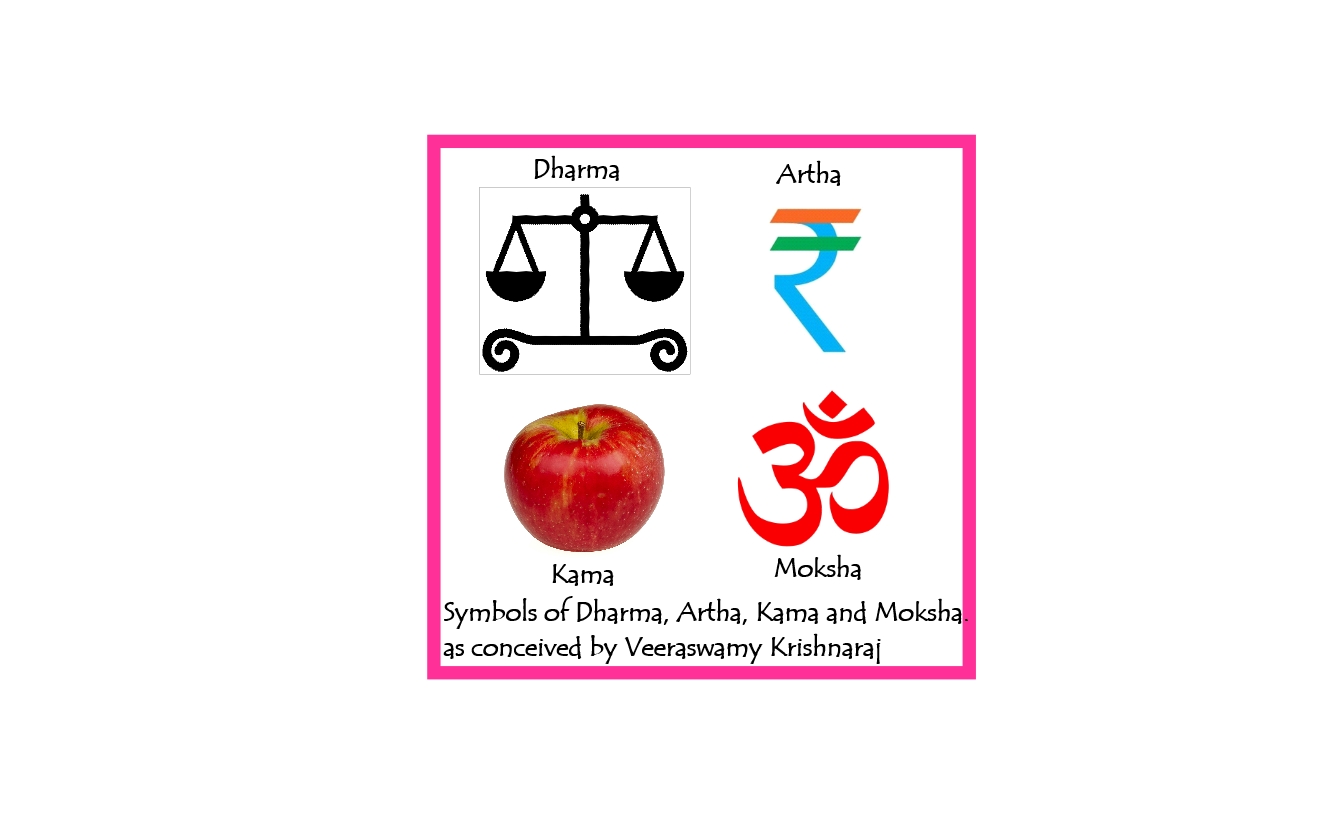
person has four goals in his life: Dharma, Artha,
Kama and Moksa (அரம், பொருள், இன்பம், வீடு =
தருமம், அருத்தம், காமம், மோட்சம்),
which are collectively called
Purushārtha
(புருடார்த்தம்): any object of
human pursuit; aims of existence; the meaning of human existence. Though
Dharma, Artha and Kama observed with determination and fortitude are of
Rajasic nature, there are no injunctions against them.
Kāma
is gratification of any and all desires; Artha,
acquisition of wealth; Dharma,
discharge of duty, righteousness; Moksa,
final emancipation. There is no human existence without these four pursuits.
These four pursuits pair off in a sattvic (virtuous) person. KAma pairs off
with Moksa; Artha with Dharma. Kama is desire and if desire does not pursue
the attainment of Moksa or emancipation, it has no value; if Artha
(accumulation of wealth) does not pair off with Dharma (righteousness), it has
no value. Ramayana has examples of these pairs. Rama is dharma, Lakshmana
Artha; Kama is Satrugna and Moksa Bharata. All these four brothers born of
Dasaratha are embodiments of Dharma, Artha, Kama and Moksa.
Purusharthas abide in
Bhagavan, Adhisesa, Sudharsanam, and
Panchajanyam.
Bhagavan: He who has Bhaga (grace, excellence, beauty,
distinction, majesty....)
Adisesha is the
First Remainders meaning the Primeval residue
consisting of Spiritual substance (Consciousness) left over
from the previous cosmic Manvantara after the
dissolution (Pralaya) and which serves as the progenitor
substance of the new universe. This Consciousness substance is
represented by the bed of coiled snake with hood, upon which Mahavishnu goes
into Yoganidra until the new world is ready to be created. After
destruction and before creation what is left (the residue) is the
Consciousness-Substance (the snake that sheds the skin and makes a new
appearance), represented by Sesha.
Acharya-initiated devotees of Vishnu wear scar-marks of Discus and Conch on
their right and left shoulders from hot seals, impressions or brandings. The
Acharya invokes Narayana and His weapons, Discus and Conch by Mantras and
applies the hot seals on the shoulders. Agni or the fire and heat carry the
spirit of Narayana and His weapons and deposit them on the shoulders of the
devotee for whom Pancha Samskaram is performed; the weapons provide eternal
protection to the disciple.
Sudharsana: Discus on His right hand
Panchajanyam: Sanku or Conch on His left hand
stands for virtue and goodness, defeat of evil, warding off of Yama and his
minions, protection from SamsArA, living in Vaikuntham (Vishnu's abode),
That conch
was called the Panchajanya Conch.
Panchajanya was a wicked demon exhorting people to perform evil acts, which
led to ruination of their lives. The son of Krishna's Guru Sandipany became a
victim of Panchajanya, whom Krishna rescued and returned to his parents.
Krishna fashioned a conch from the bones of Panchajanya and blew it to warn
the evil people of the consequences of their evil acts. In the epic war of
Mahabharata in Kurukshetra, Krishna blew the conch to strike terror in the
hearts of Kurus, which essentially sealed the fate of Kurus. The conch is also
blown on auspicious occasions and emanates the sacred syllable sound, AUM.
There is
another story connected with the Conch.
There was a demon
called Shankhaasura. He defeated the Devas, stole the Vedas (Sacred
Scriptures) and went to the bottom of the ocean to hide it. The Devas prayed
to Lord Vishnu for help. Lord Vishnu incarnated as the Matsya (fish) Avtaar,
killed Shankhaasura, and blew the conch-shaped bone of his ear. The ‘Om’
sound came out of it and the Vedas were released from captivity. That is the
reason why the conch is called ‘Shankha’ and the knowledge of the Vedas is
contained in the sound of ‘Om’ that emanates from the Shankha (conch).
18.35:The determination by which a fool never gives up
dream, fear, grief,
despondence, and conceit
or arrogance, O Partha, is Tamasic.
yaya
svapnam bhayam
sokam visadam
madam eva ca |
na vimuncati
durmedha dhrtih sa partha tamasi||18.35||
Here the Sanskrit word
Svapna means dream. Many commentators interpret it as sleep.
This description is of a person with hypochondria and depression.
Fear, grief,
despondence and excessive
sleep are signs of depression.
Durmedha =
dull-witted, stupid, ignorant.
Here “a fool who does not give up sleep” means
that he does not want to give up excessive sleep. Sleep in another
context means ignorance.
18.36:And now hear from Me, O Best among Bharatas, the three kinds of
happiness, which one enjoys by practice and by which he reaches the end of
suffering.
18.37:That happiness, which is like the poison at the beginning and nectar at
the end, comes from Atma buddhi and is sattvic.
Sattvic happiness, coming from Atma buddhi, is
like poison at the beginning and nectar at the end.
Atma buddhi: Knowledge of the Self.
Real joy is like poison in the beginning because
Yoga is a strenuous practice and realization of Brahman has not taken place,
which when realized is comparable to nectar in the end. This ambrosial
joy comes upon acquisition of Spiritual Knowledge and detachment, and absence
of egotism.
18.38:The happiness, which comes from the contact of objects of senses with
the senses, is nectar at the beginning and poison at the end, and is known as
Rajasic.
Rajasic happiness coming from contact of senses
with objects of senses is nectar at the beginning and poison at the end.
18.39:That happiness, which deludes the atman in the beginning and at the end
and which comes from sleep, laziness, and negligence, is said to be Tamasic.
Tamasic happiness deludes the atman in the beginning and the end
and comes from sleep, laziness, and negligence.
An embodied (Tamasic) being, divested of
soul-consciousness is awake, alert, enthused, and dedicated to material
pursuits, which is Tamasic happiness. It deludes the individual soul of a
person, revels in spiritual sleep, and laziness and negligence in switching
from sense objects to spiritual pursuits.
Sleep has two
meanings: 1. normal physiological sleep that a person needs for recuperation
from daily wear and tear. 2. Spiritual sleep. Spiritual sleep is
ignorance and seeking sense gratification. When we are awake to the world of
senses and its objects, we are in spiritual sleep and Kundalini Sakti is
asleep in the Muladhara Chakra. When we are awake spiritually, Kundalini Devi
is also awake, which is the first requisite for the Kundalini Sakti's rise
through all Chakras to Sahasrara to attain oneness with Siva and Sakti. That
is opposite of sleep and becoming one with the Lord; that is knowledge of
Reality. Laziness and negligence accompany Spiritual ignorance.
18.40:There is no being either on earth or in heaven or among the gods, who
is free from the three modes of Gunas born of Prakrti.
Prakrti: Material nature.
18.41: Brāhmana, Kshatriya, Vaishya and Sūdra, O
Parantapa, and their activities are divided according to the
Gunasborn of their
own nature.
In
answer to question #530, Sri Krishnan Swamy says, "There
are two ways in determining caste - by birth and by conduct. All are free to
chant Namas."
Character (Guna) makes a Brahmin
and not natal caste
Don't Ask, Don't Tell (DADT)
should be the case with castes.
The four
classes are not determined by birth or colour but by psychological
characteristics which fit us for definite functions in society. Dr.
Radhakrishnan, The Bhagavadgītā , page 364-5.
Sri Nārāyana Guru (August
22, 1856 – September 20 1928) http://en.wikipedia.org/wiki/Sree_Narayana_Guru
Sri
Nārāyana Guru (1855–1928)
From the beginning of time, so far as anyone knew,
only
Brahmins had ever installed an idol. Yet when Gurudevan (born in
Ezhavan Caste) performed the sacred rite it appeared so natural for him
to pick up a small rock and install it. When
brahmins challenged his right to consecrate, he replied in his famous
quote:This is not a Brahmin Siva, but an Ezhava Siva.To
those who questioned the timing of the consecration saying it was not an
astrologically auspicious time, he replied: Horoscope is to be cast
after the birth of a child, not before. He instructed to place a
plaque containing a motto on the temple wall which read as:
Devoid of dividing walls of Caste
Or hatred of rival faith,
We all live here
In Brotherhood,
Such, know this place to be!
This Model Foundation!
Next, he started a
Sanskrit school in
Varkala. Poor boys and orphans were taken under his care. They were
given education regardless of caste distinctions.
In 1913, he founded the Advaita Ashram at
Aluva. This was an important event in his spiritual quest. This
Ashram was dedicated to a great principle - Om Sahodaryam Sarvatra
(all men are equal in the eyes of God). This became the motto of the new
Ashram. He further said in that message, The name
Ezhava does not denote a caste or a religion and he made temple
rights to everyone. Therefore people can be admitted to this
organization without paying heed to differences of caste.
Schools rather than temples
are to be preferred, he exhorted in a dramatic shift of focus, he said.
He advised Sri Buddha's principles of five purities - body, food, mind,
word, deed called as Pancha Dharma.
An Advaithin to the core, he did not differentiate
people on the basis of their religion, caste, colour or beliefs. He was
tolerant toward all philosophies that stood for the progress of mankind.
In the year 1916, he proclaimed : It is years
since I left castes and religions. Yet some people think that I belong
to their caste. That is not correct. I do not belong to any particular
caste or religion.
The fourfold
order is not peculiar to Hindu society. It is of universal application. The
classification depends on types of human nature. Each of the four classes has
certain well-defined characteristics though they are not to be regarded as
exclusive. These are not determined always by heredity.
The Gītā cannot be used to support the existing social order with its rigidity
and confusion.
It takes up the theory of the four orders and enlarges its scope and meaning.
Man's outward life must express his inward being; the surface must reflect the
profundity. Each individual has his inborn nature, svabhāva, and to make it
effective in his life is his duty, svadharma. Each individual is a focus of
the Supreme, a fragment of the Divine. His destiny is to bring out in his life
this divine possibility. The one Spirit of the universe has produced the
multiplicity of souls in the world, but the idea of the Divine is our
essential nature, the truth of our being, our svabhāva, and not the apparatus
of the gunas, which is only the medium for expression. If each individual does
what is appropriate to him, if he follows the law of his being, his svadharma,
then God would express Himself in the free volitions of human beings. All that
is essential for the world will be done without a conflict. But men rarely do
what they ought to do. When they undertake to determine events believing that
they know the plan of the whole, they work mischief on earth. So long as our
work is done in accordance with our nature, we are righteous, and if we
dedicate it to God, our work becomes a means of spiritual perfection. When the
divine in the individual is completely manifested, he attains the eternal
imperishable status, śasvataṁ padam avyayam. The problem that human life sets
to us is to discover our true self and live according to its truth; otherwise
we would sin against our nature. The emphasis on svabhāva indicates that human
beings are to be treated as individuals and not as types. Arjuna is told that
he who fights gallantly as a warrior becomes mature for the peace of wisdom.
There are four
broad types of nature and answering to them are four kinds of social living.
The four classes are not determined by birth or colour but by psychological
characteristics which fit us for definite functions in society. Dr.
Radhakrishnan, The Bhagavadgītā , page 364-5.
'Caste is a state, not an
iron-bound class, and every one who knows and loves God is
a true Brahmin.'
Swami Vivekananda
The Complete Works of Swami Vivekananda Volume 2 [ Page : 508 ]
Mr. Thomas, Professor of
Sanskrit, University of Oxford was visiting Tiruvannamalai Tamil Nadu in
December 1937 and posed a question to Ramana Maharishi.
Q: What do you think of castes?
A: The castes relate to bodies
and not to the Self. The Self is Bliss. To realize Bliss one realizes the
Self. No need to worry oneself about caste, etc. Talk 433. Ramana Maharishi.
Here is
what Vajrasucika Upanishad says about caste. This belongs to Sama Veda
and undermines caste distinctions based on birth. This passage is a complete
extract minus Sanskrit text of Vajrasucika Upanishad,The
Principle of Upanishads, translated by Radhakrishnan (page 935-938).
I.I shall describe the Vajrasuci doctrine which blasts
ignorance, condemns those who are devoid of the knowledge (of Brahman)
and exalts those endowed with the eye of knowledge.
2. The Brahmana the
Ksatriya, the Vaisya and the Sudra are the four classes (castes). That
the Brahmana is the chief among these classes, is in accord with the Vedic
texts and is affirmed by the Smrtis.
In this connection there is a point worthy of investigation. Who is,
verily, the Brahmanas? Is he the individual soul? Is he the body? Is he the
class based on birth? Is he the knowledge? Is he the deeds (previous, present
or prospective)? Is he the performer of the rites?
3. Of these, if the first (position) that the
Jiva or the individual soul is Brahmana (is to be assumed), it is not so; for
the individual's form is one and the same in the large number of previous and
prospective bodies. Even though the Jiva (the individual soul) is one, there
is scope for (the assumption of) many bodies due to the stress of (past)
karma, and in all these bodies the form of the Jiva is one and the same.
Therefore the Jiva is not the Brahmana.
4.
Then if (it is said) that the body is the Brahmana, it is not so,
because of the oneness of the nature of the body which is composed of the five
elements, in all classes of human beings down to the candalas
(outcastes), etc.; on account of the perception of the common features of old
age and death, virtue and vice, on account of the absence of any regularity
(in the complexion of the four classes) that the Brahmana is of the white
complexion, that the Ksatriya is of the red complexion, that the Vaisya is of
the tawny complexion, that the Sūdra is of the dark complexion and because of
the liability of the sons and others (kinsmen) to becoming tainted with the
murder of a Brahmana and other (sins) on cremating the bodies of their fathers
and other kinsmen: Therefore the body is not the
Brahmana.
5. Then (if it is said) that birth (makes) the
Brahmana, it is not so, for there are many species among creatures, other than
human; many sages are of diverse origin. We hear from the sacred books that Rsyasrnga was born of a deer, Kausika of Kusa grass, Jambuka from a jackal, Valmiki from an ant-hill, Vyasa from a fisher girl, Gautama from the back of a hare, Vasistha from Urvasi (the celestial
nymph), Agastya from an earthen jar. Among these, despite their birth,
there are many sages, who have taken the highest rank, having given proof of
their wisdom. Therefore birth does not (make) a
Brahmana.
6. Then (if it is said) that knowledge (makes a)
Brahmana, it is not so because among Ksatriyas and others there are many who
have seen the Highest Reality and attained wisdom; Therefore
knowledge does not (make) a Brahmana.
7· Then (if it is said) that work (makes a)
Brahmana, it is not so, for we see that the work commenced in the present
embodiment or accumulated during the previous or to commence on a future
embodiment is common to all living creatures and that good men perform works
impelled by their past karma. Therefore work does not
(make) a Brahmana.
8. Then (if it is said) that the performer of
religious duties is a Brahmana, it is not so; for there have been many
Ksatriyas and others who have given away gold. Therefore the
performer of religious rites is not the Brahmana.
Giving away gold is an act of religious duty.
9· Then, who, verily is the Brahrnana? He who,
after directly perceiving, like the amalaka fruit in the palm of one's hand,
the Self, without a second, devoid of distinctions of birth, attribute and
action, devoid of all faults such as the six
infirmities, and the six states,
of the form of truth, wisdom, bliss and eternity, that is by itself, devoid of
determinations, the basis of endless determinations, who functions as the
indwelling spirit of all beings, who pervades the interior and the exterior.
of all like ether, of the nature of bliss, indivisible, immeasurable,
realizable only through one's experience and who manifests himself directly
(as one's self), and through the fulfillment of his nature, becomes rid of the
faults of desire, attachment, etc., and endowed with qualities of tranquility,
etc., rid of the states of being, spite, greed, expectation, bewilderment,
etc., with his mind unaffected by ostentation, selfsense and the like, he
lives. He alone who is possessed of these qualities
is the Brahmana. This is the view of the Vedic texts and tradition,
ancient lore and history. The accomplishment of the state of the Brahmans is
otherwise impossible. Meditate on Brahman, the Self who is being,
consciousness and bliss, without a second; meditate on Brahman, the
Self who is being, consciousness and bliss without a second. This is the
Upanisad,
six infirmities:
old age, death, sorrow, delusion, hunger and thirst.
six states: birth, being, growth,
change, waning and perishing.
Many texts
declare that the determining factor of caste is character and conduct and not
birth.
Listen about caste, Yaksa dear, not study, not
learning is the cause of rebornness. Conduct is the
basis, there is no doubt about it. M.B.
Aranya-parva 312. 106.
O King of serpents, he
in whom are manifest truthfulness, charity, forbearance, good conduct,
non-injury, austerity and compassion is, a Brahmana according to the sacred
tradition.
O serpent he in whom this conduct is manifest is
a Brahmana; he in whom this is absent treat all such as Sudra. M.B.
Aranya-parva 180. 20, 27. The gods consider him a Brahmana (a
knower of Brahman who has no desires, who undertakes no work, who does
not salute or praise anybody, whose work has been exhausted but who himself is
unchanged.
Sanatsujata defines a
Brahmana as one who is devoted to truth: sa eva satyānnāpaiti sa
jñeyo brahmanas tvayā.
It is valuable to recall the
teaching of this Upanişad which repudiates the system that consecrates
inequalities and hardens contingent differences into inviolable divisions.
End of Vajrasuika Upanishad.
India:
(Dalit) Woman Wins Post of Speaker, (proficient in Sanskrit, English,
Hindi and Spanish).
By THE ASSOCIATED PRESS
Published: June 4, 2009
India’s Parliament on Wednesday elected its first female speaker,
the daughter of a former deputy prime minister and a Dalit, a member
of India’s lowest caste. Meira Kumar, 64, was elected unopposed and
immediately assumed her post. She replaced Somnath Chaterjee, a member
of the Brahmin caste, India’s highest. Ms. Kumar has been elected to
Parliament five times and has also served as social justice minister.
Here is what
Pujya Swamiji of Rishikesh does in his Gurukulam; here is
his stance on caste. He takes orphaned children
irrespective of caste, names them Rishikumars, and offers them both secular
education and Vedic studies.
Parmarth Gurukul, Rishikesh India
At the sacred time of the
Paush Purnima (full moon), 24 of the rishikumars had their
official upanayana, or sacred
thread ceremony. This ceremony marks the boy's official entry into
the study of the vedas and the "gurukul" system.
Although historically it was a ritual
performed only for the brahmin caste, Pujya Swamiji
made no distinctions between
children born of different castes.Any of the boys who wanted to undergo
the official ceremony - during which they also receive a sacred mantra from
Pujya Swamiji - were welcome.
In India today there are thousands and thousands of
abandoned and impoverished children, roaming the streets of the cities
and the dirt paths of the villages. These are children whose parents were too
poor to raise them, or who simply decided they did not want to accept the
burden of a child, or who were befallen by an accident that left them
incapable of fending for themselves, let alone a child.
However, simple shelters with food, beds and babysitters are not
sufficient. These children need not only to be fed and sheltered - they
need to be educated and trained so they can be
productive members of society. They need to be
inculcated with values, ethics and spirituality which will make them
torchbearers of Indian culture and divine cultural ambassadors. We have
opened an orphanage /gurukul in Rishikesh where 100
young boys live and study - both basic academics as well as intensive
Sanskrit and ancient Vedic texts. Their days are filled with yoga,
meditation, Vedic chanting, reading of scriptures, mathematics,
seva and special programs designed to infuse their lives with essential
sanskaras. They are being trained to be not
only doctors, scientists and engineers, but they are also being trained to
be India's cultural ambassadors, to be thepriests and guides
who will travel throughout the world, carrying with them the ancient secrets
of the Vedas combined with the blessings of Mother Ganga.
From the first minute that the boys arrived,their identity was changed from "orphan" and "poor" to "Rishikumar."
With that slight, simple change of term, their entire identities have changed.
Looks of hopelessness have become looks of great optimism and hope. Lightless
eyes have become bright, shining eyes. Feelings of destitution and despair
have become feelings of pride, of faith and of enthusiasm.
We currently have 150 young boys living in our 2 gurukuls, one on the
premises of Parmarth Niketan in Rishikesh and the other on the premises of the
Veerpur ashram, 8 km. away. We are looking to take in up to 500 more children.
Computer Centre for Rishikumars
February 2005 saw the inauguration of a computer centre in the Gurukul,
which was kindly sponsored by Bellaben and Yogeshbhai Patel. A special prayer
was said at the function so that the rishikumars grow, blossom and bridge the
gap between ancient traditions of the Himalayas and modern technology of the
computer age.
Janeo Sanskar of Rishikumars
On 12 July 2005, Parmarth Gurukul accepted 91 new Rishikumars into the
Gurukul. The children, all of whom come from poor,
disadvantaged situations (some of whom are orphans, some who
have one parent, some who have both but the parents cannot properly care for
the children) received their janeo sanskar. The sacred thread ceremony
is an important ritual in the life of a Hindu boy (see www.parmarth.com/sanskaras.htm
for details of the meaning of this ceremony), and one which prepares him to
study the scriptures.
The ceremony was performed and all the rishikumars received the sacred
mantra from Pujya Swamiji and a mala for japa, as well as a special asana for
sitting for their meditation and sandhya.
In the evening, after the Ganga Aarti, the rishikumars all (new and old)
received new clothes, new school books and big sweet ladoos, by the hands of
the Shahra family from Indore and Mumbai.
Here is a real-life story of a high-caste
Nayanar (Naminandhi Adikal (¿Á¢¿ó¾¢
«Ê¸û), a devotee of Siva.
Lord ThyAgEsar (Image) rode in state from TiruvArUr to Manali. There was a
huge crowd jostling with each other for a good clear obstruction-free Darshan
(¾¡¢ºÉõ
= Auspicious sight of the deity) of the Lord. The
Brahmanas, Vaishyas, Sudras and other unclassified castes were mingling in the
crowd and rubbing shoulders. Adikal went home that night but did not enter his
pollution-free house because his body was polluted by the touch of the lower
castes. He went to sleep in front of the house that night, as he was thinking
he would take a cleansing bath. Siva in His Archana form appeared in his dream
and told him that all those born in TiruvarUr are His Ganas (attendants) and
that he should take a note of this condition. He woke up early in the morning,
told his wife of his dream and being afraid of Apasaram («Àº¡Ãõ
= irreverence) for not doing the morning
worship, left for TiruvArUr. All the people of TiruvArUr appeared as Siva-Nilakanta
(Siva with blue throat) to Adikal, who raised his hands above his head, held
the palms together and fell prostrate on the ground in humility and became
ecstatic at having seen Siva (Siva clones). Here you may notice several
things. Siva is the egalitarian God. He forgives His devotees for any
infractions and wrong notions about caste. He positively tells them what is
right and what is wrong in a very non-threatening and amiable manner without
flustering the devotee. He even gives a vision of Himself to his erring
devotees. Pollution is just not a physical but mostly a mental perception.
Siva tells the down-trodden and oppressed people that they are one with the
higher castes and He has their interest in His mind. Siva gives Grace (அனுக்கிரகம்)
to all irrespective of caste. Once Parvati and Siva played the roles of
Chandalini and Chandala. The following verse depicts the appearance of Siva
with blue throat to His devotee as myriad Clones of Himself, to teach the
high-caste errant devotee that He belongs to all castes.
Periya Puranam (பெரிய
புராணம்) Verse 1899 by Sekkizar.
தெய்வப் பெருமாள்
திருவாரூர்ப் பிறந்து வாழ்வார் எல்லாரும்
மெய்வைத்து அமர்ந்த
மேனியராம் பரிசு கண்டு முடிகுவித்து
கைவைத்து அஞ்சி அவனி
மிசை விழுந்து பணிந்து கண் சிறந்தார். 1899
All
the people born in Tiruvarur under the aegis of the Supreme Lord of the gods (ThyAgEsar)
with the black throat appeared as the blue-throated Nilakantappas with
effulgent bodies. Having seen the nature and appearance and become
afraid, he raised his hands above his head, brought his palms together, fell
prostrate on the ground in worship and humility and became ecstatic at seeing
the form of the Lord.
May 2009: Indian students in
Australia, the land down under of Aussies and a former Penal Colony are the
victims of assault by the Junkies among Aussies.
There is a lesson to be learnt from the Aussie Junkie
Curry Basher, who is an equal opportunity Basher. All Indians and Indian
look-alikes joined together to protest the violence against Indians. The
basher did not pick and choose one's religion, caste, economic status and
other identifiers. The victim could be Muslim, Buddhist, Jain, Sikh, Brahmin,
(Ksatriya), Vaishya, Sudra, Dalit, other or any one of the scheduled castes
and tribes (SCs & STs constitute 24% of India's population). The Curry Basher
goes by your look and not by your affiliation. All of you joined together in
the protest, because each one of you felt the pain irrespective of that which
separates one from the other. When you go back to India, you should remain
Indian, advocate oneness of all Indians and do not engage in divisive politics
or practices.
In a larger global context, each one of us is a
citizen of the world and thus should rise above that which separates us.
Obviously the supreme ignoramus the curry basher is not destined for
greatness. They are the scum, the dross, the riffraff, the dregs, the refuse,
the curse of Australia and the world. We should not be part of his culture.
What Krishna Bhagavan tells about Varna in
Bhagavad Gita:
4.13: I founded (created) the fourfold order of
Varna according to guna and karma (fundamental quality and work). Though I am
the founder, know me thou as unable to act or change.
Sri U. Ve Velukkudi Krishnan Swamy
One cannot move from one varna to another. It is decided when born. By
conduct one can follow satvik qualities. Moreover there is no need to
switch as moksham (मोक्ष=
Liberation = Vaikuntam)
can be attained from any varna.
Varna =वर्न=
appearance, color = Brahmana, Ksatriya, Vaisya, and Sudra (Brahmana,
Warrior, Trader, worker)
9.32:O son of Partha,
they, who take refuge in Me, though they are women, Vaisyas, Sudras and
Chandalas (those born of women with wombs of sin), attain the Supreme Goal.
From the book, Sayings of Sri Ramakrishna
Ramakrishna Paramahamsa says the following
with regard to caste in reference to spirituality in his book,
Sayings of Sri Ramakrishna (SRK),
Saying 254,
page 84. The spiritually minded belong to a caste of their own,
beyond all social conventions.
Saying 313
Page 98: The rules of caste fall away of themselves from him who has
attained perfection and has realised the unity of all things; but those
who have had no such exalted experience cannot escape the consciousness of
superiority and inferiority in others, and have to observe caste
distinctions.
Saying 314,
page 98: Is it proper for one who has attained Divine wisdom to keep the
Brahmanical thread? When the knowledge of the Self is gained, all fetters
drop off of themselves. Then there is no distinction between a
Brahmana and Sudra, between high caste and low caste. Thus the sacred
thread, a sign of caste, falls off of itself. But so long as a man is
conscious of any distinction and difference, he should not forcibly throw
it away.
Saying 315:
While a (blinding) storm is blowing, we cannot distinguish between an
Asvattha (fig tree) and a Vata (banyan tree), So when the storm of supreme
knowledge blows, there can be no distinction of caste.
Saying 317,
page 99: Krishna Kishore took me (SRK) to task for having parted with the
sacred thread. SRK says "You will see it all clearly if you are once
seized with the madness for the Lord. When this change came over me,
everything was blown away, as if by the great cyclone of Ashvin."
There is clear evidence here that the Varna
system, commonly called caste division, is based not only on birth but also on
character, aptitude, spiritual attainment, and ability.
Siva in answer to a question from Parvati tells
her: Veda is not Veda, the eternal Brahma is Veda. Whosoever knows the Brahma Vidya is a Brahmin,
skilled in the Vedas (Verse 50).
After knowing Brahma Jnana, one
is free from all distinctions of caste (57).
Jnana Sankalini Tantra.
Gandhi is a
firm believer in Varnasrma Dharma. Gandhi admits he was born of Vaishya
(Traders) parents, 3rd down the line. Gandhi says, "I as a Vaisya would be
earning my bread by selling drugs (pharmacist) or groceries. Vaisya Varna
includes all professions. A tailor may not become a blacksmith although
both may be and should be called as Vaisyas. No one is superior to any other
(among the four varnas). A scavenger has the same status as a Brahmin. He
endorses the view of Max Muller by quoting him: In Hinduism more than any
other religion that life was no more and no less than DUTY. Varna does not
make life dull and robs it of all ambition. Under the cover of Varna, hideous
inequalities and tyrannies are practiced at the present day in Hinduism. Varna
is not a mere institution made by man but it is a law discovered by him. The
evil lies in the doctrine of superiority and inferiority superadded to it.
I do regard Varnashrma as a healthy division of work based on birth. The
present idea of caste is a perversion of the original. He (a non-Brahmin)
who performs the duty of a Brahmin will easily become one in the next
incarnation.
It appears that according to
Gandhi, any Varna can do any work suited to his temperament, training,
intellect, aptitude, education and spirituality, as long as he or she
does not call himself or herself by other than his Birth-Varna or the
natal caste.
18.42:Tranquillity, self-control, austerity, purity, patience, honesty,
knowledge, wisdom, and belief in God are
the duty of the Brāhmana
born of his own becoming or nature (karma SvA-bhAva-jam)
Belief in God:
In UK, there is a movement to debaptize people.
National Secular Society UK is offering to liberate
yourself from the original Mumbo-Jumbo that liberated you from the Original
Sin you never had. NSS offers a Certificate of Debaptism.
The certficate declares:
I ________ having been subjected to the Rite of Christian Baptism in
infancy (before reaching an age of consent), hereby publicly revoke any
implications of that Rite and renounce the Church that carried it out. In the
name of human reason, I reject all its Creeds and all other such superstition
in particular, the perfidious belief that any baby needs to be cleansed by
Baptism of alleged ORIGINAL SIN, and the evil power of supposed demons. I wish
to be excluded henceforth from enhanced claims of church membership numbers
based on past baptismal statistics used, for example, for the purpose of
securing legislative privilege.
ATHEIST, AGNOSTIC, INFIDEL, SKEPTIC refer to persons not inclined toward
religious belief or a particular form of religious belief. An
ATHEIST is one who denies the existence
of a deity or of divine beings. An AGNOSTIC
is one who believes it impossible to know anything about God or about the
creation of the universe and refrains from commitment to any religious
doctrine. INFIDEL means an unbeliever,
especially a nonbeliever in Islam or Christianity. A
SKEPTIC doubts and is critical of all
accepted doctrines and creeds. --Random House Webster's Unabridged
Dictionary.
The Váyu Purana
states that the castes were first divided according to their occupations;
having, indeed, previously stated that there was no such distinction in the
Krita age: 'Brahmá now appointed those who were robust and violent to be
Kshetriyas, to protect the rest; those who were pure and pious he made
Brahmans; those who were of less power, but industrious, and addicted to
cultivate the ground, he made Vaisyas; whilst the feeble and poor of spirit
were constituted Śúdras: and he assigned them their several occupations, to
prevent that interference with one another which had occurred as long as they
recognized no duties peculiar to castes. --H.H.Wilson in
Translation of Vishnu Purana page 69,
Reprint 1989.
A true Brahmana should have these qualities born
of his own becoming; his natal caste is immaterial.
Karma Sva-bhAva-jam = duty born of self becoming.
Karma = duty; Sva =
self; bhAva = becoming. Do you see any reference
to the birth caste of a person here? Certainly not. But "learned pundits"
twist, turn, wring and torture the text; they muddle in the puddle of
meaningless words, twaddle, dawdle and speak for Bhagavan, which they
should not do. The perverse should speak for themselves and should not drag
Bhagavan to support their perverse arguments. Such is the case with some noted
so-called saints. Brahmana is not being
(born in a caste) but becoming (BhAva) one. It is
a post-natal condition and not a congenital one.
It is becoming a person of tranquillity,
self-control, austerity, purity, patience, honesty, knowledge, wisdom, and
belief in God. An infant obviously is not all that at birth.
Vyasa, the author of Mahabharata
and the Bhagavad Gita as told by Krishna, was born of a Brahmana father and a
non-Aryan mother (Fisherwoman). Bhagavan
had been a Fish, a Tortoise, a Boar, a Horse, a Lion-man.... It just shows
that Paramatman is the Inner Soul of all beings and even matter. He had been
there and done that. He doesn't need any body of any caste or race to append
any pendant on Him. He transcends all. From the following table, you can have
an idea of how the ancients abhorred the miscegenation of castes, races....
This fear of pollution, and desire for racial purity: It is not something new;
it haunts people now and will haunt in the future. The inexorable march of
Time will gradually erode the distinctions between multiple races, castes...
in the global village and produce a human race of earthen colors. America is
the caldron for the emergence of First Crop of generic man, a polyvalent DNA
soup, wherein all races abide in all and sundry.
Mixed castes according to Garuda Purana
1.96-1-73, as narrated by Yajnavalkya.
Father
Mother
The offspring
Brahmin
Ksatriya
Muurdhaabhisikta
Brahmin
Vaisya
Ambastha
Brahmin
Sudra
Nisaada, Parvata
Ksatriya
Vaisya
Maahisya (Mahisya)
Ksatriya
Sudra
Mleccha
Vaisya
Sudra
Karana
Ksatriya
Brahmin
Suta(Sūta)
Vaisya
Brahmin
Vaidehaka
Sudra
Brahmin
Chandala (Lowliest of all)
Vaisya
Ksatriya
Maagadha (Magadha)
Sudra
Ksatriya
Ksattr
Sudra
Vaisya
Ayogava
Maahisya (Mahisya)
Karanii
Rathakaara
Satyavati (Sanskrit: सत्यवती) is the
mother of Vyasa and great-grandmother of the Pandava and
Kaurava princes, principal characters of the Mahabharata. She is
nevertheless a commoner,
daughterof a
ferryman orfisherman. She is
also known as Matsyagandha (one who has
the smell of fish). Now
you see the principal characters of Mahabharata trace their origin to a
fisherwoman, who is neither a Brahmana, nor a Ksatriya, nor a Vaishya, nor a
Sudra. Whether all this is true or not is not the question. The lesson is the
ideals of Hinduism are above the pettiness of demarcation of the so-called
castes. As a young woman, she met the wandering Rishi Parasara by whom she had
a son, Vyasa. Parasara by his mystic
power guaranteed that she would not lose her virginity from union and
delivery. It sounds hypocritical that Parasara made the girl whole
anatomically but vitiated her mind which has the imprint of forced illicit
consortium and childbirth. This reminds me of girls who had premarital
sexual relations undergo hymenoplasty (surgical restoration of inviolate
contour of hymenal ring) to restore the appearance of hymen to its
virginal inviolate state to impress the husband who insists on virginity in
his bride in certain countries. Parasara and Satyavati had union and Vyasa's
birth took place in secret on an island in
the river Yamuna. Vyasa was also known as KrishnaDwaipayana because he was black in
color and born in an island. Rishi
Parasara by his Yogic power created an ambience of mist around the island, so
that no body could witness the famed union and delivery of the baby. Vyasa was
born immediately after the union with no mandatory gestational period, which
is the norm for humankind, and immediately grew into a young man. This is
again a Yogic phenomenon. (Consider Jesus Christ born of Virgin Mary.)
The West says that Vyasa is a generic name like teacher, tailor, barber. There
were many Vyasas. Many of the sacred texts span over many centuries and they
could not have been all composed by one Vyasa. This is contested by devout
Hindus. Satyavati married king Shantanu as opposed to union with Rishi
Parasara; Kauravas and Pandavas come in that lineage. Satyavati later marries
king Shanathu; thus Satyavati had one child as a single mom and later married
a king. See level 2 in the chart below.
See the pedigree
chart below. Blue
line indicate extramarital union;
Pink horizontal lines indicate
marriage and descendants. The green
squares and the wavy lines indicate progeny from non-marital union.
Numbers indicate the levels of descent. Union or united = Extramarital or
non-marital relations.
This is Kaurava genealogy. Shantanu had
two wives: Ganga (3) and Satyavati (3), the
fisherwoman. Rishi Parasara (3) previously united with Satyavati
(3) and sired instantly an infant who grew immediately to an young man, Vyasa
(4), who unites with Ambalika (4) and produced Pandu (5). Vyasa (4) again
unites with Ambika (4) and her palace maid (4); Dhritarastra (5) comes from
Ambika; Vidura (5) comes from the palace maid. Dhritarastra (5) in a fit of
extramarital fling like his father Vyasa and Grandfather Parasara unites with
a palace maid (5) and sires Yuyutsu (6). Dhritarastra marries Gandhari (5) and
sires Duryodhana, Dushana, 98 others and Dushada (6).
This is Pandu dynasty. Shantanu had two
wives: Ganga (3) and
Satyavati
(3), the fisherwoman. Rishi Parasara (3) previously united with Satyavati
(3) and sired instantly an infant who grew immediately to an young man, Vyasa
(4), who unites with Ambalika (4) and produced Pandu
(5). Vyasa (4) unites (extramarital) with Ambalika (4), sister of Ambika (4)
and sires Pandu (5) who maries Madri (5)
siring twins, Nakula (6) and Sahadeva (6),
and marries Kunti (5), siring Yudhisthira, Bhima and
Arjuna (6). Sun God (5) sires Karna (6) with Kunti (5) premaritally.
This is Pandu dynasty.
Bhagavan Krishna (6) Chose Devaki (5) and Vasudeva (as His parents).
Vasudeva was sired by Surasena (4) and Marisa (4).
18.43:Heroism, boldness, determination, skill, not fleeing from the battle,
generosity, and lordliness are the duty of Kshatriya born of his own nature or
becoming.
Heroism or valor generates boldness which needs
determination, confrontation, perseverance and skill to wrest victory from the
enemy. The king by extracting victory from the enemy by risking his limb and
life has shown his duty to his subjects. Charity and generosity are another
strong trait of a true Kshatriya, without which all his army, victories,
riches, jewels, throne, crown, royal robes, courts, and palaces are of no
value. Lordliness and leadership are essential requisites of a king
without which he cannot lead and rule his subjects.
18.44:Cultivation, cow protection, and trade are the duty of Vaishya, born of
his own (Vaishya) nature. Duty of Sudra is of the nature of service (to other
three), born of his own nature or becoming. (Cow protection is rearing of cattle.)
The following is an excerpt from
Jaiva Dharma Chapter 6 by ThAkura of
Bengal.
The
determination of
varna on the basis of birth alone is a recent
practice.
Vaisnava dasa: The qualities that are found in the nature of a
brahmana are: sama (control of the senses), dama (control of
the mind), tapah (austerity), sauca (purity), santosa
(satisfaction), ksama (forgiveness), saralata (simplicity),
isa-bhakti (devotion to Bhagavan), daya (mercy), and satya
(truthfulness).
The
natural qualities of a ksatriya are teja (prowess), bala
(physical strength), dhrti (resoluteness), saurya (heroism),
titiksa (tolerance), udarata (magnanimity), udyama
(perseverance), dhirata (gravity), brahmanyata (devotion to the
brahmanas), and aisvarya (opulence).
The
qualities that characterize the vaisyas are astikya (theism),
dana (charity), nistha (faith), adambhikata (absence of
pride), and artha trsna (eagerness to accumulate wealth).
The
natural qualities of a sudra are dvija-go-devaseva (service to
the brahmanas, cows, and celestial deities), and yathalabha- santosa
(satisfaction with whatever is obtained).
Thequalities in the nature of an antyaja (outcaste) are asaucam
(uncleanliness), mithya (dishonesty), caurya (thievery),
nastikata (atheism), vrtha kalaha (futile quarrelling), kama (lust),
krodha (anger), and indriya-trsna (hankering to satisfy one’s
senses).
The sastras prescribe that one's varna
should be determined according to these different natures.
The
determination of
varna on the basis of birth alone is a recent
practice. An individual’s inclination for a
specific type of work and his expertise in it are both related to these
natures. A person’s nature gives rise to his inclination and taste for
particular activities, and it is this particular nature (svabhava) that
is known as the nature according to specific types of work (tat-tat-karma-yogya-svabhava).
In some cases, birth is the prominent factor in
ascertaining a person’s nature, and in other cases association is the primary
factor. Nature is formed by association, which begins from birth, so birth is
certainly one cause that determines the development of nature. Indeed, nature
develops from the moment of birth but that does not mean that birth is the
only cause of nature and eligibility for a particular type of work. It is a
great mistake to think like this, for there are many other causes. Therefore,
the sastras prescribe that one must study a person’s nature when one
assesses eligibility for work.
From Jaiva
Dharma, Chapter 6, pages 130-134 by
ThAkura
Cudamani: I
understand. Now please tell me what you think about the brahmanas.
Vaisnava dasa: There are two types of brahmanas:
brahmanas by nature (svabhava-siddha) and brahmanas by birth
alone (jatisiddha). Those who are brahmanas by nature should be
respected by adherents of all philosophical systems because they are
practically Vaisnavas. Those who are only brahmanas by birth are given
conventional respect by everyone, and this is also approved by the Vaisnavas.
The conclusion of the sastra on this topic is expressed in
Srimad-Bhagavatam (7.9.10):
A bhakta who is born in a family of
dog-eaters, but who has dedicated his mind, words, activities, and
wealth at the lotus feet of Krsna, is superior to a Brahmana who has
all twelve Brahmanical qualities, but who is averse to the lotus feet of
Bhagavan, whose navel is shaped like a lotus. Such a BhaktA can purify
himself and his whole family, whereas the Brahmana
who is puffed-up with false prestige cannot even purify himself. That is my
opinion (of Vaisnava Dasa)..
Cudamani: Sudras are
not eligible to study the Vedas, so can a sudra study the
Vedas when he becomes a Vaisnava?
Vaisnava dasa: From the absolute point of view, when one becomes
a pure Vaisnava, he automatically attains the status of a brahmana,
whatever caste one may belong to. The Vedas are divided into two
sections: instructions regarding karma, the performance of prescribed
duties, and instructions regarding tattva, the Absolute Truth. Those
who are qualified as brahmanas in a worldly sense are eligible to study
the Vedas that promote karma, and those who are brahmanas
by spiritual qualification are qualified to study the Vedas that
promote tattva. Pure Vaisnavas can study and teach the Vedas
that promote spiritual truth, no matter what caste they are born into, and it
is practically observed that they do so. It is said
in the Brhad-aranyaka Upanisad (4.4.21):
tam eva dhiro vijnaya prajnam kurvita brahmanah
A brahmana is a sober and spiritually
enlightened person who clearly knows para-brahma, and serves Him
through prema-bhakti which is a manifestation of the highest
knowledge.
It is also said in the Brhad-aranyaka Upanisad
(3.8.10):
va etad aksaram gargy aviditvasmal lokat praiti
sa krpanah
atha ya etad aksaram gargi viditvasmal lokat
praiti sa brahmanah
O Gargi, he who quits this world without knowing
the supreme imperishable being, Sri Visnu, is a wretched miser, whereas he
who quits this world knowing the supreme being is recognized as a brahmana.
“Manu has said the following in regard to those
who are brahmanas by vyavaharika, or social considerations.”
yo ‘nadhitya dvijo vedam anyatra kurute sramam
sa jivann eva sudratvam asu gacchati sanvayah
Manu-smrti (2.168)
A brahmana, ksatriya, or vaisya
becomes twice-born by investiture with the sacred thread, and this
prepares him for studying the Vedas. If a dvija fails to study
the Vedas after receiving the sacred thread, and instead studies other
subjects such as economics, science or logic, he and his family members
quickly become degraded in this very life to the status of sudras.
18.45:Devoted to his own duty, man attains perfection. Hear now as to how he
engaged in his own duty attains perfection.
One should be adept at what one does and not do a
work not meant for him. It is like the donkey wanting to be the dog. The
wannabee (donkey) saw the master treating the dog better than he treats him.
The wannabee followed the dog several days and watched what he did. He said to
himself, "I do all the heavy lifting and heavy pulling. I don't get any cooing
and cuddling from my master. Look at this wretched dog; he gets all the
attention. I must emulate him and earn my adulation from my master. The master
cuddled him for barking in the middle of the night." One night, when the
master was deep asleep, he brayed his lungs out as hard as he could, waiting
for the master to come out and cuddle him. The master came out with
lantern rubbing his eyes, looked around, came to the donkey with the dog in
tow and thrashed him to a pulp. The donkey did not realize that the dog barked
when a thief tried to sneak into the house and rob the master. The donkey saw
the master cuddling him but did not know the reason: alerting him to the
presence of thief on his property.
18.46: By worshipping Him, from Whom all beings
arise, and Who pervades all this, and by doing his own duties, man attains
perfection.
(Man attains perfection by doing his own duties
and by worshipping Him, from whom all beings arise and who pervades all this.)
Worshipping Him
is the first important element here. All
beings arise from Him is the second important element;
therefore all who arise from Him are equal irrespective of race, color,
nationality, religion and any other artificial categories and divisions. The
third important element is He pervades all beings and
matter (Cit and Acit); therefore, even matter is Brahman, demanding
respect and adoration. Doing his own duties
is the fourth important element, without which the world will come to a
standstill.
Bhagavan says the following elsewhere in
Bhagavadgita in support of this verse.
7.6:All living beings have their source (Yoni or womb) in these two
natures. Know it that I am the source of the universe and its dissolution.
7.7:There is nothing higher than Me, O Arjuna. All that is here (universe)
is strung on Me, as a row of gems on a thread.
9.4:This entire universe is
pervaded with My unmanifest form (Avyakta-mūrtina). All beings abide in Me and
I do not abide in them. (All beings are dependent on Me and I do not depend on
them).
9.10:
Under My supervision, Prakrti gives rise to both moving and unmoving. By this,
O son of Kunti, the world turns or revolves.
10.8:I am
the origin of all. From Me everything emanates. Thus knowing, the wise ones
worship Me with conviction.
18.47:Better is one's own dharma though imperfectly performed than the dharma
of another however perfectly done. By performing one's karma according to
one's own nature, one does not incur any sin.
svabhava-niyatam karma
kurvan na apnoti
kilbisam||18.47||
Better one's
own duty defective another's duty
well performed|
ordained by one's own nature
duty or work by performing
never incur sin||
Better to do the duty of one's caste1,
Though bad and
ill-performed and fraught with evil,
Than undertake
the business of another,
However good
it be. For better far
Abandon life
at once than not fulfil
One's own
appointed work another's duty
Brings danger
to the man who meddles with it.
Perfection is
alone attained by him
"Who swerves
not from the business of his caste.
(III. 35,
XVIII. 47, 48.
1Compare
Śakuntalā, verse 133,’Verily the occupation in which a man is born,
though it be in bad repute, must not be abandoned. ‘The
words used (sahajaṃ karma) are the same as those in the Bhagavad-gītā.
Monier Monier Williams
Indian Wisdompage 140
Notes dated July 8, 2015.
Vaishnava
commentators of this verse by and large have a broad vision, since caste is
not important in their mental horizon. Other commentaries from other quarters
seem to hinge on delineation, demarcation, full faith on birth caste and
pernicious divisive attitude which firmly assert the view the castes are
divine dispensation, and people should do the duties within their own separate
prescribed ambits and must not transgress them. As one passes from the rigid
caste paradigm to the most liberal views on caste, one notices the
transformation, which is partly due to the universal equality of all people
(and even animals) espoused by Vaishnavas. All this is summarized in one verse
by Bhagavan: 5.18: A learned humble Brahmin, a
cow, an elephant, a dog, and even a dog-eater are seen with an equal eye by a
Punditah (sage).
All castes and people in the world
fall between a humble Brahmin and the dog eater (outcaste).
The emphasis of this verse is on
Svabhava and Svadharma, meaning one's own intrinsic nature and one's own duty
or ability to perform a duty faithfully.
Svadharma is one's own duty according to his nature;
Paradharma is the duty of the other.
Svabhava (one's own nature) and
Svadharma (one's own duty) run hand in hand. Some
old-fashioned crusty commentaries put emphasis on Svadharma based on one's
natal caste; in keeping pace with the attitude of modern times, the
commentators are switching from caste emphasis to Vasanas--impressions from
past lives; there is no way anyone can dispute Vasanas. That looks like a safe
stance. Now that the caste of Kshatriyas has been eliminated by the
constitution in Independent India, who are the new Kshatriyas? Since Brahmanas
are weaning away from priestly duties, who are the Brahmanas? Since Vaisyas
and Sudras are giving up their age-old caste duties and going up the social,
economic and educational ladder, who are the Vaisyas and Sudras? There is a
blur, a mess, and a hodge-podge, which are good in emerging India; it is not
as neat and lethal as before! The new-fangled interpretation of the verse by
modern commentators (afraid of being labeled casteist) cleverly and gratefully
avoid talking about caste by birth but caste by Vasanas (impressions from
previous life). All-embracing Vaishnavism subsumes caste as evidenced by Sudra
Alvars who earned a place in the Vaishnava temples among Alvars. The
Dalits (including tribals) deserve all the support the constitution provides;
preferential treatment is the way to go, when it comes to Dalit's education,
financial support, job opportunity.... When Bhagavan says a dog eater is equal
to a Brahmana, He refers to the Dalits and other oppressed people; who is
there to defy his pronouncement?
Let me
give you an example of the transformation taking place in India in the caste
system. Take me for instance. My birth caste is Reddy; I did not ask for it at
conception or birth; I am told it is my Karma that I am a Reddy (from Tamil
Nadu); They are a dominant community in Andhra, Tamil Nadu, Karnataka and
Maharashtra.
http://en.wikipedia.org/wiki/Reddy At present they are in all walks
of life esp in the upper echelon as it has been all along.. There were many
(is a Reddy now as a chief minister--2009) Reddys as chief ministers in Andhra
and Tamil Nadu. Many Reddys claim they belong to Kshatriya caste (Warrior
caste), because there were Reddy kings. From 1956 till to date (June
2009), there were about 10 Reddy Chief ministers among a total of about 14 in
Andhra Pradesh. Y. S. Rajasekhara Reddy, Medical doctor (born 8
July 1949- Sep 2. 2009), was the past chief Minister of State of Andhra
Pradesh India. He represents the
Indian National Congress party. Reddy was sworn in as the chief minister
for the term of 2009–2014 on 20 May 2009.--Wikipedia. The most highly regarded
Reddy (2009) is Yaga Venugopal Reddy, Ph.D, the former governor of the Reserve
Bank of India. "If America had a central bank chief like Y. V. Reddy, the U.S.
economy would not have been such a mess," Joseph E. Stiglitz, the economist
and Nobel laureate, has said. Mr. Reddy is lauded for, among other things,
restricting bank lending to real estate developers, increasing the amount of
money banks must set aside as reserves, and blocking the use of some
derivatives. “Where I do give them credit is they certainly were not in the
Greenspan camp that said markets are self regulating,” said Mr. Bery, who is
now the director general of the National
Council of Applied Economic Research in New Delhi. “They were not afraid
to call a bubble when they saw one in urban land.” NYTimes June 26,
2009.
I am a retired pediatrician; I jumped out of my
caste (traditional land owners) into a profession, normally considered fit for
Vaisyas (or Brahmanas). Traditional Brahmanas are required to exclusively
engage in Vedic
adhyayana (Study, Reciting,
learning) and adhyāpana
(Teaching). In medical school those days,
scholarship was not need based but religion and caste based. I know of rich
boys belonging to Christianity and Islam getting scholarship and riding to the
school on motorbikes and cars. It looks my Vasanas from my previous birth took
over and made me act like a Brahmana by my immersion in Sacred Texts of
Hinduism. This is not my assessment of the situation. This theory was
voluntarily advanced by a Brahmana as to my present status without my
prompting her. Why this downgrading of my present caste from the Brahmana
caste in the previous life? Answer: Karma and Vasanas. I am a fallen Brahmana
from the previous life; this is the dispensation of Karma. Or is it a proof
that in True Vaishnavism (as it has been all along) caste has no part to
play? My DNA brands me Indo-European; most of the Europeans, Brahmanas and
many other Indians excluding the tribals belong to this category. Are all
Brahmanas Indo-European? Are Sudras something different? How do you know a
Brahmana is Brahmana or a Sudra a Sudra? Is it by DNA analysis,
intellectual capacity, birth caste, behavior... that determines one's Svabhava
and Svadharma?
The Sudras, the Sutras, the
gotras and the Y chromosome
The Brahma Sutra
devotes a whole section 1.3.34 to 38 on the topic of disqualification of
Sudras for Brahma-knowledge. Janasruti, a previously documented Ksatriya,
now mistaken for a Sudra was grief-stricken to hear words of disrespect. Of
all birds, a flamingo derided Janasruti for lack of Brahma-knowledge and
he ran to Raikva in grief. When Raikva saw grief written all over the
face of Janasruti, Raikva called him a Sudra for the word Sudra also means
"grief." We have tons of grief in India by this paradigm. That makes
every Sudra feel good; for a Sudra it is a little better to grieve than to
heave in pain. The Sudras are prohibited from offering sacrifices,
but not acquiring Brahma-knowledge. A well-known Sudra of Mahabharata is
Vidura, born of Vyasadeva and a palace maid and is known to have
mastered Brahma-knowledge.
The Gotra
game
This
classification may vary from other texts.
Primary Trunk:
SaptaRishis the progenitors of Gotras.
Bhrigu
Angirah
Atri
Visvamitra
Kasyap
Vashishta
Agastya
Secondary Gotras in
Alphabetical order
Arshtikhena
Bharadvaj
Atre
Agarkarkhan
Kasyap
Jatukaraniya
Idhamabahar
Bainya
Gautam
Badbhutak
Aja
Langakshi
Kundin
Sambhabahar
Bida
Kewal-Angiras
Garishtira
Dhananjaya
Nidruba
Parashara
Somabahar
Mitryu
madhugala
Indrakaushika
Rebha
Upamanyu
Yagyabhar
Shaunak
kamkayana
Sandila
Vatsa
Katab
Yaska
Kaushika
Lohit
Puran
Raukshak
Tertiary Gotras
Five Rishis and the Primary
progenitors
Bhargava
Chyavana
Apnavana
Aurava
Jamadagni
Gotra means "Cow-pen or
Cow-shed" and is of two kinds - Vaidika and Laukika.
Vaidika is according to the Vedic
prescription and the Laukika is "mundane,
worldly, common". In ancient times the extended family members shared one
cowshed and therefore that name stuck. Gotra is a family tree
whose root can be traced to a common ancestor. Since it is exogamous and
patrilineal, it is based on the Y chromosome. The females claim
the gotra of father, and of husband after marriage. A man can not
marry a woman of the same gotra. But a male can marry a woman of the
same gotra at least seven degrees removed from his father. The
Vaidika Gotra members trace their lineage
from high priests and renowned Rishis, namely
Bharadvaja, Gautama, Jamadagni,Visvamitra,
Kasyapa, Atri,Vasistha (SaptaRishis) and more (Atharvan,
Angiras, Bhrgu). Strictly speaking only Brahmanas can claim a
gotra. The Ksatriyas and others can not claim any such medallion or
pendant, simply because they are not cognate to the original Brahmana
Rishis and for that reason they are categorized in the laukika (mundane)
variety. There were exceptions: Visvamitra and
Vasistha, both Ksatriyas by birth performed tapas ( austerity) and
were accepted as Brahmanas. Mundane gotra members are defined as
non-cognate followers of a succession of disciples of the original
Priests and Rishis. There is no genetic or Y chromosome linkage
here between the mundane gotra members and the original Progenitors listed
above. Y chromosome is transferred intact from father to son. It
is very common especially in everyday speech, in temples and in books that a
person claims his Gotra from the High Priests of Yore. There are many people
who claim Gotras of lower order. In temples, a person offers flowers, coconut,
fruits, his worship, his loyalty, and his very soul to the deity. All these
offerings have to conveyed to the God via the priest who asks, after taking
the offerings, the votary's Birth Star, Gotra and name. The priest repeats the
name, the Gotra and the Birth star to complete the process so that they are
announced and recorded in ethereal space before God. Remember this information
is sent to God in wireless mode that we are very familiar with in this modern
day! Ha, ha, laugh if you must. The concept of wireless communication was
there in ancient India. Is this a fact or factoid? Go on; belt out in belly
laugh, if you must. It is like the communication between the cell phones or
the Router and the Wireless USB adapter. How else God can hear the pleas of
the devotees? God hears without ears, walks without feet. He is omnipresent,
omniscient, omnipotent and 'omni-aural.' The priest collects the coconut etc.
goes to the Sanctum Sanctorum, invokes God on behalf of the worshipper.
The only way to resolve a
particular Gotra claim is to perform DNA analysis of Y Chromosome in males,
and Mitochondrial DNA of all people and find out the common denominator or
tree structure in Vaidika and Laukika Brahmins, Ksatriyas, Vaisyas, Sudras and
the tribals. Additional benefit would be finding any strays among
other castes who belong to Brahmana caste and strays who are Non-Brahmins
among Brahmana caste by the strength of DNA analysis. It is a known finding
that Brahmins by and large belong to Eurasian genetic pool and are closer to
Europeans than to tribal people of India. Ramanuja took in his fold a lot of
Jains, Buddhists, and non-Brahmins; genetically there is a mingling between
the Brahmins of yore and the neo-Brahmins of post-Ramanuja period. The
Brahmins are not as pure as one would like, think, or wish for. Vaisyas,
Ksatriyas, Sudras and Dalits also belong to the Eurasian pool. There are
whites in USA who have African Y Chromosome, sickle cell trait or even
disease, though they have all the conventional features of white people. Does
it all mean anything? Claim of superiority by race, color or caste is for the
weak, who has no other flotation device in this sea of Samsara; he or she
clutches on the straw of race, color, caste or Gotra to claim superiority in a
roiling sea, where intellect, knowledge, prudence, patience, tolerance,
compassion, sympathy, and empathy are the flotation devices. Bigotry,
arrogance, false sense of superiority, and inhumanity are the dead weights
that sink the soul, body, and mind into the abyss of darkness. Coming back to
those who swear by Gotra, the most pressing and scientific question is for
example whether all male Bharadvaja Brahmanas carry a common Y Chromosome
among them? That is the proof of the pudding. The same proposal applies to all
Vaidika Gotras. Only by establishing such commonality of Y Chromosome in the
individual Gotras, we can establish legitimacy of that claim. I see an
advantage in that knowing Gotra avoids marriage between same Gotra members.
That leads to a healthy and strong stock in the progeny. My take on this is
that there were extraordinary Saptarishis whose names occur in Rg Veda, and
whose male descendants carried on the tradition and their Y chromosome. My
feeling is that there may be many Laukika strains masquerading as Vaidika
strains or admixed with the original strains of The Great Saptarishis and vice
versa.
Saptarisis: Different
texts give some common and some different names.
Brahma's creative energy was bursting forth on his body
and mind. Brahma created out of his mind seven sons. These seven sons are
collectively called SaptaRishis, seven Rishis. These are the
primary Rishis or sages. They are
Kasyapa, Atri, Vasistha, Viswamitra,
Gautama, Jamadagni and Bharadwaaja.
These seven sons created seven sons
out of their minds.
Bhagavatam 8.13.5: Narada
popped out from the lap; Daksa trotted out of his thumb; Vasistha spiraled out
of his breath; Bhrgu crawled out of his skin; Kratu muscled his way out of his
hand; Pulaha sprouted out of his navel; Pulastya wriggled out of his ear;
Angira gushed out of his mouth; Atri brimmed over the eyelid;
Marici dawned out of his mind; Dharma burst out of his right breast; Adharma
scratched his way out of his back; KAma, the god of love, blossomed out
of his heart; Anger bounced off his brow; Greed gyrated on his upper lip; the
goddess of Speech (Vak) vaulted out his of mouth with the aid of a pole of
nimble wit; the oceans rained down from his phallus;
Nirrti plunked out of his anus; and the sage
Kardama stepped out of his shadow . Dharma was Lord Narayana Himself.
Thus Brahma's creations came out of his body and mind.
Nirrti: Ms.Calamity. Personified as the
goddess of death. Considered as wife of Adharma, Mr. Unrighteousness.
Ms.Calamity and Mr. Unrighteousness (Adharma) had three sons, Bhaya and
Maha-Bhaya and Myrtyu. Bhaya is fear himself, Mahabhaya, the great Fear
and Mrityu the death incarnate. Another version states that Nirrti is a
daughter of Adharma and Himsa, unrighteousnes and violence / Injury) and
mother of Bhaya and Naraka (Fear and Hell)
Kardama is the husband of Devahûti and father
of Kapila. Kapila is the founder of Sankya system of philosophy.
See Chapter two for details on Samkhya system.
It is said that Brahma, in order to hasten the pace of creation fell in
love with his own daughter, Vac, who had no carnal desire in her. His
sons, Marici and others pleaded with him and pointed out the unrighteousness
of his intentions. They brought to his attention of historical precedent
set by previous Brahmas and the moral precedent he will set for the future
Brahmas. Brahma became very much ashamed of his intent,
immediately gave up his body which became a dark fog.
Brahma brought out the four vedas from the mouths of his four heads. Vedas
such as Ayurveda ( medical sciences), Danurveda (The art and science of
Archery), Gandarvaveda (The art of music), Sthâpatyaveda (The science of
Architecture), and the Ithihasas and puranas (fifth veda). Vidya ( knowledge),
Danam (Charity), Tapah (penance) and Satyam (Truth) are created as the four
legs of Dharma.
Varnashrama Dharma was established.
All human endeavors including three Rs were created by Brahma.
Even with all serious efforts the population was sparse. He worried
about it. When he was engaged in contemplation, his body assumed a form that
was two bodies in one. This twin body had for one side a female body and
another side had a male body. This twin body or two-bodies-in-one was
called Kâya.
The male part
was Swayambhuva Manu and the female part was
Satarupa.
The bodies separated as two fully formed individuals, one male and one female
and later united in conjugal relationship. Manu fathered five
children with Satatrupa. They were two sons, Priyavrata and
Uttanapada, and three daughters, Akuti, Devahuti and Prasuti. Akuti was
married to sage Ruci, Devahuti to sage Kardama, and Prasuti to Daksa.
The population increased on account of these unions.
These narratives about mind-born sons, sons from body parts... should not
in any way be submitted to the scientific fact that the humanity came from
African Eve and African Adam. Assuming self-promoting and self-aggrandizing
Gotras and Gotra origin are true in a fit of wild imagination, where do the
Chinese, the Europeans... fit in this Gotra system. The Gotra system does not
accommodate these foreigners. Where did these foreigners come from: the mind,
body... of Brahma? The foreigners were not inducted into the system because
they were not known to exist at that time when Gotra system and the Varnasrama
(A)Dharma were conceived, promoted and practiced to the detriment of people in
the Indian subcontinent.
My belief is that there should be a national registry of
Vaidika and Laukika registrants based on Y chromosome analysis. Let us extend
this to all people. This is the age of computers and DNA. Let us do it right.
Instead of consulting an astrologer, let us do the DNA and arrange marriage
between compatible ones. I know a Brahmana boy in India whose parents had
Thalassemia trait and the child inherited Thalassemia trait from both parents,
suffered Thalassemia Major and needed periodic transfusions. This kind of
tragedy can be avoided by doing DNA. My guess is that this particular family
unknowingly traces their genetic heritage to the soldiers of Alexander
the Great who came barging into India brutally
and left DNA fingerprints. Chandragptal Maurya in 321 BCE overthrew the Greek
satraps (Governors) and founded the Maurya Empire.
We are
Africans, no matter what your race, color, caste or Gotra is. No Escape Clause
Mitochondrial DNA can trace mother backwards to the
African Eve. The first man and the
first woman are Africans;
the first Adam and the first
Eve are Africans and not what you see in the paintings of the masters; one
cannot wash that off from one's genes, body, mind and soul.
Look at the Indian portrayal of Adam and Eve in the
midst of the usual features plus a horse, an Indian elephant, a dog, a lamb,
Indian birds, a ground hog, a deer.... Also note the relative short stature of
Adam and Eve; all these fit the portrayed Indian Adam and Eve in the Indian
Garden of Eden.
In a court case "Madhavrao vs Raghavendrarao" which
involved a
Deshastha Brahmin couple, the German scholar Max Mueller's definition of
gotra as descending from eight sages and then branching out to several
families was thrown out by reputed judges of a Bombay High Court.[3]The court called the idea of Brahmin
families descending from an unbroken line of common ancestors as indicated by
the names of their respective
gotrasimpossible to accept.[4]The court consulted relevant Hindu
texts and stressed the need for Hindu society and law to keep up with the
times emphasizing that notions of good social behavior and the general
ideology of the Hindu society had changed.[5]
The court also said that the mass of material in the Hindu texts is so vast
and full of contradictions that it is almost an impossible task to reduce it
to order and coherence.[3]
Wikipedia
It is the tradition which
perpetuates the feigned superiority of race and high birth and doubtful
mythical lineage to prop something that does not exist in real-life genetics.
According to real-life genetics, Adam
and Eve were black from Africa. They were certainly not Europeans as depicted
falsely by the Great Masters (Of course, they did not have the benefit of
modern genetics; they knew Jesus Christ was Jewish.) If you go around the
world, you will see Jesus Christ morphs from Semitic, to European, to Indian
to Chinese, to Nepalese, to African.... Jesus Christ looks like European in
European countries and Americas. He was certainly not a Northern-European with
sickle-sharp nose, blue eyes, tall stature.... He was Jewish and had Semitic
features with olive or dark complexion and a short stature.
The SaptaRishis were the original Rishis, most favored by
the gods and were saved at the time of the Great Deluge by Lord Vishnu by
taking them on to a floatation device. These seven Rishis are seven
stars forming the Great Bear in the sky. Rig Veda
says that Rishis came from all castes, meaning they were not all Brahmanas.
That being so, let us embrace this delightful multi-chromatic hodgepodge.
My mom
doesn't know my Gotra.
Jabala, the poor boy goes to Gautama for
Brahma-knowledge. Gautama, a man way ahead of his time, asks him what
his gotra is. The youngster born of a maid working in a travel lodge
(eons ago) admits to his undocumented and indeterminate Gotra status.
Gautama immediately puts his trust on his honesty and truth and takes him as a
pupil. The lesson here is that the content of his character and
intellect rather than his birth or gotra determines his eligibility to
higher studies. To Gautama, Jabala is a Brahmana by honesty and intellect. The
Sudra fortunately originated from a body part of the Lord, namely the feet, at
which all the Alwars worshipped. At the feet of Lord Krishna, the Alwars, the
Sudras, and the twice-born see eye to eye. That is Lord's grace.
What do
you do with a Dalit with high IQ? One cannot keep him down too long.
A Dalit
(low-caste or Harijan- even below the Sudras) real-life Saint,
Nandanar, A real-life story
A
Dalit (Pulaiyan)
lived in Adanur in Tamil Nadu. He worked on the lands and dead carcasses of
animals and made leather goods for the Chidambaram Nataraja temple for the
temple drums. He was a Siva devotee.
(Dalit,
known by the derogatory word Paraiyan (À¨ÈÂý)
in Tamil Nadu; the word Pariah is derived from Parai, the drum; Pariah or
Paraiyan is the one who beats the drum to make announcements. Mahatma Gandhi
christened them Harijans (children of God). They live on the outskirts of the
village and are mostly day laborers, tend cattle and lands for the village
so-called upper caste landowners. I lived in such a village in Tamil Nadu and
know their lot and plight very well. If there is anything nobody wants to do,
that is the job that a Dalit takes. My grandmother went bonkers and I
drove her bananas, when I intentionally touched the untouchables during my
visits to her village. The worker admonished me for touching him because he
might receive tongue-lashing from my grandmother for no fault of his. I
received a reprimand and a scrub from my grandmother at each instance.)
He was later
named Nandanar, after people became aware of his saintliness. Before that, he
could not go to Chidambaram to see Lord Nataraja because of his daily toil on
the lands and low-caste status. People used to ask him when he was going
to visit Chidambaram. He used to say, "I will go tomorrow." So people
named him Tiru-naalai-povar (திரு-நாளை-போவார்), meaning
the "sacred-tomorrow-goer." Right from childhood he was a devotee of Lord
Nataraja but he never gained entry into the temple because of his caste
status. He watched from a distance the temple and went around the temple
walls as a mark of his devotion to Lord Nataraja. He did not want to
break the caste barriers imposed by others on him and his caste. Once he went
to Tirupungur to see the Deity Sivalokanathar. He and his friends stood
outside the temple to see the deity in the Sanctum Sanctorum; the sacred stone
bull Nandi was in the way for a proper Darsan (Viewing of the idol). Siva
ordered the stone bull to move so that his devotee can take a look at him
well. Nandi moved and he received the vision of the Lord. Since then he was
known as Nandanar (நந்தனார்; named after Nandi), a very
respectful name for a devotee. He wished to visit the sanctum sanctorum
in Nataraja Temple. How was it going to be possible for a Dalit to enter the
temple? Lord Nataraja appeared in the dreams of Nandanar and the temple
priests and ordered the priests to let him take a bath and walk through fire
and visit him in the sanctum Sanctorum.
Nandanar
enters fire.
Nandan's physical body euphemistically
called the illusory body perished in the fire with the emergence of a radiant
Muni of great virtue with the sacred thread shining on his chest and matching
matted locks. When the crimson fire rose to the sky, he was
radiant-looking like Brahma seated on the lotus flower. Dundubhi (large kettle
drum) sounded; the celestials poured showers of flowers and ManthAra blossoms
(shoe flower, Japapushpa, hibiscus rosa-sinensis). He, to the amazement
of the hereditary temple priests (Thillai-Vaz-Anthanar--¾¢ø¨Ä
Å¡ú «ó¾½÷--native Brahmana priests) walked
on his own power to the Sanctum (Golden Hall) and merged with the Lord with no
trace of him either in the cinders or in the Sanctum.
Thillai-Vaz-Anthanar--தில்லை வாழ் அந்தணர் = Thillai-living Brahmanas.
Thillai = Blinding tree, s. tr., Excoecaria agallocha. Chidambaram is named
after the tree that grew in plenty in there.
What bothers me most why
Nandanar entered or was forced to enter fire?
Ramanuja says that one's own dharma refers
to Karma Yoga which is easier and involves the use of senses. Dharma of
another is Jnana Yoga which involves controlling senses which is harder to do.
Jnana Yoga, though done well occasionally, engenders frequent failures.
Karma Yoga involves use of body and the sense organs; one does not incur any
stain. Jnana Yoga results in stain because doing it right every
time without exception is next to impossible. Ramanuja is true to
Vaishnavite tenets. Personal Bhakti is the foremost of all paths; Jnana Yoga,
Raja Yoga, belief in Impersonal Brahman are paths littered with perils.
Vaishnavism and Impersonal Brahman are poles apart.
Sankara's take on this is different. One's own
svabhaava (own nature) is safe. Sankara states that "a worm is born in a
poison, which does not kill it. In like manner a person does not incur stain
while performing duties, dictated by his own nature." Take maggots: the
flies lay eggs in the cavity of dead animals or humans. The thriving maggots
emerge from the rotting flesh. That rotting flesh is poison to a human and not
to maggots. That is what Sankara means by his analogy.
18.48:One should not give up one’s innate karma, O Kaunteya, though
defective. All endeavors are covered with defects
as the fire is covered by smoke.
Sahajam karma: usual and innate karma.
All undertakings are enveloped by defects; nothing is neat, clean and
cut-and-dry.
Man is constituted of three entities: World-Soul
or God, individual soul or Jiva, and Prakrti and its evolutes such as body,
Mind, Buddhi, Ego.... God is Antaratman or Inner Soul abiding in the spiritual
heart. That is the Fire in us; the Fire is surrounded by the body etc.
Antaratman is eternal, pristine, pure and Supreme; the body is a defect
because it is impermanent, changeable, and subject to death and decay. That
defect is due to Karma and Vasanas. Once we expunge the Karma, we rise above
the defect and attain Brahman.
A Kshatriya has to kill his enemy to gain
victory. Victory is sweet and pure as Fire; death of enemies is Himsa
(injury), defect and smoke in that undertaking and victory. A Kshatriya
should not give up fighting because it is attended with these defects; he is
free from any stain engendered by his actions. Actions by and large are
not free from defects.
Bhagavan says to Arjuna the following:
2.31: When you view this from the
perspective of your inherent
dharma, in this case the duty inherent to a
Ksatriya, you should not tremble in fear. There is no greater duty for a
Ksatriya than a fight in battle.
Man and his actions are covered with eighteen
defects, which Bhagavan does not have; all other negative qualities are
variations, and permutations of these 18 qualities.
18.49:He, whose buddhi is
unattached everywhere, having control of his self, and from whom the desires
have left, attains sannyāsa through supreme perfection by transcending all
karma.
He whose
Buddhi is unattached
everywhere, who has control over self, whose desires have departed, who
has attained perfection of non-action or transcendence of Karma,
attains
the Supreme
through renunciation.18.49
Sannyāsa: renunciation. Naiskarmya: transcending
karma or work.
18.50:Learn from Me briefly, O Kaunteya, having achieved perfection, he
attains Brahman, which is the supreme state of knowledge.
18.51:Endowed with purified Buddhi, controlling self with determination,
giving up sound, and sense objects, and casting aside likes and dislikes
(continued)
“Giving up sound,” means getting away from the
din, hustle and bustle of daily activity around him and practicing silence (mauna).
18.52:Living in solitude, eating lightly,
controlling
speech, body, and mind, engaged all the time in yoga of
meditation, having taken refuge in detachment (continued)
About 2000 years
ago, the Tamil Poet Tiruvalluvar said:
சொல்லுக சொல்லிற் பயனுடைய சொல்லற்க
சொல்லிற் பயனிலாச் சொல்.
Spoken words thus said do good (to the speaker and the listener). Say not a
word that does not do good. By Tiruvalluvar
Jesus Christ in Matthew 12:36
and 12:37 NIV
But I tell you that men will have to give account
on the day of judgment for every careless word they have spoken. Mt12:36
For by your
words you will be acquitted, and by your words you will be condemned."Mt12:37
Here are examples of
uncontrolled thoughtless speech. Swami Ramsukhdas explains that speech
should be truthful, agreeable and necessary, free from reproach and scandal
etc.
Bad
Speech. Tomorrow's Mis-Leaders Today. March 10, 2015
“There will never be a nigger SAE. There will never be a
nigger SAE . You can hang him from a tree, but he will never sign with me.
There will never be a nigger SAE.”
University of Oklahoma President David Boren expelled two members of the
Sigma Alpha Epsilon fraternity who he said were leading the racist chant
in a now-infamous video. Boren said Tuesday these students "created a
hostile learning environment" and were thus expelled. The students, who
are currently unnamed, have until the end of Friday to appeal the
expulsion. "I hope that students involved in this incident will learn from
this experience and realize that it is wrong to use words to hurt,
threaten, and exclude," Boren said, adding that more will be punished. "We
will continue our investigation of all students involved engaged in the
singing of this chant. Once their identities have been confirmed, they
will be subject to appropriate disciplinary actions."--Daily Beast dated
March 10, 2015
These incidents generally result in the students being punished on some
level. As most are aware, the president of Oklahoma University David
Boren, a former Oklahoma governor and U.S. senator,announced
Monday morning that“effective
immediately, all ties and affiliations between this University and the
local SAE are hereby severed.” He closed the fraternity house effective
Monday and condemned the students involved in the harshest terms.
Excerpts as
reported by newspapers on bad speech:
Canadian Judge Resigns After Furor Over 'Knees Together' Remarks In
Rape Case
His questioning of a woman in a sexual assault case — asking her, "Why
couldn't you just keep your knees together?" — sparked outrage. Now
Federal Court Justice Robin Camp has resigned, after a judicial review
board said he should be removed.
At least one top GOP lawmaker is taking a stand against renegade
right-wing extremist Ted
Nugent after the rocker recently called President Obama a "subhuman
mongrel.”Kentucky Senator Rand Paul tweeted on
Wednesday evening that Nugent should apologize, saying that his
"derogatory description of President Obama is offensive and has no place
in politics." Meanwhile, Texas gubernatorial candidate Greg Abbott has
received Nugent's support for his campaign.
Race row DNA scientist quits lab Oct/2007,
12/12/2007 NYTimes
James D. Watson,
the co-discoverer of the structure of DNA and winner of the
Nobel prize,
raised a storm recently when a British newspaper quoted him saying that black
Africans are not as intelligent as whites. But his
own brilliant DNA seems to blur the lines of race.
It was announced on December 9, 2007 in a
Sunday Times article[60]
that 16% of
Watson's DNA is of African origin, sixteen times the European average
of 1% suggesting that he might have had a great-grandparent of African origin.
This conclusion was reached by
deCODE Genetics, an Icelandic genetic company, which analysed Watson's
genetic code, which he published on the internet in the interests of
science---said
Kari Stefansson, the chief executive of deCODE Genetics of Iceland, which did
the analysis.
James Watson Puts Nobel Medal on Auction Block at Christie's
By
Selling Prize, a DNA Pioneer Seeks Redemption
Christie’s estimates the medal will sell for $2.5 million
to $3.5 million. Mr. Wahlgren said the medal, made out of 23-karat gold, is
worth about $20,000 to $30,000 for its gold alone — just a trifle in
proportion to its weight as intellectual property.
Christie’s is also auctioning Dr. Watson’s notes for his
Nobel acceptance speech (estimated worth: $300,000 to $400,000) and the
manuscript for the lecture he gave the day after he received the medal
($200,000 to $300,000).
”In the 2007 interview, in The Sunday Times of London
Magazine, he told a former protégée, Charlotte Hunt-Grubbe,
thathe felt gloomy about
Africa because “all our social policies are based on the fact that their
intelligence is the same as ours, whereas all the testing says not really.”
He also said that
“people who have to deal with black employees” found that everyone was not
equal.
Last week, he told The Financial Times that the interview
had turned him into an “unperson.”
He added that he was selling his medal because he needed
the money, having been ousted from boards of companies. And somewhat
puckishly, he admitted to a desire to buy a painting by David Hockney.
Watson gets back the Medal from the buyer.
December 10, 2014 Wednessday:
A Russian entrepreneur and philanthropist (Alisher
Usmanov)
revealed on Tuesday that he was the winning bidder atthe
auctionofJames
D. Watson’s
1962Nobel
Prizelast
week and that he planned to return the medal to Dr. Watson — “the person who
deserved it.”--NYTimes
January 1, 2019 New York Times. Dr. Watson blames it on the sun.
It has been more than a decade since James D. Watson, a founder of modern
genetics, landed in a kind of professional exile by suggesting that black
people are intrinsically less intelligent than whites.
In later years, even before his 2007 comments, Dr. Watson began making
offensive statements about groups of people, suggesting, among other things,
that exposure to sunlight in equatorial regions increases sexual urges and
that fat people are less ambitious than others.
In a new documentary, “American Masters: Decoding Watson,’’ to be broadcast
on P.B.S. on Wednesday night (January 2, 2019), he is asked whether his
views about the relationship between race and intelligence have changed.
His speaking invitations evaporated. In 2014, he became the first living
Nobelist to sell
his medal, citing a depleted income from having been designated a
“nonperson.’’
July 12,2008.
(It appears that a biracial candidate Barack Obama for president of USA stands
50-50 chance to become the President of United States. Watson: Who is
his choice for President of USA?). Would Watson vote to elect Barack Obama,
his Genetic Compatriot? Both are biracial, though Watson has not acknowledged
his biracial DNA.
Nov 04, 2008
10.45PM EST. Barack Obama wins the presidential election. America has
projected to the world that it has outgrown racism by electing Barack Obama as
the 44th president and the first African-American President. Most voters are
white. This commands a new respect for America in the community of nations.
America moves forward, while some nations are still roiling in the sea of
bigotry, and racial, ethnic, sectarian and religious violence. America
proves that as a country, it can look at a person beyond his race. America has
set an (inimitable) example for the rest of the world.
January 20, 2009, 3.50PM EST:
Biracial Barack Obama (African-American) the son of an African immigrant and a
white woman of British descent becomes the first black president of U.S, at 12
noon, a sign of changing times in America. It is a happy day for Rev. Martin
Luther King and all decent men and women. The nation and the world want him to
succeed. As of now, President Obama is riding the presidential limo USA1
on his way to the White House with ecstatic crowds of people watching the
motorcade from the curbside and four secret service agents walking
beside the front and the back of the president's limo. The V configuration of
the motorcycles are indeed a sight to see. Bandobust (Security cover) is
heavy.
4.03PM EST: The president is
out of the limo, waving and walking with Mrs. Obama up the street. Two agents
on their left and behind and two agents to the right and behind and one in
front are walking on Pennsylvania Avenue.
4.11PM EST: President Obama
gets back into the limo.
Andy Rooney
always denied that he was a racist. In the 1940s, he was arrested after
sitting in the back of a segregated bus in protest.[27]
Also, in 2008, when Barack Obama
was elected President of the
United States,
Rooney applauded the fact that "the citizens of this country, 80 percent of
whom are white, freely chose to elect a black man
as their leader simply because they thought he was the best choice." He said
that makes him proud, and that it proves that the country has "come a long way
— a good way."[28]Wikipedia
Washington: Barack Obama and his family would make
history on Tuesday (January 20, 2009) as the first black family to move into
the White House, a mansion largely built by slaves, who also helped shape the
national capital.
Until the Civil War, when Obama's idol Abraham Lincoln freed slaves, 12
American Presidents owned slaves and eight of them, starting with George
Washington, owned slaves while in office. Almost from the very start, slaves
were a common sight in the executive mansion. Obama evicted the bust of
Sir Winston Churchill from Oval Office and put Abraham Lincoln in its place
The US Capitol, the home of nation's parliament, on whose steps Obama will
be sworn-in as the leader of the world's oldest democracy, too was built by a
workforce that was made up largely of slaves from houses and farms in
Virginia, Maryland and the capital. http://sify.com
A Nobel laureate who claimed Africans were less clever
than Europeans has retired from his post at an American research institution.
James Watson, 79, and the Cold Spring Harbor
Laboratory in New York announced his departure on Thursday. ( The DNA Nobel
Laureate forgot that his genes are derived from African Adam and African Eve.
What a colossal forgetfulness for man of DNA fame.) Nov 04. 2008: Would
James Watson acknowledge that his genetic compatriot is his president as we
all do? Has his view changed? Whom did he vote for?
The laboratory,
based in Long Island, suspended him after his comments appeared in the Sunday
Times Magazine of London on 14 October, 2007. He was quoted as saying he was
"inherently gloomy about the prospect of Africa" because "all our social
policies are based on the fact that their intelligence is the same as ours -
whereas all the testing says not really". He said that while he hoped everyone
was equal, "people who have to deal with black employees find this is not
true".
Imus' on
again/off again sidekick Sid Rosenberg was
temporarily fired in 2001 for calling tennis player Venus Williams an "animal"
and remarking that the Williams sisters—Venus and her tennis player sister
Serena—would more likely be featured in National
Geographic than in Playboy. Rosenberg
referred to Palestinians as "stinking animals."
In his most recent racist outburst, on
April 4, 2007, Imus called the Rutgers
women's basketball team "nappy-headed hos," just moments after sidekick and
executive producer Bernard McGuirk (the "nigger jokes" hire) called them
"hard-core hos." The Rutgers team, which recently played in the national
championship finals, is made up of eight African-American women and two white
women.
June 2010.
Nikki Haley is the SC-born daughter of
a Sikh family hailing from India. She is running for Governor. June 2010
State Senator Jake Knotts on Nikki Haley, South Carolina-born daughter from
a Sikh Family: 'We
have already got a rag head in the White House; we don't need another rag head
in the governor's mansion.'
State Senator
Knotts said, "I still believe Ms. Haley is pretending
to be someone she is not, much as Obama did, but I do apologize to both for an
unintended slur."
Knotts' intemperate
racial epithet against fellow Republican draws criticism.
COLUMBIA, S.C. -- A South Carolina senator who
referred to the Republican gubernatorial front-runner as a "raghead" was
reprimanded Thursday by GOP leaders in his home county and asked to resign.
The executive committee of the Lexington County
Republican Party approved the symbolic resolution 26-7, after striking a
clause to revoke his membership from the local party.
The vote comes a week after GOP Sen. Jake Knotts'
comments on fellow Lexington County Rep. Nikki Haley and President Barack
Obama on an Internet political talk show.
"We've
got a raghead in Washington, we don't need a raghead in the Statehouse,"
Knotts said last Thursday on Pub Politics, a show cast as
insider politics over beer.
Knotts later apologized,
saying the remarks were meant as a joke.
The term is a derogatory reference to people of
Middle Eastern or Indian descent.
News coverage of Knotts'
"racial epithets brought shame and disgrace upon himself, his office and his
party. ... The Lexington County Republican Party condemns the racist
statements," reads the resolution.
Haley, whose parents immigrated from India, grew
up in the Sikh faith but describes herself as Methodist.
The gaffe did not hurt her at the polls, as she took a commanding lead in
Tuesday's four-way primary with 49 percent of the vote, more than 27
percentage points ahead of No. 2, U.S. Rep. Gresham Barrett, but not quite
enough to win the outright nomination. They will meet in a runoff.
Knotts, who did not attend, reiterated after the
vote that he will not resign.
"I don't care what they do. They can call for it
all they want to. They can get on the mountaintop if they want to," Knotts
said. "We were sitting in a setting sorta like Saturday Night Live, talking,
cutting up. I said it. I realized what I said and immediately issued an
apology."
He added, "I'm truly, deeply sorry I used those
words and there was no intention for them to be interpreted to be prejudice."
Nikki Haley,
despite opposition, vituperation, ethnic slur..., was elected Governor of SC
in November 2010 elections.
Aug/2006: Senator lost his
reelection bid upon calling Siddarth a Macaca.
Sen. George Allen, national comic treasure:
S.R. Sidarth, a senior at the University of
Virginia, had been trailing Allen with a video camera to document his
travels and speeches for the Webb campaign. During a campaign speech Friday
in Breaks, Virginia, near the Kentucky border, Allen singled out Sidarth and
called him a word that sounded like “Macaca….”
“Lets give a welcome to Macaca, here. Welcome to America and the real
world of Virginia,” said Allen, who then began talking about the “war on
terror.”
During a speech, Allen paused, then began referring to Sidarth:
“
This fellow here over here with the yellow shirt, Macaca,
or whatever his name is. He's with my opponent. He's following us around
everywhere. And it's just great. We're going to places all over
Virginia, and he's having it on film and it's great to have you here and
you show it to your opponent because he's never been there and probably
will never come. [...] Let's give a welcome to Macaca, here. Welcome to
America and the real world of Virginia.
In an interview, Sidarth said he suspects Allen singled him out because
he was the only non-white face in the audience, which he estimated included
about 100 Republican supporters.
The Facts:
1. George Allen said "macaca" three times to a young man of color, on tape.
2. "Macaca" is a French-Tunisian racial
slur.
1. any of several lemurs, as Lemur macaco. (a monkey)
3. Allen's mother is French-Tunisian and Allen is fluent in French. (I'm
not saying his mother taught him the word, but there seems to be a family
connection; perhaps a grandfather, an uncle or a cousin).
4. Allen told this young man of color "Welcome to America and the real world
of Virginia," as if this young man wasn't a native born American (as well as a
native born Virginian, something George F. Allen is not).
(Macaca-fame Senator Allen did not know his Jewish roots until newspapers
discovered his origins.
Voting public of Virginia Chose Webb in the place of Sen. George Allen
simply because Allen called Virginia-born son, Sidarth a Macaca. By the
way, Sidarth is Indo-European (racial and genetic classification) as Senator
Allen most likely is.
RICHMOND, Sept. 20, 2006 -- Henrietta "Etty" Allen said Wednesday that she
concealed her upbringing as a Jew in North Africa from
her children, including Sen. George Allen (R-Va.), until a conversation across
the dining room table in late August.
She said Allen asked her directly about his Jewish heritage when he was in
Los Angeles for a fundraiser. "We sat across the table and he said, 'Mom,
there's a rumor that Pop-pop and Mom-mom were Jewish and so were you,' " she
recalled, a day after Allen issued a statement acknowledging and embracing his
Jewish roots as he campaigns for a second term in the U.S. Senate.)
Friday, September 30, 2005; Posted: 1:08 p.m. EDT (17:08 GMT):
WASHINGTON (CNN) -- Congressional Democrats blasted
former Education Secretary William
Bennett on Thursday for saying that
aborting "every black baby in this
country" would reduce the crime rate, and demanded their Republican
counterparts do the same.
January 2009: Guess Who is coming to the White House? Guess who the
president is, come January 20, 2009?
Labor Secretary Elaine Chao
is quoted saying that American workers not only have bad
attitudes and lousy work ethics, they also need to dress better and to
have better personal hygiene. Let's be blunt -- Chao
thinks American workers have bad body odor. On top of all that,
Chao thinks that Americans need to take anger management
classes!
Of course, some
people don’t have to be drunk to blather bigoted nonsense. Ronald Reagan’s
interior secretary, James Watt, brazenly
bragged in public his department was diverse: “I have
a black, a woman, two Jews and a cripple.”
Definition of America
As opposed to James What (watt, with no
joule or juice), Vice-President Joe Biden defines America as reported in
the New York Times Magazine dated November 29, 2009. Biden loves a
stage, and loves all-American hokum. "As corny as it sounds," he said, "
damn, I'm proud to be an American." He told a story about being
driven to Camp Bondsteel, the home of American peace-keeping troops in
Kosovo, and seeing, and standing together, " a female colonel, a black
captain, a white sergeant, and, literally, a hispanic private." Turning
to his Kosovo driver, he said: "That's America. And until you understand
that here, you will never be free."
Former Vice-president Spiro Agnewdescribed the members of media as "nattering
nabobs of negativism" and as "a tiny fraternity of privileged men
elected by no one and enjoying a monopoly sanctioned and licensed by the
government". He denounced opponents of the Vietnam war as "an effete corps of
impudent snobs" who "take their tactics from Fidel Castro and their money from
Daddy". Agnew himself was often in trouble for racist remarks. He once
called a reporter a "fat Jap". Once Nixon was elected president, he used Agnew
primarily as an attack dog, making violent attacks on liberals and the media
to ecstatic applause from conservatives. If Agnew had not taken bribes, or had
not been caught, he might have been President of the United States.
More on uncontrolled speech from
Wikipedia
Tex Antoine,
the weather man reported
the rape of a five year old girl in a callous manner.
On
November 24, 1976,
his weather spot came up just after a
report of a violent rape of a five year old girl.
Tex thereupon quipped: "With rape so predominant in
the news lately, it is well to remember the words of
Confucius: 'If rape is
inevitable, lie back and enjoy it.'" (The same joke later helped
derail Texas gubernatorial candidate
Clayton Williams' 1990 election bid and got
Indiana University Basketball coach
Bob
Knight in trouble during an interview with
Connie Chung in
1988).
Roger Grimsby led the 11 p.m. newscast that night with the official
apology from WABC. Five days later Grimsby would introduce Antoine's
replacement,
Storm Field with "Lie back, relax and enjoy the weather with Storm Field."
Antoine closed out his career with a brief stint as weatherman for
WNEW-TV in
1977.
One ofIndia's
most senior policemen has been forced to apologise after comparingrapeto
unlicensed betting which, because it cannot be prevented, should be enjoyed.
Ranjit Sinha, who leads the Central Bureau of Investigation in India, made the
remarks during a discussion at a conference on Tuesday night.
18.53:giving up ego, power,
pride, lust and anger, possession, and in
perfect indifference to “mine,” and endowed with peace, he becomes worthy of
attaining Brahma-būyāyas (absorption in Brahman).
The Yogis, Munis, Rishis and Paramahamsas retain
residual ego of knowledge and service to serve humanity. They also retain
residual abhimana (pride) for the preservation of the body, practice of
devotion to God, associating with the devotees, and giving advice to others.
It is for the public weal. Ramakrishna says that his divine Mother retains his
abhimana (and ego). Adapted from Sayings of
Ramakrishna, Page 52-53.
18.54:Being one with Brahman, the tranquil atma neither laments nor desires.
Regarding all beings equal, he attains Supreme devotion to Me.
18.55:Through devotion to Me, he comes to know in Truth who I am, and what My
nature is. Knowing Me thus in Truth, he enters into Me after that.
18.56:While performing all activities all the time, he, who takes refuge in
Me, attains the eternal imperishable abode by My grace.
18.57:Mentally renouncing all actions to Me, and practicing Buddhi-yoga,
think of Me in your mind as the Supreme Goal all the time.
18.58:Thinking of Me, you will overcome all your difficulties by My grace.
However, if you do not listen to Me because of your ego, you will perish.
18.59:Taking refuge in your ego, you think: “I shall not fight.” Your
decision is contrary (to Dharma). Your nature will compel you (to fight).
Mithyā: vain, contrary, to no purpose,
fruitlessly, incorrectly.
18.60:Born of your own nature O Kaunteya, bound by your own activities, what
you wish not to do because of delusion, you will do even that against your
will.
18.61:The Supreme Lord resides within the hearts of all living beings, O
Arjuna. By His māyā power, Isvara causes all beings to spin as if they are
mounted on a machine (carousel or upright wheel).
Hrt-dese: within the hearts. Brahman resides in
the hearts of all individuals. According to Chāndogya Upanishad 8.1- 6, in the
city of Brahman, there is an abode called a small lotus flower (heart). There
is a small space within that heart. The question arises in the mind: What is
there to seek or what is there to understand? In that space, there is heaven
and earth, fire and air, sun and moon, lightning and stars. Whatever there is
of Him in this world and beyond is contained within the heart. What is left
behind in the space of the heart (hrd-ākāsa), when death strikes? It is the
Self that remains, free from sin, old age, death, sorrow, hunger, and thirst.
Desire and thought of the Self is after the Real. Once merits and demerits
have resolved upon death, liberation is obtained only when the desire of Self
is realized. Sankara interprets the vision and the goal of the self: Seeing
the Self in all and all in the Self, the self becomes autonomous and
liberated.
The Māyā power, owned by the Lord, has three
dissimilar sons: Sattva, Rajas, and Tamas. It is Rajas who spins the wheel of
creation, it is Sattva that sustains it, and it is Tamas who brings it to
dissolution. This Maya power works at Cosmic level.
Here the wheel allegorizes the sheaths of the
body, according to Panchadasi (6.173-176). Spinning denotes good and bad deeds
by the individual. At individual level, Maya power works with the Intellectual
sheath and prompts Jiva to act. This does not preclude self-motivation of an
individual.
18.62:Surrender unto Him with all your
being, O Bharata; by His grace, your will attain the Supreme peace and eternal
abode.
Sri U. Ve Velukkudi Krishnan Swamy
The moment I realize
that I am an absolute servant of Sriman Narayana and shed the last bit
of independent will (svaatantryam) I am eligible for saranagati (=
taking refuge, surrender). When I recognize that I am His belonging,
then I realize that protecting me or elevating me is no more my
responsibility, which is the state of a saranagata. A State of mind that
is difficult to achieve does not mean it would be a delayed achievement.
It can happen any day. Bhakti yogi is one who clings to his own efforts
in attaining moksham. On the contrary a saranagata leaves it to Bhagavan.
Bhakti and saranagati are two means (upaya
/ sadhana) to attain mukti. Bhakti is accomplishment by our efforts. In
saranagati, Bhagavan Himself is the upaya. We accept Him as our upaya.
Now coming to the concept of antima smriti - this is remembering /
meditating bhagavan during the last moments in the death bed in order to
reach His lotus feet. This is mandatory for a bhakti yogi but not for a
saranagata. In the case of saranagata the responsibility of remembering
is on Bhagavan . He remembers His saranagata and escorts the jiva to
Srivaikuntham. This is as per the 4th phrase of Sri Devaperumal to Sri
Ramanuja ' antima smriti varjanam' and varaha carama sloka.
18.63:Thus, knowledge that is more secret than the most secret has been
related unto you by Me. Reflect on that fully, and then do as you wish.
18.64:Hear from Me the most secret of all, My Supreme word. You are very dear
to Me; therefore, I speak to you for your benefit.
18.65:Think of Me, become My devotee, worship Me, and offer your obeisance to
Me. Certainly you will come to Me. I truly promise you that you are dear to
Me.
Sri U. Ve Velukkudi Krishnan Swamy
Even though Perumal has
all the right to arbitrarily choose to bless anybody, He follows all the
rules set by him. So kindly do not lose hope that in spite of punyams
Perumal may not choose us. Is it possible in this samsara? Can we ask
perumal to grant moksham as a right? The only alternative is to plead to
Him. Let me now explain a more important point here. Let us accept the
supremacy and the arrogant (!) authority of Perumal over this jiva. At
His will He can arbitrarily choose anybody to bless. Why cannot we plead
to Him to choose us arbitrarily and grant moksham. Punyam is not an
eligibility to attain moksham. In fact it is a hurdle to moskam. It only
qualifies us to join the band of short listed people. It is finally the
unconditional mercy (and the arbitrary choice) of Perumal that grants us
moksham. Passing +2 exam (High School graduation in USA) qualifies you
to join a college but cannot give you a seat in any college. One has to
shed all the papams and punyams to attain moksham.
Saranagata's papam gets distributed to his offenders and punyam to his
well wishers.
518. Question: What
are we to do when we are placed in this world?
Answer: Give up
everything to Him, resign yourself to Him, and there will be no more
trouble for you. Then you will come to know that everything is done by
His will.
The Complete Works of Swami Vivekananda Volume 6 [
Page : 110-111 ] NOTES TAKEN DOWN IN MADRAS, 1892-93.
Swami Vivekananda says:
Shri Krishna was God, incarnated to save
mankind. Gopi-lila (his disport with cowherd maids) is the acme of the
religion of love in which individuality vanishes and there is communion.
It is in this Lila that Shri Krishna shows what he preaches in the Gita:
"Give
up every other tie for me." Go and take shelter under
Vrindavana - Lila to understand Bhakti. On this subject a great number
of books is extant. It is the religion of India. The larger number of
Hindus follow Shri Krishna.
Shri Krishna is the God of the poor, the
beggar, the sinner, the son, the father, the wife, and of everyone. He
enters intimately into all our human relations and makes everything holy
and in the end brings us to salvation. He is the God who hides himself
from the philosopher and the learned and reveals himself to the ignorant
and the children. He is the God of faith and love and not of learning.
With the Gopis, love and God were the same thing -- they knew Him to be
love incarnate.
In Dwaraka, Shri Krishna teaches duty;
in Vrindavana, love. He allowed his sons to kill each other, they being
wicked.
God, according to the Jewish and
Mohammedan idea, is a big Session Judge. Our God is rigorous on the
surface, but loving and merciful at heart.
Sri U. Ve Velukkudi Krishnan Swamy
Tirumantram is explained by dvayam. The
meaning of dvayam is exactly explained and ordered only in Krishna
caramasloka (bg Verse18.66). It is Krishna's sloka which has the
following 1. the virtues that are to be renounced (sarva
dharman) 2. the way to renounce (parityajya)
3. the object of surrender (maam)4.
the truth that Krishna is the only means and not even surrender (ekam)
5. the upayama - Krishna's lotus feet (saranam)
6. accept absolutely and belief that Krishna is the upayam (vraja)
7. Krishna - the supreme granter (aham)
8. jiva the beneficiary (tva) 9. the
benefit (removal of sins) (mokshayishyami)
10. command to be relieved of concern (maasuca:)
All these requisites of saranagati is complete only in Krishna
caramasloka.
Samhita vakyam "bhaktya
paramaya vaapi prapatya va mahaaa mune" A jiva reaches vaikuntham either
through bhakti or through prapatti." Both are clearly different.
Bhakti is saadya upaya which is achieved through
my efforts but prapatti is
siddhopaaya where Sriman Narayana Himself is the means. It is
not mandatory for a prapanna
to meditate on the Lord in his death bed to reach vaikuntham. But being
a prapanna he would always be absorbed in His thoughts only.
Saadhya =
சாத்தியம் =
to be accomplished; That which is attainable. Siddha =
சித்தன் = one who
has obtained his object or objective.
prapanna = பிரபன்னன் =
pirapaṇṇaṇ =
He who accepts God as his sole refuge
One endowed with supernatural powers and capable of
performing miracles
Sri
U. Ve Velukkudi Krishnan Swamy
Our cycles of birth and death are decided by our karma only. It is true
for all, that karma rules. When we realise this truth and want to be
liberated, we seek protection from Sri Krishna.
Sri
Krishna's compassion is (more) powerful than karma.
Krishna chooses the one to be protected and destroys the karma of that
atman. So we have to either go through
karma phala
or krupa phala. If there
is no end to karma then it would mean that there is no end to birth and
death. So there would be no meaning in the preaching of any acharya. The
tool to end karma is krupa which is what Krishna assures in gita.
karma phala
= Fruit of Karma.
Krupa = கிருபை = kirupai =
Grace, mercy, clemency, compassion, benevolence.
phala =
பழம் = fruit.
krupa phala
= Fruit of mercy or show of mercy by God.
all kinds of duties giving up;
to meonlysurrender
|
sarva-dharmān =
all forms of rites and duties;
parityajya
= abandoning (all
duties and rites);
śaraṇam
vraja = take
refuge with; ma ekam = in Me alone;
aham
= I;
mokṣyayiṣyāmi
= shall free;
tvām
= you, (who
has the certitude of understanding);
sarva-pāpebhyaḥ
= from all sins;
mā
= do not;
śucaḥ
= grieve.
Others give a variant meaning to this Slokam:
Since you have abandoned all your dharma, surrender unto Me only. I shall
deliver you from all your sins.
Ramanujacharya
gives the following purport and commentary on this important slokam.
66.
Completely relinquishing all Dharmas, seek Me alone for refuge. I will release
you from all sins. Grieve not:
All Dharmas mean both
Dharma and Adharma, which are dispositions of Buddhi.
"Relinquishing all Dharmas means the complete relinquishment of the sense of
agency, possessiveness, fruits etc in the practicing of Karma, Jnana and
Bhakti Yogas in the way instructed, and the realizing of Me as the agent,
object of worship, the means and the end. It means that relinquishment is not
of all devotional duties but only of the sense of agency and the fruits. This
is the Sastraic relinquishment of all Dharmas. It is firmly established in the
beginning of this chapter commencing from, 'Listen regarding My decision, O
Arjuna, about abandonment; for abandonment is declared to be of three kinds'
·(18.4), and 'Renouncing attachments and also the fruit, such abandonment is
regarded as Sattvika .. .for it is impossible for one who bears the body to
abandon acts entirely. But he who gives up the fruits of works, is called the
abandoner' (18.9-11).
If you
practice such abandonment of the sense of agency and fruits, I will release
you from all 'sins'-i.e., I will release you from all evil incompatible with
the attainment of Myself, consisting of innumerable acts of the nature of
doing what ought not to be done and not doing what ought to be done. These
piled up from beginningless times form the obstruction in the way. Grieve not,
you should not despair; for I shall release you from all these obstructions.
Another
(alternative) explanation is this: Bhakti Yoga is possible only for those
people to whom the Lord is exceedingly dear and who are free from all evils.
Those evils are so huge in their case that the expiatory rites which could
wash them off, could not be performed in the limited time of one's life span.
Arjuna therefore thought that he was unfit for commencing Bhakti Yoga. To
remove the grief of Arjuna the Lord said: 'Completely relinquishing all
Dharmas, seek Me alone for refuge.' Expiatory rites can be taken here as what
is meant by Dharma, Completely forsake these rites (Dharmas) appropriate for
the removal of numerous and varied sins piled up from beginningless time and
obstructing the starting of Bhakti Yoga. The expiatory rites consist of
practices like Krcchra, Candrayana, Kusmanda, Vaisvanara, Vratapati,
Pavitresti, Trvrit, Agnistoma etc., which are of manifold varieties, and which
are difficult to perform on account of the brevity of life. So
in order to succeed in commencing Bhakti Yoga, seek Me alone for refuge.
I am supremely compassionate, the refuge of all without considering the
differences of character among them, and am an ocean of tenderness for those
dependent on Me. I will release you from all evil, the nature of which has
been explained as incompatible with the commencement of Bhakti Yoga. Grieve
not. [Both these interpretations of this famous verse are said to teach only
Bhakti Yoga and not Prapatti. But the question will rise in one’s mind—why
should it not be so taken?]
Swami Sivanandasays the
following: Abandoning all duties, take refuge in Me alone: I will liberate
thee from all sins; grieve not.
Commentary: This is the
answer given by the Lord to the question put by Arjuna in chapter and verse
2.7 (bg02): "I
ask Thee which may be better; tell me that decidedly. I am thy disciple,
suppliant to Thee; teach me."
All Dharmas: Righteous
deeds, including Adharma; all actions, righteous or unrighteous, as absolute
freedom from all actions is intended to be taught here.
Taking refuge in Me alone
implies the knowledge of unity without any thought of duality; Knowing that
there is nothing else except Me, the Self is all, dwelling the same in all. If
though art established in this faith, I shall liberate thee from all sins,
from all the bonds of Dharma and Adharma by manifesting Myself as thy own
Self.
To behold forms is the Dharma of
the eye. The support or substratum of all forms is Brahman. When you look at
an object, you behold Brahman, which is one essence and abandon the form which
is illusory and unreal. Have the same attitude towards other objects which
pertain to the other senses.
Give up the Jiva-Dharma (the
notions: "I am the doer of actions,. I enjoy. I am Brahmana. I am a
Brahmachari. I am endowed with a little knowledge and power, etc." and get
yourself established in Brahma-Bhavana (the understanding and knowledge "I am
Brahman"). This is what is meant by taking refuge in Lord Krishna, according
to Vedantins.
Work ceaselessly for the Lord but
surrender the fruits of all actions to the Lord. Take the Lord as your sole
refuge. Live for Him. Work for Him. Serve Him in all forms. Think of Him only.
Meditate on Him alone. See Him everywhere. Worship Him in your heart.
Consecrate your life, all actions, feelings and thoughts to the Lord. Your
will rest in Him. You will attain union with Him. You will attain immortal
peace and eternal bliss. This is the view of another school of thought.
Sri Sankara strongly refutes the
idea that knowledge in conjunction with Karma (action) produces or leads to
liberation. He says that Karma and knowledge may not go together in the same
man, that karma helps man to get purification of the heart, and that rihgt
knowledge of the Self alone will give him absolute freedom from Samsara. He
says that work and knowledge are like darkness and light, that action is
possible only in the universe of illusory phenomena which is the projection of
ignorance; and knowledg dispels this ignorance. (Cf. bg3.30; 9.22.)
bg3.30: Dedicating
or surrendering all your activities to me, with your consciousness fixed to or
anchored in the Self, without desire, free from conceit (ego) and sorrow
(fever), fight--Krishnaraj. (bg3.30
Renouncing all actions in Me, with the mind centred in the Self, free from
hope and egoism, and from (mental) fever, do thou fight.--Swami Sivanda)
bg9.22: To those people, who think of Me excluding all else, worshipping Me
always and devoted to Me, I bring Yogam and Ksemam (success and
security)--Krishnaraj. (9.22.
To those men who worship Me alone, thinking of no other, of those ever united,
I secure what is not already possessed and preserve what they already possess.
--Swami Sivananda).
This is one of the most celebrated statements of
Krishna and according to Ramanuja, (the final)
Sarama Slokam
meaning that it is the verse that teaches the meaning of attaining final
bliss. It is the Maha Mantra of Krishna.
What it means is that a devotee can give up daily injunctions of the nature of
Yagnas, difficult to pursue in Kali Yuga. What a devotee can attain in terms
of benefits by Yagnas can be obtained just by uttering His sacred names by way
of Sahasranamam.
Abandoning all daily duties means NOT giving up
Sandyavandanam (and Mātyānikam-- Rites performed by the twice-born daily at
noon-- but giving up performance of Yagnas (Sacrificial worship). Uttering the
names of Bhagavan gives three kinds of benefits: Dhrista
Balam, Adhrista Balam, and Dhrishtādhrishta Balam.
Dhrishta Balam is the benefit open for all to
see. Adhrishta Balam is the benefit derived by
the devotee from Bhagavan with His invisible arm. The third one is a
combination of the previous two.
Surrender to the Lord has its
own advantages. Saranagata Raksa is
surrender-protection and God is Saranagata Raksakan
(Surrender-protector). When a king surrenders to an emperor, the latter
accepts the surrender, forgives and forgets all enmity and animosities of the
surrendering king and offers him protection from other enemies. If you go to
Bhagavan with all sincerity, devotion and love and surrender to Him, the Only
One, he forgives all your sins and gives you Moksa. There are several examples
of Saranagata Raksa.
(Aham
= A is the first letter of Sanskrit
alphabet; Ha is the last one and
Ma (M) is the terminator.
Aham encompasses all the letters and thus,
is Sabda Brahman. Krishna encompasses and pervades the whole universe.)
bg18.h29.jpg replaces bg18.h2.gif
Since senses are subject to vitiation such as
Bhrama (confusion, perplexity), Pramada (negligence, carelessness), Vipralipsa
(deception), Karanapatava (misleading senses), one should take refuge in
revealed knowledge as dependable evidence.
Here are the three Mantras of Vaishnavas.
1.
AshtAksharam (eight syllable Mantra); 2. Dvayam
(two-line mantra, Thiru Mantram); 3. Sarama Slokam
(Final-Bliss Verse). See below all three Mantras with translation and
purport.
Strict Vaishnava Sampradaya Constructionists advice purification, initiation
and induction into the Sri Vaishnava sect, before the the three Mantras are
divulged ceremoniously to the prospective seeker.
Anyone who is interested in Purification, Initiation and Induction as Sri
Vaishnava would be interested to read this article.
The above web site gives details about Samashrayanam and Pancha SamskAram.
Here is an extract.
What is Samashrayanam?
SamAshrayanam means 'to approach (AchAryA) with all sincerity'. In a nut
shell, during 'SamAshrayanam', the AchAryA initiates a person,
irrespective of caste, creed or sex, as his sishyA.
It is a commitment from the disciple that he or she will live as per the
wishes of the AchAryA. Thus the person gets the link to the Sri Vaishnava
paramparA. During SamAshrayanam, Pancha SamskAram (five Purifications) is
performed and he becomes a "Sri VaishnavA".
Everyone can in fact chant 'Namo NArAyanA' aloud in
public (without even undergoing Pancha SamskAram). It is a humble request to
all the bhAgavathAs, that the chanting of 'Namo NArAyanA' be propagated
allover the world. This is the real medicine for the suffering of all the
living entities swirling in the whirlpool of SamsArA. Since this has no
restriction, anyone can be made to chant this and the soul can be saved.
Propagation of the Holy Names of NArAyanA (esp. "Namo NArAyanA") is the best
service for the whole society, irrespective of caste, creed, sex etc. The Holy
Name will then make all the necessary arrangements for the spiritual
upliftment of others.
Dvaya Mantram
consists of two lines. It is eulogised as the 'Mantra RatnA' (Gem/Jewel
amongst all the MantrAs). This helps one to perform SaranAgati unto Sriman
NArAyanA. Once this mantrA is initiated by the AchAryA, it should be recited
constantly within ourselves. It can be recited by the sishyA without bothering
about time, place etc. In fact Dvayam should be dancing in the lips of all the
SriVaishnavAs all the time. It is in fact an instruction from BhagavAn
Ramanuja that Dvayam should be chanted for maximum time possible.
Charama slokam is
the famous 'Sarva DharmAn. . . . . "sloka of Srimad Bhagavad GitA. It is a
secret because of its invaluable hidden truth. Sriman NArAyanA during His
Krishna AvatArA did the Gita UpadesA to all the people through ArjunA. Since
Bhakti YogA was highly difficult even for ArjunA, KrishnA out of His Mercy
asked him (all the people) to perform 'Prapatti', as a means of God-Realisation.
1. Ashtaksharam
Om Namo Naaraayanaaya
(ஒம் நமோ
நாராயணாய) (Tirumangai Azvar
received this Mantram from Bhagavan Himself.)
Homage or obeisance to
Lord Narayana
Purport:
Ashtaksharam: Narayana is the Means and the Goal; He is the Fruit.
2.Dvayam or
Tirumantram
ஸ்ரீமந்நாராயண சரணௌ சரணம் ப்ரபத்யே
ஸ்ரீமதே நாராயணாய நம:
Sriman Naaraayana1
Charanau2, Saranam3
Prapadye 4
Srimathe
Naaraayanaaya5 namah6.
Sriman Narayana, I fall down and surrender at your feet
Sriman Narayana, my obeisance to you.
Comment:
I hold Lakshmi-associated
Narayana's feet as the object of my surrender.
Lakshmi-associated
Narayana, my obeisance to You.
Dvaya Mantra has two lines and a total of six words.
It condenses a ten-point reference as follows:
Goddess Lakshmi is the mediator between the Jiva and
the Lord
They are the divine couple, always together.
The Lord is of auspicious nature.
His form is divine.
His feet are the means of liberation from the world of
Samsara.
We accept His feet as the means of liberation.
Lakshmi and Narayana are our goal.
His control and power are inimitable.
We worship Him.
We destroy the inimical stance of “I and Mine,” the
enemies of our soul.
SrIman nArAyaNa charaNau = Sri Lakshmi, the auspicious Narayana- His divine
feet
SaraNam = take refuge (His feet are the refuge of
Chetanas (souls) and the means for liberation.
prapadyE = fall at His feet (We accept His feet as
the refuge.)
SrImatE = Lakshmi (and) Lakshmi of the form
mercy, and mediator between Narayana and the Chetanas
nArAyaNAya = Narayana, the supporter and maintainer.
aya = wishing an impeccable service.
nama: = not mine. This destroys the attitude of "I
am the doer, enjoyer, knower and the only devotee."
Purport: Devotee in
body, mind and soul surrenders to Sriman Narayana and Sri (Periya PirAtti).
The soul, the body, the doership, and the fruit belong to Narayana. His
Grace will destroy all impediments, bad thoughts, desires, speech and acts so
that the devotee continues to perform his Kaimkaryam to Perumal and PrAtti.
3. Sarama Slokam
Sarva-dharmaan parityajya maamekam saranam vraja
aham tvaam sarva-paapebhyo moksayisyaami maasucah
சர்வ தர்மாந் பரித்யஜ்ய மாம் ஏகம்
ஸரணம் வ்ரஜ
அஹம் த்வா ஸர்வபாபேப்யோ
மோக்ஷயிஷ்யாமி மாஸூச:
Surrender unto Me....
Abandoning all duties,
surrender unto Me only. I shall deliver you from all sins.
Do not lament.
Indra’s son Jeyandran behaves very ignominiously towards Sita. (He in
the form of a crow pecks at the breasts of Sita.) Rama uses
Brahmastaram (Brahma's missile weapon system) on
Jeyandran who morphs into a crow. Unsupported by Indra and the Holy
triumvirate, he flies from town to town, from house to house. The missile
follows him wherever he goes. (That is one Smart Weapon!) Jeyandran having
been given up by the powerful now seeks refuge in ordinary households. All
turn their backs to the Crow-demon. Later he comes back to Rama and seeks
Saranagati Raksa. His feet are pointing to Rama and head is on the other end,
not a proper position of the body in Saranagati.
Sita, the victim of abuse, in her Motherly mercy turns his head towards Rama
in the role of Purushakara (mediatrix). Thus Sita, insulted and abused
by Jeyandran, helps him attain Saranagati Raksa. Rama took his sight from one
eye and that is the reason why the crow tilts its head to see. Since
then, the crow started talking in Sanskrit (believe it or not). When you
dry your clothes on the backyard clothesline, the crow sits on the wall and
cries Ka and KA. Ka means who is he
(evan-எவன்)
and Kā
means who is she
(எவள்).
He and She are Rama and Sita. When the crow caws, it is asking the question,
who the Saranagata Raksakan is. It is saying
எவன்-எவள் because Sita is the one who
puts its head at the feet of Rama for the Kākāsuran
(the Crow-demon) to ask for Saranagata Raksa from Rama. Sita helps the culprit
to gain Raksa. The one who gives Raksa or protection to the crow demon is Rama.
Naturally the question is Ka and
Kā
.
In the same way Trisadai RAksasi asked for Saranagata Raksa at the feet of
Sita; that made Sita prevent Hanuman from destroying all the RAksasis (the
ogres guarding Sita in Sri Lanka). Rama offered Saranagata Raksa to
Vibhisana. Saranagata Raksam destroys all sins. Saranagati Vidyai (சரணாகதி
வித்யை) is the superior form as illustrated by Vibhishana Saranagati (விபீஷண
சரணாகதி). Bhakti yoga may not confer Moksa in this birth; it may take
one or more future births to attain Moksa. But Saranagati to the Lord
immediately destroys all demerits (பாபம்)
and confers Moksa.
There are four kinds of Surrender or Saranagati: Ukti
Nishta, Suva Nishta, Acharya Nishta, and Bhagavata Nishta.
Nishta = abiding in firm meditation; Ukti =
action done as told; Suva = Self without outside
help; Acharya = Guru;
Bhagavata = Great devotee of Vishnu. Many use the terms
Saranagati and prapatti
interchangeably.
Ukti Nishta: The qualified aspirant receives a
mantra from the Guru and surrenders to Bhagavan.
Suva Nishta: This is Self surrender by pure souls
without outside help from Guru or Acharya. One example is Ramanujacharya.
These are highly evolved souls.
Acharya Nishta: Here Surrender is obtained
through Acharya who worships Bhagavan by chanting Mantra on behalf of the
aspirant.
Bhagavata Nishta: Tried and true devotees of
Bhagavan can introduce the aspirant to Bhagavan and implore Saranagata Raksa
(surrender protection) on behalf of the aspirant.
The beauty about Saranagatti/Prapatti
Raksa is there is no bar on any one based on external inequities or castes.
Saranagati is the act; Brahmam (Bhagavan Krishna) is the target; atma
is the seeker of Saranagati. This is explained by an example. PranavO Tanuh =
Om is the bow and the Mantra. Atma is the arrow, which must be set on the Om
bow and discharged to strike the target, Brahmam which has the ability to
receive, grasp and hold the arrow point. Once the arrow is embedded in Brahmam,
atma has found its destination at the feet of Bhagavan, who never lets go off
the individual soul. Now Saranagati is complete and found its fulfillment.
Pranavam is Om, bow, Vishnu and His Mantra.
Narayana, the
surrender-protector
Nirguna Narayana becomes manifest; thus, Saguna
Narayana is a composite divinity in that He is four-in-one unique
entity: Para Brahma,
Maha-Vishnu, Sadasiva,
and Vasudeva. Narayana with Rajasa Guna in
association with Bhu Sakti is Param Brahmaa; Maha-Vishnu endowed with Sattva
Guna is manifest Narayana with Sri Sakti; Sadasiva with Nila Sakti is endowed
with Tamasa Guna; the first three parts are imperceptible; Vasudeva is the
fourth part of the composite entity with perceptible saktis (Sri, Bhu and Nila
Saktis with three Gunas) and imperceptible saktis (Sri and Bhu Saktis).
bg18.h7.gif replaces bg18.h3.gif as below
सर्वधर्मान्परित्यज्य मामेकं शरणं व्रज ।
अहं त्वां सर्वपापेभ्यो मोक्षयिष्यामि मा शुचः ॥१८- ६६॥
parityajya2= abandoning;
sarva-dharmān1
= all duties; śaraṇam vraja5
= take refuge; mām3= in Me; ekam4= only/alone . aham6= I; mokṣyayiṣyāmi9= shall deliver;
tvā7= you; sarva-pāpebhyaḥ8= from all
sins.
ma10= do not;
śucaḥ11= worry.18.66
18.66:Abandoning all duties, surrender
unto Me only. I shall deliver you from all sins.
Do not lament.
I happened to read
Psalm of David and found statements similar to bg Verse 18.66:
Psalm 51: ...2 Wash me
thoroughly from my iniquity, and cleanse me from sin (sarva
pApebhyo moksayisyAmi =
I shall deliver you from all sins)...7Purge
me with hyssop, and I shall be clean; wash me, and I shall be whiter than
snow...10Create in me a clean heart, O God, and put a new
and right spirit within me. 11Cast me not away from thy
presence, and take not thy holy spirit from me. 12Restore to
me the joy of thy salvation and uphold me with a willing spirit. (moksayisyAmi
=
I shall deliver you from all sins)14thou God of my salvation, my tongue will sing aloud
of thy deliverance. 16For thou has no delight in sacrifice;
were I to give a burnt offering, thou would not be pleased...(sarva dharmAn
parityajya =
Abandoning all duties)17a broken and contrite heart, O God, thou will not
despise.
Krishna Paramatma gives assurance to Arjuna
and all of us that He would deliver us from all sins. In Psalm of David, the
aspirant seeks deliverance from God expressing similar sentiments. (Why would
the aspirant ask, if he is not sure of receiving God's mercy?)
18.67:This should never be divulged by you at any time to any one who is not
austere, who is not a devotee (of Mine), who is disobedient (not
god-obedient), or who speaks ill of Me.
18.68:Anyone who teaches the Supreme secret of Mine amongst My devotees shall
be doing the highest devotional service to Me and will come to Me without
doubt.
Samsara is compared to a poisonous fruit-bearing
tree; only two of its fruits are full of nectar, one is devotion to the Lord
and the other is a chance encounter with His devotee.
--Garuda Purana, 1.227.33
My mind is a horse that falters and suffers
myriad pains from Samsara. The sense organs pull me hither and thither. May I
be tied down to your feet by the reins of devotion?
--Garuda Purana, 1.227.38
18.69:There is no one other than him among men who performs a service dearer
to Me and nor will there be any one other than him dearer to Me in this world.
18.70:He, who studies the sacred conversation of ours, steeped in Dharma,
will worship Me through the sacrifice of knowledge. This is My opinion.
18.71:The man, who listens with faith and good will (anasūyah), being
liberated, attains the auspicious world of the pious karmics.
An+asūyah: absence of ill will, envy, spite,
displeasure, or indignation
18.72:O Partha, did you hear this with a (focused) single-minded attention?
Has your delusion born of ignorance been destroyed, O Dhananjaya?
18.73:Arjuna said:
My delusion has been destroyed; I gained
knowledge (smrti) by Your grace, O Acuyta. I stand firm with all doubts
removed. I shall act according to Your word.
Ignorance is the cause of delusion. Knowledge
through the Grace of Acyuta (Krishna) destroys the delusion. Knowledge is
memory of the Self. Ramanuja opines that ignorance is thinking that non-self
Prakrti is reality, which is not true. Knowledge or remembering is as
follows. Cit and Acit ( intelligent and non-intelligent entities) are the body
of the Supreme Being, who pervades all in the universe. The individual
self is not matter, but the servant (Sesa) of the Antaryamin, AntarVarti,
Antaratman and Paramatman (Inner Guide, Inner Dweller, Inner Soul, Supreme
Soul). Bhagavan has auspicious qualities. Evil is anathema to the
Lord. Creation, maintenance, and destruction of the universe are His pastimes
or sport. Worship through Bhakti is the way to reach Him. Bhakti
develops when mind and senses are controlled and used in worship of Him and
all acts are done in the name of Bhagavan.
18.74:Sanjaya said:
Thus, I heard this marvelous dialogue between
Vasudeva (Lord Krishna) and the great-souled Partha (Arjuna). (It was) so
wonderful that it made my hair stand on end.
18.75:By the grace of Vyasadeva, I heard this supreme secret and yoga
directly from Yoga-Isvara Krishna as He Himself was speaking (to Arjuna).
Yoga-Isvarat: The Lord
of Yoga.
18.76:O King, again and again remembering this pious and wonderful dialogue
between Kesava (Krishna) and Arjuna, I am thrilled with joy every moment upon moment.
This is what clairvoyant
Sanjaya told Dhrtarāstra in real time as the conversation was held between
Lord Krishna and Arjuna.
18.77:Remembering again and again the most wondrous form of Hareh ( Hari,
Lord Krishna) in amazement I rejoice again and again, O King.
Sanjaya in this instance
was able to behold the wondrous forms of the Lord as He revealed them to
Arjuna.
18.78:Wherever there is Krishna, the Lord of Yoga, wherever Partha, the
archer is, there will be fortune, victory, power, and morality. That is my
opinion (according to Sanjaya).
Krishna is Yogesvara; He is Yoga; He is
the origin of Yoga. Partha is Dhanurdharah, the bearer of bow.
fortune (Sri), victory (Vijaya),
power and prosperity (Bhūti), and morality, right conduct (dhruva nīti)



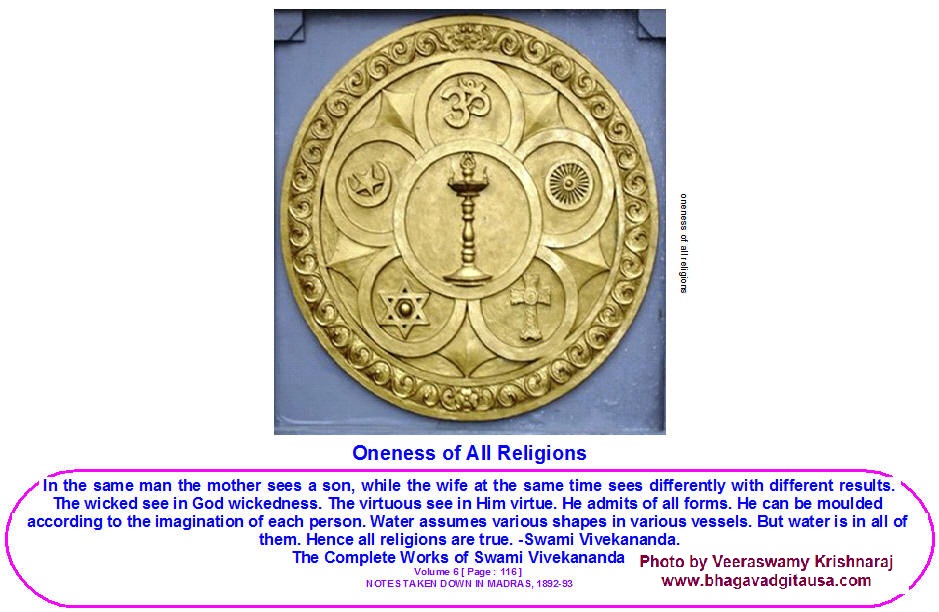
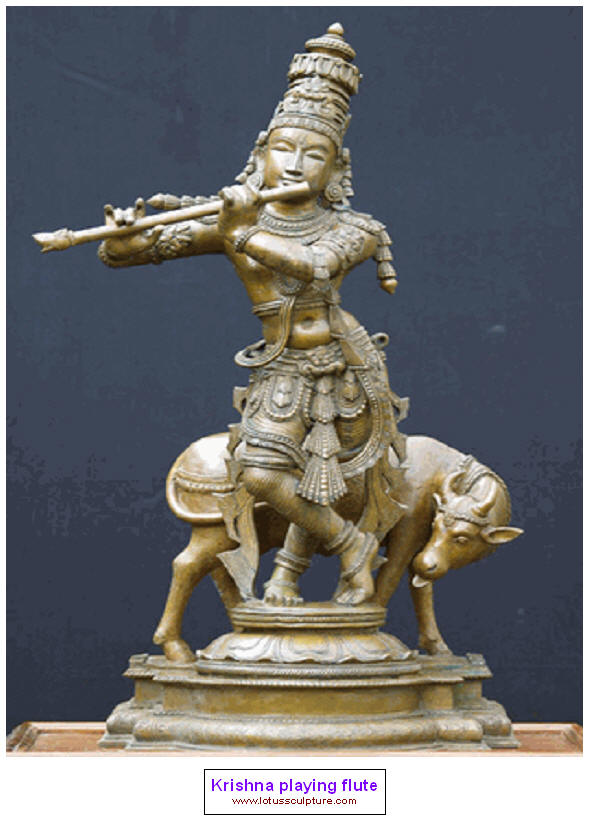
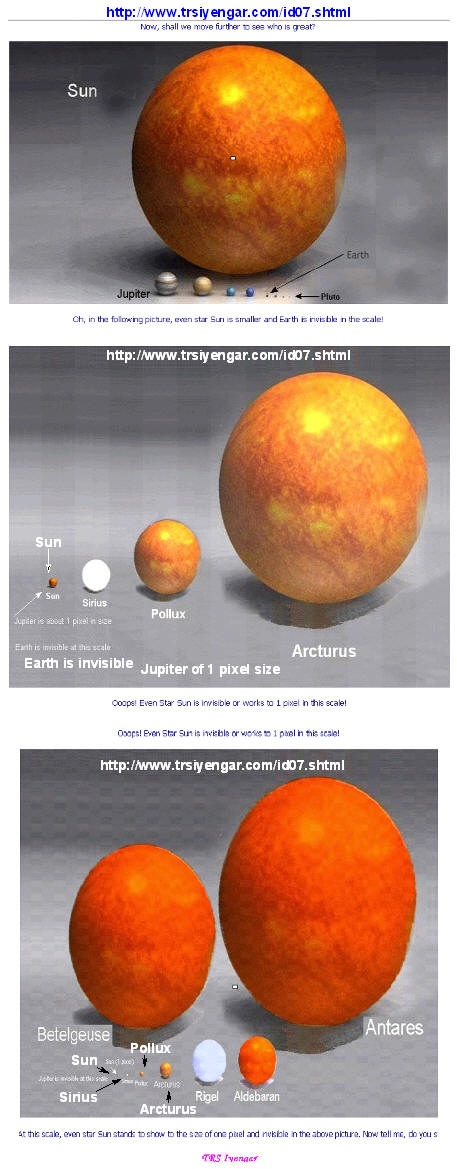
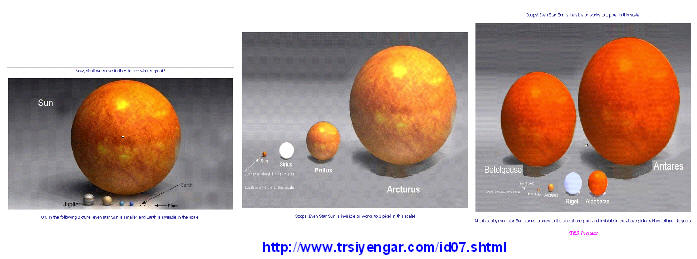
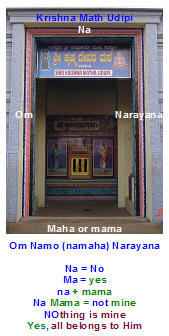 Sankaracharya says that a non-renouncer (Atyagi) experience three kinds
of fruits or results after death: 1) the Desirable, becoming god; 2) the
Undesirable, going to hell; 3) Mixed, to be reborn as human being. On the
other hand a Tyagi (= Sannyasi or renouncer) is not subject to these results
or transmigration of the soul but attains eternal liberation.
Sankaracharya says that a non-renouncer (Atyagi) experience three kinds
of fruits or results after death: 1) the Desirable, becoming god; 2) the
Undesirable, going to hell; 3) Mixed, to be reborn as human being. On the
other hand a Tyagi (= Sannyasi or renouncer) is not subject to these results
or transmigration of the soul but attains eternal liberation.