HOME PAGE


|
Bhagavad-Gita:
18 Chapters in
Sanskrit
BGALLCOLOR.pdf
|
|
Download Bhagavadgita-all 18 chapters in Sanskrit, English,
|
|
transliteration and word for word translation. |
Bhagavadgita in English
https://myindiastories.com
www.bhagavadgitausa.com
Veeraswamy
Krishnaraj: Tolerance with love is to speak in tongues of all
faiths, hold in the heart the Truth of all faiths and see
all faiths in the face of humanity.
You have
your Google search engine tailored for this site.
Please enter the word(s) in the
search box; it will take you to the file with that word in this web site.
Enjoy your visit here.
|
Dr.
Radhakrishnan in Bhagavadgita page 206. Verse 6:35
definition of non-attachment (or detachment).
The Blessed
Lord
said:
(6.35) Without
doubt, O Mighty-armed (Arjuna), the mind is difficult to curb and
restless but it can be controlled, O Son of Kuntī (Arjuna), by constant
practice and non-attachment.
1
1
When
there is earth to lie upon, why trouble about bed? When one's arm is
readily available, why need pillows? When there is the palm of one's
hand, why seek for plates and utensils? When there is the atmosphere,
the bark of trees, etc., what need is there of silks?
Four Stages of Yoga in Svetasvatara Upanisad Page 722-723 The
Principal Upanisads
By Dr. Radhakrishnan November 29, 2013.
pṛthvyaptejo'nilakhe samutthite pañcātmake yoga-guṇe
pravṛtte
na tasya rogo na jarā na mṛtyuḥ prāptasya
yogāgni-mayaṁ śarīram --2.12
2.12.
When
the fivefold quality
of Yoga
is produced,
as
earth, water, fire,
air and ether
arise,
then there
is no longer sickness no
old age,
no death to him who has obtained a body made of the fire of Yoga.
This verse
and
the
next
emphasize
the
physical
aspects
of Yoga.
Through
Yoga
we
try
to build
up
a healthy
and
clean
body.
We
attempt
to make
the very
substance
of our
body incorruptible.
Four
stages
of
yoga, ārambha,
ghaṭa,
paricaya
and niṣpatti
are
described
m
verses
13, 14,
15
and
16
respectively.
In
securing
bodily health
we
have
the
commencement of the
yoga, yoga-pravṛtti.
In attaining
freedom
from
sorrow
we reach
the
second
stage.
In
the
third
stage traces of duality disappear,
mahā-sūnyaṁ
tato bhāti sarva-samāśrayam.
In the
fourth
stage
there is
the identity
of
the
individual
with the Supreme
Self.
The
Yogin
does
not
become
disembodied.
The elements
composing
his
body
are
elevated
to
the
level
of
their
subtleness,
sukṣmatva.
He
leaves
his
gross
body
and
attains
an
indefectible
one.
It
is
a consciousness-body
akin
to that
of
the
Supreme
with
whom
the contemplator
has Identified
himself
through
meditation.
|
Veeraswamy Krishnaraj.
Contact:
Feedback
Form
About the author:
Veeraswamy Krishnaraj, M.D; F.R.C.P (Canada) is a board certified pediatrician
in active practice until the end of 1998. He immersed himself in study of
Hinduism in depth. He has sufficient knowledge and understanding of Hindu
religion that he is confident to publish this book. He kept the words simple,
supple, illuminating and to the point, while retaining the original flavor,
beauty and grace. Compound words in Sanskrit are a nightmare for the beginner,
as they are spliced together compactly in one continuous stretch of characters.
He parsed the compound words into digestible syllables or words with
superscripts and sequential numbers and rearranged the words in the verse in a
readable form in English. In this book, he claims ownership of shortcomings and
cedes the rest to Bhagavan.
This book is good for students, and devotees reading the Bhagavad-Gita in
Satsang (true company). Two verses nestle in two boxes in one page with no break
or carry-over to the next page. Diacritics help the reader enunciate the words
like a Sanskritist. The English words are reader-friendly. Wherever there is a
need for elaboration, an addendum supports it.
Simplicity, authority, universality, and profundity are the hallmark of the
Bhagavadgita, the Bible of the Hindus. The Bhagavadgita is the Song of the Lord.
It provides guidelines for daily living with no dogmas and ritual overtones. It
encourages and supports your individuality. It also explains the consequence of
errant ways. Total surrender to Bhagavan releases the devotee from the ills of
life on earth. Hinduism as a term is an external appellation from non-Hindus.
Its true name is Sanatana Dharma (Eternal Law or Eternal Order) commensurate
with Rta (Cosmic Order). The beauty about the Bhagavadgita is its appeal is
universal.
|
The Ethics of the Fathers and Gurus
Talking Thunder goes Da-Da-Da. What
does it mean? |
|
The ethical virtues we are called upon to adopt are mentioned in several
passages. Life is compared to a sacrifice where the fee shall be
asceticism, liberality, integrity, non-injury to life and truthfulness. The Taittirīya
Upaniṣad gives a list of students' duties. He should not be
negligent of truth, virtue, welfare, prosperity, study and teaching. He
should perform only those acts which are irreproachable. In case of
doubt concerning any act of conduct, the student should follow the
practice of those Brāhmaṇas who are competent to judge, apt, devoted,
not harsh lovers of virtue. In one passage all the virtues are brought
together under the three da's which are heard in the voice of the
thunder, namely, dama, or self-restraint, dāna or
self-sacrifice, and dayā or compassion Prajā-pati conveys it to
the three classes of his creation, gods (deva), men (manuṣya) and
demons (asura).1 Saṁkara
makes out that gods have desires (kāma), men suffer from greed (lobha)
and demons from anger (krodha). By the practice of the three
injunctions we free ourselves from the sway of craving, greed and anger.
When the Buddha asks us to put out in our hearts the monstrous fires of
infatuation, greed and resentment, he is emphasising the three virtues
enjoined by the Upaniṣads. |
|
1In
the Śrīmad-Bhāgavatam Lord says that anyone who does not care for the
people who are in need of care and simply takes to the worship of
God, his offer is wasted.
Yo māṁ sarveṣu bhūteṣu santam ātmānam īśvaram
Hitvārcām bhajate mauḍhyād, bhasmany eva juhoti saḥ.
SB 3.29.22 (Appended by Krishnaraj)
From
http://vedabase.com/en/sb/3/29/22
His Divine Grace A.C. Bhaktivedanta Swami Prabhupāda
|
|
Dama is
self-control.
We should reduce our wants and be prepared to suffer in the interests of
truth.1Austerity,
chastity, solitude and silence are the ways to attain self-control. |
|
Tapas is
severe self-discipline undertaken for spiritual ends. It is exercised
with reference to the natural desires of the body and the distractions
of the outer world. It consists of exercises of an inward kind, prayers
offered in the heart, self-analysis and outer acts like fasting,
self-mortification, sexual abstinence or voluntary poverty. Strength is
developed by a resisting force. The power gained by resisting one
temptation helps us in overcoming the next. To evade discipline is to
empty life of its significance. Nothing is more tranquil than to be
unshaken by the troublous motions of the flesh.
Renunciation, nyāsa, is superior to tapas or austerity or
asceticism. The latter is a means to the former. It is not to be made
into an end in itself.2 |
|
1 The
wise man overcomes anger through mind-control, lust through the
renunciation of desire. He can attain mastery over sleep by develop-ment
of a quality of Sattva. Through
steadfastness he should protect the organ of generation and the stomach
''With (the help of) the
eyes he should protect the hands and the feet. Through (the power of)
mind he should protect the eyes and the ears and through
conduct he should protect mind
and speech. Through
constant vigilance he should shed fear and thruogh the service of the
wise, he should overcome pride.' |
|
Wealth and honor
acquired contrary to righteousness are to me like passing cloud.’ Lun yu
Pt.VIII.Ch.XV. See F.T. Cheng: China moulded by Confucius (147),
P.92. |
|
2.
Do the frogs, fish and others who live from their birth to death in the
waters of the Ganges, do they become yogis?' |
|
The Principal
Upaniṣads.
By Dr. S. Radhakrishnan. Pages 108-109. September 25, 2013 |
04/23/2020
Chapter Six: The
Yoga of Self Control
6.1:
The Lord said:
He, who does his
obligatory work without claiming the fruit of action, is a
sannyāsi and a yogi. He does not become a yogin
simply because he renounces the sacred fire and performs no action.
(Simply because he renounces the sacred fire, he does not become a yogin. In
the same vein, he is not a yogin, for giving up his activity).
Matted hair, deerskin, and pious pretension do not make an
ascetic. An ascetic in name and epicure in practice, though he professes to
know Brahman, is far away from Brahman. Appearance
does not make an ascetic, though he wanders naked and shameless; a donkey does
the same. Jackals, rodents and
deer live in the forest, eat grass, and drink water: are they ascetics? The
frogs and fish take birth, eat and die in
Ganga. Are they ascetics?
–Garuda Purana, II.49.64-67-68.
A
yogin, in a spirit of renunciation, gives up all activities including the
performance of sacrificial rites. It is not the external act of renunciation
but the internal change that makes a yogin.
6.2: What they call as
sannyāsa, you know that as yoga, O
Pandava. No one can become a yogin without
renouncing (selfish) desire.
Samkalpa: purpose,
notion, desire, definite intention
Sannyāsa and yoga: The
former is renunciation and the latter is mental discipline.
Jnāna yoga is to realize the Brahman is supreme
and the body can never become identical with the pristine individual soul.
6.3:
Desirous of advancing in karma yoga, action is the means for a sage.
When he attains to such yoga, tranquillity is the means.
According to Ramanuja, when a karma yogi has attained to the pinnacle of karma
yoga, he has obtained the vision of self, tranquillity and a virtual moksa
during his life on this earth. This tranquillity will help him achieve real
moksa upon release of his soul from the body. Ramanuja believes that “virtual”
is not real and Jivanmukti (virtual moksa) is only a qualifier or a
certificate of supreme satisfaction for Videha
mukti ( Videha = bodiless, an ultimate real moksa after death). The idea is
that a soul does not enjoy the privileges of moksa or liberation until death
comes and the soul goes home. Some other sects believe that a yogi can enjoy
the real moksa while living. Caveat: Jivanmukta is not exempt from the
miseries of the phenomenal world until he dies, though he attained jivanmukti.
The soul is released, but the body is not.
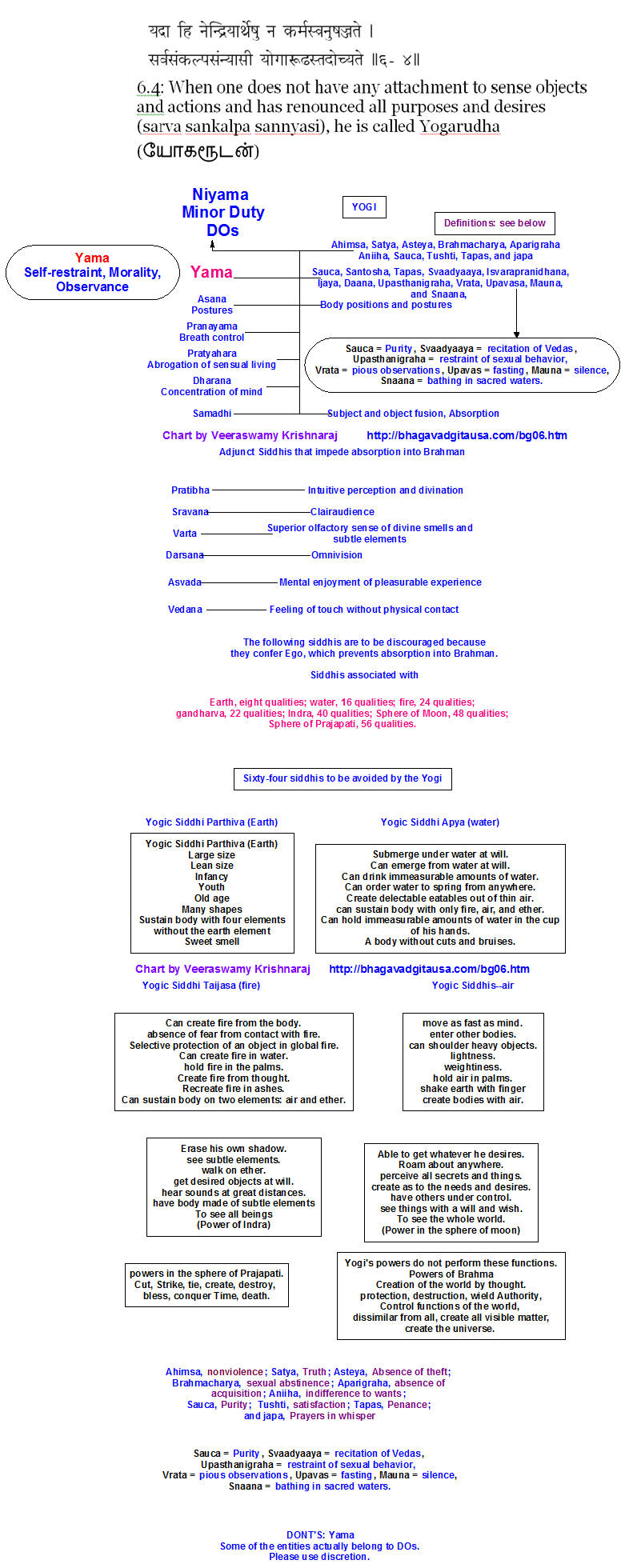
6.4: When one does not have any attachment to sense objects and
actions and has renounced all purposes and desires (sarva sankalpa sannyasi),
he is called Yogarudha.
Yogarudha: he who ascended to
yoga (accomplished yogi)
As mentioned
below, a yogin has to climb eight arduous steps in full faith and
accomplishment to reach the top. A true renunciate, Sanyāsin, is the one who
relinquishes action without expectation of fruits of such an action;
desirelessness (vairāgya) is one of the cardinal signs of a yogi. There are
eight angas or qualities:
- Yama = suppression,
restraint, self-control, Don’ts. There are five restraints according to
Patanjali. Practice
(1) nonviolence (ahimsa),
(2) not lying: truth (satya), (3) nonstealing (asteya),
(4) sexual abstinence (brahmacharya), and (5)
absence of acquisition (aparigraha). The following
ones are found in Linga purana, (6) indifference to wants (aniiha),
(7) purity (sauca), (8) satisfaction (Tushti),
(9) penance (tapas),
(10) saying prayers in a whisper (japa).
Some of these entities come under Dos.
- Niyama = checking,
controlling, Dos. Patanjali lists the following observances.
Sauca, Santosha (contentment), tapas, svaadyaaya,
isvarapranidhana (surrender to God).
The observances are ten in all
according to Linga Purana. (1) Purity (sauca), (2) sacrifice (ijyaa), (3)
penance (tapas), (4) giving (daana),
(5) recitation of Vedas (svaadyaaya),
(6) restraint of sexual desires (upasthanigraha), (7) pious observance (vrata),
(8) fasting (upavas), (9) silence (mauna), and (10) snaana (bathing [in sacred
waters]). – (Linga Purana, 7.29-31)
A+steya = absence of theft.
Staayu = a thief.
A+parigraha = absence of
acquisition.
Svaadyaaya = (Sva+adhyaya) = self
+ inquiry = reading sacred books.
isvara-pranidhana = Isvara+Pranidhaana
= God + seeking access = surrender to God.
- Āsana: body positions
and postures
- Prānayama: breath
Control
- Pratyahara: no contact
between senses and objects of senses. This should come natural to him
- Dharana: concentration
and focus of mind on an object or idea
- Dyana: meditation
- Samādhi: convergence,
one-pointedness, Subject and object (Yogi) unity
Before a
yogi can attain samādhi, he should meet the above requirements: As you see,
this is demanding. Once somebody has gone through the angas, and
jnāna yoga, he is already a
renouncer. In another commentary, read how the Alvars developed their
system of bhakti yoga, Saranāgati and Prapatti
(self-surrender to God, resignation to God).
Guru Nanak of Sikhism was distressed by the Hindu
caste hierarchy and ivory tower aloofness and isolation, celibacy, renunciation of the family and the
world and retirement to the forest and other practices of
Sannyasins and Yogis
for Moksa or spiritual liberation. He was not too thrilled with Hindu rituals
and superstitious practices. He was married with two sons. He believed in
people and uplifting them both spiritually and materially. As a sign of his
universality, he chose a Muslim minstrel to render his poetry into song and
music. He took what he thought was the best in Hinduism (he was born a Hindu),
Islam, and Buddhism and this was further enhanced by divine revelation on the
banks of a river. Against the background of consuming fire of Hindu
polytheism, witnessing excesses of Mughal kings, ritual practices of
Brahmanas, and forced conversion of Hindus to Islam, Guru Nanak received a
divine call and declared, "There is no Hindu, there is no Muslim, there is one
God and one people."
Please read commentary on Verse 6.1 about
Hindu view of false ascetics, whom Guru Nanak condemned with justification.
6.5: He should pull (lift)
himself up by his own self and not let himself sink, for the Self is the
friend of the self and the Self can be the enemy of the self.
Avasad:
to sink (as into water), faint
Paramatman or Atman is all-pervading and is separate from the
jivātman, which is the individual self or atman.
Atman (Soul) is Brahman and therefore is not subject to degradation.
Prakriti can never stain Atman, but on the other
hand, prakriti, desire, attachment, and karma can
burden the individual self. In the ocean of samsāra,
that burden on the self will drown the self; the Higher Self can be a friend
to the individual lower self at this moment, by detaching the lower self from
the burdens. If man drowns the individual self in desires, and does not seek
the help of the Higher Self and allow the rescue to take place, the lower self
drowns in the
ocean
of
Samsāra.
6.6 For one who has conquered his very self by the self, his
self is the friend of the self. For one who has not conquered his self, his
very self exhibits hostility like an enemy.
If one
conquers the lower mind, the Higher Self is realizable.
There are three
selfhoods: Primary,
secondary, and illusory. Primary Self
(Principal Self) is the unconditioned non-dual Entity, the principal source of
Bliss; the secondary self is the individual self; illusory self is
identification of the self with the body. The allegory used to define
(the relationship between) the Principal or Primary Self and the secondary
self is the relationship between father and son.
6.7: He, who maintains tranquillity, who conquered his lower self, and
who is serene in heat and cold, pleasure and pain, honor and dishonor, unites
with (communes) the Supreme Atman.
|
जितात्मनः प्रशान्तस्य परमात्मा समाहितः ।
शीतोष्णसुखदुःखेषु तथा मानापमानयोः ॥६- ७॥
jitātmanaḥ
praśāntasya paramātmā samāhitaḥ
śītoṣṇasukhaduḥkheṣu tathā mānāpamānayoḥ 6.7
jita-ātmanaḥ1
praśāntasya2 parama-ātmā3
samāhitaḥ4
śīta5
uṣṇa6
sukha7
duḥkheṣu8
tathā9
māna10
apamānayoḥ11
6.7
[For]
jita-ātmanaḥ1
= one who has conquered his body, mind and senses;
praśāntasya2
= one who maintains
tranquility;
parama-ātmā3
= [in him] the Supreme
Soul;
samāhitaḥ4
= becomes manifest.
śīta5
uṣṇa6
sukha7
duḥkheṣu8
= [He should remain balanced
in] cold, heat, happiness and sorrow;
tathā9
= also;
māna10
apamānayoḥ11
= in honor and
dishonor.
6.7
6.7: He, who maintains tranquility, who conquered his lower self, and
who is serene in heat and cold, pleasure and pain, honor and dishonor,
unites with (communes) the Supreme Atman.
|
Tranquility is absence of desire, longing, hatred, anxiety, and grief, and
presence of happiness; thus, it is the translucent and placid waters of
consciousness. Once a sannyāsin conquers his mind
and stands steady in tranquility, the dualities have no effect.
According to Ramanuja, the accomplished individual soul is comparable to
Paramatma (the Great Self or Supreme Soul). R argues in this manner: That the
jivātman has improved its spiritual stature in
comparison to its earlier stage of attainment is only an earthly
accomplishment, which never confers equal status to jiva with the exalted Real
Parmatman that is Brahman. Sankara’s views are
different: An accomplished individual soul divested of all its impurities is
no different from Brahman. It eventually becomes one with One (Paramatman).
Here we get a good dose of both Advaita and
Visistadvaita, two different interpretations of
the same verse: The interpretation is in the mind of the reader. If you take
it as you read it, it appears on the surface that the portrayal runs more
natural in the flow of words to support the advaita
or monistic philosophy. But it could be deceptive. I am sure that this verse
has undergone text torturing in many minds. R is of the firm view there is
only One Supreme Soul or Being and that an accomplished yogi can only be a
shadow.
Advaitam (non-duality),
Dvaidam,
Vishistadvaidam (qualified
non-dualism). Advaitam of Sankara is
Oneness of God, man (beings) and matter. Dvaidam
is duality. God is the First Principle; man (beings, matter) is the second
principle; there is distinction between two beings of the same species.
Vishistadvaitam, the Vedantic doctrine, states
that man (Chit) is separate and different from
the Supreme Controller (Isvara) and yet ultimately unites with the Supreme
Principle upon attaining Moksa. This union is nearness of pure soul to
Narayana; in marital union, there are still two people; a labor union still
has individual members. Man is the chip off the Old Block. The chip splinters
off just like the spark comes off the crackling fire. The Old Block (Isvara)
is a Living Entity and the chip cannot fit in upon its return; it remains
separate. The spark cannot rejoin the fire in its original form.
Acit is the world of matter and the insentient.
The chief elements in Vishistadvaidam are Isvara, Chit and Achit. When the
souls (Chit, the sentient souls) rejoin Isvara, they do not fuse with Isvara
(as water merges with water); they remain close to Isvara enjoying his
company. The difference between Isvara and the Chit elements are that Isvara
can create, maintain, and destroy, while the chit elements close to Isvara do
not possess those exclusive qualities. Isvara is a mass of Bliss and always a
Donor of Bliss; the recipient is always the individual soul or Chit. The
mother nurses the baby and the baby can never nurse the mother.
Some quote the milk and butter analogy from the
scriptures. Milk is Advaitam; milk and butter are
Dvaidam. Butter came from milk; re-suspension of
ball of butter in milk does not result in merger; the butter floats: that is
Vishistadvaidam.
6.8: The yogi, whose soul is
changeless and satisfied with knowledge and wisdom (Jnāna
and Vijnāna), who has
controlled his sense organs, and to whom lump of earth, stone and gold are the
same, is well integrated.
Jnāna
and Vijnāna: (See
Supplement for details.) Jnāna is scriptural
knowledge, while Vijnāna is realized knowledge.
This realized knowledge is in the realm beyond reason and is the world of
yogi. It is a systemic and personal spiritual experience of the presence of
God, as in kaivalya and samādhi. To such yogi,
clod, stone, and gold are the same. He is not in the least perturbed by
worldly activities, has seen, and experienced the light of wisdom emanating
from Brahman. To paraphrase Ramakrishna
Paramahamsa, Jnāna
is knowing that God exists and
Vijnāna is playing, talking with, and experiencing God in person.
Ramakrishnana Paramahamsa, Feb/18/1836 to Aug/16/1886, says the following
about gold and woman, Quote 188, Sayings of Sri Ramakrishna.
Men are of two classes--men in name only (Manush) and the
awakened men (Man-hush). Those who thirst after God alone belong to the latter
class.; those who are mad after 'woman and gold' are all ordinary men-- men in
name only.
6.9: He, who regards the
well-wishers, the friends, the enemies, the indifferent, the neutral and the
impartial, the envious and the detestable, the relatives, the saints (pious),
as well as the sinners, with equal mind (terms), excels.
|
The Complete Works of Swami Vivekananda
Volume 6 [ Page : 115 ] NOTES TAKEN DOWN IN MADRAS, 1892-93.
Nowhere is it said in the Vedas that man is
born a sinner. To say so is a great libel on human nature. |
सुहृन्मित्रार्युदासीनमध्यस्थद्वेष्यबन्धुषु ।
साधुष्वपि च पापेषु समबुद्धिर्विशिष्यते ॥६- ९॥
suhṛnmitrāryudāsīnamadhyasthadveṣyabandhuṣu
sādhuṣv api ca pāpeṣu samabuddhir viśiṣyate
6.9
suhṛt1
mitra2
ari3
udāsīna4
madhyastha5
dveṣya6
bandhuṣu7
= selfless friend1,
cognate friend2,
enemy3,
a neutral person4,
an arbiter5,
the detested6,
the relatives7;
sādhuṣu1
api2
ca3
pāpeṣu4
sama-buddhiḥ5
viśiṣyate6
= to the saints1,
even2
and3,
the sinners4,
with equal mind5,
excels6.
suhṛt1
= a friend whose
help is devoid of ulterior motive. example: a mother.
mitra2
= A cognate friend
with affection. Example: your favorite cousin.
ari3
= enemy or foe is a
person who does egregious causeless harm or evil
udāsīna4
= a neutral
indifferent person between two antagonists, more of a spectator than a
participant.
madhyastha5
= an arbiter
or mediator between two opponents bringing amicability to both.
dveṣya6
= the detested, the
hated by the people: the punk, the misfit, the antisocial elements, the
sociopath.
bandhu
= the relatives.
sādhu = a gentle harmless, virtuous
person.
The
realized yogi is impervious to the turbulence in this world. The list in Verse
9 covers all human beings without any exception. Yogi gives equal weight,
respect and treatment to all human beings, including other living entities.
The white light emerges from fusing of spectral colors and no distinction is
made between the highborn and the lowborn; among the white, the black, and the
brown; or between man and animals. Chapter Five, Verse 18: A learned humble
Brahmin, a cow, an elephant, a dog, and even a dog-eater are seen with an
equal eye by a punditah (sage). Here the
understanding is that a dog-eater is below the
Varna
system and as instances bear out, a dog-eater may be a
chandala. a person born of a Brahmin mother and a Sudra father. To go
further, Lord Krishna completely repudiates the narrow meaning of four castes
by stating in Gita Chapter 18, Verse 41 that qualities make a man: The
brahmins, Ksatriyas, Vaisyas and Sudras, O
Parantapa, are separated by the gunas (Sattva,
Rajas, and Tamas) born of their own nature. As the saying goes, “one person,
one vote,” the same is true in, “one person, one
soul.” We can extend this concept
to all living beings by saying, “one being, one
soul.” Here we see the genius and
the generosity of Lord Krishna. He tells that all living beings are equal in
His eyes, because a fragment of His Atman or Soul resides in each, person or
animal. If man and animal share the same Soul, what right do we have to injure
another soul?
6.10: A yogi, by
controlling his mind, senses and desires; by desisting from accumulating
earthly possessions; and by remaining alone by himself, should constantly
concentrate his mind [on Atman = Supreme Self].
Man is
what he thinks. There are two kinds of minds: pure and impure. Desire makes
the difference between the pure and the impure mind. When there is no fuel,
the fire dies. When desire vanishes, mind becomes pure. When desire leaves,
thought ceases. The lower self and the mind become placid like the placid
waters of a lake. Once the lower self is placid, one abides in the higher
Self; once the mind stands steady in Brahman, no longer the yogi is under the
sway of the sense objects. He is released and free; the mind is absorbed, and
“annihilated,” when it comes to rest in the Self. No words can express this
fusion. One has to be in it to know it. Silence is answer, and silence is
bliss. When the “self” merges with the Self, it is like water mixing with
water, butter with butter, fire with fire, and air with air. It is Oneness; it
is stillness. Mind here is a friend indeed; mind with attachment to sense
objects, is foe indeed.
No one
concentrates on Atman. Garuda Purana (11.12.19) says no one is obsessed with
Atman, the inner controller in the spiritual heart; while in (dawn of) infancy
he clings to his mother; in (noon of) adulthood he dotes on his wife; in
dusk of life, he is obsessed with his sons and grandsons.
|
Jesus
Christ says about earthly possessions (of Yogi in Indian context):
Bible NIV
Luke 12:33Sell
your possessions and give to the poor.
Provide purses for yourselves that will not wear out, a treasure in heaven
that will not be exhausted, where no thief comes near and no moth destroys.
Luke 12:33
Sell that ye have, and give alms; provide yourselves bags which wax not old, a
treasure in the heavens that faileth not, where no thief approacheth, neither
moth corrupteth.
--------------------------------------------------------------------------------------------------------------------------
Paul Brunton in his book 'A Search in Secret India'
Skeptics galore from the West, opposing JC's Values
In this secluded cave, in this unending heat, surrounded by
absorbent minds, it is easy to weave grandiose schemes of world reformation,
to possess oneself of extravagant religious ideas. But out in the world of
reality, amid the hard life of materialistic cities,
these things would soon dissipate like mists before the dawning sun. |
6.11: In a clean place, with
a firm seat neither too high nor too low covered with
Kusa grass,
deerskin and a soft cloth layer upon layer (one on top of another in that
order, cloth on the top, deerskin in the middle, Kusa grass in the bottom)
(continued)
Kusa grass: Desmostachya bipinnata.
Also known as Darba. It is the most sacred of all grasses, regarded as
god-born and the FIRST PLANT created. It is used on the altar without the
roots, spread in the sacrificial site and applied on the seat of the gods.
Three goddesses, Sarasvati, Ila, and Bharati are invoked and implored to
protect the grass, the sacred, pure and flawless refuge of the gods. Because
of its supernatural qualities, it is incinerated at the conclusion of
ceremonies; otherwise misfortune and harm will fall on those coming into
contact with the ritually used grass. Woman is considered impure below the
navel and can purify herself ritually by having Kusa grass on her clothes. It
extirpates anger in the wearer and the hatred in the heart of the hater; it
explodes the heads of the enemies. When Garuda spilt some Amrta (Ambrosia) on
a patch of Kusa grass, snakes licked on it; the grass being sharp as a razor,
split the tongue causing them to have forked tongue. In Vishnu Purana, King of
Nisada Vena claimed that he being the (self-appointed) Lord of the Sacrifice
had an exclusive right to the oblations. (Vishnu is the Lord of Sacrifice.)
For this asinine claim, the Vaishnava Munis whipped and beat him to death with
razor-sharp consecrated Kusa grass. Knotted and tied sheaths of Kusa grass
represent deities and manes. The terminal ends of grass are sacred to the
gods. Apart from being a weapon against Vena, the grass upon being stroked
against the side of the body prevents evil influences. Lord Rama's twin sons
are named Kusa and Lava.
6.12: with the mind
one-pointed, controlling the mind, the senses, and the activities, sitting on
the seat, he should practice yoga for self-purification.
6.13: Holding the body, the neck and the head straight and still,
looking at the tip of his nose, but not looking
all around, (continued)
6.14: With serene mind,
fearless, firmly resolved in vow of celibacy, and with subdued mind, the yogi
should sit concentrating his mind upon Me and
holding only Me as the Supreme goal.
One of
the angas (steps or limbs) is Yama meaning
abstinence or restraint This is a preparatory practice before initiation into
Sannyāsa. See Chapter six Verse four commentaries
for details on Anga. Coming to
Bramacharya, Swami Vivekananda observes that sex
leads to waste of seeds, weakness of the body, and excessive worry lines on
the face, loss of glint in the eyes, deafness, and dull brain. But a celibate
has a good body, alert keen brain, divine looks, and disposition. A
Sannyāsi's life is a reversal to his pristine
childhood, when everything was simple, celibate, and godlike. From that
childlike state, let him go to realize Brahman. Continence is energy conserved
is energy saved. Perfect sexual abstinence means purity and chastity in
thought, word, and deed. True love is one-pointed and goes to the Lord. In a
sannyāsi, it goes to Brahman. If one can control
this basic human emotion and urge, one can become a
sannyāsi. Vivekananda says that twelve years of practice of
celibacy has sharpened his intellect, improved his memory, and thought flow at
lectures. It can happen to anybody. Total abstinence and control of sex life
are two different practices: a householder who controls or limits his sex life
is a bramacharin; but an ascetic should be a
bramacharin in thought, word, and deed; higher
standards apply to the ascetic. Sex is distracting and so some ascetics and
bramacharins go to the extent of avoiding even a
visual contact with the opposite sex. To them, visual contact is
thought-provoking and that is bad for a sannyāsi.
Many of Ramanuja's disciples were married men, who most likely practiced
sexual control or moderation and not celibacy while engaged in bhakti yoga.
Then again, bhakti to God is so overwhelming that any remnants of sexual urge
and practice come to naught, though they stay married as it was the case with
Gandhi. When it comes to True Love, only God qualifies to receive it. .
Prasna Upanisad
(question 1.13) says that chastity in brahmacharya
is continence and not abstinence.
6.15: Having controlled his mind, and concentrating his
mind constantly, the Yogi attains peace, which abides in Me and which ends in
Supreme Bliss.
As
everybody knows, the word “nirvana” is common to both Hinduism and Buddhism.
Buddhist literature contains more reference to it than Hindu does. It means
the flames of desire have died down; this extinguishment with attainment of
knowledge, removal of māyā and ignorance, and
frying the karmic seeds lead to Nirvana in Buddhism and to moksa in Hinduism.
There is a difference: Liberation in Hinduism connotes attainment of Brahman,
but in Buddhism, it means attainment of knowledge.
Tantra texts mention that the act of assuming a Lotus posture and looking at
the tip of the nose is not Yoga; identification of jivatma with Paramatma is
Yoga.
6.16: Yoga is not for
him, who either eats too much, or eats too little. It is not for him, who
either sleeps too much or stays awake too long, O Arjuna.
Moderation in everything is the cornerstone of not only physical, but also of
mental and spiritual health.
There
is a story about Buddha. When he ventured out of his palace, he saw the
ravages of old age and sickness, the inevitability of death, and the beauty,
tranqility, and peace in the face of an ascetic. He decided that he wanted to
be an ascetic and left his adorable wife Yosodhara
and son Rahula. He retired to the forest,
practiced austerities, learned abstruse doctrines, and starved himself to skin
and bones. Mortification of the flesh and abstruse
doctrines did not help him attain to knowledge; he went out of the
woods, and slowly recovered his health, meditated under the
Bodhi tree; and at crack of dawn out of the blue,
the knowledge and realization dawned on him. Remember that revelation of
spiritual and intuitive knowledge comes in sudden paroxysmal fashion, a sense
of immediacy. In Christianity also, the sense of immediacy in the
descent of illumination and arrival of Jesus Christ is mentioned: Christ comes
when you are not looking for him.
Brhad-aranyaka Upanisad
2.3.6: Enlightenment or Truth comes like a sudden flash of lightning, flame of
fire, or a white lotus. In sculptures, The Buddha, attaining
enlightenment, appears seated under the fig tree in Gaya in Yogic position
with his left hand palm facing up in the midline and the pronated right hand
pointing to the earth (not in the picture) as the witness of The Buddha
gaining victory over Mara, the god of desire.
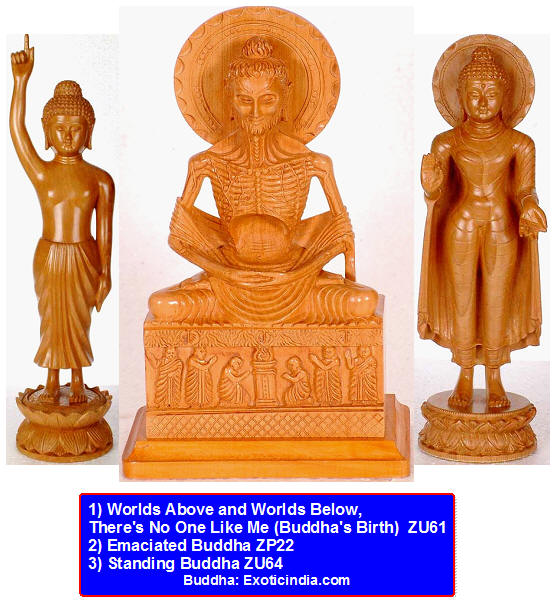
Wood carvings credit:
Exoticindia.com.
From left to right: 1. Child Buddha. 2. Emaciated Buddha. 3. Buddha. 4. His
First five disciples.
Note: Buddha stands
on double lotus, one upright and the other inverted.
The painting: Lord
Buddha from a Sarnath temple painting. Painting shows Buddha undisturbed by
the evils and pleasures of life.
Man
and animal are the same when it comes to sleep, fear, sex, and food. What
makes man better than an animal? Man with spiritual knowledge is man; others
are animals (Garuda Purana, II.49.53).
6.17: Yoga, the destroyer of sorrows, is attainable to a man who is
moderate in eating, recreation, sleep, and
wakefulness, and restrained in action.
Moderation in eating has been quantified
according to Yajnavalkya in a 24-hour period: 32 mouthfuls for a householder,
16 for a forest recluse (Vanaprasthya), and 8 for a muni/sage. Muni = he who
observes silence or mauna. Please go to comment on BG2.54--
BG Chapter 2 Samkhya Theory Verse 54.
This is what Vasistha says about food consumption. Verse 6.20:
A sage's meal is 8 mouthfuls, a forest hermit's 16, a householder's 22, and a
student's an unlimited quantity. Translation from Sanskrit by Patrick Olivelle,
Dharmasutras, page 267.
6.18: When the controlled mind abides in the Self alone, the
Yogi free from desires and all objects is called perfected in Yoga at that
time.
When
the Self is the center of the mind and all the desires die down, there is
stillness of the mind. The surface is calm and reflective of the light
emanating from the Self.
6.19: As a lamp’s flame does
not flicker in a windless place, so goes the simile that a yogi of subdued
mind practices steadfast yogam (meditation) on the Self.
There
are no thoughts wafting in and out; the wind has died down; the thoughts have
died down; there is that little steady flame of the self; and there is
oneness, stillness, absolute freedom, and splendid isolation. (Here isolation
means the self is free [isolated] from all the impurities of the material
world.) Purusa breaks away from the vanishing Prakriti.
As the flickerless flame of the “self” approaches
the effulgence of the Self, the latter consumes and annihilates the former.
That is Being, Consciousness and Bliss (SatChitAnanda).
(Purusa: Spirit; Prakriti: matter.)
6.20: When the mind is
at rest and under restraint from the practice of yoga, he enjoys the Self by
seeing the Self through the self.
6.21: When he knows that the Supreme happiness, experienced by the
intelligence, is beyond the grasp of the senses, the yogi, standing firm,
never swerves from the Truth.
6.22: By gaining that, he
considers there is no more to gain; thus standing firm, even a great sorrow
does not move him. [he is never moved by any great sorrow].
6.23: You must know, in
perspective of yoga, this disjunction (viyoga) of
union with pain. This yoga should be practiced with determination and
unwearied mind. (Determination and unwearied mind must underlie practice of
this yoga.)
(Vi+yoga:
dis+junction, dis+union,
and dis+connection)
In
this phenomenal word, this union with pain and pleasure is the stuff of
samsāra and jivātma’s
lot. Disunion from all union with pain and the dualities of this phenomenal
world is yoga, which is union with the Brahman, pure Bliss. Apart from this
disunion, yoga needs a good dose of determination and a steady mind (a
flickerless flame). Death (death is a prelude to
rebirth) does not haunt the soul’s body anymore; darkness dissipates; light
comes in; and immortality of soul is a reality now. Unreality peels off from
Reality; the veil falls; and the Truth shines. The untruth totters out and the
Truth prevails; the veiling glitter (or gold), which is mind stuff, melts
revealing the Truth.
The
union with Brahman needs dedication, determination, strength, and focus; it is
comparable to the arduous effort of a mountain climber on the sides of the
steep canyon. Every step ascended, every grip held firm, every drop of sweat
shed, every heartbeat missed, every ounce of courage mustered, every glance
cast upwards, forgetting every pain suffered, every breath taken, every peril
avoided dexterously, every thought focused on the goal, every faith held firm
and every move made deliberately help the climber see the sun, when he peeks
over the edge of the mountaintop. That is Bliss. That is Sat-chit-ananda
or Being, awareness and bliss.
6.24 - 25: Giving up all
desires born of mental will and limiting by the mind all senses from all
sides, one should withdraw slowly (little by little) by intelligence and firm
conviction (from objects). With his mind steady on atman, one should not think
of anything else
Viniyamya: to be limited
6.25: One should withdraw
slowly (little by little) by intelligence and firm conviction (from objects).
With his mind steady on atman, one should not think of anything else
Sanaih,
sanaih: slowly, slowly
6.26: In whatever direction
the unsteady fickle mind goes, one should hold this mind back and bring it
under the control of the Self (Atman).
Niyam:
hold back.
Vasam: authority, control, dominion
The
mind is fuzzy and woozy, wild and woolly, agitated and avaricious, and narrow
and shallow. Mundane thoughts come easy. Pleasure is its anchor. The mind
knows not what it thinks it knows. It blinks and flickers. Thoughts rush in
and thoughts rush out; they are erotic and erratic. The thoughts are light and
fluffy one time, and at another slap like waves. There is no end to this
onslaught. The mind wanders near and far like the wings on the wind. Mind
jumps between unrelated thoughts. What a mind, what a bind!
Lord
Krishna says that one should bring the mind under the control of the Self or
Atman. It is worthwhile to consider this phrase: Life,
Liberty,
and Pursuit of Happiness. Upanisads advance a
sentiment more ancient, more original, more comprehensive, and more
fundamental in its meaning and import. Their phrase is Atman, Moksa, and
Bliss. Soul-life is Atman;
Liberty
is moksa; and Pursuit of happiness is Satchitananda
or simply Bliss. Atman has to be in the driver's seat to reach moksa and
bliss. Hindus consider this earthly life as passage of the soul through many
bodies (plant, animal, and man) before liberation or moksa becomes a reality.
How it is that
Jefferson
used a similar and dilute and yet powerful variant of the phrase in the
Upanisads, which have been promoting them for
millenniums? I doubt that he read Upanisads. What
was he thinking when he wrote that phrase? Bliss is an advanced form of
happiness saturated with spirit. Is it a life of health, wealth, and spirit?
Is that liberty physical, spiritual, or both? Does that pursuit of
happiness lead to true Bliss (Sat, Chit and Ananda or Being, Consciousness and
Bliss)? Are they mere words? Are they mere thoughts? It could not have been
mere words; it appears that
Jefferson
and the signers of The Declaration of Independence had an idea about Atman,
Moksa, and Bliss, not exactly the way Upanishads mention. In the context of
belief in rebirth, could it be possible that
Jefferson
was a Rishi in his past life and a sage in later life?
The
lower thoughts rest on animal needs and come easy; higher thoughts are hard to
come by. Mundane thoughts come easy on good days; only on bad days and during
hard times, spiritual thoughts come fleetingly. Why is that so? Are hard times
a reminder that we think of God and the Self? Is it confused and confounded?
Has it lost its anchor in the self? Can you tie it down? Can you curb it? Can
you train it? Can you corral this wandering mind? Practice until you get it
right (under the control of the Self). Self is light, Self
is luminous, Self is Bliss, and Self is Reality. Everything else is mere
māyā (illusion).
6.27: Supreme happiness comes to yogi, whose mind is
tranquil, who is free from sin or stain, whose passions (Rajas) are pacific,
and who is one with Brahman.
Peace
be upon the Yogin, who in purity knows that karma
without fruits is salvation. Peace be upon the
Yogin, who works for the sake of Brahman. Peace be
upon the Yogin, who sees Brahman in all living beings. Peace be upon the
Yogin, who knows that all actions done as sacrifice are devoid of gunas
(transcend Sattva, Rajas, Tamas) and therefore are free from sin, stain and
karma. Peace be upon the Yogin, who knows karma is
bondage. Peace be upon the Yogin, who knows that
Prakriti blocks his vision of the Self. Peace
be upon the Yogin, who knows that ignorance and
māyā are an obstacle in attaining Brahman. Peace
be upon the Yogin who knows that all senses subside
when ego (the progenitor of senses) dies. Peace be
upon the Yogin who knows that karma and māyā die
when ego dies. Peace be upon the Yogin who knows,
not to tread on the triple fire of lust, greed, and desire. Peace
be upon the Yogin, who knows that the two broken
oars are greed and envy on a boat in the
ocean
of
Samsāra.
Peace be upon Yogin, who considers that all souls
are equal. Peace be upon the Yogin, who sacrifices
his work for animals, man, and God. Peace be upon
the Yogin, who knows that the souls and the material world belong to Him.
Peace be upon the Yogin, whose mind is on moksa and
Brahman. Peace be upon the Yogin, who knows that
attaining Brahman or merging with Brahman is the ultimate Bliss. Peace
be upon the Yogin, who ascended all the eight steps
of angas. Peace be upon
the Yogin, who overcame his ahankāra. Peace
be upon the Yogin, who overcame the
manas and the indriyas. Peace
be upon the Yogin, whose buddhi is intuitive intelligence. Peace
be upon the Yogin, who is in peace with his self,
abides in Brahman, and sees Brahman in all. Peace be
upon Yogin, whose light in the heart no eye can see. Peace
be upon the Yogin whose music no ear can hear. Peace
be upon the Yogin who is carried like a kitten by
Grace Divine. Peace be upon the Yogin who clings
like a monkey to the Grace Divine. Peace be upon
the Yogin who knows not the difference between the subject (Brahman) and the
object (Yogi). Peace be upon the Yogin, who attains
to kaivalya, samādhi, and Bliss.
6.28: The stainless Yogi by constantly concentrating his mind
easily experiences infinite bliss of contact with Brahman.
Contact with Brahman by yoga brings peace, tranquillity, bliss, stillness, and
oneness with Brahman. A true yogi endowed with pratibhā,
gets flashes of intuitional and translucent thoughts, which are rare in
ordinary men. That yogic wisdom is ārsa-jnāna (the
wisdom of Rishis). It is not analytical logic. It
is beyond discourse. The divine wisdom, into which the seers get to peak and
obtain nuggets of wisdom, is eternal and inexhaustible and not apprehended by
the ordinary human mind; it is intuitional and beyond reason and logic. We are
familiar with words like “Pro-gnosis and Dia-gnosis.”
The gnosis of the yogi is wisdom that does not flow in a linear logical
sequential fashion over a long period of analysis. It is intuitive, paroxysmal
and of sudden onset in its presentation and revelation. It comes unannounced
to the yogi. After all, the mind and buddhi are products of
prakriti and therefore by themselves are
insentient and are not capable of reaching realms beyond reason unless they
get to place themselves in proximity to the self-effulgent Self. With that
proximity to the Self, the human mind and buddhi come to acquire the light of
wisdom from the Self. Remember the tale of two birds. The lower bird on the
tree branch nudges close to the Higher bird and
merges with it in the high noon of realization. Until its merger, the lower
bird, the jivātman, was a mere shadow, and at the
high noon of realization, the shadow has gone forever. The shadow of the soul
(or the faint light of the soul) disappears in the effulgence of the Greater
Soul.
The
Greater or the Higher Self is always a subject and never an object; the
individual self, the atman or the yogi is the object. This is the instance
where an object has to get close to the subject to get a glimpse of the
subject. The subject is like a book of knowledge with a zillion pages. To copy
one page from the book of knowledge, the yogi needs the intermediation of a
copying machine, a paper, and a flash of light. The accomplished yogi's mind
is that paper capturing the image from the book of eternal knowledge with the
“Self” providing that flash of light. And the result is
Ārsa-jnāna– the wisdom of Rishi. Elsewhere, read on kaivalya, and
samādhi
6.29: One whose self is in union with yoga
and who has visions of the same divinity everywhere sees his own Self exist in
all beings and all beings [from Brahma to a blade of grass] exist in his Self.
|
Then, he (Yājñavalkya) said- 'Verily, not for the sake
of the husband is the husband dear but for the sake of the Self
is the husband dear. |
|
IV. 5 .7
Bṛhad-āraṇyaka Upaniṣad page
283.
October 15, 2013 |
|
Verily, not for the sake of the wife is the wife dear but
for the sake of the Self is the wife dear. Verily, not for the sake of
the sons are the sons dear but for the sake of the Self are the sons
dear Verily, not for the sake of wealth is wealth dear but for the sake
of the Self is wealth dear. Verily, not for the sake of the cattle are
the cattle dear but for the sake of the Self are the cattle dear.
Verily, not for the sake of the Brāhmaṇa is the Brāhmaṇa dear but for
the sake of the Self is the Brāhmaṇa dear. Verily, not for the sake of
the Kṣatriya is the Kṣatriya dear but for the sake of the Self is the
Kṣatriya dear. Verily, not for the sake of the worlds are the worlds
dear but for the sake of the Self are the worlds dear. Verily, not for
the sake of the gods are the gods dear but for the sake of the Self are
the gods dear. Verily, not for the sake of the Vedas are the Vedas dear
but for the sake of the Self are the Vedas dear. Verily not for the sake
of the beings are the beings dear but for the sake of the Self are the
beings dear.
Verily, not for the sake of all is all dear but for the sake of the Self
is all dear.
Verily, the Self, Maitreyī, is to be seen, to be heard, to be reflected
on, to be meditated upon; when, verily, the Self is seen, heard,
reflected on and known, then all this is known.
7. Brāhmaṇahood
deserts him who knows Brāhmaṇahood in anything else than the Self.
Kṣatriyahood deserts him who knows Kṣatriyahood in anything else than
the Self. The worlds desert him who
knows the worlds
in anything else than the Self. The gods desert him who knows the gods
in anything else than the Self. The Vedas desert
him who knows the Vedas in anything else than the Self. The beings
desert him who knows the beings in anything else than the Self. All
deserts him who knows all in anything else than the Self.
This Brahmanahood,
284
The Principal Upaniṣads IV. 5 12.
this Kṣatriyahood, and these worlds, these gods, these Vedas, all these
beings, this all are the Self.
Self = Brahman,
Bhagavan, Universal Consciousness, the Inner Abiding God. |
The Yogi sees the Lord in all beings, all beings in the Lord and
therefore regards all beings equally. This is the precept behind ahimsa or
nonviolence.
6.30: He
who sees Me in all things and who sees all things in Me,
I
am not lost
from
his [vision]
and he
is not lost to
Me.
The
realized yogi sees the Lord in all beings and in all things (Cit and Acit,
sentient and insentient). The individual souls are the sparks from the fire.
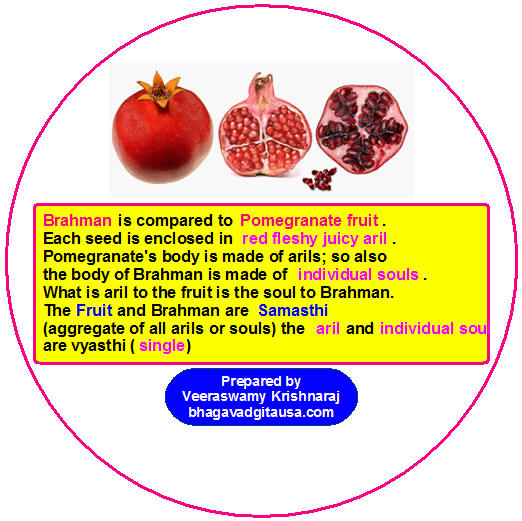
Ramanuja's Brahman is comparable to pomegranate fruit with seeds as the
individual souls; Paramatma envelops and controls all, since He is
all-pervasive. The Supreme Soul is Atman and the whole universe of individual
souls and matter are Atman's body; in the same sense, the individual body is
the body of the individual soul. Atman is the controller and owner of all
individual souls and the material world. The Supreme Soul (Atman) and the
individual souls are identical in substance, but not in their qualities:
Supreme soul is the Supreme controller, all-pervasive and blissful; the
individual soul is only a spark, an anu, or a monad. The Supreme soul and the
individual soul are magnetic to each other, but ignorance and karma are
impediments for their closeness. Saranāgati
(self-surrender), Prapatti (resignation), and Bhakti (devotion) by the
individual, and God's compassion, love and grace for the devotee get the
individual soul in closeness to God. This magnetic resonance between God and
men, in which the individual souls do the dance of symmetry around God, is the
goal and Bliss. The individual souls found their fountainhead.
Brahman is compared to Pomegranate fruit. The
seeds contained in the red, fleshy and juicy arils are the individual souls.
Brahman and the entire fruit is Samasthi or the Undivided Whole. The seeded
aril is Vyasthi or the manifest individual (soul).
6.31: The Yogin, established in
unity, worships Me abiding in all beings; that yogi, whatever his condition
may be and however much he is active, exists in Me.
I
exist in all beings: He is Antaryamin, the
Inner Guide. He resides in animate and inanimate objects. Vaishnavites
love to tell the story of Man-Lion Narasimha emerging from a pillar
substantiating the fact that Bhagavan is AntaryaAmin, Antarvarti, AntarAtman
and Paramatman (Inner Guide, Inner Dweller, Inner Self, and Supreme
Atman). One classical example of his residence in objects is that he appeared
from out of a pillar to support and save his devotee Prahalada and destroy his
cruel father. He is the Dweller in an object and also in a being. He is
neither an animal, nor a human; He is THAT or IT. He is half animal and half
human; therefore He is Narasimha (Man-Lion-Divine Chimera) that emerged from a
pillar. This illustrates He is all-pervasive.
You don't have to believe the story. Let me
bring to your attention many instances of miraculous survival of victims of
earthquake in air pockets created by falling debris and subsequent rescue. Was
that divine intervention or pure luck? Ask the victim and find the answer.
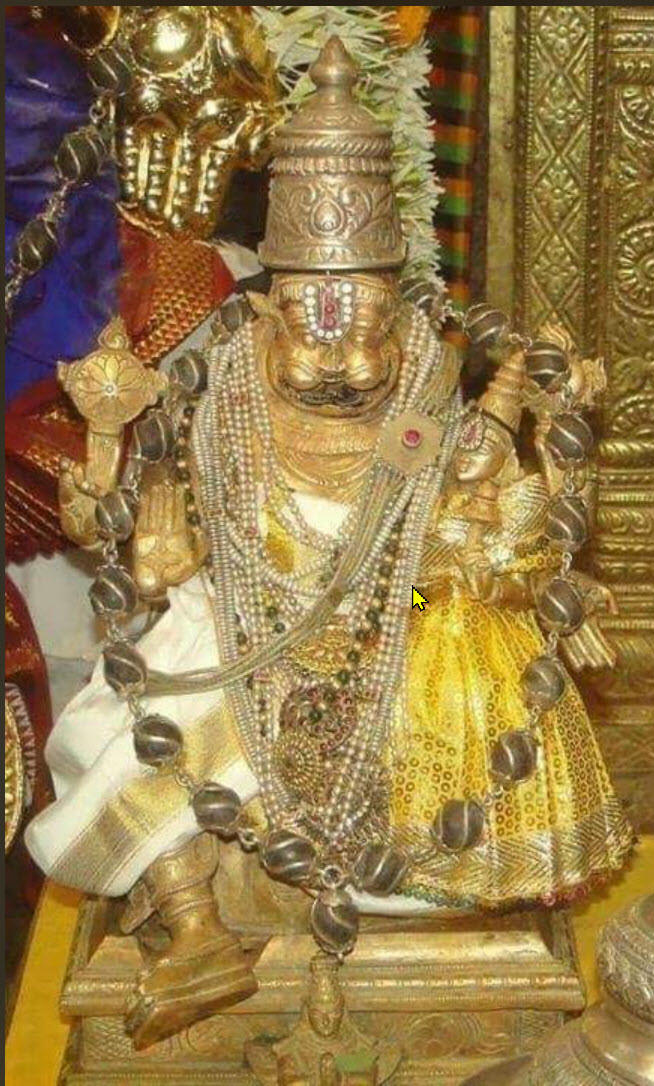
Narasimhar-Man-Lion Image from Kumudam
April 2020
Let me give you an
example to illustrate Antaryamin. When you go to a Hall of Frames, you see
just the frames from afar and not the portraits. When you go close to a frame,
you don't see the frame but the portrait that comes alive before your eyes. In
like manner, when you see matter, you don't see Him; when you see Him, you do
not see matter.
Since He exists
(Antaryamin) in all beings and matter (Cit and Acit), he is addressed as IT,
THAT. It is not in any way derogatory to address Him such.
Yogis have no
problem worshipping Paramatman in His Nirguna Brahman state. Others need an
object, idol or symbol for worship. Many hurricanes hit our coastal states,
too many to remember or recall. So what do we do? We anthropomorphize the
hurricanes, given them names (Hurricane Katrina) and recall their wayward
propensities. Yes, they have eyes, long limbs, and destructive swirl.
God appears in four ways: Daivam,
Mānusham, Ārsham, Svayam Viyaktam.
Daivam: This is the place where
Devas worshipped Paramatman and therefore it
became a place of worship.
Mānusham: People
establish and consecrate images in a new temple.
Ārsham:
This is where Paramatman appeared before Rishis
and thereby they became places of worship.
Svayam Viyaktam: =
Self manifestation: Paramatman appeared in certain places on His own
will and therefore they became places of worship.
6.32: O Arjuna; the
Yogi who sees with equality
all beings in the likeness of self (himself) and regards happiness and sorrow
as his own [that Yogi] is considered supreme.
Ātma-aupamayena: in the
likeness of self
All
souls are similar, but not the same, because of the vitiating influence of
Prakriti. All individual selves are of the same
expansive knowledge in their intrinsic pristine nature. Because of overlay of
prakriti (matter, gunas, indriyas and kosas), they
experience the dualities of happiness and sorrow, which are no different from
those of a yogi. The yogi’s self resonates with all other selves but it does
not mean the yogi experiences other people's pleasure and pain. It means that
he considers that his self and selves of others are equal in that they work in
the same milieu of prakriti and duality and that
the self of each one is immune from the pleasure and pain of this material
body. The body is susceptible to pleasure and pain but the self is immune to
such dualities of experience. It is an oxymoron to brand a soul as aching
soul, though the term is in common usage. The yogi does not identify with the
body of the other person but the self of that person in question. The pain and
pleasure come from matter and not from the self.
6.33: O Madhusudana (Killer of demon Madhu,
Krishna), In this Yoga that was declared by You as same [as the Doctrine
of Equality and Empathy], I do not see its stability because of agitation of
(my) mind.
Yogi:
Steadfastness in yoga is a prerequisite for moksa; any slippage or agitation
of mind postpones or bars the attainment of the goal. Lord Krishna says that
yogis must have unifocal vision, which is
absorption into Brahman; once the vision becomes a reality, the yogis go to
live among gods close to Lord Krishna, the God of gods. Agitation of mind is
an impediment in yogi’s progress. Once moksa is a reality, freedom is
established. Read below more about the free and bound souls.
There
are three kinds of souls: eternal souls, freed souls,
and bound souls. Let me tell you right off the reel that we are all
bound souls with a BIG B. The eternal souls are the ones who have never known
life in this universe and live their lives in Vaikuntha (Narāyana's
Heavenly Abode); the freed souls are the ones who attained to salvation and
now live with God after an arduous journey in the ocean of
samsāra during many transmigratory lives. Jivan
mukti (liberation while living) is not attainable according to Ramanuja. The
freed soul lives in the company of Bhagavan, but never becomes merged with
God; the liberated soul enjoys a status equal to that of Brahman Himself,
performs nitya-kainkarya meaning eternal divine service, enjoys Bliss, but
does not have the absolute and exclusive powers of Isvara that go with
creation, sustenance and sublation. The bound souls are of two kinds:
spiritually conscious (Udita Viveka) and (Anudita Viveka) spiritually
unconscious. Udita = proclaimed; Viveka = true knowledge, discretion. True
Vaishnavites who follow the precepts of Suddha Vaishnava Dharma are the
spiritually conscious (BG02); others are not,
according to Vaishnavas.
Lack of stability because of agitation is a
big impediment for Yoga.
According to Yoga Sutras, there are
personality types, fit for yoga. You heard about personality types like type A
and type B. Yogis studied the minds of people and divided them into five
kinds:
Kshipta Chitta: This mind is subject to
distraction or absent. Rajasic personality is the underlying
characteristic meaning there is motion and passion. If you know what a
motor-mouth is, this qualifies as a motor-mind: There is no focus; it is
not an ideal mind for yoga. Kshipta = scattered, distracted. Kshipta
Chitta = Addlehead, Scatterbrain
Mudha Chitta: This is a dull and forgetful
mind dominated by Tamasic personality, meaning darkness, sluggishness, and
general malaise. Mûdha = stupid, dull. Mudha chitta =
muddlehead.
Vikshipta Chitta: This is a distraught and
agitated mind with periods of calmness and Sattva. Vikshipta = bewildered,
agitated. Vikshipta Chitta = Rattlehead.
Ekagra Chitta: This is a one-pointed and
trainable mind, which can practice yoga. EkAgra = one-pointed, having one
point. Ekagra Chitta = laser head.
Niruddha Chitta: This is a restrained
mind, most suitable for yoga practice. Niruddha = restrained. Niruddha
Chitta = good head.
(Epithets are
for entertainment only and no insult is intended.)
Sayings of Sri Ramakrishna
34. Though all souls are one and the same
in their ultimate nature, they are of four classes according to
their respective conditions. They are
Baddha or bound, Mumukshu
or struggling for liberation, Mukta
or emancipated, and Nityamukta
or ever-free.
35. A fisherman cast his net into the
river and had a large haul. Some fish lay in the net calm and
motionless, not exerting in the least to go out of it. Others
struggled and jumped but could not extricate themselves, while a
third class of fish somehow managed to force their way out of
the net. In the world, men too are thus of three kinds---those
who are bound and never strive to be free, those who are bound
but struggle for freedom, and those who have already attained
freedom.
36. There are three dolls--the first made
of salt, the second made of cloth, and the third of stone. If
these dolls are immersed in water, the first will become
dissolved and lose its form, the second will absorb a large
quantity of water but retain its form, and the third will remain
impervious to water. The first doll represents the man who
merges his self in the universal and all-pervading Self and
becomes one with It; he is the liberated man. The second
represents the Bhakta or the true lover of God, who is full of
Divine bliss and knowledge. And the third represents the worldly
man who will not admit even a particle of true knowledge into
his heart.
37. Men are like pillow-cases. The color
of one may be red, that of another blue, and that of a third
black; but all contain the same cotton within. So it is with
man; one is beautiful, another is black, a third holy, and a
fourth wicked; but the Divine Being dwells in them all.
38. The outer layers of cakes are made of
rice flour, but inside they are stuffed with different
ingredients. The cake is good or bad according to the quality of
its stuffing. So all human bodies are made of one and the same
material, yet men are different in quality according to the
purity of their hearts.
39. A Brahmana's son is no doubt a
Brahmana by birth; but some of these born Brahmanas grow up into
great scholars, some become priests, others turn out cooks, and
still others roll themselves in the dust before courtesans'
doors.
43. Even at the time of death the 'bound
souls' speak of worldly matters only. There is no use in
visiting places of pilgrimage, or bathing in the holy Ganges, or
counting beads; if there are worldly attachments in the heart,
they are sure to manifest themselves at the dying moment. Hence
'bound souls' indulge in random talks even at that time. A
parrot may ordinarily sing the holy name of Radha-Krishna, but
when it is attacked by a cat, it cries out 'Kang', 'Kang'.--its
natural cry.
|
6.34: Because the mind is
fickle, agitated, strong, and obstinate, O
Krishna,
I think restraint of the mind is as difficult as controlling the wind.
6.35: Sri
Bhagavan said:
O son of Kunti, without doubt mind is difficult to restrain,
prone to agitation; but it can be controlled by repetitive practice and by
detachment.
6.36: Thus my opinion is that Yoga is hard to attain by one
with unbridled mind but is attainable by one with controlled mind and by the
man of endeavor through the means [mentioned above].
Joseph Campbell in
his book "Oriental Mythology"
describes Yoga as follows. (page 27-28.)
"Furthermore, the mind is in a
continuous ripple of transformation and with such force that if one should try
without yogic training to hold it to a single image or idea for as long, say,
as a minute, almost immediately it would be seen to have already broken from
the point and run off into associated, even remote, streams of thought and
feeling. The first aim of yoga, therefore, is to gain
control of this spontaneous flow, slow it down, and bring it to a stop.
Comment by Joseph Campbell
The analogy is given of the surface of a pond blown by a wind.
The images reflected on such a surface are broken, fragmentary, and
continually flickering. But if the wind should cease and the surface become
still--nirvana: "beyond or
without (nir-) the
wind Vāna)" we should behold, not
broken images, but the perfectly formed reflection of the whole sky, the trees
along the shore, the quiet depths of the pond itself, its lovely sandy bottom,
and the fish. We should then see that all the broken images, formerly only
fleetingly perceived, were actually but fragments of these true and steady
forms, now clearly and steadily seen. And we should have at our command
thereafter both the possibility of stilling the pond, to enjoy the fundamental
form, and that of letting the winds blow and waters ripple, for the enjoyment
of the play (lila) of the transformations. (We should be able to enjoy both
the undulating and still images-- my interpolation.) One is no longer afraid
when this comes and that goes; not even when the form that seems to be oneself
disappears. For the One that is all, forever remains: transcendent beyond all;
yet also immanent within all."
Joseph Campbell explains what transcendence is.
In
Occidental
theology, the word
transcendent
is used to mean
outside of the world.
In the East, it means outside of thought.
Author's interpretation: Astronauts transcend the
physical barriers and go to the moon; that is physical transcendence, which is
not as common as going to the grocery store or liquor store. In like
manner, thought transcendence takes the Yogi beyond the thought barriers into
the supraliminal realm of the Spirit with which he becomes one for the
duration of the Yogic state. To go to that realm needs special mental
equipment and training.
6.37: Arjuna said:
The failed ascetic who had faith but was of
such mind to deviate from (the path of) yoga, failing to attain yogic
perfection, which way does he go, O Krishna?
Ramakrishna Paramahamsa says the following about a
pseudo-ascetic.
Saying 304, page 95,
Sayings of Sri Ramakrishna: The man who
becomes an ascetic owing to some misunderstanding with his father, or mother
or wife may be called an 'ascetic-by-disgust.' His asceticism is momentary; he
gives up the ascetic way of life as soon as he gets a lucrative job in a
wealthy family.
Saying 305 & 07: Piety,
true dedication of heart and soul to God, renunciation of woman and gold ,
regarding and respecting all women as his mother, constant meditation on God,
service to all creatures, knowing that God resides in all and forgiveness:
these are the qualities of an ascetic or pious man.
6.38: Having lost both
(paths of Karma and Yoga), does he not perish like a
riven cloud O Krishna, without support, and bewildered on the path to
Brahman?
6.39: O Krishna, You are worthy of and obligated to remove this doubt of mine
completely because no one other than You is proven remover of this doubt.
6.40: Sri
Bhagavan said:
O Son of Partha, neither here, nor hereafter
(the other world), destruction exists for him. Never misfortune comes to the
one who does good works (kalyānakrt, auspicious
activities).
6.41: Having attained
to the world of those who performed pious activities and living there for many
years, the unrealized or fallen yogi takes birth in the house of the ritually
pure, the pious, and the prosperous.
6.42: Or such a yogi takes
his birth in the family of yogins endowed with
great wisdom; a birth like this is very rare indeed in this world.
Kularnava Tantra states that (Yogis or)
Gurus, who are learned in Brahmavidya or Brahma Yoga, are born in a Guru
family. Such family has a long line of Gurus, who are competent to initiate
Sisyas (pupils) into Pasvacara, Viracara, Mahavidya or Brahma Yoga and reveal
appropriate Mantra. Such long line of Yogis is a rare phenomenon now.
6.43: Thereupon, he regains
the mental, intellectual, and yogic disposition from his previous birth
(body), and strives again to gain for perfection, O son of
Kuru.
disposition:
Samskaras = tendencies, impressions.
6.44: By virtue of previous (yogic) practice (in former life), he is
carried forward even against his will. Even though he is only an inquisitive
seeker of yoga, he transcends Sabda-Brahman or
Vedic rituals. .
Any attempt and any progress made in yoga practice never go to waste.
God creates circumstances in such ways that the incomplete yogi (a dropout)
picks up where he left in the previous life by his birth in the right family.
There are two kinds of spiritual knowledge: Sabda-Brahman and Param-Brahman.
Param-Brahman is superior and Sabda-Brahman is only a means to Param-Brahman;
Sabda-Brahman encompasses knowledge of Upanisads
and Vedas, sacrifices and rituals, which are essential for the growth and
development of the soul or atman to a finite stage. Reciting Vedas without
knowing the meaning is standing like the pillars holding the roof. It is like
the donkey or a draft animal carrying a load of sandalwood and not knowing its
exquisite fragrance. It is like the hand that carries food to the tongue, not
knowing its taste. After that stage, they drop off in the same spirit of
detachment from desires at early stages of development. Here the self stands
by itself with no props or support to the self. The yogi is dead to the world,
figuratively; he gives up everything that he owns, be it material or
knowledge; names and forms do not matter anymore. He rides the
OM
sound waves of Sabda-Brahman until he reaches the Param-Brahman, when the
sound-syllable
OM
falls into silence (Turiya or fourth state). The Sound Brahman is the
preliminary step before attainment of Soundless Brahman, upon attainment of
which names, forms, books, rituals, sacrifices, prayers and hymns fall or
should be abandoned. It is like saying that you abandon the raft, once you
reach the shore; it is like saying that you throw away the chaff in favor of
rice. This illustrates the journey, man makes from ignorance to
Jnāna to Vijnāna.
Ramana Maharishi gives an analogy: "You remove the thorn from the sole of the
foot by another thorn and when done, throw away both thorns.” At this stage of
development, rituals, Vedas, sacrifices fall by the wayside at the dawn of
higher realization of Param-Brahman or Soundless Brahman. There is stillness
and silence. The goal is absorption and bliss. It is like the
spider climbing on its own thread to reach the higher
space; so also the yogi goes up on the sound thread of
OM
and reaches his destination, silence (Param Brahman).
He rides on the sound
waves of
OM
and his goal is silence: He goes from sound to silence, thus attaining
Vijnāna, experiential realization of God. He sheds
names and forms; speech and books are nothing for him; there are no hymns and
no prayers. Where he is, there is no fear; there is no sorrow; there is
tranquillity; there is silence; and there is bliss.
6.45: The yogi,
striving earnestly, free from all sins, and perfecting himself through many
births, attains to the Supreme (Supreme Goal).
6.46: The yogi
is superior to the ascetic, greater than the Jnāni,
and more sublime than the ritualists. Therefore, O
Arjuna, thou become a yogi.
Here
Lord Krishna mentions that a true yogi is superior to the
ritualists who perform sacrifices, the yogis who practice austerities,
and the yogis who are well versed in Vedic studies. As said earlier, a yogi
has to go beyond the stage of Sabda-Brahman and
attain to Param-Brahman.
6.47: Of all yogis, he, who
worships Me within his mind, abiding in me within with full faith, is
considered by me the most accomplished of all yogis.
Here
Lord Krishna makes a great distinction among yogis. The Lord holds the Bhakti
yogis as the most accomplished of all yogis for their love, devotion,
self-surrender, and resignation with full faith and thoughts and the “self”
centered on Bhagavan. Knowledge matters not; rituals matter not; sacrifices
matter not; and work matters not: Love and devotion (Bhakti) to
Krishna
supersede them all and win easily.
Love in this phenomenal
world waxes, wanes, and dies; blooms, withers, and falls because you are in
love with a finite, a man, a woman, an object, or an idea:
That is not love but animal passion. True love has no difficulties;
love always goes to something or somebody, who is more magnetic; love's pull
varies according to the magnetism of the subject. (There is nobody more
magnetic and infinite than God Himself.) God is the most magnetic centripetal
force on earth; if you step into that circular ambit of God's magnetism, you
are forever free. The magnetism and luminescence of God is that of the sun;
those of other objects are that of candles; that magnetism seeks love and
Bhakti, which
Krishna
considers most dear to Him.
Bhaktas, Bhubuksus and Mumukshus
Some Acharyas classify Bhakti into
Suddha (Pure) and Viddha
(selfish); the latter being Karma Viddha
and Jnana Viddha, by which an aspirant seeks
favor from Krishna.
Pure Bhakti is the best path recommended by
Bhagavan Krishna in this verse: A Yogi who worships with Sraddha and
inner self abiding in Me is considered by Me as the greatest and the highest
(of all Yogis).
BhaktA loves God for love's sake and the
Viddhas love God for something in return. Karma Viddhas
are the ubiquitous visitors (Bubhuksus-
one, hungry for enjoyment) to the temple and do rituals at home and temples
for health, wealth, happiness, education, employment, prosperity, matrimony,
progeny ... The Jnana Viddhas are the seekers of
liberation (Mumuksus) whose aptitude is towards
meditation, breathings exercises (Ashtanga Yogam)... Both are seekers of
something; Bhakta's substance is love, while Viddha's is want.
End of Chapter Six: The
Yoga of Self-Control
Feedback
Form
