
|
Bhagavad-Gita: 18 Chapters in Sanskrit |
| Download Bhagavadgita-all 18 chapters in Sanskrit, English, |
| transliteration and word for word translation |

Bhagavadgita in English
| bg07-Sanskrit | bg10-Sanskrit | bg11-Sanskrit | bg12-Sanskrit | ||
| bg13-Sanskrit | bg14-Sanskrit | bg15-Sanskrit | bg16-Sanskrit | bg17-Sanskrit | |
Veeraswamy Krishnaraj: Tolerance with love is to speak in tongues of all faiths, hold in the heart the Truth of all faiths and see
all faiths in the face of humanity.
You have your Google search engine tailored for this site.
Please enter the word(s) in the search box; it will take you to the file with that word in this web site. Enjoy your visit here.
Veeraswamy Krishnaraj.
About the author:
Veeraswamy Krishnaraj, M.D; F.R.C.P (Canada) is a board certified pediatrician in active practice until the end of 1998. He immersed himself in study of Hinduism in depth. He has sufficient knowledge and understanding of Hindu religion that he is confident to publish this book. He kept the words simple, supple, illuminating and to the point, while retaining the original flavor, beauty and grace. Compound words in Sanskrit are a nightmare for the beginner, as they are spliced together compactly in one continuous stretch of characters. He parsed the compound words into digestible syllables or words with superscripts and sequential numbers and rearranged the words in the verse in a readable form in English. In this book, he claims ownership of shortcomings and cedes the rest to Bhagavan.
This book is good for students, and devotees reading the Bhagavad-Gita in Satsang (true company). Two verses nestle in two boxes in one page with no break or carry-over to the next page. Diacritics help the reader enunciate the words like a Sanskritist. The English words are reader-friendly. Wherever there is a need for elaboration, an addendum supports it.
Simplicity, authority, universality, and profundity are the hallmark of the Bhagavadgita, the Bible of the Hindus. The Bhagavadgita is the Song of the Lord. It provides guidelines for daily living with no dogmas and ritual overtones. It encourages and supports your individuality. It also explains the consequence of errant ways. Total surrender to Bhagavan releases the devotee from the ills of life on earth. Hinduism as a term is an external appellation from non-Hindus. Its true name is Sanatana Dharma (Eternal Law or Eternal Order) commensurate with Rta (Cosmic Order). The beauty about the Bhagavadgita is its appeal is universal.
04/16/19
BG Chapter 3
|
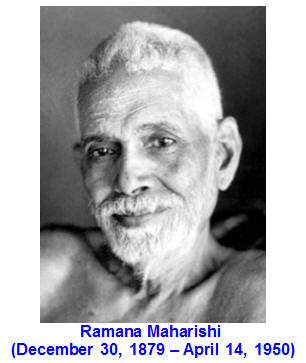
Excerpts from 'The Maharishi' 19.1 Ramana Maharishi (December 30, 1879 – April 14, 1950)
|
As all
leaves are attached to a stalk, so are all words attached to
A sentence
is a sound in itself on which other sounds called words are strung.
That is poetry by Upanishads and prose by Frost.
Yoga from embryonic to human to transcendental consciousness
'Karman is an act irrespective of purpose subject to causal law'. In Brahmanical period, Karman was performance of religious duties of sacrificial nature to ensure and obtain divine favors. Later Dharma became its cohort leading to Dharma-Karma Marga, the path in the performance of good acts. Dharma-Karma Marga is path of good deeds without desire for reciprocal fruits. Bad acts are punished and good acts are rewarded; this is known as Karmaphala (fruits of Karma). Association of Dharma with an act naturally led to the development of ethical doctrine (Jnana Marga). In Jnana and Raja Yoga, intellect is the centerpiece of Sadhana (spiritual practice). In Mantra Yoga, concentrate on worship and devotion.
Dharma has its root in Dhri meaning sustain. Dharma is a code of universal and individual principles that sustain the universe, the world, a nation, a community, a family and an individual. They are interconnected and orchestrated by The Supreme Sustainer and Purveyor of Dharma, God the Lord. Dharma should be in conformity with Rta, the Cosmic Order BG16
Woodroffe, the giant among the best West can offer, quotes Vaisesika Darsana, Dharma is that by which happiness is obtained in this and the next world, and birth and suffering are brought to an end (Moksa-dharma).
SakAma are acts that demand rewards; NishkAma are disinterested acts that do not demand rewards. Universal Dharma consists of NishkAma: The sun shines, the rain pours, the wind blows, the water quenches, the earth yields, the fire cooks.... The scientists call this "Planet in sweet spot of Goldilocks zone for life." The man has polluted, vitiated, and violated many of them and thus has engaged in Adharma on both universal and individual scale. Within the norms of Dharma, man can claim his place on earth by following Purusharthas, goals of man. They are Dharma, Artha, KAma and Moksha (Righteousness, wealth, sensual pleasure and liberation from reincarnation).
Hatha Yoga: Hatha means Ha for sun and tha for moon referring to PrAna and ApAna ( Sun and Moon Breaths), and others such as the important Energy Channels (Nadis), and Meditation. Before one can practice Hatha Yoga one has to assure and accomplish physical, mental, social, religious, and ethical purification (Niyama and Yama). Hatha Laya Yoga involves both action and intellect (Kriya Jnana). As a matter of fact Niyama and Yama are mandatory acts known as Astanga Yoga--eight-limbed requirement. Moral values, spiritual inclination and discipline are the requirements for all Yogas. The ultimate purpose of Yoga is realization or liberation (detachment from the mutable finite world and realization of its essence).--Woodroffe.
Yama and Niyama
| Ahimsa | Satyam | Asteyam | Brahmacharya | Ksama | Dhrti | DayA | Arjavam | MitAhAAra | SAucam |
| Non-injury | Truthfulness | abstain from stealth | Sexual abstinence | Forbearance | fortitude | Mercy | Simplicity | moderation in eating | purity: body and mind |
| Tapah | Samtosa | Astikyam | DAnam | PUjanam* | Sravanam** | Hri | Mati | Japa | Hutam |
| Austerities | Contentment | Belief in Veda | Charity | Worship | Hearing sacred texts | Shame, modesty | Right mind | Recitation of Mantra | Oblation |
PUjanam* = Isvara Pujanam = worship of God or Mother Goddess. Sravanam** = SiddhAnta VAkya Sravanam = Siddhanta word hearing = Study or listening to the sacred Texts, Sastras, Vedas, Vedanta....
The view from the West.
Since some acts bear immediate fruits and some do not bear fruits in the present life-time of a person, the theory of Metempsychosis (transmigration of the soul) was invented (by Sanatana Dharma). Every act bears a fruit now in this life or later in the next life. This is regarded as inflexible dogma by the West. (There is no masochistic entity in Hinduism to take ownership of somebody else's Karma and suffer or shed blood as Lord Jesus Christ did for the sins of others. Ramana Maha Rishi says,' your sins are yours and not Siva's.') Unable to find a suitable resolution of the good or bad acts that escaped reward or punishment, the West believes, the Hindus took an easy unimpeded path of transmigration of the soul, which determined the future course of karmic man in the next life. Thus the term Karma was born, which is the invisible enforcer of justice over a span of many births and dictates transmigration of the soul into a worm, an animal or a human depending on the merit or demerit of his acts in previous life or lives. Some in the West equate Yoga to Shaminism, Acrobatic Posturing....
Thus The Paradigm of Deferment--Pass-the-Buck (= kick the can down the road = to the next birth) was devised by the Hindu and is the solution for unresolved acts, the West implies. This inflexible rigidity of transmigration of the soul, the West speculates, has to have partial or total remission in the present life and so Bhakti Marga (the Path of Devotion) was conceived. Bhakti Marga ensured liberation in this life (Mukti) without the burden of transmigration of the soul, and a welcome escape from the good and the bad fruits in the present or next life. Practice of devotion to Personal Brahman and altruism, being the mainstays of Bhakti Marga, elicited Prasada (divine grace) from Brahman. Divine Grace is the ticket to liberation without the burdensome prospect of rebirth. This is the Paradigm of liberation now and anon by Divine Grace; the devotee sees the sign on the desk of his Personal God: The Buck Stops Here.
As a corollary, Karma Yoga was born to abolish Karmaphala (fruits of Karma) once for all. The theory comes to dispense the prescription by 'yoking the body and mind to achieve perfect unity.' This unity has the power of inducing energy that touches the 'unconscious mind beyond the limits of thought and language.' It had its embryonic origin in Pre-Vedic Harappa and Mohenjo-daro. Transmigration of the soul, regicide (dying and resurrection), cyclical cosmic destruction and renewal , Shamanism, and Yogic techniques, the West believes, have similarities. Should we not include resurrection of Jesus Christ in this? The implication is that the magical Shaman acts as an intermediary between man and Spirits to obtain a cure, a reward, a peek into the future, control of spiritual forces.... Likewise, the reward of Yogic techniques is to obtain a release from transmigration of soul. The West has dumped all non-occidental beliefs in a pile of rubbish. Practice of Yoga quickly spread to Jain, Buddhist and Vedanta schools. The West implies that these Yoga techniques are of pre-Aryan Dravidian origin. (Of course, there are learned people who refute the Theory of Aryan Invasion of India.) Integration of Mantra, Tantra, Yantra, Laya, Pranayama and its allied practices came into vogue. Obviously, a purveyor of these elements was necessary to practice and teach these techniques. The priests and Gurus (like Shamans) came on the scene to fulfill the need. Mantra is the mystical formula addressing and invoking a specific deity; Tantra teaches rituals, discipline and meditation; Yantra is the mystical diagram, the body of the deity in a diagrammatic representation, stills the mind and serves in the supplication and apprehension of the deity; Laya is lysis, involution or reintegration with Brahman; Pranayama (breath control) and its allied practices are the tools necessary for attaining unity. Reintegration with the Universal Soul marks the end of transmigration of the soul. Jnana Yoga is reintegration through spiritual knowledge. Bhakti Yoga is reintegration through love and exclusive devotion to a Personal Brahman (Vishnu, Siva, Mother Goddess). Karma Yoga is reintegration through religiously prescribed and observed acts and rituals. Raja Yoga (Royal way) is reintegration through transcendental knowledge, 'supra-mental perceptions,' supernatural faculties, and realization of the hypostasis of all that exists.
Author's note: Vaishnava Acharyas recommend Bhakti (Devotion) to the exclusion of Jnana and other Yogas and Margas (paths). You can mix Bhakti with anything as long as Bhakti is the major element and others are minor.
Now the Indian view
ThAkura says that Karma not aiming at Jnana (spiritual knowledge) is atheistic and should be rejected. Karma Yoga and Jnana Yoga without Bhakti are fraudulent. Karma yoga, Jnana Yoga, and Bhakti Yoga form a single Yoga system: this is Vedic Vaishnava Siddhanta.--P45 Jaiva Dharma by ThAkura. Maya-prone Jiva takes the path of Karma, Karma Yoga, Jnana Yoga and finally Bhakti Yoga to reach the Temple of Bhakti. These paths are steps in a staircase. Karma is action by body and mind. There are three kinds of Karma: Subha Karma, A-subha karma (Vikarma = prohibited acts), and Akarma. Subha Karma is auspicious act; Asubha (Vikarma) is inauspicious; Akarma is not performing an auspicious act. In other words they are Punyam, Papam and Papam (Merit, sin, and sin). Let me explain Akarma, not performing an action. A child runs across a busy thoroughfare; a capable adult knowingly ignores and watches the child hit by a car; that is Akarma and sin. What is Vikarma? That is easy to explain. An old lady drops her wallet; a youngster picks it up and pockets it--that is Vikarma. Subha Karma consists of Nitya Karma, Naimittika Karma and KAmya Karma. Nitya Karma consists of acts which promote weal of body, mind, soul, family, dependents, community, nation, and the world, in addition to offering prayers, and chanting mantras (Sandhya Vandanam). Naimittika (occasional, periodic) Karma consists of remembering and doing rites for the dear departed souls and atonement for sins. KAmya Karma consists of acts of self-interest and is discouraged.
By reading western authors on Hinduism, one is on the way to become a sterile acarpous (fruitless) pundit. There are many sterile Ph.Ds in religion in the West with sterile knowledge of religion. A Ph.D is knowledgeable and analytical but in that destructive exegesis, he loses the very essence, that is spirit. When one reads Indian Gurus, one develops devotion and a code to live by. One has to live, love and breath Hinduism to know it. When you go to a lobbyist, you want to know whom he knows; when you go to a chef, you want to know how good his culinary fare is; when you go to a professor, you want to know how much he inspires his students; when you go to a Guru, you should be able to feel the wattage of his spiritual illumination. In a professor, you measure the quantity of what he knows, more importantly inspiration and motivation he inducts in a student; in a Guru, you measure the quality. There is a difference between a professor of ethics and an ethical professor.
3.1:
Arjuna said:
O Janardana,
You said that knowledge (Buddhi)
is superior to action (Karma). O Kesava, therefore, why do you get me involved
in this horrible act?
From
Prakrti, the original undifferentiated primal matter, comes
Buddhi or Mahat:
Buddhi means discerning intelligence with faculty of judgment or intuitive
intelligence; Mahat means “Great” or primary one or cosmic principle and the
cosmic equivalent of Buddhi, which is sattvic in its yogic state. There are five
receptive organs or organs of perception: the eyes,
the ears, the nose, the tongue, and the skin (the tactile sense). The stimuli
from external objects conveyed from these organs pass through Ahamkaara,
manas, and Buddhi, collectively called Citta. Manas
is the lower instinctive undiscerning mind, the veritable seat of desires and
Indriyas (the sensory and motor organs); Ahamkāra is the Rajasic faculty that
takes an undue pride (ego) in saying “ I am the doer, I am the seer;” and has
this automated unthinking reflex response to external stimuli. Before the mind (manas)
acts on these external stimuli and after they pass through the ego of I-ness,
Buddhi applies its sattvic filter and then come the actions from manas. Citta or
antahkarana is the inner organ; Buddhi is the modulator of response, and
therefore, the moderator. Buddhi inherits Sattva, Rajas, and Tamas from Prakrti;
the yogi keeps Sattva, and gets rid of the Tamas and Rajas: Once the Tamas
falls, the darkness dissipates, and the Buddhi becomes translucent as water;
then the Rajas totters out; thus, the agitation subsides and stillness prevails.
With the clarity and composure, and the turbidity removed, Buddhi shows in its
reflective mirror Purusa in its self-luminous state standing aloof from the
hustle and bustle of Prakrti. Of course, you have to be a yogi to get to that
stage. Read next commentary.
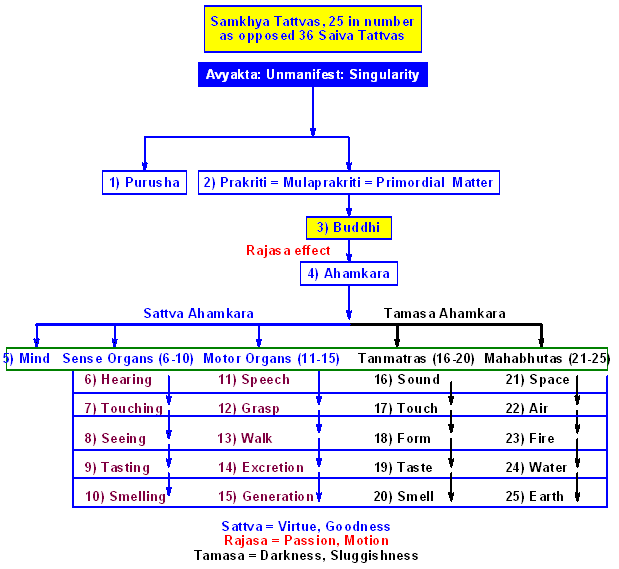
Tattvas and their different numerical placements in Samkhya and Saiva Tattvas.
| Tattva | Samkhya (25) | Saiva Tattvas (36) |
| Purusha | Purusha1 | Purusa12 |
| Prakrti | Prakrti 2 | Prakrti Tattva13 |
| Buddhi | Buddhi3 | Buddhi14 |
| Ahamkara | Ahamkara4 | Ahamkara15 |
| Mind | Mind 5 | Manas16 |
|
Hearing Touching Seeing Tasting Smelling |
Hearing6 Touching7 Seeing8 Tasting9 Smelling10 |
hearing17
tactile sense18 vision and color19 tasting20 smell21 |
|
Speech Grasp Walk Excretion Generation |
Speech11 Grasp12 Walk13 Excretion14 Generation15 |
speech22 grasp23 ambulation24 (walk) evacuation25 (Excretion) procreation26 (Generation) |
|
Sound Touch Form Taste Smell |
Sound16
Touch17 Form18 Taste19 Smell20 |
Sound27 palpation28 form29 taste30 odor31 |
|
Space Air Fire Water Earth |
Space 21 Air22 Fire23 Water24 Earth25 |
ether32 (Space) air33 fire34 water35 Earth36 |
There are 36 Saiva Tattvas (building blocks or principles). Buddhi is the 14th Tattva. The first five are Suddha or Pure Tattvas (1-5). The second 7 Tattvas are Suddha-Asuddha or Pure-Impure Tattvas (6-12). The Third category of Tattvas are Asuddha or Impure Tattvas (13-36).
TATTVAS-36: These are the Saiva Tattvas, 36 in number as compared to 25 Samkhya Tattvas.
Siva1, Sakti2, Sadasiva3, Isvara4, Sadvidya5, MāyA6, Kāla7, Niyati8, Kalā9, Vidya10, Rāga11, Purusa12 Prakrti Tattva13, Buddhi14, Ahamkara15, Manas16, hearing17 tactile sense18, vision and color19, tasting20, smell21, speech22, grasp23, ambulation24, evacuation25, procreation26, sound27, touch28, form29, taste30, odor31, ether32, air33, fire34, water35 Earth36.
Take a look at the Tattvas above and below. The light of consciousness is Purusa12. Prakrti Tattva 13 is the origin of all distal Tattvas. All the organs 17 to 31 report to Manas16, which reports to AhamkAra15, which reports to Buddhi14, which is illumined by Purusa12. All Tattvas serve for the pleasure of Purusa12. The Subtle body is made of 17 Tattvas from Buddhi14 to odor31. AhamkAra15 is part of Buddhi14. Samkhya philosophy makes no mention of Prana (the pentad); the MAyAvAdins remove the Tanmatras (sound17, touch18, color19, taste20, and smell21) and put in the five Pranas (Prana, Samana, Apana, Udana, and Vyana.
Swami Sivananda says the following about Udana Vayu.
Udana Vayu draws out the subtle body from the gross body at the time of death. It is this subtle body that goes to heaven and works in the dreaming state. Udana Vayu is the vehicle of transport for all Pranas. It helps deglutition or swallowing of food. It takes you to Brahman during deep sleep. Its abode is the throat.
Vyana which does the circulation of blood moves in these arteries.
Udana leads you to the higher worlds by means of your meritorious actions, to the evil worlds by means of your evil deeds and to the world of men by a mixture of both deeds.
In the case of Jivanmuktas or liberated sages who have nothing more by way of births nor worlds to live in, their minds and Pranas get absorbed in Brahman. The individual soul merges itself in the Supreme Soul or Para Brahman.
In the Jivanmukta [one who enjoys corporeal liberation] there is no question of any forerunner like the Udana Vayu. The liberated sages with their minds purified by renunciation and with knowledge of the imperishable Atman are completely absorbed at the time of death. There is no return to this world for them. end Sivananda.
Saiva Siddhanta classification of Tattvas: Tanmatras = Tanmatirai: தன்மாத்திரை = Rudimentary or subtle elements, viz., ஓசை, ஊரு, ஒளி, சுவை, நாற்றம் = sound27, touch28, form29, taste30, odor31 from which the Great elements came: ether32, air33, fire34, water35, earth36.
Buddhi14: Buddhi is the 14th Tattva, the human equivalent of Cosmic Mahat. Buddhi14 with Ahamkara15 and Manas16 form Antahkarana, the internal organ, the seat of thought and feeling, the thinking faculty. (Saiva Siddhanta --Sivapprakasam adds Chaitanya and Chitta to Antahkarana.) Ahamkara15 is threefold according to its Guna: Sattvika Ahamkara, Rajasa Ahamkara, and Tamasa Ahamkara. Sattvika, Rajasa and Tamasa correspond to VaikArika, Taijasa and BhUtAdi Ahamkaras. It is Vaikarika because it comes from Paramesvara and when His SAmarasya (union) with Sakti is disturbed. The Devas are called (eleven) VaikArika Deiteis of 10 senses and Manas . Ahamkara is subject to transformation by Sattvika Guna; the products are the Manas and the Vaikarika Devatas: Dik-Direction, Vata-Air, Arka-Sun, Praceta-Varuna, Aswins-deities of medicine, Vahini-Fire, Indra-god, Upendra-Vishnu, Mitra-Sun, and Ka (Chandra or moon; creation by Brahma). These Devatas preside over the products. From Taijasa Rajasa Ahamkara came ten Indriyas (Dasendriyas-10 organs) Ears for hearing17, Skin for touch18, Eyes for vision19, tongue for taste20 and Nose for smell21, Mouth (and Larynx) for speech22, hands for grasp23, feet for ambulation24, Anus for evacuation25, and genitals procreation26. From Tamasa or BhUtAdi Ahamkara came the Tanmatras and the derived BhUtas: Sound-Ether32, Touch-Air33, Form-Fire34, Taste-Water35, and Smell-Earth36.
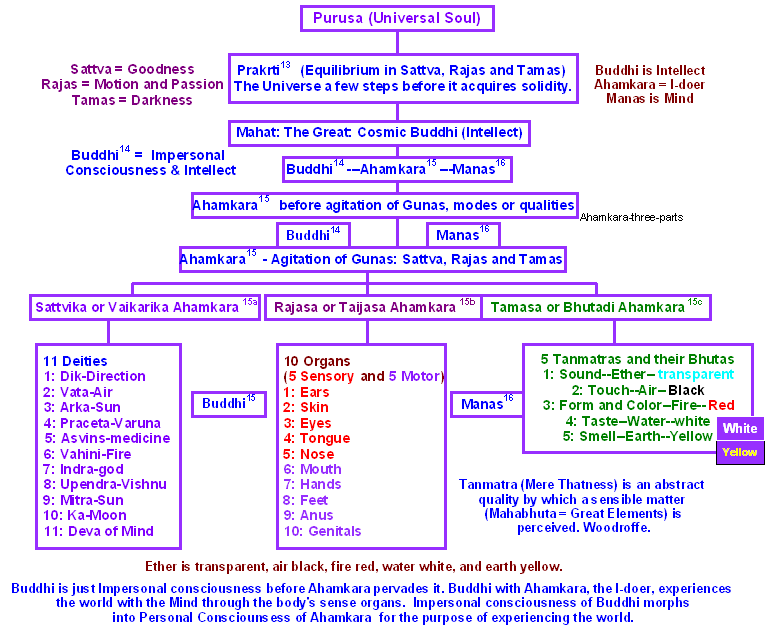
Buddhi14 , AhamkAra15, and Manas16 (Intellect, Ego, and Mind) constitute Antahkarana (inner organ). Mind is the generator of thought (samkalpasadhana) and Buddhi and Ahamkara are the filters, a thought goes through before an act is carried out. Buddhi (discerning intellect) applies ethical and moral filter; Ego applies the I-filter meaning whether a particular action is in the self-interest and welfare. Purusa12 and Prakrti Tattva 13 are the individual soul and nature. Prakrti 13 has three gunas: Sattva, Rajas, and Tamas in equilibrium. Sattva, Rajas, and Tamas = virtue, passion, darkness. When they are agitated, a panoply of behavior patterns emerge. Saiva Siddhanta (Umapathi of Sivapprakasam) says that in Buddhi, the three Gunas are disequilibrium, manifesting the plethora of behavior patterns.
Antakarana in Saiva Siddhanta = அந்தகரணம் = Inner seat of thought, feeling, and volition, consisting of five aspects: மனம்1, புத்தி2 , சித்தம்3, அகங்காரம்4, சைதன்யம்5 (Mind1, Buddhi or Intellect2, Determinative Faculty3, Egoism4 Chaitanya5 ; உட்கருவி = utkaruvu = Inner Organ. சைதன்யம்--Chaitanyam is God, Pure spirit, Intelligence, Intelligent Being. Chittam--சித்தம் is the human aspect of Divine Chaitanyam.
3.2:
By using confusing words, you perplex my mind. Therefore, tell me with
certainty that one by which I may gain bliss
(Srēyah).
Srēyah:
good fortune, better condition, bliss

Confusion
reigns in the mind of Arjuna: Buddhi Vs action. What is action without any
regard for reward or attachment? Is action without expectation of reward better
than action with attachment and desire? If knowledge is superior to action, why
should I act at all? Why should I fight the Kauravas in this battle?
3.3:
Sri Bhagavan said:
In this
world, as said before by me, O sinless One, there are twofold (two) paths, Jnāna
yoga (Yoga of knowledge) for men of contemplation (Sankhya yogi) and Karma yoga
(Yoga of action) for men of action (Karma yogi).
See Commentary for Verse 41 for definition of Jnāna and Vijnāna, and the
Supplement section.
Different people, by their innate nature, choose different paths to gain Brahma-Nirvana (extinction or absorption in Brahman). Some turn inside and some turn to work: They are complementary. Apart from Jnāna Yoga and Karma Yoga, there are Bhakti Yoga and Raja Yoga.
Jnāna Yoga is contemplation and helps the practitioner arrive at Atman by exclusion: Neti Neti, (“Not this not this,” on his way to SAT-CHIT-ANANDA, Being, Consciousness, and Bliss) is the first step towards Jnāna yoga. You are not body, you are not “Not-self,” you are atman, and you are self. “Not-self” is anything other than self. To be a Jnāna Yogi, the precondition is negation of identification with limiting factors: wealth, name, fame, body, Indriyas; dualities of experience, pain and pleasure; and love and hate. The contemplation with meditation results in oneness with the One-without-a-second.
Karma Yoga
is union, or absorption through selfless service; therefore, karma yogi should
continue to do his duties and work without expectation of a reward, detached
from the fruits of his actions:
worship, charity, and austerity. What is important is the act and not the fruit
of such an act. The karma yogi should take life as it comes with composure,
tranquillity, and peace of mind; he should rise above and stay untouched by the
dualities, such as pleasure and pain.
The
activity of the Divine Being in controlling this universe is an act of play; in
the same spirit, a man of action (karma yogin) should perform his duty in the
spirit of play activity to keep in tune with his creator. It is impossible for
any living being with a body to give up activity, but the one who surrenders the
fruit of his action is a true renouncer (a tyagin). Self-sacrifice is the
mainstay of karma yogin. One should fulfill his duties as son, father, husband,
Brahmin, or warrior or in whatever activity which one’s birth dictates or in
which one has training (Sahajam karma). More discussion later.
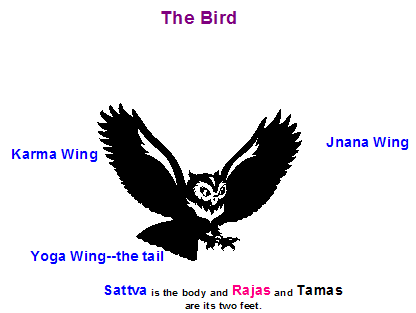
Upanishads
state that work or knowledge alone by itself is not sufficient to attain Moksa
or liberation. A bird cannot fly by one wing only. Karma and Jnana are the two
wings with which an aspirant can fly to heaven.
3.4:
Neither because man does not start an action, he gains Niaskarmyam (abandonment
of action), nor because he renounces action, he gains Siddhim (perfection).
Noninitiation of action does not mean freedom from action. Renunciation of
action does not mean attainment of perfection.
As mentioned above in my comments, a true "renouncer" (Sannyasin) is the one who relinquishes fruits of an action without relinquishing the action itself. It is like the doctor who sees patients without expectation of fees, salary or any kind of remuneration. He accepts whatever fees given to him voluntarily. (That will be the day when heaven will be on earth.) Desirelessness (vairāgya) is one of the cardinal signs of a yogi. Yogi’s qualities are eight in all: abstention, observance, postures, breath-control, withdrawal of senses, fixed attention or concentration, contemplation or meditation, and superconsciousness or samādhi.
Exemplary behavior consists of “ahimsa,
truth, honesty, continence, and rejection of gifts.” Yogi climbs all five steps,
before he can gain samādhi; inaction is as much a dereliction of duty, as
performance of action with expectation of a reward in the mind. Duty is work
according to caste by birth, or that performed in conformance with one’s
training, or that one agreed to perform, or that in a religious setting.
3.5: No
one, (for sure) even for a moment, remains without doing some action. All people
surrender against their free will (avasah) to the gunas of nature, which induce
them to action.
Gunas of
Prakriti: Sattva, Rajas, and Tamas or Virtue, Passion and Darkness)
Each one of
us is a body of our biological processes; biological functions go on with or
without our knowledge. Read commentary on Verse 12 Chapter 2 for more
information on prakriti and gunas. Men fall into three classes according to
their gunas: The one with goodness or Sattva guna is a
Sura; the one with passion or Rajas is an Asura
and one with Tamas (ignorance or Avidya) is a Raksasa.
Sura is god or godlike, Asura is demonic, and Raksasa is devilish. Man has one
dominant guna with varying amounts of the other two gunas; for example,
perfected yogi is mostly Sattvic with little Rajas or Tamas.
3.6: The
foolish man (vi-mūdha-atma), who curbs his sense organs for outward show, but
thinks about the sense objects in his mind, is a (mithya-acāra) deceitful
teacher.
Vi-mūdha-atma:
perplexed, foolish, or confused man
3.7:
The one, who restrains his senses by his mind, and begins, O Arjuna, his
karma yogam (Yoga of action) without attachment to sense organs, is superior
(and unsurpassed).
3.8:
You should do your work as prescribed to you (by the sacred texts), for
action is better than inaction. By inaction, even upkeep of the body is not
possible.
3.9: Except for the work done in the spirit (for the sake) of sacrifice (Yajna, or God), karma binds all other work done in this world. O Kaunteya (Arjuna, the son of Kunti), you perform your actions without attachment for the sake of sacrifice or God.
yajñāh = God, Yajna, Sacrifice, Vishnu.
Yajna means
sacrifice and can mean Vishnu, the Lord. In a pure spiritual sense, all actions
without attachment are sacrifices and we are mere instruments in the hands of
the Lord Vishnu. Actions without expectation of a reward become sacrifices to
the Lord. Such actions have no taint and therefore have no bondage. Yajna by
itself has undergone transformation and evolution from the first mention in
Vedas or observance to the time of Bhagavad Gita. In BG, Sri Bhagavan says that
a sacrificer does not expect a reward. Duty is work according to one’s
birth-Varna, training, or religious vows. Bondage means that it has a load of
karma attached to it. See elsewhere on karma, inflows into subtle body, and the
ways to unload this karma and bring it to a zero-sum point (இருவினையொப்பு--Equable
resolution of two-deed Karma to a Null status).
You heard
about “No Deposit, No Return.” As long as you do
not deposit (karmic inflows into the subtle body), there is no return to this
world as a transmigratory being.
Yajna (Sacrifice, sacrificial worship, offering of an oblation) is an elaborate external procedure (Exoteric Ritual). There is an alternate common procedure whose intent, purpose and result are the same. Sacrifice is giving something that you value most. Living on this earth is Yajna. The protector of Yajna and you is Paramatma. He protects you throughout your life. Vedas attest to the fact that we perform Yajnam on a daily basis without us knowing. That Yajna is PrasAda SvIkaranam, our daily eating. For the performance of Yajna, we need an auspicious place (VAdikai = வாடிகை = resting place). The body serves the purpose of Yajna VAdikai well. It is Paramatma who designed this body as the Yajna VAdikai. Now we need Homa Kundam (oblation through fire + hollow and hallowed ground = sacrificial pit). The mouth is the sacrificial pit. The tongue of fire in the pit is the anatomical tongue in the mouth. Brahma is the witness; our eyes serve that purpose, while watching the sacrificial pit of the mouth. Our Skeletal frame is the sacrificial hall (samiththam --(சமித்தம்). The hair on the body serves as the Darbha grass (taruppai = தருப்பை = Kusa/kaus grass--Poa cynosuroides). We need two implements (ladles) for the fire ceremony: சுருவம்/ஸ்ருவம்--suruvam and சுருக்கு--surukku. 1. சுருவம்/ஸ்ருவம், suruvam; 2. சுருக்கு, surukku. 1. a ladle to pour the clarified butter in the sacrificial fire and 2. mango leaves shaped into a ladle. God has given us two hands as two ladles, necessary for the ceremony. Mango-leaf ladle rests on the left hand and the other ladle in the right hand with which we pour the butter in the fire (naivEdhanam = oblation, offering). We put a single grain of cooked rice in the mouth without touching the teeth; this is PrAnahUthi (offering of vital breaths in the fire). Our daily eating of food is an oblation to Antaryamin (the Guide inside us). If one thinks and acts as if the food that we eat is not for the Antaryamin, we eat sin (papam-பாபம்). If you feed the Antaryamin in you in good faith, you are doing the proper Yajna. There is no need for the external ceremony. This daily Yajna of feeding the Antaryamin confers health, wealth and happiness. We eat for Him and not for us. This passage is based on Kurai-onrum-illai, Mukkur Lakshmi Narasimachariyar, part 2 page 289.
The View from the West
Of all the Indologists I read, Abbe J.A. Dubois (Born 1765, ordained in 1792 and came to India the same year; left India Jan 15 1823; wrote books and held posts; died age 83 in 1848.) is the most humorous; his acerbic comments in his book HINDU MANNERS CUSTOMS AND CEREMONIES (first published in 1906) should not to be taken as criticism or derision. He was a product of his formative years and upbringing; he knows us very well indeed. The factual errors have been corrected in the 1992 publication. He came as a missionary from France, soon discarded his European clothes, donned like an Indian and moved among them as if he were a native. Here are some of the comments he makes on Darbha grass. Brahmins always keep some in their house. It is extremely rough to the touch, and if rubbed the wrong way it cuts through the skin and draws blood. It was produced at the time when the gods and the giants (gods and demons) were all busy churning with the mountain of Mandara, the sea of milk in order to extract from it amrita or nectar, which would render them all immortal. The mountain rolling about on Vishnu's back (turtle supporting it) rubbed off a great many of the god's hairs (on the back) and these hairs, cast ashore by the waves, took root there and became Darbha grass. A few drops of Amrita fell on this grass, which thus became sacred. Another explanation. Vishnu metamorphosed into a courtesan (Mohini) and was distributing the nectar from a vessel supported on her hip from which some fleshy filaments fell and taking root in the ground, developed under the form of Darbha grass. Darbha grass is part of Vishnu himself. On this strength Brahmins worship it, offer sacrifices and use in ceremonies with the belief it has the virtue of purifying everything. In the month of Badra (September), an annual feast is held to honor the sacred grass. It is called Darbha Ashtami, which secures immortality and blessedness for ten ancestors. The posterity increases and multiplies like the Darbha grass itself, which is one of the most prolific members of the vegetable kingdom. I have no idea of why it is selected as worthy of special honor; I never heard of its medicinal or culinary use to receive its high position. --Opinion by Dubois.
Life on earth is Samsara, a state of internment until Karma is resolved or brought to a zero-sum status. The Bhagavata Purana (5th Skandha, Chapter 13) compares Samsara to the forest. The jivas wander in the forest of Samsara in pursuit of happiness and pleasure. Bandits (sense organs) wander in the forest of Samsara as a caravan with an undisciplined leader, the mind. A careless member of the caravan devoid of spiritual bent is mauled and carried away by wolves (wife and children), meaning that he gets married, begets children and dissipates his spiritual wealth. In the dense forest of Samsara, they are constantly subjected to stinging gnats and mosquitoes in the form of wicked people. They see the illusive city of Gandharvas in the sky (akin to seeing mirage in the desert) which promises a life of pleasure. Gandharvas are celestials (like The New York Philharmonic at Lincoln Center's Avery Fisher Hall) who entertain the gods. The city of Gandharva is the body which is impermanent and illusory, meaning that the Soul has permanence and the physical body of the soul can be changed like discarding old clothes and changing to new ones. The members of the caravan wander hither and thither in the forest looking for shelter, water and wealth. Dust storm hits them in the eye, thereby blinding them and depriving them sense of direction. Dust storm stands for the woman who raises blinding erotic dust making the man lose his sense of direction. Here directions are the deities of direction, who are the witness to his actions. The unseen chirping crickets and hooting owls annoy and pain the wandering merchant. Crickets are the back biters and the owls are oppressive enemies and authorities. Haunted by crickets, owls and hunger, they seek unholy trees, irreligious persons. When the thirst of the senses heightens, they go after the mirage of worldly pleasures. They run into dry riverbeds that are unable to quench their thirst, and resort to begging for food. (Dry riverbeds are schools which do not offer wholesome water for spiritual thirst, thus depriving the spiritually thirsty man to attain liberation.) Forest fire scorches them and the Yakshas and Raksasas (king and his officers) drain their lifeblood, squeeze them dry and deprive them of their wealth. Thus deprived of wealth, he becomes despondent. In a reflective mood, he tries to scale the great mountain of understanding only to be pricked by a thorn, cut by a sharp gravel and bruised by falling rocks. He sits down in a state of depression. Afflicted by gastric fire and responsibility for his large family, he becomes angry with his own family. The sleep, in the form of a boa constrictor overpowers him, renders him unconscious and abandons him like a corpse in a jungle. Sometimes he receives a bite from the venomous snake, becomes blind, staggers, falls into a well covered by foliage and stays there in the darkness of misery and ignorance.
Sometimes he ravenously goes after honey of low quality (another man's wife) and suffers bees stings in the form of harassment, humiliation and physical abuse from her husband. If the caravan members succeed in ravishing others' wives (stealing the honey), they engage in fight with them (like the Rocky Mountain goats over female goats) and thus distracted, some one comes along and walks off with their loot.
When they have no protection against cold, heat, hunger, storm and rain, they trade among themselves fraudulently with what little they have and become enemies of each other.
Thus deprived of wealth, house, bed, blanket and transport, they resort to begging. Unable to satisfy his daily needs, he casts his usurping eyes and suffers insults.
Though they developed hostility among themselves from fraudulent money transactions, they enter into marital arrangements with each other.
They leave their dead wherever they died and take along the newborns. They trudge up the weary path, unable to take a path to Yoga.
The resolute warriors conquer the world, earn hostility and fall dead; they do not attain the abode of Vishnu reached by the Sannyasins devoid of enmity.
3.10: Once upon a time (Time of creation) the lord of creatures, created men along with sacrifices and said, by this you bring forth more and more and let it be the giver of your desires.
Prajāpati:
Lord of the creatures, Brahma
Kāmadhuk = the celestial cow of plenty; Milking one's desires, granting every desired object
Once upon a
time, there was a cow by name Kāmadhenu, a cow of plenty, a heavenly cow
granting all desires. According to Gandhi, the sacrifice meant in this verse is
not mental work but physical labor, dedicated to Sri Krishna in a spirit of
selfless service, which will free us from evil and bondage.
The View from the West
The universe originated as the Cosmic Purusa (man) from whose sundered body came the various parts of the universe. The brick of the sacrificial fire-altar stands for the Bhutas (matter) of the Purusa; the bricks are arranged in such ways that they represent the expanding universe. In one instance, the bricks are laid out in the shape of a humongous bird with spread-out wings and consist of 10800 individual entities with a name for each brick. The number 108, its extensions, variations and divisions have cosmic significance. They represent the Year and the endless cycle of birth, death and rebirth (metempsychosis). The tongue of fire leaps from the heart of the altar and ascends to heavens indicating the identical nature of earthly man and Cosmic Purusa. By building more and more altars, the Vedic Indo-Aryan reenacted the Cosmic Purusa's creation and maintenance.
West quotes R
The West continues the story of Purusa. In another version of the creation story of Purusa in Satapatha Brahmana (800 BC) The universe was the soul. He was Consciousness first and said Aham (I am). He became two, male and female. The humankind was born from the union between the two.
Brhad-aranyaka Upanishad: The female hid herself out of shame and morphed into beasts of many kinds. The male Purusa made love to her every time she morphed; thus many kinds of animals were born. Agni issued forth from the mouth and the inside hands of Purusa. The fire singed the hairs and that is why there is no hair in the mouth and the inside of the upper arms.
|
Religion and Science. Creation Versus Evolution. Sep. 22, 2013 |
|
The Chāndogya Upaniṣad rejects the view that the world was originally a-sat or non-being, and from it all existence was produced.2 It affirms 'In the beginning this world was just being, one only without a second.'3 page 86 The Principal Upanisads Dr. Radhakrishnan. |
|
Abiogenesis (/ˌeɪbaɪ.ɵˈdʒɛnɨsɪs/ ay-by-oh-jen-ə-siss[1]) or biopoiesis[2] is a natural process by which life arises from simple organic compounds.[3][4][5][6] The earliest life on Earth existed at least 3.5 billion years ago,[7][8][9] during the Eoarchean Era when sufficient crust had solidified following the molten Hadean Eon. |
|
Scientific hypotheses about the origins of life may be divided into a number of categories. Many approaches investigate how self-replicating molecules or their components came into existence. For example, the Miller–Urey experiment and similar experiments demonstrated that most amino acids, often called "the building blocks of life", can be racemically synthesized in conditions thought to be similar to those of the early Earth. Several mechanisms have been investigated, including lightning and radiation. Other approaches ("metabolism first" hypotheses) focus on understanding how catalysis in chemical systems in the early Earth might have provided the precursor molecules necessary for self-replication.---Wikipedia |
3.11: The
gods have cherished you by sacrifices and you will cherish them in return. By
mutually cherishing each other, you will gain the supreme good.
3.12:
Since gods are pleased with you because of your sacrifices, the gods will
grant you desired enjoyments. He who enjoys these gifts without giving them
(reciprocation) to gods in return is certainly a thief.
3.13:
The virtuous, who eat the remnants of food
offerings in sacrifice, will gain release from all sins, but the sinners
who prepare food to sustain their own bodies, eat sin.
The virtuous eat the remnants of the sacrifice and gain release from all sins. The sinners who prepare and eat food to sustain their bodies eat sin.
Among Vaisnavas, it is a common belief that Four Factors awaken and sustain spiritual consciousness: Mahaprasada, Krishna, Krishna Nama and Vaishnavas. Mahaprasada (mostly cooked rice, butter, raw sugar) is prepared in the temple kitchen, served to Bhagavan and later given to the devotees to eat. Being the devotee of Krishna (He likes to be addressed as Govinda), chanting the names of Krishna, associating with other Vaishnavas and partaking of Prasada promote Bhakti. Mahaprasada, in addition, attenuates the materialistic nature of Jiva and expunges sins, setting the path to Moksa, Vaikuntha or Paramapadam.
See
comments under verse 15. It is the custom to offer food as sacrifice and then
eat it. The food that we eat consists of three parts: “the coarse, the middle
and the subtle” according to Chandogya Upanishad. The coarse part becomes feces,
the middle part becomes flesh, and the subtle part becomes mind.
Here is what Ramakrishna Paramahamsa says about food and dress.
|
Page 115 Sayings of Sri Ramakrishna Dress and Food
386. What is the good of wearing the orange coloured dress of an ascetic? What is there in the dress? The orange dress brings with it pure associations. The wearing of worn out shoes and torn clothes brings thoughts of one's low state to the mind; dressing smartly in trousers and coats, with patent leather shoes on, makes one naturally feel rather elated with pride and vanity; by wearing the black-bordered dhoti of fine muslin, one feels impelled to be lively and to sing love songs perhaps. The wearing of the orange garb of the Sannyasin naturally causes sacred thoughts to rise in the mind. Every kind of dress has its own associations, although dress in itself has no special significance.
387. A young plant should always be protected against goats and cows and the mischief of little urchins, by means of a fence. But when it becomes a big tree, a flock of goats or a herd of cows can freely find shelter under its spreading boughs and fill their stomachs with its leaves. So when your faith is yet in its infancy, you should protect it from the evil influences of bad company and worldliness. But when you grow strong in faith, no worldliness or evil inclination will dare approach your holy presence; and many who are wicked will become godly through their holy contact with you.
388. Once a student questioned Sri Ramakrishna, "Sir, as the same God dwells in every being, what harm is there in accepting food from any and every man's hands?" In reply the Master asked him whether he was a Brahmana. When the student said "Yes", the Master remarked, "That is why you put m~ the question. Suppose you light a match and heap over it a lot of dry wood. What would become of the fire?" The student replied, "The fire will 116 Sayings oF Sri Ramakrishna
get extinguished, being choked by the pile." Again the Master said, "Suppose a wild fire is blazing and you throw into it a lot of green banana trees. What would become of these trees?" The student replied, "Surely they will be reduced to ashes in a moment." "Similarly," said the Master, "if the spirituality in you is very weak, there is every danger of its being smothered by eating indiscriminately from all hands. But if it is strong, no food will affect you."
389. Once I was initiated by a Mohammedan teacher and was given the 'name' of Allah to repeat. I repeated the 'name' for several days, strictly observing the ways of Mohammedans and eating their food. During that period, I could not go to the temple of Mother Kali, or take the names of Hindu gods and goddesses.
390. Eat not in the feast given at a funeral ceremony; for such food destroys all devotion and love for God. Also do not take food in the house of a priest who lives by conducting sacrificial rites for others.
391. Q, As regards eating, should not one eat what one gets?
A. That depends upon the spiritual state. In the path of Jnana it produces no harm. When a Jnani eats, he offers the food as an oblation in the fire of Kundalini. But for a Bhakta, it is different. A Bhakta should eat only pure food, such food as he can freely offer to his beloved Lord. Animal food is not for a Bhakta. At the same time I must say that if a man loves God, even while living upon pork, he is blessed; and wretched is he who lives on milk and rice or on Havishyanna (unspiced food) but whose mind is absorbed in 'woman and gold'.
392. He who eats simple non-stimulating vegetable food, but does not desire to attain God,-for him that simple food is as bad as beef. But he who eats beef and desires to attain God ,-for him beefis as good as the food of the gods. 393. Eat to your satisfaction in the day, but let your meal at night be light and small in quantity.
394. That food alone should be taken by the devotee which does not heat the system or unsettle the mind. |
3.14:
From food come the living creatures. From the rains comes the food. From
sacrifice come the rains. From work comes sacrifice.
Work is
sacrifice; sacrifice brings rains; rains grow food and food sustains the living
creatures.
Work…sacrifice… rains…food…living creatures. Food contains the three elements:
fire, water, and earth. In Upanishads, you will find many triads. For example,
Gunas: Sattva, Rajas, and Tamas.
3.15:
Know thou that karma originates from Brahma. Brahma originates from the
imperishable; therefore, all-pervading Brahma stands steadfast in sacrifice.
Sacrifice
is giving a little of oneself: it is giving something that has value; it is
giving up one’s advantage for a higher purpose; and therefore, it has a
worshipful component. Brahma is the source of sacrifice, rains, food, and living
entities. It is only natural that everybody enjoys the bounty from the original
source, and that sharing is a part of the sacrifice. Brahma is the womb of the
universe for all living entities. Brahma is action; from action, sacrifices and
karma are born. Brahma is the same as Prakriti. See Chapter 2 verse 12 for
explanation. Brahma, after living inside for a year, came out splitting open the
Egg into two half-shells; the silver half became earth; the golden half became
the sky; the membranes became mountains and clouds; the veins became the rivers;
and the fluid became the sea. Brahman is different from Brahma, Vedic Brahmana,
Brahmana, or Brahmins of the priestly class: Brahma, Vishnu and Siva form the
Hindu holy trinity; Vedic Brahmana are texts giving details of sacrifices,
philosophy, rules, and conduct expected of priests; the Brahman is numinous,
Supreme, and the Absolute; It is Reality and it is
Satchidananda (Sat-Chit-Ananda: Being, consciousness, and bliss)
3.16: He,
who in this world, does not follow the wheel (of sacrifice) set in motion thus,
enjoys the sense objects, lives a life of sin, and lives in vain, O Partha
(Arjuna).
3.17: He,
who finds pleasure, satisfaction, and contentment in the self, does not have any
work that needs completion.
He, who
finds pleasure, satisfaction, and contentment in the self, does not have any
unfinished work.
Atmaratih:
Pleasure in the self. Atmatrptah: Satisfaction in the self. Santushta:
Contentment.
3.18:
For him, there is no advantage in action. In addition, there is no
advantage in inaction. He does not need any being (in the whole universe) for
his shelter or purpose.
Arthah:
Advantage, purpose. Artha+vyapāsraya: purpose and shelter.
This
liberated man, whose self is perfect, has nothing to gain or lose by action or
inaction; and thus he is happy and contented with self, freed from dualities: he
found the light within his spiritual heart. His jivatma (the individual soul)
and Paramatma (the Supreme Soul) are like two birds, which found each other and
remain in perfect harmony. His jivatma gave up eating fruits (actions without
expectation of rewards) longtime ago and it is in unison with Paramatma: He is a
true sanyasin.
3.19:
Therefore, do the work that has to be done with skill, always without
attachment; man, who performs action without attachment to fruit, gains the
Supreme (Param).
Let us pay
a little attention to work with and without attachment, action and inaction,
sacrifice, gift, duty, and karma. Work done expecting reward does not carry any
merit; further, work done in self-interest or self-aggrandizement is even worse.
Sacrifice is giving a little of oneself and something of value, and yielding
one's advantage to the needy for a higher purpose, and has a worshipful
component. Giving gift to the needy and deserving is superior and expectation of
a reward for work is inferior. Action is part of life and therefore unavoidable.
Gunas condition action. Sattvic actions are the best; inaction is idleness and
has no merit. Reaction can be negative, positive, or neutral: A sattvic reaction
is meritorious, Rajasic reaction is destructive, and Tamasic reaction has no
merit.
Duty is
work according to one's ordain or birth-varna, or training. Duty has a dharmic
ingredient and is performance of work as it applies to one’s station in life.
Failure to perform one's duty has no merit. Duty, sacrifice, Sattvic karma, and
work done without attachment take man to the Supreme.
3.20: Certainly, by work done
without attachment, Janaka and others gained perfection. You should also do
work, for the welfare or maintenance (Loka-samgraha) of the world.
Lokasamgraha: In the days of Rg Veda, Vedic communities cleared forests
for offering sacrifices. This clearing, open to the sun, received the name Loka,
which means world.
King
Janaka, belonging to the solar dynasty, was the king of Mithila, and his birth
was unusual. Janaka’s father, Nimi, asked the most famous priest, Vasistha, to
officiate as the sacrificial priest. Since Vasistha was also the officiating
priest for Indra, the Lord of the clouds, rain, thunder, and so asked Nimi to
wait until he completes the sacrificial ceremony for Indra. Nimi would not wait
and so appointed another priest to perform yajna. Vasistha became angry and laid
a curse on the king Nimi, saying the king’s body would fall down dead. Before
the curse could take effect, king Nimi countercursed the priest, Vasistha,
saying that the same fate would fall on the priest. Both fell down dead.
Vasistha was born again in the world. King Nimi’s sacrificial ceremony went
well, though the king was dead. The Rishis in attendance begged the visiting
gods to revive the king, who refused to be born in this world with the material
body. The Rishis ordered the royal attendants to use chemicals to preserve the
body. Since the king refused to be born again, the Rishis churned the dead body
(a good spin) and produced Janaka.
He was the father of Sita, found fully
formed in the furrow, plowed by the king in a sacrificial ritual to get a child.
He was a pious and just ruler who performed many sacrifices, which helped him
gain perfection or Siddhi. He was an exemplar of karma yoga; he practiced what
he taught to his subjects. Janaka's daughter Sita married Sri Rama of Ramāyāna.
3.21:
Whatever a great man does, the other people do. Whatever example he sets,
humankind follows.
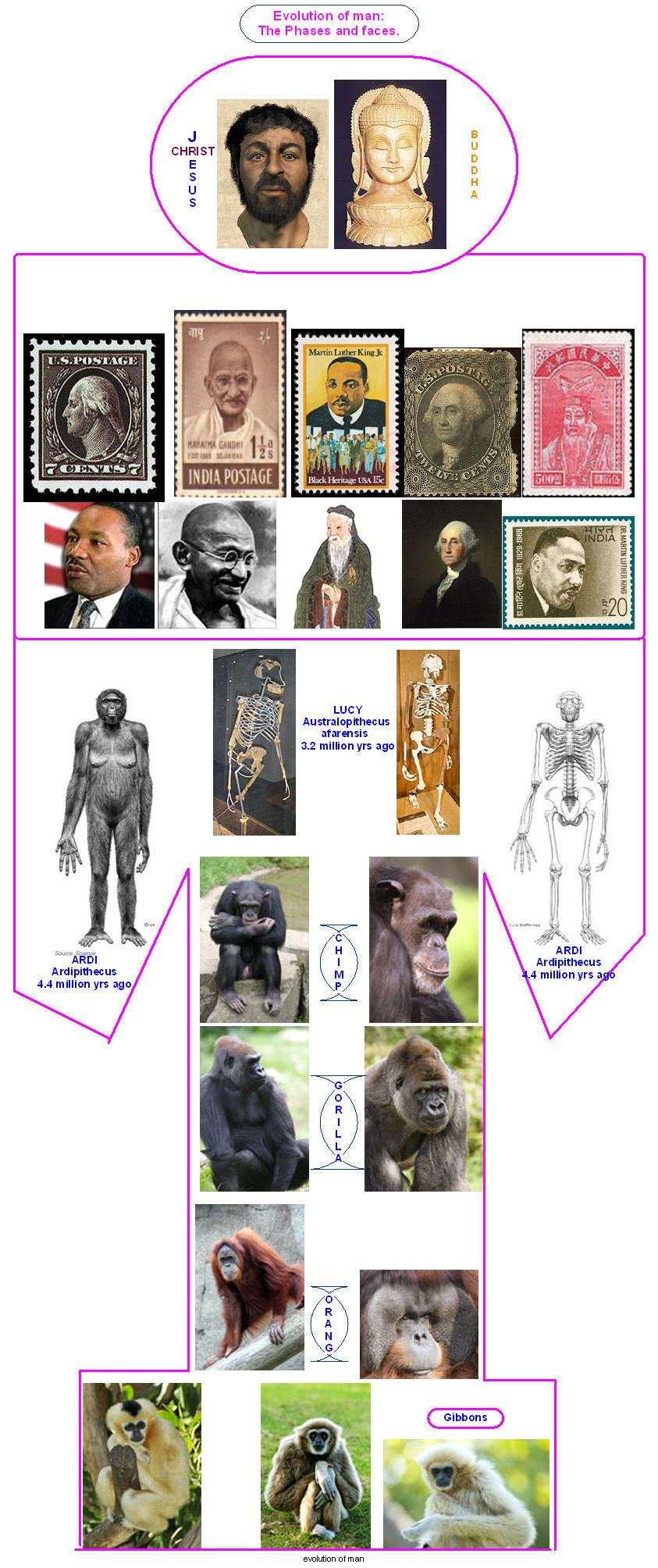
An average
person emulates whatever a great man does. His actions are the only authority,
which the whole world follows.
An average
person is not knowledgeable or spiritual enough to set his own path to
realization. The ordinary person looks up great and accomplished men (Buddha,
Jesus Christ) for direction and instructions. Deeds of great men speak louder
and clearer than an inspiring speech. These great men are responsible for
sattvic changes in society. These follow-the-leader examples are common in
religion, science, and politics. Sometimes the greatness of a man is not obvious
during his lifetime , because he is way ahead of the crowd; the realized great
men are exemplars, who have seen the light of wisdom. The light here refers to
the light of the Soul in the spiritual heart. Ramana Maharishi said, “For the
body-bound fools, the heart of flesh exists in the left chest.” The Heart (Hrdayam)
known to the seers as the seat of the Soul shines on the right side of the chest
pervading and transcending both inside and outside. The Guru, who tells his
disciple “Do this or that,” is no Guru, but the real Guru is the one who directs
the disciple to “Who am I.” “Am I
the body or am I the soul?” The body is in the Self and not the other way round.
Ramana goes on to explain this point: the screen in the movie house is not (not
part of) in the celluloid. The screen captures the moving images projected from
the celluloid. In this allegory, the screen represents the Self and the images
represent the body, meaning the body needs the Self for its reflection and the
Self is not in the body. (The mirror-soul reflects the body.) If there is no
Self, there is no projection of the body. The moving drama of life runs on the
screen-soul. [The screen is not (neither part of,
nor intrinsic to) in the celluloid images]. The moving images (of the body) on the
screen (of a Soul) are the drama of this material life. The spiritual Heart (of
a screen) is not part of the body (of images): The spirit and the body are
separate and the latter needs the former for sustenance. The realized souls, by
their yoga, have received revealed knowledge. Another way of looking at it is
the projected moving images of the body do not affect the screen of a SOUL or
SELF. The images of flood does not wet it and the fire does not burn it. There are such
perfect exemplars in all religions.
3.22: O
Partha, in all three worlds, I have no assigned
duty to perform. There is nothing I need to gain that I have not gained before
(has not been gained), yet I am engaged in action.
The Trisu
Lokesu (the three worlds) is the heaven, the earth,
and the netherworlds. There are other classifications: Brahmaloka, Svarloka and
Yama loka; World of Brahma, Indira, and Yama (death); Heaven, atmosphere and
earth; Material world, Astral world, and Superconsciousness.
Read more
in the table.
All these
planetary systems are resident on the body of Lord Vishnu.
All lokas
(worlds) except Goloka, Vaikuntha, and Brahmaloka are temporary places of
residence. Therefore, Satyaloka down to patala, fourteen worlds in all, are
subject to dissolution and creation, while the worlds above them are eternal and
indestructible—Bhagavata Puranam, 11.24.21.
Goloka is full of touchstone palaces, wish trees, wish-yielding cows (Surabhi), servant-goddesses. Goloka is an effulgent circular ring of Light equal to a thousand moons. It is surrounded by Vaikuntha containing pure water. It resonates with playing of Ragas and chanting of Vedas. Siva himself admits that he knows of no place like Goloka.
Table:
AUM is a space-filler.
|
The
World |
Body
Part |
Living
Entity |
Comments |
|
GOLOKA |
AUM |
|
EXCLUSIVE |
|
Vaikuntha |
AUM |
Vishnu
Bhaktas (devotees) |
AUM |
|
Brahmaloka |
Head |
Brahman |
Eternal, indestructible |
|
Satyaloka |
Head |
Brahma |
AUM |
|
Taparloka |
Breasts
|
Vairagins. Free from impurities |
AUM |
|
Janarloka |
Neck |
Sanat-kumara,
abode of the gods, Siddhas. Free from impurities |
Also
Sri, Bhu, Siva (Rudra) |
|
Maharloka |
Chest |
Bhrigu,
saints, and gods, Siddhas. Free from impurities |
AUM |
|
Svarloka |
Heart |
Indra’s
heaven, abode of the gods
|
AUM |
|
Bhuvarloka |
Navel |
space
between the earth and sun |
AUM |
|
Bhurloka |
Navel |
The
earth |
AUM |
|
Atāla |
Waist |
AUM |
AUM |
|
Vitāla |
Thighs |
AUM |
AUM |
|
Sutāla |
Knees |
AUM |
AUM |
|
Talatāla |
Shanks |
AUM |
AUM |
|
Rasatāla |
forefeet |
AUM |
AUM |
|
Mahatāla |
Ankles |
AUM |
AUM |
|
Patāla |
Soles
of the Feet |
Netherworld |
AUM |
According
to Bhagavata purana, 11.24.11, Bhurloka consists of the earth and the seven
subterranean regions: Atāla, Vitāla, Sutāla, Talatāla, Rasatāla, Mahatāla, and
Patāla. The Bhuvarloka is the region above the earth. The Svarloka consists of
Maharloka, Janaloka, Taparloka, and Satyaloka.
Here is what Wikipedia says of heavens of other cultures.
In ancient astronomy, before the telescope was invented, people referred to the Sun, Moon, and the five planets visible with the naked eye as the seven heavenly objects. Each had its own layer of heaven or sky assigned to it, and each was considered to be further and further away from Earth. Today we refer to the layers as the orbit of the object around the Sun.
It was believed by many cultures, and still is by some today, that when people die, their souls float into the sky, visiting each of the Seven Heavenly Objects as they travel to the outermost layer of heaven. When they reach that outermost layer, they are believed to actually meet God, who was/is supposed to exist just above the last layer of heaven, just above the orbit of the planet we currently call Saturn.
Judaism
According to Jewish mysticism, Heaven is divided into seven realms. In order from lowest to highest, the seven Heavens are listed alongside the angels who govern them and any further information:
1. Shamayim: The first Heaven, governed by Archangel Gabriel, is the closest of heavenly realms to the Earth; it is also considered the abode of Adam and Eve.
2. Raquia: The second Heaven is dually controlled by Zachariel and Raphael. It was in this Heaven that Moses, during his visit to Paradise, encountered the angel Nuriel who stood "300 parasangs high, with a retinue of 50 myriads of angels all fashioned out of water and fire." Also, Raquia is considered the realm where the fallen angels are imprisoned and the planets fastened.[1]
3. Shehaqim: The third Heaven, under the leadership of Anahel, serves as the home of the Garden of Eden and the Tree of Life; it is also the realm where manna, the holy food of angels, is produced.[2] The Second Book of Enoch, meanwhile, states that both Paradise and Hell are accommodated in Shehaqim with Hell being located simply " on the northern side."
4. Machonon: The fourth Heaven is ruled by the Archangel Michael , and according to Talmud Hagiga 12, it contains the heavenly Jerusalem, the Temple, and the Altar.
5. Machon: The fifth Heaven is under the administration of Samael, an angel referred to as evil by some, but who is to others merely a dark servant of God.
6. Zebul: The sixth Heaven falls under the jurisdiction of Zachiel.
7. Araboth: The seventh Heaven, under the leadership of Cassiel, is the holiest of the seven Heavens provided the fact that it houses the Throne of Glory attended by the Seven Archangels and serves as the realm in which God dwells; underneath the throne itself lies the abode of all unborn human souls. It is also considered the home of the Seraphim, the Cherubim, and the Hayyoth.
3.23:
If I ever do not perform my duties with great care and attention, O
Partha, all men would follow my path in all respects.
3.24:
If I do not perform my karma, all these worlds will come to ruin. I will
be the creator of death, disorder, and destruction of these people.
3.25: As the ignorant act with attachment to their work, O Bharata, the learned should do their work without attachment, but with a desire to hold the world together (lead the people in the right path).
Ramana
Maharishi said, “Forsake me not my friend Detachment, and ever let me call you
mine, for you destroy the densest darkness, the darkness of desires, kindling
the flame of knowledge. And you my friend Detachment, ever you ward off evil
from me, and keep me bound to enduring Truth. Such is your virtue. Estrangement
from you would be worse than all the world's hostility.”
3.26: A
Vidvan (the learned and the enlightened man) should not cause any mental
confusion in the ignoramus who performs action with attachment. He should
perform his actions according to propriety and induce them to act in similar
manner.
The depth
of awareness of an individual to Truth or Consciousness is as varied as the
spiritual intuitive intelligence, upbringing, receptivity, religiosity, and
environment. Pursuit of knowledge, and awareness that there is something greater
than we are, are inherent in all of us. They may be ignorant of the ways of a
yogi. We should accept the limits of such people of simple faiths and not force
our values on them; we should use their strengths to uplift them and at the same
time not take advantage of their weaknesses, such as superstitions. Hindu
religion has shown this resilience in allowing man to worship a pantheon of
forces and gods: It could be as simple as nature worship; the object of worship
could range from elements of nature to tutelary gods. As Vivekananda says, the
worships ranging from the crude to the fine are not in error, but a journey from
truth to truth, from lower truth to higher truth. It is relative as in,
“Darkness is less light; evil is less good; impurity is less pure.” The Kali of
a Yogi Ramakrishna Paramahamsa is different from the Kali of an uninitiated and
the unrealized. Ramana Maharishi's experience of Shiva Consciousness is
different from that of an ordinary devotee of Shiva. They come from two
different worlds; nevertheless, the devotee's experience is important for that
devotee; we, the ordinary devotees of God, are not the learned enlightened men
but we are on our way towards that goal.
3.27: All
actions are subject to gunas (Sattva, Rajas, and Tamas) of material nature. He,
in whom Ahamkara perplexes the mind, thinks, “I am the doer.”
प्रकृतेः क्रियमाणानि गुणैः कर्माणि सर्वशः ।
अहंकारविमूढात्मा कर्ताहमिति मन्यते ॥३- २७॥
prakṛteḥ
kriyamāṇāni
guṇaiḥ
karmāṇi
sarvaśaḥ
ahaṁkāravimūḍhātmā
kartāham iti manyate 3.27
prakṛteḥ = of the Nature; kriyamāṇāni = being performed; guṇaiḥ = by gunas; karmāṇi = all activities; sarvaśaḥ = in all ways; ahaṁkāra + vimūḍha + ātmā = the soul deluded by Ahamkara [egoism]; kartā + aham = 'I am the doer'; iti = thus; manyate = thinks.
3.27: All actions are conditioned by gunas (Sattva, Rajas and Tamas) of material nature. He whose mind is perplexed by ahankāra thinks, "I am the doer."
ahaṁkāra + vimūḍha + ātmā = the soul deluded by Ahamkara [egoism] = the one who identifies with his body and organs and who through ignorance thinks the activities are his own. --Sankara. Because of this Ahamkara, the one who is ignorant of the real nature of the self, thinks, 'I am the doer' with regard to the activities that are really being done by the Gunas of Prakrti. --Ramanuja
Ahamkāra:
ego
Gunas:
modes of behavior. In simple terms, Sattva is goodness; Rajas is passion; Tamas
is darkness and sluggishness.
Ahamkāra: Aham+Kāra = I+
making or causing. I am the doer. As said earlier there are three gunas (Sattva,
Rajas, Tamas), which control our activities of material nature. The pristine
life-soul overlaid by Ahamkāra (the ego, I-ness or I-factor, me, mine) and
Vimūdha (confusion of mind), mistakenly thinks that it is the doer. Buddhi is
like a barrier or filter between the gunas and the actions. What goes through is
what shows in action, and buddhi discards the leftover gunas: If sattva goes
through and the Rajas and Tamas stay back, the person is sattvic. Buddhi is the
automatic modulator of every activity. One's actions and reactions are according
to one's buddhi, which is the filter for ahamkāra too. Yogi controls his
ahamkāra, meaning that he is not Rajasic or Tamasic and the I-factor is
vestigial; once Tamas dissipates, the yogi steps out of darkness; with the
removal of Rajas, the mental agitation calms down; stillness prevails. Since all
the turbidities disappear, there is translucence; there is clarity; buddhi
reveals the serene stillness of purusa free from the frenetic activities of
prakriti and its gunas.
Ten Indriyas, manas and ahamkāra: The ten Indriyas, engaged in perception
and action (sensory and motor functions), and the sensory stimuli impinge the
manas (mind). The mind processes the sensory stimuli and presents them to Buddhi
through the I-ness of Ahamkāra. Buddhi filters out this turbidity as said
earlier. The soul's nature is not Prakrti and gunas. The body-mind-ego complex
(the sheath encasing the soul) causes confusion and the life-soul loses its
anchor to the Self and feels that it is separate from Self. Once the soul
(individual soul) loses its connection to the Soul (Greater Soul), it feels that
it is independent and that it is the doer.
These three
constituents of gunas are inseparable and form a complex, Sattva-Rajas-Tamas
complex, which is inert if it is in equilibrium. Only one of the three
constituents is dominant in a person or entity. Sattva is knowledge, intellect,
light, and balanced emotion; Rajas is the motor behind Sattva and Tamas; without
Rajas, Sattva and Tamas are inert. Dominance of Rajas naturally means revved-up
emotions; Tamas is darkness, passivity, or negativity. These three gunas,
strands, and complex condition the manifest world, both animate and inanimate.
The force behind this complex or strands is purusa, which agitates these strands
or gunas and causes disequilibrium with the resultant heterogeneity and
polymorphism.
3.28:
The knower of the Reality, O mighty-armed
one (Mahā-bhāho) knows the difference between the gunas and their
actions. He, knowing the gunas act on object of
gunas, remains unattached to them.
What is Reality and its nature? 1) Existence without beginning or end--eternal. 2) Existence everywhere, endless, infinite. 3) Existence underlying all forms, all changes, all forces, all matter and all spirit. The many change and pass away (phenomena), whereas the One always endures (noumenon). 4) The One displacing the triads (the knower, the knowledge, and the known). The triads are only appearances in time and space, whereas the Reality lies beyond and behind them. They are like a mirage over the Reality. They are result of delusion. --Talks, page 30, Ramana Maharishi.
Gunas act on Gunas = The Gunas depicted by the senses act on the Gunas depicted by objects of the senses.
| Gunas act on Gunas: interaction of Senses and organs | |||||
| Tanmatras | Sound | Touch | Form & Color | Taste | Smell |
| Gross Elements | Ether | Air | Fire | Water | Earth |
| Senses | Hearing | Touch | Seeing | Taste | Smell |
| Sense Organs | Ears | Skin | Eyes | Tongue | Nose |
| Motor Organs of | Speech | Grasp | Ambulation | Evacuation | Procreation |
| Motor Organs | Larynx | Hands | Feet | Anus | Genitals |
guṇāḥ = the Gunas depicted by senses [and not by the self]; guṇeṣu = on the Gunas depicted by objects of the senses.
There are
five sensory organs for hearing, touching, seeing, tasting and smelling. There
are five motor organs for speech, prehension or grasping, ambulation or
movement, excretion, and generation. Buddhi applies its filters to all actions
and what emerges in the form of an action could be
sattvic, Rajasic or Tamasic. We are what we think, speak, and do: These are
inflows. Throughout our life, we store these inflows in our soul body, a
leftover entity after the physical or gross body dies. This soul body or subtle
body carries the individual soul, a record of past and present karma, pure
consciousness, the vāsanās, and samskāra. Vāsanās, perfumes, are similar to
perfume clinging to the clothes and in this case to the subtle body, and are
karma-induced latent tendencies. (These vāsanās hitch a ride on the subtle body
or soul body.) They decide to some extent the man's basic tendency and gunas.
The meritorious and demeritorious karmic inflows cling to the subtle body and
manifests in the physical body and life of an individual. Samskāra is prakriti,
which transformed into an individual or a personality with the vāsanās; Samskāra
means that a person carries the “impression on the mind of acts done in a former
state of existence.” When the soul is ready to go home to the Lord or the
Greater Self, the soul will cast off (extra load consisting of) the body
sheaths, the Vāsanās, the karmas, and the samskāra: There is no more cycle of
births and rebirths; it is home free at last. Samskāra is behavioral and mental
imprint received from the past lives, similar to the genetic inheritance.
3.29:
The gunas of Prakrti fools or deludes men to attach themselves to the
gunas and their actions. Those, who have perfect knowledge, should not rattle
(disturb, agitate, confuse) the sluggish ones (manda) with inadequate knowledge.
Purusa has
acuity of vision and weak legs, and Prakrti has a sure foot (and a strong back).
They are complementary and the union of Purusa with Prakrti (the
3.30: Dedicating or surrendering all your activities to me, with your
consciousness fixed to or anchored in the Self, without desire, free from
conceit (ego) and sorrow (fever), fight.
Nirmama:
not caring for, indifferent to mundane matters, lack of self-conceit or vanity
Vigata:
free from sorrow; from whom, fever has left. Jvarah: fever or sorrow.
A total
self-surrender to Bhagavan by his devotee, who is free from desire or ego, who
is full of patience and contentment, who has separated senses from sense
objects, and who receives the knowledge of “Self,” helps the devotee gain Moksa
or liberation. Karma follows the individual soul from one life to the next. The
body, wealth, property, and material belongings stay behind, when man dies.
Staying attached to material belongings is like a fever and causes sorrow.
“Wealth increases one's hankering like the sweet water of the
3.31: Men,
who follow the doctrine or teachings of Mine with Sraddha
(faith) and uncomplaining (anasūya), will become free from
bondage of karma.
Read
commentary on karmic inflows into the soul in verse 33. Bad karma comes from
“defaming the Omniscient, the scriptures, the brotherhood, and religion,”
according to Jainism.
What is Sraddha?
Sraddha is the characteristic function of the heart that strives toward bhakti alone, which is totally devoid of karma
jnana, and which desires nothing other than the exclusive pleasure of Krsna. (Amnaya-sutra 57)--Vaishnava Dasa in Jaiva Dharma, Chapter 6.
What are the symptoms of Sraddha?
Sraddha is characterized by its external symptom known as saranagati, surrender to Sri Hari. (Amnaya-sutra 58)
These angas or parts (limbs) of Prapatti or Saranagati constitute the authority. (notes by the author)
The sixth is the most important Primary (angi) component of Saranagati and the first five constitutes the secondary components (angas).
- AnukUlya Sankalpam = favorable, agreeable and friendly + determination, resolution, intention, declaration. The votary resolves to do only what is pleasing to Narayana. Here it pertains to worshipping at the lotus feet of the Supreme Being; bathing and the rest; helping the needy, the poor and the ascetics with a pleasant disposition.
-
PrAtikUlya Varjanam = unfavorable + prohibition: It is avoidance of unfavorable acts towards BhAgavatAs and BhagavAn. This is actually a double NO. According to Pavai Nombu, the aspirant observer should not eat anything, wear flowers or use makeup before offering them to Bhagavan. The general prohibitions are one should desist from acts not endorsed by the Vedas. One should not eat meat, egg, fish, onion, garlic and on certain occasions certain foods. Today's beverages like tea, coffee and alcohol should be avoided. Idle talk other than praising or chanting the name of Bhagavan should be avoided.
3. KArpanyam = Pitiful circumstances. KArpanyam is a condition from external prohibition which prevents devotees other than the twice-born to perform Jnana, Raja, Kriya and Bhakti Yogas to attain oneness with the One. In such cases Krishna advises the devotee to surrender at his feet because of utter helplessness. He assures that they will attain same benefits as the twice-born. This prohibition precluded the Sudras and other lower classes to perform Yogas. Saranagati and Prapatti are open to all without regard to natal caste and are the ticket to the feet of Bhagavan.
4. MahAvisvAsam = Great Faith. Great faith in Lord Narayana as the sole Saranagata Raksakan (Surrender-Protector). Holding on to the feet of the Lord in total faith is like the baby monkey that holds the mother in full faith for its welfare and transportation. Positive efforts on the part of the devotee to obtain salvation is the Markata Nyaya School of Vadakalais (The Monkey Analogy of Northern School of Vaishnavism). The Tenkalai Marjara Nyaya School (The Cat Analogy of Southern School of Vaishnavism) believes that the devotee can dispense with any effort at seeking salvation and God by himself out of compassion will carry the devotee to his abode as a cat carries the kitten by the nape of its neck. The Tenkalais seem to imply that God picks whom he likes. Vadakalais feel that the idea is unacceptable and goes against the principle of equal pay to equal work or equal reward for equal devotion. Some get paid for working (dog work, the working monkey) and some get paid for lounging around (catnapping); this is where the Vadakalais see the inequity. Both schools believe that Great Faith is a necessary component. working monkey. You have seen simians do the daily chores for people in wheelchair: turning lights on and off, closing the door... The great oft-mentioned episode of Prahalada who had a great faith in Vishnu to save him when his father raised his weapon to cut his son's head off because Hiranyan did not believe in Vishnu and challenged his son whether Vishnu was abiding in the palace pillar. At the nick of time, Lakshmi Narasimha emerged from the pillar and ripped apart Hiranyan thus saving his peerless devotee Prahalada. That is why Narasimha (Vishnu) is Sarva-antar-yAmi of SarAsaram. He abides in all and all abide in Him. Sarva-antar-yAmi = all -inner-abider; SarAsaram = Saram + Asaram = mobile things + immobile things.
5. Goptrtva Varanam = protection + begging, seeking, choosing; praying for protection. He is the only Saranagata Raksakan (protector and refuge giver to the surrenderer).
6. atma niksepa: entrusting the burden of protection exclusively to God.
3.32: The ignoramus, who is indignant and jealous and does not follow my teachings, is deluded and ignorant of all knowledge of the Self and will come to ruin.
Abhyasūyā;
Indignation, anger, jealousy.
3.33:
(Even) the Jnanavan (the man of knowledge) acts according to his nature.
All beings behave according to their nature and modes (gunas). What can (Nigrahah)
restraint or reprimand do?
Karma-laden soul
Here, Bhagavan says that all men and beings are subject to Prakrti and
gunas or modes (Sattva, Rajas, and Tamas) inherited from the past deeds (Samskāra).
These overwhelming gunas conditions the behavior of men. This karma must come to
a zero-sum; one must erase all debts. What is the use of reprimands directed to
these beings? Perfect karma is a zero-sum entity and prevents jivatma from
transmigration, and guarantees absorption into the Absolute. It goes to show
that all karmic acts have to reach a point of zero-sum status, so the soul
escapes the cycles of birth and rebirth. As said earlier in chapter 2, jivatma
transmigrates from body to body, until jiva resolves his karma; once that
happens, it merges with Brahman. Action or yoga, based on mind, thought, speech,
deed, and body, constitute the meritorious and demeritorious karmic inflows into
the repository of the soul. Once the positive and negative inflows come to
naught and individual cancellation, the karma reaches a zero-sum point; the soul
merges with Brahman; and Bliss becomes a reality and the crowning gain. Empty
karmic bag with no residue guarantees liberation.
Meritorious karmic inflows guarantee a better life in the next birth; demeritorious inflows guarantee miserable life in the next birth; but if the sum total is zero, liberation to enjoy absolute bliss is the guaranteed outcome. This “Bliss” has no parallel in this earthly life. Liberation or Moksa constitutes several features: divestiture or stripping away of all kosas or sheaths (body or the not-self); the erasure of the threefold time element (past, present, and future); release from karma-induced transmigration, merits, and demerits; and the final step of becoming one with Brahman. The individual self that stays deep under the kosas or sheaths has to peel off all the layers from inside (here the self stands in its pristine nakedness) and merge with the Greater Self.
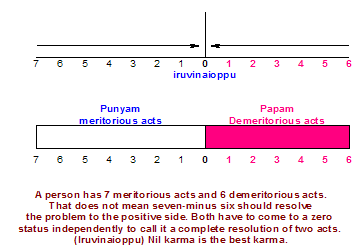
3.34:
Desire and dislike reside in senses and sense objects. Men should not
come under their influence for these two are obstructionists (to
self-realization).
Rāga and
Dvesau: Desire and dislike, attachment and aversion. Vasam: dominion, control,
influence, power. Paripanthinau: Antagonist, obstructionist, adversary, enemy,
the one who blocks the way.
Attachment
and aversion are the twin evils, which rob a person of his freedom and judgment.
Buddhi should curb Ahamkāra, destroy the I-ness in us, and promote sattvic
character: A sattvic has no likes or dislikes, or attachment or aversion.
3.35:
It is preferable to do one's own duty, however deficient it is, than to
do the duty of another, however skillful it is. Better is death in performing
one’s own duty than to perform the duty of another,
for it is inductive of fear. .
Sreyas:
preferable. Sva + dharma: one’s own + duty. Viguna: deficient, lacking in merit.
All duties
or jobs are of equal importance; that is the only way a family, a community, a
society, a country and the world can function in an ideal way; everybody
follows his or her duty, all pull together or everyone falls. A ditch-digger is
better off doing his job however imperfect it is, than to write a software
program. A software programmer should not try digging a ditch. “Don't condescend
to unskilled labor. Try it for a half a day first” Brooks Atkinson.
“Everyman's task is his life-preserver.” Don't look down on a bloodworm digger
in the shallow mud of the tidal flats of Maine or look up to an astronomer; both
have a function to perform; both have endurance --one is looking down; the
other is looking up. According to a bloodworm digger, it takes "incredible
endurance to keep your butt to the wind and your hoe in the mud when your back
is killing you." The astronomer tells you of numb butt, a stiff back and a wry
neck, when he tries hard to shortcut through a wormhole with one neck and two
mouths. Let me give you a humorous quote: “Wurruk is wurruk if you are paid to
do it an' it's pleasure if ye pay to be allowed to do it.” It is not the nature
of the work that matters, but the dedication, the enthusiasm and the spirit that
go into the work. As for Arjuna, his inherent, God-given duty as a Ksatrya is to
engage and destroy the enemy in battle: His duty is not that of a Sannyasi, a
recluse or a muni.
3.36: Arjuna said:
O Vārsneya,
what impels a man to commit a sin against his free will, as if he is forced into
it (someone forced him into it)?
Ni-yojita:
impelled, urged. An-iccha: undesirous, unwilling, averse, against one’s free
will or desire. Pra-yukta: urged, ordered, forced.
Arjuna
wonders aloud about what impels a man to commit a sin. He thinks killing his
friends, relatives, teachers and gurus in this battle as sin, and wonders about
the force behind this pāpam (sin). He feels that an unseen force draws him to
sin. Could this be the result of prakriti and its gunas?
3.37:
Sri Bhagavan said:
This is
desire; this is anger, born of the mode of
Rajas (passion),
all devouring and greatly sinful. Know this as the enemy here (on
earth).
Mahāsanah:
gluttonous, all devouring
Anger and passion seem to be the guiding principle in certain people, out to destroy the world. Here is what Ramakrishna Paramahamsa (1836-1886 CE) says in the book, Sayings of Ramakrishna.
Page 122, Saying 426. On being asked when the enemies of man, such as lust, anger etc., will be vanquished, the Master replied:
"So long as these passions are directed towards the world and its objects, they behave like enemies. But when they are directed towards God, they become the best friends of man, for then they lead him unto God. The lust for the things of the world must be changed into the hankering for God, the anger that man feels in relation to his fellow man should be turned towards God for not revealing Himself to him. One should deal with all the passions in the same manner. These passions cannot be eradicated but can be educated."
Ramakrishna was predictive of the world as it exists today.
Right Attitude To Religious Differences, page 135
480. Let a man be a Christian in the matter of mercy, a Moslem in the matter of strict observance of external forms, and a Hindu in the matter of universal charity, charity towards all living creatures.
481. When you go out and mix with people, you should have love for them all; mix with them freely and become one with them. You should not shrug your shoulders and hate them, saying, "They believe in a Personal God, and not in the Impersonal," or "They believe in the Impersonal and not in the Personal," or "They are Christians, Hindus, or Mussalmans." Man understands of Him only as much as He makes him understand.
Moreover knowing that men are of different tendencies, you should mix with them as much as you can. And you should love all. Then returning to your own 'home' (heart) you will enjoy bliss and peace. There you will meet your own real self.
482. Every man should follow his own religion. A Christian should follow Christianity, and a Mohammedan Mohammedanism. For the Hindu, the ancient path, the path of the Aryan Rishis, is the best.
483. A truly religious man should think that other religions are also so many paths leading to the Truth. One should always maintain an attitude of respect towards other religions.
484. Dispute not. As you rest firmly on your own faith and opinion, allow others also equal liberty to stand by their own faith and opinion. By mere disputation you will never succeed in convincing another of his error. When the grace of God descends, every man will understand his own mistakes.
485. One day the Master was heard talking to the Mother of the universe, in a God-intoxicated state "Mother, everyone says, 'My watch keeps correct time.' The Chris-
Page 136, Sayings of Sri Ramakrishna
tians, the Hindus, the Mohammedans, all say, 'My religion is the true religion'. But Mother, nobody's watch is exact. Who can truly know Thee? But again, if one seeks Thee with a yearning heart, one can reach Thee by Thy grace through any path, through any religion."
486. Some ardent moralists among the Master's disciples often found fault with certain people of great spiritual attainments, because some of the practices they followed were the secret rites of the Saktas and Vaishnavas which seemed to violate ordinary rules of morality. To them the Master used to say: "They are not to be blamed. For they have the thorough conviction that the paths they follow lead by themselves to God-realisation. Whatever is ardently believed in and adopted as a means to God-realisation should not be found fault with. No aspirant's attitude should be condemned, since any attitude, if sincerely followed, is sure to lead to God, who is the consummation of all attitudes. Go on calling upon Him, each in your own way, and don't find fault with another's path nor take to it for your own". End of 'Sayings of Ramakrishna'.
3.38: As the smoke envelops the fire, as the dust covers the mirror, as the womb covers the fetus, so that obscures This.
That is passion and
This is Wisdom.
VAyu Purana talks about ancient embryology in the following manner (part II, chapter35.48-57--Published by Motilal Banarsidass). Fetus develops from Semen, which gets warmed by the heat of the womb. Semen is the nature of Soma (Moon) and the menstrual blood is of the nature of fire. (It is to be understood that menstrual blood is identified with the ovum that emerges out of the ovary.) When the Lunar Semen and the fiery menstrual blood (ovum) come together, the fetus is formed. At first the fetus looks like a patch of cloud. Vayu (Air) enters the fetus and becomes one with the soul. It is the Air that develops the fetus (growth). The Air divides into five airs: Prana1 that moves around (in the blood) and develops the soul; Apana2 that remains in the lower half of the body; Udana2 that circulates in the upper half of the body;Vyana4 that pervades the body; Samana5 that remains in the joints. After these Airs, other elements enter the fetus: Earth, Wind, Ether, Water. and Fire. (Earth provides the minerals; Water is essential for life sustenance; Ether is the pervasive space in the body like the sinus cavities etc; Fire is the heat in the body. Then the fetus acquires the sense-organs. Now the fetus is said to have the earthly body. The wind is known as PranAtman, the Vital Air. Ether accounts for all the pores in the body. The element water exudes or transudes via the pores. The fire element (light) enters the eye in the form of moonlight. Vishnu is responsible for the formation of the fetus in all its aspects.
3.39:
O Kaunteya, this eternal enemy in the form of desire, the all-consuming
fire, obscures the wisdom of the knower.
Desire is
an eternal enemy that obscures wisdom like the all-consuming fire.
For desire,
there is no such limit as enough is enough; it is like fire; the more you feed
it with fuel the more it grows, and the more it grows the more fuel it needs.
3.40:
The senses, the mind,
and the buddhi (intelligence) are the seat of this
desire. This covering of the Jnānam (wisdom) by desire deludes the embodied
soul.
The senses, the mind, and the Buddhi are the seat of desire. Wisdom obscured by desire confuses the embodied soul. The senses, the mind, and the Buddhi are products of matter (Prakrti), subject to manipulation. Jnāna is wisdom. It is to know that “self” is different from “non-self;” the knowledge of the self is that which we learn from scriptures and gurus; and it is “knowing” that god exists.
Buddhi is Antah-Karana, the inner organ, which holds the determinant role (adhyasvasayatmika buddhi). External or mental action, senses, Ahamkara (action drawing MY attention), (perception by) mind, and Buddhi colored by Sattva, Rajas and Tamas --white, red, and black form the basis for any action or reaction. Of all these entities, Buddhi is pervasive and thinking and is the seat of memory, and repository of Samskaras (impressions). Buddhi projects itself in Ahamkara, Manas (mind) and Indriyas (efferent pathways or instruments). Buddhi, Ahamkara, mind, and senses form the proper channel for actions, Buddhi being the determining element and answerable only to Purusa or Consciousness. Buddhi, the charioteer; Manas, the reins; Senses, the horses; Jiva, the enjoyer; and Atma, the occupant of the chariot, forming one unit, can take you to liberation by virtuous deeds or to samsara, a cycle of births and rebirths, by karmic deeds. In man, Buddhi is Sattvic, Ahamkara is Rajasic and the Mind and Senses are Tamsic; in Yogi, Buddhi, Ahamkara, Manas and Indriyas are Sattvic, so they attain liberation easily. Buddhi can be Rajasic or Tamasic in warlike or ignorant people.
Adhyavasaaya = mental effort, apprehension.
This verse has four entities: Senses, mind, Buddhi and Jnanam (spiritual wisdom).
Wisdom, the Wise (Jnani), senses and the House of Soot:
Sayings of Ramakrishna Paramahamsa. Saying 237, page 81 modified for brevity.
There two kinds of Jnanis: one who lives in the world and one who renounced it. Their Jnanam is the same. The Jnani of the world may take a fall from being in the midst of sensual attractions. If you live in the House of Soot (world of senses) you are sure to get a little tainted by the soot, however careful you may be.
3.41: Therefore O Bharatarsabha (best of Bharatas), you should at the outset subdue the senses and the desire which being the sinner, destroy knowledge (jnāna) and wisdom (vijnānam).
Here Jnāna
is mundane knowledge, and contains a little spiritual wisdom; Vijnānam or wisdom
has a specific reference to experiential knowledge of God. Jnāna is to know that
God exists and Vijnāna is directly experiencing god. Sri Ramakrishna Paramahamsa
asked a rhetorical question in the presence of his devotees, “What is Vijnāna?”
He answered that it is to know God in a special way. He added that knowing there
is fire in the wood is Jnāna or knowledge, and cooking rice on that fire,
eating, and getting nourishment from the cooked rice is Vijnāna. To know by
inner experience that God exists is Jnāna, but to “talk to him, to enjoy Him as
a Child, as a Friend, as a Master, as the Universe, and all living beings is
Vijnāna.” (Ramakrishna Paramahamsa.)
Swami Vivekananda told a story on Jnāna. Once upon
a time, a flock of sheep adopted a lion cub. The cub was eating grass; he was
growing, and bleating like a sheep. One day a lion on the prowl saw the lion cub
grazing on grass and bleating like a sheep. The lion waited until the cub went
to sleep. Gingerly, the lion woke up the cub and asked him what he was doing
with the sheep. He rebuked him saying that he was a lion cub. The sheep-lion
said, “No I am not a lion. I am a sheep.” The visiting lion took the sheep-lion
to the lake and asked him to see his face in the water-mirror. The sheep-lion
could not believe his eyes and bleated out saying that he looked like the
visiting lion. The visiting lion roared and asked the cub to roar like him. He
tried and tried but could not roar. He bleated. After a few bleats, the
sheep-lion roared. He is not a sheep anymore. He is a lion. He arrived at Jnāna.
Jnāna is to know that you are the soul and not the body. Logic and reason is a
preliminary tool for explanation of material knowledge, but an impediment and an
imperfect instrument for insight into the spiritual knowledge.

Swami Vivekanada
Jnāna is
to know that God exists by one's inner experience; Vijnāna is to communicate and
interact with God as a slave, a servant, a child, a friend, a spouse, a devotee.
Radhakrishnan says: according to Gita, there is no purifier like Jnāna. This
Jnāna is NOT DIALECTIC learning, which Upanishads dismissed as mere words in the
famous dialogue in the Upanishads between Narada, the representative of
encyclopedic learning, and Sanatkumara, the TRUE KNOWER OF SELF. Note:
Sanatkumara features in Brahmavaivarata Purana. He was a celestial sage.
See Supplement ChitraRadha's Curse.
3.42:
(It is said that) the senses are great, greater than the senses is the
mind, greater than the mind is the Buddhi and greater than the Buddhi is THAT.
That: Atma,
Soul.
Here is a depiction of the evolutionary transformation of man from a sensual entity to a realized soul. If one looks at Kundalini yoga with a psychological perspective, the following is obvious. As the Kundalini power rises from the base of the spine to the crown, the man becomes more and more evolved and subtler until he reaches Sahasrara, a true yogic experience, Oneness with Brahman. There are seven levels* or planes; I give the anatomical locations of these levels or planes to prove a point. The planes are in an ascending order: Anal, Genital, Navel, Heart, Throat, Glabella, and Crown (Muladhara, Svadhisthana, Manipura, Anahata, Visuddha, Ajna and Sahasrara. In psychological terms, man climbs from one plane to the next to become a yogi or settles down on a plane he is most comfortable with. The Anal man, the Genital man, the Emotional man, the Thinking man, the Sattvic man, the Intuitional man and the Yogi are the seven stages of man. The Intuitional man is not only sattvic but has intuitive intelligence. Intuitive intelligence is not mere knowledge received from books; not only he gains knowledge from the religious texts, teachers and gurus, but also he has the realized knowledge (not dialectical) of a near-yogi. He received Jnānam (knowledge or realization of Atman) and he is getting ready for Vijnānam: an experiential realization of God. The Anal man (Muladhara Chakra) is infantile in his life style. He is plain alimentation and excretion. The Genital man (Svadhistana Cakra) is one step above the Anal man and is procreative and recreational in his pursuits. The Navel Man (Manipura Chakra) is one step higher and is an emotional man. The Rajas is dominant in his behavior. Jung says, "You are just bones and blood and muscles; you are in the intestines; you are functioning there like a worm with no head." Jung described "Manipura as the center of corporeal men, carnivores... the world of mere emotions."
Talking about Heart man at Anahata Center, Jung says, "Yes, you begin to reason, to think, to reflect about things, and so it is the beginning of a sort of contraction or withdrawal from mere emotional function. ...Why I am behaving like this? (The Psychology of Kundalini Yoga, page 38-39.)
Mr. Jung is quite correct in saying that Muladhara is the life of animals and primitives who live in complete harmony with nature. In consciousness we are in Ajna, and yet we actually live in Muladhara. That is Sthula aspect--IBID, Page 64.
The Heart man (Anahata Chakra) is in the transitional zone. The Throat man (Visuddha Chakra) has given up the Rajasic behavior and has become sattvic. He is cerebral and intelligent, and his Buddhi has the ability to filter out the Tamasic and the Rajasic gunas. He is beginning to see there is more to life than going to work, making a living, and raising a family. He realizes there is something greater than he is and begins to immerse himself in religious studies; he is on a path to find peace, freedom, and happiness from within. The Glabella man (Ajna Chakra) and the Crown man (Saharara Chakra) are the realized souls. The Glabella man (Bhru-madya, the spot between the eyebrows) goes in and out of samādhi and enjoys it. He is on his way to becoming one with Brahman, and enjoying samādhi is incidental but his primary aim is to become one with Brahman.
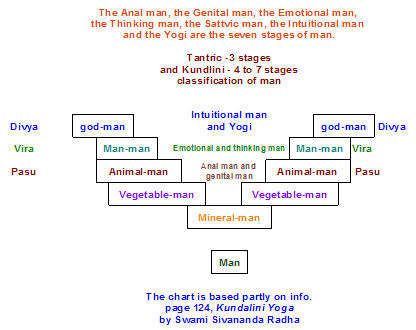
Seven levels*: In Kundalini Yoga, the Yogi ascends from Muladhara Chakra through Svadhisthana, Manipura, Anahata, Visuddhi, and Ajna Chakras to reach Sahasrara plane. The moral qualities (Vrtti) in lower two chakras are not desirable by any standards. Anahata Center shows a mix of lower and higher qualities, a transitional zone from animal to human dimension, as the jiva takes interest in higher principles. From Visuddhi to Sahasrara plane, man makes a transition from human to Yogi to absorption into Higher Consciousness. Further evolution of the soul takes the Yogi to higher circles (Mandalas). Go to Kundalini Power for more details.
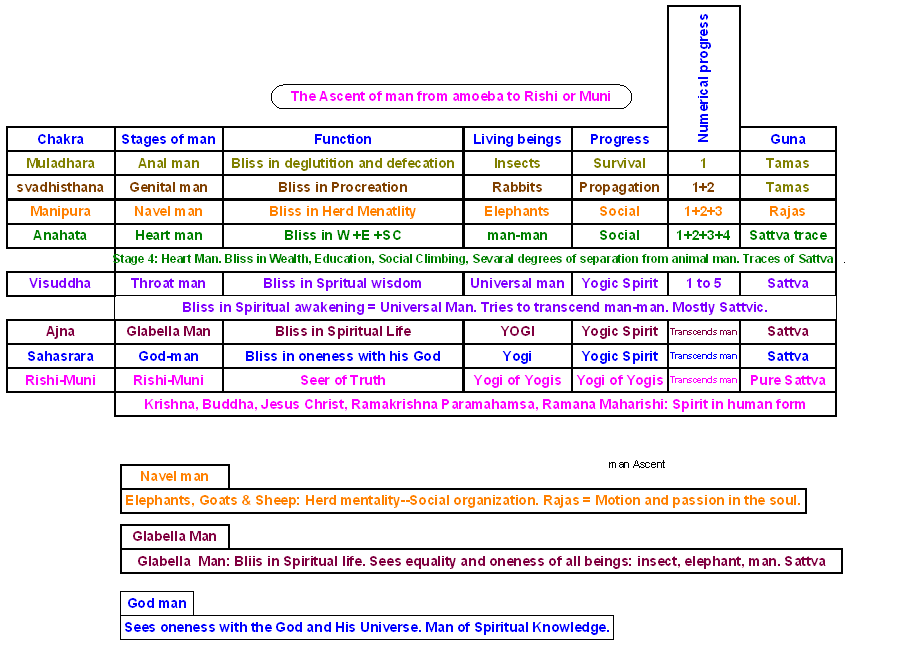
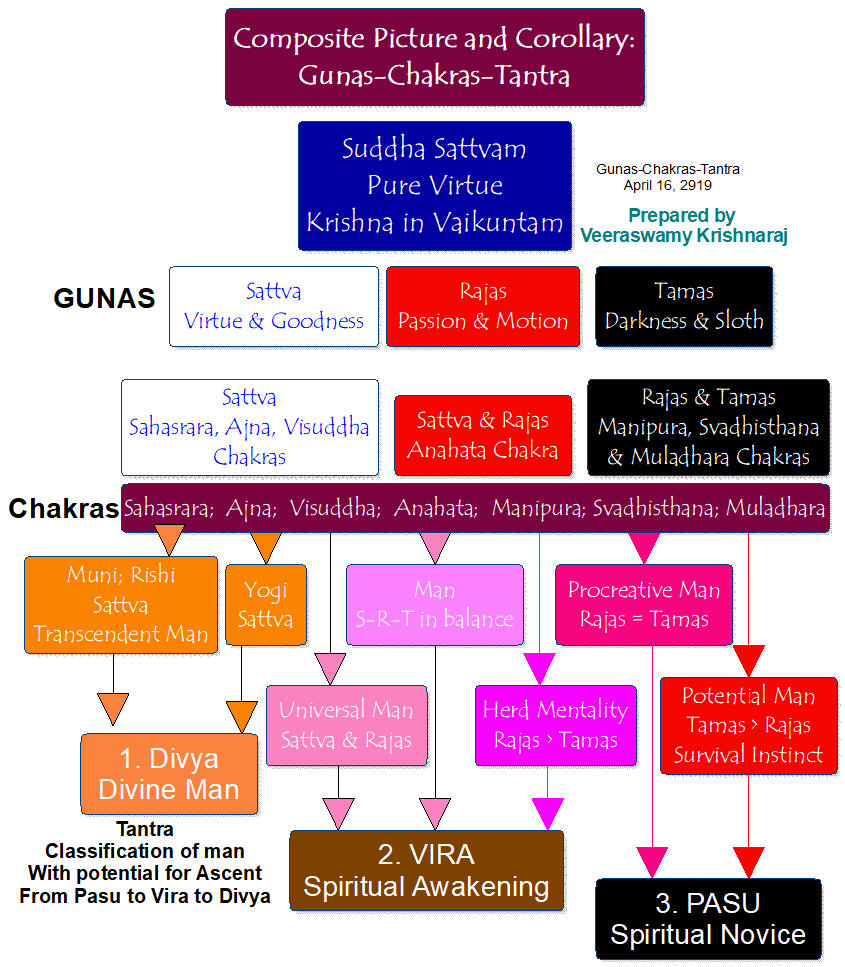
The ascent of man
1. The anal man = Bliss in deglutition and defecation = insects ---1. survival. Tamas = darkness of soul.
2. The genital man = Bliss in procreation = rabbits ---1+ propagation; venereal delights. Tamas = darkness of soul.
3. The navel man = Bliss in herd mentality = elephants, goats, sheep---1+2+ social organization and herd mentality. Rajas = motion and passion in the soul.
4. The heart man = Bliss in wealth, education, social climbing = man-man---1+2+3+social climbing. Several degrees of separation from animal. Traces of Sattva = virtue, goodness.
4. The throat man = Bliss in awakening of spiritual wisdom = universal man--tries to transcend man-man. mostly Sattvic.
5. The glabella man = Bliss in spiritual life = universe-man; Yogi -- sees equality of all beings: oneness in insect, elephant, man. Man of Sattva.
6. The god-man = Bliss in oneness with his maker (god)--Yogi--sees oneness with God and His universe. Man of spiritual knowledge.
7. Rishi, Muni = the Seer of Truth ---Buddha, Jesus Christ, Ramakrishna Paramahamsa, Ramana Maharishi. The Spirit in human form.
3.43: O mighty-armed Arjuna, knowing the Self is superior to Buddhi, having established control over the mind, strike the enemy, who is of the form of desire which is difficult to conquer.
| There are two selves in us: the individual self
and the Universal Self. November 15, 2013 Bhagavadgita by Dr. Radhakrishnan page 189. ■ Cp, Dhammapada: "The Self is the lord of the self;"1 "the Self is the goal of the self.2 The Supreme is within us. It is the consciousness underlying the ordinary individualized consciousness of every-day life but incommensurable with it. The two are different in kind, though the Supreme is realizable by one who is prepared to lose his life in order to save it. For the most part we are unaware of the Self in us because our attention is engaged by objects which we like or dislike. We must get away from them, to become aware of the Divine in us. If we do not realize the pointlessness, the irrelevance, and the squalor of our ordinary life, the true Self becomes the enemy of our ordinary life. The Universal Self and the personal self are not antagonistic to each other. The Universal Self can be the friend or the foe of the personal self. If we subdue our petty cravings and desires, if we do not exert our selfish will, we become the channel of the Universal Self. If our impulses are under control, and if our personal self offers itself to the Universal Self then the latter becomes our guide and teacher." Every one of us has the freedom to rise or fall and our future is in our own hands. 1attā hi attano nātho. 160. 2 attā hi attano gati. 380.
|
Conquering
the desires, steadying the lower self, and controlling the baser elements and
the body-mind-ego-senses complex by the will of the higher Self, are important
to liberate the self. Jnāna is within his grasp and Vijnāna faculty is dawning
on him. The self-effulgence of the higher Self is the guiding light for the self
in its struggle to go home to its natural bliss state. How do we break Samsāra,
the cycle of births and rebirths? How do we cross this ocean of samsāra? It is
with the cittasuddhi (clean mind and heart) the cycle of samsāra comes to stop.
What you think, is what you are: If the thought of man, that is “fixed
within the realms of senses” is close to Brahman, release from bondage is
a guarantee; if the man feeds on the desires of senses, the samsāra journey
never ends. “I feel like a frog in a waterless well. You know the true nature of
Self. You are our way of escape; Oh yes, you are our way of escape”
Upanishad.
Remaining fixed within the realms of senses means that you speak, see, hear, taste, and feel Brahman in all things around you. Vaishnavas feel that this universe is the body of Brahman and thus He, She and It are all Brahman. If any one of this triad is damaged, it is damage caused to Brahman and it is damage caused to you, because Brahman is the hypostasis of He, She and It.
End of
Third chapter, Karmayoga