

|
Bhagavad-Gita: 18 Chapters in Sanskrit |
| Download Bhagavadgita-all 18 chapters in Sanskrit, English, |
| transliteration and word for word translation. |
Bhagavadgita in English
| bg07-Sanskrit | bg10-Sanskrit | bg11-Sanskrit | bg12-Sanskrit | ||
| bg13-Sanskrit | bg14-Sanskrit | bg15-Sanskrit | bg16-Sanskrit | bg17-Sanskrit | |
https://myindiastories.com
www.bhagavadgitausa.com
Veeraswamy Krishnaraj: Tolerance with love is to speak in tongues of all faiths, hold in the heart the Truth of all faiths and see
all faiths in the face of humanity.
You have your Google search engine tailored for this site.
Please enter the word(s) in the search box; it will take you to the file with that word in this web site. Enjoy your visit here.
Veeraswamy Krishnaraj. Contact: Feedback Form
About the author:
Veeraswamy Krishnaraj, M.D; F.R.C.P (Canada) is a board certified pediatrician in active practice until the end of 1998. He immersed himself in study of Hinduism in depth. He has sufficient knowledge and understanding of Hindu religion that he is confident to publish this book. He kept the words simple, supple, illuminating and to the point, while retaining the original flavor, beauty and grace. Compound words in Sanskrit are a nightmare for the beginner, as they are spliced together compactly in one continuous stretch of characters. He parsed the compound words into digestible syllables or words with superscripts and sequential numbers and rearranged the words in the verse in a readable form in English. In this book, he claims ownership of shortcomings and cedes the rest to Bhagavan.
This book is good for students, and devotees reading the Bhagavad-Gita in Satsang (true company). Two verses nestle in two boxes in one page with no break or carry-over to the next page. Diacritics help the reader enunciate the words like a Sanskritist. The English words are reader-friendly. Wherever there is a need for elaboration, an addendum supports it.
Simplicity, authority, universality, and profundity are the hallmark of the Bhagavadgita, the Bible of the Hindus. The Bhagavadgita is the Song of the Lord. It provides guidelines for daily living with no dogmas and ritual overtones. It encourages and supports your individuality. It also explains the consequence of errant ways. Total surrender to Bhagavan releases the devotee from the ills of life on earth. Hinduism as a term is an external appellation from non-Hindus. Its true name is Sanatana Dharma (Eternal Law or Eternal Order) commensurate with Rta (Cosmic Order). The beauty about the Bhagavadgita is its appeal is universal.
09/21/2017
BG Chapter 12 Bhakti
|
The Complete Works of Swami
Vivekananda Volume 6 [ Page : 112 ] NOTES TAKEN DOWN IN
MADRAS, 1892-93. Bhakti [devotion] is divided into Vaidhi and Raganuga Bhakti. Vaidhi Bhakti is implicit belief in obedience to the teachings of the Vedas. Raganuga Bhakti is of five kinds: (1) Shanta [peace] as illustrated by the religion of Christ; (2) Dasya [servitude] as illustrated by that of Hanuman to Rama; (3) Sakhya [friend] as illustrated by that of Arjuna to Shri Krishna; (4) Vatsalya [paternal] as illustrated by that of Vasudeva to Shri Krishna; (5) Madhura [love] (that of the husband and wife) in the lives of Shri Krishna and the Gopikas. ------------------------------------------------------------------------------------------------------------------------- Sri U. Ve Velukkudi Krishnan Swamy 1. Technically bhakti yoga - ego is not saranagati (Surrender/servitude to God) as both are different paths with different rules. For a bhakti yogi, bhakti (devotion) is the means for moksham (liberation) but for a saranagata (Surrenderer, Servitor to God), Bhagavan Himself is the means. However you can say that when a person who wanted to practice bhakti yoga realizes his nature of absolute servitude and sheds his ego, he would switch to saranagati. 2. One is not said to have performed saranagati if he has not realized his true nature which is śeṣatvam (dependency/state of servitude to God) and pāratantryam (obedience to the Lord). So knowledge is imperative for saranagati. This is all the more important as saranagati is a state of mind. 3. The word 'conquering Krṣḥṇa' would be used by a bhakta and the word 'pleasing Krṣḥṇa' would be used by a saranagata. Saranagata is a devout servant till his last breath. 4. all the rules in bhakti yoga are obligatory to attain moksham but they are voluntary for a saranagata. So it does not matter even if done short of perfection. 5. Sri Ramanuja advised us to realize seshatvam and paratantryam and perform saranagati. Only realized souls perform saranagati. Definitions below by S.M.S. Chari śeṣa = One who exists for the purpose of god; the God-dependent. śeṣin = One who utilizes the śeṣa for His purpose; The Lord |
Introduction
Bhakti: devotion to a personal god. The path is Bhakti Marga. Krishna advocates Bhakti Marga for all. Other paths are Karma Marga and Jnana Marga. The purpose of all Margas is liberation of the soul and its reunion with its Source, The Absolute or the Universal Soul. Once reunion takes place, the soul does not take birth on earth appearing in the body of a human, animal, plant and other living things. The slate of karma is wiped clean; the soul involutes into Brahman. Liberation by Karma and Jnana (work and knowledge) are more difficult paths and are not suitable for everybody. Work (Karma Yoga) in Brahmanical term means practice of religious duties according to the prescriptive injunctions of the Sastras (Karma Khanda). Tantrics practice this kind of UpAsana (worship). As you see, this is a 24-7 ritual, which is difficult to accomplish by ordinary devotees. Karma (work) has its roots in Dharma, the personal ethical and religious law. When Karma Marga becomes more refined, the practitioner (Sadhaka) may give up the Karma Marga and follow the more difficult path, Jnana Marga. Jnana Marga is for the Yogis who have yoked their body, mind and soul to Brahman. That is a perfect union of man and god, though Vaishnavas do not recommend Jnana Yoga. All cannot be Yogis. Performing breath control and postures is not Yoga; that is easy. The proper Yogi has to follow the eight-limbed ramifications to its perfection. Go to the following files for details. BG06 TMTM03.
Lord Krishna says, 6.36: In my opinion, Yoga is
difficult to attain, if the mind is unrestrained. But by control of the mind,
and endeavor through proper means, it is attainable.
(Once a Pundit asked Ramakrishna Parmahamsa about Mahatmas, Astral, Devayanic, solar, lunar planes of existence for the subtle body. The Master replied that all these spheres and planes are trivial and one should develop, practice and intensify one's Bhakti, pray to Him with intense devotion and practice Sadhanas.) -- adapted from Sayings of Sri Ramakrishna page 25.
Bhagavatam 12.13.16 says Vishnu is foremost among gods and Siva foremost among devotees of Vishnu.
Here is the view of ThAkura, whose teaching centers around Suddha Bhakti (Pure Devotion); all else, to him, is Viddha Bhakti (polluted, pierced, afflicted devotion).
Devotion has five stages: Nishtha (intent), Bhakti (devotion), Bhava (Becoming, feeling, existence), Mahabhava (Great feeling to or Love of God), and Prema (Intense Love).
There are four spiritual types among people: Viveki, the thoughtful and just person; Mumuksu, the one who desires liberation, Mukta, the liberated one, and Bhakta, the devotee. The materialistic person is Visayin (the one attached to worldly objects), who finds beneficial association with Vivekis and Mumuksus. This is a less desirable association than the association with Bhaktas of two kinds, Grahasta Bhaktas and Tyagi Bhaktas; Grahasta Bhakta is a householder with a full-fledged family and the Tyagi Bhakta has renounced the householder's life.
Prakrta Bhakta (materialistic devotee) is one who worships Lord Hari with Sraddha (faith) but does not render service to His Bhaktas and other beings.--Bhagavatam 11.2.47. It is important to have a sense of Sambandhajnana, which is knowing the three-way relationship between material world, Jivas and Krishna.
arcayam eva haraye pujam yah sraddhayehate
na tad-bhaktesu canyesu sa bhaktah prakrtah smrtah
Bhagavatam (11.2.47)
A Maya-bound person enjoys worldly objects through Maya-derived senses: eyes for seeing, ears for hearing, nose for smelling, tactile sense for touching, and tongue for tasting; all this has no devotional target. His consciousness and senses are outbound in the world of matter and he is Visayin, the one attached to worldly objects.. If he directs his consciousness and senses inward and towards Krishna, he is a Bhakta (devotee). His senses are directed to Krishna: he loves to see forms of Krishna; he loves to hear Rama nama and Hari Katha (stories of Vishnu); he loves to smell Tulasi leaves; he loves to taste Maha Prasada; with his tongue he loves to taste Krishna nama (names of Krishna); he loves to touch the feet of Krishna Bhaktas and render service to Vishnu and Vaishnavas. True Bhakta is Nirapeksa . (நிரபேட்சை: விருப்பின்மை = absence of attachment or desire. நிரபேட்சம்: absence of attachment or desire. Antonym of Nirapeksa = sApeksa = சாபேட்சை = insatiable desire. Tamil lexicon.) All actions of a Bhakta should be free from the defects and deficiencies of worldly life. A Bhakta is entitled to make a living, though within the precepts of Nirapeksa. Needs have to be met as long as a Bhakta lives: food, medicine, dwelling, clothes.... Keeping the material body alive, well and healthy is expected so as to continue to do service to Krishna. Luxurious living and wants more than necessary to sustain a normal life should be avoided. All activities are centered around service to Krishna.
Nammalvar (880-930 C.E) Vaishnava Saint-poet says the following in verse 2628 of Divyaprabhandam.
Good mind for thought, heart for feeling and tongue for speech, though well-developed, are of no use, if one does not use them for feeling, worshipping and talking about the Lord. Thus time wasted accumulates more Karmas (demerits).
Nirapeksa: நிரபேட்சம், Absence of attachment or desire, unconcernedness, (opp. to விருப்பின்மை. Tamil Lexicon, Madras University.
The following write up is based on Bhagavatam and Jaiva Dharma by ThAkura.
Bhaktas come in three flavors according to the degree of purity of Bhakti: Kanishtha = greenhorn, freshman or neophyte, youngest, novice, Madhyama = middling, (intermediate), and Uttama = greatest, highest, first, uppermost . All these three can be householders and yet realize their goal.
All Bhaktas or BhAgavatAs are expected to be humble and compassionate. Pride that "I am a Brahmana," "I am wealthy..." and such egoistic attitudes have no place in the life of a Vaishnava Bhakta, who should consider himself as "worthless, insignificant, destitute and lower than a blade of grass." -Jaiva Dharma Page 205. Truth, humility, compassion, and forgiveness are integral parts of Vaishnava Bhakti.
Kanishtha Bhaktha is the beginner before he graduates to Madhyama stage. He is at the doorway of Bhakti whose forte is confined to worshipping of the Deity in Vigraha (image form) in the spirit of ordinary faith (Laukika Sraddha). He lacks faith based on Sastra (Sastriya Sraddha). He engages in hearing, reciting and remembering the names of Bhagavan and offering prayers to Him. He does not have Sambandha Jnana: knowledge of quadrilateral interrelationship between world of matter, Isvara, Krishna and Bhakta (Isvara-Cit-Acit-Bhakta). Because of rudimentary status of his Bhakti development, he lacks finesse, does not pay respect, hospitality and friendship to Hari Bhakta, shows no compassion to other living beings in whom the Lord is Antaryamin, Antarvarti, Antaratman and Paramatman. He is regarded as childish and innocent (Balisa) until he graduates to Madhyama Bhakthi. Kanishtha Bhakta’s chanting of Hari Nama is robotic, and shows more habit, more semblance, less Sraddha, less substance and less worthiness; thus clouded by ignorance and desires, there is less brilliance- ChAyA-nAmA-bhAsa = shadow-name-likeness = Shadow-name- likeness of the pure name. In everyday idiom, it is not the real thing, but an imitation. BhAsa also means reflection; It is like the difference between seeing Balaji in person in the temple and seeing him in a picture.
He becomes a Suddha Bhakta in Madhyama level when he gets rid of contaminants such as Karma and Jnana Margas and acquires Ananya Bhakti (exclusive love and devotion to Krishna).
Sastriya Sraddha = reading and hearing Bhagavan's pastimes, knowing Vishistadvaita Vaishnava philosophy and truths.
Bhagavatam (11.2.46) says that Madhyama Bhakta loves Isvara, shows mercy (kripa) to the neophyte, ignores the hate mongers, and serves others with friendship. Madhyama = middle)
Madhyama Bhakta shows compassion and mercy to the novice, ignores the ones with jealousy and hatred for God and serves all others with friendship. Love (Prema) for Krishna is the prime mover of Madhyama Bhakta; compassion, mercy and friendship for others (in whom God exists) are his noteworthy qualities; deliberate ignorance and benign neglect of qualities such as jealousy and hatred in non-believers are his strength. He is friendly to Suddha Bhaktas, submissive to Krishna’s will. He should induce Ananya Bhakti (exclusive devotion to Krishna) in the ignorant. Ignorance here covers faith in Karma Kanda, Jnana Yoga, belief in Varnasrama, negligence of and dissociation from pure Vaishnavas…. Bhakti Marga to the exclusion of other margas (Yoga, Karma and Raja) is the forte of a true Vaishnava. Mayavadi is of the opinion that the Lord has no form or attributes and the icon is a mere image; Kanishtha Bhaktas may fall in to this trap. The Madhyama Bhakta should rescue them from this pitfall. He should pull them before they graduate (deteriorate) to meditation on nameless and formless Para Brahman. Isvara, as against nameless Brahman, is the centerpiece of Vaishnava worship.
Jaiva Dharma talks about four primary attitudes of Madhyama Bhakta towards other Bhaktas: 1. Atma Buddhi, 2. Mamata Buddhi, 3. Ijya Buddhi, 4. Tirtha Buddhi.
1. Atma Buddhi: The Bhaktas are dearer to him than he is to himself.
2. Mamata Buddhi: He is very possessive of Bhaktas.
3. Ijya Buddhi: He feels the Bhaktas are worthy of his worship.
4. Tirtha Buddhi: He feels the Bhaktas are places of pilgrimage. --Jaiva Dharma, page 201-202.
He surrenders his life to the will of Krishna. He is firm in his conviction that whatever happens to him is His will and desire and that he does not have to have an independent desire and aspirations.
Lack of faith in Isvara, belief that Isvara is formless and nameless, conviction that Jivas are not subservient to Isvara and want of mercy come under the inauspicious banner of Dvesa (hatred, enmity) of Mayavadis; these are the very people Vaishnavas should avoid (Upeksha). Upeksha has a special meaning here. When such a person is in distress, a true Vaishnava should provide succor and support and yet should not have any association, arguments, and interaction of spiritual nature with them. Relationship with other Bhaktas is proportional to their Bhakti development; mercy and compassion to all should rule one’s behavior.
When his Sadhana and Bhava (accomplishment, and being and becoming) amount to Prema (love), condense and congeal, the Madhyama Vaishnava becomes Uttama Bhakta.
Uttama Bhakta is the consummate servitor of Bhagavan Krishna, not concerned, not enveloped and not obsessed with knowledge of impersonal Brahman, sees the Supersoul in all objects (matter and embodied souls) and regards BhagAvat (Bhagavan) is the Soul that exists in all beings. Bhagavatam, 11.2.45
Uttama Bhakta loves Krishna to the exclusion of all others and other desires, does not sport the shroud of impersonal knowledge of Para Brahman, does not perform action with expectation of fruits, and exhibits favorable mood to serve Krishna.
A true Vaishnava evokes spontaneous chanting of Hari Nama in a devotee. All his actions proceed from that transcendental love of Bhagavan; he sees no difference between Vaishnavas and others at this stage of his spiritual development.
Among the three categories of Vaishnavas, Kanistha Vaishnava does not serve the Vaishnavas because of his neophyte status and Uttama Vaishnava makes no distinction between a Vaishnava and a non-Vaishnava because all are servants of Krishna. The Uttama BhAgavatA (Bhakta) treats all types of Bhaktas and non-Bhaktas equally. That leaves the Madhyama Vaishnava rendering service to the Vaishnavas of all types, though his service is proportional to the spiritual standing of the recipient.
According to Yoga Sutras, there are personality types, fit for yoga. You heard about personality types like type A and type B. Yogis studied the minds of people and divided them into five types: Kshipta Chitta (Addlehead, Scatterbrain); Mudha Chitta (Muddlehead); Vikshipta Chitta (Rattlehead); Ekāgra Chitta (Laserhead); Niruddha Chitta (good head). Go to BG04 for more details. The epithets used here are for entertainment only and no insult is intended. The Laserhead and the Good Head are suitable for Yoga or Jnana Marga. Remember that Personal Devotion to Bhagavan is superior to Yogas.
Kshipta Chitta = distracted Mind, absent mind. Mudha = useless, to no purpose. Viksipta = scattered, distorted, agitated. EkAgra = one pointed. Niruddha = restrained. For more details go to BG04
The Mind lake
Chitta is the mind (as a lake) where thoughts rise and fall like waves; these waves in the mind lake are called Vrittis. Every time a thought rises it is a thought wave; there are many thought waves rising and falling every minute. Thoughts sometimes translates into actions. When a Yogi restrains the mind he can effectively suppress and abolish these thought waves in the mind lake. The tranquil mind lake without waves is a prerequisite for merging with the Object of meditation. The subject, the object and perception become one, meaning that the tranquil reflecting surface of the mind lake takes the color of object; it is like the crystal taking the color of the juxtaposed object. The Yogi becomes one with One. That is absorption.
Maxim of Wasp and Worm
You (embodied being) are made of your thoughts; what you think, you become: love, fear or hate. The body belongs to that which devours it in life. Time is the great devourer. Time owns our body. Avadhuta says knowing that his body, subject to birth, death, disease and rebirth, does not belong to him, he wanders renouncing all.
A lowly worm is in constant fear of the wasp and thus meditates (thinks of) on the wasp, not knowing when the dreaded fate of wasp sting will become a reality. The worm is so possessed of the image of the wasp, that its consciousness is reposed only in the thought and form of wasp. The worm becomes a wasp in its mind's image. Similarly, an Avadhuta or Yogi is constantly meditating on Brahman, not knowing when The Reality will strike (the blessed event of knowing and transforming himself to Brahman would take place). He thus becomes Brahman himself by dwelling in his mind on Brahman, (when the finality of sting strikes.)
This union (reunion, reintegration, reintegration of the chip into the Old Block, Brahman) is called Laya. Laya = clinging, dissolution, absorption) By laya, the Jiva (individual soul) clings, dissolves and gets reabsorbed into Brahman. Laya and Lysis are cognate words. This Laya are of three types: Bhakti laya, Karma Laya, Jnana Laya. Raja Yoga is the most difficult path. Patanjali is the formulator of Raja Yoga and lived some 2000 years ago. It is the Royal path leading to Laya. He wrote it in Sutras or aphorisms. Remember that Sanskrit Sutra meaning thread and English Suture are cognate words. It deals with Yoga, mental functions, and many gradations of Samadhi (Intense contemplation of an object so as to identify the contemplator with the object meditated upon; simply becoming one with One or That).
Bhakti Yoga is for everyone inclined to devotion to and close relationship with his Ishtadevata. Jnana Yoga is for the one with intellectual bent; Karma Yoga is for the ritualist; Raja yoga is for the disciplined mind with intellectual and scientific bent; Bhakti Yoga is for the devotee who has an emotional approach to God. The devotee assumes the role of a child, a slave, a friend, a spouse in relation to his Ishtadevata. A feminine role towards god is common among devotees. Action generates Karma which is good, bad or neutral. Bhakti Yogis, by their personal devotion, believe that God's grace will erase all Karma and take them into His bosom.
Bhakti seems to have originated in Rg Vedic times. Bhakti movement had taken a detour off the Brahmanical Hinduism. Bhakti Yoga as advocated by Krishna existed before the Bhakti movement in Tamil Nadu . This reactive movement was a response, when Buddhism and Jainism in South India were perceived as an alien metastatic growth in the cultural milieu of Tamil Country. They had to be excised and ousted somehow: that was the view of Nayanars and Alvars, the proponents and practitioners of Bhakti movement. Tamil Bhakti movement follows the Great Tradition of Bhakti advocated by Krishna to Arjuna; Alvars became the strong inveterate practicing Bhaktas.
|
Definition of Jnana, Bhakti and Karma: From Sayings of Sri Ramakrishna, page 196 JNANA, BHAKTI AND KARMA These Sanskrit words may roughly be translated into English as Knowledge, Love and Work; and Yogas are spiritual disciplines connected with them. So there are the path of Knowledge, the path of Love and the path of Work. But these terms mean more than their English equivalents. Thus Knowledge is not a mere intellectual affair but spiritual insight affecting the whole man: Love is not worldly love, but a kindred feeling in relation to God; and Work is not mere action, but spiritualised pursuit of duties and altruistic undertakings. So, in this book, wherever these words occur without any qualifying words to point out some special meaning, we have used capitals for them to suggest their technical sense. |
|
Sri U. Ve Velukkudi Krishnan Swamy Bhakti and saranagati are two means (= upaya = sadhana) to attain mukti. Bakti is accomplishment by our efforts. In saranagati, Bhagavan Himself is the upaya. We accept Him as our upaya. Now coming to the concept of antima smriti - this is remembering / meditating bhagavan during the last moments in the death bed in order to reach His lotus feet. This is mandatory for a bhakti yogi but not for a saranagata. In the case of saranagata the responsibility of remembering is on Bhagavan . He remembers His saranagata and escorts the jiva to Srivaikuntham. This is as per the 4th phrase of Sri Devaperumal to Sri Ramanuja ' antima smriti varjanam' and varaha carama sloka. Bhakti = Devotion; mukti = liberation = Vaikuntam = Vaishnava heaven; Saranagati = Surrender; Upaya = means; Antima = here it means 'time of death'. Smiriti = remembrance; antima smriti = remembering the Lord at the time of death; Saranagata =the one who surrendered to Bhagavan Krishna. |
12.1: Arjuna said:
Those devotees who are absorbed in You, and those who worship You as the
Aksaram (Imperishable) and the Avyaktam (Unmanifested): who among these have
the most knowledge of yoga?
Aksaram: Imperishable, Avyaktam:
Unmanifested. The devotees worship the Supreme in three modes: The
Imperishable, the Unmanifest, and the Personal God. The Imperishable Aksaram
consists of three parts: the Lower, the Higher, and the Higher than the
Higher. The lifeless Prakrti is the lower Aksara. The Vishnu-dependent Aksara
is Higher Prakrti or Aksara. This Higher Prakrti or Aksara is associated with
Sri. Hari or Vishnu Himself is Higher than Higher and therefore perfect in all
excellences or attributes. This Higher than the Higher Aksara or the
Imperishable is the same as Brahman. All other gods who do not meet the
highest standards of excellences and attributes are Non-Brahman. Therefore,
Brahman is One, only ONE, second to none, or One without a second. No (more)
excellences can be appended to Brahman. This Imperishable can neither be
sought nor avoided, because it is everywhere. According to Sankara, Brahman is
space and the transmigrating selves are like the jars. It is false knowledge
to say that the jar spaces are different from the unlimited space outside the
jars. The Unmanifest or Avyakta springs from the Imperishable; Hiranyagarbha,
the primordial golden egg comes from the Unmanifest or Avyakta; and the whole
world projects from Hiranyagarbha.
In Vedanta, Ākāsa (ether), Aksaram, and māyā are used interchangeably.
Pluripotential Ākāsa is undeveloped and imperishable principle from which all
beings and the variegated universe project. Ākāsa is the basic material and
stem substance of the sentient and the insentient. We are made of stardust;
that stardust originates from Ākāsa. Prāna is the power that breathes life
into beings or acts as the immutable laws of nature (Rta), such as magnetism,
gravity, and other natural phenomena. This prāna is not mere breath. The
beings and the universe project from and involute in Ākāsa on dissolution.
How could that be possible that Ākāsa
is the pluripotential stem substance of this sentient and insentient universe?
The following example supports the idea: There is a pluripotential stem cell
in the bone marrow and the umbilical cord blood; this stem cell has the
ability of transforming itself into any cell in the universe of human
body. According to Sruti, Akāsa contains the earth and the heaven; Brahman
contains Akāsa; Ākāsa is behind the names and forms, meaning that it is the
cause or origin or the stem substance.
Ākāsa is the matter and
Prāna is the power; both are under the control of Isvara.
Prāna is energy: Prāna energizes
transformation of Ākāsa from a primordial pluripotential stem element to a
substance in this world of evolution;
Prāna
is breath and more; Prāna
encompasses all energies discovered and yet undiscovered. It is thought, it is
motion, it is gravity, it is lightning, it is energy in the atom, it is the
motion in the atoms, and it is the juice in everything. Any discovered or
undiscovered energy in our body or universe is prāna; call it by any
name―respiration, nerve conduction, thought, gravity, magnetism and other
natural phenomena.
What
has bliss anything to do with sleep? What is absorption of the self into Self?
For Sustenance, every Jivātman or
the lower self needs communion with the Higher Self. Without that daily dose
of sustenance, we are as bad as dead. Deep sleep facilitates sustenance by
this union. It is as if the lesser self goes to the Higher Self for its daily
dose of sustenance or recharging and boosting of its batteries. It is like
being plugged into the grid every night. In deep sleep, as it were, we do not
exist in physical terms; our body does not exist, as it were. We (our souls)
know our identity. We are not the body, the mind and the senses, but the self.
The lower self and the Higher Self commune in the spiritual heart and the
former basks in the Bliss of the Higher Self: Yes, we are all Yogis during
deep sleep because we are pure, stainless, sinless, and free from dualities.
According to Paingala Upanishad, we (our souls) enter our own nature (during
deep sleep). According to Chāndogya Upanishad, we enter the Brahma world
(Brahman) during deep sleep. In deep sleep, all of us enjoy union with the
Brahman of the Spiritual Heart. After all, we are each a fragment of the
Higher Self (Brahman) and go Home to our Maker; this nightly bliss is for the
ordinary beings for their sustenance. If one becomes a perfected Yogi, that
Yogi can enjoy that Bliss any time, any place.
That is Turiya, Eternal Bliss, or wakeful sleep.
Prasna Upanishad states the following: As the birds need a tree for rest, they
all (we) find rest in the Supreme Self. In deep sleep, the soul becomes one
with Brahman. We do not seem to know it.
The Highest Self is Brahman; He is Pure
Consciousness; He is not burdened with or governed by three lesser states of
consciousness as in human beings; He is full of Bliss (Sat-Cit-Andanda =
Being-Bliss-Consciousness). This lower self has four
quarters. The lower self takes us from the outer world to the inner
world (from the waking state via
dream sleep to deep sleep,
and then to Turiya) so we meet the greater Self
for attaining Bliss. This journey of the self is similar to the ontological
journey of Brahman from the Unmanifest to the
manifest through various stages in a reverse order. It appears in this scheme
that the lower self at the end of its journey meets the Greater Self at “Point
Bliss.”
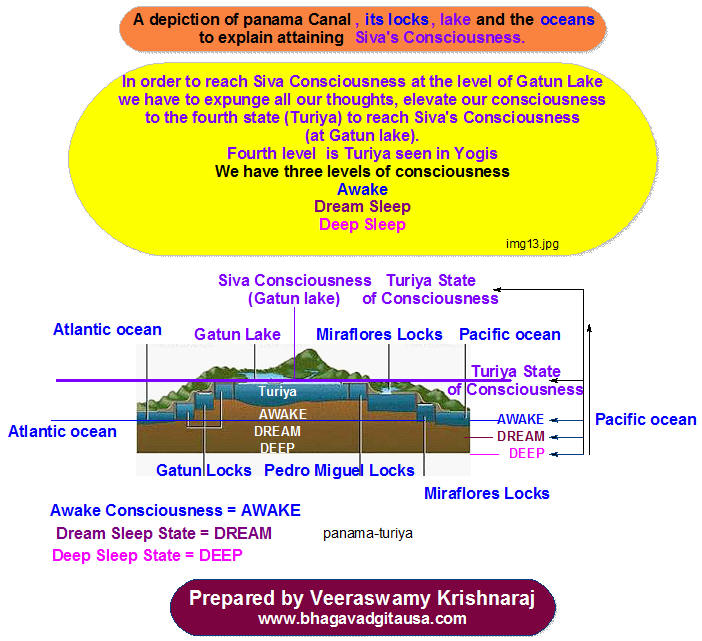
Since we are embodied souls, we are endowed with three states of consciousness; the Higher Consciousness, Turiya, is a state realizable only by Yogis . These three states attest to the dualistic world, while Turiya attests to monistic world. The soul sprang from a monistic source and took its birth in a bodily form in the dualistic world. Turiya restores that monism that we sprang from.
New Eponyms for Brahman; X and Y Chromosomes.
Macrobrahman, Mayabrahman, and Avidyabrahman or microbrahman: Transcendent Brahman without attributes is Pure Consciousness and therefore is Macrobrahman. Isvara is Mayabrahman or Macrobrahman with Maya. Human beings with a load of Avidya (ignorance) are microbrahmans or Avidyabrahmans. These eponyms are coined by me for easy identification of three levels of Brahman. Macrobrahman is Parabrahman or Supreme Brahman. Aparabrahman (Sabdabrahman) is Siva and Sakti ensconced in a sheath of Maya. Aparabrahman state is Parang-Bindu (complementary halves of seed, two halves or cotyledons wrapped in a tight skin or sheath). Polarization of Siva and Sakti takes place within the sheath; this is like the polarization of the Y and the X chromosome in Meiosis with the resultant Y and X gametes. This polarization of Siva and Sakti is Parasaktimaya; Sakti (Unmuki) turns toward Siva for a longing glance from Siva. When the Maya sheath explodes with the sound of Ham and Sa ( Hamsa Mantra), Sakti undergoes reduction division: Bindu, Bija and Nada. Bindu and Nada are the progenitors of universe. Bija is the mystic syllable of Mantra. BINDU
Brahman has four states upon
becoming Isvara, and man has the first three states of consciousness with the
fourth state achievable only by meditation and realization.
(1)
Visva is soul in the waking state and entails
cognition of external objects and duality of experience. Consciousness is
outward moving. It is the perceptual self and entails actions, reactions, and
dualities. The empirical world is its playground. The sound A of AUM
corresponds to the waking state, which is Vaisvānara
meaning “relating to all men.” (See below, compared to level four.)
The presiding deity is
Aniruddha, the son of Pradyumna and the
Grandson of Lord Krishna; He is one of the four emanations (Vyūhas) of
Purushottama. In Garuda Purana, nine forms of Visnu are listed:
Sudarsana, Hari, Acyuta, Trivikrama, Vāsudeva,
Pradyumna, Samskarsana, Aniruddha, and Ananta
If an aspirant meditates on Brahman in the Visva state, he returns to earth as human being and enjoys the objective world.
(2)
Taijasa is the self in the dream state , in which
we enjoy subtle objects. We experience pain and pleasure; consciousness is
inward moving; the self is imaginative and the dreams are woven from the
experiences of the waking state. The self is released temporarily from the
empirical world. Mind is active
and the senses are inactive and disengaged from the sense objects. The mental
images move but the body stays still (paralyzed).
The sound U of AUM corresponds to this
state. (See below, compared to level three.) The presiding deity is
Pradyumna,
the son of Lord Krishna and Rukmini; He is one of the four emanations of
Purushottama.
The following modification is based on Joseph Campbell's view of dream sleep. (Page 70, Myths of Light.)
When you are in dream sleep, all dreams are mental creations like a movie in which you see yourself, others and events. Though there is duality of you on one side (subject) and that, he, she, and it on the other side (object), they are all one because they are your mental creation. It is a dream, a myth, and an illusion that you created. Life likewise is a dream, a myth, and an illusion. The heaven and hell, good and bad, god and soul, I and That, I and He, I and She, I and it are one. The acts in the dream are your acts; the it, that, he, and she are you because there is nobody else; they are all within you; therefore we walk and work in a world of dream, myth and illusion.
(3) Prajna
(Knowledge) is the soul in deep sleep. No desire is known or expressed.
This third quarter of the self is prajna (a state of knowledge), full of
received bliss, and enjoys bliss. Consciousness enjoys peace and there is no
awareness of external or internal objects. It is a temporary state during deep
sleep; it is a conceptual self in that the concepts are incubated without
awareness until they are hatched. This state of union with Brahman confers a
temporary relief lasting for the duration of deep sleep. It is Prajna
consciousness because it does not have heterogeneous experience of the
empirical world and it knows only one homogeneous mass of Bliss. It is not
Bliss itself, but enjoys Bliss. The Higher Self is all Bliss; Brahman is all
Bliss. Objective consciousness is absent, but its seed is present. The sound M
of AUM corresponds to this state. (See Below, compared to level two.)
Samkarshana
is the presiding deity, one of the four emanations of Purushottama; He is
Balarāma who originated from embryo transfer from Devaki’s womb to Rohini’s
under the direction of Yoga Maya power of the Lord. The embryo transfer was
necessary because maternal uncle Kamsa killed six male children of Devaki
before, on hearing a voice from the sky tell him that the eighth male child of
Devaki would kill him (Kamsa). Samkarshana means extraction of anything and in
this instance, it stands to mean the actual process of extraction and transfer
of embryo from one womb to another womb; He is the second of the four forms of
Purushottama.
If an aspirant meditates on Brahman as a whole (all three parts or AUM), he goes, after death, to the sphere of the Sun from where he goes to Satya Loka, where he becomes one with the Absolute. He becomes homogenized with all other souls (with no distinction) which joined the Absolute.
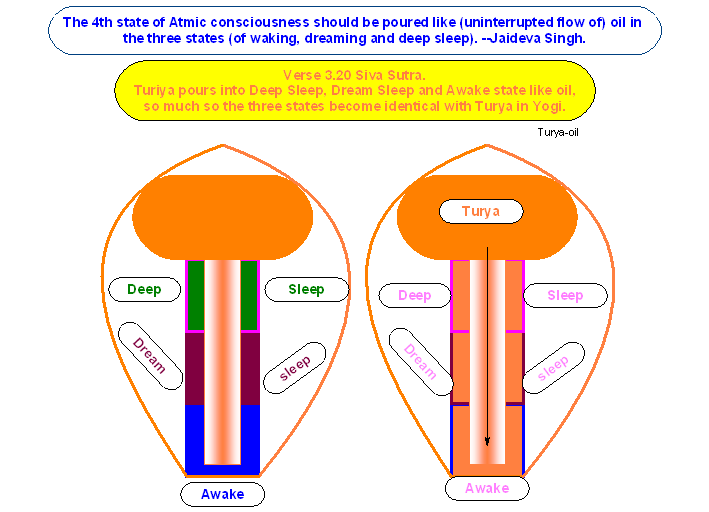
(4) Turiya is Spiritual Transcendental consciousness. Visva, Taijasa, and Prajna merge and fuse sequentially. Turiya is without any attributes. It is santam, sivam, and advaitam (சாந்தம், சிவம், அத்துவைதம்) peace, goodness, and nondual), for didactic purposes. It or He is the Self. Objective consciousness is absent and its seed is absent. Ramana Maharishi calls this “Wakeful Sleep.” Turiya is present and functional in the perfected ones, even when they are awake. In Turiya, there is an irreversible union with Brahman: There is Oneness with Brahman. There is a permanent Metaphysical Unity. There are four progressive Turiya states, one deeper and subtler than the earlier one. The silence that follows the Sound AUM corresponds to this state. (See Below, compared to level one.) The presiding deity is the Supreme Vāsudeva Himself; He is Vāsu and Deva, meaning an indwelling God. Here all three gunas (Sattva, Rajas, and Tamas) are not operative.
If an aspirant meditates on Brahman in all his four parts (AUM-Silence) he becomes non-dual with Brahman.
Ramalinga Swamigal of Madras (1823-1874 C.E.) explains Turiya in terse words as follows: 'I became it; It became me.'
Here is the view of Joseph Campbell on Turiya. (Page 71-72, Myths of Light.)
The goal of the various forms of yoga is to go into that realm of undifferentiated consciousness while remaining awake. We don't have a counterpart to this concept in our Western vocabularies. It doesn't even have a name in India; it is called simply the fourth state, and that is the fourth letter of the syllable (AUM), the level of silence. Because all the words that we speak refer either to waking images and logic, dream images and logic, or ignorance. We do not have words for this, and so it is the ultimate silence, but it is that which we are....
The Indian word for this form of forms is Isvara, "lord." Any god can be taken as this lord. The image that you have held in your mind as that image of God is what will there be experienced, be it Yahweh, Siva, Vishnu, or the Goddess, be it Christ or the Trinity or the highest image of the Buddha. Any will be all right. And what beholds it is that jiva that has gone through many incarnations and is the soul of your own existence. Here, the subject beholds its proper object. At this level the erotic principle or the second chakra (Svadhistana) finds its goal: the true beloved, the beloved that our soul intends, is God. And anything short of that is simply an inkling of what the experience of God would be.
bg12.h2.gif
|
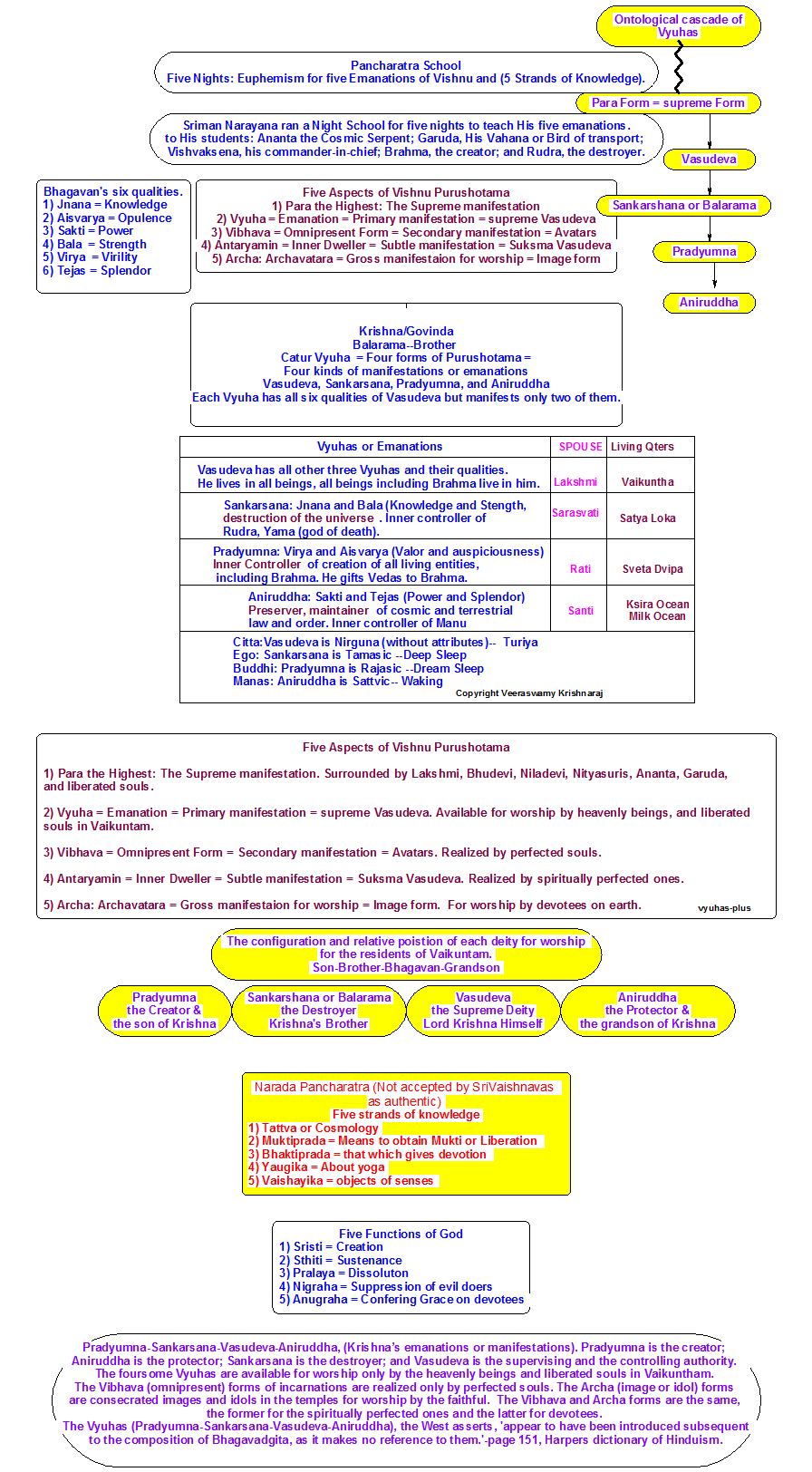
Sri U. Ve Velukkudi Krishnan Swamy All the vedas and vedanta are orders of Pancha ratra. Sriman Narayana only was preached by Himself to five rishis in five nights. Sri Krishna further explained the vedanta through gita. Pancha ratra = five nights = |
It is obvious from this that each of the four states of consciousness
is presided by one of four emanations (Vyūhas) of the Lord: Aniruddha,
Pradhyumna, Samkarshana, and Vāsudeva. (Note: The fifth entity is Prakrti (the
Bhutas) which is not an emanation of Vāsudeva as the other three are. This
fifth entity is a material complement to the spiritual side.
Vasudeva
is the first and the most important presiding Lord over Citta (reason); next
comes
Sankarsana, the serpent (Ananta,
Balarama) manifestation of the Lord, who presides over ego and destroys the
universe at the time of dissolution.
Pradyumna,
the son of Krishna, is the third Vyuha presiding over knowledge of the
universe, intellect and comprehension, and creation.
Aniruddha
is the fourth Vyuha presiding over the mind and the senses and sustenance of
the universe of beings.
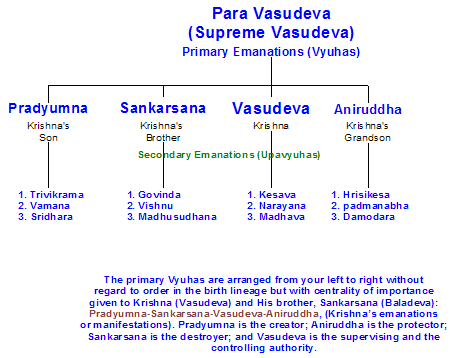
The primary Vyuhas are arranged from your left
to right without regard to order in the lineage but with centrality of
importance given to Krishna (Vasudeva) and His brother, Sankarsana (Baladeva):
Pradyumna-Sankarsana-Vasudeva-Aniruddha, (Krishna’s emanations or
manifestations). Pradyumna is the creator;
Aniruddha is the protector; Sankarsana is the destroyer; and Vasudeva is the
supervising and the controlling authority.
The foursome Vyuhas are available for worship only by the heavenly beings and liberated souls in Vaikuntham. The Vibhava (omnipresent) forms of incarnations are realized only by perfected souls. The Archa (image or idol) forms are consecrated images and idols in the temples for worship by the faithful. The Vibhava and Archa forms are the same, the former for the spiritually perfected ones and the latter for devotees.
The Vyuhas (Pradyumna-Sankarsana-Vasudeva-Aniruddha), the West asserts, 'appear to have been introduced subsequent to the composition of Bhagavadgita, as it makes no reference to them.'-page 151, Harpers dictionary of Hinduism.
An exception in Thirunaraiyur
Naachiyar Koil at Thirunaraiyur near Kumbakonam in Tamil Nadu shows the Moolavar Thirunaraiyur Nambi (main deity of Vishnu) in His ceremonial wedding stance marrying Vanchulavalli Thaayaar (Lakshmi). The legend has it that Goddess Lakshmi was born of Sage Madhava in the shade of Vanchula tree. Bhagavan appeared in Pancha Vyuha form (Sankarshana-Pradyumna-Aniruddha-Purushotama-Vasudeva) and married Goddess Lakshmi. These forms are seen in Garbha Graham (Sanctum).
|
Pradyumna |
Samkarshana |
Vasudeva |
Aniruddha |
|
Son of Lord Krishna and Rukmini |
Brother of Lord Krishna, aka
Baladeva |
Lord Krishna Himself, son of
Vasudeva and Devaki |
Grandson of Lord Krishna and Son
of Pradyumna
|
|
Dream sleep |
Deep Sleep |
Turiya |
Wakefulness |
|
Mahat |
Jivan |
Paramatman |
Ahamkara |
|
Creator |
Destroyer |
All qualities |
Sustenance (Protector) |
|
Knowledge and Intellect |
Ego |
Citta |
Mind and senses |
|
Presiding deity: Brahma
|
Presiding deity: Rudra |
Presiding deity: The Soul |
The presiding deity: Moon |
|
Vyuha |
Pradyumna |
Sankarsana |
Vasudeva |
Aniruddha |
|
Attributes |
|
|
Jnāna (Wisdom)
|
|
|
|
|
Aisvarya (Auspiciousness) |
Aisvarya (Auspiciousness) |
|
|
|
Sakti |
|
Sakti (Energy/Power) |
|
|
|
Bala |
|
Bala
(Strength) |
|
|
|
|
|
Virya
(Valor) |
Virya |
|
|
|
|
Tejas
(Splendor) |
Tejas |
|
Color |
The Rays of the Sun |
Red |
White |
Dark
|
|
Color of
Raiment |
Red |
Blue |
Yellow |
White |
|
Weapons in four hands |
Bow, Arrows, Conch, and abhaya
mudra |
Plough, Pestle, Conch, and
Abhaya mudra |
Discus and Mace, Conch, and
Abhaya mudra |
Sword, club, Conch, and Abhaya
mudra |
|
Special weapons |
Bow and arrows |
Plough and pestle |
Discus and mace |
Sword and club |
|
Alternate configuration |
Right upper: M
Right lower:C
Left upper:L
Left lower:D |
Right upper:
L
Right lower:
C
Left upper:
D
Left lower:
|
Right upper:
D
Right lower:
C
Left upper:
L
Left lower:
M |
Right upper:
D
Right lower:
L
Left upper:
M
Left lower:
C |
|
Banner, Emblem
|
Makara (crocodile) |
Tala (palm tree) |
Garuda (Eagle) |
Mrga (deer) |
All
manifestations show abhaya mudra: freedom from fear, depicted by the open palm
of the right hand raised to the level of the chest and facing forward.
(4A)
Jiva Turiya: Jiva (individual self) realizes its pristine spiritual nature and
its organic relationship with God or Self. Duality still exists: self and Self
(4B)
Para Turiya: Jiva realizes Brahman; and union, absorption, or merger takes
place; they are still “NOT” united in essence. Duality is still apparent
between object and subject, Jiva and Brahman. It is worthwhile to remember
that Brahman, the all-knowing subject, can never become an object.
(4C)
Brahman Turiya: Jiva unites with Brahman, and is fully absorbed and integrated
into One Being.
(4D) Beyond Turiya: Jiva and Brahman become ONE as butter is poured into butter, and water is mixed with water. It is an undifferentiated and homogeneous state of subject-object fusion.
(Saiva Siddhanta: Siddhantists say that this Turiya state is experiencing of Suddha Vidya of Suddha Tattvas through Samadhi yoga. Turiyatita [the fifth state] is experiencing higher states of Consciousness as follows. Kashmir Saivism: Siva Sutra 3.25 says: By continuous practice of Turiya, the aspirant attains the Turiyatita state; he becomes similar to Siva.)
Here is another variation of the above.
Avastha or state of consciousness for Sahasrara is Turiya-Turiya, 7th higher level of consciousness. Turiya-jagrat = awakening to higher consciousness --the fourth state;
Turiya-svapna = the fifth state of mystical visions;
Turiya-Susupti is the 6th higher state of Consciousness of Sa-Vikalpa Samadhi-Duality between yogi and Brahman present;
Turiya-Turiya = Nir-Vikalpa Samadhi-7th state, No duality, merger between Yogi and Brahman.
Turya (Turiya) according to Kashmir Saivism consists of seven stages.
Ananda and Turya (Turiya) are synonyms in Kashmir Saivism. Sambhunatha is the explicator of Turya. There is a gap or an interval between Waking, Dream sleep, Deep Sleep and Waking. This gap, this interval, this junction is Turya the 4th state. One cannot experience this state by concentrating one's mind on the gap between two breaths, inhalation and exhalation. The First state of Turiya is Nijananda.
1) Nijananda = The Bliss of your own Self. In anava upaya, the first stage of ananda arising from concentration on prana leading to the resting of the mind on the subject or experient.
2) Nirananda = Devoid of limited Bliss. The second stage of ananda in anava upaya resulting from the fixation of prana-sakti on sunya.
3) Parananda = Bliss of Breathing. In anava upaya the joy of the third stage that ensues by the practice of resting on prana and apana in uccara yoga
4) Brahmananda = The All-pervasive Bliss. The fourth stage of ananda (joy) in anavopaya experienced by resting of consciousness on Samana prana resulting from the unified combination of multifarious objects.
5) Mahananda = The Great Bliss. In anavopaya, the fifth stage of ananda resulting from the resting of consciousness on udana agni that devours all the pramanas and prameyas.
6) Cidananda = Bliss of Consciousness. consciousness and bliss, (1) The nature of ultimate Reality consisting of consciousness and bliss. (2) The sixth stratum of ananda in uccara yoga of anava upaya
7) Jagadananda = Universal Bliss. The bliss of the Self or the Divine appearing as the universe, the bliss of the Divine made visible.
Here is what www.experiencefestival.com says about Turya (Turiya).
This high state of consciousness is situated beyond mind, thinking, causality and identification with the physical body. It is almost indescribable in its astonishing greatness and profoundness. It is the state where the yogi is in profound union with Siva (God). Mandukya Upanishad, a text which contains an in depth analysis of the different states of consciousness, describes turya essentially only by a series of negations: turya is nor objective experience, nor subjective experience, nor consciousness, nor inconsciousness, nor knowledge attained by the five senses, nor relative knowledge, nor knowledge obtained by deductions and mental reasoning. The only positive definition is a pure consciousness completely unified, indescribable beatific peace or the nature of Atman, the Supreme Self.
Go to the end of the article for the complete translation from Mandukya Upanishad on Turiya by Dr. Radhakrishnan.
Saiva Siddhanta points to another state beyond Turiya called Turiyatita, [which is consolidation of Turiya], which has two phases: Un-mesham Consciousness, the opening of the eyes (Isvara Tattva is attained) and Nimesha Consciousness, the closing of the eyelids (Sadasiva Tattva is attained). Un-mesham is opening of the eyes; Nimesha is closing of the eyes. Sadasiva Tattva (Nimesha) experience and Consciousness are deeper and purer than the Isvara Tattva (Un-mesham) Consciousness, and the Yogi enjoys equality with Siva, when Siva reveals his Grace to the Yogi. For more information on Suddha Tattvas, refer to TATTVAS-36.htm
Yogi ascends the
Tattvas from the Muladhara plane to Sahasrara plane where the Yogi enters
Turiyatitta for onward journey to the source of SuperConsciousness or Pure
Consciousness; it is a retrograde involutional process (as opposed to
evolutional descent of Consciousness from Superconsciousness to mere human
consciousness to sub-consciousness and instinct in animals), which is Jiva's
homecoming to the source where creative cascade starts. As the Yogi ascends
the Suddha Tattvas from Vidya Tattva through Isvara, Sadasiva, Sakti to Siva
Tattva, the Consciousness becomes purer and purer, when it is the Purest at
Siva Tattva.
Ramprasad, devotee of Kali, though he attained Turiyatitta by becoming one with Brahman, says that he would rather be enjoying sugar (Brahman) than becoming Sugar himself. He liked to be separate from Kali so that he could worship Her, because Oneness with Her does not permit worship.
The
following tells us the distinction between the
Absolute and God; Brahman and Isvara;
Turiya and Prajna.
Level One: The Absolute, Brahman,
Turiya, and the Silence after AUM have a
horizontal relationship with one another. All are Imperishable Brahman. It is
all thought, all Bliss, no dream, no activity, no name, no form, all light and
all absolute repose.
Level Two: God, Isvara,
Prajna, and AUM belong to the category of the
Unmanifest becoming the manifest universe of beings and matter. He is the
Sutratman (Thread-Soul) running through all the
souls of the universe. These are derivatives of the imperishable
immeasurable Brahman. Brahman BECOMES ISVARA OR PERSONAL GOD with pure wisdom
or Prajna. Brahman does not diminish or cease to be, by becoming Isvara.
Isvara is the Principle behind the Mula-Prakrti or the unmanifested, the inner
guide (controller) of all souls. This is compared to
deep sleep.
Level Three: Isvara is the immediate cause of
Hiranyagarbha, which is the embryo of the world.
When this embryo (an internalized state compared to the
dream state, ideas, and possibilities)
projects into space and time, we get Virāt or manifestations. Ramanuja says
that Isvara is the inner controller of Cit and Acit (Beings and universe,
sentient and insentient).
Level Four: When the embryo stage matures and is exteriorized, the manifest world
is like the waking state.
Turiyatitia, Turiya, Susupti, Svapna, Jagrat have concordance with Avyakta, Brahman, Isvara, Hiranyagarbha, and Virat.
The Triads:
| Three states of consciousness | Jagrat | Svapna | Susupti |
| 3 individual Jiva | Visva | Taijasa | Pajna |
| 3 collective Jiva | Vaisvnara | Hiranyagarbha | Sutratman |
| three functions of the Lord | creation | maintenance | destruction |
Coming back to sleep, science is still trying to explain why we have and need dream (REM sleep) and deep sleep NREM sleep). NREM = Non-rapid eye movement sleep. The newborn spends many hours in REM sleep. REM and sleep are two entities; REM can occur without dream in injuries of frontal lobe and perceptive brain. Dolphins sleep while swimming with half brain at work and half brain in REM mode. Humans spend two hours dreaming in REM sleep. Deprivation of deep sleep kills rats a few weeks faster than deprivation of REM sleep. Medications can alter sleep states.
Premature babies and Immature animals spend longer periods in REM sleep. It appears, younger the brain, more REM sleep is needed. It is reasonable to think that the newborns are laying down new neural pathways and building new neurons during REM sleep; the human baby's brain grows three times its size during the first year. REM sleep is dream sleep. Do the newborns have dreams during REM sleep? It is anybody's guess. During REM sleep mind is active, and transmitter brain chemical, pontine acetylcholine sets the stage, while noradrenaline and serotonin, the chemicals next in the cascade series activate the frontal brain to have the dream run; dream lets you drive your car in dream sleep, but does not get you out of the bed to go to your car and drive it, because REM sleep is associated with muscle paralysis. REM dream sleep is paradoxical paralytic sleep, paradoxical because the brain acts as if it is awake, though the muscles are paralyzed. REM is a cholinergic state and a dream-trigger, while dream itself is a dopaminergic state. The drama of dream needs an intact frontal and perceptual cortex (Occipito-temporo-parietal junction) and dream-paralysis of motor cortex. Frontal cortex is the site of dream, but the interpretation of images, colors, smells, texture and sound takes place as usual in visual and auditory cortex. The images and perceptions are not fed from an outside world, but are internally generated and so the frontal cortex does not exercise judgment but plays the role of out-of-body spectator. REM sleep is necessary for mental health and NREM is necessary for physical health.
Some people with somnambulism might do complex activities in total absence of awareness of what they are doing. Waking mentation and consciousness, and normal inhibitions and volitions are absent, automatism takes over control of acts, of which they may not have a memory. It is dissociative motor arousal (mind-body dichotomy) without volition or inhibition; it takes place during stages 3 and 4 of deep Sleep. Automatism is seen in psychomotor epilepsy and other conditions. This is not the place for discussion of criminal automatism.
When retrograde involution takes
place, the Cit, the Acit, Hiranyagarbha, and Isvara go into Brahman. AUM
straddles all levels and is imperishable. A is for the waking state, U is for
the dream state, and M is for the Deep Sleep. The silence that follows AUM is
the Turiya State. AUM is worshipped as Isvara and Brahman.
Devotion is of several kinds, thus
bringing different results; the object of devotion or worship can range over a
wide array: nature, lesser gods, personal God, holy places, holy objects,
Saguna Brahman and Nirguna Brahman. The Self is the same in all these
entities. The fruits of this worship or devotion are according to the object
of worship, and can range from acquisition of earthly goods to success in
certain endeavors: graduated liberation, samādhi, jivanmukti, or moksa. The
choice of worship depends on the mental make-up and the aptitude of the
devotee; not everyone can become a Jnāna Yogi. They may have to be satisfied
with karma yoga, bakhti yoga, or Prapatti and Sarnāgati. The self is the same
in the snake worshipper and the Yogi practicing Jnāna yoga, but at both ends
of the spectrum and in-between it is conditioned by the excellence of the
mind, though all have the potential for eventual moksa.
The Yogi sees God in the Higher Self without attributes (he is beyond
attributes) or Nirguna Brahman and does not see any problem with worship of
idols, icons and images, which become a repository of sacred vibrations
received at consecration.
Jung says, "A symbol, then, is a living gestalt or form-- the sum total of a highly complex set of facts which our intellect cannot master conceptually, and which therefore cannot be expressed in any way other than by the use of an image." The Psychology of Kundalini Yoga, Page 61.
This brings into question the views of some (which we respect) that images, icons, and idols should not be used to represent God. Read commentary on verse 12.5.
12.2: Sri Bhagavan said:
They, who fix their mind on Me,
always engage in worship with supreme faith and are considered by Me as
perfect among yogis.
12.3-4: Those, who worship the Aksaram, the indefinable, the Avyaktam,
the Omnipresent, the Acintyam, the Unchanging, the Immovable and the Eternal,
control all the senses, remain levelheaded (even-minded) under all
circumstances, and dedicate themselves to the welfare of all creatures, attain
Me.
Aksaram: Imperishable. Avyaktam: Unmanifested. Acintyam: Inconceivable:
12.5: Greater is the difficulty for those whose thoughts are
attached to the Unmanifest (Avyakta), for the progress towards attaining the
Unmanifest by the embodied is difficult
It is
difficult to concentrate one's mind on a formless, nameless, unmanifest,
imperishable, blissful, undifferentiated, indestructible, immutable, and
impersonal Nirguna Brahman or Param-Brahman; it is easier to concentrate on
Isvara or personal God. Jnāna yogis and transcendalists can meditate on Param
Brahman or Nirguna Brahman; but Isvara, Narāyana or Krishna is for a bhakta or
a devotee because each one of them has a name, a form and attributes. Each one
of us is endowed with a body: Jivātman (individual soul) is wrapped in kosas
or sheaths, which are easily identifiable, because kosas create a mental
image; and the self or jivātman stays unseen in the spiritual heart. We are
used to and can easily relate to names, forms, and zip codes. An abstract
concept with no name or form is not a problem for a perfected Yogi, but does
not lend itself easily for a mental grasp and hold in most of the embodied
jivatmas.
12.6: For them, who renounce all their activities to Me,
accepting me as the Supreme without having a second, showing their devotion to
Me, worshipping and meditating on Me,
12.7: I soon become their deliverer from the death-dealing
ocean of Samsāra (birth and rebirth) O son of
Partha (Arjuna), because they have their thoughts fixed on Me.
Those,
who perform all their activities as a sacrifice to Me, whose devotion is
directed only towards me, who worship and meditate on Me, and whose thoughts
are always fixed on Me, are saved by Me from the ocean of death-dealing
Samsāra.
I am the savior of My true,
earnest, pure, selfless, and sacrificing devotees, who take refuge in, and
surrender to Me, rescue them from the sea of samsāra
and let them attain moksa (liberation).
Here is the definition of Samsara in the words of Candidasa in Jaiva Dharma by ThAkura, page 173-174.
The jiva is an eternal servant of Krsna, but he forgets this and takes on a material body. Influenced by the qualities of material nature, he derives happiness and distress from material objects. For the privilege of enjoying the fruits of his material activities, he must wear a garland of birth, old age, and death.
The jiva sometimes takes birth in a high position and sometimes in a low position, and he is led into innumerable circumstances by his repeated change of identity. Hunger and thirst spur him to action in a body that may perish at any instant. He is bereft of the necessities of this world, and is cast into unlimited varieties of suffering. Many diseases and ailments appear, which torment his body. In his home, he quarrels with his wife and children, and sometimes he goes to the extent of committing suicide. His greed to accumulate wealth drives him to commit many sins. He is punished by the government, insulted by others, and thus he suffers untold bodily afflictions.
He is constantly aggrieved by separation from family members, loss of wealth, theft by robbers, and countless other causes of suffering. When a person becomes old, his relatives do not take care of him, and this causes him great distress. His withered body is ravaged by mucus, rheumatism and a barrage of other pains, and is simply a source of misery. After death, he enters another womb and suffers intolerable pain. Yet despite all this, as long as the body remains, his discrimination is overpowered by lust, anger, greed, illusion, pride, and envy. This is samsara.
12.8: Fix your mind on Me, let your intelligence (Buddhim) come to
dwell on Me. You will live in Me after that. Of which, there is no doubt.
Buddhi
is a derivative of Prakrti; Mahat, the great Principle, is the cosmic
counterpart of Buddhi. Buddhi by itself is not intelligence, because it is
derived from matter. How do you breathe some life, some prāna, or some power
into it? How do you make it functional? A hard drive sitting on your desk is
not functional or knowing. This is where the Greater Self or Purusa comes in.
Purusa breathes or imparts prāna into Buddhi and thus animates matter. Purusa
is Light and has vision, while matter is blind, dark, and muscular, and has a
strong shoulder, back and brawn. Therefore, you have to let Purusa take a ride
on the back of Prakrti, if you want to go somewhere. Anther name for Purusa is
Greater or Higher Self, which is Krishna Himself. If you can get your Buddhi
close to Krishna, you are home free:
That means that you rest your mind and thoughts on Krishna; this mind
and thoughts come under the command and control of Purusa (Purusa enlightens
Buddhi). If you keep the command and control Center in good order, it means
that you are in communion with the Higher Self.
Manas, ego, and Gunas (Sattva, Rajas,
and Tamas) modulate buddhi; “Manas” is the lower instinctive mind, the
veritable seat of desires and Indriyas, the sensory and motor organs; buddhi
should bring the indriyas under tight control. If Buddhi is in its “right
mind,” it will filter out Rajas and Tamas, and Sattva will be the dominant
mode of Buddhi. Ego, falsely, inflates self-importance; when you come before
God, you should know your God. If your ego is hyperinflated and makes you feel
invincible, you are not ready to enter the temple of God. You have to leave
your companion Mr. Ego (Ye Go) at the doorstep and then enter the House of
God. Breaking a coconut into halves in the temple is symbolic of breaking
one’s ego. The message of Alvars and Ramanuja is to go with humility, seek His
refuge, and surrender to Him.
12.9: If you are not able to set your mind firmly on Me, then
practice of yoga of repetition (of My name), and thus seek to attain Me, O
Dhananjaya.
Mind
is a monkey; it jumps around. By constant practice and concentration, one can
get his mind to dwell firmly on the Lord. This concentration coupled with the
desire to attain God will ensure that our thoughts dwell in the Divine all the
time and that the Divine takes over our being.
12.10: If you are unable (even) to practice repetition, come to do
My Supreme Work (matkarma paramah). You can attain perfection (Siddhim) by
performing actions for My sake.
|
Bhagavadgita Page 295 By Dr. Radhakrishnan (12.10) If thou art unable even to seek by practice, then be as one whose supreme aim is My service; even performing actions for My sake, thou shalt attain perfection. l If concentration is found difficult all account of the outward tendencies of the mind or our circumstances, then do all actions for the sake of the Lord. Thus the individual becomes aware of the eternal reality. l matkarma is sometimes taken to mean service of the Lord, puja or worship, offering flowers and fruits, burning incense, building temples, reading scriptures, etc. 1 1Abhinavagupta regards matkarmāṇi as equivalent to bhagavati karmāṇi as pūjā, japa, svādhyāya, homa, etc. |
For
those devotees of Lord Krishna, who are unable to concentrate or repeat his
name, there are other avenues of worship. Any work performed for the sake of
Lord Krishna, however trifling it is, will guarantee perfection and a place at
the feet of Lord Krishna. Matkaram paramah means “My work Supreme.” It
includes personal service to the Lord by tending the flowerbeds and gardens
around the temple, keeping the temple clean, collecting flowers for worship,
chanting His glories, performing pujas, reading Holy Scriptures, serving the
devotees and other simple chores in the temple. No work done in the service of
the Lord, however small and insignificant it may appear, goes unnoticed by the
Lord.
12.11: If you are unable to perform (even this devotional service), take refuge in My Yogam (Mat Yogam Asritah), and perform all actions relinquishing the fruits [of all actions] with subdued self.
The
Lord is a repository of many Yogams. They are His intrinsic attributes and
glories, and some, he bequeaths to His devotees.
1) Mat
Yogam: “My wonderful power, My divine prodigious endowment.”
It is
part of His nature. If the devotee does his work with his heart, mind, and
soul in the spirit of selfless service and without expectation of a reward,
the devotee will be suffused with “Mat Yogam” of Lord Krishna. That is Bliss.
2)
Buddhiyogam: Buddhi yoked to the Self is a gift from God to the devotee for
him to see the Brahman in all and all in Brahman. The Self is the Light behind
Buddhi. Buddhi powered by Self here gives the devotee discriminating knowledge
and bliss.
3)
Yogam Aisvaram is a Divine Yogic Power that physical eyes cannot see. The Lord
gave Arjuna the Divine eyes to see the Universal Imperishable Form.
4)
AtmaYogam: This is the Divine Power of the Lord, by which he manifests His
Universal form.
Yogamāyā
and atmamāyā are divine processes by which He self-creates Himself to take
birth in this world. In these two instances, karma and avidya are not
operative, because He is Brahman and Supreme and He is above avidya and karma.
5) Maya has two meanings: 1)Illusion and 2) the progenitor of matter (earth, water, fire, air, sky, mind, buddhi, ego, gunas, 14 planetary systems, gross body, subtle body... Maya is NOT His supreme power (His Apara Sakti) and characterized as His external power (bahiranga Sakti). It is like a shadow at sunset, long and far away from Him and yet follows Him doggedly.
12.12: Better than practice is knowledge (of the self); better than
knowledge is meditation; better than meditation is renunciation of the fruits
of work. Because of such renunciation, peace comes immediately.
KarmaphalaTyāga is renunciation of fruits of action.
12.13: He who has no hatred of all living beings, friendly,
compassionate, free from mine-ness and free from ego; is same in pleasure and
pain, and patient; (continued)
|
'I do nothing of myself' (John VIII. 18). 'Not what I will but what thou wilt' (Mark XIV. 36) Boehme said 'Thou shalt do nothing but forsake thy own will, viz that which thou callest "I" or "thyself. " By which means all thy evil properties will grow weak, faint and ready to die, and then thou wilt sink down again into that one thing, from which thou art originally sprung ' Discourse between Two Souls. excerpt from The Principal Upanisads Page 128. Dr. Radhakrishnan. Sep 26. 2013. |
|
Swami Rama Tirtha (1873-1906) was great Advaitin who was also equally at ease with Persian, Arabic as well as Sanskrit literature. Victim of hatred and forgiveness You might have heard of Swami Dayanand Saraswati, the founder of Arya Samaj. He was an undaunted social reformer. The fundamentalists opposed him tooth and nail. They made his cook administer poison to him. The cook afterwards realized his mistake and repented. He fell at Swamiji's feet and apologised. The Swami, without any feeling of hatred or revenge, directed him not to commit such a heinous crime in future and he not only excused him, but also gave money to leave the state and go underground to avoid the clutches of the law. Swamiji took the whole incident as the will of God and died peacefully. Here is another version from Wikipedia. Victim of Hatred and vengeance and forgiveness According to Indian History, in 1883 Dayananda (February 12, 1824 – October 31, 1883) was invited by the Maharaja of Jodhpur, to stay at his palace. The Maharaja was eager to become his disciple and learn his teachings. One day Dayananda went to Maharaja's rest room and saw him with a dance girl. Maharaja loved this low-character dance girl. Dayananda boldly asked Maharaja to forsake that girl and all unethical acts and follow Darma of a true Aryan. Dayananda's suggestion went against to that dance girl and she decided to take revenge of this. Dance girl bribed Dayananda's cook to poison him. One evening when Dayananda was about to go to bed he brought him a glass of milk containing poison and ground glass. Dayananda took the glass of milk and went to sleep only to wake up later with a burning sensation. He realized immediately that he had been poisoned and attempted to purge his digestive system of the poisonous substance, but it was too late. The poison had already entered his blood stream. Dayananda was bedridden and suffered excruciating pain. Many doctors came to treat him but all was in vain. His body was covered all over with large bleeding sores. On seeing Dayananda's suffering the cook was overcome with unbearable guilt and remorse. He confessed his crime to Dayananda.On deathbed, Dayananda forgave him and gave him a bag of money and told him to flee the country lest he be found out and executed by the Maharaja's men. |
12.14: Yogi who is ever self-content, self-controlled, determined in his faith in Me, with his mind and intelligence dwelling upon Me, is My devotee dear to Me.
|
Freedom from Ego Swami Rama Tirtha (1873-1906) was great Advaitin who was also equally at ease with Persian, Arabic as well as Sanskrit literature. He happened to be in Lucknow in 1905 when Muslim Maulanas came to him to get enlightened on Hinduism and their own religion. He had a dialog with them about God. If you are at all the true lover of God, and if you want to meet Him, do away with your selfishness and ego and surrender your entire self to God. Now that you are a man, the highest evolved being with rationalism, you must make all-out efforts to rise to the highest rung of evolution. You must now give up the nature of the lower animals. If not immediately, you have to rise and evolve gradually and expand the circle of your oneness with all. By so doing, you must one day or the other be merged in God-hood, by achieving God-Realization. The flowing river must one day be merged into the ocean. This is the Law. Similarly, you should also make all-out efforts to continue to advance. Do not stop till you have reached the goal of your life. The habits of animals in you keep you back and cause your humiliation and failure. Give up your persisting animalism which is responsible for the sins in human life. You have emanated from God. God is your primordial cause and your original source. Though you live and are preserved in Him, yet you feel that you are something separate from God. As such, you must first know your real Self to give up this animalism in you, before you can be a perfect man. Then, step by step, you can further evolve to be angelic and finally be merged in God which you really are. |
Other quotes from Bhagavad Gita on devotee of Vishnu
4.3: I declared that same ancient yoga of knowledge to you, because you are My devotee and friend. This is the supreme secret.
7.23: Finite and limited is
the fruit gained by these men of small intelligence (small minds). The
worshippers of gods go to those gods, but My devotees
come to Me.
9.31: Soon he becomes a righteous
soul (Dharmātma) and attains to lasting peace. O son of Kunti, let it be known
that My devotee never perishes.
11.55:
He who does his work for Me; he who considers Me as Supreme; he who is
My devotee, free from attachment; he who
has no enmity to all creatures; he comes (attains) to Me. O Pandava.
18.65:
Think of Me, become My devotee,
worship Me, and offer your obeisance to Me. Certainly you will come to Me. I
truly promise you that you are dear to Me.
He,
who has malice towards none, and is friendly, compassionate, free from I-ness
and ego, equal in pleasure and pain, content, self-controlled, determined in
his faith in Me, with mind and intelligence fixed on me, is my
devotee and dear to Me.
It is a common theme in Vaishnava sect that a devotee is greater than the Lord Himself. BhAgavatAs or BhAgavatars = devotees; Bhagavat, Bhagavan = Vishnu, the Lord. Bhagavan does not tolerate any slight to BhAgavatAs. If one has to choose between Bhagavan and BhAgavatar for worship, the latter is the clear choice. That is what Bhagavan likes. Swami Desikan makes a particular mention about it in RatnAvali Hrudayam. Any BhAgavata apachAram (disrespect to Vishnu's devotee) is worse than Bhagavat apachAram according to Ramanujar. Any offence or disrespect to Lord Vishnu can be expunged by falling at the feet of His devotee. Any disrespect to BhAgavatar can be erased not by falling at the feet of Bhagavan but by doing so at the feet of BhAgavatar. Anyone cannot be a devotee. Krishna describes the qualities of a true devotee in this chapter.
The Marks of a True Vaishnava and the devotee of Vishnu as told by Vishnu Himself.
Padma Purana (Part 10, C8, V80-111) says the following about the devotees of Vishnu. The very mundane existence of the Jivas, the gods and Vishnu Himself are dependent on Vishnu's devotees. Vishnu addresses Brahma as follows. My devotees, whom I never leave, are my kinsmen. Anyone without lust, anger, harm, hypocrisy, greed, folly, and jealousy should be branded as Vishnu's devotee. The following traits are the marks of a true devotee of Mine (Vishnu): kindness; pious acts; universal goodness; service to elders and preceptors; equal treatment of Brahma, Vishnu and Sankara; honoring the guest; devotion to Vedists and Brahmanas; respect for other women; observation of Ekadasi vow; singing of My names; temple building, wearing of lotus, Tulasi, Aksa seeds, Dhatri leaves and fruits; scarification of their skin with the signs of My weapons like conch, the disc, the mace, the lotus; wearing of Tulasi tree root mud; bathing in Ganga and chanting the name of Ganga; keeping of the holy book of BhAgavata and Salagrama stone in their house; cleaning My Place and offering lamp to Me; repairing and renovating My temple; offering security to the timid; giving knowledge to Brahmanas; sprinkling of water from My feet on the head and eating of My Prasadam; offering of food and water to the oppressed, the thirsty and the hungry; performing of devout deeds; construction of lakes, villages, and gardens with Pippala trees; service to the cows; offering of libations to the deceased ancestors; service of the distressed; getting the daughters married; service to parent-in-law, elder sister, and eldest brother; desisting from censuring others; treating the wealth of a deity, a Brahmana, and others as poison; devotion to Siva; observing the vow of Caturdasi; desisting from devotion to heretics; and worshipping Me.
Here is an extract from Jaiva Dharma, Chapter 6 pages 129-130 by Srila Bhaktivinoda ThAkura,
This is very clear in the following statement from the Padma Purana:
sudram va bhagavad-bhaktam nisadam svapacam tatha
viksate jati-samanyat sa yati narakam dhruvam
quoted in Hari-bhakti-vilasa (10.119)
If one considers a devotee of Bhagavan to be a member of the lowest of the four
castes (sudra), a member of an aboriginal tribe of hunters (nisada), or an outcaste
dog-eater (svapaca), merely because the devotee has taken birth in such families,
one is assuredly destined for hell.
The Itihasa-samuccaya also says:
na me priyas catur-vedi mad-bhaktah svapacah priyah
tasmai deyam tato grahyam sa ca pujyo yatha hy aham
quoted in Hari-bhakti-vilasa (10.127)
A brahmana who has studied the four Vedas, but has no bhakti, is not dear to Me,
whereas My bhakta is very dear to Me, even if he has taken birth in a family of
dog-eaters. Such a bhakta is fit to receive charity, and whatever he offers
should be accepted. Indeed, he is as worshipable as I am.
12.15: He, by whom the world is not shuddered, who is not shuddered
by the world, and who is free from delight, displeasure, fear, agitation, is
also dear to Me.
12.16: He, who has no regard or longing for anything, is pure,
talented (dexterous), impartial, free from fear, and who has renounced all
initiatives (in work) and is devoted to Me, is dear to Me.
अनपेक्षः शुचिर्दक्ष उदासीनो गतव्यथः ।
सर्वारम्भपरित्यागी यो मद्भक्तः स मे प्रियः ॥१२- १६॥
anapekṣaḥ
śucir dakṣa
udāsīno gatavyathaḥ
sarvārambhaparityāgī yo madbhaktaḥ sa me priyaḥ 12.16
Udāsīnah: indifferent, disinterested, impartial, neutral, neither friendly nor
hostile
Lord
Krishna holds man dear for his qualities:
1)
Krishna’s devotee does not expect
any reward for any act he does.
2)
He is of external and internal purity
in body, mind, and soul; thought, speech, deed and permitted food intake.
3)
He is knowledgeable in the purpose and
goal in life.
4)
He is neither friendly nor hostile to
any living being.
5)
He is free from anxiety.
6)
In whatever he does, he does not
project his ego and declare that he is the doer.
12.17: He, who neither
rejoices nor hates; who neither grieves, nor desires; and who has renounced
both the good and the evil, is a devotee dear to Me.
12.18: He who is same to a
foe and a friend, also to honor and dishonor, in cold and heat, in pleasure
and pain, who is free from attachment,
Sama: same, even, equable, alike
12.19: equal in defamation
and praise, silent, content with anything,
having no home, with firm mind-that man is
a devotee and dear to Me.
Here “Having no home” refers to a Sannyāsin. Sannyāsa stage is the fourth stage in the life. According to scriptures, only a Brahmin or a king can go to stage four if he chooses to do so. Having lived a life through preceding three stages, a sannyāsi’s focus is now on gaining final liberation. The fourth stage in life is the result of a natural progression after proper fulfillment of the first three stages. The aspiring ascetic or Sannyāsi performs Isti or sacrifice to Prajapati, the lord of all beings before he steps into the next stage. The sannyāsi gives up all his property including his house, and leaves. He renounces kāma, artha, dharma of earlier stages. He wanders in silence without any companion. When he talks, he talks only God. He goes to a village for food, indifferent to any creature comforts; he desires neither to live nor to die. His mind’s focus is on Brahman, firm in conviction; he lives alone by himself; he practices yogic postures, ahimsa, detachment from senses and dualities, and recital of Vedas. By these ascetic practices, all his sins are washed off and the karmic seeds are fried, guaranteeing moksa. A real-life Sannyāsi is Sankara (9th Century) who went from Brahmacharya to Sannyāsa, skipping Grihasthya and Vanaprasthya. Sankara was a product of his times in the rigid rules of varnasrama dharma. He felt that Sudras had no right to study Vedas or perform Vedic rituals and sacrifices. Sankara applied this strict and uncompromising rule on Sudras. Consider the egalitarian principles of Tantric doctrines which came from the mouth of Siva, where there is no discrimination based on one's birth status. Consider the Vaishnava doctrine of inclusiveness. It is so inclusive that anyone can be a Vaishnava for the right reasons, not based on right birth. Sankara was an ardent devotee of Siva, though he was Vaidik in his inclination. Moreover, he took as his students only dedicated and promising Brahmins who wanted to study at his mutt or religious school and was responsible for stemming the spread of Buddhism in India. He was a purist and a strict Vedic constructionist of his time. His monistic theory and commentaries brought him respect and admiration from all over the world.
Another episode proves that The Great Acharya of all times always took to any human being of any Varna or even outside Varna system to be a Guru, if he understood the phenomenal world from Monistic point of view.
The legend says that on the banks of the Ganges river he had his first encounter with Siva who is known for pranks on his devotees. A Chandala (person of low caste, born of a Brahmin mother and a Sudra father) was walking along with a dog coming towards Sankara and his band of disciples; the latter asked the Chandala to stay away from the path of Sankara. The Chandala addressed Sankara, "O Guruji! Chandala and Brahmana are of the Supreme, whence this difference?"
Another expansive version of the same incident gives the following narrative. Sankara himself asked the Chandala to keep some distance from him. The Chandala spoke his mind: What is it that you want to keep away from, my Self or my body? Our body is made of food; if you desire, I could keep my physical body away from your physical body. The Self, that is pure awareness, is (shared by) you and me; thus we are one, and one with One. How is it possible for the Omnipresent Pure Awareness go away from Itself? Sankara fell at his feet like a stick with all his eight angas at prostration. (Eight Angas / Sashtanga Namaskaram: Prostration with eight limbs touching the floor: two hands, two knees, two shoulders, chest, and forehead.) Sankara thought that Lord Siva himself in the form of Chandala was there to teach him a lesson. He composed 5 slokas, named Manisha Panchaka (Five Convictions).
The slokas ended with a refrain, 'manīşā mama--This is my Conviction." that essentially said that anyone, be a Chandala or Brahmin, who was learned enough to look at phenomena in the light of Advaita (Monism), was his guru. The great Indian tradition doesn't exclude anybody from acquiring knowledge. He can rise to any height according to his ability and depth of devotion. According to Chandogya Upanishad 5.24.4, if any one offers the sacrificial remnant of his food to a Chandala, it is offered to the Universal Self. Here the caste, the race, and all other discriminatory pettiness are given the short shrift.
Manisha Panchaka: the Five Verses by Sankaracharya.
Chandala's retort:
O the best among the twice-born, What is it that you desire to stay away by asking me to leave? Do you want me to move away my body made of food from your body made of food? Do you want Consciousness move away from Consciousness?
(Man has ownership of the food-body to himself. Consciousness, which is the Universal Soul, pervades all beings and is common to one and all.)
Sankara's extempore verses in reply to Chandala's challenge in Manisha Panchaka.
Verse1. True knowledge is realization that man is not an object but Pure Consciousness that shines in all three states: wakefulness, dream sleep and deep sleep. The Pure Consciousness is the Witness, the Indweller in all bodies from the Creator Brahma to an ant. The one who realizes this knowledge is my Guru, whether he is a Chandala or a Brahmana. This is my conviction.
Verse 2. I am Brahman, the Pure Consciousness appearing as this universe. My Avidya (ignorance/nescience) made of three Gunas (Sattva, Rajas and Tamas) has dreamt all this up. He who realizes this knowledge of the eternal, pure and supreme Brahman, is my Guru whether he is a Chandala or a Brahmana. This is my conviction.
3. He who under the tutelage of his Guru has attained the realization that the whole universe is subject to destruction, meditates on Brahman constantly with tranquil and pure mind, burns his past and future sins in the fire of knowledge, and subjects himself and his body to Prarabdha karma. This is my conviction.
4. Animals, men and gods experience the pure consciousness as 'I.' The reflection (light) of the pure consciousness on the insentient mind, senses and body make them appear sentient. Objects come into perception because of this consciousness. The mind, the senses and the body conceal the Self, though they receive light from it. They are like the clouds hiding the sun. The Yogi who meditates on the Self is my Guru. This is my conviction.
5. The Self, being Brahman, is the eternal Ocean of Bliss. An infinitesimal fragment of that Bliss nurtures Indra and other gods. The sage attains realization by meditating on the Self with tranquil mind. He whose mind identifies with the Self is not only a knower of Brahman but Brahman itself. His feet, irrespective of who he is, are fit for worship even by Indra himself. This is my conviction.
But Ramanuja came out of a different mold: His preceptor was a Sudra, by name Kanchīpūrna.
Sannyāsa is the fourth stage in the
life of the twice-born. Brahmacharya (Student), Grihasthya (householder), and
vanaprathya (Hermit) are the preceding stages. The fourth stage is Sannyāsa
(the renouncer) which is giving up of all the duties of the preceding stages
and the dharma (duty) that goes with them; the aim is to attain moksa or
liberation. The Ksatriyas and Vaisyas can go up to the third stage, that of
hermit; the Sudra has to stop at second stage, that of a householder. The
Grihastya stage is the most important stage of all, because it supports all
other stages. In Vanaprasthya the practitioner gives up artha, Kāma and dharma
(accumulation of wealth, raising a family and performing his family duties).
His sole aim is moksa or liberation of soul.
12.20: The devotees who hold me as the Supreme Goal with faith and seek this nectar of duty as taught before, are very dear to Me.
Hindu scriptures (Puranas) mention that a person can attain Sayujya
(union) with the Lord, if he is obsessed with God one way or another: love,
hate, fear, friendship, or Bhakti. What matters here is the strength of
conviction and feeling towards God, whether it is love, hate or fear. If you
think of God constantly in hatred, you will attain salvation—that is the
message. It sounds incongruous but it is true. Gopis attained Sayujya by love,
Kamsa by fear, Sisupala by hatred, Pandavas by friendship, and Alvars, Munis
and Sages by bhakti. The ones, who have none of the above and not even want to
revile Him, are like moths flying into a flame. Feelings towards God, good or
bad, are like having a breath, good or bad.
-----------------------------------------------------------------------------------------------------------------
Here is Turiya according to Mandukya Upanishad (Translation from Sanskrit, and commentary by S. Radhakrishnan).
7. (Turiya is) not that which cognises the internal (objects), not that which cognises the external (objects), not what cognises both of them, not a mass of cognition, not cognitive, not non-cognitive. (It is) unseen, incapable of being spoken of, ungraspable, without any distinctive marks, unthinkable, unnameable, the essence of the knowledge of the one self, that into which the world is resolved, the peaceful, the benign, the non-dual, such, they think, is the fourth quarter. He is the self; He is to be known.
Here we get to a reality which is beyond the distinction of subject and object and yet it is above and not below this distinction. It is super-theism and not atheism or anti-theism. We cannot use here terms like all-knowing, all-powerful. Brahman, cannot be treated as having objects of knowledge or powers. It is pure being. In many passages, the Upanisads make out that Brahman is pure being beyond all word and thought. He becomes Isvara or personal God with the quality of prajna or pure wisdom. He is all-knowing, the lord of the principle of mula-prakrti or the unmanifested, the inner guide of all souls. From him proceeds Hiranya-garbha who, as Demiurge, fashions the world. From the last develops Virat or the totality of all existents. The last two are sometimes mixed up.
Gaudapada says that this Brahman is 'birthless, free from sleep and dream, without name and form, ever effulgent, all thought, 'no form is necessary for it.'
Though objective consciousness is absent in both the prajna and turiya consciousness, the seed of it is present in the state of deep sleep while it is absent in the transcendent consciousness. Empirical consciousness is present though in an unmanifested condition in the state of deep sleep while the transcendent state is the nonempirical beyond the three states and free from their interruptions and alternations. It is present, even when we are immersed in the activities of the waking world or lost in the unconsciousness of sleep. Man's highest good consists in entering into this, the self, making it the centre of one's life, instead of dwelling on the surface.
Deep sleep terminates and the self returns to the dream and the waking states. In turiya there is a permanent union with Brahman. The metaphysical reality is cognised in turiya, if such an expression can be used for the transcendent state.
Plotinus portrays a gradual ascent from the world-soul to the spirit (nous) and finally from spirit to the One. The goal of spiritual ascent is a mystical ecstatic union with the Absolute. He writes: 'Let us suppose the same rest in the body that surrounds the soul, that its movement is stilled, and that the entire surroundings are also at rest, the earth, the sea, the heaven itself above the other elements.' In words that are echoes of Plotinus, Augustine in his Confessions describes the ascent from the changeable apprehensions and objects of sense through the intelligible world of conceptual truth to the Absolute Truth. 'If the tumult of the flesh were hushed, hushed the images of earth, and the waters and air, hushed also the poles of heaven' man turns his spiritual vision godward to receive the light, then he attains the absolute object of mystical union 'the light unchangeable above the mind' with the flash of one trembling glance.
8. This is the self, which is of the nature of the syllable aum, in regard to its elements. The quarters are the elements, the elements are the quarters, namely the letter, a, the letter u . and the letter m.
This is the self: it is the deepest essence of the soul, the image of Godhead.
The world and the world-soul are both producers and produced.
The Supreme God is only the producer; Brahman is above the distinction of producer and produced. Cp, Gaudapada:
Visva and taijasa are conditioned by cause and effect. But prajna is conditioned by cause alone. These two (cause and effect) do not exist in turiya. Primal being unfolds itself as a subject-object relation. The unmeasured and undefined becomes the measured and the defined, a universe of logical discourse. Prajna or wisdom and the element 'm' both indicate that the function of measuring is that of logical mind. All distinctions are within the Supreme Brahman. God is the logical being, the defined reality. It is not we that define Brahman but Brahman defines itself. The supreme logical idea is God who is the true, the good and the beautiful. Defined reality is not divided reality. The real in itself is Brahman; the real as logically defined is Isvara who rests in Brahman who does not cease to be Brahman in becoming Isvara.
9. Vaisvanara, whose sphere (of activity) is the waking state, is the letter a, the first element, either from the root ap to obtain or from being the first. He who knows this, obtains, verily, all desires, also, he becomes first.
Vaisvanara is he who has the universe for his body.
10, Taijasa, whose sphere (of activity) is the dream state, is the letter u, the second element, from exaltation or intermediateness. He who knows this exalts, verily, the continuity of knowledge and he becomes equal; in his family is born no one who does not know Brahman.
11. Prajna, whose sphere (of activity) is the state of deep sleep is the letter m, the third element, either from the root mi, to measure or because of merging. He who knows this measures (knows) all this and merges also (all this in himself).
In deep sleep, all waking and dream experiences disappear.
Isvara is the cause of the universe as well as that of its dissolution. As the name prajna implies, the condition is one of intellection. In it we have a thinker and a thought. If this difference did not exist, it would be a silent oneness.
This verse affirms what Parmenides, Plato and Hegel assumed that the opposition of being and not-being is the original duality from the ontological standpoint. Being is a priori to non-being. The negation presupposes what it negates. Though being is a priori to non-being, being itself cannot be conceived without an opposite. Being could never be being without being opposed to not-being. But there is something which is a priori to the opposition of being and non-being and that is the unity which transcends both. Thought cannot grasp and determine this spirit beyond the opposition. There is no concept or substance that could be thought of as being the unity without any opposition whatsoever. We cannot even call it unity for it suggests the opposite category of diversity. But we are in the sphere of oppositions, dualities and yet the positive side of the opposition brings out the content of the spirit. We have to seek the ultimate truth, goodness and beauty in its direction.
Plotinus says, 'Before the two there is the one and the unit must precede the Dyad: coming later than the one, the Dyad has the One as the standard of its differentiation, that without which it could not be the separate differentiated thing it is: Enneads V. I. 5.
As long as we have duality, we must go still higher until we reach what transcends the Dyad: Ibid. III. 8. 8.
12. The fourth is that which has no elements, which cannot be spoken of, into which the world is resolved, benign, non-dual. Thus the syllable aum is the very self. He who knows it thus enters the self with his self.
In turiya, the mind is not simply withdrawn from the objects but becomes one with Brahman who is free from fear, who is all- round illumination, according to Gaudapada.
In both deep sleep and transcendental consciousness there is no consciousness of objects but this objective consciousness is present in an unmanifested 'seed' form in deep sleep while it is completely transcended in the turtya consciousness. Gaudapada says: The non-cognition of duality is common to both prajna and turiya but prajna is associated with the seed (consciousness) in sleep while this does not exist in turiya. Sankaracharya opens his commentary on the B.G., with the verse that Narayana is beyond the unmanifested principle and from this unmanifested arises the mundane egg or Hiranya-garbha. There is first the pure Brahman beyond subject and object and then Narayana or God confronted by the object but superior to it and then the world-soul.
Lao Tze looks upon the Tao as the ultimate Reality which can be defined only in negative terms as 'colourless,' 'soundless,' 'nonmaterial: His conception of creation was that out of Tao, the eternal Ultimate principle came the one, the great monad or the material cause of the universe. The one produced the two primary essences, the Yang and the Yin, positive and negative, male and female, light and shade, which gave birth to the three powers of nature, heaven, earth and man, which in their combination produced all creatures.
Lao Tze's follower Chuang-tze regarded T'ien or God as the first great cause.
Plotinus says: 'Standing transcendent above all things that follow It, existing in Itself, not mixing or to be mixed with any emanation from Itself, veritably the one, not merely possessing Oneness as an attribute of Its essence-for that would be a false oneness-a Principle overpassing all reasoning, all knowing-a principle standing over all Essence and Existence ... only when it is simplex and First, apart from all, can it be perfectly self-sufficing.' Enneads, V. 4. I.
This soundless, partless, supreme Reality is the very self. In the state of deep sleep, it becomes the subject confronting the object which is yet unmanifested. We infer the presence of the object, as its developments take place on getting out of sleep. In the dream state, the object is manifested in the form of mental states; in the waking state, the object is manifested in material states. The subject-object duality is present in different forms in the states of waking, dream and dreamless sleep. It is transcended altogether in the state of turiya, while we have a pure consciousness of Self or Absolute.
No object can be set in opposition to the Spirit and so the question of validity or otherwise does not arise. It is self-validating, self-authenticating experience. The question of validity arises when the object appears as alien and impenetrable but in spiritual experience there is no alien object. There is knowledge of identity, by possession, by the absorption of the object at the deepest levels. In the experience of turiya, there is neither subject nor object; neither the perception nor the idea of God. It does not reflect or explain any other reality than itself. It is reality, spirit in its inner life. Those who know the truth become the truth. It is not a state in which objects are extrinsically opposed to one another. It is the immersion of the self in reality, its participation in primary being. It is illumined life. It is pure consciousness without any trace of duality; it is unfailing light. When the real is known there is no world of duality.
Cp, A$tavakra Gita:
When analogically we transfer this idea from the microcosm to the macrocosm, from the individual to the world, since there is a co-relation between intelligibility and being, we have answering to the waking state, Virat, to the dream state, Hiranya-garbha, to the dreamless sleep state, Isvara. All these three are on the plane of duality, Isvara has facing him mula-prakrti, though in an unmanifested (avyakrta) condition, as the self has the object in an unmanifested condition in the state of dreamless sleep.
Plotinus who adopts a similar view puts the case thus: 'If, then, the Divine thought-forms (The Ideas) are many, there must of necessity be something common to all and something peculiar to each to differentiate them: this particularity or specific difference is the individual shape; but if there is shape there must be something that has taken the shape ... that is to say there is a foundation, substratum, a matter. Further, if there is an Intellectual kosmos of which our kosmos is an image, and if ours is compound and includes matter, there must be a matter in the Intellectual kosmos as well.' Enneads II. 4· 4·
The interaction of the universal subject and object develops the rest of the universe. Hiranya-garbha is the sutratman and plays with ideas, mental states as taijasa does in the dream world. In Rg Veda, it is said that Hiranya-garbha arose in the beginning, the lord of all created beings. X. 12I. 1. This whole world is in him in an embryo form. When these are projected into space and time, we have Virat. This answers to the waking state, which is Vaisvanara’s sphere of activity.
The waking and the dream states answer to the exteriorised existence and interiorised life of the world-spirit. When the world-spirit externalises its attention, we have the manifestation of the cosmos. When it turns its attention inward, the cosmos retreats into latency. When the world-spirit withdraws altogether into undisturbed stillness, the object, though present, becomes a mere abstraction. When even that ceases, Isvara is Brahman.
Aum thus represents both the unmanifested Absolute and the personal Isvara. Gaudapada writes: 'The sacred syllable aum is verily the lower Brahman and it is also said to be the higher Brahman. Aum is without beginning, unique, without anything external to it, unrelated to any effect and imperishable.'
If we worship Aum as lsvara, we pass beyond grief: 'Know Aum to be Isvara, ever present in the hearts of all. The wise man, realising aum as all-pervading, does not grieve.'
While Isvara, the personal God, is the lord of the world of manifestation, of becoming, the Supreme Brahman is beyond all becoming in pure being. 'One who has known Aum which is (at the same time) devoid of elements and of infinite elements, in which all duality is resolved, the benign, he is the (real) sage and none other.'
In this Upanisad we find the fundamental approach to the attainment of reality by the road of introversion and ascent from the sensible and changing, through the mind which dreams, through the soul which thinks, to the divine within but above the soul. The truth of our intellectual knowledge presupposes a light, the Light of the Real above logical truth, the Light which is not itself but that by which it has been created and by whose illumination it shines.
In the Apocryphal Wisdom of Solomon, the immanent reason is described thus: 'For she is a breath of the power of God,
And a clear effluence of the glory of the Almighty.' VII. 25.
Wisdom becomes a personality (XVIII. 14-16) akin to the word in the Prologue of the Fourth Gospel. Though Wisdom is a potency outside God it is yet wholly in God. Philo makes a sharp distinction between God in Himself and God revealed, between God who is pure being, unknowable, outside the material universe and God who is immanent in man and the universe, who is all-penetrating, all-filling. The gap between the Infinite God and the finite man was bridged in the Old Testament by God's angels who were regarded as emanations of the divine, offshoots of deity, parts of his very being. Philo held that the universe was filled with divine potencies. While in one sense these are attributes and self-revelations of God, in another sense they are personal beings, incorporeal souls who mediate between God and men, who 'report the injunctions of the father to his children and the necessities of the children to the father.' De Somniis I. 22. The unity of all these potencies is constituted by the Logos. Heaven and earth subsisted in the Logos before their material creation. The potencies which are the creators of matter emanate from the Logos. God who is the ultimate creator never works directly but through the Logos who again works through the potencies called logoi. Prajna, wisdom, Logos, Intellectual Principle, have a family likeness.
Plotinus has the transcendent triad of the Absolute One, the Intellectual Principle or God and the World-soul. 'The one is not a Being but the source of Being which is its first offspring. The One is perfect, that is it has nothing, seeks nothing, needs nothing, but, as we may say, it overflows and this overflowing is creative; the engendered entity looks towards the One and becomes the Intellectual Principle; resting within itself, this offspring of the One is Being.' Enneads V. 2. 1. This Intellectual Principle Nous is the image of the One. It is engendered because the One in its self-quest has vision. This seeing is Nous. The third is the soul, the author of all living things. It made the sun the moon the stars and the whole visible world. It is the offspring of the Divine intellect. It is, in Plotinus, of a twofold nature. There is an inner soul intent on Nous and another which faces outward. The latter is associated with a downward movement in which the soul generates its image which is nature and the world of sense. For Plotinus it is the lowest sphere, something emanating from the soul when it forgets to look upward towards the Nous. We have the One, Nous, Soul and the world answering to the fourfold nature of reality in the Mandukya U. The last two the world-soul and the world are the subtle and the gross conditions of the same being.
End BG Chapter Twelve:
Bhakti