

|
Bhagavad-Gita: 18 Chapters in Sanskrit |
| Download Bhagavadgita-all 18 chapters in Sanskrit, English, |
| transliteration and word for word translation. |
Bhagavadgita in English
| bg07-Sanskrit | bg10-Sanskrit | bg11-Sanskrit | bg12-Sanskrit | ||
| bg13-Sanskrit | bg14-Sanskrit | bg15-Sanskrit | bg16-Sanskrit | bg17-Sanskrit | |
https://myindiastories.com
www.bhagavadgitausa.com
Veeraswamy Krishnaraj: Tolerance with love is to speak in tongues of all faiths, hold in the heart the Truth of all faiths and see
all faiths in the face of humanity.
contact: Feedback Form
You have your Google search engine tailored for this site.
Please enter the word(s) in the search box; it will take you to the file with that word in this web site. Enjoy your visit here.
About the author:
Veeraswamy Krishnaraj, M.D; F.R.C.P (Canada) is a board certified pediatrician in active practice until the end of 1998. He immersed himself in study of Hinduism in depth. He has sufficient knowledge and understanding of Hindu religion that he is confident to publish this book. He kept the words simple, supple, illuminating and to the point, while retaining the original flavor, beauty and grace. Compound words in Sanskrit are a nightmare for the beginner, as they are spliced together compactly in one continuous stretch of characters. He parsed the compound words into digestible syllables or words with superscripts and sequential numbers and rearranged the words in the verse in a readable form in English. In this book, he claims ownership of shortcomings and cedes the rest to Bhagavan.
This book is good for students, and devotees reading the Bhagavad-Gita in Satsang (true company). Two verses nestle in two boxes in one page with no break or carry-over to the next page. Diacritics help the reader enunciate the words like a Sanskritist. The English words are reader-friendly. Wherever there is a need for elaboration, an addendum supports it.
Simplicity, authority, universality, and profundity are the hallmark of the Bhagavadgita, the Bible of the Hindus. The Bhagavadgita is the Song of the Lord. It provides guidelines for daily living with no dogmas and ritual overtones. It encourages and supports your individuality. It also explains the consequence of errant ways. Total surrender to Bhagavan releases the devotee from the ills of life on earth. Hinduism as a term is an external appellation from non-Hindus. Its true name is Sanatana Dharma (Eternal Law or Eternal Order) commensurate with Rta (Cosmic Order). The beauty about the Bhagavadgita is its appeal is universal.
04/27/2008
BG Chapter 14 The Three-Guna
Psychology
Sattva, Rajas, and Tamas
Virtue, Passion, and Darkness
The Gunas, the gods, and the goblins
Prakriti is matter,
Purusa is Spirit, and Gunas are modes or attributes of Prakriti. Sattva is knowledge,
intellect, light, and balanced emotion; Rajas is motion, passion, and
excitement: Rajas is the motor behind Sattva and Tamas; Tamas is darkness,
passivity, or negativity. Without Rajas, Sattva and Tamas are inert; dominance
of Rajas naturally means revved-up emotions. Sattva, Rajas, and Tamas are
Prakāsa, Pravrtti, and Apravrtti (radiance, motion and stagnation); and are
white, red and black. A mixture of Sattva and Rajas goes with yellow color.
While pravrtti is forward movement, apravrtti is stagnation and Tamas is pramāda
(heedlessness). Buddhi is intelligence, wisdom, and discernment; ahankāra is
I-consciousness, mine-ness, and ego; manas is mind but not intelligence.
Indriyas are sense organs. Sensory functions are touch, hearing, vision, taste,
and smell, while motor functions are speech, prehension (grasp), locomotion,
excretion, and generation.
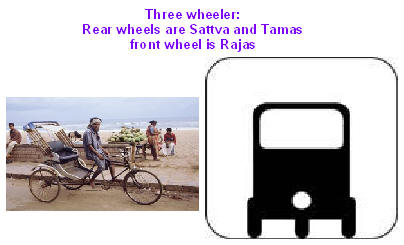 Krishna talks about psychology of human mind; the West has recently discovered
that emotion carries positive or negative valence. Happiness has a buoyant
positive valence. Greed, anger or fear weighs one down with leaden negative
valence. It is better to avoid people with negative valence because it is
contagious. Ambivalence is where a conflict exists between positive and negative
valences. Sattva carries a positive valence. Tamas carries a negative valence.
Rajas is ambivalent because it can move with Sattva or with Tamas. Sattva, Rajas
and Tamas are compared to a tricycle with Sattva and Tamas forming the rear
right and left wheels and Rajas forms the front wheel. If the front wheel moves
to the right, Positive valence of Sattva is dominant and if it moves to the
left, the negative valence of Tamas is dominant.
Krishna talks about psychology of human mind; the West has recently discovered
that emotion carries positive or negative valence. Happiness has a buoyant
positive valence. Greed, anger or fear weighs one down with leaden negative
valence. It is better to avoid people with negative valence because it is
contagious. Ambivalence is where a conflict exists between positive and negative
valences. Sattva carries a positive valence. Tamas carries a negative valence.
Rajas is ambivalent because it can move with Sattva or with Tamas. Sattva, Rajas
and Tamas are compared to a tricycle with Sattva and Tamas forming the rear
right and left wheels and Rajas forms the front wheel. If the front wheel moves
to the right, Positive valence of Sattva is dominant and if it moves to the
left, the negative valence of Tamas is dominant.
Rajas Guna is the inductor or stimulator. If Rajas is active on Tamas, Tamas becomes dominant and Sattva undergoes attenuation. If Rajas is active on Sattva, Sattva becomes dominant and Tamas undergoes attenuation. When Sattva is dominant, the person is closer to the Supreme Consciousness of Brahman (Siva in case of Saivites and Vishnu in case of Vaishnavites). When these three qualities are in balance or equilibrium (=state of equilibrium = Sāmyāvasthā), there is no expression. These qualities find expression only when there is disequilibrium. Only in the deities, Pure Sattva Guna exists--Suddha Sattvam.
Prakriti and Purusa are
like the Yin and the Yang, the feminine and the masculine principles, and Sakti
and Siva. Prakriti denotes a thought, a function, and an urge to produce and is
the product itself. Prasava Dharmin is the working principle: observation of the
law of conception and begetting. Prakriti is an active female principle, while
Purusa is the male principle; and the product is the universe. Prakriti stands
for cosmic will, and energy in projecting this universe. Purusa is Isvara, a
modification of Brahman and has the power of manifestation or māyā (Sakti).
Purusa is the subject and Prakriti is the object. Prakriti is matter which one
can touch and feel; Prakriti is also an attitude that you love, hate, ignore, or
transcend because of its gunas or modes. Prakriti is existence itself;
Prakriti's modes are the stuff of human relationship, in which Sattva, Rajas,
and Tamas clash, collide, and compromise. Prakriti by its nature makes compounds
or substances, which are not intelligent or thinking on their own accord. This
substance needs something that transcends it to control and direct it. Purusa or
Spirit carries out this necessary transcendence, because if the spirit is a
compound or a substance and has a stain of gunas, it cannot control another
substance. (See BG Chapter Two, Samkhya Theory, Verse 12 commentary.)
A person’s Sattva guna is proportional with the amount of spirit in him. God of gods display the most spirit; gods come next; the sattvic saints come next, and the Rajasic people display the least amount of spirit. In Tamasic men and animals, the spirit is infinitesimal or absent.
Since the spirit or purusa stays above the compound or substance, it is free from insentience, and does not fall in the realm of an object (both sentient and insentient), its function is that of a Witness. It stands in splendid isolation, it is neutral meaning It is not contaminated with our Gunas, and it is a Seer. That Witness abides in the spiritual heart along with the individual soul. Since the spirit or purusa has no attributes (transcends attributes), and does not take any of the qualities of our gunas, it is neutral. It is like the diamond in the dirt; the dirt does not affect the value of the diamond. This Neutral Witness is the Universal Soul, a Grid which the Yogis plug into when they are in a state of Turya.
Our bodies are made of five Great Elements of Prakriti; it is not so of the bodies of God and His cohorts in Vaishnava heaven. Prakriti is the world substance; the other worldly substance is Aprakritic, meaning it is a transcendent substance called Suddha Sattvam (Pure Goodness). The God, gods, the divine Consorts, Nityasuris (the eternally liberated ones) are all made of this Aprakritic transcendent pure goodness. We are made of bones, flesh, blood...: Prakriti; the gods are made of Suddha Sattvam. Prakriti is earth, water, air, fire, and space.
In Sri Vaishnavism, Suddha Sattvam is Pure Sattva not contaminated with Rajas and Tamas. Appearance or disappearance is not its nature. It is eternal. It is self-effulgent. Sun is self-effulgent; candle is not. It is also called Maya. It is transcendent Sattvic Aprakriti, not contaminated with Rajas and Tamas. The opposite of Maya is Avidya Prakriti, which is short on Sattva, and long on Rajas and Tamas. Malina Tattva = Avidya = Misra Tattva = Mixed principle. Suddha Sattva is the higher Form and Malina or Misra Tattva is the lower form. Suddha Sattva is Empyreal; the other is earth-bound. One is Gold; the other is iron. One is a prince; the other is a pauper. All souls caught in material energy are Misra (mixed) Tattva. One who gives up the material Tattva and considers himself an infinitesimal part of the Lord, the Supreme Personality of Godhead, is Suddha-anucit (Pure sentient atomic [small] fragment from the Lord = Chip off the Old block. Transcendental substance is called Suddha-Sattva. The Lord and His Cohorts in Paramapadam (Vaishnava Heaven) are made of Empyreal Substance; we the people are made of common prakritic substance. A little humor is in order: Gold runs in their veins, while iron runs in our veins.
All of the Lord's cohorts have transcendental bodies; have qualities identical with those of the Lord; are beyond the ravages of Time, of Suddha-Sattva nature, eternal, immutable, free of inauspicious qualities, effulgent with Vedic knowledge; and engage in fivefold worship of the Lord. --Gaudiya Cosmotheism. Bhagavan and His devotees live in Vaikuntam and have qualities of Suddha Sattva. Sankarsana (Brother of Krishna Bhagavan: It is all in the family.) radiates Suddha Sattva energy. This energy sustains Vaikuntam with auspicious qualities. Krishnn's Tirumeni (திருமேனி = Sacred Body) is of Suddha Sattva and aprakritic unlike the five great elements that make the body of His creations.
When matter or compound, or product of prakriti is close to spirit
or Purusa, matter lights up with life and the spirit reluctantly enjoys or
experiences matter or the three gunas, always yearning for isolation or
liberation. Isolation cannot come into existence, unless the impurities or
vitiating agents become obvious and undergo elimination. Isolation comes from
Kailvaya in a yogi in his superconscious state. Prakriti's products are
insentient Mahat or Buddhi, Ahankāra, Manas, body and the rest.
Naturally insentient Buddhi “receives” sentience from its proximity to Purusa. This sentience of Buddhi is
only a received and reflected glory and not an intrinsic property of Buddhi.
Isolation (Liberation = Kaivalyam) is a technical term and has nothing to do with isolation of infectious people.
Here is an example of how the three gunas help
liberate the self by illumination. If you take a lamp, there are three elements,
which cooperate to give light. The wick, the oil, and the flame are Sattva,
Tamas, and Rajas respectively. Because of their intrinsic nature, all these
three gunas or elements of the lamp are disparate and antagonistic to one another. However, in
combination and cooperation they emit light. The illumination is dependent on
diverse elements (the gunas) for the sole purpose of dissipating darkness in the
spiritual heart and eventual moksa or liberation.
The modes (gunas), namely Sattva, Rajas, and Tamas are in equilibrium in
their inert state and are resident in the sentient and the insentient. The time
element in Purusa agitates the gunas and an endless stream of behavior patterns
emerge because of varying proportions of each of the gunas. Disequilibrium
((Vaiṣamyāvasthā)
provides for the plethora of personality traits, when it comes to gunas. This
agitation caused by Purusa is the basis for the evolution or projection.
Purusa is weak in its limbs and has vision and
consciousness, and the Prakriti is blind but has the brawn and the brute
strength. The all-seeing Purusa rides on the back of the muscular Prakriti.
Prakriti is unthinking and its products are unconscious; Purusa has the vision
and consciousness and therefore we become aware of Prakriti. When Purusa is
riding on the shoulders of Prakriti, it deludes itself into thinking that it
acts and does the walk. Buddhi (discerning intellect) and Manas (Mind), and other products of Prakriti, are
unconscious elements, but are the instruments of Purusa's consciousness. When
Buddhi decides on a course of action under the aegis of Purusa, the Indriyas
(organs) carry out the order and do the work. Purusa is the King and sits at the
top of hierarchy; Buddhi is the Prime Minister; the Manas is the
commander-in-chief; and the Indriyas are the workers, soldiers, or bureaucrats.
Sattva is virtue, knowledge, light, and balance;
Rajas is motion and excitement; however, Tamas is sluggishness, darkness, and
passivity. All three elements are present in a person, an animal, and an object.
At any moment a particular Guna is dominant. (Read notes on lamp, mentioned
above.)
The dominant Gunas bring different results:
Sattvika devotees attain to God, the Rajasa people take birth again as human
beings, and the Tamasa people go to hell or come down to earth as animals. Those
who transcend all three Gunas become one with Brahman.
Brahma's Rajas is the force behind the creation. Vishnu's Sattva is the operating Guna for preservation and sustenance of the universe. Siva uses Tamas for dissolving the universe. Brahma, Vishnu, and Siva are not subject to these Gunas but use them as their instruments for specialized functions.
Prakrti = matter; Guna = modes; Avidya = spiritual ignorance; MAyA = Power; the source of Visible universe. Brahman = Self-existent Impersonal Incorporeal Spirit; the Universal Soul; Divine Essence and Source from which all created beings and matter emerge and to which all return; Supreme Consciousness. In Vaishnava view, there is no Impersonal Brahman; Vaishnava Brahman is endowed with Kalyana Gunas--auspicious qualities.
Prakrti consists of three gunas and reflects Brahman. Prakrti having Pure Sattva Guna is Maya; Prakrti having all Gunas is Avidya (A + Vidya = ignorance); Consciousness, reflected in Maya Mirror, is called Isvara (living god); Consciousness, reflected in Avidya Mirror, is Jiva (Embodied soul; We the people; the un-liberated). Brahman with Maya is Isvara; Brahman with Avidya--ignorance-- is Jiva or individual soul. Isvara has two sides, transcendent and immanent; He is transcendent when he is Brahman, He is immanent when he creates the world. Joseph Campbell explains what transcendent is. "In Occidental theology, the word transcendent is used to mean outside of the world. In the East, it means outside of thought."
Brahman is beyond human thought and imagination, as human beings are beyond the imagination of a worm. Since Avidya has many combinations and permutations by virtue of its Gunas, the Jiva has many aspects or modes of behavior. God is Supreme Consciousness (Maxi Me); we are the mini me; Supreme Consciousness has trickled down to human consciousness in people. Consciousness sleeps in stone, feels in flora, senses in fauna and thinks in man. Human consciousness can become Supreme Consciousness in the same way the lowly amoeba has evolved to become a human being.
I am introducing new terminology to explain Brahman and its linear elements. Supreme Brahman is Para Brahman and so MacroBrahman; Isvara is Maya Brahman possessing Maya; Avidya Brahman is the embodied individual soul (human beings) with Avidya or spiritual ignorance. (Remember that this piece presents the Monistic view of Brahman.)
I coined the word Exomaya to define Maya's qualities. Exomaya exudes from Isvara and is like the exotoxin of the bacterium, which affects the host and not the bacterium; in similar manner, Isvara producing Exomaya is immune from and not subject to it, but Jiva soaked in Exomaya is subject to and afflicted by it. Elsewhere Maya is compared to poison sac in snake; the poison does not affect the snake but the recipient of venom. The heat generated by the sun does not affect the sun but affects all beings and matter.
Exomaya is the product of Isvara which is the universe and its target is Jiva....
Ramprasad, an ardent devotee of Kali from Bengal calls Kali a kiter. She flies the kites; the kite enthusiasts fly the kite on the winds of hope, held by the cutting string, treated with Manjah paste (glue and glass). The bamboo frame of the kite is the human skeleton; the sails are made of Gunas; Kali applies the Manjah paste to the string. Out of many swooping, whooping, whipping, dancing, fluttering, trembling, circling kites, a few break loose; Kali laughs and claps Her hands. The loose kites are carried away to worlds beyond sea and earth. Here Kali is Isvari, the female counterpart of Isvara; the kite is Jiva (we the people) that swoops and flutters in the phenomenal world held by the string of Maya. Kite's frame, sails, tails, and colors correspond to the body and Gunas of Jiva. Maya gives the Jiva-kite enough room to make circles, swoop, play, and flutter, but Kali's grace (cutting the line with Manjah paste) releases the Jiva-kite from the phenomenal world to attain Moksa or liberation.
Isvara minus Exomaya = Transcendent Brahman = Brahman without attributes or three Gunas; Brahman beyond the three Gunas (Triguna+atitia).
Exomaya is his Iccha Sakti, His Will: His Will to create this world. Exomaya is not all bad or not all good. It is like the botox (botulinum exotoxins); untreated infant Botulism is fatal to infants in natural infection of gut, but in its therapeutic local application by local injection, it is used for cervical dystonia, strabismus and blepharospasm, and glabellar lines (wrinkles). You heard about Botox, the cosmetic used by plastic surgeons and Dermatologists as an injection to smooth over the furrows and frown lines on the forehead. The exotoxin is rendered harmless for use in medicine. http://en.wikipedia.org/wiki/Exotoxin
Exomaya's main malady is to prevent the souls from making the centripetal journey towards liberation, Moksa, Reality or God, until the soul is free from all impurities. As long as there is one unrealized soul, Exomaya is alive and well; its destruction or neutralization is the salvation of all souls. Why Isvara produces this world by his Will (or Exomaya) is beyond our understanding. Exomaya is a world of names, forms and functions (actions).
How do you go past this Exomaya? One can go past this by realizing that this world of names, forms and functions has hypostasis in God; that if there is no God, there is no universe; that we are all fragments of the Spirit cloaked by Kosas, sheaths or Kancukas made of matter and or limiting adjuncts; and that Sattva dominates all your actions.
Svetasvatara Upanishad describes Brahman as follows:
Sakti and Supreme are one entity; they are inseparable. Sakti is the cause of the world. Sakti, hidden in its Svarguna (intrinsic qualities), is the cause of creation, maintenance and destruction of the world. Unmanifest Brahman is Pure Cit (Consciousness); manifest Brahman is Cit with Maya or Prakrti and therefore goes by the name of Isvara. (Verse 1.3)
Krishna in his discourse The Uddhava Gita, Dialogue eight, Verses 27-34 advises Uddhava on Gunas and other states. Gunas have an influence on waking, dreaming and deep sleep. These three states of consciousness are not the intrinsic state of Jiva, whose true nature is eternal Superconsciousness. The three Gunas and the three states of consciousness hold the Jiva in bondage; the fourth state Turiya, a transcendental state of consciousness, shatters this bondage and lifts the Jiva to a higher state, where the Jiva identifies itself with the Self, meaning liberation of Jiva. Even higher state, the fifth state Turiyatita, results in merger of the Jiva with the Self; that is Advaitam, oneness with Brahman. As long as this world appears as many and an aspirant believes in it, he is in a dream state or deep sleep though awake, not seeing the sūtra (thread, Brahman) running through them all (like a thread in a garland.) This is true of heavens too. All are unreal as in a dream world (without the thread of the Self). In the awake world external objects appear as separate from a person, who, when dreaming, contains these objects only in his mind; in deep sleep, the external and the internal objects and experiences disappear; the only entity, Atman (Soul) is That which remains in all these states as the Witness. If there is no mind, there is no phenomenal world; therefore, the world is an illusion. That is the Monistic view of Sankara, who says that the phenomenal world and its parts are waves on the ocean surface; they rise and fall; the ocean remains the same. Here the ocean is Brahman or God; the waves are the Universe; There are no waves without a ocean; thus, the hypostasis of the universe is Brahman. Mind is operative only because Purusa illumines it. Mind is an inanimate object or entity; it is the Purusa, Isvara, Brahman, God, or Consciousness that lights it up so it can experience the world. It is like the inanimate chip in the computer: No juice, no game.
14.1:
Sri Bhagavan said:
I shall again declare the supreme knowledge, which
is the highest of all knowledge, by knowing which all munis (sages) attained
supreme perfection in their afterlives.
14.2:
Having taken refuge in knowledge, and having entered My
nature, they are neither born at the time of creation nor suffer at the
time of dissolution.
Ramanuja says that we are sparks from the fire: The
sparks are the jivātmans and the fire is the Parmātman.
According to R and Alvars, Prapatti, Saranāgati, Bhakti and sattvic
behavior guarantee liberation. When the Lord rescues us from the ocean of
Samsāra, and we step down from dizzying cycles of birth and rebirth, we gain an
equal status with the Lord: We are separate but equal in the eyes of the Lord.
This separate but equal status is at variance with Sankara's view: On
liberation, we become one with Brahman and become indistinguishable from Brahman
in the same way milk mixes with milk and waves fall back on the ocean.
Liberation, eternal and irrevocable, guarantees release from creation and
dissolution.
What is the nature of Bhagavan?
He has eight qualities generally called Purusatva: 1. Sobha = சோபனம் = beauty; 2. Vilasa = விலாசம் = sporting, pastime; 3. Madhuryam = மாதுரியம் = sweetness; 4. Mangalyam = மாங்கலியம் = auspiciousness; 5. Sthiram = ஸ்திரம் = stability; 6. Tejas = தேஜஸ் = splendor; 7. Lalita = லலிதை = playfulness; 8. Audarya = ஆதர்யம் = munificence, magnanimity.
For Bhagavan the whole universe is lalita or playfulness. It is like building sand castles on the beach, which are subject to wind and waves. Question arises as to why His playfulness is our misery and joy. We don't know the answer. Some advance partial answers. The soul is afflicted with impurities. It is sent with a body into this world that is created for it, so that the impurities mature and fall off like ripe fruits. It is like going to the school of hard knocks; graduation ensures the soul is mature and free from all impurities. Thereupon, god confers Grace to the pure soul and takes it back. This is the Saiva view.
14.3:
The great Brahman is My womb, in which I induce pregnancy. From that, all
living beings are born, O Bharata.
Brahma, the names and the forms, and the food are
born of the omniscient Isvara. He placed His seed into that womb.
Brahma is Hiranyagarbha, the Cosmic Golden womb, the food,
the egg, and the aggregate of all souls and the universe. The names and the
forms are latent. Hiranyagarbha receives the seed from Isvara; the great Brahman
is the womb and the lower prakriti; and the Purusa or the Greater Self is the
Higher prakriti (Suddha Sattvam = Pure Empyreal Substance). This lower great Brahman undergoes transformation into Mahat,
buddhi, ahankāra, manas, Indriyas and the rest. An egg contains the food for the
emerging life, all the genes, and the codes to create a new life; and thus,
Hiranyagarbha is the womb, the embryo, the food and the universe, all contained
in one unit. Narayana, the Parama Purusa, created the egg, entered the watery
part of the egg along with the principles, and rested on the coiled bed of Sesa.
The Parama Purusa, called Vairaja, is separate from the egg (Spirit is separate
from matter). Austerity (tapas) performed by Higher Brahman (Vishnu/Narayana) is
the driving and causal force behind the world.
The cosmic egg (Brahmanda; Anda = egg) was the abode of Lord Vishnu in the
form of Brahma. Water, air, fire, ether, ahankāra, and principle of intelligence
and indiscrete Principle are the external coverings of this egg, containing the
mountains as big as Mount Meru, the restless oceans, the whole universe, Suras,
Asuras, human beings, and other living creatures. It is comparable to an
unhusked whole coconut with many layers, filled with water, and lined inside
with “white meat.” Vishnu Purana says that Vishnu took the form of Brahma in the
creative process and maintenance of the universe out of His goodness. At the end
of a Kalpa, Vishnu takes the form of Janārdana (agitating or exciting Man or
Giver of rewards or the object of worship and adoration by men) with the Tamasa
(dark) guna, and becomes Rudra and swallows the universe. Janārdana is special
in the sense that as one God he assumes the duties of all three gods namely
Brahma, Vishnu, and Siva for creation, maintenance, and “devouring.” Once He
devours the universe, it becomes one large ocean. The Lord rests on the snake
bed and goes into “Nidrā.”
Nidrā is the goddess of sleep who enters the body
of Lord Vishnu, who goes into sleep on a bed of snake sheltered by a canopy of
its hoods in the causal ocean. With the imminent onset of next Kalpa, Brahma
orders Nidrā to leave the body of Vishnu and the Lord initiates the creative
process. Goddess Nidrā is no other than a form of Mahālakshmi, the consort of
Lord Vishnu.
14.4:
Whatever forms appear in the wombs, O son of Kunti, I am the seed-giving father
of all of them in the great womb of Brahma.
This tells us that Isvara or Brahman is the father
and the mother of every being in this world. The prakriti provides the matter
and He provides the seed.
14.5:
Sattva, Rajas, and Tamas are the gunas, born of Prakriti,
bind down the imperishable self to the body.
14.6:
Because Sattva is pure, it is shining and sickness-free (anāmayam), but binds
one (the self) because of its attachment to happiness and knowledge, O Arjuna.
तत्र सत्त्वं निर्मलत्वात्प्रकाशकमनामयम् ।
सुखसङ्गेन बध्नाति ज्ञानसङ्गेन चानघ ॥१४- ६॥
tatra sattvaṁ nirmalatvāt-prakāśakam-anāmayam
sukhasaṅgena badhnāti jñānasaṅgena cānagha 14.6
tatra1
sattvam2
nirmalatvāt3
prakāśakam4
anāmayam5
sukhasaṅgena6
badhnāti7
jñāna-saṅgena8
ca9
anagha10
14.6
tatra1 = Therefore; sattvam2 = Sattva; nirmalatvāt3 = being pure; [is] prakāśakam4 = shining; [and] anāmayam5 = free of sickness; [ but] badhnāti7 = binds; sukhasaṅgena6 = because of connection to happiness; ca9 = and; jñāna-saṅgena8 = connection to knowledge; anagha10 = O sinless one.14.6
Anāmayan = An+āmayam: absence of sickness, disease
Sattvic people are bright and healthy, but Sattva
binds the self to prakriti and therefore is an impediment to liberation.
14.7:
Know that Rajas is (of the nature of) passion and
greed. O son of Kunti, it (Rajas) binds the
embodied self by its attachment to fruits of work.
Ahankara works hand and glove with Rajas. Ahankāra believes it is the doer; Rajas is motion in the doer and powers the doer. All the wars and wrangling have dominance of Rajas in them. Rajas and Tamas with little Sattva are the basis for criminal and antisocial behavior. Gandhi says in effect ― with modifications: Rajas is wealth without work, and politics without principles; Rajas and Tamas are pleasure without conscience, knowledge without character, commerce without morality, science without humanity, and worship without sacrifice. Work, principle, conscience, character, morality, humanity, and sacrifice are the seven supporting pillars of Sattva.
14.8:
Know that Tamas is born of ajñāna (ignorance) and it deludes all embodied
selves. It (Tamas) binds by negligence, laziness, and sleep, O son of Bharata.
14.9:
Sattva attaches one to happiness; Rajas to action; O Bharata, and Tamas to
negligence by hiding wisdom.
These gunas bind the jiva to the matter. To rise
above these gunas, the yogin performs jnāna and raja yogas, tapas, and
austerity. The yogi uses the gunas as the steps on the ladder; he uses pure
Sattva to reach Brahman, the pure light. The raja yogi directs his energy to
unlock the Kundalini power in him. Tamas sublimates into Kaivalya, samādhi,
silence and shanti (shanti is peace, tranquillity and rest).
Let us find out what happens when Rajas and Tamas
are out of control. Hitler is a pure, double-distilled, whole, and certified
killer-lunatic of dominant Tamasic qualities with little Sattva in him. His Rajas and
Tamas showed in his Tamasic plan of final solution and the Rajasic quality of
mobilizing a military machine to achieve that end. He rejoiced in carrying out
his master plan and death of Jews based on Tamas and Rajas, while he cried over
a dead bird out of his vestigial sattvic nature! Hitler, the Messiah of death,
did not like cut flowers in his room for the sole reason: they are dead!
14.10:
Sattva dominates by overcoming Rajas and Tamas; O Bharata, Rajas (dominates)
Sattva and Tamas like that; and Tamas (dominates) thus Sattva and Rajas.
Sattva (White), Rajas (Red), and Tamas (Black) each dominate by
overcoming or suppressing the other two gunas. As said earlier, Purusa causes
this agitation and imbalance in the gunas and thus creates panoply of
personality traits.
|
Dr. Radhakrishnan on the definitions of Sattva, Rajas and Tamas in Bhagavadgita, page 319. (14.10) Goodness prevails, overpowering passion and dullness, o Bharata (Arjuna). Passion prevails, (overpowering) goodness and dullness and even so dullness prevails (overpowering) goodness and passion. |
| ■ The three modes are present in all human beings, though in different degrees. No one is free from them and in each soul one or the other predominates. Men are said to be sattvika, rajasa or tamasa according to the mode which prevails. When the theory of the "humours" of the body dominated physiology, men were divided into the sanguine, the bilious, the lymphatic and the nervous, according to the predominance of one or the other of the four humours. In the Hindu classification, the psychic characteristics are taken into account. The sattvika nature aims at light and knowledge: the rajasa nature is restless, full of desires for things outward. While the activities of a sattvika temperament are free, calm and selfless, the rajasa nature wishes to be always active and cannot sit still and its activities are tainted by selfish desires. The tamasa nature is dull and inert, its mind is dark and confused and its whole life is one continuous submission to environment. |
14.11:
When the light of knowledge shines forth from the gates of the body, we know
that Sattva has increased or expanded.
The embodied soul, while controlling all his
activities, renouncing them in his mind, and remaining in happiness in
the city of nine gates, is neither working nor
causes work. (BG 5 verse 13.) The nine gates of the
embodied soul are the two ears, the two eyes, the two nostrils, the mouth, the
reproductive, and the evacuative organs. Hear no evil, see no evil,
breathe easy, speak no evil, practice bramacharya, or fidelity in marriage, and
do no evil: All these qualities correspond to the light emanating from the nine
gates of the body. The individual soul by itself is pristine in its free state:
It has no karmic loads. However, once soul takes on the body and other sheaths,
karma, its fruits, and outcomes weigh it down. Once the karmic inflow stops
because of cessation or control of all activities, the embodied soul is
action-free and is ready for moksa.
14.12:
Greed, activity, and beginning of self-serving endeavors, unrest, and eager
desire: these come forth when Rajas increases, O Best of Bharatas.
लोभः प्रवृत्तिरारम्भः कर्मणामशमः स्पृहा ।
रजस्येतानि जायन्ते विवृद्धे भरतर्षभ ॥१४- १२॥
lobhaḥ pravṛttir ārambhaḥ karmaṇām aśamaḥ
spṛhā
rajasy etāni jāyante vivṛddhe bharatarṣabha 14.12
lobhaḥ1
pravṛttiḥ2
ārambhaḥ3
karmaṇām4
aśamaḥ5
spṛhā6
rajasi7
etāni8
jāyante9
vivṛddhe10
bharata-rṣabha11
14.12
lobhaḥ1 = Greed; pravṛttiḥ2 = activity; ārambhaḥ3 = beginning; karmaṇām4 = of actions; aśamaḥ5 = unrest; [and] spṛhā6 = desire: etāni8 = these; jāyante9 = manifest; [when] rajasi7 = Rajas quality; vivṛddhe10 = becomes dominant; bharata-rṣabha11 = O the best of Bharatas. 14.12
Sprihā: eager desire, longing for, pleasure.
Arambah: the self-serving, self-promoting initiatives to ensure personal profit
or gain.
Greed, hustle and bustle, unrest, and longing are the qualities of Rajasic
nature. Greed is
acquisitive
beyond one's needs. Activity, endeavor, and restlessness show desire for rewards
of work. Eager desire is a starter for gratification of senses.
According Garuda Purana (1.221.11-12), Greed is the cause of anger, malice,
delusion, illusion, misplaced prestige and jealousy. They, free from lust,
hatred, falsehood, anger, greed, delusion, and arrogance, become calm and
contented, and reach heaven free from sins.
14.13:
Darkness, stagnation, Negligence, and delusion: these come forth when Tamas
increases, O Joy (son) of Kurus.
Aprakāsa means lack of illumination, or darkness or
lack of knowledge. Here it is not book knowledge. It is the Spiritual Knowledge of the
Supreme or Self. Apravrttih is lack of forward movement or progress, stagnation;
Mohah is delusion; Kuru-nandana means joy and son of Kurus: It is like saying
that Arjuna is the pride and joy of the Kurus. When Tamas dominates, darkness
descends; illusion ascends; stagnation stays; and negligence pervades.
14.14:
When the embodied proceeds to dissolution and Sattva is on the ascent, that time
he reaches the world of the pure and the knowers of the Highest.
14.15:
Attaining dissolution during Rajas, (it) takes birth among those attached
to action. In like manner, when one dissolves during Tamasic nature, he takes
birth in an ignorant womb.
He who dies in a Rajasic mode takes birth among
human beings attached to action and fruits. Here
Mūdha-Yonisu means foolish,
stupid, bewildered, and ignorant womb: It implies that he will take birth in the
womb of an animal. Dissolution
means death. In Verse 14, the Lord says the Sattvic individual goes to the world
of great and pure souls. If he were to be born again, he is born in a family
with the knowledge of the Self. The Rajasic person is born again in this world
in the family of workers who seek fruits or rewards for work and gets a chance
to become sattvic. The Tamasic person is born an animal in an ignorant womb,
meaning there is no knowledge of self in the family or the Tamasic being. It
will take one or more births before he qualifies for a human birth.
14.16:
The fruit of good action is (said to be) Sātvikam and purity, the fruit of
Rājasah is
misery (and suffering), and the fruit of Tamasah is ignorance.
The fruit of good action is goodness (Sātvikam) and
purity, the fruit of Rajas is misery and suffering (Dhuhkam), and the fruit of
Tamas is ignorance (ajnānam).
Sātvikam consists of three qualities: happiness,
wisdom, and freedom from all worldly desires (sukham, jñānam, and viaragyam).
Misery = Ūrmis = ऊर्मि. The world is a dungeon full of misery and darkness. They are known as Ūrmis (ऊर्मि), meaning waves, that is waves of existence or afflictions: hunger, thirst, decay, death, grief, illusion. The spiritual beginner finds the world Kakabistha (crow's droppings), but once he attains Sadhana (perfection), the very same world appears as Brahman.
14.17:
From Sattva arises knowledge; from Rajas (arises) greed; and from Tamas
arise negligence, delusion and ignorance.
Sattva gives rise to knowledge; Rajas gives rise to
greed; and Tamas gives rise to negligence, delusion, and ignorance.
14.18:
Those who are steadfast in Sattva go upward (to heaven); the Rajasic stay in the
middle; and the Tamasic immersed in the meanest guna, go down or sink low.
The following is within the scope of Upanishads: It
appears that material originating from Akāsa (Imperishable Ether) infused with
the all-pervading Self, undergoes an evolutionary process from a plant or an
amoeba to an animal to a human being. This evolutionary compulsion carries the
being from an amoeba to a sannyāsi, who reaches the world of gods on gaining
Brahman. At human level, the individual soul displays Buddhi, which is absent in
the animals. Endowed with Buddhi and knowledge, it is up to him to ascend,
descend, or ride the ever-spinning wheel of samsāra of birth and rebirth. The
Lord gives him the equipment (gunas) and the manual (the knowledge of the Self)
to ascend. The path he chooses is up to him. Live free in heaven; or ride the
Wheel of Samsāra of birth and rebirth; or sink low and become a worm, a pig or a
plant: these are the choices for a human being. This stepping out of our body
into the realms of Higher Self is an active process. In other words, this
jivātman seeking to merge with the Higher self is not a passive process of
entitlement. We have to strive hard. “All that is human must retrograde if it do
not advance.” (Edward Gibbon, 1776)
“In this world nothing is certain but death and taxes” (Benjamin Franklin). To
this list, we should add “Rebirth and Karma.” One pays tax on the property
posthumously. Taxation is the law of the land; Karma is the Law of the Universe
of souls and intertwines with the Law of Rta: Karmic law is the rider clause.
Karmic law came into existence at creation, or more correctly, projection and
keeps samsāra in motion. If man can device posthumous taxation, it should not be
too difficult to imagine that karmic law works after death and keeps the cycle
of birth and rebirth in motion. The new saying goes like this: One cannot escape
death and taxes, karma and rebirth unless one reaches Brahman.
14.19:
When the seer discovers no performer other than the Gunas, and knows that which
is Supreme and beyond the Gunas, he attains to My state.
The Gunas are the agents or performers. The seer or
the sage as said elsewhere gets rid of the Tamas and Rajas with the help of
Buddhi's filter. When Tamas filters out, turbidity is removed; clarity is
striking; and waters of the consciousness are clear. Still there are waves on
the surface. Rajas, the generator of waves and the agitator, is removed next.
The result is the placid waters of consciousness are ready for superconscious
state. In this placid state, the self sparkles, remains translucent and shows
its pristine nature. Now the seer can ascend and transcend even the Sattvic rung
of the Gunas and become one with Brahman. When a person leaves behind and
transcends the gunas and the self returns to its original state, the seer has
attained His likeness.
14.20: The embodied self transcends the three Gunas
that give rise to the body and attains to immortality, having become free from
birth, death, old age and sorrow.
|
Dr. Radhakrishnan Bhagavadgita page 322-3. गुणानेतानतीत्य त्रीन्देही देहसमुद्भवान् । जन्ममृत्युजरादुःखैर्विमुक्तोऽमृतमश्नुते ॥१४- २०॥
guṇān
etān atītya trīn dehī
dehasamudbhavān November 24, 2013 (14.20) When the embodied soul rises above these three modes that spring from the body, it is freed from birth, death, old age and pain and attains life eternal. dehasamudbhavān: this implies that the modes are caused by the body. "Which are the seed out of which the body is evolved." Samkara:1 Even sāttvika goodness is imperfect since this goodness has for its condition the struggle with its opposite. The moment the struggle ceases and the goodness becomes absolute, it ceases to be goodness and goes beyond all ethical compulsion. By developing the nature of sattva, we rise beyond it and obtain transcendent wisdom.2 1 dehotpattibījabhūtān. 2 Just as we pull out a thorn by a thorn, so renouncing worldly things we must renounce renunciation. kāṇtakaṁ kāṇtakaneva yena tyajasi taṁ tyaja. By means of sattva we overcome rajas and tamas and then get beyond sattva itself. |
Gunas divide people into various categories; they
also help distinguish sentient from the insentient, man from animal, and god
from man. Gunas make this self or soul bound to the body. The inexorable march
of time from infancy to old age tells on the body, mind and gunas, until death
separates the body from its soul. Once the self is unbound, and set free from
the kosas and the gunas, the self goes home to immortality, never again to be
spun around in the wheel of samsāra.
Moksa is the only avenue of escape from old age. It
is quite possible to control the wind, tear the ether, and tie down the waves, but it
is impossible to maintain youth.
Terrible diseases are the companion-soldiers of old age, but they never offer
protection. Death (and Time) waits for no one; man leaves tasks half done at
death’s call. The wolf of Time preys on the goat of a man. When man is split by
greed, steeped in oil of passions, and roasted on the fire of anger and envy,
death is the epicure (Garuda Purana, 11.49.37-39-42).
14.21:
Arjuna said:
What are the marks of a man who transcended the
three Gunas? What is his conduct? How (in what manner) does he transcend these
three Gunas, O Lord?
14.22:
Sri Bhagavan said:
O Pandava, he, who hates illumination, activity,
and delusion, neither when they arise, and desires for them nor when they cease
(continued)
Here illumination, activity, and delusion stand
respectively for Sattva, Rajas, and Tamas. The transcendent person neither hates
nor desires the products of Sattva, Rajas, and Tamas.
14.23:
He, who is sitting indifferent to these Gunas, unperturbed, and knowing the
Gunas are in motion, remains firm and does not waver.
14.24:
He, who is tranquil in pain and pleasure, abides in his own self, regards that a
clod, a stone, and gold are equal; to whom the desirable and the undesirable are
the same; who is the same in blame and praise; and
(continued)
|
Swami Rama Tirtha (1873-1906) was great Advaitin who was also equally at ease
with Persian, Arabic as well as Sanskrit literature. He happened to be in
Lucknow in 1905 when Muslim Maulanas came to him to get enlightened on Hinduism
and their own religion. He had a dialog with them about God. The spiritual prince tells the twice-born to take his gift back.
Here is a case of verbal abuse piled high on the Buddha by an orthodox Brahmin. Find out how the Buddha handled him. As told by Swami Ram Tirtha. Once an orthodox Brahmin went to Lord Buddha and discussed religion with him. When Buddha did not agree with his point of view and controverted all his tricky and unsound arguments, he felt defeated and started abusing and insulting him (Buddha). But Lord Buddha, as was usual with him, kept quiet and, with his eyes closed, got lost in meditation. When the Brahmin saw that Buddha did not pay any attention to his abusive insults, he was getting ready to leave. Lord Buddha then opened his eyes and very politely put a very ordinary question to him: "What should a man do, if he does not want to accept something he has been offered?" The Brahmin said "It is very simple. The man can refuse the concerned gift and return it to the giver." Lord Buddha then said, "Quite right, I do not accept your insults. They are as such being returned to you." The bigoted Brahmin was so penitent and softened with Buddha's peaceful attitude that he immediately apologized and entered his fold with all of his followers. Anger, spite, envy etc., are like infectious diseases. The angry man knows fully well that his anger will agitate his opponent. And, if he fails to do so, due to the peaceful, smiling and unconcerned attitude of his rival, it certainly defeats his very purpose. That is how Lord Buddha, with his quiet and peaceful behaviour, forced the angry and envious Brahmin to accept defeat. You can also silence your oppressive and abusive opponent with your serenity and and peacefulness. 222 In Woods Of God-Realization |
14.25:
who considers honor and dishonor equal; who regards friends and foes
alike; and who abandons all (self-serving) initiatives, is said to transcend the
Gunas.
Arambah:
are the self-serving, self-promoting initiatives or endeavors or efforts
to gain personal profit.
14.26:
He, who serves Me with unswerving Bhakti yoga (devotional service) and rises
above all these gunas, becomes fit for the state of Brahman.
14.27:
I am the abode of Brahman, immortal and imperishable, and eternal dharma
and absolute bliss.
|
Dr. Radhakrishnan on the definition of Brahman according to Samkara, Ramanuja, Nilakantha, Madhva and Madhusudana. Bhagavadgita page 325. November 24, 2013.
(14.27) For I am the abode of Brahman, the Immortal and the Imperishable, of eternal law and of absolute bliss. ■ Here the personal Lord is said to be the foundation of the Absolute Brahman. Saṁkara (S) makes out that the Supreme Lord is Brahman in the sense that He is the manifestation of Brahman. Brahman shows His grace to His devotees through Īśvaraśakti and He is that power in manifestation and therefore Brahman Himself. S. gives an alternative explanation. Brahman is the personal Lord and the verse means "I, the unconditioned and the unutterable, am the abode of the conditioned Brahman who is immortal and indestructible." Nīlakaṇṭha takes Brahma to mean Veda. Ramanuja interprets it as the emancipated soul and Madhva as māyā. Madhusūdana takes it for the personal Lord. Kṛṣṇa identifies Himself with the absolute unconditioned Brahman. Samkara: Brahman manifests as Isvarasakti/the Personal Lord. Nilakantha: Brahman is Veda. Ramanuja: Brahman is emancipated soul. Madhva: Brahman is Maya. Madhusudana: Brahman is Personal Lord. Kṛṣṇa identifies Himself with the absolute unconditioned Brahman. |
According to Brhad-āranyaka Upanishad 4.3.33,
Bliss has been unitized. He, who
is healthy, wealthy, lordly, and opulent, enjoys one unit of the highest bliss
of man. From a previous to the succeeding stage, the bliss is greater by 100
times.
The multiplier effect is listed below:
Table:
|
Highest human bliss is (one). |
1 Unit of Bliss |
|
Man* who won over his world |
100 Units of Bliss |
|
Ghandharava’s Bliss,1 Unit = BlissX1X100X100 |
10,000 = ten K |
|
God’s bliss by action = BlissX1X100X100X100
=1,000,000 |
1 million |
|
God’s bliss by birth = BlissX1X100X100X100X100
=100,000,000 |
100million |
|
Prajapati’s bliss = BlissX1X100X100X100X100X100
=10,000,000,000 |
10 billion |
|
Hiranyagarbha’s bliss =
BlissX1X100X100X100X100X100X100(Also Brahma’s bliss Br UP 4.3.33) |
1,000,000,000,000 =
1 Trillion |
Taittiriya Upanishad (2.8.1) talks about bliss in
the following manner. Youth with erudite knowledge of the Vedas, perfect in
action, firm in mind, and sturdy in body enjoys one unit of human bliss. Human
fairy enjoys one hundred times the human bliss. Divine fairy enjoys one hundred
times the bliss of human fairy. Father enjoys one hundred times the bliss of
divine fairy. One hundred times the father’s bliss is god’s bliss (by
birth). One hundred times the bliss of god by birth is the bliss of god earned
by meritorious work Indra’s bliss is one hundred times the bliss of gods.
Brhaspati’s bliss is one hundred times Indra’s bliss. Prajapati enjoys one
hundred times Indra’s bliss. Bliss of Brahma is one hundred times Prajapati’s
bliss. Brahman’s bliss is beyond calculation.
Man* who won over his world is the one who
practiced sacrifices, charity and austerity. Br. Upanishad 6.2.16
End BG Chapter 14 The Three-Guna
Psychology