Bhagavad-Gita:Chapters in Sanskrit
|
(All 18 chapters in Sanskrit, Transliteration, and Translation.) |
Bhagavadgita in English
|
Veeraswamy Krishnaraj: Tolerance with love is to speak in tongues of all faiths, hold in the heart the Truth of all faiths and see all faiths in the face of humanity.
Here is your Google search engine tailored for this site. Please enter the word in the search box; it will take you to the file with that word in this web site. Enjoy your visit here. |
| https://myindiastories.com |
BG Chapter 2
SAMKHYA YOGA– THE YOGA OF KNOWLEDGE
The Battlefield of
Kurusetra
Arjuna’s Distress
|
For the west, knowledge is discovery, sometimes mistakenly called invention; for the Hindu, it is recovery. Our pristine soul is the repository of knowledge that will last for eternity; recovering it is man's object; a complete recovery is an impossible proposition. All discoveries and the so-called inventions are that recovery process. There is nothing new a man can invent that is not in the repository of the soul. Man who says he "invented" the wheel has not seen the sun, the moon, or the dung beetle. The idea of the wheel coming from them was floating in the cosmos and on earth; man made that recovery process. Dung Beetles knew about rolling the ball before man "invented," rolled and spun the wheel. Invention is a misnomer for its blueprint is waiting for recovery. Intuition and genius are instruments in that recovery process and are not the exclusive property of man because the instinctive dung beetles beat him to the punch. One cannot invent something that is already present in the inexhaustible repository, which defies human imagination and is a trillion steps ahead of human intelligence so much so the so-called new inventions will go on until dissolution of the universe and a fresh start will begin again. Dr. Alexander Wood of Scotland (b 1817) and Dr. Charles Gabriel Pravez (b 1791) are credited with the invention of the hypodermic needle. They deserve credit and accolades for construction of the needle and not for invention. How could they invent something that was already present in the mosquito? It is the lowly Anopheles gambiae, the living hypodermic syringe and needle of all times, which deserves the credit for designing such a fine hypodermic needle. It took so long for the industry to build a fine needle for the insulin-dependent diabetics and yet it is not as sophisticated and fine as the mosquito's system. Mosquito's needle can curl up. It was hungry and had to eat. Its soul had the knowledge to devise a way to draw and obtain balanced nutrition to sustain the 50-200 eggs it had to lay; it had only two weeks to live in the wild, before it can guarantee the survival of its progeny. Its soul helped it devise the perfect hypodermic syringe to sustain life on the nutrition, a well-balanced blood-food. That self- sustaining and self-perpetuating compulsion to devise the needed adaptation is what scientists call mutation, adaptation and evolution. We share the soul with the mosquito, however dangerous and lowly the latter is. That soul is the repository of knowledge and a fragment of Paramatman (Supreme Soul). When the Anopheles mosquito takes in a blood meal, its abdominal temperature may rise to 104ºF ; the mosquito excretes urine and preurine through the anus (see the drop at the anus); as the fluid evaporates, it cools the abdomen. |

|
The whole universe is built on 0 and 1; all else is extension of 0 and 1, an off and on switch, Siva and Sakti. It came from Sunya or void; it became One and One became many. Take Lingam, we see a perfect alignment of zero and one. |

|
"The ancient Indian mathematician Pingala presented the first known description of a binary numeral system in the 3rd century BCE, which coincided with his discovery of the concept of zero." Pingala also refers to the Nadi, the flow channel for Pingala Nadi. Go to Kundalini Power.
BG Chapter 2
SAMKHYA YOGA– THE YOGA OF KNOWLEDGE Anyone who holds these beliefs follows the Bharata Dharma or common principles of all Aryan beliefs. Thus as regards God we may either deny His existence (Atheism) or affirm it (Theism) or say we have no sufficient proof one way or another (Agnosticism). It is possible to accept the concept of an eternal Law (Dharma) and its sanctions in a self-governed universe without belief in a personal Lord (Ishvara). So Samkhya, which proceeds on intellectual proof only, does not deny God but holds that the being of a Lord is "not proved". Sir John Woodroffe. |
|
Sayings of Sri Ramkrishna, page 241 887. A devotee: Why is the Divine Mother called Yogamaya? Purusha = Spirit or Siva; Prakrti = Nature, Parvati or Sakti. The Master: Yoga maya means the union of Purusha and Prakriti. Whatever you see is nothing but that union of the two. Haven't you seen the Siva-Kali image--Kali standing on Siva? Siva is lying prostrate like a corpse and Kali is with a fixed gaze upon Siva. All this means the same Purusha-Prakriti union. Purusha is inactive, hence Siva is lying down inert like a corpse. But by virtue of the union with Him, Prakriti is doing everything--creation, preservation and destruction. The same is the significance of the coupled image of Radha and Krishna. Samkhya yoga (सांख्य योग) explained in the form of a story involving Siva and Parvati. (Siva Purana) Parvati Challenges Siva. Woman (man) challenging God is an ancient Hindu tradition. Parvati: I am Prakrti (प्रक्रृति) and You are Purusa (पुरुष).
Before Pārvati married Siva, Parvati rendered personal service to Siva, who was doing meditation and penance. Siva would not accept her unless she gives up Prakrti (प्रक्रृति = matter) and do penance, which would take her to a higher state. Parvati and her father visited with Bachelor Siva. Siva was not very receptive to divinely beautiful Parvati. Siva advised Parvati's father not to bring her near him because young woman was a distraction and hindrance to an ascetic and Yogin. Siva said that contact with woman engenders worldliness and attachment and endangers penance. " I shall not have any truck with woman; woman is the cause of loss of wisdom and detachment,' said Siva. On hearing these jarring words, Himavat the father of Parvati became very nervous and frightened because his daughter was keen on marrying Siva. Parvati was no shrinking violet. She made sure she spoke her mind to ascetic Siva, with due respect and reverence. Parvati: You have the noble soul, intellect, the energy and the inclination to do penance. That energy is Prakrti, the root cause of all activities. All things are created, maintained and destroyed by it. If not for prakrti, your Linga form would not exist. You command respect, worship and meditation because of prakrti. Siva: My penance will destroy Prakrti. I am Supreme Consciousness without a trace of prakrti. All virtuous people should avoid Prakrti and worldly affairs. Parvati: Under the existing conditions at this moment, how can Prakrti cease to exist? I find it difficult to accept that You are beyond Prakrti. This universe and objects are bound by prakrti. Your speech, your words, your actions are activities of prakrti. To say that prakrti is unreal is a meaningless proposition. This mountain is prakrti, whereon you sit to do your penance. Prakrti envelopes You. It is all around you. You cannot escape it. It is apparent you are not aware of your situation; that being so why do you perform penance? (Your) Inference carries no meaning or authority without perception. Wise people say the embodied beings are the objects of sense-organs and everything is Prakrti. O Lord, I am not inclined to give a lengthy explanations. I pronounce now in absolute terms that I am Prakrti (प्रक्रृति) and You are Purusa (पुरुष). This is the Absolute Truth without any doubt or dither. My Prakrti and blessings will help you gain a body and a set of qualities. Without me, You have no attributes and no competence to do any activity. Your activities proceed from me; you cannot exercise self-control without the admixture of Prakrti. If you are really superior to Prakrti, you should not fear keeping Me by Your side. Siva: I understand, Parvati, you just described the Samkhya (सांख्य) system. You are welcome to do all virtuous and permitted religious services to me. If I am the master of illusion and Brahman, the Supreme lord without the taint of illusion and attainable and knowable through spiritual knowledge, what will you do, Parvati? Since that day, Parvati came in the company of her maids as was before and rendered service to Siva unaccompanied by her father. None of the Ganas, Nandisvara or others prevented her from doing service to Siva. Siva: You can go and come as you please. You can render service to me. From then on, she was regular in the service of Siva. Siva would not marry her until the last remnant of ego in her died down and She performed penance on Her own accord without any prompting from Him. Siva reverted to meditation and became the Yogi of yogis. He saw Parvati was making progress. He did not see Her though He did see Her (in His inner vision). In course of time, Parvati dispelled all Her ego and married Siva. ----------------------------------------------------------------------------------------------------------------------------------------- Swami Chinmayananda on Samkhya Philosophy
According to the Sankhyan philosophy---essentially dualistic—the world is constituted of two intrinsic factors-- Purusha and Prakriti: Spirit and matter. Spirit is the sentient, intelligent, Knowing Principle, the vital factor, the source of all life that expresses through physical forms. Matter is insentient, unintelligent and lifeless in itself, but it comes to exhibit the characteristic of life when it is blessed with a close proximity with the Spirit. Purusha by itself, cannot achieve or execute but when matter comes in contact with it, it is charged with dyanamism. The spring in the watch is inert-- then what makes the watch work ?The tension in the spring. That is not an activity; all activities of life take place when Purusha has no activity; all activities of life take place when Purusha dons the robe of matter. Prakriti herself is inert ; Purusha by himself has no activity. But when they are wedded to each other, both seem to gather divinity, might and power, as a result of each blessing the other. In this philosophical concept the logic of thinking took the Sankhyans to a natural conclusion that Purusha reveling within one sample of matter is different from the Purusha in all others. Liberation from the entanglements of Prakriti is gained by Purusha when there is discrimination on all occasions and in all conditions, recognizing the eternal Spirit as separate from finite matter. One step ahead of Sankhya is Vedanta. It explains that when one gains the true knowledge of the Purusha , the Atman, the Yogi experiences that Prakriti is only a superimposition upon the Purusha, that there is, in fact, no such distinction—the Supreme alone is, One-without-a-second, reveling everywhere, the subtlest of the subtle, the pure Principle of Consciousness.
Dr. Radhakrishnan on Purusa and Prakrti Bhagavadgita page 308. November 19, 2013.
(13.I9) Know thou that prakṛti (nature) and Puruṣa (soul) are both beginningless; and know also that the forms and modes are born of prakṛti (nature). ■ As the Supreme is eternal, so are His prakṛtis.1 Through the possession of the two pṛakrtis, nature and soul, Īśvara causes the origin, preservation and dissolution of the universe. The puruṣa described in this section is not the multiple puruṣa of the Sāṁkhya but the Kṣetrajña who is one in all fields. The Gītā does not look upon prakṛti and Puruṣa as two independent elements as the Sāṁkhya does but looks upon them as the inferior and the superior forms of one and the same Supreme. 1nityeśvaratvād Īśvarasya, tat prakṛtyor api yuktaṁ nityatvena bhavitum. S. |
|
The Māyā-Tantra says: "Those who are learned in Yoga say that it is the union of Jiva and Atma. According to others (i.e., Saivas) it is the experience of the identity of Siva and Atma. The Agama-vādis proclaim that Yoga is the knowledge (Jñāna) relating to Sakti. Other wise men say that the knowledge of the Purāna-Purusa is Yoga, and others again, the Prakrti-vādīs, declare that the bliss of union of Siva and Sakti is Yoga." By" union of Jiva and Atma " is meant Samadhi. By Yoga is meant that by which oneness is attained with the Paramatma. Serpent power, Page 463,Sir John Woodroffe. |
|
Samkhya, Vedanta, Srivaishnava, and Saiva perspectives. |
|
The ultimate aim of Samkhya-Yoga and Vedanta is to attain liberation (Mukti) which is isolation (soleness, Kaivalya). Samkhya Yoga helps isolation of the soul from Prakrti; Vedanta from Māyā. In Srivaishnava tradition, Kaivalya has an added import. It is liberation of the soul from matter, karma and rebirth but it has not earned its right to live in Paramapadam or Vaikuntam, the Ultima Thule of the soul in Srivaishnava tradition. This is one of the divisive issues between Ten Kalais and Vada Kalais of Srivaishnavism. It appears that Ten Kalais are satisfied with Kaivalyam, a lower achievement; the Vada Kalais insist that Vaikuntam or Paramapadam is the Real Thing. Below, read Nammalvar's opinion on Kaivalyam and Paramapadam (Soul realization Vs God realization). In Samkhya, liberation of the Self or Purusha means freedom from pain and suffering without the Vedantic Bliss. Samkhya Purusha or Self is the highest entity, Sat-Cit (Being-Consciousness) but there is no Ananda or Bliss. In Vedanta, the Self attains liberation meaning it is Sat-Cit-Ananda (Being-Consciousness-Bliss), identical with Brahman. It is Atmananda, the Bliss of Self. |
|
|
|
Kaivalyam in Srivaishnava TenKalai (தென்கலை) tradition is like a glass ceiling wherein you look through the glass but cannot get into Vaikuntam. Vada Kalais believe in Vaikuntam as the only mark and place of liberation. |
|
Kaivalyam is glass ceiling. glass ceiling: An unacknowledged discriminatory barrier that prevents women and minorities from rising to positions of power or responsibility, as within a corporation. |
|
|
|
|
|
|
|
2.1: Madhusudhana (Killer of demon Madhu), Lord Krishna, having seen Arjuna overwhelmed by compassion, looking confused, eyes brimming with tears, depressed and lamenting... |
|
2.2: Sri Bhagavan said to Arjuna where
this filth (kasmalam) came from at this hour of crisis which is
Un-Aryan practice and which would not lead
him to heaven but to infamy. |
|
Aryan = one with courage, courtesy, nobility and straight dealing. Definition by Dr. Radhakrishnan. |
|
The old-world Indian (Sanskrit) word Aryan is synonymous with nobility and trustworthiness. |
|
The view from the West: A change from invasion theory to native Aryan Indian theory |
|
Donald A. Mackenzie in his book, Indian Myth and Legend (page, xxxviii-ix, says, "If the long-headed Kurds are, as Ripley believes, the descendants of the Mitanni raiders, then the Aryans of history must be included in the Brown race. They are regarded as ancient brunet dolichocephalic (long-headed) peoples. During the Brahmanical age, a fresh Aryan wave hit India and divided (themselves) as Westerners of Punjab and Easterners of Kasi (Benares, Varanasi), Maghada, Kosala, and Videha. The kings of the Easterners (Ramayana) claimed to have descended from the solar race. The Middle Country Aryans came as the next wave and put themselves between the Westerners and Easterners, called themselves descendents of Lunar Race and Bharatas and worshipped goddess Bharati associated with Sarasvati river. Sarasvati River dried up in 1900 B.C.; Rg Vedic hymns are placed prior to it. The Kurus and Purus of Mahabharata were the descendants of Bharatas. |
|
It is postulated that the Indo-Aryans migrated out west as far as Egypt, when Sarasvati river dried up. The Bharatas worshipping the moon and Sarasvati River were possibly the Brown Aryans. Much later, the Vedic gods, the Fire god and Indra "suffered eclipse;" Brahma, Vishnu, and Siva with their respective consorts came into prominence. |
|
The west is quick to say that the central figures of Ramayana and Mahabharata are not historical but creations of active imagination of Brahmanical compilers for religious propaganda. Here are some dates: Epic Sanskrit, the forerunner of Classical Sanskrit is tentatively assigned a date between 5000 BC (the date of Rg Veda) to 2000 BC. Ramayana of Valmiki is assigned a date to about 3500 BC; Mahabharata of Vyasa to about 3000 BC. Misra opines that the theory that the Mahabharata precedes the Ramayana is baseless. The original home of Indo-Iranians is India; Iranian is the second most archaic language next to Sanskrit; all other Indo-European languages and the Indo-Europeans came from India and thus the Indo-Aryan is the immediate or proximate progenitor of the Europeans. Simply put, Indo-Aryan gave the genes and the speech to the Europeans. The loan words of Hungarian, Finnish, and Estonian (Uralic) are derived from Sanskrit as the Indo-Aryan made several trips to these areas from 5000 BC. Harmatta says that the loan words in Chinese and Korean are derived from Sanskrit. Since the discovery of fire altars, Indus civilization is accepted as a continuation of the Vedic Civilization. Misra opines that Dravidians are also Aryans and that Aryans did not drive out the Dravidians to the South. Thus the Indo-Aryans, the Iranians and the Dravidians were living in India spreading out to Europe. One factor in the color of the people depends upon the longitude and latitude of their habitat. Remember people marry within their group or caste and thus certain physical features get embedded or imprinted in that group and make them appear distinct from other groups or castes. Some people defy by their physical features categorization by group or caste or even race. The Greeks were not Greeks in that they came from outside and destroyed the Minoan-Mycenaean civilization. (Joseph Campbell says that Greeks and Indo-Aryans are cousins.) The Germans came to Germany from outside; so were the Celts, the Slavs, the Iranians. Misra goes a little further to say that "India as the best place for the origin of human beings." -- Page 224-229, The Indo-Aryan Controversy. |
|
There are historians who dispute the supposition that Indo-Aryans were of external origin; they originated in India, spread to other countries (Persia, Europe and Asia) and later came back to their motherland; in that process they spread their language and speech. The world was making cockamamie sounds; Sanskrit life letter a and its cohorts e, i, o, u, au, am... came about and introduced intelligible mellifluous sound, speech, and text for the first time. The world, before the Indians gave the vowels, were talking in lifeless generic consonants, grunting, grating, screeching, jarring.... Satya Swarup Misra says that no language worth its salt existed before 5000 BCE when Rg Veda was existent. No European language existed before that date: Sanskrit first, Persian later and all other Indo-European languages much later. The Gypsies left Central India earlier than 3rd century BC and spread all over Europe. The Indo-Aryans likewise populated Persia and Europe. (Misra thinks that Dravidian and Indo-Aryan belong to one language and one genetic family.) |
|
The English words father, mother, brother and sister are (derived from) cognate with Sanskrit: pitar, mātar, bhrātr, and svasar (पितृ, माता/मातृ, भ्रात्र, स्वस्रृ). Sanskrit was the First Spoken and Written Language in this world. The universe of alphabets, words and languages originated from Mother Goddess, Kali. |
|
Jesus uses the word abba (father) 170 times to describe God's relationship to humans and his very nature. In Tamil we call father APPA (அப்பா) mother Amma (அம்மா). ABBA and APPA are cognate with Pitar, Patar or pater. In Tamil, it is common to address Father God as Appan (= அப்பன்). Tamil 'Amma' and Hebrew 'Ima' means mother. |
|
Here is an instance of pettiness and unwillingness on the part of erstwhile ruling class to give credit to India. H.L.Gray says, "The earliest investigators were quite certain that it was in Asia, the continent which was the source of oldest civilization, the traditional site of the garden of Eden, and where Sanskrit was spoken." A scholar of his caliber could not get himself to mention India by name and thus used the substitute word Asia instead. Now you know why the West makes it appear that Aryan came from outside India. In their mind the Indo-Aryan of Sanskrit could not be a original native Indian. So they put him all over central Asia. |
|
Return of the Aryans by Bhagavan S. Gidwani tells the story of Indo-Aryans in the format of a novel. |
|
The West says that there are essentially three schools: 1) the Indigenous School which claims Punjab as the origin of the Indo-Aryans 2) the Out of India School which espouses the theory that the Indo-Aryans were the immigrant forefathers of today's Iranians. [The dug-up old Iranian human skeletons are not Indian.] and 3) the Devabhasya School which asserts that all so-called Indo-European languages originated from Sanskrit. |
|
Elst says Sanskrit palatization of words (ca, cha, ja, jha, na) allows for the possibility that (Indo-Aryan) homeland was originally India and not outside. He makes a somersault and an about-face and says that still there is a possibility of immigrant origin of Indo-Aryan. Retroflection, so characteristic of South Asia, is not found in Old Iranian, discounting Out of India Theory. |
|
Hock injects a new element on the so-called anasa (noseless or mouthless) Dasyas in Rg Veda. Arya and Dasa do not refer to color but to "light and dark worlds." Anasa refers according to him to possessing bad speech and not to bad nose. (Some regard the inhabitants of Indus valley as Sumero-Dravidians.) Let me give you an example of onomatopoeic words, bad speech and good speech. Brr, grr, hmm, mm, psst, tsk are some of the dead consonantal English words (onomatopoetic interjections) without vowels. Let us take the word Zebra. It was most likely called zbr, that dead consonantal annoying sound without mellifluous ease, grace, stars and stripes; then came along the vowels donated by the Sanskritic Indo-Aryan; zbr acquired the sound of zebra and the life-giving vowels show their stripes (and stars). |
|
The prevailing opinion at present is that 1) there is no linguistic or archeological evidence to support the Invasion Theory, 2) Pre-Vedic Indo-Aryan culture became a Hybrid Vedic Culture from contact with other cultures at religious, material, and linguistic areas, 3) the Indus Valley Script and the Horse are the bugaboos. If the Indus Valley script is deciphered, a new paradigm comes into play and the theories have to be revised. The horse, the chariot, and the Indo-Aryan: do they go together always? Are they contemporaneous? The horse was first present in 4th millennium BC in India and later in Persia and Caucasus. Likewise the Indo-Aryan traveled from India to Persia, Caucasus and beyond. They all didn't walk; some rode on horses and some walked. |
|
Skeletons of
IVC
(3300 BCE-1700 BCE) ,
Harappans
(1700 BCE-1300 BCE)
Vedic
Aryans
(1500 BCE-500 BCE) and present-day
North-west Indians
are not markedly different. Some believe that Harappans were Proto-dravidian. Decline of
Indus
Valley Civilization
(IVC)
is not attributed to invasion but to natural conditions, such as drying up of
Sarasvati River. |
|
Let me give you an idea of the kind of cities they had. The walls encircling the city was 40 feet wide at the base and 35 feet high. Mud was used to hold the bricks on the walls, and gypsum and lime mortar for the drains. The sewer system featured terra cotta pipes with manholes like what you see in the modern cities now. They built multistoried house with flat tops. Like the modern day laundry chutes they had garbage chutes in the houses along with toilets and bathrooms. They had 23x39x8 feet tank with 8 feet thick walls for public bathing. Copper, bronze, lead, silver, ivory and gold were in use. They were trading with Mesopotamia and were called Meluhha. They cultivated barley, wheat, peas, sesamum, cotton.... Cotton would not appear in the west in the next 2000 years.
|
|
Indus Valley Civilisation collapsed due to Climate change Monday, March 03, 2014
A study of Scientists led by the University of Cambridge and Banaras Hindu University has suggested that Climate change contributed in the fall of the Bronze Age Indus Valley Civilisation (also known as the Harappan Civilisation), which spanned across present India and Pakistan. The study has revealed that the Bronze Age megacities declined during the 21st and 20th centuries BC and never recovered back following a series of droughts that lasted for about 200 years in the zone of Indus valley. To study on the concept of the collapse the team of British Scientists studied snail shells that were preserved in the sediments of an ancient lake bed Kotla Dahar in Haryana. They anlysed oxygen isotopes of the shell and calculated the amount of rain that happened in the lake thousands of years ago. he results of the project shed a light on the mystery for sudden disappearance of the major cities of the Indus Valley Civilisation. The study has also linked the decline with the documented global scale climate event and its impact on other civilisation of Old Kingdom in Egypt, the early Bronze Age civilizations of Greece and Crete as well as the Akkadian Empire in Mesopotamia.
Scientists confirmed that climate change as the reason
for collapse of the civilization by studying the evidences from Arabian
Sea, Oman and Meghalaya and say that unexpected weakening of the summer
monsoon affected northwest India 4100 years ago. The
study was funded by the British Council UK-India Education and Research
Initiative to investigate the archeology river systems and climate of
north-west India using a combination of archaeology and geo-science. The
study was published in the journal Geology. |
|
Cotton was cultivated in India 7000 years ago (5th millennium BC) for use in clothes. Use of cotton was widespread in its use in 2000 BC in India. The Greeks and Arabs did not know what cotton was and its use until the invasion of Alexander. Megasthenus said that in Indica, there were trees growing wool. China and Egypt used cotton a few hundred years before Christ. |
|
Cotton appeared as imported fiber in Europe in the late medieval period. It was then called Tree Wool. "There (India), they grew a wonderful tree which bore tiny lambs on the ends of branches." British East India Company forced India to supply raw cotton only for manufacture as textiles in the UK and the Indians were forced to buy British textiles. |
|
Take Adam and Eve, born 4004 B.C according to Bible. They were unaware of their nakedness to begin with in their pristine innocence; once they consumed the forbidden fruit, they became aware of their nakedness and adroitly and artfully arranged the fig leaves to hide their pudendal assets. If Adam and Eve were born in India, they would have worn cotton. Yes, the Europeans were wearing animal skins, while the Indians were strutting their stuff in lightweight elegant cotton. |
|
We know Siva wore tiger and elephant skins under different circumstances. Siva, the mendicant God, went incognito on a mission to subdue the all-powerful arrogant Seers (Rishis) in the forest. The desperate wives of the Rishis were casting forlorn glances at handsome Siva, who made very suggestive gestures to the ladies. The gaggle of seers' wives went around Him in circles, were giggling, arranging the hair and touching Siva. The Rishis became mad, dug a pit, raised a fire, and chanted Mantras. Out came a living tiger from the fire pit by the strength of magical Mantras, pouncing on the bare-chested mendicant Siva. Siva, the Lord of men, gods and animals, skinned the animal with his fingernail (Yes, a God can do that.) in the blink of an eye and wore the skin immediately. The Rishis realized only Siva could do something like that to tear apart their hubris, immediately fell flat on the ground and paid their obeisance. The ever-auspicious Siva, on acknowledging their repentance, forgave them. |
|
Sanskrit is the Mother of languages; the European languages are the daughter languages. There are only two classical languages in India: Sanskrit and Tamil. |
|
|
|
Listen to what Mark Twain says:
|
|
***They tried to find horse bones in Harappa. Yes, the horses were in Harappa. They tried to pin the tail on the donkey. It was decided after all India was not a donkey country but donkeys came from outside India. Thank God, donkeys are not native to India, but horses were. What a relief to know that. We all can attest to it. They were looking for broken and bruised skeletons as evidence of massacre of the native Harappans by the so-called invading Aryans. Uninjured skeletons were found at different depths in the dig, evidence against a massacre. George F. Dales (1964) very aptly decried this so-called massacre as "The Mythical Massacre at Mohenjo-daro." For fifty years since Independence the Indians were made to sit in the corner. Now suddenly, the talking heads (read yapping heads) of TV Land are talking about Bangalore and Indians taking their jobs. Recently, the leaders from other nations are visiting New Delhi to drum up some business. 2010.
***November 28, 2021 Thehindu.com Horses in India https://www.thehindu.com/sci-tech/science/were-there-domestic-horses-in-ancient-india/article37725223.ece?homepage=true
Indian story
|
Momma comics February 01, 2010

|
What a mind-tickling ride for me in all these years! Indian scientists have Chandrayaan 1 circle the moon without outside help (November 2008). India sent 2976-lb Mangalyaan (Mars Orbiter Mission) to Mars on November 5th, 2013 on its 300-day 485-million-mile journey. |
|
The native genius is showing. The Indo-Aryan vs Dravidian or North vs South divide goes bust. The scientists belong to both South and North. Some suggest that the Dravidian and Sanskrit share many words and thus need further study of their affinity. Another hypothesis is Aryan and Dravidian are two parts of single Aryan identity. They exchanged culture, words, phrases etc. Colonialism and independence have not served well to sort out this matter. If you are all confused, welcome to the club of polemics, politics, passion, and confusion. How is this for rumination: We all belong to one human race? |
|
The Indo-Aryan looks at the sun and the moon and said that is Circle, Zero, Zip, Zilch, Nada, Null.... If it is not for the Dravidian, you won't have an idea of a million, a billion, a trillion, a quadrillion, a zillion.... The concept of ZERO came from the Indo-Aryan. Without 0 and 1, You would not have the computer. This is the story of Zero. The Indo-Aryans were fond of offering sacrifices to the elemental gods so they could receive favors in return. Indra was the god of thunder and lightning. The Indo-Aryan provided Soma (inebriant and hallucinogen) to the gods and the gods gave them rain, cattle... The sacrificial pit was constructed to raise fire. The Fire-god was the messenger to carry the plea to the gods, who in return sent rain... For the construction of the pit, they had to have a starting point and precise measurements. That starting point, they called Zero (śūnya). |
|
sunya (śūnya), meaning "empty") = empty, void, unoccupied, deserted. |
|
Comparison of Hindu Sanskrit Numerals and Roman Numerals |
|||||||||
|
१ |
२ |
३ |
४ |
५ |
६ |
७ |
८ |
९ |
० |
|
1 |
2 |
3 |
4 |
5 |
6 |
7 |
8 |
9 |
0 |
|
I |
II |
III |
IV |
V |
VI |
VII |
VIII |
IX |
|
|
When you take 8, it is a composite number (VIII) having four glyphs. Sanskrit has only one glyph for 8. This great convenience of Hindu numerals made the European merchants change to single-glyph numerals in the 14th century, so it was easy to calculate the profits... |
|
To know about the story of 1 (the origin and dissemination of 0 (Zero)and numbers) click on the link below (PBS) |
|
http://www.pbs.org/previews/storyof1/ |
|
Excerpt: |
|
The Indian numbers were a smash hit across the Islamic world before they were finally brought to Europe, where they met fierce resistance. It took 500 years for the battle between Roman and Indian numbers to play out, but by the 16th century, the Indian figures, now commonly called Arabic numerals (Read Indian numerals- my input), finally triumphed - perhaps because Florentine mathematician Fibonacci showed Christian merchants how useful Indian numerals could be, for instance, for calculating profits. |
|
But the story doesn't end there. Within a hundred years, German mathematician Gottfried Leibniz invented a binary system, using the Adam and Eve of mathematics, One and Zero. Since then, as the language of computers, this two-digit binary system has come to dominate every part of modern life. |
|
"The ancient Indian mathematician Pingala presented the first known description of a binary numeral system in the 3rd century BCE, which coincided with his discovery of the concept of zero." Pingala also refers to the Nadi, the flow channel for Pingala Nadi. Go to Kundalini Power. See what happens, Gottfried got the accolades for binary system, and Pingala was never heard of. This is the way history is written. |
|
The story of the number one is the story of Western civilization. Terry Jones ("Monty Python's Flying Circus") goes on a humor-filled journey to recount the amazing tale behind the world's simplest number. Using computer graphics, "One" is brought to life, in all his various guises, in STORY OF 1, airing on PBS Wednesday, March 29, 2006, 8:00-9:00 p.m. ET. One's story reveals how celebrated civilizations in history were achieved, where our modern numbers came from and how the invention of zero changed the world forever - and saved us from having to use Roman numerals today. |
|
Here is an example of servile sycophancy of some Indians of the colonial period and Phule's demolition of pet theory of two castes and petty divisions of the caste system. |
|
The following piece is from The Indo-Aryan Controversy edited by Bryant and Patton. The words are mine. |
|
The Arya-Brahmanas declared, fortuitous circumstances brought the civilized British White Aryans to India to uplift the degraded Indian (Brown) Aryans -- the forerunners of the bygone era and bring the latter to their former glory. Some British felt it that way too. The Brown Indo-Aryans declared themselves as the chosen race. "It was for nothing that God has showered his choicest blessings on this ancient land of Aryavarta. We can see His hand in history." This declaration was made in Lahore in the Aryan Land of Five Rivers. One such Indo-Aryan declared that there were only two castes: Brahmins and Sudras. The Ksatriyas, they declared, were killed by Parasurama; the Vaisyas no longer existed. The acuteness of the hostile situation was felt by the then ruler Shivaji in 1676, when the local Brahmins refused to accept him as Ksatriya (they were all killed by Parasurama) and refused to perform his coronation ceremony. A Kasi Brahmin did the honors to Shivaji. |
|
Then came Phule of gardener caste, sedimented, hardened, layered, and sandwiched between the Untouchable and the Sudra. He agreed with vicarious mildly malevolent glee with the prevalent premise of two castes, Brahmanas and Sudras. Then he began his demolition by design by placing explosive charges at the critical places and lighting the fuse. Phule (1827-90) accepted the theory of invading Aryan Brahmanas for didactic purposes, killing of the indigenous kings and Vaisyas and subjugation of the humble indigenous people (Dasas and Dasyus by the Brahmin-Aryas). He spoke aloud of the cruelty of the foreign Arya-Brahmins subjugating the humble Pre-Aryan people of the soil and killing of all the Vaisyas and the indigenous Ksatriyas (the kings), many of whom died fighting the invading Arya-Brahmanas; the survivors became the MahA-ari (Great Enemies). These MahA-aris were relegated to the status of Untouchables; the king (Ksatriyas--the ruling class) becomes an Untouchable. The subjugated native sons of the soil became the land-owners or land-tillers and the name he gave them was Ksetriyas (Ksetra = land, field), which sounds cunningly like Ksatriyas. Now you see Phule's use of Arya's premise and tools of separation, segregation and superiority to demolish them. He says Vamana's subjugation of king Bali and his expulsion to Netherworld as an example. |
|
|
|
As said earlier,
Arjuna incarnates from
|
|
Vyasa, the author of Mahabharata, and the Bhagavad Gita as
told by Krishna, was born of a Brahmana father and a non-Aryan mother (a
fisherwoman).
Satyavati
(Sanskrit: सत्यवती) is the mother of Vyasa and
great-grandmother of the Pandava and Kaurava princes, principal
characters of the Mahabharata. She is nevertheless a
commoner, daughter of a ferryman or fisherman.
She is also known as Matsyagandha (one who
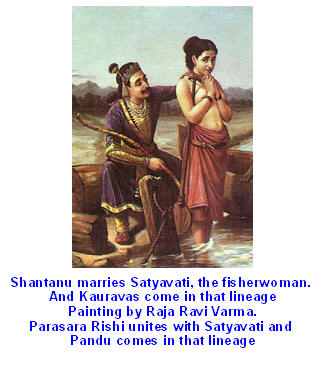
has the smell of fish). This is again a Yogic phenomenon. (Consider Jesus Christ born of Virgin Mary.) The West says that Vyasa is a generic name (meaning compiler) like teacher, tailor, barber. There were many Vyasas, according to the west. Many of the sacred texts span over many centuries and they could not have been all composed by one Vyasa. This is contested by devout Hindus. Later, King Santanu legally marries Satyavati with "inviolate hymen", who thus becomes the matriarch of the Pandavas in the lineage of Parasara Rishi and the Kauravas in the lineage of Santanu. Pandavas (the good guys) have the Seer's (Rishi) blood run in their veins. The Kauravas (the bad guys) have the royal blood run in their veins. |
|
The lineage of Pandavas and Kauravas. Union = Sexual relations not sanctified by marriage.
|

|
Note:
Purusa creates heaven from His head and the earth from His feet. If
liberated men and gods do not populate heaven, there is no meaning in living
(a virtuous life) on this earth; therefore, earth and heaven are integral
parts in the life of men and gods. When gods fall from grace, they come down
to earth as humans. Prajapati created the asuras (demons) first and the gods
second; there were more asuras than gods; the asuras and the gods were
half-brothers, the embodiments of evil and goodness. Each one of us is part
asura, and part god: Which is dominant? If there is no evil, there is no idea
of goodness; therefore, evil is a necessary part of our character. How much of
one is evil? We have in each one of us a pristine, stainless entity, namely
atman. It is evil-free.
|
|
Garuda Purana (1.213.35) defines filth as fat, semen, blood, marrow, saliva, feces, urine, earwax, phlegm, tears, mucus in the eyes and body sweat. There are eight auspicious entities in this world: Brahmins, cows, fire, gold, butter, the sun, water, and the king. When one encounters any of the above, he should view, worship and circumambulate that entity. |
|
Let me take up the example of water as auspicious.
Rudra was born of Brahma and was given water as his body.
Wherever you see water, you are seeing Rudra, Bhava or Siva. Since all
living beings are born through water and made of water, the body of Rudra or
Siva, one should not urinate, defecate, spit, wade nude, or have sex in the
waters (think of Jacuzzi). One should not obstruct the natural flow of waters into the sea. –Brahmanda
Purana,1.2.10.29-32.
Pollution of water is
considered an act against the body of god.
|
|
|
|
क्लैब्यं मा स्म गमः पार्थ नैतत्त्वय्युपपद्यते । |
|
क्षुद्रं हृदयदौर्बल्यं त्यक्त्वोत्तिष्ठ परन्तप ॥२- ३॥ 2.3 |
|
klaibyaṁ
mā sma gamaḥ
pārtha nai 'tat tvayy upapadyate |
|
|
|
klaibyaṁ = unmaniliness. mā sma gamaḥ = do not yield to. pārtha = Partha (Arjuna). tvayi = of you. upapadyate = becoming or worthy. kṣudraṁ = base (Ramanuja). hṛdayadaurbalyaṁ = faint-heartedness (R); Weakness of the heart (Sankara). tyaktva = giving up (S). Uttiṣṭha = Arise (Rad = Radhakrishnan). paraṁtapa = Scorcher of foes (R). |
|
2.3: O
son of Partha (Arjuna), this smacks of impotence and weakness of the heart,
which are unbecoming of you, the conqueror of enemies. |
|
Lord
Krishna says that this sudden attack of grief speaks ill of a Ksatriya.
Cowardice and weakness of the heart are the Tamasic qualities of king in
retreat; the Sattvic Ksatriya must face the enemy, have a balanced emotion,
weigh the outcome, and fight to win: That is Ksatriya's duty. Since retreat
from battlefield for a Ksatriya is sin itself,
|
|
|
|
2.4: Arjuna said:
|
|
O Madhusūdana, how
could I ever fight with arrows on the battlefield
|
|
|
|
Note: Bhisma is the
grandfather of the Kurus, and Drona is the military science or marital arts
teacher for the Kurus. Arisūdana: slayer of foes. |
|
|
|
2.5: Begging would give me more joy than killing my gurus and the great souls; By killing them, I will be enjoying wealth and desires tainted with blood. |
|
|
|
The pleasures, I would
enjoy in this life and in this world by killing them, are not worthwhile,
considering that those gains would have a taint of blood. |
|
|
|
Bhisma
and Drona are worthy figures for reverence and even worship; they enjoyed high
life under the Kauravas. Arjuna contends how he could enjoy same high life,
after killing the revered Bhisma and Drona: All those enjoyments would have a
taint of blood. Arjuna did not consider that his was a just cause and theirs
was not. Arjuna's reverence, compassion, and love for the teachers, elders,
and relatives overpowered his will to fight: He was shirking his duty. |
|
|
|
|
|
want to live, having killed the sons
of Dhritarastra, who stand before us in the battlefield. |
|
We do not know what is better for us between the two: vanquish them or be vanquished by them. If we killed the sons of Dhrtarastra arrayed before us in the battlefield, we do not have a penchant for living. |
|
|
|
Note:
Dhrtarastra is the blind king with 100 sons, the Kauravas; and Duryodhana is
the eldest. Arjuna sees a conflict between his dharma (duty) as a Ksatriya and
his principle ahimsa (nonviolence) as a man |
|
2.7: A taint of
misplaced compassion afflicts my nature; I am addled about my sense of duty;
what I ask of You is that You tell me in no uncertain terms what is honorable
for me. I am Your disciple and seek advice and refuge in You. |
|
Dharma
means duty and virtue. Arjuna cannot cope, and lost his verve and nerve. What
can he do? Arjuna seeks advice
from his God and his friend, Lord Krishna. Arjuna wants divine help in
conflict resolution in his mind. |
|
The
king is the refuge of his subjects, the parents are the refuge of the
children, righteousness is the refuge of men, Lord Hari is the refuge of all
(Garuda Purana, 1.230.46). |
|
2.8: I do not see how I
could get rid of my sorrow that has wilted my senses, even if I achieve
unrivaled prosperity and kingdom on the earth and the supremacy over gods in
heaven. |
|
2.9: Sanjaya said (to
Dhritrastra):
|
|
Having spoken thus to
Hrisikesam ( |
|
Hrisikesam: the Lord of the senses. Gudakesa: the conqueror of sleep, a name
for Arjuna. |
|
Fall
into silence may suggest here the beginning of a spiritual awakening for
Arjuna, also known as the conqueror of sleep (ignorance). Gudākesa also means
that Arjuna is “thick-haired.”
Arjuna has reached the end of the rope. Initially he was exercising his reason
and even reason has taken leave of him. The faintness of his heart hindered
his capacity to address the call for duty. He has not even waited to see what
his God Lord Krishna or teacher has to say on this matter: It shows a total
exhaustion. That makes it all the more difficult for his savior or teacher to
get him out of his deep depression, and inculcate some sense and dharma into
Arjuna. Dhritrastra, the father of Kauravas, was happy to hear from Sanjaya
that Arjuna, the archenemy of Kauravas, was losing the will to fight, which
could end in the victory of the Kauravas.
|
|
2.10: O Bharata (Dhritarastra),
Hrisikesa smiling with a hint of ridicule, standing between the two armies,
spoke the following words to Arjuna who was in acute sorrow. |
|
|
|
2.11: Sri
Bhagavan ( |
|
You grieve for those
worth not grieving for, yet you speak words of wisdom. The panditah (learned
men) grieve neither for the dead nor for the living.
|
|
An individual has an eternal soul and a perishable body; there is no reason to grieve for something that is eternal, and there is no reason to grieve for something that is perishable. If a living one grieves for the dead because of the death of the physical body, the dead have to eat the tears and the phlegm formed during the grieving; eulogy instead of grief will appease the departing soul. When a person has the knowledge of the self and the body, he grieves neither for the living nor for the dead. The soul is eternal and real, and the body is unreal (in relative terms) and subject to change, because of its insentient elements. |
|
Bhagavan: One who is endowed with Bhaga (Grace) is Bhaga-van. Bhaga consists of six attributes: (Transliteration from Tamil) Aisvaryam, Viryam, Pukaz, Tiru, Jnanam, and Viaragyam (Supremacy, Power, Glory, Sacredness, Wisdom, and desirelessness. others list the following attributes: knowledge of creation, maintenance, destruction, origin and sublation of all life forms, Supreme Truth, and Avidya or ignorance. Some say that the attributes correspond to nine angles of Yantra, which is a mystical diagram made of geometric forms, images, avaranas, deities, alphabets and syllables etched on metals and stones, whose purpose is to invoke god for progeny, health, and wealth and attain Samadhi |
|
Others list the following: Sri (Auspiciousness), Virya (Power), Jnana (Wisdom), Vairagya (Dispassion), Kirti (Glory), and Mahatmya (Greatness). |
|
Bhaga is Grace and any desirable quality such as dignity, majesty, distinction, excellence, beauty, loveliness, love, affection. |
|
2.12:
Never was there a time that neither I, nor you, nor those kings did not exist
and nor will all of us stop to exist from now on.
|
|
The Recycling of souls. |
|
We are spirit and matter, which are recycled according to the merit or demerit of karmic load. It is Samsara, birth and rebirth. Samkhya philosophy of dualism: Kapila was the founder and propounder of Samkhya philosophy. Its basis is not Vedic; it treats two juxtaposed contrary polar principles: Prakrti and Purusa. In Samkhya, Prakrti does not contaminate Purusa but the latter lights up Prakrti. Prakrtik products are Mahat, Ego, and the senses. It is the Purusa that lights up these products of Prakrti. Ramakrishna Paramahamsa illustrates this point by saying that the human body is like a pot and the mind, intellect and the senses are like water, rice and potato. When the pot is boiling the contents become hot, though the heat source is from the fire. Similarly, the power of Brahman causes the mind, intellect and the senses to function. When that power stops to act, all cease to work. Adapted from Sayings Ramakrishna, saying 27, page 28. |
|
Proponents of Sankhya system do not believe in Isvara but in Purusa that has Jnana not unlike Nirguna Brahman. The Light of Purusa makes the Inert Prakrti to quicken and evolve the world of matter. Purusa is not the Nimitta Karana (Efficient Cause) as Isvara is. This transformation (Parinama) is inherent, spontaneous, and pre-programmed in Prakrti. Of course Vaishnavas and Saivas who believe in Isvara dispute this idea. |
|
Sankaracharya of Kanchi says Parinama Vada does not hold water and advocates Monistic Vivarta Vada (a method of asserting the Vedanta doctrine--maintaining the development of the Universe from Brahman as the sole real entity , the phenomenal world being held to be a mere illusion or MAyA) |
|
Purusa is Consciousness and Supreme Unparalleled Intelligence, and Prakrti [Pra (before) krti (creation)] is matter, unconscious, indiscriminate, and insentient. If PRAKRTI sounds similar to PROCREATE, it is so in meaning too. Prakrti indicates an urgency to produce, as Prasavam (parturition) has the imminence to deliver a baby. It is the same as PROCREATIX in Latin. |
|
Woodroffe in Serpent Power: Prakrti is derived from Kr and the affix ktin which is added to express bhAva or the abstract idea and sometimes the Karma, or object of the action, corresponding with the Greek affix sis. Ktin inflected in the nominative becomes tih, tis. Prakrti therefore has been said to correspond with 'nature' of the Greeks (Banerjee, "Dialogues on Hindu Philosophy," 24). It is also called Pradhana, Pra+dha+anat=Pradhatte sarvam ātmani, or that which contains all things in itself, the source and receptacle of all matter and form. Pradhana also literally means" chief" (substance), for according to Samkhya it is the real creator. |
|
The splendid Hymn to Prakrti in Prapancasāra-Tantra. What can be seen by the eyes can be defined, but not She. "It cannot be seen by the eyes." Kena Up., 1-6: "Yat caksusa na pasyati." She is beyond the senses. Hence the Trisati addressess the Devi who is not to be particularly pointed out as being this or that. She is ineffable and inconceivable: with form (Vikrti}, yet Herself (Mula-prakrti) formless. Mahanirvana-Tantra, IV. 33-35. Thus Sayana (Rig-Veda. X, 129, 2) says that, whilst Maya is Anirvācyā (indefinable), since it is neither Sat nor Asat, Cit is definable as Sat. end Woodroffe. |
|
Matter in Saiva Siddhanta has the following qualities: |
|
1. unconscious element. |
|
2. anything that obstructs consciousness and its working. |
|
3. anything that obstructs obtaining right knowledge. |
|
4. anything that imparts false, incomplete and partial knowledge. |
|
5. senses which do not have intrinsic consciousness or omniscience. |
|
6. a mind that does not present knowledge of things as they truly are. |
|
7. all physiological and psychological processes. |
|
8. all organs. |
|
9. Space, Time. |
|
10. Apara vidya, not supreme knowledge (Faustian knowledge) as opposed to Para Vidya. |
|
Aparavidya covers arts and sciences. |
|
Andakosa, the cosmic egg, represents matter. The cosmic
egg has seven layers: water, fire, Hara, ether, ahankara (ego), Mahat, and
gunas. Vishnu pervades the egg as Vairaja and makes it viable and productive.
The individual souls emanate from the Lord’s Para Prakrti (Supreme Nature),
while the universe emanates from his Apara Prakriti (Inferior [not supreme]
Nature). The cosmic egg is Apara, while Vairaja is
|
|
|
|
The second and third bodies are the differentiations through evolution of the causal body, from which first proceeds the subtle body, and from the latter is produced the gross body. |
|
The Subtle Body, which is also called Linga Sarira or Puryaṣtaka, is constituted of the first evolutes (Vikrti) from the causal Prakrtic body--namely, the Mind (Antah-karana), the internal instrument, together with the external instruments (Bahya-karana), or the Senses (Indriya), and their supersensible objects (Tanmatra). |
|
The third or Gross Body is the body of " matter" which is the gross particular object of the senses1 derived from the supersensibles. |
|
Shortly, the subtle body may be described as the Mental Body, as that which succeeds is called the gross body of Matter. Mind is abstractedly considered by itself, that is, as dissociated from Consciousness which is never the case, an unconscious force which breaks up into particulars the Experience-Whole which is Cit. It is called the ee working within" or "internal instrument" (Antah-karana), and is one only, but is given different names to denote the diversity of its functions. The Sāṁkhya thus speaks of Buddhi, Ahaṁkāra, Manas, to which the Vedānta adds Citta, being different aspects or attributes (Dharma) of Mind as displayed in the psychical processes by which the Jiva knows, feels and wills. End Woodroffe. |
|
Bhagavatam. Nothing new can come out in this world that does not exist in Aparaprakrti in its potential form. Also from Prakrti evolves, Chitta which consists of Mahat, buddhi, ahankāra, and manas. Mahat has the unique ability to undergo transformation into this universe when it comes under the field of vision of the Lord, (influence of) Time, and three gunas, according to Bhagavatam 3.5.28. |
|
Prakrti according to the followers of Mother Goddess |
|
Prakrti: Prakrti produces matter which is gross in its form, undergoes mutation and is not eternal. It is the Universe of Mind and Matter according to Woodroffe. Prakrti is personified as She, cannot be seen by the eyes and is beyond the senses. She is ineffable, inconceivable, formless and derived from Mula Prakriti (Root Producer) and yet can produces forms (Vikriti-- Alteration, manifestation). Prakrti is synonymous with Pradhana (Chief substance, That which contains all) and sometimes with Sakti, Maya and Mahamaya. Prakrti Sakti is personified and called Trigunamayi and Triguna-atmikA (Composed of Sattva, Rajas, and Tamas). When Sattva dominates pure Consciousness dominates; when Rajas (Action) dominates, the results are two-fold: dominance of Sattva or dominance of Tamas with mutual suppression of the other; when Tams dominates, there is veiling of consciousness. As Tattvas evolve, the more distant the tattva from Sakti Tattva, the degree of Sattva diminishes and Tamas rises gradually. Siddha Yogi is the purest and most Sattvic (Divya Bhava); he is Sat, Cit and Ananda (Consciousness, Being and Bliss). Among people, dominance of Rajas with suppression of Tamas produces a Vira (Hero) according to Tantrics. When Tamas Guna dominates, he is Pasu (animal). Prakrti exists in two states: quiescent and agitated. In quiescent state the Gunas are in equilibrium and thus a state of Avyakta (unmanifest) exists. Woodroffe calls it natura naturans. When Karma comes into the forefront, Sabdabrahman quickens and makes Spandana (vibration); Gunaksoba (agitation of Gunas) takes place and the universe is created. The products of Prakrti is called Vikara or Vikrti. Technically, milk is Vikara and curd is Vikrti, indicating the change. |
|
Mahat
|
|
Mahat
is the Great principle and results in buddhi, from which develops ahankāra,
I-ness or individuation. Mahat and buddhi are the cosmic and individual
counterparts of intellect. Sixteen entities such as five faculties of action,
manas (instinctive mind) five faculties of sense, and five tanmatras namely
sound, touch, color, taste, and smell arise from ahankāra (ego). This
pluripotential Prakrti (nature) results in gunas – Sattva, Rajas, and Tamas.
These three constituents of gunas are inseparable and form a complex –
Sattva-Rajas-Tamas complex, which is inert, if it is in equilibrium. Only one
of the three constituents is dominant in a person or entity. Sattva is
knowledge, intellect, light, and balanced emotion; Rajas is the motor behind
Sattva and Tamas; Tamas is darkness, passivity, or negativity. Without Rajas,
Sattva, and Tamas are inert; dominance of Rajas naturally means revved-up
emotions. These three gunas, complex or strands condition the manifest world,
both animate and inanimate; the force behind this complex or strands is
excitatory Purusa, which agitates these strands or gunas and causes
disequilibrium and subsequently diversity and polymorphism. Bhagavatam
(3.10.14) states that God created the first product Mahat by causing
disturbance in the equilibrium of the gunas. |
|
Taittiriya Upanishad Chapter 2 Section four Mind is the sheath of Intellect or the self: Both Mind and Intellect have the shape of man: they are anthropomorphized for illustration. Intellect: Faith is its head; Rta or Rightness the right side; Satyam or Truth the left side; Contemplation the body; Mahat or the Great one the lower part or the foundation. Mind is the faculty of perception, receiving impressions from the external world; intellect is what grows inside the mind. Vedas are the external source of knowledge for the mind. Intellect, Vijnana, or experiential knowledge is the inner man or the soul (with body parts) that grows and matures and thus consists of faith, order, truthfulness, contemplation, and Mahat. Mind is outbound knowledge. Intellect, self or Vijnana is inbound Experiential Spiritual Knowledge, the ultimate function of which is realization of the Universal Consciousness: union of the soul or intellect with the Universal Consciousness.
|
|||||||||||||||
|
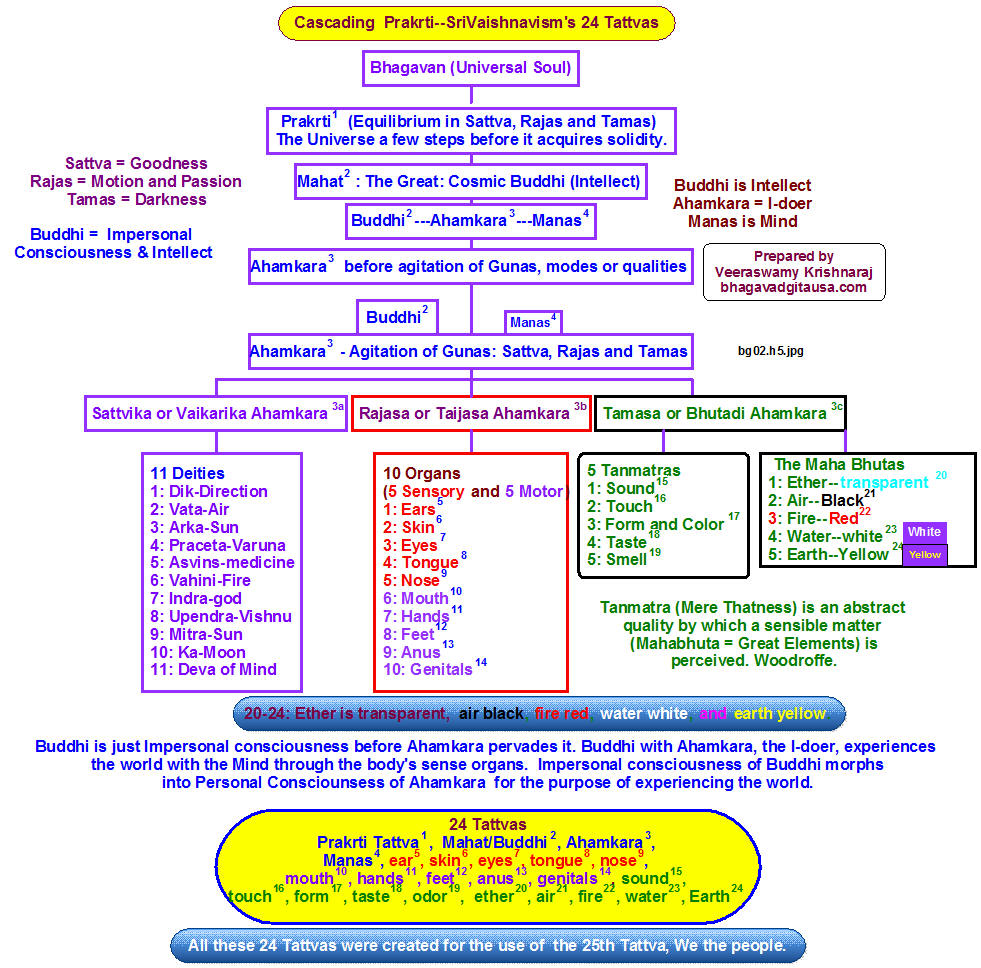
Ahankāra (ego), the second product, is subject to Sattva, Rajas, and Tamas: The Sattvika ahamkāra gives rise to the mind and the presiding deities of the senses; the Rajasic ahamkāra gives rise to the sensory and motor organs; the Tamasika ahamkāra gives rise to the subtle elements like sound, touch, color and vision, taste, and odor. |
|
Ego by nature does not express satisfaction and is in a state of restless motion. Ego has ignorance, likes and dislikes: 1. ignorance of the difference between the eternal and the noneternal, 2. mistaken belief that body and mind are the same as self, 3. love and attachment to gratifying objects, 4. hatred and avoidance of unpleasant things, and 5. love of life and fear of death. |
|
Mind perceives by Samkalpa-Vikalpa, selection and rejection from the material provided by Janendriya--sense organs, --Woodroffe. Samkalpa = purpose, will, desire, determination. Vikalpa = imagination, doubt. Samkalpa is experiencing the perceived sensation by the mind and presenting the sensation to the AhamkAra and Buddhi, the former 'making the sensation his own in feeling and experience' and the latter making a determination on the sensation, so that the experiencer identifies with the sensation. Sensation is personalized by Ahamkara. Woodroffe states, 'when a sensation is perceived by the Manas (mind) and determined by Buddhi, Ahamkara says: "It is I who perceives it." Buddhi, Ahamkara being its part, pervades the organs, and is the repository of all Karmic tendencies (Samskaras), and the seat of memory. Buddhi is the thinking entity involved in ideation and conceptualization with the help of AhamkAra, Manas and Indriyas (organs). Sense organs beam sensations to mind or Manas (perception); AhamkAra identifies them for personalization (self-arrogation); Buddhi stores the sensations for determination, cognition, resolution and presentation to Consciousness (Purusa), which illumines the Buddhi. Buddhi is the Charioteer; Manas, whose quality is Samkalpa-Vikalpa, is the reins; the senses are the horses; Jiva is the enjoyer. Buddhi is Sattva-dominant; AhamkAra is Rajas-dominant; Manas, Indriyas and their objects are Tamas-dominant. |
|
The Principal Upanisads, page 92, Dr. Radhakrishnan Sep. 22, 2013 The ego is perpetually changing, moving up and down, up towards union with the divine godhead or down to the fiendish extremes of selfishness, stupidity and sensuality. The self-transcending capacity of the Jīva is the proof that it is not the limited entity it takes itself to be. There does not seem to be any suggestion that the individual egos are unreal. They all exist only through the Self (God) and have no reality apart from It. -Page 93. The Divine Reason is immanent in our reason. The ego's possession of intelligence gives it the capacity for moral choice. It may either turn to the Indwelling Spirit or pursue the separate interests of the ego. It may open itself to the Self or shut itself away from It. One leads to light and life, the other to darkness and death. We have the seeds of both in us. We may live a life controlled by flesh and blood and earth-born intellect or we may lay ourselves open to God and let Him work in us. As we choose the one or the other, we are led to death or immortality. -Page 94. |

|
Take a look at the Tattvas above and below. The light of consciousness is Purusa12. Prakrti Tattva 13 is the origin of all distal Tattvas. All the organs 17 to 31 report to Manas16, which reports to AhamkAra15, which reports to Buddhi14, which is illumined by Purusa12. All Tattvas serve for the pleasure of Purusa12. The Subtle body is made of 17 Tattvas from Buddhi14 to odor31. AhamkAra15 is part of Buddhi14. Samkhya philosophy makes no mention of Prana (the pentad); the MAyAvAdins remove the Tanmatras (sound17, touch18, color19, taste20, and smell21) and put in the five Pranas (Prana, Samana, Apana, Udana, and Vyana.. 12. Purusa, 13. Prakrti Tattva, 14. Buddhi, 15. Ahamkara 16. Manas, 17. hearing 18. tactile sense, 19. vision and color, 20.tasting, 21. smell, 22. speech, 23. grasp, 24. ambulation, 25. evacuation, 26. procreation, 27. sound, 28. palpation, 29. form, 30. taste, 31. odor, 32. ether, 33. air, 34. fire, 35. water, 36. earth. According to Ramakrishna Paramahamsa ego comes in two flavors: unripe and ripe. Unripe ego gives rise to ideas such as "This is my house, this is my child, this is my wife, this is my body." Ripe ego gives rise to ideas such as "Nothing is mine, whatever I see or feel or hear, nay, even this body, is not mine; I (my soul) am always eternal, free and all-knowing." adapted from Sayings of Ramakrishna, saying 115, page 48. Ramana Maharishi says that from the vast unbroken Being-Awareness-Self springs forth a separate "I" ( I am, my, mine, me) which falls into the error of confronting a world perceived as something other than the Self --Verse 156. A true seer and ascetic is the strong hero who has discarded the body-based ego. It is hard for those who still retain regard for Asrama or varna (caste) to cast off the ego's heavy burden. Varna and Asrama pertain to the body and ego. The egoless person is the true Brahmin and true ascetic--Verse 163. One who sees otherness and difference cannot become a Brahmin merely by the study of four Vedas. He alone is a true Brahmin who sees his ego dead and knows the Veda's import. Failing here one swelters inly (sic), fallen, despised--Verse163. If a traveler does not put down his luggage in the cart but carries it plainly on his head, whose fault is it? The Lord sustains the universe; the pseudo-self, which thinks it bears it, is like the grinning figure which seems to carry the weight of the temple tower--Verse 171. Adapted from The garland of Guru's sayings, pages 30 to 33. The sensory and motor organs are called Jnanedriyani and Karmendriyani. (Jnana +Indriyani = perception (sensory) organs. Karma + Indriyani = action (motor) organs.) Organs of perception are eyes, ears, nose, tongue, and skin. Motor organs are larynx, hands, feet, anus and genitals and their functions are speech, grasp, locomotion, evacuation and reproduction. Chitta, the command and control center or inner organ (antahkarana), presides over the vital functions of the universe of the body. These vital functions go by the generic name Prana (breath) which consists of five parts: Prana, Samana, Apana, Udana, and Vyana. Please refer to the commentary on verse, BG10.9 for more details on Vital breaths. Here breath does not exclusively mean physiological respiration. Implicit in the terms is the fact that all the organs to work optimally need breathing of air (prana) by the lungs. Saiva siddhantist says, soul is the ever-awake knowing entity in wakefulness, deep sleep and dream sleep. The sense organs receive their respective stimuli (eyes perceive color and form, ears receive sound.) and pass them on to Antahkarana, the inner organ which consists of Manas (the Mind), Buddhi (Intellect), Ahamkara (Ego), and Chitta (Subconscious) (Chitta covers manas, ahamkara, and buddhi: mind, ego and power of discernment or judgment). Perception received by the inner organ reaches the soul, as the wave rolls to the shore. Antahkarana is the expression of Saksin (Atman-Witness) as listed above and is compared to a ray which radiates from the Witness, Atman or Self. This emanation is called Vrttis or ripples. Perceptions are compared to the waves reaching the Self. Chitta (Citta) is less subtle than Ahamkara and is like the RAM memory, remembering and forgetting; The forgetting is called Apohana and recall is known as Smrti. Chitta obtains knowledge from Buddhi and keeps it in storage. Apohana or forgetting is to move the knowledge to the back burner from the front of consciousness. Smrti or remembering is to move the knowledge from the back to the front. The Buddhi is less subtle than Chitta, makes decisions and instructs the Mind which works in collaboration with the five Janendriyas (sense organs = eyes, ears, nose, tongue and skin). Mind serves as the blackboard where on the sense organs register their impressions, which are converted as concepts by the mind and presented to Buddhi, which rejects most of them and keeps some as nuggets of knowledge. Buddhi keeps moving the knowledge back and forth between the front and back of the consciousness as Smrti and Apohana with the help of Chitta. Antahkarana is operational in two modes: External knowledge Acquisition (Abhijna) and internal Self-Knowledge (Pratyabhijna) acquisition. In Abhijna knowledge acquisition, knowledge proceeds from the gross to the subtle, from the sense organs to Chitta. It also depicts the evolution of the gross from the subtle (Ahamkara, Chitta, Buddhi, Manas). In Pratyabhijna mode, it turns itself inward and obtain Self-Knowledge. Abhijna is outbound, while Pratyabhijna is inbound. -------------------------------------------------------------------------------------------------------- The subtle elements proceed in their formation in a cascade fashion starting with sound, which gives rise to ether. The elements combine under the enzymatic action of Time, Maya, Jiva, and the glance of the Lord. Ether, treated with these enzymes, becomes touch, which transforms to air; the air and ether combine in the presence of enzymes to become color; from color evolves fire; fire and air combine to produce water, whose special quality is taste; water and fire combine to form earth, whose special quality is odor. Source: Bhagavatam 3.5.27-37. The term enzyme (inductor) is my interpolation.
The
elements starting with Sound and its product Ether going forward in their
combinations and permutations sequentially and progressively pick up qualities
of the previous elements and display their own special qualities. Bhagavatam
3.5.36
|
Table:
|
Element(s) |
Resulting Product |
Cumulative & Special quality |
|
Sound |
Ether (all-pervasive, one quality)→→→ |
Sound |
|
Ether |
Air (two qualities)→→→→→→→→ |
Sound and Touch |
|
Air and Ether |
Fire (three qualities)→→→→→→→→ |
Sound, Touch, and color/form |
|
Air and Fire |
Water (four qualities)→→→→→→→ |
Sound, Touch, Color, and Taste |
|
Water and Fire |
Earth (five qualities)→→→→→→→→ |
Sound, Touch, Color, taste and odor. |
|
As I said earlier, the elements need four factors for transformation and they are Time, Maya, Jīva, and the glance of the Lord; time connotes change; Maya is illusion plus distraction; Jīva is the life force; the most critical deciding factor in the combinations, permutations, and transformations is the glance of the Lord. Maya is the cause of the universe, which, in its female form, derives its energy and support from the Lord. Avyakta (the Unmanifest) is the father of Maya. |
|
According Saiva Siddhanta and its main formulating proponent Tirumular, Sakti is the mother of Maya. Space, air, fire, water, and earth were born of Maya in succession. From Maya came the subtle elements Tanmatras, from which the gross elements were born; thus, Maya is the Mother of the Universe and beings. |
|
Maya according to Ramakrishna Parmahamsa |
|
On attainment of Nirvikalpa Samadhi, Ramakrishna Paramahamsa sees Maya as Brahman in its twofold aspect: Avidyamaya and Vidyamaya. (Avidya = ignorance; Vidya = wisdom) Avidyamaya in terms of Kundalini Chakras is living in the pelvis and abdomen--Muladhara, Svadhisthana and Manipura Chakras of lower order; it is living a life of animal passions, Kama, Krodha, lobha, Raga and Dvesha (lust, anger, greed, passion and hate). One should transcend the lower Chakras and ascend to higher chakras. Avidyamaya keeps man in samsara, a cycle of birth and rebirth. Vidyamaya represents the higher centers and consciousness of Anahata, Visuddha, Ajna and Sahasrara Chakras or stations of life. Once Avidyamaya is conquered with Vidyamaya, the round of birth and rebirth is abolished and one enters a state of Mayatita, end of Maya or freedom from Maya. Maya is the power of Kali who transcends both types of Maya. She shines far above the clouds of Maya, under whose spell and shadow man lives. The word pelvis is my interpolation. |
|
Let us
take cloning as an example: The biologists have mastered the physical art of
cloning. The product is not as perfect as nature because the main factor –
glance of the Lord – is lacking. |
|
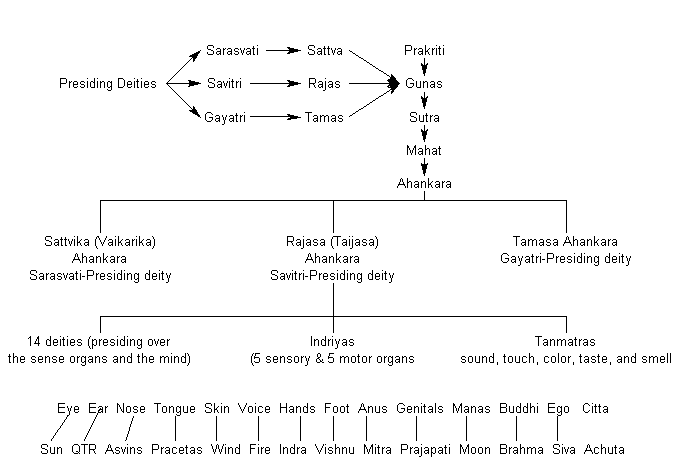
In the
following diagram, the concept of Sūtra, not found in Sankhya system, is a
contribution of Bhagavata purana. Sūtra means
thread or aphoristic rule. Sutra = suture. Sutra
is the functional counterpart of Mahat, the Cosmic Intelligence. Both work
together --Intelligence and function—to evolve Ahankara. Sutra is subtler than
Mahat. |
|
Karmendriyani are five motor organs, voice box, hands, feet, rectum and genitals, causing speech, grasp, locomotion, evacuation, and generation. Janendriyani are five sensory organs, ear, skin, eye, tongue and nose involved in hearing, touch, vision, taste, and smell. |
|
Sarasvati, Savitri and Gayatri preside over the gunas, Sattva,
Rajas and Tamas respectively.
|
|
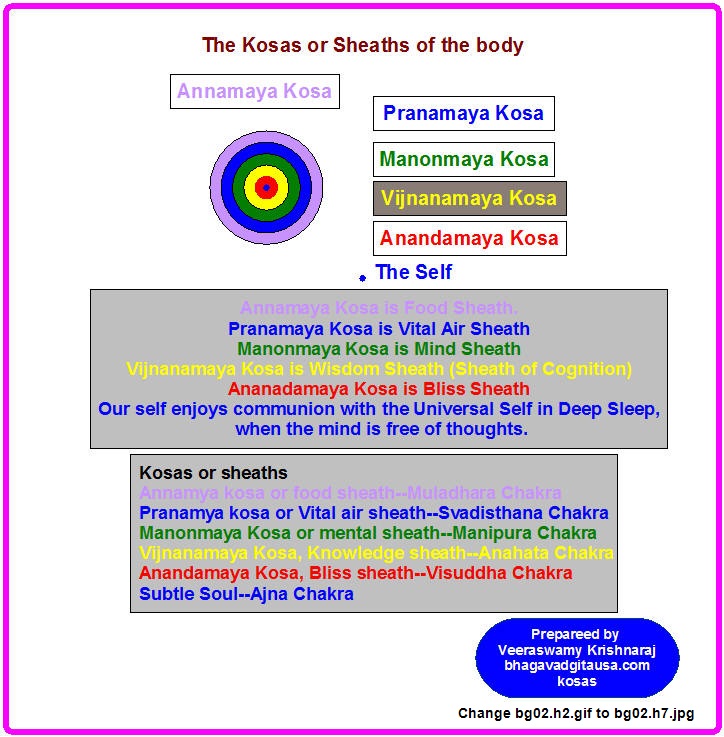
Matter consists of four (individual and) cumulative stages 1: Matter (Anna) 2: Life (Prāna) 3: Mind (Manas) and 4: Intelligence (Jnāna). Bliss (Ānanda) is the spirit. These are Kosas – sheaths: The four sheaths, layer on layer veil the self. Self stands alone when the kosas fall; Self is King and likes his nakedness without all these sticky layers or Kosas. Self is self-supporting and self is Bliss. Self is the light of Purusa's consciousness by which we become aware of the insentient Prakrti (nature) and its gunas (modes). The AnandaMaya kosa or the Bliss-Body or Pure Consciousness or the Absolute is Self itself, and is a chronicler and a repository of karma of this and past lives. This is the sheath of Consciousness and Bliss (Cinmaya) and made of Nada and Bindu. Self is the companion of jivatma – the individual self and the Greater Self in the spiritual heart are like the two birds on a tree. The Self by itself is bliss, but man needs realization to find the light that is bliss. Man has four cumulative features but does not reach his inherent potential that is bliss, illumined Consciousness, if he does not strive for it. As you see, matter becomes finer from one stage to the next. Here is an illustration of evolution from the gross to subtle via Food sheath, Vital breath sheath, Mind sheath, Knowledge sheath and eventually to the Bliss sheath. When man strives for and gains perfection, he receives Ananda (Bliss); God according to the Vedas is Sat-Chit-Ananda– Satchidananda– Being, Consciousness, and Bliss. Bliss comes to man in Deep Sleep, when there are no mental Vrittis, modifications or thoughts. It is as if the individual self plugs into the Power Grid of the Universal Self (the origin of the individual self) every night in deep sleep. Without this infusion of nightly bliss, we are zombies. This temporary life-sustaining nightly Bliss should not be mistaken for the Eternal Bliss that comes with liberation. The first four outer sheaths are matter; Matter and Mind have to come to a standstill for the individual self wrapped in Anandamaya Kosa to enjoy the Bliss of the Universal Self. |
bg02.h2.gif
-->bg02.h7.jpg
Kosas and their origin
|
Entity |
Annamaya Kosa |
Pranamaya Kosa |
Manomaya Kosa |
Vijnanamaya Kosa |
Anandamaya Kosa |
|
Sheaths |
Food Sheath |
Vital Air Sheath & Ether |
Mind Sheath |
Knowledge Sheath |
Bliss Sheath |
|
Origin |
Earth, Water and Fire. Lower three Chakras |
Anahata and Visuddha Chakras |
Ajna Chakra |
Nada and Bindu Chakras |
Sahasrara Chakra |
|
Saiva View |
Brahma shines in Food Sheath. |
Vishnu shines in Breath Sheath. |
Rudra shines in the Mind Sheath. |
Mahesa shines in the sheath of Consciousness. |
Sadasiva shines in the sheath of Bliss. |
|
Saiva view is expressed by a real-life sage-poet by name Umapati Sivacharya (around 1300 C.E.) in Chidambaram, Tamil Nadu. |
|||||
|
Vaishnavas have this view on the Tattvas, 26 in all: |
|
Prakrti, Mahat, Ahankaram = 3 |
|
Tanmatras =5 |
|
Five Bhutas = 5 |
|
10 Indriyas + manas = 11 |
|
All these are Prakrti Tattvas, 24 in all. |
|
Jivatma is the 25th Tattva. |
|
Paramatma is the 26th Tattva. |
|
Saivites describe 36 Tattvas; one and two are Siva and Sakti Tattvas; 12th is Purusa or the Jivatma. |
|
TATTVAS-36 for more information on Tattvas. |
|
Bhrgu Muni practicing Raja Yoga (Kundalini yoga) discovered the sheaths or Kosas of the body. Annamaya Kosa takes its origin from Earth, Water, and Fire which are present in Muladhara, Svadisthana, and Manipura centers. Earth (minerals), water and Fire (heat) are the basic elements of our body. Pranamaya Kosa (Vital Air Sheath, five in number) and Ether take their origin from Anahata and Visuddha Chakras respectively. The mind or mental sheath originates from Ajna Chakra, which is the seat of Nada and Bindu, which give rise to Vijnanamaya Kosa. Primordial Prakrti in its undifferentiated form is Anadamaya Kosa. |
|
According to Joseph Campbell, bliss is never having to say that you did not
follow your bliss and that you did not do what you wanted to do. He talks
about the hub at the center and the rim of the wheel. A person at the hub is
serene and the one riding on the rim gets the dizzying experience of duality
of pain and pleasure, love and hate. He adds that one should go where his body
and soul take him. It is not the wealth or the prestige (body-mind-ego
complex) that he seeks or recommends. You are the soul and not the body. Why
does this soul wrap itself with the body or these kosas? Swami Vivekananda
says: “For the same reason that I take a looking glass: to see myself. Thus in
the body, the soul is reflected.” Joseph Campbell puts it in another way
(paraphrase): "when one gains transcendence (or the Brahman), one dies to his
flesh and is born into his spirit. The body is a vehicle.
|
|
Panchadasi puts forward the following theory with regards to Brahman, Jiva, and Prakrti. Prakrti is not a product of Brahman; it is not a palpable real entity separate from Brahman. It represents the Will (Iccha) of Brahman to create and this Will becomes (transforms into) the three gunas: Sattva, Rajas and Tamas which gel into material. When Prakrti is sattvic, it is called Maya; when it is dominated by Rajas and Tamas, it is called Avidya (nescience). Maya is the mirror that reflects Brahman; the reflected image of Brahman is called Isvara who controls Maya. It is like the lady who carries the mirror in her purse. The lady is Brahman, the mirror is maya and the lady's image in the mirror is Isvara. Sat Chit: Sat (Being) is Consciousness (Chit) and exercises its Will to create; therefore, it is Being, possessing and controlling maya, and becoming matter through the gunas. On the other hand, Brahman is the subject; Avidya is the water-mirror; and Jiva is the inverted reflection of Isvara in water. What does it mean? Isvara' head is at a high point and man's head in the water-mirror is at the low point. Isvara's consciousness is Pure Consciousness at the high point, while Jiva's consciousness is at the low point; there is a wide chasm between these two entities--two heads. Man, as said before, is governed by ignorance (avidya), meaning that he identifies himself with the body and not with the soul (self) which is organically connected and related to Isvara. This ignorance is both veiling and projecting (Avarana and Vikshepa). This ignorance veils Sat and Cit (Being and Consciousness) of Brahman and projects the phenomenal world by Vikshepa. Vikshepa: power of ignorance that causes the world seem real. This projection is mediated by Tanmatras: Principles of Sound, touch, vision and color, taste and smell, which are pervaded by qualities Sattva, Rajas and Tamas. The Sattva of Sound becomes the sense of hearing; that of touch, the sense of touch and so on. These in combination form an entity called Antahkarana or inner organ which have four aspects: Manas, Buddhi, Ahankara and Chitta (citta). These were discussed above. The Rajas-dominated sound, touch, vision (color and form), taste, and smell become the respective motor organs. |
|
Sattva of Sound becomes hearing. |
Sattva of touch becomes touch. |
Sattva of vision or form becomes sight. |
Sattva of taste becomes taste. |
Sattva of smell becomes smell. |
|
Antahkarana: |
||||
|
Rajas of Sound becomes larynx. |
Rajas of touch becomes hand. |
Rajas of vision or form becomes feet. |
Rajas of taste becomes genitals. |
Rajas of smell becomes rectum and anus. |
|
Quintuplication of elements (Panchikarana) |
||||
|
Tamas of Sound becomes ether. |
Tamas of touch becomes air. |
Tamas of vision or form becomes fire. |
Tamas of taste becomes water. |
Tamas of smell becomes earth. |
|
Go to BG Chapter 13 The Knower, the Field, the Nature for more details contained in commentary under Verse 13.06 Table. Panchadasi says that these composite elements formed the Cosmic Egg (Brahma Anda) from which the universe came into being. |
|
Jiva takes on the qualities of Sattva, Rajas and Tamas. Jiva's body is Avidya while Isvara's body is Maya. Subtle and gross bodies of Jiva come out of Avidya causal body. Lord's will (Ichha) is Maya Sarira (body) and the creator of the world. Here the term "body" does not mean a palpable body with head, trunk and limbs, in the same sense that a "body of knowledge" does not walk on feet. Isvara's Maya Body is creative (of the universe) while Jiva (man's individual soul) is the causal body, creative in its own limited sense because it gives rise to subtle and gross body--Suksma and Sthula Sarira). Jiva's causal body (Karana Sarira) is pervaded by Avidya (ignorance) of its true nature that it is part of Brahman; it is temporary amnesia (loss of memory or forgetfulness). In its amnesic state, Jiva is not contaminated with Vikshepa until it takes on the gross body with head, trunk and limbs. Jiva without Vikshepa is closer to Isvara (Supreme Consciousness and Supreme Knowledge) than the Sthula Sarira (gross body). Though it forgets its true nature, the causal body is closer to Isvara than the gross body; therefore, it has supreme knowledge within ignorance (Prajna within Praajna--knowledge within ignorance). Vikshepa = projecting power of Avidya or ignorance. |
|
Let me mention the Tantric view, which is cognate with some aspects of Samkhya philosophy. Mahanirvana Tantra says the following as a dialogue between Sadasiva (Siva) and Devi (Sakti). |
|
Sadasiva eulogies Devi. |
|
You are Sive (Devi, the counterpart of Siva); you are Mula Prakriti; You created everything in this universe; You are Isvari, the controller; You are the Great Mother Goddess, the origin of Brahma, Vishnu and Siva. You know the essence of all Tattvas (building blocks) of the entire universe, but no one knows your nature. You are the gods and goddesses of the universe; you are Kali, Bhairavi, Mahalakshmi, Devi of speech and Annapurna. You are Sakti; you are subtle, gross, unmanifest, and manifest; you are formless and with form. |
|
Saivaites say that the universe and beings are made of 36 Tattvas, which take their origin from Siva-Sakti. |
|
Saktas (monistic worshippers of Devi, Mother Goddess) are firmly entrenched in their view that conflicts with Samkhya philosophy. Samkhya declares Prakrti (matter) as an unconscious element, apart from Purusa, the conscious element. Saktas declare that Devi has both aspects in her, matter and Consciousness. Another concept that is notably absent in Sankhya System and unique to Saiva Siddhanta is Mum-malam (three impurities) of the soul. Go to Primer in Saiva Siddhanta. |
|
2.13: As the soul
passes from childhood to youth to old age in a body, so also the soul takes
another body. This does not confuse a sage (brave and composed person).
|
|
Dēhina: Embodied soul
or jivātma. Dēhē: body. Kaumāra: childhood, age one to five) |
|
III.3 Praśna Upaniṣad |
|
|
|
The soul of good people leaves the body through Brahmarandhra (Brahma's aperture, crevice: Anterior fontanel area of the head at the crown, equivalent to the soft spot on baby's head). The soul of evil people takes a downward descent and is expelled in the same manner as the excreta. If the spirit exits through the feet, it goes to Vishnu; if from the head to Brahma, and if through the eyes to Agni or Fire-god. In Buddhist, it exits through back of the forehead. Harper's Dictionary of Hinduism P53. |
|
Hindus perform Samskaras from conception to death in order to prevent the soul from taking another body and attain liberation from rebirth. In Hinduism, the twice-born (Brahmanas, Ksatriyas, and Vaishyas) and the Sudras perform Samskaras or sacraments from conception to departure from this world. In twice-born, Samskaras are mandatory and the Sudras too practice if not all of them. |
|
Samskaras have more than one meaning. The most common one means Sacraments. The other meaning is Impression. It is the impression that your soul carries from birth to birth as a result of actions in the past life. What is an impression? It is like the odor of cedar wood closet that your clothes carry though the clothes are out of the closet. It is the fragrance or impressions (Samskaras) from past life, that clings to your soul like fragrance and shape your present life. |
|
The body follows the soul in the sense the body in the next birth may be a human or animal depending on the Samskaras-- impression from the past life. It is your action, good, bad, or indifferent performed under right thought, delusion, or illusion, which contributes to the Impression or Samskaras. They determine one's heredity, ancestry and environment. Heredity: One may be born in a royal family or a commoner. Ancestry: One's ancestors may be Vedic Pundits, accomplished musicians or jailbirds. Environment: One's environment may be wretched poverty and penury in a world of perennial want or a life of luxury in the present life, all determined by the Samskaras from the past life. |
|
Samskara draws its meaning from Sam meaning together and Kri meaning to do or act. It is putting the act or acts together creating an Impression, that determines the future direction (of the embodied soul). |
|
Now we come to Samskaras or Sacraments, which celebrate the various stages in the life a person. People who question rituals are in the minority. Take for instance the Presidential Inauguration, which is an expensive and extravagant ritual or Samskara in the political life of the nation and the elected president. We know a person has been elected by due process, will occupy the White House and discharge his or her duties. Why should we fuss with pomp and pageantry of the ceremonial aspect of inauguration? Why can't the president just move into the White House and start working? It is a milestone for the nation, people and the world that demands a Samskara and a historical record. |
|
Take the Jewish tradition. They have more Samskaras than one may imagine. Every move, turn or act is a Samskara for a good reason: Circumcision, naming of boys and girls, the Redemption of the First-born Son (Pidyon Ha-ben Ceremony), Bar/Bat Mitzva and confirmation, Mikva (immersion), Wedding (Erusin and Nisuin--Betrothal and Marriage), Contract (Ketuba with witnesses), the Seven Blessings (Sheva Berachot), Breaking the glass to scare away the demons, Rending Garment at death (Keria), Burial with shroud (Tachrichim), Seven day mourning (Shiva), Dietary Laws (DOs and DON'Ts), Mitzva (good acts: 248 DOs and 365 DON'Ts), Synagogue (as house of prayer, community hall, and house of study), Sabbath and cooking rules, Passover (Pesach), Koshering, Shavuot, Days of Awe (Rosh Hashana and Yom Kippur), Sukkot, Shemini, Atzeret, Simchat Torah, Chanuka, purim.... |
|
In the Hindu religion the Samskaras fall into Prenatal Samskaras, Natal Samskaras, Postnatal Samskaras, Childhood Samskaras, Educational Samskaras, Wedding Samskaras, and Final Samskaras (Funeral Rites). I am excluding listing of religious festivals and associated rites. Samskaras of childhood include: Conception ceremony, Quickening Ceremony, Hair-parting ceremony of the pregnant woman, Birth ceremony, Naming ceremony, First outing, First feeding, Tonsure, Piercing the ears, First entry into school, Upanayana (initiation), Vedic Studies, First shaving, Completion of studies, Marriage and its subsidiary ceremonies, and Funeral ceremonies. |
|
A person undergoes many Samskaras (purification rites) from the time of his birth: Jatakarma (consecratory rites after birth), Namakarana (naming sacrament) and Upanayanam (holy triple-cord ceremony). The goal of all these sacraments or Pancha (5) Samskaras is to purify the individual and his soul so that he attains God realization. Samskarams in Vaishnava tradition is done to induct an individual into Sri Vaishnava sect, because no one is Sri Vaishnava until he or she is inducted; Sri Vaishnava is not a birth right. When a person is inducted with Pancha Samskaras, he is born into the sect. The idea is that all previous lives were a waste until one becomes a Sri Vaishnava. |
|
There is a particular bangle ceremony among Tamils, which has been in practice since 1000BCE. |
|
Harappan stone bangles: During pregnancy and childbirth, the mother and child are in danger of being attacked by demons. In Tamil Nadu, the expectant mother is ritually adorned with bangles around the 5th or 7th month of pregnancy and blessed by the older women. The bangles symbolize an enclosed circle of protection.( Remember the elder elephants form a ring of protection around the calf when the lion is on prowl nearby. ) This practice has been around since 1000 BCE among Tamils. source: http://www.thehindu.com/multimedia/archive/00133/_A_Dravidian_Soluti_133901a.pdf |
|
As a child, I remember the bangle salesman going from village to village selling his bangles. In his professional pursuit, he gets the privilege of holding the hands of the village girls and married women while he slips the bangles on their wrists. Some women coming to know of the prurience of the bangle salesman, would take the bangle from the soft cloth on the floor and try them themselves without the eager salesman's offer to slip them on their hands. |
Samskaras (Purificatory rites or sacraments) are many:
|
From birth to naming ceremony--infancy and early Childhood |
||||
|
Garbadhana |
Punsavana |
simantonnayana |
Jatakarma |
Namakarman |
|
Residence in the womb at conception. |
wish for a son at the end of 1st trimester. |
parting the hair of wife by the husband at 4th to 7th month of pregnancy. |
Father welcomes the newborn and feeds ghee and honey* (Honey feeding is dangerous before one year of age because of botulism.) |
naming ceremony between 11 to 41 days. |
|
Early childhood to preteen |
||||
|
Annaprashana |
Karnavedha |
Cudakarana |
Vidyarambha |
Upanayana |
|
Feeding of solids at age 6 months. |
ear-piercing at 1st, 3rd or 5th year of life. |
Head shaving between 31 days and 4 yrs after birth. |
Beginning of education at variable age. |
Triple-cord ceremony; induction into study of sacred texts. |
|
Teen to marriage |
||||
|
Ritukula |
Keshanta |
Nishchitartha |
Vivaha |
|
|
coming of age for girls. Menarche. |
1st shave of the chin at age 16. |
betrothal ceremony. |
Marriage. |
|
|
Transition to spiritual life ending in death |
||||
|
Vanaprastha |
Sannyasa |
Antyeshti |
|
|
|
Transition from family life |
Transition to life of seclusion and meditation. |
Funeral rites. |
|
|
|
|
|
|
|
|
|
The best book I know of on Hindu Samskaras is written by Dr. Rajbali Pandey. The work was originally written as a thesis, which was approved by the Benares Hindu University for the degree of Doctor of Letters in 1936. The publisher is Motilal Banarsidass. |
|
2.14: O son of Kunti (Arjuna), as organs and objects induce cold and heat, happiness and sorrow which are sensory perceptions, appearing, disappearing and impermanent. Learn to endure them, O Bharata (Arjuna). When
the body, mind and ego interact, perceptions of dualities, such as pleasure
and pain, love and hate are dominant. These dualities cause vibrations on the
Body-Mind-Ego complex and are temporary during its existence. When the mind
separates from the body and the ego, and turns inward, composure, tranquillity,
transcendence, and certitude free from dualities get you close to your self
and therefore close to Brahman. 2.15: He, who suffers
no distress from these, O the best of men, and stays even in sorrow and
happiness, is a sage and fit for nectar of
eternity or liberation. He, in whom dualities cause no distress, O the best of men, and who stays even in sorrow and happiness, is a sage and fit for nectar of eternity or liberation Krishna in his discourse The Uddhava Gita, Dialogue 6, Verse 29 - 31 lists the attributes of a Sage. He, who is compassionate to all beings, who brings no harm to anyone, who is patient and controlled, whose tenet and strength is Truth, who does not entertain envy, whose mind is even in joy and sorrow and whose only interest is the welfare of all, is a sage. His mind is not overcast by a cloud of desire; he reins in his senses; he is kind to others; he is pleasing in his disposition, freeing himself from a desire for possessions; he eats to live; he fulfills his duty. He thinks deep and his judgment is considered and deliberate. He is calm, collected and resistant when the six waves of hunger, thirst, heat, cold, greed, and infatuation buffet him on a daily basis. He is averse to seeking honor and yet confers honor on others. When adversity strikes, he contemplates. He is friendly and kind esp., to those in misery. He does not discriminate as to whom he gives his light of knowledge. He renounces his duties and their outcome, good or bad. A sage sees his Self in all. In the
Unreal (Asatah) continuance is absent, and in the Real (Satah), there is
eternity (no end). In the
Being (Sat), the Truth is existent and self itself. The self is real, the body
is unreal, and the self is embodied. The I-factor, heavily influenced by
avidya – ignorance – prevents us, from accepting the self as real and the body
as unreal. The self, being real, is eternal. 2.17: Know that which
pervades all, is indestructible and immutable by anyone. |
|
The Principal Upanisads page 635 Katha Upanisad. Dr. Radhakrishnan Oct 26, 2013. The Size of Atman Samkara discusses this passage in his Sūtra Bhāṣya (I. 3. 24 and 25) and argues that the soul which is said to be of the size of a thumb is in reality Brahman. Rāmānuja and Nimbārka agree and hold that the highest self is called 'thumb-sized' since it dwells in the heart of the worshipper. In B.U. the self is said to be 'as small as a grain of rice or barley and yet it is the ruler of all and lord of all,' V.5.I. In C.U., it is said to be of the measure of a span, pradeśa-mātra, V.18.1. Maitrī states all the views of the size of the soul. It tells us that a man 'reaches the supreme state by meditating on the soul, which is smaller than an atom or else of the size of the thumb, or of a span, or of the whole body.' VI.38. |
|
The
self, emanating from Brahman (chip off the Old Block as it were), is
all-pervasive. Let me present to you the monistic theory of Atman or the
Absolute. What is that force that moves and animates the body? Body is not self-created. This force must be a common denominator for all sentient beings. According to Advaita philosophy even insentient objects have a force in them. This force must be beyond the mind, body and matter, because it is still a mover or a force or a bright light even after the mind and body are gone. Atman is that all-pervasive force that remains after the body falls. It has to be infinitesimal to be all-pervasive; it is what remains after you chop a fig seed to its ultimate infinitesimal size. You cannot see it but you know it is there; It has no shape and therefore no name; the ultimate infinitesimal, the one without form or name, if it is conceivable, is within the fig seed. It (Brahman) is neither Sura (god) nor Asura (Demon), nor man, nor woman, nor eunuch, nor animal, nor insect, nor attribute, nor action, nor existence, nor non-existence; What remains after all negation is THAT. |
|
It is
like the salt in the water: You know it is there, but you do not see it. It is
all-pervasive like the all-pervasive salt in the saltwater. You have an Atman
and I have an Atman. How could that be possible if Atman is only One? Each one
of us is like a pot holding one’s individual space inside. When the pot
breaks, the space is still there. The Real (space) is Atman and the seeming
(space) is limit of the Real as in a pot. The space is unbound and bound at
the same time: The Real is unbound and the apparent has bounds. That is the
difference between the Real and the apparent man. The phenomenal world is an
apparent product of the Absolute by intermediation of time, space and
causation. Since Atman has no form and is beyond mind, it cannot be under the
control of time, space and causation. |
|
Since it is infinite and there can be only one infinite, infinite cannot have a beginning or end, birth or death; and that infinite is Atman. Since the infinite is only one and all-pervasive, Atman pervades the sentient and the insentient, the whole universe. Monistic doctrine describes the phenomenal world and superimposition: This phenomenal world rises and falls like the waves in the ocean. The wave has the time, space and causation elements incorporated or expressed in them during the wave. In addition, there are many waves; and therefore, there are many forms and many names. Since the waves rise and fall into the ocean, the waves have a finite existence; the ocean is Monism and the waves are dualism. When the dualistic waves fall back into the monistic ocean, the transient dualism disappears and the Monism exists as it does always. How can there be finite elements in the Infinite or the Absolute? As the waves rise and fall (superimposition) on the ocean surface, transient elements rise and fall on the Absolute. That is an illusion and superimposition. The term for this apparent and unreal phenomenon or change is called Vivarta. Now it is there; and now it is not there, as the waves rise and fall: It is Maya (illusion). Monists say that the Prakrti becomes products (Vikara or Vikrti) of the universe. The substrate is Prakrti and the substance is the universe of products. The products are called Vikara or Vikrti. Example: Curds (Yogurt) is the Vikara of milk. Vikara is transformation from to another and the product. The Time, Space, and causation elements are translucent elements between the Upper Absolute and the lower universe. The lower universe is a superimposition on the Absolute seen through time, space, and causation. The allegory of a snake and a rope explains this superimposition. In the dark, we see a snake in a rope; the rope is real and the snake is a superimposition and unreal. When ignorance dissipates on closer inspection, the real asserts itself. In the same manner, the phenomenal world (the snake) superimposes on the absolute (the rope). Once ignorance dissipates, realization sets in. |
|
That
is how Maya manipulates our mind and the phenomenal world. The snake depends
on the rope, as the world depends on Brahman; if there is no rope, there is no
snake; if there is no Brahman, there is no phenomenal world. The world is both
real and unreal at the same time. The world is Brahman-dependent, as the snake
is rope-dependent. The world and the snake by themselves (their intrinsic
merit) are not real and non-existent; they are real if considered in the
context of primary essential Brahman and the primary essential rope. Isvara
has control over Maya whose effect is on the mind. Since there is only one
Absolute pervading the whole world, there is no second: The Absolute or the
Atman and the manifested universe are one giant organism. There is no
individuality: Individuality is apparent only because of the mind; if there is
no mind, there is no perception of individuality. If you look beyond time and
space, the Absolute is One who is real, immutable, all-pervasive; that is
Advaitism or Monism of Sankara. We are all part of that oneness. Vivekananda
says: “I am in everything, in everybody. I am in all lives and I am the
universe.” |
|
How
could you say that Atman pervades everything in the universe, both sentient
and insentient? You cannot compare a tree or an animal to a man. Yes, you can.
Sentience is same in all. Only the extent of its manifestation varies.
Sentience manifests the most in man and the least in the insentient or the
inanimate and somewhere between from the plants to animals.
Saiva Siddhanta asserts the power of Sakti
(Tattva) exists in all beings and matter. Consciousness sleeps in the stone,
feels in the flora, senses in the fauna and thinks in man. Sentience runs
parallel with consciousness.
Since there is only a difference in the (expression) degree of sentience
between animal and man, how could one kill an animal for whatever purpose?
That is the basis of Ahimsa or noninjury. |
|
2.18: The material bodies are perishable, but the (embodied) souls being eternal, indestructible, and unexplainable are never destroyed and beyond comprehension. Therefore, fight O Bharata (Arjuna). The
bodies (encasing the imperishable, incomprehensible, and eternal individual
souls) are perishable. Therefore, O Arjuna, fight.
Matthew
10:28.
Here is what Jesus Christ said to his disciples. 2.19: Anyone who knows
this (atman or soul) as the killer, and thinks that this is killed, knows not
in his knowledge that this soul neither kills nor is killed. He, who thinks he knows
this (atman or soul) as the killer, and thinks that this soul dies in the
hands of another soul, does not have the knowledge of the self. The soul
neither kills another soul nor dies in the hands of another soul.
As
there is Atman or Self, there is “not-Self” (anatman); according to Samkhya,
anything that is not Atman is anatman. To put it simply, not-Self is anything
other than atman except Brahman or Paramatman; anatman consists of
body, sense organs, and their functions, sense objects, mind, breath,
ego, thoughts, emotions, and Maya – life itself. Discussion of Maya appears
later.
2.20: This (atman or
soul) is neither born, nor dead, nor coming to be, nor will it cease to be at
any time. This atman is unborn, eternal, timeless, everlasting, and primeval;
it is not killed when the body is slain.
திருநெடுந்தாண்டகம் by Tirumangai Azvar Divyaprabhandam Verse 2052 Here is Srivaishnava Tattvatriyam: Isvara, Cit and Acit. God, the Sentient and the Insentient. This verse speaks of the body as an evanescent lightning. God is like the Vedas, dispelling darkness of spiritual ignorance; He is like the waxing moon. The soul is the background and the body is in the foreground. The free soul is without birth or death. The Supersoul is of the golden form abiding in the body, like a gem, easily accessible; It is like the fire. You (God) are the Father who rests Your lotus-like feet on my head. (The individual soul is in the background (பின் உரு); the lightning-like changing body is in the foreground (முன் உரு). Pon Uru (பொன் உரு) is Golden Form meaning the Universal Soul. Note the vocalic alliteration: முன், பின், பொன். What is in front (முன் உரு) is the mutable form--body, what is behind (பின் உரு) the body is the immutable individual soul. All the miseries of the front body, the back soul does not have. The Golden Form (பொன் உரு) does suffer the miseries of the embodied soul. The Golden Form is Bhagavan (Isvara); the back soul is Cit (sentient); the front body is Acit (insentient). Cit in its free state is immutable and has no death, rebirth, disease, old age and other maladies of mankind. Body with the resident Cit suffers from the maladies. what is behind, above, below, inside, outside is the Golden Form, the all-pervasive Universal soul. O God, You only showed me the difference between the body and the soul. Bhagavan, the Universal Soul of the Golden Form, abides in the spiritual heart.
1மின்
உரு ஆய்
முன் உருகில்
வேதம் நான்கு ஆய்
*
1As the evanescent lightning, the front form as the four Vedas, 2As the light dispelling darkness, as the sprouting and waxing moon, 3The soul as the back form, the (mutant) front body in the foreground, without disease or old age 4No birth, of death thinks not, eternal 5As the golden form (the SuperSoul), of the form of a gem, of five Great Elements 6as water, resplendent Fire the glittering Light 7 Your own Form abide in my form, O Father 8Your lotus-like sacred feet rest on my head. Philosophy of Druids Alexander Cornelius Polyhistor referred to the Druids as philosophers and called their doctrine of the immortality of the soul and reincarnation or metempsychosis "Pythagorean": "The Pythagorean doctrine prevails among the Gauls' teaching that the souls of men are immortal, and that after a fixed number of years they will enter into another body." Caesar remarks: "The principal point of their doctrine is that the soul does not die and that after death it passes from one body into another" (see metempsychosis). Caesar wrote: "With regard to their actual course of studies, the main object of all education is, in their opinion, to imbue their scholars with a firm belief in the indestructibility of the human soul, which, according to their belief, merely passes at death from one tenement to another; for by such doctrine alone, they say, which robs death of all its terrors, can the highest form of human courage be developed. Subsidiary to the teachings of this main principle, they hold various lectures and discussions on astronomy, on the extent and geographical distribution of the globe, on the different branches of natural philosophy, and on many problems connected with religion". —Julius Caesar, "De Bello Gallico", VI, 13 Diodorus Siculus, writing in 36 BCE, described how the druids followed "the Pythagorean doctrine", that human souls "are immortal and after a prescribed number of years they commence a new life in a new body."[35] One modern scholar has speculated that Buddhist missionaries had been sent by the Indian king Ashoka.[36] Others have invoked common Indo-European parallels.[37] Caesar noted the druidic doctrine of the original ancestor of the tribe, whom he referred to as Dispater, or Father Hades. Wikipedia Since
atman is the chip off the Old Block, which is “Self” (Atman, Paramatman,
Brahman, Superconsciousness or Purusa), it has the qualities, mentioned in
Verse 2.20. The atman is only a chip and not the whole and so it does not
share the highest qualities of the “Self.” The atman remains in the heart, not
the anatomical heart, but the spiritual heart, which exists on the right side
of the front of chest cavity. Man has two souls: Parmatman and jivātman.
Jivātman is the individual soul that falsely identifies itself with the body;
Paramatman is the universal immortal Self. This jivātman and Paramatman are
like the two companion birds on a tree. The jiva bird is eating the sweet
fruits, while Paramatman is watching and witnessing, and taking notes without
eating, contented, great, and free from sorrow. The jiva bird, once it
finishes eating the fruits on one tree, goes to the next tree. The tree here
represents the body and the bird represents the jivatma. Here eating means the
jiva identifies itself with the body, the body-mind-senses complex
experiencing pleasure and pain, and other life events. The transmigrating
jivātman, one among many, is susceptible to rebirth, while all-pervasive
Paramatman, free from Vasanas, Samskaras (impressions from past life), Karma
and transmigration, is One (Paramatman), but appears as many. Karma is the
cause of transmigration of the individual soul. Discussion of Karma will
appear elsewhere. Note: Read the
detailed story of the birds in the Supplement section: See Supplement < Go to
Two Birds in One> Indian Mystic Maher Baba (1894-1969) talks about colonial India to Paul Brunton (1898-1981) who went in search of Yogis and Rishis in India. Maher Baba: "The so-called subjection of India is not real subjection. It is of the body, and therefore temporary. The soul of the country is deathless and great, even if outwardly the nation has lost its power." Paul Brunton: "This subtle explanation somewhat eludes my understanding." Feb 6, 2013. Comment by Veeraswamy Krishnaraj. Maher Baba and Paul Brunton are spirit and matter (body), the former talking to the latter. The matter does not understand the spirit. The spirit lives and matter dies. If the matter were to come back alive today in another body, it would know what spirit meant on that day in the past. Since
Purusa is uncreated, atman also is uncreated or unborn. That which is
uncreated or unborn cannot be slain. It is like saying, “You are not the body
but the jivātman and Parmatman, which can never be slain, when the body is
slain.” Here, Arjuna is fulfilling his duty as Ksatrya, by killing his
enemies. Death is justifiable in battlefield.
2.22: As a person (
vasamsi jirnani yatha vihaya navani grhnati naro 'parani tatha sarirani vihaya jirnany anyani samyati navani dehi
Sarīra is body and has its root in Srī, to wane and waste, to decay, to molder, to disintegrate. What can be truer than this definition of Sarira or body? Now you can appreciate the power of words in Sanskrit. The word body is from the root bodig meaning 'trunk, chest' or botah of unknown origin. What a dull word 'body' is.
Atman changes body as a person changes garment. Each one of us has five
sheaths, according to Vivekachoodamani: The food sheath, the vital-air sheath,
the mental sheath, the intellectual sheath, and the bliss sheath. Another
classification bundles these sheaths differently. The physical body (Sthula or
Annamaya Sarira) is food sheath or layer. The astral or subtle body (Suksma
Sarira) consists of many sheaths namely vital air sheath (Prāna), mental, and
intellectual-instinctive sheaths–buddhi, ahankāra, manas, indriyāni, and
tanmātrāni. The causal body (Kārana Sarira) is the most important and the
innermost sheath consisting of the soul as light, which has a record of all
karmas of present and past lives and Bliss. When someone dies, the physical
body goes to the elements that nourished the physical body; the vital air
sheath dissipates, leaving the intellectual-instinctive and mental sheath with
the karmic sheath, the soul-light, and Bliss intact. Brhad-aranyaka UP:
3.2.13: According to Yajnavalkya, on death, the speech of a dead person goes
into the fire, the breath into the air, the eyes into the sun, the mind into
the moon, the hearing into the space, the body into the earth, the self into
the ākāsam (ether), the hairs of the body into the bushes, the hairs of the
head into the trees, and the blood and the seed go into the waters. The
message is the body parts come home to their respective cosmic counterparts.
Karma, Dharma, and the functions of the respective organs including that of
the mind are the companions of the soul, when the kosas drop and go to their
gross or subtle source. Please read the commentary section of verse 40 for
details. The
Lingasarira or Kāranasarira (causal body) takes with it not only the
soul-light and karma, but also the primary prāna, the senses, the manas,
avidya, a suitcase of experiences, purvajnāna, vidyā (knowledge), and other
vāsanās and samskaras. Purvajnāna is wisdom of past lives; Vāsanā is fragrance
from past karmas and impressions that cling to the subtle body from birth to
birth. At the time of creation, Lingasarira takes its birth from Sattvika
Mahat and is presided over by ksetrajana, which is jiva-ksetrajna in beings
and Supreme ksetrajna in the Lord, having control over the respective ksetras.
The Supreme Ksetrajna presides over all jiva-ksetrajnas and the universe,
while each jiva-ksetrajana presides over its respective body. It is the light
of life for we work, eat, sleep, and wake up again because of its presence.
The soul-light encased with the rest
of the layers is ready for rebirth according to the karmic compulsions. This
karmic connection determines “the heredity, ancestry, and environment”, the
phrase used by Radhakrishnan.
The soul is distinct from the body;
they do not go together from one birth to the next. The transmigration of the
soul does not support Mendelian laws but adheres to Karmic laws. A soul shall
not come to reside in a son or grandson. --Bhagavatha Purana, 12.5.3. The
soul’s origin is Brahman, while the body’s origin is matter. The laws for each
entity are different, but Isvara (Brahman) has control over both. 2.23: The weapons cannot cut the self, the fire cannot burn it, the water cannot wet it, and the wind cannot dry it. October 15, 2013. This Self, verily, is imperishable and of indestructible nature. Page 286 The Principal Upaniṣads IV. 5 15 15. 'For where there is duality as it were, there one sees the other, one smells the other, one tastes the other, one speaks to the other, one hears the other, one thinks of the other, one touches the other, one knows the other. But where everything has become just one's own self, by what and whom should one see, by what and whom should one smell, by what and whom should one taste, by what and to whom should one speak, by what and whom should one hear, by what and of whom should one think, by what and whom should one touch, by what and whom should one know.' By what should one know him by whom all this is known.' That self is (to be described as) not this, not this. He is incomprehensible for he cannot be comprehended. He is indestructible for He cannot be destroyed. He is unattached for He does not attach himself. He is unfettered, He does not suffer, He is not injured. Indeed, by what would one know the knower? Thus you have the instruction given to you, O Maitreyī. Such, verily, is life eternal.' Having said this, Yājñavalkya went away (into the forest). The suggestion is that the knower cannot be known in the usual way. He can only be experienced. ■Samkara makes out that all the four chapters had the one end in view, knowledge of Brahman culminating in renunciation: This is the instruction, this is the teaching of the Vedas, this is the ultimate goal, this is the end of man's effort to achieve his highest good.Different views are expressed according to the B S, about the relation of the individual and the universal Self. IV 6 3 Bṛhad āraṇyaka Upaniṣad 287 The unity of the two is emphasised to indicate that when the Universal Self is seen all else is seen. I. 4. 20. Auḍulomi thinks that the identity taught here refers to the state which the individual finally attains when he is released from all limitations I. 4 21. Kāśakṛtṣna holds that the identity is taught because the individual is the form in which the Universal exists. I.4. 22 Page 877. Subala Upanisad December 3, 2013 VIII.I. This self abiding within the secret place in the body of all beings is pure. Though intimately connected with the interior of the body, which is full of stinking fluid oozing out of the fat and the flesh, resembling (for its durability) the wall painted in a picture (for its invulnerability) the city of the Gandharvas (a castle in the air), as substanceless as the pith of a plantain tree, as fickle as a bubble of water, the self is pure. The learned perceive the self, of inconceivable form, radiant, divine, non-attached, pore, with a body of radiance, formless, lord of all, inconceivable, incorporeal, abiding jn the secret place, immortal, shining (of the form of) bliss. When it subsides they do not perceive. The similes used here indicate the fragility of the human body. The inner self remains unaffected by the changes of the body.
Upanishads looks at Atman in a perspective of exclusion: It is not this; it is
not that (neti, neti). The first Neti excludes Maya and the second Neti
excludes the products of Maya (Prakrti), matter and beings with names and
forms; thus, what stands alone after those exclusions is Atman. It is
not susceptible to seizure and destruction. It is irrevocably independent
(unattached); no one can injure it; and it does not tremble. Earth, water,
light, ether, and air, the inanimate ingredients forming the body need
consciousness to animate it, which at universal level is Atman (Paramātman or
Supreme Soul) and at individual level is atman or individual soul. There are many individual souls, many bodies, and many experiences; therefore, all souls are immutable, irreducible, and atomic, and dependent on a controlling authority: Brahman or God.
Swami Vivekananda says: "So then the Hindu believes that he is a spirit. Him the sword cannot pierce -- him the fire cannot burn -- him the water cannot melt -- him the air cannot dry. The Hindu believes that every soul is a circle whose circumference is nowhere, but whose centre is located in the body, and that death means the change of this centre from body to body. Nor is the soul bound by the conditions of matter. In its very essence it is free, unbounded, holy, pure, and perfect. But somehow or other it finds itself tied down to matter, and thinks of itself as matter." 2.24: This (atman) is
uncuttable, fireproof, waterproof, besides without doubt drought-proof,
eternal, all-pervading, stable and immovable; it is everlasting (sanātanah).
2.25: This (atman) is
unmanifest (avyaktah), inconceivable (acintyah), and unchanging (avikāryah).
Knowing this, you don't deserve to grieve. This
Superconsciousness or this Purusa is unmanifest and immutable, has no form and
no name, and is timeless: Time is in it. The bodies come and go, names come
and go, forms come and go, but atman or soul remains the same.
2.26: Even if you think
that this atman is continuously born, and continuously dies, O mighty-armed (Mahābhāho),
you should not grieve. It is
not proper to grieve, even if you think the atman rides the perpetual cycle of
births and deaths.
Mahābhāho refers to Arjuna here and means mighty-armed or long-armed one. The individual self (jivātman) is susceptible to rebirth in a body, be it an animal, man or plant. The jivātman goes through this cycle of birth and rebirth based on ignorance and karma. Jivātman by itself has a life of its own; it goes through bodies as in reincarnation or can achieve moksa and arrive at Brahman. Reincarnation = to come back in flesh. CarO is flesh. Carnous or Carnose = fleshy. Reincarnation, though not an universal belief in Judaism, is accepted by Kabbalists (those who study and become expert in secret inner meaning of Torah). Kabbalists get Peshat (simple meaning), take Remez (hint), delve in Deresh (exegesis), and receive Sod (inner meaning of Torah). When Jews observe or sit Shiva (seven; seven days of mourning), they do not eat meat. On the first day of mourning after the burial of the dead, they eat bagels, eggs and round rolls signifying the unending cycle of life. They believe that death is separation of soul from body. 2.27: For one who is
born, death is a certainty. For one who dies,
birth is a certainty. It is not
proper that you grieve over something that is not an avoidable matter.
Milarepa, the Tibetan mystic says 'All worldly pursuits end in dispersion, buildings in destruction, meetings in separation, births in death' Page 86. The Principal Upanisads. Dr. Radhakrishnan. Cycle
of births and deaths is the drama and karma of life. The embodied souls are
like passengers on the bus and at the bus stops: some get on the bus, some get
off the bus, some go to the last stop, but everyone has to get off the bus at
some time. Do we rejoice when they get on the bus and sink into depression
when they get off the bus? No. Karmic compulsions keep the cycle of births and
rebirths in motion. Wrongful death is not the subject of discussion here. Garuda
Purana (1.113.48-52) states that karma brings killer and victim together. Man
receives what he is destined to receive. Karma takes him against his will to
places where he does not want to go or has no intent to go and yet goes. Flowers and fruits come into
season at their appointed time, so is the bane or boon of karma. Karma seeks
and finds the doer just like a calf finds its mother in the melee of a
thousand cows. Your actions follow you doggedly in this life and hereafter,
for better or worse. When an infant is born, it may have some visible marks, which may indicate what is affecting the infant. If the ears are malformed, it may be a clue to impaired hearing which may prevent the child from developing normal speech. This infant can be helped with early detection of hearing impairment. According to Hindu religion, all infants are born with five invisible marks that determine his or her future. The teaching is not to grieve or exult over such things but cope with them, especially if they are adverse events. 1. ஆயுள் = AayuL: Lifespan. How long an infant will live is predetermined. 2. கர்மா = Karma: Profession, line of work, avocation. 3. வித்தம் = Vittam: Wealth, possessions and the like. 4. வித்யா or வித்தை = VidyA: Learning, knowledge, education. 5. நிதனம் = Nidhanam: Death, its day, moment, nature. These five categories, though presumably altered in any way by man, are still within the purview of the Ultimate Agency. Since they are unalterable in spite of human efforts, we should not lament their occurrence.
2.28: All living beings
are unmanifest before birth, manifest in the middle, and unmanifest again
after death. Therefore, O Bharata, where is the need for (paridevanā)
lamentation? Until
the individual soul gets a body, there is no obvious or visual presence of a
soul in man or animal. So it is manifest in the middle and not so at the
beginning or the end. 2.29: Some see IT
(Atman) as astonishing, moreover some speak of IT as marvelous, and another
hears of IT as wonderful. Having heard of IT, no one yet knows what IT is.
September 17, 2013. The Principal Upanishads Dr. Radhakrishnan, Page 56. Brahman Definition: 'That from which these beings are born, that in which when born they live, and that into which they enter at their death is Brahman'
Āscarya-vat: Astonishing, marvelous, wonderful. Enam: IT (that, he, she.)
Brahman as a subject is It or That and never He or She. Brahman is unknowable,
inscrutable, and unseen. Those who declare that they understand “IT” do not.
However, those who say they do not understand “IT,” understand “IT.” That is
the riddle and the paradox of its inscrutability. IT is the thought in your
mind, the voice in your speech, the movement of air in your breath, and the
sight in you eye. However, your mind knows IT not. Kena Upanishad states,
“Your speech goes not, and your eyes see not.” How could anybody say what IT
is? Atman also is beyond human reason, intelligence, and understanding. It is
the knower and the knowledge, but unknown (to us). No one knows what Atman is:
The yogis with an inkling are not talking much–mauna! Mauna or silence is its
message. Since it is beyond human understanding, it is not possible for a
yogi, who experienced Atman or Brahman, to explain IT to us. That is where the
mauna comes in.
However, Ramakrishna Paramahamsa had
experienced Brahman many times and offered his insight: Brahman performs magic
shows, Brahman’s conjuring deludes the audience, Brahman is Real, Brahman’s
magic show is unreal, and Brahman’s world is illusory. He
elaborates further: One sees a shaft of light, one feels joy, one experiences
upsurge of immense current in one’s chest, and one sees another person
(Brahman or the Self) within him. This tells us the Greater Self and the
individual self reside in the spiritual heart in the right side of the chest
in the form of light.
|
|
|
|
Ramakrishna paramahamsa Atman:
Wonder beyond comprehension. Self-realization is a hard and difficult
path.
2.30: This atman,
residing in the bodies of all living beings, is eternal and cannot be slain.
Therefore, O Bharata, it is not proper that you grieve for all living beings.
Light in the Heart is Brahman. October 15, 2013. 1. This person who consists of mind is of the nature of light, is within the heart like a gram of rice or of barley. He is the ruler of all, the lord of all and governs all this whatever there is. Brhad-aranyaka Upanisad V.7.1 Comment by Dr. Radhakrishnan: By meditating on Brahman in the form of mind, we attain identity with Him as such, for one becomes what one meditates on.
This is Prajā-pati (the same as) this heart. It is Brahman. It is all. It has three syllables, hr, da, yam. Hr is one syllable' His own people and others bring (presents) to him who knows' this. Da is one syllable. His own people and others give to him who knows this Yam is one syllable He who knows this goes to the heavenly world. Page 292 The Principal Upaniṣads V.5.1.
The threefold offspring of Prajā-pati, gods, men and demons, lived with their father Prajā-pati as students of sacred knowledge. I. In the beginning this universe was just water. That water produced the true (or the real), Brahman is the true. Brahman (produced) Prajā-pati and Prajā-pati (produced) the gods. Those gods meditated on the real That consists of three syllables, sa, it, yam' sa is one syllable, ti is one syllable, and yam is one syllable. The first and the last syllables are the truth; in the middle is untruth. This untruth is enclosed on both sides by truth, it partakes of the nature of truth itself. Him who knows this, untruth does not injure.--- V. 5 3. Brhad-aranyaka Upanisad 293
Sarvāni Bhūtani: All living beings. Socitum: to grieve. Man is
self and “not-self.” The self is eternal and immortal, and the “not-self” is
the body, which is mortal. This mortal body is only a casing or a box or a
container for the self. What is more important, the container or the content?
The box or the cereal? If the content is more important and the casing is
replaceable, why worry about the casing or the body? The body or the casing is
important to the extent that it embodies the soul until death; that
impermanence of the body is reason enough not to lament over its departure.
Arjuna, the warrior, has to worry less over the death of the impermanent body
and concentrate more on his dharma on the battlefield and the permanence of
the soul. 2.31: When you view the duty inherent to a Ksatriya from the perspective of your inherent dharma, you should not falter. There is no greater duty for a Ksatriya than a fight in battle. A
duty-bound Ksatriya has to engage, kill and defeat his enemies. That is his
duty and his ticket to heaven. Anything other than that is humiliation for a
Ksatriya. Svadharmam = one's own religious beliefs and principles. Dharma is difficult to interpret because there is no equivalent English word. It is a word with many coordinate meanings: your primary essential natural state of being and action, religious law, an ordained path, an ordained duty. Universal Dharma is the coming together of all individual Dharmas as a perfectly composed jigsaw puzzle; the meaningful picture that emerges contributes to the welfare of society, world and universe. Ordained path or duty is not something that is forced on someone but that which comes natural to the individual. Examples are, a teacher must teach; a doctor must doctor; a cow must yield milk; a donkey must carry cargo; a cuckoo must practice brood parasitism; the earth should go around the sun and spin on its own axis… There are people doing many coordinate things in a community for its weal.
Dharma: conformity to religious law, custom, duty, or one's own quality or character; faith in and pursuit of one’s own calling. Dharma sports three colors: Nitya Dharma, Naimittika Dharma and Anitya Dharma. Nitya = perpetual, eternal, regular; Naimittika = occasional, periodic; Anitya = irregular, unstable. These technical terms are interpreted here according to Vaishnava belief. Vaishnava Dharma is Nitya Dharma described below. A true Vaishnava is spiritually alive and awake though bound by matter and body. In his pursuit of Krishna Prema, he accepts all that is favorable and rejects all that is unfavorable, though the precepts may come from Sacred Texts. Vaishnava Dharma's main precept is that Krishna Prema is the eternal function, wealth and goal of every Jiva.
The following synopsis is according to the interpretation of Babaji of Bengal, as told by ThAkura. Nitya Dharma is Jiva’s (embodied soul) transcendental love (Krishna Prema) for Krishna. It implicitly accepts the existence of Isvara and the eternality of soul. Service to Krishna is part of Krishna Prema. Krishna is infinite; Supreme Nature is His immutable eternal Pure Vastu (substance). A Jiva is part pure, and part impure because of contamination with Maya. His pure spiritual part pulls him towards Krishna and his impure material nature pulls him to the world of Indriyas (sense organs). If his Indriyas are used in the glory of Krishna, there is concordance of spirit and matter. His Prema and his connectedness to Krishna keep him pure which is and should be his sva-dharma. Desires of the external world must be eliminated and sublimated into Prema for Krishna; that is Nitya Dharma, which is complete, pure and eternal. Knowledge and practice of connectedness to Krishna (Sambanda Jnana) is an essential element in Nitya Dharma. Bajans involving group chanting of Krishna’s many names are another feature. Babaji studied paradox calls Sankara’s Advaita Siddhi identical with Prema, which is a spontaneous magnetic attraction of two transcendental entities close together and not having any bearing to matter. Prema is love; the donor of Prema and the Recipient-enjoyer are two entities. In South India, Vaishnavites express the same idea in a slightly different way. All men and women in relation to Krishna are Striya (women) for the enjoyment of Purusa, Krishna, who gives in return Bliss or Grace to his devotees. Babaji stresses the identical nature of the substance of Krishna and Jiva (the soul) before the Jiva acquired a body. It is proposed that Ashtanga Yoga or meditation of Parabrahman cannot attain spiritual realization and purification as obtained by Krishna Prema and Bhakti. My understanding: Though the souls came from Krishna, Moksa of the souls does not allow resolute and absolute merger. Krishna is one entity and all the liberated souls are another entity enjoying close proximity to Krishna.
Vaishnava Dharma according to Vaishnava Dasa Babaji and Acharyas, consists of Suddha Vaishnava Dharma and Viddha Vaishnava Dharma. Suddha = Pure, selfless; Viddha = selfish, adulterated, perverted, not authentic.. Suddha Vaishnava Dharma, being Nitya or Para Dharma has four parts: Dasya, Sakhya, Vatsalya, and Madhurya (servitude, friendship, parental affection, conjugal love). The kind of relationship the devotee seeks with Krishna is according to his predisposition and inclination known as Rasa (taste) and can change. My input: Suddha Vaishnava Dharma's central theme is Isvara-Cit-Acit Axis and pure Bhakti; anything that strays away from this, is Viddha (selfish) Vaishnava Dharma: Meditation on Parabrahman (with attributes) and performance of rituals. Pure Bhakti does not expect any reciprocal return or payback from Krishna. Further explanation follows in the next paragraph. Bhaktas, Bhubuksus and Mumukshus Some Acharyas classify Bhakti into Suddha (Pure) and Viddha (selfish); the latter being Karma Viddha and Jnana Viddha, by which an aspirant seeks favor from Krishna. Pure Bhakti is the best path recommended by Bhagavan Krishna in BG 6.47: A Yogi who worships with Sraddha and inner self abiding in Me is considered by Me as the greatest and the highest (of all Yogis). BhaktA loves God for love's sake and the Viddhas love God for something in return. Karma Viddhas are the ubiquitous visitors (Bubhuksus- one, hungry for enjoyment) to the temple and do rituals at home and temples for health, wealth, happiness, education, employment, prosperity, matrimony, progeny ... The Jnana Viddhas are the seekers of liberation (Mumuksus) whose aptitude is towards meditation, breathings exercises (Ashtanga Yogam)... Both are seekers of something; Bhakta's substance is love, while Viddha's is want.
Bhakti Marga guarantees and promotes Krishna Prema and attaining Krishna. Sravanam: hearing, chanting, listening and enjoying the exploits of many incarnations of God. Kirtanam: singing the eulogies of God. Smaranam: Thinking constantly of God, Japam. PAda Sevanam: Serving (at) the feet of the Lord. Doing Kaimkaryam for the Lord in the temple or doing service to the BhAgavatAs (devotees). Archanam: Offering of water, flower, fruit, leaf to the God. Vandanam: showing reverence or homage to God by prostration. DAsyam: Doing service to God in the capacity of a slave or servant. Sakyam: சக்கியம்: To act as a friend to God, who is the constant companion in life, death and thereafter. Atma nivEdanam: ஆத்மநிவேதனம் = offering oneself to God; self-dedication. Paramahamsa Babaji identifies three kinds of Vaishnava devotees: Kanistha (neophyte), the Madhyama (middling), and Uttama (the foremost, the exalted). The Kanistha Vaishnava chants Krishna’s name occasionally; the Madhyama does so constantly; the Uttama causes others to chant His names by his mere presence. Hare Krishna, Hare Krishna, Krishna Krishna, Hare Hare| Hare Rama, Hare Rama, Rama Rama, Hare Hare.|| Naimittika Dharma consists of material corporeal activities, all duties and acts other than Nitya Dharma described above. They are performance of Varnasrama dharma, Yogas, obtaining mundane knowledge, Tapasya which are the means to an end: spiritual practice. It is the preliminary step to the final goal. Naimittika Dharma is mainly a corporeal act which changes from birth to birth. In one birth the embodied souls is a doctor; in the next a farmer; each has different corporeal Naimittika Dharma; the Nitya Dharma never changes for all persons at all births.
2.32: It happens on its
own accord; the battle comes unsolicited to a happy Ksatriya in the form of
gateway to heaven, O Partha.
Happy
are the Ksatriyas, to whom war comes unsolicited in the form of a wide-open
gateway to heaven, O Partha (Arjuna).
Kurusetra war came to Arjuna, his
brothers and their allies unsolicited. There is no greater honor, duty or
expectation than for the Ksatriya to fight his battle to the end, win or lose,
rise or fall, live or die.
2.33: If you do not
prosecute this war according to your dharma, you will lose your inherent
dharma and fame, and incur sin. A
Ksatriya's inherent, god-given duty is what his birth
BG: 2.42-43 for details
on karma. Varnasrama Dharma mandates that an individual performs his caste Dharma. Dharma has its root in Dhr, Dhara meaning support. By performing one's Varnasrama Dharma, one supports the universe and keeps it in order; it is upholding one's duty. Dharma is more powerful than gods, men, and nature; the universe is supported by its equivalent Rta (same as the Egyptian Maat). A story goes like this. Ganges river overran the banks and was threatening neighboring towns and villages. The hymn-chanting Brahmins, heroic king, rich merchants could not stop the overflowing Ganges river, because they were not truthful to and supportive of their duty. Along came a Sudra prostitute, saying that she would stop the river. She did stop the river, which flowed backwards. The king asked her what was so special about her Truth or Dharma. She said, "O King, in the performance of my profession, I was faithful to the Truth (Dharma) in serving the rich and the poor, the handsome and the ugly alike and gave them equal service for equal money." 2.34: Besides, people
will forever talk of your infamy. For a man enjoying tributes, infamy is worse
than death. 2.35: The great
Chariot-warriors, who held you in high esteem so far, would think low of you
and say that you backtracked from the battlefield out of fear. 2.36: Your enemies will
utter many unspeakable words and prevarication, while disparaging your ability
(Sāmarthyam). Is there any sorrow worse than that?
2.37: If you
die you will go to heaven. If you conquer, you will enjoy this world.
Therefore, O Kaunteya, firmly resolved on war (yuddhāya krta-niscayah), get
up.
Kaunteya means “son of Kunti.” 2.38: Holding happiness
and sorrow, profit and loss, victory and defeat alike, you will prepare to
fight for the sake of fighting. By doing this, you will incur no sin. One's
emotions, considered outcomes in battle, or the resulting earthly gains or
losses should not deter a Ksatriya from doing his duty.
2.39: I revealed to you
this enlightened wisdom of Samkhya. Now hear thou the
wisdom of yoga. With your intuitive intelligence (buddhya), O Partha,
you will be able free yourself from the bondage of action (Karma). This enlightened wisdom
of Samkhya comes from Me (the Lord). Now hear thou the wisdom of yoga. With
your intuitive intelligence, O Partha, you will be able free yourself from the
bondage of action (Karma).
Karman = act, action, performance. Karma = that which results from action, bondage of action. Karam = hand. Most of the actions are done by hand; therefore what is done is Karman and the result is Karma. Kara = a doer, doing. Karana = doing. |
|
Discussion of Samkhya’s Purusa, and Prakrti, self and “not-self” occurs
earlier. The burden of proof that Purusa is indestructible and the external
events in this world have no effect on Purusa is under discussion here. How
and when does Arjuna come to realize this? The intellectual-instinctive-mental
faculty is a derivative of Prakrti; Buddhi or intuitive intelligence is part
of this faculty; but this Buddhi is not the ordinary or the creative
intelligence seen in arts and sciences. |
|
Buddhi
helps you come to conclusions; manas flies on the wings of doubt; ahankara
burdens you with pride; Chitta helps you remember.
|
|
The
body is the chariot and the atman is riding on the chariot; Buddhi – intuitive
intelligence– is the chariot driver; the mind is the reins and the senses are
the horses. Buddhi, the chariot driver, controls the mind, ahankāra (ego), and
the senses. Control of the mind and senses is a precondition for understanding
self. Accomplished buddhi by its nature and training is discriminating,
restrained, calm, contented and forgiving, unless there are some dominant
vitiating factors such as senses. These characteristics weigh heavily, when
buddhi discriminates between purusa and Prakrti and consequently liberation is
attainable. In other words, the I-factor or I-ness or ego, the mind, and
Indriyas – sense organs – must come under the influence of enlightened buddhi.
When it happens, the ever-luminous light of self or atman imparts its light
and glow to buddhi. Now buddhi and atman are in unison, leading to a union
between these two principles. Discussion of Karma occurs elsewhere.
All life events--good, bad and indifferent--are a dream. When will this dream come to an end? Only when you wake up into spiritual wisdom. Ramana Maharishi says the following in his own words.
Bhagavan (Ramana) says that we don’t deem a dream, a dream
till we wake up, that the dream looks quite real while it lasts; and that
similarly this waking state will not appear a dream till we wake up into jnana. Still, it
seems to me that, because of the above difference between the dream and the
waking states, our effort is called for. It may be our duty to make an effort
to wake into jnana.
--Day by day
Ramana's sayings to queries by Mudaliar. 2.40: In this path
(karma yoga path), loss and adverse effects are unknown. Even a meager pursuit
of this dharma saves (the practitioner) from the great fear (of birth and
death). Karma,
performed without expecting fruits, is cumulative: the merit does not diminish
and never loses its value. Performing ordained duty of Ksatriya guarantees
against the fear of rebirth. The Great Fear here refers to the fear of
rebirth; the opposite of the Great Fear is The Great Freedom or Liberation or
Moksa and perpetual service to God in the other world without the fear of
rebirth in this world. Every little bit counts, when a man performs his
righteous duty and amasses merit, which takes him a little closer to his goal,
namely liberation. Let me
give you some information on the cumulative usefulness of endeavor in the
pursuit of Brahman and attainment of moksa after many births. Brahma Sutra
4.2.1: According to scriptures, the function of speech at death merges into
the mind; the mind merges into vital breath or life; life merges into the
individual soul; this soul-life entity merges into the functions of gross
elements (ether, air, fire, water, and earth): All these said entities make up
the subtle body with a load of karma. (The subtle body
is composed of the so-called "17": Buddhi1 inclusive of Ahamkara,
Manas2 (mind), the ten senses12 (Indriyas) and the five
Tanmatras.17
Mayavadins
have put the five Pranas in the place of Tanmatras. There may be other
variations.)
Explanation: When a
person dies, the body dies and what remains are the functions of all organs,
the mind, and the prānas. These undying remnants, called soul-life entity have
a few destinations: It can go to Brahman permanently, if it does not have a
karmic load on it; or it can enjoy a certain period of respite in various
nontemporal worlds according to the weight, nature and quality of its karmic
load. The functions of all organs including the mind of this soul-life entity
of the dead remain intact in the subtle body’s memory (Vāsanās or fragrance
with samskara or impressions). According to its karmic load, subtle body will
find a home in a physical body with relevance to “ancestry, heredity, and
environment.” Jung says: "our idea of heredity would be similar to the idea of Samskara, as well as our hypothesis of the collective unconscious." The
benefits from meditation, contemplation, and religious study collect in the
repository of soul-life entity over many births until liberation: They do not
go to waste; the mind as a function remains intact over many births. If you look around, you
will see people who excel in various fields of endeavor. It is not a stroke of
luck, but earned during this and previous lives; it is true of yogis,
scientists and every person on this earth. 2.41: (In this world), O beloved joy of Kurus – Arjuna, the intelligence is focused only in the resolute, while in the irresolute, the intelligence is many-branched – unfocused and endless. O
beloved joy of the Kurus, (in the path of karma yoga) resolute intelligence
prevails. The irresolute intelligence is many-branched and unending. (2.41) Bahu+sākhā:
many-branched. Distraction is the natural state of an untrained and irresolute
buddhi. Buddhi
needs training and cultivation so it meets its expectation or goal; an
irresolute buddhi lets the mind go in many directions and keeps it unfocused:
There is no end to wandering of the mind. In such a case, the buddhi is not in
control of the mind and senses. If buddhi does not reflect the light of the
soul, it remains in avidya or ignorance (darkness). Resolute buddhi filters
out Rajas and Tamas (passion and ignorance) to project a sattvic character;
therefore, the resolute concentrates mainly on liberation. In the irresolute,
that focus on liberation (Moksa) is absent; he concentrates on rituals to earn
material benefits such as money, better job, better vahana (vehicle), a son, a
palatial house. The irresolute go for such secondary fruits and miss the
primary fruit of liberation, and that is why this unfocused intelligence is
many-branched. 2.42: O Arjuna, ignoramuses utter all these flowery words enamored with the discussion of Vedas, declare there is nothing other than... 2.43: heaven as the goal, mind full of desires, recommend various special Vedic rites towards attainment of enjoyments and affluence which bestows birth as a result of karma. Veda-Vāda-ratāh: Vedic sophism (sophist); shallow sciolism (superficial knowledge) Veda:
Vedas. Vāda: discuss, dispute. Ratāh: (those who are) devoted or addicted to,
Vedic ritualists.
September 17, 2013. In the Upaniṣads, we find a criticism of the empty and barren ritualistic religion. (Muṇḍakaupaniṣad I. 2. 1, 7-11; bṛhad-āraṇyaka upaniṣad III. 9. 6, 21; Chāndogya upaniṣad I. 10-12, IV. 1-3.) Sacrifices were relegated to an inferior position. They do not lead to final liberation; they take one to the world of the Fathers from which one has to return to earth again in due course. (bṛhad-āraṇyaka upaniṣad I. 5. 16, VI.) Page 49, The Prinicipal Upanisads By Dr. Radhakrishnan.
Krishna in his discourse on heaven gives us a realistic picture of heaven in The Uddhava Gita, Dialogue 5 verses 21-26. Heavenly pleasures are the same as the earthly counterparts, colored by envy and rivalry, decay and waste. Striving on earth to go to heaven is like sowing seeds that may or may not germinate. Any aspirant for heaven must take heed to my words, guidance and path, failing which going to heaven is impossible. An aspirant, performing rituals and worshipping gods according to prescribed scriptural injunctions will find his way to heaven and enjoy heaven's fruits. These rituals and practices elevate an aspirant to the gates of heaven where he enjoys wearing beautiful clothes, eating and drinking the best of foods, making merry and receiving adulations from the ancestors. Thus enjoying the heavenly fruits with abandon and complacency, and happily playing in the celestial garden, the dweller of heaven is smug in his thinking that this is for ever with no premonition of his fall back down to earth. The monstrous moment comes, when the savings of merit earned from good deeds in the previous life have gradually eroded to naught. Bound to the Karmic weight and a body, and propelled by Time, the enjoyer falls from the high heaven. The lesson is that prescriptive rituals take the aspirant to heaven and when the merit is exhausted, he is returned to earth. No-return Salvation comes to those who serve the Lord at his feet by devotion (Bhakti). The View from the West ( based on Indian Myth and Legend By Donald Mackenzie and others) The religious history of India has four ages: 1) The Vedic Age; 2) The Brahmanical Age; 3) The Buddhist Age; 4) the Age of Reform and Revival of Brahmanism. Pantheism was the order of the day in the Vedic Age and found expression in hymns. Brahmanical age has seen the dominance of priests and Brahmanas and subsequently Pantheism with broadening of spirit and opposition to narrow and pedantic ritualism. The end of Vedic age sees the perpetuation and ascendancy of the triumvirate, Brahma, Vishnu, and Siva. The Buddhist age started in the six century before Christ, grew in appeal and replaced Brahmanism as pan-Indian religion. In the tenth century, Brahmanism underwent revival under the guidance of Upanishads and reformation from the teachings of the Buddha. The high speculative philosophy and doctrines of the Upanishads were largely unknown to the ordinary masses. That knowledge was in the exclusive domain of Brahmanas. The Buddhism's and Jainism's growth and nurture started with the Kshatriyas. The elaborate rituals had an oppressive effect on the growth of Hinduism in general ; the gods and men were dependent on the priests for sacrifice and communication. Gods were afraid to alienate the priestly class for fear that they may not receive their daily oblations. Eventually the priests won over the Kshatriyas and became the exclusive purveyors of spiritual and ritual domain. The wandering Bhiksus not bent on performing rituals and rites and the Kshatriyas who resented the domination of the priestly class brought about change in the religious landscape by saying that there is a Supreme personal God not subject to and not wanting rites and rituals. Bhakti (devotion) to a personal God is the only requirement. The Alvars and the Naynanars were the purveyors of Bhakti movement. The Greek ambassador, Megasthenes notes that Siva and Vishnu (Krishna) were worshipped in 300 B.C. as High Gods. At that time in history the concept of Yugas was fully developed. Rg Veda extols Vishnu as the god of grace, though He was not a primary deity then. There is a reference to His high step as Vamana. In Yajur Veda Vishnu receives a prominent mention and the Brahmanas refer to Him as the blessed Cosmic Spirit. Siva was Vedic Storm god Rudra. Vishnu and Siva were worshipped as the Great Gods and became the leading gods of their respective cults. 2.44: For them who cling to enjoyment and sovereignty and whose mind is taken away by that [speech], focused Buddhi is not well established in the Self.
bhoga1
aiśvarya2
prasaktānām3
tayā4
apahṛta5
cetasām6 The Kulārṇava-Tantra (ix, 9) defines Samadhi thus: Samadhi is that kind of contemplation in which there is neither' here' nor' not here' which is illumination and is still like the ocean, and which is the Void Itself." The Munis declare that the constant realization of the identity of the Jivatma with the Paramatma is Samadhi, which is, one of the eight limbs (Anga) of Yoga." Pataiijali defines" Yoga to be the control of the modifications (or functions) of Chitta (Yogas-Chitta-vrtti-nirodhah), " --Serpent Power, page 468, Woodroffe
With
their desire set on sense satisfaction and their eyes turned towards heaven,
they recommend various special ceremonies to gain enjoyments and opulence,
which result in “fruits” of actions and rebirth. Actions with good merits take
one to prosperity on earth and heaven after death but do not lead him to Moksa
or liberation. Once the term ends in heaven, he returns to earth and the cycle
begins again. Let me explain what "action" is according to Hindu sacred books.
Karman is action; originally, it meant performance of religious duty. Each
action bears fruit or fruits; action is neutral, good, or bad and so the fruit
it bears is neutral, good, or bad. Neutral action has no consequence, while
good and bad actions bear good and bad fruits respectively. This is Karmaphala
(action-fruit). The action-fruit gives rise to aftereffects (Uttaraphala)
which could be beneficial or harmful. Action that leads to bondage is karma-bandha.
The consequences, called fruits, can happen immediately, later in life, or in
the next birth. Vedas
give descriptive and prescriptive details on the performance of rituals for
obtaining possessions, sense pleasures, and heaven. The rituals and actions
result in the fruits of karma, which is thought, word, and deed; deed carries
more weight than a thought, unit for unit. Karma is cumulative and continuous
during one’s lifetime; thus, it reflects the past, the present, and the
real-time; karmas result in the cycle of birth and rebirths. Karmas resolve in
many ways: Some are in storage for resolution as fruits of actions
(consequences, good or bad) in the future births, some resolve in this life,
some undergo resolution in real-time, and some are in storage for the future
as seed karmas. Perfect karma is a zero-sum entity: When a person pares down
his karma to a zero-sum status by engaging in neutral or no acts, the
unburdened atman is ready to merge with Paramatman. Unresolved karma
guarantees rebirth and determines “the ancestry, heredity, and environment.”
When bad incidents happen to good people, bad karma is bearing fruits. When
the actions of past life or lives bear fruit in this life, the resulting
consequence is unforeseen and appears as if an invisible hand is dispensing
either reward or punishment; this power goes under the name, adrishta. Nobody
escapes the pleasure, the pain, and the ravages--the good, the bad, and the
ugly--of karma, according to Hindus. There are three basic karmas: 1.
Prārabda Karma (Actively sprouting seed karma) 2.
Āgami Karma (Kriyamana Karma, coming, approaching, impending, harvested seed
Karma) 3.
Sanchita karma (Storehouse seed karma, the silos)
The
Sanchita or the storehouse seeds (karma) can be roasted, fried, burned down,
or depleted by Grace of God, if He chooses to do that, or by performing
Kundalini yoga under the expert guidance of a Guru or by knowledge of
Brahman. Agāmi Karma is karma made in the present by thought, word or deed. Prarabda Karma is the carry-over from past life or lives; it bears fruits now or later. Prārabda karma is not under our control, it is in resolution, it is in motion, it is germinating,it would not stop, and it is like the potter's wheel, it spins even after the cessation of the external force, and it stops once the momentum has spent itself. It is like the discharged arrow from the bow; the archer has no control over it once the arrow leaves the bow. Even the Lord has no control over it. General principles governing Karma were laid even before the appearance of gods. The deed is done and the doer dies. Who is there to dispense uneaten karmic fruits of deeds to the dead doer? It is the Supreme Lord, the dispenser of justice and fruits, who makes sure that fruits are eaten. The fruit has to be consumed to stop rebirth of the doer. The doer is dead and the deed is dead. How can the deed bear fruit? The deed is the seed which disappears under the fertilizer, grows into a tree, and bears fruits. The donor, the recipient, and the gift disappear in time; it is the Lord, the purveyor of karma and appropriate fruit, shows grace to those who do good acts and anger to those who do evil acts. Because the deeds are diverse, the fruits are diverse in the life of a person; there are moments of grace and moments of suffering in the life of a person as he consumes his sweet and bitter karmic fruits. All deeds have to eaten; there is no mutual or reciprocal cancellation (of good and bad deeds); all fruits must be eaten. Certain priests encourage people to perform sacrificial rites to cancel eating of bad fruits. Its advocacy is found in Vaidic tradition. Siva, the Supreme Lord, according Saiva Siddhantists, keeps a running account of deeds which need consumption of diverse fruits; thus, he subjects the soul to transmigration and creates diverse circumstances to fit the bill. The fruits of the deeds make the embodied soul suffer or enjoy on this earth, heaven or hell, depending on the habitat. They are back again on earth for further resolution of Karma. The deed dies in this life and may bear fruit in the next; the doer will eat his fruit. It is like water evaporating under the scorching sun in one place and come down as rain in another place. |
|
Generally Prarabdha Karmic fruit comes in three flavors: Adhidaivika, Adiyatmika and Adhibautika (Theogenous, endogenous and exogenous). Adhidaivika (Theogenous Misery) karmic fruit originates from God and determines the heredity, ancestry, and environment of the eater of the fruit. The birth may be of high, average or low status with its fruits; the souls after departure may enter heaven or hell for pleasure or pain. Vedas pronounce the word of God. The violator goes to hell and suffers; the complier goes to heaven and enjoys bliss. The Lord dispenses fruits according the merit or demerit of one's karma; that is the will of God. Suffering in hell abolishes sins. Another source tells that Theogenous misery happens at conception and embryonic stage, at birth, and at death. Adhiatmika Karma (Endogenous Misery) brings fruits from one's own body by way of disease, suffering, misery, old age and others. Another source tells that the miseries come from self, other people, animals.... Theogenous and Endogenous Miseries are both mental and physical. Mental Miseries are அழுக்காறு, அவா, வெகுளி, கவலை (Envy, Desire, Anger, and Anxiety). Physical Miseries are பிணி, காயம் (Disease, Injury). Adhibhautica Karma (Exogenous Misery) means that the miseries proceed from the five Great Elements: Rain, Wind, Earthquake, and Volcano. The souls after death go to the world of Vishnu, Brahma, or Indra, live among gods and enjoy bliss, eating fruits of good deeds. Once this pleasant sojourn in heaven is over, it is time to eat the bitter fruits of evil deeds; the soul is taken to Yama, the god of death, who dispenses appropriate fruits for the sins. The suffering involves incineration, dipping in hot oils and other unspeakable hellish experiences. Once the fruits are eaten in heaven and hell, the soul returns to earth to expiate the remaining karma.
Knowledge of Brahman
cannot destroy Prārabda Karma. It is both congenital (inherited from past
lives) and acquired; there is no prevention or cure for this; it is waiting
for resolution. However, we do have control over Āgami Karma, because our
thoughts, words, and deeds make it; and if the actions are Tamasic (black or
krishna), “black seeds” accumulate for sprouting later either in this life or
in the next life. If the actions are sattvic (white or shukla), “white seeds”
accumulate for sprouting now or later. If the actions are of mixed nature (shukla-krishna--white
and black), the seeds are of both colors. Acarpous
Karma: If the seeds (actions) are neither white nor black, they
result in sterile or acarpous (ashukla-akrishna--neither
white not black) seeds. Rishis, by sterile karma-free actions, kaivalya, and
realization of the Self create the sterile seeds. Some of the newly harvested
Āgami karmic seeds sprout (bear fruits) in this life, as it is the case with
prārabda karma; some seeds that do not sprout and bear fruits now, go into
storage in Sanchita karmic silos. The stored seeds of Sanchita karma are
dormant (anarabhda) and the sprouting seeds of Prarabdha karma are arabdha
(sprouting). SEE Chapter 3 Verse 28 Comments on inflows into the silos. Author
expresses his views here on karma: Karma is thought, speech, and deed. A
perfect karma is null karma: a zero-sum entity. In this world, karma is the
only equalizer of all living beings; therefore, you wish you were holding an
empty bag of karma. The fried karmic seeds are healthier and tastier than
germinating seeds or nuts. The fact you are reading this means that your karma
is in the barrel for discharge, resolution, roasting, sprouting or
accumulation. Karma is something you do not wish on your friend or your enemy,
because it can boomerang on you (adrishta) when you least expect it in this
birth or future births: You will never know. Unit for unit thought is one
karmic unit, speech is ten karmic units, and deed is ten to the power of ten
karmic units. This karmic unit can be meritorious or demeritorious (positive
or negative, punyam or papam), or neutral, acarpous or “sterile.” One's aim is
zero karmic units, because getting moksa is zero-sum game; only in karma, zero
karmic units is better than positive or negative units, because anything other
than zero karmic units guarantees birth, accumulation of Sanchita Karma and
sprouting of Prārabda karma. Isoelectric status or line is better than
amplitudes either way.
Sankaracharya states
that God provides the necessary ingredients for any possible path man chooses.
He provides the rain, the earth, the nutrients, the opportunities and seeds
(karma) and Himself as the constant companion of man; the karma (and dharma)
of men are like the seeds, which will germinate, sprout and grow into their
respective plants under identical soil conditions. God-pleasing thought,
speech and deed would kill, roast or destroy the karmic seeds. Rishis roast
the karmic seeds by the heat produced by Kaivalya.
Actions in this phenomenal world are the fodder for karma. When life events go
wrong, one should not fall apart, but stay steady in the knowledge that karma
is resolving; your previous karma has put you in circumstances over which you
have no control (adrishta). According to karmic principles, you are self-natal
(self-born), self-controlling, self-sustaining, and self-releasing. You cannot
blame your parents for your birth; they are the womb, the egg, and the seed
(sperm) in physical terms; in karmic terms, your prarabdha karma chooses the
womb, the egg, and the seed for your body. Everybody else and everything else
have a secondary role in your life; resolution and God-pleasing acts help one
gain a karma-free state: liberation or moksa.
<BG
Chapter Three Karma Yoga. Go to verse 28> 2.45: The three modes
of material nature (Prakrti) are the
subject matter of the Veda. Do not attach yourself to these three gunas. O
Arjuna, be free from dualities such as pain and pleasure, steady in goodness
(Sattva), free from thoughts of acquisition and preservation, and fixed in
atman (self). Please
go to Verse 12, which explains three gunas (Sattva, Rajas, and Tamas). Here
Krishna Paramatama is prescriptive to Arjuna. The main thrust and message in
Bhagavad Gita is that one should love and devote oneself to
2.46:
A Brahmana with Brahman
knowledge has as much use for knowledge from
all Vedas, as he who has a large body of water all around has use for a pond.
A Brahmana is expert in Vedas and belongs to the Brahmin caste,
while Brahman is the Supreme Lord. For a
billionaire, several thousand dollars are small change. In the same manner,
Brahman knowledge exceeds the essence of all Vedas: Know your Brahman, and
know Him well; there is nothing else and nothing more to know; do not waste
time and effort in ceremonial acts as prescribed in Karma-kanda. Gita
challenges the usefulness of ceremonies, rites, sacrifices, and austerities
performed by the Brahmanas and others for the sake of rewards in this life and
after-life. Upanishads expects us to emulate and give respect to a Brahmana
who is knowledgeable, respectful, just, and virtuous; but Gita puts the man in
direct contact with his God, getting rid of the intermediaries with
self-aggrandizement, haughtiness and their elaborate ceremonies. Experiencing or receiving Brahman knowledge is Aparoksha and Alaukika Jnana, perceptible (spiritual) knowledge. Everything else is Paroksha and laukika knowledge, mere intellectual. Perception indicates spiritual and not intellectual knowledge (arts and sciences). Receiving Brahman knowledge is Sākshātkāra, evident or intuitive perception, realization, super-sensual experience, Experience-Whole. Aproksha = Direct perception. Alaukika: Not worldly. Laukika = Worldly
Siva explains Brahman knowledge to Parvati: It is like a dreamless sleep which dissolves mind, speech and actions. It is one-pointedness, second to none, with tranquillity and peace; it is free from delusion and of the nature of a child (V59-60, Jnanasankalini Tantra).
Samkhya recognized the miseries of human existence and came up with some
solutions to avoid or correct them. There are three miseries:
adhyatmika, endogenous; adhibhautika, exogenous; and
adhidaivika, “theogenous,” divine (or demonic) origin. Three
recommended cures are empirical methods, ceremonies and sacrifices, and
Samkhya (discriminative knowledge). The first misery comes from inside the
sufferer; the second misery comes from external sources; the third is god-sent
and of unknown cause 2.47: You have a right
to action and never to its fruits. At no time should your motive be the fruit
of your actions. Never should there be any attachment to inaction either.
Disinterested action, without any hidden motives or expectation of rewards in
the form of monetary gain, recognition, fame and name is the highest form of
action and dharma. For instance: In Gandhi and Mother Theresa, there was no
expectation of reward in their actions or services. Action for action's sake
is superior action; thus, attachment to the fruit action is action with no
merit and for sale. One commonly hears these expressions in the form of
questions:
Why should I do it? What is in it for me? What is it with you?
Inaction means nonperformance of one's duty. Gandhi said the relationship
between God and man is like that of a master and a slave, and that of a
puppeteer and a puppet. The slave owner decides on the reward to a slave; the
puppet has no say in what a puppeteer does. 2.48: O Dhananjaya
(Arjuna), give up attachment, and remain the same in success and failure. Be
steadfast in yoga and do your work. Equanimity (Samatvam) is yoga.
Dhananjaya: winner of material wealth. The word “Yoga” means “yoke, join, or unite.” One needs two or more entities to unite or yoke. Yoga's premise is to make atman to work in unison with Paramatman for union of man and God or of atman and Paramatman. To attain this Sat-Chit-Ananda (Being-Awareness-Bliss), one has to have certain yogic qualities: putting the reins over senses and desires; focused concentration on Paramatman; intuitive intelligence (buddhi); “egolessness,” even temperament and inner composure (peace and poise) under duress; staying even in pleasure and pain; and restrained and contemplative mind. According to Ramanuja, one has to cultivate and develop yoga with care; otherwise, one can lose it. Mind's wavering can make one lose it. The Yogi is like a wind-sheltered “flickerless” flame in a lamp, stays calm by subduing his indriyas (senses) and mind, and concentrates steadily on the Self. As the floating lotus leaf does not get wet with the water, the yogi floating in the ocean of samsāra (transmigration, mundane existence with all its sorrows) does not succumb to agitations and oscillations of the world. 2.49: Action is inferior to Buddhi yoga by a long shot; therefore, O Dhananjaya, take refuge in Buddhi. The pitiable ones hanker after fruits. 2.50: He whose buddhi
is equable gives up both virtue and vice in this world. Therefore, remain in
commitment to yoga, for yoga is skill in action. Since
yogi’s intelligence is in harmony with higher divine intelligence, he does
only good acts; anchoring well in yoga
(refer to verse 48 for yogi's qualities), he transcends good and evil,
goes about doing his prescribed duties day in and day out and gains union with
God: That yogi has skill in action. To
dilate further on the yogi in making, the following is in order:
(1)
Abstinence from injury, lies, sex, and
greed
(2)
Morality, cleanliness of body and
mind, study of sacred books, silent interludes, meditation on God
(3)
Asanas or body postures (many and
varied). Lotus position is simple
(4) Control over his senses and prevention of senses meeting their objects
(5)
Focus of the mind on the Brahman
(6)
Awareness of what he does in his daily
routine
(7)
Meditation on the Self
(8)
Samādhi: convergence and unity of the
contemplator and the Contemplated (Brahman).
(9)
Kaivalya: Total and absolute
independence, “neither white nor black” meaning complete resolution of Karma;
splendid isolation Superconsciousness is
above human consciousness and have multiple layers: Kaivalya, Samādhi, and
Turiya.
Vivekananda groups them under superconsciousness. He is one with God or
Brahman or Parmatman or Self or Superconsciousness.
Examples of true Yogis: Ramakrishna Paramahamsa, Ramana Maharishi, Jesus Christ.... 2.51: The wise ones
with equable intuitive intelligence, give up fruits of their actions, gain
liberation from bondage of birth and death, and reach salutary (Anāmayam)
supreme bliss
Anāmayam: free from sickness, salutary, healthy, wholesome The
wise one knows that this earthly existence and enjoyment of fruits of action
result in the cycle of births and rebirths. Maitrayana says “what is the use
of enjoyment of pleasures, if he who feeds on them (pleasures) has in his
destiny to come back again and again. Realization releases the atman from the
bondage of birth and rebirth and thus the wise one gains Supreme Bliss or
Sat-Chit-Ananda (Being, Consciousness and Bliss). 2.52: When your
intuitive intelligence goes beyond the turbidity of delusion (moha-kalilam),
then, you become dispassionate, and indifferent to all that is heard (srutasya)
and all that is yet to be heard (srotavyasya). यदा ते मोहकलिलं बुद्धिर्व्यतितरिष्यति । तदा गन्तासि निर्वेदं श्रोतव्यस्य श्रुतस्य च ॥२- ५२॥ 2.52
yadā te
mohakalilaṁ
buddhir vyatitariṣyati yadā = whenever; te = your; moha-kalilaṁ = delusion-turbidity; buddhiḥ = Buddhi, mind; vyatitariṣyati = go beyond [pass the Rubicon]; tadā = at that moment; gantāsi = you will obtain; nirvedaṁ = Vairagyam, dispassion, detachment; śrotavyasya ca = what has to be heard, scriptures; śrutasya = what has already been heard [other than Brahman Knowledge]; ca. Moha:
delusion. Kalilam: full of, turbid, muddy, dirty. He, who has gained deep
insight into divine intelligence, has outgrown the knowledge revealed by the
shrutis (Vedas and Upanishads) and has no need for them. See Sabda-brahman and
Param-brahman, BG 6.44 Commentary 2.53: When your buddhi,
perplexed by the Vedas, remains unmoved and steadfast in contemplation on God
(Samādhi), then you will achieve self-realization (yoga). With
many and diverse prescriptive rituals and recommendations, it is no wonder the
Vedas are bewildering to an aspiring mind. With buddhi (intuitive
intelligence) and devotion to God or
In Savikalpa Samādhi (imperfect), there is an awareness of Triad: the contemplator1 (object) and the Contemplated2, the Subject and the process3; in Nirvikalpa (perfect) Samādhi, the distinction disappears. The yogi becomes one with the One, the Brahman, who is One-without-a-second. The second Samādhi is deeper than the first; in the first, one gets to enjoy bliss or ecstasy knowing fully well there is a chasm between the yogi and the Brahman. The first phase can go into the second phase. In Savikalpa samādhi, the consciousness of the yogi is aware of its proximity to the Brahman, the self-awareness is still present, and the yogi experiences bliss and ecstasy. In Nirvikalpa Samādhi, the distinction between the yogi and the Brahman disappears, they become one (absorption of the yogi into Brahman takes place) and the yogi experiences bliss and ecstasy. Distracted mind, stray thoughts, “astringent, sharp (Kasaya) reminiscences,” (simply put an audiovisual tape running in the background of the mind), deep dreamless sleep, and Savikalpa samādhi are the obstacles to Nirvikalpa Samādhi. Why is Savikalpa Samādhi an obstacle? This is so because the yogi is an enjoyer and wants to keep on enjoying the juice (rasa) of bliss. Still the mind has not crossed the subtle line, boundary, space or chasm between nearness and a total assimilation or union or absorption or merging. The assimilation is similar to the wave falling into the water and disappearing. This cessation of action and motion in Nirvikalpa Samadhi is called Uparama. There are five modification of mind, Pramana, Viparyaya, Vikalpa, Nidra and Smrti. Pramana = Correct notion, correct knowledge, true conception, comprehension. Viparyaya = inverted notion, perverse idea, misapprehension. Vikalpa: conceptualization. Nidra = sleep. Smrti = memory.
People, who experience Samādhi, are not talking much, but the devotees of Ramakrishna Paramahamsa recorded and documented many of his experiences and sayings on Samādhi. What it means is that during Samādhi, a new state of consciousness outside the scope and range of usual human experience comes into existence. There are no satisfactory words to describe it. Rasa and Vi-Rasa: Rasa is Bliss or Parama-Ananda-Rasa, Supreme Bliss Experience. Virasa = tasteless, bad flavor, having no taste for... Siva is both Rasa and Virasa. Rasa means both Superconscious Bliss and enjoyment of mundane pleasures. Virasa is detachment from mundane pleasures. Later,
I will discuss gradations of devotion to God and the degrees of nearness of
Jivatma (the soul) to Brahman.
2.54: Arjuna said, O
Kesava (
Kesava: Krishna's one of many names. Kesava = killer of Kesin, the Daitya (demon) who attacked Krishna with intent to kill on behalf of Kamsa, the evil maternal uncle of Krishna, in the form of a horse. The chanting of Kesava before leaving the house destroys all impediments.
Samādhi: meditation Arjuna is asking
A man’s full life is
for 100 years. This (asrma) divides into four periods of 25 years each:
Brahmacharya (student),
Grihasthya (householder), Vanaprasthya
(the ascetic or hermit), and Sanyasya (renunciate,
renouncer, or Sannyāsi). The fourth stage is the last, and follows the earlier
three stages of variable duration (which is often the case) and is the
crowning accomplishment in the life of a person. This fourth stage, in an
accomplished yogi, compares to Sahasrara Chakra of a thousand petals in a rise
of Kundalini energy from the base of the spine to the crown. The caution is
there are only a few yogis, who accomplished this, that too for short
duration. The previous stage namely, Ajna Chakra is more commonly
accomplished, that too only by a yogi. The true yogi and the renunciate has
given up all the duties of the student, the householder, and gone on a journey
to self-realization. He has no possessions, no family ties, and no dharmic
demands, and transcends all dualities. The third stage is a preparation for
the last stage. The yogi transcends
The Uddhava Gita Verse 12.14 says the brahmacharis (the sexual abstainers) emerged from the heart of the Supreme, the householders the loin, Vanaprasthyas the chest, and Sannyasis the crown of the head.
The following is applicable to Saktas, the followers of Sakti, the Mother Goddess. He (the renouncer) is called Bhikshu (Beggar) or Avadhuta, one who has renounced all worldly attachments. There are two classes of Avadhutas: (1) Saivavadhutas, (2) Brahmavadhutas, the last one grouped again as (2A) Apurna ( imperfect) and (2B) Purna ( Perfect or whole or Paramahamavadhuta). According to Tantric injunctions, one and 2A are allowed to have sexual relations with his own wife; 2B category Purna Avadhuta should lead a chaste life, need not perform any rites, and should not come into contact with metal. He is Paramahamsa. It is said that a follower of Mother Goddess (Kaula) is Sakta at heart, Saiva in his external purport, and a Vaishnava in a gathering, chanting the glory of Hari.
A Brahmana only is allowed to go through all four stages of life; the Ksatriya, the first three; the Vaisya, the first two; and the Sudra, the second only. 2.55: Sri Bhagavan
said:
O son of Partha, When a
man completely sheds the desires of his mind, and finds satisfaction in the
self by the self, he is steady in wisdom. Asrmas
(see above): Learning, earning, marriage, raising a family and accumulation of
wealth constitute the first two stages. Vanaprasthya is the next step, when
the aspiring yogi takes his vows. It means living in the forest; the man moves
away from his family and friends, leaving all responsibilities to his sons. He
gives up his lands, belongings, carnal desires, and sexual activities (loka,
artha, sthree, and vanchana); takes his wife with him; offers guidance to
others; and prepares himself for the next stage. Now he has satisfaction with
himself and is in peace and harmony with his self. Vanaprasthya is a
preparatory stage for Sanyāsa; the practitioner turns his energy, sram, inside
to liberate the self.
In
sanyāsa, he withdraws himself from all the worldly pleasures and sense objects
and focuses only on yoga. Bhagavan Krishna gives us an idea of what a Sannyasin or Avadhuta is in his discourse, The Uddhava Gita, Dialogue two. Krishna utters this wisdom by telling the story of an Avadhuta giving spiritual advice to an older king. These are the words of the Avadhuta. I had twenty-four teachers: the earth, air, ether, water, fire, the sun, the moon, dove, python, sea, moth, bee, elephant, deer, fish, prostitute Pingala, osprey, infant, maid, arrowsmith, serpent, spider, insect, and wasp. Avadhuta
Krupananda Variyar Swamigal says the following in his booklet Manimozikal --மணிமொழிகள் May 31, 2013 Page 23. My dear friend! 2.56: He, in whose mind
sorrow does not cause perturbation, and who is not ardent in happiness and who
is free from passion, fear, and anger, is (called) a sage (muni) of steadfast
wisdom.
Freedom from dualities, passion, fear, and anger is an indispensable condition
of a realized Muni. Muni and Mauna (silence) go together. Muni speaks rarely. Skanda Purana (VI.1.5-9a) says that sages come in many flavors. 1) Abbaksas are the sages who drink only water for subsistence. 2) VAyubhaksas are the ones who live on air only. 3) SIrnaparnasins eat exfoliated dry and withered leaves.4) DantolUkhalas use there teeth (Danta cognate with Dental) as the hulling machine and remove the husk from the grain. Some are Asma-kuttakas who use plain stones (not mortars) to separate the husk and pound the grains to a powder. 5) Vanaprasthas are the ones who retired to the forest after a life of a householder. 6) Tridandas are recluses with three staffs. 7) Hamsas are the highly spiritual sages. Hamsa is a high-flying bird and the eponym for sages whose mind abides in the higher realms of spiritual consciousness. 8) Kuticaras are the recluses who live in huts. 9) SnAtakas are the sages who successfully completed their studies. 10) Yatis are ascetics whose hallmark is concentration and restraint. 11) DAntas are ascetics with a great self-restraint. 12) Pancagni-Sadakas are the five-fire practitioners who sit in the midst of five fires and practice austerities. 2.57: He, who shows detachment from all desires, and who neither rejoices good nor detests evil, has a steadfast wisdom. Good
and evil happen. One should take them in stride. One should not have a love or
hate relationship with anything or anybody. 2.58: He, who retracts
his senses from sense objects as a tortoise,
which withdraws all its limbs from all directions, is steadfast in wisdom. As
said earlier, a yogi does not spend his energy in anything other than yoga. The Tortoise and the Senses: Bhagavatam (Canto 11, Chapter 5, Verse 11- 13- 14) states the following: 11) man is naturally inclined towards enjoyment of sexual pleasure, flesh and wine. No rules enjoin them to indulge in them. A certain check is provided over these tendencies (by the Sastra) by permitting sexual commerce with one's wedded wife. meat-eating at the end of an animal sacrifice, drinking of wine during SautrAmani sacrifice; the intention is to turn man away from them. 12) They do not understand the pure essence of their religion. Only the smelling of wine is sanctioned and animal sacrifice is allowed fro the adoration of the deities and it is not permissible to kill them for meat. 13) Those who are ignorant of this Dharma and, though wicked and haughty, account themselves virtuous kill animals without any feeling of remorse or fear of punishment, and are devoured by those very animals in their next birth. The view from the West: Tortoise (KUrma): The cosmos is an egg, which Prajapati the creator broke. There emerged a tortoise with its upper shell representing the sky, its body and atmosphere, and the lower shell the earth. Thus the tortoise came to symbolize the three worlds. The fluid in the egg is the life-sap. The West is of the belief that Tortoise, Fish (Matsya) and the Boar (Varaha) avatars of Lord Vishnu represent an earlier stage in the pantheon of Avataras (incarnations), all three constituting the Prajapati forms. The tortoise figures prominently in the cosmic churning of the Causal Ocean; the churning stick was the Mount Mandara; the back of the Tortoise was the steady base; and the main product among others was Ambrosia (Amrta). A living and breathing tortoise formed the living brick in the first layer in the construction of the northern altar of the universe. Tortoise motif is seen in the namesake Kasyapa, who is the secondary creator and whose name means tortoise. Thus tortoise symbolizes the ideal man. India itself rests on the back of a tortoise facing eastwards. Tortoise again forms the base of all altars, symbolizing the source of all things. Tortoise motif (in all things) represent Narayana, the basis of everything.
Here is what Sankaracharya says about senses and Sense objects in Vivekachudamani शब्दादिभि: पञ्चभिरेव पञ्च पञ्चत्वमापु: स्वगुणेन बद्धा: । कुरङ्गमातङ्गपतङ्गमीन भृङ्गा नर: पञ्चभिरिञ्चत: किम् ।। 76।। śabdādibhiḥ pañcabhireva pañca pañcatvamāpuḥ svaguṇena baddhāḥ | kuraṇgamātaṇgapataṅgamīna- bhṛṅgā naraḥ pañcabhirañchitaḥ kim || 76||
76. The deer, the elephant, the moth, the fish and the honey-bee—these five meet with death because of their bondage to one or the other of the senses such as sound etc.,. What then is the condition of a man who is attached to all these five (senses)? दोषेण तीव्रो विषय: कृष्णसर्पविषादपि । विषं निहन्ति भोक्तारं द्रष्टारं चक्षुषाप्ययम् ।। 77।। doṣeṇa tīvro viṣayaḥ kṛṣṇasarpaviṣādapi | viṣaṁ nihanti bhoktāraṁ draṣṭāraṁ cakṣuṣāpyayam || 77|| 77. Sense-objects are even more venomous in their tragic effects than cobra poison. Poison is fatal to one who swallows it, but the sense-objects kill him who even looks at them with his eyes. विषयाशामहापाशाद्यो विमुक्त: सुदुस्त्यजात् । स एव कल्पते मुक्त्यै नान्य: षट्शास्त्रवेद्यपि ।। 78।। viṣayāśāmahāpāśādyo vimuktaḥ sudustyajāt | sa eva kalpate muktyai nānyaḥ ṣaṭ śāstravedyapi || 78|| 78. He who has liberated himself from the terrible bonds of desires for sense-objects, (indeed), very difficult to renounce, is alone fit for liberation: none else, even if he is well-versed in all the six schools of philosophy. आपातवैराग्यवतो मुमुक्षून् भवाब्धिपारं प्रतियातुमुद्यतान् । आशाग्रहो मज्जयतेऽन्तराले निगृह्य कण्ठे विनिवर्त्य वेगात् ।। 79।। āpātavairāgyavato mumukṣūn bhavābdhipāraṁ pratiyātumudyatān | āśāgraho majjayate ‘ntarāle nigṛhya kaṇṭhe vinivartya vegāt || 79|| 79. Those who have only an apparent detachment, wanting to cross the ocean of change to the other shore, have their throats caught by crocodile of desire which drags them along, and drowns them half way in the middle of the ocean. विषयाख्यग्रहो येन सुविरक्त्यसिना हत: । स गच्छति भवाम्भोधे: पारं प्रत्यूहवर्जित: ।। 80।। viṣayākhyagraho yena suviraktyasinā hataḥ | sa gacchati bhavāmbhodheḥ pāraṁ pratyūhavarjitaḥ || 80|| 80. He who has destroyed the crocodile called "sense-objects" with the sword of mature dispassion crosses the ocean of samsara without obstacles.
2.59:
Once the objects of senses of man turn away from (any contact with) the
sense organs, the taste (rasah) remains, but it leaves once the Supreme
(Param) is in sight. A proper understanding of the fleeting enjoyment of the senses and objects by the mind opens the door to the Eternal Bliss of Brahman. If mundane pleasures are measurable, Brahman-Bliss is immeasurable. When pleasure is experienced certain amount of calm and inner happiness result which is the reflection of Brahman-Bliss of the Self; it is not the Real Thing. Another universal bliss that we enjoy in this world is the Brahman-Bliss of deep sleep. The Yogi enjoys that bliss (Samadhi) in Turiya state, the fourth state of consciousness. The Jnani enjoys Bliss directly from the Self, the Source. Go to 14.27 for details on Bliss. BG Chapter 14 The Gunas. SatChitAnanda (Being, Consciousness, and Bliss) is the nature of Brahman (Svarupa) and not attributes of Brahman.
The Brahman-Bliss does not go parallel with mundane bliss of the senses; they actually go in opposite directions. Once the objects of
senses of man do not come into contact the sense organs, the taste (rasah)
remains; however, it leaves, once he sees the Supreme (Param). Man
should prevent contact between sense organs and sense objects. That itself is
not enough. Later, the mind should come under control of buddhi in the sense
that those desires do not even occur in one's thought; this occurs, once he
realizes the supreme. Body and mind should be focused and stay focused before
the seeker realizes the Supreme; once the Supreme fills the heart and mind,
all desires simply evaporate 2.60: O son of Kunti, agitated senses carry away the mind of an intelligent person by force, even as he strives sincerely. Simply
put, the mind is no match against the raging hormones and the slavish senses.
We learned from the Puranas and the Great Epics that over ages many a sannyasi
came to ruin because of weakness and susceptibility to seduction by the
titillation of a seducer. Fighting the agitated and prurient senses is hard
even for a man of discriminate knowledge. If a sannyasi is susceptible to the
lure of sex and senses, it is a battle for ordinary people. 2.61:
Having curbed all his senses, he should
meditate on (Supreme) Me; when his senses are
under restraint, his wisdom is steadfast.
Curbing the senses is the most difficult accomplishment for a man jostled and tossed by the waves in the sea of Samsara. Here is an analogy to the sorry state of affairs of Jiva in the world of misery. The senses, Indriyas or Vishayam are the crocodiles and the Jiva is the elephant out of its environment in a lake. The elephant's legs are caught by the powerful jaws of the crocodiles. Though the elephant is very powerful on land and can kill a crocodile, it is helpless in water. In like manner man is pulled in all directions by the five senses and unable to wrestle his way out of their grip. Meditating on Bhagavan helps man to curb his senses. Alavandar says that world is like bewitching Mohini drawing us to wards her. We should disengage ourselves from her sway and seek refuge at the feet of Bhagavan. He,
who meditates on the supreme, having curbed his senses, is a man of steadfast
intelligence (wisdom). Intelligence is not getting a postgraduate degree. The
real one is intuitive intelligence (Buddhi). According to Ramana Maharishi,
there are four internal and five external Indriyas or sense organs. One should
control all nine organs and break his ego. The four internal organs are mind,
intellect, will, and I-sense; and the five external organs are hearing,
smelling, seeing, taste, and touch.
2.62: A person while
thinking about the sense objects develops attachment to them. From attachment
develops desire (Kāmah). From desire develops anger. 2.63:
From anger comes forth delusion (Sammohah); from delusion comes loss of
memory; from loss of memory comes loss of intuitive (discriminative)
intelligence; and from loss of intuitive intelligence, he falls. Sammohah: delusion, bewilderment
Buddhi-nāsāt: loss of intuitive intelligence A succession of
cascading events from unrestrained senses results in destruction. Buddhi, as
said earlier is the intuitive (discriminative) intelligence. Bhagavan infers
that a person should keep the horses (senses) in harness; He wants us to keep
the senses under tight reins and under the control of the mind and buddhi. 2.64:
He, who is free from likes and dislikes, attachment or aversion, while
keeping the senses and sense objects under control of, and regulated by atman,
gains calmness of mind (prasādam). 2.65:
In that placid state of mind, the destruction of all sorrows takes
place. In that placid mind, certainly, soon the wisdom (buddhi) becomes
steady.
How do you make the mind placid? The mind is by nature restless. Begin liberating it from its restlessness; give it peace; make it free from distractions; train it to look inward; make this a habit. This is done by ignoring the external world and removing the obstacles to peace of mind. Restlessness of the mind is removed by avoiding contact with external objects. Loss of interest in non-Self (vairagya) is the first step. Then the habits of introspection and concentration follow. They are characterized by control of external senses, internal faculties (sama, dama) ending in Samadhi (undistracted mind).-- Talks, page 27, Ramana Maharishi. 2.66: There is neither wisdom nor meditation for the unsteady; for the unmeditative person there is no peace; for the one without peace, where is happiness?
2.67: As the wind
sweeps away the boat in the water, the mind wandering among the senses
succumbs to the senses, which sweep away the wisdom.
Bhagavan gives a good example here. The senses are the wind, the mind is the
water, and the boat is the wisdom. The wind of the senses sweeps away the
wisdom floating on the waters of the mind 2.68: Therefore, O
mighty-armed (Arjuna), when his senses withdraw from the sense objects in all
ways, his wisdom is steadfast.
2.69:
What is night for all beings is awakening for the disciplined soul and
what is awakening for all beings, is night for the muni– the sage or seer. What is night for all
beings is wakefulness for the self-controlled person. That (the senses) which
keeps all beings awake, is the night for the muni-the discriminating sage or
seer. Man,
who seeks satiation of the senses, lives his life in the night of darkness and
ignorance; and is not awake to the reality of the soul or Truth. The ignorant
man “walks the nights.” What is awakening for a man of heightened senses, is
the night of the soul (no enlightenment) for the muni (sage, seer). Muni,
lacking worldly and sensual pursuits, and in the darkness (night of quietness)
of his mauna (silence), sees enlightenment of the soul
Pleasure seekers are the “nightwalkers.” Muni, in his silence, is the night
guard keeping the senses out of his realm for the sake of realization of the
Self. 2.70: As the waters
enter the ocean from all sides, it remains steady and unperturbed. So also,
the desires enter a person of steadiness, tranquility, and peace (without
causing any perturbation). It is not so in (an epicure) a person who seeks
desires.
Rivers enter the ocean, but the ocean remains the same, unperturbed by
the waters. In the same sense, desires do not cause any ripple effect in a
realized person; but in an “epicure,” desires cause perturbation. 2.71: He, who has abandoned his desires and who wanders free from desires and a sense of ego and mineness attains peace. The
first condition to gain Oneness with Brahman is abandoning the sense of “I.”
You cannot have the I-factor or individuality to come between you and Brahman;
that I-factor projects as ego. Ego is an
interloper between you and God. You have to efface or shatter your
ego before God. The halves of a broken coconut,
offered in temples and homes in worship of God, represent a broken ego of the
worshipper, who stands humble before the Lord.
The EGO is compared to a dragon that keeps you bound to greed. There are four kinds of ego: Karuthruthva (I am the doer), bhogthruthva (I am the enjoyer), Jnathruthva (I am the Knower) and Seshtva (I am the only devotee). This is not the healthy attitude for a human being to arrogate himself as the exclusive doer, enjoyer, knower, and devotee. This four-fanged ego serves to create conflict with the next person, being and God. It is a series of "I AM. " Krishna is a I-series killer. God is the One who has the four-part distinction; man cannot. One has to sacrifice this four-part ego if one wants to attain God or live in peace with the next man and God. There is another way of looking at it. Aham (அகம்) is Atma. I (நான்) is my Atma and not the body. My (என்) is the body. Whenever a person refers to himself as I , he always refers (and should refer) to Atma or soul. Whenever a person refers to My, he refers to his body. Since one I is not different from the next I, all Is are equal. Giving up all his wishes and pleasures: Since the aggregate of all Is came from the putative Supreme I, you are looking up and subservient and subject to the Will of the Supreme I. The screen that is drawn between the devotees and the idol in the temple stands for the Prakrti (matter) between God and man; matter blocks the vision of God. Ramakrishna Parmahamsa says
in Sayings of Ramakrishna, saying 103,
page 46, as long as there is egotism neither
Jnana (self-knowledge) nor Mukti (liberation) is possible; and there is no
cessation of birth and death. The
Lord originates ego from His Prakrti (matter); the individual’s ego should
always be subservient to the Lord. When ego goes out of your heart and mind,
bliss comes in. In the ocean of samsāra (birth and rebirth), EGO is driftwood
and boat is the Bliss. Take the “Boat” and abandon the driftwood. Say, “Ye go,
Ego.” Say NAY to “I”-ness. Consciousness is contaminated with ego, desire, and fruit of action; this contaminated consciousness is like the ore which has to be divested of earth, impurities and contaminants before it is smelted and rendered into pure gold. In like manner, consciousness divested of ego, desire and fruit of action goes through the fire of love, devotion and worship before man is ready for the shining Grace of God. ("Thirty tons of earth must be moved for each ounce of gold; 90 tons for a typical three-ounce ring".)
2.72:
This is the state of God-realization for him, O Partha, and having
achieved it, he does not suffer from delusion. Steadying himself in the state
of God-realization at (the hour of) death, he gains Brahma-Nirvana (Absorption
into Brahman, assimilation, union, Bliss). God's
grace is huge, incomparable, and forgiving. He, by his grace, offers bliss, if
a person decides to allow God into his heart for the first time in his life at
(the hour of) death, and remains convincingly in a
spiritual state.
Sir John Woodroffe on Dharma, 1918.
◄►The general Indian Religion or Bharata
Dharma holds that the world is an Order or Cosmos. It is not a Chaos of things
and beings thrown haphazard together, in which there is no binding relation or
rule. The world-order is Dharma, which is that by which the universe is upheld
(Dharyate). Without Dharma it would fall to pieces and dissolve into
nothingness. But this is not possible, for though there is Disorder (Adharma),
it exists, and can exist only locally, for a time, and in particular parts of
the whole. Order however will and, from the nature of things, must
ultimately assert itself. And this is the meaning of the saying that
Righteousness or Dharma prevails. ◄►
End BG Chapter two: SAMKHYA YOGA– THE YOGA OF KNOWLEDGE |