

|
Bhagavad-Gita: 18 Chapters in Sanskrit |
| Download Bhagavadgita-all 18 chapters in Sanskrit, English, |
| transliteration and word for word translation. |
Bhagavadgita in English
| bg07-Sanskrit | bg10-Sanskrit | bg11-Sanskrit | bg12-Sanskrit | ||
| bg13-Sanskrit | bg14-Sanskrit | bg15-Sanskrit | bg16-Sanskrit | bg17-Sanskrit | |
https://myindiastories.com
www.bhagavadgitausa.com
Veeraswamy Krishnaraj: Tolerance with love is to speak in tongues of all faiths, hold in the heart the Truth of all faiths and see
all faiths in the face of humanity.
You have your Google search engine tailored for this site.
Please enter the word(s) in the search box; it will take you to the file with that word in this web site. Enjoy your visit here.
Veeraswamy Krishnaraj. Contact: Feedback Form
About the author:
Veeraswamy Krishnaraj, M.D; F.R.C.P (Canada) is a board certified pediatrician in active practice until the end of 1998. He immersed himself in study of Hinduism in depth. He has sufficient knowledge and understanding of Hindu religion that he is confident to publish this book. He kept the words simple, supple, illuminating and to the point, while retaining the original flavor, beauty and grace. Compound words in Sanskrit are a nightmare for the beginner, as they are spliced together compactly in one continuous stretch of characters. He parsed the compound words into digestible syllables or words with superscripts and sequential numbers and rearranged the words in the verse in a readable form in English. In this book, he claims ownership of shortcomings and cedes the rest to Bhagavan.
This book is good for students, and devotees reading the Bhagavad-Gita in Satsang (true company). Two verses nestle in two boxes in one page with no break or carry-over to the next page. Diacritics help the reader enunciate the words like a Sanskritist. The English words are reader-friendly. Wherever there is a need for elaboration, an addendum supports it.
Simplicity, authority, universality, and profundity are the hallmark of the Bhagavadgita, the Bible of the Hindus. The Bhagavadgita is the Song of the Lord. It provides guidelines for daily living with no dogmas and ritual overtones. It encourages and supports your individuality. It also explains the consequence of errant ways. Total surrender to Bhagavan releases the devotee from the ills of life on earth. Hinduism as a term is an external appellation from non-Hindus. Its true name is Sanatana Dharma (Eternal Law or Eternal Order) commensurate with Rta (Cosmic Order). The beauty about the Bhagavadgita is its appeal is universal.
10/27/2023
Om namO BhagavathE VAsudEvAya
BG Chapter 11 The
Grand Vision
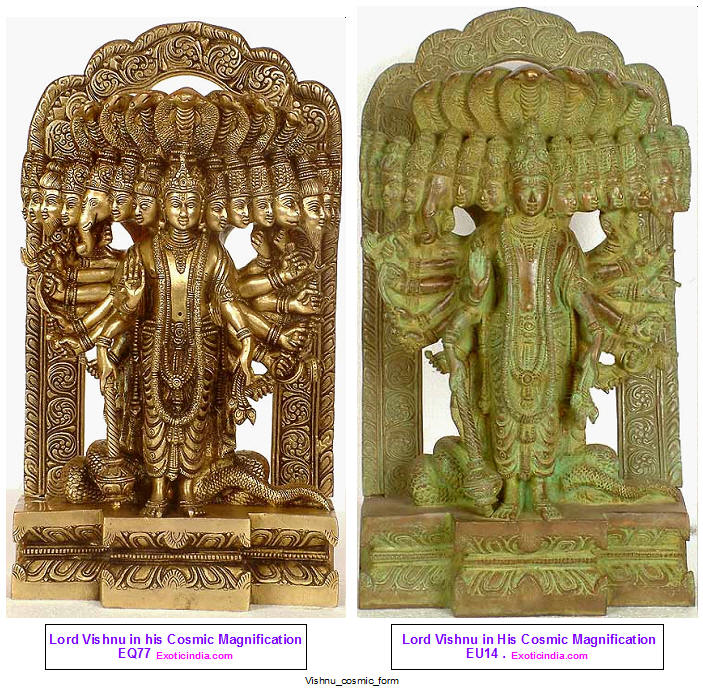
Though Bhagavan has many heads, many eyes, many hands, many .., He has only one hip.
|
Nammalvar (880-930 C.E)
Vaishnava Saint-poet says the following in Divyaprabhandam. 2612:
அன்றே நம் கண் காணும் ஆழியான் கார்
உருவம்; We are unable to see the sacred feet of Bhagavan (Krishna) at any time; His form is not visible to the external eyes until we can see Him with our internal eyes; at that moment, our (external) eyes see His dark-blue cloud color form bearing the discus. 2613:
உணர ஒருவர்க்கு
எளியனே? செவ்வே, Bhagavan wears the garland of Sacred Basil. Is He that easy of access? Humbler you are, easier is the access to the Lord. To me (Nammalvar) here and now, He (Emperuman) is easy of access. (From this it is obvious that Nammalvar had visions of the Lord.) 2636:
மாண் பாவித்து அஞ்ஞான்று மண் இரந்தான், மாயவள் நஞ்சு Then, the Lord appeared as a dwarf (Vamana). He as a child killed the ogress as he suckled on her poisoned breast. My eyes desire to see His form and would no see any other. My mouth would rather not eat anything than utter His auspicious qualities. |
|
"There is a principle which is pure, placed in the human mind, which in different places and ages hath had different names; it is, however, pure and proceeds from God. It is deep, and inward, confined to no forms of religion, nor excluded from any, where the heart stands in perfect sincerity. In whomsoever this takes root and grows, of what nation soever, they become brethren in the best sense of the expression." John Woolman, the American Quaker saint. Dr. Radhakrishnan. The Bhagavadgita page 51. November 2, 2013 |
11.1:
Arjuna said:
As a favor to me, You instructed me in matters of
supreme secret and spiritual Self. By what you said and by such words, my
delusion is removed.
The delusion that Arjuna had was that the body was the self. We are also body-conscious but not soul-conscious. We see the body and not the soul and thus the invisible soul does not receive its place of primacy. The soul is eternal, while a different body shrouds the soul at each rebirth--the embodied soul. Once Karma is expunged, the soul becomes free and attains Vaikuntam and does not come to the world sporting a body.
You did me a favor by
your instructions on the supreme Self, and my delusion is removed. The delusion
is that you are the body and not the self. Now that Krishna imparted important
lessons on the Supreme Self, the individual self and the means of attaining to
Brahman, Arjuna's awareness has increased.
11.2:
O Lotus-eyed One (Lord Krishna), creation and dissolution of all living entities
have been heard from You at length, so also Your imperishable (immutable) greatness.
Lord Krishna instructed Arjuna in matters of Supreme Secret, Spiritual Self, creation, maintenance, dissolution, rebirth. What about the ordinary people? Who instructs them in ways that they can understand. That is where Puranas come. Srinivas explains:
The puranas are religious stories in which figure deities and many semi-divine characters, and the public reading of the puranas and epics is even now popular. The puranas have played a great part in the spread of Hinduism as ordinary people became familiar with deities and ideas of Sanskritic Hinduism through them. Even more important is the fact that the puranas facilitated the absorption of local myths and legends. ... The puranas have been continually expanding, absorbing local myths and legends, and also weaving myths around great historical figures and, events. . . . Thus, through the Puranas, a local community becomes acquainted with the mythology of All-India Hinduism, and also its myths and legends are Sanskritized and made the property, of Hindus all over India.
11.3:
O Paramesvara (Supreme Lord), You are as you said (you are). I wish to see your
divine form, O Supreme Person.
Arjuna, having come to know Krishna as the unmanifest, the manifest, the Supreme, the sustainer, the controller, and the protector of His devotees, would like to see Him in his divine form. Arjuna knows Him as the Self.
मन्यसे यदि तच्छक्यं मया द्रष्टुमिति प्रभो ।
योगेश्वर ततो मे त्वं दर्शयात्मानमव्ययम् ॥११- ४॥
manyase yadi tac chakyaṁ
mayā draṣṭum iti prabho
yogeśvara tato me tvaṁ
darśayātmānam avyayam 11.4
manyase1
yadi2
tat3
śakyam4
mayā5
draṣṭum6
iti7
prabho8
yogeśvara9
tataḥ10
me11
tvam12
darśaya13
ātmānam14
avyayam15
11.4
prabho8= O Lord; yadi2 = if; manyase1 = You think; tat3 = that; [it] śakyam4 = is possible; mayā5 = by me; draṣṭum6 = to witness; iti7 = thus; yogeśvara9 = O Lord of Yogis (one with auspicious qualities); tataḥ10 = then; tvam12 = You; darśaya13 = show; avyayam15 = the imperishable; ātmānam14 = Your Self; me11 = to me. 11.4
11.4: If you think that by me it can be seen O Lord, then you show me Your (imperishable) Self completely, O Lord of Yoga
(Avyayam = completely, an adverb by Ramanujacharya; Monier William dic: Imperishable.)
Krishna is the First and the Foremost of All Yogis.
11.5:
Sri Bhagavan said: O Partha, see My forms by the hundreds, also by the
thousands: divine, many kinds, many colors and forms too.
Sri Bhagavan reveals
Himself to Arjuna and says that he could see his divine Self of many shapes,
forms, and colors by the hundreds and by the thousands. It is out of this world,
spectacular, mind-blowing, disorienting, and awe-inspiring; and it was never
seen before.
11.6:
See (in Me) the (12) Adityas, the (8) Vasus, the (11) Rudras, the two Asvins, also the
(49) Maruts, and
many wonders that you have not seen before, O Bharata (Arjuna).
Asvins: Mercury and Venus
Bharat is the endonymic name for the exonym, India. Arjuna goes by the name of Bharata. Bharata was the name of an Aryan Tribe. Bhr (भृ) or Bhri is the root for Bharata and means to 'carry, nourish, cherish'; the West says that Bhr or 'carry' is euphemism for stealing or plundering. Then 'Bhr' must mean plundering the natives and cherishing and nourishing own kind, the family and the fellow Aryans. In Sanskrit, some words have several and opposite meanings. Semanticists have fun with words like this. The west by explaining this has incriminated itself: The West by coming into India plundered India.
There are thirty-thee gods to begin with: 12 Adityas, 8 Vasus, 11 Rudras, and 2 Asvins.
The view from the West:
Adityas are the sons of Aditi who vary in number from text to text. The eight Adityas are Mitra, Varuna, Dhatar, Aryaman, Amsa, Bhaga, Vivasvat, and Aditya (Surya). Satapatha Brahmana lists 12 Adityas, the 12 names of the sun. The sun illuminates the heaven and the earth; the former is populated by immortals and the latter by creatures of the earth. So sun is death on the earth side. All the worlds are attached to the sun by threads (? the thread of gravity). The Adityas are waiting on the wings to arrive at the dissolution of the world and so the sun is called 12-souled. The 12 Adityas are Vishnu, Sakra, Aryaman, Dhuti, Tvastr, Pusan, Vivasvat, Savitr, Mitra, Varuna, Amsa and Bhaga.
|
Adityas (the sun) are waiting on the wing to dissolve the world. The sun's surface temperature is rising about 10% every billion years and is becoming brighter and brighter. In a billion years sun will be so hot that water and all gases in and around the earth will vanish into space. Sun goes from red giant phase to planetary nebula to a white dwarf. In Red Giant phase, the sun will swallow the earth. The above scenario has been described in the sacred texts of Hinduism, if not in precise scientific terms. Jun 2009. |
Rudras, the Howling Ones, are the Maruts, the sons of Rudra. They preside over 11 life-breaths (Rudra-Prana). , 10 of them representing physical and sensory entities and the 11th the individual soul or self. When they take leave of the body upon death, they wail (rud). 1110 Rudras surround Siva and also serve as escorts for Yama.
Asvins (Satya and Dasra, the physicians of the Celestials) are the horse-headed charioteers associated primarily with sun and light and later with agriculture, cattle and horses, and also with medicinal plants for their healing powers, restoration of youth and prevention of death. They are considered the physicians of the mankind, as Dhanvantari is the physician of gods. They store the herbal pharmaceuticals in heaven and enjoy drinking Soma. They were known to cure the blind and the lame, restore fertility to the barren cows, and bring rain to relieve drought. They provided artificial limb made of metal to the amputees, a reference to surgery in Vedic times. They blow their Bakura (trumpets) and drive away the Asuras and Dasyus (demons and natives). They preserve the germ of life (ovary and its eggs) in all females. They were born of sun-god Dharma Vivasvat and Samjna, the daughter of Tvastr. Samjna could not bear the splendor and light of sun-god and left him to live as a mare; sun-god assumed the form of a stallion, found her and fathered the Asvins, thus the name Asvinikumaras. This is the reason for invoking Asvins in marriage ceremonies. Coomaraswamy opines that Asvins are Yaksas like Kubera.
11.7:
See here in one part of My Body the whole universe, moving and unmoving, O Gudakesa (Arjuna), and anything else you wish to see.
The body, Bhagavan refers to here in this verse, is His physical Body, that too a small part of His Body.--(Krishnan Swami). Bhagavan's whole Body is unlimited beyond measure.
Ramanuja says that there are three parts to Brahman: The whole universe is His body. The triad consists of Isvara, cit and acit (prakara). Isvara is the antaryāmin meaning the inner controller of cit and acit. Cit is life, the sentient (world of organisms from ameba to) man, and plants. Acit is the world of matter, unmoving, and insentient. Upanishads mention Himalayas as an example of unmoving object.
Gudakesa = the one who has conquered sleep.
11.8:
But thou cannot see Me with your own (two physical) eyes; I give you divine eyes
to see My Yogam Aisvaram, My auspicious qualities.
Your physical eyes are
inadequate and therefore I bestow upon you the divine eyes in order that you can
see My yogic powers. I am the sun, the moon, and the stars. I am Prāna. I am OM.
I am Self-effulgence. I am brighter than the brightest light. With the Divine
eyes, you can see My Universal imperishable Form, marvel and wonder.
11.9:
Sanjaya said:
Thus saying, O King, the Great Controller,
the
Lord of yogic powers of auspiciousness, Hari showed to Arjuna (Krishna's
uncle's and aunt's son ) His Supreme divine Universal form.
Sanjaya (charioteer,
friend, secretary, and palace companion) was acting as a reporter to the blind
king Dhrtarastra, the father of Kauravas, on the battlefield happenings. Sanjaya
had this unique “Omnivision” or clairvoyance, by which he could see in his
mind’s eye and recount all events in real time on the battlefield happenings,
while staying close to the blind king in safety and away from the battlefield.
He was in effect the Seeing Eye of the blind king, with omnivision. Kauravas are
fighting Arjuna and his brothers, who are deprived of their kingdom and honor.
Obviously, the revelation of the Supreme form of Krishna to Arjuna has not moved
Dhrtarastra to stop the fighting. Probably the karmic compulsions are stronger
than the will of Dhrtarastra to stop the fight; with the bind love for his sons,
he does not see even a modicum of justice.
11.10:
Many mouths and eyes, many visions of wonder and (marvel), many divine
ornaments, many divine weapons held up high.
In
reality Bhagavan has no form, name, ornaments, weapons or Pitambaram. He does
not have appendages, accouterments, weapons, and the rest. He does not need them
to beautify or protect himself. They become beautiful because they appear on his
body. He is All on his own merit. He is secure and beautiful without them. He
sports them to please and protect the devotees. We give extra hands,
ornaments, and weapons and array him with Pitambaram and the rest because we
want to look at an auspicious form and receive protection from him.
11.11:
Wearing Divine garlands and garments smeared with Divine perfumes, all
uncommonly wonderful, resplendent, boundless God facing all sides in all
directions.
Visvato-mukham:
Facing all sides, one whose face is turned everywhere
I am the all-seeing and all-devouring Brahman. I strike wonder and awe in you with My visions. Look at My divine ornaments. My weapons are held high ready to be deployed. My divine opulence shows in My garlands and garments. My body is resplendent, wonderful, boundless all smeared with divine perfumes with My face looking in all directions.
11.12:
If a thousand suns were to rise and shine forth all at once in the sky, it could
be possible that their effulgence might equal the splendor of the Great or
Exalted Being.
I (Bhagavan) resemble a thousands suns in My splendor.
An instance of thousand suns in our galaxy rising all at once does not exist. Comparing Bhagavan's effulgence with a thousand suns rising and shining all at once is called இல் பொருள் உவமை அணி (Rhetoric of resemblance to a non-existent entity = अभूतोपमा = Simile implying an impossibility, impossible analogy). There is no existing object that can resemble Bhagavan. So Bhagavan is compared to a non-existing object. All this means He is incomparable, inconceivable... in His effulgence. When you take all the effulgent objects in the universe and put them all together, that effulgent entity will look dark before Bhagavan's effulgence. - Translation and paraphrase from U.V. Krishnan Swamy's Tamil Upanyasam (sermon).
11.13:
Arjuna beheld the complete universe divided into many parts, but
brought together in one place as one, in one part of the body of God of gods.
tatra1
ekastham2
jagat3
kṛtsnam4
pravibhaktam5
anekadhā6
apaśyat7
devadevasya8
śarīre9
pāṇḍavaḥ10
tadā11
11.13
devadevasya8 God of gods. go to the next verse for explanation.
Arjuna saw this manifold universe in one place in
the body of the God of the gods.
The table lists the Lord’s body parts and their equivalences on this earth,
heaven and the netherworlds. Source: Bhagavatam. Goloka is the highest heaven
and Patala is the lowest place where chthonian (Danavas, Daityas, Yakshas) beings
live. Mountains separate Aloka (Mahar, Jana, Tapas, and Satya lokas) from other
lokas and the sun does not shine in such farthest areas where gods and Siddhas
live.
The Cosmic Form of the Lord: Source Bhagavatam and
other sacred texts.
The table shows some overlaps to reflect different
sources.
|
The Body of the Lord |
The many worlds and their residents |
|
The Most Supreme Abode |
Goloka: Krishna,
Radha, Sridama (Krishna's friend) |
|
The Supreme Abode |
Vaikuntha, Abode
of Lord Narāyana or Krishna or Vishnu, Devotees of Lord Krishna; |
|
Heads of the thousand-headed |
Satyaloka–
Brahma's abode (Brahmaloka), Sankarsana. Brahma lives on the eyebrow. The
creation is a play of the eyebrows of the Supreme Lord. |
|
Brahma-randhra (Anterior Fontanel area on the
crown) |
The exit point for the soul from the body. In
addition, it is the entry point of the soul. |
|
Forehead |
Tapoloka,
Vairagins' heaven |
|
Face (midface) |
Janaloka:
Sri, Bhu, Siva (Rudra), Sanatkumara |
|
Neck |
Maharloka:
Bhrigu, Prajapati. Escapes sublation of three lower worlds. Above the
Polar star. |
|
Chest |
Svarloka:
Indra’s heaven, gods. Situated between sun and polar region |
|
His Heart |
Avyaktam or The Unmanifest or Primordial matter |
|
Breasts |
Indra's heaven, also god of righteousness |
|
Arms |
Ksatriyas' origin, also gods |
|
Navel |
Bhuvarloka Space between the earth and the sun (Munis and
Siddhas) |
|
Loins or Hips
|
Bhurloka, men,
others animals–the Earth's crust |
|
Buttocks or Thighs
|
Atala or Vitalaloka, Vaishyas's origin.
Subterranean locus (-2) Demon Bala, the son Maya lives here. Here, women
make any men sexually potent by administering Hātaka elixir—ingredients not
identified in Bhagavata Purana Book five, Chapter 24 Verse 16. |
|
|
|
|
Knees |
Sutalaloka - Subterranean locus (-3) Bali lives
here with Lord Visnu as the doorkeeper. |
|
Shins |
Talātala - Subterranean locus (-5) Siva has
given refuge to Maya in this location. |
|
Ankles |
Mahātala - Subterranean locus (-6) A snake
pit—a region of serpents |
|
Dorsum of the feet
|
Rasātala - Subterranean locus (-4). Daityas,
Dānavas and Panis live here. They are demons opposed to gods and stole
Ambrosia from Dhanvantari, the attending physician for gods. |
|
Feet |
Sudras' origin |
|
Soles of the Feet |
Pātāla - Subterranean locus (-7) The kingdom of
Vāsuki, the serpent king. |
|
His Mind |
The Moon was born of His mind |
|
His Eyes |
The Sun |
|
The Eyelids (apt locations and metaphor for day
and night) |
The day and the night
|
|
His Mouth |
Indira and Agni (Fire) came out |
|
Nostrils |
Asvinikumaras―The physicians of the gods |
|
The Head |
The Sky was born |
|
His ears |
The quarters |
|
His Speech |
The Vedas |
|
His arms |
Indra and the subsidiary gods |
|
His Breath |
The Vayu (Wind) was born |
|
The Navel |
The middle space was born |
|
His Two feet |
The earth evolved |
|
Crown of the head (Brahma-randhra) |
Vedas, Exit point for the departing soul |
|
His jaw |
Yama, the god of death |
|
Teeth |
Show of affection |
|
Palate |
Lord of water, Varuna |
|
Tongue |
Rasah, the essence of any |
|
His Smile |
Intoxicating māyā
|
|
His Glance |
Infinite, unending creation |
|
Upper Lip |
Modesty |
|
Lower Lip |
Greed (Lobhah) |
|
Breast (right) |
Dharma– Righteousness |
|
Back |
Adharma - Unrighteousness |
|
Genital - Phallus |
Ka = Who, What and which. Prajapati, Brahma |
|
His Gonads―testicles |
Gods Mitra and Varuna (Sustainer of all created
beings and water) Common meaning of Mitra is “friend” |
|
Abdominal Cavity (Kukshi) |
The oceans |
|
Skeletal mass |
The hills and mountains |
|
Blood vessels (Nadyah) |
The rivers |
|
Body hair |
The vegetation |
|
|
|
|
His activity |
The continuous flow of gunas as in creation and
the created |
|
The water-laden clouds |
|
|
His Eyebrows |
The abode of Brahma |
|
His Eyelashes |
Night and day |
|
His eyes |
The Sun and the Moon |
|
His ears |
The Quarters, directions |
|
The nares (nasal openings) |
The Asvinis |
|
His lips |
Greed and modesty |
|
His front teeth |
The stars |
|
His molars |
Death, the great equalizer |
|
His Smile |
Māyā, illusion or māyā energy |
|
His Breath |
The Infinite power of air |
|
His Speech |
The formation of the birds in flight |
|
His tunes |
Siddhas and celestial artists |
|
His mouth |
Fire |
|
|
|
|
The twilight |
The apparel or Raiment |
|
|
|
|
His Mind |
The Moon |
|
Mahim or Cosmic Intelligence or Maha-tattva |
Universal Consciousness |
|
Rudra |
Ego of the Universal Soul |
|
His Nails |
The horse, the mule, the camel and the elephant |
|
His Hips and Loins |
The deer and other animals |
|
Manu |
Intelligence |
|
Manujah -Sons of Manu |
Abode |
|
Ghandharvas etc. |
Melody |
|
Asuras―Demons |
His Virility―Virya |
Table: The Lord’s body parts, the universe, and the
functions
|
Hair on body |
Vegetation, trees especially those used in
sacrifices |
|
Hair on the head and face |
Clouds |
|
Nails |
Generates electricity. Boulders and iron ore
deposits |
|
Hands |
Fields for gods |
|
Feet |
Shelter for upper, lower and heavenly planets |
|
Genitals |
Water, Vital Generative Fluid, Rain |
|
Anal opening |
The abode of the deity of death |
|
Anus and Rectum |
Abode of violence, ruin, death |
|
Back |
Ignorance, frustration, adharma |
|
Veins |
Rivers |
|
Bones |
Mountains |
|
Avyakta―Unmanifest |
Oceans |
|
Abdomen |
The materially devastated beings |
|
Heart |
Subtle material bodies |
|
Consciousness |
Duty, Justice, and four bachelors: Sanaka,
Sanatana, Sanatkumara and Sanandana, Also Sattva and Vijnāna
-Goodness and wisdom |
|
All beings, past, present and future |
Occupy one Vitastim, distance between the tip
of extended thumb to the tip of the fifth finger. – 9 inches or 12 angulams |
|
Upper Lips |
Modesty, bashfulness (Vrida) |
|
Chin |
Longing, eager desire (Lobhah) |
|
Breast (Stanah) |
Righteousness (Dharma) |
|
Back |
Unrighteousness (Adharma) |
|
Vrsanau-male Gonads |
Mitra and Varuna uphold and rule the earth and
sky, protect the world, and preserve religious rites: guardians of truth and
light. Punish sinners. |
|
Waist (back of it) |
Oceans, animals |
|
The toenails |
The elephant, camel, horse, and mule. All
four-legged animals |
|
Blood vessels |
The rivers |
|
The air |
His Movements |
|
The march of Time |
His activities―Karma |
|
Guna pravahah―reactions and consequences of
modes of behavior and nature |
His Ego |
|
Rudra - later known as “Siva Face” |
Brahmanas |
|
Arms |
Ksatriyas |
|
Thighs |
Vaisyas |
|
Feet |
Sudras |
|
|
|
The God of gods creates Brahma; Brahma in turn
creates the world of beings; Brahma’s body parts and the emerging beings are
listed below.
|
Brahma’s Body parts |
|
|
Brahma's Head |
Rudra |
|
Brahma's Lap |
Narada |
|
Brahma's Thumb |
Daksa |
|
Brahma's Breath |
Vasistha |
|
Brahma's Skin |
Bhrgu |
|
Brahma's Hand |
Kratu |
|
Brahma's Navel |
Pulaha |
|
Brahma's Ears |
Pulastya |
|
Brahma's Mouth |
Angira |
|
Brahma's eyes |
Atri |
|
Bream’s Mind |
Marici |
|
Brahma's Right Breast |
Dharma |
|
Brahma's Left Breast |
AUM |
|
Brahma's Back |
Adharma |
|
Brahma's Heart |
Kāma |
|
Brahma's Brows |
Anger |
|
Brahma's Lower Lip |
Greed |
|
Brahma's Mouth |
Vak or Speech |
|
Brahma's Private Parts |
Ocean |
|
Brahma's Anus |
Nirrti |
|
Brahma's Shadow |
Kardama |
11.14:
Then Dhananjaya (Arjuna), filled with wonder and his hair standing on end, bowed
down his head to the Lord, and spoke with folded hands.
tataḥ1
saḥ2
vismaya-āviṣṭaḥ3
hṛṣṭa-romā4
dhanañjayaḥ5
praṇamya6
śirasā7
devam8
kṛta-añjaliḥ10
abhāṣata11
11.14
tataḥ1 = Then; saḥ2 = he [Arjuna]; vismaya-āviṣṭaḥ3 = filled with wonder; [and] hṛṣṭa-romā4 = his hair standing on end; dhanañjayaḥ5 = Dhananjaya; praṇamya6 = bowing down; śirasā7 = with his head; devam8 = to the Lord; kṛta-añjaliḥ10 = with opposed hands; abhāṣata11 = he [Arjuna] said. 11.14
Filled with wonder, with his hairs standing on end
and hands folded in supplication, Arjuna spoke.
devam8 : Deva is etymologically connected with 'dyaus' (the bright sky), and 'div,' indicating 'to shine,' 'be bright.' The one who shines is Deva. Bhagavan is Deva-deva meaning He is God of gods. The gods shine over and more than men; Bhagavan shines over and more than gods.
dhanañjayaḥ5 = Dhananjaya = Arjuna the warrior, whose charioteer is the Lord. (Arjuna and Bhagavan Krishna have many names; each name most often has a contextual significance in Bhagavadgita.) dhana = Prize, wealth, riches, money , treasure. jaya = victory. dhanañjayaḥ = one who has gained wealth. Here the wealth is not earthly but divinely. Arjuna has just witnessed the Universal Form of the Lord, which has never been seen by others. That is the wealth, Arjuna gained by witnessing Visvarupa.
11.15:
Arjuna said:
I see on your body an assembly of all gods, many
kinds of living beings, Lord Brahma seated on a Lotus flower, Lord Siva (Isam),
all Rishis, and divine snakes.
I see on Your body your own creations such as gods,
living entities, Brahma seated on the lotus flower, Siva, the Rishis and the
divine snakes. One should remember that Brahma, Siva, Sri, Bhū Devi, and
Nila have taken
up residence on the body of Vishnu. (In the temple sculptures, only Sri and Bhu
Devi appear sitting on the chest, along with the “mark of Srivatsa” on the
Lord’s chest as the hair representing the footprint of Bhrigu―Canto or Book six,
chapter 8, text 22 Bhagavatam).
Brahma is sitting on the lotus flower sprouting out of His navel.
Sri, Vishnu's consort took up residence on the right front chest, while Rudra
(in temple sculpture, Bhu has taken the place of Rudra) also took up residence
on the chest. His body is this universe: He creates it, He sustains it, and He
dissolves it. Vishnu in this form represents the Hindu Holy Trinity:
encompassing creation, sustenance, and dissolution. Nammalvar and later
Ramanuja expanded on the theory of Vishnu or Narāyana as the Supreme Soul
(Atman) and this universe as His Body. Nammalvar has stressed on this organic
and systemic relationship between God on one hand, His created beings and the
universe on the other hand.
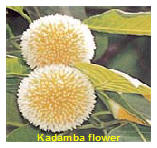 In Svadhisthana Chakra, Vishnu is the presiding Deity. He is depicted as having
a “luminous blue beautiful” body. He wears the mark of Sri Vatsa, Kaustubha gem
(close to his heart) which has the luster of ten thousand suns, and Vanamala
having the luster of ten thousand
moons. He has four arms holding the Conch, Discus, Mace, and Lotus with dark
blue body; He wears yellow raiment. Vanamālā is a garland of forest flowers
extending down to the knee. It is of celestial origin and of all seasons
interspersed with Kadamba flowers. The garland is
symbolic of elements (earth, water etc.); the Sword, Jnana (knowledge); its
Sheath, Ajnana (ignorance); Discus, the Manas (mind); the Arrows, the senses;
the Conch, Sattvica Ahamkara; the bow, Tamasic Ahamkara; and the Club, Mahat.
In Svadhisthana Chakra, Vishnu is the presiding Deity. He is depicted as having
a “luminous blue beautiful” body. He wears the mark of Sri Vatsa, Kaustubha gem
(close to his heart) which has the luster of ten thousand suns, and Vanamala
having the luster of ten thousand
moons. He has four arms holding the Conch, Discus, Mace, and Lotus with dark
blue body; He wears yellow raiment. Vanamālā is a garland of forest flowers
extending down to the knee. It is of celestial origin and of all seasons
interspersed with Kadamba flowers. The garland is
symbolic of elements (earth, water etc.); the Sword, Jnana (knowledge); its
Sheath, Ajnana (ignorance); Discus, the Manas (mind); the Arrows, the senses;
the Conch, Sattvica Ahamkara; the bow, Tamasic Ahamkara; and the Club, Mahat.
GITAGO4.jpg
In temple sculptures, it is not uncommon to see two miniature sentinels on either side of Vishnu, who are the anthropomorphic forms of the Discus and the Club.
Kadamba flower = Ipomoea acquatica Forsk.
11.16:
I see You in your infinite form with many arms, many stomachs, many mouths, and
many eyes on all sides. I could neither see the end, nor the middle, and nor the
beginning, in Your universal form, O Lord (Controller) of the Universe,
Visvesvara.
O Lord, You are infinite; You have no beginning, no
middle, and no end. I see all created beings in You; You are the controller of
this universe: Visvesvara is the controller of the Universe, both sentient and
insentient. This is called Ādhāra-Ādheya; Ādhāra is the support and the Ādheya
is the supported. Krishna is all-pervasive and that is how He becomes the inner
controller of both the sentient and the insentient.
11.17:
I see You wearing the crown, holding the mace and the discus, glowing on all
sides with a mass of light, and blazing like the burning fire and the sun. It is
difficult to see You on every side because You are unfathomable.
Tējo-rāsim: Light-heap, mass of light. Samantāt:
being on every side. Apramēyam: unlimited, immeasurable, unfathomable.
Tejas is Divine light of God, known by other names:
splendor, brilliance, luster, luminosity, or effulgence. Not only does it have
the brilliance of a thousand suns, but also the burst of color from a thousand
Lotus flowers. It dazzles and it sparkles. Tejas is the source of all lights:
the lightning, the sun, the moon, the stars, and the hidden light in any device
or object. It is also the Light of the Self in the spiritual heart; such is its
nature and grandeur.
11.18:
You are the Imperishable and the Supreme, to be realized. You are the Supreme
abode of the universe. You are the protector of eternal Dharma
(Sāsvata-Dharma-goptā), the unmanifest and the eternal Supreme Personality. That
is my opinion
My opinion is that You are the Supreme, the
Imperishable, and the Unmanifest, worthy of realization, that the universe rests
in you, and that You are the protector of Eternal Dharma.
11.19:
I see You without beginning, middle, or end, with infinite power and many arms;
having the sun and the moon as Your eyes, with blazing fire in Your mouth, whose
radiance heats up this universe.
You have no beginning, middle or end and have many
arms; the sun and the moon are your eyes. The radiance of fire in your mouth is
heating up the universe. Your power is infinite.
11.20: You alone pervade the space between heaven
and earth in all directions. O Mahatman, on seeing your wonderful and terrible form, the
three worlds tremble in fear.
महात्मन् = Mahātman = literal meaning is 'Great Soul'. Ramanuja's interpretation: The One, the dimensions of whose mind has no limits.
Vishnu pervades the space in all directions. Each direction has a deity in charge. But Vishnu is the Lord of all directions and all are his surrogate deities.
Of the guardians or regents (Dik-pālas) of the quarters-viz., Indra's Vajra (thunderbolt)1, Agni's Śakti (spear, dart)2, Yama's Danda (staff or stick)3, Naiṛṛta's Khaḍga(sword)4, Varuna's Pāśa (fetter)5, Vāyu's Aṅkuśa (hook)6, Kubera's Gadā (mace)7, Īśāna's Triśūla (trident)8, Brahmā's Padma (lotus)9, Viṣṇu's Chakra (discus)10. Page 172—The Great Liberation, By Woodroffe
11.21:
The bevy of gods enters You; some extol thee in fear with folded hands. The
confluence of great sages (Maha Rishis) and the perfected ones (Siddhas), to
increase auspiciousness, praise Thee and sing richly beautiful hymns.
Svasti: auspiciousness. The word Swastika /
Svastika is derived from svasti. Pushkal: abundant, full, excellent, richly.
Stutibhi: praise. Stuvanti: praise
All these gods, sages and the siddhas enter you
with humility and fear in their heart, and praise and prayers on their lips.
Bhagavatam (2.3.19) states that men of the nature of dogs, hogs, camels, and donkeys shower praises vainly on those who never let the holy name of Sri Krishna enter his ear.
11.22:
Rudras, Adityas, Vasus, Sādhyās, Visvedevas, Ashvins, Maruts, Ushmapas,
Ghandarvas, Yakshas, Asuras, and Siddhas gaze at you in amazement.
उष्मपा =
uṣmapā = manes = the souls of the dead, usually of the forefathers.There are 3003 gods, the many manifestations of 33 gods: eight Vasus, 11 Rudras, 12 Adityas, Indra, and Prajapati. Brhad-aranyaka Upanishad 3.9.1. The Vasus are fire, earth, air, sky, sun, heaven, moon, and stars, live in the bodies and organs of beings, and support the body functions. It is obvious from various functioning organs that the gods live in our bodies, preside over various organs and their corresponding functions, and that without the presiding gods there is no substance or function in our bodies. Ghandarvas are the celestial singers. Because they make us weep at the departure of a soul, Rudras are named so and are the mind, and the ten “breaths”: the sensory and motor organs. The Adityas are the 12 months. Bhaga is one of the Adityas presiding over love and marriage. Indra is the thunderbolt and Prajapati is the sacrifice.
Sumerian deities are also in charge of the various organs of the body. Ninhaursaug is Mother Earth and also the goddess and protector of vegetation. Once her husband Enki ate one of her cherished plants, which made her angry enough to kill him. After a while, she regretted and relented and created eight deities (compare with the eight Vasus above) to heal and restore the vital organs and thus bringing Enki (the god of waters) back to life. The Indian god of water is Varuna, the Greek Oceanus and the Sumerian Enki.
11.23:
O Mahā-Bāho, Mighty-armed One, on seeing your great form with many mouths, eyes,
many arms, thighs and legs, many stomachs, many formidable teeth, the worlds
shake in fear; and so do I.
11.24:
On seeing, You glow in many colors and touch the sky (Supreme Heaven) with wide-open mouth and
large lustrous eyes, my soul deep inside shakes in fear. I find neither support
nor tranquility, O Vishnu.
11.25:
On seeing your formidable teeth, your faces, the Time's (all-consuming)
fires, I know not my sense of direction and find no
comfort. Give me grace, O Lord of Gods and the Refuge of the Universe.
This appears like a dissolution scenario. The Time
is up. Is this the end of Time? Is this finality? The fires rage; the teeth
gnash; and the faces contort. There is no place to hide, nowhere to turn. I am
lost, I am disoriented, I am numb, and I
am vulnerable. There is no place for refuge. Only avenue left is to plead with
the God of gods and the sole refuge of the universe. You are my Hope, You are my
Supreme, You are my refuge, and You have mercy on me. The Vision of Lord Krishna
is so realistic and compelling that Arjuna feels that he is part of the
scenario. Fear took over Arjuna: Am I going to suffer crushing death between the
terrible teeth? Am I going face death from the raging fire? Is my end near? I am
afraid of Your Universal form, O Krishna; please let me get over the form of
yours. May I see your usual human form, which is pleasing to my eyes, mind, and
soul?
11.26:
The sons of Dhrtarastra together with host of kings enter into You.
Bhishma, Drona, Suta Putra (Karna) and chief
warriors on our side, (continued)
11.27:
are rushing and entering your fearful (mouths) with formidable teeth. Some of
them are caught between (your) teeth with heads crushed (to a pulp).
11.28:
As many (swift) currents of rivers rush towards (Abhimukhah) the ocean, so are
the brave men of this world entering Your flaming mouths.
From ocean to ocean:
The hungry clouds hovering over the ocean are
turgid with waters and disgorge them on the plains, hills and valleys; the rains
run off as rivers back to the ocean; in like manner, the souls go through cycle
of transmigration.
11.29: Moths enter a blazing fire at full speed for
destruction, and similarly, all people enter your mouths at full speed for their
destruction.
11.30:
As you devour all people from all directions by Your flaming mouths, You are
licking. Your terrible radiance filling the whole world is scorching it, O
Vishnu.
11.31:
Tell me, who are You with a terrible form? Salutations to You, O Supreme God,
have mercy. I wish to know You, the primal One, for I do not know your activity.
You are the Original. You are the Supreme God. My
salutations to you are in order. Tell me, who are You with this terrible and
scary form? What is the purpose of this projection? Have mercy on me.
11.32:
Sri Bhagavan said:
I am Time, the great destroyer of the world and the
people. Even without your active engagement or participation, all these warriors
in the opposing armies will cease to exist.
Time (काल = Kāla =) Time is the calculator which calculates (kalayati) the end of life. --Ramanuja
Father Time is the ultimate destroyer of the universe. Time is in the Lord and the Lord is not in the Time. Time has no effect on God. Death is certain; all meet their maker at some time or other. This destiny with Time or death is under the control of Karma.
Here is the story of Markandeya who had a view of the universe in the abdomen of the Supreme Being. In the eventide of last Kaliyuga, the Day of Brahma comes to an end. Symptomatic of Kaliyuga, Brahmanas do not perform meditation and prayer; Sudras reign high and become their surrogates, Sudra-Brahmanas, performing the duties of Brahmanas. Kshatriyas and Vaisyas give up their ordained duties. The earth is besieged with sporadic fires; milch cows yield very little milk; trees do not bear blossoms and fruits. Indra abstains from sending rain to earth; earth is parched dry, desolate and fissured. Sin and immorality are rampant in an unprecedented scale. Fire engulfs the world; rain comes pouring down, submerging the remaining forests and mountains. The winds die down because they are absorbed by the lotus of the flood waters, wherein sleeps the Creator. The lesser gods, demons and all die; only Markandeya survives as a witness. He finds no resting place; at last he finds a Banyan tree and a divine-looking boy sitting on one of its boughs. The boy knowingly invites the sage to enter his mouth to find rest from his weariness. Markandeya enters the mouth of the boy and slides down to the stomach where he sees people, gods, demons, earth, kingdoms, mountains, rivers, animals, fishes... He was so terrified of the sight he begged the Supreme Being to protect him; soon he found himself, belched out of His stomach resting on one of the branches of the tree amidst the vast expanse of water. The Supreme Being spoke to Markandeya, "These waters are Nara; they are my Ayana (home); therefore, I am Narayana, the creator, the maintainer and the destroyer. Another explanation is as follows: The waters are called Nárá, because they were the production of Nara, or 'the spirit' of God; and since they were his first Ayana, or place of motion, he thence is named Náráyańa, or 'moving on the waters.'
Laws of Manu(1.8-9-10) says the following about Narayana:
8. He, desiring to produce beings of many kinds from his own body, first with a thought created the waters, and placed his seed in them.
9. That (seed) became a golden egg, in brilliancy equal to the sun; in that (egg) he himself was born as Brahman, the progenitor of the whole world.
10. The waters are called narah, (for) the waters are, indeed, the offspring of Nara; as they were his first residence (ayana), he thence is named Narayana.
Nárá or Apa (Waters) has the meaning of 'bodily forms,' in which spirit is enshrined, and of which the waters, with Vishńu resting upon them. He received the name of Náráyańa: the waters being the product of the embodied deity:' i. e. they were the product of Nara or Vishńu, as the first male or Virát, and were therefore termed Nára: and from there being his Ayana or Sthána, his 'abiding place,' comes his epithet of Náráyańa. By H.H.Wilson: Commentary on Vishnu Purana.
I am the God of gods, men and beings. Fire is my mouth, earth my feet, the sun and the moon my eyes, the Heaven the crown of my head, the cardinal points my ears, the waters my sweat, the Air my mind, and the space my body. I am Wind, Fire, and Sun. The ocean is my raiment, home and my bed; the stars are my sweat pores; I am the source of good and evil; I am lust, joy, anger, fear, clouding of intellect; men's will sways under my command; I come in many forms; I take birth in Sattvic families; I am the creator and destroyer of men, gods, Gandharvas, Rakshasas, mobile and immobile beings (trees). I enforce order in the world; I take inconceivable forms as occasion demands; I am white, yellow, red and black in Krita, Treta, Dwapara and Kali Yugas respectively. I spin the wheel of Time."
The View from the West
The West is of the opinion that the concept of transmigration of soul originated in the Indo-Aryan mind and spread to Egypt, the Greeks and the Celts. Agni and the spark of life (soul) are identical; Agni (fire) carried the soul to heaven in the same way it carried the holocaust (the food of gods) to gods. Rg Veda speaks of the soul coming down to the waters and the plants. This, the West feels, is the beginning of the concept of soul entering living beings and bodies, when it comes down from heaven. The concept extended as follows. The soul enters and sojourns in 8.5 million lesser living things before it enters the human body, the highest of all beings on earth. The soul from man may obtain a permanent place in Heaven upon death or gets shunted back to earth to enter a body in animal, human, or plant depending on its Karmic merit or demerit (Punyam or Papam). Sacrificial rights played a big role in facilitating the soul to take a permanent place in heaven after one more birth. The West claims that transmigration of the soul is punishment for the sins perpetrated during the previous life or it could be a prelude and preparation to attaining Moksa. The West quotes Manu: A gold thief becomes a rat in next life, a murderer a tiger, a camel, a dog, a pig, a goat. Suffering in the present life is retaliation and requital for the sins of the past life. The souls depart earth, go to the Moon and contribute to its waxing; its waning coincides with the departure of the souls from the moon to take birth on earth. The moon poses questions to the arriving souls; satisfactory answers puts them on a course for a Higher Life; the failures are sent back to earth in the form of rain, worm, fly, fish, bird, lion, boar, toothed animals. What the man thinks of at the time of death, that he becomes: When he thinks of Brahman, he goes to Brahman; any thought other than on Brahman sends him back to earth as an animal or human. The early Indo-Aryan postulate conceives of transmigration as a round wherein the souls move in circles; much later came the idea of liberation (Moksa) from the cycle of birth, death and rebirth. Moksa is shaking off, freeing oneself, letting oneself loose. It is a late Vedic concept. It quotes Brahad Aranyaka Upanishad chapter III.1.4-5 as follows: Mukti is effected by hotr, Adhvaryu, Udgatr and Brahman, who are the four kinds of priests. The priests served as the facilitator of Mukta or release based on rituals.
Hotr: Priest who offers oblations or burnt offerings and reciter of Rg Veda
Adhvaryu: The priest who performs Adhvara: measuring the ground, building the altar, prepare the sacrificial vessels, fetching wood and water, lighting the fire, bringing the animal to immolate it, chanting hymns of Yajur Veda.
UdgAtr: the chanter of Sama Veda hymns at Soma Sacrifice.
Brahman: Learned supervising priest of the sacrifice, making right the mistakes.
My quote from Brahad Aranyaka Upanishad
Rituals are not enough for liberation. The Brahad Aranyaka Upanishad (chapter iv.4.7) says, "The desires from the heart should be cast away; only then the mortal body becomes immortal; he attains Brahman, the Supreme Soul."
Desires keep the soul bound to the body; once desires are relinquished, the soul is liberated and reaches Brahman.
The concept started as simple passage of the soul with the smoke, fire and light, became transmigration of souls in many bodies, rituals to release the soul with the help of four kinds of priests with the accompaniment of oblations, animal sacrifice and chanting of Hymns and Vedas and ended up as the most developed philosophy of relinquishing desires to attain liberation. The first concept is still valid. Bhagavan Krishna says:
8.24: The paths of the departing souls, who attain the Brahman because of Brahman knowledge, are the fire, the day, the bright half of the month and the six months of sun’s northern passage.
11.33:
Therefore, get up and gain your glory. Vanquishing your enemies, enjoy your a
prosperous kingdom. I alone have killed all these enemies earlier. You are only
a mere instrument, O Savyasācin (Arjuna).
निमित्तमात्रं
Nimitta-mātram: mere Instrument
(-al cause).
God is the efficient cause of the universe, birth,
sustenance, and death. Lord Krishna says that the fate of the warriors on either
side was decided earlier on the weight of their own karmic compulsions. Arjuna
need not worry about his responsibility for the death of the warriors, his near
and dear, and kith and kin on the battlefield. Arjuna is only a mere instrument
in the hands of God and therefore not a real and efficient cause, but a token
(not intentional but mere (Mātra) instrumental and accidental) cause of their
death. Karma is the immediate and proximate cause of their death. As karma goes, so goes
birth, life, or death. This is death by karma. Even the Lord (Krishna) has to
abide by His own Laws on this earthly sojourn. The law of Karma has to run its
course. During Vishnu’s Avatars, the Lord had
to abide by His own karmic laws. His own disappearance (death) from this earth
by His own illusory energy at the hands of a hunter illustrates the karmic
consequence of one’s acts.
Arjuna is gripped by pangs of guilt to engage in the killing of such noble souls like Droṇa, Bhīṣma, Karṇa etc.,
They transgressed the law of righteousness and thus were chosen by Me alone for destruction. Do not be distressed and think about the right and wrong of slaying them out of love and compassion for them. These are guilty of unrighteousness by siding with the evil-minded Duryodhana. Therefore fight without doubt (or dither). You shall conquer your enemies. In slaying them, there is not the slightest trace of cruelty. --Ramanuja
11.35:
Sanjaya said:
Thus hearing the words of Krishna (Kesava), Arjuna
bowed down to Krishna and spoke with folded hands, trembling, stammering, and
fearful.
Sanjaya, the palace companion of Dhrtarastra is
narrating the battlefield conversation between Krishna and Arjuna.
11.36:
Arjuna said:
O Hrisikesa (Krishna), rightly, by glorifying You,
the world rejoices and delights. The raksasas, out of fear are fleeing in all
directions. The confluence of Siddhas bows down to
you in reverence. All this is fit and proper.
Siddha-Sanghah: Confluence of Siddhas or spiritually perfected or accomplished souls, who found oneness with Brahman; assembly of spiritually perfected ones.
Siddhas are the yogins who possess eight siddhis or supranormal powers. Siddhas have attained liberation (jivanmukti) while living. His body is secure from Time or death; he can choose his death at will at a time and place of his choice. They are the gurus and spiritual preceptors. Among Sivas, Siva is the Supreme Siddha; Siddhi is achieving a siddha. The Supranormal powers are impediments to Samādhi, which is becoming one with ONE. The siddhis are eight: Anima, Mahima, Gharima, Laghima, Prapti, Prakamya, Isatva, Vashistva, (and Kāmarutattva.) Note some texts do not mention Gharima or Kamarutattva.
Major Siddhis which are possessed by Mother Goddess, Bhagavan, Bhagavati, Isvari or Isvara and to a lesser degree by the Siddha.
1. Anima. (smallness): Supernatural power of becoming as small as an atom, atomization
2. Mahima. (largeness): The supernatural power of increasing size at will
3. Gharima. The supernatural power of making one self heavy at will
4. Laghima. (lightness): The supernatural power of levitation
5. Prāptih. Supernatural power to obtain everything
6. Praakaamya. Capacity to accomplish anything desired
7. Isitva. Supremacy or superiority considered as a super natural power
8. Vashistva. The supernatural power of subduing all to one's own will
---Definitions as found in Tamil Lexicon, Madras University
Kāmarutattva (consummation of all desires)
Minor Siddhis (some are common to major and minor siddhis)
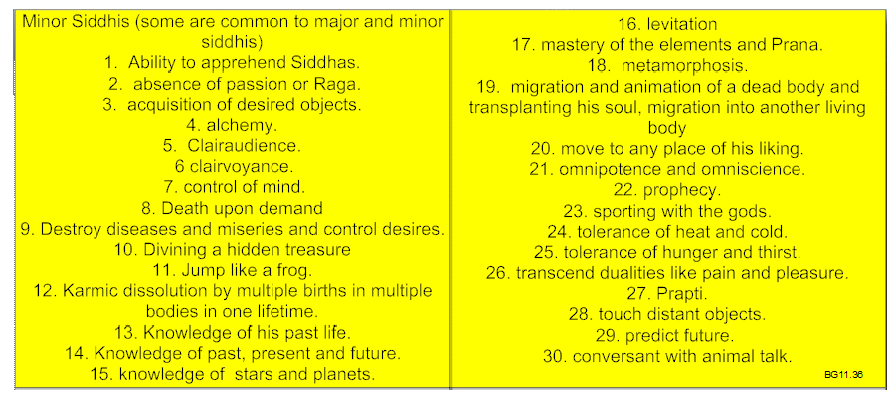
Prapti =
பிராப்தி = pirāpti = Enjoyment. Interpretations differ. It
is power to enter anywhere. It also means
the supernatural power of obtaining everything. This includes Ability to touch
the sun, the moon or the sky. The Siddha can predict the future. He understands
the language of birds and beasts, and unknown kind. Prapti is defined as ability
to apprehend knowledge and perceptions perceived by the individual soul in his
senses, which are presided over by god or gods. Once a Yogi or Siddha enters the
body of another, he can perceive and modulate the feelings and perceptions of
the the host's senses.
Prâkâmya is the ability to enjoy anything that is heard, seen, touched, thought and more. பிராகாமியம் pirākāmiyam, prā- kāmya. 1. Capacity to accomplish by will-power anything desired, one of aṣṭamā-citti,
Isitva is introduction and diffusion of Sakti of His Maya into every Jiva in the universe. It also means supreme domination.
Clairvoyance, Clairaudience, Divination, and
Hyperacuity to pain, taste, and smell are supranormal faculties, which are an
impediment to True Siddhi (Oneness with One) because they generate Ahankāra, the
I-ness, and the Mine-ness and prevent total surrender to God. The eighth power
indicates the consummation of yogi's desire for God-realization and subduction
from Kāma or sexual desire.
A realized Yogi Ramana Maharishi makes the following observations on Siddhis. The Siddhis are not natural to the Self. That which is not natural, but acquired, cannot be permanent, and is not worth striving for. They denote extended powers. All these Siddhis are related to body and not to Brahman. A man is possessed of limited powers, and is miserable; he wants to expand his powers so that he may be happy. But consider if it will be so; if with limited perceptions one is miserable, with extended perceptions the misery must increase proportionately. Occult powers will not bring happiness to anyone, but will make him all the more miserable! He desires to display the Siddhis so that others may appreciate him. Without appreciation he will not be happy. If he finds another one with greater powers, he will be unhappy and jealous. The higher occultist may find another higher Siddha and so on until there will come one who will blow up everything in a trice. Such is the highest adept (Siddha) and He is God or the Self. --Talks with Ramana Maharishi, page 19.
Sayings of Ramakrishna page 112, Saying 374
A man, after fourteen years of hard penance in a solitary forest, obtained the power of walking on water. Overjoyed at this acquisition, he went to his Guru and said, "Master, I have acquired the power of walking on water." The Guru rebuked him, saying, "Fie upon you. Is this all the result of your fourteen years' labour? What you have attained is worth only a pice (penny). What you can accomplish after fourteen years' labour, ordinary men can do by paying a pice (penny) to the boatman."
11.37:
Why should they not bow to You, O Mahatman (Great Soul), when You are the
original creator of, and more venerable than Brahma Himself? O Infinite Being, O
God of gods, O refuge of the universe, You are imperishable, Sat and Asat (Being
and NonBeing) and (what is) beyond that.
11.38: You are the Primal God, the most
ancient Purusa (person). You are the Supreme abode of the universe. You are the
knower, the knowable, and the supreme refuge. You pervaded this universe, O
Infinite Form.
11.39:
You are Vayu, air; Yama, death or destroyer; Agni, fire; Varuna, water; Sasānka,
moon; Prajapati, Brahma; and the great-grandfather. Homage to You a thousand
times. Again and again, homage to You.
11.40: Homage to Thee from front and also behind. I offer homage to You from all sides indeed. (You are) all infinite power, immeasurable prowess. You pervade everything and therefore you are everything.
Arjuna says that Krishna is everything and He pervades everything. All beings and objects have three faults: Avyapti, Ativyapti, and Asambhavam --negative qualities of limited pervasion, generalization and impossibility.
Vishnu is beyond three faults.
Negative Characteristics (that which is not there). All these three come under the title, “He is Not.”
Avyapti: Absence of pervasion; Narrow definition; localized occurrence. It is a fault. Vishnu is all-pervasive. He is in all the objects that we see. Thus he is not limited by this fault. The following example explains absence of pervasion or narrow definition. Animals have horns. Some animals don’t have horns. Horns are not a comprehensive pervasive occurrence in animals. That logic is Avyapti. The statement, “Animals have horns” is a dosham or fault, because all animals do not have horns. Horns are not a pervasive feature in animals. Vishnu's pervasion is all-inclusive.
Ativyapti: excessive generalization; Broad definition; Unwarrantable stretch of a rule. This is a fault. A feature of the cow is its horns. Horns are characteristic of cows. This is a faulty premise or broad definition, because besides the cow, horns are present in other animals too. Vishnu is beyond generalization, limitation, restriction, broad definition. He cannot be categorized and catalogued.
Asambhavam: Impossibility is a fault. Example: Man has two horns on his head. That is impossibility. Vishnu is not subject to the impossible. Everything is possible for him.
In Vishnu's dictionary, there are no words like Avyapti, Ativyapti, and Asambhavam (absence of pervasion, generalization and impossibility).
Vishnu pervades all the worlds. He is in the cow, elephant, lotus flower, mountain, river, and us. We have no idea what He has. Nothingness is not characteristic of him; thus, impossibility is faulty premise when it comes to Vishnu.
11.41:
Thinking of you as a friend, whatever I said impetuously (Prasabham), O Krishna,
O Yadhava, O Friend, without knowing Your greatness (Mahimānam) out of
negligence or fondness.
11.42:
In whatever manner I disrespected you in jest, while playing, lying down,
sitting down, eating together, or when alone or in the company of others, O
Acyuta, I ask forgiveness from You, the Immeasurable.
Whatever Arjuna did with Krishna, could appear as
disrespect towards Krishna, once he has seen the awesome powers and the splendor
of Krishna. It struck him that he was in the presence of the creator, the
sustainer, and the destroyer of the universe. Arjuna felt so small, so guilty,
so worthless, and so sinful that he feels the shakes looking at the Lord of the
Universe.
11.43:
You are the Father of the moving and the unmoving world (animate and inanimate).
You are the Guru worthy of worship, and of
incomparable power. There is nobody equal to You. How could there be anybody
greater than You in the three worlds?
pratima: unequaled, without a match, incomparable.
Prabhāva: might, power, majesty, dignity, supernatural power
Arjuna is the pupil and Lord Krishna is the Guru who taught him Brahmavidya and showed him his universal form.
A Guru is always worthy of worship irrespective of age or relationship. Once upon a time, Devi, daughter of King of Mountains who was married to Siva had Sakti that her father did not have. Himavat, the father addresses his daughter, Isvari, asking her to show him the universal form of Mahesvari. Daughter Devi obliges and shows her father the universal form. She, now transformed into Mahesvara, the male aspect, shows the effulgence of ten million moons, his radiant trident, crescent moon, matted hair, and Abhaya (Fear-not) mudra of right anterior hand. Himavat was struck with wonder and awe at the transformation, and manifestation of his daughter, Devi. Himavat addresses her as Mother Goddess. Devi, obligingly reveals another form to him which is a duplicate of four handed Vishnu holding conch, discus, mace, and lotus. He (Devi here) had all the divine regalia of Vishnu Paramatma. Later he saw a form with countless, arms, legs, faces, and eyes. Himavat falls prostrate at the feet of his Daughter and addresses her as Mother.
Some belong to the Guru category: teacher, mother, father, the two in-laws!
He is the Father of moving and unmoving world. He is also the Father of Vaikuntham, the heaven. His power and wealth are described by epithets, Lila Vibhuthi and Nithya Vibhuthi; the former refers to the world, his creation, maintenance and destruction and the latter to His heavenly world variously called as Vaikuntham and Paramapadam.
There is no one equal to Him, though He condescends to be the Atma Bandhu, the friend of one's Atma or soul.
11.44: Therefore, bowing down and prostrating my
body before you, O Supreme Lord, I seek to please you so You show tolerance to
me like a father to his son, a friend to a friend, and a
lover to the beloved.
Arjuna, a true Krishna Bhakta, shows prapatti and saranāgati here. Prapatti and Saranāgati are pious resignation and total self-surrender to God with six conditions for its fulfillment: God- pleasing acts; Avoidance of God-displeasing acts; Humility, helplessness, vulnerability; Absolute and irreconcilable faith in God; Supplication to God for Protection; and Prayerful pleading of God to safe-keep one's self. The sixth is the centerpiece. Arjuna pleads with God for tolerance: as a father to a son, a friend to a friend, Master to slave, husband to wife (spouse to spouse), and a lover to the beloved, including illicit love. Vatsalya (tenderness and affection) is a two-way relationship with God: God can act as the tender loving cow (parent) towards its newborn by licking the calf clean (forgiveness of sins); or the devotee can be the mother as Yasoda to Baby Krishna. This is same motif as the Christmas creche--a small or large modeled representation or tableau of Mary, Joseph, and others around the crib of Jesus in the stable at Bethlehem, as is displayed in homes or erected for exhibition in a community at Christmas season.
Master-slave relationship is the first and basic kind, in which the chosen god is the master and the votary is the slave. Alvars and Nayanars always addressed themselves as the slaves of the Lord. The Tamil child Saint-poet, Sambandar is the son of the Lord and Uma, just like Jesus Christ is the son of God. Many female devotees (Kodai or Andal) consider themselves the consort of the Lord (Vishnu), just like the nuns consider themselves brides of Jesus Christ.
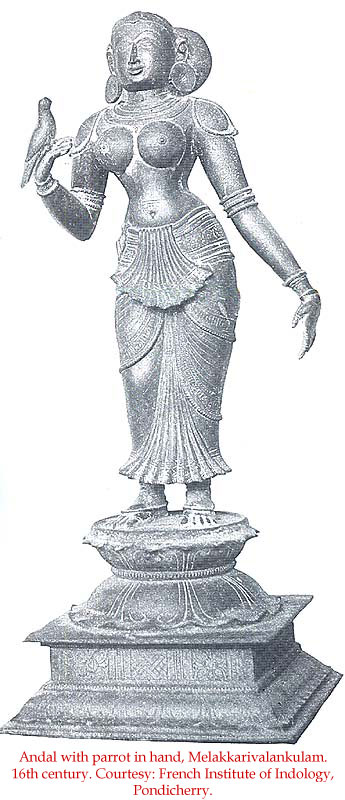
Illicit love the most celebrated love between Krishna and the gopis is a form of love, where love is the purest emotion, and a woman has everything to lose including reputation and standing in the community and family. Though there is a touch of prurience in this illicit love, it is not really so and Krishna's magical maya made every gopi feel that he was the only lover she ever had. This union is allegorical of the individual soul merging with the Greater Soul. It is said that devotees are closer to Krishna than His own family. The example given is that the RAsa dance with Krishna was the sole privilege of Gopis which was not available to His wives, Rukmini, Satyabhama, or Lakshmis of Vaikuntha.
|
Alvars worship the Lord by assuming the role of consort,
foster-mother, bride (Andal), father, and maiden.
The relationship between Krishna and devotee (Seshi-Sesha) is nine-fold according to one source. 1) He is Atma and we the sentient beings (Chit or Chetanams) are his body. 2) He is the Master and we are His servants. 3) He is the Father and we are His sons. 4) He is AchArya and we are His SishyAs. (Teacher-pupil) 5) He is Pati (husband) and we are his wives. 6) He is BOkthA (Enjoyer) and we are BhOgyam (object of enjoyment). 7) He is Raksakan or Rakshika (protector) and we are the protected. 8) He is the originator of orders or injunctions and we are the obeyers. 9) He is Seshi and we are Seshas. = Lord and devotee |
11.45:
I am glad to have seen what was never seen before. Fear grips my mind. O Lord,
show me your divine form and grace, O Lord of Lords and Refuge of the Universe.
Arjuna was glad that he saw the Universal form.
However, he had his fill and was afraid; he was yearning for the four-handed and
the two-handed form of Lord Krishna, which was pleasing to his eyes, mind, and
soul. He always knew him as a friend, a relative, a teacher, his God and now as
the Universe itself.
11.46:
I wish to see You with the crown, the club, and the discus in your hand. Take on
the four-armed form, O Lord of a thousand arms and Universal form (Visvamūrte)
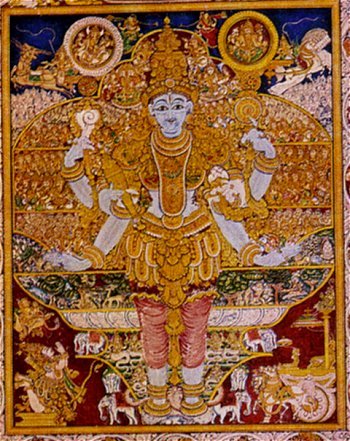
Vishwarupa of Lord Vishnu (credit: Kamat.com)
Mysore traditional school of painting
Visvamūrte represents God's body as the Universe
and all forms: that is the view of the Ramanujas. Arjuna is asking Lord Krishna
to show His Vishnu form endowed with four arms.
11.47:
Sri Bhagavan said:
O Arjuna, I have shown you by My grace and through
My yogic power the supreme, radiant, universal, infinite, and primal form of
Mine, which no one, besides you, has ever seen before.
Ātmayōgam: Yogic power of the Lord. Tējomayam:
Radiance
11.48:
Neither by Vedic sacrifices, nor by Vedic studies,
nor by charity, nor by rituals, nor by severe
tapas (austerity) can I be seen with this form in
this world of men by anyone other than you, O KuruPravira (Arjuna).
KuruPravira = Great hero of the Kurus.
The View from the West
"Krishna is represented as the teacher of the Vishnuite faith, the devotional religion which displaced the Vedic ceremonies and links Upanishadic doctrines with modern Hinduism."
11.49:
You need not be agitated and bewildered by seeing this dreadful form of Mine.
Free from fear and pleased in your mind, you see My (other) form.
11.50:
Sanjaya said to Dhritarastra:
Having spoken to Arjuna, Vasudeva (Krishna)
displayed again His own form. Mahatma (Krishna) assuming the placid form
comforted Arjuna gripped with fear.
The Lord has undergone progressively benign-looking
and eye-pleasing transfiguration from His horrendous Universal form to the
four-armed Vishnu. We were all scared witless when we read
the verses in the eleventh chapter.
11.51:
Arjuna said:
O Janardhana (Krishna), seeing your pleasing human form, I regained composure in my mind and have returned to my own nature.
arjuna uvAca
arjuna uvāca
dṛṣṭvā1
idam2
mānuṣam3
rūpam4
tava5
saumyam6
janārdana7
idānīm8
asmi9
saṁvṛttaḥ10
sacetāḥ11
prakṛtim12
gataḥ13
11.51
अर्जुन उवाच
दृष्ट्वेदं मानुषं रूपं तव सौम्यं जनार्दन ।
इदानीम् अस्मि संवृत्तः सचेताः प्रकृतिं गतः
॥११- ५१॥
Some of the many forms of Krishna (Vishnu) are Arupam (formlessness), Rupam, Svarupam, ananta rupam and Visva rupam (BG 11.16), Ugra rupam (fierce form)--BG 11.31), Visva Murti, Catur-bhuja rupam (four-handed form), and mAnusam rupam (BG11.51).
Rupam is different from Svarupam. Svarupam (natural state, one's own form), true to Ramanuja's Visistadvatam, consists of mountains and motes, rivers and oceans, sky, earth, water.... Rupam is generally an anthropomorphic form assumed by Vishnu to please His devotees, though Brahman-Vishnu has no form (ArUpam-- incorporeality). Ananta rupam is unlimited form shown by Krishna to Arjuna, consisting of many arms, abdomens, mouths, eyes on all sides (BG 11.16). The universal form consists of the following features: twenty-three elements that make the universe (the others are the individual Soul and the Supersoul); all gods, all animals, Brahma on Lotus seat, Sankara of Kailas, all Maharishis, and serpents; Visvesvara with many eyes, hands, abdomen, and faces; many forms of Him; all kinds of weapons; leaping tongues of flame; multitudes of devotees, Maharishis entering his mouth with His sacred name on their lips; all celestials; the entire universe.
Seeing your eye-pleasing human form again, I am
calm and collected, and back to my own normal self again.
11.52:
Sri Bhagavan said:
This form of mine, which you have seen is hard (to
come by) to see. Even the gods eternally strive to see this form.
Here Krishna refers to his universal form as the
rarest form to come by and the gods try hard to see this form. Gods are used to
seeing Vishnu with four hands. The two-handed form is witnessed by all the
mortals of His period. The Universal form is a sight unseen by most beings
including the gods, except Arjuna.
11.53:
Neither by the study of Vedas, nor by austerity, nor by charity, nor by
sacrifices, is it possible to see Me, as you are seeing Me.
11.54:
But by devotion rendered to Me exclusively, O Arjuna, I make it possible for you
to know, see, and in fact to enter (Me), O Parantapa.
11.55:
He who does his work for Me; he who considers Me as Supreme; he who is My
devotee, free from attachment; he who has no enmity to all creatures; he comes
(attains) to Me. O Pandava.
The prescription to cure
the spiritual ailment of man consists of many parts: do thy duty without
attachment which is service to God, look up to the Supreme Spirit and take
refuge in Him, surrender to Him, focus your mind on Him, sing His praises, and
show love and concern to all beings for they are all His. First step to love
yourself is to love your neighbor and your enemy. When your enemy is well, you
are well; when one of His (created) beings is hurt we are all hurt, for He is in
all beings. If one is hurt, He is hurt and we are all hurt. Brahman, the
universe, and all beings are one entity and the Brahman is the Supreme
Controller. Joseph Campbell relates a real-life story, which shows this
metaphysical unity. Two police officers in the patrol car saw a man getting
ready to jump off a cliff. The police officer on the passenger side rushed out
and caught the victim in the act and he found himself hanging precariously off
the cliff. The second officer rushed and rescued both of them. The first
officer, when asked why he risked his life for the victim, he replied that he
would not have been able to live with himself, had he not done that.
Schopenhauer says that the crisis represents the emergence of metaphysical
realization that you and the victim are the same separated only by time and
space.
------------------------------------------------------------------------------------------------------------------------
Notes on Siddhis obtained by Yogis by meditation and devotion.
Kāmarutattva (consummation of all desires)
Praptih / Prāptih. the power (of the wind) to enter or penetrate everywhere; the power of obtaining or attaining anything like touching the moon with the finger.
Prakamya / Prākāmya. Irresistible will, fiat, absolute authority. Capacity to accomplish by willpower anything desired.
Isitva. Supremacy or superiority considered as a supernatural power.
Vashista. The supernatural power of subduing all to one's own will.
According to The Uddhava Gita, Dialogue 10, Krishna reveals the following features with regard to Siddhis. Once the awareness is fixed on Krishna and the Indriyas and Prana (senses and breath) are brought under control, the Siddhis come to the aspirant by themselves. Krishna lists eighteen Siddhis; eight Siddhis are conferred by Krishna and the rest cascades from Sattva Guna (Virtue). The first three Siddhis belong to the body.
This material is based on Swami Saraswati's translation of The Uddhava Gita.
bg11.h4.gif
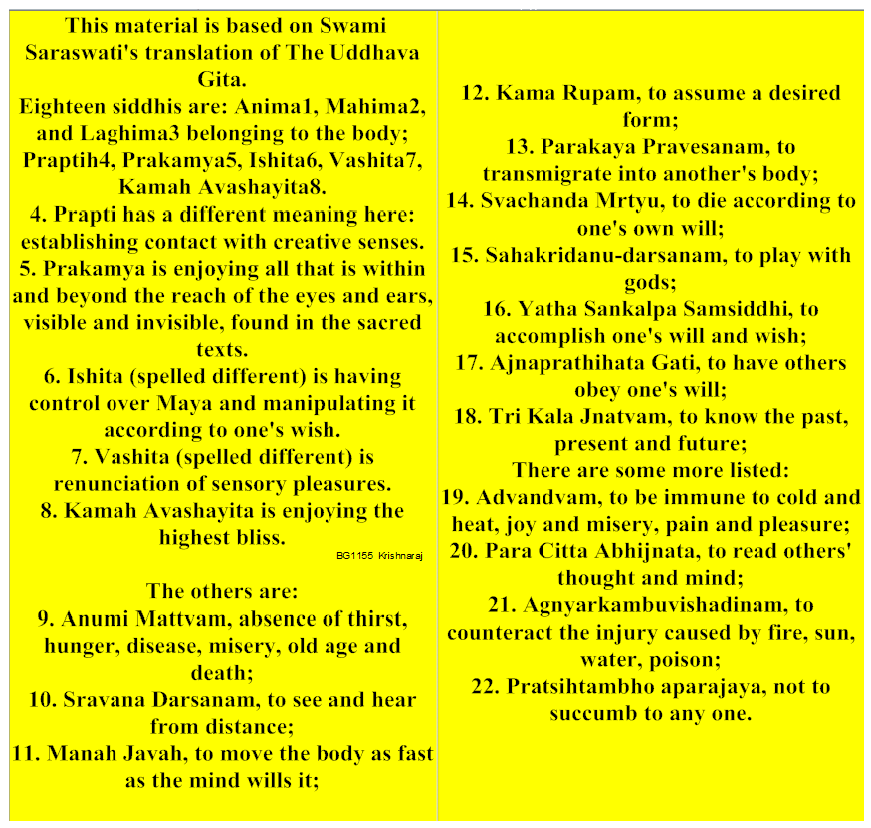
The last five Siddhis come directly from Yoga of the Sadhaka. Krishna further elaborates on all these Siddhis. He says the following:
Anima comes from meditating on me as the subtle element pervading the universe. (The Pervader is Vishnu; the subtle element that is Vishnu is Ether, the stem substance of all creation.)
Mahima comes to the Yogi from meditating on me as Earth, Water, Fire, Wind, and Space.
Laghima comes to the Yogi who meditates on me as the Tejas (power) in the Maha Tattvas as listed above.
Prapti comes to the Yogi who meditates on me as the tattva that gives Ahamkara (ego).
Prakamya comes to the Yogi who meditates on me as the Supreme Atman, which is the thread of consciousness that runs through all beings.
Ishita comes to the Yogi who meditates on me as Vishnu, the controller of Maya in all living creatures and beings.
Vashita comes to the Yogi who meditates on me as Narayana.
Kamah Avashayita comes to the Yogi who meditates on me as Brahman, the omnipresent and yet transcending expansive being.
Anumi Mattvam comes to the Yogi who meditates on me as svetadvipa, teh embodiment of virtue.
Sravana Darsanam comes to the Yogi who meditates on me as the transcendent sound which pulses through air and space, the sun that lights up the universe, the eye that sees and the light of both sun and the eye.
Manah Javah comes to the Yogi who meditates on me as the unifier of body, breath and mind.
Kama Rupam comes to the Yogi who meditates on me as the one form that becomes many.
Parakaya Pravesanam comes to the Yogi who meditates on himself as the force that transmigrates into another body through Prana as easily as the bee enters and exits a flower.
Svachanda Mrtyu comes to the Yogi who learned the art of occluding the anus with his heel, channeling the prana from the heart to the crown, known as Brahma randhara, and returning to any Chakra as he desires.
Sahakridanu-darsanam comes to the Yogi whose compass is aligned with my Sattvic nature.
Yatha Sankalpa Samsiddhi comes to the Yogi who entertains full faith in me knowing that my will always be carried out.
Ajnaprathihata Gati comes to the Yogi who attains merger with my self-contained oneness in which all things move.
Tri Kala Jnatvam comes to the Yogi whose devotion to me purified him and who knows the perfect art of meditation.
Advandvam comes to the Yogi whose mind attains tranquility through Yoga and devotion to me.
The Yogi who meditates on me and my glory remains undefeatable.
The Yogi who worships me and performs Dharana, attains all Siddhis.
To the Yogi who has subjugated his senses and trained his breath and mind and meditates on me, no Siddhi is difficult to achieve.
Siddhis are a hindrance to the Yogi who practices perfect Yoga, seeks union with me, and wants to overcome Maya (Verse 10.33, The Uddhava Gita.)
Whatever Siddhis attained by the Yogi because of auspicious time of birth, secret herbs, and mystical Mantras can be fructified only by devotion to me.
I am the cause, creator, and protector of all Siddhis; I am the master of Yoga, rites and rituals, and the Gurus.
I am the elements, I am the Supreme Being, residing inside and outside all; elements exist inside and outside all creatures; I alone am enveloped by Nothing.
----Based on Translation by Swami Saraswati
The Sadhakas have a choice of becoming gods, Lokapalas, and Dikpalas or come down to earth from time to time to uplift humanity.
End BG Chapter Eleven: The
Grand Vision