

|
Bhagavad-Gita: 18 Chapters in Sanskrit |
| Download Bhagavadgita-all 18 chapters in Sanskrit, English, |
| transliteration and word for word translation. |
Bhagavadgita in English
| bg07-Sanskrit | bg10-Sanskrit | bg11-Sanskrit | bg12-Sanskrit | ||
| bg13-Sanskrit | bg14-Sanskrit | bg15-Sanskrit | bg16-Sanskrit | bg17-Sanskrit | |
https://myindiastories.com
Veeraswamy Krishnaraj: Tolerance with love is to speak in tongues of all faiths, hold in the heart the Truth of all faiths and see
all faiths in the face of humanity.
You have your Google search engine tailored for this site.
Please enter the word(s) in the search box; it will take you to the file with that word in this web site. Enjoy your visit here.
About the author:
Veeraswamy Krishnaraj, M.D; F.R.C.P (Canada) is a board certified pediatrician in active practice until the end of 1998. He immersed himself in study of Hinduism in depth. He has sufficient knowledge and understanding of Hindu religion that he is confident to publish this book. He kept the words simple, supple, illuminating and to the point, while retaining the original flavor, beauty and grace. Compound words in Sanskrit are a nightmare for the beginner, as they are spliced together compactly in one continuous stretch of characters. He parsed the compound words into digestible syllables or words with superscripts and sequential numbers and rearranged the words in the verse in a readable form in English. In this book, he claims ownership of shortcomings and cedes the rest to Bhagavan.
This book is good for students, and devotees reading the Bhagavad-Gita in Satsang (true company). Two verses nestle in two boxes in one page with no break or carry-over to the next page. Diacritics help the reader enunciate the words like a Sanskritist. The English words are reader-friendly. Wherever there is a need for elaboration, an addendum supports it.
Simplicity, authority, universality, and profundity are the hallmark of the Bhagavadgita, the Bible of the Hindus. The Bhagavadgita is the Song of the Lord. It provides guidelines for daily living with no dogmas and ritual overtones. It encourages and supports your individuality. It also explains the consequence of errant ways. Total surrender to Bhagavan releases the devotee from the ills of life on earth. Hinduism as a term is an external appellation from non-Hindus. Its true name is Sanatana Dharma (Eternal Law or Eternal Order) commensurate with Rta (Cosmic Order). The beauty about the Bhagavadgita is its appeal is universal.
|
The popular verse from the Vaiṣṇavīya Tantrasāra makes out that the Gītā restates the central teachings of the Upaniṣads, The Upaniṣads are the cows and the cowherd's son, Kṛṣṇa, is the milker; Arjuna is the calf, the wise man is the drinker and the nectar-like Gītā is the excellent milk. Excerpt from Bhagavadgita. translation by Dr. Radhakrishnan. page 13. |
Veeraswamy Krishnaraj. Contact: myumbra-bgusa@yahoo.com
BGALLCOLOR.pdf 3181.08KB (3257428 bytes)
|
Sample Verse श्रीभगवानुवाच ऊर्ध्वमूलमधःशाखमश्वत्थं प्राहुरव्ययम् । छन्दांसि यस्य पर्णानि यस्तं वेद स वेदवित् ॥१५- १॥
śrībhagavān uvāca: ūrdhvamūlam adhaḥśākham aśvatthaṁ prāhur avyayam śrībhagavān uvāca = Sri Bhagavan said: prāhuḥ4 = they say; avyayam5 = the imperishable; aśvattham3 = the Asvattham tree/Banyan tree; ūrdhva-mūlam1 = with roots above; [and] adhaḥ-śākham2 = branches below; yasya7 = of which/that; parṇāni8 = the leaves; [are] chandāṁsi6 = Vedic hymns; yaḥ9 saḥ12= he who; veda11 = knows; tam10 = that; [is] vedavit13 = the knower of Vedas.15.1 chandāṁsi = Vedic hymns. 'Chandas/chad' means 'to spread as a cover or canopy.' That which covers is a protector. That which protects is Veda. Thus Chandas refers to the Vedas. 15.1: Sri Bhagavan said: It is said that there is the imperishable Asvattham tree with its roots above and the branches below and of which the leaves are the hymns. He who knows this is the knower of the Vedas. |
09/02/2021
BG Chapter 15
The Supreme Person
15.1:
Sri Bhagavan said:
It is said
that there is the imperishable Asvattham tree with its roots above and the
branches below and of which the leaves are the hymns. He who knows this is
the knower of the Vedas.
श्रीभगवानुवाच
ऊर्ध्वमूलमधःशाखमश्वत्थं प्राहुरव्ययम् ।
छन्दांसि यस्य पर्णानि यस्तं वेद स वेदवित् ॥१५- १॥
śrībhagavān uvāca
ūrdhvamūlam adhaḥśākham
aśvatthaṁ
prāhur avyayam
chandāṁsi
yasya parṇāni
yas taṁ
veda sa vedavit 15.1
śrībhagavān uvāca = Sri Bhagavan said: prāhuḥ = they say; avyayam = the imperishable; aśvattham = Asvattham tree/Banyan tree; ūrdhva-mūlam = with roots above; [and] adhaḥ-śākham = branches below; yasya = of which/that; parṇāni = the leaves; [are] chandāṁsi = Vedic hymns; yaḥ saḥ = he who; veda = knows; tam = that; [is] vedavit = the knower of Vedas. 15.1
chandāṁsi = Vedic hymns. 'Chandas/chad' means 'to spread as a cover or canopy.' That which covers is a protector. That which protects is Veda. Thus Chandas refers to the Vedas.
bg15.h15.jpg
replaces bg15.h3.jpg
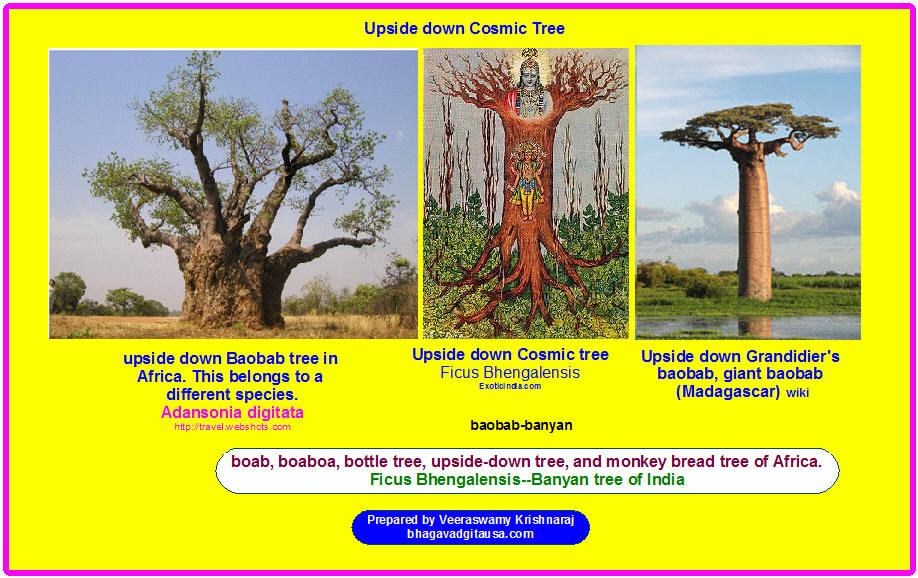
| Dvā suparṇā sayujā sakhāyā samānaṃ vṛiksham parishasvajāte, Tayor anyaḥ pippalam svādv atty an-aśnann anyo abhićākaśīti, 'two birds associated together as friends inhabit the same tree. The one of them tastes the sweet fig, the other looks on without enjoying.' Śankara, commenting on the Upanishad, explains sakhāyā by samāna-khyātau, 'of the same name.' He also remarks that the Pippala or Aśvattha, 'holy fig-tree,' having roots above and branches bent downwards, is allegorical, and that each tree, springing from an unperceived root, is emblematic of the body, which really springs from and is one with Brahma. In the Kaṭha VI.1 and Bhagavad-gīta XV.1-3 the same tree is said to typify the universe. It is supposed to be the male of the Vaṭa or Banyan (Ficus Indica). --Monier-Williams in Indian Wisdom page 42 (98 OF 644). Notes dated May 13, 2015 |
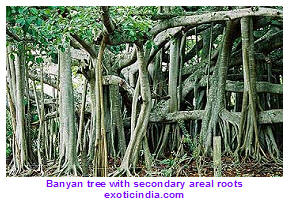
There is some confusion in books about the identity of Asvattham tree. It is called “Arasa Maram” (அரச மரம்-- Ficus religiosa) in Tamil Nadu, Ravi-manu in Telugu, Aruli-mara in Canarese. One calls it a Palm tree; another calls it Pipal (Ficus religiosa-pagoda fig-tree); and yet another calls it Banyan Tree (Ficus Bhengalensis) with the adventitious aerial roots. Both (the latter two) are related to each other. It is a humongous tree with bright green leathery leaves chatting with each other with a pat on the back as they rustle in the gush of wind. It is music to the ears. The breeze sets the leaves dancing in the wind and doing partial pirouette on their spindly petioles. When the wind quiets down, the song and dance stop suddenly. One thing we know is that it is a cosmic tree. The berry of the Pipal is sweet, and Soma (intoxicant) is prepared from its juice according to some accounts. (There is another claim that says the soma juice comes from a mushroom.) Images of Pipal tree appear on the Harrapan seals. Asvattham is said to be a “body-tree.” “A” is no; “THA” is existence; “Shva” means “after tomorrow:” No existence after tomorrow. It tells us that life is precarious. The body tree itself is imperishable (HAM), because God pervades it. The tree is rooted in heaven and since its aerial adventitious roots go down to anchor to the earth and Prakrti (matter), we are susceptible to the temptations of evil. The middle branches are the men and the sap that keeps flowing inside and sustaining the branches are the Gunas (modes = qualities). Cutting the branches and the aerial roots figuratively depicts transcending the gunas and a move to a higher plane― that of Sannyāsi. In Chinese lore, the body is compared to the Bodhi tree (Tree of Wisdom). Katha Upanishad 2.3.1: With the root above and branches below the fig tree stands: That is pure, That is Brahman, That is immortal. In It the world rests and no one goes beyond it. The upside down Tree of Life has roots in Brahman: The tree, the roots, the trunk, and the branches represent Manifest Brahman or the phenomenal world of Isvara, matter and beings.
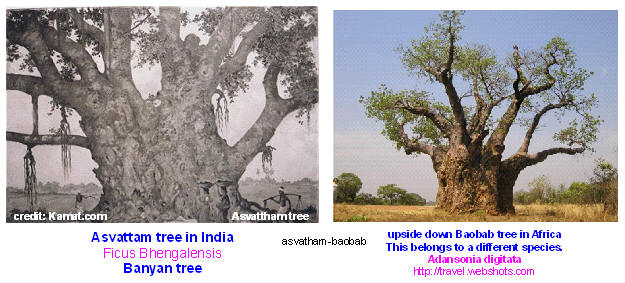
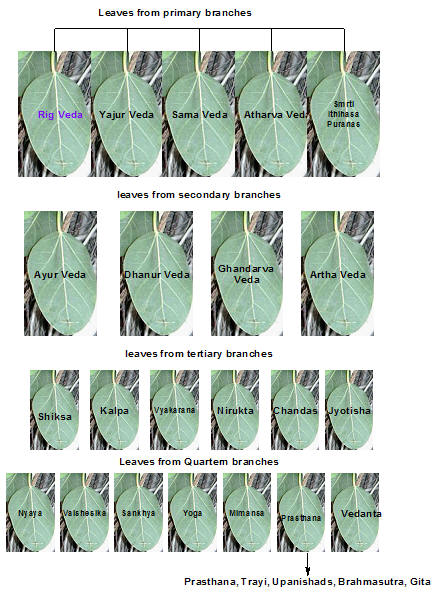
The leaves of Hymns
Katha Upanishad describes Manifest Brahman as follows: He is self-born and first-born from the waters (Mula Prakrti, root cause or matter) by an act of meditation. He resides in the cave of the heart of beings and is immanent in all causes and effects. He who knows this knows the Absolute in Him. Verse 2.1.6
It goes on to describe the Mother Goddess. She is Aditi, the Boundless. She is born as Prana (Breath or life) from the Absolute genderless Brahman, the nameless, and the formless. She is the Devatamayi (Mother of gods) and the soul of all beings. She stands in the inner recess of the heart. Verse 2.1.7
The Buddha attained enlightenment
under the Bo tree; Bo is short for bo-gaha, tree of wisdom; Bo tree is Pipal
or Banyan tree; Bo is wisdom, Bodhi is enlightenment, Buddhi is knowledge
and the Buddha is he who attained enlightenment.
|
Jiva is Eve or Evā (as Eva Perone); Atman is Adam; Bodhi Tree is Tree
of Knowledge. The connection between Upanishads and Old Testament. http://www.bhagavadgitausa.com/DeivaththinKural.htm
|
Krishna states
that He is Asvattha tree among trees. Jesus Christ says that he is the true
vine. It appears the trees have souls from what Lord Krishna and Jesus
Christ say.
Sage Narada
cursed the two sons of Kubera to become trees for knowingly playing naked in
the shoal of a river with Ghandarva women. (You thought that having a shower
mate is a modern phenomenon: not so from what you read here.) The young
women in a turn of modesty put on their clothes while the Kubera’s sons
ignored the sage, who cursed them to become trees for their feral nature,
arrogance, insolence, and ignorance; Krishna released their souls and bodies
after one hundred divine years by uprooting the trees.
Krishna drank
water from River Sarasvati, sat, and meditated under Asvattha (Pipal) tree
in a reclining position, before his departure to Goloka, Bhagavata Purana
3.4.3 and 8.
Asva, meaning
horse, is the root word for Asvattha, the tree; Asvamedha, horse sacrifice;
Asvatthaman, he who cried like a horse at birth; Asvatthaman, the elephant;
Asvini, the wife of Asvins, who took the form of a mare; and Asvinikumaras,
the sons of Asvini-the sons of a mare. Asvattha tree gained such name
because people used the tree’s shade as shelter for horses.
Between 2000 B.C. and 1700 B.C. the Aryans (the late comers) in Babylon domesticated the horses which were then called the ass of the East. The horse was later introduced in Egypt before 1580 B.C. The Aryan victory march was attributed to tamed fast horses and chariots.
Vishnu as Horse Avatar, Hyagriva and His 'Honey Knowledge (Madhu-vidya)'. Honey-sweet Doctrine: A case of 'Heard it from Horse's Mouth'. The talking horse Mr. Ed, a pale comparison.
If you are old enough you would have seen, 'Mr.Ed, The Talking Horse' on American TV in the 1960s and if you are young, you would have seen the reruns. Mr. Ed would not talk. He observed Mauna on TV (silence because he thought he was a Muni, the silent sadhu.) That posed a problem for the producers, who would not give up and at last found Amelia the talking zebra in Jungleland animal park in thousand oaks, California. Another problem popped its head; the zebra has stripes. How are they to wash off the hairy stripes? Abracadabra. In the black and white celluloid, the technicians whitewashed the body and enlarged zebra's head. Now you have the talking horse.
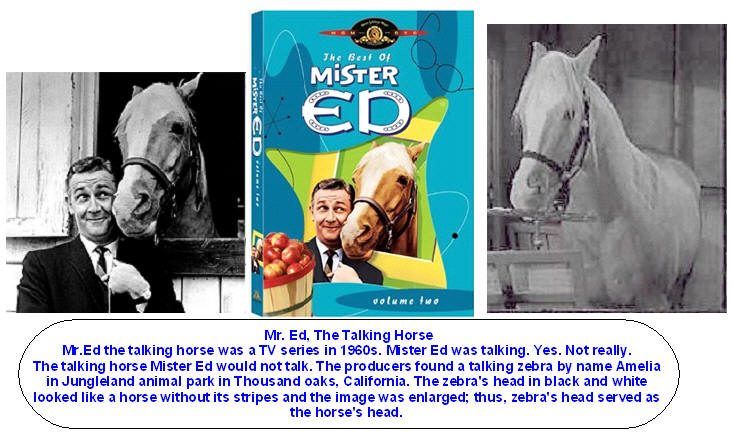
What has horse anything to do with knowledge? Then why do they say, ' Heard from the horse's mouth'?
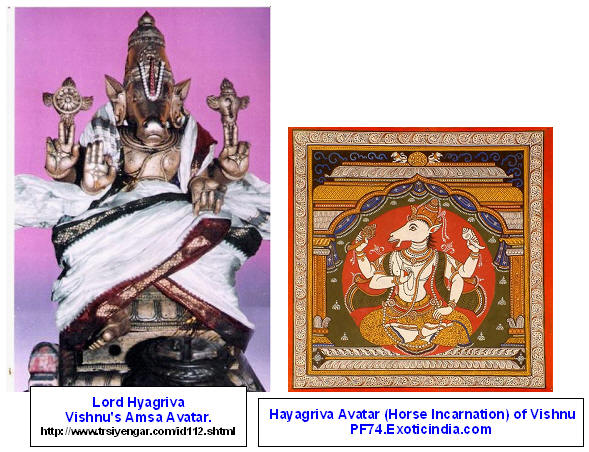
The eighteenth incarnation or Avatara of Solar Vishnu is Hyagriva or Horse-necked or Horse-headed (Hyasiras).
(1) Yama: sexual abstinence (celibacy), ahimsa (noninjury), no lies, no theft, no greed.
(2) Niyama: meditation on Brahman or Isvara; silence (mauna); study of Vedas (svādyāya), Upanishads, and moksa-promoting books; repeating of mantra OM; Tapas (ascetic practice); Sauca (clean body and mind) ; Santosha (contentment); Isvara Pranidhāna (submission to God, God-Pleasing actions). moksa = liberation, heaven.
Liberation depends on Sat and Asat (good and evil karmans or acts). Jnana, spiritual knowledge bestows all Siddhis (perfection). By meditating on the eternal form, man obtains liberation, though he may be a sinner. The worshippers of Sakti are the liberated souls and never suffer in life on earth. Lord Siva became the leader of all Siddhas by worshipping Parasakti (Supreme Sakti). He became Ardhanarisvara (Androgynous Lord) with his Sakti form as part of his body. Abrahma as the leader of Devas became a Siddha by worshipping her. Goddess Tripura guarantees worldly enjoyment and liberation to her devotees. You will attain liberation by reposing your desires, breath, mind worship, rites and soul in Her. This is what I have to say to you and all for the welfare of all.
Agastya bowed and asked the Lord, "please tell me the nature of your form, its power and your sports." The Lord answered, "This divine sage Hyagriva is a partial incarnation of Mine (Vishnu). He will tell you whatever you want to know." Thus saying the Lord disappeared from in front of pot-born Agastya.
Once Hyagriva Hari, the Lord of the universe took leave and disappeared, sage Hyagriva and Agastya went back to their hermitage. Agastya offered a high seat for Sage Hyagriva and spoke, "O Siddha of Siddhantas, please tell me the manifestation of the Great Goddess, her forms, sportive activities and pastimes."
Sage Hyagriva answered:
The Goddess has no beginning and is the support of everything in the universe; Sat and Asat karmans are her forms; meditation is the only way she is perceived; meditation and Vidyas make her limbs with her heart as her base; she manifests to the ones who attained oneness with her by performing sacred rites. She manifests herself as a Sakti and Prakrti (power and matter) to those who perform meditation of god Brahma.
More on Divine horse.
There is a Personified divine horse by name DadhikrA, which is associated with Vishnu, morning sun, light and knowledge and mentioned in Rgveda. He was created by heaven and Earth or Mitra and Varuna, the latter being the tutelary deity of horses. Horse is symbolic of fragrant mouth (Knowledge) and cures halitosis of Avidya (ignorance) upon invocation of DadhikrA (Dadhyan). This is known as MadhuVidya, the honey-sweet doctrine. The following concept is challenged by this doctrine. There are two entities (Duality) in the world the knower and the known; in other words consciousness and object; Consciousness and object are demarcated and circumscribed entities in the sense one cannot take the place of another and serve the alternate function.
Now hear from the horse's mouth. Honey-sweet doctrine continued.
Sage Dadhayan Atharvana says these two spheres (consciousness and object) are linked by a third entity. The First Entity, the consciousness is Adhyatma (the individual soul, the perceiver, we the people), the object is Adhibhuta (the world of objects). The linkage between this two spheres is provided by Adhidaiva (Brahman, God), which is the divine force like gravity that keeps these two entities linked together in an un-demarcated unity. Consciousness is phenomenal subject (we the people) and Adhyatma; object refers to the phenomenal world of objects and Adhibhuta. The Adhidaiva (God) is the facilitator of experience between the perceiver and the perceived object. Thus there is a continuous dynamic flow between myriad perceivers and myriad perceived objects, like the ocean waves flow into each other. This experience, this knowledge is explicated by Sage Dadhyan. This knowledge is the essence as the honey is the condensed essence of the nectar from all flowers. Thus it is called Honey Knowledge (Madhu-vidya). Honey is essence of the sap of countless flowers. The knowledge is thus the Honey Knowledge of the perceiver. This experience, this knowledge, this honey abrogates the demarcation between the perceiver and the perceived revealing the inner essence, which will not come into being without the participation of transcendent Adhidaiva and thus this confluence is a triune entity made of the soul, the world of objects and Brahman.
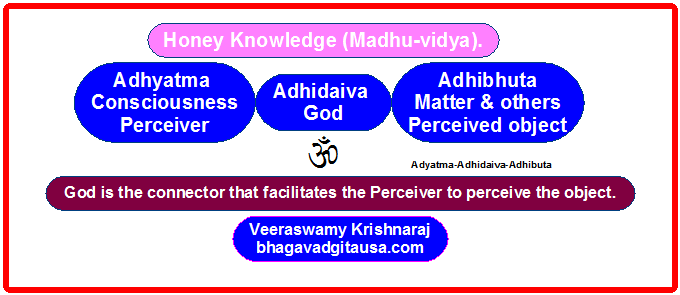
Fifth Brahmana, Brhad-Aranyaka Upanishad talks about this Honey-Knowledge.
The earth and all living beings are mutually dependent, even as bees and honey (flowers and bees for pollination) are. Brahman is the Self in each, in the earth and in the individual. The water, the fire, the air, the sun, the moon, the quarters, the lightning, the cloud, the space, the law, the truth, the mankind, and the self are like honey to all beings and all beings are like honey for all the above entities. Shining immortal person Brahman exists in all these. This Lord is the hub which holds the spokes and the rim together. The chief of lesser gods (Brahman is the God of all gods.) Indra threatened Sage Dadhyan with decapitation, if he revealed the honey-knowledge (Madhu-Vidya) to Asvins, who themselves went ahead and cut the head off in a hurry to get knowledge, transplanted horse's head in the place of his head, received knowledge from the fragrant mouth of the horse and put his own human head back in its the place of horse's head after receiving the Madhu-Vidya. Thus the Asvins heard the Madhu-Vidya from the horse's mouth. Now you know what it means to hear from horse's mouth. 'From the horse's mouth', 'on good authority; from the original or a trustworthy source: I have it straight from the horse's mouth that the boss is retiring.'
The future Avatara of Vishnu is Kalkin, a Brahmana or Ksatriya riding a white horse.
BG Verse. Krishna Bhagavan says: 10.27: Know Me, among horses to be Ucchaisravas born along with the nectar. Of the elephants, I am Airavata. Of men, I am king.
Ucchaisravas is the long-eared horse, which came out of the churned ocean. Lord Vishnu claimed ownership of Ucchaisravas, a white horse with a black tail. You see it abundantly made clear that horse is a symbol of Vishnu who is omniscient.
A note on Asvamedha:
In Vedic period, horse sacrifice was made by
kings for obtaining progeny and later, for universal supremacy and
sovereignty. A horse was let loose in the easterly direction (the
unconquered territory and direction of gods) to wander for a year
accompanied by a caretaker. Another variation states that the horse is
accompanied by a host of a hundred each of princes, sons of chiefs, sons of
attendants and charioteers, all with weapons. (You wonder where the heck you
can find 100 princes in one place. Have you seen a prince lately? Remember
the king has a harem, where there are a large in-house nursery, a Neonatal
Intensive Care Unit, neonatologists on 24-hour duty, midwives, nurses,
nurse-practitioners, wet nurses, obstetricians.... Don't forget the
doctors and nurses are either females or eunuchs either natural or
surgically-altered, so there is no hanky-panky in the harem which is the
exclusive breeding domain of the king. If the king lives with his brothers,
one would end up with that many harems.
If the horse is slaughtered and the challengers are defeated, that brings ridicule to the challenging king. In case the horse is stolen, diseased or dead, it is replaced with another one by sprinkling water on the new one.
When the horse wanders into a foreign country the king was obligated to either surrender or fight. The surrendering kings accompanied the winning horse and the guardian-caretaker to the sovereign king at the end of the year. The horse was sacrificed in the celebration of universal sovereignty in the presence of surrendering kings. To make amends to it for its slaughter, the queens of the sovereign king circumambulate the horse before sacrifice. Another version indicates that the horse was not immolated but kept as a reminder of its triumphant return. A dog with a yellow spot on each side of the eyelid (four-eyed), the embodiment of evil and misfortune, is killed as a mark of warding off of evil. The dog is the canine equivalent of four-eyed demons.. Emperor Ashoka abolished blood sacrifices; but later it was resumed until the last one was performed in Orissa in the 9th Century A.D. The Cretans and Greeks sacrificed horses to Poseidon Hippios. Rhodian Islanders dedicated a horse carriage with horses annually. Kings of Judah dedicated horses to the sun. In China, horse sacrifice was in vogue. Pegasus the winged horse in Greek mythology was born of Poseidon as the horse-god and god of the sea and Gorgon Medusa.
Contrarian views and rebuttal.
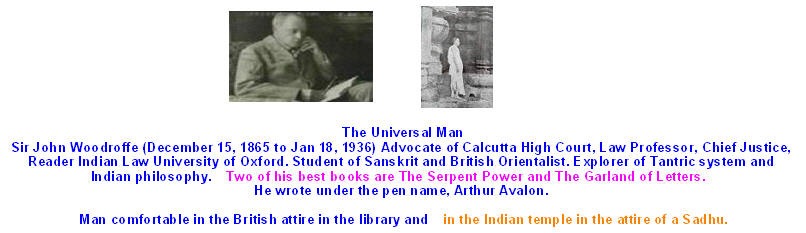
Indologists of the West say that the Aryans came in waves, landed in the present Punjab sometime between 2000 B.C. to 1200 B.C and spread from there. Some say that they came in three waves and settled in the West, Middle and East country of North India. Vedic age was between arrival and 800 B.C. or 700 B.C. according to the West. Indians are particular in pointing to the fact that the Indo-Aryans never made one mention of their origin (in their Vedas) outside of India. The Indians are of the opinion that the Indo-Aryans spread from India as far as Europe; during their travels they contributed to the genes, speech and languages of Europeans and others. Another important point the Indians mention is that Rg Veda does not speak of any flora and fauna of cold climates such as Russia and northern Europe. The Rg Vedic Indo-Aryans knew only rivers of India, present Pakistan and Afghanistan and not rivers from outside this region. Rg Veda is dated accordingly to 2nd or 3rd millennium B.C. Take a note of the previous dating going back to 5000 B.C. There is a prevailing view among some Indians that the Western Indologists of the colonial period were dilettantes coming from the ranks of missionaries and bureaucrats who spent the happy hour (with authorities) writing the history of Vedic Indo-Aryans. Some Indigenists contend that there was less science and more surmise in their conclusions. The Indian nationalists question the depth of Sanskrit scholarship of the European, British and American Indologists of the present, who are recycling the 19th century translations so much so that an interested Sanskrit scholar would demand labeling of the product in terms of its recycled and original content. They claim race and prejudice have colored the content of their presentation. The Indians claim the present day Europeans are the lighter version of the Indo-Aryans who spread the genes and language in Europe. The opponents claim that Hindutva ideology has percolated down and stained the observations of certain Indian authors. We should agree on one thing that the British, the Europeans and the Americans were and are responsible to a great extent for the popularization of Indic studies abroad. Many sacred texts of India would not have found the light of day if not for them. Take for instance Sir John Woodroffe, who is universally acclaimed to be a true Indologist. There were in the past and are at present very valuable manuscripts from antiquity in India, which the Indians hide from the eyes of other Indians and the West so much so, they have become the steady diet of bookworms.
Swami Satyananda Saraswati calls this tree The Mystical Tree. He says that this imperishable tree has roots above and branches below. The human body, according to him, resembles the upside-down tree in that the brain forms the root structure; the spinal column, the tree trunk; and the leaves, the thoughts, emotions and distractions. The occult truth and the secret knowledge of the Mystical Tree cannot be understood until the aspirant gets spiritual awakening.
Let me touch upon the significance of tree in Christianity. As you see Krishna's image on the cosmic tree, it reminds us of Jesus Christ on Holy Rood, the tree of immortal life, and he is himself the fruit of the tree. Jesus on the cross, the Buddha under the tree, and Krishna on the cosmic tree--my interpolation and interpretation, are the same figures. Page 107 The Power of Myth, by Joseph Campbell. Joseph Campbell, the universal man, sees oneness in Jesus Christ and the Buddha. Campbell is one among the rarest of breeds who knows the essence of (a generic) religion. He can see through the apparent differences among the religions and find the common Truth.
15.2:
Its branches extend downwards and upwards nourished by Gunas, with
sense objects as shoots or sprouts; and its roots extend downwards to the
world of men, bound to karma.
The tree has many adventitious
roots, coming down from the tree branches; the wider the tree grows the more
adventitious roots there are. These adventitious roots, compared to ego,
ignorance and vasanas supporting the heavy branches grow down, while the
cosmic roots of the tree trunk grow towards heaven and anchor in Brahman.
The lower branches are synonymous with human beings, animals, birds,
reptiles, worms, insects, and insentient and immovable matter. The upper
branches are comparable to Ghandarvas, yaksas, gods, and goddesses. The sap
of Gunas nourishes the branches, the product of Prakrti; the sap flowing
through the upper branches contains Sattva (goodness and virtue), while that
of the lower branches comparable to animals, contains Tamas (ignorance and
delusion). The middle branches are the men with varying combinations of the
Gunas and thrive by the sap of Sattva, Rajas, and Tamas in varying
combinations. The adventitious roots of the middle and lower branches
represent bondage of the human beings and animals. The lateral branches are
the sense objects, namely sound, vision, smell, taste, and touch; the
growing ends of lateral branches are the ears, eyes, nose, mouth, and skin;
the leaves representing the Vedas reach for the sun and illumination from
God. The adventitious roots originate from branches, which draw nourishment
from Gunas: they are extensions of these branches and therefore of the gunas,
which are responsible for the way men behave. The adventitious roots or the
gunas anchor to Prakrti and bind the jivatma to karma and therefore to
Samsāra. In this world of beings, man has the most opportunity to advance to
a higher state, fall to lower state, or remain in the same state. The
animals are born in the lower state because they have to resolve the
prārabda (past) karma inherited from the past life; they do not accumulate
new karma in the present life because their acts are commensurate with their
animal traits; and they are incapable of making informed choice from Sattva,
Rajas, or Tamas. But, man on the other hand can accumulate new karma because
he can choose his (thought), word, and deed.
Krishna in his discourse in The Uddhava Gita, Dialogue 7.21-7.24 describes the Tree of Life. (based on translation by Swami Saraswati.)
The tree of Samsara bears flowers and fruits; good and bad deeds are its seeds; desires are its deep roots; Sattva, Rajas, and Tamas are its support; earth, water, fire, air, and ether are its five secondary branches through which five kinds of sap (smell, taste, sight, touch and hearing) flow. The five branches fork into ten branches: five motor organs, five sensory organs plus the mind. Two birds (The Supreme One and Ahamkara) live in their nests in the branches. The bark has three layers, the three humors of the body: wind, bile and phlegm. The tree bears two fruits: joy and sorrow. Some eat the fruit of sorrow; some on right path eat the fruit of joy. Krishna tells Uddhava to cut down the tree and free the Self, identifying himself with the Self.
15.3: Neither its form nor its end
nor its beginning nor its support is seen. Having cut this firm-rooted
Asvattham tree by the strong weapon of detachment…
15.4: Thereafter, seek out that
goal, attaining which one does not return again. Surrender to the (first
and) Primal Person from whom the ancient manifestation comes forth.
We have to cut the adventitious
roots to prevent lowermost branches from getting the sap of Tamas (darkness
and delusion); then we have to cut the adventitious roots, which supply the
Rajas sap (motion and passion) to the middle branches; now we are left with
the upper branches (and their adventitious roots), whose sap is Sattva
(goodness, virtue, and calmness). To attain to Brahman, we have to transcend
all three Gunas and therefore have to cut the tree, roots, and all. The tree
represents the nonself or Prakrti, and we have to separate the Jivātman from
Prakrti, so it merges with the Higher Self.
Let me explain what attaining to
Brahman means. It points to a certain quality of life and behavior. It is
simply not having the didactic knowledge of the Holy Scriptures; it is not
simply the rituals alone. Dharma, duty; sama, equanimity; dama,
self-control; vairāgya, indifference to worldly objects; uparati, desisting
from sensual enjoyment; sraddhā, faithfulness; and atha, “much more or more over,” (auspiciousness, authority, flair
and divine grace) are the preconditions for reaching Brahman. The fit person
is the one who knows his Vedas, has the attributes (described above), and is
devoted to the Lord only and detached from the world.
|
Dharma |
Sama |
Dama |
Vairāgya |
Uparati |
Sraddhā |
Atha |
|
Duty |
Equanimity |
Self-control |
Desirelessness |
Abstinence |
Faithfulness |
Much
more |
Sraddhā is implicit faith in Hindu
Holy Scriptures. “Atha” has no English equivalent and means “much more” or
“more over” meaning auspiciousness, authority, flair, and divine grace.
15.5:
The wise ones, without false pride and delusion, having vanquished
the evil of attachment, eternally devoted to the Supreme Self, divorced from
passion (Kāmāh), free from dualities of happiness and
distress, and delusion, reach the eternal state.
Suka and Dukha = இன்பம் (Inbam) and துன்பம் (Thunbham) = happiness and distress.
There is a story that tells that no one including Bhagavan is immune from happiness and distress, particularly the latter. Vyasam: Misfortune, Calamity, Distress. Bhagavan gives an example of Vyasam that happened one after another and how he experienced, tolerated and overcame it - he became a piece of Wood. There is a lesson to be learnt from this.
Bhagavan married Bhumi Devi (Mother Earth). He thought that would be his first and the last. Things did not go that way. Soon after marriage in the presence of galaxy of gods and godlings, Siva and Parvati invited the newly-weds for a dinner in Kailas. Bhagavan asked Bhumi Devi, "Shall we go for the dinner." She retorted saying, "I cannot be going to where all you want to go. Don't you remember my other name is 'the Immovable.' What would happen to this Sarāsaram (the Universe) without me? You could go alone; I can't make it." Sarāsaram = Saram + Asaram = the mobile + the immobile = beings and things). Paramatma went places without his consort. Gods were wondering and asking, "What happened to your other half?" That gave him some discomfort. He was left speechless whenever he was asked, "Where is your other half?" Thus Bhagavan ended up taking a second consort, Lakshmi, the daughter of Samudra Raja (the king of the ocean--Lakshmi was born of the ocean; now you know we all came from the sea.). Lakshmi's other name is Cancala (Moving too and fro, unsteady) and thus she was restless, on the move and leaving everyone one breathless and short on cash. Bhagavan also was left restless and breathless (cashless) on account of her moving too much. (Riches do not stay in one place or person; they move). He set out to see his son Manmatha, the god of love. On his way, travelers gave him the tragic news that Manmatha was rendered into ashes from the wrath and the fiery third eye of Siva. (Manmatha created an ambience of spring to entice Siva out of meditation which prompted Siva to incinerate him.) Bhagavan became very anguished at his bereavement and decided to go to his father-in-law's house against the convention that he should take Samudra Rajas's daughter and his consort, Lakshmi with him. Soon a gigantic wave hit him and threw him off before he could venture into the ocean, the palace of the King of the ocean. That was probably a rebuff to Bhagavan. He retreated faster even before the punishing wave could fall back on the ocean. Bhagavan thought that he deserved rest after all these futile efforts and distress. He laid down on his usual bed of snake, Adisesha. Sooner than he laid his head, he heard hissing noises and felt emission of poison from the snake. He thought that there was no use trying to seek any help from any one and it was time to go on pilgrimage to Kasi (Benares/Varnasi). He promptly mounted on his flying Vahana (vehicle) Garuda, the bird of transport. Things appeared going fine until Garuda saw a snake on the ground below near the city of Puri. Hunger pangs struck the bird all at once; he decided to dismount Bhagavan for a good meal and said to him, "O Narayana, I have to eat right at this moment. Let me dismount you; you could walk to Kasi rest of the way. I will catch up with you later, once I finished with my meal." The bird took off in the direction of the snake leaving Bhagavan in the lurch. (Aren't you reminded of the stranded airline passengers? That is why a politician wants to become the president. Somebody said perks and power draw people. He has Air Force One for his personal use; If Air Force One* is stuck in the mud, he has Air Force two to fly.) Bhagavan, having heard the words of Garuda, sat on the ground with his hand on the head, wondered about his predicament and morphed into a piece of wood. This is the way Bhagavan presents himself (as a piece of wood) in Puri. Now you understand what it means to touch wood --to ward off evil consequences.
This story illustrates the fact that no one including Bhagavan can escape vyasanam (distress). One should keep his composure at all times.
Air Force One*: President's Plane Gets Stuck In The Mud - 01-28-98
| President's Plane Gets Stuck In
The Mud ... Now, he says, a support plane, another
Boeing 707, is arriving to pick up the president and others on
the plane. ... |
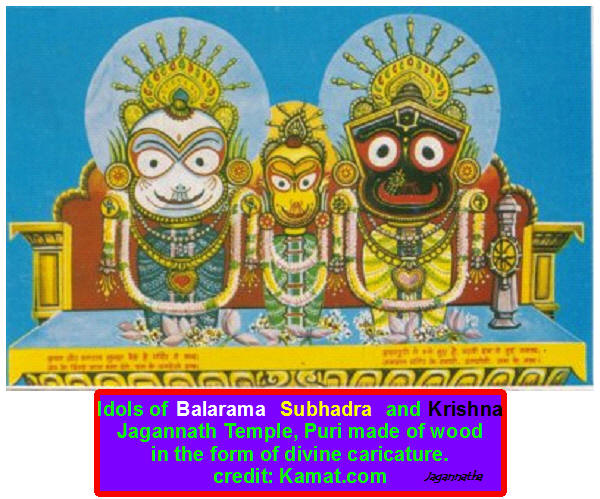
Below is a sibling portrait depiction of the abstract triune form of Krishna (Jagannatha = Master of the universe): a divine caricature of the three siblings, white Balarama, black Krishna and their sister (?yellow) Subhadra in the middle. Now you see the oneness of human race in the colors of the divine siblings.
Jagannath is Black (inscrutability) in color, Lord Balabhadra is white (enlightment) in color, sister Subhadra is yellow (goodness) in color and lord Sudarshan is red in color, hence representing all the four races of world.--http://www.shreekhetra.com/jaga.html
15.6:
They never come back once they reach the supreme abode of Mine, where
the sun does not shine, nor the moon, nor the fire.
Mundaka Upanishad: 2.2.11: The sun,
the moon, the stars, and the lightning shine not there (where the Supreme
Light is). Where could this fire be? Everything shines “only after that
shining light.” His effulgence illumines this entire world. In many
cultures, God is described as the source of light and self-effulgent, not
needing an external source for its splendor.
The Self is the Supreme Light and
Consciousness; It is self-effulgent and gives light to the sun, the moon,
the stars, and the fire. Isvara is the creator of the universe and He is the
light and the heat in the sun and the fire, and the light in the moon.
The physical light removes the
darkness in order that there is a contact between the senses and the sense
objects. The sun, the moon, and the stars do not illumine the Self, for the
Supreme Knowledge or Consciousness is the One that illumines these heavenly
objects. When one reaches that Supreme Light, going past the hurdles of the
beginningless karma and avidya and embracing detachment, prapatti and
saranāgati, he never returns to the samsāra of births and rebirths.
न तद्भासयते सूर्यो न शशाङ्को न पावकः ।
यद्गत्वा न निवर्तन्ते तद्धाम परमं मम ॥१५- ६॥
na tad bhāsayate sūryo na śaśāṅko
na pāvakaḥ
yad gatvā na nivartante tad dhāma paramaṁ mama 15.6
na1
tat2
bhāsayate3
sūryaḥ4
na śaśāṅkaḥ5
na pāvakaḥ6
yat7
gatvā8
na nivartante9
tat10
dhāma11
paramam12
mama13
15.6
na1
sūryaḥ4
=
Neither sun;
na śaśāṅkaḥ5
= nor moon;
na
pāvakaḥ6
= nor fire;
bhāsayate3
= illuminates;
tat2
= That.
tat10
= That; [is]
mama13
=
My;
paramam12
= Supreme;
dhāma11
= abode;
gatvā8
= reaching;
yat7
= which;
[they]
na nivartante9
= do not
come back. 15.6
|
View From The West. Indian Wisdom (By) Sir Monier Monier-Williams, KCIE (12 November 1819 – 11 April 1899) was the second Boden Professor of Sanskrit at Oxford University, England. Page 146. |
|
Na tad bhāsayate sūryo na Śasānkaḥ XV. 6. Yad āditya-gataṃ tejo yać ćandramasi tat tejo viddhi māmakam XV. 12. Cf. Bible Rev. xxi. 23, ‘The city had no need of the sun, neither of the moon, to shine in it: for the glory of God did lighten it.’Cf. also Mahā-bhārata III. 1745, &c, Na tatra sūryāḥ somo vā dyotate na ca pāvakaḥ, Svayaiva prabhayā tatra dyotante puṇya-labdhayā,’there (in Indra's heaven) the sun shines not, nor the moon nor fire there they (righteous men) shine by their own glory acquired by their own merit.’ Date entry made: July 10, 2015 |
15.7: A fragment of My own Self becomes the eternal living soul in this world of Jivas (= jīva-bhūtaḥ individual soul) and draws the senses of material nature (Prakrti), of which the mind is the sixth.
Definition of Jīvātmā: Jīvātmā here spoken of is the Ātmā of the subtle body - that is, the Antahkaraṇa or mind as Buddhi (including therein Ahamkāra) and Manas, the faculties of sense (Indriya) or mind operating to receive impression through the sense organs, and Prāṇa; the constituents of the second, third, and fourth bodily sheaths.--Woodroffe, Serpent Power, page 233.
|
'Sayings of Sri Ramakrishna'
Real
Nature of Man
16. The digit 1 may be raised to a figure
of any value by adding zeros after it; but if that 1 is omitted, zeros
by themselves have no value. Similarly so long as the Jiva (individual
soul) does not cling to God, who is the One, he has no value, for all
things here get their value from their connection with God. So long as
the Jiva clings to God, who is the value-giving figure behind the
world, and does all his work for Him, he gains more and more thereby;
on the contrary, if he overlooks God and adds to his work many grand
achievements, all done for his own glorification, he will gain nothing
therefrom.
17. As a lamp does not burn without oil,
so a man cannot live without
God.
18. God is to man what a magnet is to
iron. Why does He not then attract man? As iron thickly imbedded in
mud is not moved by the attraction of the magnet, so the soul thickly
imbedded in Maya does not feel the attraction of the Lord. But when
the mud is washed away with water, the iron is free to move. Even so,
when by the constant tears of prayer and repentance, the soul washes
away the mud of Maya that compels it to stick to the earth, it is soon
attracted by the Lord to Himself.
19. The union of the Jivatman with the
Paramatman is like the union of the hour and the minute hands of a
watch once in every hour. They are inter-related and interdependent,
and though usually separate, they may become united as often as
favorable opportunities occur.
20. The soul enchained is man, but when
free from the chain (Maya), it is the Lord.
21. What is the relation between the
Jivatman and the Paramatman? As a current of water seems to be divided
into two when a plank of wood is placed against it edgewise, so the
Indivisible appears divided into two, the Jivatman and the Paramatrnan,
due to the limitation of Maya.
22. Water and a bubble on it are one and
the same. The bubble has its birth in the water, floats on it, and is
ultimately resolved into it. So also the Jivatman and the Paramatman
are one and the same, the difference between them being only one of
degree. For, one is finite and limited while the other is infinite;
one is dependent while the other is independent.
23. The idea of an individual ego is just
like enclosing a portion of the water of the Ganges and calling the
enclosed portion one's own Ganges.
24. As a piece of lead thrown into a basin
of mercury soon becomes an amalgam with it, so an individual soul
loses its limited existence when it falls into the ocean of Brahman.
25. God is the infinite Being, while Jiva
is only a finite being. How then can the finite grasp the Infinite? It
is like a doll made of salt trying to fathom the depth of the ocean.
In doing so the salt doll is dissolved into the sea and lost.
Similarly the Jiva, in trying to measure God and know Him, loses its
separateness and becomes one with Him.
26. The Lord Himself is playing in the
form of man. He is the great juggler and this phantasmagoria of Jiva
and Jagat is His great jugglery. The Juggler alone is true, the
jugglery is false.
|
Karsha: the act
of drawing
The divisive power that helps the fragment come off Bhagavan is His Tatastha Sakti. Tatastha = marginal, slope, bank of a river. This fragment of Jiva is Cit Paramanu (atomic entity of Pure Consciousness; anu = atomic = small). Tatastha Sakti is considered as the repository of Jivas. (Cit Paramanu is a fragment of Cit Sakti of Bhagavan which is the cause of human consciousness; the soul comes from Marginal Tatastha Jiva Sakti; the body comes from External Maya Sakti.) go to BG04 for more details.
According to Panchadasi (Chapter 7), Pure Consciousness, that is God, looks in a mirror and sees its image, called Cidabhasa. This image has no real life or existence without the Pure Consciousness. The mirror is Maya, illusory energy of the Lord, which is the causal agent of the universe. The image carries an aura of reflected glory. When the adjuncts of adventitious nature such as the mirror are removed, the only remaining entity is the eternal Consciousness or Kutastha. Kûtastha = immovable, immutable, occupying the highest place. Cid-abhasa = Cid + Âbhâsa = Intelligence, Consciousness + luster, apparition, phantom = reflected intelligence or consciousness. That Kutastha is our substratum and we are the Cidabhasa. Cidabhasa (image) is an illusion with no substance. Cidabhasa apparition does not exist without Kutastha Consciousness; therefore, the illusion has a basis in Kutastha which is Brahman. Cidabhasa is false or a pretender from the transcendental point of view and not from empirical stance. In empirical world, Cidabhasa is a palpable entity. The bottom line is that Cidabhasa is Brahman with limitations (Upadhi), such as Avidya (ignorance). Here it is spiritual ignorance meaning that Cidabhasa apparition does not identify with Brahman-Kutastha Consciousness but with the body that houses the individual soul. Most of our lives are spent in the upkeep of our body, mind, and matter and not the soul, whose origin is Brahman-Kutastha Consciousness or Soul. We have doctors to mend our body and mind but there is no one to tend to our soul.
Ramakrishna Paramahamsa says that Paramatman is equal to the digit 1. A Jivatma is like a zero. That zero has no value unless it clings to the left side of 1. All achievements amount to zero unless the Jiva clings to God. Adapted from Sayings of Ramakrishna, saying 16-page 26-27.
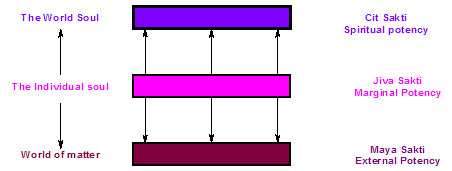
Sri Vaishnavism. Diagrammatic representation of Saktis (powers) of Bhagavan. Cit Sakti is His Supreme Consciousness. Jiva Sakti is the origin of the souls of human beings and other living things. See its declivity away from Cit Sakti. (Tatastha = one foot in the river and one foot on the bank of the river'; Not inclined to either party; One foot with Cit Sakti and one foot on Maya Sakti) Maya Sakti is the origin of the building blocks of the universe and the bodies of living beings and has the deluding power over Jivas in that they forget their connection with Cit Sakti and hold dearly to the material connection they have with Maya Sakti. Tatastha concept is very interesting and ingenious. Tatastha is keeping one tenuous foot in the river of Supreme Consciousness and one firm foot on the bank; the river is Cit Sakti and the bank is Maya Sakti. Eventually, the tenuous foot comes off from the river and joins the other foot in Maya Sakti; the connection with Cit Sakti is meager with a firm connection with Maya Sakti and the soul takes birth on earth in an embodied form derived from Maya Sakti. We are human beings here on earth because of our fragile union with Cit Sakti and attachment to Maya Sakti. We (our souls) have to find our way back to Jiva Sakti and stay firmly attached to Cit Sakti; that is Mukti, Moksa, liberation.

Woodroffe defines Cit as the Unchanging Principle of all Experience, the source and basis for Mind and Matter. All the finites such as the Mind and Matter repose ultimately in the Infinite Whole, that is Cit. It is Whole (Purna) and Spirit.
15.8:
When Isvarah enters and leaves a body, he takes all these (senses and
mind) and goes as the wind carries the fragrance from their place (flowers).
Avāpnoti: to reach, attain, obtain,
gain. Utkrāmati: to step out, to pass away. Āsaya: place, seat, bed, asylum
Read more on Vāsanās (fragrance),
Samskāras (impressions), and subtle body elsewhere.
When a person dies and placed on the funeral pyre (fire), the said person is reborn again from the fire as if the person was reborn of the parents; the fire consumes one's body leaving the subtle body alone which acquires the physical body in the reborn person.
15.9:
He experiences the sense objects (sound, vision, touch, taste, and
smell) by overseeing the ears, the eyes, the skin, the tongue, the nose, and
the mind.
15.10:
The ignorant do not see the “self” leaving the body, residing in the
body or enjoying the sense pleasures of the Gunas. Those who have the eye of
wisdom can see.
15.11:
The striving yogis can see it [the Self] established in themselves.
The imprudent, not established in the Self, though striving, do not see
this.
Acētasah: the imprudent
15.12:
The splendor coming from the sun illumines the whole world; that
which is in the moon and that which is also in the fire, know (Arjuna) that
splendor is Mine.
यदादित्यगतं तेजो जगद्भासयतेऽखिलम् ।
यच्चन्द्रमसि यच्चाग्नौ तत्तेजो विद्धि मामकम् ॥१५- १२॥
yad ādityagataṁ tejo jagad bhāsayatekhilam
yac candramasi yac cāgnau tat tejo viddhi māmakam 15.12
yat1
āditya-gatam2
tejaḥ3
jagat4
bhāsayate5
akhilam6
yat7
candramasi8
yat9
ca10
agnau11
tat12
tejaḥ13
viddhi14
māmakam15
15.12
tejaḥ3
= The
splendor;
yat1
= which is;
āditya-gatam2
= in the
sun;
bhāsayate5
= illumines;
akhilam6
= the whole;
jagat4
= world;
yat7
= that which
is;
candramasi8
= in the
moon;
ca10
= and;
yat9
= that which
is;
agnau11
= in the
fire;
viddhi14
= know;
tat12
= that;
tejaḥ13
= light; [is]
māmakam15
=
Mine. 15.12
|
View From The West. Indian Wisdom (By) Sir Monier Monier-Williams, KCIE (12 November 1819 – 11 April 1899) was the second Boden Professor of Sanskrit at Oxford University, England. Page 146. Yad āditya-gataṃ tejo yać ćandramasi tat tejo viddhi māmakam XV.12. Cf. Bible Rev. xxi.23, ‘The city had no need of the sun, neither of the moon, to shine in it: for the glory of God did lighten it. Note Entry Date July 10, 2015 |
Know that the splendor from the sun,
the moon, and the fire is Mine.
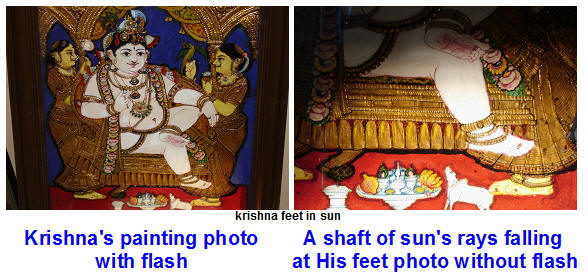
15.13:
I sustain all beings with My Power, entering earth. Becoming the
juice-giving moon, I nourish all the herbs (plants).
It is said that the plants
manufacture the sap under the influence of moonlight.
15.14:
Becoming the (digestive) fire in the bodies of all living creatures,
and moving with (ease and) equal balance in upward and downward breaths, I
digest foods of four kinds.
|
Katha Upanisad II.2.3. He leads the out-breath upward, he casts inwards the in-breath, the dwarf who is seated in the middle, all the gods adore. |
|
Originally prāṇa meant breath and was used for the Supreme Being. In the early Upaniṣads, all the vital powers (i.e., speech, breath, eye, ear and manas) are called prāṇaḥ. B U. I. 5. 3, T U. I.7. These are looked upon as varieties of breath or as powers presiding over different parts of the body. Prāṇa and apāna stand for breaths in expiration and inspiration respectively. |
|
Dwarf = the soul.The Principal Upanisads, Page 637. Dr. Radhakrishnan. Oct 26, 2013 |
Vaisvānara is Agni or fire and
represents the fire of digestion. Visva+nara means universal+man, belonging
or common to man. According to Kurma Purana, Book two chapter 6.16-17, the
fire-god, Vaisvānara digests the food eaten by day and night on the orders
of Isvara, the clinical manifestation of Brahman. (Now you know who provides
the fire in the belly.) Vaisvānara is the god who cooks the food by virtue
of the fact he is the fire-god and carries the oblations to the forefathers.
Becoming the digestive fire in the
bodies of all living creatures, and moving with ease in inspiration and
expiration, I digest all four varieties of foods. The food is classified
according to the modes of ingestion: licking food, sucking food, drinking
food, and chewing food. Here it a functional classification: Honey is a
“licking” food, hand-softened mango fruit with intact skin is a “sucking”
food, milk is a “drinking” food, and vegetable is a “chewing” food.
Both Vaisnavites and Saivites claim
that their Isvara (Narayana or Siva) is the Vaisvanara, the fire-god. Here
in this verse, Krishna (Narayana) claims to be Vaisvanara.
15.15: I am seated in
the hearts of all living beings. From Me come
the memory, the knowledge, and the removal. I am also
the knowable from the Vedas. I am the author of
the Vedas and the knower of Vedas.
Apōhanam: removal
Memory and knowledge in this
instance are not the usual faculties of the mind and the brain as the
scientists have taught us. Memory of mundane knowledge is not true memory.
Memory and knowledge of the “self” are what they are:
Memory is recollection of something known already; each soul carries
a memory of its origin and destination, which are the Lord’s Greater Soul
(World Soul). Think of your credit or debit card which carries data memory
in it. During its passage in the living bodies, the soul forgets its origin
(Self) because of its association with matter. As the association with
matter diminishes, the memory of the self increases. To restore this memory
of the self, man has to resort to karma yoga, jnāna yoga, bhakti yoga, or
Prapatti and Saranagati. Let me give you an instance by an allegory: The
genes that we inherit from our parents carry the memory of our skin and eye
color. The memory of the self is in many ways similar: our subtle body
carries that memory from birth to birth.
Knowledge of the self is discussed
elsewhere.
Here Apōhanam
means removal of doubt and faulty perception, which impede the progress of
the soul towards liberation.
Vedas are four and each has four qualities: Nityatvam, A-paurusheyatvam, Avichchinnaparam, and Anantatvam.
1) Nityatvam (eternal existence), Air in Bhagava's breath confers eternity to Vedas. It is indestructible. It has no script; it is all sound. 2) Apaurusheyatvam, Not created by any Being, not even gods. 3) Avichchinnaparam paraaha-tatvam (continual supreme pass-down Tattvam) It is passed down by word of mouth. 4) Anantatvam, endless principle. No body has mastered all the four Vedas and they will never be learned completely by any one.
Vēdānta is the concluding portions of Vedas or the end of Vedas, meaning that it contains the essence of Vedas in a cryptic form. Such cryptic statements are open to misinterpretation without the help of an Achārya, who is the torchbearer in removing the darkness to expose and expound the meaning of Vedanta. Vedanta is Paratatva, that needs shedding of light and interpretation. It is a dark cave, whose interior cannot be revealed without an Acharya, torchbearer, or leader. We cannot go past the mountain, let alone the cave. What is the object of our search in the cave? It is the lion or Vishnu.
Vishnu is VEdaVEththiyan. வேதவேத்தியன் = God as knowable through Vedas.
He is VEdAnta VEthyan = வேதாந்த வேத்யன் = essence of Vedas-One who is knowable.
Such a lion is Vishnu also known as Narasimha--the Man-Lion-- in the cave of Vedanta. He is the Parabrahmam. We look at a mountain and don't see the lion or have an idea of the cave or the lion, who is the resident of cave in the mountain, otherwise known as Antaryamin (Inner Guide). Vishnu lives in the cave of the heart in every one of us.
Let me give an example to illustrate Antaryamin. When you go to a Hall of Frames, you see just the frames from afar and not the portraits. When you get close to a frame, you don't see the frame but the portrait that comes alive before your eyes. In like manner, when you see matter (mountain), He (lion) is not seen; when you see Him (lion), you do not see matter (mountain).
Since He exists (Antaryamin) in all beings and matter (Cit and Acit), He is addressed as IT, THAT. It is not in any way derogatory to address Him such. People in different religions give names to IT or THAT in their own chosen nomenclature and language.
15.16:
There are these two (kinds of) Purushas (entities) in this world, the
perishable (Ksara) and the imperishable (Aksara). The Perishable are (the
bodies of all) living beings and it is said that the imperishable is the
Immutable (= Kutastha = Soul).
द्वाविमौ पुरुषौ लोके क्षरश्चाक्षर एव च ।
क्षरः सर्वाणि भूतानि कूटस्थोऽक्षर उच्यते ॥१५- १६॥
(SanskritLSU font)
dvāu imau
puruṣau
loke kṣaraḥ
ca akṣaraḥ
eva ca
kṣaraḥ
sarvāṇi
bhūtāni kūṭasthaḥ
akṣara
ucyate 15.16
Contextually, Purusa is a living entity with imperishable soul and perishable body. Kūtasthan (கூடஸ்தன்) is the immutable, imperishable or unchanging Self.
There are two living entities: Ksarah Sarvani bhutani (perishable beings of the world) and Kutostho 'ksara (the Eternal & Immutable). A living breathing person (and other beings) consists of Paramatman, Jivatman and body (Supreme Soul, individual soul and the physical body). Of these three, the former two are imperishable and the body is perishable. Paramatman is the Old Block and the Jivatmans are the chips off the Old Block. We are only chips (amsa-fragment) and not the whole; the latter does not diminish from chipping. We are sparks emanating from the Great Fire of Brahman. We are a blip or a spark and He is the Eternal Light and Fire. Paramatman remains in the spiritual heart as a witness. When the light of blip goes out, it merges with the Eternal Light. When the pure soul light leaves the body, it sheds all residual accretions, becomes the purest entity and goes to Vishnu's heaven. The unfortunate impure soul finds housing in another body for another round of Samsara--worldly life. The pure soul is not different from the Soul of God. Light water is chemically same as heavy water; thus, chemistry of individual soul and Great Soul are same but functions are different. We as pure souls in Vishnu's heaven cannot create, maintain, destroy or contain the universe during Pralaya (the Great Deluge). They are the exclusive functions of Bhagavan.
ThAkura says that Paramatman is a complete spiritual entity or substance (Purna-CidVastu); Jivas are small particles (amsa) of spirit (Cit kana). kana = alpa = small. Jiva is located in the no man's land or border line between spirit and matter. There are oppositional forces pulling the Jiva: Cit Sakti and Maya, Cit Sakti towards Krishna and Maya Sakti to the world of matter. Forgetfulness of Krishna (that we are soul and not body) gives that little push towards the gravitational forces of Maya. When Jiva gravitates towards Maya, it takes on the qualities of Maya and proportionally spirit wanes. Maya imparts three qualities to matter and Jiva: Sattva, Rajas and Tamas (Virtue, passion, darkness). One has to remember that Cit Sakti and Maya Sakti emanate from Krishna, Cit being salubrious and Maya being injurious. Why so? Because He is in charge of all forces in this universe. Krishna is like the sun and the Jiva is a photon, dependant on the sun. No sun, no photon. Paramatman = Supreme Soul, God; Jiva = Individual souls, we the people;
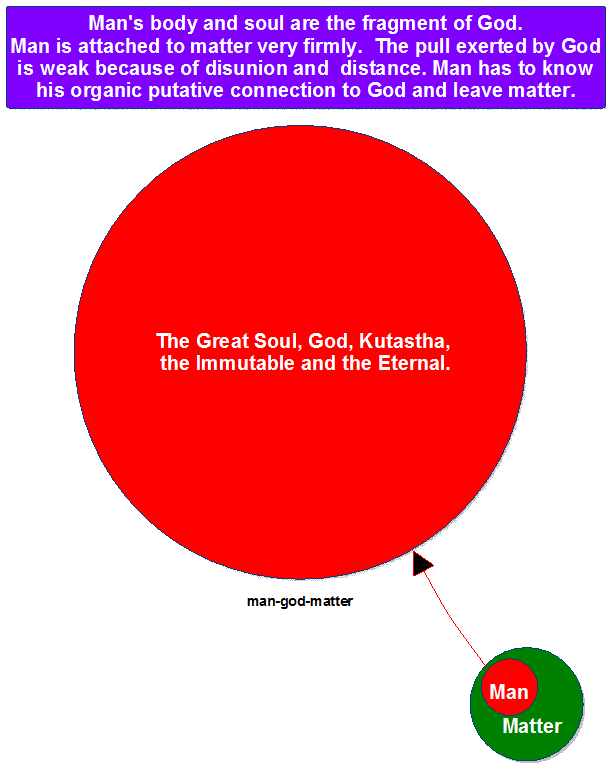
The Jiva, forgetting Krishna, wanders in the worlds sometimes as a Brahmana, a Sudra, a Vaishya, a Ksatriya, an insect, a worm, an amoeba; sometimes happy; sometimes distressed; sometimes on earth or in hell; sometimes a Deva or a demon; and sometimes a servant or a master. Fortuitously, if Jiva comes into contact with a Bhakta (devotee, BhAgavata), it realizes its true identity and the long unfortunate service to Maya, grieves for his present condition and laments the long fruitless association with Maya. Jiva begs for mercy from Krishna, the Ocean of Mercy, who quickly whisks him off from the world of Maya. Krishna infuses Cit Sakti into the Jiva, by promoting association with the Bhaktas, Prapatti and Saranagati and participation in chanting Krishna Nama; the influence of Maya wanes with firmly established Cit Sakti. This is the recipe for crossing the material world of Maya into the world of Krishna and Cit Sakti.
Notes: Maya is not a palpable entity in its original state. It is an energy of Bhagavan who sets in motion the forces that makes Maya become the body. Let me give you an example. The humidity in the air is not something you can see. It takes condensation to change humidity into water, cloud, and fog and precipitation to see it as rain, snow or hail.
Who are these two Purushas?
According to Panchadasi (Chapter 7), Pure Consciousness, that is God, looks in a mirror and sees its image (which is called) Cidabhasa. This image has no real life or existence without the Pure Consciousness. The mirror is Maya, illusory energy of the Lord, which is the causal agent of the universe. Kashmir Saivism claims that the mirror is Sakti of Siva. The image carries an aura of reflected glory. When the adjuncts of adventitious nature are removed, such as the mirror, the only remaining entity is the eternal Consciousness or Kūtastha. Kūtastha = immovable, immutable, occupying the highest place. Cid-abhasa = Cid + Âbhâsa = Intelligence, Consciousness + luster, apparition, phantom = reflected intelligence or consciousness. That Kutastha is our substratum and we are the Cidabhasa. Cidabhasa is an illusion with no substance. Cidabhasa apparition does not exist without Kutastha Consciousness; therefore, the illusion has a basis in Kutastha which is Brahman. Cidabhasa is false or a pretender from the transcendental point of view and not from empirical stance. In empirical world, Cidabhasa is a palpable living entity (people). The bottom line is that Cidabhasa is Brahman with limitations (Upadhi), such as Avidya (ignorance). Here it is spiritual ignorance meaning that Cidabhasa apparition does not identify with Brahman-Kutastha Consciousness but with the body that houses the individual soul. Most of our lives are spent in the upkeep of our body, mind, and matter and not the soul, whose origin is Brahman-Kutastha Consciousness or Soul. We have doctors to tend and mend our body and mind but there is no one to tend to our soul.
Anything that is changeable (Kshara) has no permanence. The soul (Akshara) is eternal and immutable.
Here is what Ramanuja says about the two Purushas.
Ksara purusha is man (his body) and refers to beings from Brahma to a blade of grass associated with unconscious matter; Aksara Kutastha is the aggregate of all released souls devoid of matter. These souls have attained My State (Bhagavan's) and are free from birth at the time of creation and suffering at the time of dissolution. The gods, man and beings are the perishable ones because of contact with matter. They, when divested of their body and matter upon release, become the Higher Imperishable Being in the state of Bhagavan. Both Purushas are earthly beings at the beginning, one bound to earth and another released from bondage. All released souls attain Paramapadam (Supreme Abode) and exist in oneness with the Lord.
Let us see what Sankara has to say on this important verse.
He agrees on the Immutable God and the mutable persons of the world. Ramanuja's Cit (individual sentient soul) is the other mutable person, who emanates from the body of the manifest Brahman. He says that we are all sparks coming off from the Fire of Brahman. Sankara's mutable person originates from Maya of manifest Brahman. Maya is not the body of Brahman but the power of God. This Maya morphs into Tattvas (building blocks) which make this universe and beings. Sankara says sarvāni bhūtāni are all things, the aggregate of all mutable things, matter and beings. Kūtastha is Brahman; Maya is a heap of diverse things and the Maker of Maya (objects); diversity is the Immutable Kutastha. (Yes, He is immutable and yet He becomes many; that is His inconceivable power.) How could Immutable Kutastha or Cit Sakti show diversity? An apparent oxymoron. The following explains this apparent paradox.
Sakti-Saktiman Abheda = Sakti-Purusa-Abheda = Power-owner of Power- non-difference: Non-difference between Bhagavan and His power. Saktiman Purusa has the Sakti; he has the Will to exercise the power; thus, sakti and Saktiman Purusa are non-different. Rich man and his riches are non-different. His Para Tattva (Cit Sakti) is immutable (Nirvikara); His Maya Sakti undergoes mutation, transformation, evolution in the world of matter and objects expressing the Will and Lila (pastimes) of Bhagavan. This transformational quality (Vikara) of Hari is a manifestation of His Prema (love and affection). Commentators say that Maya Sakti is a shadow of Cit Sakti- Supreme Consciousness of Bhagavan; thus the variegated material world is a shadow or reflection (Pratibimba) of Cit Sakti.
Saktiman is the immutable substance. His shadow goes wherever He goes. He is the world; He is the universe. The shadow has many configurations, many directions, many sizes, many inclinations, many distortions, many shades and modes and yet Saktiman is immutable.
Vaishnavas love to illustrate the existence of the all-pervasive Vishnu in inanimate things and His emergence as Man-Lion from inside a palace pillar in a demolition derby fashion to protect, serve, and save his devotee Prahalada and kill his father, the poster boy for torture of his own son because Prahalada told his father that His God was everywhere and in the palace pillar too. That was the story of Narasimha Avataram (the Man-Lion Divine Chimera).
15.17: He pervades and sustains the three worlds and is known as the Imperishable, the Supreme Controller (Isvara). Uttama Purusa is different (from the Ksara and Aksara Purusas).
This Supreme person (Uttaman)
is different from the Ksara and Aksara, mentioned in verse 16.
He (Vishnu) is the all-Pervader and sustainer of this universe.
Uttama Purusa:
Uttama = excellent, eminent, superior, most elevated, Highest,
uppermost.
Highest person;
Paramātma: Supreme Self;
Isvara: Controller and the Lord, God of
gods;
Anyah: is different.
Who is this Uttama Purusa? He is the one who reached the Highest Place, Parmapadam, Vishnu's heaven by ascending the nine steps. He obtains release from the world of Samsara, goes to Paramapadam and lives in the company of Nityasuris and Vishnu. The Prapannan (devotee par excellence) having entered the gates of Vaikuntham (Paramapadam) becomes the Uttaman in heaven.
There are three entities here: Aksara Purusa (Vishnu), Ksara Purusa (the mutable SamsAri) and Uttaman. Uttaman lives in the company of Vishnu and Nityasuris. He serves at the feet of Vishnu.
15.18:
Because I go beyond the perishable and higher than the Imperishable
and supreme, I am renowned in the world and in the Vedas as
Purushottama (Supreme Person).
The Lord is above the perishable bodies and higher than Atma itself. He is the Supreme Person in the Vedas and the universe. It also means that ontologically, He is the highest; the next entity is Aksram followed by Avyaktam (Imperishable and Unmainfest).
What sets the Supreme Person above everybody else?
Man, male and female Devatas, Brahma, Siva, Narayana share many qualities. Krishna has qualities that are exclusive to Him. There are a total of 64 qualities of which the first fifty are in unlimited quantity in Bhagavan, and graded quantity in other gods and deities; man has them in limited quantity. Qualities from 51 to 55 are in unlimited quantity in Bhagavan Krishna and are deemed special to Brahma, Siva and other gods and goddesses. Listed between 56 to 60, Narayana has still higher qualities which are not shared by the preceding entities. Qualities listed between 61 to 64 are the exclusive domain of Bhagavan Krishna, the Supreme Person. This is a modified list as depicted in Jaiva Dharma, Chapter 13.
Qualities of individual souls, deities, Brahma, Siva and Bhagavan
Qualities of Bhagavan include all 64 of them.
1) Beautiful limbs; 2) All- auspicious qualities; 3) Beauty; 4) Radiance; 5) Strength; 6) Eternal youth; 7) Linguist; 8) Truth Sayer; 9) pleasing speaker; 10) eloquence; 11) Intelligent; 12) Learned; 13) good conversationalist; 14) connoisseur; 15) clever and dexterous; 16) Expert; 17) Gratitude; 18) Keeper of vows; 19) Knowledge of place, time and circumstance; 20) Seer through Sastric eyes; 21) Purity; 22) Self-control; 23) steadfast; 24) forbearance; 25) forgiveness; 26) Inscrutability; 27) Forgiveness; 28) equipoise; 29) Munificence 30) Dharma; 31) Chivalry; 32) Compassion; 33) respectful; 34) Amicability; 35) Modesty; 36) Shyness; 37) Saranagata Raksaka- Surrender-protector 38) Happiness; 39) protector of devotees; 40) Controlled by Prema (love) of devotees; 41) Benefactor of all; 42) Tormentor of enemies; 43) Fame; 44) Beloved by all; 45) Partiality to Sadhus; 46) Enchanter of women's mind; 47) Worthy of worship by all; 48) All opulence; 49) Superior to all; 50) The Controller.
All these above qualities are in unlimited quantity in Bhagavan and in a limited quantity in Jivas, Individual souls.
Five qualities are in Brahma, Siva and other Deities.
51) One's own divine form (Svarupa);
52) Omniscience;
53) Eternal Youth;
54) Being, Knowledge and Bliss (SatCitAnanda);
55) Possessor of all Siddhis (special powers like levitation, omnipresence etc;
The above 55 qualities are present in lesser amounts in Deities.
Lakshmipati Narayana has the following additional exclusive qualities.
56) Inconceivable great qualities and powers;
57) Myriad universes abide within His Body;
58) He is Bija or seed of all Avatars;
59) Giver of higher destination to those He killed;
60) Enchanter of the ones who attained the Delight of their souls.
The following qualities (61-64) are in the exclusive domain of Sri Krishna not present in anyone other than HIM.
61) He is like the vast ocean with incessant waves of wonderful Lilas;
62) His adoration is Madhurya Prema (Sweet love and affection) showered by His devotees;
63) He enchants the three worlds with inimitable sounds of His flute;
64) The resplendent beauty of His transcendental form is enchanting to all mobiles and immobile forms.
In Srivaishnavism, number 8 and its multiples are auspicious. Thus 8X8 = 64 is auspicious.
15.19: He, who is
undeluded, knows Me as the Supreme Person, knows everything, and worships Me
with his heart and soul, O son of Bharata.
Sarvabhāvena: Whole-heartedly, heart and soul. Complete satisfaction.
15.20:
O sinless one, I have explained thus the most secret doctrine.
Knowing thus, one becomes the enlightened and would have done his duty well,
Bharata.
End BG Chapter Fifteen: The Supreme Person